


The Omega Genève 136.041 represents a critical inflection point in the brand’s design evolution: a manual-wind dress watch from 1967–1972 that borrowed tonneau case geometry from Omega’s experimental portfolio (notably the Speedmaster Mark II and Alaska Project prototypes) and applied it to an understated, refined daily wear timepiece. What initially appeared as an obscure reference within Omega’s voluminous catalog has, in recent years, become recognized among collectors as one of the most undervalued manual-wind Omega offerings of the late 1960s.
The 136.041 was conceived at a moment when Omega was simultaneously investing in bold innovation (the Speedmaster Mark II chronograph, the Chronostop, diving instruments) while maintaining traditional dress watch aesthetics. The tonneau case was not accidental but rather a deliberate design decision: the elongated barrel shape provided ergonomic advantages, a contemporary aesthetic aligned with space-age minimalism, and visual differentiation from round-cased dress watches. Housed within the modest 34–35mm case was the caliber 613 movement, Omega’s manual-wind equivalent to the celebrated caliber 565 automatic. This pairing created a watch with reliability, restrained styling, and mechanical integrity that demanded no justification beyond its own engineering merit.
The 136.041 entered production in 1967 and remained in the catalog through approximately 1972, with production concentrated between 1967 and 1970. Serial number evidence suggests approximately 50,000 to 100,000+ examples were manufactured during this five-year span, making the reference common by collector standards. This abundance has preserved many examples in original condition; fewer aggressive polishes, fewer unnecessary movements, fewer restoration decisions made simply because the watch seemed expendable. The reference is classified as common in the vintage market, though specific dial variants (blue, black, tropical) command moderate premiums.
In the contemporary collector market (2025–2026), the 136.041 occupies a position of growing appreciation without speculative fervor. The watch commands stable value with modest annual appreciation, increasing recognition among collectors seeking entry-level vintage Omegas with mechanical credibility. Unpolished examples with original dials and intact case geometry command 15–25% premiums over polished equivalents. Blue or tropical dials attract international collector attention and command 20–40% premiums over standard silver/grey variants. Examples with complete original paperwork or boxes are exceptionally rare and may achieve 30–50% premiums, though such pieces appear in the market only sporadically. The reference is sometimes informally called the “TV case Genève” by enthusiasts, though this nickname holds no factory significance.
HISTORICAL CONTEXT, PROVENANCE, AND MANUFACTURING DETAILS
Omega launched the 136.041 in 1967 during a period of unprecedented design experimentation. This was the era of the Speedmaster Mark II’s tonneau case introduction, the Chronostop’s cam-driven mechanism, and the ongoing Alaska Project, Omega’s titanium prototype chronograph designed to withstand extreme thermal and environmental conditions. The case designers working with Omega drew inspiration from these advanced projects but applied tonneau geometry to the Genève line as a commercially viable alternative to traditional round dress watch cases.
The reference addressed a specific market need: collectors and professionals seeking a refined, contemporary dress watch with understated styling, mechanical reliability, and visual distinction. Round cases dominated the dress watch category; the tonneau offered a middle aesthetic between conservative tradition and the emerging sportiness of chronographs and divers. Manufacturing partners including La Centrale Boîtes—Omega’s principal case supplier during this era—engineered the tonneau case to achieve tight tolerances while maintaining cost-effective production volumes.
Development history reveals that the 136.041 was not a technical breakthrough but rather a disciplined evolution. The caliber 613 movement had been introduced in 1967 (producing examples from 1967–1974), derived directly from Omega’s 600-series family. By pairing this proven movement with the new tonneau case geometry, Omega achieved efficient product development: minimal movement engineering risk, established case suppliers, and refined dial language borrowed from existing Genève models.
The 136.041 succeeded earlier round-cased Genève manual-wind models (such as the 135.041 with caliber 601) and eventually yielded to later iterations including the 136.0049 (a refined tonneau variant with marginally adjusted lug width and case proportions) and the automatic 166.041 (using the caliber 565 automatic). By the early 1970s, as quartz technology accelerated and Omega shifted manufacturing priorities, the 136.041 phased out of active production. This timing—precisely when manual mechanical dress watches were declining commercially—ironically preserved the reference’s appeal among modern collectors.
In broader horological context, the 136.041 marked the twilight of a design philosophy: refined mechanical watches developed without electronic assistance, marketed without speculative narrative, and engineered to serve practical timekeeping needs. The tonneau case, controversial at introduction, became recognized retrospectively as an avatar of 1960s-1970s design sensibility. Unlike the Speedmaster Mark II (a chronograph with kinetic appeal), or the Alaska Project (an experimental prototype), the 136.041 remained in modest production, its understated character ensuring that collectors overlooked it until recent years.
CONSTRUCTION AND ARCHITECTURE
The 136.041’s tonneau case is engineered geometry: width of 34–35mm (measured excluding the crown), 40–40.5mm lug-to-lug span, 18mm lug width, and thickness approximating 10–12mm. The proportions are deliberately flattened compared to traditional round dress cases, creating a silhouette informally described as barrel or television-shaped—hence the casual “TV case” moniker among vintage watch enthusiasts. The case sides taper inward slightly, contributing to the elongated profile.
Case Finish and Architecture:
The upper surface (bezel area) features a radial or linear satin brush finish, applied directionally to create matte visual texture. This brushing is NOT polished; it represents Omega’s intentional original finish. The case sides—flanking the central band—are polished steel, creating a deliberate contrast between matte upper surfaces and reflective side facets. This “sandwich” effect (matte top, polished flanks) is characteristic of Omega’s 1960s-1970s case finishing philosophy and is immediately recognizable to collectors familiar with period Seamasters and Constellations. The beveled edge between satin and polished surfaces is crisp on unpolished examples and represents a primary authentication marker.
Case Back and Crown:
The screw-down case back is signed internally with “136.041,” material designation (e.g., “Acier Inoxydable” for stainless steel), “Swiss Made,” and the Omega triangle hallmark. Cases with missing, unclear, or incorrectly engraved case backs warrant closer examination for authenticity. The crown is small, knurled, and signed “Omega.” It is unguarded (no crown protectors), consistent with dress watch convention. The crown operates in three positions: crown pushed in (watch running), pulled once (time setting), pulled twice (date quickset). The quickset mechanism is among the caliber 613’s most valued features, enabling date advancement through repeated crown manipulation without moving the hour/minute hands.
Crystal:
Original examples feature acrylic (Omega’s proprietary term: hesalite; industry term: plexiglass) crystals secured by tension rings. Hesalite scratches easily but is inherently more shatter-resistant than mineral glass—a design choice favored by NASA for the Speedmaster Professional. Identifying original crystals is essential: genuine Omega hesalite crystals carry the Omega triangle logo laser-etched at the center top of the crystal; the symbol’s feet point downward on originals. Later replacement crystals—even genuine Omega replacements—often feature curled feet on the logo or lack the logo entirely. Original crystals accumulate surface scratching over decades; this is expected and cosmetically acceptable to collectors, often preferred as evidence of authenticity.
Dial:
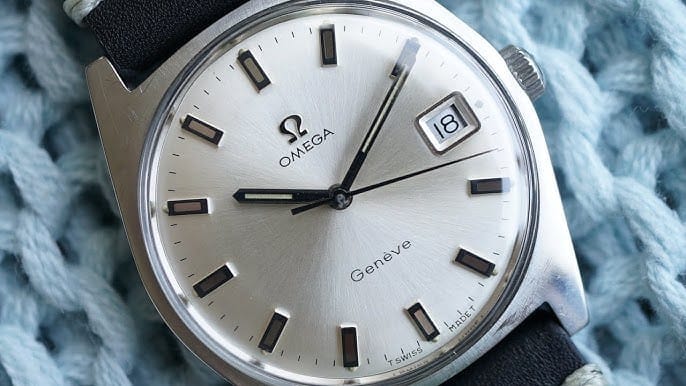
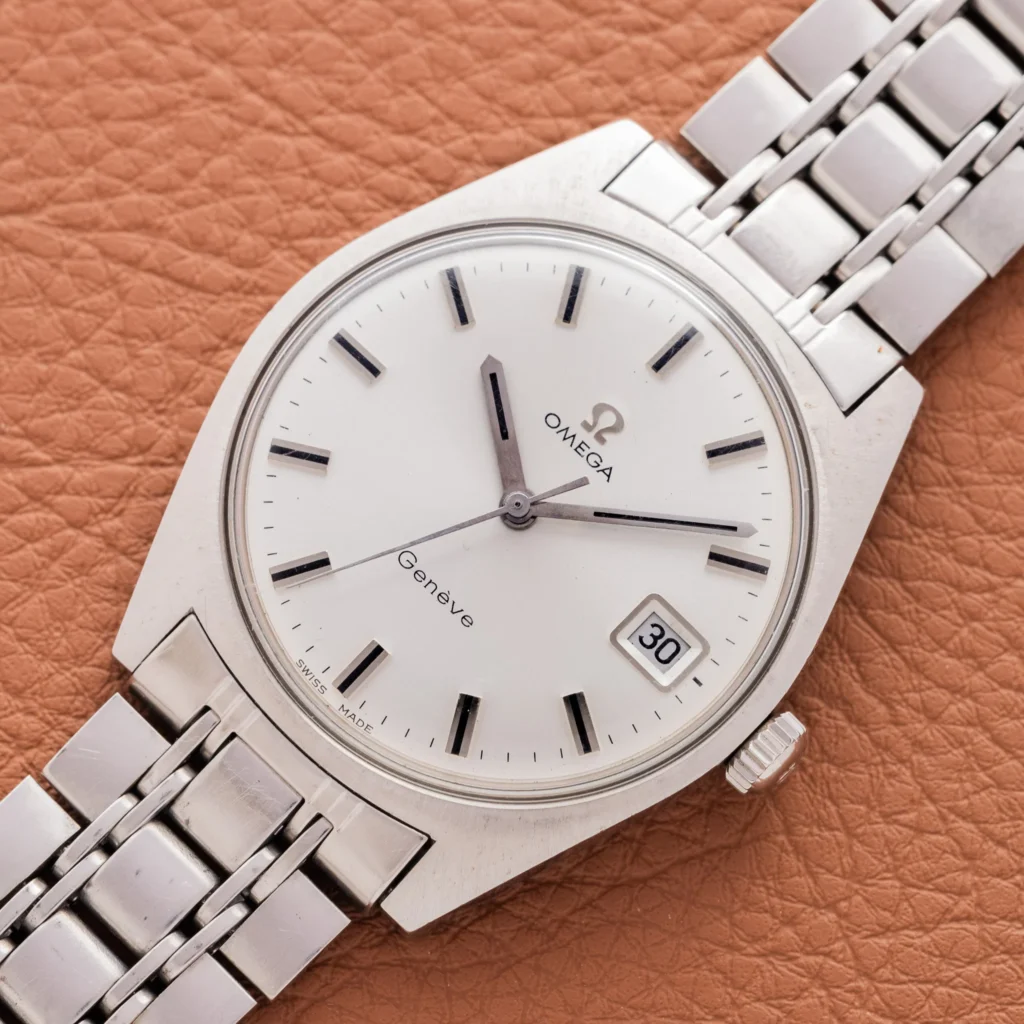
The dial employs applied construction: Omega logo and “Genève” inscription are metal applications, not printed. Hour markers are applied baton indexes with black lacquer or onyx inserts at the center; these too are separate applied pieces, not printed elements. The dial surface exhibits radial or linear satin finishing, presenting brushed rather than mirror-polished appearance. Common dial colors include silver (sunburst or linear), grey/slate, and blue (sunburst or solid). Gold or champagne dials appear on gold-cased examples. Tropical dials—where original silver or grey lacquer has aged to chocolate, coffee, or tan tones due to UV exposure—are documented and highly sought. The date aperture at 3 o’clock is framed with subtle border lines and typography. Hands are baton-shaped, typically with black lacquer or enamel centers on the hour and minute hands; the central seconds hand is solid metal, often orange or contrasting color. Luminescent material (tritium on all production pieces; a few earliest 1967 examples may retain residual radium) is applied to hand surfaces and dial marker dots.
Hands:
Original hands are baton-shaped with specific characteristics: hour and minute hands feature black enamel or lacquer inserts at the base; the central seconds hand is typically solid metal in contrasting color (orange, gold, white). Luminescent material on original hands exhibits natural patina—browning or subtle darkening of the lume—that correlates with tritium’s natural decay (tritium has a 12-year half-life; by 50+ years post-production, original lume appears aged, not bright). Hands showing uniformly bright green lume, excessive brightness, or unusually pristine appearance likely indicate service replacement with modern Luminova rather than period-correct tritium.
Case Materials and Finishes:
The 136.041 was offered in three material configurations: stainless steel (primary and vastly most common), solid 18-karat yellow gold (documented but scarce; 10–15 examples known), and gold-plated steel (also documented; less desirable than solid gold but more attractive than base steel to some collectors). Gold-plated examples typically carry 20-micron plating and paired with champagne or gold dials. After 50+ years, plating wears through at lugs and case edges, revealing underlying steel; this is cosmetically acceptable but acknowledged in fair-condition examples. Solid gold 136.041 examples are rare enough that each documented instance enters collector conversation; these command significant premiums (typically 40–80% above steel equivalents).
Bracelet and Strap Offerings:
Original factory bracelets for the 136.041 are extraordinarily scarce. When documented, they are typically three-link riveted steel bracelets (such as the 1156 variant) or stainless steel Fixo-Flex expandable bracelets. The 1156 bracelet is compatible with the 18mm lug width. Fixo-Flex bracelets, while uncomfortable for modern wearers (prone to dirt accumulation), represent desirable original accessories and command premiums when intact. Most 136.041 examples in the secondary market have been restrapped multiple times over decades; original leather or fabric straps rarely survive. This is expected and not problematic; the 18mm lug width ensures compatibility with modern aftermarket straps in leather, fabric, and steel.
Case Subreferences and Variants
The 136.041 nomenclature includes minor variations reflecting manufacturing refinement over its production lifespan:
| Reference | Case Width | Lug Width | Caliber | Production Span | Case Maker | Notes |
|---|---|---|---|---|---|---|
| 136.041 | 34–35mm | 18mm | Cal. 613 | 1967–1972 | Multiple (La Centrale Boîtes confirmed) | Original tonneau variant; standard production |
| 136.0049 | 35mm | 19mm | Cal. 613 | 1969–1972 | Multiple | Refined tonneau variant; slightly increased lug width and case thickness; later production |
| 166.041 | 34–35mm | 18mm | Cal. 565 (auto) | 1968–1970 | Multiple | Automatic tonneau Genève; separate reference family |
The 136.0049 represents a manufacturing evolution of the 136.041: same movement (caliber 613), same tonneau geometry, but with marginal proportional refinements. Both references remain functionally and aesthetically near-identical from a collector’s perspective; the distinction matters primarily to specialists tracking case evolution. The 136.0049 is slightly less common than the 136.041 in the secondary market and may command a modest 5–10% premium due to perceived rarity.
The automatic counterpart, reference 166.041, represents a parallel production line: identical case to the 136.041, but powered by the caliber 565 automatic movement. The 166.041 is frequently confused with the 136.041 at initial glance; the dial typically bears “Automatic” text, and listening to the movement immediately distinguishes automatic rotor noise from manual wind silence. The 166.041 is documented but less common than the manual 136.041; the caliber 565’s revered status among collectors commands premiums for 166.041 examples, typically 10–20% above manual equivalents.
MOVEMENTS AND CALIBERS
The 136.041 was exclusively powered by the Omega caliber 613, a manual-wind movement introduced in 1967 and produced through 1974.
Caliber 613 Specifications:
- Type: Manual winding, lever escapement, three-hand movement with center seconds and date
- Jewel Count: 17
- Frequency: 19,800 vibrations per hour (BPH), approximately 2.75 Hz
- Power Reserve: 48–50 hours when fully wound and functioning optimally
- Balance: Mono-metallic annular balance wheel, beryllium-bronze alloy
- Shock Protection: Incabloc shock absorber system
- Regulator: Excenter (eccentric) regulator with fine-tuning capability
- Date Function: Quick-set date via crown pull-and-push mechanism; continuous date wheel advances between 23:00 and 00:30 each day
- Escapement: Pallet lever escapement
- Movement Finish: Red-toned movement finish from brass composition and specific case manufacturing processes; visible through screw-down case back
Design Rationale and Derivation:
The caliber 613 was developed as the manual-wind equivalent to Omega’s acclaimed caliber 565 automatic. Both movements share foundational design principles, frequency (19,800 BPH), and jewel count (613 has 17 jewels; 565 has 24 jewels, the extras driving the automatic rotor system). By eliminating the automatic winding rotor and associated complications, the 613 achieves inherent mechanical simplicity and reliability superior to its automatic counterpart in specific conditions: fewer moving parts, fewer points of mechanical failure, lower wear on pivot points and escapement components from reduced operating complexity.
The 613 is renowned among watch service professionals for robust, straightforward design. The movement contains no exotic materials, no chronograph cam mechanisms, no complicated date jumping systems. This simplicity translates directly to longevity and service affordability—a 613 service typically costs less than a 565 or automatic equivalent, and replacement parts remain readily available decades after production ceased.
Movement Serial Numbers and Dating:
Movement serial numbers on 136.041 examples typically fall within the broader caliber 613 production range (1967–1974). Specific 136.041 movements most commonly carry serial numbers in the 25xxxxxx to 31xxxxxx range (corresponding to 1967–1972 production, per Omega serial numbering conventions). Dating a 136.041 requires cross-referencing the movement serial number with established Omega serial number tables; serial numbers beginning with 25, 26, 27, or 28 indicate production between 1967–1971, while 31xxxxxx denotes 1972 production.
Quick-Set Date Mechanism:
The quickset date function is mechanically elegant and functionally superior to manual date changes via hour hand rotation. To execute quickset: (1) Pull crown to second position (past time-setting position); (2) Repeatedly pull crown outward and push inward; (3) Date wheel advances one day per pull-push cycle; (4) Push crown fully in to resume normal operation. This mechanism is robust but requires periodic maintenance—the internal lever and spring must remain properly lubricated or can develop stiffness or sluggish response. Watchmakers caution against using quickset during the window between 22:00 and 02:00 (approximately), when the date jumping mechanism is actively engaged; operating quickset during this window risks jamming the mechanism or even breaking internal levers.
Movement Production Variants:
All authentic 136.041 examples must carry caliber 613 movements. Earlier Genève models (pre-1967) employed caliber 601 (no date function) or were date-equipped with different movements; the presence of a non-613 movement is an immediate red flag for authenticity. All 136.041 movement serial numbers should fall within the 1967–1972 production range consistent with the watch reference’s lifespan. Movement numbers in the pre-1967 range (below 25000000) or post-1974 range (above 32000000) warrant verification, as the watch may be a mismatched assembly or require documentation review.
Visual Movement Markers:
The 613 movement is visually distinctive when viewed through the screw-down case back. Key identification markers include: red-toned movement finish (a characteristic result of brass composition and Omega manufacturing practices); four-arm annular balance wheel; three-wheel train architecture; gear cock assembly housing the escapement, fourth wheel, and third wheel; central seconds mechanism (indirect drive via dedicated gear cock); Omega signature on main plate; and “613” marking clearly visible on movement. The 613 visual profile is similar to the caliber 565 but lacks the automatic rotor visible on automatic examples; spotting the difference requires careful observation of the movement architecture.
IDENTIFYING ORIGINAL VS. REPLACED PARTS
Distinguishing original components from service replacements is essential for valuation and authenticity assessment. The 136.041, given its five-decade age and readily available service history, presents numerous opportunities for part substitution.
Original Dials: Authentication Markers
Correct original dials exhibit these characteristics:
- Applied Omega logo (metal cap with Ω symbol) and “Genève” inscription in cursive, applied as separate metal pieces
- Dial surface is satin-finished with either linear or radial brushing in silver, grey, blue, or champagne
- Applied baton hour markers with distinct onyx or black lacquer inserts; applied as separate pieces, not printed
- Date window frame at 3 o’clock with subtle border and typography
- Dial text (e.g., “SWISS MADE,” “T SWISS T,” “GENÈVE”) exhibits period-correct typography and placement
- Luminescent material visible on hand support dots or bars above baton markers; material appears aged (creamy yellow or tan) if tritium, NOT uniformly bright green
- Patina consistent across dial surface; any aging appears uniform, not in patches or concentrated areas
- Tropical dials (if applicable) show even, symmetric fading from silver/grey to chocolate/brown tones without sharp demarcation lines
Red Flags for Service/Replacement Dials:
- Printed Omega logo or “Genève” text instead of applied metal pieces
- Mirror polished or glossy dial surface inconsistent with period satin finishing
- Marker placement or count inconsistent with known originals for that period
- Dial color mismatched with case material (e.g., champagne dial on stainless steel case)
- Uneven or patchy lume appearance, indicating partial re-luming or mixed original/replaced components
- Modern lume designation markings (e.g., “SWISS MADE C.O.S.C.” in unusual typography) inconsistent with 1967–1972 production standards
- Dial thickness or material visibly different from contemporaneous examples
- Evidence of refinishing (spray paint overspray, uneven lacquer, modern finish techniques)
Correct Hands:
Original hands carry specific characteristics:
- Baton shape with balanced proportions (neither oversized nor attenuated)
- Central seconds hand in contrasting color—typically orange, gold, or white; solid metal construction
- Hour and minute hands with black enamel or lacquer inserts at base; inserts are distinct color contrasting with metal
- Luminescent material applied to hand surfaces, appearing aged (creamy, tan, or butterscotch colored if tritium); NOT uniformly bright green
- Even, natural patina on lume; browning or subtle discoloration is authenticity marker
- Hand thickness and weight appropriate to 1960s-1970s construction standards
Service Replacement Hands: Identifiers:
- Modern lume appearing too bright, overly uniform green (indicates Luminova or similar modern compounds)
- Hands with oversized lume plots or coverage inconsistent with original design intent
- Hands lacking enamel inserts at base
- Thin or overly slender hand proportions inconsistent with period originals
- Pristine lume showing no age-related darkening (lume should never appear uniformly perfect after 50 years)
Crown Authenticity:
- Original Omega-signed crowns carry “Omega” clearly engraved on top face
- Proper knurling pattern consistent with 1960s-1970s production
- Correct functional engagement with movement stem; smooth operation without grinding or resistance
- No stripped or damaged threads; crown should wind smoothly and engage precisely
Service replacement crowns may lack Omega marking, carry generic third-party branding, or show evidence of sloppy stem engagement.
Crystal Assessment:
Original Omega hesalite crystals feature:
- Omega triangle logo laser-etched at center top; logo feet point downward (NOT curled upward)
- Significant accumulated scratching over 50+ years; this is normal and expected
- Possible slight hazing or internal fogging from age-related material degradation
- Original date lens may show subtle hazing or interior dust; replacement lenses are typically optically clearer
Later replacement crystals show:
- Logo missing entirely, OR logo with curled feet (indicates post-original replacement)
- Uniformly fine scratching pattern inconsistent with genuine 50-year aging
- Pristine optical clarity (replacement crystals lack internal patina)
Case Proportions and Polishing Concerns:
Original Unpolished Cases Retain:
- Sharp lug edges without rounding
- Visible radial or linear brushing on upper surface with distinct directional texture
- Crisp, defined beveled edges between satin upper surface and polished side facets
- Original case measurements consistent with factory specifications (34–35mm width; 40–40.5mm lug-to-lug)
- Proportionate lugs without evidence of case material removal or re-profiling
Over-Polished Cases Exhibit:
- Soft, rounded lug edges from material removal during aggressive polishing
- Diminished or obliterated brushing pattern on upper surface
- Blended edges; satin and polished surfaces merge without crisp separation
- Case measurements reduced by 0.5–1.5mm from factory original due to aggressive material removal
- Loss of defined case geometry; case appears “shrunk” or re-proportioned
Collectors strongly prefer unpolished cases, rewarding them with 15–25% premiums. Evidence of severe polishing reduces value comparably.
Bracelet Authenticity Markers:
Original factory bracelets are vanishingly rare. When present:
- Riveted three-link steel bracelets (or Fixo-Flex expandable types) with evidence of period manufacturing
- Consistent patina across all links; uneven finish suggests partial replacement
- Correct clasp style (simple pin or fold-over designs typical of 1960s-1970s)
- Proper end-link fit without visible gaps
- Omega marking on clasp or links (if present)
Aftermarket or service bracelets typically show:
- Screw-and-pin construction inconsistent with original riveted design
- Overly shiny or inconsistent finish across links
- Poor end-link fit with visible side gaps
- Modern clasp mechanisms with safety features beyond original design standards
Most 136.041 examples wear aftermarket straps or non-original bracelets; this is expected and not problematic to most collectors.
MOVEMENTS AND CALIBERS (DETAILED)
Additional details on the caliber 613 worth understanding:
Maintenance and Service Expectations:
The 613 typically requires complete service (disassembly, cleaning, reassembly, lubrication, regulation) every 5–7 years depending on wear. Service costs through independent watchmakers typically range €300–€400 (approximately $330–$440 USD), substantially less than automatic or chronograph equivalents. Official Omega service centers charge approximately $550–$700 for vintage movements, though pricing varies by location and service complexity.
Accuracy Standards:
Post-service, a 613 should regulate to approximately -4 to +6 seconds per day when functioning optimally, consistent with COSC chronometer standards. Many examples perform better than this specification; well-regulated 613 examples commonly achieve -2 to +2 seconds per day. Pre-service accuracy varies; a 136.041 that has not been serviced in decades may run 20–30 seconds slow per day or faster, depending on mainspring condition and wear.
Reliability and Longevity:
The 613 is celebrated among service professionals for inherent robustness. The absence of an automatic rotor system eliminates common failure modes (rotor wear, automatic gear breakage, mainspring over-wind damage). The manual wind mechanism is simple and durable. Many 136.041 examples remain functional with minimal service, a testament to Omega’s engineering discipline and the 613’s enduring mechanical soundness. Examples with original movements unserviced for 20–30 years may still function after a single professional service, emerging as reliable daily wearers.
COLLECTOR NOTES AND MARKET CONTEXT
Current Market Positioning (January 2026):
The 136.041 occupies a stable, modestly appreciating niche within the vintage Omega market. Pricing for functional examples distributed as follows:
- Fair condition, original dial, polished case: €400–€600 ($440–$660 USD)
- Very good condition, original dial, unpolished case: €600–€900 ($660–$990 USD)
- Excellent condition, rare dial (blue/tropical), complete service history, unpolished case: €900–€1,300 ($990–$1,430 USD)
- Gold-cased examples: Add 30–50% premium over stainless steel equivalents
- Exemplary condition with original box/papers: €1,300–€1,800+ ($1,430–$1,980+ USD)
These ranges reflect European market pricing; US market pricing typically runs 10–15% higher. Prices remain stable year-over-year with modest annual appreciation (2–4% annually across the category), indicating a mature, non-speculative collector base.
Most Sought-After Configurations:
Collectors prioritize in descending order:
- Unpolished, sharp cases: Original case geometry and brushing command 15–25% premiums. Sharpness of lug edges and case definition are immediate visual markers of originality.
- Blue sunburst dials: Original blue dials—whether sunburst or solid—are comparatively scarce. Documented blue dial 136.041 examples command 20–40% premiums over standard silver/grey variants.
- Tropical dials: Aged dials where original silver/grey lacquer has developed chocolate or coffee patina attract immediate collector attention. Even faded appears uniform, symmetric, and cosmetically appealing. Tropical examples command 25–50% premiums.
- Unpolished, original dial, unserviced: A 136.041 with original dial, unpolished case, and decades-unserviced movement represents a collector fantasy. Such examples are exceptionally rare and may command 40–60% premiums.
- Complete original packaging: Original box, warranty card, chronometer certificate (if issued), or any factory documentation commands 30–50% premiums. Such pieces appear perhaps 2–3 times annually across all major markets globally.
- Red baton dial variants: 136.041 examples with red or burgundy lacquer baton markers and hands (documented but very scarce) attract specialized collector interest, commanding 30–50% premiums.
- Black dials: Factory black dial 136.041 examples are documented but rare. These command 25–40% premiums.
Common Pitfalls to Avoid When Purchasing:
- Overpolished cases: A case with rounded lugs and obliterated brushing indicates aggressive over-polishing. Value diminishes 15–25%. Beware of seemingly pristine cases on very old watches; pristineness often signals modern restoration, not originality.
- Service/replacement dials: Printed dials, modern finishes, or inconsistent dial colors are service replacements. These reduce desirability substantially (30–50% value reduction). Original dials are the primary collectibility driver; a watch with a perfect dial but mediocre case remains more desirable than the reverse.
- Movement concerns: Verify caliber 613 presence and confirm serial number range (25xxxxxx–31xxxxxx) consistent with 1967–1972 production. Mismatched movements indicate assembly errors or complications.
- Quickset dysfunction: Test the date mechanism. Stiff or non-functional quickset indicates service needs (typically €100–€200 in repair costs). Budget accordingly.
- Water resistance misconceptions: The 136.041 carries zero water resistance specification. Treat it as non-water-resistant; avoid hand-washing or any moisture exposure. Crystal-gasket degradation or case-back corrosion can occur if wetted.
- Assumed bracelet originality: Most 136.041 examples wear non-original straps or bracelets. This is expected and cosmetically acceptable. Original bracelets are so scarce that their absence is not a valuation factor; original bracelets, if present, command substantial premiums.
- Lume re-luming: Re-lumed examples with modern Luminova show bright green lume under UV. Period-correct tritium lume appears creamy yellow or tan, never bright neon. Re-lumed dials are desirable only if the original dial could not be preserved; original lume is always preferred.
- Crown authenticity: Verify Omega marking on crown. Generic crowns suggest service replacement; original Omega-signed crowns are authentication markers.
Valuation Drivers:
Premium factors for 136.041 examples:
- Original, unpolished case with sharp edges and defined case geometry
- Original, unrefined dial finishes (particularly tropical dials showing authentic patina)
- Complete original packaging (box, papers, chronometer certificate, warranty card)
- Blue or black dial variants
- Service history documentation (indicates caring ownership and known movement condition)
- Unserviced condition (paradoxically, unserviced examples with original movements generate collector excitement, though a service is usually necessary)
- Rare bracelet accompaniment (original 1156 rivet or Fixo-Flex bracelets)
- Solid gold case (18k yellow gold examples command 40–80% premiums)
- Original hesalite crystal with Omega logo
WEARABILITY AND LIFESTYLE FIT
Daily Wearer Viability:
The 136.041 is an excellent daily wearer. The caliber 613 requires no automatic winding mechanism, eliminating rotor wear and associated complications. Manual winding—a 25–35 second ritual each morning—ensures consistent accuracy and fosters intimate mechanical connection between owner and watch. The tonneau case sits ergonomically on the wrist; stubby lugs prevent bracelet overtightness. Size at 34–35mm is modest by modern standards (Rolex Submariner: 40mm; Seiko 5: 42mm) but entirely appropriate for dress wear and professional contexts. The watch is capable of withstanding daily mechanical stress; the 613’s robust construction ensures longevity with periodic servicing.
Dress Watch Appropriateness:
The 136.041 is fundamentally a dress watch. Its understated dial, modest proportions, refined tonneau case, and restrained case finishing position it squarely in the dress category. Paired with leather straps (crocodile, calf, cordovan), the 136.041 elevates business casual or formal dress without calling undue attention to itself. The Omega branding is subtle (only “Genève” on dial; no “Seamaster” or “Constellation” marketing text). Collectors who prefer understated watches over overt brand signage will appreciate the 136.041’s quiet authority.
Sport or Tool Watch Suitability:
The 136.041 is not a tool watch. Its absence of water resistance specification, lack of rotating bezel, and refined case finishing position it explicitly outside sports watch territory. Wearing the 136.041 in water, humid environments, or high-splash situations is inadvisable; the case is not engineered for moisture protection. This limitation reflects the watch’s 1960s dress watch positioning and design intent. Collectors seeking an everyday sports watch should look to Seamaster or comparable references; the 136.041 is a dress watch, period.
Water Resistance in Practice:
The 136.041 carries no water resistance rating and should be treated as non-water-resistant. The screw-down case back and crown provide some inherent protection against incidental moisture, but this is passive protection, not active design feature. Long-term moisture exposure causes internal oxidation, dial damage, and movement corrosion. Owners should remove the watch before showering, swimming, hand-washing, or any moisture exposure. This is not a limitation unique to the 136.041; all dress watches of the era share this characteristic. It is simply a design trade-off: refined aesthetics and slim profile versus water protection.
Comfort Factors:
- Weight: Stainless steel 136.041 examples weigh approximately 100–120 grams (3.5–4.2 ounces), creating a refined, unburdened feel on the wrist. The weight is substantial enough to feel present without becoming oppressive.
- Thickness: At approximately 10–12mm, the 136.041 sits relatively flush against the wrist and slides easily under shirt cuffs without catching fabric.
- Lug curve: The tonneau case geometry includes subtle curvature that hugs the wrist more ergonomically than straight-sided cases. Comfort is notably high; the 136.041 is frequently praised by wearers for its wrist feel.
- Lug-to-lug span: At 40–40.5mm, the span is proportionate to most wrist sizes (fits wrists 6 inches to 8.5 inches without difficulty). The watch neither overwears like modern 44mm sports watches nor appears lost on the wrist like some vintage 33mm dress watches.
- Lug attachment: Straightforward spring bar attachment (no special tools required) enables easy strap changes. The 18mm lug width is compatible with most modern aftermarket straps.
Strap Versatility:
The 136.041 pairs beautifully with leather straps in brown, black, cordovan, or even exotic materials (crocodile, alligator). Fabric straps (canvas, rally-style) add sportiness while remaining appropriate for the reference. Modern steel bracelets from third-party manufacturers (Uncle Straps, Blushark, Barton, etc.) can be sourced affordably and allow dress-to-sporty character shifts for different contexts. Original vintage bracelets (1156 riveted or Fixo-Flex) are scarce but represent authentic historical accessories if encountered.