The most interesting Jaeger chronographs are not, strictly speaking, Jaeger chronographs at all. In our opinion, a Jaeger Tri-Compax Chronograph signed JAEGER FAB. SUISSE on the bridge sits among the most compelling vintage pieces anyone can buy under the storied JLC name, because it was not made by JLC. It was made by Universal Genève, and the deeper you go into that detail, the better the watch gets.
For most of the twentieth century, Jaeger-LeCoultre split its commercial identity across markets. Jaeger handled France, LeCoultre served the United States, and Jaeger-LeCoultre covered the rest of Europe. JLC’s reputation as a movement house is unassailable, but the manufacture never built an in-house wristwatch chronograph caliber until the mid-1990s. For everything before that, JLC turned to outside suppliers, and for their finest column-wheel chronographs, they turned to Universal Genève.
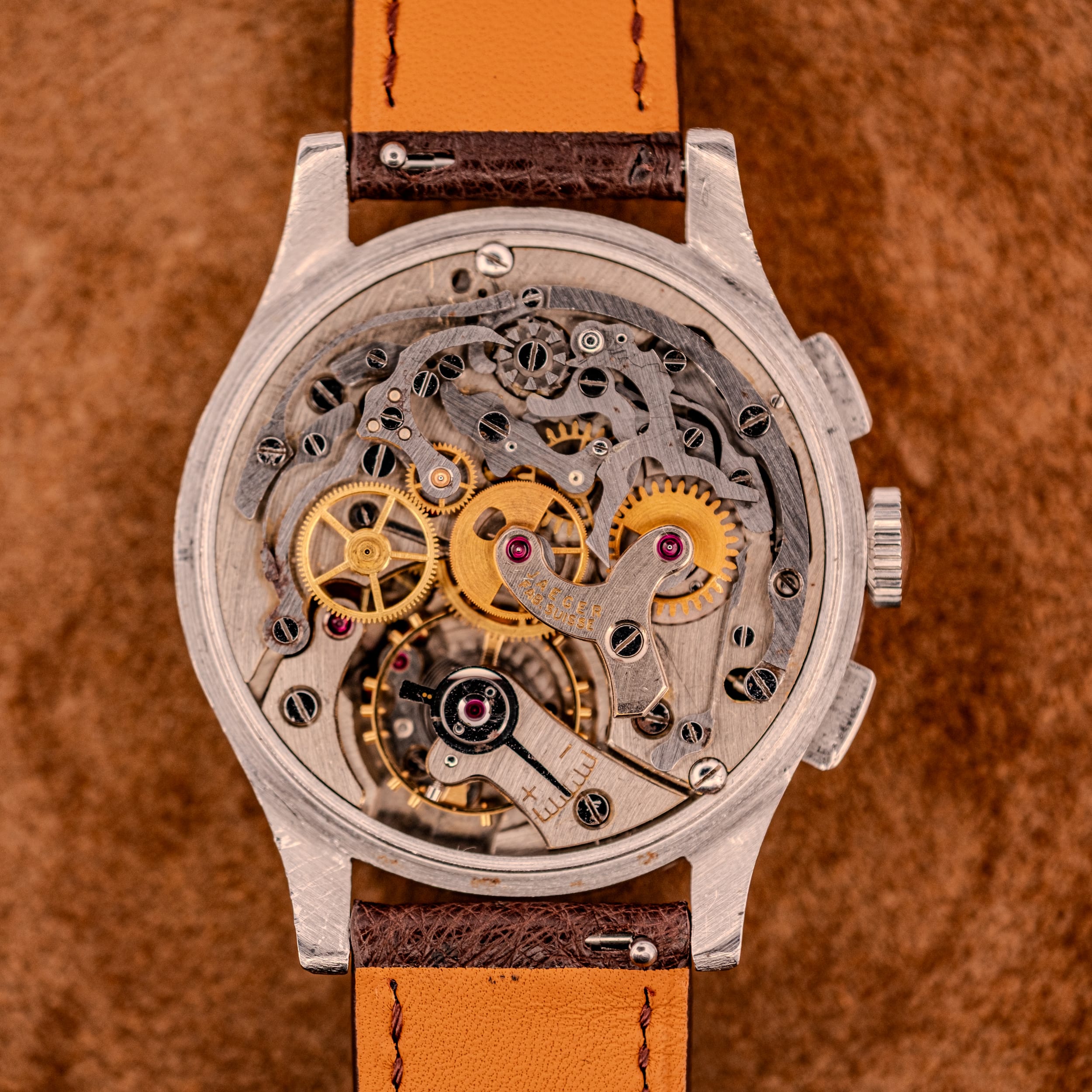
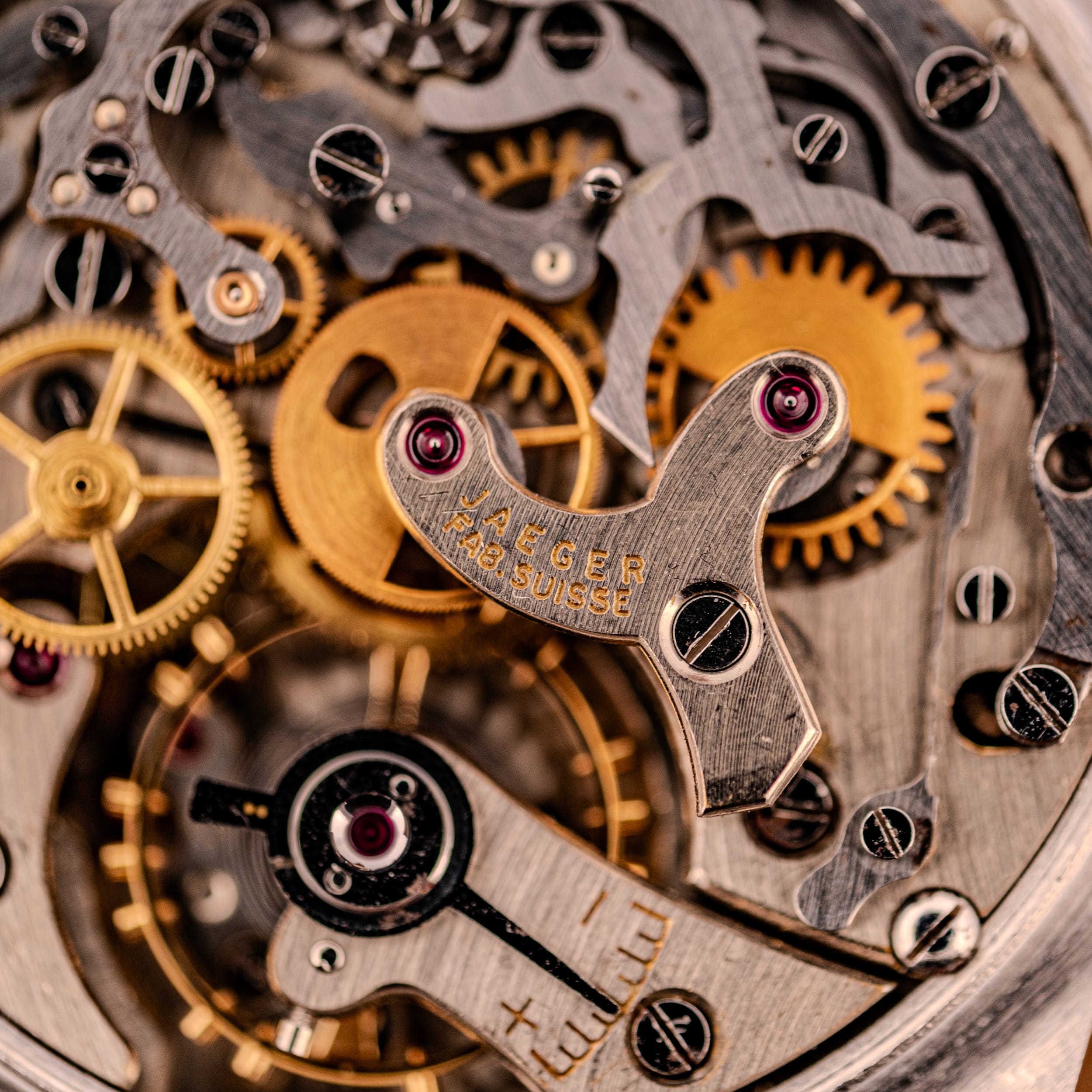
The Universal Genève caliber 285 at the heart of this watch is one of the more historically important calibers in chronograph horology, and the trivia matters. It was conceived not at Universal but at Martel Watch Co., a small Swiss workshop in Les Ponts-de-Martel that quietly supplied movements to Universal, Zenith, Vacheron Constantin, and Girard-Perregaux through the middle of the century. Martel produced the caliber 285 exclusively for Universal Genève beginning in the early 1930s, and it was the first wristwatch chronograph movement to use a two-pusher, column-wheel architecture, which is to say that every two-button chronograph made since traces its lineage to this design. Through the open caseback in our movement photographs, the bridge is signed JAEGER FAB. SUISSE in deep, crisp engraving. The eight-column pillar wheel, the ruby chatons, the gilt wheels, and the robust Martel finishing are all on full display. With 17 jewels beating at 18,000 vibrations per hour, the caliber 285 is a hand-wound movement of real substance.
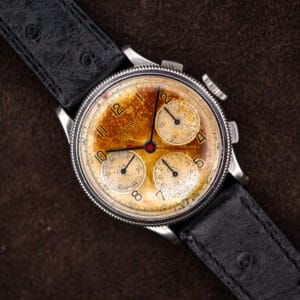
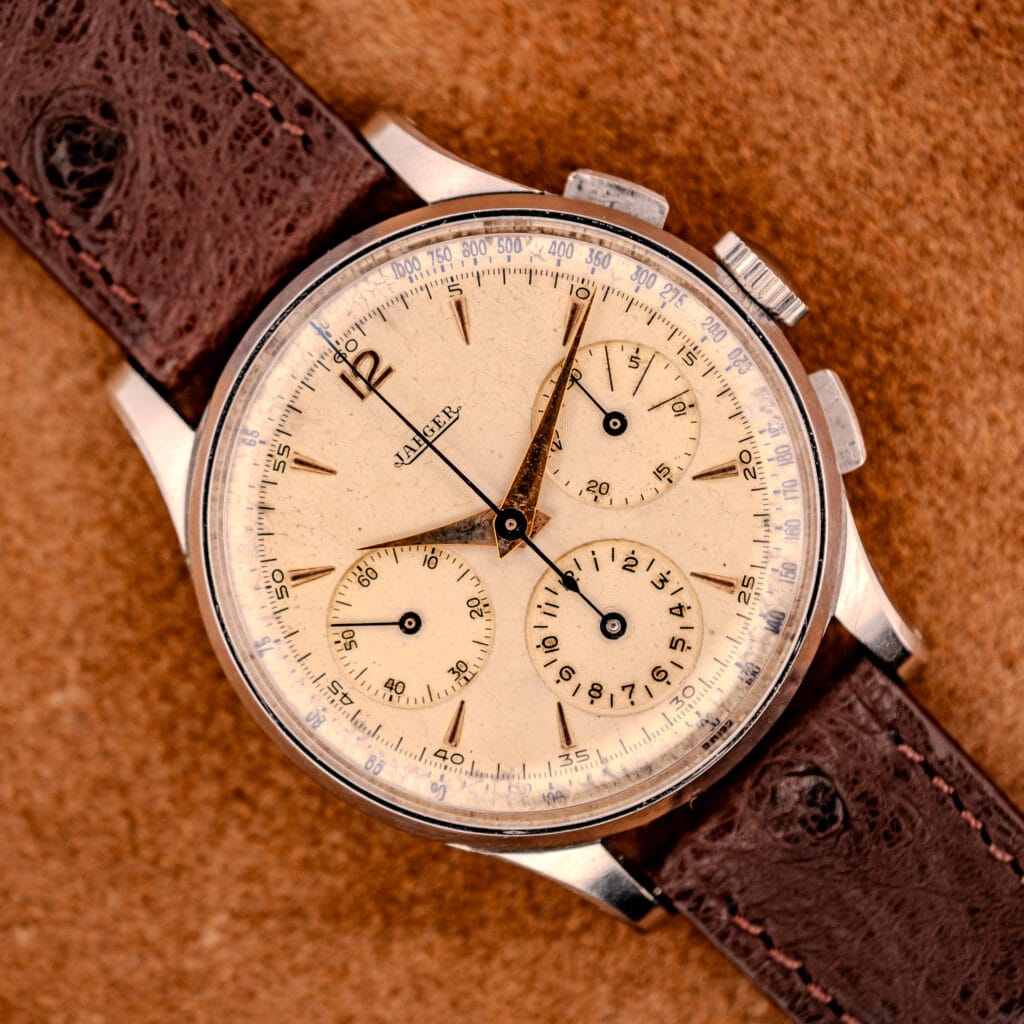
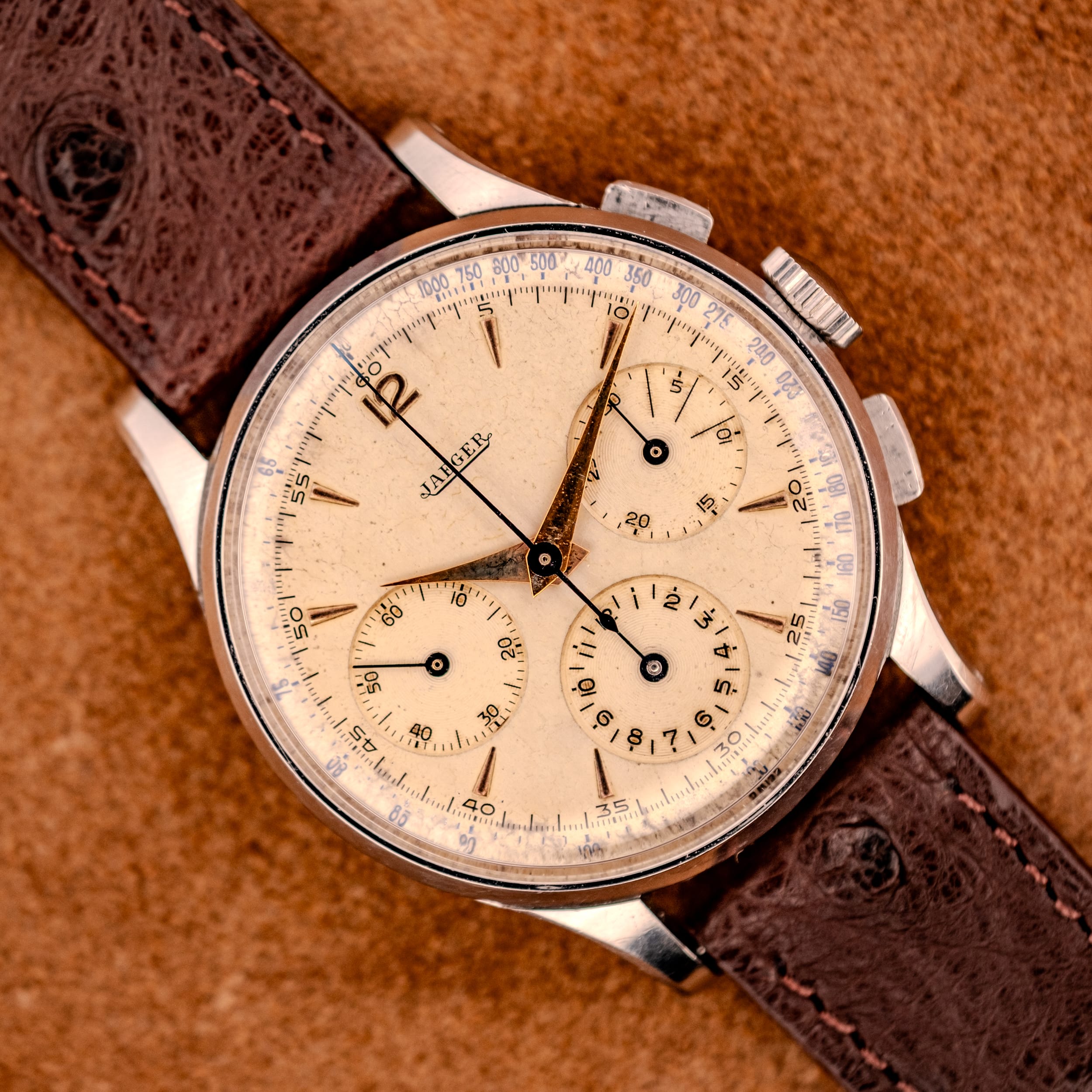
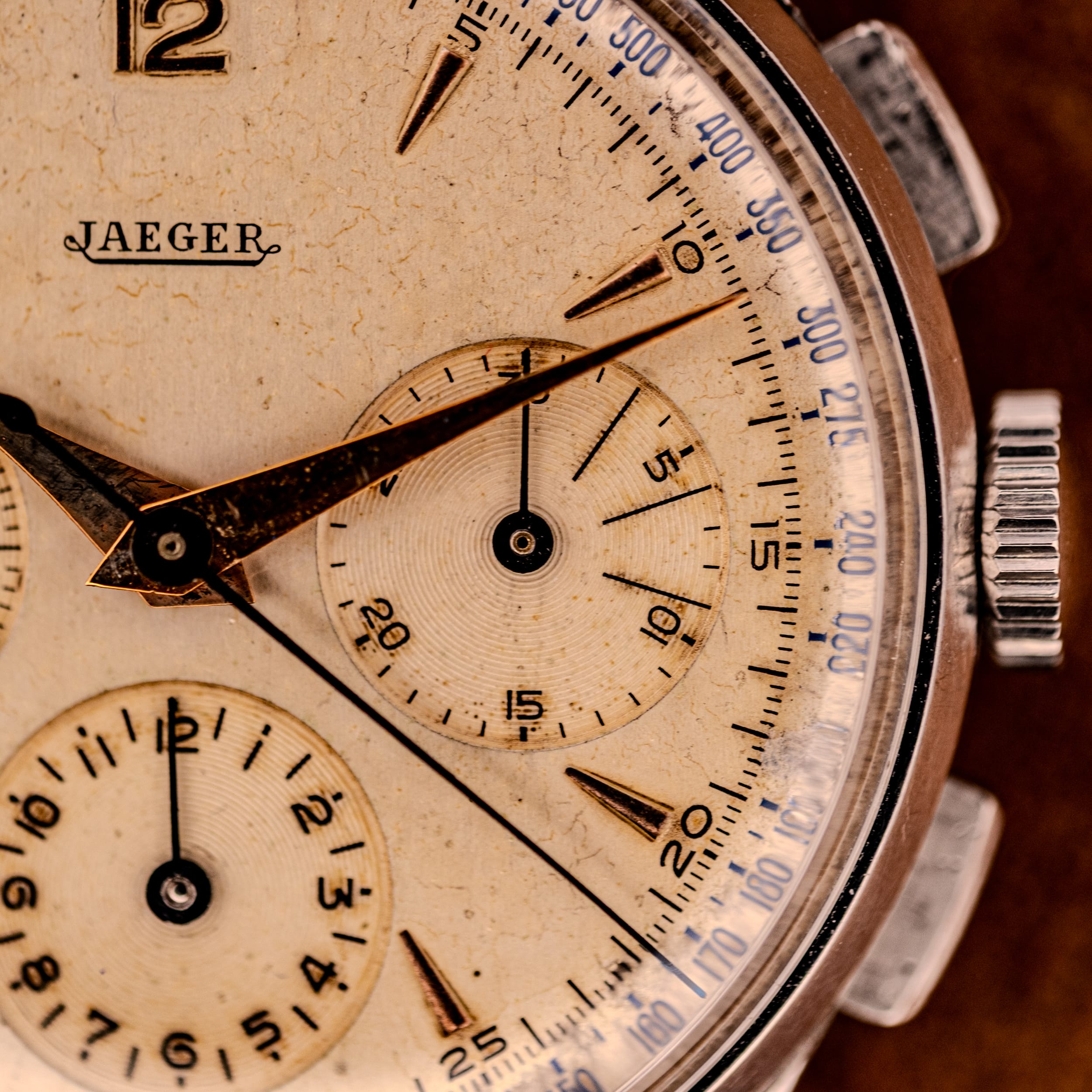
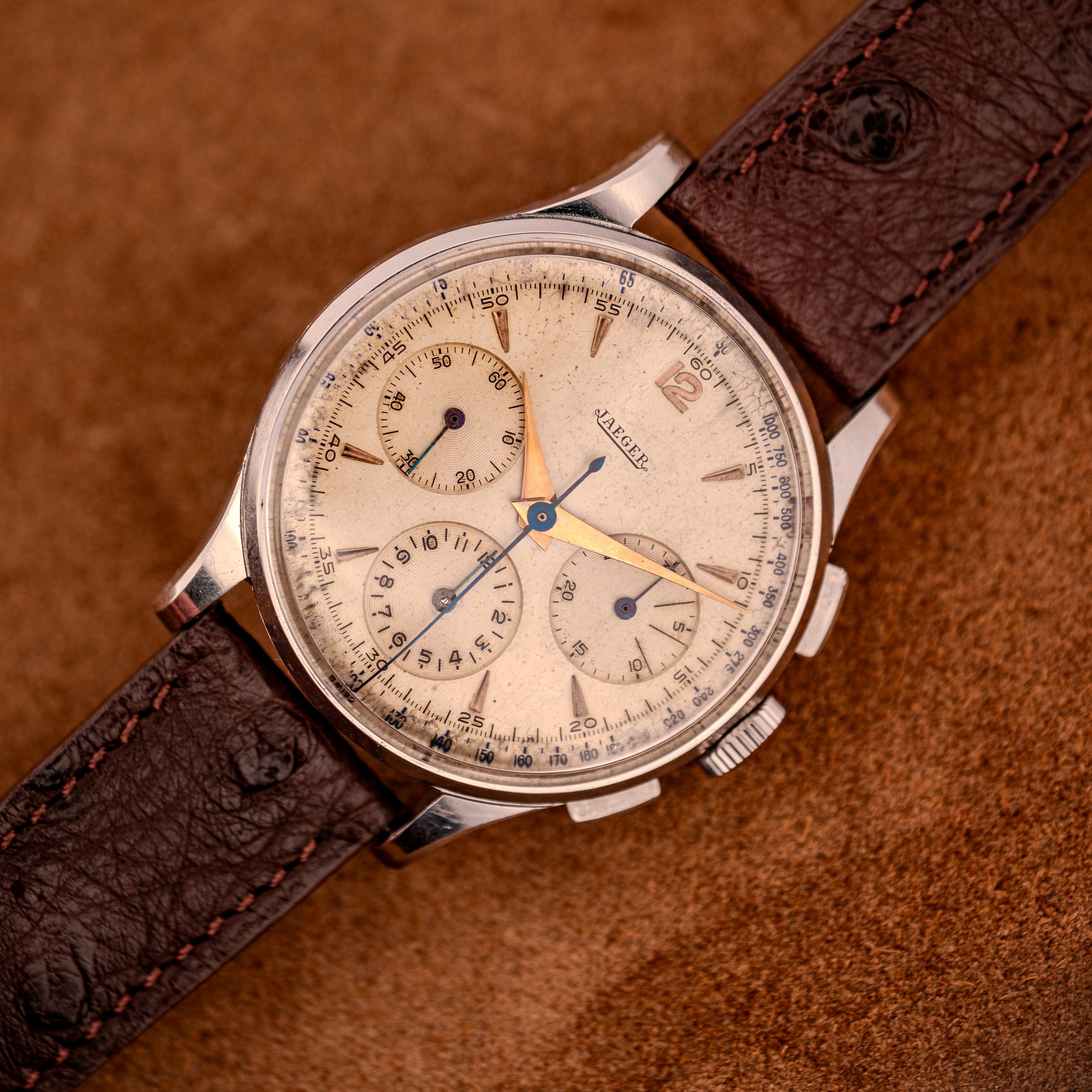
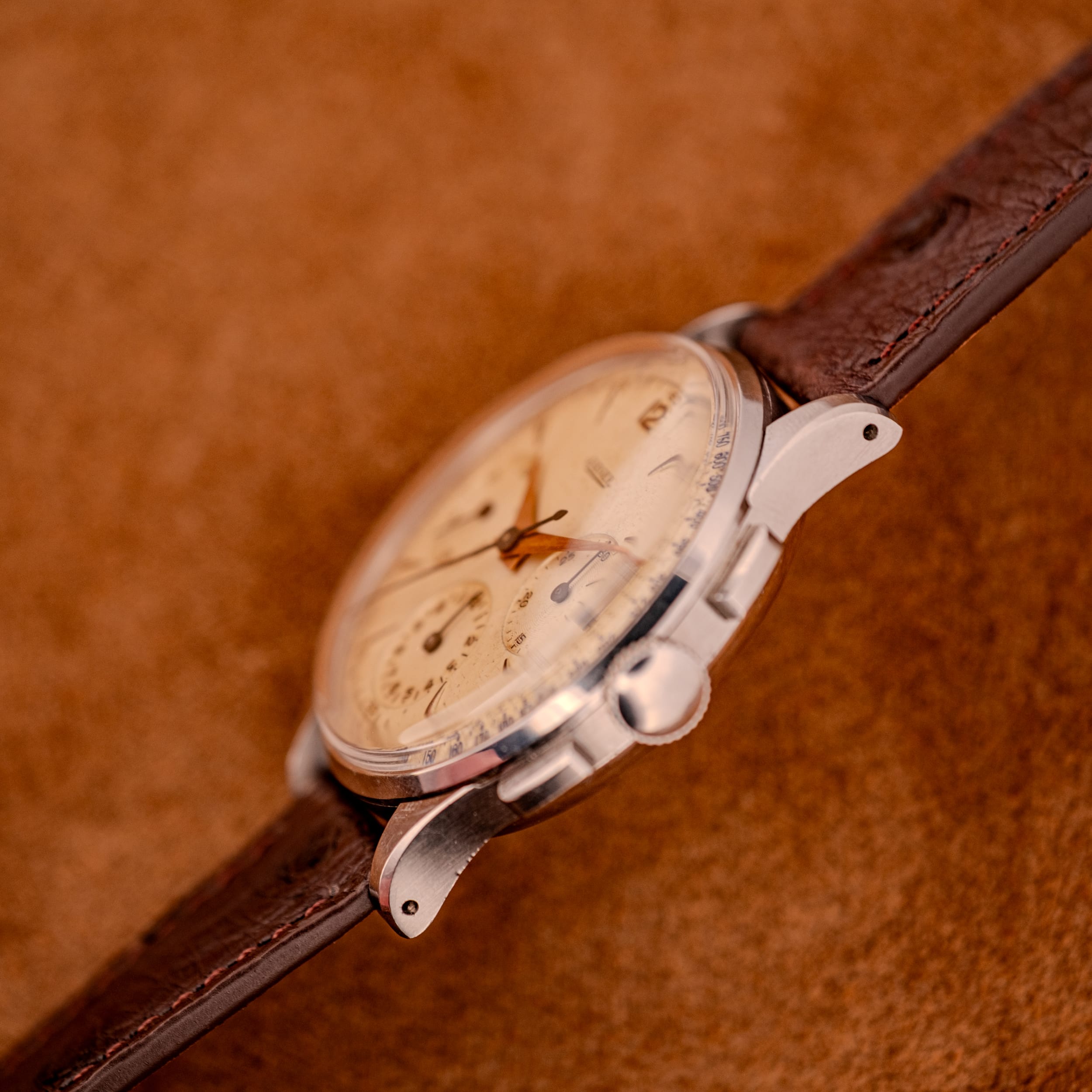
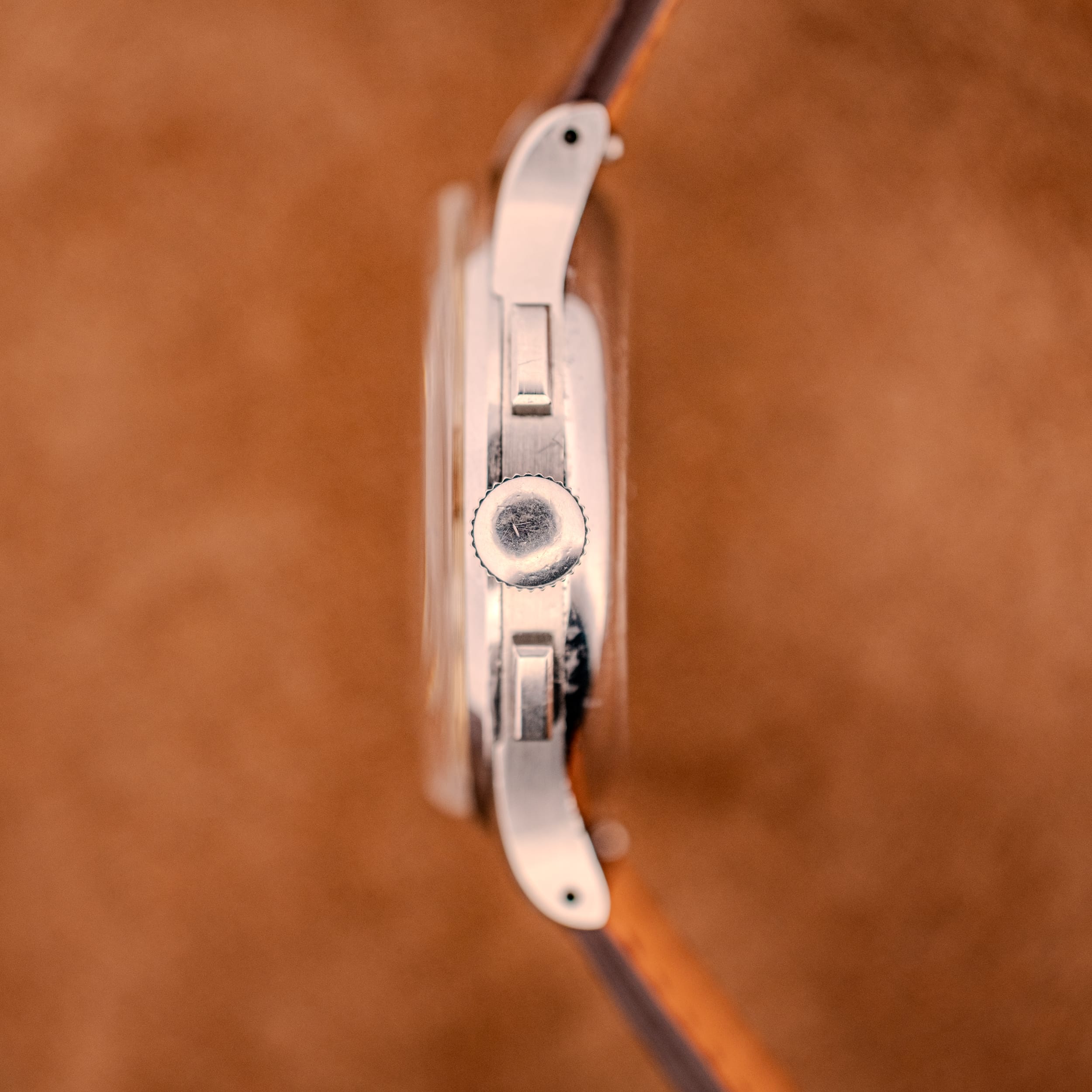
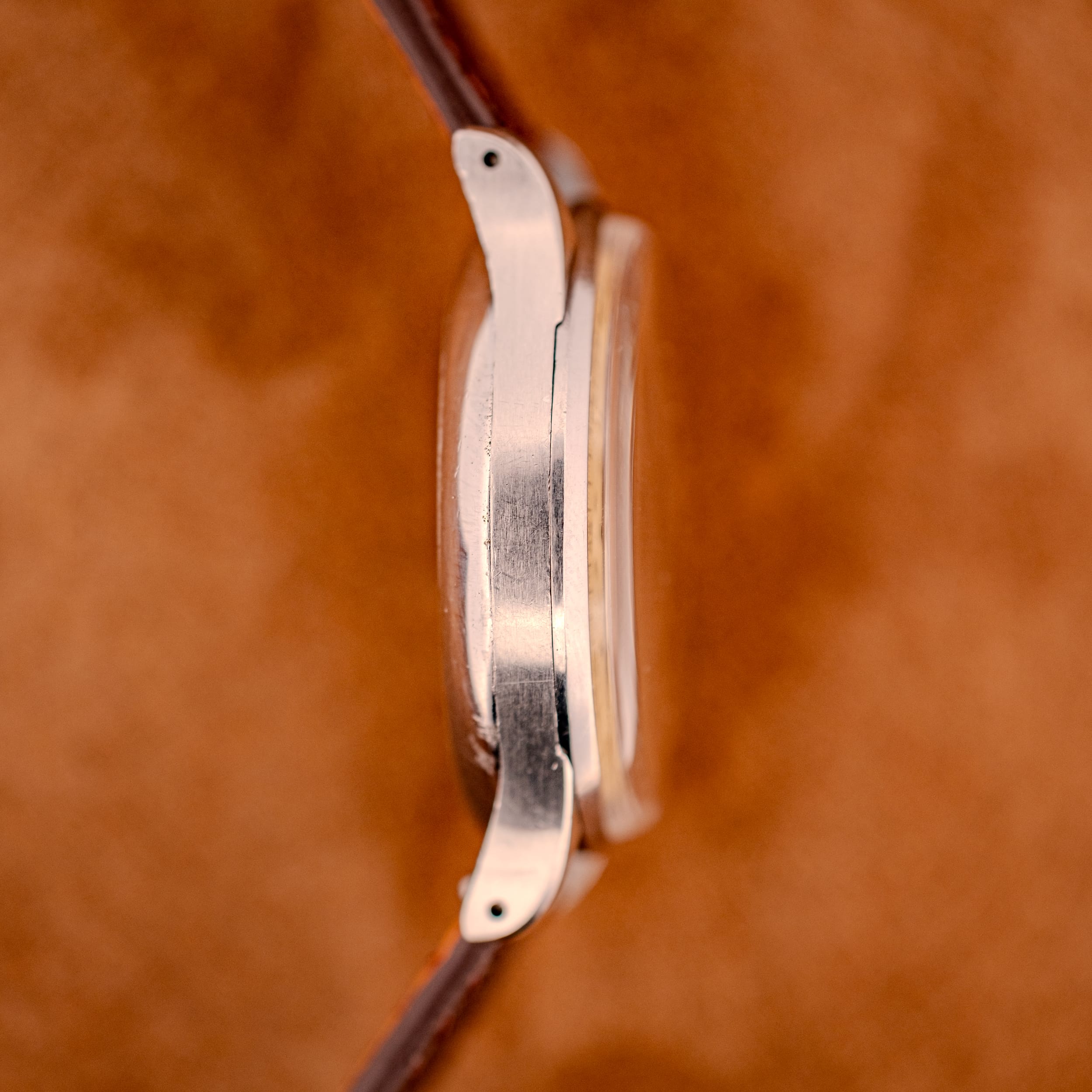
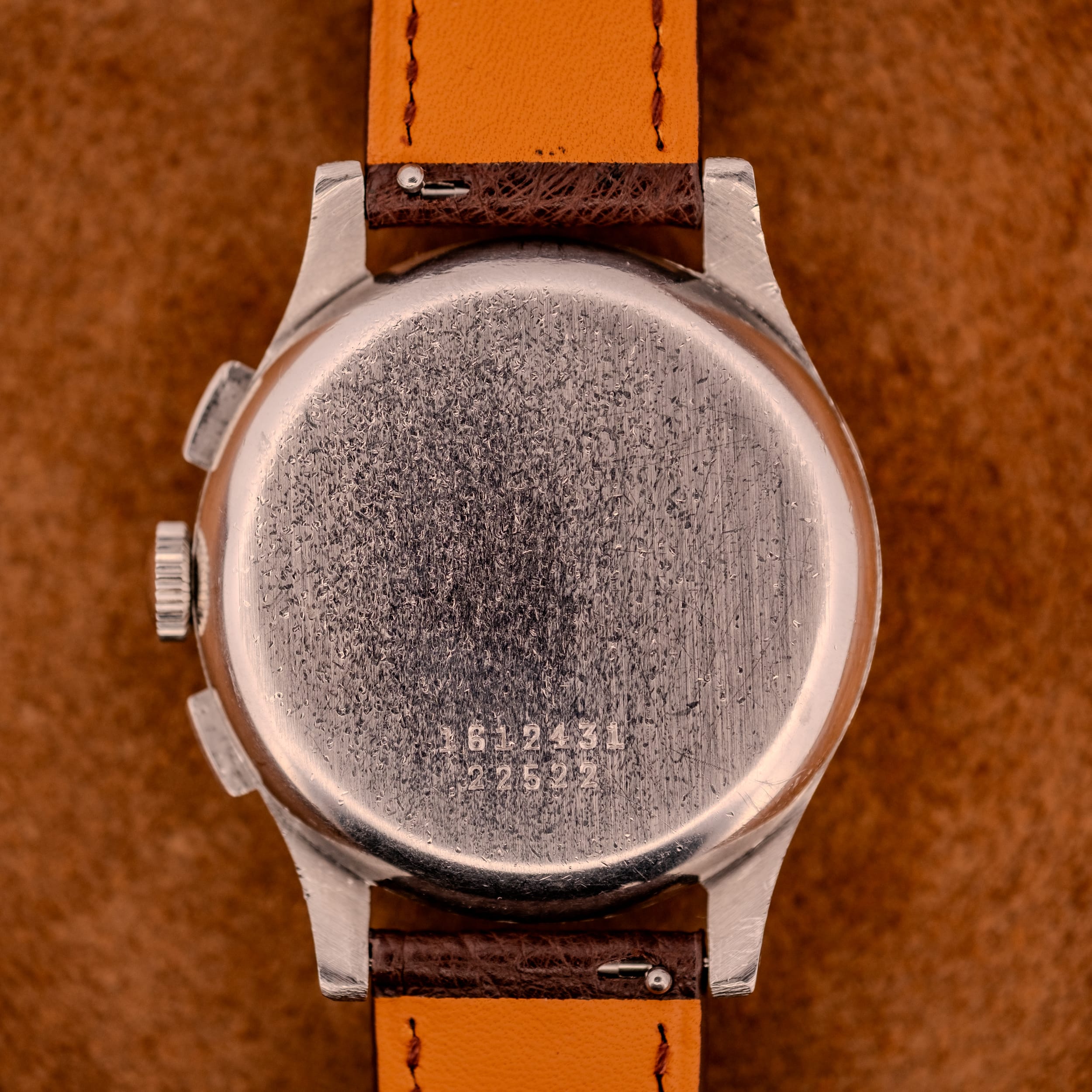
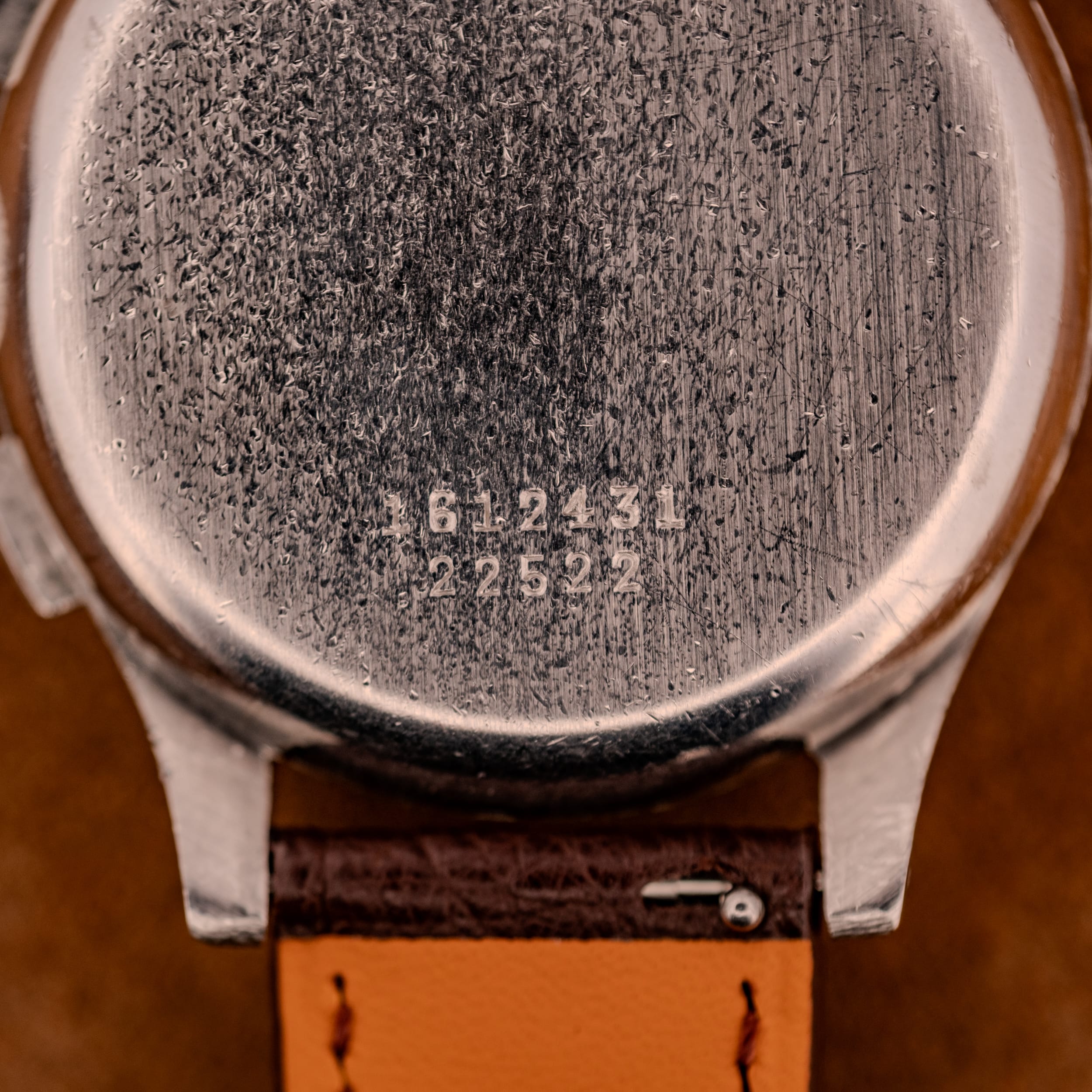
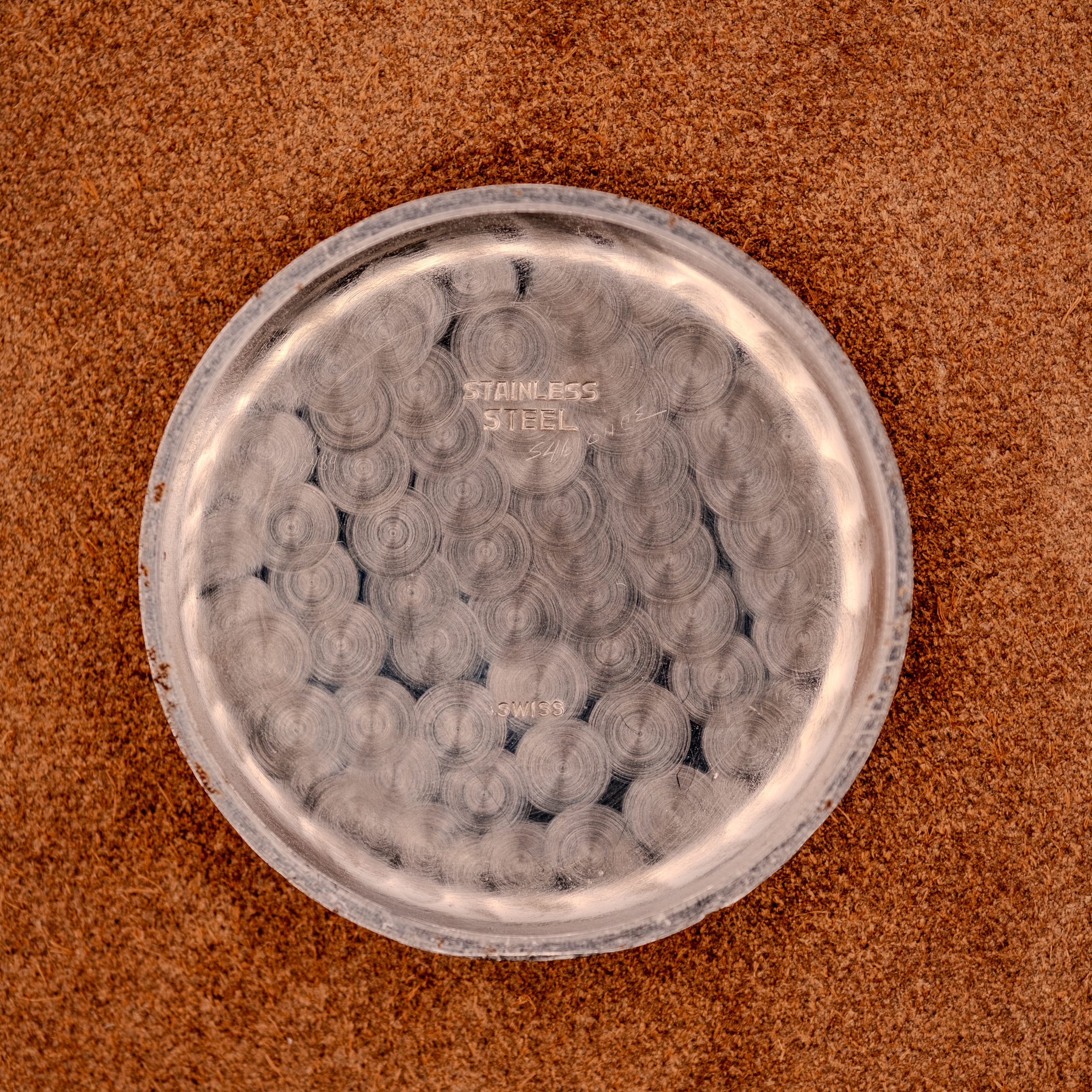
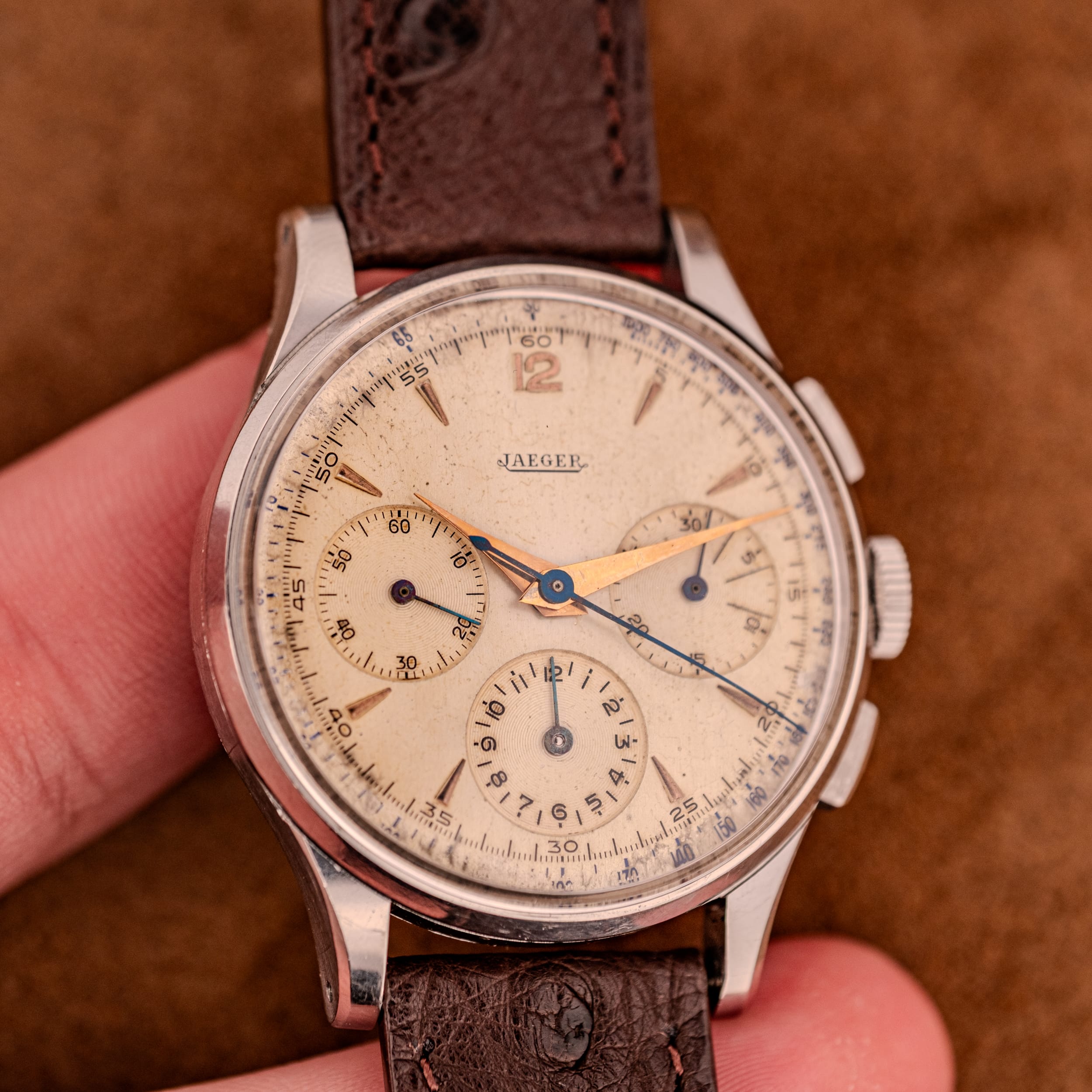
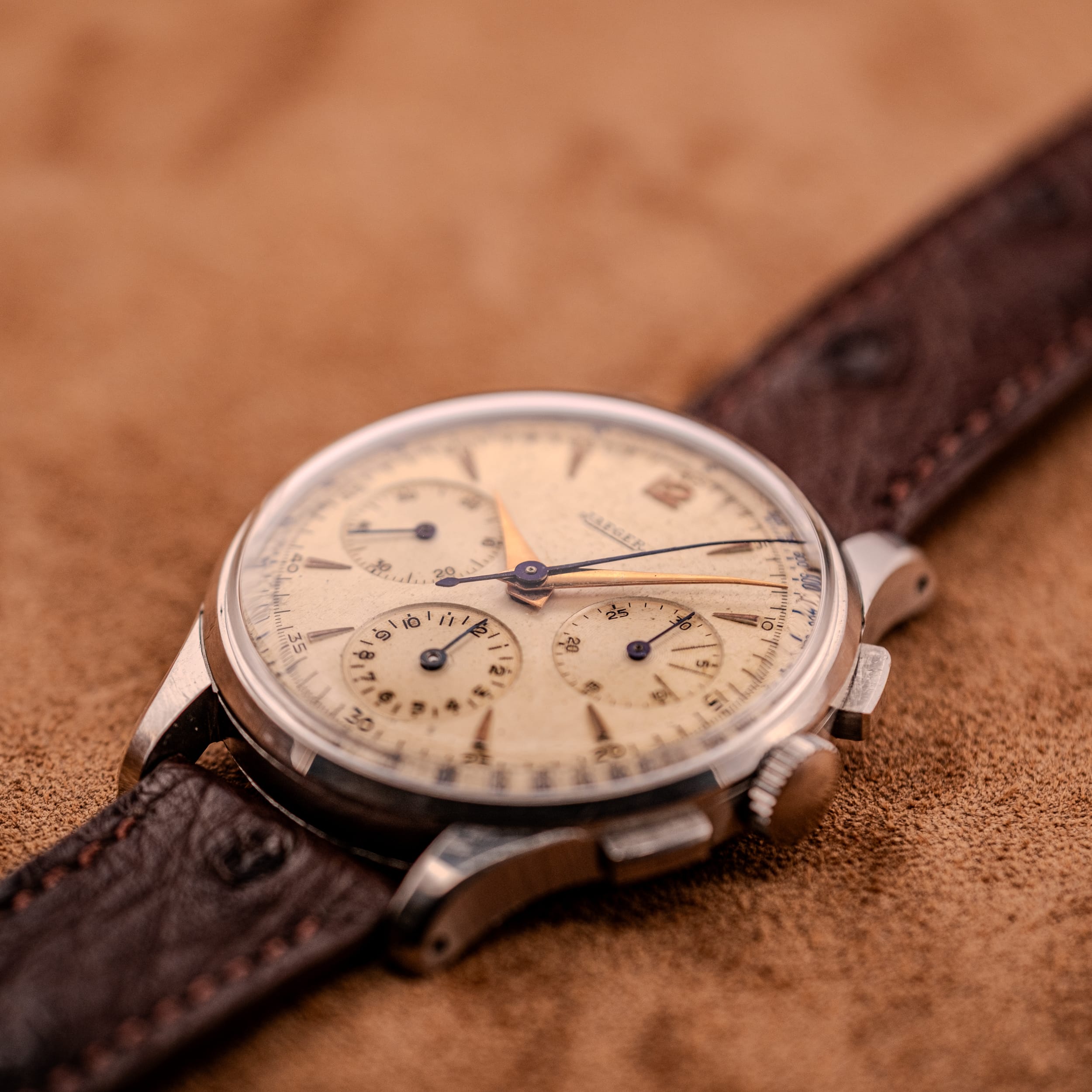
The 37.5mm stainless steel case carries the reference 22522, a number Universal Genève used for the rare Film Compax, and it wears with a presence that still feels modern on the wrist. This was a jumbo diameter for the 1940s, and the proportions have aged beautifully. The case retains honest wear consistent with decades of life, a softened brushed surface across the top, with the polished sides showing fine marks of use. The exterior of the snap-back caseback is stamped with the serial 1612431 above the reference 22522. The interior of the caseback is stamped STAINLESS STEEL and finished in the characteristic engine-turned overlapping-circle pattern of the period. Rectangular chronograph pushers flank the signed crown at 2 and 4 o’clock, the hallmark of UG-powered Jaeger chronographs that visually separates them from their Valjoux-equipped siblings, which used mushroom pushers and screw-down backs.
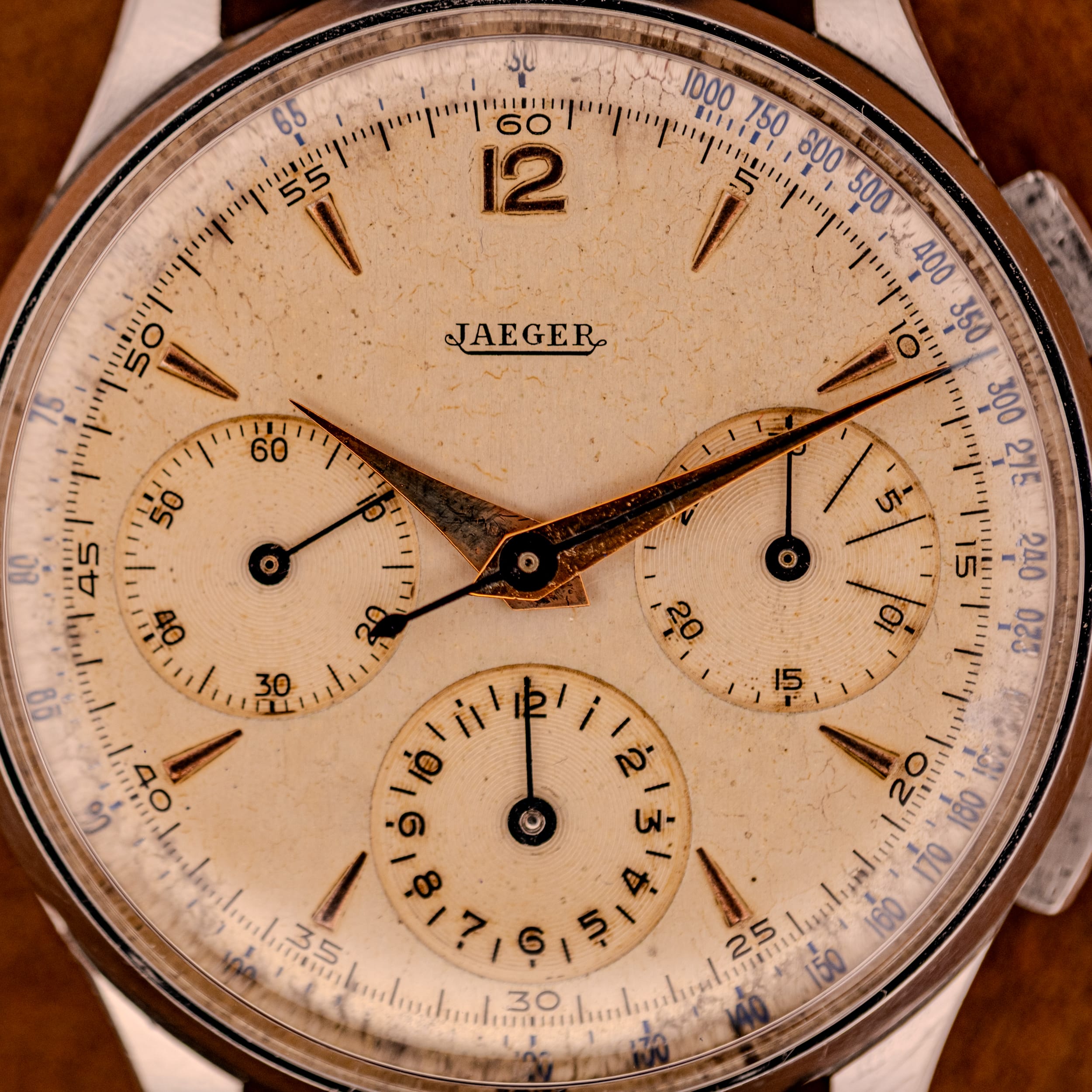
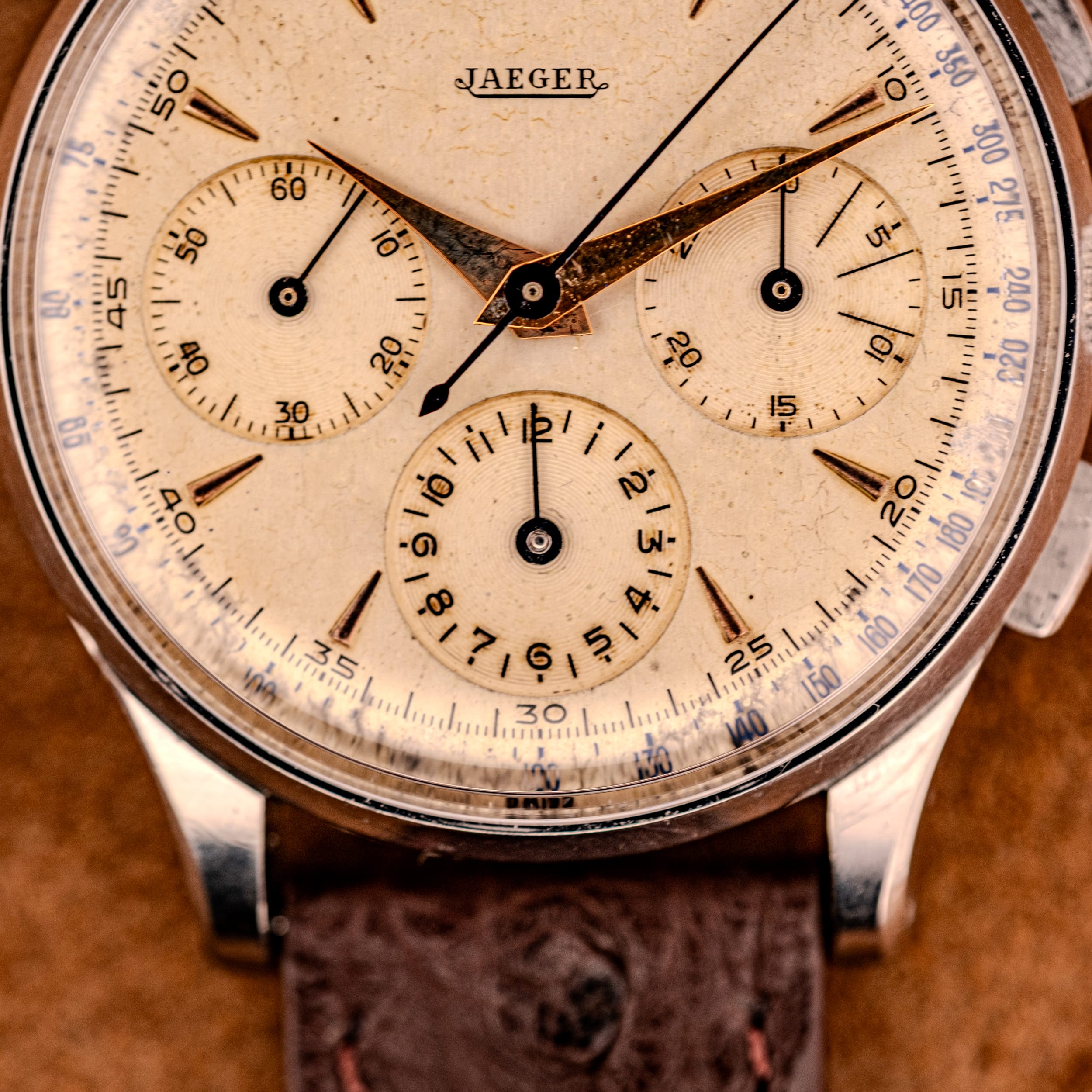
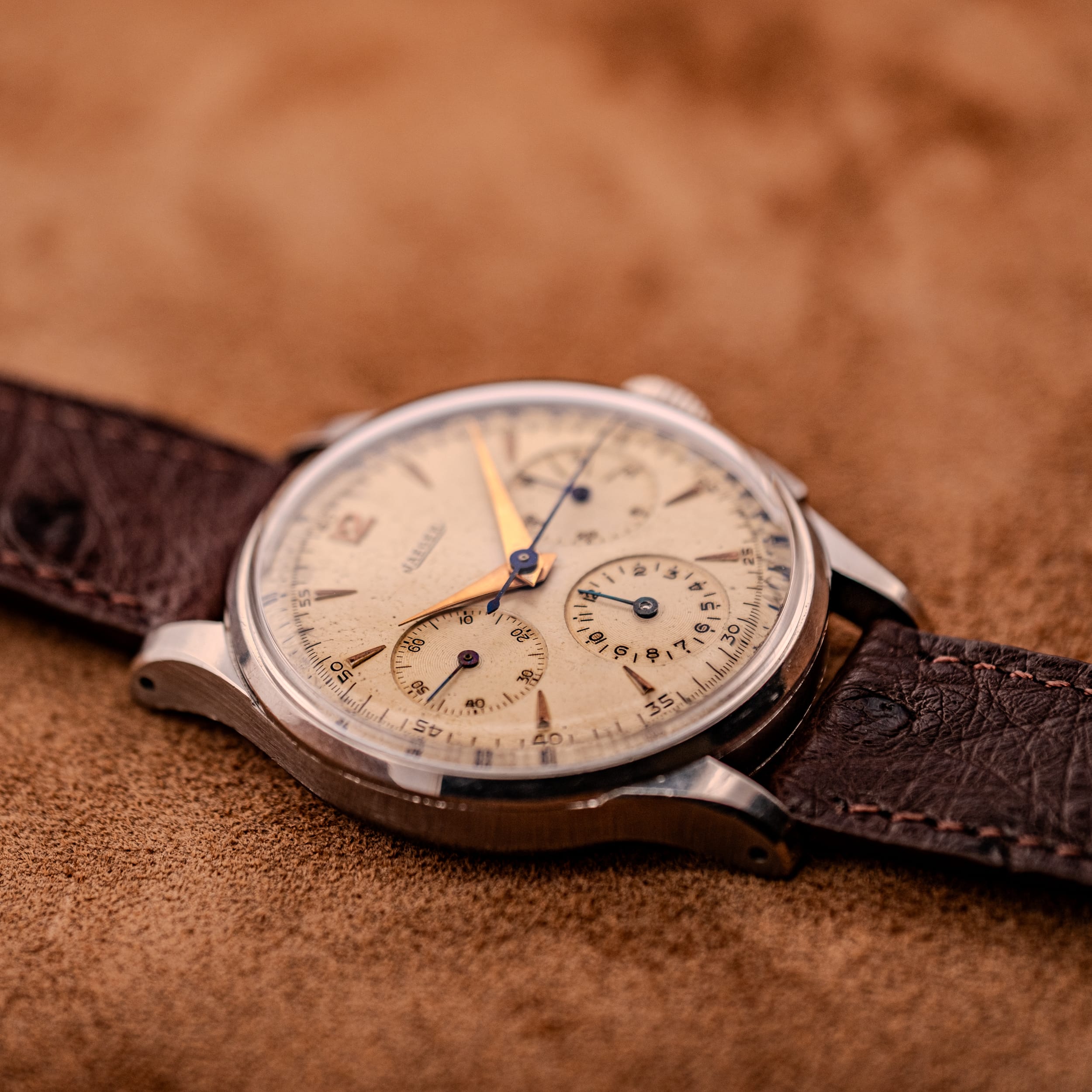
To us, the dial is where this Jaeger Tri-Compax Chronograph really takes hold. The original silver surface has aged to a warm, creamy ivory, with light spotting across the field that only reinforces its authenticity. The applied rose gold arrow indices catch light with a sharpness that contrasts beautifully against the softened patina of the dial, and the bold applied Arabic 12 at the top of the dial gives the composition a confident, almost architectural anchor. The JAEGER signature sits in cursive italic script beneath the 12. Three recessed subdials carry concentric engine-turned finishing: a small running seconds at 9, a 30-minute chronograph register at 3, and a 12-hour chronograph register with Arabic numerals at 6. A blue tachymeter scale runs along the outer chapter ring, adding a layer of cool-tone complexity that rewards a closer look. The rose gold dauphine handset has developed a gentle patina of its own, while the blued steel subdial counters and central chronograph sweep remain vivid and legible against the warm dial.
We have paired the watch with a chocolate ostrich leather strap with red contrast stitching and an OTTUHR-signed buckle, an honestly aged leather that picks up the warm tones of the dial without trying to be quieter or louder than the watch deserves.
Serviced in-house at OTTUHR and backed by our 2-year mechanical warranty, this is the kind of vintage Jaeger chronograph we find genuinely exciting to bring to market. A factory dial that has aged with grace, a column-wheel caliber whose architecture wrote the rulebook for the modern two-pusher chronograph, a case shared with one of the rarer references in postwar Universal Genève collecting, and the deeper story of why a watch can be both a Jaeger and a Universal Genève at the same time. For the collector who values the historical thread inside a vintage watch as much as the wrist presence on top of it, this Jaeger Tri-Compax Chronograph is, to us, an unusually rewarding piece.