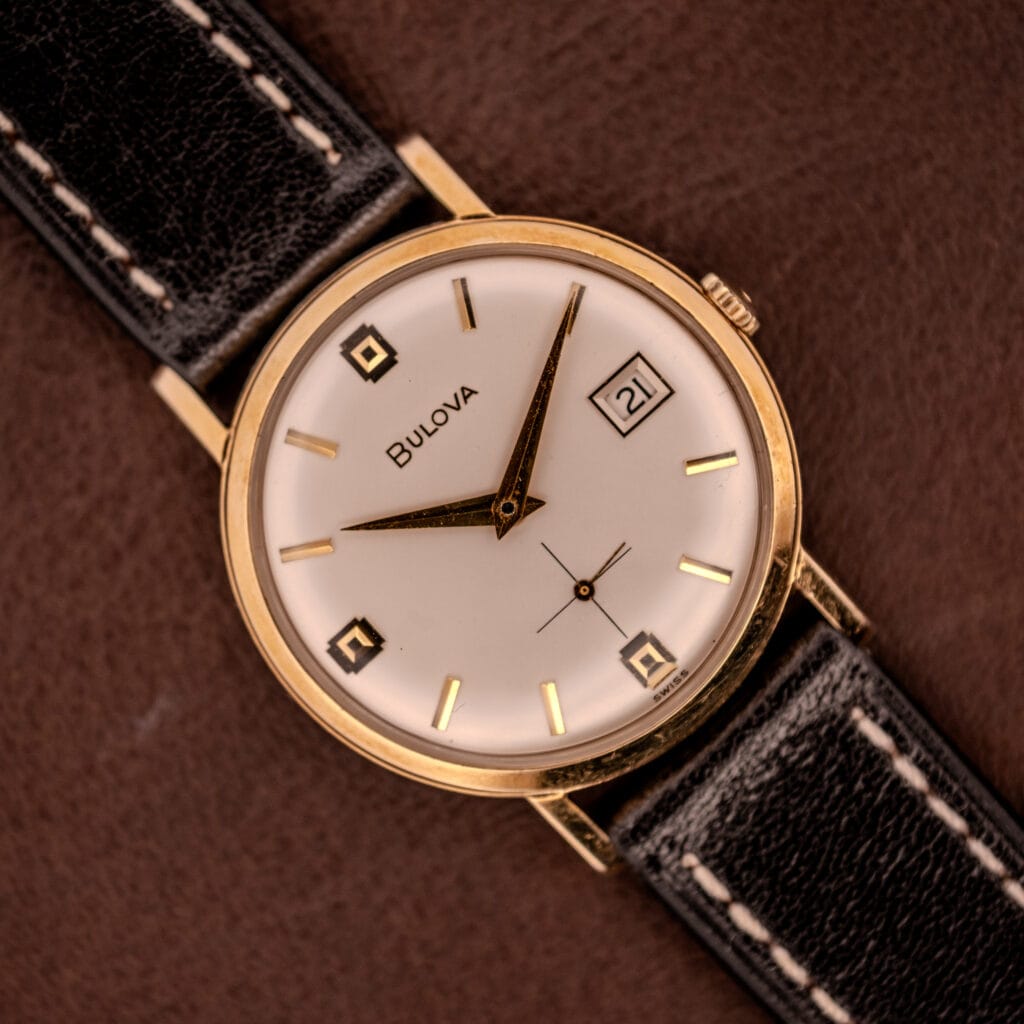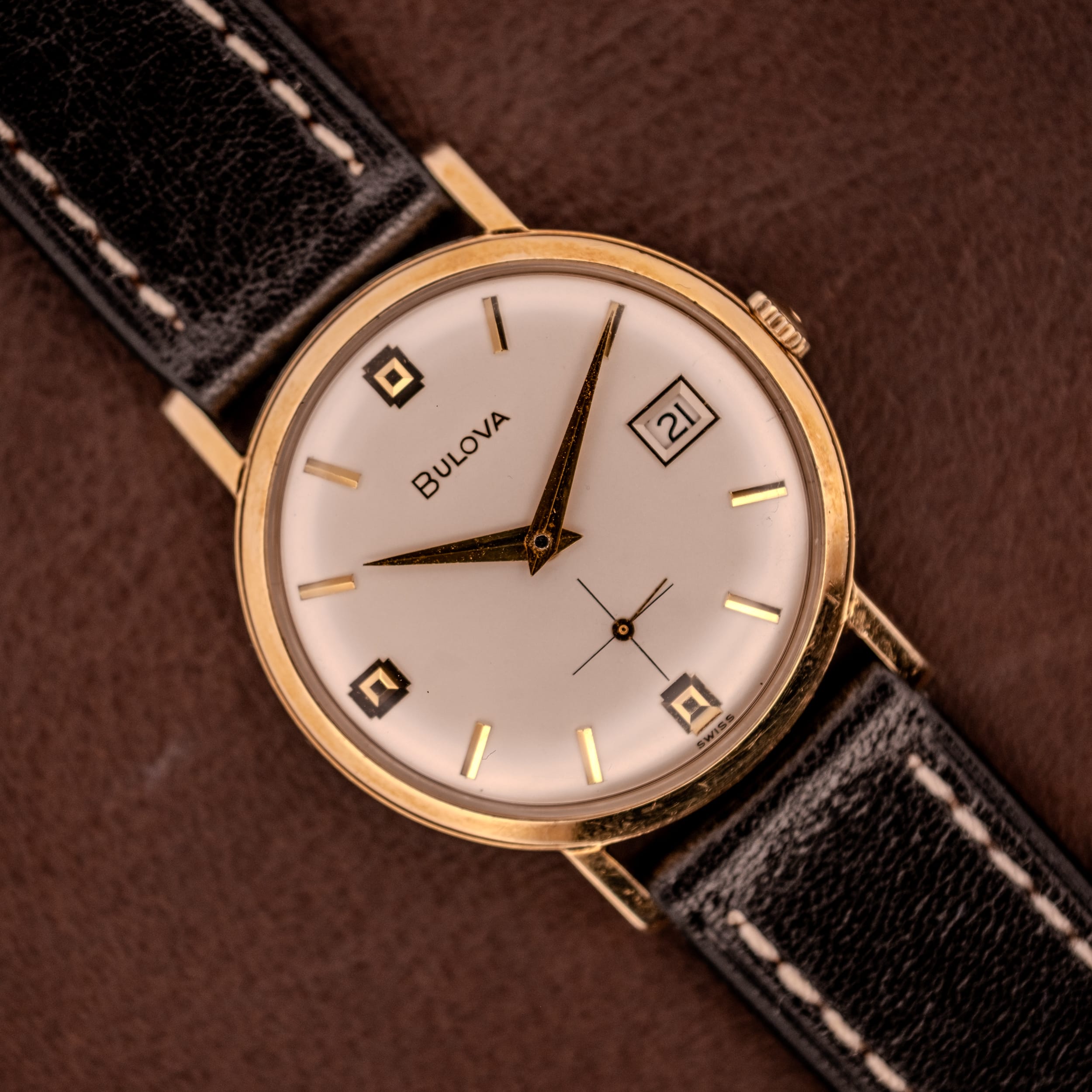
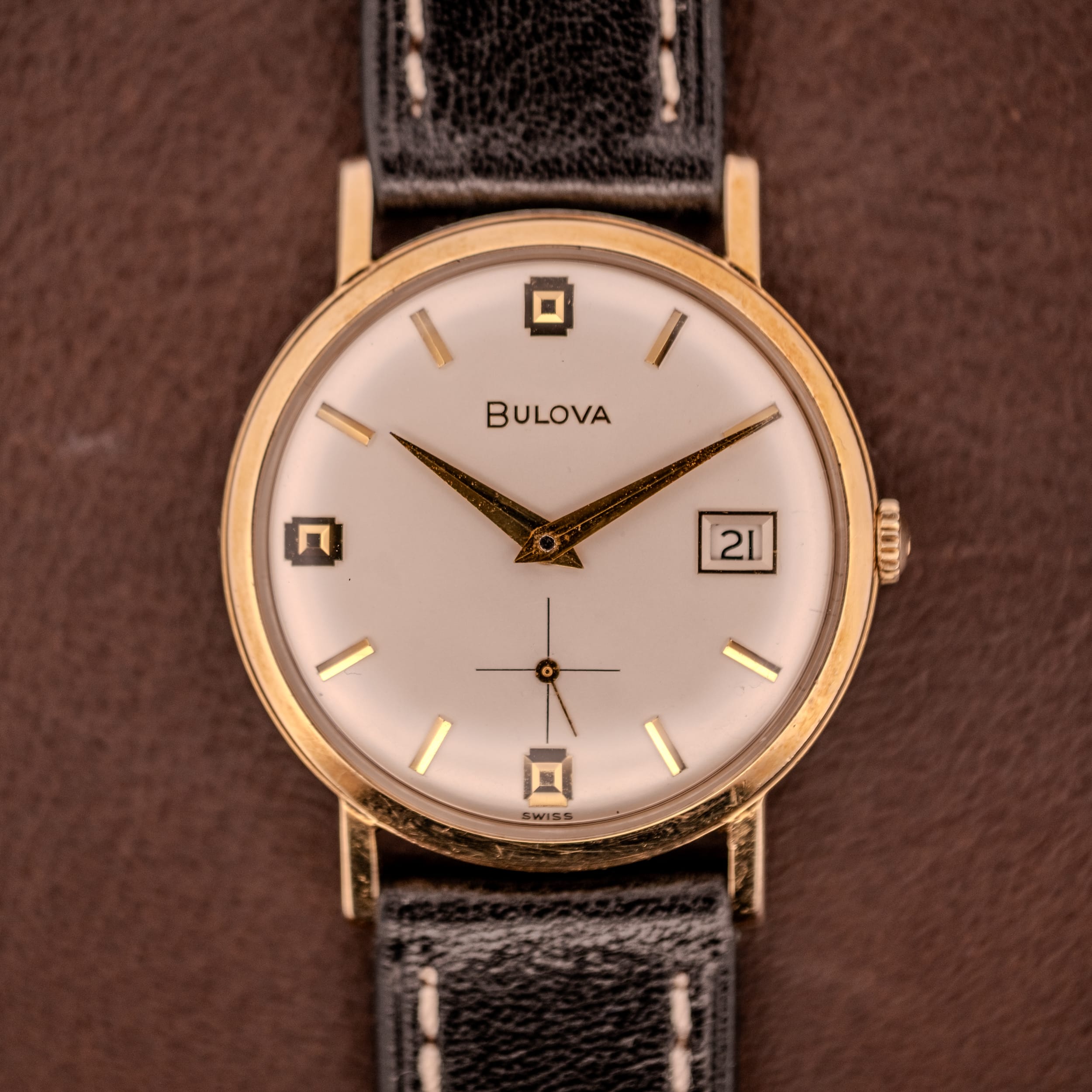
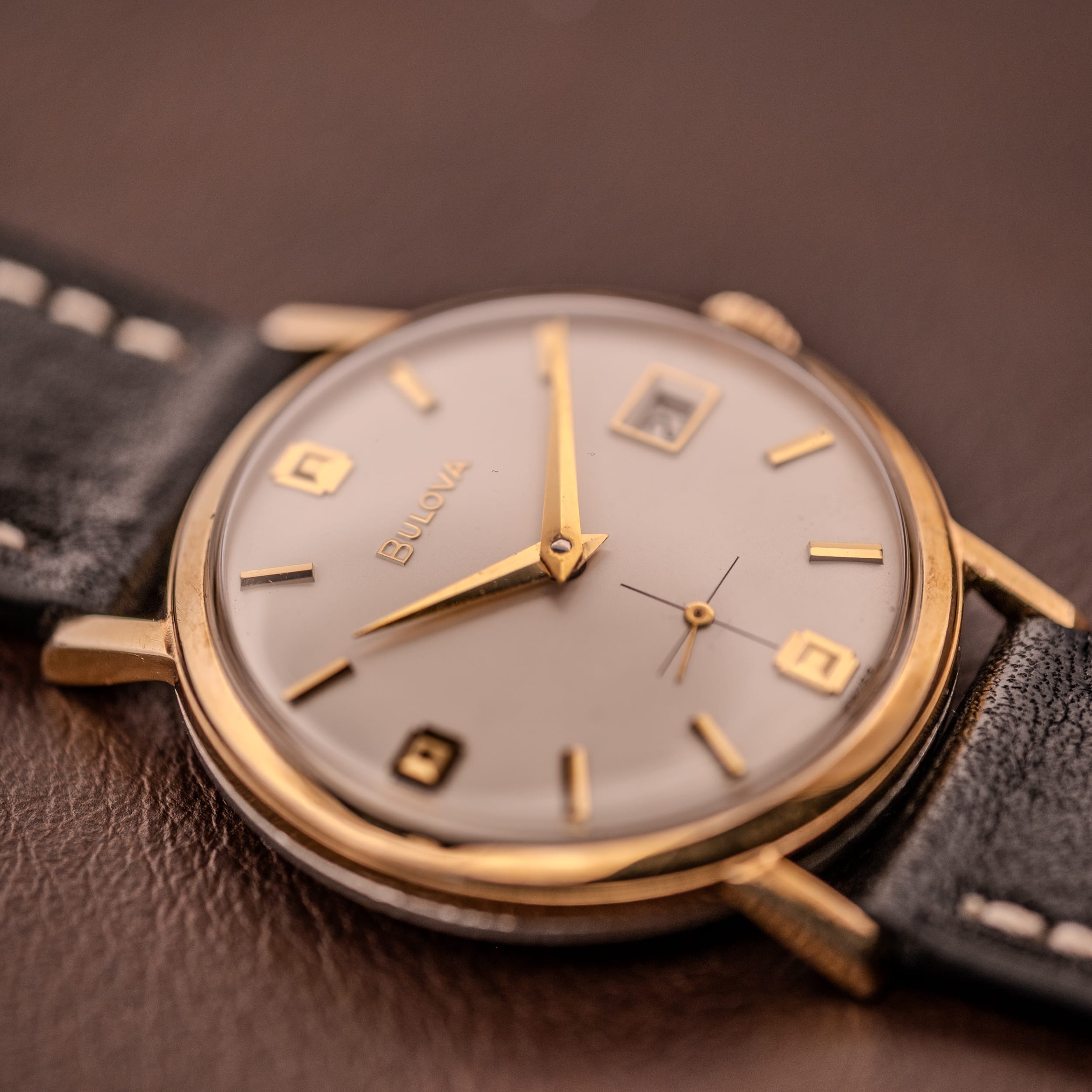
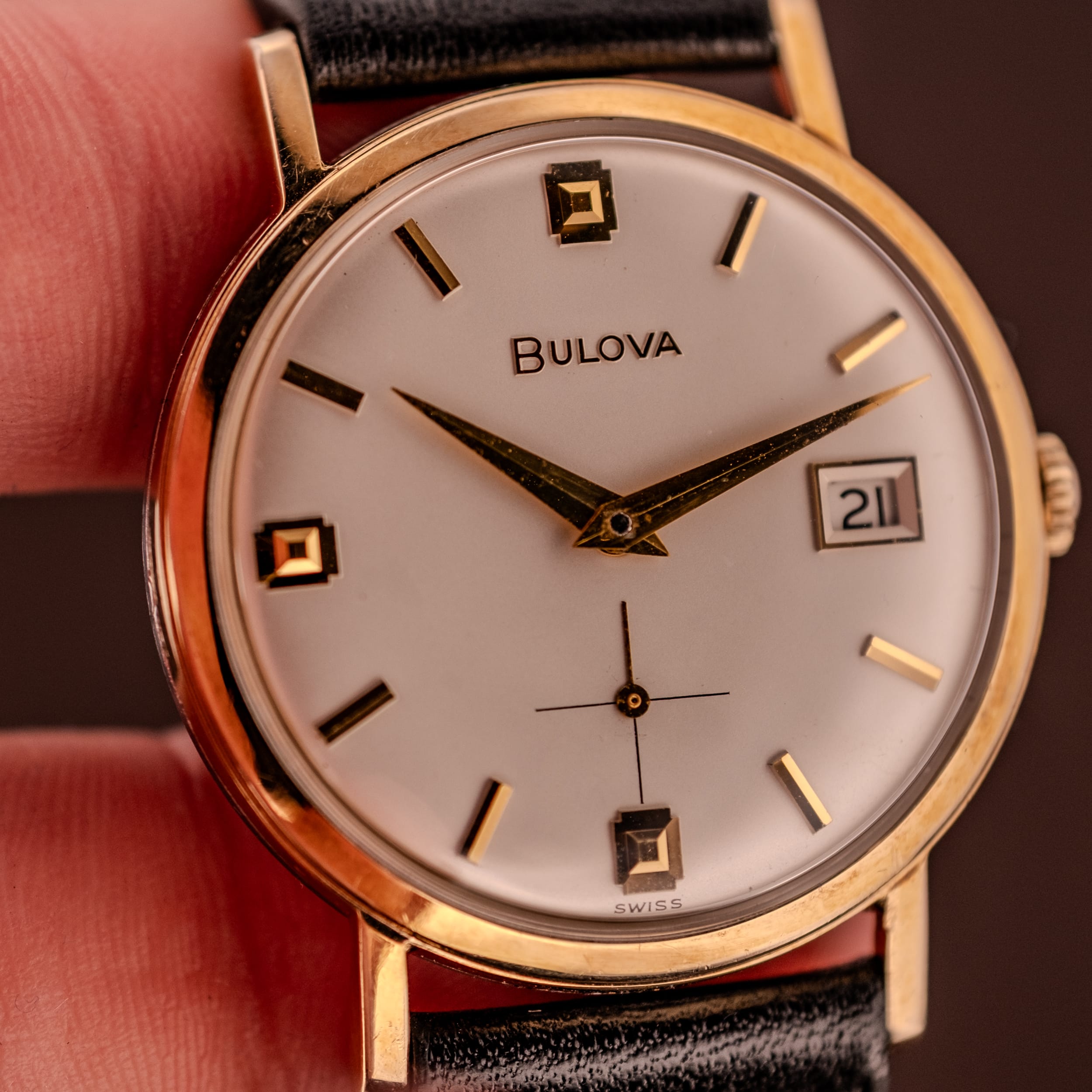
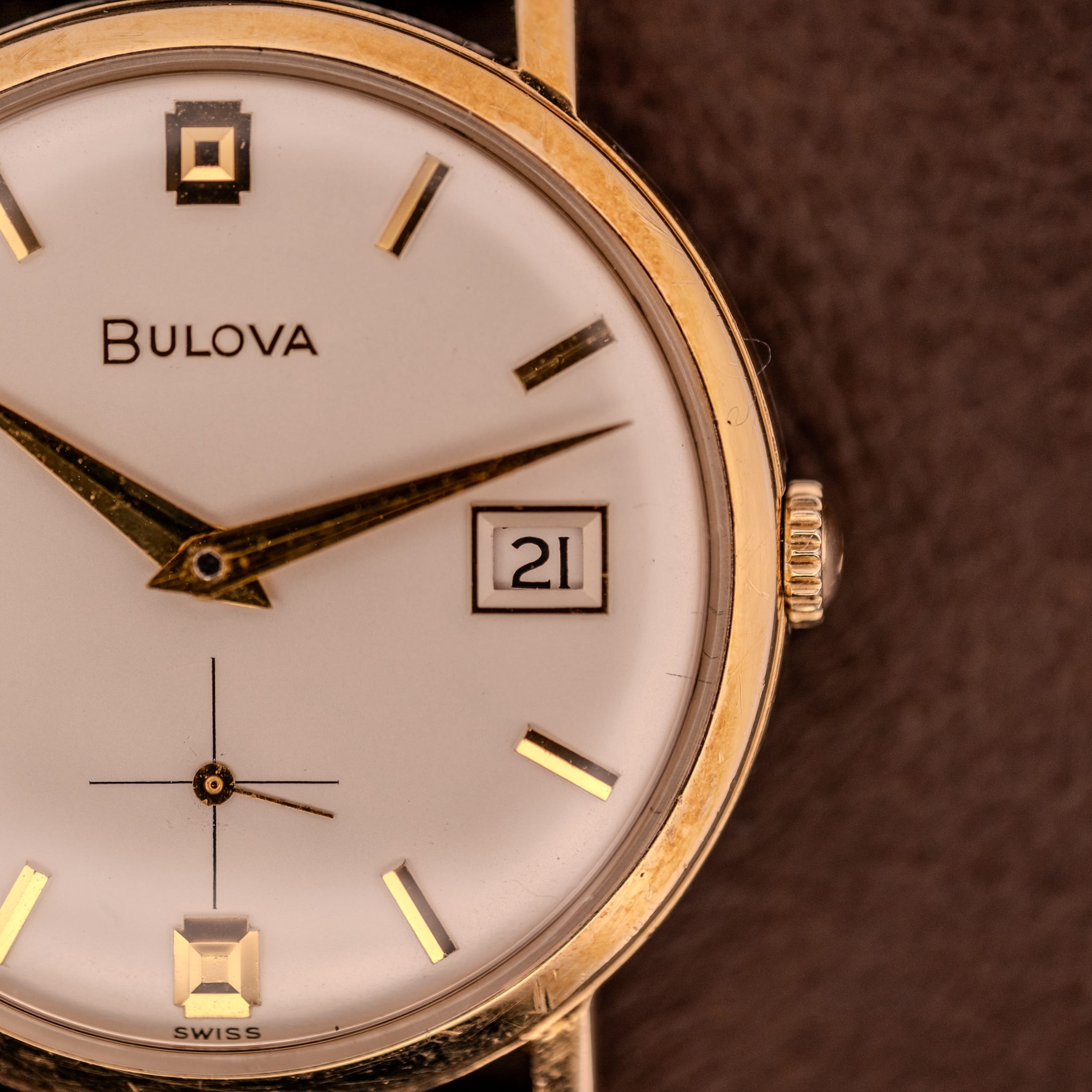
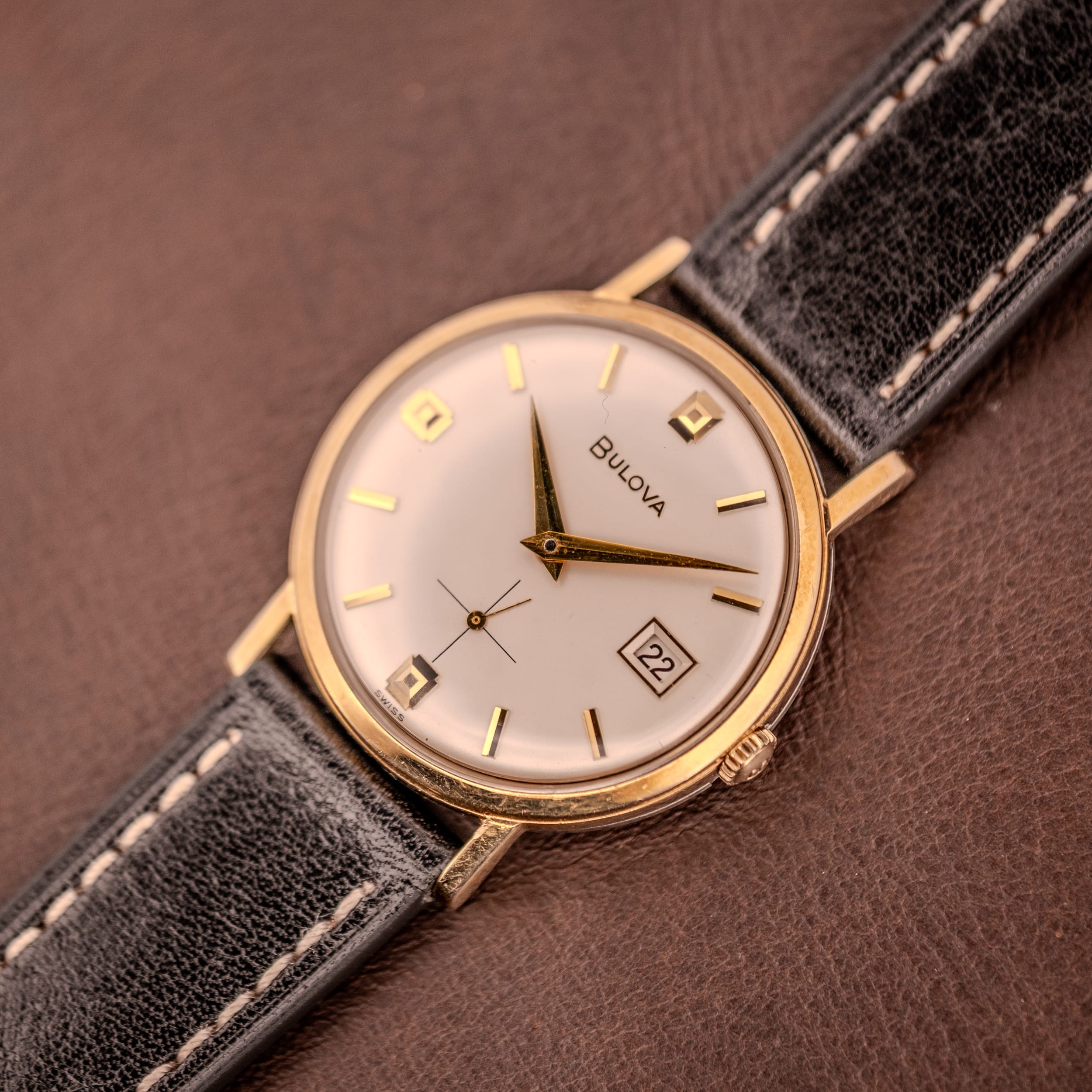

Twelve, three, six, and nine on the dial are applied gold squares, each with a dark recessed inner square that sits a hair lower than the surrounding metal, and the rest of the hours are slim applied gold sticks. That alternating geometry is what tells us this is not the generic Bulova Manual Wind Date of the late 1960s catalogue but a slightly more deliberate dial variant, in our opinion, and it is the kind of small dial-design decision that quietly separates the watches Bulova made for a specific year from the ones the brand made for every year.
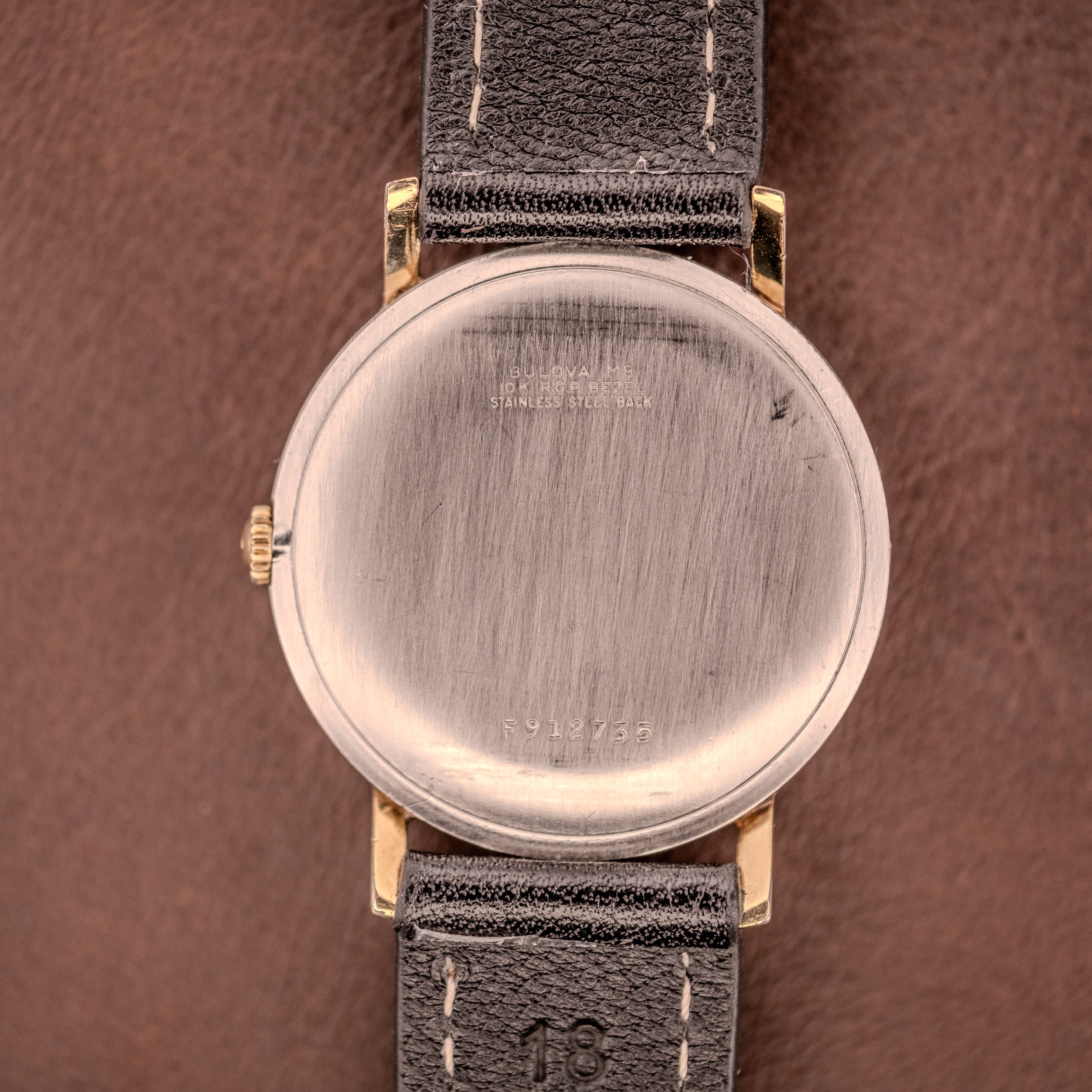
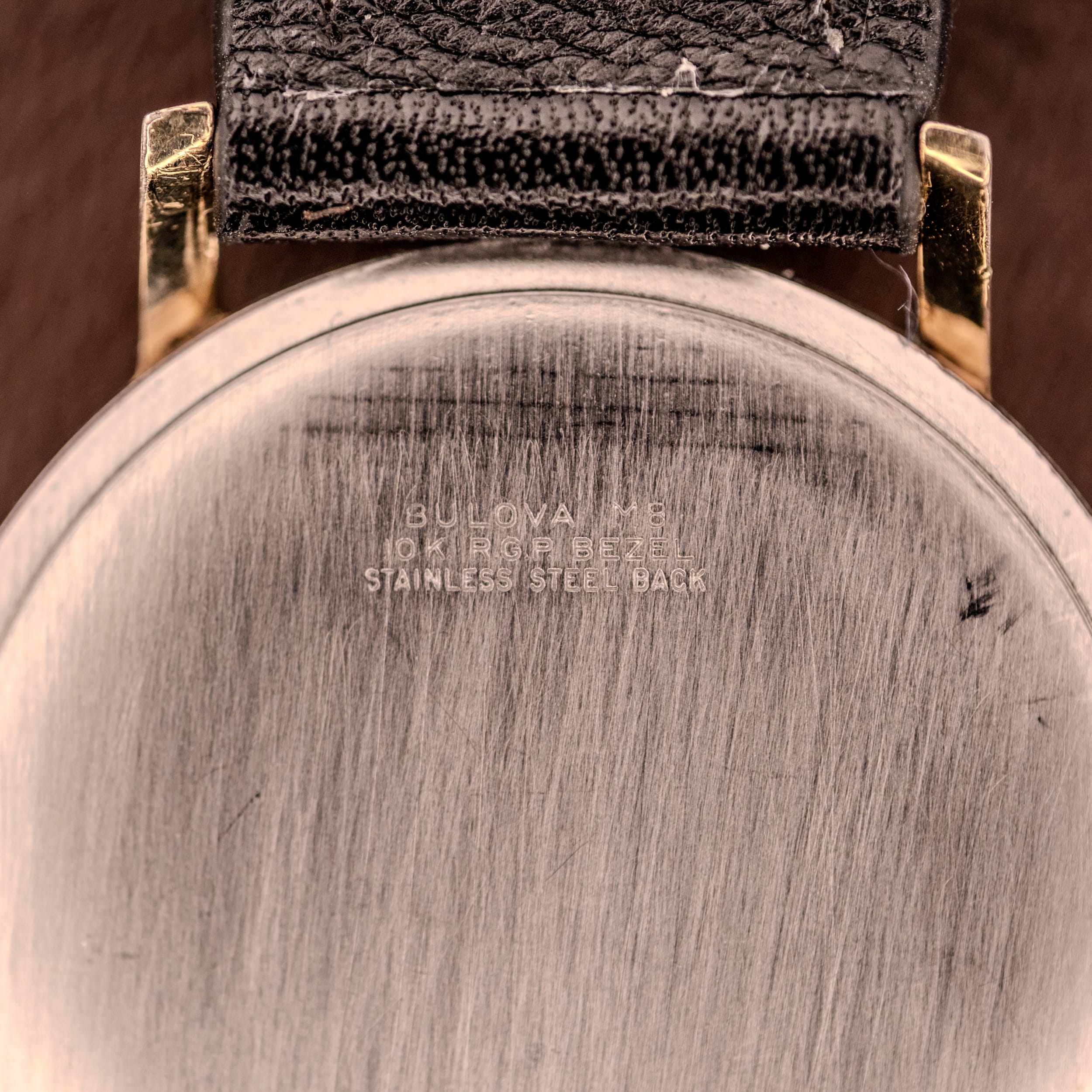
Bulova in 1968 was deep into the era that defined the brand for American collectors. The Accutron tuning fork had landed in 1960 and was selling at the top of the lineup, and underneath the Accutron the brand ran a wide bench of Swiss-made mechanical calibers built in the Bienne facility. This watch sits in that second tier, the dress-case Swiss mechanical Bulova that competed head to head with Hamilton, Wittnauer, and the imported Longines at the same price point. The caseback inner stamping reads BULOVA M8, the M placing production in the 1960s and the 8 placing it specifically in 1968, exactly as the title says.
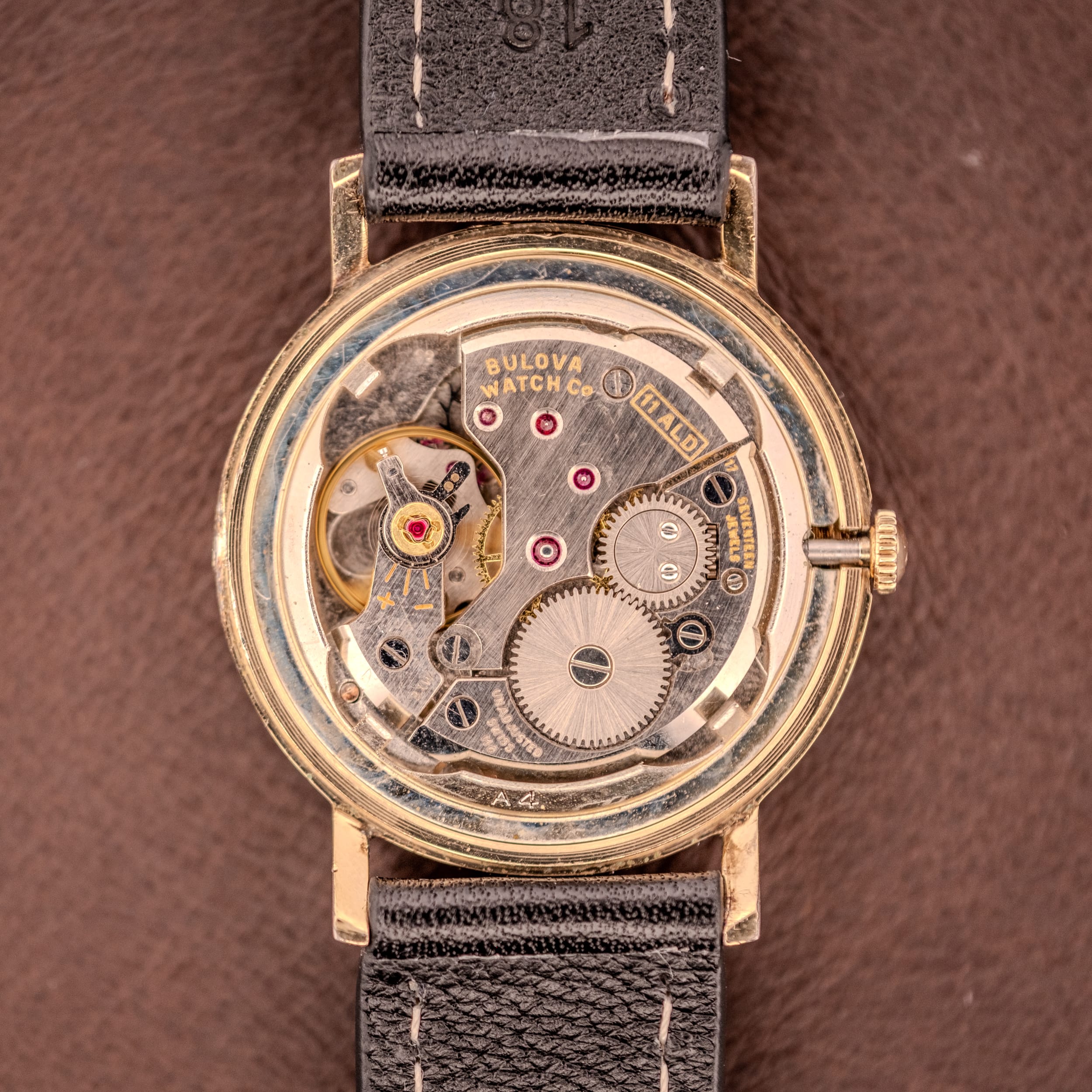
The caliber is the Bulova 11ALD, signed across the bridge BULOVA WATCH Co. with 11ALD and 17 JEWELS stamped clearly through the service photo. The 11ALD is the manual-wind version of the 11AL family that Bulova ran out of its Swiss workshops from the mid 1960s, the D suffix indicating the addition of a date complication on top of the base movement architecture. It runs at 18,000 vibrations per hour with roughly a forty-six hour power reserve when fully wound, lever escapement, KIF Elastor shock protection, and the bridge carries the Geneva striping you can see catching light across the train. The 11ALD family is the bench movement that gave the late-1960s American-market Bulova its calendar capability without bumping the watch up to Accutron money, and it is the caliber the brand quietly retired at the very end of the decade when the lineup pivoted to integrated automatic and quartz architecture. To us, a clean 11ALD with the bridge stamping intact is one of the more honest manual-wind Bulova calibers a collector can pick up today.
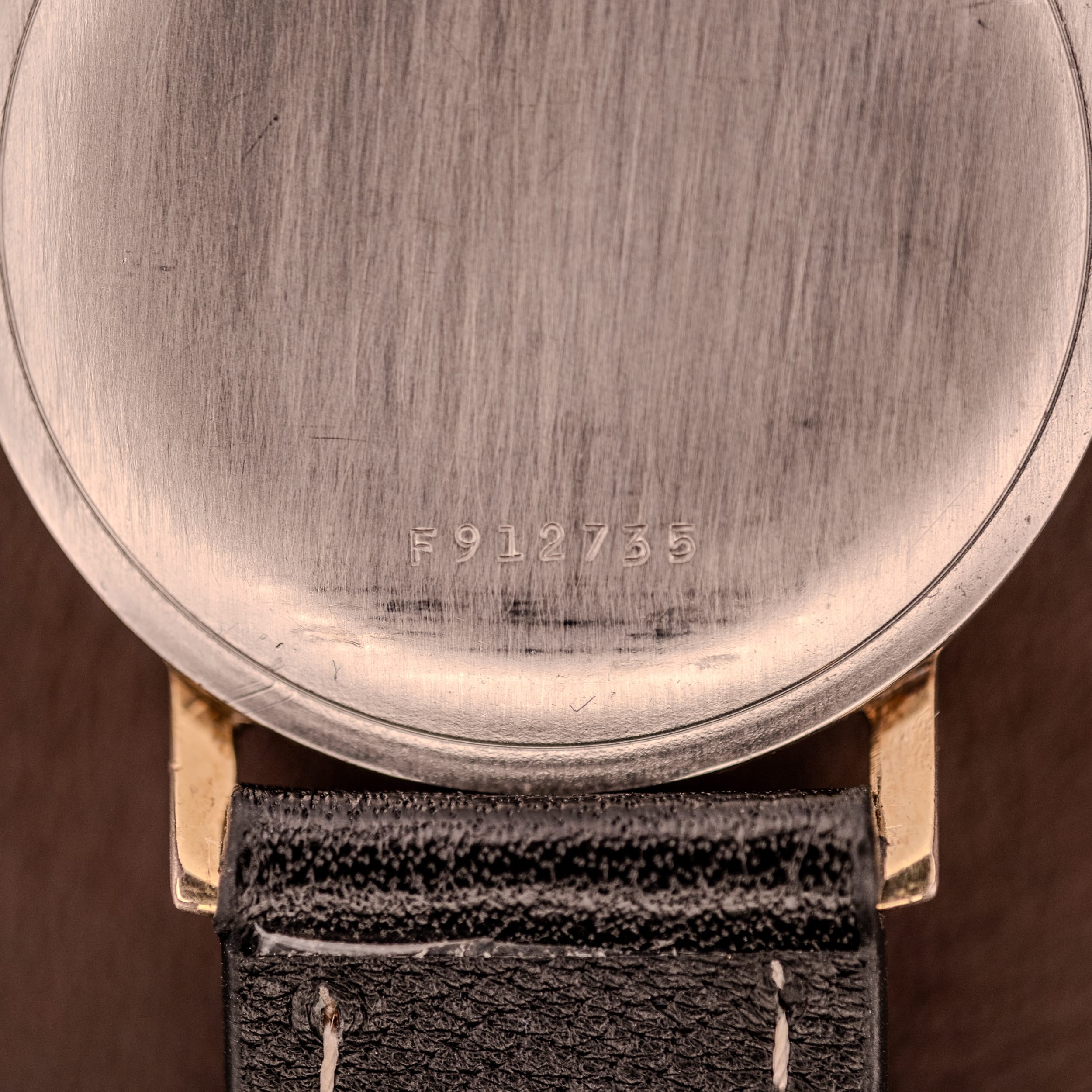
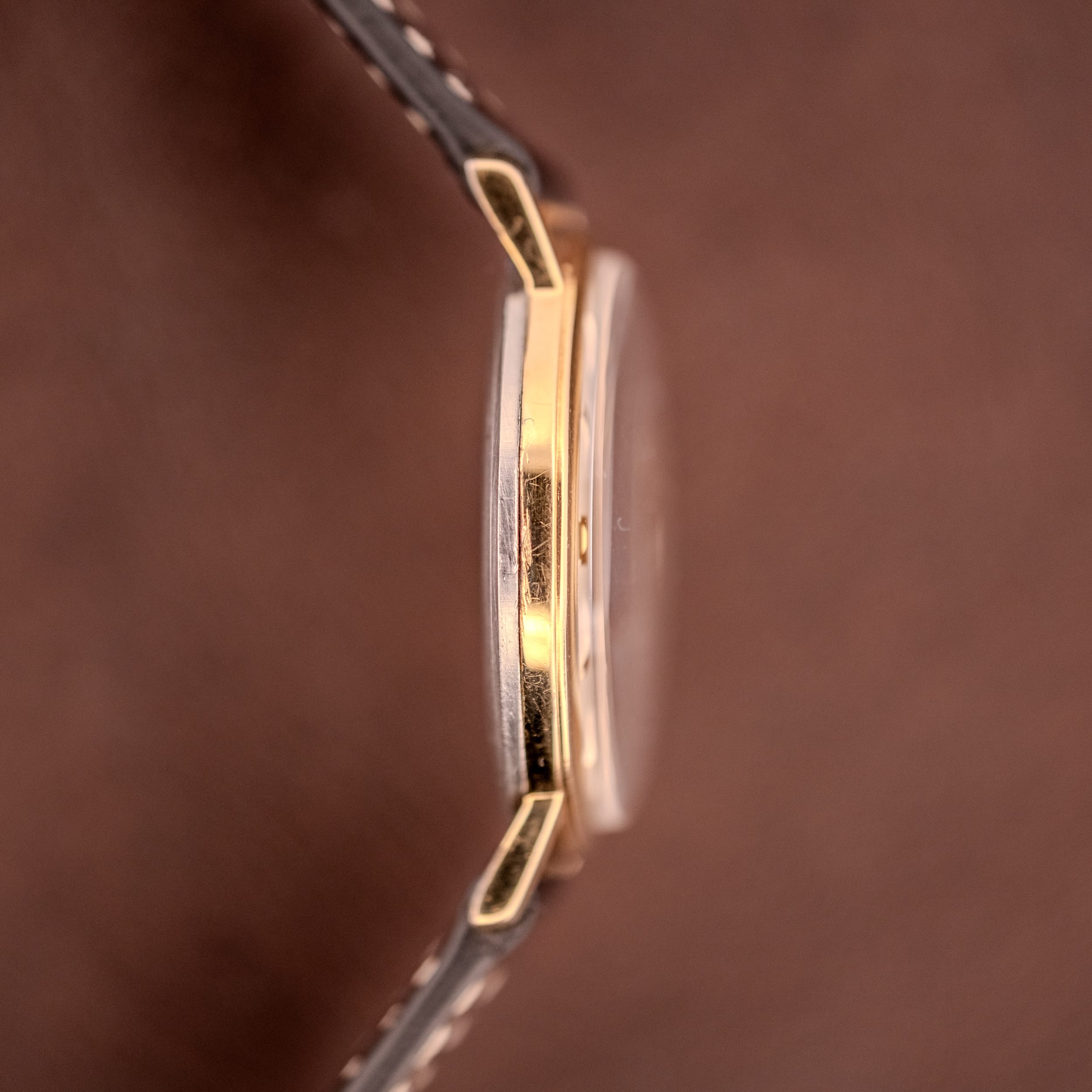
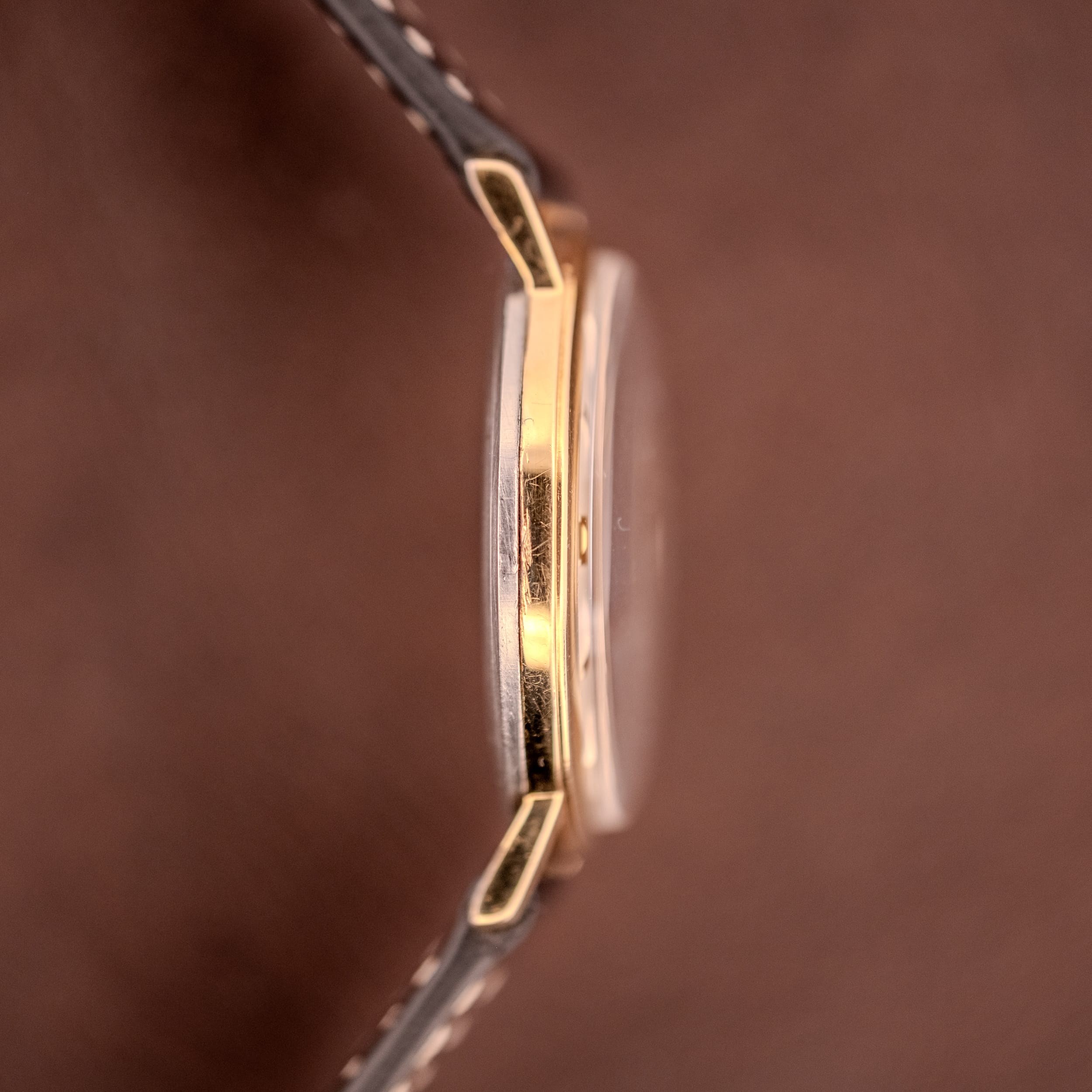
The case carries the construction the inner caseback spells out exactly: 10K RGP BEZEL with a STAINLESS STEEL BACK. RGP is rolled gold plate, a thick bonded layer of 10 karat gold over a base metal substrate, distinct from electroplated gold in both wear pattern and how it ages. The two-tone construction with a gold bezel face and steel screw-style back is the era-correct American-market build for a Bulova at this price point, and you can see the steel side of the case where the bezel meets the back along the case profile. The outer caseback wears the polished brushed finish of a piece that has been carried but never refinished, with the serial F912735 stamped low along the lower edge of the back. The case rounds to a measured 32.5mm across the bezel with a 39.5mm lug-to-lug span and an 18mm lug width, the lugs flowing into the case band as a continuous curve rather than meeting it at a step.
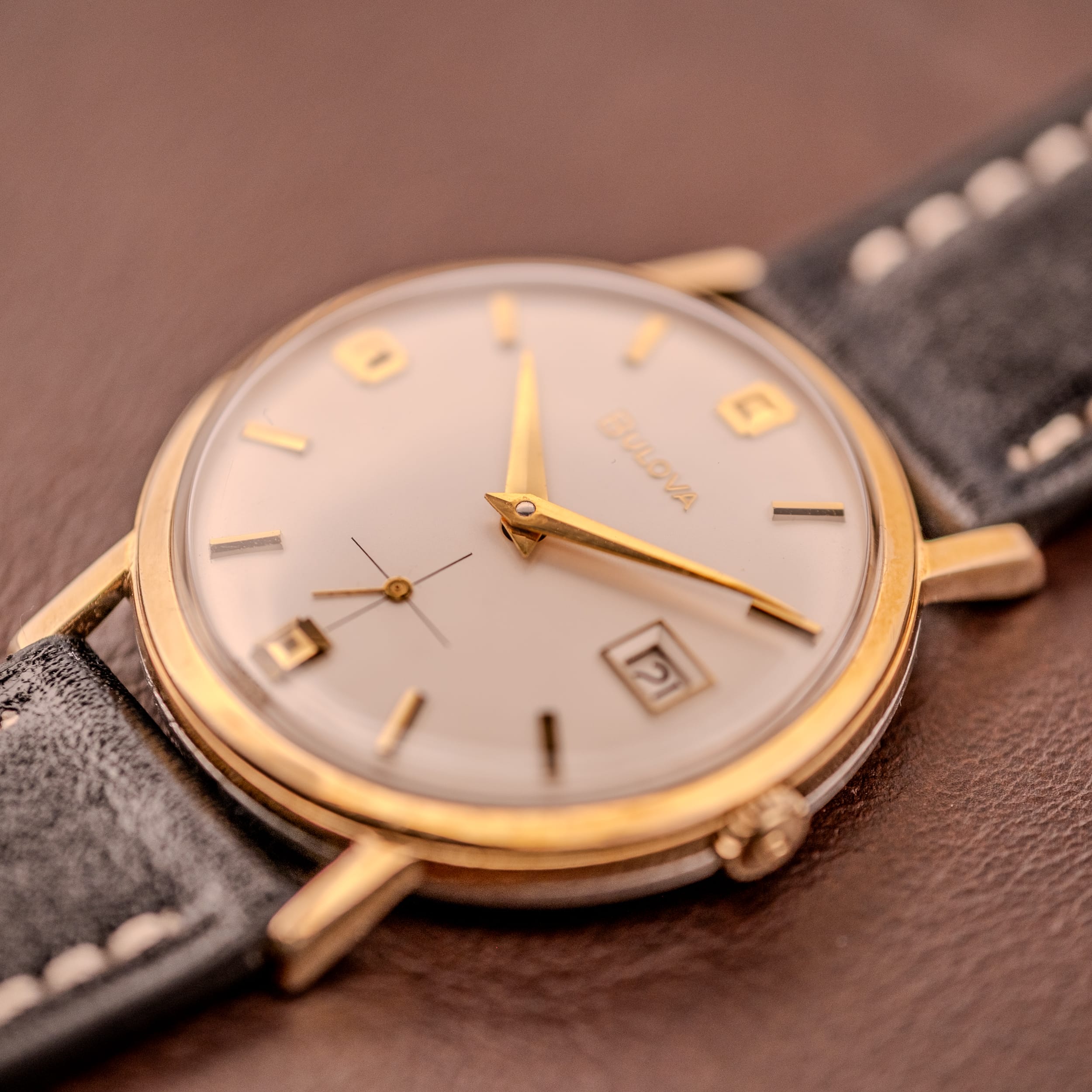
The dial reads cream rather than white, a soft warm matte with no separate inner zone or chapter ring. The applied gold square markers at twelve, three, six, and nine each sit slightly raised off the surface with a recessed inner square that takes light differently than the surrounding gold, and the stick markers between them carry the same slim gold-toned applied profile. The printed BULOVA wordmark sits upper center in period serif, with SWISS printed cleanly below the sub-seconds register at six. The sub-seconds register itself sits at six with a thin crosshair and a small black-tipped seconds hand, and the date window opens at three with a white wheel and black numerals showing through. The handset is the matched gold dauphine pair with slim arrow-pointed tips and a central groove running down the spine of each hand, and the hands remain factory original with the matched profile intact across both minute and hour. There are no T SWISS T markers flanking the SWISS print, consistent with a dial Bulova specified without tritium for this dress-case configuration. Light warm aging across the cream field reads as character rather than damage, and the dial remains factory original and unrefinished.
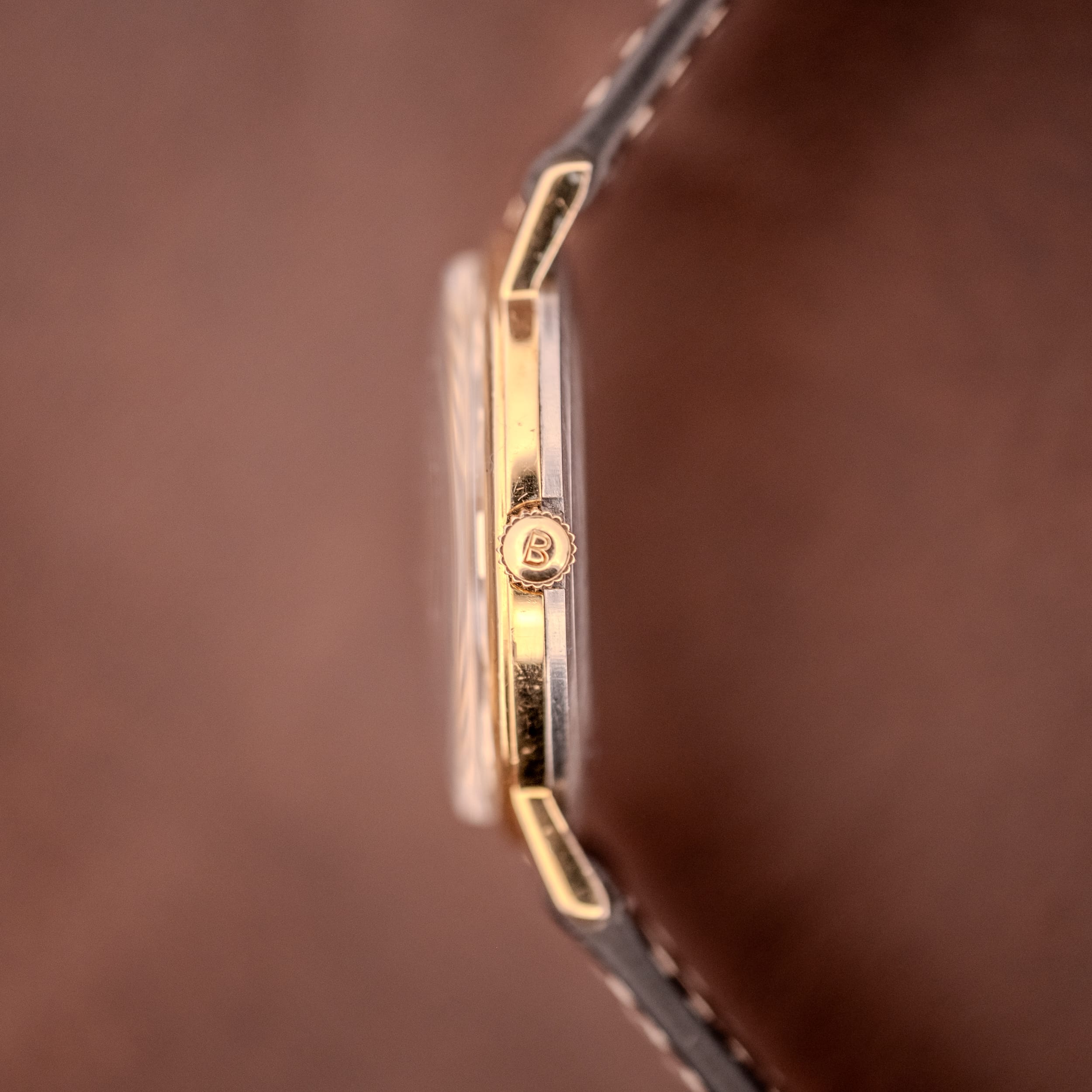
The crown is signed Bulova with the B inside a scalloped circle visible at three on the case profile shot, the period-correct component intact and engaging properly into the winding train. The acrylic crystal domes lightly above the dial. We have paired the watch with one of our black leather straps with white contrast stitching, the black running as a counterweight against the warm cream dial and gold bezel.
Serviced in-house at OTTUHR and backed by our 2-year mechanical warranty, this Bulova Manual Wind Date is the kind of late-1960s American-market Swiss mechanical we genuinely like handling. Factory original cream dial with applied gold squares at the cardinal hours, factory dauphine handset, Bulova-signed crown, intact 10K RGP bezel over the original stainless back, and the 11ALD caliber signed correctly across the bridge and running cleanly. For the collector who values an honest catalogue-correct Bulova over a refinished retail-case piece, and who reads a softly aged cream dial as the better version of the same watch, this is exactly the kind of 1968 Bulova we love bringing in.