
Hamilton’s early wristwatch catalog from the late 1920s and 1930s is, arguably, where the company’s design legacy truly began. While Hamilton had already built an impeccable reputation as America’s premier pocket watch manufacturer, it was the transition to the wrist that unleashed the brand’s creative ambitions. The geometric models of this era, the Squares, Tonneau, Barrel, and their many variations, represented Hamilton’s bold entry into the Art Deco movement, and the results were some of the most beautifully crafted small watches ever produced in America. These were not modest, utilitarian timepieces; they were jewelry-grade objects designed for a clientele that understood quality and demanded it. Every case was made in precious metal or gold filled, every movement was produced in Lancaster, Pennsylvania to exacting standards, and every dial was a miniature canvas of period design.
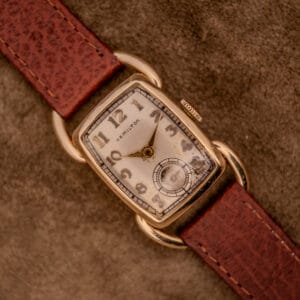
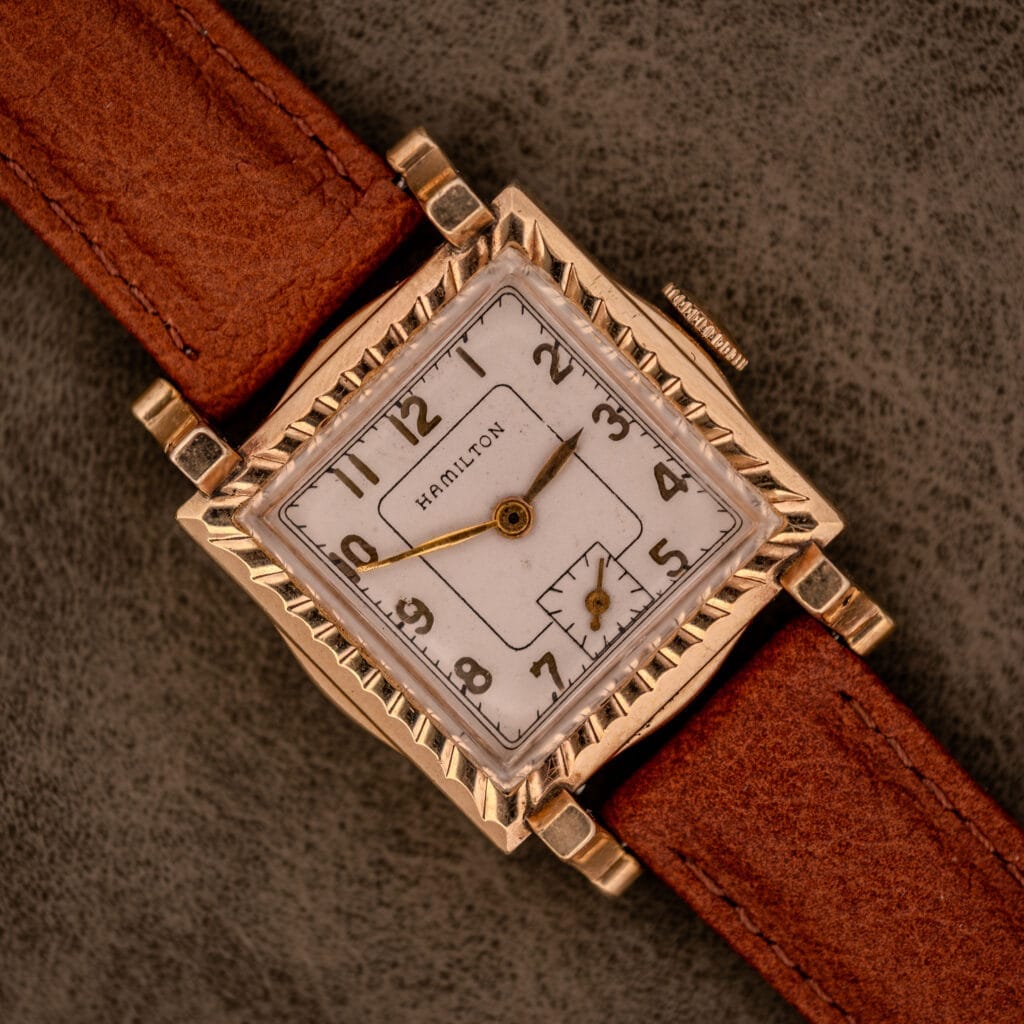
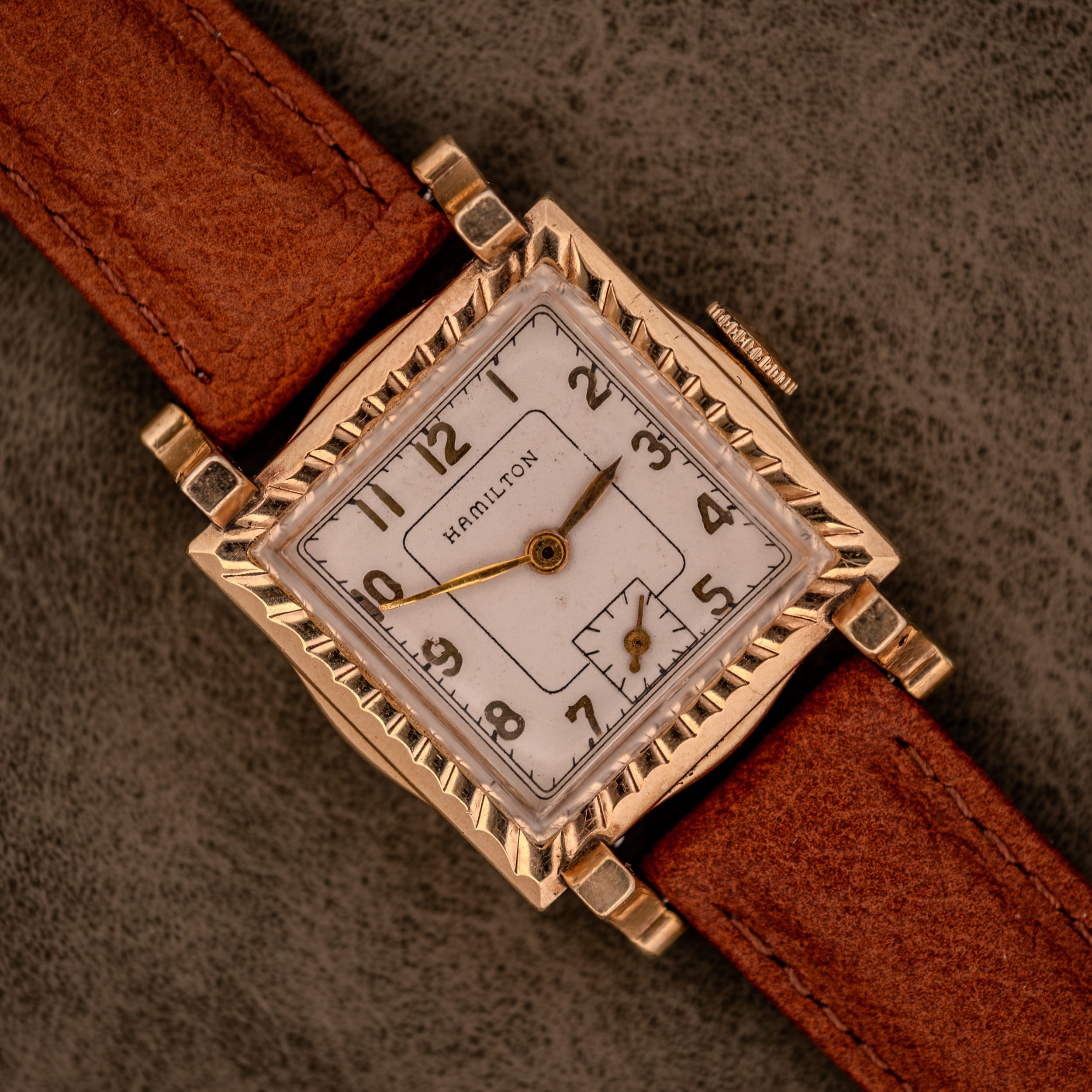
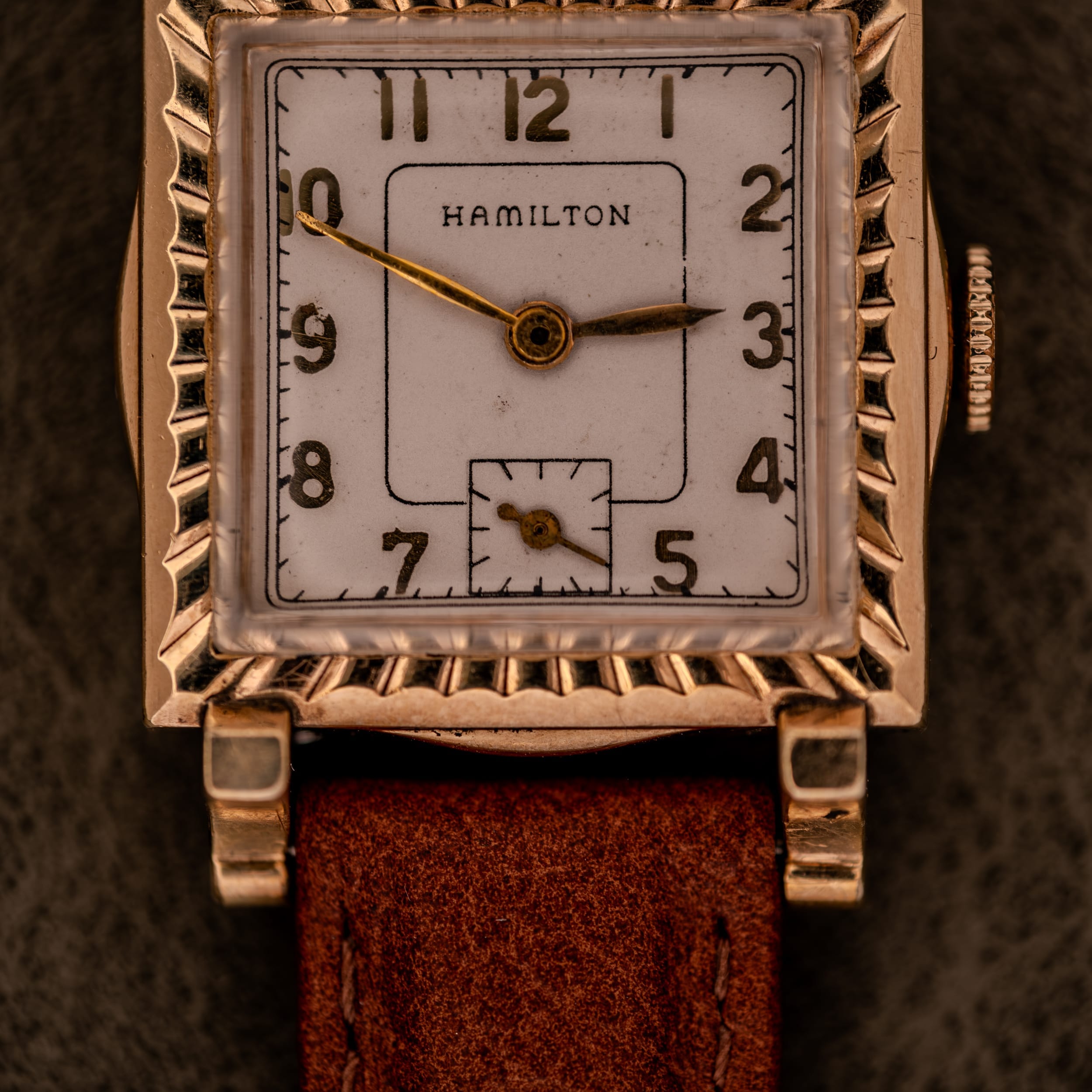
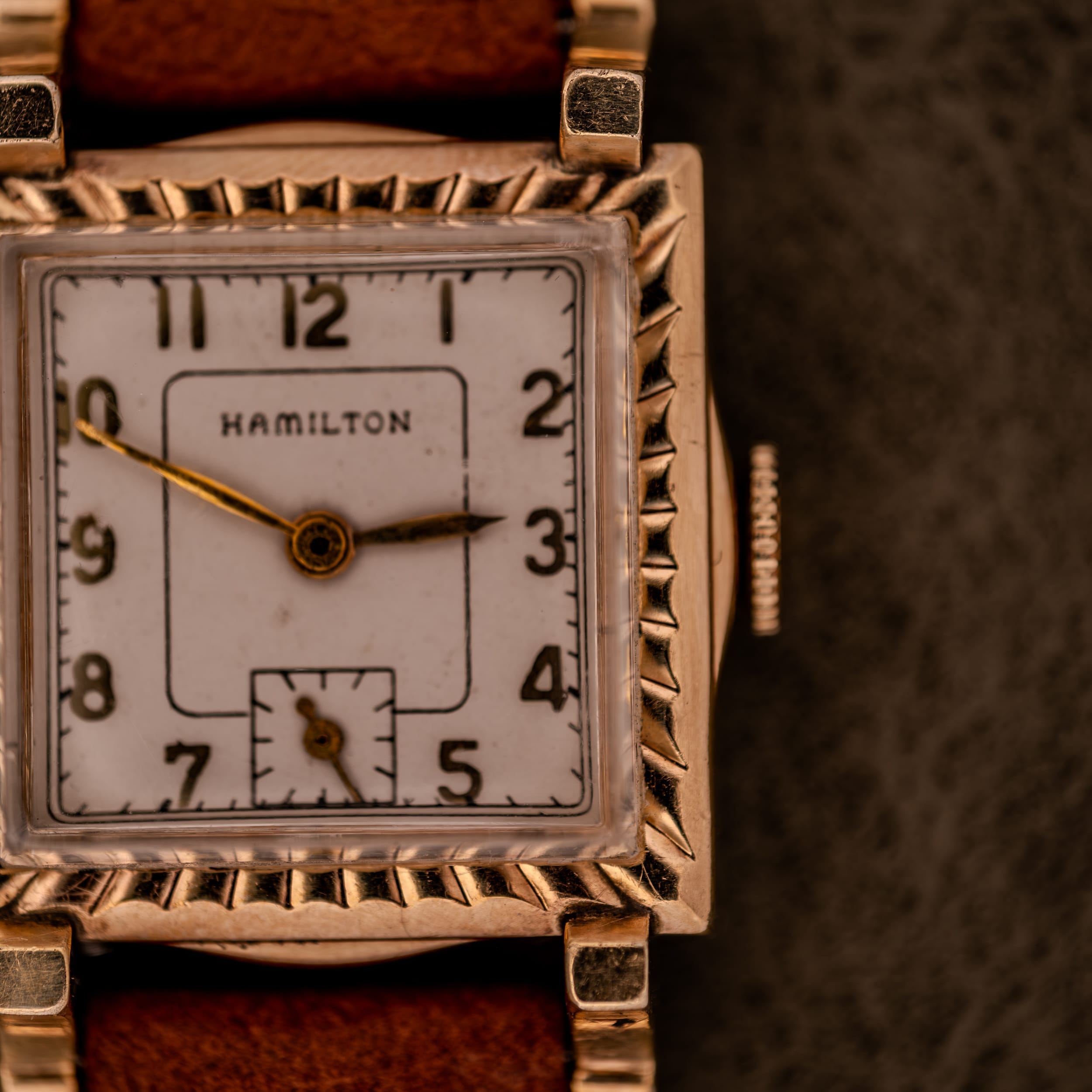
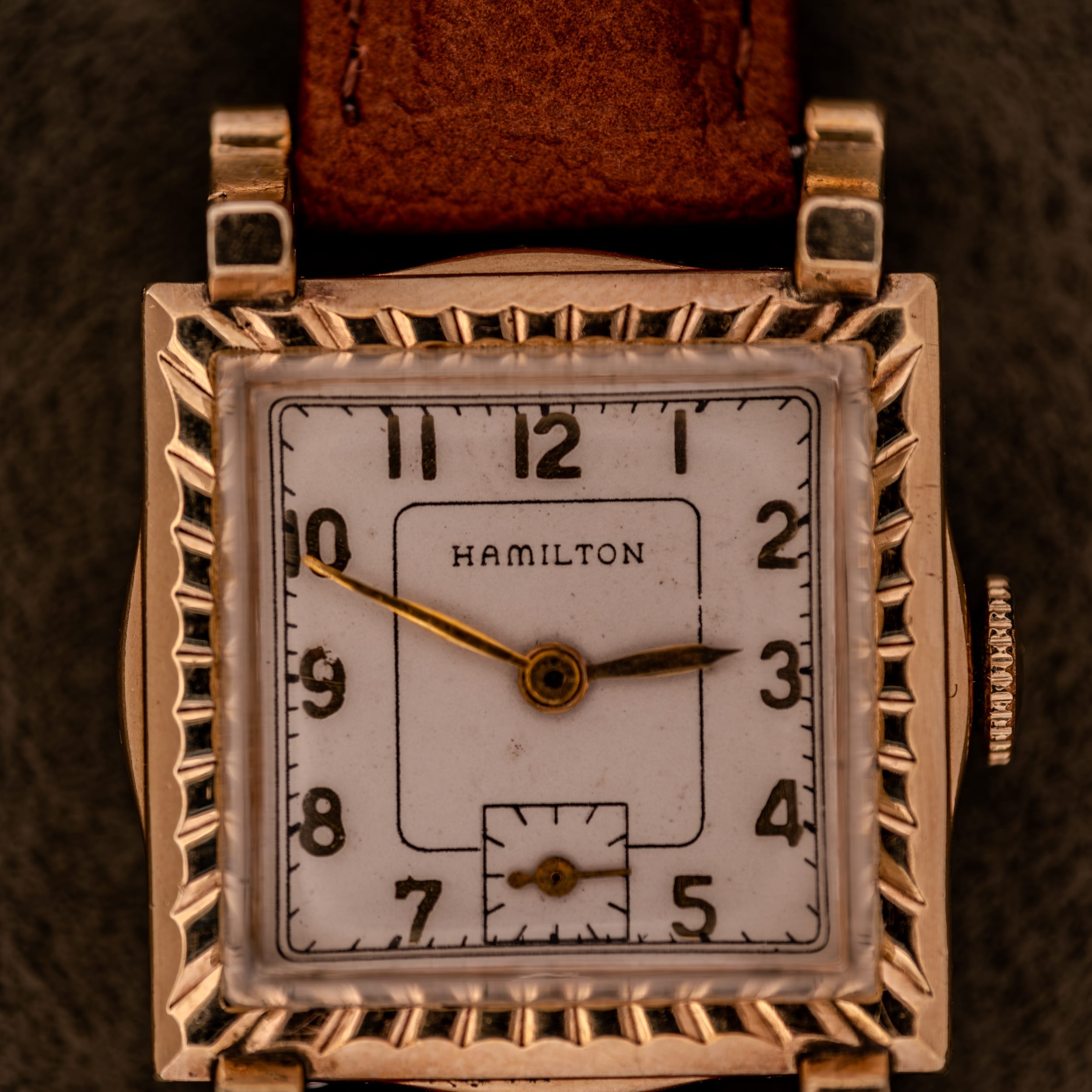
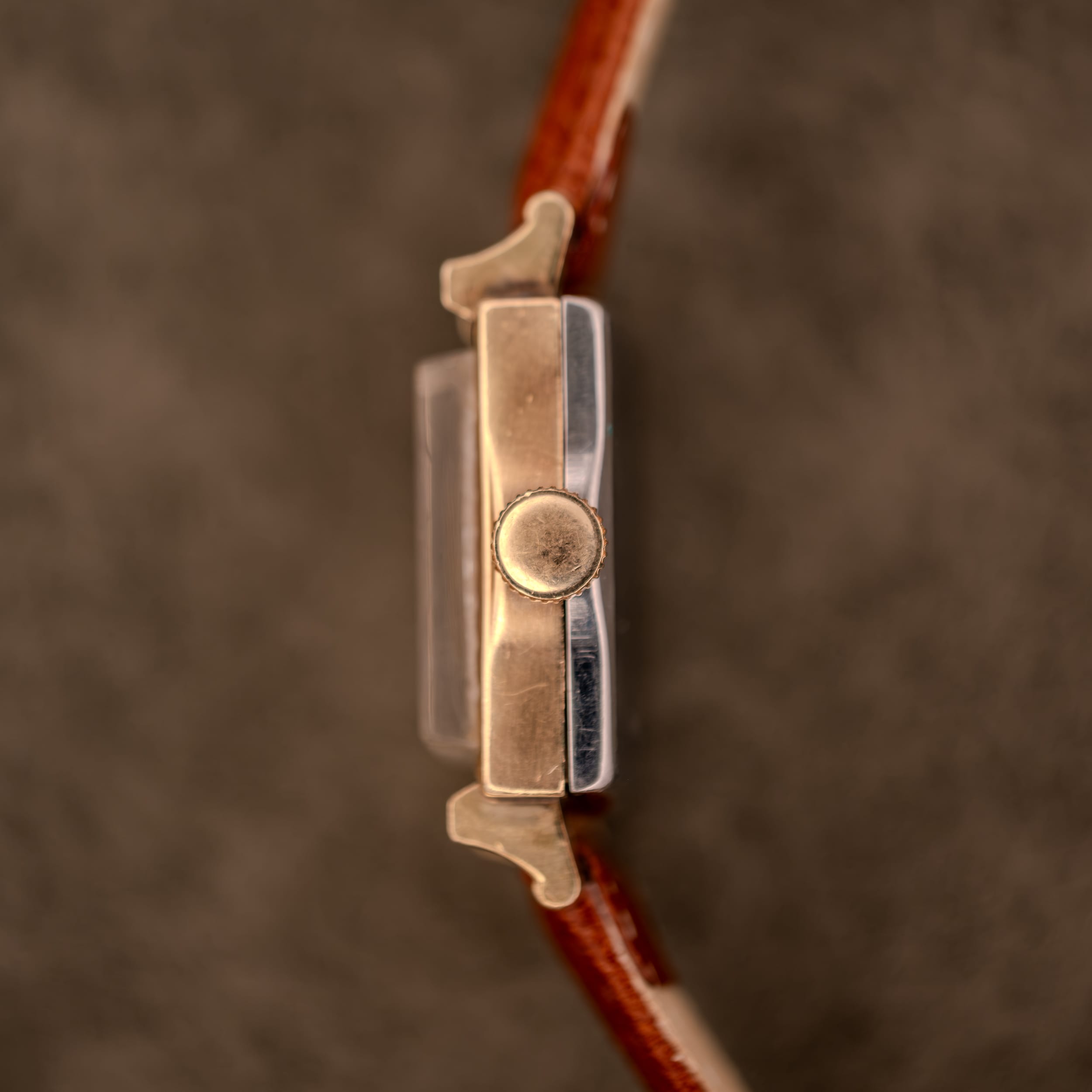
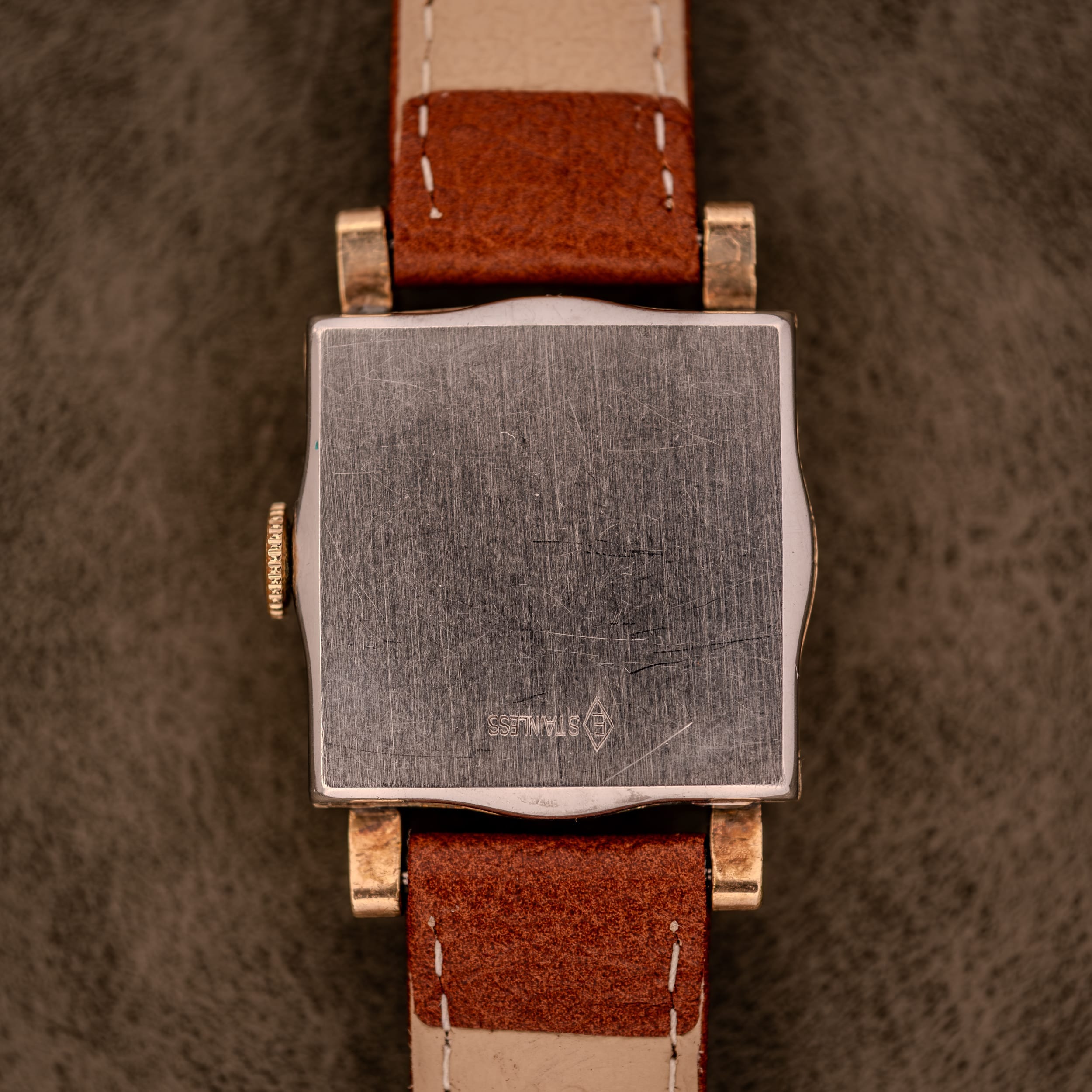
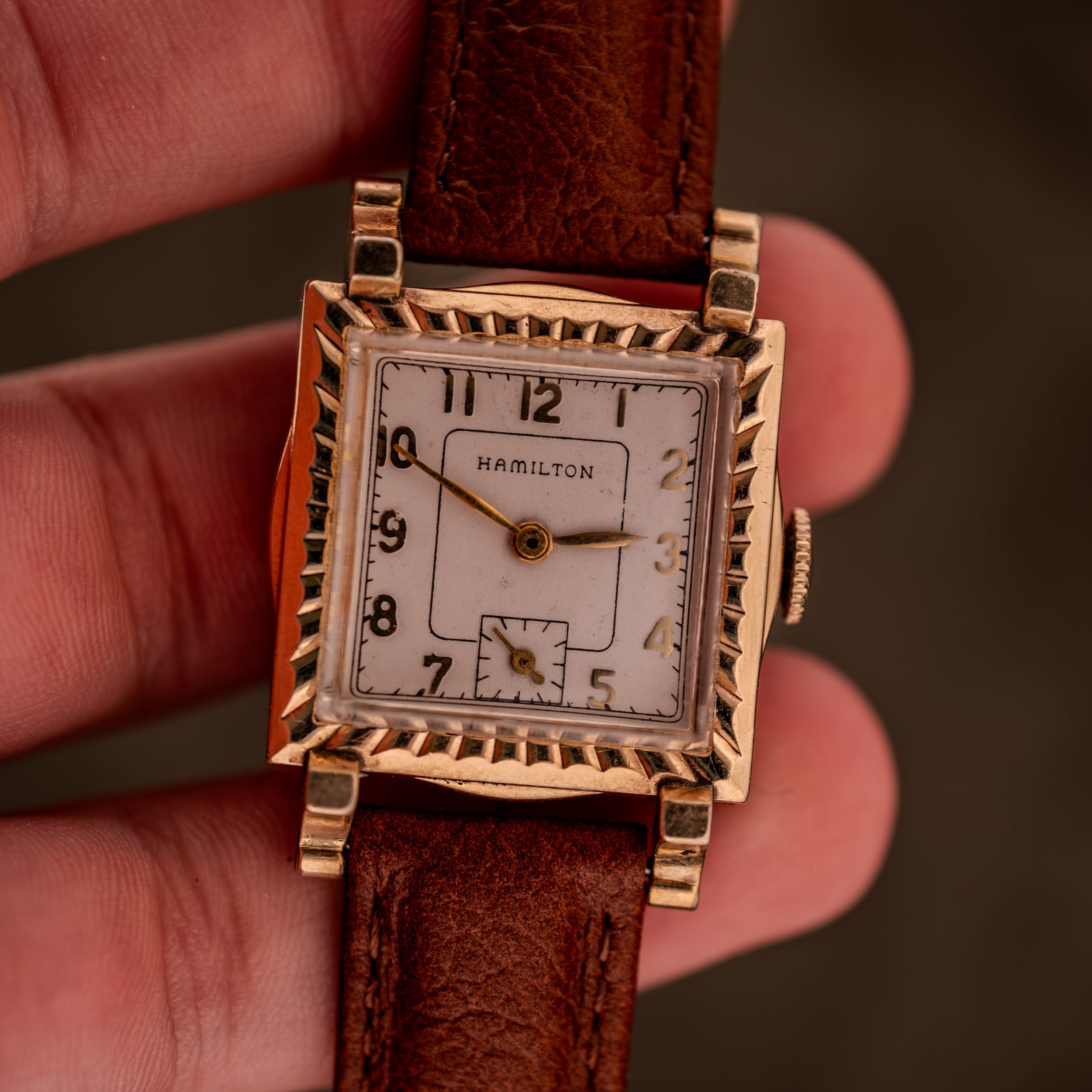
This particular example features an engraved bezel variant that is, to us, one of the most visually arresting case treatments Hamilton ever offered. The square case is surrounded on all four sides by a deeply carved sawtooth pattern, each tiny ridge catching and refracting light to create a shimmering, almost crown-like effect around the dial aperture. It is a remarkably labor-intensive finishing technique, and the precision required to execute it uniformly across the entire bezel perimeter speaks to the quality of the casemakers Hamilton worked with during this period. The fixed wire lugs at each corner are elegantly simple, providing a clean visual counterpoint to the richness of the bezel decoration. The gold filled construction retains a warm, rich tone throughout, and the stainless steel snap-back caseback is stamped with the Hamilton diamond logo and “Stainless.”
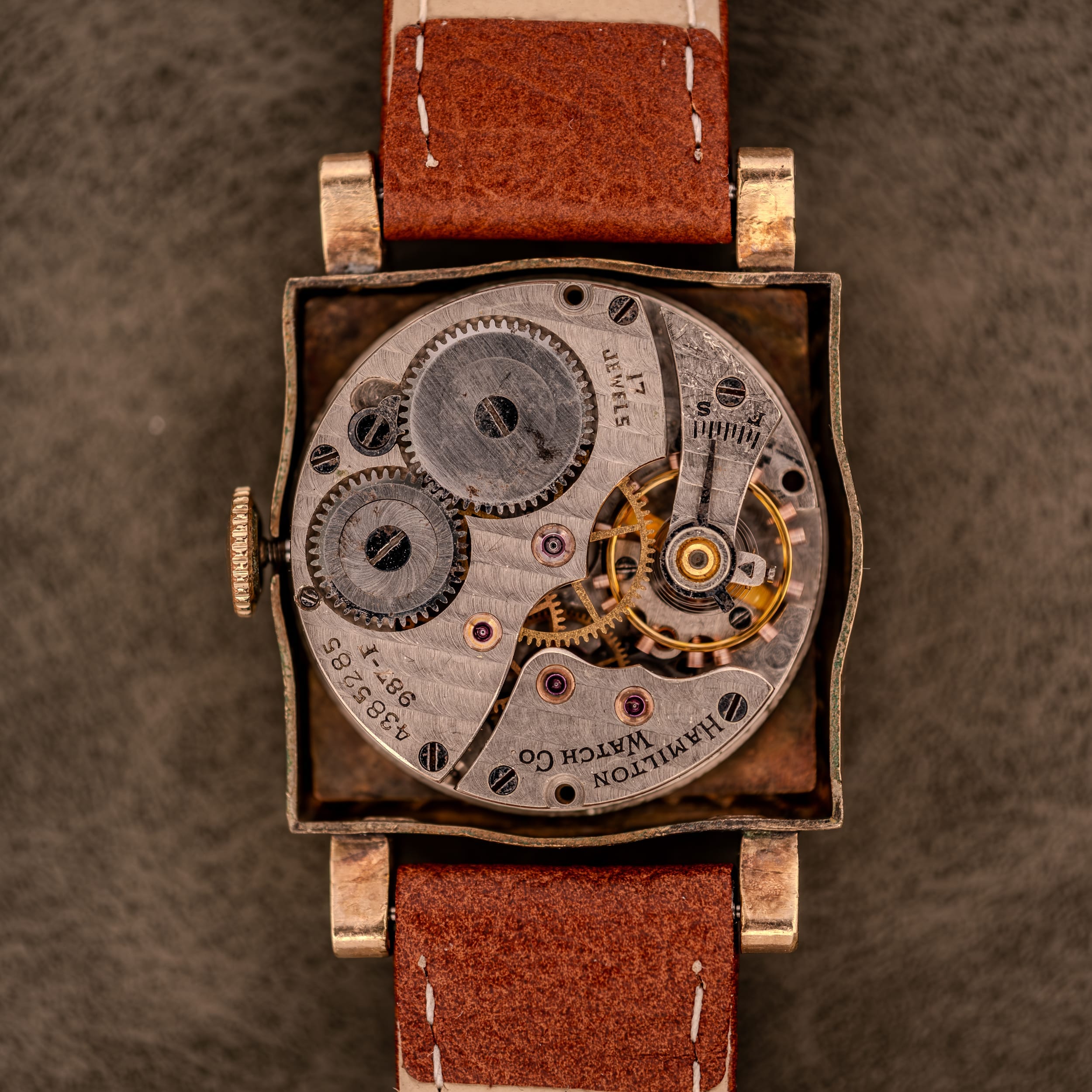
Powering this watch is Hamilton’s Caliber 987-F, a 17-jewel, 6/0 size, American-made manual-wind movement. The 987-F was produced from approximately 1930 to 1934, which helps date this watch to the early 1930s. It was an evolution of the original 987 caliber introduced in 1927, and it is engraved “Hamilton Watch Co., 987-F, 17 Jewels” with the serial number 4385285. The movement is beautifully finished with Geneva striping across the bridges, visible ruby jewels, and a gilt gear train, the kind of meticulous American watchmaking that made Hamilton’s reputation. It is a hand-wound movement with subsidiary seconds, and the tactile, mechanical experience of winding it daily is part of the pleasure of owning a watch from this era.
The white dial is in honest, characterful condition, carrying a full set of printed Arabic numerals in a period-correct typography that is unmistakably 1930s. The Hamilton name is printed within a rectangular cartouche in the upper center of the dial, and the subsidiary seconds register at six o’clock features a geometric frame with radiating hash marks that adds a decorative depth entirely in keeping with the Art Deco design language. The original gold lance-shaped hour and minute hands are present and correct, showing warm patina that has mellowed beautifully. The dial itself shows gentle aging with light marks and toning consistent with a watch that is roughly ninety years old, lending it the kind of authentic character that collectors in this space treasure.
For the enthusiast of prewar American horology, a Hamilton Square with an engraved bezel is the real deal. It is a watch that represents Hamilton at the very beginning of its wristwatch story, powered by a proper Lancaster-made movement, housed in a case that doubles as a work of Art Deco decorative art, and small enough to wear with genuine charm and period correctness. On the brown leather strap, it is a conversation piece of the highest order, a miniature jewel from the Jazz Age that continues to captivate nearly a century later.