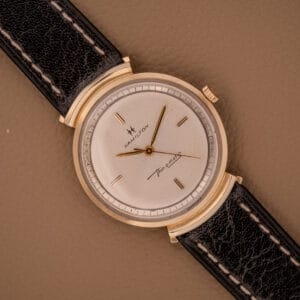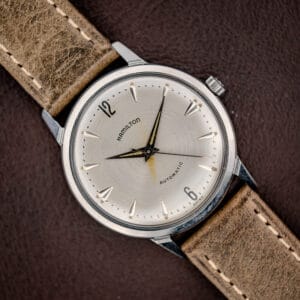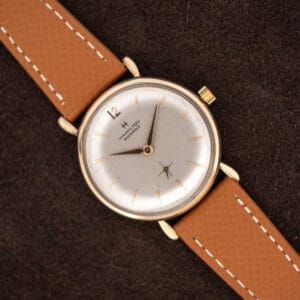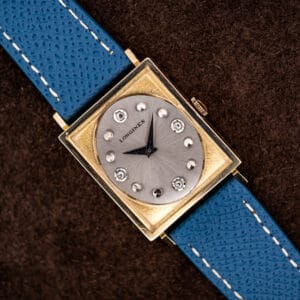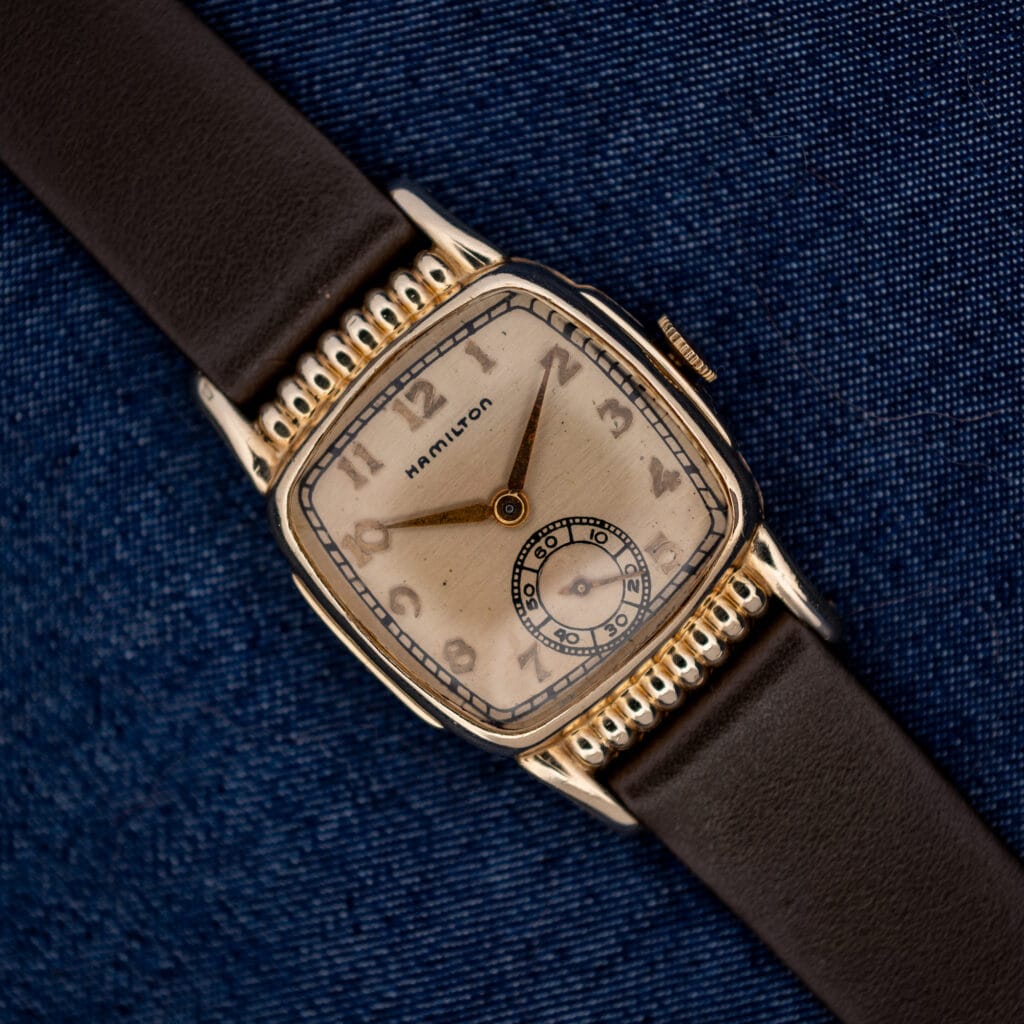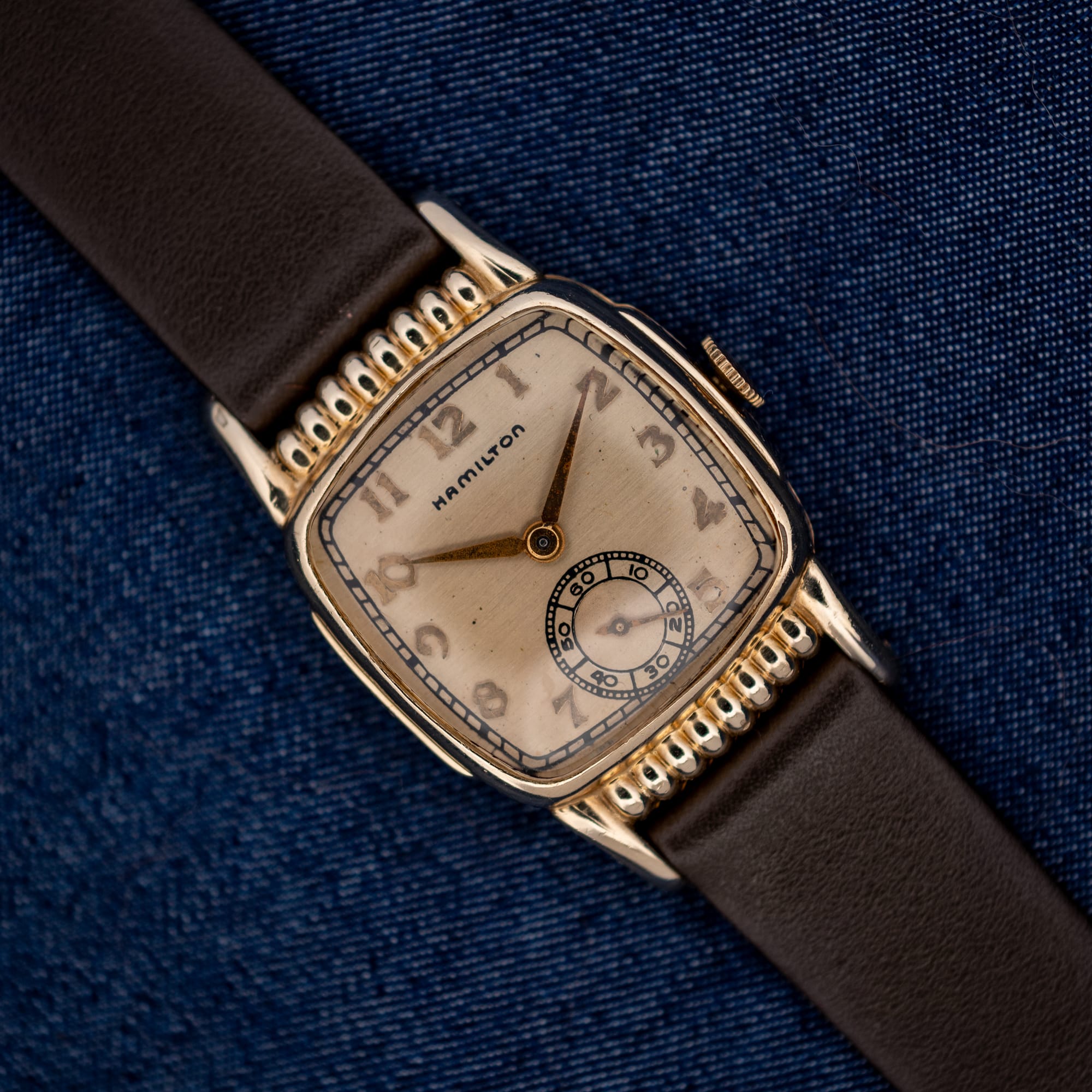
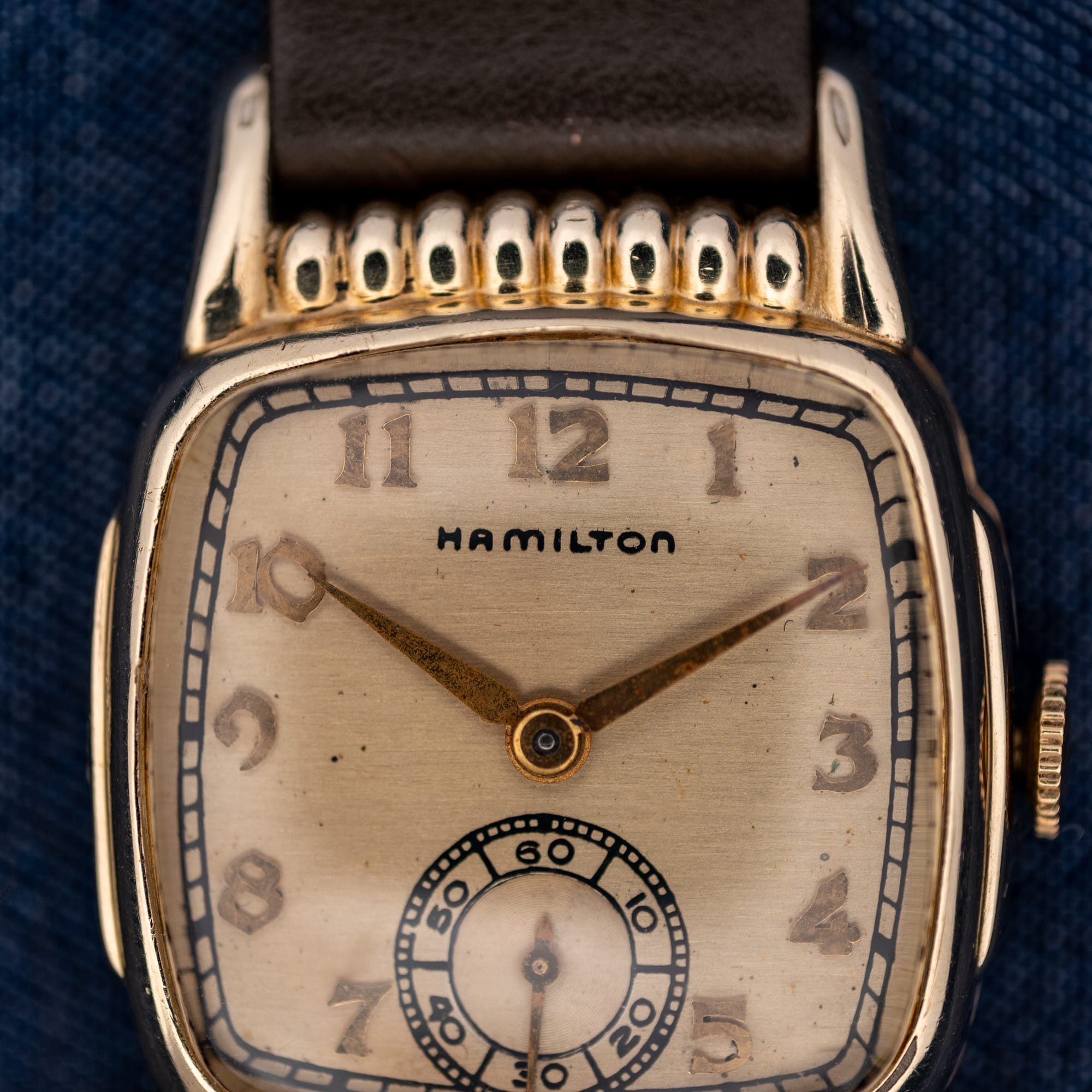
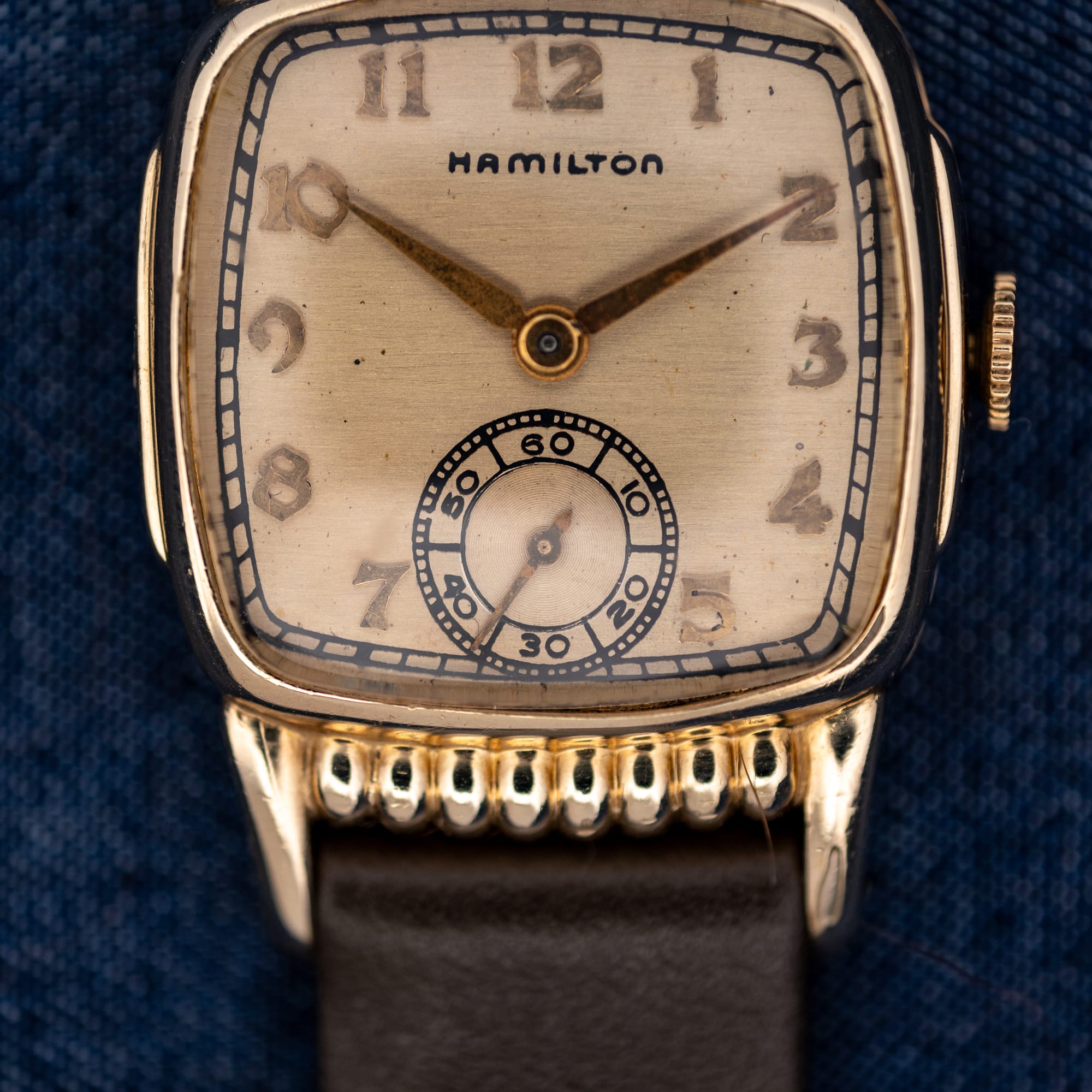
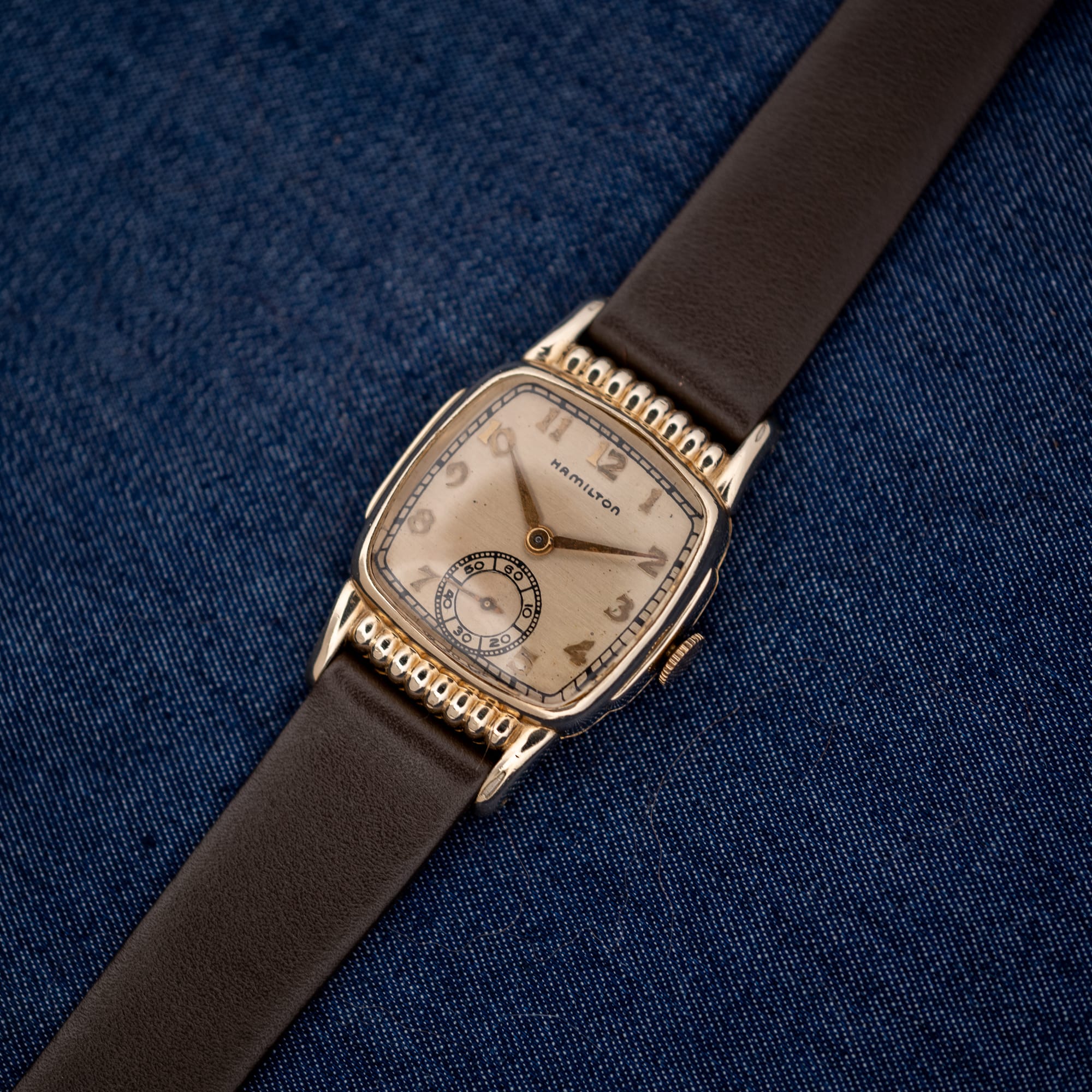
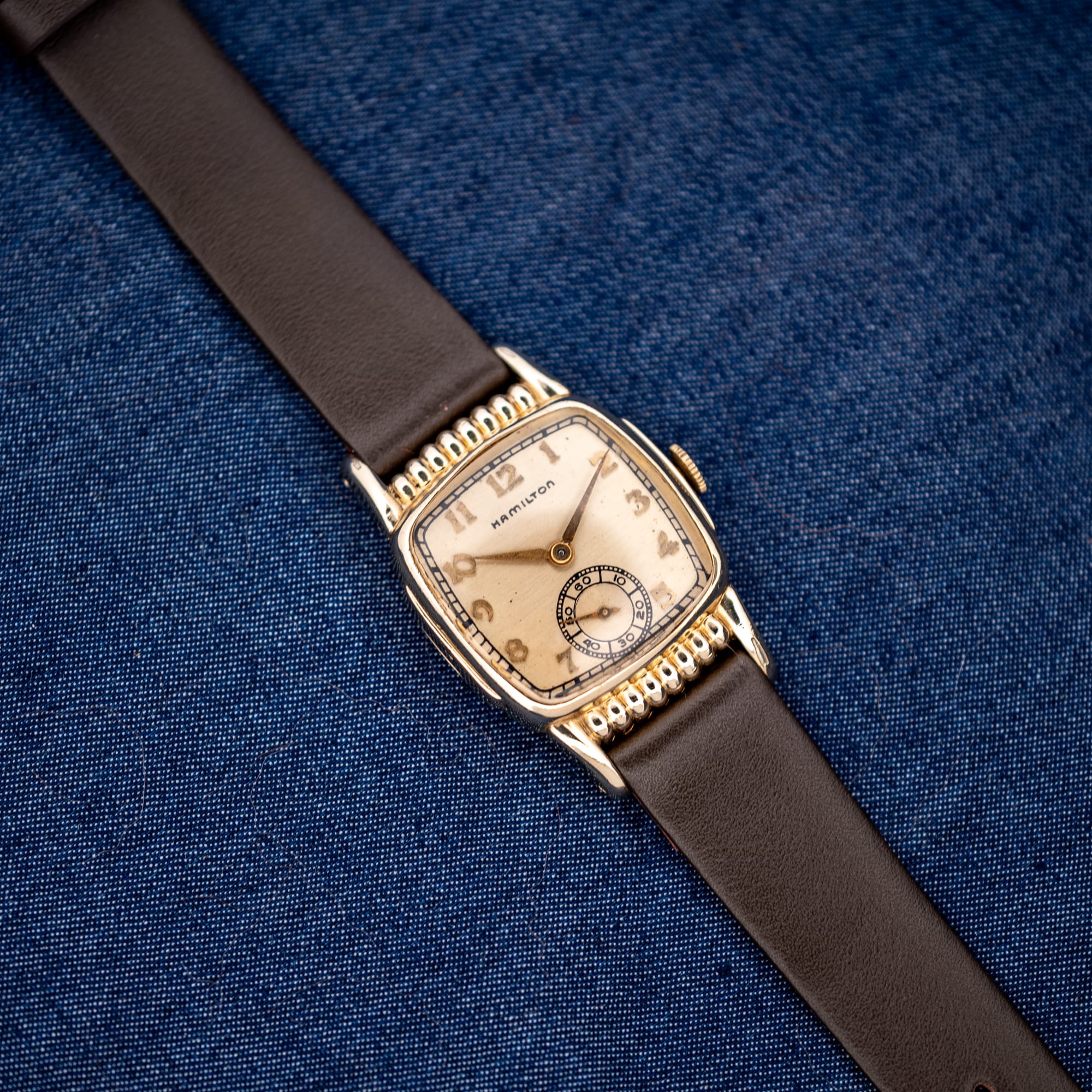
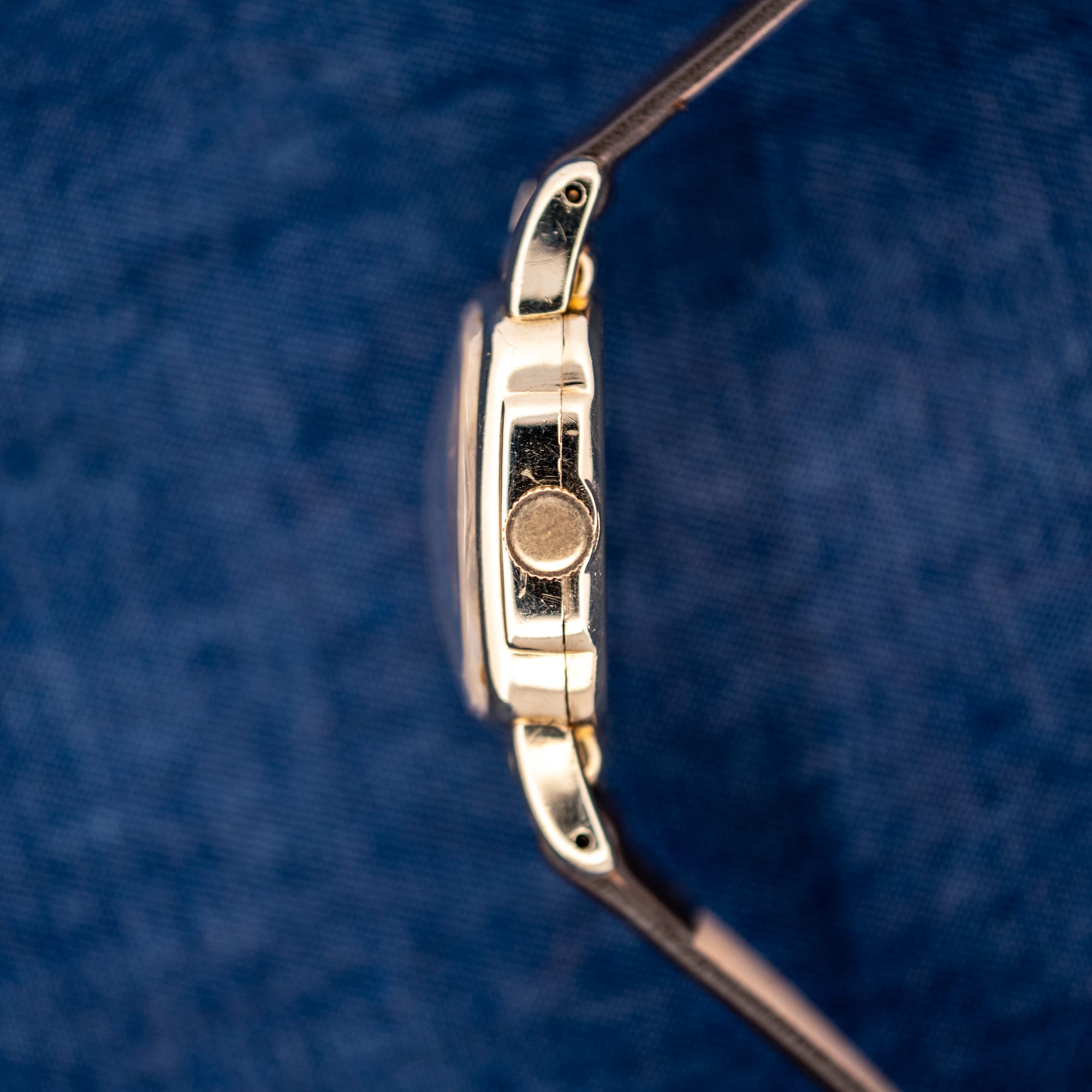
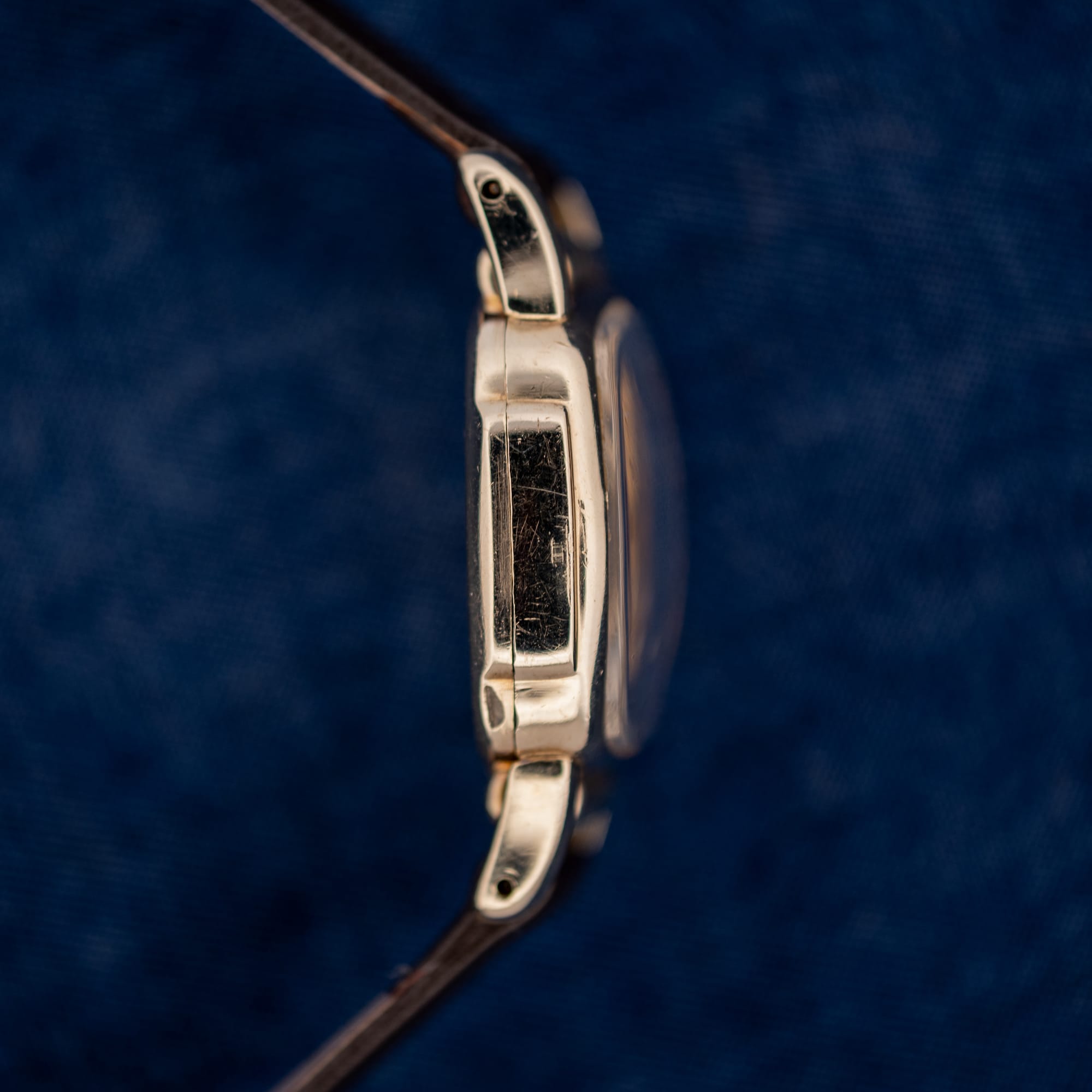
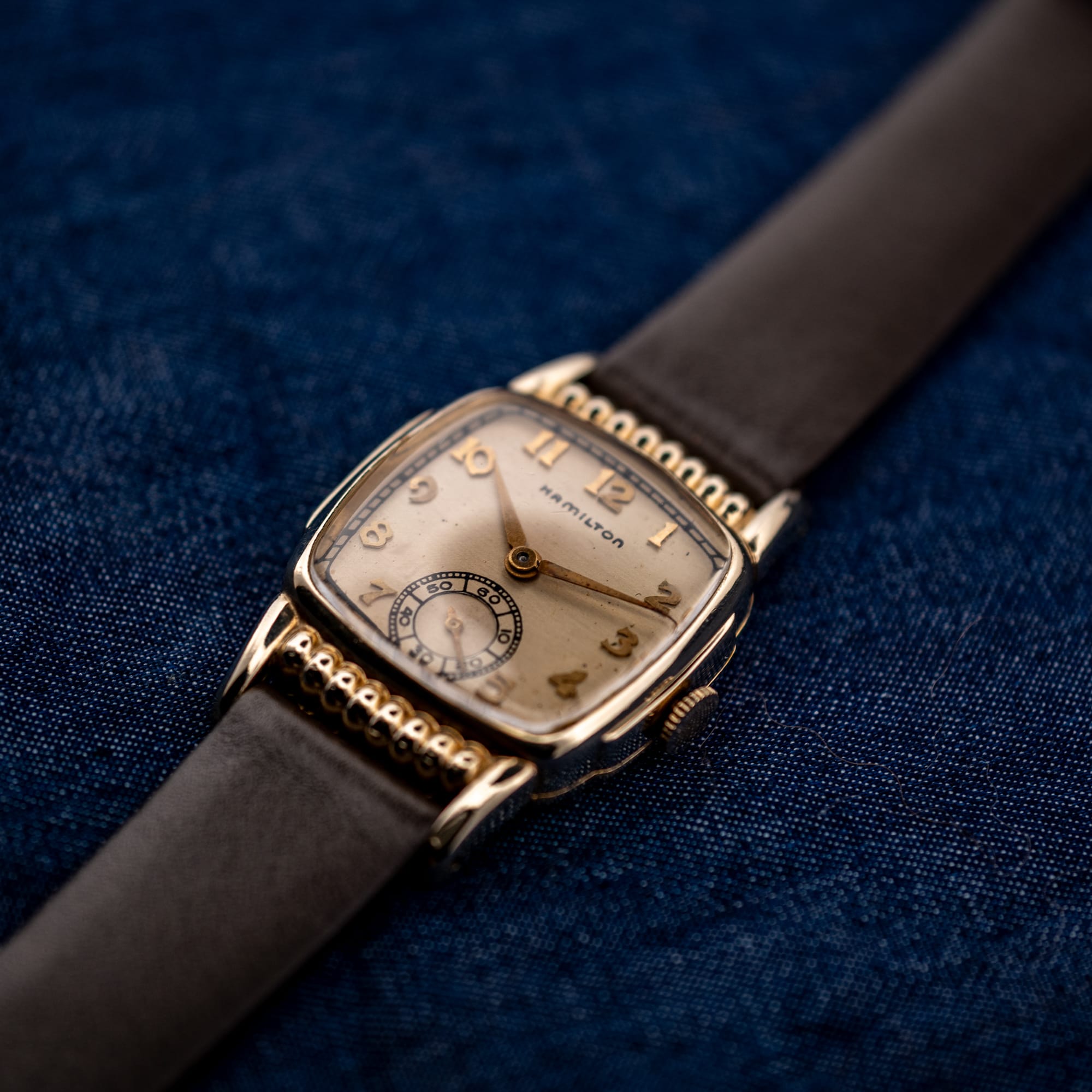
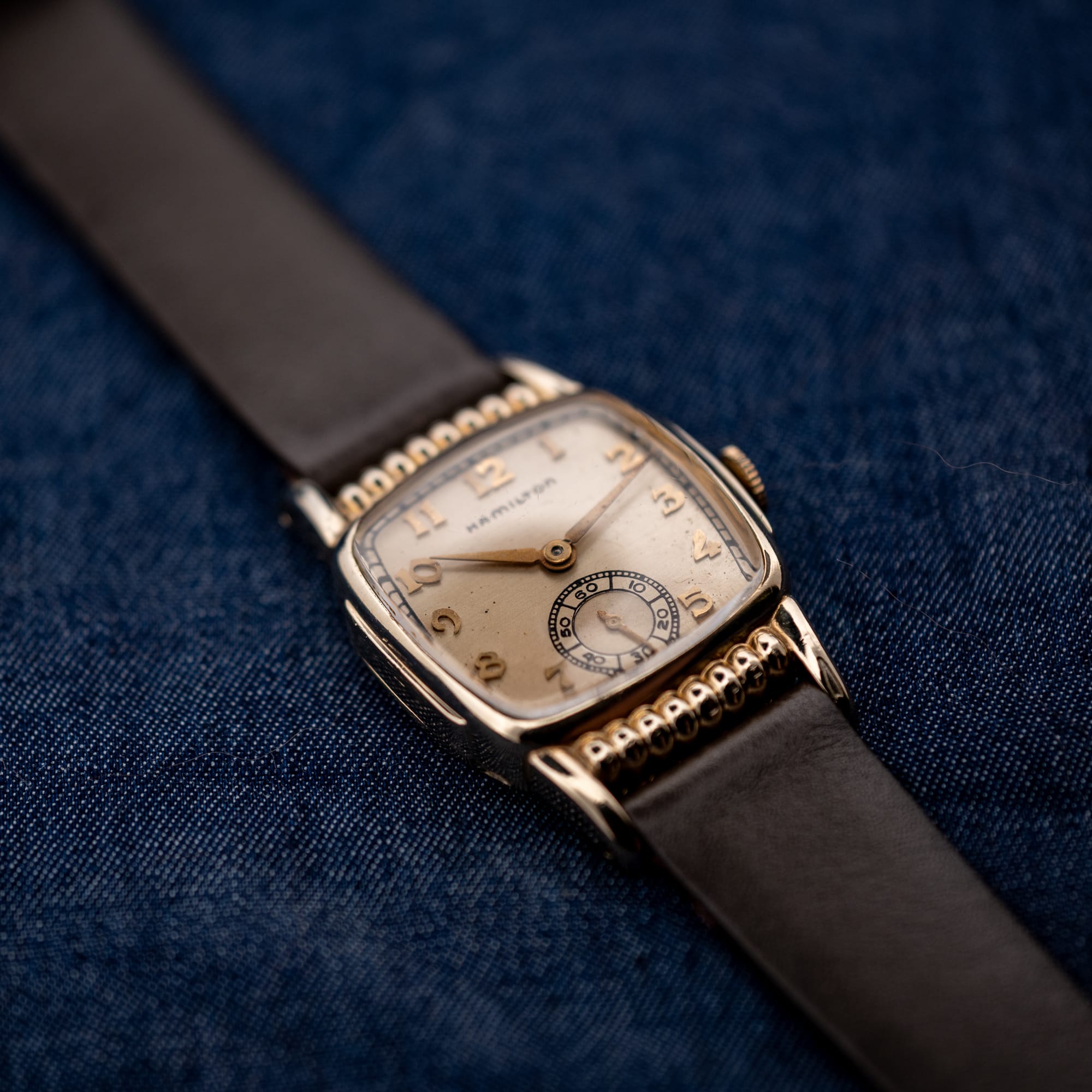
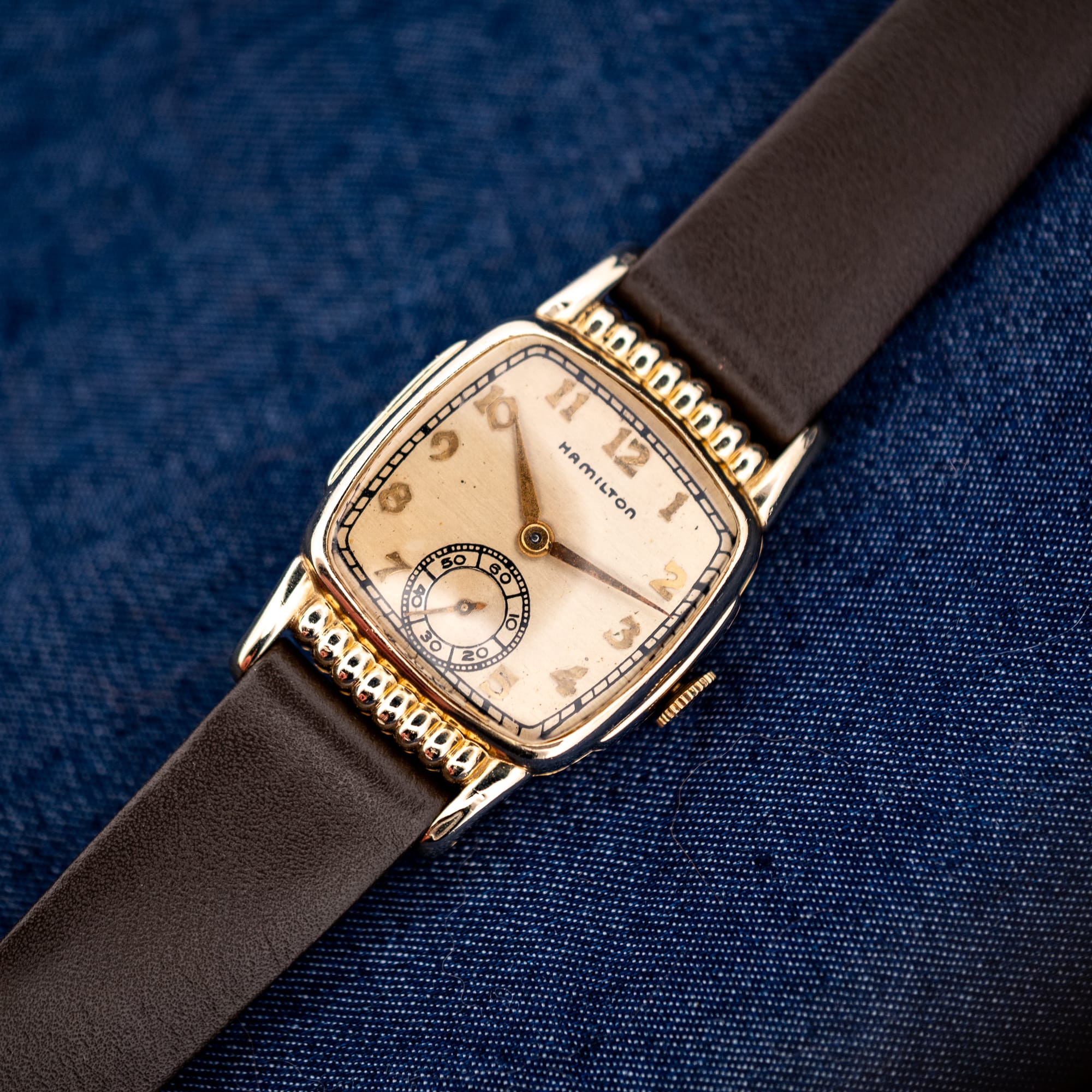

Hamilton finished both ends of the Roland’s case with a row of small rounded beads, packed between two sharply pointed lugs. At a glance they pass for the first links of a gold bracelet. They are solid, part of the 10k gold-filled case, and they give this Hamilton Roland a texture that a plain rectangle never has. Hamilton had used a similar row on the 1940 Russell, where it sat on flexible lugs that moved with the strap. On the Roland the lugs are fixed, and the beads stay purely for show.
Because the beads stand proud of everything around them, they are where a Roland takes its knocks first, and a crisp row is the thing to look for in this model. On this example each bead still reads as its own rounded form, top and bottom.
Hamilton listed the Roland in 1948, for that year only, at $52.25. Its catalog entry is a single line of specification: “Grade 987. 17 jewels. 10K natural gold-filled. 18K applied gold numeral dial.” The last phrase is the one worth lingering on. Hamilton specified the raised Arabic numerals in 18k gold and set them onto the dial rather than printing them, so they stand up off the surface when the watch is seen low and from the side.
Around those numerals the silver dial is drawn for reading: a black railway track at the edge, and at six a large sunken seconds register in place of the numeral, ringed with bold black figures from 10 to 60. To us that register is the best thing on the watch, a big round eye inside a rectangular case that answers the round beads at either end. The dial has toned warm with age and carries scattered fine spots, and the gold-tone hands have darkened along with it.
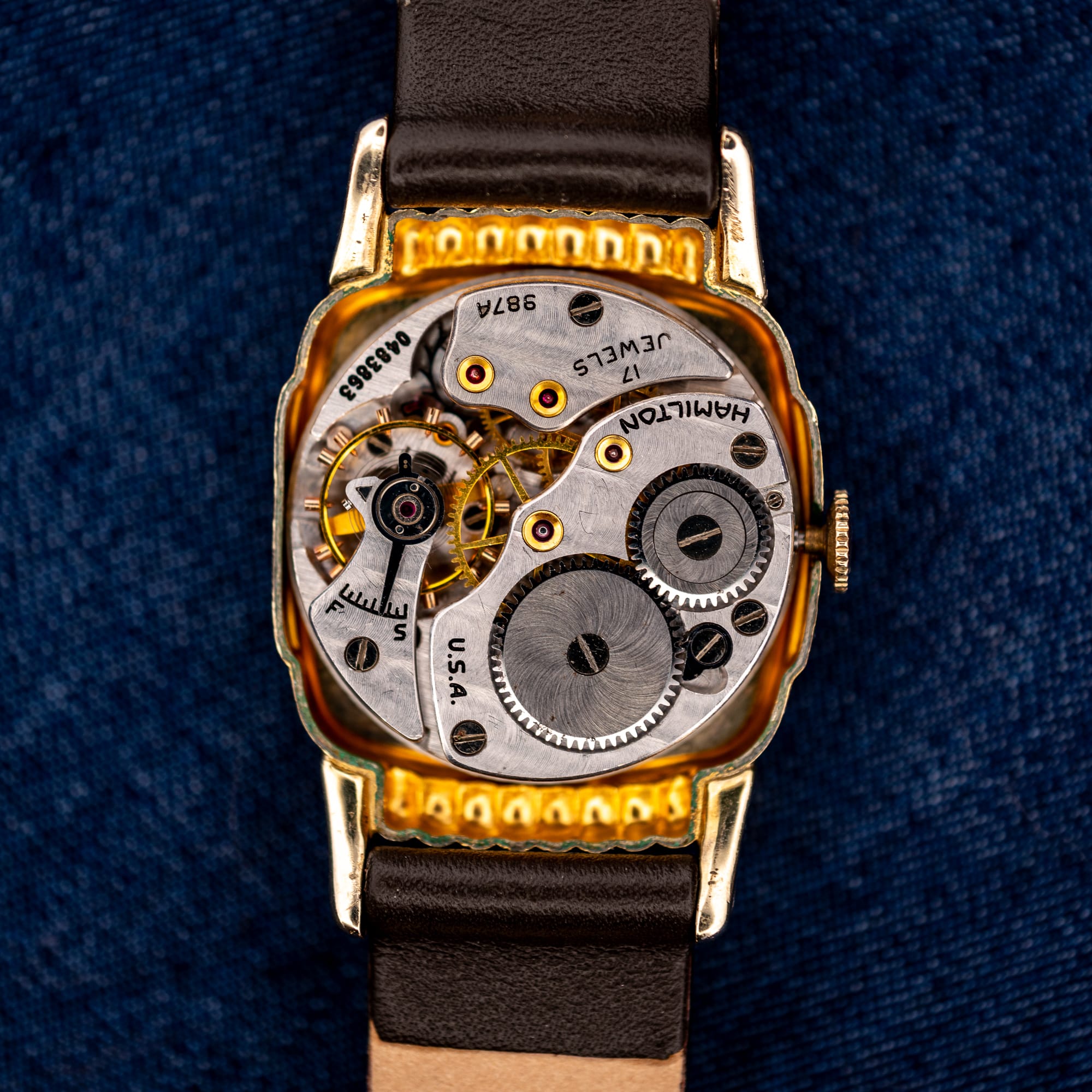
Behind the dial is a 987A, the 17-jewel caliber Hamilton released in 1937 as a substantially reworked version of its 987. The 987A went to war in military watches. In 1947 Hamilton introduced the smaller 747, and the 987 family, about twenty years old in its wristwatches by then, began to wind down. The Roland belongs to the last stretch of that run. It winds by hand at the crown, a few turns each morning, and carries no automatic rotor.
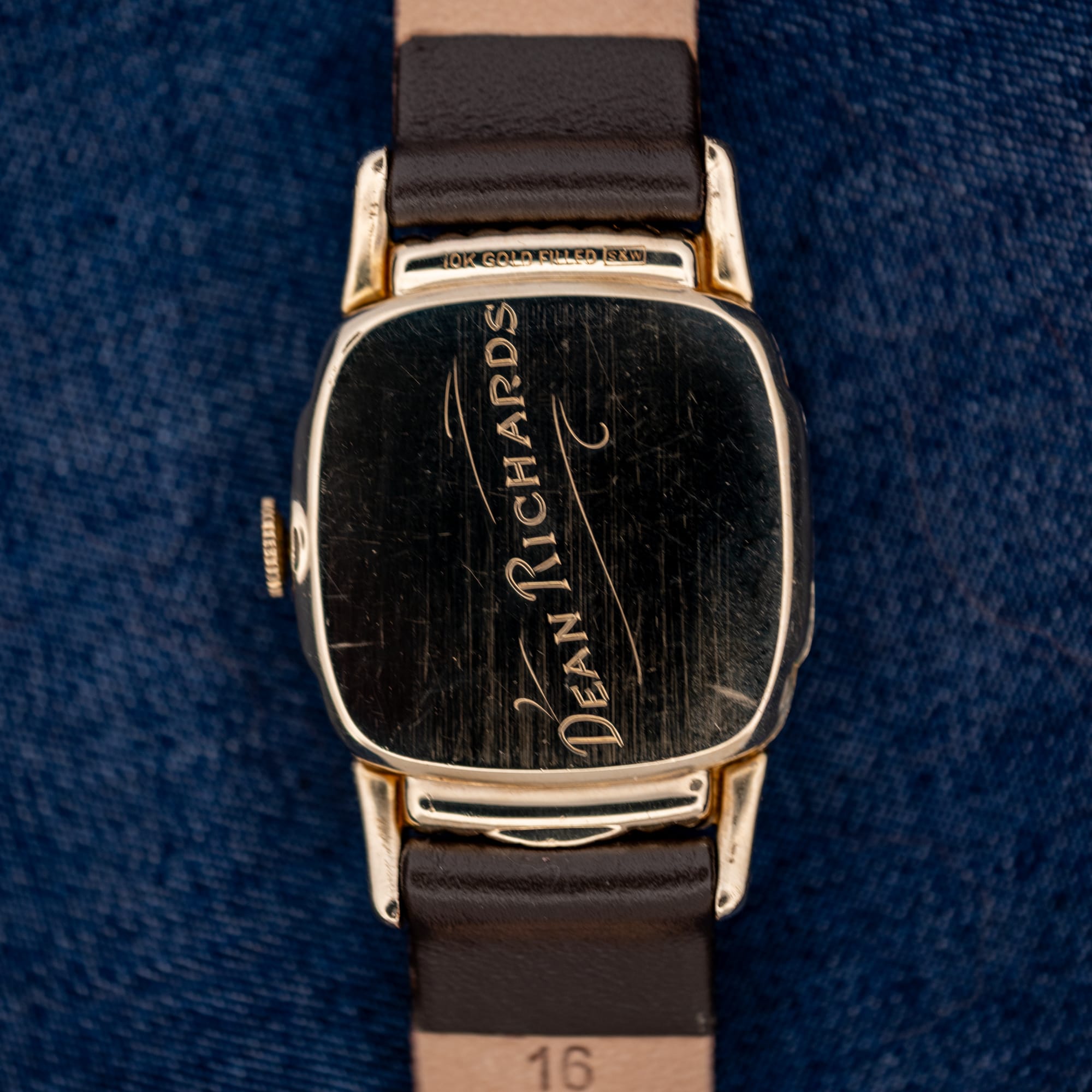
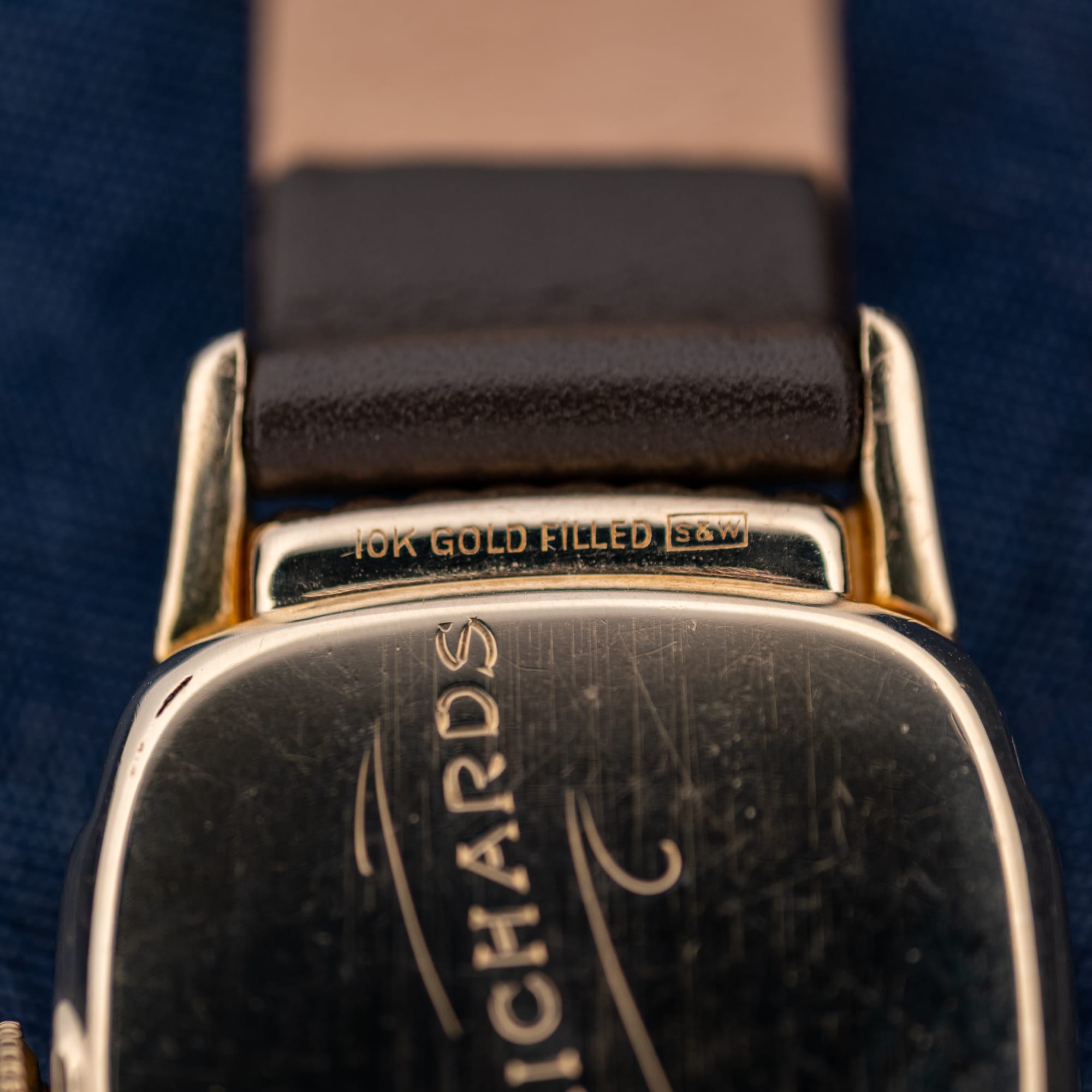
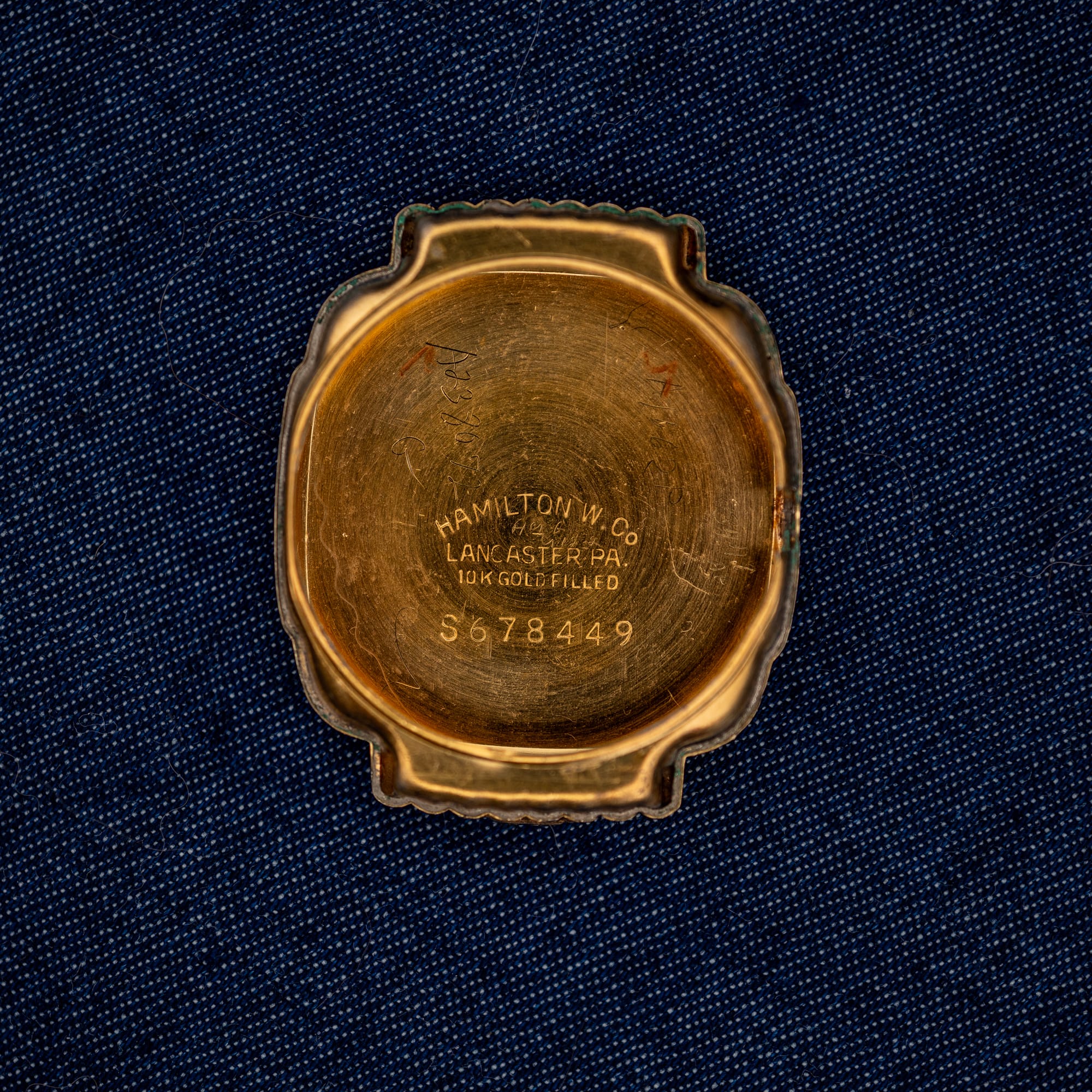
The movement came from Lancaster, Pennsylvania, and the inside of the back is stamped for the Hamilton Watch Co. there. The case did not. Under the upper lugs sits a boxed S&W, the mark of Schwab & Wuischpard, a New York firm that made many of Hamilton’s wristwatch cases and turned out military compasses during the Second World War. The case measures 27mm across and 40mm lug to lug, and the watch comes on a brown leather strap. The case flanks show fine surface scratches.
The back holds one detail no catalog could list. Across it, in tall decorative capitals with flourishes, a name has been engraved: DEAN RICHARDS. The D and the R are enlarged, and the lettering fills most of the back.