

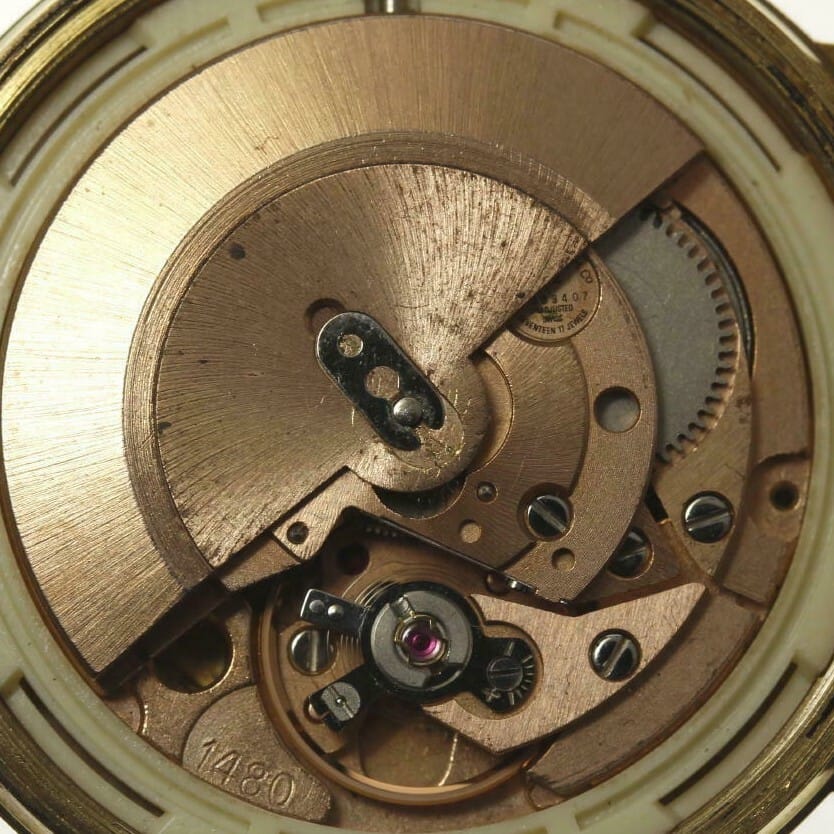
The Omega 1480 represents one of the most telling footnotes in Omega’s automatic movement history: a Tissot-derived ébauche that filled a critical gap when Omega’s own automatic program stumbled. Between 1970 and 1974, while the troubled Cal. 1000 series proved unreliable and before the improved 1010/1020 family reached full production capacity, Omega turned to sister brand Tissot’s Cal. 2471 architecture and rebadged it as the 1480. For collectors focused on Omega’s corporate evolution within SSIH (Société Suisse pour l’Industrie Horlogère), the 1480 documents a pragmatic moment when brand pride took second place to delivering functional, saleable watches during the early quartz crisis years.
The Omega 1480 is a straightforward 3-hand automatic date movement with indirect central seconds, integrated automatic winding, and a semi-quickset date mechanism operated by rotating hands through a specific time window. It powered primarily mid-tier Omega Genève references and retailer-signed variants in 34-36mm stainless or gold-plated cases, watches aimed at everyday wearers rather than collectors or enthusiasts. Watchmakers describe it as mechanically conventional and serviceable, though parts availability has become the limiting factor as Omega restricts access to vintage components and third-party stocks deplete.
Production numbers are not officially published by Omega. Based on observed serial number ranges from dated examples, case reference distribution, and the movement’s four-year production window, total output likely falls in the range of 15,000 to 30,000 units. This makes the 1480 uncommon rather than rare: it appears regularly in vintage Genève listings and watchmaker benches, but far less frequently than the ubiquitous 5xx manual-wind series or the later 1010/1020 automatics. Surviving examples are concentrated in European markets and among watches that avoided heavy use, as these movements were not built to tool-watch tolerances.
In the current collector market, the 1480 commands no movement-specific premium. Values are determined by case condition, dial originality, bracelet presence (especially rare integrated bracelet variants on ref. 166.099), and overall cosmetic preservation. Demand is stable but modest: these are entry-level vintage Omegas for buyers seeking affordable Swiss automatics with legitimate Omega branding, not trophy pieces for serious collectors. The movement’s Tissot origins and non-manufacture status limit upside, though clean, unpolished examples with original dials in desirable colorways (chocolate, blue, certain gilt finishes) can command premiums in the $400-$800 range depending on case material and bracelet.
Historical Context, Provenance, and Manufacturing Details
The 1480 was developed during a turbulent period for Omega. By the late 1960s, the company faced mounting pressure from Japanese quartz technology, internal production bottlenecks, and quality issues with its Cal. 1000 series automatics, which suffered from fragile calendar mechanisms and rotor bearing failures. While Omega worked to redesign its automatic platform into what would become the successful 1010/1020 family, it needed an interim solution to keep automatic watches in dealer cases.
The solution came from within SSIH, the holding company that controlled both Omega and Tissot. Tissot had developed the Cal. 2471, an 11.5 ligne automatic with integrated winding and a practical date complication. Rather than wait for Omega’s engineers to solve the 1000 series problems, SSIH authorized Omega to adopt the 2471 architecture with minor branding and finishing changes, creating the 1480 (time and date) and its close sibling the 1481 (essentially identical with minor keyless works differences).
Within Omega’s caliber lineage, the 1480 replaced nothing and was replaced by everything. It did not evolve from a specific Omega predecessor; it existed alongside the troubled 1000 series and overlapped the early rollout of the 1010/1012/1020 family, which became Omega’s definitive automatic workhorses for the 1970s and 1980s. By 1974, as the 1010/1020 reached full production scale and Omega reasserted in-house automatic development, the 1480 was quietly discontinued.
The 1480 is an ébauche-based movement. Tissot Cal. 2471 provides the base architecture: plate design, gear train layout, automatic winding system, and escapement geometry. Omega applied its own branding, specified certain finishing standards (which varied by production batch and remain modest compared to Constellation-grade movements), and integrated the movement into Omega case ecosystems with corresponding dial feet spacing and date window positions. Manufacturing took place within SSIH’s integrated Swiss production facilities, with movement finishing and final assembly likely handled at Omega’s Bienne factory or shared group facilities.
Historically, the 1480 reads as a pragmatic compromise during the quartz crisis. It was not groundbreaking, nor was it meant to be. It kept Omega’s automatic offerings alive at a critical moment when brand prestige alone could not deliver reliable movements, and it bought Omega time to rebuild its automatic program on sounder engineering. For that reason, the 1480 is more interesting as a case study in Swiss watchmaking consolidation and crisis management than as a horological achievement.
Construction and Architecture
The 1480 uses a conventional three-bridge layout: a brass main plate with separate bridges for the barrel, train wheels, and balance assembly, plus an integrated automatic winding module on the dial side rather than a bolted-on top plate. The architecture is compact and optimized for thin dress watches, with the 11.5 ligne (25.9mm) diameter and approximately 4.5mm height allowing it to fit into slim cases common to early-1970s Genève models. The automatic winding system employs a bi-directional winding rotor with a single reduction wheel driving the barrel ratchet, a simpler and more economical design than Omega’s later bumper or high-efficiency winding systems.

Balance wheel
The balance is a Glucydur-type monometallic alloy balance, smooth-rimmed without adjustable timing screws, running at 21,600 vph (3 Hz). This frequency was standard for mid-tier Swiss automatics of the era, balancing acceptable timekeeping with mechanical durability and power reserve efficiency. The balance staff cross-references to Tissot part U2480, meaning replacement staffs are sourced from Tissot parts inventories or aftermarket suppliers who list compatibility across the 1480/1481/2471/2481 family. The balance wheel diameter is typical for 11.5 ligne movements, approximately 9-10mm, optimized for reliable amplitude rather than high-frequency precision.
Balance spring (hairspring)
The hairspring is a flat Nivarox-type alloy spring, the industry-standard self-compensating alloy introduced in the 1930s and ubiquitous by the 1970s. It is a flat configuration with no Breguet overcoil, prioritizing manufacturing efficiency and movement thinness over chronometer-grade isochronism. The terminal curve is a standard inner attachment with the outer end fixed to the stud holder, which is part of the regulator assembly. Replacement hairsprings are available from aftermarket suppliers as part of complete balance assemblies or separately for watchmakers who can perform hairspring work, though Omega-specific springs are increasingly difficult to source as NOS stocks deplete.
Escapement type
The movement employs a standard Swiss lever escapement with synthetic ruby pallet stones and a single impulse jewel on the balance roller. The escape wheel is seven-pointed with club-tooth geometry typical of mid-20th century Swiss production, jeweled at the pivots in the base 17-jewel configuration. There are no notable innovations or refinements; this is a textbook Swiss lever designed for reliable, economical production rather than cutting-edge performance. The escapement jeweling uses pressed synthetic rubies rather than gold chatons, consistent with the movement’s mid-tier positioning.
Shock protection system
Shock protection is provided by Incabloc on the balance staff only, specifically the “Incabloc DSS” variant documented in parts references for the 1480/1481 family. The system uses the classic Incabloc lyre-shaped spring and conical jewel settings to absorb impacts to the balance pivots, the most vulnerable point in any mechanical movement. Pallet fork and escape wheel pivots are not shock-protected in the base 17-jewel configuration, which is typical for dress watches of this era and price point. The Incabloc jewel settings are serviceable with standard watchmaking tools, and replacement springs and jewels are widely available from aftermarket suppliers.
Regulator type
Regulation uses a conventional index regulator with movable curb pins acting on the hairspring’s active length, mounted on a regulator arm that pivots around the balance cock. The regulator assembly includes a stud holder for the hairspring’s outer terminal, often supplied as a combined “regulator with stud holder” part in replacement catalogs. Fine adjustment is achieved via a micrometric screw on the regulator arm in most examples, providing adequate resolution for ±10-20 second per day regulation but falling short of the precision available in free-sprung or swan-neck systems. There is no provision for multi-position adjustment markings or chronometer-grade regulation; the movement was never submitted for observatory certification.
Mainspring material and type
The mainspring is documented in aftermarket catalogs as approximately 1.20mm height, 0.115-0.117mm thickness, and 280-320mm length (sources vary slightly), designed for a 9-9.5mm barrel. It is manufactured in Nivaflex or equivalent modern white-metal alloy, specifically formulated for automatic winding applications with a slipping bridle attachment to prevent overwinding damage. The slipping bridle allows the mainspring to slip against the barrel wall once fully wound, dissipating excess energy from continued rotor rotation rather than transmitting damaging torque to the automatic works. Original mainsprings were likely traditional blued steel or early Nivaflex alloys, but modern replacements universally use Nivaflex 45 or similar alloys for superior elastic properties and resistance to setting (permanent deformation).
Gear train details
The gear train follows the standard four-wheel configuration: barrel wheel, center wheel (driving the minute hand via cannon pinion), third wheel, and fourth wheel driving the escape wheel. The seconds hand is driven by an indirect system: the fourth wheel drives a separate sweep second wheel that mounts the seconds hand arbor, allowing the seconds hand to run continuously while isolating it from mainspring torque variations. This indirect drive is common in automatic movements where rotor-induced vibration could otherwise affect seconds hand stability. Specific gear ratios are not published in available technical documentation, but the standard 21,600 vph frequency and 42-hour power reserve indicate conventional Swiss lever train geometry with no unusual multiplication or reduction.
Finishing quality and techniques
Finishing on the 1480 is functional and economical, appropriate for its mid-tier positioning. Main plates typically show circular graining or perlage in central areas, applied by machine in regular patterns. Bridges are finished with straight graining or brushing, also machine-applied, with no hand-applied Côtes de Genève (Geneva stripes) observed on documented examples. Anglage (beveling of edges) is minimal or absent; edges are generally chamfered by machining but not hand-polished. Screw heads are polished but not blued or thermally treated. There is no documented variation in finishing quality across the production run, suggesting Omega applied consistent (and consistently modest) finishing standards throughout the 1480’s brief life. This contrasts sharply with higher-grade Omega calibers of the same era, such as Constellation movements with Cal. 561 or 564, which received gilt finishes, Côtes de Genève, and sometimes chronometer-grade regulation.
Cross-Reference Data
Alternative caliber names and base architecture
| Manufacturer | Caliber Designation | Notes on Differences |
|---|---|---|
| Tissot | Cal. 2471 | Base ébauche architecture; mechanically equivalent with Tissot branding |
| Tissot | Cal. 2481 | Close Tissot variant, same family, minor keyless works differences |
| Omega | Cal. 1481 | Omega sibling caliber; functionally nearly identical, minor keyless works and date mechanism variations |
Base caliber vs. elaborated versions
No chronometer-grade or heavily adjusted variant of the 1480 is documented in Omega’s production records or parts catalogs. The movement was never submitted for COSC certification or observatory trials, and no “adjusted to X positions” markings appear on known examples. The 1481 is sometimes described as a variant, but it is more accurately understood as a parallel version with identical specifications and a nearly identical parts inventory, differentiated primarily by minor keyless works geometry and date mechanism details. Parts interchange between 1480 and 1481 is high, particularly for the going train, escapement, balance assembly, and automatic works, though keyless works parts and some calendar components are caliber-specific.
Compatible case references by brand
Dial compatibility notes
The 1480 is an 11.5 ligne (25.9mm) movement with dial feet positioned for Omega’s standard Genève case family of the early 1970s. The date window is positioned at 3 o’clock on the dial, requiring dials with a corresponding cutout. Semi-quickset date operation means the date advances by rotating the hands forward through approximately 20:00-24:00 (8 PM to midnight), so dial printing must not obstruct the date aperture and should allow clear visibility of the date disc. Dial feet spacing is Omega-specific and does not match generic ETA or other ébauche standards, so restorers must use original Omega dials or custom-made dials with correct foot positioning. Original dials were produced in silver, champagne, blue, chocolate/brown, black, and gilt variants, with both stick markers and applied indices depending on case reference.
Crown and stem specifications
The winding stem for the 1480 is Omega part number 1480-1106, shared with the 1481 and available from aftermarket suppliers who list it as compatible across both calibers. The stem thread follows Swiss standard tap 10 geometry, consistent with other Omega movements of the era. Crown threading is typically 0.90mm pitch for screw-down applications, though most 1480-equipped watches use push/pull crowns rather than screw-down designs. The setting mechanism uses a yoke-type clutch: pulling the crown outward engages a yoke that lifts the clutch lever, shifting the sliding pinion from winding to setting position. Common service issues include worn or broken setting lever springs (part 440/431) and detent springs that fail to hold the crown securely in winding or setting positions.
Identification Marks
Caliber number location and branding
The caliber number “1480” is engraved or stamped on the main plate or a primary bridge, typically visible once the automatic winding rotor and automatic bridge are removed. The Omega brand logo, a stylized Ω symbol with “OMEGA” in uppercase serif lettering, appears on the movement, matching the dial logo style used on Genève models of the 1970-1974 period. The logo placement varies slightly across production batches but is most commonly found on the automatic bridge or main plate near the caliber designation.
Date codes and serial numbers
The 1480 does not use a separate date code system stamped on the movement itself. Dating is accomplished via Omega’s eight-digit serial number system, stamped on the movement (typically on the main plate or a large bridge) and repeated on the case interior. Serial numbers for 1480-equipped watches fall primarily in the 30-million to 33-million range, corresponding to production years circa 1970-1974 based on Omega’s serial number chronology. Specific examples documented in collector discussions and sales listings include serials around 31-32 million for 1972-1973 production. Caseback interiors carry Omega reference numbers (e.g., 166.099, 166.0098), Swiss assay marks (hippocampus head or other cantonal marks depending on case material), and “FAB. SUISSE” or “SWISS MADE” country-of-origin markings.
Finishing marks and jewel characteristics
Expected finishing patterns include circular graining or perlage on the main plate (applied by machine in regular, repeating dots) and straight brushing or linear graining on bridges, also machine-applied. There is no hand-applied Côtes de Genève or elaborate decorative finishing; collectors should be suspicious of 1480 movements with obviously luxurious finishing, as this would be inconsistent with documented examples and may indicate incorrect movement substitution or misrepresentation. Jewel settings use pressed synthetic rubies without gold chatons in the 17-jewel base configuration. The balance cock and pallet cock are jeweled with standard Incabloc settings on the balance and plain jewel settings elsewhere. Jewel count “17 JEWELS” is typically engraved near the caliber number or on the balance cock.
Adjustment markings
There are no “Adjusted to X positions” or chronometer certification markings on documented 1480 examples. The movement was not chronometer-tested, and Omega did not market 1480-equipped watches as chronometers or precision-adjusted timepieces. Collectors should be wary of any 1480 marked with adjustment or chronometer language, as this would be inconsistent with Omega’s production practices for this caliber and may indicate forgery or mismarking.
Correct serial number formats and locations
Omega serial numbers on the 1480 are eight-digit numerals with no alphabetic prefixes, following Omega’s standard serial number system in use from the 1960s through the 1980s. The serial number is stamped on the movement, typically on the main plate or under the balance cock, and is repeated inside the case back. Authentic engravings are crisp, evenly spaced, and consistent in depth, applied by precision stamping or engraving equipment. Hand-scratched or irregularly spaced serial numbers are red flags for counterfeit or refinished movements. Known serial number ranges for 1480 production: approximately 30,000,000 to 33,500,000, with the bulk of production concentrated in the 31-32 million range corresponding to 1971-1973.
Font and marking style by production era
Engravings on the 1480 use a clean, sans-serif or lightly serifed uppercase font typical of Omega’s 1970s production, distinct from the more ornate scripts used in earlier decades. The Omega logo evolved during the 1970s from a more stylized serif design to a cleaner, modernist treatment, but the 1480’s short production window (1970-1974) means most examples show consistent branding without major transitions. Movement engraving depth is moderate, neither deeply incised like vintage pocket watch movements nor superficially laser-etched; authentic Omega engravings from this era have a characteristic precision-stamped appearance with slight punch marks at character boundaries.
Part Information

Key movement components and part numbers
The following table consolidates part numbers from Omega parts catalogs, aftermarket suppliers (EmmyWatch, WatchMaterial, Cousins UK, Ofrei, Boley, Urdelar), and cross-references to the related 1481 and Tissot 2471/2481 calibers.
Sourcing notes
Several specialized suppliers maintain stocks of Omega 1480 parts, though availability is declining as NOS (new old stock) inventories deplete and Omega’s parts restriction policies limit access to original components. WatchMaterial, Ofrei, Cousins UK, Gleave, Boley, and Urdelar list specific 1480 and 1480/1481 parts including balance staffs, click springs, setting springs, mainsprings, keyless works components, and train wheels. Many components, especially the automatic winding system (rotor axle, rotor bearing, reversing wheels), are becoming scarce, forcing watchmakers to salvage parts from donor movements or fabricate custom solutions.
Common failure points on surviving 1480 movements include:
- Rotor bearing wear: Causes rotor wobble, noise, and inefficient winding; requires bearing replacement or donor movement.
- Mainspring fatigue: Tired or broken mainsprings reduce power reserve and amplitude; replaceable with aftermarket Nivaflex springs to proper dimensions.
- Setting lever spring breakage: Leads to crown slipping out of setting position or inability to engage setting mode; replaceable with part 440/431.
- Keyless works detent wear: Causes crown to feel loose or fail to hold in winding/setting positions; requires keyless works overhaul with parts from specialized suppliers.
- Calendar mechanism wear: Semi-quickset date systems are sensitive to improper setting (changing date by hand-rotation during the change window can damage calendar parts); calendar wheels and springs often need replacement.
Acceptable generic replacements exist for some components: mainsprings (with correct dimensions), balance staffs (with Tissot U2480 cross-reference verification), Incabloc jewel settings and springs, and certain screws and springs. Escapement components (escape wheel, pallet fork), automatic works (rotor, reversing wheels, reduction gears), and calendar mechanism parts should be treated as caliber-specific, with substitution only after dimensional verification and functional testing.
Performance Data
Manufacturer specifications
Omega did not publish detailed performance specifications for the 1480, as it was marketed as a mid-tier automatic rather than a chronometer or precision-tested movement. Based on the Tissot 2471 base caliber and standard Swiss industry practice for 21,600 vph automatics of the early 1970s, expected factory-new performance would have been:
- Accuracy (new): ±15 to ±30 seconds per day, unadjusted, in horizontal positions
- Positions tested: Likely 2 positions (dial up, crown down) for factory regulation, not multi-position adjusted
- Temperature compensation: Inherent Glucydur balance and Nivarox hairspring provide passive temperature compensation across typical wearing temperatures (approximately 5-35°C), but no active compensation or observatory-grade temperature testing
- Isochronism: Moderate rate variation over power reserve run-down; flat hairspring without Breguet overcoil exhibits some amplitude-dependent rate change, typical for this class of movement
The lift angle of 48° is a commonly referenced watchmaker value for this family of movements, used for timing machine analysis, though it is not explicitly stated in Omega’s technical documentation. This value is consistent with Swiss lever escapements of the period and allows proper timing machine setup for rate measurement.
Observed performance (field data)
Collector reports, watchmaker observations, forum discussions, and YouTube repair videos provide field performance data for the 1480 in various states of service and wear:
- Accuracy range for well-maintained examples: ±8 to ±20 seconds per day after fresh service, regulation, and cleaning; best performance achieved when amplitude remains above 250° and the movement is kept clean and properly lubricated
- Common performance issues and causes:
- Low amplitude (under 220°): Dried or incorrect lubrication, tired mainspring, rotor bearing drag, pallet stones needing cleaning
- Irregular rate / position variation: Dirty escapement, magnetization, balance staff pivot wear, hairspring damage from shocks
- Stopping or inconsistent running: Keyless works jamming, calendar mechanism interference (especially if date is changed during danger zone), rotor rubbing on movement or case
- Insufficient winding or dead rotor: Rotor bearing seized or worn, automatic works bridges misaligned, reversing wheel teeth worn or broken
- Expected amplitude:
- Degradation patterns over time:
- First service interval (5-10 years): Lubrication dries, amplitude drops 20-40°, rate drifts positive (gaining time) as pallet/escape wheel friction increases
- Long-term wear (15+ years unserviced): Pivot holes oval, mainspring weakens or breaks, rotor bearing seizes or wears causing noise and winding failure, calendar mechanism gums up leading to incomplete date changes or stuck date wheel
- Critical wear points: Rotor axle and bearing (most common failure), setting lever spring (breaks, causing setting problems), calendar jumper spring (weakens, causing incomplete date jumps), balance staff pivots (wear if run with insufficient lubrication or after shocks with failed Incabloc)
Field data from YouTube watchmaker channels documents typical service results: a tired 1480 arriving at +60 to +120 seconds per day with 180-200° amplitude can be restored to +10 to +15 seconds per day with 270-280° amplitude after full disassembly, ultrasonic cleaning, pivot polishing if necessary, fresh lubrication, mainspring replacement if fatigued, and regulation. Watchmakers note that the 1480 responds well to competent service but is parts-limited: if escapement components, automatic works, or calendar parts are damaged beyond repair, sourcing replacements can be challenging and expensive relative to the watch’s market value.