

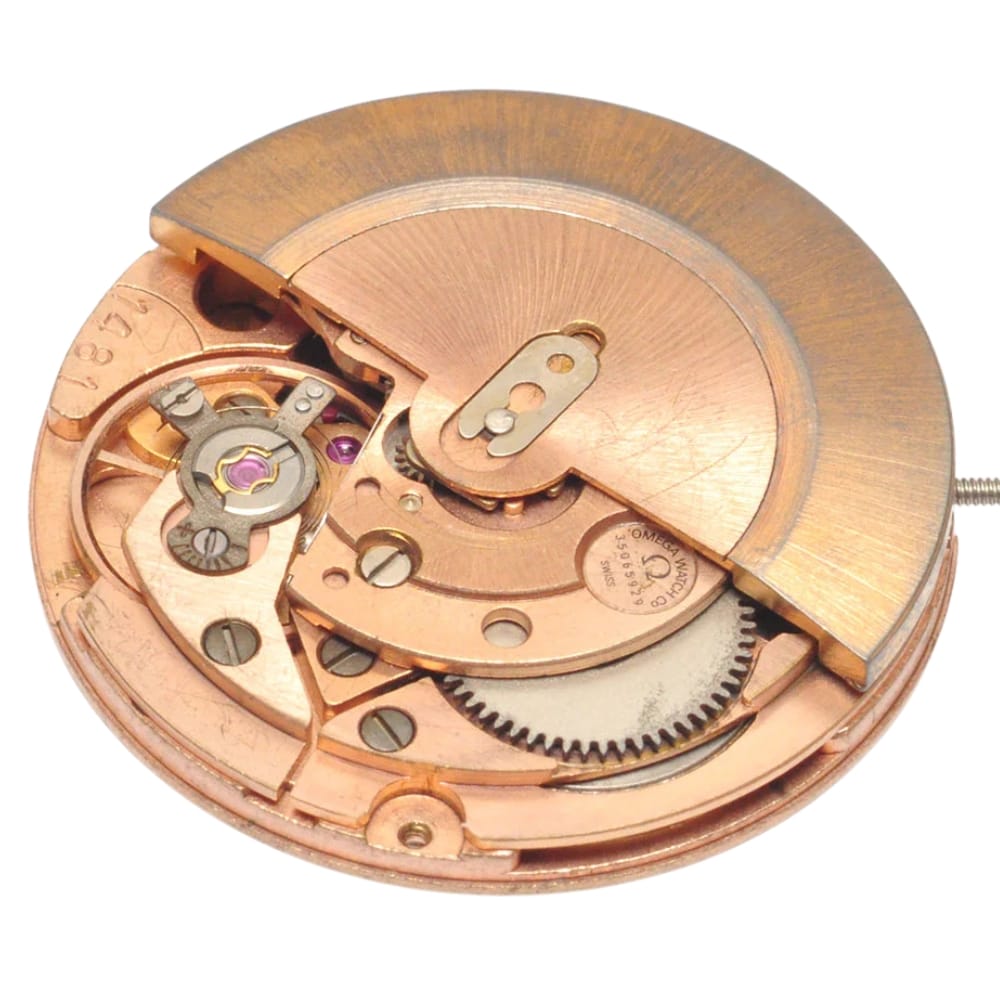
The Omega 1481 stands as one of the most pragmatic examples of survival engineering during the quartz crisis, a joint development between Omega and Tissot born from economic necessity rather than horological ambition. Introduced in 1972 under the SSIH conglomerate’s cost-sharing initiative, the 1481 powered thousands of Omega Geneve watches through the industry’s most turbulent decade, including the distinctive Stingray (Cobra) models that defined 1970s avant-garde design.
The caliber’s defining characteristic is its unusual quickset date mechanism, operated by pushing the crown inward rather than pulling to an intermediate position. This design choice, while innovative, has proven both a conversation piece and a maintenance liability. The movement represents Omega’s deliberate pivot toward volume production and rationalized manufacturing, sharing its architecture entirely with the Tissot caliber 2481 save for surface finishing and branding. Where higher-grade Omega movements of the era featured gilt decoration and 24 jewels, the 1481 settled for 21 jewels and functional reliability over prestige.
Production volume estimates remain undocumented by Omega, but serial number distribution and market availability suggest moderate to high production during the eight-year run. Serial numbers for 1481-equipped watches typically fall within the 33,000,000 to 41,000,000 range, corresponding to the 1971-1980 period. Given that the Geneve line constituted a significant portion of Omega’s non-Seamaster, non-Speedmaster production during this era, conservatively tens of thousands of 1481 movements were manufactured. The caliber appears in references ranging from conventional dress watches (162.0042, 166.0098) to unconventional statement pieces (166.121 Stingray), indicating Omega’s reliance on this workhorse across multiple market segments.
The 1481 occupies an interesting position in the current collector market: common enough to be accessible, distinctive enough to warrant attention for its quirky date mechanism and period-correct aesthetics. Demand remains stable rather than rising, with typical examples trading between $400 and $800 depending on case reference and condition. The Stingray variants command premiums ($800-$1,500) due to case design rather than movement pedigree. Collectors seeking entry-level vintage Omega automatics often gravitate toward the more prestigious caliber 565 series, relegating the 1481 to enthusiasts who appreciate its historical context or those specifically hunting 1970s Geneve references.
Historical Context, Provenance, and Manufacturing Details
The caliber 1481’s development cannot be separated from the existential crisis facing Swiss watchmaking in the early 1970s. By 1972, Japanese quartz movements had demonstrated both technical superiority and cost advantages that threatened the Swiss industry’s dominance. The SSIH conglomerate, formed in 1930 through the merger of Omega, Tissot, and later Lemania, responded by centralizing development costs and sharing ebauches across brands.
The 1481 emerged from this defensive strategy, jointly engineered by Omega and Tissot to reduce redundant R&D expenditure. Development likely occurred between 1970 and 1972, with market introduction in 1972. The movement was not groundbreaking technically. It offered automatic winding, date complication, and adequate reliability at a time when Omega needed volume production more than horological innovation. The unusual push-button quickset date mechanism represented the sole design flourish, a cost-effective alternative to the traditional pull-crown intermediate position found in the caliber 565 family.
The 1481 succeeded the caliber 565 in the Geneve line, though “succession” overstates the relationship. The 565, introduced in the mid-1960s, was a superior movement: 24 jewels, adjusted to positions, chronometer-capable in higher grades, and featuring a more conventional quickset date via crown pull. The 1481 was not an evolution but a cost-reduction exercise. It replaced the 565 in mid-tier Geneve references as Omega rationalized its product line to weather the quartz crisis. The 1481 itself was eventually replaced by quartz calibers and, later, ETA-based automatics as Omega transitioned into the Swatch Group era post-1983.
The 1481 is not an in-house manufacture movement in the traditional sense, though it was designed within the SSIH group. The architecture was developed collaboratively between Omega and Tissot engineering teams, with production likely occurring at shared SSIH facilities in Switzerland. The movement does not derive from a specific ETA or Peseux ebauche. It represents proprietary SSIH engineering, though cost constraints and component sourcing meant certain parts (shock protection, balance materials) came from standard Swiss suppliers like Incabloc and Nivarox-FAR.
Production occurred exclusively in Switzerland, with no documented location changes during the 1972-1980 lifespan. The caliber was manufactured under the Omega name (1481) and Tissot name (2481), with the primary difference being cosmetic finishing: Omega movements received gilt (copper-toned) plating on bridges, while Tissot received rhodium (silver-toned) finishing. The jewel count also varied: Omega produced both a 17-jewel variant (caliber 1480) and the 21-jewel 1481, while Tissot standardized on the 21-jewel 2481.
In the broader sweep of horological history, the 1481 is neither groundbreaking nor transitional. It is a workhorse born of necessity, competent but unremarkable. Its legacy lies not in technical achievement but in its role as a survival mechanism during the industry’s darkest decade. The movement kept Omega’s Geneve line viable when quartz threatened to eliminate mechanical watchmaking entirely. That it did so with an oddball quickset date mechanism adds character, if not prestige.
Construction and Architecture
Plate and Bridge Layout
The Omega 1481 employs a modular three-bridge architecture common to mid-century Swiss automatic movements, with a full brass main plate supporting the gear train and a separate automatic winding module mounted to the dial side. The main plate features the traditional three-cock configuration: a balance cock securing the escapement, a train bridge covering the third and fourth wheels, and a barrel bridge anchoring the mainspring housing. The automatic winding mechanism occupies a separate upper bridge assembly (part 1481.1031) that attaches to the main plate via three screws, allowing for independent servicing or replacement.
The plate and bridge materials are brass, consistent with Omega’s manufacturing standards of the era. Finishing quality is functional rather than decorative: the Omega-branded 1481 features gilt (copper-toned) plating on bridges, while the mechanically identical Tissot 2481 uses rhodium (silver-toned) finishing. Neither version incorporates Cotes de Geneve decoration, perlage, or anglage beyond basic machining marks and functional chamfering. The movement prioritizes serviceability and cost efficiency over aesthetic refinement, a deliberate choice given its intended role as a volume-production caliber.
Balance Wheel
The 1481 utilizes a monometallic Glucydur balance wheel, an alloy of beryllium and bronze (beryllium copper) valued for its temperature stability and shock resistance. Glucydur balances do not require bimetallic temperature compensation because the alloy maintains consistent elasticity across operational temperature ranges, simplifying construction and reducing manufacturing costs. The balance wheel diameter is not specified in available documentation, but dimensions are consistent with 11.5-ligne movements of the period (approximately 8-9mm diameter).
The balance wheel is smooth-rimmed without timing screws, indicating adjustment occurs via the regulator rather than by adding or removing mass. This construction is typical of non-chronometer-grade movements where production efficiency outweighs precision adjustment capabilities. The balance pivots are supported by Incabloc shock-protected jewels top and bottom, with the upper pivot secured by the balance cock.

Balance Spring (Hairspring)
The hairspring is a flat Nivarox alloy spring, the industry-standard material developed in the 1930s by Charles-Édouard Guillaume’s successors at Nivarox-FAR. Nivarox consists of cobalt (42-48%), nickel (15-25%), chromium (16-22%), with trace amounts of titanium and beryllium. The alloy provides anti-magnetic properties, oxidation resistance, and thermoelastic stability superior to earlier Elinvar formulations.
The 1481 employs a flat hairspring rather than a Breguet overcoil, another cost-saving measure. Flat springs are easier to manufacture and install but offer slightly inferior isochronism (consistent timekeeping across different amplitudes) compared to overcoil designs. The spring attaches to the balance staff via a collet and terminates at the regulator, allowing for rate adjustment by lengthening or shortening the active spring length. The spring material is likely Nivarox 2 or Nivarox 3 grade, standard for non-chronometer movements of the era.
Escapement Type
The caliber 1481 uses a Swiss lever escapement, the dominant design in mechanical watchmaking since the mid-19th century. The escapement consists of an escape wheel (15 teeth, typical for 21,600 vph movements), a pallet fork with two jeweled pallet stones (entry and exit), and an impulse jewel mounted on the balance wheel. The pallet stones are synthetic ruby, standard for mid-grade Swiss movements. The escape wheel is brass with polished steel teeth, visible in disassembly videos and parts diagrams.
The escapement geometry is conventional, with no notable innovations or deviations from standard Swiss practice. The lift angle is 48 degrees, meaning the impulse jewel travels 48 degrees of arc during each escapement cycle. This figure is manufacturer-stated and confirmed across multiple technical references. A 48-degree lift angle is moderate, falling within the 46-52 degree range typical of Swiss lever escapements at 21,600 vph.
Shock Protection System
The 1481 employs Incabloc shock protection on the balance wheel pivots (upper and lower jewels). Incabloc is a lyre-shaped spring-loaded mounting system that allows the balance jewels to deflect under impact, preventing pivot damage from drops or shocks. The specific Incabloc variant used is standard Type K (spring reference 400/1461 or similar), common to Omega movements of the 1970s.
Incabloc protection is present only on the balance wheel pivots. The pallet fork and escape wheel pivots are not shock-protected, a cost-saving measure acceptable in non-chronometer-grade movements. The balance jewels are held in chatons (removable jewel settings) for easier replacement during service.
Regulator Type
The 1481 uses a simple index regulator, a movable arm that shortens or lengthens the effective length of the hairspring to adjust rate. The regulator is marked with plus and minus indicators for fast and slow adjustment. This is the most basic regulator design, lacking the micrometric adjustment capabilities or swan-neck fine regulation found in higher-grade movements.
Adjustment precision is adequate for daily wear (target rate +8 to +15 seconds per day for automatic movements of this era), but the 1481 was not designed or tested for chronometer certification. The regulator operates via a simple lever mechanism accessible during service, with no provision for temperature compensation or position adjustment beyond basic rate regulation.
Mainspring Material and Type
The mainspring is a slipping-bridle automatic winding spring, part number designation 771 or equivalent aftermarket reference Zf2960-X. Dimensions are 1.20mm width, 0.115-0.117mm thickness, 280-320mm length, with a barrel arbor hole diameter of 9.0mm. The spring is Nivaflex or equivalent white alloy, a cobalt-nickel-iron alloy developed by Nivarox-FAR for automatic winding applications. Nivaflex springs are non-magnetic and provide consistent torque delivery across the winding cycle.
The slipping-bridle design allows the mainspring to slip against the barrel wall when fully wound, preventing overwinding damage. This is standard practice in automatic movements, where the rotor continuously winds the spring whenever the watch is worn.
Gear Train Details
The 1481 features a conventional four-wheel gear train: barrel wheel (mainspring housing), center wheel (hour hand drive, one revolution per hour), third wheel (intermediate), and fourth wheel (seconds hand drive, one revolution per minute, 60 seconds). The escape wheel (fifth wheel) completes the train, oscillating at 21,600 semi-oscillations per hour (3 Hz).
Specific gear ratios are not documented in available technical literature, but they conform to standard Swiss practice for 21,600 vph movements. The center wheel is directly driven by the barrel wheel, and the fourth wheel directly drives the seconds hand at the 6:00 position (small seconds) or center (sweep seconds, as in the 1481). The seconds hand is center-mounted via a friction-fit pipe extending from the fourth wheel pinion.
Finishing Quality and Techniques
The Omega 1481 is a non-adjusted, functional-grade movement with minimal decorative finishing. The main plate and bridges receive basic machining and plating (gilt for Omega, rhodium for Tissot) but lack Cotes de Geneve, circular graining (perlage), or anglage (beveled edges). Screw heads are flat-slotted without bluing or polishing.
The rotor (oscillating weight) is solid brass or bronze, plated to match the movement finish, with the Omega logo engraved on the visible side. The rotor bearing is a simple bushing design, press-fit into the automatic bridge, with the rotor axle inserted through the center. This press-fit construction is non-serviceable and prone to wear, a known weakness of the 1481 architecture.
The movement’s finishing reflects its cost-conscious design brief. It is clean, functional, and adequate, but it does not compete aesthetically with higher-grade Omega calibers (565, 751, 1120) or contemporary ETA Top/Chronometer grades. Collectors seeking exhibition-grade finishing will be disappointed. Those valuing mechanical competence over cosmetic polish will find the 1481 honest and unpretentious.
Cross-Reference Data
Alternative Caliber Names (Rebranded Versions)
Base Caliber vs. Elaborated Versions
| Variant | Differences | Jewel Count | Functions |
|---|---|---|---|
| Omega 1480 | Base version; fewer jewels | 17 | Time, Date (quickset) |
| Omega 1481 | Standard version; additional jewels in automatic winding module | 21 | Time, Date (quickset) |
| Tissot 2481 | Tissot branding; rhodium finish | 21 | Time, Date (quickset) |
No chronometer-adjusted or COSC-certified variants of the 1481 exist. The movement was not designed or produced in elaborated grades.
Compatible Case References by Brand
Dial Compatibility Note
The Omega 1481 dial uses standard Omega Geneve dial feet positioning for 11.5-ligne movements. The date window is located at the 3:00 position, requiring dials with a corresponding aperture. Dial feet spacing is consistent across Geneve references using the 1481, allowing for cross-compatibility within the family. However, dials from other caliber families (565, 1020, etc.) are not interchangeable due to different mounting hole positions.
When replacing or restoring dials, verify the date window alignment and dial feet positioning. Aftermarket dials frequently use incorrect feet spacing, resulting in offset or misaligned date windows. Original Omega dials for 1481 watches are marked with caliber designations on the reverse, typically noting “Cal. 1481” or “Omega 1481” near the dial feet.
Crown and Stem Specifications
The crown and stem system is critical to the 1481’s distinctive quickset date function. The crown must have adequate clearance from the case (approximately 0.5-1.0mm gap) to allow inward push travel. If the crown sits flush against the case, the quickset mechanism will not engage. This is a common problem with replacement crowns that lack proper dimensions or when stems are shortened during service without accounting for the push-date function.
Identification Marks
Caliber Number Location
The caliber number “1481” is engraved on the main plate, visible when the automatic winding module is removed. The number appears on the dial side of the plate, typically near the center or toward the barrel bridge. The engraving is shallow and may require magnification to read clearly, particularly on movements with heavy wear or oxidation.
Logo and Brand Marks
Authentic Omega 1481 movements feature the Omega logo engraved on the oscillating weight (rotor), visible through the caseback on display models or when the caseback is removed. The logo is raised or engraved, depending on production period, and should be crisp and proportional. The main plate may also bear the Omega name or logo near the caliber number engraving, though this varies by production batch.
The movement does not carry “Swiss Made” or “Swiss” markings on visible surfaces. Such markings appear on the dial and caseback exterior rather than the movement itself, per Swiss regulatory standards of the era.
Date Codes
Omega movements from the 1970s do not use date codes on the caliber itself. Dating must be performed via the watch’s case serial number, which is engraved on the inside of the caseback or on the case between the lugs. Serial numbers for 1481-equipped watches fall within the following approximate ranges:
- 31,000,000 to 32,999,999: 1972
- 33,000,000 to 33,999,999: 1971-1973 (sources vary)
- 34,000,000 to 35,999,999: 1972-1973
- 36,000,000 to 37,999,999: 1973-1974
- 38,000,000 to 38,999,999: 1974
- 39,000,000 to 40,999,999: 1975-1977
- 41,000,000 to 41,999,999: 1978-1980
Finishing Marks
The Omega 1481 features gilt (copper-toned) plating on the bridges, a distinguishing characteristic from the rhodium (silver-toned) finishing on the Tissot 2481. The plating should be consistent across all bridges, including the balance cock, train bridge, barrel bridge, and automatic module. Uneven plating or mismatched finishes suggest incorrect parts replacement during service.
The movement does not feature Cotes de Geneve, perlage, or circular graining. Any such decoration is non-original and indicates aftermarket modification.
Jewel Markings
The caliber 1481 uses 21 jewels, a count that includes the balance pivots (2), pallet stones (2), escape wheel pivots (2), fourth wheel pivots (2), third wheel pivots (2), center wheel pivots (2), barrel arbor (1), and jewels in the automatic winding mechanism (8). The jewel count should be marked on the main plate near the caliber number or on the rotor side of the movement.
The balance jewels are held in chatons (gold-colored bezels on the Omega version), removable jewel settings that allow replacement during service. The pallet stones are press-fit into the pallet fork and are not interchangeable without specialized tools.
Adjustment Markings
The Omega 1481 is a non-adjusted movement and carries no adjustment markings (positions tested, temperature compensation, etc.). Presence of such markings indicates incorrect identification or fraudulent alteration.
Correct Serial Number Formats and Locations
Watch serial numbers are eight digits, engraved on the inside of the caseback or between the lugs at the 12:00 position. Serial numbers for 1481-equipped watches should fall within the ranges listed above (31,000,000 to 41,999,999). Numbers outside this range suggest a different caliber or a re-cased movement.
Expected Engravings and Stampings
Authentic Omega 1481 movements will have:
- “1481” caliber number engraved on the main plate
- “21 Jewels” or “21 rubis” marked on the plate or rotor
- Omega logo engraved on the rotor
- Serial number on the case (not the movement)
The engravings should be sharp, evenly spaced, and proportional. Blurred, oversized, or inconsistent fonts indicate incorrect parts or fraudulent marking.
Font and Marking Style by Production Era
Omega’s engraving style remained relatively consistent during the 1972-1980 production period. The caliber number uses a sans-serif font, approximately 1-2mm tall, with even stroke width. The Omega logo on the rotor uses the classic serif font, with proportional letter spacing and consistent line weight.
Post-1980 movements (after the Swatch Group merger) may show slight font variations, but these are subtle and require side-by-side comparison to detect. The most reliable authentication method is to verify the serial number range against known production years.
Part Information
Part Numbers and Interchangeability
Sourcing Notes
Parts Still Available:
- Mainsprings: Readily available from generic suppliers (Borel, Perrin, Otto Frei) at $10-15
- Stems: Available as generic Tap 10 stems; Omega-branded increasingly scarce
- Balance staffs: Available from specialized balance staff suppliers ($35-40)
- Basic jewels and cap jewels: Generic Incabloc components compatible
Parts Commonly Failing:
- Rotor axle bushing (press-fit, wears over time; requires automatic bridge replacement)
- Yoke spring (unusual design, difficult to reinstall correctly)
- Mainspring (loses temper after 20-30 years; replacement required for proper amplitude)
- Setting lever spring (large, complex part; can fatigue or deform)
Acceptable Generic Replacements:
- Mainspring: Any 1.20 x 0.115 x 280-320mm automatic slipping-bridle spring will work; Nivaflex or white alloy preferred
- Stems: Generic Tap 10 stems cut to 14mm length are acceptable; verify crown push clearance
- Click spring: Generic Swiss click springs can substitute if dimensions match
- Incabloc jewels and springs: Standard Incabloc components (cap jewel 400/1461 series) are cross-compatible
Non-Interchangeable Parts:
- Rotor: Tissot 2481 rotor fits mechanically but lacks Omega branding; collectors prefer original
- Bridges: Omega and Tissot bridges differ in finish (gilt vs. rhodium); mechanical compatibility exists but cosmetic mismatch is obvious
- Automatic module: Complete assembly (part 1481.1031) is specific to Omega; Tissot 2481 equivalent fits but may have branding differences
Performance Data
Manufacturer Specifications
Omega did not publish formal accuracy specifications for the caliber 1481, as it was not designed or tested for chronometer certification. Based on contemporaneous Omega documentation for non-chronometer automatic movements, expected performance would be:
- Accuracy (new): +8 to +15 seconds per day in horizontal position
- Positions tested: Not adjusted; basic regulation only
- Temperature compensation: No; monometallic Glucydur balance and Nivarox hairspring provide passive thermoelastic stability
- Isochronism: Moderate; flat hairspring limits consistent rate across amplitude variations
The movement was not tested or adjusted to multiple positions (dial up, dial down, crown up, etc.). Basic regulation occurs in the horizontal position only, typical for volume-production automatic movements of the era.
Observed Performance (Field Data)
Based on collector reports, watchmaker observations, and auction house timing results, typical performance for well-maintained Omega 1481 examples:
- Accuracy range: +5 to +20 seconds per day for serviced movements
- Common performance issues:
- Rotor axle wear: Causes erratic winding, rotor wobble, and eventual automatic function failure. The press-fit axle bushing wears over time and cannot be lubricated during standard service. This is a design flaw inherent to the 1481 architecture.
- Low amplitude: Unserviced movements or those with weak mainsprings often exhibit amplitude below 220 degrees, resulting in poor timekeeping and stopping. Target amplitude for a serviced 1481 is 240-270 degrees fully wound, 200-220 degrees near power reserve exhaustion.
- Quickset date failure: The crown-push quickset mechanism fails when crowns are replaced without proper clearance from the case. Many service technicians unfamiliar with the 1481 install flush-fitting crowns, disabling the quickset function.
- Expected amplitude:
- Fully wound: 240-280 degrees (dial-up position)
- Near power reserve depletion (40 hours): 200-230 degrees
- Below 200 degrees at full wind: Service required (mainspring, cleaning, or escapement issue)
- Performance degradation over time:
- Mainspring fatigue: After 20-30 years without service, the mainspring loses temper, reducing power reserve and amplitude. Replacement restores performance.
- Rotor axle wear: Appears after 30-40 years or with heavy use. Progressive issue: starts as slight rotor wobble, advances to rotor rubbing on caseback, eventually causes automatic winding failure.
- Lubrication breakdown: Dried oils in the escapement and gear train cause increased friction, reducing amplitude and accuracy. Standard service interval is 5-7 years.
The Omega 1481 is a competent workhorse when properly maintained but requires awareness of its design limitations. The rotor axle issue is endemic and non-repairable without replacing the entire automatic bridge assembly, a part that is scarce and expensive ($150-200). Collectors should budget for eventual automatic system failure or accept conversion to manual wind if a replacement bridge cannot be sourced.
Accuracy performance is adequate for daily wear but does not approach chronometer-grade precision. Expect to adjust the watch once per week. The movement is not suitable for applications requiring high accuracy or for collectors seeking COSC-certified precision.