

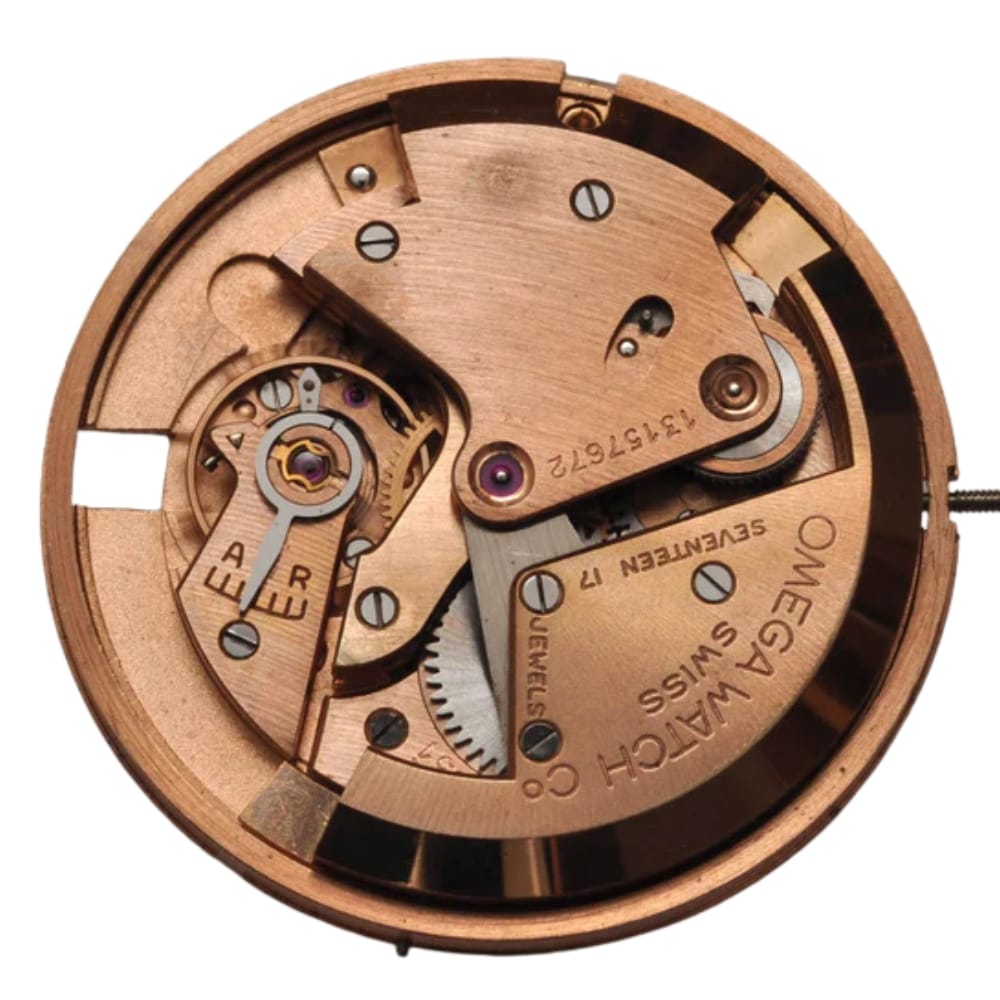
The Omega 351 represents a pivotal chapter in Omega’s technical evolution, bridging the gap between traditional manual-wind movements and the modern full-rotor automatics that would define the brand’s later success. Introduced in January 1949 as a redesignation of the earlier 28.10 RA SC PC movement (which had been in production since 1943), the caliber 351 powered some of the earliest Omega Seamaster references and stands as one of the final iterations of bumper automatic technology before Omega transitioned to full-rotor movements with the 500 series in 1952.
The caliber 351 is part of Omega’s broader 330 series of bumper automatics, a family of movements that produced over 1.3 million units between 1943 and 1955, with approximately 500,000 receiving chronometer certification. The 351 variant specifically features center seconds via an indirect drive system, distinguishing it from its sub-seconds sibling, the caliber 330. While most caliber 351 movements were non-chronometer grade with simple index regulators, rare examples exist with chronometer certification, making these specimens highly sought after by collectors.
Production volume estimates for the caliber 351 specifically are difficult to isolate from the broader 330 series family, but based on serial number ranges and production records, the movement was produced primarily between 1949 and 1955, with the heaviest concentration in the early 1950s (serial numbers approximately 11,600,000 through 14,500,000). The caliber 351 can be considered uncommon rather than rare, as it was used extensively across multiple Omega case references during its six-year production run. However, specific variants such as chronometer-certified examples or those in precious metal cases command significant premiums in the collector market.
The caliber 351 occupies a respected position in the vintage Omega collecting community. While bumper automatics were once considered less desirable than their full-rotor successors, collector attitudes have shifted significantly. The caliber 351 is now appreciated for its historical significance, robust construction, and mechanical charm. The distinctive audible “bump” of the oscillating weight hitting its springs provides tactile feedback that modern rotors lack, adding character to the wearing experience. Values for watches containing caliber 351 movements have steadily appreciated, particularly for examples in original condition with period-correct dials and cases.
Historical Context, Provenance, and Manufacturing Details
The Omega caliber 351 was developed in response to the post-war surge in demand for automatic wristwatches. Following World War II, consumers increasingly favored self-winding mechanisms over manual-wind movements, and Omega needed a competitive automatic caliber to maintain market share against rivals like Rolex, which had introduced its full-rotor Perpetual movement in 1931.
Omega turned to Charles Perregaux, a senior watchmaker at the Bienne manufacture, who had been tasked with designing a robust automatic movement that could circumvent Rolex’s patent on 360-degree full-rotor winding systems. Perregaux’s solution, completed in 1943, was a bumper (or hammer) automatic movement designated 28.10 RA PC. This movement featured a semi-circular oscillating weight that swung through an arc of approximately 270 degrees before striking buffer springs and reversing direction. The kinetic energy from this back-and-forth motion wound the mainspring via a unidirectional ratchet mechanism.
The original 28.10 designation referred to the movement’s 28.10mm mounting diameter, while the suffix code indicated specific features: RA (Remontage Automatique, automatic winding), SC (Seconde Centrale, center seconds), PC (Pare-Chocs, shock protection), and T1 (specific bridge configuration). In January 1949, Omega implemented a comprehensive recalibration of its movement nomenclature, redesignating the 28.10 RA SC PC as caliber 351. This change was purely administrative; movements produced before and after January 1949 are mechanically identical, differing only in the caliber number engraved on the movement plate.
The caliber 351 succeeded the caliber 330 (sub-seconds bumper) and ran concurrently with several related variants: the caliber 350 (base center-seconds bumper), caliber 352 (chronometer with eccentric regulator), caliber 353 (date complication), caliber 354 (chronometer with swan neck regulator), and caliber 355 (date with swan neck regulator). The caliber 351 was eventually superseded by the caliber 354 around 1953, which offered both chronometer and non-chronometer grades, consolidating Omega’s production.
The caliber 351 is an entirely in-house Omega manufacture movement, not based on any ebauche from suppliers like ETA, AS, or Peseux. All components were designed, manufactured, and assembled at Omega’s Bienne factory in Switzerland. Production remained at the Bienne facility throughout the caliber’s lifespan, with no evidence of satellite manufacturing locations.
The caliber 351 occupies an important transitional position in horological history. It represents the final generation of bumper automatic technology before the industry universally adopted full-rotor designs. While less efficient than full-rotor systems, bumper movements were a clever workaround for patent restrictions and proved remarkably reliable. Over 1.3 million examples were produced across the 330 series family, demonstrating that Omega’s engineering was sound even if the technology was ultimately superseded.
Construction and Architecture
The caliber 351 employs a three-quarter plate construction with separate bridges for the barrel, balance wheel, and automatic winding mechanism. The main plate and bridges are fabricated from brass with a copper electroplating finish, a surface treatment that was standard for Omega movements of this era. This copper plating serves both aesthetic and functional purposes, providing a distinctive rose-gold appearance and offering mild corrosion resistance. Over time, the copper plating oxidizes, developing a warm patina that ranges from golden brown to reddish brown. In areas of wear, the brass substrate may become visible. This patina does not affect mechanical performance but serves as a visual indicator of age.
The balance wheel is a smooth-rim beryllium bronze (Glucydur) type without timing screws, measuring approximately 8.8 mm in diameter. Glucydur is a beryllium bronze alloy prized for its dimensional stability, anti-magnetic properties, and resistance to thermal expansion. The balance operates at 19,800 vph (2.75 Hz), a frequency that was standard for mid-century Swiss movements, slightly faster than the older 18,000 vph standard but not yet at the 21,600 vph that would become common in the 1960s. The balance assembly is mounted in Incabloc shock protection jewels at both the upper and lower pivots.
The balance spring (hairspring) is a Nivarox alloy with a flat terminal configuration (non-Breguet overcoil). Nivarox is a proprietary beryllium-nickel alloy developed by Straumann in the 1930s, featuring excellent thermal compensation properties. The Nivarox spring’s thermoelastic coefficient is engineered to offset the thermal expansion of the Glucydur balance wheel, resulting in near-zero temperature error across normal wearing temperatures. This pairing eliminates the need for bimetallic compensation balances that were standard in earlier movements.
The escapement is a conventional Swiss lever design with a club-tooth escape wheel. The pallet fork is fabricated from brass with synthetic ruby pallet stones, and the impulse jewel mounted on the balance roller is similarly synthetic ruby. This configuration provides efficient energy transfer from the escape wheel to the balance wheel while minimizing friction and wear. The escapement operates reliably within the 19,800 vph frequency, providing consistent timekeeping performance.
The anti-shock protection system is Incabloc, consisting of spring-loaded jewel settings at both the upper and lower balance pivots. The specific Incabloc components are part numbers 400/11 (lower jewel block), 400/8 (upper cap jewel), 400/811 (lower spring), and 400/4 (upper spring). These components allow the balance jewels to move slightly under impact, preventing damage to the delicate balance staff pivots. The Incabloc system was standard on mid-grade and higher Omega movements during this period.
The regulator is a simple index type with a baton-shaped index arm and curb pins. The regulator assembly (part number 1333) allows the watchmaker to adjust the effective length of the hairspring by moving the curb pins closer to or farther from the balance collet, thereby speeding up or slowing down the rate. This is a basic adjustment system, less sophisticated than the swan neck micrometric regulators found on calibers 352, 354, and 355, but entirely adequate for non-chronometer-grade movements. The regulator scale is typically marked with plus and minus symbols indicating fast and slow directions.
The mainspring is a traditional white alloy automatic type, with approximate dimensions of 1.00 mm width by 0.115 mm thickness by 340 mm length (Dennison Width 2, Dennison Strength 11 1/2, 12 inches). The mainspring is housed in a barrel with a slipping bridle mechanism, allowing the spring to slip once fully wound and preventing overwinding damage. The mainspring can be manually wound via the crown in addition to the automatic winding provided by the oscillating weight. The 42-hour power reserve is consistent with other Omega movements of this era and provides adequate runtime for daily wear with overnight rest periods.
The gear train consists of four wheels: barrel wheel, center wheel, third wheel, and fourth wheel (seconds wheel). The center wheel is directly driven by the barrel and makes one rotation per hour, carrying the minute hand. The seconds hand is driven indirectly via an intermediate wheel (part number 275, sweep second pinion), allowing the center seconds hand to be mounted on a central arbor above the center wheel. This indirect drive configuration is necessary because the center wheel in the basic movement architecture does not rotate at the correct frequency for seconds indication. The gear ratios are conventional for movements of this frequency and provide reliable power transmission from the mainspring to the escapement.
The automatic winding mechanism employs a bumper (hammer) rotor design. The oscillating weight is a semi-circular mass engraved with “OMEGA” and mounted on an eccentric pivot. The rotor swings through an arc of approximately 270 degrees, limited by two buffer springs (part number 1415, bumper springs). When the rotor reaches the end of its travel, it strikes the buffer spring and reverses direction, creating the characteristic audible “bump” that gives these movements their nickname. The rotor drives a ratchet wheel (part number 415) via a clutch mechanism, which in turn winds the mainspring barrel in one direction only. This unidirectional winding system is less efficient than the bidirectional winding found in full-rotor movements but proved remarkably reliable in practice.
Finishing quality on the caliber 351 is typical of mid-grade Omega movements from this period. The movement is not elaborated to chronometer standard unless specifically marked, and finishing is functional rather than decorative. The bridges exhibit machine-turned perlage (circular graining) on visible surfaces, with the edges deburred but not anglaged (hand-chamfered). The ratchet wheel and crown wheel are typically plain functional finish, though higher-grade examples may feature polished versions of these components. The copper electroplating provides an attractive appearance, though this was a cost-effective finishing technique rather than a premium treatment. Overall, the caliber 351 represents solid mid-century Swiss watchmaking with an emphasis on reliability and serviceability rather than haute horlogerie finishing.
Cross-Reference Data

Alternative Caliber Names (Rebranded Versions)
| Manufacturer | Caliber Designation | Notes |
|---|---|---|
| Omega | 28.10 RA SC PC | Pre-1949 designation for identical movement |
| Omega | 28.10T1 RA SC PC AM | Full designation including bridge type and automatic designation |
The caliber 351 was not rebranded or sold to other watch manufacturers. It remained an Omega proprietary movement throughout its production run.
Base Caliber vs. Elaborated Versions
| Variant | Differences | Jewel Count | Functions |
|---|---|---|---|
| Cal. 330 | Sub-seconds, no date, index regulator | 17 | Sub-seconds at 6:00 |
| Cal. 350 | Base center seconds, index regulator | 17 | Center seconds |
| Cal. 351 | Non-chronometer, index regulator, center seconds | 17 | Center seconds |
| Cal. 352 | Chronometer certified, eccentric regulator (RG), no date | 17 | Center seconds |
| Cal. 353 | Date at 6:00, index regulator | 17 | Date, center seconds |
| Cal. 354 | Chronometer certified, swan neck regulator, no date | 17 | Center seconds |
| Cal. 355 | Date at 6:00, swan neck regulator | 17 | Date, center seconds |
The caliber 351 occupies the middle position in the bumper automatic family, offering center seconds functionality without chronometer certification or date complication. Caliber 352 and 354 represent chronometer-grade versions with superior regulation systems, while caliber 353 and 355 add date complications.
Compatible Case References by Brand
| Brand | Reference Numbers | Production Years | Notes |
|---|---|---|---|
| Omega | 2445, 2445-1 | 1949-1952 | Standard dress case, 32-33mm |
| Omega | 2577, 2577-xx variants | 1949-1955 | Early Seamaster, 34-35mm, multiple lug styles |
| Omega | 2635, 2635-1 | 1949-1952 | Dress case with fancy lugs, 33.5mm |
| Omega | 2637, 2637-1, 2637-4 | 1949-1953 | Standard case, 35-36mm |
| Omega | 2582, 2582-5 | 1949-1953 | Seamaster variant |
| Omega | 2494 | 1950-1953 | Jumbo Seamaster, larger case |
| Omega | 2550 | 1950-1952 | Dress case, various metals |
The caliber 351 was used across a wide range of Omega case references during its production run, primarily in dress watches and early Seamaster models. Case materials included stainless steel, gold-capped (gold layer on steel), 9ct gold, 14ct gold, and 18ct gold in both yellow and rose gold variations.
Dial Compatibility Note
Dial feet positions for caliber 351 movements are typically at approximately 11:00 and 5:00 positions, though this can vary slightly depending on case reference and dial diameter. The center seconds pinion height varies depending on dial thickness, with common specifications being 2.2 mm and 2.7 mm (part number 1218). Date window compatibility is not applicable for caliber 351 as it lacks a date complication. Collectors and restorers should verify dial foot positions before purchasing replacement dials, as later full-rotor calibers used different mounting positions.
Crown and Stem Specifications
| Component | Specification |
|---|---|
| Stem Part Number | 1106 (Omega) / 1360 (Ronda cross-reference) |
| Stem Thread | TAP 10 (male thread for two-piece stem systems) |
| Crown Thread | 0.90 mm tap size (for screw-down crowns) or friction-fit |
| Setting Mechanism | Yoke type (clutch lever system) |
The winding stem (part number 1106) is specific to the caliber 351 and related 330 series movements. The stem features a TAP 10 male thread and is available in various lengths to accommodate different case heights. The setting mechanism employs a yoke clutch system rather than a pusher type, requiring the stem to be pulled out to the hand-setting position.
Identification Marks
Authenticating an Omega caliber 351 requires careful examination of several key markings and finishing characteristics.
The caliber number “351” is engraved on the movement plate, typically visible near the balance cock area once the balance assembly is removed. Early examples from 1949 may show both “28.10 RA SC PC” and “351” designations during the transitional period, though this is uncommon. Movements produced before January 1949 will show only the “28.10 RA SC PC” designation without the numeric caliber code.
Logo and brand marks on the caliber 351 include “OMEGA” engraved on the oscillating rotor weight, “Omega Watch Co Swiss” engraved on the movement plate near the barrel bridge, and “17 Jewels” indicating jewel count. The movement serial number is engraved on the movement plate, typically in the 11,600,000 to 14,500,000 range for 1949-1955 production. Chronometer-certified examples (rare for caliber 351) would additionally show adjustment markings such as “Adjusted 5 Positions” or “Adjusted Temperatures,” though most 351 movements were not submitted for chronometer certification.
Omega did not use date codes on caliber 351 movements. Dating is accomplished through the movement serial number cross-referenced against Omega’s production records. Serial numbers in the 11,600,000 range indicate 1949 production, 12,000,000 indicates 1950, 13,000,000 indicates 1952, 14,000,000 indicates 1954, and 14,500,000 indicates 1955.
Expected finishing patterns on authentic caliber 351 movements include machine-turned perlage (circular graining) on the bridges, copper electroplating over brass giving a rose-gold appearance, and functional finishing without elaborate hand decoration on non-chronometer examples. The copper plating may show oxidation or patina ranging from golden brown to dark brown, particularly on older examples. Polishing or aggressive cleaning that removes the copper plating is considered detrimental to collector value.
Jewel settings on the caliber 351 use pressed jewels rather than gold chatons. The balance jewels are mounted in Incabloc shock protection settings (gold-colored spring-loaded caps), while the pallet stones and impulse jewel are set directly in the pallet fork and balance roller without separate chatons. This is consistent with mid-grade Swiss movements of the period.
Adjustment markings for chronometer-certified caliber 351 movements (rare) would include engravings such as “Adjusted 5 Positions” indicating regulation in five positions (dial up, dial down, crown down, crown left, crown right) and potentially “Adjusted Temperature” indicating thermal compensation testing. However, the vast majority of caliber 351 movements were not chronometer-certified and carry no such markings. The presence of chronometer markings on a caliber 351 significantly increases collector value due to rarity.
Correct serial number formats for caliber 351 movements consist of eight-digit numbers in the range of approximately 11,600,000 (1949) through 14,500,000 (1955), engraved on the movement plate. The serial number should match the expected range for the case reference and dial style. Significant discrepancies (e.g., a caliber 351 with a serial number below 11,000,000 or above 15,000,000) suggest either an incorrect movement, a marriage of components, or misidentification of the caliber.
Expected engravings on authentic caliber 351 movements include the caliber number “351” (or “28.10 RA SC PC” for pre-1949 examples), the eight-digit serial number, “Omega Watch Co Swiss,” “17 Jewels,” and “OMEGA” on the oscillating rotor. The engravings should be crisp, evenly spaced, and consistent with period-correct Omega typography. Shallow, poorly formed, or inconsistent engravings may indicate refinishing or counterfeiting.
Font and marking style remained relatively consistent throughout the caliber 351’s production run (1949-1955). The Omega logo on the rotor is a standard serif typeface, while the text engravings on the movement plate use a simple sans-serif style. There were no major transitions in branding or logo design during this period, unlike later decades when Omega updated its logo several times. The copper electroplating finish was standard throughout production, though earlier examples may show richer plating that has developed a warmer patina with age.
Part Information

Part Numbers
Mainspring and Barrel Components:
| Part Name | Part Number | Interchangeability Notes |
|---|---|---|
| Mainspring | 770/15 (Omega) / MS-26N (Generic) / GR2464X (Gruen) | Compatible with 330, 341, 342, 344, 350, 351, 352, 353, 354, 355 |
| Barrel Complete (drum and cover) | 1202 | Compatible with 330 series |
| Barrel Arbor | 1204 | Compatible with 330 series |
Balance Assembly Components:
| Part Name | Part Number | Interchangeability Notes |
|---|---|---|
| Balance Complete | 1240 | Specific to 351, some interchangeability with 344, 350, 354 |
| Hairspring | Not separately numbered | Nivarox flat terminal, requires matching to balance diameter and frequency |
| Balance Staff | 1236 | Specific to 351 |
Escapement Components:
| Part Name | Part Number | Interchangeability Notes |
|---|---|---|
| Escape Wheel | 704/705 | Compatible with 330 series |
| Pallet Fork | 1316 (jeweled) | Compatible with 330 series |
Automatic Winding Components:
| Part Name | Part Number | Interchangeability Notes |
|---|---|---|
| Bumper Spring | 1415 | Specific to bumper calibers, compatible with 330-355 series |
| Oscillating Weight Bearing | 1403 | Compatible with 330, 340, 350 series |
| Ratchet Wheel | 415 | Standard or polished versions available |
| Crown Wheel | 420 | Standard or polished versions available |
Setting and Winding Components:
| Part Name | Part Number | Interchangeability Notes |
|---|---|---|
| Winding Stem | 1106 | Specific to 351, various lengths available |
| Crown Wheel | 420 | Compatible with 330 series |
| Ratchet Wheel | 415 | Compatible with 330 series |
| Click Spring | 430 | Compatible with 330 series |
| Setting Lever | 443 | Compatible with 330 series |
| Setting Lever Spring | 445 | Compatible with 330 series |
| Yoke | 435 | Compatible with 330 series |
| Yoke Spring | 440 | Compatible with 330 series |
| Clutch Wheel | 407 | Compatible with 330 series |
Shock Protection Components (Incabloc):
| Part Name | Part Number | Interchangeability Notes |
|---|---|---|
| Incabloc Upper Complete | 1347 | Includes jewel block, cap jewel, and spring |
| Incabloc Lower and Upper Jewel Setting | 1341 | Compatible with 330 series |
| Upper Cap Jewel | 400/8 (122.11 generic) | Incabloc #6 |
| Lower Jewel Block | 400/11 (111.09 generic) | Incabloc #8 |
| Upper Spring | 400/4 (170.03 generic) | Incabloc #1 |
| Lower Spring | 400/811 (173.03 generic) | Incabloc spring |
Dial Side Components:
| Part Name | Part Number | Interchangeability Notes |
|---|---|---|
| Cannon Pinion | 1218 | Height 2.70 mm or 2.20 mm versions available |
| Center Wheel | 200/201 | With or without cannon pinion |
| Hour Wheel | 1250 | Compatible with 330 series |
| Minute Wheel | 260 | Compatible with 330 series |
| Sweep Second Pinion | 275 | Height 5.52 mm, specific to center seconds calibers |
Regulator Components:
| Part Name | Part Number | Interchangeability Notes |
|---|---|---|
| Regulator Assembly | 1333 | Index type, compatible with 330, 350, 351, 353 |
Case Components:
| Part Name | Part Number | Interchangeability Notes |
|---|---|---|
| Case Ring | 1905 | Specific to 351 |
| Case Ring Pin | 1961 | Specific to 351 |
| Impulse Click Spring | 1411 | Specific to bumper calibers |
Sourcing Notes
Original Omega parts for the caliber 351 are increasingly difficult to source from official Omega service centers, as the movement has been obsolete for over 60 years. However, new old stock (NOS) parts are still available from specialist vintage watch parts suppliers such as Ofrei, Watch Material, Cousins UK, and independent watchmakers specializing in vintage Omega movements.
Commonly failing components that require replacement include the mainspring (which fatigues over time and loses power reserve), the bumper springs (which can crack or lose tension), and the Incabloc shock protection springs (which weaken with age). The balance staff is relatively robust but can break if the watch is severely shocked. The pallet fork pivots are delicate and prone to damage if the movement is run dry without proper lubrication.
Generic replacements are acceptable for certain components, particularly the mainspring (generic MS-26N is functionally identical to the original Omega 770/15), Incabloc shock protection components (generic Incabloc parts using the same reference numbers are manufactured to the same specifications), and certain screws and springs. However, critical components such as the balance complete, escape wheel, pallet fork, and automatic winding mechanism components should ideally be genuine Omega parts to ensure proper function and maintain collector value.
The hairspring requires careful matching to the balance wheel’s diameter and the movement’s frequency (19,800 vph). Generic Nivarox hairsprings can be custom-fitted by skilled watchmakers, but this is a time-intensive process requiring specialized tools and expertise. Many watchmakers prefer to source a donor balance complete rather than attempting to respring a caliber 351 balance.
Parts availability has improved in recent years due to the growing collector interest in vintage Omega bumper movements. Specialist suppliers maintain stocks of common service parts, and the online vintage watch community facilitates parts exchanges among collectors and watchmakers. However, collectors should be aware that certain components (particularly decorative parts like polished ratchet wheels and fancy crown wheels) can command premium prices when available.
Performance Data
Manufacturer Specifications
Omega’s original specifications for the caliber 351 indicate the following performance parameters:
Accuracy (new): Not officially specified for non-chronometer grade; chronometer-certified examples (rare) would meet Swiss chronometer standards of +6/-4 seconds per day.
Positions tested: Non-chronometer examples: typically regulated in dial-up position only. Chronometer examples: 5 positions (dial up, dial down, crown down, crown left, crown right).
Temperature compensation: Yes, via Nivarox hairspring and Glucydur balance wheel pairing, effective across normal wearing temperatures (0°C to 40°C).
Isochronism: The movement exhibits typical isochronism characteristics for movements of this era, with rate variation dependent on mainspring tension. Amplitude drops as power reserve depletes, with corresponding rate changes. Well-adjusted examples maintain consistent rate within +/- 10 seconds per day across the full power reserve cycle.
Observed Performance (Field Data)
Based on collector reports, watchmaker observations, and timing machine data from serviced examples, typical performance characteristics for well-maintained caliber 351 movements are:
Typical accuracy range: +5 to +15 seconds per day for fully serviced examples in dial-up position. Well-adjusted examples can achieve +/- 5 seconds per day, while chronometer-certified examples (rare) may achieve +/- 3 seconds per day. Poorly maintained or worn examples may exhibit -30 to +60 seconds per day, often due to dried lubricants, worn pivots, or magnetization.
Common performance issues and their causes:
- Low amplitude (below 200 degrees): Typically caused by dirty movement, dried lubricants, weak or broken mainspring, or worn pivots. Normal amplitude for a freshly serviced caliber 351 should be 235-260 degrees dial up, 220-250 degrees in vertical positions.
- Excessive rate variation between positions: Often indicates improper regulation, bent balance staff, or unbalanced balance wheel. The bumper mechanism can introduce additional positional variation due to the indirect center seconds drive system.
- Stopping after short intervals: Usually caused by weak mainspring, excessive friction in the gear train, or interference between the bumper mechanism and the dial or case. The sweep second pinion height is critical and must be correctly matched to dial thickness.
- Inconsistent automatic winding: Bumper springs lose tension over time, reducing winding efficiency. Worn rotor bearings or clutch mechanism can also impair automatic winding. Manual winding should remain functional even if automatic winding is compromised.
Expected amplitude: 250-270 degrees dial-up position when fully wound, 220-250 degrees in vertical positions (crown down, crown up). Amplitude typically drops to 220-240 degrees dial-up and 200-220 degrees vertical when power reserve is near depletion (38-40 hours). Amplitudes below 200 degrees indicate service is needed.
Beat error: 0.5-1.5 milliseconds is typical for serviced examples. Well-adjusted examples can achieve 0.3-0.5 milliseconds. Beat error above 2.0 milliseconds indicates improper impulse jewel positioning or balance staff damage.
Aging and degradation patterns: The caliber 351 is generally robust and ages gracefully when properly maintained. Common age-related issues include copper plating oxidation (cosmetic only), worn pivot holes in brass plates (requiring jewel installation or bushing), and fatigue of the mainspring and bumper springs. The bumper mechanism experiences more mechanical stress than full-rotor systems due to the impact forces, but properly designed buffer springs absorb most shock. Well-maintained examples can provide reliable service for decades with periodic servicing every 5-7 years.
The caliber 351’s reputation among watchmakers is generally positive, with most considering it a reliable workhorse movement. Service is straightforward for watchmakers familiar with vintage Omega movements, though the bumper mechanism requires specific knowledge and care during assembly. Parts availability is adequate for common service items, making the caliber 351 a viable choice for collectors seeking a wearable vintage automatic movement.