

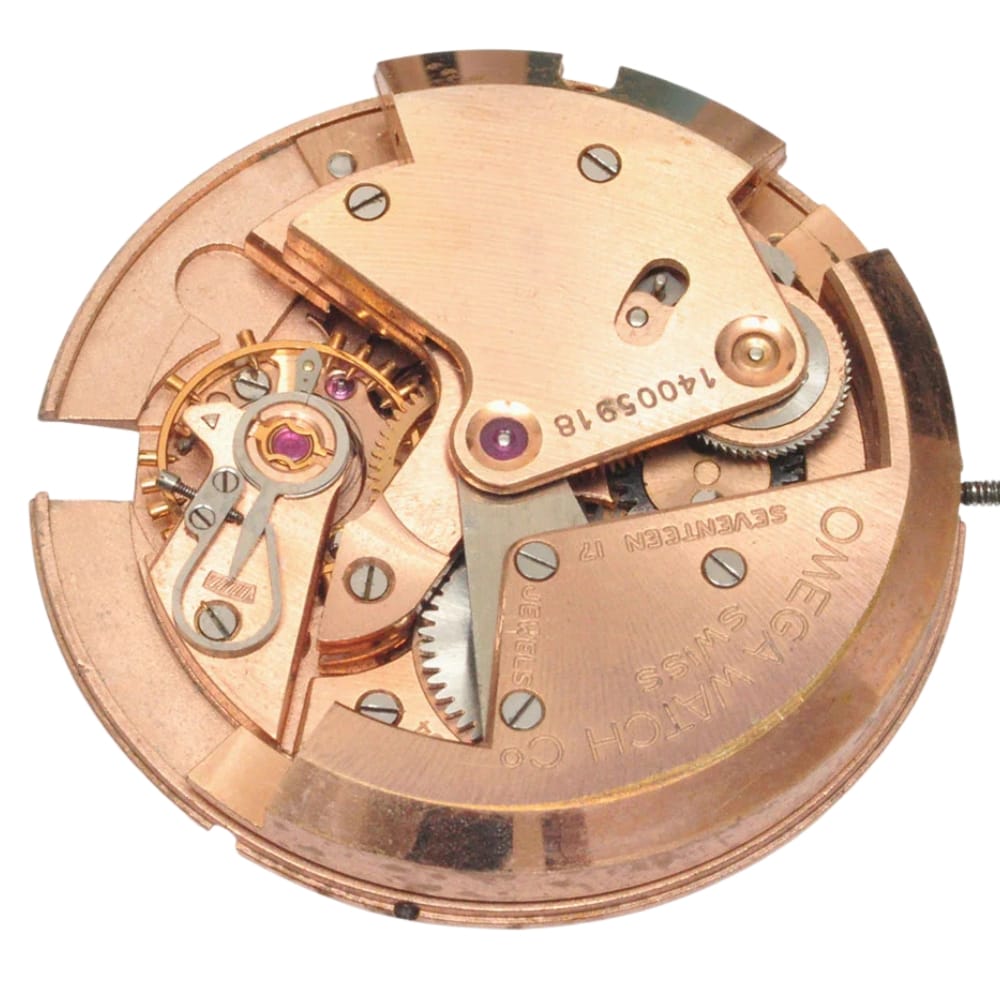
The Omega 354 powered the first Omega Constellation chronometer watches introduced in 1952, establishing the foundation for what would become Omega’s flagship precision collection. This bumper automatic movement represents the pinnacle of Omega’s first-generation self-winding technology and served as the benchmark caliber before the introduction of full-rotor movements in the mid-1950s.
The caliber 354 belongs to Omega’s 28.10 RA series and shares its core architecture with the caliber 330 introduced in 1943, the first automatic movement produced by Omega. Designed by Charles Perregaux under the direction of technical director Henri Gerber, the 354 was engineered specifically for chronometer certification, featuring superior regulation capability through its swan neck micrometric regulator and careful adjustment in five positions and temperatures. The movement’s chronometer-grade performance made it suitable for both the Seamaster line and the newly launched Constellation collection, with Omega positioning the 354 as proof that bumper technology could achieve observatory-level precision despite the mechanical stress of hammer-action winding.
Over 1.3 million bumper movements from the 28.10 RA family were produced between 1943 and 1955, making the caliber 354 uncommon rather than rare. Serial numbers in the 13 million range (1952-1953) and 14 million range (1954-1955) indicate 354 production concentrated in the final three years of the bumper era. The caliber’s production ended in 1955 as Omega transitioned to the superior caliber 500 series with its bidirectional full-rotor winding system, which eliminated the directional limitations and mechanical shock inherent to bumper springs.
The caliber 354 occupies a significant position in the collector market as the movement that launched the Constellation line. Chronometer-certified examples with intact adjustment markings and original dials command premiums over standard variants. Demand remains stable among collectors who appreciate early automatic technology and the historical significance of pre-full-rotor Omega movements. The caliber’s robust construction and continued parts availability make it suitable for regular wear, contributing to its sustained collector interest.
Historical Context, Provenance, and Manufacturing Details
The caliber 354 evolved from Omega’s groundbreaking entry into automatic watchmaking with the 28.10 RA PC (also known as caliber 330) in 1943. When Omega reorganized its caliber numbering system in 1949, the 28.10 RA series was redesignated into the 300-series range, with the caliber 354 emerging around 1952 as a chronometer-grade variant optimized for the new Constellation collection. The movement addressed the market demand for certified chronometers in automatic watches while leveraging Omega’s decade of experience refining bumper automatic technology.
The caliber 354 replaced the caliber 352 as Omega’s primary chronometer bumper movement. While the 352 featured the more complex “Omega System” RG micrometric regulator found on earlier deluxe executions, the 354 employed a swan neck regulator with simplified adjustment mechanisms, representing a cost-reduction measure that maintained chronometer capability while improving production efficiency. This transition reflected Omega’s strategic shift toward standardizing chronometer movements across both Seamaster and Constellation lines. The caliber 354 was itself replaced in 1955 by the caliber 501/505 series, full-rotor automatics that wound bidirectionally and eliminated the bumper mechanism entirely.
The caliber 354 is an in-house Omega manufacture movement, not based on an ebauche. Production took place at Omega’s facilities in Bienne, Switzerland, where the movement was manufactured, adjusted, and tested. Chronometer-certified examples were submitted to the Swiss Official Chronometer Testing Institute (COSC) or independent observatory testing facilities where they underwent 15-day trials across five positions and three temperatures (8°C, 23°C, 38°C) to achieve certification. Movements that met the -4 to +6 seconds per day standard received chronometer certificates and were engraved with “Adjusted five (5) positions and temperatures” on the oscillating weight.

The caliber 354 emerged during Omega’s golden age of observatory trial dominance. Following Omega’s record-breaking performances at Kew-Teddington (1933, 1936) and Geneva Observatory trials (1931, 1950), the company leveraged its chronometric expertise to produce certified chronometer movements at scale. The caliber 354 represented practical application of observatory-level precision engineering in production watches, translating competition-winning regulation techniques into movements suitable for daily wear. This positioned the 354 as a workhorse chronometer rather than a groundbreaking innovation, a reliable execution of proven bumper technology engineered to meet certification standards consistently.
Construction and Architecture
Plate and Bridge Layout
The caliber 354 employs a three-quarter plate construction typical of the 28.10 RA series. The movement features a main plate supporting the gear train with an upper automatic device bridge (part #1013) that secures the oscillating weight mechanism. A separate balance bridge holds the balance assembly, allowing independent removal and servicing of the escapement without disturbing the automatic winding system. The plate material is brass-based beryllium bronze alloy, heat-treated for hardness and dimensional stability. The architecture follows Omega’s established layout philosophy prioritizing serviceability and chronometric stability over visual elaboration.
Balance Wheel
The caliber 354 utilizes a free-sprung Glucydur balance wheel. Glucydur is a beryllium-bronze alloy (approximately 98% copper, 2% beryllium) precipitation-hardened to achieve strength comparable to hardened steel while remaining non-magnetic. The balance features a coefficient of thermal expansion of 17 × 10^-6 per degree Celsius, designed to work in conjunction with the Nivarox hairspring’s positive thermoelastic response to compensate for temperature-induced rate variations. The balance is smooth-rim without timing screws, relying on rate adjustment through the swan neck regulator rather than mass adjustment at the balance rim. This configuration simplifies servicing and reduces the risk of balance distortion from improper screw adjustment.
Balance Spring (Hairspring)
The caliber 354 employs a Nivarox hairspring with Breguet overcoil terminal curve. Nivarox is a nickel-iron alloy (37% nickel, 8% chromium, 1% titanium, 0.8% beryllium, balance iron) with controlled thermoelastic properties. The hairspring’s positive thermoelastic coefficient causes its modulus of elasticity to increase with rising temperature, compensating for the increased rotational inertia of the expanding Glucydur balance. The Breguet overcoil terminal ensures concentric spring development during oscillation, improving isochronism and positional performance. The hairspring attaches to a triangular stud secured to the balance cock, with adjustment accomplished via the swan neck regulator’s index pins.
Escapement Type
The caliber 354 features a Swiss lever escapement with jeweled pallet fork and escape wheel. The escapement employs synthetic ruby pallet stones and an impulse jewel at the balance roller. The escape wheel operates at 19,800 vibrations per hour (2.75 Hz), translating to 5.5 beats per second. The escapement geometry provides a lift angle of 50 degrees, a commonly accepted watchmaker value for this caliber family. The lever escapement design balances energy efficiency with chronometric stability, suitable for the directional winding constraints of the bumper mechanism.
Shock Protection System
The caliber 354 incorporates Incabloc shock protection at the balance jewels. The system uses Incabloc part #1347 for the upper balance jewel. Incabloc employs a spring-mounted jewel setting that allows the balance staff pivots to absorb shock by momentary displacement and self-centering return to the jewel setting. This protects the delicate balance staff pivots from damage during impacts. The system was standard across the 28.10 RA caliber family and represents mid-century state-of-the-art shock protection technology.
Regulator Type
The caliber 354 employs a swan neck micrometric regulator for rate adjustment. The swan neck spring applies constant pressure against an adjustment screw (Omega part #3403), allowing fine rate adjustment through micrometric screw turns that move the regulator index pins and effectively change the active length of the hairspring. This system provides superior adjustment precision compared to the simple baton-shaped index regulators used on non-chronometer calibers, facilitating the fine regulation required for chronometer certification. Chronometer-adjusted movements feature this swan neck regulator, while earlier caliber 352 examples sometimes employed the more elaborate RG micrometric regulator found on deluxe finish executions.
Mainspring Material and Type
The caliber 354 uses an automatic-type mainspring with slipping bridle mechanism. The mainspring is cataloged as MS-26N (Omega part numbers 770/14, 770/15, or 770/91 depending on supplier). Specifications are Dennison Width 2, Dennison Strength 11.5, length 12 inches (approximately 305mm), with metric dimensions of 1.10mm width and 0.095mm thickness. The mainspring material is a white alloy steel composition suitable for automatic winding applications. The slipping bridle prevents overwinding damage by allowing the mainspring to slip within the barrel when fully wound, essential for automatic movements where the wearer has no direct control over winding force.
Gear Train Details
The caliber 354 employs a four-wheel gear train with center seconds configuration. The gear train consists of barrel wheel, center wheel with cannon pinion (height 4.33mm per technical specifications), third wheel, fourth wheel (part #1243), and escape wheel. The center wheel drives the cannon pinion for the hour and minute hands, while the fourth wheel drives the center seconds pinion directly, positioning the seconds hand at the dial center. This center seconds arrangement (indicated by “SC” in the technical designation 28.10 RA SC) was preferred for readability compared to small seconds configurations. The gear train ratios produce the 19,800 vph beat rate characteristic of the 28.10 RA family.
Finishing Quality and Techniques
The caliber 354 exhibits mid-grade finishing appropriate for a production chronometer movement. The movement features a distinctive pink or rose-gold appearance, created by beryllium bronze plates with a thin copper coating rather than actual gold plating. This finish provides corrosion resistance and attractive appearance while maintaining the material properties of beryllium bronze. Chronometer-grade examples display Geneva stripes (Côtes de Genève) on the automatic bridge and circular perlage (circular graining) on the main plate. The oscillating weight receives polishing and may feature radial brushing or sunburst patterns. Wheel spokes show beveling and polishing, while screw heads receive slots with polished edges. The finishing quality remains functional rather than decorative, prioritizing chronometric performance over aesthetic elaboration, consistent with Omega’s engineering-focused approach during this era.
Cross-Reference Data
Alternative Caliber Names (Rebranded Versions)
| Manufacturer | Caliber Designation | Notes |
|---|---|---|
| Omega | 28.10 RA SC – 354 | Full technical designation; “RA” indicates automatic, “SC” indicates center seconds |
| Omega | Cal. 354 | Standard collector/service designation post-1949 renumbering |
The caliber 354 was not sold to other manufacturers under different designations. It remains an Omega-exclusive manufacture movement.
Base Caliber vs. Elaborated Versions
| Variant Name | Differences | Jewel Count | Functions | Adjustment |
|---|---|---|---|---|
| Cal. 354 (Standard) | Swan neck regulator, standard adjustment | 17 | Center seconds | Basic adjustment |
| Cal. 354 (Chronometer) | Swan neck regulator, chronometer certification | 17 | Center seconds | Adjusted 5 positions and temperatures |
| Cal. 352 RG | Earlier chronometer version with RG micrometric regulator | 17 | Center seconds | Chronometer grade with deluxe finish |
| Cal. 351 | Non-chronometer variant with simpler regulation | 17 | Center seconds | Standard adjustment |
| Cal. 355 | Date complication at 6 o’clock, swan neck regulator | 17 | Center seconds, date | Adjusted or chronometer grade |
The caliber 354 shares core architecture with calibers 350-355 from the same family, differing primarily in regulation system and complications.
Compatible Case References by Brand
Dial Compatibility Note
The caliber 354 uses a two-foot dial mounting system with dial feet secured by case clamps rather than traditional dial screws. Mounting screws (part #2145, 2163, or 1279 depending on case reference) located on the movement side press against the dial feet to secure the dial. This system requires careful alignment during dial installation. Dial feet positions are specific to the 28.10 RA series and are not directly compatible with later full-rotor calibers without modification. Date window compatibility: caliber 354 is time-only without date complication; sister caliber 355 features date at 6 o’clock position.
Crown and Stem Specifications
Identification Marks
Caliber Number Location
The caliber number “354” is engraved on the movement next to the winding wheel on the automatic device bridge. The location is visible when viewing the movement from the dial side with the oscillating weight and automatic bridge in place. The engraving appears as stamped numerals approximately 1-2mm in height.
Logo and Brand Marks
Authentic caliber 354 movements bear several manufacturer markings:
- “Omega Watch Co Swiss” engraved on the oscillating weight (rotor)
- “Seventeen 17 Jewels” or “Seventeen Jewels” engraved on the oscillating weight
- Omega symbol (Ω) may appear on certain components depending on production period
- Case interior markings include “Omega Watch Co,” “Fab Suisse,” “Swiss Made,” and case reference numbers
- Gold cases feature hallmarks (18K, 14K, or relevant gold standard marks) on case interior
Date Codes
The caliber 354 uses serial numbers for dating rather than specific date codes. Serial numbers appear on the movement and correspond to production year:
Serial numbers were assigned to movements during manufacture, and there may be a time lag between movement production and final watch casing, potentially causing minor dating discrepancies.
Finishing Marks
Expected finishing patterns by location:
- Automatic bridge: Geneva stripes (Côtes de Genève) running parallel to bridge length
- Main plate: Circular perlage (circular graining) covering exposed plate surfaces
- Oscillating weight: Radial brushing or sunburst pattern with polished surfaces
- Balance cock: Polished or brushed finish depending on grade
- Screw heads: Polished slots with beveled edges
- Overall movement: Pink or rose-gold colored finish from beryllium bronze with copper coating
Jewel Markings
The caliber 354 employs 17 jewels in the following locations:
- Balance staff (upper and lower jewels): Incabloc shock-protected settings
- Pallet fork pivots (upper and lower): Two jewels
- Escape wheel pivots (upper and lower): Two jewels
- Fourth wheel pivots (upper and lower): Two jewels
- Third wheel pivots (upper and lower): Two jewels
- Center wheel pivots (upper and lower): Two jewels
- Oscillating weight bearing: Two jewels (parts #4009 upper, #4010 lower)
- Pallet stones and impulse jewel: Three jewels in escapement
Jewels are pressed settings rather than chatons on standard grades. Higher chronometer grades may feature gold chatons on balance and escape wheel jewels, though this is uncommon on caliber 354.
Adjustment Markings
Chronometer-certified caliber 354 movements feature specific adjustment markings:
- “Adjusted five (5) positions and temperatures” engraved on the oscillating weight
- “Chronometer” may appear on the dial when movement is certified
- “Officially Certified” may appear on dial below “Chronometer” marking
- COSC or observatory certification papers (if retained) confirm chronometer status
Non-chronometer examples lack these adjustment markings and feature only standard jewel count and manufacturer engravings.
Correct Serial Number Formats and Locations
Serial numbers on authentic caliber 354 movements appear in the following locations:
- Movement serial number: Engraved on the automatic bridge or movement plate, visible when viewing movement from dial side
- Case serial number: Engraved on case interior, often on case back inner surface
Serial numbers follow these format characteristics:
- Eight digits in length (examples: 13290591, 13628698, 13722840, 13757900, 13777035, 13763365, 14041379)
- No letters or prefixes in caliber 354 era serial numbers
- Numbers stamped or engraved in clear, evenly spaced digits approximately 1-2mm in height
- Serial numbers progress sequentially through production years
Expected Engravings and Stampings
Legitimate caliber 354 movements display the following engraving characteristics:
- Caliber number “354” stamped with consistent depth and clear, sharp edges
- Serial numbers engraved with uniform character height and spacing
- Jewel count marking “Seventeen 17 Jewels” or “Seventeen Jewels” with consistent font style
- “Omega Watch Co Swiss” engraved in period-correct font (sans-serif style typical of 1950s)
- Adjustment markings (on chronometer versions) engraved with same depth and clarity as other engravings
Font and Marking Style by Production Era
The caliber 354’s production period (1952-1955) falls within a stable marking style era for Omega:
- 1952-1955: Consistent use of sans-serif font for all movement engravings
- No significant font transitions during caliber 354 production period
- Omega logo transitions: Pre-1949 movements used full “Omega Watch Co.” designation; post-1949 movements (including caliber 354) maintained this convention
- Case back markings: Pre-1959 Seamaster cases lack the hippocampus (seahorse) emblem; smooth case backs were standard for 1952-1955 production
Part Information

Part Numbers
Automatic Winding Components:
Escapement and Balance Components:
Mainspring and Barrel:
Gear Train Components:
Setting and Winding Components:
Case Components:
Regulator Components:
Sourcing Notes
Parts availability for the caliber 354 remains moderate as of 2026:
- Readily Available: Mainsprings (MS-26N), generic TAP 10 crowns and stems, bumper springs (#1415), common screws, generic Incabloc components
- Limited Availability: Original Omega oscillating weights (#1017), balance assemblies, original signed crowns, pallet forks, escape wheels
- Scarce/NOS Only: Automatic device bridges (#1013), specific regulator components, original dials with correct feet positioning
- Commonly Failed Parts: Bumper springs (fatigue from repeated compression), mainsprings (loss of elasticity), balance staff pivots (impact damage), oscillating weight bearings (wear from constant rotation)
- Acceptable Generic Replacements: Mainsprings (Swiss-made generic MS-26N equivalents), crowns (non-signed TAP 10 generic crowns), basic screws, Incabloc components (generic Incabloc systems compatible)
- Parts Requiring Omega Originals: Pallet forks (geometry-specific), dials (feet position and aesthetics), oscillating weights (correct markings and balance), balance assemblies (specific frequency and timing characteristics)
The caliber 354 benefits from substantial parts commonality with the entire 330-355 bumper caliber family, improving sourcing options for many components. Many generic Swiss parts suppliers offer compatible mainsprings, shock protection components, and winding/setting parts. Specialized Omega parts dealers and watchmaker networks remain the primary sources for movement-specific components like bridges, rotors, and dials.

Performance Data
Manufacturer Specifications
The caliber 354 chronometer certification requires meeting the following COSC standards:
- Accuracy (New): -4 to +6 seconds per day
- Positions Tested: 5 positions (horizontal, crown up, crown down, crown left, crown right)
- Temperature Range: Three temperatures: 8°C, 23°C, 38°C
- Test Duration: 15 days of continuous observation
- Isochronism: Maximum variation between fully wound and nearly unwound states within specified tolerances
Non-chronometer caliber 354 movements (standard adjustment) were regulated to looser tolerances, typically -10 to +15 seconds per day across fewer positions.
Observed Performance (Field Data)
Based on collector reports, watchmaker observations, and dealer timing data from serviced examples:
Accuracy Range for Well-Maintained Examples:
- Chronometer-certified examples after professional service: +5 to +10 seconds per day averaged over 5 positions
- Exceptional examples: +7 to +8 seconds per day, maintained over years of regular wear
- Standard (non-chronometer) examples after service: -10 to +15 seconds per day
Common Performance Issues and Causes:
- Loss of amplitude over power reserve depletion: Amplitude drops from approximately 270-290 degrees when fully wound to 220-250 degrees as mainspring approaches end of 42-hour power reserve. This is normal behavior for bumper automatics due to directional winding limitations.
- Bumper spring fatigue: Repeated compression of bumper springs (#1415) over decades causes loss of spring tension, reducing winding efficiency and requiring replacement.
- Oscillating weight bearing wear: Constant rotation of the oscillating weight causes wear to the upper (#4009) and lower (#4010) jewels and bearing plate (#1403), leading to increased friction and reduced winding efficiency.
- Magnetization: Exposure to magnetic fields causes balance spring coils to stick together, dramatically increasing rate gain (watch runs fast). Demagnetization restores normal performance.
- Dried lubricants: Age-related degradation of movement oils increases friction throughout the gear train, reducing amplitude and accuracy. Complete disassembly, cleaning, and relubrication restores performance.
Expected Amplitude:
- Fully wound, horizontal position: 270-290 degrees
- Fully wound, vertical positions: 250-270 degrees
- Near end of power reserve, horizontal: 220-250 degrees
- Near end of power reserve, vertical: 200-230 degrees
Amplitudes below 200 degrees in any position indicate service requirement (dried oils, worn pivots, damaged mainspring, or escapement issues).
Performance Degradation Over Time:
Unserviced caliber 354 movements typically exhibit degraded performance after 10-15 years without service:
- Rate variation increases beyond acceptable tolerances (often +30 to +60 seconds per day)
- Amplitude drops below 200 degrees even when fully wound
- Power reserve diminishes from 42 hours to 24-30 hours due to increased friction
- Bumper winding mechanism becomes audibly rough as spring tension decreases
Professional service (complete disassembly, cleaning, part replacement as needed, relubrication, and regulation) typically restores performance to within 10-15 seconds per day for non-chronometer examples and within 5-10 seconds per day for chronometer-grade movements with intact original adjustment.
The caliber 354’s robust construction and continued parts availability support long-term reliability when properly maintained through regular servicing every 5-7 years. The movement’s chronometer-grade engineering provides sufficient performance for daily wear even in standard-adjusted examples, while certified chronometer versions offer accuracy comparable to modern mechanical movements when freshly serviced