

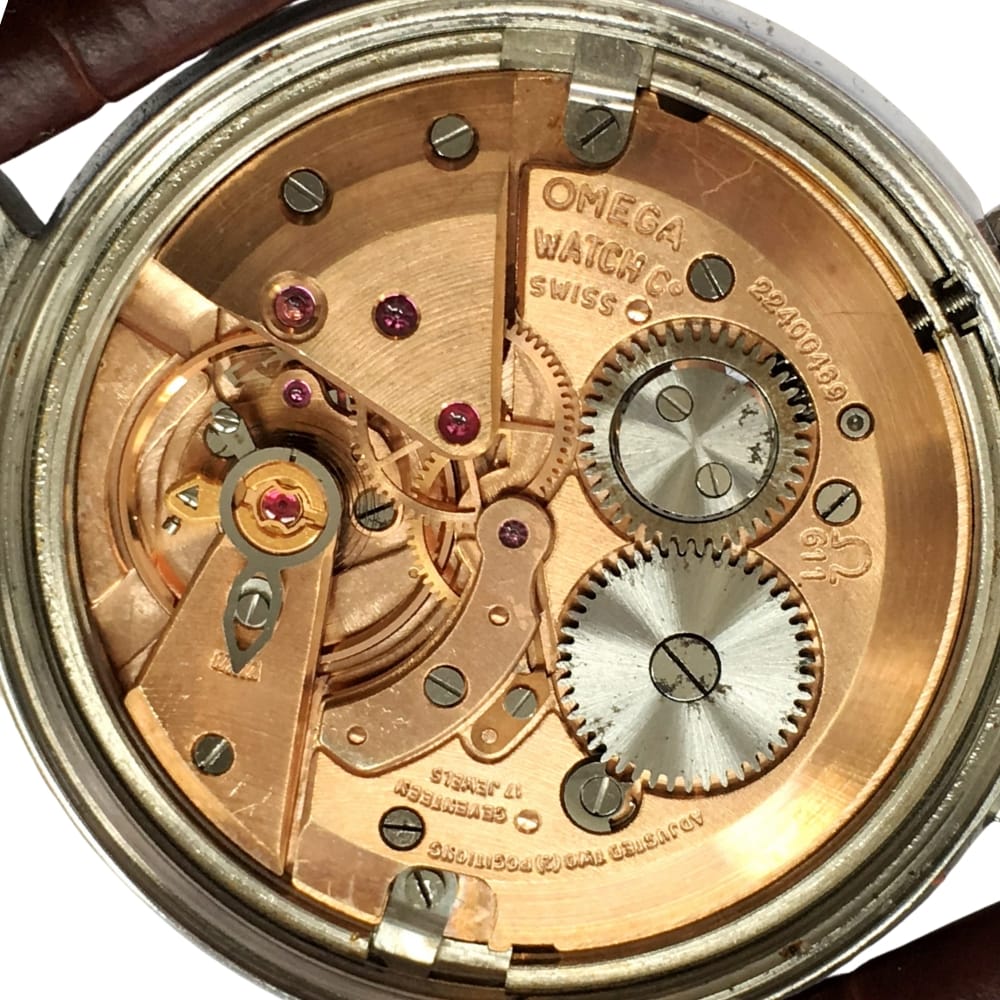
The Omega 611 caliber occupies a specific niche in Omega’s 1960s lineup: the date-equipped variant of the successful 600 series manual-wind movements, positioned between the base no-date 601 and the later quickset-equipped 613. While not revolutionary, the 611 represented Omega’s pragmatic approach to market segmentation during an era when Swiss manufacturers faced mounting competitive pressure, offering collectors a reliable date complication in the increasingly popular mid-sized dress watch format that defined the decade.
This movement powered three distinct product lines during its brief production window: the Seamaster 600 sports-casual watches (primarily reference 136.011), Seamaster De Ville dress watches (references 136.019, 136.020), and Geneve models (references 132.003, 132.018, 132.019). The 611’s semi-quickset date mechanism, set by rotating hands backward from midnight to 9 o’clock repeatedly, distinguishes it from both its predecessor (the no-date 601) and successor (the quickset 613), making it a transitional design that collectors should understand when evaluating originality and period correctness.
Production records indicate Omega manufactured approximately 123,000 units of the Caliber 611 during its run, making it uncommon but not rare in today’s market. The movement’s relative scarcity compared to the longer-running 601 (produced 1962-1970 with substantially higher volumes) stems from its compressed production timeline and Omega’s rapid iteration toward the improved 613 variant. Serial numbers in the 21 million range correspond to 1964 production, while 24-25 million serial numbers date to 1966-1967, providing collectors with reliable dating parameters.
The 611’s standing in the current collector market reflects vintage Omega’s broader trajectory: prices remain accessible ($800-$2,000 for complete examples depending on condition and case material), demand is stable rather than rising, and condition matters more than model rarity. Original dials, unpolished cases, and documented service history command premiums, while the movement’s continued parts availability and straightforward service requirements make it attractive to collectors prioritizing wearability over investment potential. The Seamaster 600 variants, particularly black dial examples and De Ville configurations with intact gold plating, generate the strongest collector interest.
Historical Context, Provenance, and Manufacturing Details
Omega introduced the Caliber 600 series in the early 1960s as a calculated response to market demand for thinner, more affordable watches that maintained the company’s reputation for quality. The development sequence began with Caliber 600 in 1960 (featuring a swan-neck regulator), followed by the cost-reduced Caliber 601 in 1962 with an excenter regulator replacing the more expensive swan-neck system. The 611 emerged around 1964-1965 as the date-equipped variant, adding a semi-quickset date complication to the proven 601 architecture.
The Caliber 611 evolved directly from the 601, inheriting its excenter regulator, 17-jewel configuration, and basic gear train layout while incorporating a date wheel, date driving mechanism, and associated components. Its successor, the Caliber 613, appeared in 1966-1967 with a true quickset date function activated by a separate position on the crown rather than the semi-quickset hand-cycling method. The entire 600 series was ultimately replaced by the Caliber 1000 series in the early 1970s as Omega transitioned to newer movement architectures designed for improved water resistance and reduced manufacturing costs.
The 611 represents an ebauche-based movement in the sense that it derives from the automatic Caliber 550 series architecture, with Omega manufacturing the movement in-house at its Bienne facility after removing the self-winding mechanism. This design strategy simplified production by allowing extensive parts interchangeability between the 550/560 automatic family and the 600 manual family, including bridges, wheels, jewels, and setting mechanism components. The balance complete (part 1327), barrel bridge (part 1001), and numerous gear train components cross-reference directly between calibers, reducing inventory complexity and service costs.
In the broader context of horological history, the Caliber 611 embodies the practical Swiss philosophy of the 1960s: leverage proven automatic movement architecture, remove complexity where market segments don’t demand it, maintain quality standards sufficient to uphold brand reputation, and price competitively. The movement is neither groundbreaking nor inferior but rather a competent workhorse that served its intended purpose during a period when Swiss watchmaking faced the early stages of what would become the quartz crisis.
Construction and Architecture
The Caliber 611 employs a traditional three-bridge architecture with a main plate, barrel bridge (part 1001), train wheel bridge (part 1003), and separate cocks for the pallet fork (part 1005), sweep second (part 1007), and balance (part 1030). This layout prioritizes serviceability and manufacturing efficiency, with bridges constructed from brass with nickel plating providing corrosion resistance and dimensional stability. The architectural philosophy emphasizes practical durability: bridges are substantial enough to maintain jewel positioning under shock, and the construction allows complete disassembly and reassembly without specialized tooling.
The main plate features proper jeweling for all pivots requiring low-friction support, with the gear train mounted between the plate and train wheel bridge in a sandwich configuration that maintains precise gear mesh. The sweep second cock mounts separately, a design choice necessitated by the indirect center seconds drive system inherited from the automatic 550 base caliber. This separate cock arrangement slightly increases movement height compared to direct-drive center seconds but improves reliability and simplifies service.
Balance Wheel
The Caliber 611 utilizes a Glucydur balance wheel, a beryllium bronze alloy standard for Swiss movements of this era that offers superior temperature stability and shock resistance compared to traditional nickel alloys. The balance wheel features a smooth rim without timing screws, relying instead on factory regulation via the excenter regulator system. This screwless configuration was standard for mid-grade movements of the period, prioritizing manufacturing efficiency over user adjustability while maintaining adequate chronometric performance for daily wear.
Balance Spring (Hairspring)
The 611 employs a Nivarox hairspring, the industry-standard cobalt-nickel-iron alloy developed in the 1930s for its temperature compensation, anti-magnetic properties, and resistance to oxidation. The spring configuration is a flat spiral with a standard inner terminal curve rather than a Breguet overcoil, consistent with the movement’s positioning as a practical rather than haute horlogerie caliber. The Nivarox material ensures stable timekeeping across temperature variations typically encountered in daily wear while remaining serviceable with standard watchmaking tools and techniques.
Escapement Type
The movement features a standard Swiss lever escapement with jeweled pallet stones, representing the dominant escapement design for mechanical watches throughout the 20th century. The escape wheel (part 1305) drives two synthetic ruby pallet stones mounted in the pallet fork (part 1316), with the escapement delivering impulse to the balance wheel through a direct-acting mechanism that provides reliable timekeeping with moderate power consumption.
Shock Protection System
The 611 incorporates Incabloc shock protection at the balance wheel pivots, using the lyre-shaped spring-loaded mounting system standard for Swiss movements of the era. Specific Incabloc components include top block 129.21.300, bottom block 102.20, cap jewels 122.11 (top and bottom), top spring 170.02, and bottom spring 172.02. The Incabloc system protects the delicate balance pivots and jewel bearings during impacts by allowing controlled vertical movement within the spring-loaded chaton, significantly improving durability for daily wear compared to older fixed-jewel systems.
Regulator Type
The Caliber 611 employs an excenter regulator (also called pointer regulator or index regulator), a simpler and less expensive system than the swan-neck regulator found on its predecessor Caliber 600. The regulator consists of a curved arm with pins that embrace the hairspring, with the entire arm rotating around an eccentric pivot to adjust the effective length of the spring. This design allows reasonably precise adjustment when performed carefully but lacks the micrometric screw-adjustment capability of swan-neck systems. The transition from swan-neck (Caliber 600) to excenter (Caliber 601/611) exemplifies Omega’s strategic cost management during the 1960s, as both systems achieve similar accuracy results in skilled hands.
Mainspring Material and Type
The movement uses a traditional alloy mainspring with dimensions documented as 1.05 x 0.120 x 380 x 10.00mm (GR reference 2536), though variations exist with slightly different measurements (1.05 x 0.125 x 340 x 10.5mm also documented). The mainspring attaches to the barrel arbor (part 1204) with a fixed hook rather than a slipping bridle, typical for manual-wind movements of this era and generation. Replacement mainsprings remain readily available from multiple suppliers under various reference numbers including GR2536 and factory number 72206001208.
Gear Train Details
The Caliber 611 employs a four-wheel gear train with indirect center seconds drive, inherited from the automatic Caliber 550 architecture. The gear train consists of barrel wheel (great wheel, part 1216), center wheel with cannon pinion (parts 1219), third wheel (part 1240, which also serves as the intermediate wheel for center seconds), fourth wheel (seconds wheel, part 1243), and escape wheel (part 1305). The indirect center seconds configuration, while slightly increasing movement thickness, proved more reliable and easier to service than direct-drive alternatives, contributing to the movement’s reputation for durability.
Finishing Quality and Techniques
The Caliber 611 receives functional rather than decorative finishing, appropriate for its mid-grade market positioning. Bridges do not receive Côtes de Genève (Geneva stripes) in standard production, instead featuring perlage (circular graining) or brushed finishes depending on production era. The absence of Geneva striping distinguishes the 611 from higher-grade Omega movements and reduces manufacturing time without affecting functionality. Bridge edges receive minimal chamfering (anglage) if any, typically showing simple radiused edges rather than hand-polished bevels.
The movement is not adjusted to chronometer standard in normal production, though rare examples exist with adjustment markings. Standard 611 movements received adjustment in two positions at the factory, sufficient for daily-wear accuracy in the range of -1 to +16 seconds per day when new. The functional finishing approach prioritizes long-term reliability and serviceability over aesthetic elaboration, consistent with Omega’s strategy for volume production dress watches during the 1960s.
Cross-Reference Data
The Caliber 600 series comprises six related movements, all based on the automatic Caliber 550 architecture with the self-winding mechanism removed:
| Caliber | Jewels | Regulator Type | Date Function | Production Notes |
|---|---|---|---|---|
| 600 | 17 | Swan-neck (Reed’s) | No | 1960-1962, first of series |
| 601 | 17 | Excenter | No | 1962-1970, longest production run |
| 602 | 17 | Excenter | No | Chronometer-grade variant of 601 |
| 610 | 17 | Swan-neck (Reed’s) | Yes (semi-quickset) | Date variant of 600 |
| 611 | 17 | Excenter | Yes (semi-quickset) | Date variant of 601 |
| 613 | 17 | Excenter | Yes (quickset) | 1966-1967, replaced 611 |
Parts interchangeability exists extensively within the 600 series and between the 600 and 550 series base calibers. Key components including the balance complete (part 1327), barrel bridge (part 1001), gear train wheels, and many smaller parts cross-reference directly between calibers.
Compatible Case References by Brand
Omega Seamaster 600 References:
Omega Seamaster De Ville References:
Omega Geneve References:
Dial Compatibility Note
The Caliber 611 uses standard Omega dial foot positions compatible with other 600 series movements, with the date window positioned at 3 o’clock. Dial foot spacing matches the 550/560 automatic series, allowing some cross-compatibility when dimensions permit. The date window requires a specific cutout for the date wheel, distinguishing 611-compatible dials from no-date 601 variants. Collectors should verify dial authenticity by checking for proper date window aperture size, correct font style for the period (no “Swiss Made” text should appear above 6 o’clock on period-correct dials), and appropriate lume plot aging consistent with hands.
Crown and Stem Specifications
Stem: Part number 1160, male split stem (movement side) with length 10.60mm. The split stem design separates into movement-side and case-side components, with the male portion threading into the movement and the female outer stem (part 9993) connecting to the crown.
Crown thread: Standard Omega tap size for the period, typically 0.90mm thread pitch. Original Omega crowns measure approximately 4.9mm diameter with 2.2mm thickness.
Setting mechanism: Yoke-type clutch system (part 1111, the wipe/yoke) with associated spring (part 1112) engaging the setting lever (part 1109). The semi-quickset date function operates through the standard hand-setting mechanism rather than requiring a dedicated quickset position, distinguishing it from the later 613 caliber.
Identification Marks
The caliber designation “611” appears engraved on the main plate, typically visible near the balance cock or under the balance wheel when removed. The engraving depth and style are consistent with Omega’s standards from the mid-1960s, featuring clean, sans-serif numerals machine-engraved rather than hand-stamped.
Logo and Brand Marks
Authentic movements display the Omega name and logo on the main plate, with the specific logo style corresponding to the 1960s design featuring the Greek letter Omega (Ω) above or adjacent to the word “OMEGA” in capital letters. The balance cock may also feature decorative engraving or the Omega logo, depending on production year and grade.
Date Codes
Omega did not use internal date codes on the Caliber 611 itself. Movement dating relies on the serial number stamped on the movement (typically on the main plate or under the balance) and cross-referenced with Omega’s production records. The case serial number, stamped inside the case back, should correlate with the movement serial number within reasonable ranges for original pairings.
Finishing Marks
Expect perlage (circular graining) on the main plate and barrel bridge, with brushed or matte finishes on smaller bridges and cocks. The absence of Côtes de Genève striping is correct for standard-grade 611 movements. Jewel settings are pressed rather than mounted in gold chatons, appropriate for the movement’s grade level.
Adjustment Markings
Most 611 movements lack formal adjustment markings, as they were not chronometer-certified in standard production. When present, adjustment markings appear on the balance cock or main plate, typically indicating two-position adjustment. The absence of adjustment markings is correct and should not raise authenticity concerns.
Correct Serial Number Formats and Locations
Movement serial numbers appear stamped on the movement, typically in the 21-25 million range for 611 production:
- 21,000,000 – 21,999,999: 1964
- 22,000,000 – 23,999,999: 1965
- 24,000,000 – 25,999,999: 1966-1967
Case serial numbers are stamped inside the case back, with the same numerical range. For original pairings, the movement and case serial numbers should be within several hundred thousand of each other, though mixing occurred during service.
Expected Engravings and Stampings
Legitimate 611 movements display:
- Caliber number “611” engraved on the main plate
- “OMEGA” name and logo on the main plate
- “17 JEWELS” or “17 RUBIS” designation
- “SWISS” or “SWISS MADE” marking
- Movement serial number (8 digits in 21-25 million range)
- “ADJUSTED” or “ADJUSTED 2 POSITIONS” if present (uncommon)
Engraving depth should be consistent and crisp, with machine-engraved characters showing uniform depth and spacing.
Font and Marking Style by Production Era
Omega maintained relatively consistent engraving styles throughout the 611’s brief production run (1964-1966), using sans-serif machine-engraved fonts standard for the era. Earlier examples (1964-1965) occasionally show slightly different font weights compared to later 1966-1967 production, but variations are subtle. The Omega logo transitioned from a more ornate style to the simplified modern design during the 1960s, so collectors should verify logo style matches the production year indicated by serial numbers.
Part Information

Major Component Part Numbers
Incabloc Components
Date Mechanism Parts
Crystal and Case Parts
Crystal: PZ5007L, 31.6mm diameter, domed acrylic with metal tension ring and date magnifier, no longer available from Omega. Generic replacements from aftermarket suppliers are standard practice.
Case Gasket: Reference 088.0010 for case back, overall diameter 31.10mm, thickness 0.60mm.
Bracelet Options: Period-correct options included the 7912/1035 bracelet with endlinks (expensive) and beads-of-rice style bracelets. Lug width: 18mm.
Sourcing Notes
Currently Available Parts:
- Mainsprings remain readily available from multiple suppliers (Cousins, Ofrei, Gleave, Perrin)
- Stems (part 1160) available as new old stock and generic replacements
- Balance complete (part 1327) occasionally available from parts dealers
- Common components like click springs, barrel bridges, and date mechanism parts surface regularly in vintage parts inventories
Commonly Failed Parts:
- Mainsprings deteriorate with age and require replacement during service
- Date jumper springs lose tension over decades
- Incabloc springs can crack or lose tension
- Barrel arbor bushings wear and cause power reserve issues
Acceptable Generic Replacements:
- Mainsprings: Generic manual wind springs in correct dimensions work acceptably
- Stems: Generic split stems in correct dimensions function properly, though original parts preferred for authenticity
- Crystals: Modern acrylic replacements with appropriate dimensions suitable for daily wear
- Gaskets: Modern equivalents in correct dimensions acceptable for service
Performance Data
Manufacturer Specifications
Accuracy (New): Standard production 611 movements were adjusted to approximately -1 to +16 seconds per day average daily rate when new, measured over 3 positions (two horizontal: dial up and dial down; one vertical: 3 o’clock left). This specification reflects mid-grade Swiss chronometric performance, adequate for daily wear but not chronometer-certified quality.
Positions Tested: Two positions standard (dial up, dial down), with occasional three or five-position adjustment for higher-grade examples. The movement was not routinely submitted for COSC chronometer certification, distinguishing it from higher-grade Omega calibers like the 562 and 564 chronometer variants.
Temperature Compensation: The Nivarox hairspring provides inherent temperature compensation across the typical wearing range of 0-40°C (32-104°F), with minimal rate variation when properly adjusted. No special temperature compensation mechanisms beyond the material properties of the Nivarox spring are incorporated.
Isochronism: The movement should maintain consistent rate across the full power reserve when properly adjusted, though amplitude drops from approximately 240-270 degrees when fully wound to 180-210 degrees near the end of the 48-hour reserve. Rate variation across power reserve positions should remain within manufacturer specifications when the mainspring and escapement function correctly.
Observed Performance (Field Data)
Typical Accuracy Range (Well-Maintained Examples): Properly serviced 611 movements typically achieve -5 to +15 seconds per day in daily wear, with better results possible when carefully adjusted. Collectors and watchmakers report that well-maintained examples frequently achieve chronometer-level performance (-4 to +6 seconds per day) despite lacking formal certification, particularly when fitted with fresh mainsprings and properly cleaned escapements.
Common Performance Issues and Causes:
- Reduced Power Reserve (10-14 hours instead of 48): The most frequently reported issue stems from aged mainsprings that have lost resilience, barrel arbor bushing wear, or excessive mainspring grease that impedes unwinding. Replacement mainsprings typically restore full 48-hour reserve.
- Low Amplitude (Below 200 degrees): Insufficient lubrication, dirty escapement, or worn balance pivots cause reduced amplitude. Well-serviced examples should maintain 240-270 degrees dial-up when fully wound, dropping to 220-240 degrees in vertical positions.
- Positional Rate Variation: Excessive differences between horizontal and vertical positions (beyond ±10 seconds/day) indicate escapement issues, worn balance pivots, or improper regulation. The indirect center seconds system can introduce additional friction if the center seconds pinion or jewel bearings are worn.
- Date Mechanism Failures: The semi-quickset date function’s reliability depends on proper engagement of the date driving wheel and adequate tension in the date jumper spring. Worn date jumper springs or damaged date wheel teeth cause incomplete or double-changing dates.
Expected Amplitude Values:
- Fully wound, dial up: 260-280 degrees
- Fully wound, vertical positions: 230-250 degrees
- Near end of reserve, dial up: 190-220 degrees
- Near end of reserve, vertical: 170-200 degrees
Amplitudes below 180 degrees in any position indicate service requirements.
Performance Degradation with Age: Unserviced movements exhibit predictable performance decline after 10-15 years without service:
- Years 0-5: Minimal degradation, accuracy within specification
- Years 5-10: Gradual amplitude reduction, slight accuracy drift
- Years 10-15: Noticeable accuracy loss (±20-30 seconds/day), reduced power reserve
- Years 15+: Significant performance degradation requiring complete service
The 611’s reputation for durability means many examples continue running decades after their last service, though accuracy and reliability suffer. Regular 5-year service intervals maintain optimal performance and prevent accelerated wear