


Last updated ~ February 2, 2026
Brand
Production Period
1966–1970
Model Line
Case Shape
Cushion
Diameter
41mm
Lug to Lug
47mm
Lug Width
20mm
Case Thickness
13mm
Case Back
Screw-Down
Caliber
Crystal
Bezel
Tachymeter
The Omega Chronostop Reference 145.008 represents one of the most innovative and underappreciated chronographs of the 1960s, a period when Omega stood at the zenith of its creative and technical prowess. This watch embodies the experimental spirit of late 1960s watchmaking, offering a radical departure from traditional chronograph design through its single-pusher, 60-second timing mechanism and rotating inner bezel functionality.
What distinguishes the 145.008 from its sibling reference 145.007 is the addition of a second crown at 10 o’clock, which controls a bi-directional rotating inner bezel, adding versatility to what was already a bold design statement. At 41mm in diameter, this was a substantial watch for its era, predating the modern trend toward larger case sizes by several decades. The Chronostop earned industry recognition, winning the 1967 Honor Prize for Chronographs and Sport Watches from the Swiss watchmakers federation and serving as the official timer for the 1968 Olympic Games in Mexico.

Vintage Omega Seamaster 145.008 Chronostop sold on watchPool24
Despite sharing fundamental movement architecture with the legendary Speedmaster Professional through its Caliber 865 (a derivative of the iconic Caliber 861), the Chronostop has remained relatively affordable in the vintage market, making it one of the most compelling value propositions for collectors seeking genuine 1960s Omega chronograph quality without Speedmaster pricing.
History & Production Period
The Chronostop was introduced in 1966 as part of Omega’s Seamaster collection, conceived during a period of intense innovation at the brand. The company had recently achieved new world records for accuracy in timing competitions at Geneva and Neuchâtel in 1963, and was investing heavily in developing technical sports watches that pushed boundaries. The Chronostop lineup represented Omega’s answer to a market increasingly interested in specialized timing instruments with novel functionality.
The 145.008 was born from this creative ferment as the larger, more sophisticated variant within the Seamaster Chronostop family. While initially launched under the Seamaster banner in 1966, the broader Chronostop collection was transitioned to the Genève line in 1967 to target a younger, more price-conscious demographic. However, the Seamaster variants, including both the 145.007 and 145.008, retained their Seamaster designation and remained positioned as the premium offerings within the Chronostop range.
Production of the 145.008 spanned approximately 1966 to 1970, based on serial number analysis and documented examples. Watches from this reference bear serial numbers typically ranging from the mid-23 million range (1966) through the low 32 million range (1970). The entire Chronostop program, across all references and calibers, produced roughly 185,000 units, with approximately 124,000 featuring the Caliber 865 found in the 145.008.
The watch earned multiple accolades during its brief production run. In 1966, it won top prize at the prestigious Federation Horologer competition. The following year brought the 1967 Honor Prize for Chronographs and Sport Watches, and in 1968, it captured first prize for Industrial Aesthetics at the Utrecht Spring Fair. These awards validated Omega’s risk-taking approach to chronograph design.
Production numbers for the 145.008 specifically have not been officially documented, but it appears to be among the less common Chronostop variants. The watch was never heavily marketed compared to Omega’s flagship Speedmaster line, and surviving examples suggest limited production, particularly for certain bezel configurations like the sought-after “roulette” 24-hour variant.

1960’s Omega Seamaster Chronostop (Pilot Roulette Bezel
Technical Specifications
The Reference 145.008 presents impressive specifications for a vintage sports chronograph:
Case Construction:
The watch features a substantial 41mm stainless steel case with a distinctive cushion or tonneau profile, known within Omega’s nomenclature as a “C-case” construction. At a time when most dress watches measured 34-36mm, the 145.008’s 41mm diameter was genuinely oversized, lending it substantial wrist presence. The case extends 46-47mm from lug to lug, with a thickness of approximately 12-14mm (including crystal). This creates a watch that wears larger than its numbers suggest due to the broad, flat bezel and cushion case shape.
The case features a screw-down caseback with six notches for a specialized case opener, stamped internally with “145.008” for authentication. The caseback exterior typically bears “OMEGA WATCH CO,” “SWISS MADE,” “SEAMASTER,” “STAINLESS STEEL,” and “WATERPROOF TESTED 60M 200FT” in circular text arrangement.
Dual Crown Configuration:
A defining characteristic of the 145.008 is its dual-crown setup. The primary crown sits at 4 o’clock (signed with the Omega logo) and controls time-setting and manual winding. A secondary crown at 10 o’clock operates the inner rotating bezel, distinguishing this reference from the single-crown 145.007. Both crowns are screw-down for water resistance.
Chronograph Pusher:
At 2 o’clock sits the mono-pusher that controls all chronograph functions through an innovative press-and-release mechanism unique to the Chronostop. The pusher is also signed with Omega branding on period-correct examples.
Crystal:
The watch mounts an acrylic (hesalite) crystal with the Omega logo subtly engraved on its underside at the center, a feature Omega used to identify the specific hesalite type and serve as an anti-counterfeiting measure. This logo is often difficult to see without proper lighting and magnification but confirms originality.
Water Resistance:
Rated at 60 meters (approximately 6 ATM), the 145.008 offers legitimate water resistance for a vintage chronograph, though the screw-down pusher should not be operated while submerged.
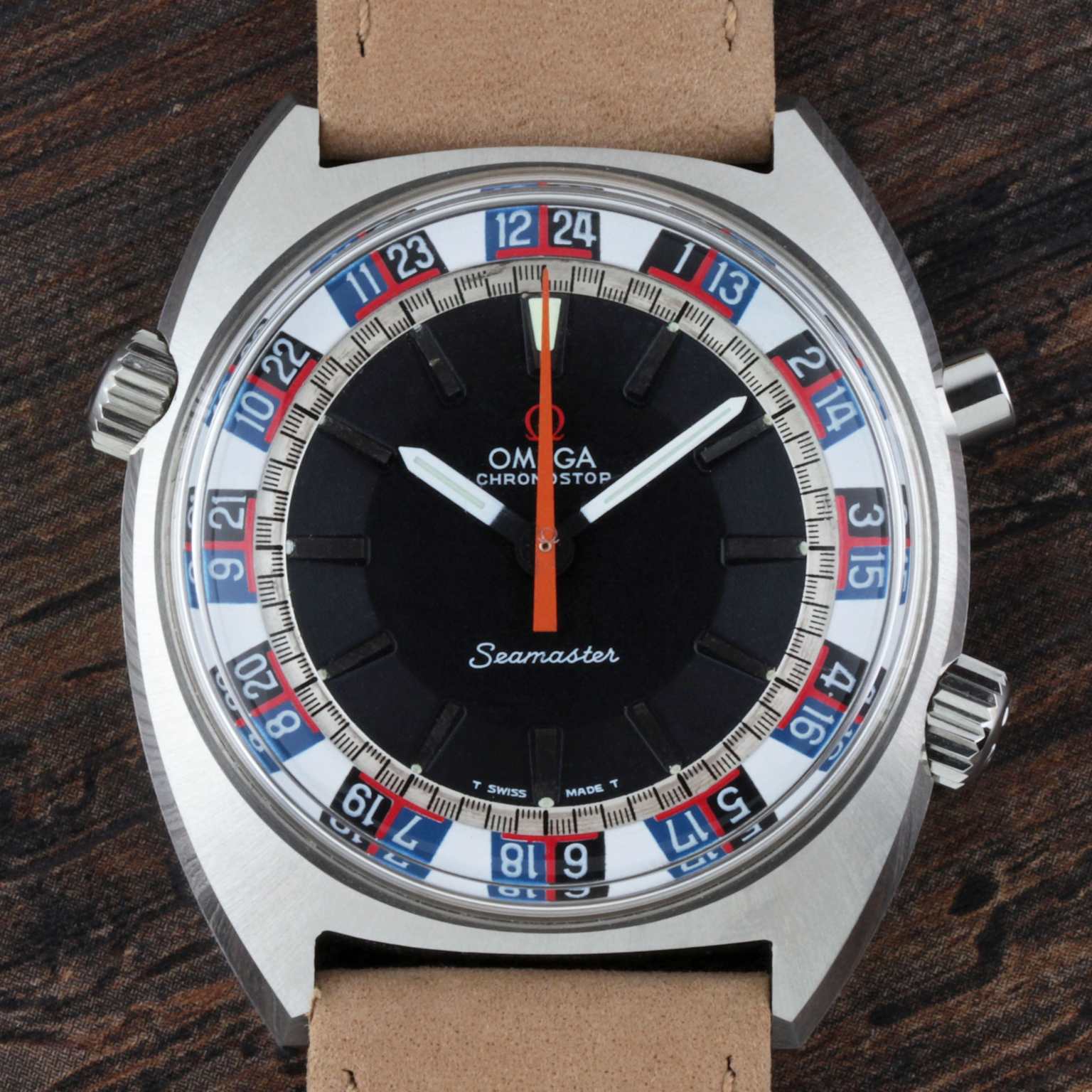
Omega 1968 Seamaster Chronostop “Roulette” Ref.145.008
Movements & Calibers
The heart of the Reference 145.008 is the Omega Caliber 865, a hand-wound chronograph movement that shares its fundamental architecture with one of horology’s most celebrated calibers: the Omega 861 found in Speedmaster Professional Moonwatches.
Caliber 865 Specifications:
- Jewels: 17
- Frequency: 21,600 vibrations per hour (3 Hz)
- Power Reserve: Approximately 36 hours
- Winding: Manual wind only (no automatic function)
- Chronograph Type: Cam-and-lever operated, single pusher
- Special Features: Shock protection, antimagnetic properties
- Chronometer Status: Not COSC certified, though capable of excellent accuracy when properly serviced
Movement Architecture:
The Caliber 865 is essentially a simplified derivative of the Lemania-based Omega Caliber 861. Where the 861 features a 30-minute totalizer and running seconds subdial, the 865 strips away these complications to focus purely on a central 60-second chronograph hand. This simplification doesn’t indicate inferior quality; rather, it represents a different functional philosophy suited to the Chronostop’s purpose as a dedicated short-interval timer.
The movement lacks hacking (the seconds hand continues running when the crown is pulled) and features a traditional column-wheel-free cam system for chronograph actuation. The single pusher controls all three chronograph functions through an elegant mechanical sequence: press once to start the chronograph hand, press and hold to stop and read the elapsed time, then release the pusher to flyback reset to zero. This operation differs from traditional two-pusher chronographs and requires a brief learning curve.
Movement Quality & Servicing:
Period watchmakers familiar with the 861 family find the 865 straightforward to service, with parts availability generally good due to the movement’s relationship to the Speedmaster line. Common service issues include dried lubricants (the movement was designed for regular oiling), potential rust formation on steel components like the escape wheel if moisture has entered the case, and mainspring deterioration. A properly serviced Caliber 865 should maintain accuracy within ±10 seconds per day.
The movement features Omega’s characteristic rose gold-colored bridges and is signed “OMEGA SWISS 17 JEWELS” along with the caliber number 865 and individual serial number. The serial number on the movement can help date the watch when cross-referenced with production records.
Dial Variations
Unlike the broader Chronostop family, which appeared in a kaleidoscope of dial colors including grey, burgundy, blue, white, and even green across the Genève references, the Seamaster Chronostop Reference 145.008 was exclusively produced with black dials. This uniformity simplifies authentication but also means collectors should be immediately skeptical of any 145.008 offered with alternate dial colors, as these would represent service replacements, redials, or misidentified references.
Standard Dial Configuration:
The 145.008 dial features a distinctive reverse (inverted) pie-pan construction, where the outer dial surface sits slightly recessed from the applied hour markers, creating a subtle concave profile when viewed from the side. This design adds visual depth and was characteristic of premium Omega sports watches from this era.

Omega Chronostop Reference Guide – The Monopusher
Dial Elements:
- Hour Markers: Applied polished steel baton indices at each hour position, with the 12 o’clock marker typically wider or wedge-shaped
- Luminous Material: Small dots of tritium-based lume applied to the outer tip of each hour marker, originally emitting a greenish glow. Period-correct dials are marked “T SWISS T” or “T SWISS MADE T” at 6 o’clock below the inner bezel, indicating tritium content below 7.5 millicuries
- Branding: “OMEGA” printed in white (occasionally the logo appears in orange/red to match the chronograph hand), “SEAMASTER” below the logo, and the Omega symbol itself
- Minutes Track: A distinctive “checkerboard” or racing-style chapter ring with alternating white blocks marks the outer minutes, creating visual contrast and enhancing legibility
- Inner Bezel Scale: Visible beneath the crystal, surrounding the dial proper, with markings depending on the specific bezel variant (detailed in the next section)
Dial Condition & Patina:
Original dials from the 1960s will have developed natural patina in the tritium lume, which ages from white/cream to various shades of tan, custard, or even light brown depending on storage conditions and UV exposure. The dial printing may show subtle fading, and light oxidation spots can appear, particularly around the perimeter. These signs of age are generally acceptable to collectors when they appear naturally and don’t obscure dial legibility.
Tropical Dials:
Some examples have developed what collectors call “tropical” characteristics, where the matte black dial has faded to dark brown or chocolate tones due to UV exposure. While not originally intended, these tropical dials have become desirable among certain collectors for their unique aesthetic.
Case & Bezel Variations
The Reference 145.008 maintains consistency in case material and construction but offers significant variety through its inner rotating bezel configurations, which fundamentally alter the watch’s functionality and collector appeal.
Case Details:
All 145.008 examples feature stainless steel construction exclusively. No gold, gold-capped, or two-tone variants were produced for this reference. The case finishing combines brushed surfaces on the case flanks with polished bevels running along the edges where the case top meets the sides, creating visual definition. The top surface of the case typically shows radial or sunburst brushing extending from the bezel area.
The case design incorporates integrated lugs that flow from the main case body rather than being separately attached. The lug width measures 22mm, wider than the 18mm straps used on smaller Chronostop variants, accommodating more substantial bracelets appropriate for the watch’s sporting character.
A critical detail for collectors is the case edge where the bezel meets the lugs. This transition features a subtle but sharp chamfer that is easily lost through aggressive polishing. Unpolished examples show crisp, well-defined edges, while over-polished cases appear rounded and blob-like, significantly diminishing the watch’s character.
Rotating Bezel Variants:
The inner rotating bezel sits beneath the crystal and is controlled by the crown at 10 o’clock. The bezel rotates bi-directionally (both clockwise and counterclockwise) and can be positioned against the dial to provide additional timing or time-zone functionality. Three primary bezel types appeared on the 145.008:
1. 24-Hour Bezel (“Roulette”):
This is the most iconic and sought-after variant. The bezel displays a 24-hour scale with numerals 1-12 in one color (often white or cream) and 13-24 in contrasting colors. The most famous iteration features alternating red and blue segments, nicknamed the “roulette wheel” by collectors due to its resemblance to a casino roulette table. The bezel allows for dual time zone tracking by rotating it to align with the hour hand, then reading the second timezone off the bezel scale. Some variants feature simpler monochrome 24-hour scales without the colorful roulette treatment.

The Seamaster Chronostop Family of Fixed & Rotating Bezel
2. Elapsed Minutes Bezel:
This bezel provides 60-minute markings around its circumference, addressing the Chronostop’s inherent limitation of timing only up to 60 seconds with the chronograph hand. By rotating the bezel’s triangle or arrow marker to align with the minute hand before starting a timed event, the wearer can track elapsed minutes up to one full hour while using the chronograph seconds hand for precision within each minute. This represents perhaps the most practical bezel choice for the Chronostop’s intended sporting use.
3. Regatta Countdown Bezel:
Designed specifically for yacht racing, this variant features a 15-minute countdown scale with enhanced visibility markings in the final minutes before a race start. The bezel typically shows blue markings from 15 to 5 minutes, then switches to red for the critical final 5 minutes counting down to zero. Also called the “countdown” bezel, this variant is considerably rarer than the 24-hour or elapsed minutes types and commands premium pricing when encountered.
1968 Omega Seamaster Chronostop 145.008 Regatta Bezel
Bezel Condition Notes:
The bezels, being internal to the crystal, are somewhat protected from wear but can develop patina, fading, or damage from moisture ingress. The bezel rotation mechanism can become stiff or unresponsive if the watch hasn’t been regularly used or if old lubricants have congealed. The bezel should rotate smoothly with gentle resistance when operated via the 10 o’clock crown.
Interchangeability:
These inner bezels were shared components across multiple Omega references from the period, including the later Seamaster Chronograph models 145.016, 145.019, and 145.020, which used the Caliber 861 movement. This parts commonality means bezels can potentially be swapped, though collectors strongly prefer watches retaining their original bezel configurations.

1968 Omega Seamaster Chronostop 145.008 Regatta Bezel
1960’s Omega Seamaster Chronostop (Pilot Roulette Bezel
Bracelet & Strap Options
The Reference 145.008 was offered with both bracelet and strap options during its production period, with the bracelet being the premium choice for this larger Seamaster variant.
Omega Reference 1117 Bracelet:
The period-correct bracelet for the 145.008 is the Omega Reference 1117, a stainless steel multi-link design with folded link construction typical of 1960s-1970s Omega sports watches. This bracelet features:
- End Links: Reference 549, specifically designed to fit the 145.008’s 22mm lugs
- Construction: Folded link (hollow) design, lighter and more affordable than solid link bracelets but prone to stretching over decades of wear
- Links: Individual links connect with small screws rather than pins, making sizing adjustments more involved than modern quick-release systems
- Clasp: Signed Omega folding clasp in stainless steel
- Width: Tapers from 22mm at the lugs to approximately 18-20mm at the clasp
The 1117 bracelet was also used on other period Omega sports models, including some Seamaster 300 variants and other chronographs, making it reasonably available on the vintage market, though finding examples in good condition without excessive stretch has become challenging.
Alternative Period Bracelets:
Other documented original bracelet options include:
- Reference 1170 with 604 end links: Another multi-link bracelet option
- Reference 1162 with 172 end links: Less commonly seen
- Omega mesh bracelets: Vintage mesh styles in 22mm width also appear on period examples and photographs
Strap Options:
Many 145.008 examples have been fitted with leather straps over the years, which suit the watch’s sporting character well. Period advertisements and surviving examples show:
- Racing-style leather straps: Often in black or brown with contrast stitching and quick-release holes
- Rally straps: Perforated leather in various colors
- NATO-style straps: Though not period-correct, modern NATO straps in 22mm width have become popular for casual wear
- Red or orange leather: Occasionally paired to echo the chronograph seconds hand
Original Omega leather straps from this era would have featured signed Omega buckles, though most vintage leather has deteriorated and been replaced over the decades.
Bracelet Condition Considerations:
The folded-link construction of the 1117 and similar period bracelets means they’re prone to stretching, where the hollow links deform from repeated flexing. Severe stretch manifests as excessive play between links and an overall “slinky” feel. While some stretch is inevitable in 50+ year-old bracelets, examples with minimal stretch command premiums. The screws holding links together can also strip or loosen, requiring periodic maintenance.
When purchasing a 145.008 on bracelet, verify the end links are correct 549 references (or appropriate alternatives for other bracelet types) as mismatched end links indicate replacement or assembly from parts.
![WTS] 1968 Omega Seamaster Jumbo Chronostop Ref. 145.008 Cal](https://ottuhr.com/wp-content/uploads/2025/12/4d4d0b5cecc8235f094b11748b3f1b844fc309c8.jpg)
WTS] 1968 Omega Seamaster Jumbo Chronostop Ref. 145.008 Cal
Identifying Original vs. Replaced Parts
For a watch approaching 60 years of age, distinguishing original period components from service replacements or aftermarket parts is essential for both authentication and valuation. The 145.008 presents several key areas requiring scrutiny.
Dial Authentication:
Original 145.008 dials are exclusively black with matte or semi-matte finish. Any other color represents either a service replacement from a different Chronostop reference or a redial. Key authenticity markers include:
- Print Quality: Period Omega dial printing shows crisp, evenly applied text with consistent font weight. Redials often exhibit unsteady text, incorrect font styles, or misaligned printing
- Lume Color Matching: The tritium lume on the dial indices and the hands should show similar aging characteristics and color. If dial lume appears fresh and cream-colored while hands show dark brown patina (or vice versa), it suggests reluming or replaced hands
- T Swiss T Marking: Period dials should show “T SWISS T” or “T SWISS MADE T” printed at 6 o’clock. Service replacement dials from later periods might incorrectly show different markings
- Dial Texture: Original dials have a specific matte texture. Refinished dials often appear too glossy or have irregular texture
- Applied Markers: Hour markers should be cleanly applied with no glue residue visible. Markers on redials sometimes sit at slightly incorrect angles or heights
Collectors should be particularly wary of the Omega logo color. While most 145.008 dials show white printing throughout, some period examples have the Omega logo in orange/red to match the chronograph hand. Inconsistency in logo color across otherwise identical examples makes authentication challenging and emphasizes the importance of examining overall dial quality holistically.
Hands Originality:
The 145.008 should feature:
- Hour and Minute Hands: White-painted steel baton hands with black roots and tritium-filled luminous sections near the tips
- Chronograph Seconds Hand: Orange/red painted steel hand, typically without luminous material
- Lume Condition: Original tritium in the hands ages similarly to dial lume, developing tan, custard, or brown tones. If hands show dramatically different aging than the dial, replacement is likely
Relumed hands are common in vintage watches, as watchmakers would refresh deteriorating lume during service. While this affects originality, it doesn’t necessarily impact functionality. However, collectors prefer matching original lume between dial and hands, even if aged. Crude reluming with incorrect color paint or texture is undesirable.
Black hands or hands with white lume that doesn’t match the dial patina often indicate service replacements from Omega’s parts stock, potentially from different model lines.
Crystal Verification:
Original acrylic crystals should feature the tiny engraved Omega logo at the center, visible under proper lighting. The logo’s presence confirms hesalite material and period-appropriate service. However, the logo can be oriented incorrectly (upside down or sideways) even on factory-original crystals due to the difficulty of seeing it during installation.
Replacement crystals without the logo indicate service work, though this is a minor concern compared to dial or movement authenticity. Some watchmakers replaced original signed crystals with generic acrylic during routine service, not understanding their significance.
Case & Caseback:
- Polishing Assessment: Original case finishing shows distinct brushed and polished surfaces with sharp transitions. Over-polished cases lose these crisp edges, particularly the subtle chamfer where the bezel meets the lugs. Hold the watch at various angles under light to assess whether edges appear rounded or sharp
- Caseback Markings: The exterior should show clear, evenly stamped text. The interior must be stamped “145.008”
- Case Proportions: Compare overall case shape to reference photos. Aggressive polishing can alter the case profile noticeably
Crown & Pusher:
Both crowns (4 o’clock and 10 o’clock) and the chronograph pusher should be signed with the Omega logo. Replacement generic crowns or pushers are red flags. The crown tubes should be original with appropriate threading for the screw-down function. Cross-threading damage from improper crown operation is common and can necessitate tube replacement.
Movement Authenticity:
- Caliber Verification: Opening the caseback should reveal Caliber 865, signed accordingly with matching serial number within the appropriate range for the watch’s production year
- Service Parts: During service, watchmakers sometimes replaced worn components with parts from Omega’s stock. Common replacements include mainsprings, balance assemblies, and escapement components. These replacements don’t necessarily diminish the watch if genuine Omega parts were used, but all-original movements command premiums among serious collectors
Bezel Originality:
Verifying bezel originality is challenging without extensive reference photo comparison. The bezel should match known configurations for the 145.008 (24-hour, elapsed minutes, or regatta). Bezels from later Seamaster Chronograph references (145.016, 145.019, 145.020) share the same physical dimensions and could be swapped, intentionally or during service.

Omega SEAMASTER CHRONOSTOP Jumbo, Ref.145.008, 1969
Collector Notes & Market Context
The Omega Chronostop 145.008 occupies a unique position in the vintage chronograph market, offering genuine 1960s Omega quality and Speedmaster-derived movement technology at a fraction of comparable Speedmaster Professional prices.
Current Market Positioning:
As of late 2024 to early 2025, the 145.008 typically trades in the $2,000-$3,500 USD range depending on condition, bezel variant, and completeness. This represents remarkable value considering:
- Comparable period Speedmaster Professional references (145.012, 145.022) command $8,000-$15,000+ in similar condition
- The 145.008 shares fundamental movement architecture with these Speedmasters through the Caliber 865/861 family
- The 41mm case size aligns with modern preferences better than 38-39mm vintage Speedmasters
- Period industry recognition through multiple awards validates the design’s significance
Premium Configurations:
Certain variants and conditions command prices at the higher end of the range or beyond:
- “Roulette” 24-Hour Bezel: The red/blue/white roulette bezel is the most visually striking and sought-after variant, often adding $500-$1,000 to base values
- Regatta Countdown Bezel: Rarity makes this variant desirable, though less universally popular than the roulette
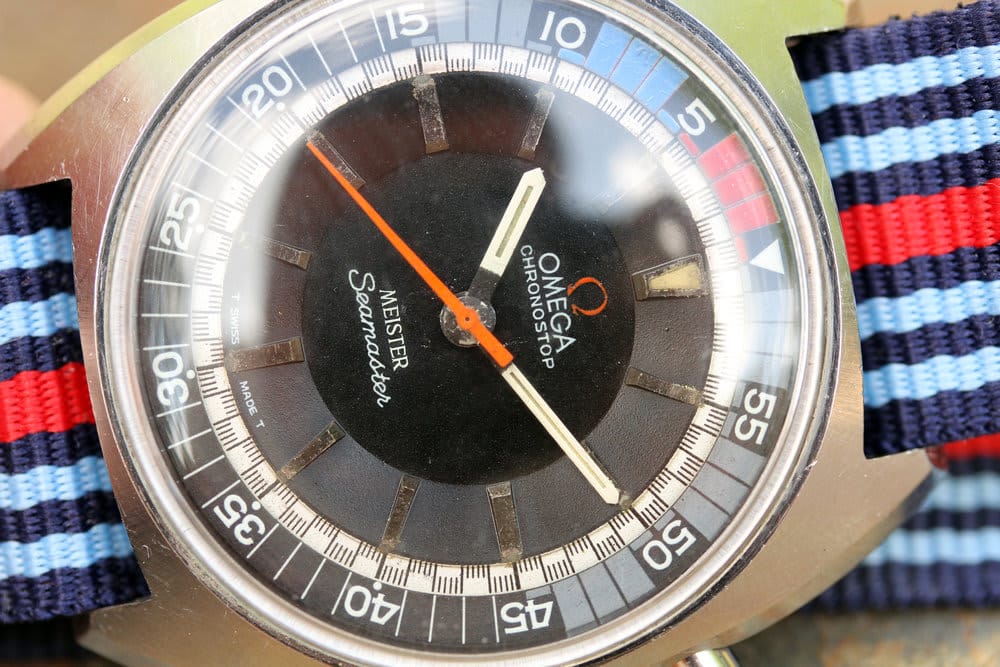
1968 Omega Seamaster Chronostop 145.008 Regatta Bezel
- Complete Set with Box and Papers: Period box, papers, and purchase documentation can add 30-50% to value, though complete sets are exceptionally rare for this reference
- Unpolished Examples: Sharp, original case finishing with intact chamfers and brushing commands premiums of 20-40% over polished examples
- All-Original Configuration: Matching original dial, hands with consistent patina, signed crowns and pusher, and original bracelet represent the most desirable package
Condition Priorities:
When evaluating a potential purchase, collectors should prioritize:
- Dial Originality: An original, unrestored dial is the single most important factor. Even a perfect dial with some patina vastly outweighs a refinished “perfect” dial
- Case Condition: Unpolished or lightly polished cases with visible original finishing preserve value. Heavy polishing significantly diminishes desirability
- Movement Functionality: The Caliber 865 should run properly and preferably have recent service documentation. Budget $400-$800 for professional service if history is unknown
- Completeness: Original signed crowns, pusher, crystal with Omega logo, and period-correct bracelet or quality strap add significant value
- Bezel Function: The inner rotating bezel must operate smoothly. Sticky or non-functional bezel mechanisms require specialist service
Common Pitfalls to Avoid:
- Redials: These are relatively common in the Chronostop market. Always scrutinize dial printing quality, lume matching, and overall appearance against known authentic examples
- Over-polished Cases: Many 145.008 examples have been heavily polished during service, losing their original character. The subtle chamfer at the bezel edge is the first casualty
- Mismatched Components: Some examples appear with parts borrowed from other Chronostop references (different bezels, wrong hands, incorrect dial variants). Verify all components match 145.008 specifications
- Movement Issues: Rust on steel components (particularly the escape wheel), dried lubricants, and worn pivots are common in unserviced examples. While serviceable, severe movement damage can exceed repair economics
- Tritium Deterioration: Old tritium can become flaky and contaminate the movement. While some deterioration is normal, excessive flaking or crumbling tritium may necessitate dial replacement to protect the movement
Investment Perspective:
The 145.008 has shown steady appreciation over the past decade as collectors increasingly recognize the quality and significance of 1960s Omega sports watches beyond the Speedmaster line. Several factors suggest continued appreciation potential:
- Speedmaster Halo Effect: As Speedmaster prices climb beyond reach for many collectors, related references with similar movement architecture offer accessible alternatives
- Limited Production: Estimated total 145.008 production was likely well under 10,000 pieces across all variants, creating genuine scarcity
- Modern Wearability: The 41mm case size and 22mm lug width accommodate modern preferences and contemporary straps/bracelets
- Historical Significance: Multiple period awards and Olympic Games association provide compelling provenance
However, the watch remains relatively unknown outside dedicated Omega collecting circles, meaning significant price jumps are unlikely in the near term. This makes the 145.008 ideal for collectors prioritizing enjoyment and historical interest over pure investment returns.
Wearing and Maintenance:
The 145.008 serves well as a regular wearer with appropriate care:
- Water Resistance: While rated to 60m, gaskets are likely degraded in unserviced examples. Have seals replaced during service before exposing the watch to water. Even then, vintage chronographs should never have pushers operated while submerged
- Manual Winding: Wind daily at approximately the same time for consistent performance. Avoid overwinding by stopping when resistance increases
- Chronograph Use: The single-pusher system requires acclimatization. Remember: press to start, press and hold to stop and read, release to reset
- Crystal Care: Acrylic crystals scratch easily but can be polished with products like Polywatch to restore clarity. This maintenance can be performed at home with minimal risk
- Bezel Operation: Exercise the rotating bezel periodically to prevent lubricants from congealing and the mechanism from seizing
- Service Interval: Budget for professional service every 5-7 years to maintain optimal performance and prevent excessive wear
Market Outlook:
The vintage sports watch market remains robust, with 1960s-1970s designs particularly favored for their combination of historical significance and modern wearability. The 145.008’s current value relative to comparable Speedmasters suggests room for appreciation as more collectors discover the reference. However, condition and originality will increasingly differentiate prices, with premium examples potentially commanding double or triple what well-worn or heavily modified pieces achieve.
For collectors seeking an entry point into serious vintage Omega chronographs, the 145.008 offers compelling value, genuine quality, and distinctive design that stands apart from ubiquitous Speedmasters while sharing much of the same technical DNA.