


Last updated ~ February 2, 2026
Brand
Production Period
1966–1972
Model Line
Case Shape
Round
Diameter
35mm
Lug to Lug
40mm
Lug Width
19mm
Case Thickness
11mm
Case Back
Screw-Down
Caliber
Crystal
Bezel
Smooth
The Omega Constellation 168.017 represents a pivotal design evolution in one of watchmaking’s most enduring collections. Introduced in 1966 and produced through 1972, the 168.017 embodies Gérald Genta’s radical reimagining of the Constellation aesthetic through the distinctive “C-Shape” case design. This was Genta’s third major contribution to the Constellation line, following his celebrated “dog-leg” lugs, and it preceded his more famous integrated bracelet designs for Patek Philippe and Audemars Piguet by nearly a decade.
What distinguishes the 168.017 from its pie-pan predecessors is a fundamental shift in design philosophy. Where earlier Constellation references like the 167.005 emphasized Art Deco elegance through multi-faceted dials and angular lugs, the C-shape pursued a cleaner, more contemporary aesthetic befitting the late 1960s. The case design, with its integrated lugs forming two opposing C curves, created an elongated profile that delivered larger wrist presence at essentially the same diameter as earlier models. This clever optical engineering allowed Omega to embrace the era’s trend toward larger watches without sacrificing the refined proportions expected of a dress chronometer.
The 168.017 specifically occupies the sweet spot within the C-shape family: date-only functionality (no day complication), powered by the chronometer-certified caliber 564 with innovative quick-set date mechanism, and typically featuring flat or subtly guilloché bezels that maintained elegance over sportiness. Approximately 36% of C-shape Constellations featured the rare “frosty” dial finish, a vertically brushed texture that catches light with remarkable beauty. When present on a 168.017, this dial treatment elevates the reference from excellent to exceptional.
For collectors, the 168.017 offers accessible entry into Genta-designed vintage Omega at prices ranging from $500 to over $4,000 depending on condition, dial variant, and originality. The reference rewards careful study, as distinguishing original examples from over-polished or incorrectly restored pieces requires understanding the subtle design cues that define authentic C-shape Constellations.

Omega Constellation c-shaped 168.017
History and Production Period
The Omega Constellation 168.017 emerged during one of the most transformative periods in watchmaking history, spanning the height of mechanical watchmaking through the early tremors of the quartz revolution.
The C-Shape Revolution:
In 1964, while the celebrated pie-pan Constellation models with dog-leg lugs were still in full production, Omega introduced the C-shape case design as the collection’s third major evolution. This seemingly counterintuitive decision to run two distinct Constellation aesthetics simultaneously reflected Omega’s recognition that the market was fragmenting. Some consumers gravitated toward traditional elegance (the pie-pan), while a growing segment sought more contemporary, streamlined designs befitting the Space Age aesthetic of the mid-1960s.
Gérald Genta, already established as a designer of distinction through his pie-pan work, conceived the C-shape with deliberate intent. The case derives its name from the profile formed when viewed from above or below: two opposing C curves creating the elongated, integrated-lug design. Legend suggests Genta chose this geometry as a reference to the Constellation being Omega’s third major watch collection (C representing the third letter of the alphabet), though this attribution remains unconfirmed folklore.
Production Timeline:
The broader C-shape era spanned 1964 to 1978, encompassing seven main references as Omega refined the concept:
- 168.009 (1964-1966): First C-shape, date function, caliber 561, gold construction
- 168.017 (1966-1972): Steel and gold-plated variants, date, caliber 564, flat/guilloché bezel
- 168.027 (1966-1972): Similar to 168.017 but with fluted bezel
- 168.004 (1962-1966): Early transitional C-shape
- 168.010 (1966-1968): Mid-period evolution
- 168.018 (1968-1969): Later refinement
- 168.019/168.029 (1967-1972): Day-date variants with caliber 751
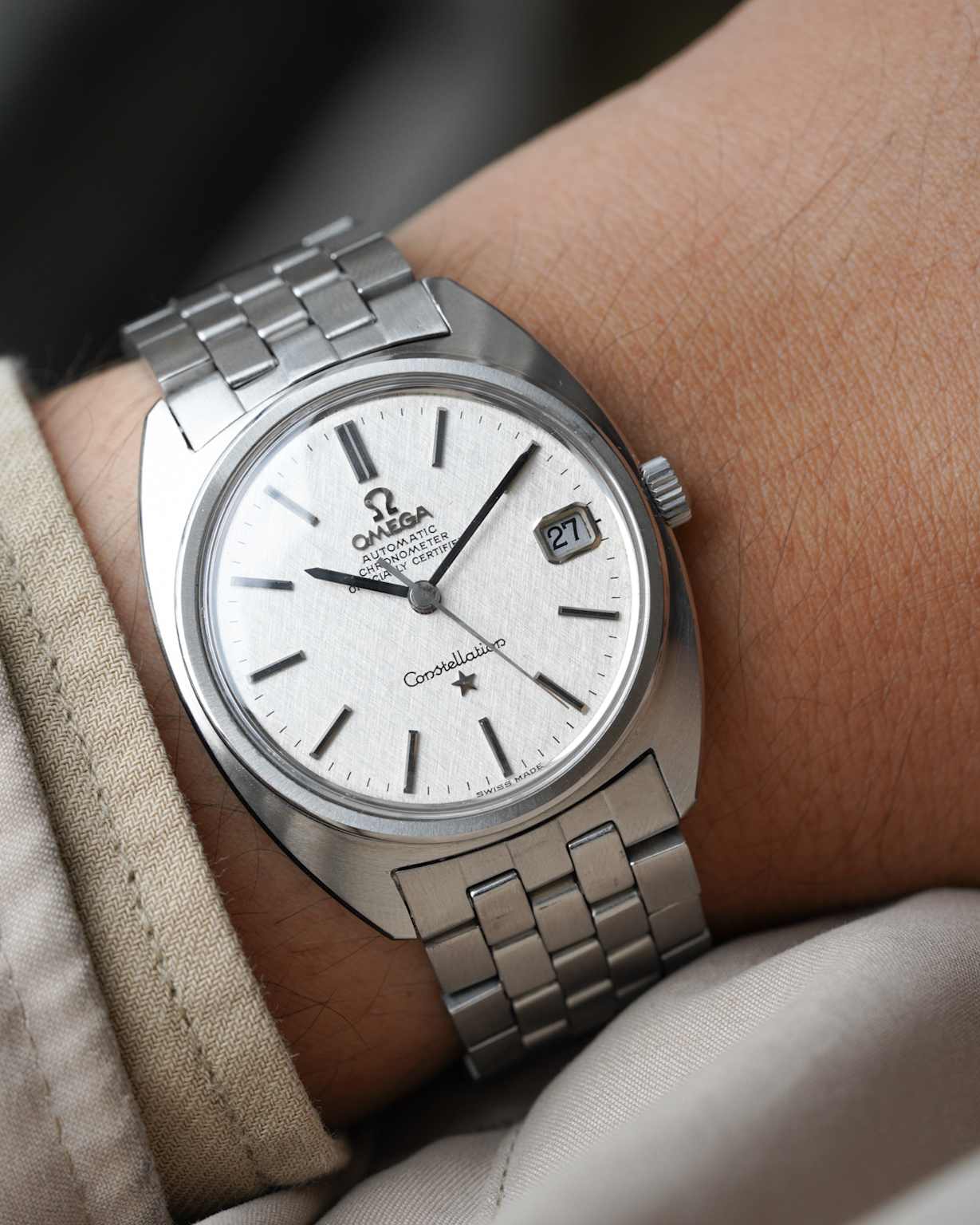
Omega Constellation C-Shape Ref. 168.017 Linen Dial
The 168.017 specifically entered production in 1966, coinciding with Omega’s introduction of the caliber 564, which added a unique quick-set date mechanism to the proven chronometer-grade caliber 561 base. This timing placed the 168.017 squarely in the middle of the C-shape evolution, benefiting from lessons learned with the 168.009 while avoiding the complications of day-date mechanisms in later references.
Production continued through 1972, giving the 168.017 a six-year run that captured the final zenith of mechanical watchmaking before the quartz crisis fundamentally transformed the industry. Watches with serial numbers in the 26 million range date to 1968, representing the midpoint of production when output was likely at its peak.
Design Philosophy:
The C-shape represented a conscious departure from the established Constellation aesthetic. Where pie-pan dials featured twelve facets creating dramatic three-dimensional depth, C-shape dials embraced minimalism with slim baton hands and simple applied markers. The integrated lugs flowed seamlessly from the case body, maximizing the impression of size while maintaining the approximately 35mm diameter that defined dress watches of the era.
This design evolution reflected broader cultural shifts. The late 1960s saw younger consumers rejecting ornate traditionalism in favor of clean, modern lines. The C-shape answered this aesthetic moment while maintaining the technical substance Constellation represented: chronometer certification, observatory heritage, and Swiss precision.
Technical Specifications
The Omega Constellation 168.017 balances classic proportions with thoughtful modern engineering for its era.
Case Construction and C-Shape Design:
The 168.017 employs a two-piece case construction with integrated lugs forming the distinctive C-shape profile. This design creates an elongated appearance that extends the visual presence beyond what the 35mm width might suggest. The optical effect is deliberate: viewed from above, the watch appears larger and more contemporary than traditional round cases of equivalent diameter.
The integrated lugs represent a significant departure from earlier Constellation cases where lugs were distinct, separate elements. On the 168.017, lugs flow seamlessly from the case body, creating continuous curves that maximize comfort and aesthetic coherence. This integration required sophisticated case manufacturing, as the entire case body, bezel, and lug structure formed a single component before the caseback was attached.
Bezel Variations:
Understanding bezel styles is essential for distinguishing 168.017 from related references:
Flat Bezel (most common on 168.017): Smooth, polished surface creating clean, minimalist aesthetic
Sun Guilloché Bezel (transitional variant): Subtly textured finish placing the 168.017 between classic flat and fully fluted bezels. This treatment adds visual interest without the pronounced decoration of fluted examples.
The 168.027, while similar in all other respects, features a fluted (knurled) bezel creating more pronounced visual texture. Steel examples of both 168.017 and 168.019 have steel bezels, while gold-plated variants feature gold-toned bezels matching the case finish.
Crown Design Evolution:
The crown on C-shape Constellations evolved throughout production. Early examples feature more pronounced crowns with fewer grooves, while later pieces (including most 168.017 production) show less protrusion and more numerous, finer grooves. This evolution improved winding ergonomics while reducing the crown’s visual impact, maintaining the streamlined aesthetic Genta envisioned.
Caseback Details:
The screw-down caseback bears the iconic Observatory medallion depicting the Geneva Observatory beneath a starry sky. This embossed design directly references Omega’s chronometric achievements during the observatory trial era. The quality of this medallion’s definition serves as an authentication point: crisp, deeply defined details indicate minimal polishing and good case preservation.
Inside the caseback, collectors find:
- Reference number “168.017” stamped
- Case serial number
- Material markings on precious metal variants
- Case maker marks (though less commonly documented than on earlier references)
A movement holder sits inside the case, necessary to properly secure the caliber 564 movement within the case architecture. This component should be present; its absence indicates prior improper service.
Movement: Omega Caliber 564
The Omega caliber 564 represents a sophisticated evolution of the brand’s proven automatic chronometer movements, adding modern convenience to traditional Swiss precision.
Movement Specifications:
Quick-Set Date Innovation:
The caliber 564’s defining feature is its unique quick-set date mechanism, which operates distinctly from later designs. Rather than turning the crown in a specific position, the quick-set function activates by repeatedly pulling the crown in and out. Each pull/push cycle advances the date by one day, allowing rapid correction without manually advancing through a full 24-hour cycle.
This mechanism, while innovative for its era, introduces specific service considerations. The repeated pushing and pulling action places stress on internal components, particularly the clutch and date change mechanism. Anecdotal evidence suggests the 564 quick-set system can be prone to failure if not properly maintained or if operated roughly. When functioning correctly, however, the mechanism provides genuine convenience and represents Omega’s commitment to user-friendly features during the 1960s.
Chronometer Certification:
Like its caliber 561 predecessor, the 564 received chronometer certification as standard equipment. The movement underwent official testing by Swiss chronometer bureaus, meeting stringent accuracy standards across multiple positions and temperatures. The automatic bridge is engraved “Officially Certified Chronometer,” confirming this designation.
Well-serviced examples typically achieve +5 to +15 seconds per day accuracy, with some particularly well-regulated pieces performing even better. A serviced 168.017 achieving +9 seconds daily with 50 hours of power reserve represents normal, excellent performance for the caliber.
Movement Authenticity:
Verifying correct movement installation is straightforward but essential:
Correct Configuration:
- Caliber 564 with 24 jewels
- “Officially Certified Chronometer” engraving on automatic bridge
- Quick-set date function operating via pull/push crown action
- Movement serial number appropriate for 1966-1972 period
- Copper-toned movement finish characteristic of era
Incorrect Configurations:
- Any caliber other than 564 for 168.017 (561 indicates 168.009 early C-shape; 751 indicates day-date model)
- Missing chronometer certification markings
- Incorrect quick-set mechanism operation
- Movement serial numbers incompatible with case production dates
Dial Variations
The Omega Constellation 168.017 appeared with diverse dial configurations, creating substantial collecting opportunities across aesthetic preferences.
The “Frosty” Dial:
The most sought-after dial variant for the 168.017 is the “frosty” finish, featuring vertical brushing that creates exceptional light play. This textured treatment gives the dial a subtle three-dimensional quality, with vertical striations catching and reflecting light as the wrist moves. The effect is delicate rather than pronounced, suggesting sophistication through restraint.
Statistical analysis of C-shape production indicates approximately 36% of all C-shape Constellations received frosty dial treatments. This substantial minority makes frosty dials uncommon but not rare, placing them in the desirable middle ground of collectibility: special enough to command premiums, common enough to be realistically obtainable.

Omega Constellation C-Shape C-Shape Frosty dial 1970
Dial Colors:
Documented original dial colors on the 168.017 include:
- Silver: Most common, often with frosty or sunburst texture
- White: Clean, bright appearance with crisp sunburst finishing
- Champagne/Gold: Warm tones particularly attractive on gold-plated cases
- Grey: Subtle, sophisticated variant with faint sunray finishing
- Linen-textured: Champagne dials with horizontal linen texture creating tactile quality
The linen-textured champagne dial represents a particularly collectible variant, combining warm coloration with horizontal texture patterns creating visual depth. This treatment differs from the vertical frosty finish, offering alternative sophistication through different geometric patterning.
Dial Construction and Markings:
Standard 168.017 dials feature minimalist, clean layouts reflecting 1960s design sensibilities:
- Applied Omega logo at 12 o’clock
- Constellation star symbol below center (applied metal element)
- Applied baton hour markers: Slim, elongated design emphasizing vertical lines
- Date window at 3 o’clock with precisely cut calendar frame showing attention to detail
- “Omega Constellation Officially Certified Chronometer” text below star
- “T Swiss Made T” or “Swiss Made” at 6 o’clock, depending on lume presence and production period
The applied markers are typically jet-style (solid metal without luminous material), though some examples feature small luminous plots for low-light legibility. The presence or absence of lume should match throughout: non-lume dials require non-lume hands.
Hand Styles:
The 168.017 typically features slim, pencil-style hands in polished finish. The center of each hand is painted black for improved legibility, creating subtle contrast against lighter dials. This treatment demonstrates Omega’s attention to functional details while maintaining aesthetic refinement.
Some variants feature broader “index” hands with more substantial proportions, though these appear more commonly on day-date references like the 168.019. The hand style should correspond to overall dial aesthetic: minimalist baton markers pair with slim pencil hands, while bolder dial designs might feature more substantial hands.
Co-Signed Dials:
Certain 168.017 examples feature co-signed dials from prestigious retailers. Türler co-signed pieces, bearing both Omega and Türler text on the dial, represent rare variants with additional provenance. These retailer signatures typically appear near 6 o’clock or below the Constellation star, adding historical specificity to individual examples.
Case and Bezel Variations
The C-shape case design defines the 168.017’s character and serves as the primary visual distinguishing feature from earlier Constellation references.
Case Materials:
The 168.017 appeared in multiple material configurations:
Stainless Steel (ST designation): Most common and durable specification, offering timeless appeal and resistance to wear
Gold-Plated: 18K gold plating over stainless steel base (typically 20-40 microns thickness), creating gold aesthetic at accessible pricing. The caseback remains stainless steel with a gold-toned observatory medallion.
Gold-Capped: Thicker gold layer than plating (approximately 100-200 microns), bonded to steel through mechanical/thermal processes providing superior wear resistance. Less common than standard gold plating.
Solid Gold: Rare variants in 14K or 18K gold throughout, commanding substantial premiums
Understanding gold-plated construction is essential for collectors. After 50+ years of wear, gold-plated 168.017 examples commonly show wear-through to steel at high-contact points: bezel edges, lug tips, caseback perimeter, and near crown. This wear is expected and acceptable on vintage pieces, though the extent impacts value.
Distinguishing C-Shape Models by Profile:
The 168.017 can be distinguished from related C-shape references through side-profile examination:
- 168.004 (1962-1966): Thick bezel, thin body, deeply recessed crown creating “hidden” appearance
- 168.010 (1966-1968): Thin bezel, thin body (6.9mm excluding crystal)
- 168.017/168.027 (1966-1972): Thin bezel, thick/wide body (11mm total thickness)
- 168.018 (1968-1969): Similar profile to 168.017 but with refinements
This progression shows Omega’s evolution toward thicker, more substantial cases through the C-shape era. The 168.017’s 11mm thickness places it among the more robust C-shape variants, contributing to its satisfying wrist presence.
Lug Design:
The 168.017 features 19mm lug width, an increase from the 18mm width of earlier C-shape reference 168.004. This widening accommodated larger, more substantial bracelets and straps befitting the era’s aesthetic evolution toward bolder proportions. The lugs integrate fully into the case body rather than attaching as separate components, requiring sophisticated manufacturing and creating the characteristic C-shape profile.
Crown Evolution:
C-shape Constellations show progressive crown design changes. The 168.017, produced from 1966-1972, features moderately recessed crowns with multiple fine grooves. This design is less hidden than early 168.004 crowns but more refined than earlier round-crown Constellations. The crown bears the Omega logo and provides positive winding feedback.
Caseback Observatory Medallion:
The screw-down caseback features the iconic embossed Observatory medallion. The quality of this embossing serves as an indicator of case condition and polishing history. Sharp, deeply defined details with clear star separation and building definition indicate minimal polishing. Shallow, worn medallions with indistinct details suggest heavy polishing or poor preservation.
Bracelet and Strap Options
The Omega Constellation 168.017 primarily sold on leather straps, though several period-correct metal bracelet options existed for buyers seeking integrated metal aesthetics.
Original Strap Configurations:
The 168.017 typically left the factory on premium leather straps:
- Leather types: Calf, crocodile, lizard, or ostrich skin in various colors
- Lug width: 19mm at case
- Buckle: Simple pin buckle or tang buckle in matching case material
- Buckle marking: Original Omega buckles show proper logo and construction quality
Period Metal Bracelets:
While less common than leather, several metal bracelet options were available:

Omega Constellation C Case Bracelet 1970s Omega
Brick Bracelet: The most iconic bracelet for C-shape Constellations, featuring rectangular “brick” link patterns. This design perfectly complements the angular, geometric aesthetic of the C-shape case.
Key specifications:
- Clasp typically marked “No. 12”
- 19mm lug width tapering toward clasp
- Moderate to heavy stretch common on 50+ year old examples
- Fits up to 8-inch wrists on original examples
Beads of Rice (BOR): Alternative bracelet option featuring hollow three-link construction
- End piece #55 for 168.017 (different from earlier #22 end pieces on 168.004)
- Creates more delicate, dressy aesthetic than brick bracelet
Other Options:
- Reference 1040/518 bracelet documented as fitting 168.017
- Reference 1172/515 also compatible
- Various mesh and link patterns period-appropriate for late 1960s
Bracelet Condition Considerations:
Original 1960s-1970s Omega bracelets show predictable wear patterns:
- Link stretch from decades of flexing and wear
- Clasp wear creating looseness or play
- Fading or uneven finishing on plated bracelets
- Missing or damaged individual links
The condition of period bracelets significantly impacts value, with tight, well-preserved examples commanding substantial premiums. A 168.017 with original, tight brick bracelet in excellent condition can justify 20-30% higher pricing than the same watch on leather.
Identifying Original vs. Replaced Parts
The vintage Constellation market requires careful authentication, as the 168.017’s accessible pricing makes it vulnerable to incorrect restoration and part substitution.
Dial Authentication:
Original 168.017 dials exhibit specific characteristics:
Correct Physical Characteristics:

Vintage Omega Constellation C-shape linen champagne dial
- Metallic quality rather than paint-like appearance
- Consistent applied marker height, alignment, and attachment
- Precisely cut date window with clean edges
- Constellation star appropriately positioned relative to text
Correct Typography:
- “Constellation” text in period-correct font
- “Officially Certified Chronometer” properly formatted
- “Swiss Made” or “T Swiss Made T” present at 6 o’clock
Lume Consistency:
- Non-lume dials must have non-lume hands
- If tritium markings present (“T Swiss Made T”), hands must show corresponding aged tritium
- All luminous elements should show consistent aging (cream/tan patina)
Movement Verification:
Confirming correct movement installation is essential:
Correct Configuration:
- Caliber 564 only (not 561, 751, or any other caliber)
- 24 jewels
- “Officially Certified Chronometer” engraving on automatic bridge
- Quick-set date operates via pull/push crown action
- Movement serial number appropriate for 1966-1972 production
Quick-Set Function Testing:
- Winding at position 0 (crown fully in)
- Time setting at position 1 (crown pulled one position)
- Quick-set date via repeated pull/push from position 0
- Should NOT use quick-set between 10 PM and 2 AM (interferes with automatic date change)
Case Integrity Assessment:
Evaluating case condition requires attention to C-shape specific details:
Unpolished or Minimally Polished Indicators:
- Clean chamfered mirror finish on lug edges
- Crisp transitions between polished and brushed surfaces
- Deep, well-defined observatory medallion on caseback
- Appropriate micro-scratching and patina for 50+ years age
Over-Polished Warning Signs:
- Rounded lug edges and soft case lines
- Shallow, indistinct observatory medallion
- Inconsistent surface finishing
- Unnaturally smooth appearance for age
The debate over polishing vintage watches remains contentious. Omega’s official service typically includes polishing to restore “like-new” appearance, which collectors often view negatively as it removes original surfaces and alters case geometry. An unpolished case retains factory-made lines, sharp or round edges as designed, and original finishing transitions.
For 168.017 specifically, collectors should prioritize “honest” condition showing appropriate wear over heavily polished examples masquerading as mint. Natural patina and scratches on an unpolished case are preferable to artificial smoothness from excessive buffing.
Crown and Crystal Verification:
Original Crown Characteristics:
- Omega logo properly engraved
- Appropriate size for C-shape case (less pronounced than earlier models)
- Multiple fine grooves for grip
- Smooth winding and setting operation
Crystal Authenticity:
- Domed acrylic material
- Possible Omega logo etched in center
- Appropriate dome profile for late 1960s style
- Light scratching acceptable and expected; pristine crystals may indicate replacement
Generic replacement crystals are readily available and acceptable for service purposes. Perfect crystal condition on an otherwise aged watch may indicate recent servicing or crystal replacement, which is cosmetically beneficial but removes a period-correct component.
Collector Notes and Market Context
The Omega Constellation 168.017 occupies an interesting niche in vintage collecting: genuine Gérald Genta design heritage at prices that remain remarkably accessible relative to his more famous creations.
Current Market Positioning:
Based on recent sales data, dealer listings, and auction results, the 168.017 trades across a spectrum:
Entry Level ($500-$1,000):
- Polished cases showing wear
- Questionable dial originality
- No bracelet or generic replacement
- Fair to good overall condition
Mid-Range ($1,000-$1,800):
- Good condition with honest wear
- Original dial, possibly common color/finish
- Serviced movement running well
- Leather strap or period-style replacement
Premium ($1,800-$2,500):
- Excellent unpolished or minimally polished case
- Frosty dial or rare color variant
- Original brick bracelet in good condition
- Complete recent service documentation
Exceptional ($2,500-$4,000+):
- Unpolished case with sharp lines
- Rare frosty dial in pristine condition
- Original box and papers
- Co-signed retailer dials (Türler, etc.)
- Complete original brick bracelet
Market data from EveryWatch shows 70 examples available from 10 dealers worldwide, with prices ranging from $506 to $4,090. This wide spread reflects the dramatic impact of condition, dial variant, and originality on valuation.
Size and Wearability Considerations:
The 168.017’s dimensions create surprising wearability:
Advantages:
- 35mm width appropriate for vintage dress watch proportions
- 40mm lug-to-lug creates strong presence without overwhelming
- Elongated C-shape profile maximizes visual size
- 11mm thickness provides substantial wrist feel
- 19mm lug width accommodates modern straps easily
The elongated case design creates optical effects that make the watch wear larger than 35mm width alone might suggest. The fully integrated lugs and 40mm lug-to-lug measurement allow comfortable wear on wrists from 6.5 to 7.5 inches.
Most Sought-After Configurations:
Certain 168.017 variants command significant premiums:
- Frosty Dial Variants: Rare vertical brushed texture creating exceptional light play
- Unpolished Cases: Sharp chamfers and crisp lines indicating minimal intervention
- Original Brick Bracelets: Period-correct metal bracelet in good condition
Omega Constellation C Case Bracelet 1970s Omega
- Co-Signed Dials: Retailer signatures adding provenance
- Linen-Textured Champagne: Horizontal texture pattern alternative to frosty finish
Vintage Omega Constellation C-shape linen champagne dial
Common Pitfalls to Avoid:
The 168.017 market presents recurring authentication and condition challenges:
Over-Polished Cases: The most pervasive issue, where well-meaning service has removed excessive material and softened the C-shape’s distinctive lines. The chamfered lug edges are particularly vulnerable, transforming from sharp geometric facets to rounded, indistinct curves.
Incorrect Movements: Caliber 561 (non-quick-set date) occasionally appears in 168.017 cases, representing either incorrect service replacement or deliberate substitution to avoid servicing the more complex caliber 564. Always verify caliber 564 with functional quick-set date mechanism.
Failed Quick-Set Mechanisms: The caliber 564’s innovative quick-set date system can fail with age or improper use. Testing before purchase is essential, as repairs can be costly if parts are damaged.
Refinished Dials: While less prevalent than on earlier pie-pan Constellations, dial refinishing does occur. Frosty dial variants are particularly vulnerable to incorrect restoration attempts, as the vertical brushing is difficult to replicate authentically.
Missing Movement Holders: The case requires a movement holder to properly secure caliber 564. Missing holders indicate prior poor-quality service and can cause movement damage from inadequate support.
What Drives Value:
Beyond basic condition, specific attributes command premiums:
- Unpolished condition: Original case lines and sharp chamfers
- Frosty dial: Rare vertical brushed texture
- Period bracelet: Original brick bracelet in good condition
- Early production: Non-quick-set caliber 564 variants (transitional pieces)
- Retailer co-signs: Türler or other prestigious retailers
- Complete documentation: Box, papers, service records
Comparative Context:
Understanding the 168.017’s position relative to other Constellation references helps establish value expectations:
167.005/168.005 (Pie-Pan Dog-Leg): Generally command 20-40% premiums over equivalent 168.017 examples due to greater collector recognition and the iconic pie-pan dial. The dog-leg lugs are more visually distinctive than the C-shape’s integrated design.
168.027 (Fluted Bezel C-Shape): Approximately equivalent value to 168.017, with slight premiums for exceptional examples combining fluted bezel and frosty dial (the 22% of C-shapes with both textures).
168.019/168.029 (Day-Date C-Shape): Similar or slightly higher values due to additional complication, though caliber 751 availability and serviceability can be concerns.
Investment Perspective:
The 168.017 should be approached as a collecting and wearing proposition rather than pure investment:
Advantages:
- Accessible Gérald Genta design heritage
- Chronometer-certified movement with modern convenience features
- Strong wearability for contemporary collectors
- Reasonable service costs and parts availability
- Growing appreciation for 1960s-1970s Constellation designs
Limitations:
- Less iconic than pie-pan Constellations
- C-shape aesthetic less universally appealing
- Quick-set mechanism fragility concerns
- Modest appreciation compared to Speedmaster or rare variants
Service Considerations:
Prospective buyers should understand service requirements:
- Independent watchmaker service: $300-700 depending on complexity
- Omega official service: $800-1,200+, typically includes polishing
- Quick-set mechanism repair: May require specialist if damaged
- Parts availability: Caliber 564 components generally accessible
- Power reserve: Properly serviced examples achieve 50 hours
- Timing: Well-serviced pieces achieve +5 to +15 seconds/day
When commissioning service, explicitly request no polishing or minimal polishing if case condition is good, as Omega’s standard practice removes substantial material to achieve like-new appearance. Many collectors prefer independent specialists familiar with vintage Constellation servicing who respect case integrity.
The C-Shape Era Context
Understanding the 168.017 requires appreciating its position within the broader C-shape family and Constellation evolution from 1952 through the late 1970s.
Production Statistics and Variants:
Goldammer’s quantitative analysis of C-shape production reveals fascinating distribution patterns:
Bezel Styles:
- 66% flat or smooth bezel (including 168.017)
- 34% fluted/knurled bezel (168.027, 168.029)
Dial Textures:
- 64% standard smooth or subtle sunburst
- 36% frosty dial patterns (vertically brushed)
- 22% combined both fluted bezel AND frosty dial
These statistics confirm that frosty dials represent substantial minorities rather than extreme rarities, making them attainable collecting goals while still special enough to command premiums.
Design Philosophy:
The C-shape represented Omega’s answer to a fundamental question: how do you design a dress-casual watch fit for the 1960s and 1970s? The solution balanced several competing priorities:
- Contemporary Aesthetic: Clean lines and minimalist dials reflecting modern sensibilities
- Increased Size: Elongated profile creating larger presence without crossing into sports watch territory
- Technical Substance: Maintaining chronometer certification and observatory heritage
- Market Positioning: Accessible pricing compared to ultra-luxury competitors while preserving Omega quality
The C-shape’s 14-year production run (1964-1978) captured watchmaking’s transition from mechanical supremacy through the quartz crisis. Early references like the 168.009 and 168.017 represent mechanical watchmaking at its zenith, while later references increasingly competed with quartz alternatives offering superior accuracy at lower costs.
Gérald Genta’s Legacy:
The 168.017 represents one chapter in Genta’s remarkable design career. His work on Constellation references progressed from the dog-leg lugs (167.005, 168.005) through the C-shape (168.017, 168.027) to his later integrated bracelet designs for other brands. Collectors seeking affordable entry into Genta-designed watches find the 168.017 offers genuine pedigree at prices far below the Nautilus or Royal Oak.
The C-shape’s architectural approach, with its geometric curves and integrated construction, foreshadows design thinking Genta would refine throughout his career. While less famous than his 1970s masterpieces, the C-shape demonstrates the same attention to case architecture and optical effects that defined his later work.
Conclusion
The Omega Constellation reference 168.017 represents a compelling intersection of design heritage, technical substance, and accessible collecting. As a Gérald Genta creation from the C-shape era, the watch embodies a pivotal moment when Omega’s flagship collection evolved to meet changing aesthetic sensibilities while maintaining the chronometer certification and observatory heritage that defined Constellation’s identity.
For collectors, the 168.017 offers several distinct advantages. The reference provides entry into Genta-designed vintage Omega at prices ranging from $500 to $2,500 for quality examples, with exceptional pieces commanding up to $4,000. This accessibility contrasts dramatically with Genta’s more famous designs, which trade at tens of thousands or even hundreds of thousands of dollars. The elongated C-shape case creates surprising wrist presence from a modest 35mm diameter, while the integrated lugs and 40mm lug-to-lug measurement ensure comfortable modern wearability.
The caliber 564 movement delivers genuine substance: chronometer certification, 50-hour power reserve, and innovative quick-set date functionality placing the 168.017 among the more convenient vintage watches to own and wear regularly. While the quick-set mechanism requires careful use and proper service, functioning examples provide user-friendly convenience rare in 1960s-era timepieces.
Success in acquiring a quality 168.017 demands attention to authentication and condition fundamentals. Verify the correct caliber 564 movement with functional quick-set date mechanism. Assess case condition for excessive polishing that softens the C-shape’s geometric lines and chamfered lug edges. Confirm dial originality, particularly on desirable frosty variants where refinishing attempts often fail to replicate the authentic vertical brushing. Purchase from reputable dealers who guarantee authenticity and stand behind their descriptions.
The approximately 36% of C-shapes featuring frosty dials create attainable collecting goals rather than impossible quests. These textured examples offer exceptional light play and visual interest while remaining obtainable with patient searching. Similarly, examples with original brick bracelets in good condition command deserved premiums but appear regularly enough that collectors can realistically acquire complete packages.
Whether pursued for its Genta design heritage, its chronometer-certified caliber 564 movement, its distinctive C-shape aesthetic, or simply as a wearable piece of 1960s Omega craftsmanship, the 168.017 rewards collectors who invest time understanding its nuances. It remains a watch that tells not only time but also a story of design evolution during one of watchmaking’s most dynamic periods, when established aesthetics gave way to contemporary sensibilities that would define the industry’s transition into the 1970s.