


Last updated ~ February 2, 2026
Brand
Production Period
1966–1974
Model Line
Case Shape
Round
Diameter
35mm
Lug to Lug
42mm
Lug Width
18mm
Case Thickness
10mm
Case Back
Screw-Down
Caliber
Crystal
Bezel
Smooth
The Omega Constellation Reference 168.017 stands as one of the most significant—yet underappreciated—designs in vintage Omega’s storied history. Introduced in 1966 as part of the revolutionary C-Shape family, the 168.017 represents a pivotal moment when Omega entrusted its flagship chronometer collection to Gérald Genta, the legendary designer who would later create the Audemars Piguet Royal Oak and Patek Philippe Nautilus.
The Birth of the C-Shape: A Design Revolution
The Constellation collection originated in 1952 as Omega’s flagship chronometer line, celebrating the brand’s centenary and embodying its commitment to precision timekeeping. Through the 1950s and early 1960s, Constellations featured the iconic “Pie-Pan” dial design—domed dials with Art Deco-influenced aesthetics that defined luxury watchmaking of the era.
By 1964, Omega recognized the need for design evolution. The brand commissioned Gérald Genta—then an independent designer based in Geneva—to reimagine the Constellation for a new decade. Genta’s response was radical: the C-Shape case, named for its distinctive curved profile that resembles the letter “C” when viewed from the side.
The initial C-Shape model, reference 168.009, launched in December 1964 powered by Omega’s Caliber 561 movement. This first generation featured the revolutionary case design but retained non-quickset date functionality. In mid-1966, Omega upgraded the C-Shape line with the newly developed Caliber 564, introducing quickset date capability and creating the reference that would define the collection: 168.017.
Design Philosophy: Minimalism Meets Wrist Presence
The C-Shape represented a dramatic departure from the Pie-Pan aesthetic. Where Pie-Pan Constellations emphasized ornate dials with dimensional depth and Art Deco flourishes, Genta’s C-Shape embraced clean, contemporary minimalism. The design featured:
- Integrated case construction with lugs flowing seamlessly from the case body, creating visual cohesion
- Elongated case profile that maximized wrist presence despite the modest 35mm diameter
- Slim “jet line” markers—understated baton indices that emphasized dial clarity over ornamentation
- Ultra-slim bezel that maximized dial real estate, allowing the watch face to dominate the visual composition
This minimalist approach proved prescient. The C-Shape anticipated design trends that would dominate the 1970s, when integrated-bracelet sports watches like Genta’s own Royal Oak (1972) and Nautilus (1976) revolutionized luxury watch aesthetics.
Market Positioning and Production Context
Omega positioned the Constellation as its premier chronometer collection throughout the 1960s—the brand’s flagship offering for clients demanding certified precision and refined design. The C-Shape maintained this positioning while broadening market accessibility through material diversification.

Omega Constellation 168.017 Case Material Distribution
Significantly, over 53% of C-Shape Constellations were produced in stainless steel, compared to only 38% of earlier Pie-Pan models. This steel emphasis democratized Constellation ownership, making chronometer-certified Omega luxury accessible at more attainable price points while reserving gold-capped and solid gold variants for premium market segments.
The 168.017 specifically targeted the date-only market—collectors who valued chronometer precision but didn’t require day-date complications. This positioned it as the “essential” C-Shape: neither entry-level nor ultra-premium, but rather the definitive expression of Genta’s design vision in its purest form.
Why It Matters to Collectors Today
The Omega Constellation 168.017 holds enduring significance for several compelling reasons:
1. Authentic Genta Design: Unlike later Genta creations that command astronomical prices (vintage Royal Oaks regularly exceed $50,000-$100,000), the 168.017 offers accessible entry to the designer’s work at $1,500-$3,000.
2. Chronometer Certification: Every 168.017 houses a COSC-certified chronometer movement—genuine observatory-grade precision validated by independent testing. This wasn’t marketing language but certified performance meeting Switzerland’s strictest timekeeping standards.
3. Undervalued Icon: The vintage watch market has historically undervalued C-Shape Constellations relative to their design significance, technical merit, and historical importance. Recent collector recognition has begun correcting this imbalance, but the 168.017 remains remarkably affordable compared to contemporaneous Rolex, Omega Speedmaster, or even earlier Omega Pie-Pan models.
4. Wearable Vintage: The 35mm diameter with 40-41mm lug-to-lug measurement provides contemporary wearability. Unlike many vintage dress watches that appear diminutive on modern wrists, the C-Shape’s elongated profile creates substantial presence.
5. Dial Artistry: The iconic “linen” or “frosty” textured dials—found on approximately 36% of examples—showcase mechanical dial finishing techniques rarely seen in contemporary watchmaking. These hand-guilloché patterns create dimensional depth and light play that flat-printed modern dials cannot replicate.
The C-Shape Era and Its Legacy
The C-Shape family spanned 1964-1978, encompassing approximately seven main references and representing a 14-year design evolution. This production timeline parallels one of watchmaking’s most transformative periods: the Quartz Crisis that decimated Swiss mechanical watch production.
Omega continued C-Shape production through much of this tumultuous era, eventually transitioning to the modern Constellation design with distinctive “griffes” (claws) in 1982. However, many collectors and historians consider the C-Shape the last “pure” Constellation—the final expression of mid-century mechanical watchmaking excellence before quartz technology and design compromises reshaped the industry.
Today, the 168.017 occupies a unique position: authentic vintage Genta design, chronometer-certified precision, accessible pricing, and growing collector recognition that suggests the reference remains undervalued relative to its historical and aesthetic significance.
TECHNICAL SPECIFICATIONS
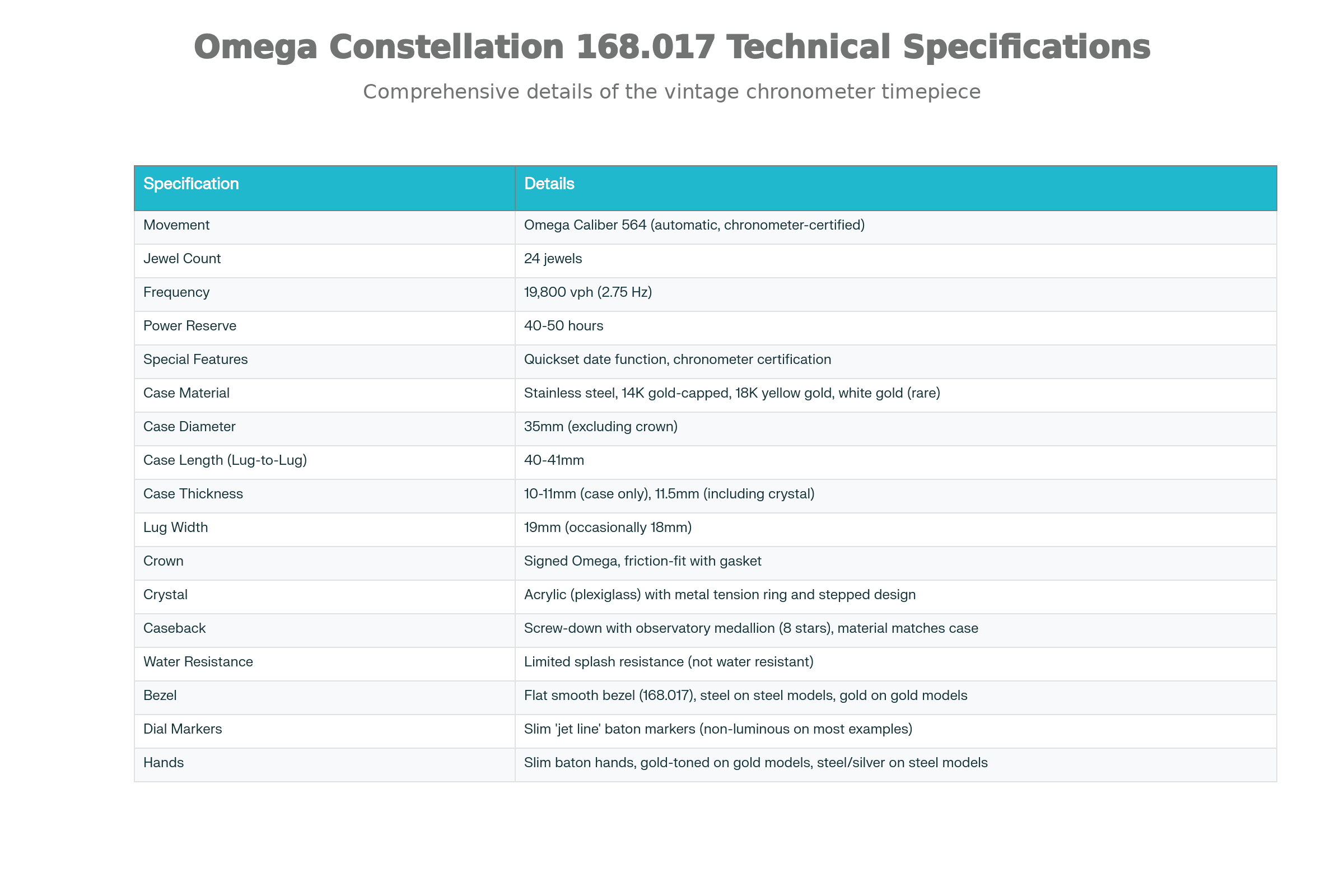
Omega Constellation 168.017 Complete Technical Specifications
Movement Details
Caliber Name and Type: Omega Caliber 564 (automatic winding, chronometer-certified)
The Caliber 564 represents a pivotal advancement in Omega’s automatic movement development, building upon the successful Caliber 561 while introducing quickset date functionality that became essential for modern watch usability.
Technical Specifications:
- Jewel Count: 24 jewels
- Frequency: 19,800 vibrations per hour (vph) or 2.75 Hz
- Power Reserve: 40-50 hours when fully wound
- Diameter: 27.9mm (movement diameter)
- Chronometer Certification: COSC-certified (Contrôle Officiel Suisse des Chronomètres)
- Complications: Date with quickset function, center seconds
Evolution from Caliber 561:
The Caliber 564 evolved directly from the 561, which powered the earliest C-Shape models (reference 168.009) from 1964-1966. The critical enhancement: quickset date functionality allowing rapid date adjustment by repeatedly pulling the crown to the first position, rather than cycling the hands through 24-hour periods to advance the date.
While this seems mundane by contemporary standards, quickset date represented significant technical progress in 1966. The mechanism required additional components and careful engineering to prevent calendar damage if adjusted near midnight—the period when date-change gearing engages.
Chronometer Certification and Performance:
Every Caliber 564 in a 168.017 underwent COSC chronometer testing, meeting stringent accuracy standards: -4/+6 seconds per day variation across multiple positions and temperatures. This certification separated Constellations from Omega’s Seamaster and Genève lines, which used the non-chronometer Caliber 565—mechanically similar but lacking the refined regulation and testing that defined chronometer grade.
The certification is documented by the “Chronometer Officially Certified” text on the dial and the observatory medallion on the caseback featuring eight stars—representing Omega’s eight outright victories in prestigious 20th-century observatory competitions.
Known Service Considerations:
The Caliber 564 enjoys a strong reputation for reliability and serviceability among vintage Omega movements:
- Parts Availability: Omega produced the 564 in large quantities through the late 1960s and early 1970s. Consequently, service parts remain reasonably available through Omega’s vintage parts network and specialist suppliers
- Automatic Winding System: The 564 employs a uni-directional winding rotor. While less efficient than modern bi-directional systems, it provides adequate winding for daily wear. Desk workers or sedentary wearers may need occasional manual winding to maintain power reserve
- Date Quickset Mechanism: The quickset date complication adds mechanical complexity and potential failure points. Watchmakers report that worn quickset components can cause date-change hesitation or failure—repair typically requires replacing specific calendar components
- Service Intervals: Complete service every 4-5 years for regularly worn examples, or every 5-7 years for occasional wear, ensures optimal performance and longevity
- Movement Substitution: Collectors should verify the correct Caliber 564 chronometer movement. Some examples encountered in the market contain incorrectly installed Caliber 565 (non-chronometer) movements—likely service substitutions that significantly diminish authenticity and value
Timing Accuracy:
Properly serviced Caliber 564 movements typically achieve excellent chronometric performance. Period testing showed -2 to +4 seconds per day in optimal conditions, though 50+ year-old examples today more commonly deliver -5 to +10 seconds per day depending on service quality, wear, and position.
Case Specifications
Material and Variants:
The Omega 168.017 was produced in multiple case materials serving different market segments:
- Stainless Steel: Most common configuration, representing over 50% of production. Offers durability, everyday wearability, and accessible pricing
- 14K Gold-Capped: Thick gold layer (significantly thicker than gold plating) applied over stainless steel case body. Features solid gold bezel and gold caseback medallion. Offers luxury aesthetics at mid-tier pricing—the “sweet spot” for many collectors
- 18K Yellow Gold: Solid 18K gold throughout, including case, bezel, and caseback. Premium configuration with approximately 32 grams of gold content
- Gold-Plated: Thin gold electroplating over stainless steel. Less common and less durable than gold-capping; plating wear reveals base metal over time
- White Gold: Solid 18K white gold. Extremely rare variant seldom encountered in the market
Exact Dimensions:
- Case Width: 35mm excluding crown
- Case Length (Lug-to-Lug): 40-41mm
- Case Thickness: 10-11mm (case body only); 11.5mm including crystal
- Lug Width: 19mm (most common); occasionally 18mm on certain variants
- Overall Width (Including Crown): Approximately 37-38mm
The C-Shape Case Design:
Gérald Genta’s C-Shape case represents one of vintage watchmaking’s most distinctive designs. Key architectural elements include:
- Integrated Construction: Lugs flow seamlessly from the case body without clear demarcation, creating visual cohesion that anticipated integrated-bracelet sports watch designs of the 1970s
- Curved Profile: When viewed from the side, the case exhibits pronounced curvature forming a “C” shape. This ergonomic design improves wrist conformity and wearing comfort
- Elongated Geometry: The 40-41mm lug-to-lug measurement relative to 35mm diameter creates an elongated appearance that maximizes wrist presence and visual impact
- Slim Bezel: The ultra-thin bezel maximizes dial real estate, a deliberate design choice emphasizing the watch face over case ornamentation
Bezel Variations:
The 168.017 specifically features a flat, smooth bezel—the defining characteristic distinguishing it from the fluted-bezel reference 168.027. However, collectors should note subtle variations within 168.017 production:
- Early Models: Completely flat, polished bezel
- Mid-Production: “Sun guilloché” or lightly textured bezel finish—a subtle radial pattern creating visual interest while maintaining the “flat” designation
- Material Matching: Steel bezel on all-steel models; gold bezel on gold-capped and solid gold examples
Crown and Crystal:
The 168.017 employs several detail refinements distinguishing it from earlier 168.009 production:
- Crown: Signed Omega crown with moderate grooving (more grooves and less pronounced than early 168.009 crowns)
- Crown Gasket: Rubber gasket provides basic moisture protection, though the watch is not designed for water resistance
- Crystal: Acrylic (plexiglass) with distinctive internal metal tension ring featuring a stepped design. This engineering detail prevents the tension ring from contacting the dial surface or interfering with calendar disc rotation—a thoughtful solution to a common vintage watch problem
- Crystal Signature: Omega logo micro-etched into the crystal at 6 o’clock position (though may be worn away on heavily used examples)
Caseback Design and Markings:
The 168.017 caseback represents one of the reference’s most distinctive features:
Exterior Caseback:
- Observatory Medallion: Embossed Omega observatory symbol with constellation stars arranged in a circle
- Eight Stars: Surrounding the observatory represent Omega’s eight outright victories in 20th-century observatory chronometer competitions—a proud declaration of the brand’s precision heritage
- Material: Steel caseback on all-steel models; solid gold caseback medallion on gold-capped models; fully gold caseback on solid gold examples
Interior Caseback:
- Reference Number: Stamped “168.017” (or “168.009/017” on transitional cases from 1966)
- Serial Number: Case serial number (typically 8 digits, format: 2X,XXX,XXX for late 1960s/early 1970s production)
- Material Marks: Gold hallmarks and purity stamps on precious metal variants
Case Finishing and Condition:
Period 168.017 cases feature mixed finishing: polished surfaces on the bezel, case sides, and lugs combined with brushed elements on certain surfaces. This combination creates visual interest through contrasting textures and light reflection.
Collectors should carefully assess case condition, particularly polishing. The C-Shape’s crisp angles and defined edges represent critical design elements that heavy polishing can obliterate. Over-polished examples show rounded lug edges, thinned case walls, and loss of the sharp geometric definition integral to Genta’s design.
DIAL & AESTHETIC VARIATIONS
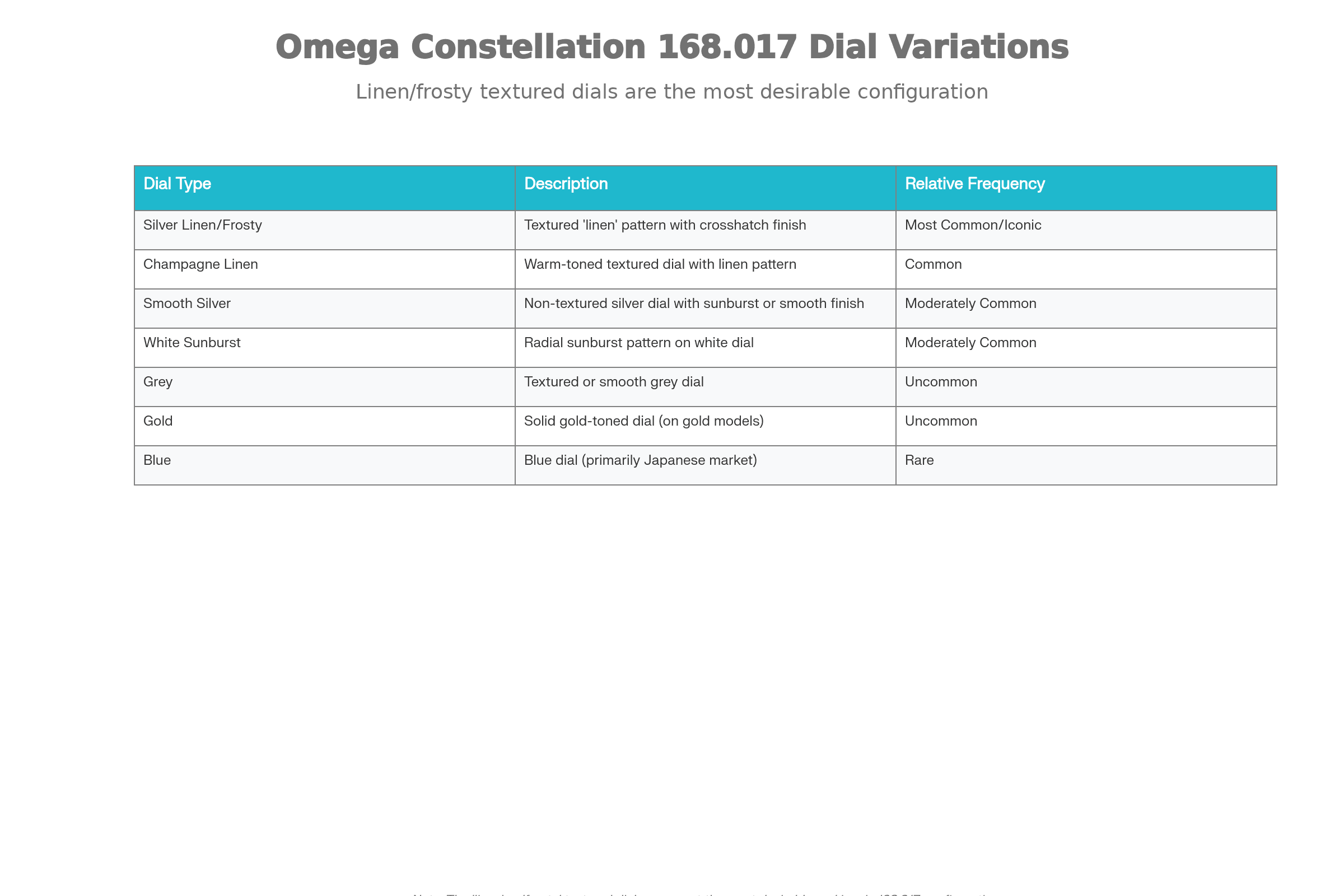
Omega Constellation 168.017 Dial Variation Matrix
The Omega Constellation 168.017 exhibits remarkable dial diversity, with variations spanning colors, finishes, and textures that significantly impact collectibility and value. Understanding these variations represents critical knowledge for authentication and informed acquisition.
Documented Original Dial Configurations
Silver Linen/Frosty Dial (Most Iconic):
The quintessential 168.017 dial features the famous “linen” or “frosty” texture—a mechanically-applied crosshatch pattern creating dimensional depth and exceptional light play. This finish, sometimes called “silky guilloché,” was applied through specialized dial finishing techniques that modern printing cannot replicate.
The linen texture creates constantly shifting visual appearance depending on viewing angle and lighting conditions. In certain light, the dial appears uniformly silver; in others, the crosshatch pattern becomes dramatically visible, creating subtle three-dimensionality that flat-printed dials lack.
Approximately 36% of C-Shape Constellations featured this frosty/linen dial finish, making it common enough to be obtainable but distinctive enough to command premium pricing over smooth-dial variants. Collectors widely consider linen dials the most desirable 168.017 configuration, with market pricing reflecting this preference.
Champagne Linen Dial:
A popular variant features the linen texture on a warm champagne or gold-toned dial base. These dials particularly complement gold-capped and solid gold cases, creating harmonious warm-toned aesthetics.
Champagne linen dials exhibit the same mechanical texture as silver variants but with color tones ranging from pale champagne to deeper golden hues depending on specific dial production and aging characteristics.
Smooth Silver/White Dials:
Non-textured silver or white dials represent another common configuration, typically featuring sunburst finishing (radial grain radiating from center) or completely smooth surfaces. While less distinctive than linen variants, these dials offer clean, minimalist aesthetics aligning with Genta’s design philosophy.
Smooth dials occasionally develop attractive patina over decades—subtle aging that adds character without degradation.
Sunburst Dials:
Some examples feature pronounced sunburst finishing—radial graining creating dynamic visual effects as light moves across the dial surface. Colors include white, silver, and champagne, with the sunburst pattern creating depth and visual interest.
Grey Dials:
Uncommon grey dial variants exist, offering subdued, sophisticated aesthetics. These typically feature either smooth or linen-textured finishes and appeal to collectors seeking less common configurations.
Gold Dials:
Solid gold-toned dials (distinct from champagne) appear primarily on solid gold watch examples. These create monochromatic gold aesthetics from case through dial.
Blue Dials (Very Rare):
Extremely rare blue dial variants were produced primarily for the Japanese market. These command significant premiums when authentic examples appear, though collectors should exercise particular caution regarding authenticity given the dial’s rarity.
Dial Text and Markings
Standard Text Hierarchy:
- “OMEGA” logo at 12 o’clock position (applied metal logo)
- “Constellation” text below Omega logo
- “Officially Certified” text at center dial
- “Chronometer” text below center
- “SWISS MADE” at 6 o’clock position (or occasionally “SWISS”)
Notable Variations:
- Some late-production examples feature “OMEGA” text positioned above 6 o’clock rather than below 12 o’clock—referred to as “Japanese market” dials, though the geographic specificity remains debated
- Dial text font and arrangement evolved subtly through production, with later examples showing slightly different typography
Hour Markers and Hands
“Jet Line” Markers:
The 168.017’s defining aesthetic feature is its ultra-slim baton hour markers, termed “jet line” markers in collector parlance. These minimalist indices represent a dramatic departure from the applied Arabic numerals or substantial batons common on earlier Constellations.
The jet line markers are applied (not printed)—three-dimensional elements affixed to the dial surface—typically in gold or gilt finish on all models regardless of case material. This creates subtle dimensional depth and allows markers to catch light distinctively from the dial surface.
Critically, the vast majority of 168.017 examples feature non-luminous markers—no radioactive or luminescent material on markers or hands. This represents a deliberate design choice for dress watch aesthetics, distinguishing the 168.017 from tool watches requiring low-light legibility.
Hand Styles:
The 168.017 primarily employs slim baton hands matching the minimalist marker aesthetic:
- Hour and Minute Hands: Elongated, tapered baton form in gold/gilt (on all models) or steel/rhodium finish
- Seconds Hand: Simple stick seconds hand with minimal counterweight, typically matching hour/minute hand finish
- Hand Finishing: Hands show polished or brushed finish depending on specific production variant
Hand Evolution:
Subtle hand style variations occurred through 168.017 production:
- Early Production: Slightly slimmer hands closely matching early 168.009 aesthetics
- Mid/Late Production: Marginally thicker hands, though still maintaining the overall slim profile that defines the reference
Different C-Shape references employed distinct hand styles—for example, the 168.027 featured thicker baton hands, while day-date models (168.019/029) incorporated index/dauphine hands with luminous tips—but the 168.017 consistently maintained slim, non-luminous batons.
Dial Authenticity and Condition Assessment
Original Dial Verification:
Unlike some vintage Omega references plagued by refinishing, the 168.017 benefits from relatively high original dial survival rates. The linen texture, in particular, is extremely difficult to replicate convincingly, providing some natural protection against refinishing.
However, collectors should verify several authenticity markers:
- Linen Texture Consistency: Authentic mechanical linen finishing shows consistent, even crosshatch pattern across the entire dial surface. The texture should feel subtle under magnification, not heavy or exaggerated
- Applied Elements: The Omega logo and hour markers should be applied (three-dimensional) elements sitting atop the dial surface, not flat printing. Examine under magnification for dimensional depth
- Printing Quality: Text should show crisp, even printing with consistent character forms and spacing. Factory printing exhibits professional quality distinct from hand-applied text
- Aging Patterns: Original dials may show subtle, even aging—light patina or minimal spotting distributed naturally across the surface. Suspicious signs include blotchy aging, water damage circles, or refinishing indicators
Common Dial Issues:
- Service Replacements: Omega vintage service sometimes installed generic “service dials” lacking the original finish quality or correct text arrangement
- Moisture Damage: Acrylic crystals and limited water resistance mean some examples developed moisture-related dial issues—spotting, corrosion, or discoloration
- Marker Loss: Applied hour markers can detach over decades, particularly if the watch experienced impacts. Re-gluing markers typically shows adhesive residue visible under magnification
BRACELET & STRAP OPTIONS
Original Bracelets
The Omega Constellation 168.017 was offered with several distinct original bracelet options, representing some of vintage Omega’s finest bracelet designs:
1040/518 “Brick Road” Bracelet (Most Desirable):
The iconic 1040/518 bracelet—nicknamed “Brick Road” by collectors—features tightly interlocked brick-pattern links creating exceptional flexibility and sophisticated aesthetics. This bracelet is characterized by:
- Clasp Number: 1040
- End Piece Number: 518
- Construction: Hundreds of small, rectangular links creating a tight brick pattern
- Flexibility: Exceptional drape and wrist conformity due to small link size
- Width: Tapers from 19mm at lugs
- Material: Stainless steel on steel models; gold-plated or solid gold on precious metal variants
The 518 bracelet ranks among vintage Omega’s most sought-after bracelets due to its build quality, comfort, and distinctive appearance. Examples in excellent condition with minimal stretch command significant premiums—often adding $500-$800 to watch value.
1172/515 or 1098/515 Rivet Bracelet:
An alternative original bracelet features rivet-style construction:
- Clasp Numbers: 1172 or 1098
- End Piece Number: 515
- Construction: Visible rivets connecting links, creating industrial-aesthetic appeal
- Width: 19mm at lugs, tapering toward clasp
This bracelet style is less commonly encountered than the 518 but represents an authentic period-correct option.
Substitutes and Modern Options:
Given the difficulty locating original bracelets in good condition, many collectors employ period-correct substitute bracelets. One frequently mentioned option is the mesh/milanese bracelet, which collectors report works well aesthetically with the C-Shape design, though documentation of this as a factory-original option remains unclear.
Contemporary Strap Recommendations
The 168.017’s 19mm lug width (occasionally 18mm) accommodates wide strap variety:
Period-Appropriate Options:
- Black or Brown Leather: Simple two-piece calfskin straps in black or brown provide classic dress watch aesthetics appropriate for 1960s-70s styling
- Crocodile/Alligator: Exotic leathers elevate the watch for formal occasions
- Ostrich or Lizard: Alternative textures popular during the 1960s-70s
Modern Alternatives:
- NATO Straps: While anachronistic for 1960s dress watches, NATO straps provide casual wearing options
- Perlon: Woven nylon straps offer breathable summer wear
- Custom Leather: Many collectors commission handmade leather straps from specialist strap makers
Buckle Considerations:
Original Omega-signed buckles significantly enhance authenticity and value. Period-correct buckles show:
- Omega logo and text
- Appropriate aging/patina matching watch era
- Correct width (typically 16-17mm at buckle)
Modern Omega buckles appear inappropriate on vintage examples due to different logo styles and finishing—collectors should seek period buckles or quality unsigned alternatives.
COLLECTIBILITY & AUTHENTICATION
Rarity Factors and Production Numbers
Precise production figures for the 168.017 remain unavailable, as Omega has not published comprehensive reference-level production data for 1960s-70s Constellations. However, several indicators provide relative rarity context:
Within C-Shape Family:
The 168.017 represents the most commonly encountered C-Shape reference. This stems from several factors:
- Longest Production Run: 1966-1972 (six years) represents substantial production compared to earlier 168.009 (two years) or niche variants
- Broadest Market Appeal: Date-only complication without day function appealed to wider audiences than day-date models
- Material Diversity: Production across steel, gold-capped, and solid gold maximized market reach
Material Rarity Hierarchy:
Within 168.017 production, material distribution creates relative rarity levels:
- Most Common: Stainless steel (53% of C-Shape production)
- Moderately Common: 14K gold-capped (estimated 20-25% of production)
- Uncommon: 18K yellow gold (estimated 15% of production)
- Rare: Gold-plated variants
- Very Rare: White gold (extremely limited production)
Dial Rarity Considerations:
Dial variations significantly impact collectibility:
- Common: Silver linen/frosty (approximately 36% featured textured dials)
- Common: Smooth silver/white sunburst
- Moderately Common: Champagne linen
- Uncommon: Grey dials
- Rare: Blue dials (Japanese market)
- Rare: Specific text variations (Omega logo below 6 o’clock)
Bracelet Rarity:
Original bracelets in good condition have become increasingly scarce:
- 518 “Brick Road” in excellent condition: Rare, commands significant premiums
- 515 rivet bracelet in good condition: Uncommon
- Most examples: Sold with aftermarket leather straps due to bracelet loss/wear over 50+ years
Value Drivers and Market Positioning
The vintage 168.017 market assigns value based on multiple interconnected factors:
Dial Condition and Configuration (Primary Value Driver):
Original dials in excellent condition represent the single most important value determinant:
- Linen/Frosty Dial, Excellent Condition: 100% reference value (premium pricing)
- Linen/Frosty Dial, Light Aging: 90-95% (still desirable with character)
- Smooth Dial, Excellent Condition: 75-85% of linen dial value
- Compromised Dial (moisture damage, heavy aging): 50-60% reduction
- Service Replacement Dial: 40-50% of original dial value
The linen/frosty dial commands 15-25% premiums over smooth dial equivalents in similar condition.
Case Material and Condition:
Material hierarchy and condition multipliers:
- Stainless Steel, Unpolished: Base reference value
- Stainless Steel, Lightly Polished: 90-95% of unpolished value
- Stainless Steel, Heavily Polished (rounded edges): 70-80% of unpolished value
- 14K Gold-Capped, Excellent: 1.4-1.6× all-steel values
- 18K Yellow Gold, Excellent: 2.5-3.5× all-steel values
- White Gold: Premium pricing when authentic examples appear
Movement Authenticity:
Correct Caliber 564 chronometer movement is essential:
- Correct Cal 564, Running Well: No deduction
- Correct Cal 564, Needs Service: -10-15%
- Incorrect Cal 565 (non-chronometer): -30-40% due to authenticity compromise
Completeness and Originality:
- Complete with Original 518 Bracelet (Excellent Condition): +$500-$800
- Original Omega Box and Papers: +20-30% premium
- Period-Correct Omega Bracelet (Good Condition): +$300-$500
- Aftermarket Leather Strap: Base pricing (typical offering)
- All-Original Components (hands, crown, crystal): Base reference value
- Service-Replaced Components: -5-10% per non-original element
Current Market Position and Value Trends
Price Ranges (2024-2025 Market):
Stainless Steel Examples:
- Excellent linen dial, original bracelet, unpolished: $2,800-$3,500
- Excellent linen dial, leather strap, unpolished: $2,000-$2,800
- Good linen dial, some polishing, leather strap: $1,650-$2,200
- Smooth dial, good condition, leather strap: $1,400-$1,900
- Compromised dial or heavy polishing: $1,000-$1,400
Gold-Capped Examples:
- Excellent linen dial, unpolished: $2,800-$3,800
- Good condition, smooth dial: $2,200-$2,800
- Significant wear or polishing: $1,800-$2,200
Solid 18K Gold Examples:
- Excellent linen dial, minimal polishing: $5,400-$6,500
- Good condition: $4,500-$5,500
- Compromised condition: $3,500-$4,500
NOS/Exceptional Examples:
Market Trends and Investment Perspective:
The vintage 168.017 market has strengthened notably over the past 5-7 years as collector awareness of the C-Shape’s design significance has grown:
- Genta Recognition: Increasing recognition of Gérald Genta’s broader design legacy has elevated interest in all his creations, including the C-Shape Constellation
- Chronometer Appreciation: Growing collector emphasis on authentic chronometer certification rather than marketing language drives demand for COSC-certified pieces
- Affordable Vintage Omega: As Speedmaster and Seamaster vintage prices escalate, collectors seek alternative entry points to vintage Omega—the 168.017 offers chronometer certification at Seamaster pricing
- Design Minimalism: Contemporary design trends favoring minimalism align with the C-Shape’s clean aesthetic, making the watch feel modern despite 50+ year age
- Undervalued Status: The 168.017 remains significantly undervalued relative to comparable vintage Rolex dress watches, earlier Omega Pie-Pan Constellations, or even some contemporary Omega references
Investment Considerations:
Well-preserved 168.017 examples—particularly linen dial variants in steel or gold-capped with minimal polishing—represent potentially sound vintage watch investments. The reference combines:
- Authentic Genta design provenance
- COSC chronometer certification
- Reasonable current pricing relative to quality
- Growing collector recognition and market momentum
However, the market remains relatively small compared to Speedmaster or Seamaster segments, potentially limiting liquidity for quick sales. Collectors should approach 168.017 acquisition as long-term holdings rather than short-term speculation.
Authentication and Verification
Priority Authentication Checklist:
1. Movement Verification (Critical):
Open the caseback to confirm:
- Caliber 564 with “24 jewels” marking (not Cal 565)
- “Chronometer Officially Certified” or “Adjusted Five Positions” text on movement
- Omega signed automatic rotor
- Movement serial number corresponds to case serial and stated production year
Movement substitution represents the most common authenticity issue—verify before purchase.
2. Case Reference Confirmation:
Interior caseback should show:
- Reference “168.017” stamped (or “168.009/017” on early examples)
- Case serial number format appropriate for 1966-1972 production (typically 24,XXX,XXX through 32,XXX,XXX)
- Material marks appropriate for stated case material (hallmarks on gold examples)
3. Dial Authenticity Assessment:
Examine under magnification:
- Applied Omega logo and hour markers (three-dimensional, not flat)
- Consistent linen texture if textured dial (mechanical finish, not printing)
- Crisp text printing with appropriate font characteristics
- No evidence of moisture damage, improper aging, or refinishing
4. Case Condition Evaluation:
Assess polishing extent:
- Sharp, defined lug edges (unpolished or minimal polishing)
- Crisp case angles and geometric definition
- Rounded edges or soft geometry indicate heavy polishing reducing value
5. Hands and Crown Verification:
- Hands should match dial lume state (typically non-luminous)
- Signed Omega crown with appropriate styling for era
- Crystal signed Omega (though signature may be worn on heavily used examples)
6. Caseback Medallion Quality:
- Observatory emblem should show crisp definition
- Eight stars clearly visible and evenly spaced
- Material should match case (steel on steel models, gold on gold models)
Common Red Flags:
- Caliber 565 instead of 564 (wrong movement)
- Incorrectly applied lume on markers or hands (168.017 typically non-lume)
- Poorly defined caseback medallion (possible replacement or heavily polished caseback)
- Incorrect case thickness (some franken-watches use wrong case components)
- Mismatched patina between case and dial (suggesting parts from multiple watches)
NOTABLE DETAILS & COLLECTOR NOTES
Unique Features and Design Elements
The Genta Signature:
What fundamentally distinguishes the 168.017 from countless vintage dress watches is Gérald Genta’s design authorship. While Genta would achieve greater fame for the Royal Oak and Nautilus, the C-Shape Constellation represents his vision for refined, integrated-case design applied to a dress watch rather than a luxury sports watch.
Collectors who study Genta’s broader œuvre recognize consistent design DNA: integrated cases, bold geometric forms, exceptional wrist presence relative to stated dimensions, and design courage that challenged conservative watchmaking conventions.
The Observatory Heritage:
The eight stars on the caseback represent more than decoration—they symbolize Omega’s eight outright victories in 20th-century observatory chronometer competitions. These victories (Geneva Observatory, Kew Observatory, Neuchâtel Observatory competitions) established Omega’s reputation for precision and validated the brand’s positioning as Switzerland’s premier chronometer manufacturer.
When purchasing a 168.017, buyers acquire not just a watch but a certified chronometer that would have met the same stringent accuracy standards demanded by observatories, scientists, and professionals requiring precision timekeeping.
The Texture Revolution:
The linen/frosty dial finishing represents one of 1960s watchmaking’s most sophisticated dial treatments. This mechanical guilloché technique required specialized equipment and skilled craftsmen, creating dimensional dial texture that modern printing and laser etching cannot convincingly replicate.
Approximately 36% of C-Shape production featured this textured finishing—common enough to represent an achievable collecting goal but distinctive enough to command premiums. The texture creates constantly shifting appearance as lighting and viewing angles change, delivering visual complexity that flat dials lack.
The Non-Lume Choice:
The 168.017’s typical lack of luminous material on markers and hands represents a deliberate design decision emphasizing dress watch aesthetics over tool watch functionality. This distinguishes the reference from contemporary Seamasters and military watches requiring low-light legibility.
Collectors should recognize non-lume as correct and original—presence of lume would indicate either incorrect hands/markers or a different C-Shape variant (168.019/029 day-date models featured luminous-tipped hands).
Common Issues and Condition Considerations
Polishing Concerns:
The C-Shape case’s crisp geometric angles and defined edges represent critical design elements that polishing can irreversibly damage. Many vintage 168.017 examples encountered in the market show:
- Rounded lug edges (should be sharp)
- Softened case angles (should be crisp)
- Thinned case walls from repeated polishing
- Diminished caseback medallion definition
Unpolished or lightly polished examples command significant premiums (15-25%) over heavily polished examples of equivalent dial quality.
Crystal and Gasket Deterioration:
The acrylic crystal and rubber gaskets deteriorate over 50+ years:
- Scratched or damaged crystals (replacement relatively straightforward)
- Deteriorated gaskets allowing moisture ingress (leading to dial damage)
- Crystal tension ring issues (unique stepped design sometimes requires specialized service)
Moisture Damage:
Limited water resistance combined with aging gaskets makes moisture damage a common issue:
- Dial spotting or corrosion
- Moisture-induced dial discoloration
- Calendar disc corrosion affecting date function
Movement Authenticity Issues:
The most significant authentication concern involves movement substitution:
- Caliber 565 (non-chronometer) incorrectly installed during service
- Mixed movement parts from different calibers
- Service-replaced components reducing originality
Collectors should always verify movement authenticity before purchase.
What to Look for When Buying
Priority Hierarchy:
- Verify Caliber 564 chronometer movement—this is non-negotiable for authenticity
- Assess dial condition and authenticity—original linen dials command significant premiums
- Evaluate case polishing extent—unpolished examples increasingly rare and valuable
- Confirm correct components—hands, crown, crystal should be period-appropriate
- Check movement function—quickset date, automatic winding, timekeeping should operate correctly
- Assess overall completeness—original bracelet significantly enhances value
Budget Considerations:
Collectors should establish realistic expectations based on desired condition:
- Entry-level (smooth dial, some polishing, leather strap): $1,400-$1,900 budget
- Mid-tier (linen dial, moderate condition, leather strap): $2,000-$2,500 budget
- High-end (linen dial, unpolished, original bracelet): $2,800-$3,500 budget
- Premium gold-capped: $2,800-$3,800 budget
- Solid gold examples: $4,500-$6,500 budget
Refusing to compromise on movement authenticity (correct Cal 564) and reasonable dial condition preserves long-term value better than accepting a cheaper example with incorrect movement or compromised dial.
Wearing and Service Considerations
Daily Wear Suitability:
The 168.017 functions well as a vintage daily wearer for appropriate contexts:
- Office/Business: Ideal dress watch for professional environments
- Formal Occasions: Appropriate for formal wear requiring understated elegance
- Casual Wear: 35mm size and thin profile work for smart-casual styles
- Not Suitable: Sports, swimming, high-impact activities (limited water resistance, vintage fragility)
The non-water-resistant design means avoiding swimming, showering, or high-humidity environments.
Service Intervals and Maintenance:
- Regular Service: Every 4-5 years for worn examples, 5-7 years for occasional wear
- Automatic Winding: Desk workers may need occasional manual winding; watch requires wrist movement for automatic winding
- Gasket Replacement: Replace crown and case gaskets during service for basic moisture protection
- Crystal Inspection: Check crystal tension ring integrity during service
Finding Qualified Service:
The Caliber 564’s widespread use in 1960s-70s Omega production means qualified watchmakers remain available:
- Omega official vintage service (expensive but authoritative)
- Independent watchmakers specializing in vintage Omega
- Online communities (OmegaForums, Reddit r/Omega) provide service recommendations
Collectors should seek watchmakers experienced specifically with Caliber 564 and C-Shape case construction rather than generalist repair services.
Long-Term Preservation:
- Store in stable humidity (40-60% RH ideal) when not worn
- Avoid extreme temperatures or magnetic fields
- Wind regularly if not worn (once per week minimum to keep lubricants distributed)
- Service proactively rather than waiting for failure—preventive maintenance preserves condition
CONCLUSION
The Omega Constellation Reference 168.017 represents one of vintage watchmaking’s most compelling yet underappreciated achievements: authentic Gérald Genta design, COSC chronometer certification, iconic 1960s aesthetics, and remarkable value relative to comparable vintage pieces. Born from Omega’s flagship chronometer program and refined through Genta’s design genius, the 168.017 embodies mid-century mechanical watchmaking excellence at its most elegant.
For collectors, the 168.017 offers multiple value propositions: accessible entry to Genta’s design legacy at 1-2% the cost of vintage Royal Oaks, genuine chronometer certification validated by observatory testing, exceptional vintage aesthetics featuring the iconic linen dial texture, and wearable 35mm sizing with contemporary relevance. The reference’s stainless steel availability makes chronometer-certified vintage Omega accessible at modest entry points while gold-capped and solid gold variants satisfy collectors seeking precious metal luxury.
However, successful 168.017 collecting demands knowledge and diligence. Movement authenticity verification is non-negotiable—confirming correct Caliber 564 chronometer movement versus incorrectly substituted Cal 565. Dial condition and originality significantly impact value, with linen-textured examples commanding 15-25% premiums over smooth dials. Case polishing assessment is critical, as the C-Shape’s crisp geometric design suffers irreversible damage from heavy polishing.
The vintage watch market has begun recognizing the 168.017’s significance, with prices strengthening over the past 5-7 years as Genta’s broader design legacy receives appropriate appreciation. Yet the reference remains notably undervalued relative to comparable pieces—earlier Omega Pie-Pan Constellations, vintage Rolex Oyster Perpetuals, or even some contemporary Omega references—suggesting continued appreciation potential for well-preserved examples.
Whether acquired as an accessible Genta design, a chronometer-certified precision timepiece, or simply an elegant vintage dress watch with exceptional aesthetic qualities, the Omega Constellation 168.017 delivers tangible value that transcends its modest pricing. The watch represents not merely vintage horology but a specific historical moment when Omega entrusted its flagship collection to one of design’s greatest talents—and that talent delivered a timepiece that remains stylistically relevant and technically accomplished six decades later.