

01
Overview
1 of 9
Table of contents
Omega 2899 Reference Report
The Omega 2899 represents a pivotal moment in Omega’s horological evolution: the transition from bumper automatics to full-rotor self-winding movements. Produced during the mid to late 1950s, this oversized dress watch housed Omega’s newly developed Caliber 491, one of the manufacturer’s first genuine full-rotor automatic movements with bidirectional winding capability. At a time when most automatic dress watches measured 34mm or less, the 2899’s generous 36-37mm case earned it the “jumbo” designation among collectors, offering substantial wrist presence while maintaining elegant proportions.
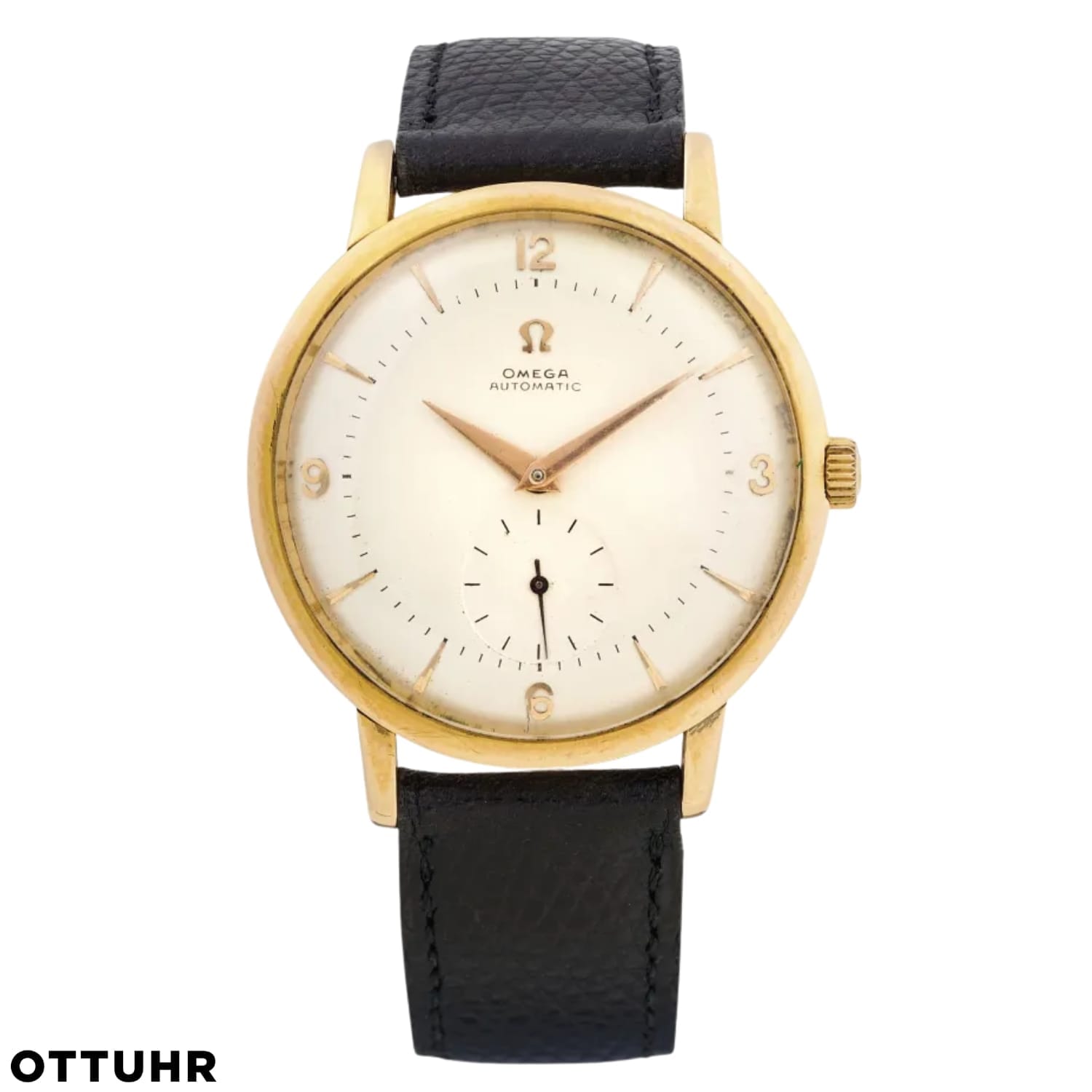
The reference 2899 occupies a specific niche within Omega’s 1950s catalog: an automatic dress watch designed for those seeking both modern convenience and traditional formality. Unlike the sport-oriented Seamaster or chronometer-certified Constellation, the 2899 was a straightforward time-and-date watch emphasizing clean aesthetics and reliable automatic winding. The watch featured classic dress watch architecture with a subsidiary seconds dial at 6 o’clock, applied rose gold indices, and refined dauphine hands. Its solid 18-karat rose gold construction positioned it as a premium offering, suitable for formal occasions or as a retirement gift in its era.
Production estimates for the reference 2899 remain imprecise, as Omega did not publish specific manufacturing figures for individual references during this period. Based on surviving examples appearing at auction and dealer listings, the 2899 appears to be uncommon rather than truly rare. Serial number analysis from documented examples suggests production occurred primarily between 1955 and 1960, coinciding with the production run of Caliber 491. The watch’s scarcity today stems more from its solid gold construction and limited original production than from any particular historical significance. Many period dress watches in precious metals were later melted down during economic downturns or when gold prices spiked, naturally reducing the surviving population.
The reference 2899 occupies a modest position in the current collector market. Vintage Omega dress watches from the 1950s generally remain affordable compared to sport models from the same era, and the 2899 follows this pattern. Auction results and dealer pricing typically range from $3,000 to $4,500 USD for examples in good condition with serviced movements. The market favors unpolished cases with original dials, even if aged, over heavily refinished examples. Demand remains steady but not intense, with the 2899 appealing primarily to collectors seeking authentic 1950s Omega automatics in precious metals rather than speculators chasing appreciation. No specific dial variants command significant premiums, though examples with original boxes and papers naturally fetch higher prices despite their rarity for watches of this age.
No widely recognized nickname exists for the reference 2899. While sometimes described as “Jumbo” in dealer listings, this term applies generically to any oversized 1950s Omega dress watch measuring 36mm or larger rather than designating this specific reference.
HISTORICAL CONTEXT, PROVENANCE, AND MANUFACTURING DETAILS
The reference 2899 emerged during a transformative period for Omega’s automatic movements. For the previous decade, Omega had relied on bumper automatic calibers, ingenious mechanisms that used a semicircular rotor bouncing between buffer springs to wind the mainspring. While functional, bumper automatics proved less efficient than full-rotor designs and required more vigorous wrist motion to maintain power. By 1955, Omega committed to developing true full-rotor automatic movements that could wind bidirectionally through a complete 360-degree rotation, following the path Rolex had pioneered decades earlier with the Oyster Perpetual.
Caliber 491, introduced in 1956, represented the second generation of Omega’s full-rotor automatic family. The first generation, Caliber 470 and 471, appeared in 1955 with center seconds, while the 490 and 491 followed in 1956 featuring subsidiary seconds at 6 o’clock. The distinction between 490 and 491 was minimal: the former contained 17 jewels while the latter featured 19 jewels for enhanced performance. Both calibers shared the same 28mm diameter, bidirectional winding system, and robust construction that would define Omega automatics through the remainder of the decade.
The reference 2899 did not replace a specific predecessor nor evolve from an earlier model. Rather, it represented Omega’s expansion of automatic dress watch offerings in precious metals during the mid-1950s. The watch occupied a position between the smaller, more conventional dress watches Omega produced in the early 1950s and the emerging sport-oriented Seamaster line. While not groundbreaking in terms of complications or technical innovation, the 2899 demonstrated Omega’s commitment to offering automatic movements across its entire product range, from sport watches to formal dress pieces.
Production took place at Omega’s Bienne facility in Switzerland, where the company manufactured movements entirely in-house during this period. The solid 18-karat rose gold cases were likely produced by specialized case makers contracted by Omega rather than manufactured internally, as was standard practice among Swiss watch brands at the time. The cases bear the OT prefix in the complete reference designation (OT 2899), indicating solid gold construction according to Omega’s reference numbering system. Inside the case back, collectors will find the reference number 2899, case serial number, and Swiss hallmarks confirming the gold content.
Omega 2899 CONSTRUCTION AND ARCHITECTURE
The reference 2899 employs classic round case architecture with generous proportions for its era. The solid 18-karat rose gold case measures between 36mm and 37.5mm in diameter excluding the crown, placing it firmly in “jumbo” territory for 1950s dress watches. The case features gently curving lugs that sweep downward to enhance wrist conformity, a characteristic detail of Omega dress watches from this period. Case thickness including the crystal measures approximately 11-12mm, maintaining a relatively slim profile despite housing an automatic movement.
The case construction follows a three-piece design: bezel, case body, and press-fit case back. Unlike many Seamaster models from the same era that featured screw-down case backs for enhanced water resistance, the 2899 uses a friction-fit snap back secured by pressure alone. This simpler construction aligns with the watch’s dress watch orientation, where water resistance was not a priority. The press-fit design requires careful opening with proper case knives to avoid damaging the case edge. When properly sealed, the case provides sufficient protection against dust and moisture for normal dress watch use.
The bezel is fixed and polished to match the case finish, with no functional purpose beyond securing the crystal. Speaking of which, the 2899 uses an acrylic crystal, standard for the period and offering the advantage of easy polishing to remove minor scratches. Some examples retain the original Omega-signed crystal featuring a tiny Omega logo at the center, though many have been replaced during service over the decades.
Dial configurations vary, but most reference 2899 examples feature clean, symmetrical layouts emphasizing legibility. The most common dial design presents applied rose gold Arabic numerals at 12, 2, 4, 6, 8, and 10 o’clock positions, with applied rose gold baton indices marking the remaining hours. The Omega logo sits at 12 o’clock, typically as an applied metal emblem rather than printed text. A subsidiary seconds dial occupies the 6 o’clock position, maintaining the symmetry expected of quality dress watches. Dial colors range from silvered white to cream, with some examples displaying attractive two-tone finishes that create subtle contrast between the dial center and outer chapter ring.
Hands follow the dauphine style, featuring faceted surfaces that catch light elegantly. Both hour and minute hands are typically rose gold-plated or solid rose gold to match the case and applied indices, maintaining visual cohesion. The subsidiary seconds hand is a simple straight design, appropriate for its supporting role.
The crown is signed with the Omega logo, a detail Omega standardized across most civilian watches from approximately 1950 onward. The crown features fine knurling for grip during manual winding and time setting. Original crowns for this reference are becoming increasingly scarce, and many examples have been fitted with generic service replacement crowns over the years.
Case dimensions break down as follows based on documented examples: 36-37.5mm diameter excluding crown, 44-45mm lug-to-lug measurement, 18mm lug width, and 11-12mm total thickness including crystal. These proportions create a watch that wears larger than its diameter might suggest, thanks to the prominent lugs and generous dial real estate.
The watch originally shipped on leather straps rather than bracelets, appropriate for its formal dress watch positioning. Brown leather was most common, though black options existed for more conservative tastes. The lug width of 18mm allows for easy strap replacement with modern aftermarket options. Period-correct Omega buckles in rose gold plating complemented the watch’s overall aesthetic.
All known examples of the reference 2899 feature solid 18-karat rose gold cases. No variations in steel, gold-filled, or other materials have been documented, reinforcing the watch’s positioning as a premium dress piece.
CROSS-REFERENCE DATA
The reference 2899 shares case manufacturing and design language with other Omega dress watches from the mid-to-late 1950s. The references listed above represent functionally similar watches differing primarily in case reference numbers and minor dial variations. These models were often sold through different markets or time periods while maintaining similar core specifications.
MOVEMENTS & CALIBERS
The reference 2899 exclusively houses Omega Caliber 491, a 19-jewel automatic movement representing Omega’s second generation of full-rotor self-winding mechanisms.
Caliber 491 Specifications:
- Production period: 1956-1960
- Jewel count: 19
- Diameter: 28mm
- Height: Approximately 5-6mm
- Frequency: 19,800 vibrations per hour (2.75 Hz)
- Power reserve: Approximately 46 hours
- Winding: Bidirectional automatic with full 360-degree rotor
- Shock protection: Incabloc
- Regulator: Etachron
Caliber 491 shares its fundamental architecture with the 17-jewel Caliber 490, differing only in jewel count. Both calibers feature subsidiary seconds rather than center seconds, distinguishing them from the contemporary Calibers 470/471 and later 500/501 series which placed the seconds hand at the dial center.
The movement’s construction reveals an interesting transitional design philosophy. Rather than developing an entirely new automatic caliber from scratch, Omega essentially took a proven manual-wind base movement and added a separate rotor winding module on top. This modular approach, previously employed by Rolex in their early bubble back automatics, allowed Omega to leverage existing tooling while achieving full-rotor automatic functionality. While not a “true” integrated automatic in the strictest sense, this design proved robust and serviceable.
The rotor itself rotates freely through a full circle and winds the mainspring in both directions via a reversing wheel system. This bidirectional winding represents a significant improvement over the earlier bumper automatics, requiring less arm movement to maintain power and eliminating the characteristic “thump” of the bumper hitting its stops.
Caliber 491 does not feature hacking seconds, a complication not yet standard on Omega automatic movements in the 1950s. When the crown is pulled to set the time, the seconds hand continues running, making precise synchronization impossible without reference to an external time source. Similarly, the movement lacks quickset date capability, as no date complication exists on this caliber.
The movement finishing reflects Omega’s high standards from this era. The bridges feature Geneva stripes (côtes de Genève), and the rotor bears “Omega Watch Co Swiss” engraving along with the jewel count and caliber number. The copper-toned plating common to Omega movements of this period gives the caliber an attractive warm appearance when viewed through the case back, though the press-fit back design means most owners rarely glimpse the movement.
Movement markings collectors should verify: The rotor bridge should be stamped with “491” clearly visible. The movement serial number, typically in the 14-16 million range for mid-to-late 1950s production, appears on one of the movement bridges. This serial number should logically align with the case serial number for dating consistency, though slight discrepancies can occur due to parts inventory practices.
IDENTIFYING ORIGINAL VS. REPLACED PARTS
Authenticating a reference 2899 requires careful examination of multiple components, as these watches have aged 65-70 years and many have undergone service, repair, or modification.
Dial Authentication:
Original dials for the reference 2899 typically display certain age-appropriate characteristics. The printing should show slight irregularities consistent with 1950s silk-screening technology rather than the perfectly uniform appearance of modern reprints. Under magnification, inspect transitions between the dial surface and applied indices for any evidence of paint or lacquer overspray, a telltale sign of refinishing. Original dials should show the dial color stopping cleanly at the feet of applied hour markers, with no color visible on the indices themselves.
“Swiss” or “Swiss Made” markings should appear at the bottom of the dial near 6 o’clock on watches produced after approximately 1950. The absence of this marking on a 1955-1960 watch suggests dial refinishing, as refinishers often omit this detail due to the difficulty of reprinting on curved dial edges.
The dial surface texture matters significantly. Original dials from this era develop a subtle patina over decades, creating a soft, slightly matte appearance even when originally glossy. An unnaturally high-gloss finish, especially one that looks wet or freshly lacquered, indicates recent refinishing. Two-tone dials showing distinct sectors or color zones should display natural aging patterns consistent across all sections.
Omega Cal.491 Automatic 18ct Pink Gold 1955 37.5mm Two Tone Dial
Applied numerals and indices warrant close inspection. Original applied markers sit precisely in their mounting holes with burnished feet on the dial reverse holding them secure. Misaligned indices, uneven spacing, or markers that appear too small or large for their mounting holes suggest replacement. Some refinished dials reuse original applied markers, but hastily refinished examples may show glue residue around the marker bases.
Hands Examination:
Hands should exhibit consistent aging relative to the dial and case condition. If the watch case shows 65 years of wear but the hands look pristine and bright, replacement during service becomes likely. Conversely, if hands show radium or tritium lume that has aged to a warm cream or tan color while dial markers remain stark white, someone has replaced the hands at some point.
Dauphine hands original to this reference feature carefully proportioned shapes with faceted surfaces. Modern replacement hands often lack the refinement of period originals, appearing thicker, less elegantly tapered, or with less pronounced faceting.
Crown Verification:
Original crowns for 1950s Omega dress watches should bear the Omega logo on the crown face. The clover-type crown was common for Omega dress watches of this era, though various crown styles existed depending on specific references. Many reference 2899 examples have had crowns replaced with generic service parts over the decades, as original crowns wear out or are lost during case refinishing. While a replaced crown does not necessarily indicate a problematic watch, original crowns carry value with collectors focused on complete originality.
Case Integrity:
Over-polishing represents the most common case-related issue with vintage watches. Original reference 2899 cases should maintain crisp lines where the lugs meet the case body, with clearly defined edges and contours. Heavily polished cases show rounded lug edges, blurred transitions between case surfaces, and reduced metal thickness. Inspect the area around the lugs particularly carefully, as this is where polishing damage first becomes apparent.
The case should retain its hallmarks on the case back interior, including the Omega stamp, reference number 2899, case serial number, and Swiss gold purity marks. The reference number 2899 should be clearly stamped and legible, not faint or partially polished away. A second reference number occasionally appears on case backs that were shared across multiple model variants, a normal Omega practice.
Bracelet and Strap Considerations:
The reference 2899 did not originally ship with a metal bracelet, so any example on a bracelet has been fitted with an aftermarket option. Original straps rarely survive 65+ years of use, so replacement leather straps are expected and acceptable. Period Omega buckles in rose gold plating, if present, add modest value and authenticity.
COLLECTOR NOTES & MARKET CONTEXT
The reference 2899 occupies a specific segment of the vintage Omega market: mid-century automatic dress watches in precious metals. Unlike the sport-oriented Seamaster Professional or the iconic Speedmaster, dress watches from this era generate steady but modest collector interest.
Current Market Positioning:
Based on auction results and dealer listings from 2023-2026, reference 2899 examples in good condition typically trade between $3,000 and $4,500 USD. Exceptional examples with original boxes and papers, unpolished cases, and pristine original dials can command up to $5,000, though such complete packages rarely appear for watches of this age. Conversely, heavily worn examples requiring service or showing refinished dials may sell for $2,000-2,500.
The market has remained relatively stable over the past decade. While Omega sport models from the 1950s have appreciated significantly, dress watches have seen more modest gains. This creates opportunity for collectors seeking authentic 1950s Omega craftsmanship without paying premiums associated with Seamaster or Speedmaster models.
Most Sought-After Configurations:
Among reference 2899 variants, the market shows preference for:
- Unpolished or lightly polished cases retaining sharp lugs and crisp lines
- Original, unrestored dials even with minor patina or age spots
- Proper Caliber 491 movements in good working order
- Correct signed crowns, though these are increasingly rare
Refinished dials significantly impact value, often reducing prices by 30-50% compared to original dial examples. Collectors in this market segment prioritize originality over pristine condition, accepting honest wear as evidence of authenticity.
Common Pitfalls:
Buyers should exercise caution regarding:
- Misrepresented refinished dials sold as original
- Over-polished cases that have lost their original proportions
- Non-running or poorly serviced movements requiring extensive restoration
- Frankenwatch assemblies combining parts from multiple watches or references
The relatively low value of these watches compared to sport models means some sellers may not disclose refinishing or replacement parts, either through ignorance or deliberate deception. Thorough photographic inspection or in-person viewing becomes essential before purchase.
Premium Drivers:
Several factors elevate reference 2899 values above baseline:
- Complete set with original box and papers, though exceptionally rare for watches from the 1950s
- Unpolished cases showing only light superficial wear
- Particularly attractive dial variations such as well-preserved two-tone finishes
- Recent professional service with documentation
- Provenance documentation or interesting ownership history
The reference 2899’s solid rose gold construction provides inherent value through precious metal content alone, establishing a price floor below which the watch cannot fall regardless of condition. This differs from gold-plated or steel examples where condition and originality drive virtually all value.
WEARABILITY & LIFESTYLE FIT
Daily Wear Viability:
The reference 2899 occupies a middle ground between delicate collector piece and practical daily wearer. The solid gold construction provides durability advantages over gold-filled or plated alternatives, as the entire case is precious metal rather than a thin layer over base metal. The Caliber 491 movement, while lacking modern conveniences, offers robust reliability when properly serviced.
However, several factors limit daily wear suitability. The press-fit case back provides minimal water resistance, making the watch unsuitable for any water exposure beyond hand washing. The acrylic crystal scratches easily, though this can be addressed through periodic polishing. The age of the watch, 65-70 years, means that despite solid construction, mechanical components experience wear that requires careful handling and regular service.
For collectors willing to baby their watches and avoid rough use, the 2899 can serve as an occasional daily wearer. For those seeking a true go-anywhere, do-anything timepiece, modern watches prove more practical.
Dress Watch Appropriateness:
The reference 2899 excels as a formal dress watch, its original design intent. The 36-37mm case size, while considered large in the 1950s, fits modern dress watch proportions perfectly. The clean dial, refined hands, and precious metal case create an appropriate aesthetic for business formal or black-tie occasions.
The subsidiary seconds at 6 o’clock and lack of date complication maintain the dial symmetry and classical proportions expected of quality dress watches. The rose gold case offers warmth without the flashiness of yellow gold, appealing to those seeking understated elegance.
Sport/Tool Watch Suitability:
The reference 2899 is definitively not a sport or tool watch. The minimal water resistance, delicate acrylic crystal, and formal aesthetic make it inappropriate for active pursuits. This is a watch for the office, dinner party, or theater, not the tennis court or swimming pool.
Water Resistance In Practice:
Omega did not publish water resistance ratings for dress watches of this era, and the press-fit case back design provides only nominal protection against moisture. In practical terms, owners should avoid any water exposure beyond incidental hand washing. Swimming, showering, or heavy rain could allow water ingress that damages the movement.
Periodic water resistance testing proves impossible without risking damage to the watch, as the press-fit case back was not designed for repeated opening and closing. The best approach involves treating the watch as non-water-resistant and exercising appropriate caution.
Comfort Factors:
The reference 2899 wears comfortably for its size. At 36-37mm diameter with 44-45mm lug-to-lug measurement, the watch fits a wide range of wrist sizes from approximately 6.25 inches to 7.5 inches. The downward-curving lugs enhance comfort by following the wrist contour rather than extending straight outward.
Weight is moderate for a solid gold watch. While heavier than a steel equivalent, the relatively small case size keeps total weight manageable for all-day wear. The 18mm lug width accommodates comfortable leather straps with light padding, distributing weight evenly.
The slim profile, approximately 11-12mm thick, allows the watch to slide easily under dress shirt cuffs, a key consideration for formal wear. This thickness compares favorably to many modern automatics that can exceed 13-14mm.
Strap Versatility:
The 18mm lug width provides excellent strap options. This standard vintage size offers abundant choices in leather, from simple calfskin to exotic materials like alligator or ostrich. Brown leather complements the rose gold case beautifully, though black leather works for more conservative tastes.
Modern quick-release spring bars can be fitted for easy strap changes, though purists may prefer traditional spring bars for period authenticity. NATO or canvas straps appear incongruous with the watch’s formal character, so leather remains the appropriate choice.
Size Context:
In contemporary terms, 36-37mm sits at the smaller end of modern men’s watches but aligns perfectly with the current trend toward vintage-inspired sizing. This makes the reference 2899 appealing to those who find 40mm+ modern watches too large or who appreciate classical proportions.
For wearers accustomed to 42mm+ sport watches, the reference 2899 may initially feel small. However, the generous dial real estate and prominent applied indices create visual presence that exceeds the nominal diameter. Most wearers adapt quickly to the smaller size and come to appreciate the elegance of vintage proportions