


The Omega Seamaster 166.010 represents the third generation of a design lineage that began with the CK 2975 in 1958, serving as Omega’s answer to the Rolex Datejust during the brand’s golden era of watchmaking. Where its predecessors relied on snap-on casebacks, the 166.010 introduced a more robust screw-down construction housed in a muscular yet refined case that punches above its 35mm dimensions. Widely attributed to Gerald Genta’s design work for Omega, though not definitively documented, the reference exhibits the proportional sophistication and wearability that would become hallmarks of his later iconic designs.
This is a straightforward sports-dress hybrid: an everyday automatic with date function, built for reliability rather than complications. The 166.010 bridges the gap between Omega’s dress-oriented models and their professional dive watches, offering water resistance courtesy of its screw-down caseback while maintaining a slim 11mm profile suitable for formal wear. Among collectors, the reference enjoys steady appreciation as an accessible entry point into vintage Omega, though it lacks the fervent following of chronograph or dive references. The caliber 562 and 565 movements inside are respected workhorses from Omega’s 550 series, known for durability and serviceability.
Production numbers for the 166.010 were never officially published by Omega, but serial number ranges and surviving examples suggest substantial output over its eight-year run from 1962 to 1970. This places the reference firmly in the “common” to “uncommon” category, far more accessible than chronometer-certified variants or limited editions, yet not flooding the market. The watch appears regularly at auction and through dealers, with prices ranging from $700 to $1,500+ depending on condition, originality, and dial variant. Scarcity increases significantly for examples with original beads-of-rice bracelets, unpolished cases, and rare dial configurations like the crosshair or black dial variants.
Collector demand for the 166.010 remains stable rather than explosive. The reference appeals to those seeking a wearable vintage Omega without the premium associated with Speedmasters or Seamaster 300 dive watches. Unpolished cases with sharp lugs and original brushed side finishes command noticeable premiums, as do examples housing the quickset-date caliber 565 over the semi-quickset 562. The chronometer-certified sibling reference 168.024, which shares the same case but houses the higher-grade caliber 564, consistently trades at 20-30% higher prices, though both references are often confused or conflated in listings. No widely-recognized nickname exists for the 166.010, though individual dial variants like the “crosshair” carry descriptive identifiers.
Historical Context, Provenance, and Manufacturing Details
The Omega Seamaster 166.010 emerged in 1962 as the natural evolution of Omega’s mid-century Seamaster dress-sport line. Its direct predecessor, the CK 2975, debuted in 1958 with a 35mm case and large Seamonster medallion caseback, followed by reference 14710 from 1959 to 1962. Both earlier generations used snap-on casebacks, a design Omega deemed insufficient as water resistance expectations rose during the 1960s. The 166.010 addressed this by introducing a screw-down caseback while retaining the broad-shouldered case architecture and proportions collectors had come to appreciate.
The watch entered production during Omega’s golden era of the 1950s and 1960s, when the brand operated as a true manufacture, producing movements, cases, and components in-house or through trusted Swiss suppliers. This period saw Omega introduce the Professional trilogy in 1957 (Seamaster 300, Railmaster, Speedmaster) and achieve technical milestones like NASA’s Speedmaster selection in 1965. The 166.010 was not a groundbreaking release in this context but rather a workhorse addition to the Seamaster dress-sport lineup, intended to compete directly with the Rolex Datejust in both functionality and market positioning.
Production spanned from approximately 1962 to 1970, though sources occasionally cite 1958 or 1967 as start dates, likely confusing the 166.010 with its CK 2975 predecessor or referencing later serial number batches. The reference code follows Omega’s shift to a six-digit numbering system in 1962, replacing earlier alphanumeric codes like “CK” (stainless steel) or “KO” (gold cap). Early examples from 1962-1965 typically house caliber 562 movements with semi-quickset date, while later examples from 1966 onward often contain caliber 565 with true quickset date functionality.
Cases were manufactured primarily by two Swiss suppliers: Huguenin Frères (marked “HF” inside the caseback) and La Centrale Boîtes, or Centrale Boites (marked “CB”). Both firms supplied Omega during the 1960s, with HF particularly famous for producing early Speedmaster Professional cases. Some examples also bear “TR” case stamps, though the manufacturer associated with this marking remains less documented. The movements were produced at Omega’s Bienne facility, continuing the caliber 550 series architecture introduced in 1958.
The 166.010 was succeeded indirectly by the evolution of the Seamaster line itself rather than a single replacement reference. By 1967, Omega split the De Ville models into a standalone collection, separating dress-oriented watches from the Seamaster sports line. The Seamaster lineup continued to diversify through the 1970s, with no direct successor maintaining the 166.010’s specific case design and proportions. The reference represents a transitional period in Omega’s design language, positioned between the classical dress aesthetics of the 1950s and the bolder, more tool-oriented designs that would dominate the 1970s.
Construction and Architecture
The 166.010 case measures 35mm in diameter, 42-43mm lug to lug, and approximately 11mm in thickness, dimensions that translate to surprising wrist presence despite the modest diameter. The case architecture follows a classic three-piece oyster-style construction: a main body with fixed bezel, screw-down caseback, and press-fit crystal. The bezel is wide and polished, creating visual balance with the case diameter, while the case sides exhibit vertical brushed finishing contrasting against the polished top surfaces and bezel. The lugs are broad, straight, and downturned, with sharp beveled edges that are frequently lost to over-polishing on poorly maintained examples.
The screw-down caseback features Omega’s iconic Seamonster (hippocampus) medallion in deep relief, a symbol associated with the Seamaster line since its 1948 introduction. Inside the caseback, you will find the reference number “166.010” along with a two-digit date code (e.g., “-63” for 1963, “-67” for 1967), case manufacturer markings (typically “HF” for Huguenin Frères or “CB” for Centrale Boîtes), and “Omega Watch Co. Swiss Made” inscriptions. Cases were produced in stainless steel as standard, with a less common gold-capped variant featuring 14k yellow gold plating over stainless steel, identified by reference codes like “CD 166.010”.
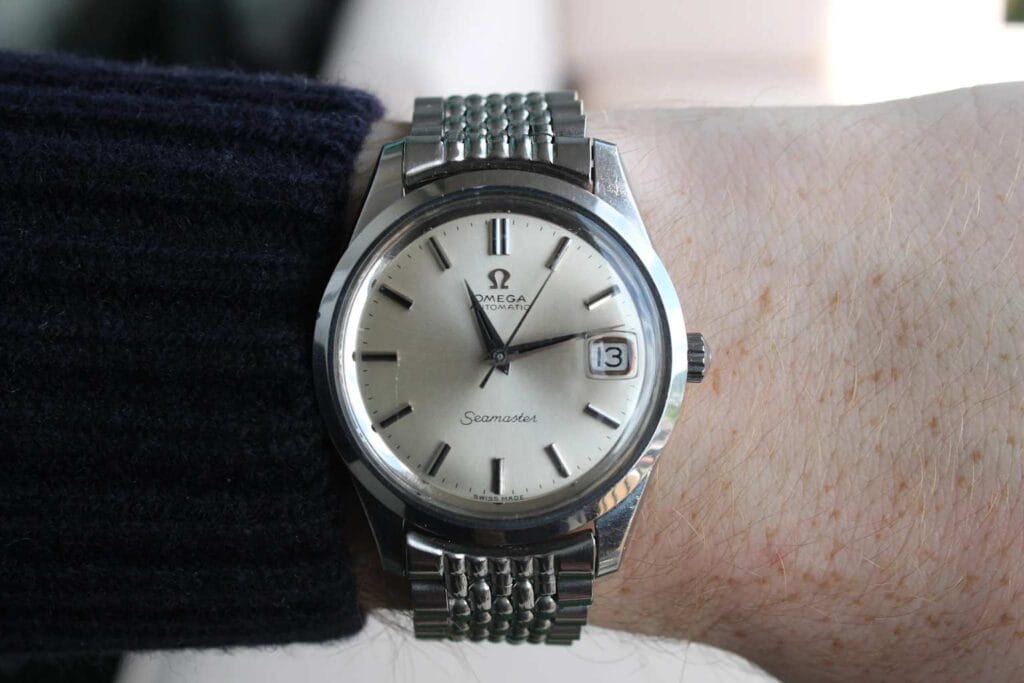
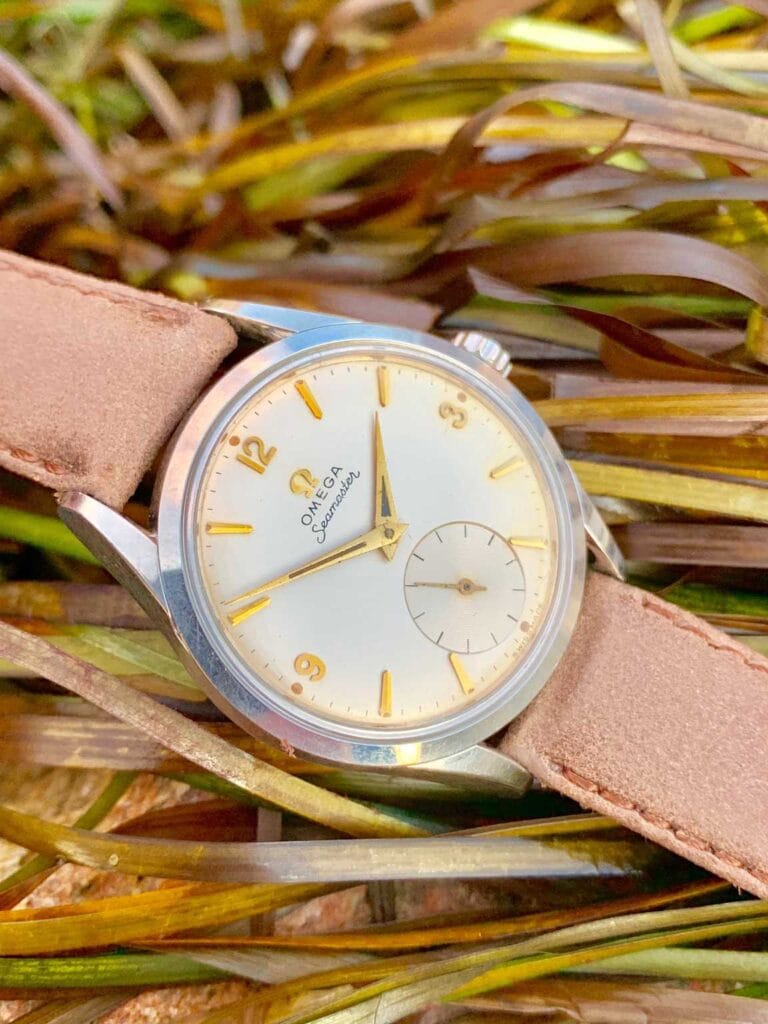
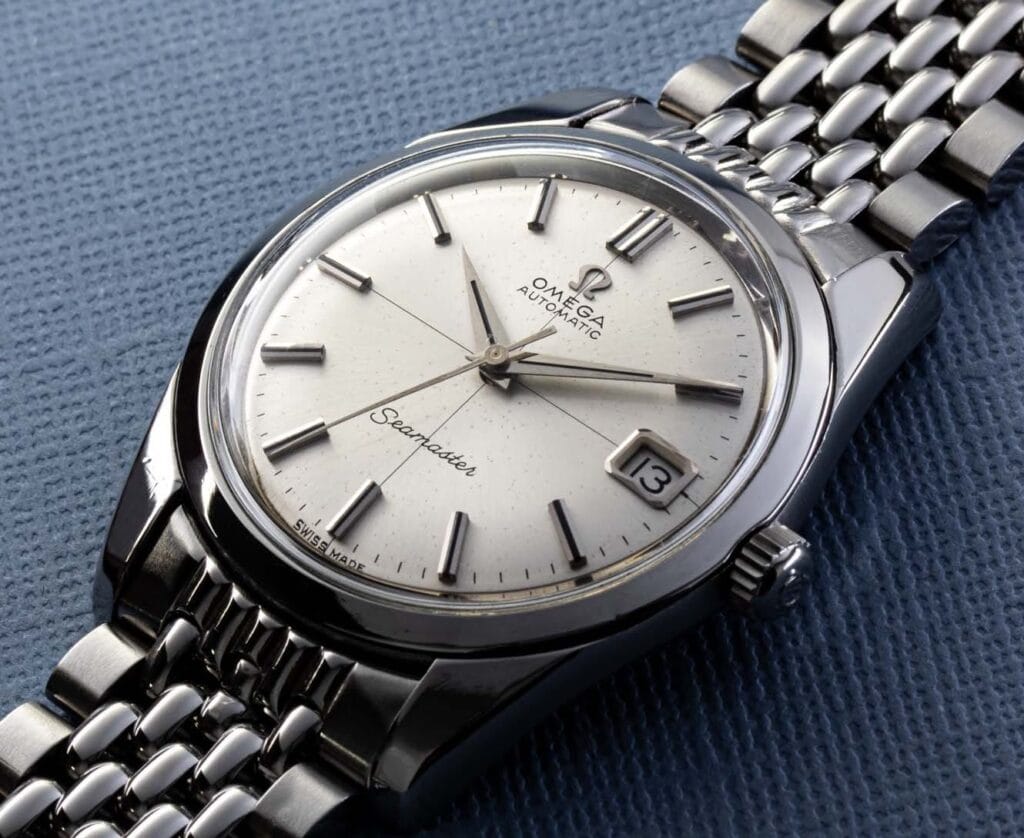
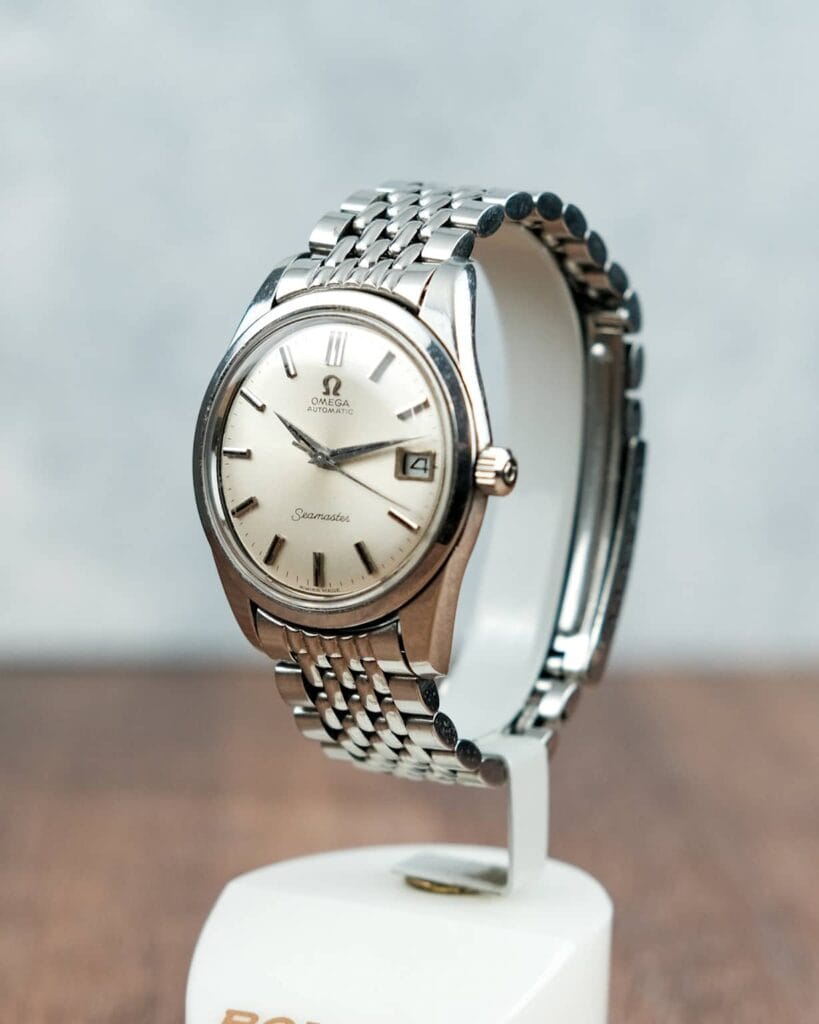
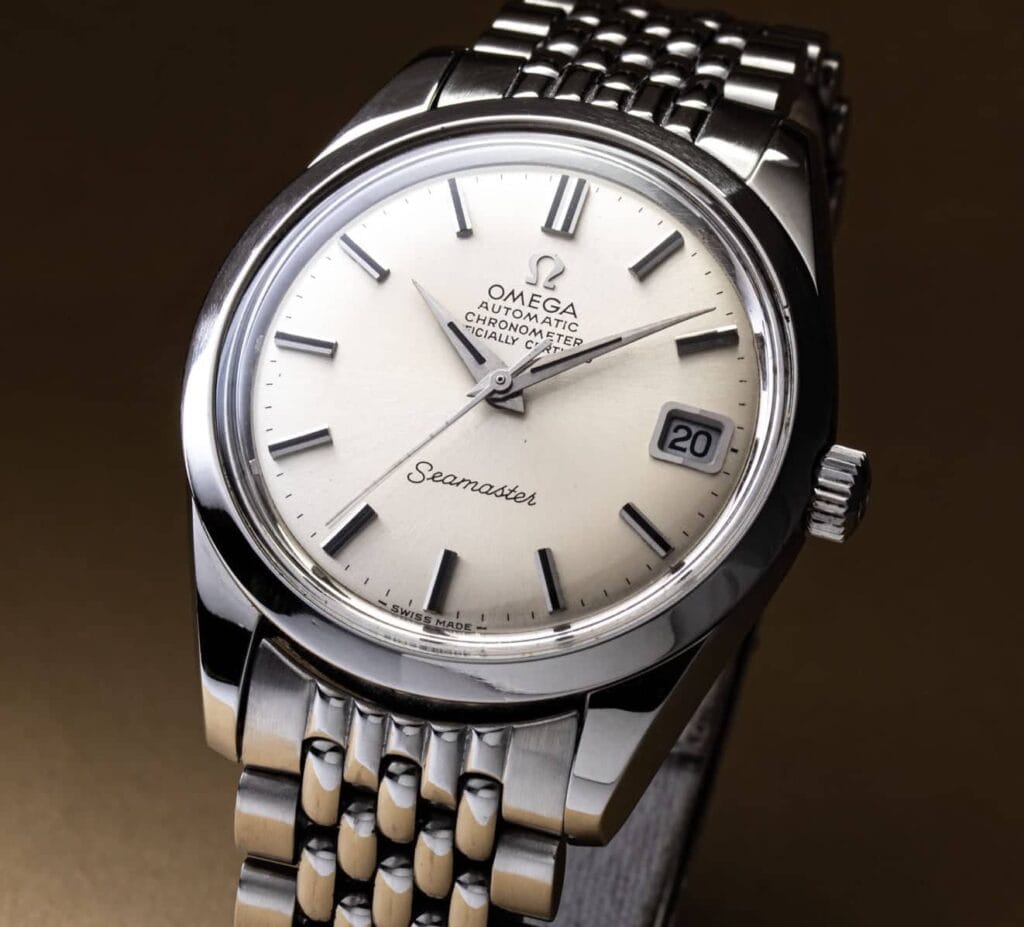
The dial follows a sunburst satin finish in silver or champagne tones, though rare black dial examples exist, primarily sourced from Asian markets. Applied faceted hour markers feature black-filled or onyx inlays, though the extent of this inlay varies: some examples show black filling on all twelve markers, while others limit the inlay to cardinal positions at 3, 6, 9, and 12 o’clock. The most commonly seen configuration includes black inlays on all markers. At 12 o’clock, a double marker distinguishes the top of the dial. Hands are polished dauphine style with black inserts, occasionally showing aged luminous material depending on the dial variant. The date window sits at 3 o’clock within a polished, faceted frame integrated into the dial, a detail that adds refinement to an otherwise minimalist design.
A rare dial variant known as the “crosshair” features a thin cross of lines bisecting the dial horizontally and vertically, intersecting at the center pinion. These crosshair dials are considered among the rarest and most desirable 166.010 configurations, commanding premiums in the collector market. Dial printing follows Omega’s serif fonts of the period, with “Omega” at 12 o’clock below the applied logo, “Automatic” in the upper half, and “Seamaster” printed at 6 o’clock in Omega’s characteristic script with the pointed “A” in “Automatic” and flattened “A”s elsewhere.
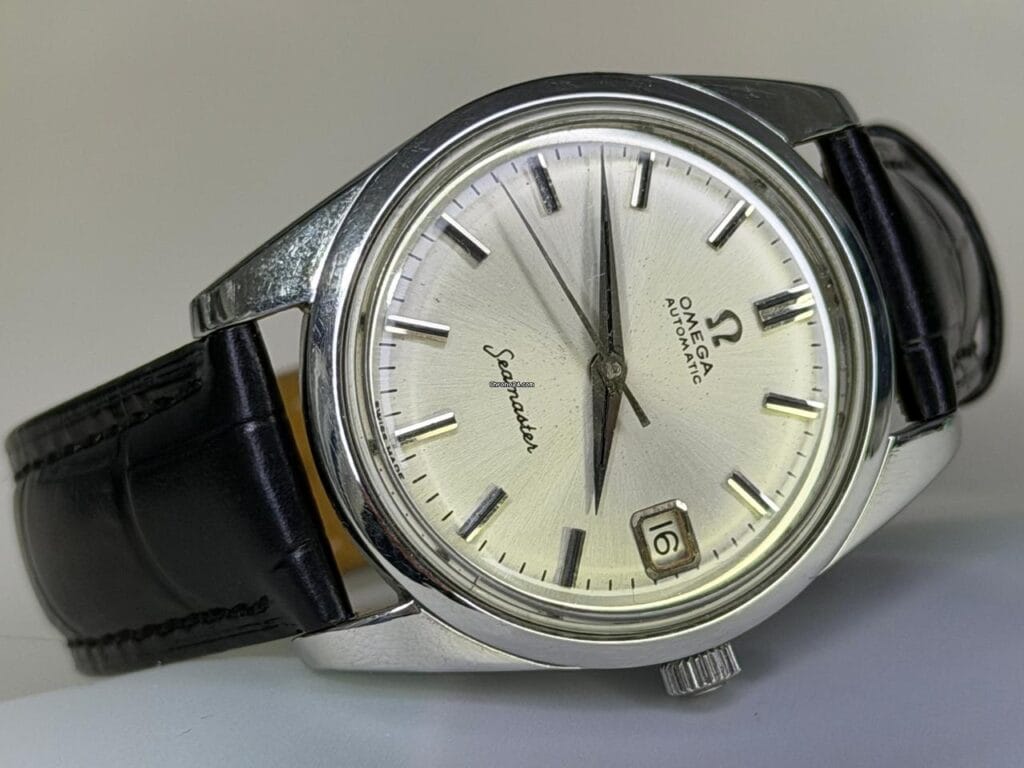
Lume treatment varies. Many 166.010 dials feature no luminous material whatsoever, while others include tritium plots in the hour markers and hands, indicated by “T Swiss T” or “Swiss Made T” text below the 6 o’clock marker. The tritium has aged to cream or light brown patina on original examples, though loose or deteriorating lume is a common issue that can contaminate the movement.
The crystal is domed acrylic (plexiglass), with original examples bearing a small raised Omega logo on the underside center, visible when viewed at an angle. Some later examples or replacements feature a cyclops magnifier over the date window, though this was a customer-selected option rather than standard equipment and is less common. The crown is a small, knurled design with the Omega logo, measuring approximately 5mm in diameter, departing from the larger “clover leaf” crowns seen on earlier Seamasters. Non-original crowns are frequently encountered and are often identifiable by incorrect proportions, oversized diameter, or lack of fine detailing in the Omega logo engraving.
The 166.010 was originally supplied on either leather straps or Omega’s five-row beads-of-rice bracelet, reference 1502 or 1036, with 11-style endlinks. The beads-of-rice bracelet is highly desirable among collectors, often adding $200-400 to the value of a watch when original and in good condition. These bracelets exhibit minimal stretch when well-maintained but can suffer from worn pivot pins and loose links after decades of use.
Dial and Case Variants
| Variant | Case Material | Dial Color | Dial Style | Markers | Notes |
|---|---|---|---|---|---|
| 166.010 | Stainless steel | Silver sunburst | Standard | Applied with black/onyx inlay | Most common |
| 166.010 | Stainless steel | Champagne sunburst | Standard | Applied with black/onyx inlay | Natural patina development |
| 166.010 | Stainless steel | Silver sunburst | Crosshair | Applied with black/onyx inlay | Rare, premium |
| 166.010 | Stainless steel | Black | Gilt text | Luminous strips in markers | Very rare, Asian market |
| CD 166.010 | 14k gold cap/SS | Silver or champagne | Standard | Applied with black/onyx inlay | Uncommon |
| 166.010-67 (etc.) | Stainless steel | Varies | Varies | Varies | Date code suffix indicates year |
Cross-Reference Data
| Related Reference | Manufacturer | Dial Markings | Movement | Key Differences |
|---|---|---|---|---|
| 168.024 | Omega | Adds “Chronometer Officially Certified” text | Caliber 564 (chronometer) | Higher-grade movement, chronometer certification, 20-30% price premium |
| 168.022 | Omega | Adds “Chronometer Officially Certified” text | Caliber 564 (chronometer) | Larger 36.5mm case, different case style with radial bezel finish |
| CK 2975 | Omega | Seamaster branding | Caliber 500/501 series | Predecessor, 1958 only, snap-on caseback, larger medallion |
| 14710 | Omega | Seamaster branding | Caliber 500/501 series | Second generation, 1959-1962, snap-on caseback |
The 168.024 is the most commonly confused reference, as it shares the exact same case, dimensions, and visual appearance as the 166.010 but adds chronometer certification and corresponding dial text. The two are functionally interchangeable in terms of case components and aesthetics, with the movement grade being the sole differentiator.
Movements & Calibers
The 166.010 was produced with two movements during its production run: caliber 562 (1962-circa 1966) and caliber 565 (circa 1966-1970). Both are part of Omega’s highly regarded 550 series, introduced in 1958 as a flatter, more refined successor to the 470 series. These movements were designed by Marc Favre, whose company was acquired by Omega’s parent SSIH Group, integrating his expertise directly into Omega’s manufacture capabilities.
Caliber 562
- Production Period: 1962-circa 1966
- Jewel Count: 24 jewels
- Frequency: 19,800 vph (2.75 Hz)
- Lift Angle: 49 degrees
- Power Reserve: Approximately 50 hours
- Diameter: 27.9mm (12.5 lignes)
- Height: 4.5mm
- Winding: Automatic, bidirectional rotor, hand-windable
- Hacking: No
- Date Setting: Semi-quickset (advance by rotating hands past midnight and back to 9pm repeatedly)
- Shock Protection: Incabloc
- Regulator: Swan-neck fine adjustment
- Country of Origin: Switzerland, Swiss made
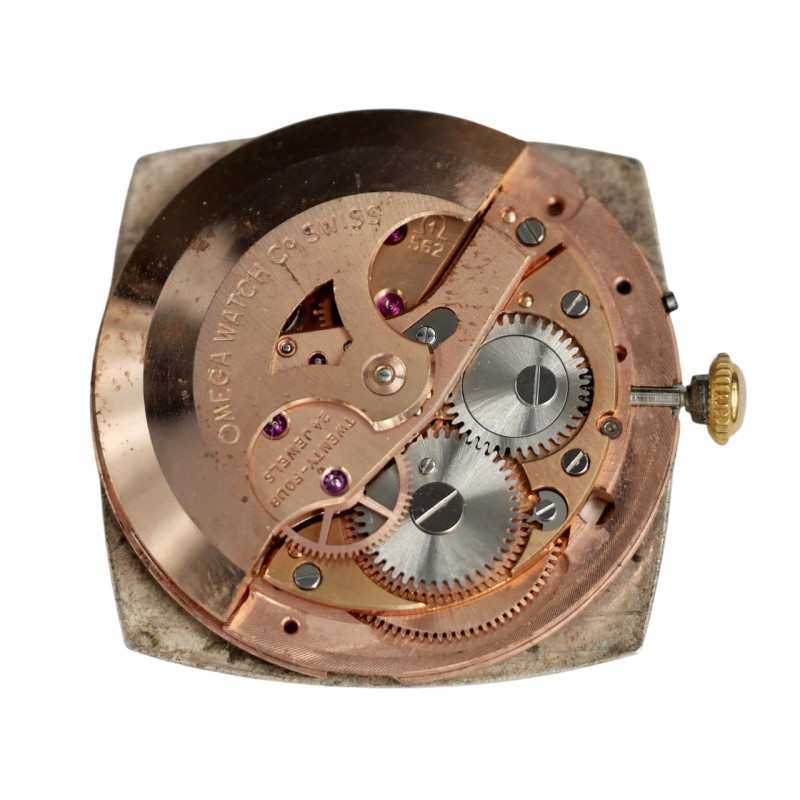
The caliber 562 represents the date-equipped, non-chronometer version of the 550 series. It features a semi-quickset date mechanism, meaning the date can be advanced relatively quickly by rotating the minute hand forward past midnight, then backward to 9pm, then forward again, cycling until the correct date is reached. This is faster than fully manual date setting but slower than modern quickset systems. The movement does not hack (the seconds hand continues running when the crown is pulled to the time-setting position).
The 562 is finished in Omega’s signature copper-toned bridges (not gold plating, but a specific alloy color), with perlage on the baseplate, Côtes de Genève on the rotor and bridges, and polished beveled edges. The rotor is skeletonized and marked with the Omega logo. Some examples feature a “1” inside the Omega logo on the movement, indicating a higher hand assembly to accommodate taller dials like pie-pan styles, not a production date or quality indicator. The movement is robust, reliable, and parts remain available through vintage suppliers and Omega service centers.
Caliber 565
- Production Period: Introduced 1966, used in 166.010 from circa 1966-1970
- Jewel Count: 24 jewels
- Frequency: 19,800 vph (2.75 Hz)
- Lift Angle: 49 degrees
- Power Reserve: 38-50 hours (sources vary)
- Diameter: 27.9mm (12.5 lignes)
- Height: 5mm
- Winding: Automatic, bidirectional rotor, hand-windable
- Hacking: No
- Date Setting: Quickset (pull crown to first position, pull/push repeatedly to advance date)
- Shock Protection: Incabloc
- Regulator: Swan-neck fine adjustment
- Country of Origin: Switzerland, Swiss made
The caliber 565 improves upon the 562 by introducing a true quickset date mechanism. To set the date, pull the crown to the first position (past the winding position but before the time-setting position), then pull outward and push inward repeatedly to advance the date one day per pull-push cycle. This mechanism is more efficient than the 562’s semi-quickset system but requires careful use: the date should never be adjusted between 9pm and 1am, as the automatic date change mechanism is engaged during this window and adjusting the date can break fragile gears in the quickset system.
The caliber 565 is otherwise mechanically similar to the 562, sharing the same base architecture, frequency, jewel count, and shock protection. Omega later updated the quickset mechanism with an improved part to reduce the risk of damage if the date is changed during the danger zone, though not all serviced examples have received this update. The 565 is considered one of Omega’s most reliable and respected vintage automatic movements, combining good accuracy, durability, and ease of service.
Both calibers feature an indirect central seconds hand driven by the third wheel via a tension spring. This design can occasionally cause the seconds hand to pause or stutter at specific positions on the dial, typically indicating that the tension spring has loosened or requires lubrication, a common issue in vintage examples that is easily corrected during service. Neither movement features chronometer certification in the 166.010 application, though the same movement architecture was used in chronometer-certified variants in other references (calibers 561 and 564).
Movement serial numbers are stamped on the bridges and can be cross-referenced to approximate production years, though Omega’s serial number dating is not always precise, with overlaps and gaps in the records. Service and parts availability for both calibers remain good, with mainsprings, stems, gaskets, and other consumables readily available from aftermarket suppliers. Service costs for vintage caliber 562/565 movements range from $600 to $1,250+ depending on whether the work is performed by an independent watchmaker or an Omega service center.
Identifying Original vs. Replaced Parts
Redials, service replacements, and incorrect parts are common in the vintage Omega market, making originality verification critical for serious collectors. The 166.010 is particularly vulnerable to dial refinishing and hand replacements due to its age and the prevalence of service interventions over decades of wear.
Dial Authenticity
Original 166.010 dials exhibit specific characteristics collectors should verify:
- Font Details: The “Omega” text uses serif fonts with a pointed “A” in “Automatic” and flattened “A”s in other words like “Seamaster”. The “S” letters in “Seamaster” should have a small gap between the top and bottom curves, not a merged connection.
- Printing Quality: Text should be crisp, evenly spaced, and properly aligned. Blurry, uneven, or incorrectly positioned text suggests a redial.
- Lume Markings: Dials with tritium should be marked “T Swiss T” or “Swiss Made T” below 6 o’clock. Dials without tritium may lack any “T” markings. A dial marked with “T” but showing no luminous material in the markers is suspect.
- Patina Development: Original dials often develop a light champagne patina over decades, a natural and desirable aging process. Uniform, “tropical” patina (dramatic color change) is less common on 166.010 dials than on other Omega references. Be wary of dials that appear too white, too uniform, or show bubbling, cracking, or lifting printing, all signs of refinishing or poor storage conditions.
- Applied Markers: Original applied markers should be straight, evenly spaced, and securely attached. Crooked or misaligned markers suggest a redial or incorrect service replacement.
- Onyx Inlays: The black filling in applied markers should appear uniform and consistent across all markers (or limited to specific positions if that variant is verified). Missing inlays or inconsistent patterns may indicate lost original material or a redial.
Redials are common because Omega offered dial refinishing as a service option, and many owners opted to “restore” dials that showed age-related wear. Service dials can sometimes be identified by lack of printing details, incorrect fonts, or missing elements like the crosshair on rare variants.
Hands
Original 166.010 hands are dauphine style with black inserts, featuring polished surfaces and crisp edges. Common replacement issues:
- Incorrect Style: Sword hands, baton hands, or other styles are incorrect and indicate replacements. The 166.010 uses only dauphine hands.
- Proportions: Replacement hands may be slightly too long, too short, or improperly balanced. Compare against verified original examples.
- Lume Aging: If the dial has aged tritium, the hands should show similar aging and color. Mismatched aging suggests replaced hands.
- Condition Mismatch: Pristine hands on a patinated dial (or vice versa) warrant scrutiny.
Crown
The original crown is a small (approximately 5mm), knurled design with the Omega logo engraved. Common replacement crowns are larger, have deeper knurling, lack fine detail in the logo engraving, or feature incorrect crown tube threading. The 166.010 does not use the larger “cloverleaf” style crown seen on some earlier Seamasters. Some later examples may have a slightly larger, easier-to-grip crown, which some sources describe as an upgrade introduced around 1968-1970, though the distinction between original variation and replacement is often difficult to determine.
Case Finishing and Polishing
Original, unpolished 166.010 cases exhibit:
- Sharp Beveled Edges: The lugs should have crisp, well-defined bevels along the top edges. Rounded or softened edges indicate polishing.
- Brushed Side Finish: The case sides should retain vertical brushed finishing, contrasting with the polished bezel and top surfaces. Cases where this finish is lost or shows irregular patterns have been over-polished.
- Lug Thickness: Heavy polishing reduces lug thickness and shortens the distance between the lug tops and the bracelet/strap holes. Compare lug proportions to verified original examples.
Over-polishing is one of the most common condition issues with vintage Omega watches, as many owners and jewelers routinely polished cases to a uniform shine, erasing the original mixed finishes and softening case details.
Crystal
The original crystal is domed acrylic with a small raised Omega logo on the underside center. Replacement crystals may lack this logo or feature incorrect proportions. Some examples have a cyclops magnifier over the date, which was an optional feature but is less common than non-cyclops crystals.
Bracelet
The correct beads-of-rice bracelet is reference 1502 or 1036 with 11 endlinks. Other Omega bracelets, such as the 1503 (also a beads-of-rice style but with different endlinks), may fit but are not period-correct. Generic or aftermarket bracelets are frequently encountered and detract from originality and value.
Collector Notes & Market Context
The 166.010 occupies a sweet spot in the vintage Omega market: accessible, wearable, and historically significant without commanding the premiums of chronograph or dive references. Current market prices range from approximately $700 to $1,500 for most examples, with outliers reaching $2,000+ for rare dial variants, unpolished cases with original bracelets, or examples in exceptional condition.
Market Positioning
- Entry-Level Vintage Omega: The 166.010 serves as an accessible introduction to vintage Omega collecting, priced well below Speedmasters, Seamaster 300 dive watches, and even many Constellation references.
- Stable Appreciation: The reference shows steady value appreciation over the past decade, driven by broader interest in vintage dress-sport watches and the 166.010’s wearable proportions.
- Regional Variation: Examples from Japan and Asian markets are common and often priced competitively, though black dial variants from these regions warrant extra scrutiny for originality.
Configuration Premiums
Certain configurations command higher prices:
- Crosshair Dial: The rarest standard dial variant, adding 20-30% to base values.
- Black Dial: Extremely rare, though provenance and authenticity questions are common. Premiums of 50%+ over silver dial examples when verified original.
- Caliber 565 vs. 562: The quickset-date 565 commands a modest premium (10-15%) over the semi-quickset 562, as collectors appreciate the convenience and later production date.
- Original Beads-of-Rice Bracelet: Adds $200-400 when original and in good condition.
- Unpolished Case: Sharp, unpolished cases with original finishes command 20-30% premiums over polished examples.
- Box and Papers: Rare with this reference, adding 30-50% when present and verifiable.
Common Pitfalls When Purchasing
- Redials: The most common originality issue. Verify fonts, printing quality, and markings against confirmed original examples.
- Over-Polished Cases: Rounded lugs and lost brushed finishes significantly reduce value and desirability among serious collectors.
- Incorrect Hands or Crown: Replacements are common and often go unnoticed by less experienced buyers.
- Movement Swaps: Some examples have had movements replaced with incorrect calibers during service. Verify the movement serial number and caliber against the watch’s serial number dating.
- Misidentified 168.024: Sellers sometimes list 168.024 chronometer examples as 166.010 or vice versa. Verify dial text and movement caliber to confirm.
The 166.010 market benefits from strong collector interest in Gerald Genta-attributed designs (whether definitively confirmed or not), the growing appreciation for vintage dress-sport watches, and the reference’s reputation as a well-proportioned daily wearer. Demand is steady rather than volatile, with examples selling consistently through online platforms, auctions, and specialist dealers.
Wearability & Lifestyle Fit
The 166.010 excels as a daily wearer, offering vintage aesthetics with modern usability. The 35mm case diameter, often considered small by contemporary standards, wears larger due to the broad lugs, wide bezel, and 42-43mm lug-to-lug dimension. The result is a watch that fits comfortably on wrists from 6.5 to 7.5 inches without appearing undersized or lost.
The 166.010 functions well as an everyday watch with caveats:
- Reliability: Both caliber 562 and 565 movements are durable and serviceable, capable of daily wear when properly maintained.
- Date Function: The semi-quickset (562) or quickset (565) date is practical for daily use, though the 565 requires care not to adjust the date between 9pm and 1am.
- No Hacking Seconds: The lack of hacking seconds makes precise time-setting more difficult but is typical of vintage movements and not a significant functional limitation.
The 166.010 is highly suitable as a dress watch:
- Slim Profile: The 11mm case thickness slips easily under shirt cuffs.
- Refined Aesthetics: The polished bezel, sunburst dial, and dauphine hands project understated elegance.
- Versatile Dial Color: Silver and champagne sunburst dials pair well with both formal and casual attire.
- Leather Strap Compatibility: The 18mm lug width accommodates a wide range of leather straps, allowing easy customization for different occasions.
The 166.010 is a dress-sport hybrid, not a tool watch:
- Limited Water Resistance: The screw-down caseback provides some water resistance, likely 30-60 meters in original condition, though this cannot be guaranteed on 50+ year-old watches. Hand washing and rain exposure are generally safe, but swimming and showering should be avoided unless the watch has been recently serviced and pressure tested.
- No Rotating Bezel: The fixed, polished bezel is purely aesthetic.
- Fragile Acrylic Crystal: The domed acrylic crystal scratches easily, though scratches can be polished out with products like Polywatch.
- Weight: Stainless steel cases are lightweight, comfortable for all-day wear.
- Thickness: At 11mm, the watch feels substantial without being bulky.
- Lug Curve: The straight, downturned lugs conform well to most wrist shapes.
- Bracelet vs. Strap: The beads-of-rice bracelet is comfortable but can feel vintage in its flexibility and articulation. Many collectors prefer leather straps for daily wear, which also protects the original bracelet from stretch.
The 18mm lug width is a common vintage size, offering broad compatibility with aftermarket straps:
- Leather: Brown, black, and tan leather straps complement the silver dial and stainless steel case.
- Suede: Casual suede straps enhance the watch’s sporty character.
- NATO and Perlon: Uncommon but functional for a more casual look, though the vintage aesthetic may clash with modern strap styles.
The 166.010 strikes a balance between collector piece and daily wearer. Its vintage provenance and age demand respect (regular servicing, avoiding water exposure, careful handling), but the watch is durable enough for everyday use when properly maintained. It is not a “set and forget” modern timepiece, but collectors who appreciate the interaction and care required by vintage watches will find the 166.010 a rewarding daily companion
One thought on “Omega Seamaster 166.010”
Thank you for a very thorough report.
I found a 166010 63 SC online with Turler sign and a dauphine hands. It is a non-lumed version.
The black onyx is on 6, 9, 12 with double-baton at 12. The dauphine hands length seem to be correct but there are no black inlay on the hands.
I have see some example of plain dauphine hands online but very few. Do you think the hands are unoriginal?
Best regards!