

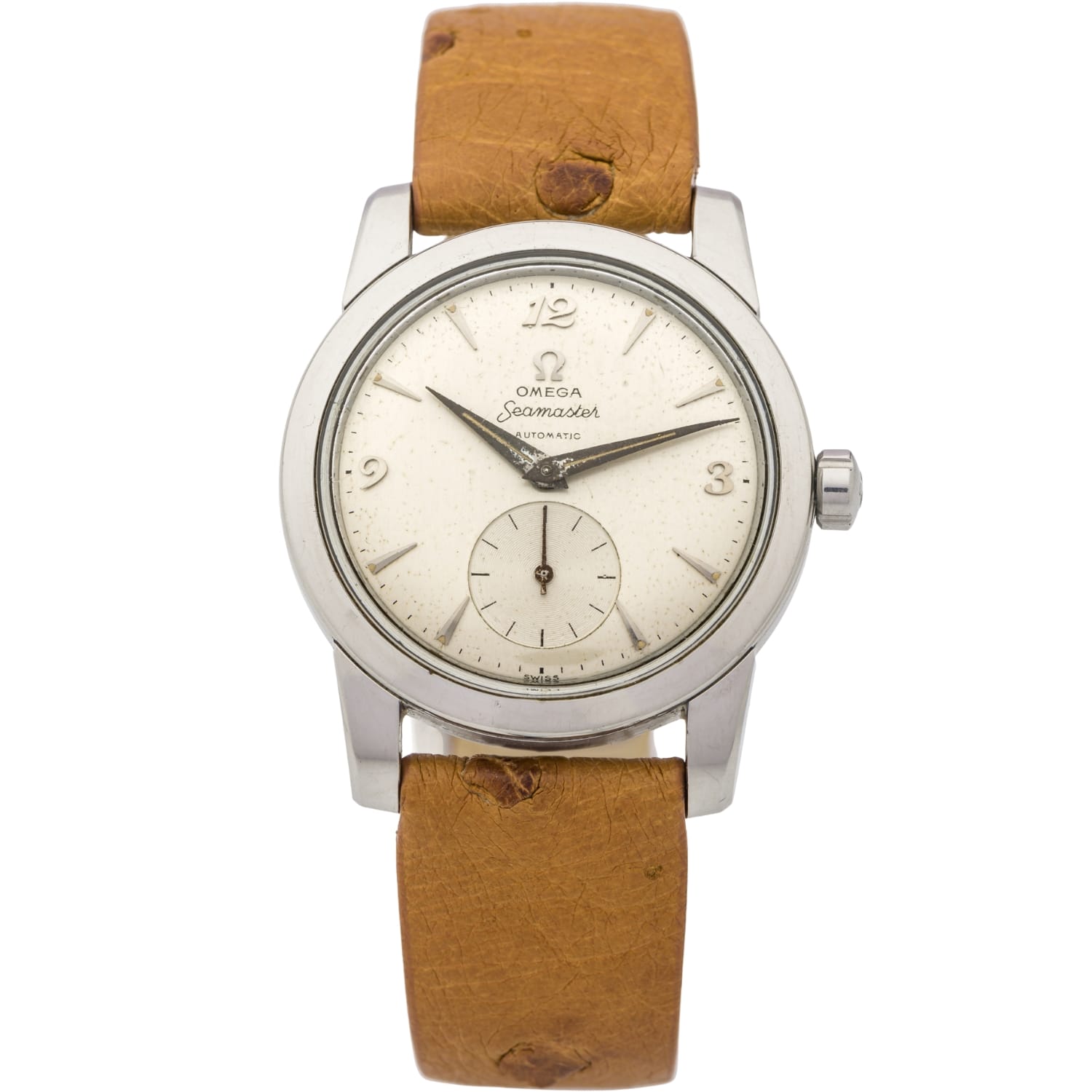
The Omega Seamaster 2576 occupies a distinctive and historically significant position within the early Seamaster collection as the sub-seconds variant of Omega’s centennial automatic lineup launched in 1948. Produced continuously from 1948 to 1955, the 2576 presents a compelling alternative to its more ubiquitous center-seconds sister reference, the 2577. At 34–36mm depending on sub-reference, powered by innovative bumper automatic movements (Caliber 342 or 344), and featuring a distinctive subsidiary seconds dial at 6 o’clock, the 2576 embodies both mechanical interest and vintage charm. The reference encompasses substantial diversity through its numerous sub-references, extensive dial variations, and availability across multiple case materials—from accessible stainless steel to rare precious metal versions. This comprehensive guide addresses specifications, production chronology, case and movement variations, authentication protocols, and the subtle distinctions that separate the 2576 from related references. For collectors navigating the early Seamaster collection, the 2576 represents a more exclusive alternative to the 2577 while maintaining historical importance and mechanical integrity.
Reference Overview and Historical Context
Official Designation: CK 2576 (stainless steel); KO 2576 (gold-capped); OT/OJ 2576 (solid gold)
Production Timeline: Approximately 1948–1955
Sister Reference: 2577 (center-seconds variant, same era and similar specifications)
Related References: 2637 (identical except for metal tenture ring crystal); 2518 (earlier Seamaster variant)
The Omega Seamaster collection launched in 1948 to commemorate Omega’s centennial and to introduce the public to technological innovations developed through military supply work. The Seamaster line originally comprised two primary models: the reference 2576 with subsidiary seconds and the reference 2577 with center seconds. Both shared identical movement lineages (Caliber 342/344 and 351/354 respectively), nearly identical case construction, and comparable dimensions. However, the 2576’s subdial configuration was intentionally positioned as the more exclusive variant, appealing to collectors who valued the classical aesthetic of subsidiary seconds dials—a configuration long associated with prestige timepieces from brands like Patek Philippe and Vacheron Constantin.
The 2576’s production run, while substantial, generated fewer surviving examples than the 2577. This scarcity, combined with the visual distinctiveness of the crosshair subdial pattern at 6 o’clock, has made the 2576 moderately sought after in today’s collector market.
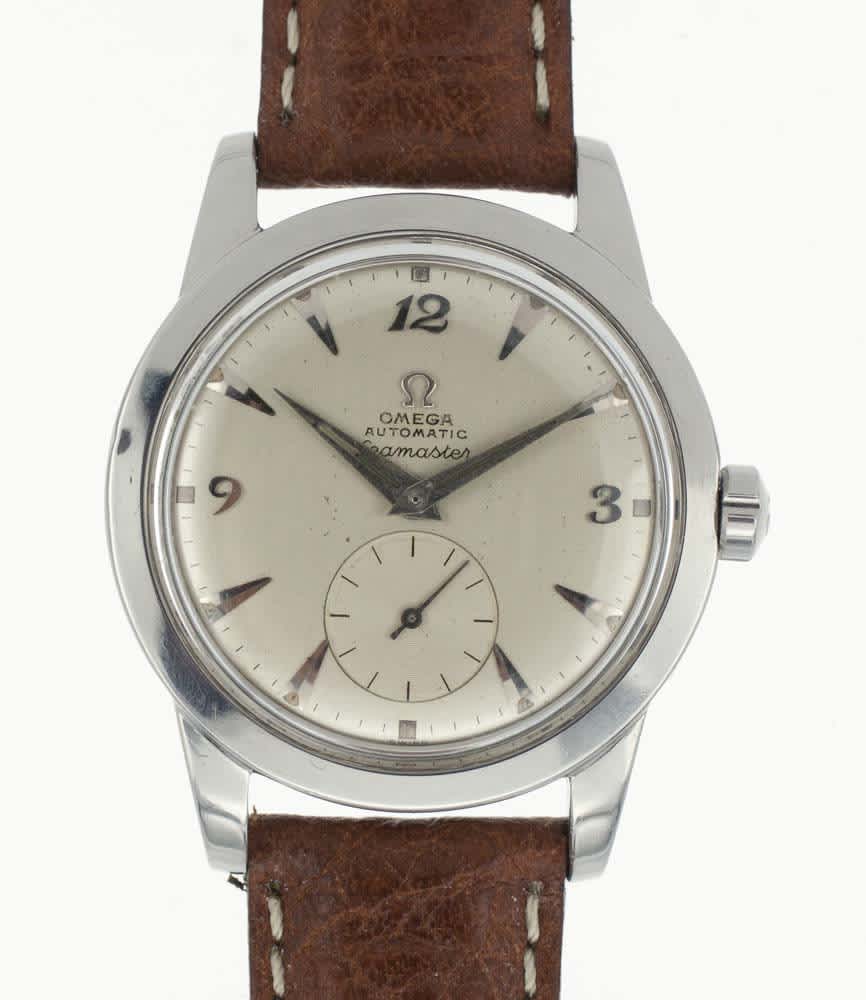
Vintage Omega Seamaster bumper automatic watch
Physical Specifications
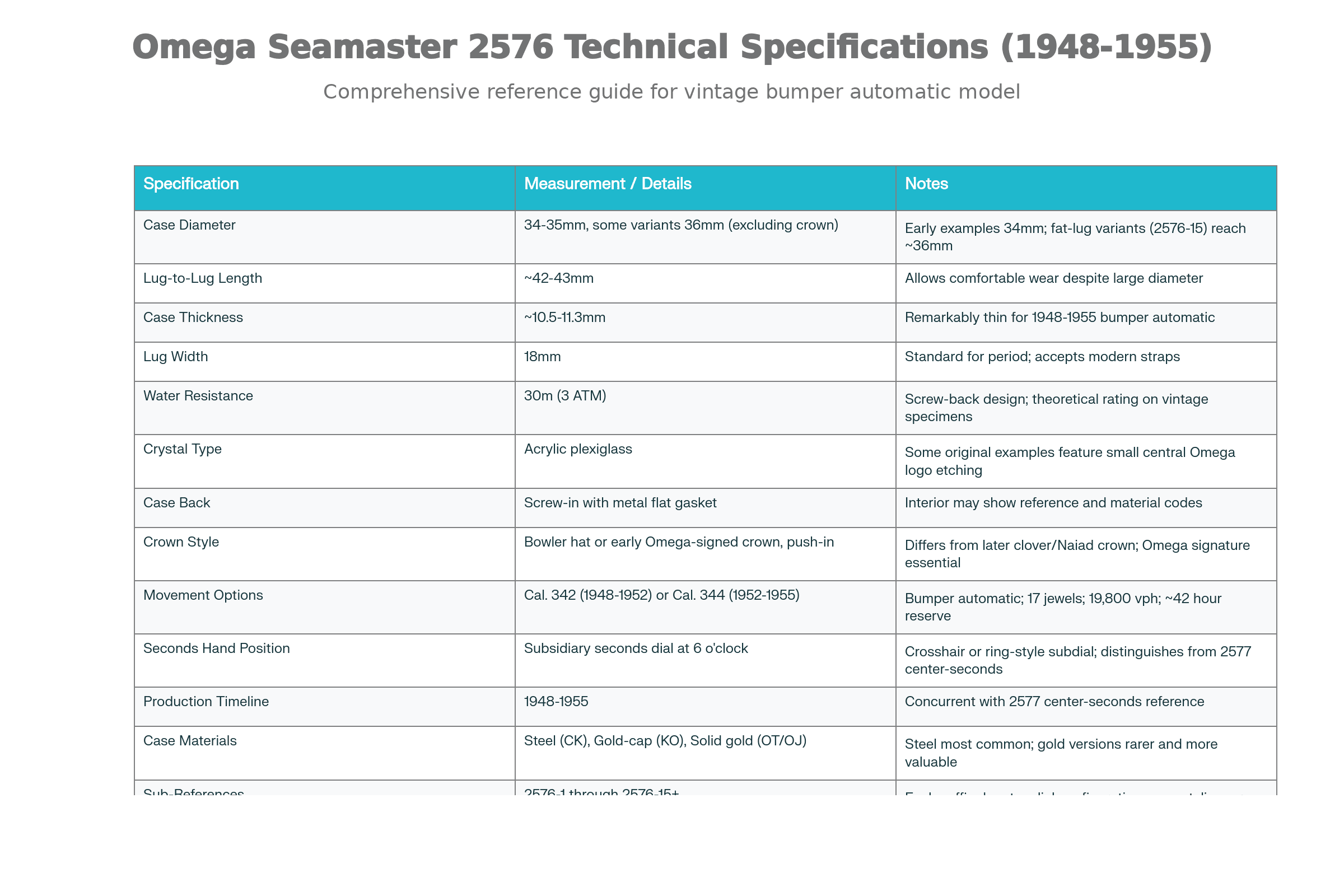
Omega Seamaster Reference 2576 Key Specifications
Dimensional Variations by Sub-Reference
The 2576 presents notable dimensional variation across its production run and sub-references. Standard examples measure 34–35mm in diameter (excluding crown), with later “fat lug” variants (particularly sub-reference 2576-15) reaching approximately 36mm. This size variation reflects Omega’s iterative design refinements and reflects the broader trend toward slightly larger watch cases throughout the early 1950s.
Lug-to-lug measurements of approximately 42–43mm ensure that despite the relatively large diameter, the watches remain comfortable for varied wrist sizes. Case thickness of 10.5–11.3mm represents remarkable thinness for 1948-era automatic movement technology and speaks to the sophistication of the bumper automatic design.
| Dimension | Measurement | Context |
|---|---|---|
| Case Diameter | 34–35mm, some variants 36mm (excluding crown) | Notably oversized for dress watch standard; fat-lug variants (2576-15) reach upper range |
| Lug-to-Lug | ~42–43mm | Comfortable despite large diameter; accommodates varied wrist sizes |
| Case Thickness | ~10.5–11.3mm | Remarkably slim for 1948 bumper automatic technology |
| Lug Width | 18mm | Standard for period; modern straps fit readily |
| Water Resistance | 30m (3 ATM) | Screw-back construction; theoretical on vintage specimens |
Movement Specifications and Evolution
The 2576 was powered by Omega’s ingenious bumper automatic movements, representing a critical stage in the company’s automatic wristwatch development:
The caliber 342 is a bumper automatic movement, meaning the rotor oscillates back and forth (approximately 120 degrees) against coiled springs rather than rotating a full 360 degrees as in modern automatics. This design yielded several advantages: reduced overall movement height, mechanical simplicity, and exceptional reliability. The Cal. 342 features 17 jewels, beats at 19,800 vibrations per hour, incorporates Incabloc shock protection and non-magnetic balance springs, and delivers approximately 42 hours of power reserve.
Early serial numbers in the 11.5M–13.7M range typically house a caliber 342. These movements, despite their 75+ year age, continue to function reliably in properly serviced examples, a testament to Omega’s engineering discipline.
The caliber 344 entered production around 1952–1954 and represents a refinement of the 342 philosophy. Technically a “chronometer-grade” movement option (though not all 344-equipped watches were certified), the 344 introduced improved internal geometry and durability compared to the 342. Serial numbers from 13.7M onward typically indicate Cal. 344.
The 344 retains the bumper automatic design, 17–19 jewels, 19,800 vph beat rate, and similar architecture to the 342. The visible distinction between the two—the characteristic side-to-side rotor action—provides an authentication checkpoint for collectors.
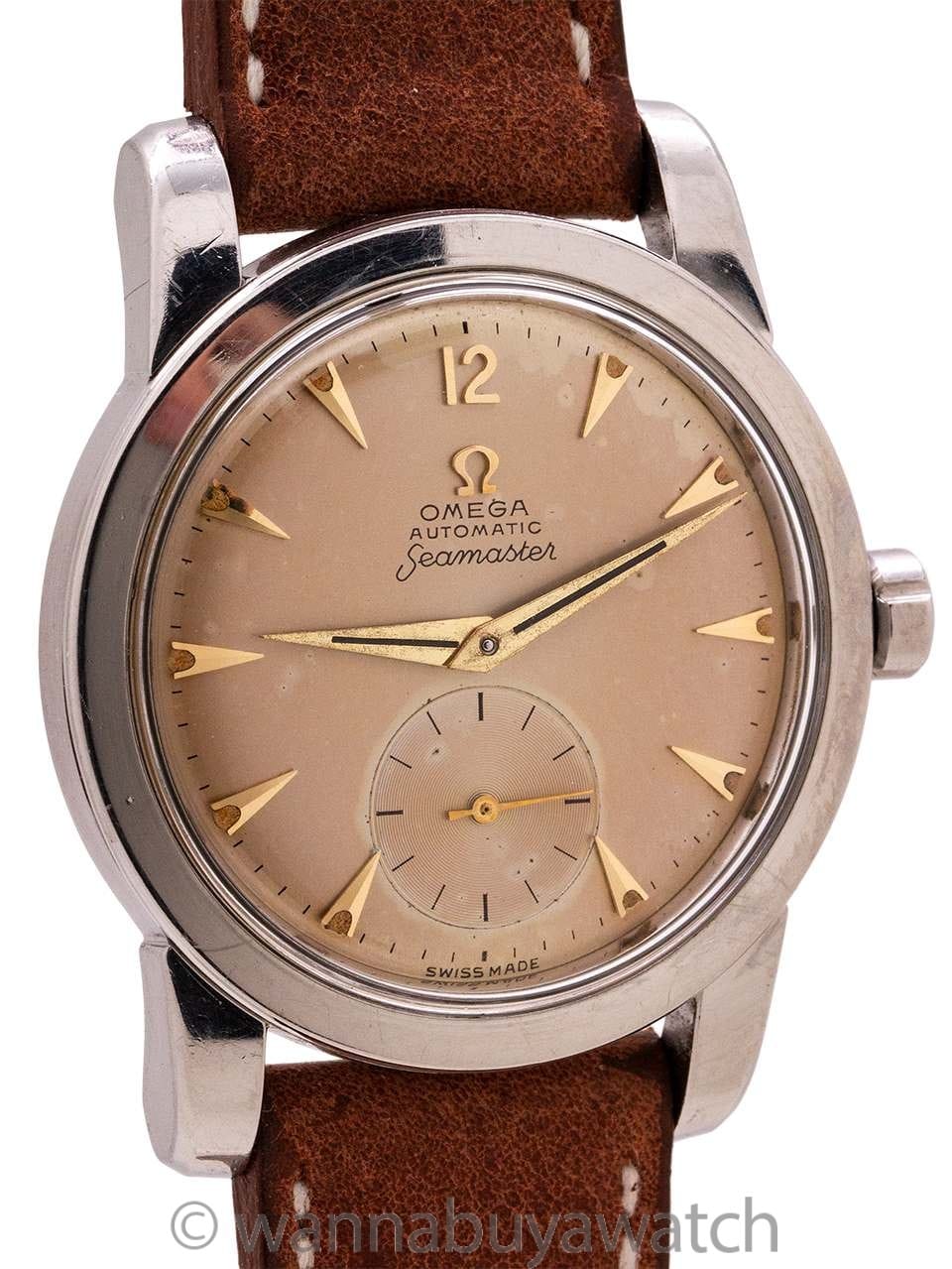
Omega Seamaster Automatic Tropical Dial ref# 2576-4 circa 1952
Case Materials and Construction
The 2576 was manufactured in three primary material configurations:
Stainless steel examples represent the largest production segment. Omega employed robust Staybrite stainless steel, finished with a brushed exterior and polished inner edges. Steel 2576s remain relatively more accessible than precious metal versions and command correspondingly moderate prices in the collector market.
Gold-capped 2576s feature a mechanically bonded layer of 14K or 18K gold affixed to a stainless steel base. This construction method proved durable, with the gold layer rarely wearing through under normal use. Gold-cap examples command premiums of 30–50% over steel equivalents, representing an attractive middle ground between affordability and aesthetic warmth.
Solid gold 2576s were produced in 14K and occasionally 18K yellow gold, making them rarer and significantly more valuable than their steel and gold-cap counterparts. Pricing for solid gold examples typically ranges from $2,500–$4,500+ depending on condition and dial originality.
Case Design and Evolution
The 2576 underwent subtle refinements during its production, reflecting broader design trends within Omega’s lineup:
Early Style (circa 1948–1950)
Early examples featured:
- Thin, tapered lugs without pronounced beveling
- Visible spring bar holes on lug sides (an authenticity marker of unpolished original cases)
- Some drilled lug variants in early production
- Fixed bezel machined integral to the case
- Plain caseback with circular groove pattern and brushed finish
- Sharp, unbeveled lug edges
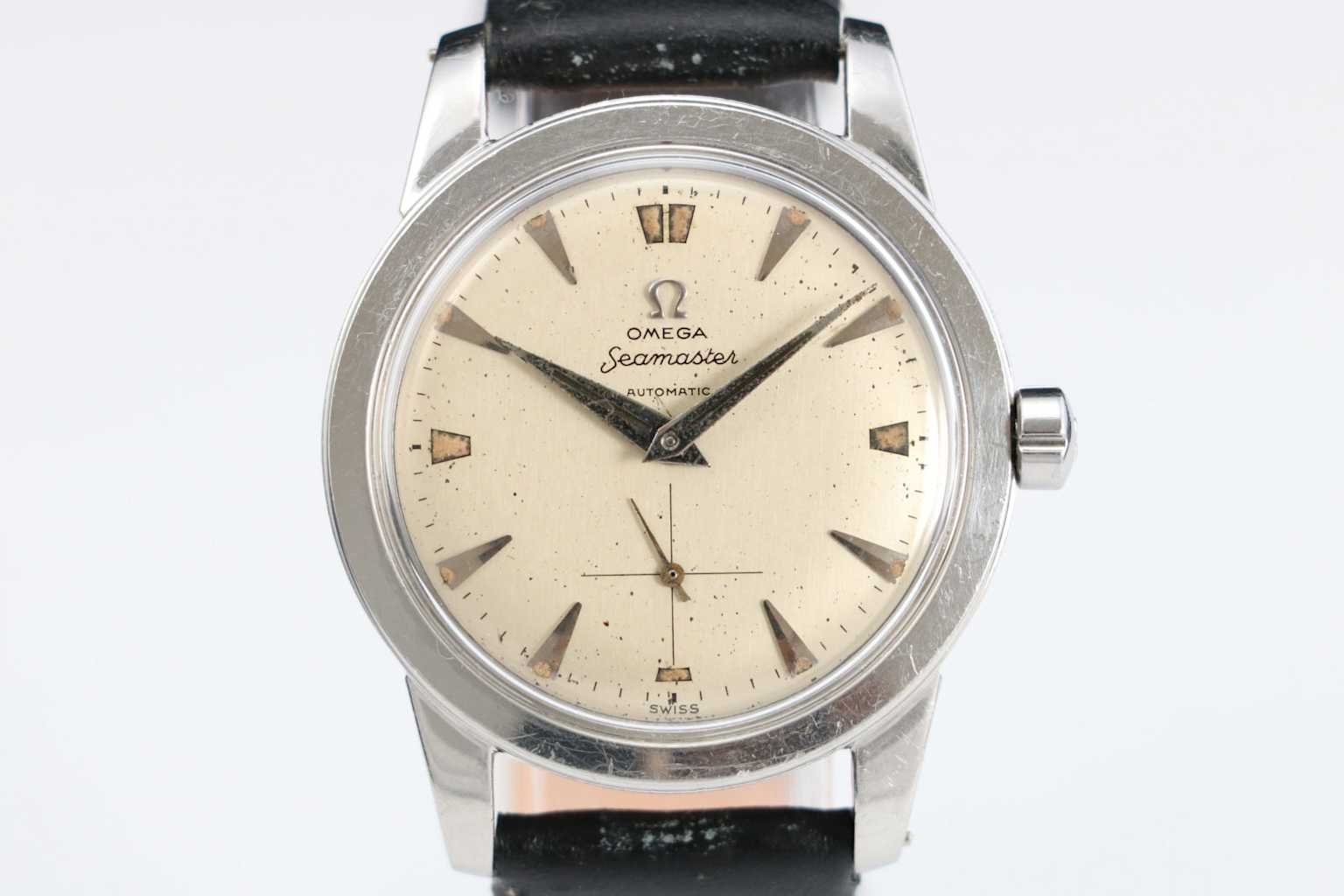
OMEGA SEAMASTER 2576 -3 | 1952 | CAL 342 | STEEL • Vintage
Fat Lug / Beefy Lug Variants (1952–1955)
Later examples, particularly sub-reference 2576-15, introduced:
- Thicker, more sculpted “fat lugs” with well-defined bevels
- Case diameter expansion to accommodate thicker lugs (up to 36mm)
- Potentially removable bezel (construction varied)
- More robust overall appearance
- Possible caseback engraving (varies by variant)
The “fat lug” nomenclature has become collector shorthand for these later, more visually striking variants. These examples wear noticeably larger on the wrist despite similar lug-to-lug measurements, owing to the pronounced lug profile.
Caseback Evolution
Early casebacks featured subtle circular groove patterns and were generally plain on the exterior. Later examples may have been engraved or featured slightly different finishing, though the interior construction—screw-in design with metal flat gasket—remained consistent throughout production.
The Subdial: The Defining Feature
The most visually distinctive characteristic of the 2576 is its subsidiary seconds dial located at 6 o’clock. This subdial comes in several configurations:
The most characteristic and desirable subdial design features a prominent crosshair or cross pattern (+) at the center of the seconds dial. This distinctive marking became a collector’s hallmark of original 2576 dials and serves as an important authentication checkpoint. The crosshair—sometimes with additional minute track rings—creates a visually striking and purposeful appearance.
Ring or Circle Subdial
Some examples feature a simpler circular dial with just a dot or minimal marking. While less visually striking than the crosshair variant, these remain entirely original and period-correct.
Seconds Hand Configurations
Seconds hands in the subdial vary from slim sweep designs to hands with small lume pips. All original examples contain radium lume for nighttime visibility.
This subdial design creates a visual hierarchy that distinguishes the 2576 fundamentally from the center-seconds 2577. For collectors familiar with classical horology, the subdial aesthetic evokes the heritage of prestige dress watches and represents a more “traditional” approach to seconds indication.
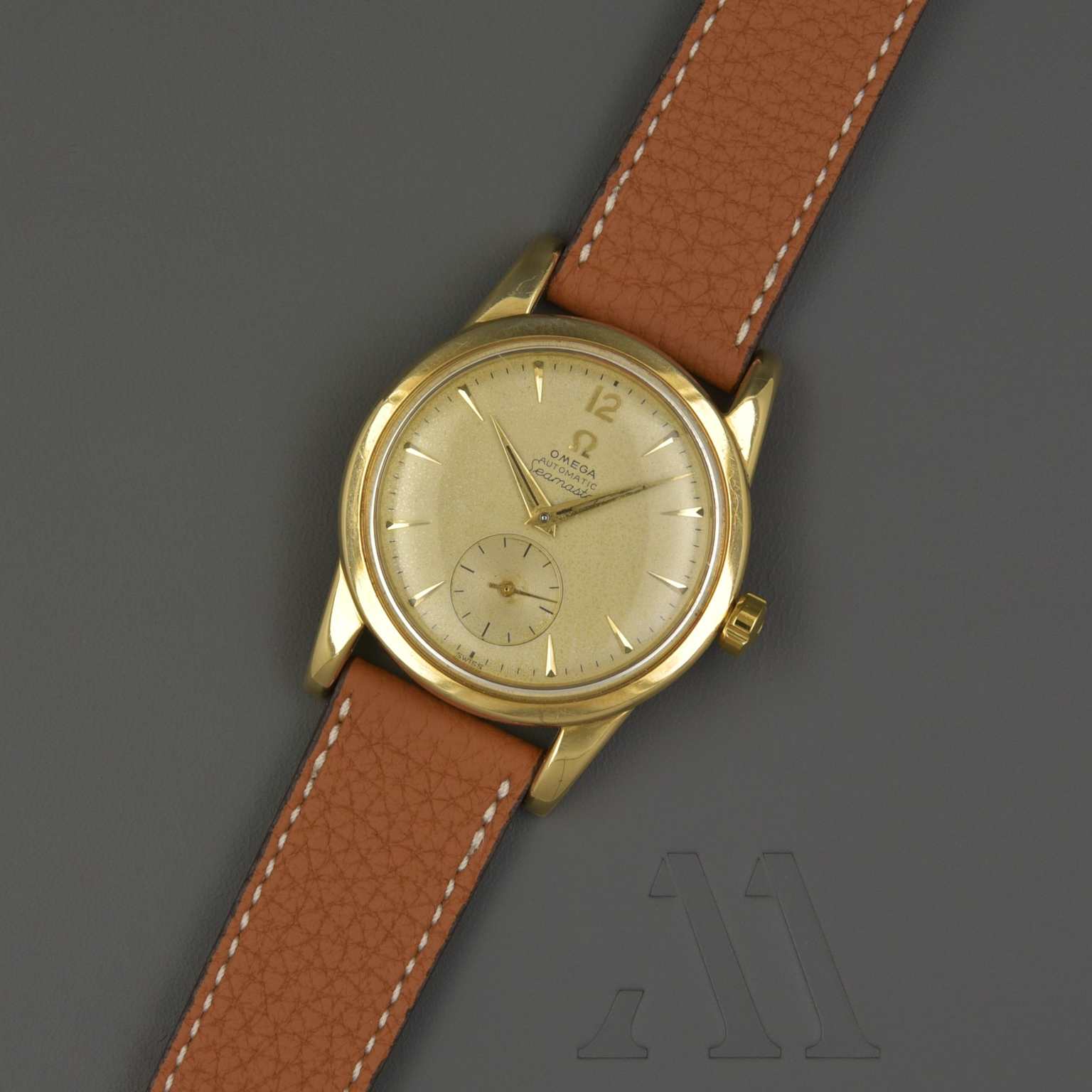
Omega Seamaster 2576 – ALMA Watches
Dial Variations: An Extensive Taxonomy
The 2576 exemplifies Omega’s 1948–1955 practice of offering extensive customization options. Collectors have documented over 100 distinct dial variations across the 2576 family:
The presence and position of “Seamaster” text provides chronological clues:
- Pre-1950 / Early Variants: Some examples lack “Seamaster” branding entirely, displaying only the Omega logo and basic model information. These are particularly scarce and sought after.
- 1950–1952 (Mid-Production): “Seamaster” text appears in the upper half of the dial, typically beneath or near the Omega logo at 12 o’clock.
- 1952–1955 (Late Production): Text relocates to the lower portion of the dial, positioned above the subsidiary seconds dial at 6 o’clock.
This evolution aligns with broader marketing and design changes across the Seamaster collection and correlates reliably with serial number ranges.
The 2576 displays remarkable diversity in hour marker styles:
- Applied Faceted Batons: The most typical arrangement, featuring metal indices with radium lume in central grooves
- Breguet-Style Numerals: Elegant curved numerals at cardinal positions (3, 6, 9, 12), especially on luxury or chronometer examples
- Dagger-Style Markers: Art Deco-influenced pointed triangular markers
- Shark Tooth Markers: Distinctive pointed triangular indices
- Explorer-Style: Arabic numerals at 3, 6, and 9 with markers at other hours
- Printed Numerals: Less common; found on some examples
- Mixed Layouts: Combinations of numerals and markers creating balanced visual compositions
- Silver/White: Most common; often aged to cream or champagne tones
- Black: Considerably rarer; highly sought by collectors, particularly on 2576-8 variant
- Champagne/Cream: Warmer tone variant, less common than silver
- Two-Tone: Contrasting metallic tones, characteristic of 1940s design philosophy
- Tropical/Patinated: Natural aging effects creating warm gold, brown, or “egg yolk” tones
The most striking examples feature black dials with honeycomb guilloché finish and crosshair subdials—dramatic presentation that commands collector premiums.
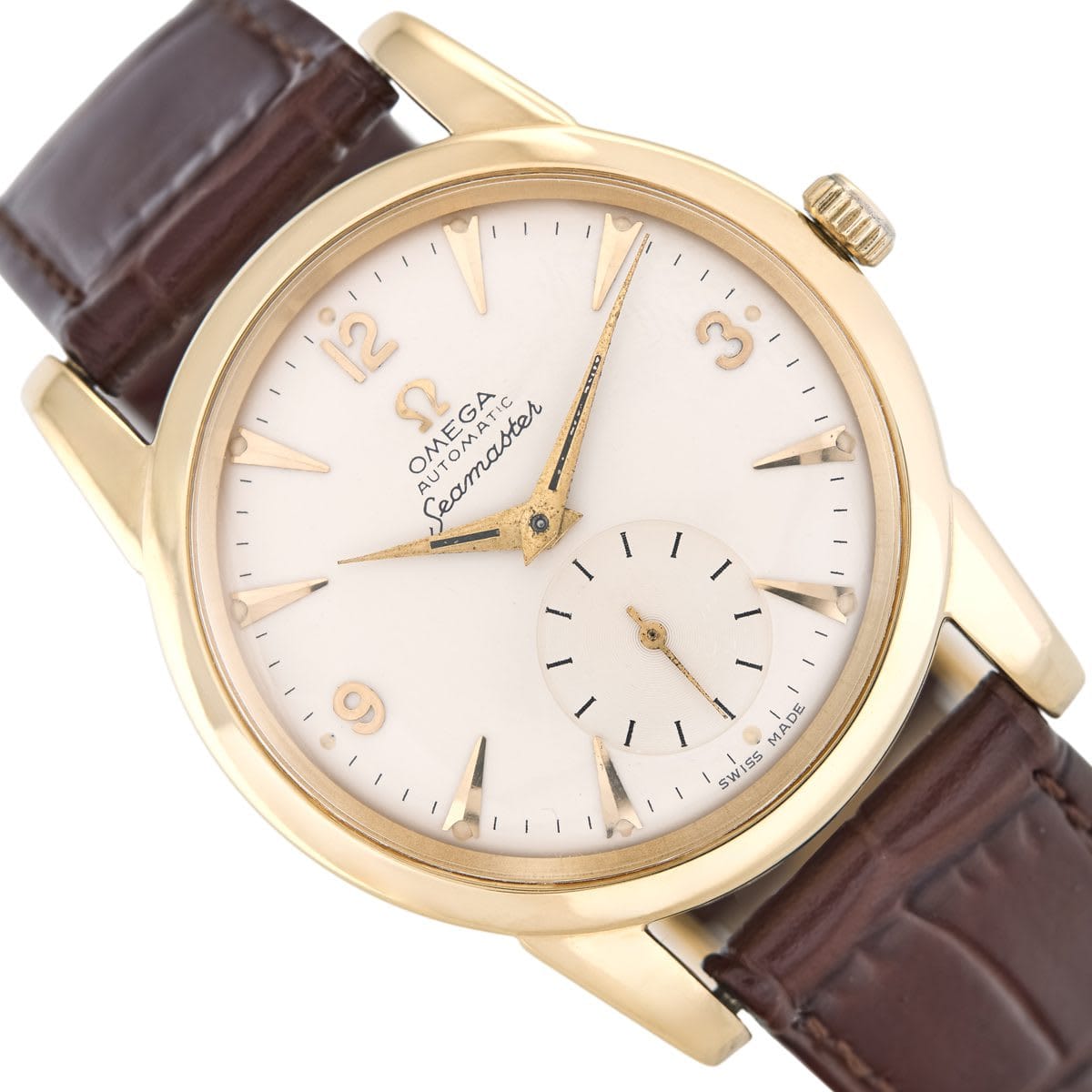
Omega Seamaster Model Ref.2576 18ct 1950 | Vintage Gold Watches
Hands and Luminous Material
The 2576 typically features Dauphine-style hands (faceted, lance-shaped) or occasional leaf-style hands, proportionate to the 34–36mm dial. The hour and minute hands taper gracefully from a wider base to fine points, creating visual elegance. Hands are gold-colored on gold cases and steel-colored on steel cases.
The subsidiary seconds hand is typically a slim sweep, sometimes with a small lume pip or tail, though entirely polished versions also exist on some examples.
Radium Lume and Aging Patterns
All original 2576 examples contain radium-based luminous material, filling grooves in the hands and sitting beneath applied markers. Understanding radium aging is essential for authentication:
- Expected Aging: Radium darkens naturally over 70+ years, typically transitioning to cream, tan, brown, grey, or yellowish tones depending on storage and UV exposure
- Asymmetrical Patina (Normal & Desired): Lume on the hands often ages differently in color from lume on the dial indices due to separate manufacturing and application. This variation is entirely authentic and desirable.
- Subdial Lume Distinctiveness: Lume in the subsidiary seconds dial often displays particularly striking patina effects due to its isolated position on the dial
- Red Flag – Uniform Color: If all lume (hands, dial, subdial) displays identical bright color, relume is indicated rather than original radium aging
Crown Design and Water Sealing
The 2576 is equipped with either a bowler hat style crown or an early Omega-signed crown design—both featuring push-in (non-screw) construction. These crowns differ markedly from the clover/Naiad crown used on later Seamaster models. The bowler hat crown’s distinctive elongated, rounded profile immediately identifies the reference as pre-1955 Seamaster.
Authentication: Any 2576 fitted with a clover or Naiad crown represents a post-factory modification. While replacement crowns may function adequately, they indicate deviation from original specification and reduce collector value.
Caseback Features and Serial Information
The 2576 caseback represents an improvement over earlier friction-fit designs (like the 2374). The screw-in caseback with metal flat gasket provides superior water sealing and durability.
The caseback interior typically displays:
- Reference number “2576”
- Material codes (CK for steel, KO for gold-cap, etc.)
- Case serial number
- Sometimes sub-reference suffix (e.g., “2576-4”)
A completely blank caseback interior suggests replacement or service history.
Exterior Surface
The outer caseback surface is generally plain, though some later examples may show subtle engraving or finishing marks. The stark difference from later Seamaster models (which often bore prominent “SEAMASTER” inscriptions) reflects the minimal branding philosophy of the 1948–1955 era.
Sub-Reference System and Variants
While Omega’s pre-1962 suffix encoding system remains incompletely documented, the following sub-references are confirmed in the collector community:
| Sub-Reference | Approximate Production Years | Documented Characteristics | Notes |
|---|---|---|---|
| 2576-1 | 1948–1950 | Early variant; varied dial configurations | First production run |
| 2576-3 | 1949–1951 | Standard configuration | Common early variant |
| 2576-4 | 1950–1952 | Often with Breguet numerals or centered dial markers | One of most documented variants |
| 2576-8 | 1952–1954 | Black honeycomb dial variant; crosshair subdial | Particularly striking; commands premiums |
| 2576-10 | 1949–1950 | Very early production; some lacking “Seamaster” text | Scarce; historical importance |
| 2576-11 | 1950–1953 | Specific dial configuration; moderate production | Documented variant |
| 2576-12 | 1951–1953 | Korean War era production; varied dials | Military context variant |
| 2576-15 | 1952–1955 | “Fat lug” or “beefy lug” variant; larger case (~36mm) | Distinctive styling; rarer than standard |
Each suffix denotes subtle differences in dial design, case construction, or component sourcing. While the system’s full logic remains unclear, researching specific sub-references on forums like https://omegaforums.net/ provides valuable authenticity context.
Distinguishing 2576 from Related
Understanding the distinctions between closely related early Seamasters is essential for accurate identification:
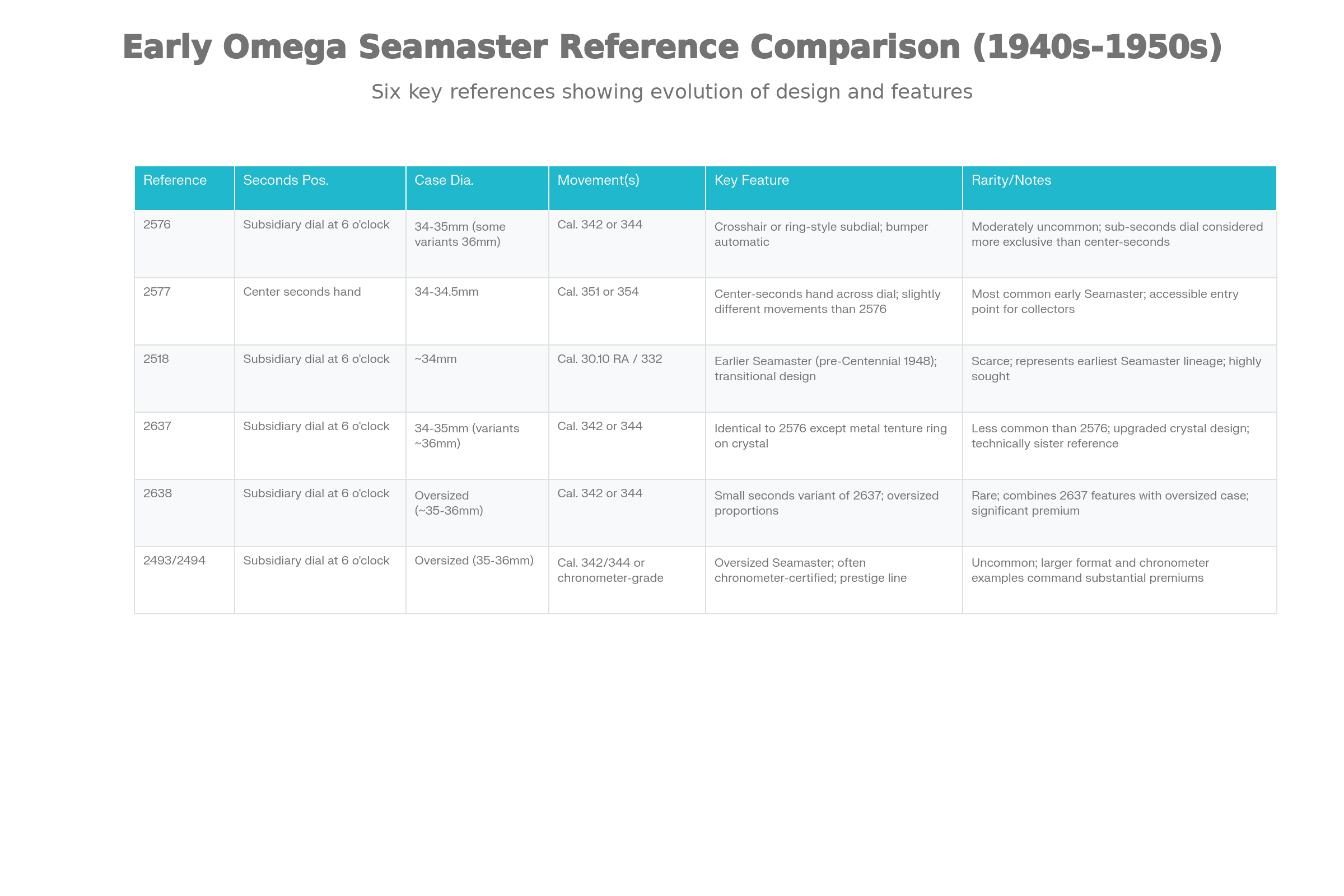
Early Omega Seamaster References (1948-1955): Comparative Overview
The fundamental distinction is the seconds hand configuration:
- 2576: Subsidiary dial at 6 o’clock
- 2577: Center seconds hand
Despite this visual difference, the references are mechanically comparable with similar case sizes and overlapping movements (Cal. 342/344 vs. Cal. 351/354). The 2577 achieved much larger production volumes, making it more commonly encountered.
The 2637 is essentially identical to the 2576 except for the crystal design:
- 2576: Simple acrylic plexiglass crystal (no additions)
- 2637: Metal tenture ring at crystal edge (upgraded water sealing)
All other aspects—case diameter, movements, subdial design—are equivalent. The choice between references depended on whether the buyer paid for the enhanced crystal feature.
The 2518 is an earlier Seamaster reference (pre-1948) with 34mm case and sub-seconds dial. It represents the transitional Seamaster design before the 1948 centennial collection refresh. The 2518 is considerably rarer and commands significant collector premiums.
Visual Aspects and Wrist Presence
The 2576 presents a distinctive mid-century modern aesthetic:
- Commanding Case Presence: At 34–36mm diameter, the watch dominates the wrist more assertively than typical 34mm dress watches
- Slim Elegance: Despite the large diameter, 10.5–11.3mm thickness maintains a refined, dress-appropriate profile
- Curved Lug Design: Gracefully tapered lugs (standard or fat versions) create elegant visual lines
- Subdial Visual Hierarchy: The crosshair subdial at 6 o’clock creates visual interest and draws the eye, differentiating the dial significantly from center-seconds layouts
- Domed Crystal: The slight dome of the acrylic crystal catches light beautifully and adds dimensional depth
- Applied Marker Dimensionality: Applied indices and numerals cast subtle shadows, creating depth on the dial
- Patina Charm: Aged radium lume and dial patina develop individual character over decades
The overall wrist presence is sophisticated, historically conscious, and distinctly different from the more utilitarian aesthetic of the contemporary 2577 center-seconds model.
Authentication and Identification Guide
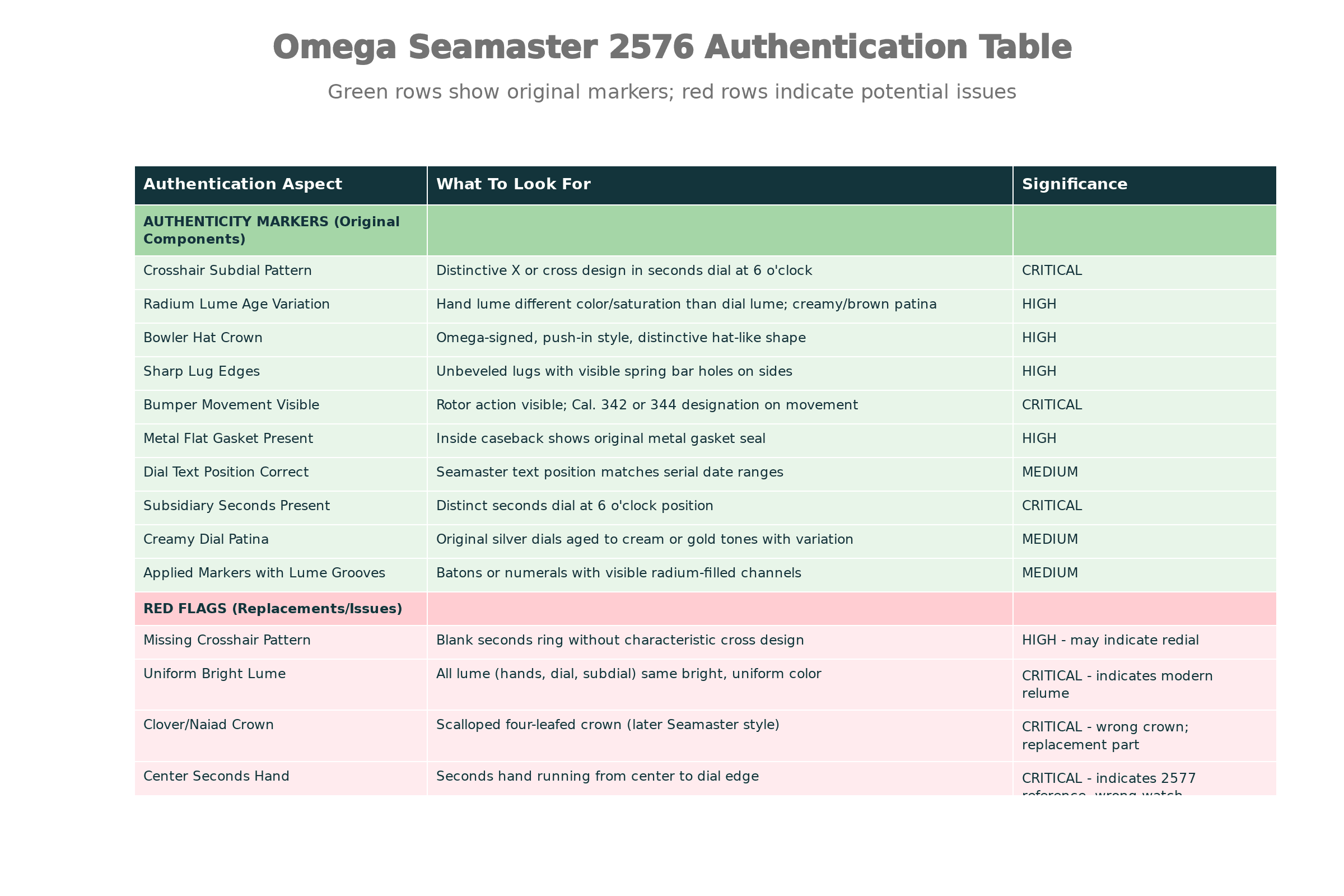
Omega Seamaster 2576 Authentication Guide: Original Markers and Red Flags
Critical Authenticity Checkpoints
- Crosshair Subdial Pattern: The most diagnostic marker. Original 2576 dials typically feature the distinctive + or X crosshair pattern in the seconds dial. Absence or blank subdial may indicate redial or wrong reference.
- Subsidiary Seconds Dial Present: Verify seconds dial at 6 o’clock. Center-seconds hand indicates 2577, not 2576.
- Bumper Movement Confirmation: Open the caseback and verify the rotor bumps against springs in a side-to-side motion (~120 degrees). Full 360-degree rotor rotation indicates wrong movement (case swap or service replacement).
- Radium Lume Asymmetry: Original watches exhibit different lume colors between hands and dial indices. Uniform bright lume indicates modern relume.
- Bowler Hat Crown: The crown should feature the distinctive bowler hat or early Omega-signed style. A clover/Naiad crown indicates non-original replacement.
- Unpolished Case with Sharp Edges: Original unpolished cases show visible spring bar holes on lug sides. Smooth, completely polished cases indicate refinishing that destroys authenticity markers.
- Dial Text Alignment: “Seamaster” text position should correlate with known production date ranges from serial numbers. Misalignment may indicate redial.
- Metal Flat Gasket Visible: Inside caseback should show original metal gasket. Absence suggests caseback replacement or excessive service.
- Center seconds hand (wrong reference—likely 2577)
- Clover/Naiad crown (non-original)
- Blank or entirely featureless subdial
- Uniform bright lume throughout
- Completely polished case (no spring bar holes visible)
- Full-rotor rotating automatic movement
- Snap-on caseback (wrong design)
- Blank caseback interior
- Dial text misaligned with serial number date
- Non-original crystal (sapphire indicates modern replacement)
Pricing and Market Context
Vintage Omega Seamaster 2576 watches command varied pricing based on condition, originality, and specific features:
| Specification | Approximate Price Range | Market Notes |
|---|---|---|
| Steel, good condition | $1,200–$2,200 | Accessible entry; moderate demand |
| Steel, exceptional unpolished | $1,800–$2,800 | Premium for case preservation and originality |
| Steel, black dial | $2,000–$3,500+ | Rarer dial color commands substantial premium |
| Gold-cap, good condition | $1,600–$2,800 | Warmer aesthetic appeals to dress watch collectors |
| Solid 14K gold, good condition | $2,500–$4,500 | Material value plus rarity |
| Solid 18K gold, excellent | $3,500–$6,000+ | Premium precious metal and scarcity |
| Chronometer-certified versions | Add 20–40% premium | Rare; documentation significant |
| Fat-lug variants (2576-15) | Add 10–20% premium | Distinctive styling and relative rarity |
| Sub-reference 2576-8 (black honeycomb) | Add 15–30% premium | Striking dial highly sought by collectors |
Additional premiums apply for:
- Unpolished original cases with visible spring bar holes
- Factory-original dials with authentic tropical patina
- Documented chronometer certification
- Precious metal construction
- Rare dial variants (black, specific sub-references)
- Complete original boxes and papers (extremely rare; can double value)
Servicing and Preservation
Movement Servicing
Bumper automatic movements require specialized knowledge. The Cal. 342 and 344, while mechanically robust, feature unique escapement and balance requirements that demand experienced watchmakers. Professional full service typically costs $400–$800 in 2024. Many collectors prefer to find watchmakers specializing in pre-1960 automatics to ensure proper handling.
Radium Safety
Original radium lume poses negligible health risk in sealed cases. Alpha radiation is blocked by the crystal; gamma radiation decays substantially over distance. However, if caseback opening becomes necessary, minimal handling is advisable.
Case Restoration
Unpolished original cases with visible patina and spring bar holes are increasingly valued. Aggressive polishing destroys these markers and reduces authenticity. Conservative restoration preserving sharp edges and original surface character is preferable to complete refinishing.
Crystal and Crown Considerations
Replacement with period-correct acrylic plexiglass (rather than sapphire) maintains authenticity. Original examples sometimes feature tiny etched Omega logos centrally on the crystal—a detail worth preserving if present.
Related References and Early Seamaster Context
Understanding the 2576 requires familiarity with the broader early Seamaster ecosystem:
Reference 2577 (Center-Seconds Sister)
The 2577 is mechanically and dimensionally nearly identical to the 2576 but features a center-seconds hand. The 2577 achieved substantially larger production volumes, making it more accessible but somewhat less distinctive as a collector piece. Many collectors are drawn to the 2576 specifically for its relative scarcity and classical subdial aesthetic.
Reference 2637 (Metal Tenture Variant)
The 2637 represents an upgraded 2576 with an improved crystal design. The metal tenture ring provides enhanced water sealing and represents Omega’s responsiveness to customer feedback. The 2637 is rarer than the 2576 and typically commands modest premiums.
Reference 2518 (Earlier Seamaster)
The 2518 predates the Seamaster centennial collection (launched 1948) and represents the transitional earliest Seamaster designs. The 2518 is considerably scarcer and highly sought by historians and serious collectors.
References 2493/2494 (Oversized Seamaster)
These references employ the same movement technology and subdial design but with enlarged cases (35–36mm). Chronometer variants exist, particularly rare and valuable. These oversized references represented a prestige tier within the Seamaster collection.
Conclusion
The Omega Seamaster reference 2576 represents a sophisticated intersection of mechanical innovation, classical aesthetic sensibility, and historical significance. As the sub-seconds variant of Omega’s centennial Seamaster collection, it offers serious collectors a less common alternative to the more ubiquitous center-seconds 2577 while maintaining equivalent mechanical interest and market accessibility.
The distinctive crosshair subdial pattern at 6 o’clock serves as both a visual hallmark and an authentication checkpoint. The bumper automatic movements (Cal. 342 and 344) embody an ingenious engineering approach that remains mechanically engaging for those who appreciate the subtle side-to-side action of the rotor against its springs. The extensive dial variations—from simple applied batons to striking black honeycomb patterns with Breguet numerals—ensure that individual examples remain visually distinctive and personally meaningful to their owners.
For collectors navigating the early Seamaster collection via sources like https://www.chrono24.com/ (which hosts numerous 2576 listings) or specialized vintage dealers, careful authentication using the markers outlined in this report is essential. The presence of a genuine crosshair subdial, unpolished case with visible spring bar holes, radium lume showing appropriate age patina, and correct bumper movement construction all confirm original specification.
An authentic, well-preserved Omega Seamaster 2576—whether in steel, gold-cap, or precious metal—represents both a mechanically sound investment and a tangible connection to the post-war horological innovation that defined Omega’s mid-century reputation. The 2576 deserves its place in serious vintage watch collections alongside its center-seconds companion, offering a distinctive aesthetic and historical narrative that continues to resonate with collectors more than 70 years after its introduction.