

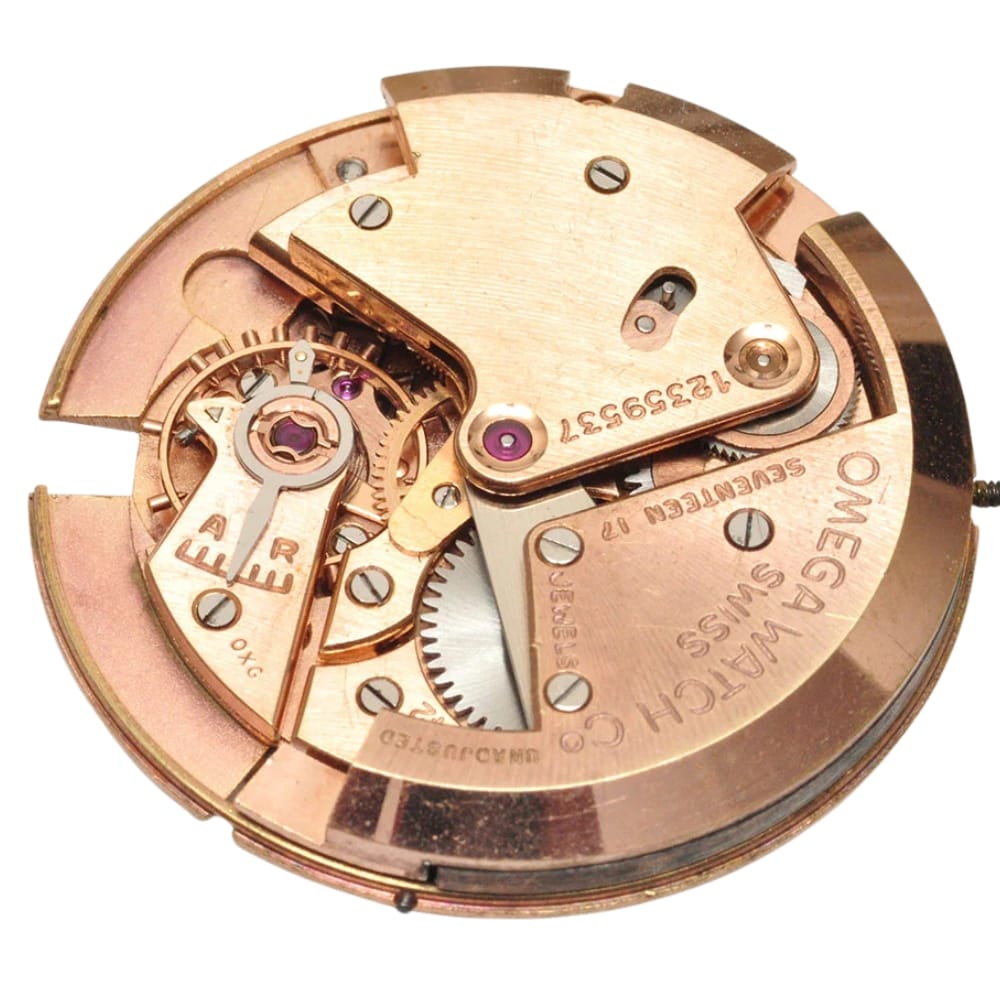
The Omega 342 powered the first Omega Seamaster wristwatches introduced in 1948, establishing the foundation for what would become one of the most successful watch collections in horological history. As a bumper automatic movement from Omega’s landmark 330 series, the 342 represents a critical evolutionary step in automatic winding technology, bridging the gap between early semi-automatic designs and modern full-rotor systems.
The cal. 342 is functionally identical to the earlier 28.10 RA PC but features concealed buffer springs integrated into the movement architecture rather than externally visible springs. This bumper mechanism uses an oscillating weight that swings through a 120-degree arc, striking internal buffer springs that reverse its direction and wind the mainspring through a unidirectional ratchet system. The distinctive audible “thump” when the rotor contacts the springs gives these movements their nickname. With 17 jewels, Incabloc shock protection, and a 42-hour power reserve, the 342 was designed as a reliable daily-wear movement for dress and sport watches, prioritizing durability and serviceability over chronometric precision.
The entire 28.10/30.10 family, which includes the 330 series (calibers 330-355), produced over 1,300,000 units between 1943 and 1955, with approximately 500,000 achieving chronometer certification. Based on serial number ranges, the cal. 342 specifically (produced 1949-1955) likely accounts for 250,000-350,000 of these movements. Serial numbers for 342-equipped watches typically fall between 11,000,000 (1947) and 15,000,000 (1956), with the bulk of 342 production occurring between serial 12,000,000 (1950) and 14,000,000 (1954). This makes the 342 common to uncommon depending on condition. Complete, original examples in working order are readily available in the vintage market, though unmolested specimens with original dials and cases command premiums. The movement itself is not particularly scarce, but finding examples that have not been cannibalized for parts or subjected to poor repair work requires patience.
The cal. 342 occupies a sweet spot in the collector market. It lacks the prestige of chronometer-grade variants (343, 344) or the complexity of sweep-second versions (350, 352), but its historical significance as the first Seamaster caliber and its robust, serviceable design have created stable demand. Market prices for 342-equipped watches range from $800-$3,500 depending on case material, dial condition, and provenance. Gold-cased examples, particularly in 18K pink gold, can command $3,000-$5,000 when accompanied by original dials with attractive patina. Collector interest is stable rather than rising, as the bumper mechanism appeals more to horological enthusiasts than casual buyers. However, the 342’s association with early Seamaster references (particularly 2576, 2636, 2639 series) ensures continued demand.
Historical Context, Provenance, and Manufacturing Details
Development History
The cal. 342 emerged from Omega’s ambitious automatic movement program initiated in the early 1940s. Omega introduced its first mass-produced bumper automatic, the 28.10 RA PC, in 1943, alongside the larger 30.10 RA PC (30.1 mm). Designer Charles Perregaux engineered these movements to compete with automatic designs from Rolex, Jaeger-LeCoultre, and other manufacturers who had pioneered self-winding systems in the 1930s. The bumper approach allowed Omega to create a thin automatic movement by confining the winding mechanism to the same plane as the gear train, avoiding the height penalty of early full-rotor designs.
In 1949, Omega redesigned its caliber nomenclature system, moving from alphanumeric designations (28.10 RA PC) to three-digit caliber numbers. The 28.10 RA PC became the cal. 330 (for 30.10 size) and cal. 340 (for 28.10 size with subsidiary seconds), while the 28.10 RA SC PC (sweep seconds) became the cal. 350. The cal. 342 represented a refinement of the 28.10 RA PC design, incorporating concealed buffer springs that improved aesthetics and protected the spring mechanism from dust and debris. This design choice distinguished the 342 from its immediate predecessor while maintaining complete mechanical compatibility.
Omega launched the Seamaster line in 1948 to celebrate the company’s centennial anniversary, positioning it as a robust, water-resistant automatic watch suitable for active wear. The timing aligned perfectly with post-war demand for reliable, affordable automatic wristwatches. The cal. 342, introduced the following year, became the standard movement for non-chronometer Seamaster models throughout the early 1950s.
Predecessor and Successor
The cal. 342 directly evolved from the 28.10 RA PC (later designated cal. 340), sharing identical architecture, jeweling layout, and performance specifications. The key distinction between the 28.10 RA PC and the 342 lies in the buffer spring concealment, an aesthetic and practical improvement rather than a fundamental mechanical change. This design refinement allowed Omega to present a cleaner movement appearance through exhibition casebacks, though most 342-equipped watches featured solid snap-back or screw-down cases.
Within the 330 series family, the cal. 342 sits alongside several variants: cal. 343 (chronometer grade with eccentric regulator), cal. 344 (chronometer grade with swan neck regulator), cal. 350 (sweep seconds), cal. 351 (sweep seconds, higher grade), and cal. 354 (sweep seconds with swan neck regulator). These calibers share interchangeable parts for many components, including mainsprings, balance assemblies, and escapement components.
The cal. 342 was superseded by full-rotor automatic movements in the mid-1950s. Omega introduced the cal. 470 and cal. 471 (the company’s first bi-directional full-rotor automatics) in 1955, followed by the cal. 490, cal. 491, cal. 500, and cal. 501 between 1955-1956. The cal. 501, which powered Constellation models from 1956 onward, effectively replaced the 342 in Omega’s dress watch lineup. The transition from bumper to full-rotor technology was complete by 1957, with the last bumper-equipped Seamaster and Constellation models phasing out by 1958.
Manufacturing Context
The cal. 342 is an in-house Omega manufacture movement, designed and produced at Omega’s facilities in Biel/Bienne, Switzerland. Unlike many mid-century movements that relied on ébauche suppliers (ETA, Peseux, A. Schild, Felsa), Omega manufactured the entire 330 series internally, from base plates and bridges to escapements and automatic winding mechanisms. This vertical integration gave Omega complete control over quality, finishing standards, and production tolerances.
The movement construction uses brass base plates with rhodium or copper-toned electroplating, typical of 1940s-1950s Swiss manufacture. The beryllium-bronze alloy rotor (often described as “rose gold” or “pink gold” in appearance) was a deliberate material choice for its corrosion resistance and optimal weight-to-strength ratio. Beryllium-bronze, the same alloy used in Glucydur balance wheels, provided durability without requiring precious metal content.
Production took place exclusively at Omega’s main manufacturing complex in Biel/Bienne, Switzerland, with no evidence of outsourced production or secondary facilities. The 330 series movements, including the cal. 342, represented a major production program for Omega, with the company dedicating significant capacity to automatic movement manufacture during the late 1940s and early 1950s. The scale of production (over 1.3 million units across all 330 series variants) positioned Omega as one of the largest automatic movement manufacturers in Switzerland during this period.
The cal. 342 occupies an important but transitional position in horological history. While not groundbreaking in the manner of Rolex’s Perpetual rotor or Jaeger-LeCoultre’s ultra-thin automatics, the 342 and its 330 series siblings demonstrated Omega’s manufacturing prowess and commitment to democratizing automatic watch technology. The movement’s reliability and serviceability contributed significantly to Omega’s reputation during the critical post-war period when Swiss watchmaking sought to rebuild international markets.
However, the bumper mechanism itself was already obsolete by the time the 342 entered production in 1949. Rolex’s Perpetual rotor patent expired in the early 1950s, allowing widespread adoption of superior full-rotor designs. Omega’s decision to continue bumper production until 1955 was economically pragmatic (amortizing tooling investments and utilizing existing inventory) but left the brand slightly behind competitors who transitioned to full-rotor systems earlier. The 342 thus represents both a triumph of mid-century mass production and the last gasp of an evolutionary dead-end in automatic winding technology.
Construction and Architecture
Plate and Bridge Layout
The cal. 342 employs a three-quarter plate construction with separate bridges for the automatic winding mechanism, barrel, and balance assembly. The base plate is stamped brass with rhodium or copper-toned electroplating, providing corrosion resistance and an attractive rose-gold appearance visible through case apertures. The movement uses three primary bridges: the barrel bridge (securing the mainspring barrel), the train bridge (covering the center, third, and fourth wheels), and the automatic winding bridge (holding the oscillating weight assembly and buffer spring mechanism).
The buffer springs, concealed within the automatic winding bridge architecture, distinguish the 342 from the earlier 28.10 RA PC, which featured exposed springs mounted externally on the plate. This design change improved movement aesthetics and protected the springs from environmental contamination while maintaining identical functional performance. The oscillating weight rotates on a dedicated pivot secured by the automatic winding bridge, with the weight swinging through a 120-degree arc before contacting the concealed buffer springs.
Bridge construction prioritizes serviceability over elaborate decoration. The bridges attach via blued steel screws with polished heads, facilitating disassembly for cleaning and lubrication. The three-quarter plate design, while less sophisticated than contemporary Geneva-style architecture with multiple separate bridges, provides structural rigidity and simplifies parts alignment during assembly and service.
Balance Wheel
The cal. 342 uses a Glucydur-type bimetallic balance wheel, approximately 11.5-12 mm in diameter, with screw adjustment for poising and rate regulation. Glucydur is a beryllium-copper alloy developed in the 1930s for its exceptional temperature stability, corrosion resistance, and consistent elasticity across environmental conditions. The balance wheel features smooth-faced construction without visible poising screws on the rim, relying instead on adjustment screws inserted through the rim at strategic positions (typically 4-6 screws depending on the specific balance used).
The balance construction is two-piece, with a brass balance wheel core and a beryllium-copper alloy rim, creating a bimetallic structure that provides passive temperature compensation. This design reduces rate variation across temperature ranges without requiring active compensation mechanisms. The balance pivots rotate in jeweled bearings protected by Incabloc shock absorbers on both upper and lower jewels, safeguarding the delicate pivots from impact damage.
Balance Spring (Hairspring)
The cal. 342 employs a flat Nivarox hairspring with no terminal curve modifications (Breguet overcoil) or inner terminal adjustments. Nivarox, a cobalt-nickel-chromium-titanium-beryllium alloy, became the Swiss industry standard for hairsprings in the 1930s due to its antimagnetic properties, temperature stability, and resistance to oxidation. The flat spiral configuration, while less sophisticated than Breguet overcoil designs, reduces manufacturing complexity and cost while providing adequate isochronism for mid-grade timekeeping applications.
The hairspring attaches to the balance staff via a collet friction-fit to the staff, with the outer terminal secured to a stud mounted on the balance cock. The stud is fixed (non-movable), requiring beat error adjustment through collet repositioning rather than stud manipulation. This design simplification reduces adjustment complexity but requires greater precision during initial assembly and regulation.
Escapement Type
The cal. 342 uses a Swiss lever escapement, the industry standard for quality mechanical watches since the mid-19th century. The escapement consists of a 15-tooth escape wheel (likely steel, though some sources suggest brass with hardened teeth), a forked lever with two synthetic ruby pallet stones (entry and exit pallets), and an impulse jewel (ruby pin) mounted on the balance staff.
The Swiss lever design provides reliable, consistent energy transfer from the mainspring to the balance while maintaining the isochronism necessary for accurate timekeeping. The 50-degree lift angle indicates the angular distance through which the pallet stones interact with escape wheel teeth during impulse delivery. This relatively high lift angle (compared to 45-47 degrees in some contemporary movements) suggests robust impulse delivery at the cost of slightly increased friction and escapement wear over time.
The escapement jewels (entry pallet, exit pallet, and impulse jewel) are friction-set synthetic rubies, allowing replacement without specialized tooling. The pallet fork pivots in jeweled bearings secured by the pallet cock, with the fork spring (hairspring-like element providing fork tension) visible beneath the balance cock.
Shock Protection System
The cal. 342 uses Incabloc shock protection for the balance staff upper and lower jewels. Incabloc, developed by Portescap in 1933, became the Swiss industry standard shock protection system by the 1940s. The system employs a spring-loaded setting (chaton) holding the cap jewel and hole jewel, allowing the jewels to lift and move laterally during shock events, absorbing impact energy and preventing balance staff pivot damage.
The specific Incabloc variant used in the cal. 342 is the 122.11 series (also designated 122.21 or 122.41), compatible across the entire 330-series family (calibers 330, 331, 332, 333, 340, 341, 342, 343, 344, 350, 351, 352, 353, 354, 355). The upper Incabloc setting (under the balance cock) is more visible and accessible, while the lower setting (on the movement plate) sits beneath the balance wheel assembly.
The Incabloc system on the cal. 342 protects only the balance staff bearings, not the pallet fork or other pivot points. This selective protection was standard practice for mid-grade movements, as the balance staff experiences the highest acceleration forces during shock events and features the most delicate pivots. The pallet fork pivots, escape wheel pivots, and gear train wheel pivots use conventional jeweled bearings without shock protection.
Regulator Type
The cal. 342 employs a simple index regulator with no micrometric adjustment mechanism. The regulator consists of a spring-loaded arm with two pins (curb pins) that straddle the hairspring outer coils, allowing the watchmaker to adjust the effective length of the hairspring and thus the timekeeping rate. Moving the regulator toward the “+” (advance) direction shortens the effective hairspring length, increasing beat rate and making the watch run faster; moving toward the “-” (retard) direction lengthens the effective hairspring length, slowing the watch.
The cal. 342 regulator lacks the refinement of swan-neck regulators found in higher-grade variants (cal. 344, cal. 354) or micrometric screw adjustments seen in chronometer movements. The regulator arm features friction sufficient to maintain position during normal use but allows repositioning with light finger pressure or a small screwdriver. A graduated scale on the balance cock provides reference marks for adjustment, though these are approximate rather than precise.
This simple regulator design prioritizes serviceability and cost reduction over fine adjustment capability. Experienced watchmakers can achieve excellent timekeeping results with index regulators through careful adjustment and multiple test-regulation cycles, but the system lacks the precision and stability of free-sprung balance designs or swan-neck micrometric regulators.
Mainspring Material and Type
The cal. 342 uses a traditional white alloy mainspring, dimensions 1.10 mm width × 0.095-0.10 mm thickness × 290-300 mm length, with an auto-wind barrel configuration featuring an internal bridle mechanism. The mainspring is housed in a barrel with a slipping bridle rather than a fixed attachment, allowing the spring to slip once fully wound and preventing overwinding damage from continued automatic winding.
The slipping bridle consists of a curved metal strip riveted to the mainspring outer end, pressed against the barrel wall by spring tension. As the mainspring approaches full wind, increased tension causes the bridle to slip against the barrel wall, limiting maximum torque and protecting the mainspring from stress damage. This mechanism allows the watch to be manually wound via the crown in addition to automatic winding, a key advantage of the bumper design over some contemporary automatics that lacked manual winding capability.
The “white alloy” designation refers to a heat-treated steel alloy (sometimes nickel-steel) that replaced blued steel mainsprings in quality movements by the 1940s. White alloy mainsprings provide superior elasticity, fatigue resistance, and consistent torque delivery compared to traditional blued steel springs. The 42-hour power reserve indicates adequate mainspring energy storage for overnight rest periods with sufficient reserve for timekeeping accuracy throughout the power curve.
Gear Train Details
The cal. 342 uses a conventional four-wheel gear train (barrel, center, third, fourth, escape) with indirect drive configuration. The mainspring barrel drives the center wheel via reduction gearing, with the center wheel carrying the minute hand and completing one rotation per hour. The center wheel meshes with the third wheel, which drives the fourth wheel (seconds wheel), which in turn drives the escape wheel at the escapement interface.
The subsidiary seconds hand mounts on an arbor positioned at the 6 o’clock position on the dial, driven indirectly from the fourth wheel through an intermediate seconds transfer wheel. This indirect seconds drive, typical of subsidiary seconds movements, allows compact movement architecture but precludes center seconds hand mounting without significant redesign.
Gear ratios follow standard Swiss practice for 18,000-19,800 vph movements, with the fourth wheel rotating once per minute (driving the escape wheel at 15 teeth × 1,320 beats per minute = 19,800 beats per hour). Specific gear tooth counts are not documented in available technical literature, but likely follow conventions: center wheel 60-80 teeth, third wheel 60-75 teeth, fourth wheel 60-70 teeth, with corresponding pinions of 10-14 leaves.
The gear train wheels are brass with hardened steel arbors (pinions), using jeweled bearings for the center wheel, third wheel, fourth wheel, and escape wheel pivots. The 17-jewel count breaks down as: 2 balance staff jewels, 2 balance staff cap jewels, 2 pallet fork jewels, 1 impulse jewel, 2 escape wheel jewels, 2 fourth wheel jewels, 2 third wheel jewels, 2 center wheel jewels, 2 barrel arbor jewels (total 19 jewels, though some sources list the cap jewels as separate, yielding 17 functional jewels plus 2 cap jewels).
Finishing Quality and Techniques
The cal. 342 represents mid-grade finishing appropriate for a mass-production automatic movement intended for commercial rather than luxury positioning. Finishing techniques include circular perlage (spotted pattern) on the base plate visible through bridge openings, minimal Côtes de Genève (Geneva stripes) on the automatic winding bridge and possibly the barrel bridge, and brushed finishing on bridge edges.
Perlage, created by rotating abrasive tools pressed against the movement plate, serves both aesthetic and functional purposes by creating texture that traps dust particles and prevents them from migrating across the movement. The circular overlapping pattern visible on cal. 342 plates is consistent in size and spacing, indicating machine application rather than hand-executed finishing. Côtes de Genève, if present, appears on visible bridge surfaces (particularly the automatic winding bridge and rotor) as parallel stripes running the length of the bridge. The quality and consistency of striping on the 342 varies by production period, with earlier examples sometimes showing finer, more consistent patterns than later production runs.
The movement plates exhibit copper-tone or rose-colored plating that distinguishes 1940s-1950s Omega movements from later rhodium-plated calibers. This plating provides corrosion resistance while creating the characteristic “pink gold” appearance collectors associate with vintage Omega automatics. The beryllium-bronze rotor receives minimal finishing beyond machining marks and possible light brushing, with the Omega script engraved rather than relief-cast.
Anglage (beveling) on bridge edges is minimal to absent, with most edges showing simple machined chamfers rather than hand-polished bevels. Screw heads receive basic polishing but lack the mirror-polished “black polishing” found in haute horlogerie movements. The escapement components (pallet fork, escape wheel) show machine finishing without additional hand work.
The cal. 342 was not offered in adjusted or chronometer grades under this caliber designation. Watches seeking chronometer certification received the cal. 343 (with eccentric regulator) or cal. 344 (with swan neck regulator), which featured identical architecture but superior regulation and possibly tighter component tolerances. The 342 thus represents Omega’s standard production grade, prioritizing reliability and cost efficiency over timekeeping excellence or aesthetic refinement.
Cross-Reference Data
Alternative Caliber Names (Rebranded Versions)
| Manufacturer | Caliber Designation | Notes |
|---|---|---|
| Omega | 28.10 RA PC T1 AM | Original pre-1949 designation, functionally identical |
| Omega | 342 | Standard designation 1949-1955 |
The cal. 342 was not rebadged or sold to other manufacturers. Omega produced the movement exclusively for its own watch production.
Base Caliber vs. Elaborated Versions
Compatible Case References by Brand
Dial Compatibility Note
The cal. 342 uses a two-screw dial mounting system with dial feet positioned at approximately 2:30 and 8:30 on the movement. The subsidiary seconds register appears at the 6 o’clock position, requiring dial cut-outs aligned with the seconds arbor location. No date window complications were offered on the 342 (date functionality appeared only on cal. 355 and later full-rotor movements).
Dial foot spacing and positioning are critical for proper fitment. Original Omega dials for cal. 342 watches feature pressed feet soldered to the dial underside, positioned to align with the movement’s dial foot screws. Replacement or service dials must match these specifications precisely to ensure proper seating and prevent movement or dial damage during installation.
The 342’s 28.1 mm movement diameter accommodates dial openings ranging from approximately 26-27 mm (accounting for dial edge overlap on the movement ring), making it compatible with case sizes from 32 mm to 36 mm in diameter. Larger case sizes require dial spacers or movement rings to center the movement properly within the case.
Crown and Stem Specifications
The crown and stem system on cal. 342 watches allows both manual winding (via crown rotation) and automatic winding via the bumper rotor. The setting mechanism uses a yoke-type clutch that engages the winding pinion for winding and releases to engage the setting mechanism when the crown is pulled to the setting position.
Genuine Omega stems for the cal. 342 are increasingly scarce but remain available from specialized suppliers and NOS (new old stock) dealers. Aftermarket Swiss-made stems offer acceptable quality for restoration projects where originality is not paramount. Stem fitment requires precise length matching to ensure proper crown positioning and setting mechanism engagement.
Identification Marks
Caliber Number Location
The caliber number “342” is engraved on the automatic winding bridge (the bridge securing the oscillating weight and buffer spring mechanism), typically visible once the rotor is removed. On earlier production examples from 1949, some movements may lack caliber number engravings entirely, as Omega implemented the three-digit caliber numbering system in August 1949, and movements manufactured prior to this date may show only the “28.10 RA PC” designation or no caliber designation at all. Post-August 1949 movements consistently show “342” engraved on the automatic bridge or movement plate.
Logo and Brand Marks
Authentic cal. 342 movements display the following engravings and stampings:
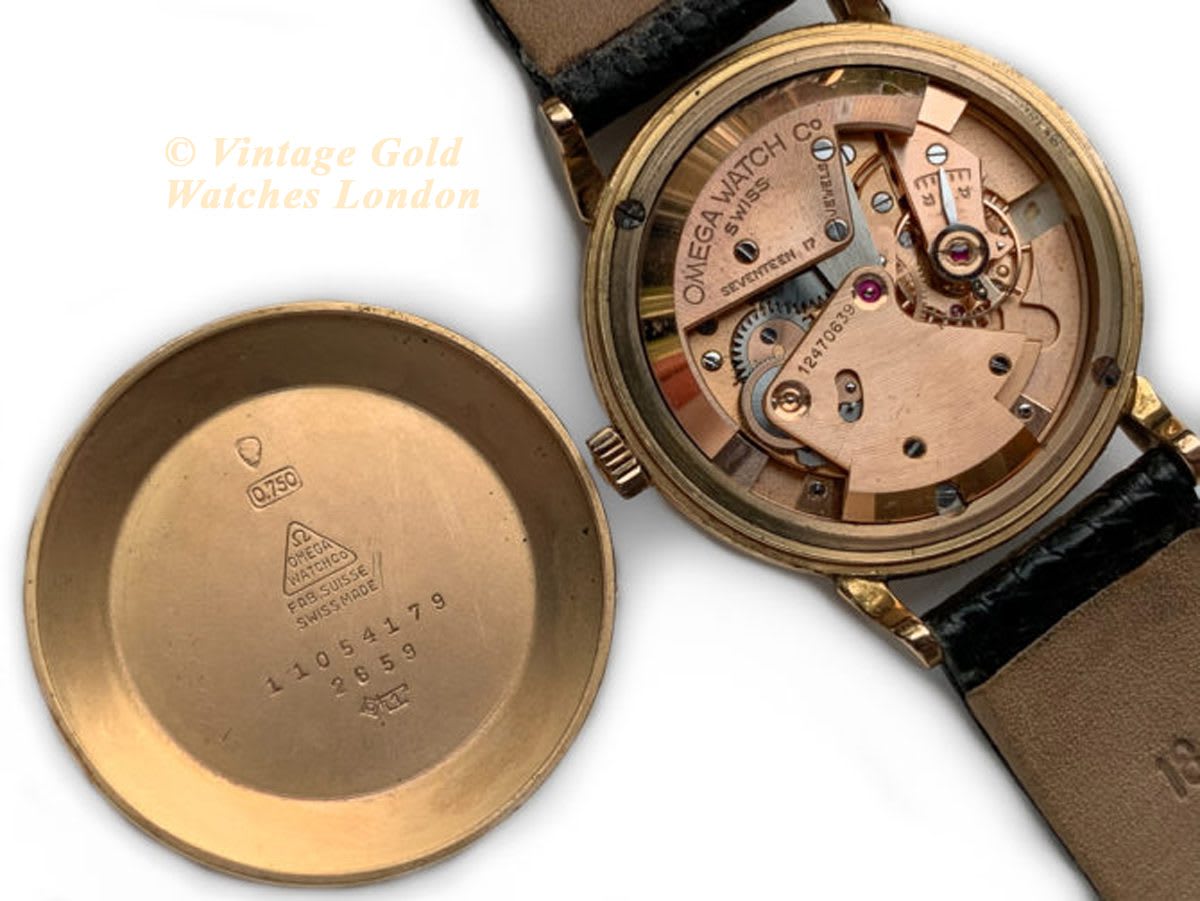
On the Oscillating Weight (Rotor): “OMEGA WATCH CO” or “OMEGA” script engraved in a serif font, typically centered on the weight’s visible surface. The engraving depth and clarity should be consistent, with sharp, well-defined characters. Earlier production examples may show slightly different font styling compared to later production, but all authentic rotors feature engraved rather than stamped or relief-cast lettering.
On the Automatic Winding Bridge or Barrel Bridge: “SWISS” or “SWISS MADE” engraved in block letters. This marking confirms Swiss origin and manufacture.
On the Movement Plate or Balance Cock: “SEVENTEEN JEWELS” or “17 JEWELS” engraved in English or occasionally in French (“17 RUBIS”). The jewel count should match the actual jewel configuration (17 functional jewels plus 2 cap jewels for balance shock protection).
Date Codes
The cal. 342 does not use a date code system. Omega identified movement production dates via serial numbers engraved on the movement, typically on the automatic winding bridge or the movement plate beneath the balance cock. Serial numbers are seven-digit figures that correspond to specific production years based on Omega’s sequential numbering system.
Serial Number Ranges by Year:
- 11,000,000 – 11,999,999: 1947 (pre-342, but relevant for 28.10 RA PC movements)
- 12,000,000 – 12,999,999: 1950
- 13,000,000 – 13,499,999: 1951-1952
- 13,500,000 – 13,999,999: 1952
- 14,000,000 – 14,999,999: 1954
- 15,000,000 and above: 1956 (late production, transitioning to full-rotor calibers)
These ranges are approximate, as Omega’s production was not perfectly linear and serial numbers occasionally overlapped across production years.
Finishing Marks
Expected finishing patterns on authentic cal. 342 movements include:
Circular Perlage (Spotted Pattern): Visible on the movement plate (base plate) through openings in the bridges, particularly around the balance cock area and beneath the automatic winding bridge. The perlage consists of overlapping circular marks approximately 1-2 mm in diameter, creating a regular spotted texture. The pattern should be consistent in density and size, indicating machine application.
Côtes de Genève (Geneva Stripes): May appear on the automatic winding bridge and barrel bridge, consisting of parallel stripes running the length of the bridge. The presence and quality of Côtes de Genève varies by production period, with some 342 movements showing minimal striping or brushed finishing only. When present, stripes should be straight, parallel, and evenly spaced (approximately 0.5-1.0 mm apart).
Brushed or Satin Finishing: Bridge edges and flat surfaces may show linear brushed finishing rather than polishing, creating a matte appearance. This is normal for mid-grade production movements.
Copper or Rose-Gold Plating: The movement plate and bridges exhibit a warm copper-tone or rose-gold appearance from electroplating, characteristic of 1940s-1950s Omega production. This plating should be even and consistent across all surfaces, without flaking or discoloration (though minor darkening or patina development is normal for 70+ year-old movements).
Jewel Markings
The cal. 342 uses friction-set jewels in chatons for critical pivot points (balance, pallet fork, escape wheel) and pressed jewels for wheel train pivots (center, third, fourth wheels). Chatons are raised settings that hold the jewel, allowing light to pass through the jewel and making them visible as ruby-red elements on the movement. Pressed jewels are set flush with the plate or bridge surface and may be less visually prominent.
Incabloc Shock Protection: The balance jewels (upper and lower) are secured in Incabloc shock protection settings, identifiable by the spring-loaded cap jewel and surrounding setting that allows vertical and lateral movement during shock events. The Incabloc setting should show a spring clip holding the cap jewel in place, with the setting free to move slightly when pressed (indicating proper shock protection function).
Gold chatons (settings made from gold rather than brass) do not appear on standard cal. 342 movements. Gold chatons were reserved for higher-grade movements such as chronometer-certified calibers (343, 344) or precious metal presentation pieces. Standard cal. 342 movements use brass chatons with gilded or copper-toned plating.
Adjustment Markings
The cal. 342 was not produced in adjusted or chronometer-certified grades under the 342 designation. Watches requiring chronometer certification received the cal. 343 or cal. 344, which feature identical base architecture but superior regulation and COSC (Contrôle Officiel Suisse des Chronomètres) certification markings.
Standard cal. 342 movements should not show adjustment markings such as “Adjusted to 5 Positions,” “Chronometer,” or “Officially Certified Chronometer”. If a movement marked “342” shows such engravings, it may indicate: (1) a dial or case marking rather than a movement marking (cases and dials could be marked “Chronometer” even with non-chronometer movements in some markets), (2) incorrect movement identification (the movement may actually be a cal. 343 or 344), or (3) non-original engraving added later.
The regulator scale on the balance cock may show “+” and “-” markings to guide rate adjustment, but these are functional indicators rather than certification marks.
Correct Serial Number Formats and Locations
Serial Number Location: Engraved on the automatic winding bridge (beneath the rotor) or on the movement plate beneath the balance cock. The specific location varies by production period, with earlier 1949-1950 examples sometimes showing serial numbers on the plate and later 1951-1955 examples more consistently using the automatic bridge location.
Serial Number Format: Seven digits, no letters or prefixes, in the range 11,000,000 to 15,000,000 for movements produced during the 342 production period (1949-1955). The serial number should be cleanly engraved with consistent depth and character size.
Case Serial Number: A separate serial number appears inside the case back, typically stamped rather than engraved. The case serial number does not necessarily match the movement serial number, as Omega cased movements based on availability rather than sequential pairing. The case serial number helps verify case authenticity but does not directly date the movement.
Expected Engravings and Stampings
Authentic cal. 342 movements should display the following engravings:
- Caliber number “342” on the automatic winding bridge (post-August 1949 production)
- “OMEGA WATCH CO” or “OMEGA” on the oscillating weight
- “SWISS” or “SWISS MADE” on a bridge or movement plate
- “SEVENTEEN JEWELS” or “17 JEWELS” on a bridge or movement plate
- Seven-digit serial number on the automatic winding bridge or movement plate
Engraving Depth and Clarity: Authentic engravings are cleanly executed with consistent depth (approximately 0.1-0.2 mm) and sharp, well-defined characters. Font styles vary slightly by production period but should appear professionally executed without irregularities or rough edges.
Stamped vs. Engraved: Movement markings are typically engraved (cut into the metal surface) rather than stamped (pressed into the surface). Case markings (hallmarks, reference numbers, serial numbers) are usually stamped.
Font and Marking Style by Production Era
Early Production (1949-1951): Serif fonts with traditional styling for “OMEGA” script, block letters for “SWISS” and jewel count markings. Some movements from 1949 may lack caliber number engravings entirely, as the three-digit system was implemented mid-year.
Mid Production (1951-1953): Consistent use of “342” caliber marking on automatic winding bridge, serif fonts maintained for brand markings. Serial numbers consistently present on automatic bridge or movement plate.
Late Production (1953-1955): Marking styles remain consistent with mid-production, though some later examples may show slight font variations or simplified engraving styles as production transitioned toward full-rotor calibers. Quality and depth of finishing (perlage, striping) may decline slightly in the final production years as Omega shifted resources toward developing and producing second-generation automatic movements.
Omega’s logo and branding evolved slowly during the 1940s-1950s, with minimal changes visible on movements. The characteristic serif “OMEGA” script remained consistent throughout the 342 production period, providing reliable authentication reference points.
Part Information

Part Numbers and Interchangeability
Mainspring
Balance Complete
Hairspring
| Part Name | Part Number | Interchangeability Notes |
|---|---|---|
| Hairspring (Balance Spring) | Omega part, supplier-dependent | Specific to balance wheel diameter and timing requirements |
Escapement Components
Winding and Setting Components
Automatic Winding Components
Case Hardware
| Part Name | Part Number | Interchangeability Notes |
|---|---|---|
| Case Clamp | Omega 342-1974, BF#A/2334 | Specific to 342, holds movement in case |
| Case Spring | Omega 342-1910, BF#AUT/1224 | Specific to 342 |
Shock Protection Components
Other Components
Sourcing Notes
Parts Still Available:
- Mainsprings: Readily available from multiple suppliers (Generale Ressorts, Ofrei, Watch Material, Cousins UK) in both genuine and high-quality aftermarket versions
- Incabloc shock protection components: Cap jewels, springs, and settings remain available for the 122.11 series used in the 342
- Crown wheels and cores: NOS (new old stock) genuine Omega parts available from specialized dealers
- Stems: Genuine and aftermarket stems compatible with 330-355 series available
- Set bridges: Sealed packages of genuine Omega set bridges (part #1110) compatible with 330-355 series available
Parts Commonly Requiring Replacement:
- Mainsprings: Should be replaced during any complete service, as 70+ year-old springs lose elasticity and torque delivery
- Bumper springs: Subject to fatigue from repeated impacts; original springs may be weakened or cracked
- Balance staff pivots: Delicate pivots vulnerable to damage from shock or improper service
- Pallet fork: Jewels may be chipped or dislodged; fork pivots subject to wear
- Incabloc cap jewels and springs: May be lost during disassembly or damaged during cleaning
Parts Difficult to Source:
- Complete balance assemblies: Specific to 342 dimensions and timing screw configuration; may require donor movements
- Pallet forks: Limited availability; watchmakers report difficulty sourcing replacements
- Oscillating weight (rotor): Must match 342 specifications; not universally interchangeable with other 330-series variants
- Dial feet and dial hardware: Specific to movement architecture; reproduction or adaptation may be necessary
Acceptable Generic Replacements:
- Mainsprings: High-quality Swiss-made generic mainsprings (Generale Ressorts, Nivaflex) provide performance equivalent to or exceeding original Omega mainsprings
- Incabloc components: Generic Incabloc cap jewels and springs (122.11 series) are functionally identical to Omega-branded parts
- Stems: Swiss-made generic stems matching Omega specifications are acceptable for non-original restorations
Parts Requiring Donor Movements:
- Specialized bridges and plates if damaged or modified
- Balance wheels with correct timing screw configuration
- Pallet forks and escape wheels in cases where genuine or NOS parts are unavailable
Collectors and watchmakers seeking parts for cal. 342 restoration should establish relationships with specialized vintage parts dealers (Old Swiss Watches, Scotch Watch, McCaw Company, Perrin Supply) and monitor online marketplaces (eBay, Chrono24, watchmaking forums) for NOS parts and donor movements. The relatively high production volume of the 330-series (1.3+ million units) ensures that donor movements remain available, though prices have increased as vintage Omega interest has grown.
Performance Data
Manufacturer Specifications
Accuracy (New): Omega did not publish specific accuracy specifications for non-chronometer cal. 342 movements. As a standard-grade production automatic, the 342 was manufactured to commercial timekeeping standards rather than chronometer tolerances.
Based on contemporary Swiss industry standards for mid-grade automatic movements (circa 1949-1955), expected accuracy for a new, properly regulated cal. 342 would fall in the range of +10 to +30 seconds per day across all positions. Individual examples with careful regulation could achieve +5 to +15 seconds per day in typical wearing positions.
Positions Tested: Not specified by Omega for non-chronometer cal. 342 movements. Standard watchmaking practice for mid-grade movements involved regulation in 1-2 positions (typically dial up and crown down or crown left). The simple index regulator design precluded multi-position adjustment without specialized timing and regulation.
Temperature Compensation: The Glucydur balance wheel provides passive temperature compensation through its bimetallic construction, reducing rate variation across typical ambient temperature ranges (10-30°C / 50-86°F). However, the flat hairspring and absence of paired temperature compensation screws limit compensation effectiveness compared to chronometer-grade movements with Breguet overcoil springs and sophisticated balance designs.
Isochronism: The flat hairspring and simple regulator design provide adequate but not exceptional isochronism (consistency of rate across the mainspring’s power curve from fully wound to nearly depleted). Omega likely allowed rate variation of 5-10 seconds per day between fully wound and end-of-reserve states, typical for mid-grade movements of this era.
Observed Performance (Field Data)
Typical Accuracy Range for Well-Maintained Examples: Collector reports, watchmaker observations, and online forum discussions suggest the following performance ranges for properly serviced cal. 342 movements:
- Optimal Position (typically crown down or dial up): +5 to +15 seconds per day
- Wearing Position (wrist worn, moderate activity): +10 to +30 seconds per day
- Poor Position (typically crown up or vertical positions): -10 to -45 seconds per day
These figures represent well-maintained movements with recent service (complete cleaning, lubrication, regulation) and intact mainsprings. Individual examples vary significantly based on service quality, parts condition, and regulation technique.
Common Performance Issues and Their Causes:
- Excessive Positional Variation (>40 seconds/day delta between best and worst positions):
- Low Amplitude (<220 degrees when fully wound):
- Stopping During Overnight Rest or Declining Performance:
- Erratic Timekeeping or Sudden Rate Changes:
- Excessive Noise from Bumper Mechanism:
Expected Amplitude Ranges:
- Fully Wound, Dial Up Position: 260-300 degrees
- Fully Wound, Crown Down Position: 250-280 degrees
- Fully Wound, Crown Up Position: 240-270 degrees
- 24 Hours After Full Wind, Dial Up: 240-270 degrees
- End of Power Reserve (40-42 hours), Dial Up: 220-250 degrees
Amplitudes below 250 degrees when fully wound indicate service requirements (cleaning, lubrication, mainspring replacement). Amplitudes below 220 degrees at any state of wind suggest serious maintenance neglect or component damage requiring immediate attention.
Performance Degradation Over Time:
Well-maintained cal. 342 movements can maintain acceptable timekeeping performance for 5-7 years between complete services, though annual regulation adjustment may be necessary as lubricants age and component wear accumulates. Factors accelerating performance degradation include:
- Exposure to moisture or humidity (corrosion of steel components, lubricant contamination)
- Shock damage (balance staff pivots, pallet jewels particularly vulnerable)
- Irregular or excessive wearing (automatic winding mechanism wear)
- Improper storage (magnetization from electronic devices)
- Extended periods without use (lubricant migration, mainspring set)
Service Interval Recommendations:
Modern watchmaking consensus suggests complete service (disassembly, cleaning, lubrication, regulation) every 5-7 years for vintage automatic movements like the cal. 342. Movements experiencing timekeeping drift, amplitude loss, or stopping should receive service immediately regardless of time since last service.
Practical Timekeeping Expectations:
Collectors should expect properly serviced cal. 342 movements to maintain timekeeping within ±20-30 seconds per day during normal wear, with careful regulation potentially achieving ±10-15 seconds per day. These results are entirely satisfactory for a 70+ year-old mid-grade automatic movement and reflect the robust engineering and quality construction that made the 330-series one of Omega’s most successful movement families.
Comparing the cal. 342’s performance to modern standards (±5 seconds per day for standard mechanical watches, ±2 seconds per day for COSC chronometers) is historically anachronistic. The 342 was designed to provide reliable daily timekeeping for 1950s wearers who adjusted their watches daily or every few days, not to meet 21st-century expectations of precision. Collectors valuing historical authenticity and mechanical character over absolute accuracy will find the 342’s performance entirely appropriate for its era and grade