

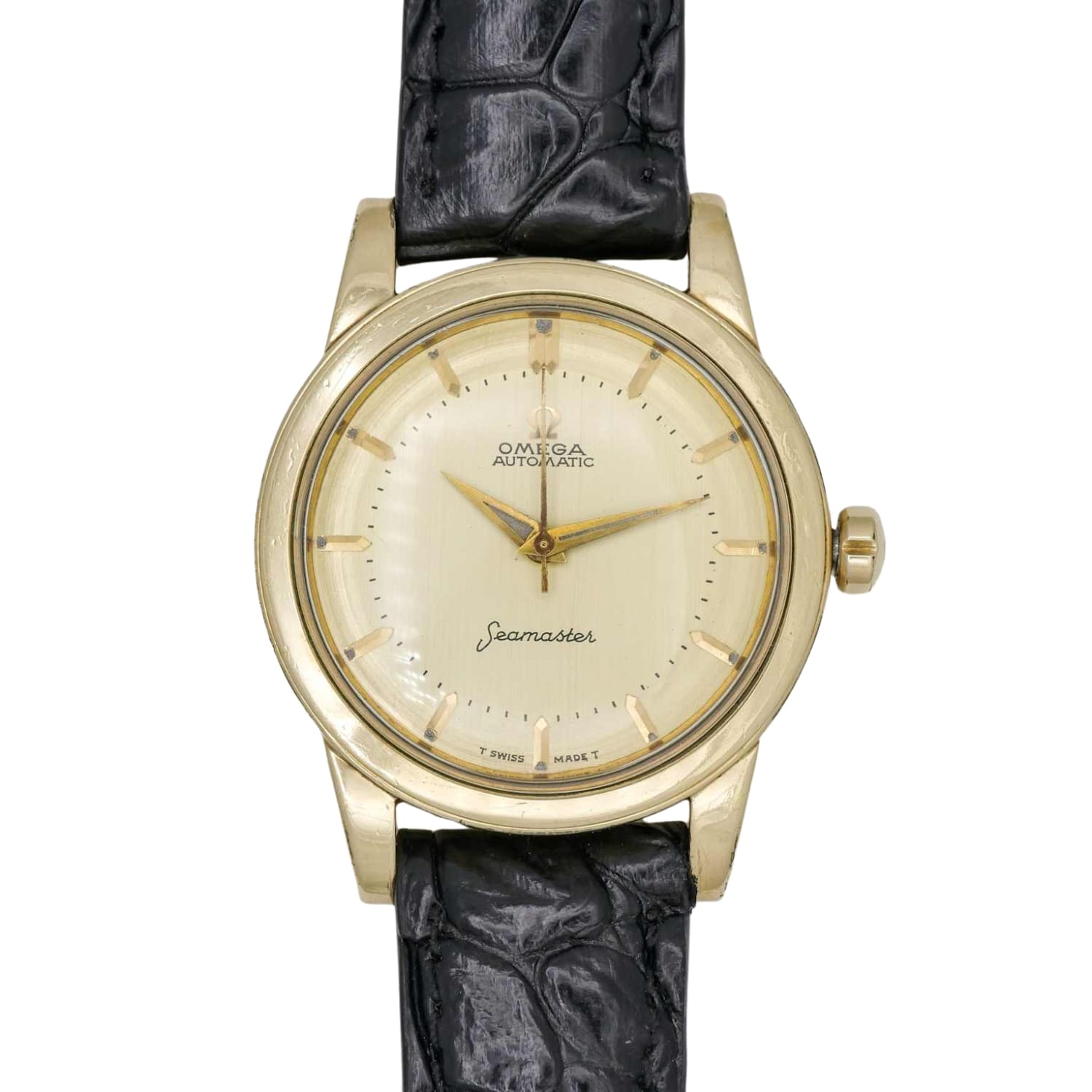
The Omega Seamaster 6250 also designated GX6250 for U.S. market examples and G6250 for international distribution, represents a distinguished chapter in mid-to-late 1950s Seamaster evolution, embodying the collection’s maturation from experimental bumper technology to reliable full-rotor automatic movements. Produced between approximately 1954 and 1961, this reference occupies a pivotal transition period when Omega refined case proportions, standardized the celebrated caliber 500 movement family, and established design language that would define Seamaster aesthetics through the golden age of Swiss watchmaking.
What distinguishes the 6250 from its contemporaries is its sophisticated balance of dressy elegance and functional robustness, a 34.5-35mm case that remains wearable across modern contexts, screw-back waterproof construction that delivers genuine utility, and the pioneering caliber 500 automatic movement that marked Omega’s definitive abandonment of bumper technology in favor of superior full-rotor winding. The reference achieved particular prominence in gold-filled configurations, offering the visual warmth and luxury of precious metal at accessible price points through advanced metallurgical techniques that bonded substantial gold layers (40-80 microns) to stainless steel cores.
For collectors, the 6250 provides exceptional value proposition: an authentic late-1950s Seamaster with proven movement reliability (caliber 500’s 1.075 million unit production run testifies to its success), distinctive “beefy lug” architecture that creates immediate visual recognition, and accessible pricing ($800-$1,500 for gold-filled examples) that belies its historical significance and mechanical excellence.
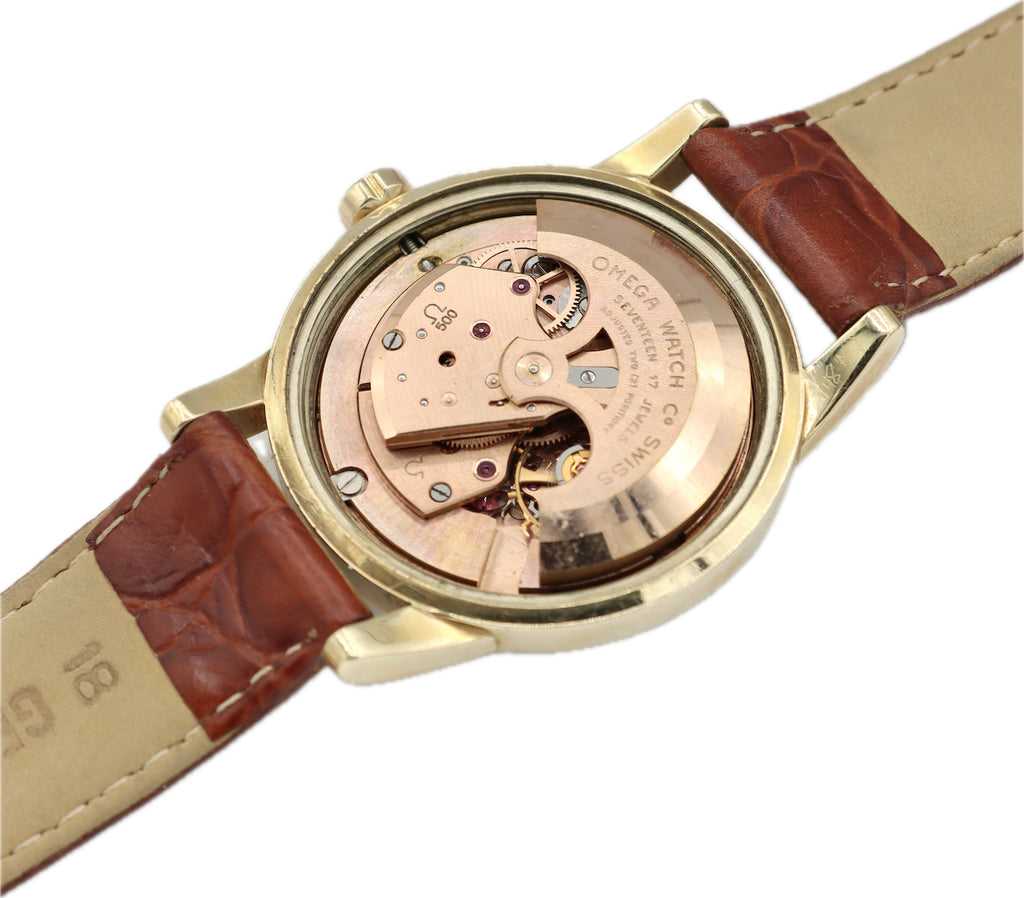
Vintage 35mm Omega GX6250 Seamaster Men’s Automatic
Historical Context and Technical Evolution
The Caliber 500 Revolution
To understand the Omega Seamaster 6250’s significance, one must appreciate the technical revolution embodied by its caliber 500 movement. By the early 1950s, Omega’s bumper automatic technology—which had powered first-generation Seamasters like the CK 2494—was approaching obsolescence. While functionally reliable, bumper movements suffered from inherent limitations: restricted winding efficiency due to the rotor’s limited oscillation arc (120-270 degrees versus 360-degree full rotation), mechanical wear from constant buffer spring impact, and parts availability challenges as technology evolved.
Omega responded by developing the revolutionary caliber 470/490/500 family between 1954-1959, producing a combined 1,075,000 movements across these related calibers. This massive production volume—unprecedented for Omega automatic movements of the era—signals the manufacturer’s confidence in full-rotor technology and market demand for improved automatic winding. The caliber 500, introduced in the mid-1950s, represented the culmination of this development: a 28mm (12.5 ligne) movement featuring 17 jewels, full 360-degree bidirectional rotor winding, Incabloc shock protection, and approximately 46 hours of power reserve.
The technical advantages over bumper predecessors were substantial:
Winding Efficiency: The full-rotor system captured kinetic energy through complete rotations in both directions, winding the mainspring far more efficiently than bumper mechanisms. Wearers experienced reliably wound watches through normal daily activity without requiring the aggressive wrist motion that bumper movements demanded.
Mechanical Durability: By eliminating buffer springs and the constant impact forces inherent to bumper systems, the caliber 500 reduced wear points and extended service intervals. The smooth, continuous rotor rotation created less mechanical stress than bumper hammering.
Serviceability: The caliber 500’s widespread adoption across Omega’s lineup meant that parts availability, watchmaker familiarity, and service protocols were standardized and accessible—advantages that persist into the present for collectors seeking vintage watch maintenance.
Market Positioning and the U.S. Collection
The 6250’s production coincided with Omega’s strategic expansion into the American market during the 1950s-1960s. The “GX” prefix specifically denoted watches produced for U.S. distribution, while the “G” prefix indicated international/European market variants. This market segmentation reflected Omega’s recognition of regional preferences: American consumers demonstrated particular enthusiasm for gold-filled watches that delivered precious metal aesthetics at accessible price points, while European markets favored both gold-filled and solid precious metal offerings.
The reference’s designation as part of Omega’s “US Collection” (visible in period marketing materials and dealer documentation) positioned it as an accessible luxury timepiece for the aspirational American middle class—professionals, executives, and discerning buyers who valued Swiss craftsmanship but required price points below solid gold territory. The gold-filled construction, typically employing 40-80 micron gold layers bonded to stainless steel cores, provided durability and visual warmth that satisfied aesthetic preferences while maintaining practical pricing.
Production Timeline and Serial Number Analysis
Omega produced the 6250 reference between approximately 1954 and 1961, with movement serial numbers providing reliable dating:
| Movement Serial Range | Approximate Year | Example Number |
|---|---|---|
| 15,000,000 – 15,999,999 | 1954-1957 | 15,893,315 (1958) |
| 16,000,000 – 16,999,999 | 1957-1961 | 16,117,599 (1958); 16,258,462 (1961) |
Examples with serial numbers around 15.9 million date to 1957-1958, representing mid-production runs when the caliber 500 had achieved full maturity. Watches bearing serial numbers exceeding 16.2 million date to 1960-1961, marking the tail end of production before Omega transitioned to updated Seamaster architectures and movement families.
The seven-year production span (1954-1961) represents substantial longevity for a specific case reference, testifying to the 6250’s market success and design appeal. By 1961, evolving consumer preferences toward larger case diameters and updated styling prompted Omega to phase out the 6250 in favor of more contemporary references, though the caliber 500 movement continued powering other Seamaster models through the early 1960s.
Technical Specifications
Case Dimensions and Architecture
The Omega Seamaster 6250 exhibits proportions that epitomize mid-1950s sports-elegant design philosophy:
| Specification | Measurement |
|---|---|
| Case Diameter | 34.5-35mm (excluding crown) |
| Lug-to-Lug Distance | 42-43mm |
| Lug Width | 18mm |
| Movement Well Diameter | 28mm |
| Case Construction | Screw-down caseback |
| Crystal Type | Acrylic (plexiglass), domed |
| Water Resistance | ~30 meters (100 feet) nominal |
The case diameter measures 34.5-35mm across most documented examples, with minor variations resulting from measurement methodology (bezel included versus case body only) and manufacturing tolerances. This sizing positions the 6250 as a mid-sized watch by 1950s standards—smaller than the 36mm “Jumbo” references but maintaining sufficient presence for masculine wear. Notably, the 34.5-35mm diameter translates to excellent wearability in contemporary contexts, as modern preferences have shifted toward vintage-inspired proportions that avoid the excessive sizing of 2000s-2010s watch design.
The lug-to-lug measurement ranges from 42mm to 43mm depending on specific lug terminus points and measurement technique. This compact dimension ensures comfortable wear on wrists from 6.5 inches to 7.5 inches without overhang, while the 18mm lug width accommodates standard vintage-style leather straps and period-appropriate mesh bracelets.
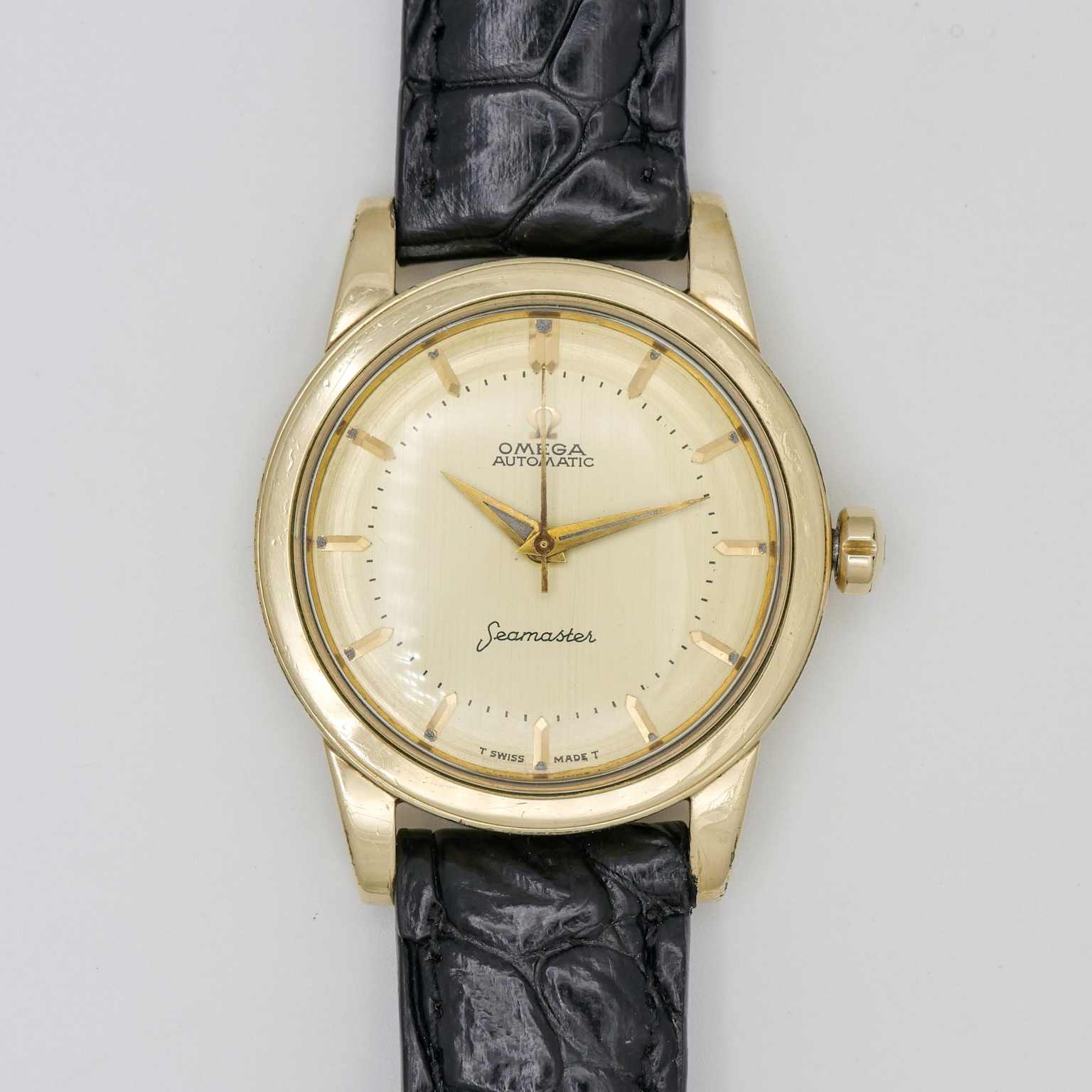
OMEGA SEAMASTER AUTOMATIC REF. GX6250 US COLLECTION – Zeit
Case Construction and Design Elements
Screw-Back Architecture: Unlike snap-back Seamasters such as the CK 2869, the 6250 employs screw-down caseback construction for superior water resistance. The threaded caseback screws firmly into the case body, compressing a flat gasket to create a moisture-resistant seal rated nominally to 30 meters (100 feet). This construction provides genuine utility for daily wear including hand washing, rain exposure, and incidental water contact—advantages that differentiate Seamaster references from pure dress watches of the era.
The caseback exterior typically features engraved text including “SEAMASTER,” “WATERPROOF,” “AUTOMATIC,” and “SWISS,” confirming the watch’s specification and provenance. The interior surface bears the case reference number (GX6250, G6250, or simply 6250), Omega logo, material designation (14K GOLD FILLED, 14K GOLD, ACIER INOXYDABLE), and serial numbers.
“Beefy Lug” Design: The 6250’s most distinctive visual characteristic is its substantial, sculptural lug architecture—widely described within collector communities as “beefy lugs”. These thick, solid lugs extend from the case body with pronounced volume and architectural presence, creating visual weight and masculine character while maintaining elegant proportions through careful curvature and tapering. The lugs flow organically from the round case, curving downward toward the wrist to ensure comfortable conformity despite their robust dimensions.
This lug style distinguishes the 6250 from other 1950s Seamaster references featuring alternative architectures: straight horn lugs (CK 2597), rhinoceros lugs (CK 2715), spider/dog leg lugs, or teardrop lugs. The beefy lug design strikes balance between functional robustness and dressy refinement, enabling the 6250 to transition seamlessly from business attire to casual contexts.
Crown: Original crowns feature the Omega logo and appropriate proportions for the era—neither oversized nor miniature. The signed crown screws onto a threaded tube, providing additional water resistance through compression gaskets. Period-correct crowns should exhibit consistent signing and proportional diameter relative to the case (approximately 5-6mm).
Movement Specifications: Caliber 500
The heart of the Omega 6250 is the celebrated caliber 500 automatic movement—a technically accomplished, reliably engineered caliber that powered countless Seamaster references throughout the late 1950s-early 1960s.
Technical Characteristics
Core Specifications:
- Diameter: 28mm (12.5 lignes)
- Height: 5.55mm
- Jewel Count: 17
- Frequency: 19,800 vibrations per hour (2.75 Hz)
- Power Reserve: 46 hours
- Winding: Bidirectional full-rotor automatic
- Escapement: Lever escapement with monometallic balance
- Regulation: Micrometer regulator (detached type)
- Shock Protection: Incabloc on bearing jewels
The caliber 500 measures 28mm in diameter, fitting perfectly within the 6250’s movement well while providing sufficient size for robust gear train spacing and substantial mainspring barrel. The movement’s 5.55mm height contributes to the watch’s overall slim profile, enabling dress-watch elegance despite automatic complication.
At 19,800 vibrations per hour (2.75 Hz or 5.5 beats per second), the caliber 500 operates at a slightly faster frequency than earlier Omega movements running at 18,000 vph. This elevated beat rate improves timekeeping stability by reducing the impact of minor positional variations and shock events—a technical refinement that demonstrates Omega’s continuous movement development through the 1950s.
The generous 46-hour power reserve ensures the watch remains wound through weekend inactivity if removed Friday evening and worn again Monday morning—a practical advantage for owners alternating between multiple watches.
Automatic Winding System
The caliber 500’s full-rotor automatic winding system represents the technological culmination of Omega’s decade-long development of self-winding mechanisms. The rotor—a weighted semicircular mass visible through display casebacks (though not present on the 6250’s solid caseback)—rotates freely 360 degrees in both directions, capturing kinetic energy from wrist movement through each rotation.
As the rotor spins, it drives a reduction gear train that winds the mainspring bidirectionally through a reversing mechanism. This bidirectional winding doubles efficiency relative to unidirectional systems, ensuring the watch remains fully wound through normal daily wear.
The automatic mechanism features “detached manual wind” capability, allowing the wearer to wind the watch via the crown when necessary (after extended storage, for example) without engaging the automatic mechanism. This hybrid functionality provides flexibility and ensures the watch can be brought to full wind without requiring wrist motion—a practical refinement over pure automatic systems lacking manual winding.
Performance and Collectibility
The caliber 500 earned acclaim for its exceptional reliability, ease of service, and refined finishing. The movement features practical finishing appropriate to its tool-watch mandate: rhodium-plated or natural brass plates, chamfered bridges, and functional layout prioritizing serviceability over decorative elaboration.
While not reaching the elevated finishing standards of the higher-jewel calibers 501 (19/20 jewels with swan neck regulator) or 505 (24 jewels, chronometer-grade), the caliber 500 delivers excellent daily performance and represents the “sweet spot” of reliability, maintainability, and accessible pricing for vintage Omega collectors.
Parts availability for the caliber 500 remains relatively good compared to rarer Omega calibers, as the movement’s massive production run (part of the 1.075 million units across the 470/490/500 family) ensures substantial surviving populations and donor movements. Competent vintage watchmakers can service caliber 500 movements successfully, though specialized expertise improves outcomes.
Visual Design and Dial Variations
The Omega 6250 appeared with notable dial diversity, offering configurations that satisfied varied aesthetic preferences while maintaining cohesive Seamaster identity.
Dial Finishes and Colors
Two-Tone Silvered Dials: The most common configuration, two-tone silvered dials feature contrasting textures or tones between the central dial area and outer chapter ring. These dials typically exhibit matte or brushed central zones with slightly different finishes on perimeter sections, creating subtle visual depth through texture variation. Original silvered dials develop warm cream, champagne, or honey patination over decades, enhancing vintage character.
Champagne/Cream Dials: Factory champagne or light cream dials provided warmer tones than stark silver finishes. These dials complement gold-filled cases particularly well, creating cohesive precious-metal aesthetics. Natural aging develops rich, even patina that increases desirability among collectors valuing authentic vintage presentation.
Black Dials: Less common than silvered or champagne variants, black dials deliver maximum contrast and sportier character. Original black lacquer dials from the 1950s-1960s frequently develop attractive patination, though true “tropical” aging (chocolate brown transformation) is less common on Seamaster dials than on Constellation or Speedmaster examples. Black dial 6250 references command premiums due to relative scarcity and visual impact.
Black Gilt Dials: Particularly desirable variants feature black dials with gilt (gold-toned) printing and applied gilt markers. The warm gilt against black lacquer creates stunning contrast and emphasizes the watch’s luxury positioning. These dials pair beautifully with gold-filled cases, creating unified precious-metal presentation. A documented example described as having “INCREDIBLE dial hand lume” and “sparkling black gilt dial” illustrates collector enthusiasm for well-preserved gilt examples.
Index and Marker Configurations
The 6250 appeared with multiple hour marking styles:
Applied Baton Markers: The most common configuration features applied steel or gilt baton markers at all twelve hour positions. These three-dimensional markers create depth and refinement while maintaining clean legibility. Gilt batons on gold-filled or solid gold examples provide cohesive precious-metal aesthetics.
Applied Arrow/Dart Indices: Alternative examples feature distinctive arrow or dart-shaped hour markers, some with luminous plots for enhanced nighttime legibility. These sportier markers align with the Seamaster’s functional mandate while maintaining dressy proportions.
Mixed Configurations: Some dial variants combine different marker styles—applied indices at certain positions with printed markers elsewhere, or alternating marker shapes for visual interest.
Hands and Luminous Material
Original 6250 hands typically feature dauphine (“dolphin”) profiles—the classic tapered silhouette with pointed tips and faceted surfaces that catch light elegantly. Hands appear in finishes matching the dial’s markers: gilt hands complement gilt dials and gold cases, while rhodium or steel hands pair with silvered dials.
Many examples feature luminous-filled hands with matching luminous plots on hour markers. The luminous material—radium on earlier 1954-1956 examples transitioning to tritium by 1958-1961—has aged to cream, tan, or light brown tones after 60-70 years. Functional luminescence should not be expected on authentic vintage examples, as both radium and tritium lose glow intensity over decades.
Collectors should verify that luminous aging on hands matches dial marker patination—mismatched lume colors (bright white hands with aged dial plots) indicate replacement hands or restoration.
Case Material Variations
14-Karat Gold-Filled
The overwhelming majority of 6250 production utilized 14-karat gold-filled construction—a sophisticated metallurgical technique that bonded substantial gold layers (typically 40-80 microns thick) to stainless steel case cores. This construction method, also termed “gold-capped” or “plaqué or” in French-market documentation, provided several advantages over simple electroplating:
Durability: The thick gold layer could withstand polishing, regular wear, and environmental exposure far better than thin electroplated coatings (typically 10-20 microns). Well-maintained gold-filled cases retain attractive gold coverage across high-wear areas (lug tops, bezel, case flanks) even after decades of use.
Visual Authenticity: The substantial gold thickness created weight, color depth, and tactile quality closely approaching solid gold examples. Period advertisements emphasized that gold-filled watches “looked solid gold for a fraction of the price”—positioning that resonated with aspirational buyers.
Accessibility: Gold-filled construction enabled Omega to offer precious-metal aesthetics at price points roughly 40-60% below solid gold equivalents. This democratization of luxury expanded Omega’s market reach significantly during the 1950s-1960s.
Gold-filled 6250 examples typically feature fully capped construction including the caseback—a quality indicator that distinguishes them from cheaper bi-metal constructions with stainless steel casebacks. The caseback bears “14K GOLD FILLED” marking alongside Swiss hallmarks confirming precious metal content.
14-Karat Solid Yellow Gold
Solid 14-karat yellow gold examples represent the pinnacle of 6250 production, though they constitute perhaps 5-10% of total output based on market observations. These watches feature fully solid gold cases (.585 fineness) throughout, with appropriate Swiss hallmarks stamped on case flanks confirming gold purity and origin.
The solid gold construction delivers substantially greater weight than gold-filled equivalents—a tactile distinction immediately apparent when handling. The warm, consistent yellow gold tone throughout the case, including interior surfaces and caseback, confirms solid construction.
Solid gold 6250 examples command significant premiums over gold-filled variants, typically ranging from $3,000-$6,000 depending on condition and provenance. The combination of solid precious metal construction with proven caliber 500 reliability makes these watches attractive to collectors seeking authentic 1950s-1960s luxury timepieces with practical wearability.
Stainless Steel
While gold-filled and solid gold cases dominate documented examples, isolated stainless steel 6250 references may exist as special orders or regional market variants. These would have been marketed at lower price points than gold versions but are substantially rarer in the contemporary collector market. Steel examples should be approached with verification requirements, as the 6250’s primary market positioning emphasized gold aesthetics.
Collecting Guidance and Authentication
Verifying Gold-Filled vs. Solid Gold
The distinction between gold-filled and solid gold construction dramatically impacts value ($800-$1,500 for gold-filled versus $3,000-$6,000 for solid gold), making proper authentication essential:
Weight Test: Solid gold cases weigh substantially more than gold-filled equivalents due to the full precious metal construction. A documented solid gold 6250 should weigh approximately 40-50 grams with bracelet, versus 30-40 grams for gold-filled.
Caseback Markings: Gold-filled examples bear “14K GOLD FILLED” or “14K G.F.” stamping, while solid gold cases display “14K,” “.585,” or “585” alongside Swiss hallmarks. The absence of “FILLED” or “G.F.” terminology strongly suggests solid gold.
Interior Inspection: Opening the caseback reveals color differences: gold-filled cases show stainless steel interior surfaces, while solid gold cases exhibit consistent yellow gold tone throughout.
Professional Verification: When significant investments are considered, acid testing or X-ray fluorescence (XRF) analysis provides definitive confirmation of gold content and purity.
Common Issues and Authentication Concerns
Redials: As with all vintage Omega references, dial refinishing represents a pervasive issue. Refinished dials appear too pristine for their age, with stark white or uniform silver backgrounds, overly sharp printing, and modern typography that doesn’t match period fonts. Collectors should compare suspect examples against verified original dials from multiple authoritative sources including auction houses, reputable dealers, and forum archives.
Aftermarket Crowns: Original signed Omega crowns are frequently replaced during service with generic unsigned alternatives. Period-correct crowns should feature clear Omega logo signing and proportions appropriate to the case.
Worn Gold Filling: Gold-filled cases naturally wear through decades of use and polishing, revealing stainless steel substrate at high-contact points (lug edges, case corners, bezel). Extensive wear-through significantly impacts both aesthetics and value. Collectors should carefully assess gold coverage completeness before purchase.
Incorrect Movements: Because the 6250 case accommodates 28mm movements, unscrupulous sellers have historically substituted incorrect calibers to create frankenwatches. Verify that the movement is indeed caliber 500 (occasionally caliber 471) and that serial numbers align with documented production periods.
Over-Polishing: Aggressive polishing thins case walls, rounds lug edges, and compromises the distinctive “beefy lug” architecture that defines the 6250’s visual character. Unpolished or lightly polished examples with sharp edges and crisp facets command premiums.
Market Considerations and Valuation
The Omega 6250 occupies an accessible segment of vintage Seamaster collecting, offering authentic 1950s-1960s craftsmanship at reasonable entry points:
Typical Price Ranges:
| Configuration | Condition | Typical Range (USD) |
|---|---|---|
| 14K Gold-Filled, standard dial | Good | $800-$1,200 |
| 14K Gold-Filled, black/gilt dial | Very Good | $1,200-$1,800 |
| 14K Gold-Filled, exceptional condition | Excellent | $1,500-$2,000 |
| 14K Solid Gold, standard condition | Good | $3,000-$4,000 |
| 14K Solid Gold, black dial, excellent | Excellent | $4,500-$6,000+ |
Value Drivers:
- Original dial with attractive, even patination
- Black or black gilt dial configurations (less common)
- Complete gold-filled coverage without wear-through
- Solid 14K gold construction
- Unpolished case with sharp “beefy lugs”
- Original signed Omega crown
- Fully functional caliber 500 movement
- Complete service history and documentation
- “US Collection” provenance
Value Detractors:
- Refinished or service replacement dials
- Extensive gold filling wear-through to steel substrate
- Over-polished case with softened lugs
- Incorrect or replacement hands
- Non-original crown
- Non-functional or incomplete movement
- Missing or incorrect caseback
- Poor service history
Authentication Best Practices
- Verify Gold Construction: Carefully examine caseback markings, assess weight, and inspect interior surfaces to confirm gold-filled versus solid gold.
- Assess Gold Filling Condition: On gold-filled examples, closely inspect high-wear areas for substrate exposure.
- Examine Dial Authenticity: Compare printing style, marker application, aging patterns, and text layout against documented original examples.
- Verify Movement: Open caseback to confirm caliber 500 (or 471) is present, check movement serial number alignment with production dates, and assess movement condition.
- Evaluate Case Condition: Assess lug sharpness, case facets, and beefy lug definition to determine polishing history.
- Check Crown Originality: Verify proper Omega signing and period-appropriate design.
- Request Service Documentation: Service history provides valuable provenance and confirms mechanical integrity.
- Consult Specialists: For significant purchases, consult vintage Omega experts through forums like OmegaForums.net or submit inquiries to Omega’s Extract from the Archives service.
Conclusion
The Omega Seamaster 6250 stands as an exemplary expression of mid-to-late 1950s Swiss watchmaking, synthesizing technical advancement (the pioneering caliber 500 full-rotor automatic), refined aesthetics (distinctive “beefy lug” architecture and versatile dial configurations), and accessible luxury (sophisticated gold-filled construction democratizing precious metal elegance). Produced during a pivotal seven-year period (1954-1961) when Omega definitively transitioned from bumper to full-rotor automatic technology, the 6250 embodies both the culmination of lessons learned through first-generation Seamaster development and the confident engineering maturity that would carry the brand through the 1960s golden age.
The reference’s particular success in the U.S. market—evidenced by the “GX” prefix designation and “US Collection” positioning—reflects Omega’s strategic understanding of American consumer preferences for gold aesthetics, automatic convenience, and Swiss prestige at accessible price points. The widespread adoption of 14K gold-filled construction enabled thousands of American professionals, executives, and discerning buyers to experience genuine Swiss luxury during an era when solid precious metal watches remained financially inaccessible to most consumers.
For contemporary collectors, the 6250 delivers exceptional value proposition through multiple dimensions: authentic 1950s-1960s Seamaster provenance with documented production history, mechanical excellence via the proven caliber 500 (part of Omega’s most successful automatic movement family), distinctive visual character through beefy lug architecture that creates immediate recognition, and accessible pricing that enables entry into vintage Seamaster collecting without the premiums commanded by professional diving references or Constellation models.
The diversity of dial configurations—from elegant two-tone silvered finishes to striking black gilt variants, from conservative champagne tones to sporty high-contrast layouts—ensures that collectors can pursue aesthetic preferences while benefiting from consistent mechanical quality and case architecture. Whether drawn to the warm patina of aged champagne dials, the visual impact of black gilt configurations, or the pristine elegance of well-preserved silvered examples, the 6250 offers compelling options at every condition level and price point.
Understanding the specifications, gold-filled versus solid gold distinctions, caliber 500 characteristics, and authentication considerations outlined in this reference guide empowers informed acquisition decisions and deeper appreciation for this underappreciated Omega reference. As vintage watch collecting continues maturing and collector attention shifts from hyped references toward historically significant but undervalued alternatives, the Seamaster 6250 represents a compelling opportunity to acquire authentic mid-century Swiss excellence at rational pricing.
For additional information on vintage Omega Seamaster watches, consult authoritative resources including OmegaForums.net, Omega Enthusiast Ltd., and Zeit Vintage Watch.