

The Omega Seamaster F6249 represents a fascinating chapter in mid-century American horological history, a watch that blends Swiss precision with distinctly American market sensibilities. Produced exclusively for the United States market during the early-to-mid 1950s, this reference embodies Omega’s strategic response to American tastes for gold-toned dress watches with refined proportions.
What distinguishes the F6249 from its more celebrated siblings is its deliberate elegance: housed in a 14K gold-filled case with the signature “beefy lugs” that define 1950s Seamaster aesthetics, it features the refined small seconds sub-dial configuration that appealed to traditional watch connoisseurs. The “F” prefix in its reference number signals its gold-filled construction, a sophisticated manufacturing technique that delivered the visual warmth and heft of solid gold at a fraction of the cost, making luxury accessible to America’s burgeoning middle class.
For collectors today, the F6249 offers compelling value: authentic examples with original dials and uncompromised cases trade for $1,200-$2,500, a fraction of what comparable solid gold references command, yet delivering the same bumper movement charm and period-correct aesthetics. This is a watch that rewards knowledge over fashion, appealing to those who appreciate mid-century design subtlety and mechanical ingenuity.
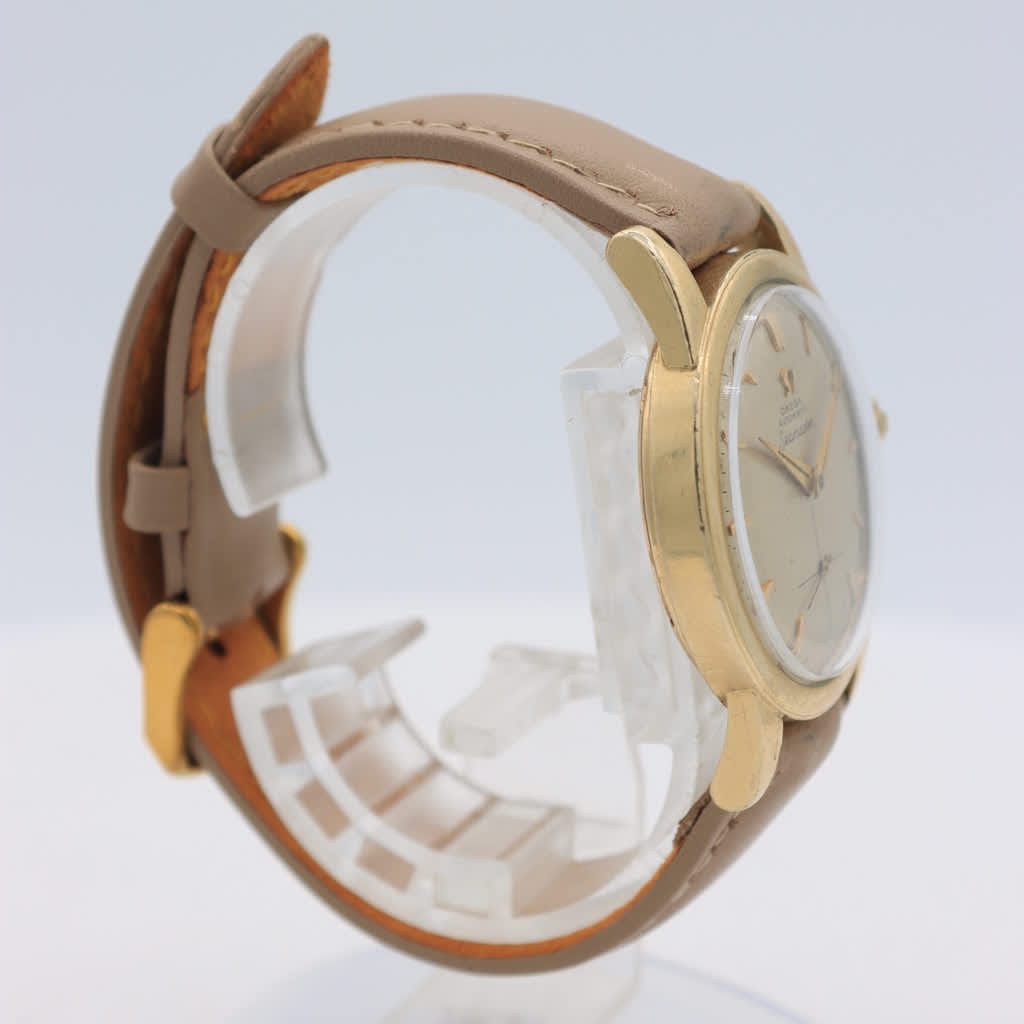
Vintage Omega F6249 Seamaster Men’s Bumper Automatic
HISTORY & PRODUCTION PERIOD
Production Years: Approximately 1952-1956, with concentrated production between 1953-1955.
The F6249’s story begins with Omega’s expanding ambitions in post-war America. By the early 1950s, the American market represented a crucial growth opportunity for Swiss watchmakers, but it demanded products tailored to American preferences, which often diverged from European tastes. American consumers showed strong affinity for gold-toned watches, dressy proportions, and cases that projected substance without ostentation.
Omega responded by developing a series of references specifically for the U.S. market, manufactured with American-made gold-filled cases and delivered through its network of American retailers. The F6249 emerged from this strategy, combining Swiss movement excellence with American case-making expertise.
The “F” Designation:
The “F” prefix in F6249 identifies this watch as featuring a gold-filled case, specifically, 14K gold-filled construction. This manufacturing technique bonds a substantial layer of solid 14K gold to a base metal substrate (typically brass or steel), creating a case that exhibits gold’s visual warmth and weight while maintaining durability. The gold layer in quality gold-filled pieces measures significantly thicker than gold plating, allowing for polishing and maintaining appearance over decades.
Production Context:
The F6249 appeared during the zenith of Omega’s bumper automatic era. These charming “hammer-wind” movements represented the transition between manual-wind mechanisms and modern full-rotor automatics, delivering automatic convenience through ingenious semi-circular rotors that “bumped” against spring stops. By 1956-1957, Omega had largely transitioned to full-rotor calibers (the 470, 471, 490, 500-series), making the F6249 one of the final Seamaster references powered by bumper technology.
Related References:
The F6249 belonged to a family of gold-filled references produced for the American market during this period:
- F6212: Earlier, smaller version with removable bezel (approximately 32-33mm)
- F6231: Similar construction and era, featuring slightly different case proportions
- F6249: The subject of this report, featuring beefy lugs and 34.5mm sizing
- G6232, G6250, N6259: Related gold-filled references with varying case designs
Serial Number Dating:
Based on movement serial numbers documented in surviving examples:
- Serial numbers 13,000,000-13,999,999: 1952-1953
- Serial numbers 14,000,000-14,999,999: 1954-1955
- Serial numbers 15,000,000-15,999,999: 1956-1957
Most F6249 examples carry movement serial numbers in the 13,800,000-15,200,000 range, confirming production concentration between 1953-1956.
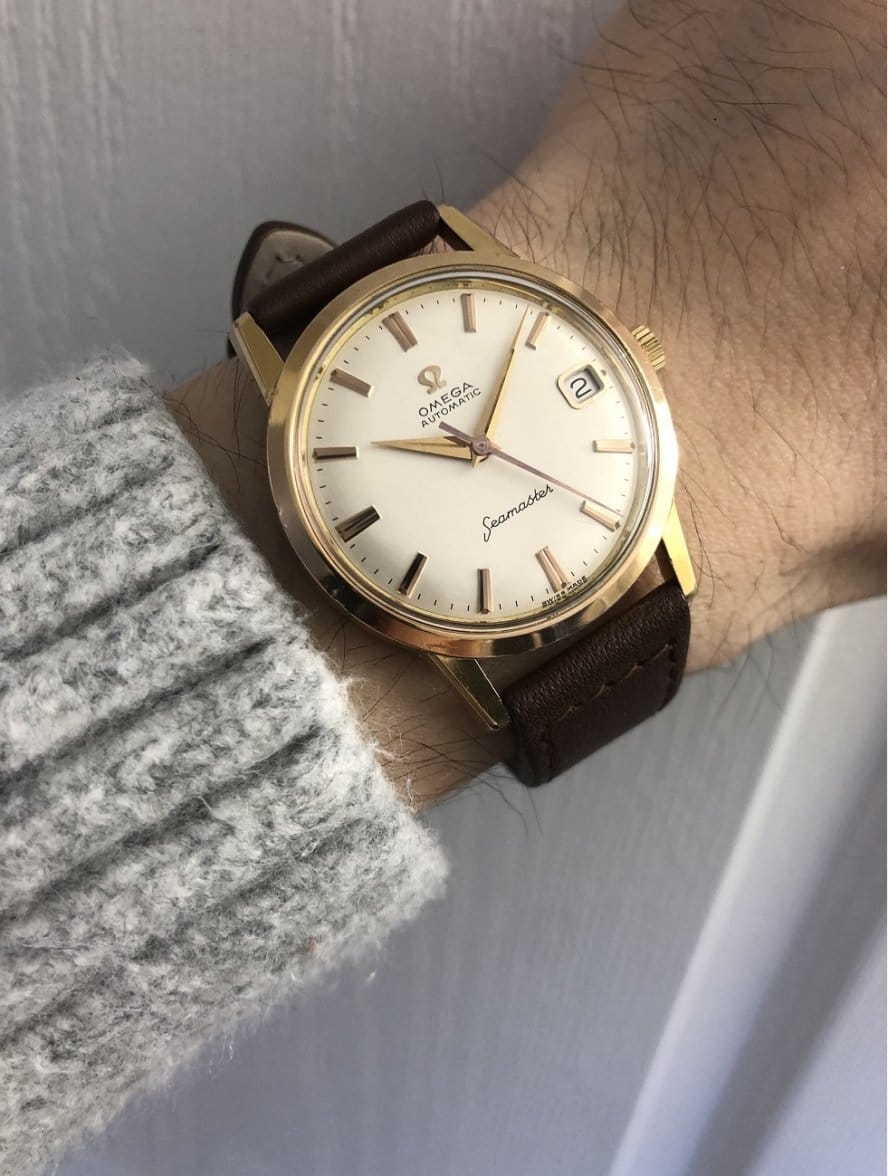
Anniversary Gift Help: OPTIONS 3-5 – Vintage Seamaster for a
TECHNICAL SPECIFICATIONS
Case Construction Details:
The F6249’s gold-filled case represents sophisticated mid-century manufacturing. The 14K gold layer bonds permanently to the base metal through heat and pressure, creating a composite that wears remarkably well when properly cared for. Quality gold-filled cases from this era typically feature gold layers 50-100 times thicker than electroplating, explaining their longevity.
Distinctive Features:
- “Beefy Lugs” Design: The F6249 features the characteristic robust, downward-sweeping lugs that define 1950s Seamaster aesthetics. These substantial lugs create visual presence that belies the watch’s modest 34.5mm diameter.
- Small Seconds Sub-Dial: Unlike center-seconds Seamasters (designated “SC”), the F6249 features a small seconds sub-dial at 6 o’clock. This traditional complication appealed to conservative watch enthusiasts who associated small seconds with precision timepieces.
- Signed Crown: Period-correct Omega-signed crowns feature either the clover-leaf or flat-foot Omega logo.
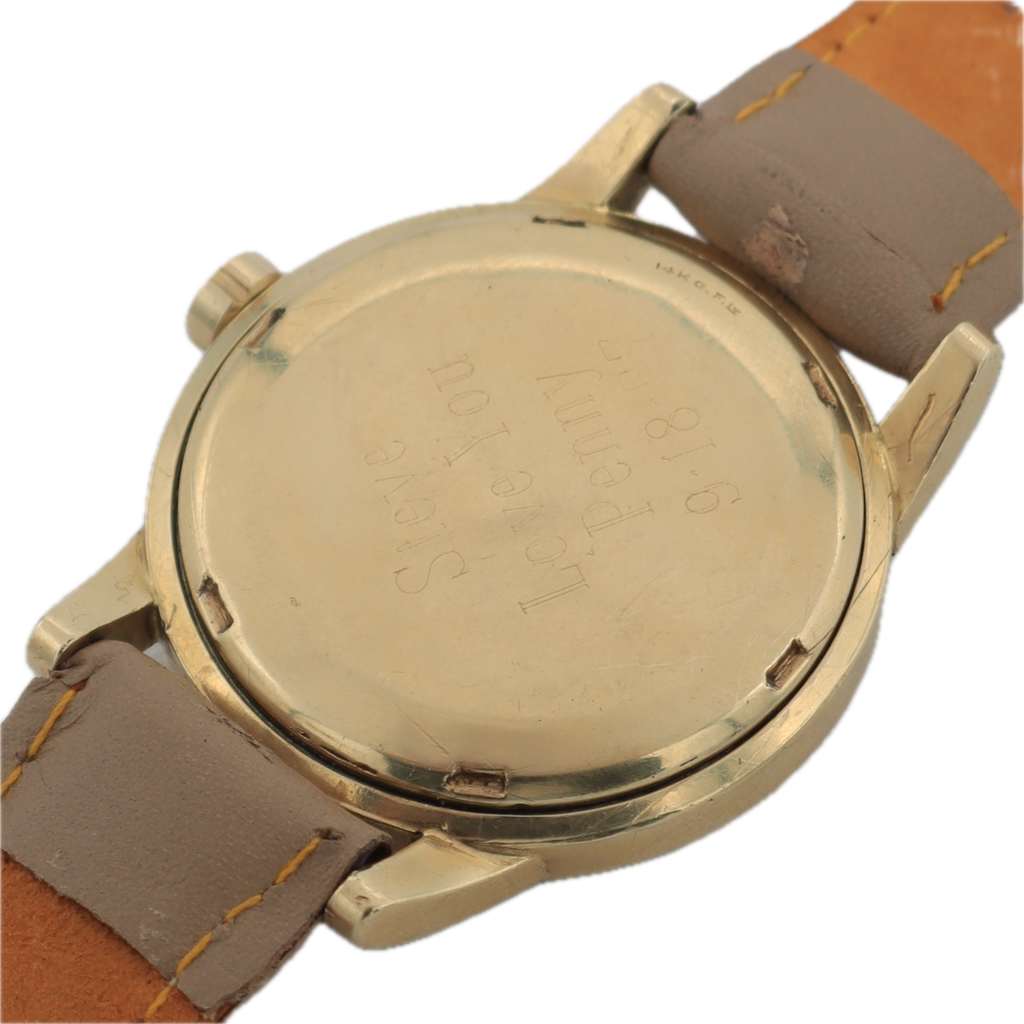
Case Markings:
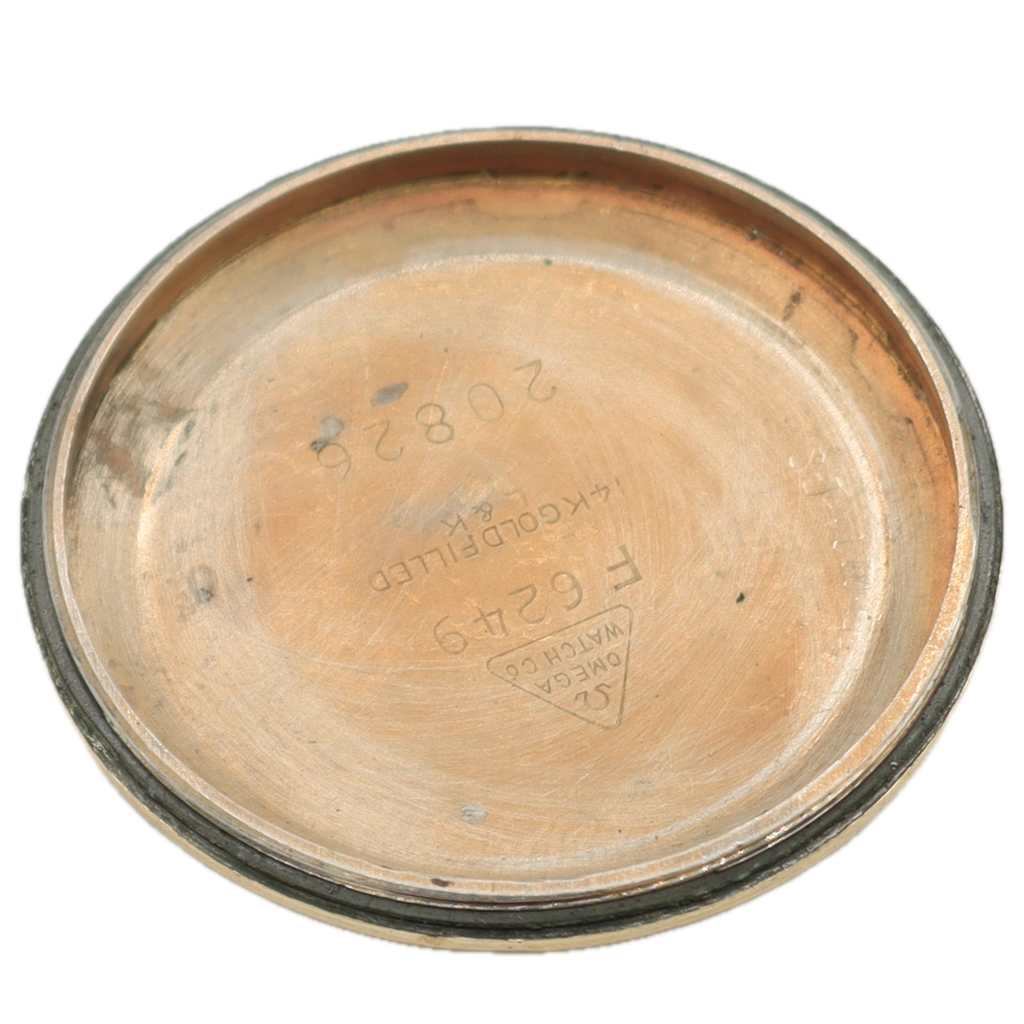
Interior case back markings typically include:
- “14K GOLD FILLED” or “14K G.F.” stamped between lugs or on case back
- Case reference: “F6249”
- Movement serial number
- Case maker marks (varies by manufacturer)
- “SEAMASTER” engraved on exterior case back (some examples)
Unlike solid gold cases which display hallmarks, gold-filled cases carry the “14K GOLD FILLED” designation as their authentication mark.
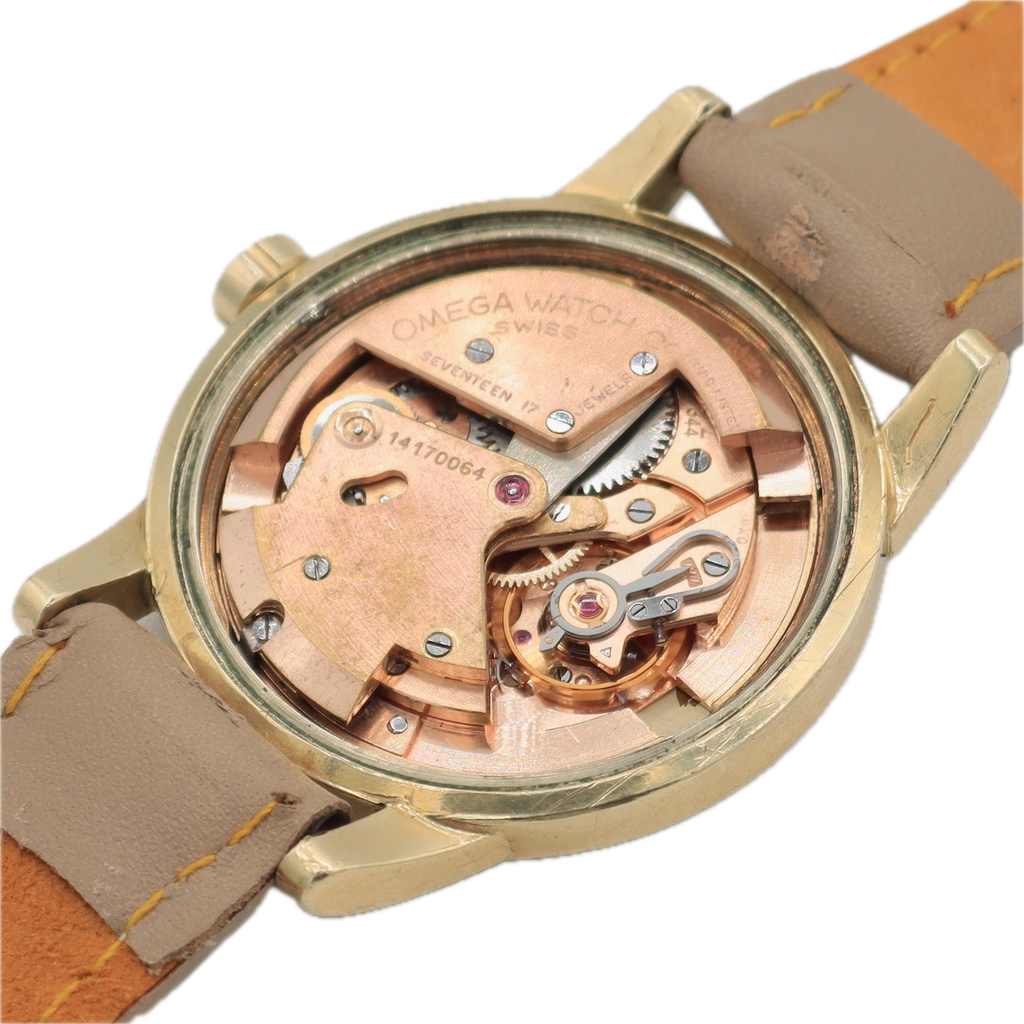
Vintage Omega F6249 Seamaster Men’s Bumper Automatic
MOVEMENTS/CALIBERS
The F6249 housed two primary bumper automatic calibers during its production run: the Omega caliber 344 (most common) and caliber 343 (less frequent).
Omega Caliber 344
Technical Characteristics:
The caliber 344 represents refined bumper automatic technology. The movement features a semi-circular rotor that oscillates approximately 200-270 degrees before striking spring-loaded bumpers at each terminus. This distinctive mechanism creates the characteristic “thunk” sensation when shaking the watch—a tactile signature that enthusiasts cherish.
- Copper-tone rhodium plating on bridges
- Circular Côtes de Genève decoration on select surfaces
- Blued screws on certain components
- Movement signed “OMEGA WATCH CO SWISS”
- “SEVENTEEN 17 JEWELS” engraving
- Excenter regulator for precision adjustment
Relationship to Other Calibers:
The caliber 344 descended from Omega’s earlier bumper movements:
- Cal. 330-333: First-generation bumper movements (late 1940s)
- Cal. 342-343: Early Seamaster bumpers
- Cal. 344: Refined version with improved regulation
- Cal. 350-355: Related bumper calibers with various features
Many parts interchange between these calibers, which aids serviceability.
Omega Caliber 343
The caliber 343 occasionally appears in F6249 examples. Specifications closely mirror the 344, with minor differences in regulation systems and finishing. Both calibers deliver comparable performance and reliability when properly serviced.
Service Considerations:
Bumper movements require watchmakers familiar with their unique construction. Common service issues include:
- Worn bumper springs (reduces winding efficiency)
- Dried lubricants affecting amplitude
- Worn ratchet wheels causing slipping
- Loose movement clamp pins
Parts Availability:
Parts for calibers 343/344 remain available through specialist suppliers, though sourcing has become more challenging. Many components interchange with related calibers (330-355 series), expanding sourcing options. Service costs typically range $350-$650 for complete overhaul by experienced watchmakers.
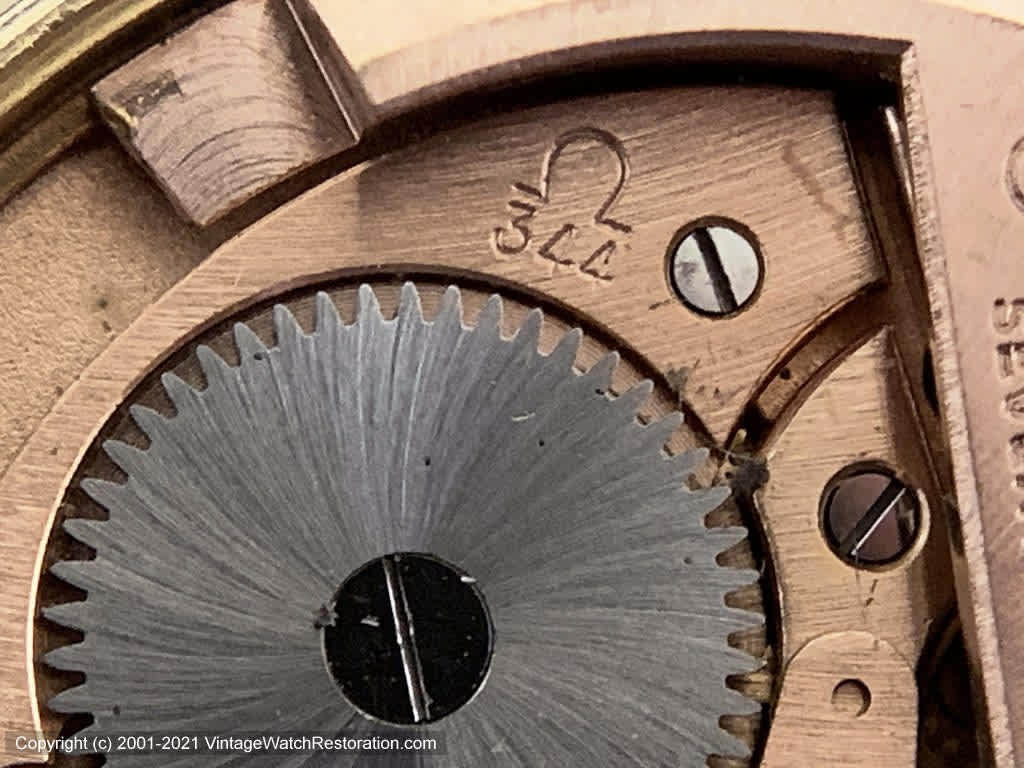
Omega Silver Dial Cal 344 Bumper, Automatic, 33mm
DIAL VARIATIONS
The F6249 appeared with several dial configurations, all unified by the small seconds sub-dial at 6 o’clock.
Dial Colors & Finishes
Silver/Silvered Dials
The most common configuration features a silvered or white dial surface with applied gold-toned hour markers. Original examples develop gentle patina ranging from cream to light champagne tones over decades. This even aging—distinct from damage—adds character and authenticity.
Champagne/Gold Dials
Warm-toned dials in various champagne and gold hues appeared throughout production. These dials harmonize beautifully with the gold-filled case, creating cohesive warm-toned presentation.
“Tropical” Dials
Some examples have developed pronounced tropical patina—dial discoloration caused by UV exposure and age. While controversial, many collectors prize evenly-developed tropical patina as evidence of authentic aging.
Black Dials
Black dial F6249 examples exist but require careful authentication. Many black-dial vintage Omegas feature refinished dials or service replacements. Authentic period black dials should show appropriate aging patterns and correct printing.
Dial Elements
Hour Markers:
- Applied gold-toned indices: Most common style, featuring dart or arrowhead-shaped markers
- Applied faceted daggers: Elegant multi-faceted markers catching light beautifully
- Breguet numerals: Some examples feature applied Arabic numerals at 3, 6, 9, and 12
All applied elements should exhibit period-appropriate construction with visible mounting pins or solder points.
Dial Text:
- “OMEGA” applied metal logo at 12 o’clock
- “AUTOMATIC” printed below logo
- “SEAMASTER” text (varies by example—some dials omit “SEAMASTER”)
- “SWISS” or “SWISS MADE” at bottom
Small Seconds Sub-Dial:
The defining feature of the F6249 is its small seconds register at 6 o’clock. The sub-dial typically features a simple minute track with minimal decoration, maintaining the watch’s clean, legible aesthetic.
Hands
Dauphine Hands
The F6249 overwhelmingly features dauphine-style hands—elegant tapered hands with diamond-shaped profiles. Original hands should:
- Match dial metal finish (gold hands with gold indices)
- Show appropriate aging consistent with dial condition
- Feature proper proportions relative to dial size
Luminous Material:
Original examples contain radium luminous compound on hands and indices. This material develops cream-to-tan patina over 70+ years. The presence of tritium indicators (“T SWISS T”) on an F6249 dial signals a service replacement, as tritium adoption occurred after this reference’s production.
Vintage Omega F6249 Seamaster Men’s Bumper Automatic
CASE & BEZEL VARIATIONS
Understanding the F6249’s gold-filled construction is essential for authentication and preservation.
Gold-Filled Case Construction
Manufacturing Process:
14K gold-filled cases feature a substantial layer of 14K gold mechanically bonded to a base metal core through heat and pressure. The gold layer comprises approximately 5% of the total case weight—significantly more substantial than electroplating’s microscopic coating. This thickness allows for moderate polishing and maintains appearance across decades.
- Visual appearance indistinguishable from solid gold
- Substantially more durable than gold plating
- Allows for complex case shapes with sharp edges
- More affordable than solid gold
- Excellent longevity when properly maintained
Wear Patterns:
Gold-filled cases exhibit predictable wear patterns after 70+ years:
- Lug edges: Most vulnerable to wear-through, especially tips of beefy lugs
- Bezel edges: High points show thinning of gold layer
- Case back edges: Contact with surfaces causes accelerated wear
- Crown interaction points: Repeated contact creates localized wear
Examining these high-wear areas reveals whether the watch received excessive polishing or sustained heavy use. Sharp, well-defined lug bevels indicate careful preservation, while rounded, “blobby” edges signal over-polishing.
Case Design Elements
Beefy Lugs:
The F6249’s defining aesthetic feature is its robust, downward-sweeping lugs. These substantial lugs extend dramatically from the case, creating visual presence that makes the 34.5mm case wear larger than its dimensions suggest. When unpolished, these lugs feature sharp bevels and crisp facets that catch light beautifully.
Bezel:
Smooth, polished bezel with subtle bevel at edge. The bezel integrates seamlessly with the case top, maintaining clean lines characteristic of 1950s dress watch design.
Crown:
Original Omega-signed crowns feature period-appropriate designs including the clover-leaf style. The crown should screw smoothly without excessive play. Replacement crowns are common—verify correct style for the period.
Case Back:
- “SEAMASTER” engraved at 12 o’clock (some examples)
- Omega logo or hippocampus medallion (varies)
- Plain case backs also common
Interior markings should include:
- “14K GOLD FILLED” or “14K G.F.”
- Case reference “F6249”
- Movement serial number
- Case maker marks
- “FAB SUISSE” or “SWISS MADE” (some examples)
The absence of solid gold hallmarks confirms gold-filled construction. Solid gold cases display assay marks (14K or 585), while gold-filled pieces carry the “GOLD FILLED” designation.
BRACELET & STRAP OPTIONS
Original bracelets rarely survive on F6249 examples, as gold-filled bracelets experienced heavy wear and were often replaced during the watch’s working life.
Period-Correct Options
Gold-Filled Expansion Bracelets
Some F6249 examples were sold with gold-filled expansion bracelets featuring brand markings like Speidel or Kreisler. These period accessories complemented the watch’s dressy aesthetic but typically show substantial wear.
Leather Straps
Most F6249 examples today wear leather straps in appropriate widths (18mm). Period-appropriate choices include:
- Black or brown calfskin
- Crocodile-grain leather
- Honey or oxblood tones complementing the gold case
- Vintage-style buckles, preferably gold-plated or gold-filled
Original Omega-signed buckles add authenticity but are increasingly rare.
IDENTIFYING ORIGINAL vs. REPLACED PARTS
Authentication is crucial when evaluating F6249 examples, as the market contains watches with refinished dials, incorrect movements, and mismatched components.
Dial Authentication
Original dial characteristics:
- Crisp, even printing with consistent line weights
- Applied metal Omega logo with sharp definition
- Period-appropriate patina showing even aging
- Correct font styles matching documented examples
- “SWISS MADE” or “SWISS” at bottom (except service dials)
- Proper alignment of all elements
Red flags for refinished/replaced dials:
- Overly pristine appearance inconsistent with 70+ year age
- Uneven surface texture or bubbling
- Incorrect font styles or spacing
- Missing or poorly executed applied logos
- Evidence of repainting under magnification
- Crosshairs (if present) in wrong positions
The F6249 dial discussion forum documents numerous examples of refinished dials, emphasizing the prevalence of this issue. Refinished dials reduce value by 50-70% compared to original examples.
Hands Authentication
- Match case and dial metal finish (gold hands with gold case/indices)
- Show appropriate lume aging if luminous
- Fit proportionally to dial size
- Display period-correct dauphine styling
- Metal finish mismatched to dial
- Modern luminous materials
- Incorrect hand styles for the period
- Disproportionate sizing
Movement Authentication
- F6249 should house caliber 343 or 344
- Movement serial number should align with 1952-1956 production dates
- Movement signatures and jewel count markings should be correct
Dating by movement serial number:
- 12,000,000-12,999,999: 1950-1952
- 13,000,000-13,999,999: 1952-1954
- 14,000,000-14,999,999: 1954-1956
- 15,000,000-15,999,999: 1956-1958
Most F6249 examples carry serial numbers between 13,800,000-15,200,000.
Incorrect movements sometimes result from watchmaker substitutions during service. Always verify the movement matches expected calibers and production dates.
Case Condition Assessment
Gold-filled specific concerns:
Examine wear patterns:
- Lug tips and edges for gold layer thinning
- Bezel high points for wear-through
- Case back edges for base metal exposure
- Crown interaction areas for localized wear
Assess polishing:
- Sharp lug bevels indicate minimal polishing
- Rounded edges suggest over-polishing
- Inconsistent gold tone across surfaces may indicate worn areas
Gold-filled vs. Gold-plated:
Understanding the distinction is crucial:
- Gold-filled: Substantial gold layer, “14K G.F.” marking, allows moderate polishing
- Gold-plated: Microscopic gold layer, “Gold Plated” or micron marking, wears quickly
F6249 cases are gold-filled, not plated. Significant base metal exposure indicates either extreme wear or over-polishing.
Vintage Omega F6249 Seamaster Men’s Bumper Automatic
COLLECTOR NOTES & MARKET CONTEXT
Current Market Positioning
The F6249 occupies an appealing niche in the vintage Omega market: authentic, historically interesting, and attractively priced relative to comparable steel or solid gold references.
Approximate value ranges (2024-2025 market):
Value modifiers:
- Refinished dial: -50% to -70%
- Over-polished case with worn gold layer: -30% to -50%
- Incorrect movement: -40% to -60%
- Significant gold wear-through at lugs: -20% to -40%
- Complete tropical patina (desirable): +20% to +40%
- Original box and papers: +30% to +50%
Investment Perspective
The F6249 represents value rather than aggressive appreciation potential. While vintage Omega watches have shown steady appreciation, gold-filled references trail steel and solid gold counterparts in collector demand.
Bullish factors:
- Growing appreciation for 1950s dress watch aesthetics
- Distinctive beefy lug design increasingly sought by collectors
- Limited surviving examples in excellent condition
- Bumper movement charm appeals to mechanical watch enthusiasts
- Relatively affordable entry into vintage Omega collecting
Risk factors:
- Gold-filled cases require careful preservation—damage is irreversible
- Bumper movements need specialized service knowledge
- Market flooded with refinished dials and incorrect parts
- Limited name recognition compared to sports models
- Service costs ($350-$650) represent significant percentage of value
Collecting Strategy
Prioritize:
- Original, unrefined dials – Worth 2-3x refinished equivalents
- Sharp, unpolished cases with minimal gold wear – Gold layer preservation critical
- Correct caliber 343/344 with appropriate serial numbers – Authentication essential
- Complete tropical patina – If evenly developed, adds character and value
- Period-correct dauphine hands matching dial finish – Often replaced during service
- Documentation and provenance – Box, papers, service records enhance value
Common pitfalls:
- Assuming all gold-toned cases are gold-filled – Verify markings
- Overlooking gold wear-through – Examine lug tips carefully
- Buying refinished dials unknowingly – Study authentic examples extensively
- Accepting inappropriate hands – Should match dial metal finish
- Missing incorrect caliber – Verify 343 or 344
- Underestimating service costs – Budget for eventual overhaul
What Drives Premiums
Dial condition and originality: Original, well-preserved dials with attractive patina command significant premiums. Evenly-developed tropical patina is particularly desirable.
Case preservation: Sharp, unpolished cases with minimal gold wear represent increasingly rare finds. The beefy lugs should retain crisp bevels and facets.
Complete originality: All-original examples (dial, hands, movement, crown) in excellent condition are becoming scarce.
Provenance: Presentation watches, corporate gifts, or examples with documented history add interest.
Rare dial configurations: Breguet numeral dials and certain tropical patina examples command premiums.
Comparison to Related References
vs. CK 2767 (steel, center seconds):
The stainless steel CK 2767 shares the beefy lug design but features center seconds and steel construction. Market values for steel examples in comparable condition exceed the F6249 by 20-40%, reflecting collector preference for steel and center seconds complications.
vs. F6231 (smaller gold-filled):
The F6231 predates the F6249 slightly and measures smaller (approximately 33mm). Both share gold-filled construction and bumper movements. Values are comparable, with dial condition and case preservation determining premiums rather than reference number.
vs. F6212 (earlier gold-filled):
The F6212 represents an earlier, smaller iteration (32-33mm) with removable bezel. It appeals to collectors seeking more compact proportions. Values trend 10-20% below F6249 equivalents due to smaller size.
vs. Solid gold Seamasters (OT series):
Solid 18K gold Seamasters from this era command substantial premiums—typically 2-4x the F6249’s value in comparable condition. The gold content alone justifies much of this premium, but collector prestige also drives the differential.
CONCLUSION
The Omega Seamaster F6249 embodies an elegant paradox: a watch designed for the American market that remained distinctly Swiss in its mechanical sophistication and finishing standards. Its 14K gold-filled case delivered luxury’s visual warmth at accessible pricing, while its bumper automatic heart provided the reliable precision Omega built its reputation upon.
For contemporary collectors, the F6249 offers compelling entry into mid-century Omega collecting. Its modest 34.5mm dimensions suit modern sensibilities better than many oversized vintage pieces, while the beefy lugs provide wrist presence that transcends the case diameter. The small seconds sub-dial lends traditional elegance, and the gold-toned case complements virtually any attire from business suits to casual weekend wear.
The collector’s challenge—and reward—lies in locating well-preserved examples. Seven decades of wear have taken their toll on gold-filled cases, and the refinishing epidemic has compromised countless dials. Patient collectors who study authentic examples, understand period-correct details, and insist on originality will find the F6249 delivers exceptional value: a genuine Swiss luxury timepiece with fascinating American-market history, powered by one of horology’s most charming movement technologies.
As the vintage watch market matures and collectors increasingly appreciate nuanced references beyond the celebrated icons, the F6249’s combination of attributes—historical interest, mechanical charm, distinctive aesthetics, and relative affordability, positions it as an intelligent acquisition. This is a watch that rewards knowledge over fashion, patience over impulse, and appreciation of horological subtlety over brand recognition. For those seeking authentic mid-century character without six-figure investment, the Omega Seamaster F6249 represents one of vintage watchmaking’s most compelling value propositions.