

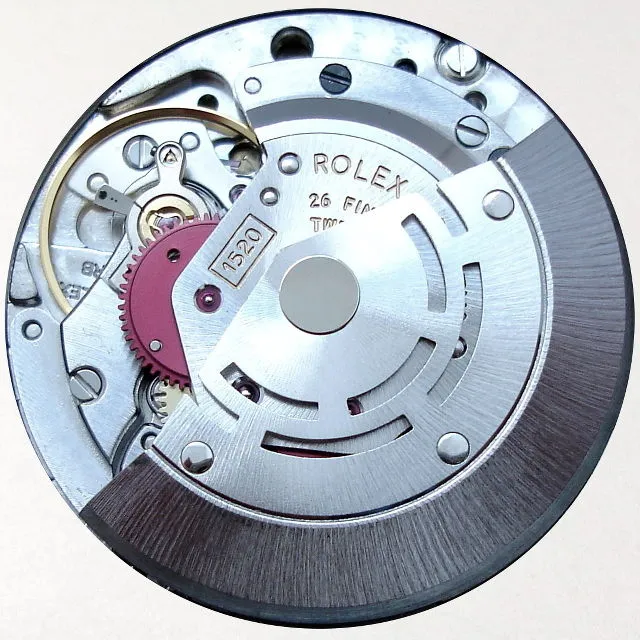
The Rolex Caliber 1520 powered some of the most iconic tool watches in horological history, including the legendary Submariner 5513 and the workhorse Air-King 5500, yet it remains one of Rolex’s most misunderstood movements. Introduced in 1963 as a cost-engineered alternative to the Caliber 1530, the 1520 represented an unusual backwards step for a company known for relentless progress, trading the Microstella regulating system and Breguet overcoil hairspring for simpler, cheaper solutions. Despite these compromises, the 1520 delivered exceptional reliability and became the heartbeat of Rolex’s non-chronometer “Precision” models for nearly two decades.
The caliber’s core identity centers on pragmatic engineering. Running at 19,800 vph, faster than its 18,000 vph predecessor, the 1520 offered improved shock resistance and timekeeping stability while maintaining Rolex’s reputation for robust construction. The movement employs a screwless balance wheel regulated by two inertia blocks rather than the sophisticated Microstella screws found on chronometer-grade calibers, making it simpler to manufacture and service while still delivering accuracy that satisfied professional dive watch requirements.This was a precision movement in the truest sense, built for daily reliability rather than observatory-grade performance.
Production volume estimates place the 1520’s total output between 500,000 and 750,000 units across its 17-year run, based on the serial number ranges of watches known to contain the caliber. The Submariner 5513 alone was produced from 1962 to 1989, with the 1520 serving as its primary movement from approximately 1963 to 1980. The Air-King 5500 ran from 1957 to 1989, with the 1520 replacing the earlier 1530 around 1963-1965.These two references account for the majority of 1520 production, with smaller quantities appearing in other Precision-grade models. The caliber is common among vintage Rolex movements, though finding examples in excellent mechanical condition becomes increasingly difficult as these watches approach 50-60 years of age.
The 1520 occupies a stable position in the current collector market, valued primarily for its presence in desirable vintage references rather than for the movement itself. Submariner 5513 values have appreciated substantially, with clean examples commanding $8,000 to $15,000 depending on dial variant and condition. Air-King 5500 models remain more accessible at $3,000 to $6,000, representing entry-level vintage Rolex. Watchmakers consistently praise the 1520 for ease of service and parts availability, factors that support long-term collectibility. Demand remains steady rather than rising, with condition and originality driving premiums rather than movement specifications.
Historical Context, Provenance, and Manufacturing Details
Rolex introduced the Caliber 1520 in 1963 to address a specific market need: reliable automatic movements for non-chronometer watches that could be manufactured at lower cost than chronometer-grade calibers. The company faced pressure to maintain price points on its “Precision” line while still delivering the performance expected of the Rolex name. The solution was to redesign the successful Caliber 1530, introduced in 1957, by eliminating its most expensive features while retaining its fundamental architecture and increasing the beat rate for improved performance.
The 1520 evolved directly from the Caliber 1530, sharing the identical base plate and bridge layout but incorporating several key changes. Where the 1530 used a Breguet overcoil hairspring, the 1520 employed a flat hairspring. The Microstella regulating system was replaced with a traditional index regulator. The screwed balance wheel gave way to a screwless design with two inertia blocks for fine adjustment. Initially released in 17-jewel configuration to avoid US import tariffs, the caliber was also produced in 26-jewel versions for international markets.The beat rate increased from 18,000 vph to 19,800 vph, providing better shock resistance and accuracy potential despite the simplified regulating mechanism.
The Caliber 3000, introduced in 1977 and running at 28,800 vph, began replacing the 1520 across Rolex’s lineup starting around 1980. The 3000 series represented a generational leap: higher frequency, improved shock protection, and updated architecture that would carry Rolex into the modern era. The 1520 was fully phased out by 1980, ending a 17-year production run.
The 1520 was manufactured entirely in-house at Rolex’s facilities in Biel/Bienne, Switzerland, where the company had consolidated movement production in the 1950s. Unlike many Swiss manufacturers that relied on ebauche suppliers like ETA or AS Schild, Rolex produced the 1500 family movements from raw materials to finished calibers under one roof, controlling every aspect of quality and performance. No changes in production location occurred during the caliber’s lifespan.
Within the broader context of horological history, the 1520 represents a pragmatic approach during a transitional period. While competitors pursued chronometer certification and increasingly sophisticated complications, Rolex maintained a tiered product line where non-chronometer movements like the 1520 served professional tool watch applications without the expense of COSC testing. This strategy allowed the brand to offer robust, reliable watches at accessible price points while reserving chronometer movements for premium models. The 1520 proved that excellent timekeeping did not require observatory-grade adjustments, a philosophy that served professional users well.
Construction and Architecture
Plate and Bridge Layout
The Caliber 1520 employs a three-bridge architecture typical of the Rolex 1500 family. The main plate, measuring 28.5mm in diameter, is constructed from rhodium-plated brass and features the semi-circular cut-out necessary for the automatic winding system. A substantial barrel bridge secures only the mainspring barrel, allowing easy access during service. The train wheel bridge covers all gear train components in a single unit, simplifying assembly and improving rigidity. The third bridge carries the balance cock, which supports the balance wheel assembly. This layout prioritizes serviceability and durability over decorative finishing, reflecting the caliber’s tool watch mission.
Balance Wheel
The 1520 uses a screwless Glucydur balance wheel approximately 9.5mm in diameter. Unlike chronometer-grade Rolex movements with 18 timing screws, the 1520 balance wheel is smooth with no adjustment screws, relying instead on two inertia blocks positioned on opposite sides of the wheel for fine regulation. One block is gold-colored (brass), the other white (nickel-plated), making them visually distinct during adjustment. These blocks can be rotated using a fine blade: directing the split toward the center slows the rate, while rotating outward increases the rate. The maximum adjustment range is approximately 10 seconds per 24 hours from one extreme to the other, with larger corrections made via the regulator.

Balance Spring (Hairspring)
The caliber employs a flat hairspring rather than the Breguet overcoil found on chronometer-grade movements. The spring is manufactured from Nivarox or similar paramagnetic alloy, providing temperature compensation and resistance to magnetism. While the flat configuration is simpler to produce and less expensive than an overcoil, it is more susceptible to positional errors and does not breathe as concentrically as a properly formed Breguet spring. This represents one of the key cost-reduction measures that distinguish the 1520 from its chronometer-rated siblings. The hairspring attaches to the collet in conventional pinned fashion.
Escapement Type
The 1520 uses a Swiss lever escapement with a traditional club-tooth escape wheel. The escape wheel has standard dimensions with pallet stones in the fork made from synthetic ruby. This is the same escapement design used across Rolex’s product line during this era, proven reliable across millions of watches. The escapement is not the later Clinergic type, which appeared in smaller ladies’ calibers like the 2030. No special innovations appear in the 1520’s escapement, which follows conventional Swiss lever principles with proper draw angles and lock on both entry and exit pallets.
Shock Protection System
The caliber employs Incabloc shock protection on the balance wheel pivots, both upper and lower. The Incabloc system uses a spring-mounted jewel setting that absorbs impacts by allowing the jewel to move vertically when subjected to shock, then return to center position. The specific Incabloc type used is the standard Swiss system with the characteristic lyre-shaped spring. Part number for the upper shock absorber is 8065. The escape wheel also features shock protection on the upper pivot, an unusual feature typically reserved for the balance wheel. This additional protection reflects the movement’s tool watch application where shock resistance was paramount.
Regulator Type
The 1520 uses a traditional index regulator with a movable stud holder for beat adjustment. The regulator consists of two pins (sometimes with small ruby pins) that embrace the active length of the hairspring, with movement of the regulator shortening or lengthening the effective hairspring length to adjust rate. The regulator features a scale marked fast/slow with gradations allowing approximation of adjustment magnitude. This system, while simpler and less expensive than the Microstella free-sprung approach, requires more skill to adjust properly and is more susceptible to rate changes from shock. Combined with the inertia blocks, the system provides adequate adjustment range for non-chronometer accuracy standards.
Mainspring Material and Type
The mainspring is a white alloy steel spring designed for automatic winding applications, stronger and more compact than traditional blued steel springs. Rolex part number B7825-Y1 serves calibers 1520, 1525, 1530, and other 1500-family movements. The spring features a slipping bridle attachment to the barrel wall, allowing it to slip at full wind rather than applying excessive force to the gear train. The mainspring measures approximately 1,680mm in length when fully extended and develops sufficient torque to provide the caliber’s 42-hour power reserve. Material specifications indicate thickness of 0.125mm to 0.128mm, appropriate for the 19,800 vph frequency.
Gear Train Details
The gear train consists of four wheels plus the escape wheel, following conventional Swiss practice. The center wheel is decentered rather than directly under the barrel, a design requiring an additional intermediate wheel but allowing for the large diameter barrel necessary for extended power reserve. The fourth wheel drives the seconds hand directly through the center of the movement, providing the sweep seconds function. Gear ratios are calculated to produce exactly 19,800 beats per hour from the escapement. The third wheel features particularly fine pinion leaves, and watchmakers note that worn pinions here are a common failure point in high-mileage examples. All wheels run in jeweled bearings.
Finishing Quality and Techniques
The 1520’s finishing is utilitarian rather than decorative, reflecting its positioning as a non-chronometer movement. The main plate features circular graining (perlage) on both sides, applied by rotating abrasive pads. The pattern is regular but not exceptional by haute horlogerie standards. Bridges receive a similar circular grain finish rather than Geneva stripes (Côtes de Genève). Screw heads are polished but not mirror-finished. Wheel edges are deburred but not beveled or polished. The barrel and ratchet wheels show a fine satin finish from machining. No black polishing, hand-applied anglage, or gold chatons appear. This level of finishing was standard for tool watch movements of the era and in no way impairs function, but collectors seeking highly decorated movements should look elsewhere.
Cross-Reference Data
Alternative Caliber Names (Rebranded Versions)
| Manufacturer | Caliber Designation | Notes |
|---|---|---|
| Rolex | 1520 | Original designation, time-only, no date |
| Tudor | Equivalent movements used Tudor branding but were Rolex-manufactured 1520 calibers in some cases | Functional identity, Tudor-branded |
Base Caliber vs. Elaborated Versions
Compatible Case References by Brand
Dial Compatibility Note
Dial feet positions for the 1520 follow standard Rolex 12.5”’ spacing with feet at approximately 2:00 and 8:00 positions. No date window is present on the 1520 (date function appears on the 1525 variant). Dial compatibility extends to other 1500-series calibers sharing the same plate dimensions, though date window position differs between non-date and date models. Collectors performing restoration should verify original dial specifications for their reference number, as feet positions varied slightly across production years. Hour markers on original dials are either painted (early production, gilt era) or applied (later production).
Crown and Stem Specifications
| Component | Specification |
|---|---|
| Stem Thread | TAP 10 (0.90 mm) |
| Stem Diameter | 0.90 mm |
| Crown Thread | 0.90 mm TAP 10 |
| Setting Mechanism | Keyless works with yoke clutch type |
Rolex part number for the generic winding stem fitting the 1520 is 6947, which is compatible across the entire 1500 family of calibers (1030, 1035, 1520, 1525, 1530, 1555, 1556, 1560, 1565, 1570, 1575, 1580). The stem engages a castle wheel for hand setting and a clutch wheel for winding. Early production 1520 movements did not feature hacking seconds; this function was added during the early 1970s, appearing on movements dated approximately 1972 and later. The hack lever engages the balance wheel rim when the crown is pulled to the setting position, stopping the seconds hand for precise time synchronization.
Identification Marks
Caliber Number Location
The caliber number “1520” is engraved on the hub of the balance wheel, visible when viewing the movement from the balance side. The number is also engraved on the train wheel bridge. Some sources report seeing it engraved on the automatic device bridge, though the primary location remains the balance wheel hub. The engraving is small, requiring magnification to read clearly, and uses a serif typeface typical of Rolex movements from this era.
Logo and Brand Marks
The Rolex coronet logo appears stamped on the rotor (automatic winding weight). The bridges may carry the Rolex name in script, though this varies by production era. No other manufacturer logos should appear on genuine 1520 movements. The Incabloc shock protection device carries the characteristic Incabloc logo on the spring component. Jewel settings in higher-grade examples may show slight brass coloring, though gold chatons are not used on the 1520.
Date Codes
Rolex case backs from the 1520 production era (1963-1980) feature Roman numeral date codes indicating quarter and year of case manufacture. These codes appear stamped inside the case back in the format “I 65” (first quarter 1965), “II 67” (second quarter 1967), etc. The movement itself does not carry specific date codes, though serial numbers on the case between the lugs at 6 o’clock allow approximate dating. Serial numbers from the 1520 era run from approximately 824,000 (1963) through 6,434,000 (1980).
Finishing Marks
Expected finishing patterns include circular graining (perlage) on the main plate visible from both sides, with overlapping circular patterns creating the characteristic fish-scale appearance. Bridges show similar circular graining rather than Côtes de Genève striping. Screw heads are polished with slots cut cleanly. The barrel and ratchet wheel exhibit machined satin finish. Rotor finishing shows radial brushing in a sunburst pattern. These finishes were applied by machine and should appear regular and consistent. Hand-applied finishes, mirror polishing, or Geneva stripes would indicate either incorrect parts or replacement components from higher-grade movements.
Jewel Markings
The 1520 exists in both 17-jewel and 26-jewel configurations. The jewel count appears engraved somewhere on the movement, typically on a bridge or near the balance cock. Jewels are set in pressed brass settings, not in gold chatons. The color ranges from clear (synthetic ruby) to slightly pink, all stones being synthetic corundum. Jewels should show smooth, polished surfaces without chips or cracks. The balance jewels sit within Incabloc shock settings and can be distinguished by the lyre-shaped spring visible around them. Escape wheel jeweling includes both the pallet stones in the fork (synthetic ruby) and the pivot jewels for the escape wheel shaft (also in Incabloc settings on better examples).
Adjustment Markings
The 1520 was not submitted for chronometer certification and therefore carries no COSC or observatory adjustment markings. No stamps indicating tested positions (5 positions, 6 positions) appear on the movement. The absence of such markings is correct and expected for this caliber. Movements marked “Adjusted” or “Adjusted to Temperature” would be unusual and should be verified against other authenticity markers, as such markings typically appear only on chronometer-grade movements like the 1560, 1565, 1570, or 1575.
Correct Serial Number Formats and Locations
Rolex serial numbers from the 1520 production era (1963-1980) appear engraved on the case between the lugs at the 6 o’clock position. To view this number, the bracelet must be removed. Serial numbers from this period are purely numeric, ranging from approximately 824,000 (1963) to 6,434,000 (1980). Format consists of 6-7 digits with no letters or prefixes. The engraving is clean and crisp, applied by precision stamping equipment. Font is a sans-serif style with consistent depth and spacing.
Expected Engravings and Stampings
Genuine 1520 movements will display the following engravings:
- “1520” on the balance wheel hub and/or train wheel bridge
- Rolex coronet on the rotor
- Jewel count (“17 JEWELS” or “26 JEWELS”) engraved on a bridge
- “SWISS” or “SWISS MADE” on the movement, typically near the balance or on the rotor
- Part numbers on individual components (7825 on mainspring, 8055 on balance complete, etc.)
Engraving depth should be consistent and moderate, not overly deep or shallow. The style is utilitarian without decorative flourishes. Any engravings that appear hand-scratched, use inconsistent fonts, or include information not typical of the era (such as modern part numbers or service marks in inappropriate locations) warrant closer inspection.
Font and Marking Style by Production Era
Early production (1963-1968): Engravings tend to be slightly finer and more delicate, with serif fonts occasionally appearing on component part numbers. The Rolex coronet on the rotor may be slightly smaller and more detailed.
Mid production (1968-1975): Standardized sans-serif fonts become universal. Engraving depth increases slightly for durability. The coronet logo stabilizes in size and detail level.
Late production (1975-1980): Fonts and engraving techniques remain consistent with mid-production. No significant changes in marking style occurred during this period, though component suppliers occasionally changed, leading to minor variations in supplier part markings (not affecting Rolex’s own stampings).
No dramatic transitions in branding or logo design occurred during the 1520’s production run, making font analysis a relatively weak authentication method compared to examining overall construction quality, finishing patterns, and component compatibility.
Part Information

Part Numbers and Interchangeability
Sourcing Notes
Parts availability for the Rolex Caliber 1520 remains good despite production ending over 40 years ago. Several factors support this:
Generic Parts: Many components are available as Swiss-made generic replacements that meet or exceed original specifications. Mainsprings, stems, gaskets, and some jeweled components are readily available from suppliers like Esslinger, Cas-Ker, and Jules Borel. These parts work reliably and cost significantly less than NOS (new old stock) Rolex factory parts.
Factory Parts: Genuine Rolex parts for the 1500 family, including the 1520, remain available through authorized Rolex service centers and specialized vintage parts dealers. However, Rolex restricts parts sales to authorized watchmakers and service centers, making direct consumer purchase difficult. Prices for genuine Rolex parts significantly exceed generic alternatives. Balance assemblies, escape wheels, and rotors command premium prices when genuine Rolex parts are specified.
Common Failure Points: The most frequent service requirements include:
- Mainspring replacement due to loss of elasticity (occurs every 15-20 years regardless of service frequency)
- Balance staff replacement from impacts or wear
- Barrel arbor bushing wear in the barrel bridge, requiring jeweling or replacement
- Rotor bearing wear from decades of continuous operation
- Escape wheel and pallet fork wear in heavily used examples
- Reversing wheel driver pivots, especially on 17-jewel versions with bushed rather than jeweled pivots
Generic Replacements: Acceptable generic replacements exist for most components except the balance assembly, rotor, and some jeweled wheels. Watchmakers generally recommend genuine balance assemblies to maintain original timekeeping characteristics, as aftermarket balances may differ slightly in weight, moment of inertia, or hairspring characteristics. Mainsprings, stems, shock parts, and basic wheels perform acceptably in generic form.
Obsolescence Risk: No components are truly obsolete or unobtainable, though finding specific variants (such as 17-jewel-specific parts) becomes more difficult. The wide production volume and commonality with other 1500-family calibers ensures continued parts availability for the foreseeable future. Watchmakers report no difficulty servicing 1520 movements given proper access to parts suppliers.
Performance Data
Manufacturer Specifications
Rolex specified the following performance parameters for the Caliber 1520:
Accuracy (new): Not submitted for chronometer certification; no official COSC accuracy specification. As a “Precision” movement, expected accuracy was approximately +/- 10 to 15 seconds per day when new and properly regulated, though no official guarantee was provided.
Positions Tested: Not tested to COSC standards. Internal Rolex testing likely evaluated performance in dial-up, dial-down, and pendant positions, but no specific testing protocol was publicly documented.
Temperature Compensation: Yes. The Glucydur balance wheel and Nivarox-type hairspring provide passive temperature compensation across normal wearing temperatures (approximately 5°C to 35°C). No active temperature compensation system is employed.
Isochronism: Moderate isochronism achieved through proper hairspring design and balance poising. The flat hairspring configuration provides less optimal isochronism than a Breguet overcoil, meaning rate may vary slightly between fully wound and nearly exhausted power reserve states. Properly regulated examples show rate variation of 3-5 seconds per day between full wind and end of reserve.
Observed Performance (Field Data)
Based on collector reports, watchmaker observations, and timing machine data from vintage watch dealers:
Typical Accuracy Range (well-maintained examples): Properly serviced 1520 movements commonly achieve +/- 5 to 10 seconds per day accuracy, with exceptional examples running within +/- 3 seconds per day. These figures represent real-world performance in normal wearing conditions, not controlled laboratory testing. The better-than-specification performance reflects Rolex’s conservative rating system and the inherent quality of the caliber’s construction.
Common Performance Issues:
- Positional Variation: The flat hairspring and index regulator system make the 1520 more susceptible to positional rate changes than free-sprung chronometer movements. Rate differences of 10-15 seconds per day between dial-up and pendant positions are not uncommon in well-used examples, though skilled regulation can reduce this to 5-8 seconds.
- Worn Balance Pivots: Decades of service lead to pivot wear, increasing friction and reducing amplitude. Symptoms include stopping in certain positions, irregular rate, and low amplitude readings (below 200 degrees when fully wound).
- Mainspring Degradation: Original mainsprings lose elasticity over 40-50 years, reducing power reserve and amplitude. Watches may run with acceptable accuracy for 24-30 hours then stop, rather than achieving the full 42-hour reserve.
- Dried Lubrication: Age causes lubricants to oxidize and harden, increasing friction throughout the gear train. This manifests as reduced amplitude, irregular rate, and eventual stopping. Complete disassembly, cleaning, and relubrication resolves the issue.
- Barrel Bridge Wear: The brass barrel bridge can wear where the barrel arbor pivots, creating end shake that causes the ratchet wheel to drag on the bridge surface. This results in poor auto-winding efficiency and reduced power reserve. The condition is repairable by jeweling the worn bushing or replacing the bridge.
Expected Amplitude:
- Fully wound, dial-up position: 260-280 degrees (healthy movement)
- Fully wound, pendant-up: 240-260 degrees
- Fully wound, pendant-down: 240-260 degrees
- After 24 hours: 240-260 degrees dial-up
- After 36 hours: 220-240 degrees dial-up
- Near end of reserve (40+ hours): 200-220 degrees
Amplitude readings below 220 degrees when fully wound indicate service requirements. Readings below 180 degrees suggest significant wear or insufficient power delivery.
Beat Error: Properly regulated examples should show beat error below 0.5 milliseconds. Beat error above 1.0 ms indicates the balance is not centered on its impulse jewel or the hairspring collet has shifted, requiring expert correction. The 1520’s movable stud holder allows beat correction without balance removal.
Rate Degradation Over Time: Anecdotal evidence suggests well-maintained 1520 movements lose approximately 1-2 seconds per day of accuracy per decade of service. A movement running at +2 seconds per day when serviced in 1975 might run at +5 to +7 seconds per day by 2000 if not serviced, increasing to +10 to +15 seconds per day by 2025. Regular service every 8-10 years arrests this degradation by addressing wear, replacing lubricants, and adjusting for component changes.
Service Interval Impact: Collectors report that 1520 movements serviced regularly (every 8-10 years) maintain good timekeeping for 50+ years. Movements never serviced or serviced only once in 50 years frequently show amplitude below 180 degrees, irregular rate, and may stop in certain positions. The caliber responds well to proper service, often returning to near-original performance specifications when worn components are replaced.