

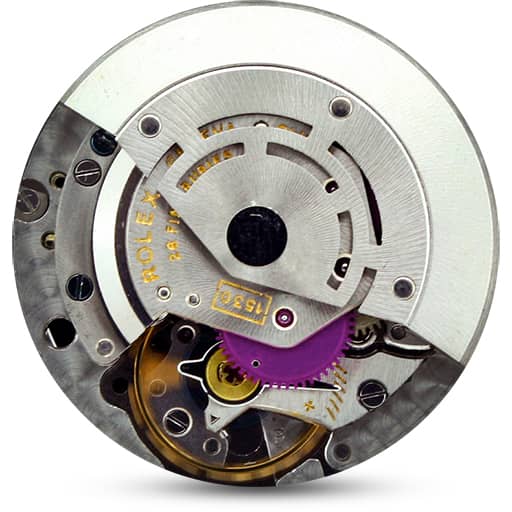
The Rolex Caliber 1530 occupies a peculiar position in horological history: it was the first movement Rolex manufactured entirely in-house as part of the 1500 series, yet it never received chronometer certification. For collectors familiar with Rolex’s obsession with precision, this seems contradictory until you understand the context. The 1530 was technically capable of chronometer-level accuracy, but its screwed balance wheel made consistent regulation across high production volumes nearly impossible without the Microstella system that would arrive later. Rather than compromise on throughput, Rolex deployed the caliber in non-chronometer models like the Air-King 5500 “Super Precision” and early Submariner 5513 references, where precision mattered but certification paperwork did not.
The caliber 1530 represents Rolex’s transitional moment between dependence on external suppliers and complete vertical integration. Prior to the 1500 series, Rolex relied on movements like the 1030, which incorporated components from various Swiss manufacturers. The 1530 changed that, establishing the architectural foundation that would evolve into the legendary 1560 and 1570 chronometer calibers. It featured bidirectional automatic winding via a rotor (initially butterfly-style, later half-moon), a free-sprung Breguet hairspring, yoke winding system, and KIF Flector shock protection. The movement beat at 18,000 vph, lower than the 19,800 vph rate of its successors, giving it a distinctive five-beat-per-second tick rather than the smoother sweep of later calibers.
Production estimates for the 1530 remain imprecise because Rolex phased the caliber in gradually alongside the outgoing 1000 series between 1957 and 1965. Serial number analysis suggests watches housing the 1530 fall roughly between serial numbers 224,000 (1957) and 1,100,000 (1965), though overlap with the 1560 (introduced 1959) and 1520 (introduced 1963) complicates precise attribution. The caliber was produced in three jewel configurations: 17-jewel versions for the U.S. market to avoid punitive import tariffs on higher jewel counts, and 25- or 26-jewel versions for other markets. Early production featured brass auto-winding components that wore prematurely, prompting Rolex to switch to jeweled pivots in the reversing wheels. The butterfly rotor evolved into a half-moon design, and brass gears gave way to red Teflon-coated versions that remain visually distinctive today.
The 1530 occupies an uncommon middle ground in the collector market. It is neither rare enough to command Daytona premiums nor common enough to be dismissed as pedestrian. Watchmakers consistently cite the 1530 as among the best movements Rolex ever produced, praising its robust construction, ease of service, and surprising longevity despite lacking chronometer certification. Collectors seeking a 1530-equipped Air-King 5500 or Submariner 5513 pay attention to dial markings: “Super Precision” denotes the 1530, while “Precision” (without the “Super”) typically indicates the later 1520. Demand for 1530-powered watches has remained steady, with well-maintained examples commanding respectable prices driven more by the watch’s overall condition and provenance than the movement’s specific mystique.
Historical Context, Provenance, and Manufacturing Details
Rolex commenced development of the 1500 series calibers in the mid-1950s to replace the 1000 series movements, which themselves represented Rolex’s first serious attempt at vertical integration. The goal was clear: eliminate dependence on external ébauche suppliers and establish complete control over quality, supply chain, and technological evolution. The Caliber 1530, introduced in 1957, became the foundation stone of this strategy. It served as the base architecture from which Rolex would develop the chronometer-grade 1560 (1959) and 1570 (1965), as well as the cost-optimized 1520 (1963).
The 1530 replaced the Caliber 1030, which had been Rolex’s primary automatic movement since the early 1950s. While the 1030 was reliable, it suffered from wear issues in the auto-winding mechanism where brass components rubbed against each other, creating friction and debris. The 1530 addressed this by incorporating jeweled pivots in the reversing wheels (in 25- and 26-jewel versions), significantly improving durability. However, Rolex also produced a 17-jewel variant specifically for the U.S. market, where import tariffs penalized watches with more than 17 jewels. These lower-jewel movements retained brass bushings in the auto-winding mechanism, which proved less durable and are known among watchmakers for developing play and requiring more frequent service.
The 1530 was not chronometer-certified, a deliberate decision driven by practicality rather than capability. The movement used a traditional screwed balance wheel for rate adjustment, which required painstaking manual regulation to achieve and maintain chronometer standards. Rolex was ramping up production volumes in the late 1950s, and the labor intensity of regulating thousands of screwed-balance movements to within COSC tolerances (-4/+6 seconds per day over 15 days in multiple positions) was economically unviable. The introduction of the Microstella regulating system on the 1560 in 1959 solved this problem, allowing fine adjustments via two star-shaped screws accessible on the balance wheel’s rim. But for the 1530, Rolex simply marketed it as “Super Precision” rather than chronometer-certified, positioning it in the Oyster Perpetual and Air-King lines where certification was not a prerequisite.
The 1530’s successor relationships are worth clarifying because they illuminate Rolex’s product segmentation strategy. The 1560 (1959) was the chronometer-grade evolution of the 1530, incorporating the Microstella system and COSC certification while retaining the 18,000 vph frequency. The 1570 (1965) increased the frequency to 19,800 vph for improved shock resistance and timekeeping stability, and also gained hacking seconds in 1972. Meanwhile, the 1520 (1963) was positioned as a cost-reduced alternative: it ran at 19,800 vph like the 1570 but used a flat hairspring instead of a Breguet overcoil and omitted the Microstella system in favor of a traditional regulator with inertia blocks. The 1530 was gradually phased out by 1965, replaced entirely by the 1560, 1570, and 1520 depending on the watch’s intended market position.
Rolex manufactured the 1500 series entirely in-house at its Geneva facilities, marking a significant shift from the semi-manufactured movements of earlier decades. This vertical integration allowed Rolex to control tolerances, finishing standards, and quality checkpoints throughout the production process. The movement plates and bridges were machined from brass or German silver, finished with perlage on visible surfaces, and fitted with blued screws in later production runs (particularly on the auto-winding bridge). The free-sprung balance featured a Breguet overcoil hairspring, improving isochronism and reducing positional rate variations compared to flat hairsprings. The escapement used traditional Swiss lever design with jeweled pallet stones, and the entire movement was protected by KIF Flector shock absorbers on the balance pivots.
The 1530 represents a brief but critical chapter in Rolex’s evolution from assembler to manufacturer, from craftsman to industrial engineer. It was the movement that proved Rolex could build everything themselves, even if chronometer certification would have to wait for the next generation.
Construction and Architecture
Plate and Bridge Layout: The Caliber 1530 uses a three-quarter plate architecture with separate bridges for the barrel, train, and balance. The mainplate is machined from brass and features circular graining (perlage) on both the dial and movement sides, a finishing technique Rolex applied even to non-chronometer movements. The barrel bridge secures the mainspring barrel, while the train wheel bridge covers the third and fourth wheels. The balance cock is a standalone component, elegantly curved and fitted with the regulator assembly. Early production movements had brass-colored bridges; later versions featured blued screws on the auto-winding bridge, providing both corrosion resistance and visual distinction. The auto-winding mechanism sits above the mainplate, secured by three blue screws that became a hallmark of Rolex automatic calibers.
Balance Wheel: The 1530 employs a screwed balance wheel, Rolex part number 7855, constructed from Glucydur (a beryllium-copper alloy) for temperature stability. The balance features 18 screws around its rim, including two regulating screws with slotted heads for timing adjustments when the movement is uncased. Later production incorporated Microstella screws (two gold-colored star-shaped regulators), allowing fine adjustment while the watch is fully assembled and cased. The Microstella system provided graduations corresponding to approximately one second per division, making regulation more precise and repeatable than traditional methods. The balance diameter and inertia were optimized for the 18,000 vph frequency, resulting in a larger, slower-beating balance compared to the higher-frequency 1570.
Balance Spring (Hairspring): The 1530 uses a free-sprung Breguet overcoil hairspring, a significant upgrade over flat hairsprings used in earlier movements. The Breguet overcoil features a terminal curve that elevates the outermost coil above the body of the spring, allowing the hairspring to breathe concentrically and reducing positional rate variations. The hairspring is attached to a collet on the balance staff and terminates at a stud holder mounted on the balance cock. Rolex manufactured these hairsprings from Nivarox or similar paramagnetic alloys, providing resistance to magnetism and temperature variations. The free-sprung design (no regulator pins touching the hairspring) eliminates friction and improves long-term rate stability, though it makes timing adjustments more labor-intensive since regulation must be done via the balance screws rather than moving a regulator arm.
Escapement Type: The caliber employs a traditional Swiss lever escapement with club-tooth escape wheel design. The escape wheel, Rolex part 7841, features 15 teeth and is jeweled at both pivots with cap jewels (part 7937). The pallet fork carries two synthetic ruby pallet stones that engage the escape wheel teeth, converting the rotational energy of the gear train into discrete impulses that drive the balance wheel. The roller jewel (impulse pin) on the balance staff engages the pallet fork’s notch, creating the characteristic tick-tick sound. Rolex jeweled the escapement components to minimize friction and wear, contributing to the movement’s legendary longevity.
Shock Protection System: The 1530 uses KIF Flector shock absorbers to protect the delicate balance staff pivots. The KIF system consists of a conical jewel (hole jewel) and a flat cap jewel, both mounted in a spring-loaded chaton that can move vertically when subjected to impact. The spring (part 7934, a clover-shaped component) returns the jewel assembly to its centered position after shock. KIF Flector was the predecessor to the more advanced KIF Ultraflex system used in later Rolex movements, but it proved more than adequate for the 1530’s intended applications. Both the upper (part 7930) and lower (part 7931) balance pivots are protected, as are the pallet fork and escape wheel pivots in higher-jewel versions.
Regulator Type: Early 1530 movements used a traditional index regulator with two curb pins that constrain the active length of the hairspring. Moving the regulator toward “+” shortens the effective hairspring length, increasing the frequency and making the watch run faster; moving it toward “-” has the opposite effect. Later production incorporated the Microstella regulating system, which eliminated the curb pins entirely and instead used two adjustable screws on the balance wheel rim. Turning these screws inward (toward the balance center) increases inertia and slows the rate; turning them outward decreases inertia and speeds it up. The Microstella wrench features graduations corresponding to approximately one second per day per division, allowing precise adjustments in assembled movements.
Mainspring Material and Type: The 1530 uses a white alloy mainspring, Rolex part number 7825, designed for consistent torque delivery and resistance to setting (permanent deformation). The recommended mainspring strength for the 1530 is 0.122 to 0.125 mm thickness, providing optimal power reserve without overstressing the barrel arbor or gear train. The mainspring is housed in a barrel with a slipping bridle design, allowing the spring to slip against the barrel wall when fully wound rather than breaking or damaging the winding mechanism. Service documentation recommends checking barrel arbor endshake carefully during servicing, as the brass barrel bridge in early movements could wear, creating excessive play. Later production incorporated a beryllium bushing in the barrel bridge to address this.
Gear Train Details: The 1530 employs a four-wheel gear train consisting of the barrel (first wheel), center wheel (second wheel, driving the minute hand and rotating once per hour), third wheel, and fourth wheel (escape wheel pinion side, rotating once per minute). The center seconds configuration uses an indirect drive system: the fourth wheel drives a separate center seconds pinion, which is spring-tensioned to prevent stuttering. This design is less efficient than the direct center seconds layout used in modern movements but was standard practice in vintage Rolex calibers. The gear train runs in jeweled bearings, with the higher-jewel versions (25J, 26J) providing additional jeweling on the auto-winding mechanism’s reversing wheels.
Finishing Quality and Techniques: The 1530 exhibits workmanlike finishing appropriate for a non-chronometer movement. The mainplate and bridges feature circular graining (perlage) on visible surfaces, applied with rotating abrasive-tipped tools that create overlapping circular patterns. The edges of bridges and cocks are beveled (anglage) and polished, though not to the mirror finish seen in haute horlogerie. Screw heads are polished and slotted cleanly, with later production using blued screws on the auto-winding bridge for corrosion resistance. Gear teeth are cut precisely but not hand-polished. The automatic winding mechanism’s rotor features radial Côtes de Genève stripes on some examples, though this was not universal. Overall, the 1530’s finishing prioritizes durability and manufacturability over decorative excess, consistent with Rolex’s tool-watch ethos.
Cross-Reference Data

Alternative Caliber Names and Related Variants
The Caliber 1530 was exclusively a Rolex in-house movement and was not rebranded or sold to other manufacturers. However, it served as the architectural foundation for several related calibers within the 1500 series:
| Caliber | Relationship | Key Differences | Jewel Count | Frequency | Functions |
|---|---|---|---|---|---|
| 1530 | Base caliber | Non-chronometer, screwed balance (later Microstella) | 17J, 25J, 26J | 18,000 vph | Time, center seconds |
| 1560 | Chronometer evolution | COSC certified, Microstella system standard | 26J | 18,000 vph | Time, center seconds |
| 1565 | Date variant of 1560 | Adds date complication | 26J | 18,000 vph | Time, date, center seconds |
| 1520 | Cost-reduced variant | Flat hairspring, inertia block regulation, non-chronometer | 17J, 26J | 19,800 vph | Time, center seconds |
| 1570 | Higher-frequency chronometer | COSC certified, Breguet hairspring, Microstella, hacking (1972+) | 26J | 19,800 vph | Time, center seconds |
| 1575 | Date variant of 1570 | Adds date complication | 26J | 19,800 vph | Time, date, center seconds |
Compatible Case References by Brand
The Caliber 1530 was fitted to various Rolex case references during its production from 1957 to approximately 1965:
| Reference | Model Name | Production Years | Notes |
|---|---|---|---|
| 5500 | Air-King | 1957-1963 (for Cal. 1530) | “Super Precision” dial marking indicates Cal. 1530; smooth bezel, 34mm case |
| 5513 | Submariner | 1962-1963 (early production) | Very early examples only; quickly replaced by Cal. 1520; two-line dials |
| 5512 | Submariner | 1959-1960 (very early examples) | Rare; most 5512s used chronometer-grade Cal. 1560 or 1570 |
| 1002 | Oyster Perpetual | Late 1950s-early 1960s | Some examples; most used Cal. 1560 or 1570 |
| Various OP references | Oyster Perpetual (no-date models) | 1957-1965 | Including gold and two-tone case variants |
Dial Compatibility and Mounting
Rolex dials for the 1530 use standard dial feet positioning consistent across the 1500 series calibers. The movement does not have a date complication, so dials are time-only with no date window. Dial foot positions are at 01:30 and 08:00 (approximately), secured by dial foot screws. Collectors restoring 1530-equipped watches should note that dial compatibility extends across the 1500 series time-only calibers (1520, 1530, 1560, 1570), but dials intended for date versions (1525, 1535, 1565, 1575) will have an incorrect date window cutout.
Crown and Stem Specifications
| Component | Specification | Part Number |
|---|---|---|
| Winding Stem | Thread diameter: 0.90 mm (TAP 10) | 7869 (standard) / 7869-1 (1.10mm thread variant) |
| Setting Mechanism | Yoke-style clutch | Standard Rolex Oyster system |
| Crown Thread | 0.90 mm (compatible with Rolex Oyster crowns) | Varies by case reference |
| Stem Length | Case-dependent; typically requires trimming | Generic stems available, cut to fit |
Identification Marks
Caliber Number Location: The caliber designation “1530” is engraved in two locations on authentic movements. The primary marking appears on the hub sinking of the balance wheel (the recessed area where the balance cock mounts), visible when the balance is removed. A secondary marking is stamped on the train wheel bridge. These engravings are crisp, evenly spaced, and executed in a consistent serif font characteristic of Rolex’s engraving style from this era. Fake or incorrectly restored movements may have poorly formed numbers, inconsistent depth, or modern sans-serif fonts.
Logo and Brand Marks: Authentic 1530 movements bear the Rolex coronet logo on the rotor (automatic winding weight), typically with “ROLEX” spelled out beneath it. The rotor itself evolved during production: early examples feature a butterfly-style rotor with two symmetrical wings, while later production used the more familiar half-moon design. The balance cock may also carry quality stamps or finishing marks, though these vary by production era. The movement plates themselves are not typically branded with the Rolex name, as the caliber number serves as the primary identifier.
Date Codes: Rolex did not use a standardized date code system on the Caliber 1530 itself. Production year must be inferred from the watch’s serial number, which is engraved on the case (not the movement) between the lugs at 12 o’clock. Serial numbers from approximately 224,000 (1957) to 1,100,000 (1965) encompass the 1530 production period, though overlap with the 1560 and 1520 makes precise attribution impossible without examining the movement directly.
Finishing Marks: Authentic 1530 movements display circular graining (perlage) on the mainplate and bridges, applied in overlapping circular patterns. The perlage should be consistent in size and spacing, created by rotating abrasive pins. The balance cock features a distinctive curved shape, and the edges of bridges should show beveling (anglage) with polished facets. Screw heads are polished and evenly slotted; later production may feature blued screws on the auto-winding bridge. Any grinding marks, tool chatter, or inconsistent finishing suggests amateur restoration or replacement parts.
Jewel Markings: Jewel settings in the 1530 vary by production era and jewel count. Higher-grade 25- and 26-jewel movements use chatons (gold-colored brass bezels) to hold jewels in the balance, escape wheel, and pallet fork pivots. These chatons are press-fit or screwed into the bridges and should sit flush with the surface. The 17-jewel U.S. market versions used pressed jewels without chatons in the auto-winding mechanism, a cost-saving measure that contributed to premature wear. Jewels should be clean, free of cracks, and properly seated. Rolex did not mark individual jewels with jewel counts or quality grades.
Adjustment Markings: The Caliber 1530 was not chronometer-certified and therefore does not carry COSC adjustment markings (e.g., “Adjusted to 5 Positions,” “Chronometer,” etc.) that would appear on chronometer-grade movements like the 1560 or 1570. However, some movements may have internal timing marks or production batch codes engraved by Rolex watchmakers during assembly, though these are not standardized. The absence of chronometer markings is a key identifier distinguishing the 1530 from its certified siblings.
Correct Serial Number Formats and Locations: Serial numbers are case-specific, not movement-specific, and are engraved on the watch case between the lugs at the 12 o’clock position. For watches produced between 1957 and 1965, serial numbers are numeric and range from approximately 224,000 to 1,100,000. Rolex used sequential serial numbering during this period, allowing rough dating. The serial number should be deeply engraved, evenly spaced, and consistent with Rolex’s period-correct font style. Modern laser-etched serials or poorly formed numbers indicate refinishing or fakery. Note that in 1954, Rolex reset serial numbers to 100,000 after reaching 999,999, so some overlap exists.
Expected Engravings and Stampings: Authentic 1530 movements feature several expected engravings:
- “1530” on the balance wheel hub sinking and train wheel bridge
- Rolex coronet and “ROLEX” on the rotor
- Part numbers on individual components (e.g., “7855” on the balance, “7825” on the mainspring barrel)
- Swiss origin marks (typically “SWISS” or “SWISS MADE”) on some components, though not universal
The depth, clarity, and font style should be consistent across all engravings. Hand-engraved numbers or modern electric-engraving marks suggest replacement parts or restoration.
Font and Marking Style by Production Era: Rolex used a consistent serif font for caliber markings throughout the 1530 production run, though very early examples may show slight variations due to hand-engraving techniques. By the late 1950s, Rolex had standardized machine engraving, resulting in uniform character height, spacing, and depth. The transition from butterfly to half-moon rotors (mid-1950s to early 1960s) provides a secondary dating method, though exact transition dates are not documented. Rotors should be marked with the Rolex coronet logo; unmarked or poorly marked rotors suggest replacement parts.
Part Information
Key Component Part Numbers and Interchangeability
| Component | Part Number | Interchangeability Notes |
|---|---|---|
| Balance Complete (with timed Breguet hairspring) | 7855 | Complete assembly; Breguet overcoil; also fits Cal. 1560; later versions with Microstella screws; difficult to source |
| Balance Staff | 7864 | 0.53mm collet fitting; interchangeable with Cal. 1520, 1525, 1530, 1535, 1556, 1560, 1565, 1570, 1575; generic aftermarket available |
| Mainspring | 7825 | White alloy; 0.122-0.125mm thickness; also fits Cal. 1520, 1525, 1535, 1555, 1556, 1560, 1565, 1570, 1575, 1580; Swiss aftermarket available |
| Barrel with Arbor | 1530-310 | Complete barrel assembly; check for wear on arbor pivots and barrel bridge hole |
| Escape Wheel | 7841 | 15 teeth; also fits Cal. 1520, 1525, 1535, 1555, 1556, 1560, 1565, 1570, 1575; original parts difficult to source |
| Escape Wheel Cap Jewel (upper or lower) | 7937 | Also fits Cal. 1520, 1525, 1535, 1555, 1556, 1560, 1565, 1570, 1575, 1580; genuine Rolex parts available |
| Pallet Fork | Standard for 1500 series | Not individually numbered; check pivots and pallet stones for wear |
| Crown Wheel | 7872 | Also fits Cal. 1560, 1570; drives ratchet wheel during manual winding |
| Ratchet Wheel | 7871 | Also fits Cal. 1560, 1570; part of manual winding mechanism |
| Click Spring | 7873 | Prevents ratchet wheel reversal; also fits Cal. 1560, 1570 |
| Setting Lever Spring | Standard 1500 series | Tension spring for keyless works |
| Rotor (Oscillating Weight) | 7903 | Bidirectional winding; early butterfly style or later half-moon style; also fits Cal. 1520, 1560, 1565, 1570, 1575, 1580; original parts expensive |
| Rotor Axle | 7904 | Can wear or loosen; check tightness of rotor weight on axle |
| Rotor Bearing Jewel (upper) | 7907 | Supports rotor axle; also fits Cal. 1570 |
| Rotor Bearing Jewel (lower) | 7909 | Supports rotor axle; also fits Cal. 1570 |
| Third Wheel | 7831 (Cal. 1530) / 7931 (Cal. 1570) | Check teeth and pivots for wear |
| Winding Stem | 7869 (0.90mm thread) / 7869-1 (1.10mm thread) | TAP 10 thread; case-dependent length; trim to fit; generic Swiss aftermarket available |
| Winding Pinion | 7870 | Also fits Cal. 1556, 1570; generic aftermarket available |
| Shock Absorber for Balance (upper) | 7930 | KIF Flector system; clover spring holds cap jewel |
| Shock Absorber for Balance (lower) | 7931 | KIF Flector system; critical for protection |
| Balance/Barrel/Train Bridge Screw | 7853 | Multiple screws secure bridges; generic aftermarket available |
| Microstella Regulating Screw | 7858 | Two gold star-shaped screws on balance rim (later production only) |
| Auto-Winding Bridge Screws | 7898 | Set of three blue screws; distinctive Rolex component |
Sourcing Notes and Common Failures
Still Available: Generic aftermarket parts for the 1530 remain widely available from Swiss suppliers, particularly for wear items like the balance staff (7864), mainspring (7825), winding stem (7869), and winding pinion (7870). These components are shared across the entire 1500 series, ensuring continued availability. Shock absorber components (7930, 7931) and escape wheel cap jewels (7937) are also stocked by most vintage Rolex parts suppliers.
Commonly Failed Components:
- Barrel arbor bushings: The brass barrel bridge in early 1530 movements wears at the arbor pivot hole, creating excessive endshake. Rolex service documentation recommends closing worn holes with punches or fitting a jewel bushing (2.30mm OD / 1.60mm ID) if wear is severe. Later production used beryllium bushings, which are far more durable.
- Rotor reversing wheel bushings (17-jewel versions): The 17-jewel variant used brass bushings instead of jewels for the reversing wheel pivots, leading to premature wear and loss of winding efficiency. These should be replaced with jewels of the same dimensions, available from Rolex Material Division or generic suppliers.
- Rotor axle looseness: The rotor weight can loosen on its axle over decades, creating noise and reduced winding efficiency. If not excessively worn, the rotor can be re-riveted; otherwise, the axle must be replaced (machined in a lathe like a balance staff).
- Center seconds pinion tension: The indirect center seconds design uses a spring to tension the center seconds pinion against the fourth wheel. If this spring loses tension, the seconds hand will stutter or stop. Replacement springs are available generically.
Acceptable Generic Replacements: Most internal parts (balance staff, mainspring, winding stem, pinion, screws, shock absorbers) are available as Swiss-made generic replacements that meet or exceed Rolex’s original specifications. However, collectors and purists should be aware that using generic parts may affect the watch’s value and originality. For high-grade restorations, NOS (new old stock) Rolex parts are preferred, though increasingly difficult and expensive to source.
Parts Diagrams: Technical drawings and exploded parts diagrams for the Caliber 1530 are available in vintage Rolex technical service manuals. Key sources include the “Rolex Technical and Service Information 3rd Edition” (1978), which provides detailed assembly/disassembly instructions, and archived parts catalogs available through specialist suppliers like WatchGuy, Gleave, and Watchparts24.

Performance Data
Manufacturer Specifications
Accuracy (New): The Caliber 1530 was not submitted for COSC chronometer certification and therefore lacks official accuracy specifications. However, Rolex’s internal quality control during this period typically aimed for ±10 to ±15 seconds per day for non-chronometer movements when new and properly regulated. Well-maintained examples in optimal condition can achieve ±5 to ±10 seconds per day, approaching (but not equaling) chronometer standards.
Positions Tested: Non-chronometer movements like the 1530 were not subjected to COSC’s rigorous five-position testing (dial up, dial down, crown up, crown down, crown left). However, watchmakers would typically regulate the movement in at least two positions (dial up and dial down) during final assembly to minimize positional rate variations. The free-sprung Breguet hairspring design helps reduce positional errors compared to flat hairsprings.
Temperature Compensation: The 1530 uses a Glucydur balance wheel and Nivarox (or similar alloy) hairspring, both of which provide passive temperature compensation. Glucydur’s low thermal expansion coefficient and the hairspring’s paramagnetic properties ensure relatively stable timekeeping across typical wearing temperatures (0°C to 40°C). However, extreme temperatures will still affect rate, as the 1530 predates Rolex’s modern Parachrom hairspring with superior temperature stability.
Isochronism: The Breguet overcoil hairspring significantly improves isochronism (consistent rate regardless of amplitude) compared to flat hairsprings. This means the movement maintains more consistent timekeeping whether fully wound or nearly depleted. However, the 1530’s isochronism is not as advanced as later free-sprung balances with modern hairspring alloys and optimized terminal curves.
Observed Performance (Field Data)
Typical Accuracy Range for Well-Maintained Examples: Collectors and watchmakers report that properly serviced 1530 movements typically run within ±10 to ±20 seconds per day, with well-regulated examples achieving ±5 to ±10 seconds per day. Position variance is generally moderate, with differences of 5-10 seconds per day between dial-up and dial-down positions being common. These figures assume the movement has been serviced within the past 3-5 years, with fresh lubrication and proper adjustment.
Common Performance Issues and Their Causes:
- Erratic timekeeping or stopping: Often caused by dried lubrication, debris in the escapement, or a damaged hairspring. The 1530’s 18,000 vph frequency is relatively tolerant of contamination, but decades-old oil will gum up and stop the train.
- Low amplitude (less than 200° when fully wound): Indicates excessive friction, typically in the auto-winding mechanism (worn reversing wheel bushings in 17-jewel versions), barrel arbor (worn pivot holes), or mainspring (weakened or broken spring).
- Positional rate variations exceeding 20 seconds per day: Suggests the balance is out of poise, the hairspring is not breathing concentrically, or the Microstella screws (if present) need adjustment.
- Stuttering seconds hand: Center seconds pinion tension spring has lost tension or the fourth wheel pinion is worn.
- No automatic winding: Rotor axle is loose, reversing wheels are worn or frozen, or the auto-winding bridge screws are loose (common issue with the three blue screws).
Expected Amplitude When Fully Wound vs. Near Depletion: A healthy 1530 movement should exhibit an amplitude of approximately 250-280° in the dial-up position when fully wound, dropping to around 220-240° when the power reserve is nearly depleted (40-44 hours). Amplitudes below 200° suggest service is needed. Rolex service documentation does not specify minimum amplitude targets for the 1530, as it was not COSC-certified, but these figures align with typical Swiss lever escapement performance at 18,000 vph.
Performance Degradation Over Time: Like all mechanical movements, the 1530 experiences gradual degradation of timekeeping performance as lubricants oxidize, pivots wear, and springs weaken. A movement serviced 10+ years ago will typically show reduced amplitude, increased positional error, and decreased power reserve. The 1530’s robust construction and generous jeweling (in 25- and 26-jewel versions) help slow this process, but service intervals of 5-7 years are recommended to maintain optimal performance. Notably, the 1530’s screwed balance design (pre-Microstella) makes fine adjustments more difficult during service, sometimes requiring multiple iterations to achieve optimal rate.
Comparative Performance: Watchmakers consistently note that the 1530, despite lacking chronometer certification, performs remarkably well in real-world conditions. Its 18,000 vph frequency is lower than modern movements, resulting in a slightly less smooth seconds hand sweep, but also makes it more tolerant of shock and contamination. The bidirectional auto-winding is efficient, fully winding the mainspring with moderate daily wear. Many collectors report that well-maintained 1530-powered Air-Kings and Submariners keep time as well as or better than contemporaneous chronometer movements, a testament to Rolex’s conservative engineering and robust execution.