

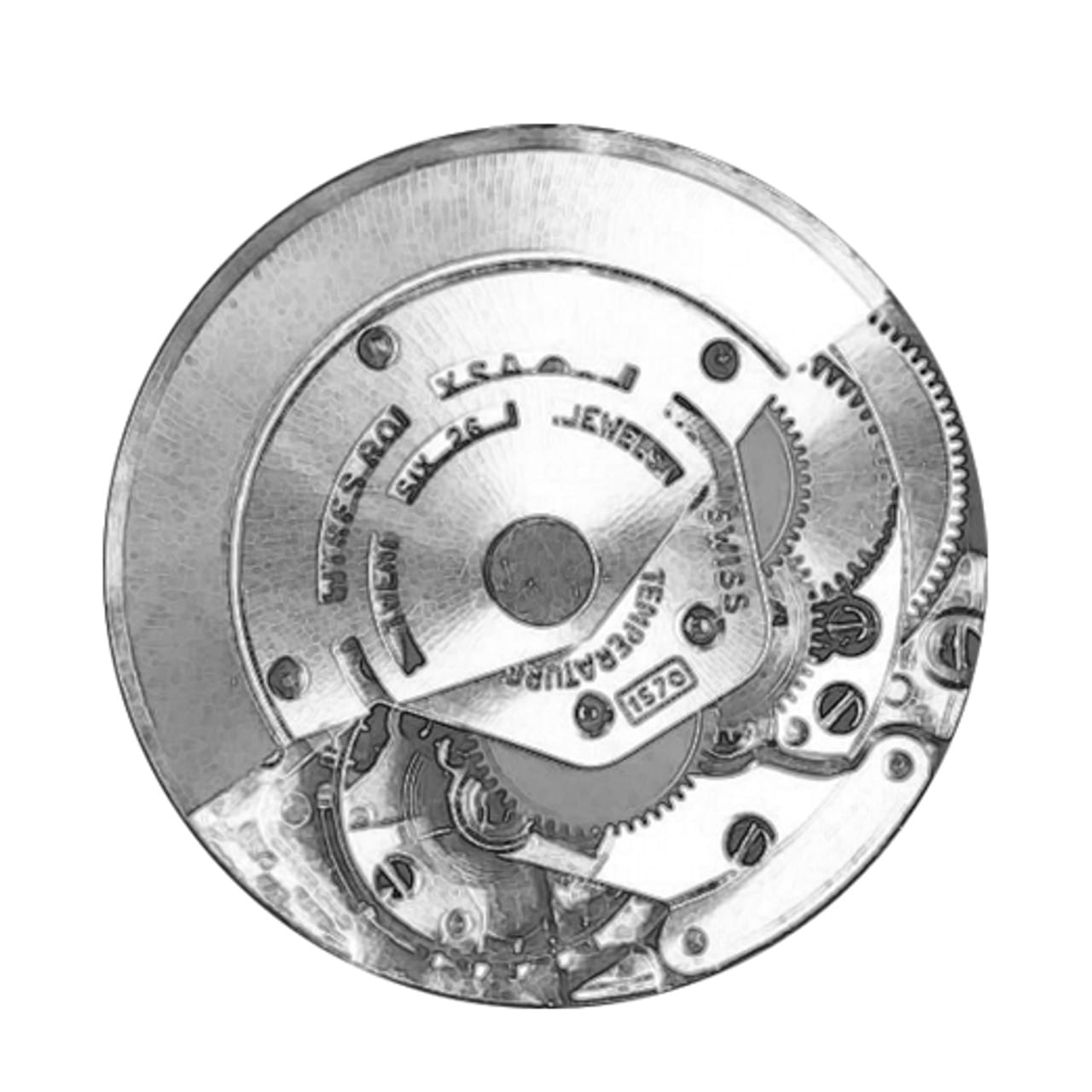
The Caliber 1570 represents one of Rolex’s most significant achievements in mechanical watchmaking, powering some of the brand’s most legendary references during what many collectors consider the golden era of vintage Rolex. From 1965 through 1977, this COSC-certified chronometer movement beat inside Submariner 5512s, Explorer 1016s, GMT-Master 1675s, and the first Sea-Dweller 1665, establishing a reputation for reliability so formidable that watchmakers still reference it as a benchmark for robust, serviceable automatic movements.
The 1570 distinguished itself as Rolex’s third-generation in-house automatic caliber, succeeding the 1560 with a higher 19,800 vph beat rate and improved power reserve. Rolex marketed these watches with “Superlative Chronometer Officially Certified” printed across four lines on the dial, a designation earned through rigorous COSC testing that demanded accuracy within -4/+6 seconds per day over 15 days across multiple positions and temperatures. The 1570 achieved this standard through a combination of free-sprung balance design, Breguet overcoil hairspring, and microstella adjustment screws that eliminated the positional errors inherent in regulator-pin systems.
Production estimates based on serial number ranges suggest Rolex manufactured several hundred thousand examples of the 1570 across its 12-year production run, though exact figures remain manufacturer-confidential. The caliber’s ubiquity in professional Rolex models from the late 1960s and 1970s makes complete movements relatively available today, though finding examples with original, unserviced components becomes increasingly challenging. Within the vintage Rolex ecosystem, the 1570 occupies a “common but collectible” status: watchmakers appreciate its serviceability and parts availability, while collectors value it for powering the most desirable vintage sport references.
Collector demand for 1570-powered watches remains robust, particularly for chronometer-certified four-line dial Submariners and early hacking-seconds examples from 1972 forward. The caliber’s reputation among independent watchmakers as straightforward to service, combined with decent aftermarket parts support, has kept values stable. Watches containing well-maintained 1570 movements command premiums when accompanied by service history documentation, while examples requiring complete overhauls trade at discounts reflecting $600-1,200 service costs.
Historical Context, Provenance, and Manufacturing Details
Rolex developed the 1570 as a direct evolution of the 1560, which itself descended from the company’s first true manufacture movement, the 1530, introduced in 1957. The 1530 series marked Rolex’s independence from external movement suppliers like Aegler, though the relationship had been so close that Aegler movements were effectively Rolex designs. When Rolex formally acquired Aegler’s facilities, the 1530 became the foundation for a family of calibers that would power the brand through two decades.
The 1560, introduced in 1959, brought chronometer certification to the 1530 architecture. Running at 18,000 vph with 26 jewels, it featured Rolex part number 7980 balance assembly with Microstella screws, Breguet free-sprung hairspring, and KIF Flector shock protection. The 1570 retained this essential architecture but increased the frequency to 19,800 vph (2.75 Hz) using the new 8106 balance assembly, extended power reserve from 42 to 48 hours, and prepared the platform for the hacking seconds feature that would arrive in 1972.
The hacking function, introduced midway through the 1570’s production, allowed wearers to stop the balance by pulling the crown to the time-setting position, enabling precise synchronization. This feature distinguished later 1570 examples from earlier ones and became standard across Rolex’s professional line. Collectors can identify hacking-capable movements by manufacturing date codes, though all 1570s share the same caliber designation regardless of hacking capability.
Rolex manufactured the 1570 entirely in-house at its Geneva facilities. The movement represents a bridge generation: it retained traditional construction methods including brass plates and bridges with rhodium plating, perlage finishing on the main plate, and lightly grained bridge surfaces, prioritizing reliability and serviceability over decorative finishing. This utilitarian approach reflected Rolex’s tool-watch philosophy, where functionality superseded exhibition-grade aesthetics.
The 3035, introduced in 1977, replaced the 1570 as Rolex’s men’s automatic caliber. The 3035 maintained much of the 1570’s proven architecture but increased frequency to 28,800 vph, introduced quickset date functionality, and adopted a direct-drive seconds layout rather than the 1570’s indirect seconds system. Some four-digit Rolex references continued using the 1570 through the early 1980s as Rolex depleted existing inventory, creating overlap between the old and new generations.
Construction and Architecture
The 1570 employs a traditional full plate and bridge construction with separate bridges for the automatic device, gear train, and balance. The main plate and bridges are brass with rhodium plating, chosen for dimensional stability and ease of machining. This architecture places all pivots on opposite sides of the gear train in jeweled bearings, distributing load and simplifying servicing.
The balance wheel measures approximately 10.5mm in diameter and uses Glucydur alloy, a beryllium-copper compound that maintains consistent elasticity across temperature ranges. The balance features two pairs of microstella nuts: one pair for coarse adjustment and one for fine regulation. These gold-colored nuts thread into the balance rim and can be rotated to move mass inward or outward, changing the moment of inertia and thus the rate. Adjustment requires a specialized microstella key (Rolex part 2019), and proper regulation demands moving opposing nuts equally to maintain poise.
The Breguet overcoil hairspring represents one of the movement’s most sophisticated elements. Rolex used Nivarox alloy (a nickel-cobalt-iron-beryllium formulation) for corrosion resistance and temperature compensation. The blue coloring comes from heat treatment during manufacturing. The Breguet overcoil, where the outer terminal curve rises above the hairspring plane, allows the spring to breathe concentrically as it expands and contracts, reducing positional errors. The hairspring mounts to a stud carrier with fine adjustment capability, though the free-sprung design means primary regulation occurs via the microstella screws rather than adjusting hairspring length.
The escapement uses Swiss lever design with a 21-tooth escape wheel and traditional pallet stones. KIF Ultraflex shock protection guards both balance jewels, with the upper jewel secured in a spring-loaded setting that allows vertical movement during impact then returns to center. The system protects against the balance staff fractures that plagued early wristwatches. Rolex also specified shock protection for the escape wheel pivots, an uncommon practice that improved durability in professional-use scenarios.
The 1570 features a free-sprung balance design, meaning no regulator pins contact the hairspring to adjust effective length. Instead, all timing adjustments occur by changing the balance wheel’s moment of inertia via the microstella screws. This eliminates the risk of regulator pins shifting during shock, which would alter timekeeping. The trade-off is that regulation requires specialized tools and greater skill than simply moving a regulator index.
The mainspring uses white alloy steel with slipping bridle attachment, allowing the spring to slip against the barrel arbor when fully wound rather than transmitting excessive force to the gear train. The barrel diameter measures approximately 11.5mm. Aftermarket mainsprings are widely available and typically specified as 0.122-0.125mm thick for the 1570’s 19,800 vph frequency.
The gear train uses indirect center seconds configuration: the fourth wheel drives an intermediate seconds wheel (part 8050) that engages with the center seconds pinion via a friction spring. This spring-loaded seconds pinion creates the smooth, gliding sweep characteristic of Rolex movements, dampening any backlash in the gear train that would cause the seconds hand to stutter. The tension spring must be carefully adjusted during servicing to balance smooth operation against excessive friction that would reduce amplitude.
The bidirectional automatic winding system uses a full-size rotor (part 7903) mounted on a center pivot with jeweled bearings rather than ball bearings. The rotor drives a reversing mechanism with reduction gears that wind the mainspring regardless of rotor direction. Red-anodized reversing wheels mark this assembly visually. The rotor bridges are lightly finished but lack decorative Côtes de Genève, reflecting the caliber’s tool-watch priorities.
Finishing quality is functional rather than haute horlogerie. The main plate receives circular perlage (overlapping circular grain patterns) applied by rotating abrasive tools. Bridges show light linear graining or matte finish, and edges receive simple beveling without black polishing. Jewel settings are pressed rather than gold chatons. Screws show blued heads but lack mirror polishing. This finishing level was standard for COSC chronometers in this era and does not indicate lower quality, only different priorities than exhibition-grade movements.
Cross-Reference Data
Alternative Caliber Names and Elaborated Versions
| Designation | Type | Key Differences |
|---|---|---|
| Cal. 1570 | Base, no-date | Time-only with center seconds |
| Cal. 1575 | Date version | Adds instantaneous date complication via cam, spring, and jewel mechanism |
| Cal. 1575 GMT | GMT version | Adds 24-hour hand and independently adjustable GMT function |
| Cal. 1580 | Anti-magnetic | Milgauss version with soft-iron inner case |
Note: Date versions often carry bridge stampings reading “1570” despite being functionally 1575 movements. This was common Rolex practice and does not indicate incorrect parts.
Compatible Case References by Brand
Rolex Submariner
Rolex Explorer
Rolex GMT-Master
Rolex Sea-Dweller
Rolex Date
Rolex Datejust
- Reference 1601: Most common Datejust using Cal. 1575
- Reference 1603: Smooth bezel variant
- Reference 1625: Turn-O-Graph with rotating bezel
- Reference 1630: Integrated bracelet prototype with sapphire crystal
Rolex Oyster Perpetual
Dial Compatibility Notes
The 1570 accepts dial feet in the standard 1500-series configuration with feet at approximately 3:22 and 9:22 positions. Date versions (1575) require date window at 3:00 position. Dial height clearance is 5.75mm movement height plus approximately 0.8-1.0mm for dial thickness and spacers. Hands mount via friction-fit cannon pinion for hour hand, center post for minute hand, and seconds pinion for sweep seconds hand.
Crown and Stem Specifications
| Component | Specification |
|---|---|
| Stem Thread | TAP 10 (0.9mm thread diameter) |
| Stem Part Number | 7869 |
| Crown Thread | 0.9mm |
| Setting Mechanism | Yoke clutch with intermediate setting wheel |
Generic aftermarket stems are widely available and specified as 0.9mm thread diameter compatible with 1530/1560/1570 series movements.
Identification Marks
Caliber Number Location: The designation “1570” appears engraved on the automatic device bridge (the upper bridge covering the reversing mechanism). Date versions often show “1570” stamping despite being functionally 1575 movements, as Rolex used the same bridge across both versions.
Rolex Crown Logo: The Rolex coronet appears stamped on the rotor, typically with “ROLEX” text. Earlier examples may show “Montres Rolex SA Geneva” around the rotor periphery. The logo should exhibit crisp, clean lines with proper spacing and proportions.
COSC Certification Marks: Movements certified as chronometers do not carry COSC stamps on the movement itself (unlike some manufacturers). Instead, certification appears only on the dial as “Superlative Chronometer Officially Certified” text.
Date Codes: The interior caseback carries a Roman numeral date code indicating quarter and year of case production. The format consists of I-XII (quarter) followed by two digits (year). For example, “III 69” indicates third quarter 1969. These codes help date the watch but do not appear on the movement itself.
Balance Cock Engravings: Watchmakers who serviced movements often scratched identifying marks or service dates on the balance cock. While these marks detract from collector value if excessive, discrete service marks can provide provenance documentation.
Serial Number Formats and Locations
Watch Serial Numbers: Rolex serial numbers appear engraved on the case between the lugs at 6:00 position (pre-2007 models). For 1570 production period:
- 1965: 1,100,000-1,275,000
- 1966-1967: 1,275,000-1,710,000
- 1968-1970: 1,710,000-2,590,000
- 1971-1973: 2,590,000-3,570,000
- 1974-1976: 3,570,000-4,260,000
- 1977: 4,260,000-5,085,000
Movement Serial Numbers: The movement itself carries a separate serial number engraved on the plate, though these are less commonly referenced than case serial numbers.
Expected Engravings and Style
Authentic 1570 movements show machine engraving with consistent depth and clean edges. The caliber designation, part numbers, and jewel count appear in a standard Rolex font with specific character spacing. Counterfeit movements often exhibit irregular engraving depth, incorrect fonts, or misplaced markings. The “26 JEWELS” marking should appear clearly stamped on the main plate or bridges.
Part Information

Major Component Part Numbers
| Component | Part Number | Notes |
|---|---|---|
| Mainspring | B7825-Y1 | Also available as generic part 771, thickness 0.122-0.125mm |
| Balance Complete | 8106 | Includes Breguet hairspring, timed and regulated |
| Balance Bridge | 8102 | Supports balance jewels |
| Hairspring (separate) | Varies | Difficult to source; typically requires complete balance assembly |
| Escape Wheel | 8051 | 26 jewels specification |
| Second Wheel | 8050 | Critical for indirect seconds function |
| Third Wheel | 7831/7931 | Variations exist between 1530 and 1570 series |
| Fourth Wheel | Varies | Part of gear train |
| Pallet Fork | Varies | Swiss lever type |
| Rotor | 7903 | Automatic winding weight, bidirectional |
| Rotor Bearing Upper | 6083 | Jeweled bearing |
| Rotor Bearing Lower | Varies | Jeweled bearing |
| Winding Stem | 7869 | 0.9mm thread diameter |
| Crown Wheel | 7872 | Engages with stem |
| Ratchet Wheel | Varies | Part of winding mechanism |
| Click Spring | 7878 | Prevents mainspring unwinding |
| Setting Lever Spring | Varies | Part of keyless works |
| Stud Holder | 8103 | Supports hairspring stud |
| Balance Stop Spring | 8115 | Hacking function component (post-1972) |
Parts Interchangeability
Many parts interchange across 1520/1525/1530/1535/1555/1556/1560/1565/1570/1575/1580 calibers, as these share common architecture. However, specific components like balance assemblies differ between 18,000 vph (1560) and 19,800 vph (1570) versions. Always verify compatibility before substitution.
Parts Sourcing and Availability
Mainspring: Widely available from generic suppliers. Both Nivarox S-form automatic mainsprings and aftermarket alternatives exist. Expect $8-25 for generic, $40-80 for original Rolex parts.
Balance Complete (8106): Original Rolex balance assemblies appear occasionally at $300-600. Watchmakers often prefer replacing complete balance assemblies rather than attempting hairspring work, given the specialized skill required.
Common Wear Items: Stems, crown wheels, ratchet wheels, click springs, and setting mechanism parts remain available from both genuine Rolex parts suppliers and generic aftermarket sources. Quality varies significantly in generic parts, with Swiss-made generics preferred over economy alternatives.
Jewels and Shock Settings: KIF shock absorber jewels and settings are available through watchmaking suppliers, though identifying the correct KIF variant requires careful measurement.
Reversing Wheels and Automatic Components: Red-anodized reversing wheels and rotor parts are available but less common than gear train components. Rotors surface regularly in parts markets at $200-500.
Common Failure Points
The seconds pinion friction spring requires adjustment during service, as improper tension causes erratic seconds hand behavior. The center wheel bushing (part 8076) can wear, creating vertical play that affects timekeeping. Balance staff pivots may break if shock protection fails. The yoke mechanism in the setting works wears at contact points with the detent spring.
Performance Data

Manufacturer Specifications
Accuracy (new): -4/+6 seconds per day (COSC chronometer standard)
Positions Tested: 5 positions plus 3 temperature ranges during COSC certification
Temperature Compensation: Glucydur balance and Nivarox hairspring provide passive temperature compensation across typical wearing temperatures
Isochronism: Free-sprung balance with Breguet overcoil optimizes isochronism (rate consistency across amplitude range).
Observed Performance
Field Accuracy: Well-maintained examples typically achieve +2 to +4 seconds per day in normal wearing positions, often exceeding COSC standards. Some examples run within 0 to +2 seconds per day after proper regulation. Accuracy degrades with age, wear, and lubrication breakdown; unserviced movements may show +10 to +30 seconds per day.
Amplitude Expectations:
- Fully wound, dial-up position: 270-295 degrees
- Dial-up after 24 hours: 250-270 degrees
- Vertical positions: 225-250 degrees
- Minimum acceptable: 200 degrees after 24 hours
Amplitudes below 250 degrees dial-up when fully wound suggest service need, though vintage watches showing 240-250 degrees with good rate may simply reflect aged mainsprings rather than requiring complete overhaul.
Beat Error: Properly serviced movements should exhibit beat error below 0.3 milliseconds across all positions. The 1570’s free-sprung balance allows beat error adjustment via rotating the hairspring collet on the balance staff.
Common Performance Issues:
- Positional variation exceeding 10 seconds per day between dial-up and vertical positions indicates balance poise problems requiring microstella adjustment
- Amplitude loss in specific positions suggests dirty pivots or inadequate lubrication
- Rate variation with temperature suggests hairspring or balance issues
- Erratic seconds hand movement indicates seconds pinion friction spring misadjustment
Service Intervals: Rolex officially recommends service every 10 years, though collectors debate this standard. Watches worn daily in demanding conditions may require service every 5-7 years, while carefully maintained examples can run 10-15 years between services if kept clean and dry. Amplitude testing provides better service timing guidance than arbitrary intervals