

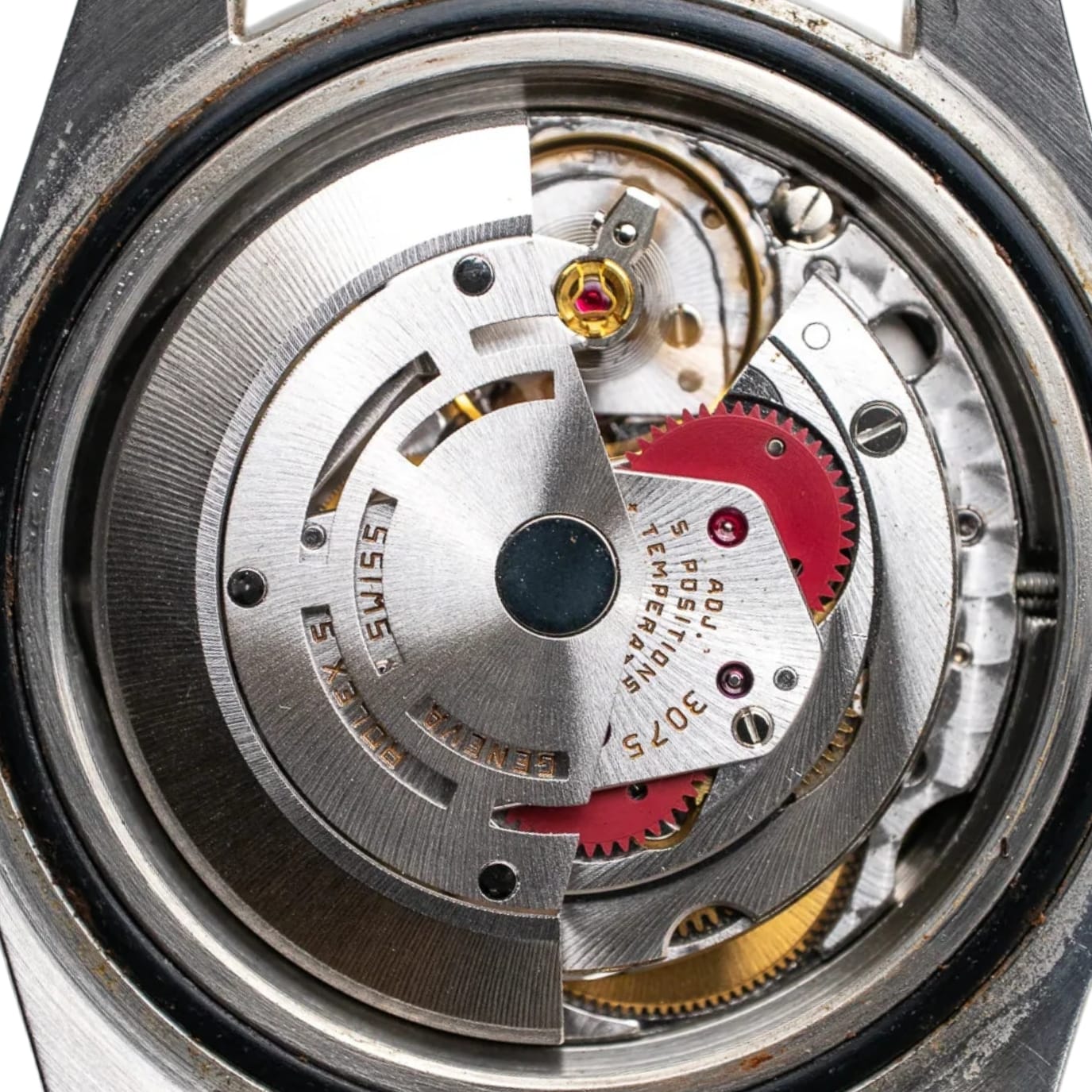
The Rolex Caliber 3075 represents a pivotal moment in GMT-Master history. It was the first movement in the GMT-Master line to feature a quickset date function, eliminating the tedious process of advancing the hour hand through 24 complete cycles to change the date. This practical improvement, combined with a jump from 19,800 vph to 28,800 vph, transformed the GMT-Master from a charming vintage tool into a modern professional instrument.
Caliber 3075 served as the mechanical heart of the transitional reference 16750, a watch that bridges the vintage 1675 and the more modern 16700. While in production for only seven to eight years, the 3075 defined the GMT-Master’s evolution during the 1980s, introducing features that collectors and pilots immediately appreciated. The movement maintained the linked GMT and hour hand architecture of the original GMT-Master, where both hands move together when setting the time, distinguishing it from the later GMT-Master II’s independently adjustable local hour hand.
Production estimates for the 16750 suggest between 50,000 and 80,000 units across all variants (steel 16750, two-tone 16753, and gold 16758) over the seven-year run, making this caliber relatively uncommon compared to the long-running 1575 before it or the 3175 that followed. Serial numbers for 16750 models range from approximately 6.0M through 8.4M, with early matte dial examples (6.0M-8.4M) commanding premiums over later glossy dial variants (8.4M and higher).
The collector market for caliber 3075-powered watches has shown strong appreciation. The GMT-Master 16750 has experienced approximately 254-325% price appreciation from 2010-2025, with matte dial variants particularly sought after. Values currently range from $11,000 to $15,000 for steel examples in good condition, with two-tone and gold variants commanding higher premiums. Demand remains stable to rising, driven by collectors who appreciate the transitional nature of the reference and the quickset convenience combined with vintage aesthetics.
Historical Context, Provenance, and Manufacturing Details
Rolex developed Caliber 3075 in 1980-1981 as a direct response to market demands for improved functionality in professional watches. The caliber evolved from the 3035, which Rolex introduced in 1977 as the brand’s first high-beat (28,800 vph) automatic movement with quickset date. The 3075 adapted the 3035 architecture specifically for GMT complications, adding the 24-hour hand and gear train necessary for dual time zone display.
The predecessor to Caliber 3075 was the 1575, a 19,800 vph movement without quickset date that powered the GMT-Master from the mid-1960s through 1980. The 1575 itself evolved from the earlier 1565, creating a lineage of incremental improvements. Caliber 3075 replaced the 1575 entirely when the reference 16750 launched, bringing the GMT-Master in line with Rolex’s modern movement architecture.
Caliber 3175 succeeded the 3075 in 1988 when Rolex introduced the GMT-Master reference 16700. The 3175 maintained identical GMT functionality (linked hands, same beat rate, quickset date) but featured updated construction with a double balance wheel bridge and minor refinements in the gear train. The 3175 continued production until 1999, when Rolex discontinued the GMT-Master entirely in favor of the GMT-Master II line.
Rolex manufactured Caliber 3075 entirely in-house at their facilities in Geneva, Switzerland. Unlike many Swiss brands that relied on ebauche movements from ETA or other suppliers, Rolex produced every component of the 3075 internally, from the base plates and bridges to the gear train, balance wheel, and escapement. This vertical integration allowed Rolex to maintain strict quality control and achieve COSC chronometer certification on every movement.
Within the broader context of horological history, Caliber 3075 arrived during Rolex’s transition from traditional watchmaking to modern manufacturing. The movement represented applied engineering rather than groundbreaking innovation. The quickset date mechanism, while new to GMT-Master watches, had already proven itself in other Rolex calibers. The 28,800 vph frequency matched industry standards set by competitors. What distinguished the 3075 was execution: reliable, robust, serviceable, and built to COSC chronometer standards. This made it a workhorse caliber that performed its function without fanfare, exactly what professional users required.
Construction and Architecture
Plate and Bridge Layout
Caliber 3075 employs a traditional three-quarter plate construction with four separate bridges covering the going train, the pallet/escapement, the automatic winding mechanism, and the balance wheel. The main plate and bridges are brass with rhodium plating, providing corrosion resistance and a distinctive silvery-white appearance. The architecture follows Rolex’s established philosophy: prioritize stability and serviceability over decorative complexity.
The movement features the characteristic Rolex winding bridge that secures the automatic winding reversing wheels and the intermediate ratchet wheel. This bridge design, shared across the 3000 series (3000, 3035, 3055, 3075, 3085), became notorious among watchmakers for a specific failure mode. When watches powered by these calibers undergo frequent manual winding, the intermediate ratchet wheel can wear down the threaded brass post it rotates on, eventually requiring bridge replacement or modification. This wear pattern only occurs with manual winding, not automatic winding, making it a user-dependent issue.
Balance Wheel
The 3075 uses a Glucydur balance wheel, a beryllium-copper alloy renowned for temperature stability and resistance to magnetic fields. The balance wheel measures approximately 10.2 mm in diameter and features four Microstella regulating nuts positioned at 90-degree intervals around the rim. These gold-colored nuts allow for rate adjustment by changing the wheel’s moment of inertia without requiring an index regulator pin.
The Microstella system represents a free-sprung balance architecture, where the hairspring breathes naturally without constraint from a regulator. Adjustments require a specialized Microstella key tool that precisely turns the nuts. Moving a nut outward slows the rate by approximately 1 second per day (for low-profile nuts) or 2 seconds per day (for high-profile nuts) per graduation mark on the adjustment tool. This system demands greater skill than simple index regulation but delivers superior isochronism and positional stability.
Balance Spring (Hairspring)
Caliber 3075 employs a Nivarox hairspring with a Breguet overcoil. Nivarox, a nickel-iron alloy, was the industry standard for high-grade movements throughout the 1980s and remains in production today. The alloy resists oxidation, maintains elasticity across temperature ranges, and exhibits minimal magnetic susceptibility, though it cannot match the paramagnetic properties of later alloys like Rolex’s Parachrom (introduced in 2005).
The Breguet overcoil represents the terminal curve of the hairspring, where the outer coil lifts and curves inward toward the balance staff. This geometry promotes concentric breathing of the spring during oscillation, reducing positional errors and improving chronometric performance. The hairspring attaches to the balance staff via a brass collet, laser-welded at the factory. The outer end affixes to a stud mounted on the balance cock.
Escapement Type
The 3075 uses a Swiss lever escapement with ruby pallets and a synthetic ruby impulse jewel on the balance roller. The escape wheel features 15 teeth and operates at the standard Swiss lever angle. Both pallet stones sit in brass chatons, indicating chronometer-grade construction. The escapement delivers impulse to the balance wheel through the pallet fork, which rocks between two banking pins to limit travel.
This escapement design traces its lineage to the 18th century and remains the dominant architecture in mechanical watchmaking. Rolex’s execution focuses on durability and consistent amplitude rather than advanced geometry. The pallets receive minimal lubrication (only on the impulse faces), and the escape wheel teeth remain dry. This approach sacrifices marginal efficiency gains for long-term reliability and resistance to lubricant degradation.
Shock Protection System
Caliber 3075 employs KIF Parechoc shock absorbers at both balance jewel locations (cap jewel and hole jewel, top and bottom). Rolex selected KIF over the more common Incabloc system reportedly to avoid mandatory “Incabloc” dial printing that Incabloc required from licensees during the mid-20th century. KIF shock protection uses a lyre-shaped spring that secures a conical jewel setting. Upon impact, the balance staff pivots compress the spring, allowing controlled movement that prevents staff breakage.
The KIF system in the 3075 uses the Elastor variant, which features a removable spring design. Watchmakers can replace worn springs without removing the entire balance assembly. The shock protection appears on both the top (balance cock side) and bottom (plate side) of the balance wheel, providing comprehensive protection against impacts from any direction.
Regulator Type
The 3075 uses Microstella free-sprung regulation, eliminating the traditional index regulator entirely. Four gold-colored Microstella nuts thread onto posts on the balance wheel rim. Turning a nut inward (toward the center) increases the rate by reducing the wheel’s moment of inertia. Turning outward decreases the rate. The system requires no hairspring manipulation during regulation, preserving the spring’s geometry and improving long-term stability.
Adjustment requires a specialized Microstella wrench with a graduated scale. Each graduation represents approximately 1-2 seconds per day of rate change, depending on nut height. The oil-filled version of this tool, used by Rolex technicians, provides dampening for more controlled movements. Watchmakers typically adjust two opposing nuts simultaneously to maintain balance wheel poise, though single-nut adjustments work for fine-tuning.
Mainspring Material and Type
The 3075 employs a Nivaflex mainspring, a white-alloy spring manufactured by Nivarox-FAR (a Swatch Group subsidiary). The spring measures approximately 1.20-1.40 mm in height, 0.100-0.106 mm in thickness, and 530 mm in total length when fully extended. The barrel diameter measures approximately 11.2 mm. The spring uses a slipping bridle attachment to the barrel arbor, preventing overwinding by allowing the spring to slip when fully wound.
Nivaflex springs represent a significant improvement over traditional blue steel springs, offering superior elastic memory, resistance to temperature variation, and immunity to magnetism. The spring provides 48-50 hours of power reserve when fully wound, though most sources cite 48 hours as the conservative estimate.
Gear Train Details
The 3075 gear train follows standard Swiss construction: barrel, center wheel (cannon pinion), third wheel, fourth wheel (seconds), escape wheel. The center wheel drives both the time display and the calendar mechanism. The GMT hand receives drive through an additional wheel in the motion works on the dial side, geared to complete one revolution in 24 hours while the hour hand completes two revolutions.
The seconds hand mounts directly to the fourth wheel pivot, which extends through the dial. This direct-drive configuration delivers crisp seconds hand movement and reliable hacking (the seconds hand stops when the crown is pulled to the setting position, achieved by a lever that contacts the balance wheel rim).
The quickset date mechanism operates through an intermediate wheel that can engage or disengage the date wheel depending on crown position. In position one (first click), the quickset system engages, allowing forward date advancement without affecting the time display. In position two (full pull), the entire going train engages for time setting.
Finishing Quality and Techniques
Caliber 3075 receives COSC chronometer-grade finishing, which prioritizes functional excellence over decorative elaboration. The movement features basic perlage (circular graining) on the main plate, visible around jewel settings and in open areas. The bridges display brushed surfaces with polished beveled edges. The automatic winding bridge shows no Geneva stripes (Côtes de Genève), instead featuring a practical matte or fine-grained finish.
Screw heads receive simple slots without bluing or polishing. Jewel settings use brass chatons with straight-grained sides, indicating mid-grade finishing. The balance cock displays Rolex’s signature engraving of the caliber number and jewel count, executed with consistent depth and clarity. The rotor features radial brushing with polished edges and the Rolex coronet in relief.
Compared to haute horlogerie movements, the 3075’s finishing remains utilitarian. Rolex prioritizes longevity, repairability, and consistent performance over aesthetic refinement. The finishing techniques prevent corrosion, reduce friction, and facilitate inspection during service, but they do not aspire to the hand-applied Geneva stripes, black polishing, or anglage found in movements from Patek Philippe, Vacheron Constantin, or A. Lange & Söhne.
Cross-Reference Data
Compatible Case References by Brand
| Brand | Reference Number | Production Years | Notes |
|---|---|---|---|
| Rolex | 16750 | 1981-1988 | Steel, matte dial (early) or glossy dial (late), Pepsi or black bezel |
| Rolex | 16753 | 1981-1988 | Two-tone steel/yellow gold, Pepsi or Root Beer bezel |
| Rolex | 16758 | 1981-1988 | Solid 18k yellow gold, sapphire crystal, Root Beer or black bezel |
Dial Compatibility Note
Caliber 3075 dial feet positions sit at approximately 13 and 37 minutes, measured from 12 o’clock. This spacing differs from the earlier 1575 movement (30 and 57 minutes), making dials non-interchangeable between these calibers without modification. Date window position remains at 3 o’clock. GMT-Master dials for the 3075 feature either matte printing with painted indexes (early production) or glossy surfaces with applied white gold hour markers (later production). Both dial types function identically with the 3075, though matte dials command collector premiums.
Crown and Stem Specifications
| Component | Specification |
|---|---|
| Stem Thread | 0.90 mm (Tap 10) |
| Stem Part Number | 5025 |
| Crown Thread | 0.90 mm (Tap 10) |
| Setting Mechanism | Spring-loaded clutch lever |
| Stem Height | 2.2 mm |
The stem uses a spring-loaded setting lever that must be depressed with a tool to remove the stem from the movement. The crown operates in three positions: position 0 (fully screwed down, waterproof), position 1 (first click, quickset date), and position 2 (pulled fully out, time setting with hacking).
Identification Marks
Caliber Number Location
The caliber number “3075” appears engraved on the automatic winding bridge, visible when the rotor is removed. The engraving sits between the reversing wheels mounting points, executed in sans-serif capitals approximately 2-3 mm in height. Early production examples may show minor variations in font, but all authentic 3075 movements display this marking in the same location.
Logo and Brand Marks
Authentic Caliber 3075 movements display the Rolex coronet logo in relief on the oscillating weight (rotor). The balance cock features engraved text indicating “TWENTY SEVEN (27) JEWELS,” “SWISS,” and “SHOCK PROOF” in addition to the caliber designation. All text uses consistent serif fonts with even depth and clean edges. Modern refinished or replacement parts may show laser-etched markings that differ in appearance from period-correct engravings.
Date Codes
Rolex discontinued internal case back date code stamps around 1972, well before the 3075 entered production. Therefore, authentic 3075-powered watches do not carry production date stamps inside the case back. Dating relies on serial numbers engraved between the lugs at 6 o’clock.
Finishing Marks
Expected finishing on authentic 3075 movements includes perlage (circular graining) on the main plate visible through jewel cutouts, brushed surfaces on bridges with narrow polished bevels, and radial brushing on the rotor with polished outer edge. The automatic winding reversing wheels display the characteristic PTFE coating in deep red, introduced by Rolex in 1957.
Jewel Markings
The 27 jewels in Caliber 3075 consist of synthetic rubies set in brass chatons for the balance pivots, pallet pivots, and escape wheel. Remaining jewels use pressed settings. Authentic chatons display straight-grain finishing on their sides and beveled edges. Under magnification, genuine synthetic rubies appear flawlessly transparent with slightly pink coloration. Jewels should show no chipping, cracking, or cloudiness.
Adjustment Markings
All Caliber 3075 movements received COSC chronometer certification, tested for 15 days in five positions at three temperatures. However, individual adjustment markings (such as “Adjusted to 5 Positions” or temperature compensation indicators) do not appear on the movement itself. The only reference to adjustment appears on the dial, which reads “SUPERLATIVE CHRONOMETER OFFICIALLY CERTIFIED” below the Rolex coronet.
Correct Serial Number Formats and Locations
Serial numbers for watches housing Caliber 3075 appear engraved between the lugs at 6 o’clock on the case. These numbers range from approximately 6,000,000 (early 1981) through 8,400,000 (late 1988). Early examples with matte dials typically fall in the 6.0M-8.4M range, while later glossy dial variants start around 8.4M and continue through the end of production.
Serial numbers consist of seven digits engraved in clean, consistent sans-serif numerals approximately 1.5-2 mm in height. The engraving depth remains uniform across all digits. Refinished cases or modern forgeries often show shallow, uneven, or incorrectly spaced serial numbers. Authentic engravings feel crisp under magnification with no double strikes or irregular edges.
Expected Engravings and Stampings
Movement side engravings include “3075” on the automatic winding bridge, “TWENTY SEVEN (27) JEWELS” on the balance cock, “SWISS” below the jewel count, and “SHOCK PROOF” indicating the KIF anti-shock system. The rotor displays the Rolex coronet in relief, approximately 5-6 mm in diameter, raised about 0.2 mm above the rotor surface.
Case engravings include the reference number (16750, 16753, or 16758) between the lugs at 12 o’clock and the serial number between the lugs at 6 o’clock. Case backs feature “ROLEX OYSTER ORIGINAL GAS ESCAPE VALVE” engraved in concentric circles, with material marks (STAINLESS STEEL, 750, or 18K) and country of manufacture.
Font and Marking Style by Production Era
The 3075 production run (1981-1988) remained consistent in font and marking style. Rolex used sans-serif numerals for serial numbers throughout this period, with uniform stroke width and spacing. Movement engravings maintained identical placement and sizing across the entire production run. The transition from matte to glossy dials in the mid-1980s (around serial 8.4M) represented the only significant change during the 3075 era, but this affected dial printing rather than case or movement engravings.
Part Information

Part Numbers: Key Components
| Part Name | Part Number | Interchangeability Notes |
|---|---|---|
| Mainspring | 5009 | Compatible with 3035, 3055, 3085 |
| Balance Complete | B5019-G1 | Includes hairspring, shared with 3035 |
| Hairspring (Breguet) | – | Separate ordering, Nivarox manufacture |
| Escape Wheel | – | Shared across 3000 series |
| Pallet Fork | – | Shared with 3035 |
| Crown Wheel | – | Compatible with 3035, 3055, 3085 |
| Ratchet Wheel | – | Compatible with 3035, 3055, 3085 |
| Click Spring | Generic available | Aftermarket compatible |
| Setting Lever Spring | Generic available | Aftermarket compatible |
| Rotor (Oscillating Weight) | 5063 | Compatible with 3000, 3035, 3055, 3085 |
| Rotor Bearing | Axle type | Ball bearing used in later 3135, not 3075 |
| Hour Wheel 12H | 5157 | Specific to GMT function |
| Hour Wheel 24H | 5158 | GMT hand drive |
| GMT Friction Spring | 5159 | Specific to 3075 |
| Winding Bridge | 5006 | Compatible with 3035, 3055, 3085 |
| Third Wheel | B5013-Y1 | Compatible with 3035, 3055, 3085 |
Sourcing Notes
Major watch parts suppliers including Cas-Ker, Esslinger, Watch Material, Perrin Supply, Gleave & Co., and Overnight Watch Parts maintain inventory of common 3075 components. The rotor, balance complete, mainspring, and basic bridge screws remain readily available. Generic aftermarket alternatives exist for gaskets, click springs, and setting lever springs, though collectors and purists prefer genuine Rolex parts to preserve authenticity and value.

Parts that commonly fail include the automatic winding mechanism components (particularly the intermediate ratchet wheel post, which can wear due to manual winding) and the rotor axle. The balance staff rarely breaks thanks to KIF shock protection, but falls or severe impacts can damage it. Hairsprings occasionally require replacement due to mishandling during service or magnetization, though the Nivarox alloy resists magnetism better than steel springs.
Acceptable generic replacements exist for gaskets, crown/stem assemblies, click springs, and basic screws. However, critical components like the balance complete, escape wheel, pallet fork, and mainspring should use genuine or Swiss-made equivalents. Using low-quality generic parts in these positions compromises timekeeping accuracy and long-term reliability.
Rolex technical manuals and parts diagrams for the 3075 circulate among watchmakers and are available through specialized suppliers. These documents provide exploded views showing component relationships, part numbers, and assembly sequences. The official Rolex technical sheet for Caliber 3075 specifies lubrication points, tolerances, and adjustment procedures.
Performance Data
Manufacturer Specifications
| Specification | Value |
|---|---|
| Accuracy (New, COSC) | -4/+6 seconds per day |
| Positions Tested | 5 positions (COSC standard) |
| Temperature Compensation | Tested at 8°C, 23°C, 38°C during certification |
| Isochronism | Amplitude variation <15% over 24 hours (COSC requirement) |
All Caliber 3075 movements received COSC chronometer certification, requiring 15 days of testing in five positions (dial up, dial down, crown up, crown left, crown right) and three temperatures. The COSC standard demands accuracy within -4/+6 seconds per day across these conditions. Rolex adjusted each movement to meet or exceed this standard before final assembly.
The lift angle specification of 52 degrees determines how timing machines calculate amplitude. When measuring a 3075 on a timegrapher, setting the lift angle correctly ensures accurate amplitude readings. Typical well-regulated examples show 270-290 degrees amplitude dial up when fully wound, dropping to 220-250 degrees after 24 hours of power reserve depletion.
Observed Performance (Field Data)
Based on watchmaker reports, auction timing results, and collector observations, well-maintained Caliber 3075 movements typically achieve -2/+4 seconds per day in five positions after professional regulation. This performance slightly exceeds the COSC requirement but falls short of Rolex’s modern “Superlative Chronometer” standard of -2/+2 seconds per day (introduced in 2015 for newer calibers). The 3075 predates this enhanced standard, adhering only to COSC requirements.
Common performance issues in aged 3075 movements include:
- Automatic Winding Mechanism Wear: The intermediate ratchet wheel post can wear when watches undergo frequent manual winding, creating play that reduces winding efficiency and causes the rotor to spin excessively. This issue requires bridge replacement or post repair, a labor-intensive procedure.
- Degraded Lubricants: Movements serviced more than 7-10 years ago often show thickened oils at the pallet stones and balance pivots, reducing amplitude and accuracy. Synthetic lubricants introduced in later Rolex calibers resist degradation better than the oils used in 1980s production.
- Quickset Date Mechanism Wear: The quickset intermediate wheel and date jumper spring can wear with extensive use, causing difficulty advancing the date or incomplete date changes at midnight. Replacement parts remain available.
Expected amplitude when fully wound and properly serviced ranges from 270-290 degrees dial up, 260-280 degrees crown up, and 250-270 degrees crown down. After 48 hours on the wrist, amplitude typically drops to 220-250 degrees dial up, at which point rate stability decreases and the watch should be rewound or allowed to fully stop. Maintaining amplitude above 220 degrees ensures reliable timekeeping.
As the movement ages, common degradation includes reduced amplitude due to dried lubricants (manifesting as loss of 30-50 degrees across all positions), increased positional variation (rate differences exceeding 10-15 seconds per day between positions), and rotor noise indicating worn bearings or dried reversing wheel pivots. These symptoms typically appear 7-10 years after the last complete service, though aggressive use environments (high temperatures, humidity, frequent shocks) accelerate deterioration.
Service intervals for Caliber 3075 fall in the 5-7 year range for regularly worn examples. Rolex’s modern 10-year service recommendation applies to newer calibers using advanced synthetic lubricants and Paraflex shock protection, neither of which the 3075 benefits from. Vintage movements like the 3075 require more frequent maintenance to preserve accuracy and prevent permanent damage from dried oils.