

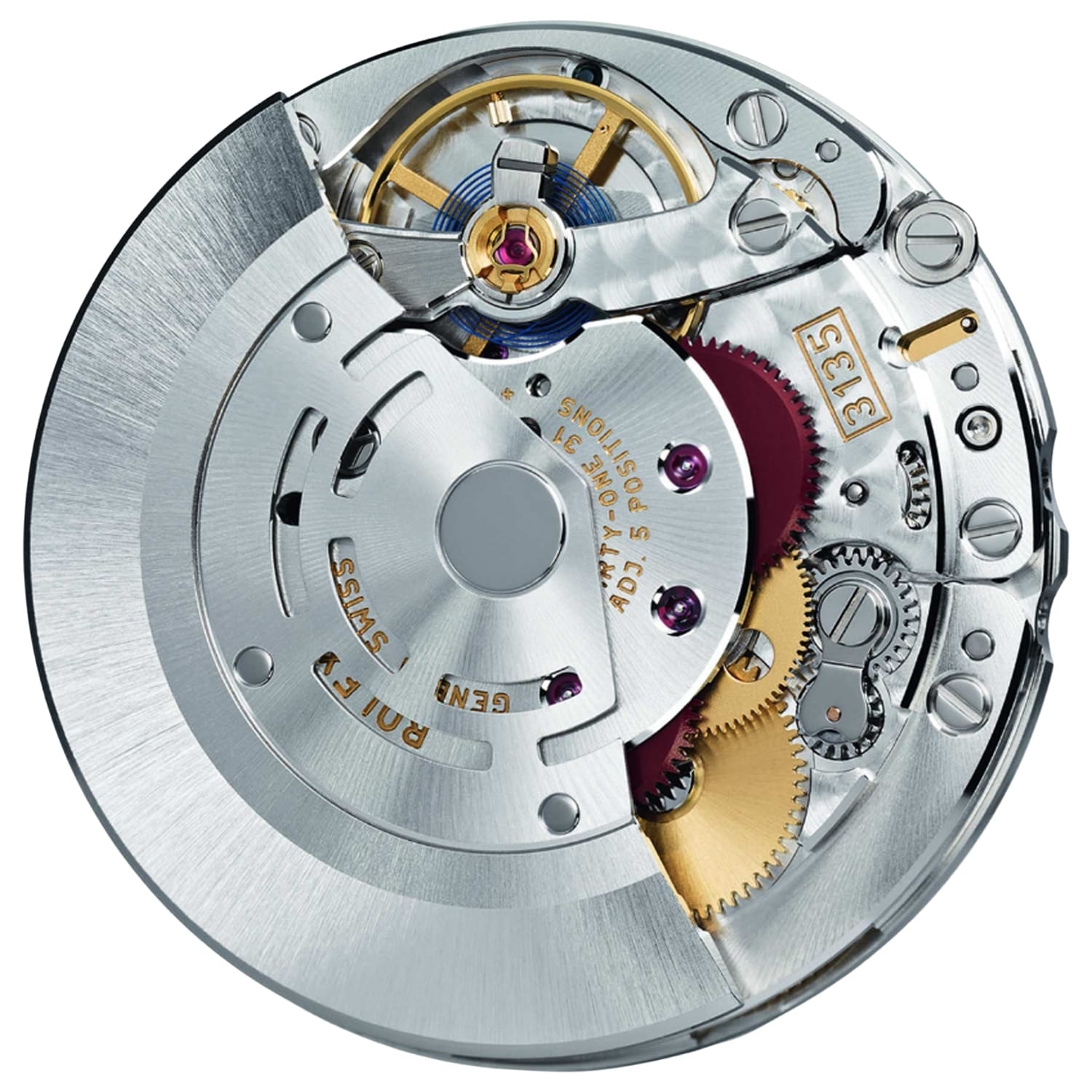
The Rolex 3135 caliber stands as one of the most manufactured and widely deployed mechanical movements in horological history, powering more iconic Rolex models than any other single caliber across a 34-year production run. Introduced in 1988 to replace the already-successful Caliber 3035, the 3135 became the backbone of Rolex’s professional and classic collections, residing in everything from the Submariner Date to the Datejust, Sea-Dweller, Yacht-Master, and Deepsea. Watchmakers consistently praise the 3135 as among the easiest automatic movements to service while simultaneously recognizing its exceptional robustness, a rare combination that cemented its reputation as Rolex’s ultimate workhorse caliber.
The 3135 represents Rolex’s approach to evolutionary perfection rather than revolutionary redesign. Building on the high-beat 28,800 vph architecture established by the 3035 in 1977, the 3135 introduced critical refinements: a full balance bridge replaced the balance cock for improved shock resistance, the balance wheel diameter increased for greater inertia and stability, jewel count rose from 27 to 31, and power reserve extended from 42 to 48 hours. These changes, while individually modest, collectively produced a movement that would remain competitive for over three decades with minimal modifications, ultimately serving until 2022 when the final watches using it left production.
Estimating total 3135 production requires extrapolation from available data. Rolex produced approximately 750,000 to 1.24 million watches annually during the caliber’s lifespan, with the 3135 and its derivatives (3130, 3155, 3175, 3185, 3186, 3187) powering the majority of full-size automatic models. Conservative estimates suggest between 15 and 25 million caliber 3135 movements were produced across all variants from 1988 to 2022, though Rolex has never disclosed official production figures. This high production volume places the 3135 among the most common Swiss chronometer movements ever made, making individual specimens readily available in the service parts market and in watches offered for sale. The caliber cannot be considered scarce or rare. Its collectibility derives not from rarity but from its technical merit, serviceability, historical significance as Rolex’s longest-serving modern caliber, and its presence in highly sought-after watch references.
Collector demand for 3135-powered watches remains exceptionally strong, particularly for discontinued professional models. The Submariner 16610, produced from 1988 to 2010 with the 3135, now commands $13,000 to $25,500 depending on variant (with the “Kermit” 16610LV at the high end). The Sea-Dweller 16600 (1989-2009) trades between $11,600 and $14,000. Datejust references with the 3135, such as the 16234 (1988-2005), remain accessible entry points at $8,000 to $9,000. Market data indicates stable to appreciating values for 3135-equipped references, with the GMT-Master II 16710 showing 303% appreciation from 2010 to 2025 and maintaining strong demand despite being replaced by newer calibers. The caliber’s reputation for reliability and ease of service contributes to long-term value retention, as collectors recognize that a well-maintained 3135 can provide decades of accurate service with routine 10-year overhauls.
Historical Context, Provenance, and Manufacturing Details
Rolex developed the Caliber 3135 as the direct successor to the Caliber 3035, which had introduced high-beat 28,800 vph timekeeping and the quickset date function to Rolex in 1977. The 3035 represented a significant leap forward from the earlier 1575 series with its 19,800 vph frequency, establishing the baseline architecture that would define Rolex movements for decades. By the mid-1980s, Rolex recognized opportunities for refinement in stability, shock resistance, and serviceability, leading to the development of the 31XX caliber family with the 3135 as its time-and-date foundation.
The 3135 addressed specific engineering objectives: improved shock resistance through a full balance bridge instead of a balance cock, enhanced isochronism via a larger balance wheel with greater inertia, increased power reserve through a redesigned mainspring barrel and more efficient automatic winding system, and improved modularity for easier servicing. These objectives aligned with Rolex’s broader strategy in the late 1980s and early 1990s to standardize production, improve manufacturability, and reduce service complexity while maintaining chronometric performance. The timing of the 3135’s introduction coincided with Rolex’s transition to 904L stainless steel (beginning around 1985-1988) and the brand’s expansion of COSC chronometer certification across its entire automatic line.
The Caliber 3135 is a fully in-house manufacture movement, with all components designed, produced, and assembled by Rolex. No ebauche supplier or third-party manufacturer participated in its production. This vertical integration distinguishes Rolex from many competitors who relied on ETA, Valjoux, or other movement suppliers. The sole exception to complete in-house manufacture was the hairspring, initially sourced from Nivarox (a Swatch Group subsidiary), though Rolex began producing its proprietary Parachrom hairspring in-house starting in 2000 and retrofitted it to 3135 movements during the mid-2000s.
All Rolex movements, including the 3135, are manufactured at the Manufacture des Montres Rolex facility in Bienne, Switzerland, located at the foot of the Jura mountains in the canton of Berne. Rolex has maintained movement production in Bienne since the company’s founding, though the facility has expanded dramatically over time. The most recent major expansion, Building 7, was completed in 2012 to accommodate increased production and houses state-of-the-art CNC machining and assembly facilities. Approximately 2,000 to 3,000 employees work at the Bienne site, producing an estimated 50 million movement components annually that are assembled into over 750,000 movements. Finished movements are sent to COSC in nearby Grenchen for chronometer certification testing, then returned to Rolex for final casing and adjustment at the company’s facilities in Geneva (Acacias headquarters for assembly, Plan-les-Ouates for cases and bracelets, Chêne-Bourg for dials and gem-setting).
The 3135 succeeded the Caliber 3035, which remained in production until 1988 when the 31XX family fully replaced it. The 3135 itself was gradually phased out starting in 2015 when Rolex introduced the Caliber 3235 in the Pearlmaster 39. The transition occurred model-by-model over seven years. The 3235 appeared in the Datejust 41 (2016), Sea-Dweller 43mm (2017), Submariner Date (2020), and other references. The final production watches with the 3135 were Submariner Date references that shipped in late 2020 before the model transitioned to the 3235. Some service parts and movements remained in Rolex’s inventory beyond this date for warranty and service purposes. The 3135 thus served as Rolex’s primary time-and-date caliber for 32 to 34 years depending on model, making it the longest-serving caliber in the brand’s modern history.
The Caliber 3135 occupies a pivotal position in horological history as the embodiment of mature mechanical watchmaking in the late 20th century. It was not groundbreaking in the sense of introducing entirely new complications or technologies. Instead, it perfected existing solutions: the Swiss lever escapement, free-sprung balance with Breguet overcoil, bi-directional automatic winding with reversing wheels, and instantaneous date change with quickset capability. This refinement-over-revolution approach parallels concurrent developments at other manufactures in the 1980s and 1990s but distinguishes itself through Rolex’s commitment to maintaining the design with minimal changes for over three decades. The 3135 demonstrated that a well-engineered movement could remain competitive across multiple technology generations through incremental upgrades (Parachrom hairspring in 2000, Paraflex shock absorbers in 2005) rather than complete redesign.
Construction and Architecture
The Caliber 3135 employs a traditional three-plate architecture with a mainplate, barrel bridge, and train wheel bridge, plus a separate balance bridge and numerous smaller bridges and cocks for the automatic winding mechanism and calendar complication. All bridges and the mainplate are fabricated from nickel-plated brass, finished with rhodium plating that gives the movement its characteristic milky appearance. The modular construction allows watchmakers to access critical components without complete disassembly, a design priority that contributes to the caliber’s reputation for serviceability.
The barrel bridge (part number 3135-105) secures the mainspring barrel and is held by three screws. The train wheel bridge (part number 3135-110) supports the center wheel, third wheel, fourth wheel, and escape wheel, each running in jeweled bearings. Unlike many movements that use a balance cock (secured at one point), the 3135 features a full balance bridge (secured at two points), significantly improving stability and shock resistance at the cost of slightly more complex servicing. This design choice reflects Rolex’s prioritization of durability over ease of assembly, as removing and correctly positioning the balance wheel requires more care with a bridge than a cock.
The balance wheel measures approximately 10 mm in diameter and is constructed from Glucydur, a beryllium-copper alloy with minimal thermal expansion coefficient. Glucydur’s low magnetic susceptibility and stable dimensions across temperature ranges contribute to the movement’s chronometric performance. The balance wheel features the Microstella regulation system, consisting of four small gold-colored regulating screws positioned at 90-degree intervals on the inner rim of the wheel. Unlike traditional index regulation (which shortens or lengthens the effective hairspring length via a regulator arm), the Microstella system adjusts the moment of inertia of the balance wheel itself. Moving the screws toward the balance center increases frequency (faster timekeeping), while moving them outward decreases frequency (slower timekeeping). The Microstella key (Rolex part number 2019) is required to adjust the screws, with each adjustment affecting rate by a few seconds per day. Proper adjustment demands equal positioning of opposing screws to maintain balance poise.
The balance spring (hairspring) in early 3135 movements (1988-2000) was sourced from Nivarox and fabricated from a Nivarox alloy, typically flat-wound with a Breguet overcoil terminal curve. Starting in 2000, Rolex began retrofitting movements with its proprietary Parachrom hairspring, manufactured in-house from a niobium-zirconium alloy (approximately 85% niobium, 15% zirconium). The Parachrom spring is paramagnetic (unaffected by magnetic fields), highly resistant to temperature variations, and up to 10 times more resistant to shocks than traditional hairsprings. An enhanced version with thicker oxide coating, producing the distinctive blue color and named Parachrom Bleu, was introduced in 2005. All 3135 movements currently in service have been retrofitted with Parachrom Bleu hairsprings during overhauls unless specifically preserved in original configuration. The hairspring features a Breguet overcoil (also called terminal curve), a raised outer coil that allows the spring to expand and contract concentrically, improving isochronism across the power reserve range. The overcoil is laser-welded to the stud fixed in the balance bridge, replacing the older glued attachment method used in the 3035.
The escapement is a traditional Swiss lever design with a 15-tooth escape wheel (part number 3135-410) and forked pallet (part number 3135-421). The escape wheel and pallet fork are jeweled with synthetic ruby pallet stones that engage the escape wheel teeth. The lift angle of 52 degrees is critical for timing machine diagnosis and regulation. This standard lever escapement architecture has been refined over more than two centuries and represents mature technology. Rolex made no fundamental changes to the escapement design in the 3135, focusing instead on precision manufacturing, proper jeweling, and appropriate lubrication.
The anti-shock system protects the delicate balance staff pivots from impact damage. Early 3135 movements (1988-2005) employed KIF Elastor shock absorbers, a Swiss industry-standard system. Around 2005, Rolex began transitioning to its proprietary Paraflex shock absorber system, designed in-house to provide superior shock protection. The Paraflex system appeared first in more complex calibers (3186, 3156) before being retrofitted to the 3135. Not all 3135 movements received Paraflex upgrades, with some remaining on KIF Elastor throughout their service life, particularly in watches that did not return for overhaul after 2005. The shock protection applies to both the upper and lower balance jewels, with the system allowing the balance staff to deflect slightly during impact and then return to correct position.
The regulator system in the 3135 is a Microstella free-sprung design, meaning the hairspring has no traditional index regulator with pins that adjust effective spring length. Instead, all timing adjustment occurs via the four Microstella screws on the balance wheel rim. This eliminates the risk of hairspring pinching in regulator pins, improves isochronism, and simplifies the balance assembly at the cost of requiring specialized tools for adjustment. Fine adjustment capability is excellent, with each Microstella screw adjustment producing changes of approximately 5-10 seconds per day depending on how far the screw is moved. The system allows a total adjustment range of plus or minus 150 seconds per day, providing more than adequate margin for regulation within COSC chronometer specifications.
The mainspring is fabricated from a modern white alloy (as opposed to blued steel) and is housed in a barrel with conventional wall thickness. The spring features a slipping bridle (not a fixed attachment), which prevents overwinding by allowing the spring to slip once fully wound. The barrel arbor diameter, spring thickness, and spring length are optimized to provide 48 hours of power reserve with consistent amplitude across the full power band. The mainspring is lubricated with specialized breaking grease (Rolex uses proprietary TEPA grease) applied to the barrel wall to prevent sudden release of energy and provide consistent torque delivery. The mainspring is one of the most commonly replaced components during service, as the alloy fatigues over time and loses tension, resulting in reduced amplitude and power reserve.
The gear train consists of the barrel (great wheel), center wheel, third wheel, fourth wheel (seconds wheel), and escape wheel. The center wheel drives the motion works (cannon pinion, minute wheel, hour wheel) to display time on the dial side. The fourth wheel is directly geared to the center seconds hand, providing the characteristic smooth eight-beats-per-second sweep Rolex is known for. All train wheels run in jeweled bearings, with the escape wheel and fourth wheel featuring capped jewels (jewels with endstones) on both the upper and lower pivots for reduced friction. The gear ratios are standard for a 28,800 vph movement with center seconds, with the train optimized for both accuracy and durability rather than maximum power reserve.
Finishing quality on the 3135 is appropriate for a mass-produced chronometer movement rather than haute horlogerie. Bridges and the mainplate receive rhodium plating, providing a pleasing milky white appearance and corrosion resistance. Screw heads are beveled and polished. Edges of bridges receive light chamfering (anglage), though not to the standards of hand-finished manufacture movements. Visible surfaces on the mainplate and bridges show light perlage (circular graining), applied mechanically rather than by hand. The rotor features a distinctive radial sunburst finish. No Côtes de Genève (Geneva stripes) appear on the 3135, as this finishing is typically reserved for higher-grade movements or applied only to specific bridges in manufacture calibers. The movement is not adjusted or regulated in multiple positions beyond COSC requirements (five positions and three temperatures). After casing, Rolex applies its Superlative Chronometer certification with additional testing and adjustment to achieve -2/+2 seconds per day accuracy.
Base Caliber and Elaborated Versions
The Caliber 3135 serves as the base movement for an entire family of related calibers, all sharing the same fundamental architecture with modifications to accommodate additional complications or size requirements:
Compatible Case References
The Caliber 3135 powered Rolex’s most significant professional and classic models from 1988 to 2022. The following table documents major references, though this is not exhaustive as numerous variations (metal types, dial colors, bezel options) exist within each reference family:
Dial Compatibility
Rolex caliber 3135 dials feature two dial feet positioned at approximately 13 and 37 minutes (measuring from center), which differs from the older 1570/1575 calibers that positioned feet at 30 and 57 minutes. The dial feet must be 2.40mm to 2.60mm in length depending on case design. The date window aperture is positioned at 3 o’clock on the dial, aligned with the date disc at that position. Dials from the 3035 caliber (immediate predecessor) are not directly compatible due to slight differences in dial feet length, though conversion is possible by adjusting foot height. The dial diameter visible within the case is approximately 28mm, matching the movement diameter.
Crown and Stem Specifications
Identification Marks
Authenticating a Rolex Caliber 3135 requires careful examination of multiple features, as the movement’s mass production and high value have made it a target for counterfeiters.
The caliber designation “3135” should be engraved on the mainplate, typically visible when the automatic winding module is removed or when viewing the movement from the dial side. Some movements may have additional markings such as “B3135” indicating production batches. The engraving should be crisp, evenly spaced, and deeply struck. Shallow or irregularly spaced engravings suggest counterfeit or refinished components.
Logo and Brand Marks
Genuine movements display “ROLEX” engraved on the automatic winding module bridge and on the balance bridge. The Rolex crown logo may appear stamped on certain bridges. The movement should also display “SWISS” or “SWISS MADE” engraved near the balance wheel or on the mainplate. COSC chronometer certification is marked with “CHRONOMETRE” or “CHRONOMETER” and may include COSC certification numbers. After 2015, movements cased after COSC certification display “SUPERLATIVE CHRONOMETER OFFICIALLY CERTIFIED” on the dial, indicating Rolex’s enhanced -2/+2 seconds per day standard.
Date Codes
Rolex does not use date codes on movements themselves. Date determination relies on the case serial number, which appears between the lugs at 6 o’clock (pre-2005) or engraved on the rehaut (inner bezel ring) between the dial and crystal (2005+). Serial numbers transitioned from sequential numeric (1988-1987), to letter-prefix series (1987-2010), to randomized alphanumeric (2010+). Specific letter prefixes correlate to production years: L-series (1989), E-series (1990), X-series (1991), N-series (1991), C-series (1992), S-series (1993), W-series (1995), T-series (1995), U-series (1997), A-series (1999), P-series (2000), K-series (2001), Y-series (2002), F-series (2003), D-series (2005), Z-series (2006), M-series (2007), V-series (2008), G-series (2009+).
Finishing Marks
Authentic 3135 movements display consistent rhodium plating on all brass components, producing a milky white appearance. Bridges should show light perlage (circular graining) on flat surfaces and beveled, polished screw heads. The automatic winding reversing wheels (reduction wheels) are colored deep red or purple-red due to PTFE (Teflon) coating on the light alloy wheels, a distinctive Rolex feature. The balance wheel should be gold-colored (brass with gold plating or unplated Glucydur), and the four Microstella regulating screws should be gold-colored and uniform in appearance. The Parachrom hairspring (if present) should appear blue due to the oxide coating, while older Nivarox hairsprings appear metallic silver.
Jewel Markings
The Caliber 3135 uses 31 jewels, a specification that should match markings on the movement and dial. Jewels are set in gold chatons (bezels) for the balance, pallet fork, and some train wheels on higher-grade examples, though many production 3135 movements use pressed jewels without chatons to reduce cost. The balance jewels feature shock protection (KIF or Paraflex) with spring-mounted jewel assemblies visible on both sides of the balance bridge. Jewels should be clear synthetic ruby (pink or red tint), not glass or plastic substitutes found in counterfeits.
Adjustment Markings
As a COSC-certified chronometer, the 3135 has been tested in five positions and three temperatures (8°C, 23°C, 38°C) before casing. COSC chronometer certification guarantees -4/+6 seconds per day performance during testing, though Rolex’s Superlative Chronometer standard further tightens this to -2/+2 seconds per day after casing. Adjustment markings may appear on the movement indicating which positions were tested, though this is not universally present on all 3135 movements.
Correct Serial Number Formats and Locations
Watch case serial numbers (not to be confused with movement production numbers, which are internal) follow Rolex’s chronological systems described above. Genuine serial numbers should be deeply engraved with consistent depth, width, and spacing. Pre-2005 serial numbers between the lugs at 6 o’clock should show signs of aging consistent with the watch’s production date (slight wear from bracelet contact is normal). Post-2005 rehaut engravings should be fine, evenly spaced, and perfectly circular around the rehaut perimeter. The rehaut also includes “ROLEX” repeated around the circumference, with the crown logo at 12 o’clock. Poorly executed rehauts with uneven spacing or irregular fonts indicate counterfeit cases.
Expected Engravings and Stampings
Authentic 3135 movements display several standardized engravings: caliber number “3135” on mainplate, “ROLEX” on bridges, “SWISS” or “SWISS MADE” indicating manufacture origin, jewel count “31 RUBIS” or “31 JEWELS” (though not always present), part numbers on individual components (e.g., “3135-100” on mainplate, “3135-105” on barrel bridge, etc.). Engravings should appear machine-executed with consistent depth and font. Hand-engraved or poorly executed markings suggest refinished or counterfeit parts.
Font and Marking Style by Production Era
Early 3135 movements (1988-1995) may show slightly different font styles and engraving techniques compared to later production, reflecting evolution in Rolex’s manufacturing processes. The transition to Parachrom hairsprings around 2000 and Paraflex shock absorbers around 2005 can help date movements, as these components are visually distinctive (blue hairspring, different shock absorber design). However, service and part replacement means these components may not match original production date. Movement serial numbers are internal Rolex records and not accessible to collectors without factory service documentation.
Part Information
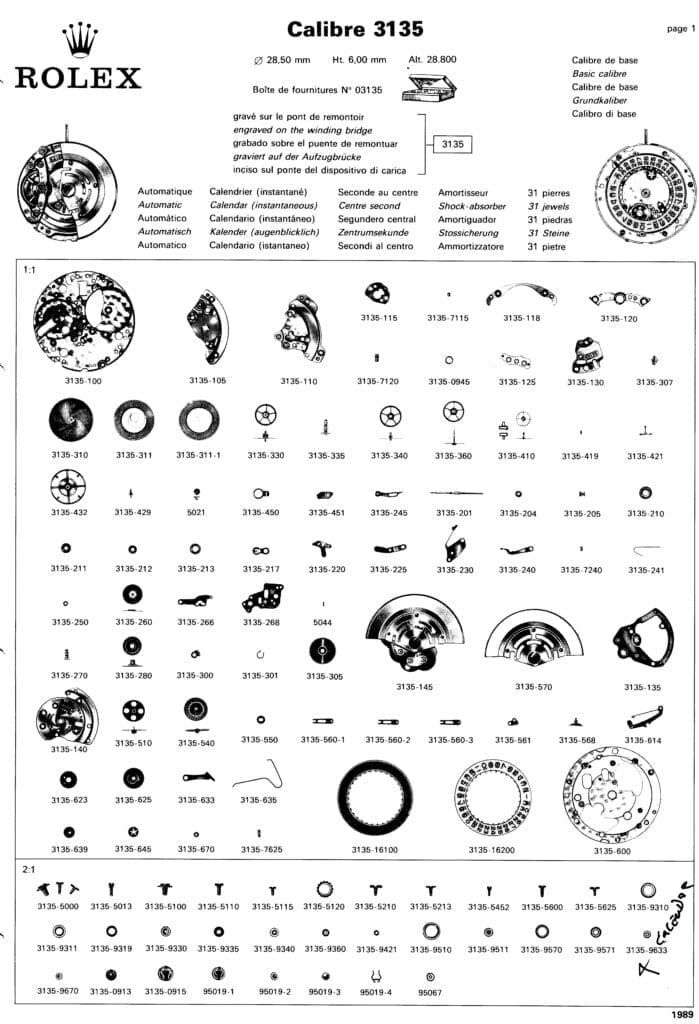
Major Component Part Numbers
Sourcing Notes
Generic aftermarket parts for the 3135 are widely available from suppliers such as Cas-Ker, Esslinger, Gleave & Co., Watch Material, Cousins UK, and others. These parts are manufactured to fit Rolex specifications but are not produced by Rolex, meaning they will void any remaining factory warranty. Quality varies by supplier, with Swiss-made generic parts generally offering better dimensional accuracy and material quality than Asian-made alternatives. Genuine Rolex parts are available only through authorized Rolex service centers or from watchmakers with Rolex accounts, and are significantly more expensive (example: genuine mainspring approximately £46 vs. generic £14).
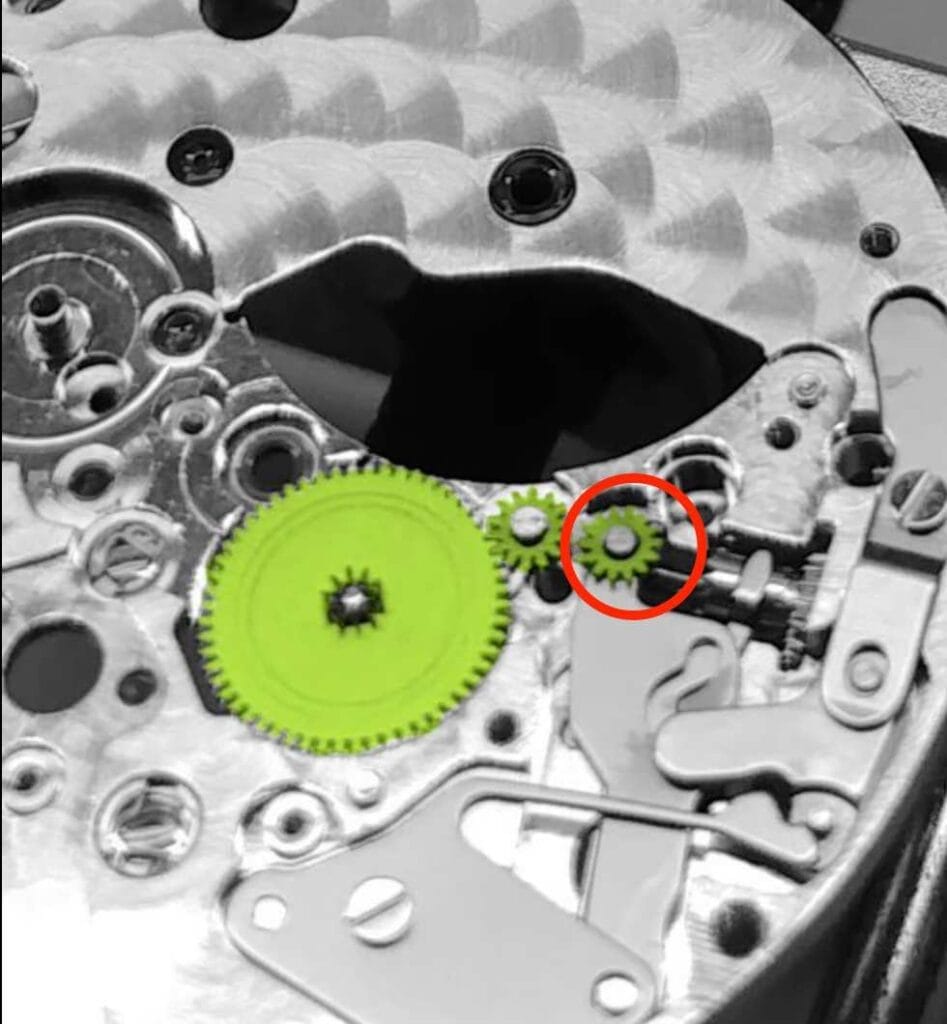
Commonly failing components requiring replacement include: rotor axle (wear from rotation causes noise and insufficient winding), mainspring (fatigue reduces power reserve and amplitude over time), balance staff (breakage from impacts), shock absorber jewels (wear or breakage), reversing wheels (wear on teeth or internal clutches), barrel arbor bushings (wear causes increased friction and power loss). The automatic winding system, particularly the rotor axle and reversing wheels, experiences the most wear due to continuous operation whenever the watch is worn.
Acceptable generic replacements exist for most wearing parts (mainspring, rotor axle, reversing wheels, train wheels, screws) provided the supplier maintains good quality control. Critical components where genuine parts are preferred include the balance complete (difficult to match hairspring characteristics and poise), pallet fork and escape wheel (precision of angles and jewel setting affects performance), and barrel bridge (dimensional accuracy required for proper mainspring tension). Collectors maintaining original specifications for investment purposes should insist on genuine parts only, while users prioritizing functionality over originality may use high-quality generics for most components.
Performance Data
Manufacturer Specifications
Rolex specifies the following performance parameters for the Caliber 3135:
Observed Performance (Field Data)
Collectors, watchmakers, and timing results from authenticated examples provide real-world performance data:
Typical accuracy for well-maintained 3135 movements falls within 0 to +5 seconds per day under normal wearing conditions, with many examples achieving 0 to +2 seconds per day consistency when properly regulated. Watches that have not been serviced in 10+ years commonly drift to +8 to +15 seconds per day due to lubricant degradation, mainspring fatigue, or accumulated magnetism. Negative rates (running slow) are less common and usually indicate more serious issues such as contaminated escapement, damaged pallet stones, or severely weakened mainspring.
Amplitude measurements on timegrapher show significant variation by position and power reserve state. Freshly serviced movements typically display 295 degrees horizontal (dial up), 280-290 degrees dial down, and 260-280 degrees in vertical positions (crown up, crown down, crown left, crown right). After 24-48 hours without winding, amplitude drops by approximately 15-30 degrees across all positions as mainspring tension decreases. Minimum acceptable amplitude is 200 degrees, below which the escapement may not unlock properly and the watch will stop. Amplitude below 250 degrees in any position after full winding indicates service requirements: insufficient lubrication, worn pivots, magnetized hairspring, or failing mainspring.
Common performance issues include: magnetization causing fast running (+30 to +120 seconds per day) and erratic timekeeping, resolved by demagnetization; quickset date mechanism failures preventing date advancement, often due to worn intermediate date corrector or detent spring; automatic winding insufficiency from worn rotor axle, resulting in watch stopping if not manually wound daily; amplitude loss from congealed lubricants or dirt accumulation, requiring complete service; positional variation exceeding ±10 seconds per day between dial up and vertical positions, indicating balance poise issues or hairspring irregularities.
Rate stability over temperature shows the 3135 performing within specifications, with observed variation of approximately +0.35 seconds per day per degree Celsius, comfortably within the ±0.5 maximum specification. This temperature stability improved significantly with the introduction of Parachrom hairsprings after 2000, as the niobium-zirconium alloy has superior thermal characteristics compared to traditional Nivarox alloys.
The 3135 demonstrates excellent long-term reliability when serviced on Rolex’s recommended 10-year interval. Movements that receive proper service (complete disassembly, ultrasonic cleaning, replacement of worn parts, re-lubrication, and timing adjustment) typically provide another 10 years of accurate service. The caliber’s reputation among watchmakers as one of the easiest to service and most reliable in operation is well-deserved, with properly maintained examples regularly exceeding 30-40 years of service life