

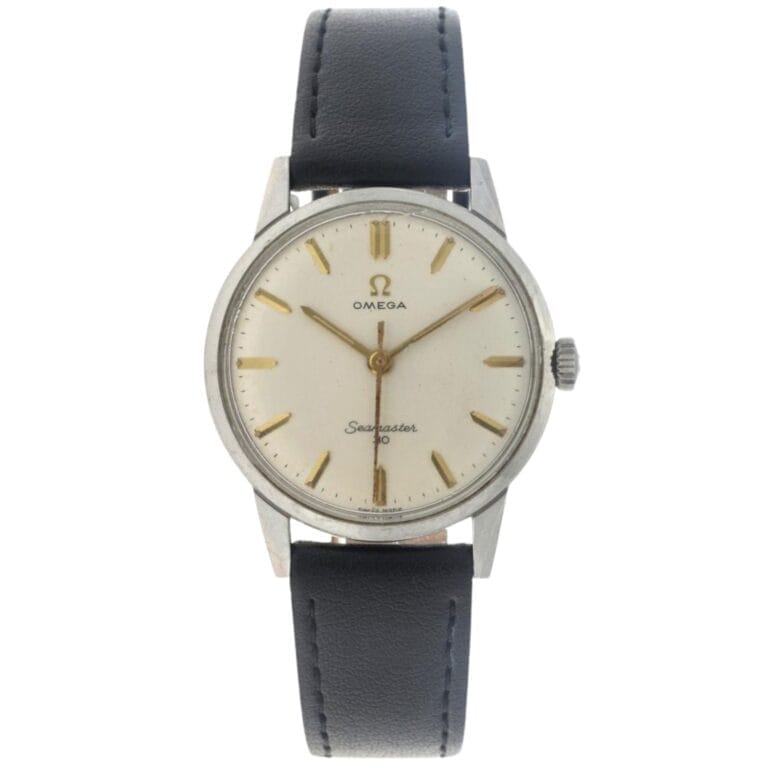
The “30” in Seamaster 30 refers to the 30mm movement diameter, not water resistance—a persistent misconception that masks this model’s true significance. Introduced in 1962 as the final showcase for Omega’s legendary hand-wound caliber family, the Seamaster 30 represents the culmination of movement technology that dominated observatory precision trials for two decades. Today it offers collectors genuine mid-century Swiss craftsmanship at prices starting around $500-800, making it one of the best value propositions in vintage Omega collecting.
The model’s understated elegance and proven Caliber 286 movement make it an ideal entry point for new collectors, while rare military-issued variants with Pakistan Air Force provenance command premiums exceeding $3,000. Production ran from 1962 to approximately 1966, a brief window at the twilight of mechanical watchmaking’s golden age, just before the quartz crisis transformed the industry.
Origins in Omega’s observatory-conquering movement family
The Seamaster 30 was conceived to showcase Omega’s 30mm caliber family in an elegant dress watch format. This movement lineage traces back to the 30T2, introduced in 1939 and nicknamed “bulletproof” by collectors for its exceptional durability. The 30T2 family accumulated remarkable achievements: first place at Kew Observatory precision trials in 1940 and 1946, dominance at Geneva and Neuchâtel competitions from 1947-1951, and selection by the British Army for over 110,000 WWW (Wrist Watch Waterproof) military timepieces during World War II.
By 1962, Omega had refined this architecture into Caliber 286 (center seconds) and Caliber 269 (sub-seconds at 6 o’clock)—the final evolutions featuring NOVOCHOC shock protection unique to these movements, plus improved parts interchangeability that Omega’s 1963 Technical Guide No. 27 specifically highlighted for easier servicing. The Seamaster 30 thus embodied decades of precision horological engineering in a slim, wearable package.
The watch occupied a distinct niche within Omega’s expanding Seamaster lineup. While the Seamaster 300 (1957) pursued professional divers and the automatic DeVille targeted the American luxury market, the Seamaster 30 offered hand-wound precision for dress watch purists who valued direct engagement with their timepiece.
Production context from 1962 to 1966
Manufacturing occurred at Omega’s historic headquarters in Biel/Bienne, Switzerland, where the company had been based since 1882. Cases came from La Central Boite (Fabrique de Boites La Centrale), the same supplier Omega used for contemporary Speedmaster production.
The 1960s represented Swiss watchmaking’s zenith before the quartz disruption. When the Seamaster 30 launched, the industry employed approximately 90,000 workers, and Omega’s parent company SSIH (Société Suisse pour l’Industrie Horlogère) operated 28 companies across 12 countries with 76,000 employees. Omega was outselling Rolex in volume, though Rolex commanded higher price points.
Competitive landscape during production:
- Rolex had established the Oyster Perpetual and was refining the Datejust (1945) and Day-Date (1956)
- Longines competed with Flagship and Conquest models featuring Ultra-Chron high-beat movements
- IWC offered the highly regarded Mark XI pilot watches at premium prices
- The broader market was transitioning from hand-wound to automatic movements
By 1964, Omega introduced the Seamaster 600 as successor, named for its 600-series automatic calibers. Consumer preferences had shifted toward self-winding movements and waterproof cases, rendering the elegant but manually-wound Seamaster 30 increasingly obsolete. Caliber 286 production ceased around 1966, and the 30mm movement family—after approximately 3 million units across all variants since 1939—came to an end.
Design evolution remained remarkably consistent
Unlike many vintage watch lines that underwent dramatic redesigns, the Seamaster 30 maintained visual consistency throughout its brief production run. This reflects both its short lifespan and Omega’s focused design philosophy.
Case design featured a 35mm diameter (some variants measured 35.3-35.5mm), 42-43mm lug-to-lug, and 18mm lug width—proportions that remain wearable by contemporary standards. The slim profile showcased polished surfaces with faceted, downturned lugs. Case backs bore the iconic Hippocampus (seahorse) medallion, with some references featuring screw-down backs (135.xxx series) and others using snap-backs (125.xxx series).
Dial evolution showed subtle refinements rather than wholesale changes. Early 1962-1963 production featured applied Omega logos at 12 o’clock with “Seamaster” or “Seamaster 30” printed at 6 o’clock. Applied faceted baton indices predominated, with luminous plots positioned above hour markers. Silver/white dials were standard, while black dials—produced in much smaller quantities—now command roughly double the market price.
Rare dial variants emerged throughout production: linen-textured surfaces, crosshair configurations, and Explorer-style dials with Arabic numerals at cardinal positions. The most collectible are military-inspired MoD-style examples featuring railroad minute tracks, Arabic numerals, and heavy luminous application—designed after specifications used for British Armed Forces watches.
The most significant documented military connection came in 1963 when the Pakistan Air Force ordered Ref. 135.007 watches, creating the most sought-after Seamaster 30 variant in today’s market.
Reference numbers follow Omega’s 1962 MAPICS system
Omega introduced the MAPICS reference format in 1962, providing collectors with a logical decoding system. The structure XYZ.ABC-YY reveals:
- First digit (X): Gender (1 = men’s)
- Second digit (Y): Movement type (2 = sub-seconds, 3 = center seconds)
- Third digit (Z): Water resistance classification (5 = water resistant)
- Suffix (-YY): Production year
The two primary reference families:
| Series | Movement | Seconds Position | Key References |
|---|---|---|---|
| 125.xxx | Caliber 269 | Sub-seconds at 6 o’clock | 125.003, 125.007 |
| 135.xxx | Caliber 286 | Center (sweep) seconds | 135.003, 135.007 |
Reference 135.007 is the most commonly encountered Seamaster 30, produced from 1963 through 1966 with year suffixes (-63, -64, -65, -66) indicating case production date. This reference served as the basis for Pakistan Air Force military orders and remains the primary entry point for collectors.
Case material prefixes further distinguish variants: ST (stainless steel), JD (gold), and CD (gold-capped/gold-filled). The ST 135.0007 and JD 125.0003 formats appear in Omega’s modern vintage database cataloging.
Technical specifications reveal precision engineering
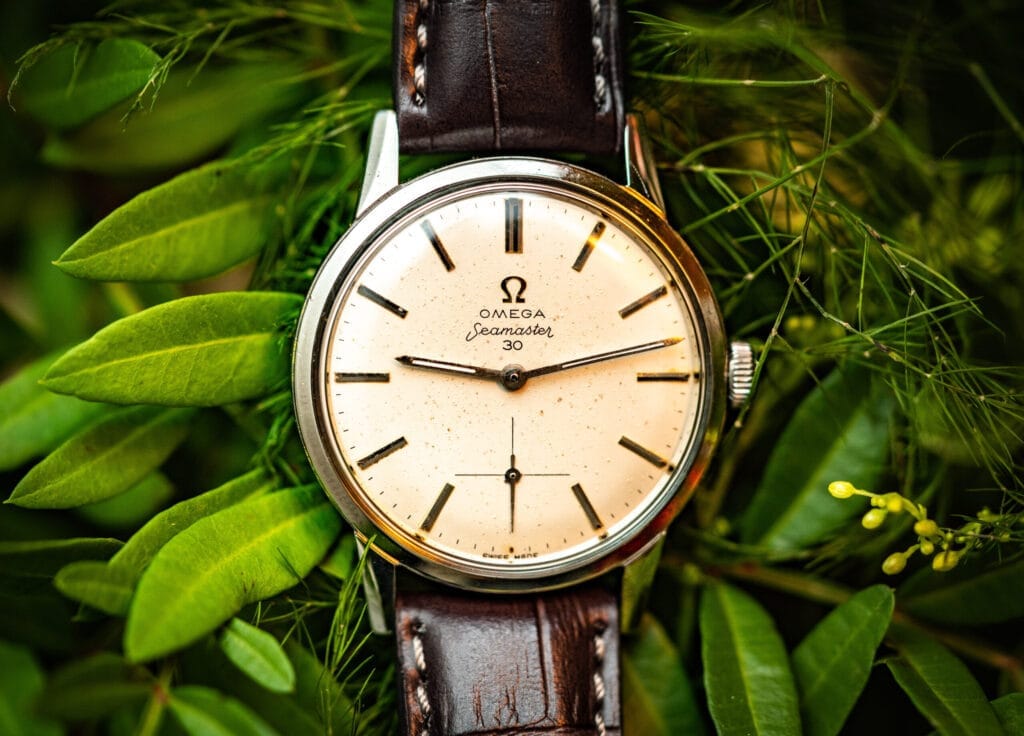
Caliber 286 (center seconds) — most common
| Specification | Value |
|---|---|
| Diameter | 30mm |
| Height | 5.1mm |
| Jewels | 17 |
| Frequency | 18,000 bph (2.5 Hz) |
| Power reserve | 42-45 hours |
| Lift angle | 49 degrees |
| Shock protection | NOVOCHOC |
| Balance | Monometallic Glucydur |
| Hairspring | Flat (not Breguet overcoil) |
Caliber 269 (sub-seconds) — less common
Same base specifications as Cal. 286 but with 4.0mm height and sub-seconds display at 6 o’clock. Both calibers eliminated banking pins in the escapement to improve accuracy—a refinement specifically noted in Omega’s period technical documentation.
Water resistance was rated at 30 meters (3 bar)—coincidentally matching the name but entirely unrelated to its origin. This provided splash protection suitable for handwashing but not swimming.
Case specifications remained consistent: 35mm diameter, 42-43mm lug-to-lug, 18mm lug width, acrylic/Hesalite crystal (some signed with tiny Omega logo), and standard push-pull crown operation.
Collector market favors military variants and black dials
Most sought-after configurations
Pakistan Air Force examples (Ref. 135.007, 135.011) represent the pinnacle of Seamaster 30 collecting. Featuring black dials with tritium triangle markers and PAF caseback engravings, documented examples with Omega Archive Extracts command $2,650-$3,500+. Authentication concerns run high—many redials and fantasy pieces circulate, making Extract verification essential.
Black dial variants (non-military) consistently sell for approximately double equivalent silver dial models. Military-inspired MoD-style configurations with railroad minute tracks attract collectors focused on tool watch aesthetics.
Rare dial variants generating premiums include linen-textured surfaces, crosshair patterns, and applied Arabic numeral configurations from 1963-1966 production.
Current market pricing structure
| Category | Price Range | Description |
|---|---|---|
| Entry-level | $500-800 | Fair condition silver dial, may need service |
| Good condition | $800-1,200 | Clean, serviced, original dial |
| Collector grade | $1,200-2,000 | Excellent condition, uncommon variants |
| Premium black dial | $2,000-3,000 | Black dial, linen texture, exceptional condition |
| Military documented | $2,650-4,500+ | PAF/RAF with Archive Extract |
What drives value
Dial condition matters most—original, unrestored dials command maximum prices while redials significantly diminish value. Case condition follows closely: sharp lugs retaining original beveling indicate minimal polishing, while rounded “soft” lugs suggest aggressive refinishing that reduces desirability.
Movement authenticity (original Cal. 286 or 269), matching hands and dial, signed Omega crowns, and intact Hippocampus caseback emblems complete the authentication checklist. Papers and boxes add modest premiums for standard models but become essential for military variants requiring provenance documentation.
Position relative to other vintage Omega
The Seamaster 30 occupies the accessible tier of vintage Omega collecting—positioned below the Constellation (chronometer-certified movements, $2,000-5,000+) and dramatically below the Seamaster 300 ($13,000-20,000+ for desirable references) and Speedmaster ($4,000-50,000+).
This represents opportunity rather than weakness. Forum consensus characterizes the Seamaster 30 as offering “solid value relative to design, movement, and brand heritage”—genuine 1960s Omega craftsmanship without the premium pricing driven by Speedmaster hype or dive watch speculation. The vintage Omega market has appreciated approximately 80% in auction sales from 2019-2022, and Seamaster 30 values have risen correspondingly from roughly $500 (2019) to $1,000+ (2024) for comparable examples.
Acquisition guidance for collectors
For newcomers, the silver dial Reference 135.007 in stainless steel provides the ideal starting point at $700-1,000. These remain readily available on Chrono24, eBay, Omega Forums, and through vintage watch dealers. Verify original dial condition under magnification, confirm the signed crown and clean Hippocampus caseback, and request timing certificates or recent service documentation.
Red flags include military-style dials without Archive Extract documentation, prices exceeding $1,000 for standard silver dial examples, Indian market sources (frequently problematic per collector forums), and over-polished cases with soft lugs.
Best value opportunities exist in honest gold-plated examples with light wear ($600-900) and steel models needing service ($400-600 plus $200-300 service cost)—allowing buyers to acquire genuine vintage Omega with room for appreciation while understanding the investment required.
Conclusion
The Omega Seamaster 30 represents the final expression of a movement family that dominated precision watchmaking for two decades. Its 1962-1966 production window captured a pivotal moment—the twilight of hand-wound supremacy before automatic movements and ultimately quartz technology transformed consumer expectations.
For collectors, this positioning creates opportunity. The Seamaster 30 offers authentic mid-century Swiss craftsmanship, proven movement architecture, and elegant design at entry-level prices. The most desirable variants—documented military-issue PAF models and rare black dials—have established their collectibility with corresponding premiums. Standard silver dial examples remain accessible and likely undervalued relative to their historical significance and the broader appreciation in vintage Omega markets.
The key insight: while the Seamaster 30 lacks the name recognition of its diving and chronograph siblings, it shares their fundamental quality and represents the culmination of Omega’s manual-wind expertise. For collectors willing to look beyond hype toward genuine horological heritage, few 1960s watches offer comparable value.