

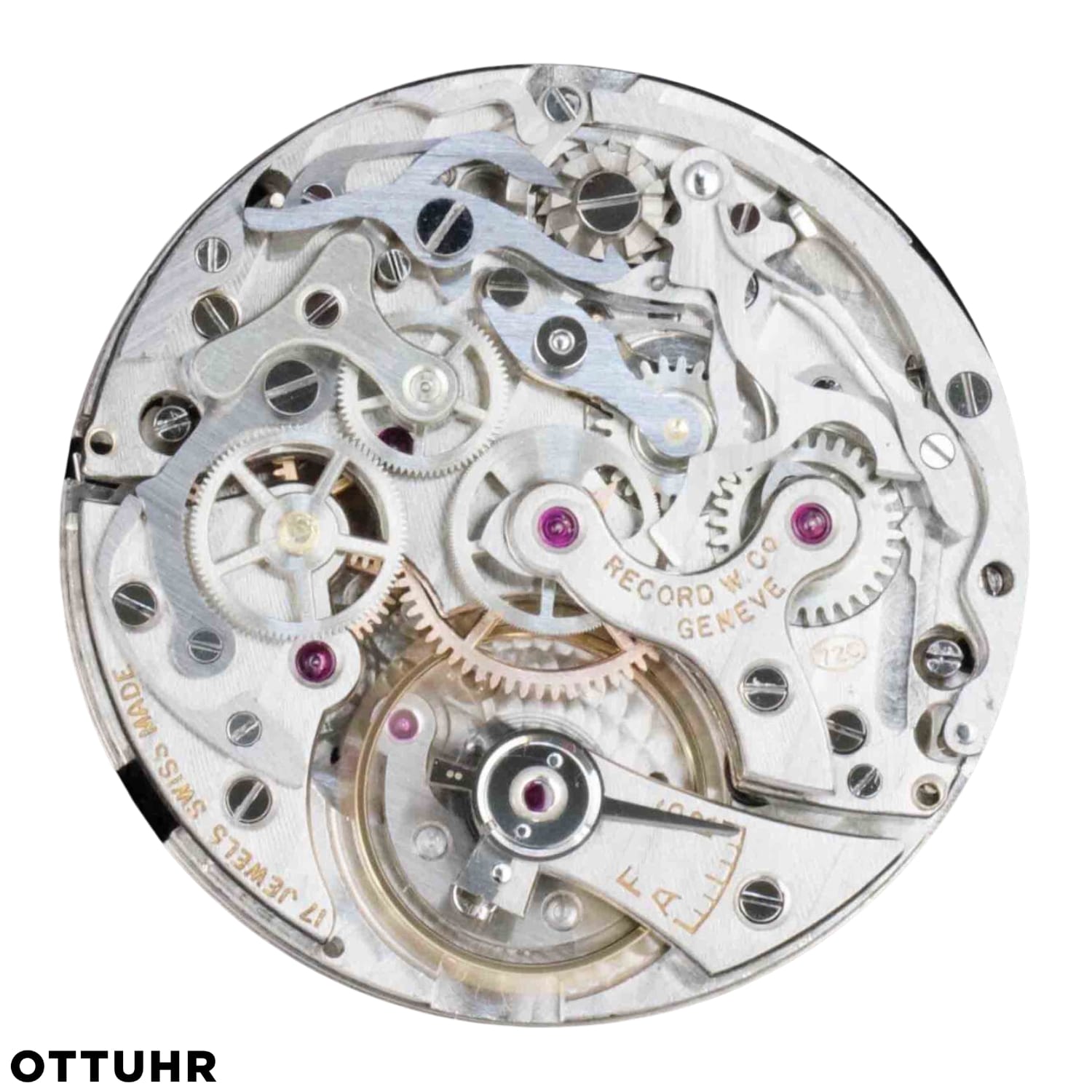
The Valjoux 72C powers one of the rarest and most complicated Rolex chronographs ever produced: the “Jean-Claude Killy” Dato-Compax, a triple calendar chronograph that combines column wheel chronograph architecture with full calendar complications in the brand’s signature Oyster case. Fewer than 1,000 examples across all Rolex 72C references are believed to exist, making any watch powered by this caliber a significant historical artifact from the golden age of mechanical complications.
The 72C represents Valjoux’s answer to the post-war demand for full-featured dress chronographs. Where the base Valjoux 72 offered chronograph and 12-hour counter functionality, the 72C adds a complete triple calendar mechanism with day and month windows at 12 o’clock and a central date hand pointing to a perimeter date track. This is not a simple module bolted onto an existing movement. The calendar integration required substantive engineering, increasing movement height from approximately 6.95mm to 7.35mm and adding mechanical complexity that would challenge watchmakers for the next 28 years of production.
Production estimates for the entire Valjoux 72 family (all variants from 1938 to 1974) suggest approximately 750,000 movements across the 36-year run, translating to roughly 15,000 to 20,000 pieces annually shared across dozens of brands. The 72C, as a more complicated and expensive variant, represents a smaller subset of this total. Rolex alone consumed an estimated 59,847 Valjoux 72 movements for Daytona production, representing nearly 8 percent of total 72 family output. For the 72C specifically, Rolex produced approximately 1,500 to 2,000 examples across references 4767, 4768, 5036, 6036, and 6236 between 1947 and the early 1960s. Reference 4768, the non-Oyster case version, saw production of only 220 examples, with approximately 30 known survivors in stainless steel.
The 72C sits in rare territory today. Not scarce in the sense of impossible to locate, but uncommon enough that most examples command four-figure premiums over comparable time-only chronographs. Demand centers on Rolex references, which regularly achieve six-figure results at auction when presented in original condition. Non-Rolex examples from brands like Wittnauer, Heuer, Gallet, and Universal Genève offer collectors access to the same movement architecture at substantially lower entry points, typically ranging from $3,000 to $8,000 depending on condition and provenance. Collector interest remains stable to rising, driven by broader appreciation for column wheel chronographs and triple calendar complications as mechanical complexity becomes increasingly valued in a quartz-dominated landscape.
Historical Context, Provenance, and Manufacturing Details
Valjoux SA introduced the Caliber 72C around 1946, approximately eight years after the launch of the base Valjoux 72 in 1938. The development timeline makes sense: World War II disrupted Swiss watchmaking, and the immediate post-war period saw renewed demand for complicated wristwatches from an affluent customer base seeking both functionality and status. A chronograph with full calendar answered that demand, offering business travelers and executives a single-wrist solution for timing events while tracking day, date, and month across time zones and international datelines.
The 72C evolved directly from the Valjoux 72, which itself descended from the earlier Valjoux 23 (introduced 1916) and Valjoux 22 (introduced 1914). The 23 and 72 shared the same 13 ligne diameter, with the 72 adding the 12-hour counter mechanism on the dial side. The 72C takes this evolution one step further, integrating a triple calendar mechanism that adds approximately 0.40mm to movement height. Component interchangeability between the 72 and 72C is high for base movement parts like the gear train, escapement, and winding mechanism. The chronograph runners, column wheel, and coupling clutch are largely identical. The calendar-specific components, including the day and month discs, date driving wheel, and calendar jumpers, are unique to the 72C.
Valjoux operated as an independent ebauche manufacturer until 1944, when it joined Ebauches SA, the massive holding company that controlled most Swiss movement blank production. In 1965, Ebauches SA absorbed Valjoux more fully into the ETA division, though movements continued to carry Valjoux nomenclature through the end of production in 1974. Throughout the 72C’s production life, manufacturing remained centered at Valjoux’s Les Bioux facility in the Vallée de Joux. No evidence suggests satellite facilities or production shifts during the 28-year run from 1946 to 1974.
The 72C had no single direct predecessor. It represents a parallel development to the base 72, adding calendar complications while the 72 continued production as the simpler, more affordable option. Valjoux offered both simultaneously, allowing watch brands to choose between chronograph-only (72) or chronograph-with-calendar (72C) depending on target market and price positioning.
The successor arrived in the early 1970s when Valjoux increased beat rate from 18,000 vph to 21,600 vph, creating the Valjoux 730. The 730 incorporated several technical improvements: a Glucydur balance wheel (more temperature-stable than the bimetallic balance in the 72C), a Triovis micro-regulator for finer adjustment, and Nivarox components in higher grades. The increased beat rate improved theoretical accuracy but reduced power reserve from 48 hours to 46 hours and demanded more frequent servicing. Production of both the 18,000 vph (72C) and 21,600 vph (730) versions ended in 1974 when Valjoux shifted focus to the cam-operated Valjoux 7750, a fundamentally different architecture designed for higher-volume production and lower manufacturing costs. The 7750 reportedly produced 100,000 units in its first year alone, dwarfing the modest annual output of the column wheel 72C.
The 72C represented neither groundbreaking innovation nor workhorse ubiquity. It occupied the middle ground: a competent, well-engineered caliber that delivered reliable chronograph and calendar functions at a reasonable cost to watch brands. Its column wheel architecture placed it above cam-operated competitors in mechanical sophistication, while its ebauche origins kept pricing accessible compared to in-house manufacture calibers. For brands like Rolex, Heuer, and Universal Genève, the 72C offered a turnkey solution for complicated dress chronographs without the expense of developing proprietary calendar-chronograph movements.
Construction and Architecture
The Valjoux 72C employs a traditional Swiss architecture with a main plate and separate bridges for the balance, chronograph mechanism, and dial-side calendar works. The main plate and bridges are brass, typical for mid-grade Swiss movements of the era. Higher-grade examples received rhodium plating for corrosion resistance and aesthetic appeal, while base-grade movements retained natural brass coloring.
The dial side houses the calendar mechanism, including the day and month discs, date driving wheel, and calendar jumpers. This arrangement places the most visually complex components where they remain hidden beneath the dial, while the movement side presents the more traditional chronograph architecture. The chronograph bridge spans the center of the movement, covering the column wheel at 6 o’clock and the coupling clutch mechanism. The balance cock sits at 12 o’clock, easily removable for service access to the escapement and balance assembly.
The architectural philosophy prioritizes serviceability. Bridges attach via screws rather than friction-fit posts, allowing watchmakers to disassemble the movement in logical stages: balance cock first, then chronograph bridge, then calendar works. Parts are robustly dimensioned for the era, though not to the standards of higher-grade manufacture movements. Pivot holes in brass plates rather than jeweled chatons represent one cost-saving measure, though the 17-jewel count still places the 72C in the mid-grade category.
Balance Wheel
The Valjoux 72C uses a bimetallic balance wheel with external timing screws in standard configurations. The balance consists of a two-layer construction: an inner brass ring for inertia and an outer steel rim for temperature compensation. As temperature changes, the differential expansion rates of brass and steel cause the rim to bend slightly, theoretically offsetting the effects of temperature on the hairspring. In practice, this passive compensation provides modest benefit, typically reducing temperature-related rate variation to approximately ±5-10 seconds per day across an 8°C to 38°C range.
Higher-grade examples and later production runs incorporated Glucydur balance wheels, a beryllium-bronze alloy that resists deformation better than standard bimetallic balances. Glucydur balances appeared more commonly in the successor Valjoux 730, though some late-production 72C examples may have received this upgrade. The balance diameter measures approximately 10-11mm, substantial for a 13 ligne movement and contributing to stable timekeeping.
Timing screws typically number 8 to 12 around the balance rim, positioned in pairs for symmetry. Watchmakers adjust rate by turning screws inward (faster) or outward (slower), changing the balance’s moment of inertia. The screw-adjusted design allows for precise rate adjustment but requires skilled regulation. Free-sprung balances, which eliminate the regulator entirely, did not appear in the 72C.
Balance Spring (Hairspring)
The Valjoux 72C came with two hairspring configurations: flat hairspring and Breguet overcoil. Early production and base-grade examples used flat hairsprings, simpler to manufacture but more susceptible to position errors. Later production and adjusted-grade examples received Breguet overcoil hairsprings, which lift the outer coil above the plane of the spring, improving concentricity during expansion and contraction. This design reduces position error, the variation in rate as the watch orientation changes.
Material specification for standard grades was Nivarox 2, a cobalt-nickel alloy developed in the 1930s that resists magnetism and temperature variations better than traditional steel springs. Higher grades used Nivarox 1 or Anachron, premium alloys with superior temperature coefficients. The hairspring attaches to the balance staff via a collet and to the balance cock via a stud, typically mounted in a slotted stud holder for fine adjustment. The regulator (index arm) moves along the hairspring, effectively shortening or lengthening the active length to adjust rate.
Escapement Type
The Valjoux 72C employs a Swiss lever escapement with a straight-line lever, the standard configuration for mid-to-high grade Swiss movements. The escape wheel features 15 teeth and is manufactured from steel in base grades, with Nivarox escape wheels appearing in higher grades for improved wear resistance and reduced magnetic susceptibility.
The pallet fork carries two synthetic ruby pallet stones (entrance and exit) and one synthetic ruby impulse jewel mounted on the roller table. The lever escapement delivers impulses to the balance wheel twice per oscillation, once at each extreme of the balance’s swing. The geometry creates a self-starting characteristic: if the balance stops, slight motion will restart the escapement, unlike some early lever designs that required manual intervention.
The escapement receives 5 of the movement’s 17 jewels: two for the escape wheel pivots, two for the pallet fork pivots, and one impulse jewel. Additional jewels appear at the fourth wheel (2 jewels), third wheel (2 jewels), center wheel (2 jewels), balance staff (2 jewels), and pallet assembly (2 jewels), totaling 17. The jewel count does not include chronograph jewels, which Valjoux considered part of the complication rather than the base movement.
Banking pins limit the pallet fork’s lateral travel, preventing over-banking that would cause the escapement to lock incorrectly. These pins are adjustable by bending, allowing watchmakers to set proper escapement depth during service. The banking pins sit on the movement side, directly adjacent to the pallet fork.
Shock Protection System
The Valjoux 72C uses Incabloc shock protection, the Swiss industry standard introduced in 1934. The Incabloc system employs a lyre-shaped spring that holds a conical jewel setting in place. When subjected to shock, the jewel setting can move slightly, absorbing impact and protecting the delicate balance staff pivots from damage. Once the shock passes, the lyre spring returns the jewel to its proper position.
Incabloc protection appears at both ends of the balance staff (upper and lower pivots), the two most vulnerable points in the movement. The system uses a synthetic ruby cap jewel above and below the balance staff, with a synthetic ruby hole jewel serving as the pivot bearing. The entire assembly seats in a brass chaton held by the lyre spring.
Earlier production 72C movements may have used other shock systems or no shock protection at all, as shock systems were not universal in the 1940s. By the 1950s, however, Incabloc had become standard on mid-grade and higher Swiss movements. The Incabloc block is removable with a specialized tool, allowing watchmakers to replace the jewels and springs during service.
Regulator Type
The Valjoux 72C employs an index regulator, the traditional Swiss system consisting of a movable arm that slides along the hairspring. The regulator arm features two pins (the regulator pins) that bracket the hairspring, creating a fixed point that effectively determines the active length of the spring. Moving the regulator toward “+” (plus, or fast) shortens the active spring length, increasing frequency. Moving toward “-” (minus, or slow) lengthens the spring, decreasing frequency.
The index regulator attaches to the balance cock via a central pivot and is adjusted by moving a lever arm marked with + and – indicators. Fine adjustment typically offers a range of approximately ±30 seconds per day, sufficient for most regulation needs. The regulator also incorporates the stud holder, which secures the outer end of the hairspring to the balance cock.
Base-grade 72C movements use simple index regulators without fine adjustment mechanisms. Adjusted-grade examples may incorporate micrometric screws for more precise regulation. The successor Valjoux 730 introduced the Triovis micro-regulator, a more sophisticated system with finer adjustment capability, but this did not appear in the 72C.
Free-sprung regulation, which eliminates the regulator entirely and adjusts rate solely via timing screws on the balance wheel, did not appear in the 72C. This system, preferred by high-grade manufacturers like Patek Philippe and Rolex for in-house movements, remains uncommon in ebauche-based calibers due to higher manufacturing and regulation costs.
Mainspring Material and Type
The Valjoux 72C uses a traditional alloy mainspring, later upgraded to Nivaflex NO in standard grades and Nivaflex NM in higher grades. Nivaflex, like Nivarox, is a cobalt-nickel alloy that resists setting (permanent deformation) and delivers more consistent torque over its power reserve compared to carbon steel springs. The mainspring is referenced as part number 771 in Valjoux parts catalogs, though multiple suppliers offered compatible springs under different reference numbers.
Mainspring dimensions vary slightly by source, but typical specifications include:
- Height: 1.30-1.35mm
- Thickness: 0.14mm
- Length: 360-380mm
- Barrel diameter: 12.0mm
The spring attaches to the barrel arbor via a hole or hook, and the outer end attaches to the barrel wall via a slipping bridle. The slipping bridle is a safety feature that allows the spring to slip rather than break when the movement is overwound, though this remains rare in manual-wind movements with competent users. The bridle also prevents mainspring breakage from over-tensioning during winding.
The barrel makes one complete revolution per mainspring wind, and the typical 72C accepts approximately 10-12 full turns of the crown for complete winding. Power delivery is not linear: torque peaks around 60-70 percent wind and decreases as the spring approaches full wind or near-empty states. This non-linear delivery affects amplitude, which is why well-maintained 72C movements show amplitude variation from 260-280° when fully wound to 200-240° near the end of the 48-hour power reserve.
Gear Train Details
The Valjoux 72C employs a standard Swiss four-wheel gear train: barrel, center wheel, third wheel, fourth wheel, and escape wheel. The center wheel makes one revolution per hour, driven by the cannon pinion that friction-fits to the center wheel arbor. The seconds hand drives from the fourth wheel, which makes one revolution per minute. The small seconds display at 9 o’clock takes its drive from the fourth wheel via an intermediate wheel.
Gear ratios follow standard Swiss practice but are not widely published, as Valjoux considered these details proprietary during production. Typical ratios for a 13 ligne movement with 18,000 vph frequency would place the center wheel at approximately 60-80 teeth, third wheel at 70-90 teeth, and fourth wheel at 70-80 teeth, with corresponding pinions calculated to achieve the desired beat rate. The escape wheel’s 15 teeth deliver impulses to the balance wheel, which oscillates at 18,000 vibrations per hour (5 beats per second, 2.5 Hz).
The center wheel configuration uses direct drive from the barrel via the cannon pinion. The chronograph mechanism engages the fourth wheel via a lateral coupling clutch that meshes a stationary chronograph runner with the continuously rotating fourth wheel. When the chronograph starts, the coupling clutch moves laterally, bringing the chronograph runner into contact with the fourth wheel. This drives the center chronograph seconds hand and, through additional gearing, the 30-minute counter at 3 o’clock and 12-hour counter at 6 o’clock.
Finishing Quality and Techniques
Finishing quality on the Valjoux 72C varies dramatically by grade and by which brand commissioned the movement. Base-grade movements received utilitarian finishing: circular graining (perlage) on the main plate visible through the dial side, brushed or lightly grained bridges, and polished screw heads. Adjusted-grade examples added Geneva stripes (Côtes de Genève) to visible bridges, beveled (anglaged) edges on steel parts, and decorative patterns on the chronograph bridge.
Perlage appears as overlapping circular patterns applied with a rotating abrasive tool. The patterns serve both functional and aesthetic purposes: functionally, the texture helps retain lubrication; aesthetically, the regular pattern is more visually pleasing than raw machined surfaces. Perlage quality varies from coarse (large circles with significant overlap) to fine (small circles with minimal overlap). Base-grade 72C movements typically show coarse perlage, while adjusted grades show finer work.
Geneva stripes (Côtes de Genève) consist of parallel lines applied with a rotating abrasive wheel guided by hand or machine. The stripes should be evenly spaced, parallel, and without interruption. High-grade examples show sharp demarcation between adjacent stripes, while lower grades may show overlapping or irregular patterns. On the 72C, Geneva stripes typically appear on the chronograph bridge and, in higher grades, on the balance cock.
Anglage (beveling) involves creating polished 45-degree chamfers on the edges of steel parts, particularly bridges and levers. The chamfer should be consistent in width and mirror-polished, with a sharp transition between the chamfer and the flat surface. Base-grade 72C movements show simple deburred edges rather than true anglage. Adjusted grades show beveled edges, though not always mirror-polished to manufacture standards.
Brand-modified versions varied dramatically. Rolex-signed 72C movements show moderate finishing upgrades while maintaining the ebauche character. The chronograph bridge carries the Rolex coronet and “Montres Rolex SA” engraving, applied with sharp, deep stamping. Universal Genève applied similar branding. Higher-end brands occasionally applied additional finishing, though full manufacture-level reworking (as Patek Philippe did with some Valjoux-based perpetual calendar movements) did not occur with the 72C. The calendar complication made the movement complex enough that brands generally left the architecture largely as Valjoux supplied it.
Cross-Reference Data
Alternative Caliber Names
| Manufacturer | Caliber Designation | Notes |
|---|---|---|
| Valjoux | 72C | Standard designation |
| Valjoux | VZHC | Technical designation: Valjoux Zähler Heure Calendrier |
| Valjoux | 723 | Functionally identical variant, possibly earlier production |
Base Caliber vs. Elaborated Versions
| Variant | Differences | Jewels | Functions | Production Period |
|---|---|---|---|---|
| Valjoux 72 | Base chronograph, no calendar | 17 | Chronograph, 30-min counter, 12-hr counter | 1938-1974 |
| Valjoux 72C | Adds triple calendar | 17 | Chronograph, 30-min counter, 12-hr counter, day, date, month | 1946-1974 |
| Valjoux 723 | Identical to 72C, possible designation variant | 17 | Chronograph, 30-min counter, 12-hr counter, day, date, month | 1946-1974 |
| Valjoux 730 | Higher beat rate, improved components | 17 | Chronograph, 30-min counter, 12-hr counter, day, date, month | 1971-1974 |
| Valjoux 88 | Adds moon phase to 72C architecture | 17 | Chronograph, 30-min counter, 12-hr counter, day, date, month, moon phase | 1946-1974 |
Compatible Case References by Brand
| Brand | Reference Numbers | Production Years | Notes |
|---|---|---|---|
| Rolex | 4767 | 1947-1955 | First Oyster Dato-Compax, screw-back case, ~400 produced |
| Rolex | 4768 | 1947-1955 | Non-Oyster case with fancy lugs, ~220 produced |
| Rolex | 5036 | 1948-1955 | Transitional reference, monoblock Oyster case |
| Rolex | 6036 | 1948-1955 | Monoblock Oyster case, steel and gold versions |
| Rolex | 6236 | Late 1950s-early 1960s | Final Dato-Compax, three-piece Oyster case with separate bezel |
| Heuer | 2543 | 1940s-1950s | Pre-Carrera triple date, steel and gold |
| Heuer | 2548 | 1940s-1950s | Triple date chronograph |
| Wittnauer | Various | 1950s-1960s | Multiple triple date references |
| Universal Genève | 22705/1 | 1950s-1960s | Compax triple date |
| Universal Genève | 885103/01 | 1960s | Compax chronograph |
| Gallet | 998 | 1950s-1960s | Multichron Calendar, steel “waterproof” case |
| Zodiac | Various | 1950s | Triple calendar chronograph, shared cases with Heuer |
| Breitling | Datora | 1940s-1950s | Triple date chronograph |
| Baume & Mercier | Various | 1950s | Triple calendar chronograph, steel and gold |
| Wakmann | 725.1311 | 1950s-1960s | Triple date chronograph |
| Enicar | 072-01-03, 072-02-01 | 1960s-1970s | Sherpa Graph and other chronographs with date |
| Mathey-Tissot | Various | 1950s | Triple calendar chronograph, gold and steel |
Dial Compatibility Note
The Valjoux 72C dial features a complex layout that requires precise dial foot positioning to align with the calendar mechanism and chronograph subdials. Standard dial configuration includes:
- Dial feet at approximately 3:00 and 9:00 positions (varies slightly by manufacturer)
- Day and month windows at 12 o’clock (day window typically at 11:30, month window at 12:30)
- Date track on dial outer perimeter with central date hand
- 30-minute counter at 3:00
- 12-hour counter at 6:00
- Small seconds at 9:00
- Chronograph pushers at 2:00 and 4:00
- Calendar pushers at 8:30 (date corrector) and 10:00 (day/month corrector)
Dial compatibility between watches is limited. While the movement diameter remains constant, dial designs were typically brand-specific with proprietary dial foot positions, making dial swaps difficult without modification. The date track graduation must also match the date disc diameter exactly, or the date hand will not point to the correct date. Restoration using incorrect dials is common in the vintage market and should be carefully scrutinized.
Crown and Stem Specifications
| Component | Specification | Notes |
|---|---|---|
| Stem Part Number | 401 | Valjoux parts catalog reference |
| Stem Thread | TAP 10 (0.90mm) or TAP 7 (1.20mm) | Two sizes available depending on case threading |
| Stem Type | Male/female variants available (#404) | |
| Crown Thread | TAP 10 (0.90mm) or TAP 7 (1.20mm) | Must match stem thread size |
| Setting Mechanism | Yoke-type clutch (part #435) | Moves sliding pinion for hand-setting |
The stem passes through the crown into the case tube and engages with the winding pinion for winding and the clutch mechanism for hand-setting. Pulling the crown to the first position engages the setting mechanism, allowing hand adjustment. The stem release mechanism uses a screw at the setting lever (rather than a push-button), requiring quarter-turn increments while pulling the stem to remove it. Over-loosening this screw can cause the setting lever to detach, requiring complete keyless works disassembly to reassemble.
Identification Marks
The caliber number “72C” or “VZHC” is stamped on the main plate, typically visible under the balance cock after its removal. The engraving appears as “72C” followed by the Valjoux logo (a stylized “R” in earlier production, later variations) and may include additional markings depending on the grade and client brand.
On Rolex-commissioned examples, the movement may carry “72C” along with “Montres Rolex SA” or “Rolex” engraving. Some examples show the Valjoux logo only, with no numeric designation visible without disassembly. Universal Genève-signed movements carry similar dual branding. Unsigned or lightly branded examples likely went to smaller brands or were sold as generic ebauches.
Logo and Brand Marks
Valjoux movements from the 1940s through 1974 typically carry the Valjoux logo, which evolved over the production period:
- Early production (1940s): Stylized “R” logo, sometimes accompanied by “Valjoux” text
- Mid-production (1950s-1960s): “Valjoux” text with logo, consistent engraving style
- Late production (1970s): Simplified logo, occasionally “ETA” marks appearing as Valjoux was absorbed into ETA
Quality stamps and adjustment markings vary by grade:
- Base grade: Typically no adjustment marks, may show “17 Jewels” and “Swiss” or “Swiss Made”
- Adjusted grades: May show position adjustment marks (2 positions, 3 positions, 5 positions) along with “Adjusted” or “Réglé” engraving
- Chronometer grade: Extremely rare on the 72C, would show “Chronometre” or COSC certification marks
Brand modifications appear on the chronograph bridge or balance cock:
- Rolex: “Montres Rolex SA” or “Rolex” with coronet on chronograph bridge
- Universal Genève: “Universal Genève” engraving
- Other brands: Varied, from full brand engraving to no additional marking
Date Codes
Valjoux did not use systematic date codes visible without disassembly during the 72C production period. Dating a 72C relies on:
- Serial number ranges (when documented)
- Case serial numbers from the watch brand
- Stylistic evolution of logo and engraving styles
- Component characteristics (flat vs. Breguet hairspring, shock system type)
Some movements carry production batch numbers or inspector marks, but these are not systematically documented and require movement-specific research to interpret.
Finishing Marks
Expected finishing patterns vary by grade:
Base Grade:
- Circular perlage on main plate (dial side), coarse pattern with large overlapping circles
- Brushed or lightly grained bridges without striping
- Polished screw heads, simple slots
- Natural brass coloring or light plating
Adjusted Grade:
- Fine perlage on main plate, smaller circles with tighter spacing
- Geneva stripes (Côtes de Genève) on chronograph bridge, parallel lines with consistent spacing
- Beveled edges on some steel components
- Rhodium or nickel plating on plates and bridges
Top Grade (rare on 72C):
- Hand-applied Geneva stripes with sharp demarcation
- Mirror-polished steel parts
- Anglage (beveled edges) on all visible steel components
- Polished screw head flanks and slots
- “Black polish” on some steel parts visible from caseback
The chronograph bridge receives the highest finishing attention, as it is the most visible component from the caseback. The bridge should show consistent grain direction and pattern. Refinishing is common in restored movements and typically shows less crisp patterns, particularly in Geneva striping where machine refinishing cannot replicate hand-applied quality.
Jewel Markings
The 17-jewel configuration places jewels at:
- Balance staff: 2 jewels (upper and lower, with Incabloc shock protection)
- Escape wheel: 2 jewels
- Pallet fork: 2 jewels
- Fourth wheel: 2 jewels
- Third wheel: 2 jewels
- Center wheel: 2 jewels
- Additional jewels: 5 (impulse jewel, chronograph mechanism jewels)
Jewels in the 72C are typically pressed directly into the plates and bridges rather than mounted in chatons (decorative settings). This is characteristic of mid-grade ebauches where cost considerations limit decorative elements. Higher-grade manufacture movements would mount all jewels in gold chatons for both functional (easier replacement during service) and aesthetic reasons.
The synthetic ruby jewels should be clear to light pink in color, with smooth surfaces and consistent dimensions. Jewel holes should be round and polished. Damaged or replaced jewels may show discoloration, chips, or incorrect dimensions, indicating previous service work of varying quality.
Adjustment Markings
Adjusted movements carry markings indicating position testing:
- “2 positions” or “2 pos.”: Tested dial up and crown down
- “3 positions”: Tested dial up, crown down, and one additional position (usually crown left)
- “5 positions”: Tested dial up, dial down, crown down, crown left, crown right
These markings typically appear on the main plate near the balance cock or on the balance cock itself. The absence of adjustment markings indicates a base-grade, unadjusted movement. Adjusted movements command premium pricing in the vintage market, though condition and originality matter more than adjustment markings for collector value.
Temperature adjustment is rare on the 72C and would be indicated by “C” (cold), “T” (temperate), “CH” (hot) or similar markings. Isochronism adjustment (rate consistency from full wind to end of power reserve) may appear as “Isochrone” but is uncommon on ebauche-grade movements.
Correct Serial Number Formats and Locations
Movement serial numbers on the Valjoux 72C appear stamped on the movement plates, though location varies by production period and whether the movement was signed by a brand. Typical locations include:
- Main plate near the balance cock
- Under the balance cock (requiring removal to view)
- On the case side of the main plate (visible only with movement removed from case)
Serial number format typically consists of 6-7 numeric digits, though some periods show prefixes or suffixes. Rolex-commissioned movements may carry Rolex-specific serial numbers that differ from Valjoux’s numbering system. Serial numbers should show consistent depth, spacing, and engraving style throughout. Re-engraved or fake serial numbers typically show irregular depth, inconsistent spacing, or styles that don’t match known authentic examples.
Known serial number ranges by production year are not comprehensively documented for the 72C, as Valjoux production records were not systematically preserved or published. Dating via serial number requires cross-referencing case serial numbers (which are better documented for brands like Rolex) with movement characteristics.
Expected Engravings and Stampings
Legitimate Valjoux 72C movements should show:
Main plate:
- “72C” or “VZHC” caliber designation
- Valjoux logo
- “17 Jewels” or “17 Rubis”
- “Swiss” or “Swiss Made”
- Serial number (if present)
- Adjustment marks (if adjusted grade)
Balance cock:
- May carry brand name (Rolex, Universal Genève, etc.) on adjusted grades
- Position marks or quality indicators
Chronograph bridge:
- Brand engraving (common on Rolex and high-grade examples)
- May show Valjoux logo or “R” mark
Other components:
- Part numbers on some components (barrel bridge, calendar mechanism parts)
- Inspector marks or batch numbers (typically numeric or alphabetic codes)
Engravings should be crisp, consistent in depth, and appropriate to the production period. Soft, shallow, or inconsistent engravings suggest re-engraving or counterfeiting. The 72C’s relative rarity and the high values commanded by Rolex examples make counterfeiting and “upgrading” common. Unsigned movements may be legitimate generic ebauches or may have had branding removed. Authentication requires careful examination of finishing, component characteristics, and overall wear patterns consistent with age.
Font and Marking Style by Production Era
Engraving styles evolved over the 28-year production run:
Early Production (1946-1955):
- Serif fonts common on brand engravings
- Hand-engraved appearance with slight irregularities
- Valjoux “R” logo often present
- Deeper stampings typical
Mid-Production (1956-1965):
- Transition to sans-serif fonts
- More consistent machine-engraved appearance
- “Valjoux” text replacing or accompanying logo
- Moderate engraving depth
Late Production (1966-1974):
- Simplified fonts and markings
- Lighter engravings
- ETA branding beginning to appear as Valjoux absorbed into ETA
- Reduced decorative elements
Logo transitions:
- 1946-1960: Stylized “R” logo predominant
- 1960-1974: “Valjoux” text more common, logo less prominent
- 1965 onward: Occasional ETA marks as corporate structure changed
Brand-specific variations complicate this timeline. Rolex maintained consistent engraving standards across production periods, so a 1950s Rolex-signed 72C and a 1960s example may show more similarity to each other than to unsigned movements from the same periods. Authentication requires comparing to known authentic examples from the same brand and approximate production year.
Part Information
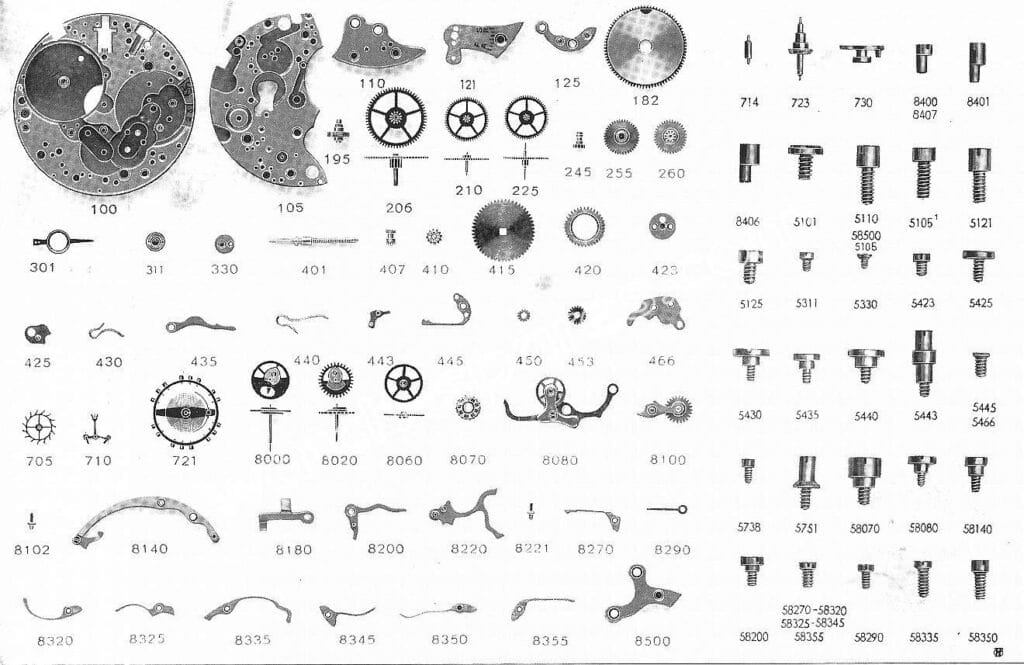
Part Numbers and Interchangeability
| Part Name | Part Number | Interchangeability Notes |
|---|---|---|
| Mainspring | GR26101DB, GR3358, 771/163 | Multiple suppliers, ensure proper dimensions (1.30-1.35mm x 0.14mm x 360-380mm) |
| Balance Complete | 721/1920 | Must match frequency (18,000 vph), terminal curve position critical |
| Hairspring | Varies by type (flat vs. Breguet) | Must match balance type, Nivarox 2 standard, Nivarox 1/Anachron for high grades |
| Escape Wheel | 705/1220, 704 (alternative) | 15 teeth, steel standard, Nivarox for high grades |
| Pallet Fork Complete | 710/1255 | Jeweled pallet stones must be intact |
| Pallet Arbor | 72S/354P, 714/HAN 36 (alternate) | |
| Fourth Wheel | 220/746, 224 (long pivot variant) | |
| Third Wheel | 211/43, 210 (alternative) | |
| Center Wheel | 203/125 (offset), 200 (with cannon pinion) | |
| Barrel Complete | 182/1205 (drum and cover) | |
| Barrel Arbor | 195/1267 | |
| Crown Wheel | 420/1209 | |
| Ratchet Wheel | 415/1214 | |
| Click | 425/931 | |
| Click Spring | 430/992 | |
| Winding Pinion | 410/1209 | |
| Clutch Wheel | 407/993 | Keyless works component |
| Setting Lever | 443/1302 | Critical keyless works part |
| Setting Lever Spring | 440/939 | |
| Yoke | 435/870 | Controls setting position |
| Cannon Pinion | 245/1040 (sweep second height 1.60) | Friction-fit to center wheel |
| Hour Wheel | 255/770 (height 0.95) | |
| Minute Wheel | 260/1043 | |
| Regulator | 301/1300 (flat hairspring), 307 (Breguet) | Must match hairspring type |
| Chronograph Runner (complete) | 8000 | Height and pinion engagement critical |
| Column Wheel (Pillar Wheel) | 8070 | 9-column design, must mesh properly with operating levers |
| Coupling Clutch | 8080 | Lateral clutch mechanism, engagement critical for chronograph operation |
| Operating Lever | 8140 (complete) | Controls column wheel rotation |
| Hammer (complete) | 8220 | Returns chronograph hands to zero |
| Minute Recording Jumper | 8270 | 30-minute counter positioning |
| Hour Counting Wheel | 8600 (height 2.1mm) | 12-hour counter mechanism |
| Friction Spring | 8290 | Holds chronograph hands stable when stopped |
| Stem | 401 (standard), 404 (male/female) | TAP 10 (0.90mm) or TAP 7 (1.20mm) threading |
Calendar-Specific Parts
The Valjoux 72C calendar mechanism includes proprietary parts not shared with the base Valjoux 72:
- Day disc and driving wheel
- Month disc and driving wheel
- Date driving wheel and jumper
- Calendar corrector mechanisms (parts for pushers at 8:30 and 10:00)
- Calendar jumper springs
These parts are less commonly available than base chronograph components and typically require sourcing from parts movements. The calendar mechanism is fragile and prone to damage from improper operation (correcting calendar while mechanism is engaged, typically between 8pm and 2am).
Sourcing Notes
Parts availability for the Valjoux 72C has declined substantially since production ended in 1974:
Readily Available:
- Mainsprings (multiple aftermarket suppliers)
- Balance complete assemblies (generic and original Valjoux)
- Stems (TAP 10 and TAP 7 variants widely stocked)
- Common screws and springs
- Basic gear train components (center wheel, third wheel, fourth wheel)
Moderate Availability:
- Escape wheels (steel, original Nivarox increasingly scarce)
- Pallet forks (original preferred, generic substitutes function but may affect performance)
- Chronograph runners and coupling clutch components
- Column wheels (available but expensive)
- Balance cocks and bridges
Scarce:
- Calendar-specific components (day/month discs, date driving wheels, calendar corrector parts)
- Branded components (Rolex-signed chronograph bridges, balance cocks)
- Hairsprings (particularly Breguet overcoil types)
- High-grade components (Glucydur balances, Nivarox escape wheels)
Generic Replacements:
Acceptable generic replacements exist for:
- Mainsprings (modern Nivaflex springs perform well, ensure correct dimensions)
- Balance complete (aftermarket balances work but may require timing screw adjustment and stud repositioning)
- Pallet forks (functionality adequate, originality compromised)
- Stems (generic Swiss stems in correct TAP size function identically)
No Acceptable Generic Substitutes:
- Calendar mechanism components (must use original Valjoux parts)
- Column wheels (generic column wheels do not fit)
- Chronograph-specific components (hammers, operating levers, coupling clutch)
- Branded components where originality matters for value
Watchmakers servicing the 72C should inspect calendar mechanisms carefully, as wear on calendar jumpers, corrector mechanisms, and driving wheels commonly causes malfunction. These parts are difficult to source and expensive to replace. The keyless works also shows characteristic wear patterns: the brass bearing supporting the stem tip and the brass bearer limiting stem axial movement both wear over decades of use, causing crunchy hand setting and winding that may strip teeth on winding wheels and motion work.
Performance Data
Manufacturer Specifications
Accuracy (New Movement, Factory Specification):
- Standard grade: ±12 seconds per day (2 positions: dial up, crown down)
- Elaboré grade: ±7 seconds per day (3 positions: dial up, crown down, crown left)
- Top grade: ±4 seconds per day (5 positions: dial up, dial down, crown down, crown left, crown right)
- Chronometer grade: -4 to +6 seconds per day (COSC specification, 5 positions, temperature tested)
Chronometer-grade 72C movements are exceptionally rare. Most production consisted of standard and elaboré grades, with top grade appearing primarily on branded examples from Rolex and higher-end manufacturers.
Positions Tested:
Position testing evaluates rate variation as watch orientation changes:
- 2 positions: Minimum testing for base-grade movements
- 3 positions: Standard for elaboré grades
- 5 positions: Required for top grades and chronometer certification
- Additional positions: Some manufacturers tested 6 positions (all positions except dial down, which is rarely encountered in wrist wear)
Temperature Compensation:
- Base movements: Passive temperature compensation via bimetallic balance (limited effectiveness)
- Glucydur balance (rare on 72C, standard on 730): Improved temperature stability
- Typical temperature tolerance: ±5-10 seconds per day across 8°C to 38°C range
- Full temperature compensation (active adjustment): Not present on 72C
True temperature-compensated movements use free-sprung balance systems with paired timing screws of different materials that automatically adjust balance inertia as temperature changes. The 72C’s bimetallic balance provides modest passive compensation but cannot match the performance of dedicated temperature-compensated systems.
Isochronism:
Isochronism describes rate consistency as mainspring winds down:
- Standard grade: ±20 seconds per day variation from full wind to 24 hours elapsed
- Elaboré: ±15 seconds per day
- Top: ±10 seconds per day
Translation: A standard-grade 72C might run at -2 seconds per day when fully wound and -22 seconds per day after 24 hours, a 20-second swing. Better isochronism means more consistent daily rate regardless of how recently the watch was wound. Watchmakers adjust isochronism by modifying the mainspring or adjusting timing across power reserve states, a time-consuming process rarely performed on mid-grade movements.
Observed Performance (Field Data)
Based on collector reports, watchmaker observations, and auction house timing results:
Typical Accuracy Range for Well-Maintained Examples:
- Daily rate variation: -10 to +20 seconds per day
- Well-regulated examples: -5 to +10 seconds per day
- Exceptional examples (recent service, optimal regulation): 0 to +5 seconds per day
These figures assume proper service within the last 3-5 years, clean lubrication, properly adjusted hairspring position, and no damaged components. The 72C will not match modern chronometer specifications when maintained to era-appropriate standards, but well-serviced examples easily achieve daily rate variation under ±10 seconds, adequate for daily wear.
Common Performance Issues and Causes:
- Excessive rate variation (±30+ seconds per day):
- Dried or contaminated lubrication (most common cause)
- Worn pivot holes in plates/bridges
- Damaged or magnetized hairspring
- Improper hairspring stud position or pinching from regulator pins
- Worn escape wheel or pallet stones
- Chronograph issues:
- Center seconds hand does not return to zero: Misaligned hammer or heart cam, sticky friction spring
- Chronograph hand jumps when starting: Lateral coupling clutch engagement issue, backlash in chronograph wheel train
- Chronograph drags (hand wobbles or moves when stopped): Weak friction spring, damaged brake mechanism
- Chronograph counters do not advance: Worn intermediate wheels, damaged sliding pinion, eccentric screw misadjustment
- Calendar issues:
- Date does not advance at midnight: Calendar mechanism jammed, insufficient mainspring torque, calendar corrector engaged during advancement period
- Day or month does not change: Damaged jumper springs, worn calendar driving wheels, corrector mechanism stuck
- Calendar correctors do not function: Bent pusher rods, stuck corrector levers, broken springs
- Keyless works issues:
- Stem loose or falls out: Worn setting lever, damaged stem, incorrect stem length
- Crunchy or difficult winding: Worn crown wheel bearing, stripped teeth on winding pinion or motion work, insufficient lubrication
- Cannot set hands: Yoke not engaging sliding pinion, broken yoke spring, stem not pulling out fully
Expected Amplitude When Fully Wound vs. Power Reserve Depleted:
- Fully wound (0-6 hours): 260-280° (well-regulated examples reach 300-330°)
- Mid reserve (12-24 hours): 240-270°
- Near end of reserve (36-48 hours): 200-240°
- Minimum acceptable: 180° (below this, rate becomes unstable and escapement may stop)
Amplitude measures the balance wheel’s swing angle. Higher amplitude indicates strong mainspring torque and efficient gear train. Amplitude drops as the mainspring unwinds, which is normal. Excessively low amplitude (below 180° when fully wound) indicates problems: excessive friction from dried lubrication, damaged pivots, magnetization, or worn components.
Chronograph operation affects amplitude. When the chronograph runs, it draws additional power from the gear train, typically dropping amplitude by 10-30°. A well-maintained 72C should maintain 220-250° amplitude with chronograph running. Amplitude below 200° with chronograph engaged suggests the movement needs service or has worn components creating excessive friction.
How Performance Typically Degrades as Movement Ages:
Without service (10+ years):
- Lubrication dries or becomes gummy, increasing friction
- Rate variation increases to ±20-40 seconds per day
- Amplitude drops to 180-220° fully wound
- Chronograph operation becomes sluggish or stops
- Power reserve decreases to 36-42 hours
With periodic service (every 5-7 years):
- Rate variation remains stable at ±5-15 seconds per day
- Amplitude maintains 240-280° fully wound
- Chronograph operates reliably
- Power reserve holds near factory specification of 48 hours
Long-term wear (20-30+ years, multiple service cycles):
- Pivot holes wear, requiring bushing replacement
- Balance staff may require replacement
- Chronograph runners show tooth wear
- Calendar mechanism springs weaken
- Keyless works shows progressive wear on brass bearings
The 72C, like all mechanical movements, requires regular service to maintain performance. Five to seven years represents the typical service interval for mechanical chronographs with moderate use. Calendar chronographs like the 72C benefit from slightly more frequent service (every 5 years) due to the additional complexity and friction from calendar mechanisms. Movements used as daily wearers accumulate more wear than occasional-use pieces and may require service every 3-4 years.
Modern synthetic lubricants extend service intervals compared to era-appropriate oils, but watchmakers disagree on whether modern lubricants are appropriate for vintage movements. Traditional approach uses era-correct oils (requiring more frequent service), while modern approach uses synthetic lubricants (longer intervals but potentially less authentic). Either approach works if executed properly, though collectors often prefer era-correct service for historically important examples.