


Last updated ~ February 2, 2026
Brand
Production Period
1963–1969
Model Line
Case Shape
Round
Diameter
38mm
Lug to Lug
44mm
Lug Width
19mm
Case Thickness
12mm
Case Back
Snap-On
Caliber
Crystal
Bezel
Dive
The Wittnauer Skin Diver Reference 4000 represents a compelling chapter in American-Swiss watchmaking during the golden era of dive watches. Introduced in the early-to-mid 1960s, this timepiece emerged during a period when Wittnauer operated under Longines ownership (1950-1969), allowing the brand to leverage Swiss manufacturing expertise while maintaining its distinct American market identity. The Reference 4000 embodies the classic skin diver aesthetic: a purpose-built tool watch designed for recreational diving that maintains enough elegance to transition seamlessly from water to wrist in everyday life.
What distinguishes the Wittnauer 4000 from its contemporaries is its refined execution at an accessible price point. While lacking the cachet of Rolex or the technical sophistication of Blancpain, the 4000 offered everyday divers and enthusiasts a reliable, beautifully proportioned timekeeper that captured the adventurous spirit of 1960s underwater exploration. The watch’s modest 38mm case, curved lugs, and slim profile create a wearing experience that feels remarkably modern, making it a favorite among collectors seeking vintage dive watches that actually fit contemporary wrists.
History & Production Period
The Wittnauer Skin Diver 4000 was produced during the 1960s, spanning the middle years of the decade through approximately 1969. This production window coincides with the height of the skin diver watch phenomenon, when brands across the Swiss and American markets rushed to offer affordable alternatives to professional dive watches like the Rolex Submariner and Omega Seamaster.
The watch’s development occurred during a unique period in Wittnauer’s corporate history. In 1950, the Swiss manufacturer Longines had acquired Wittnauer, creating the Longines-Wittnauer Watch Company. This arrangement allowed Wittnauer to source movements and manufacturing expertise from Longines while maintaining separate branding and market positioning. The 4000 was marketed as distinctly Wittnauer, positioned as “the next best thing to Longines” and priced accordingly for the American middle-class consumer.
The skin diver category itself emerged in response to growing recreational diving activity in the 1950s and 1960s. Unlike professional dive watches rated for extreme depths, skin divers typically featured 100-200 meter water resistance, lighter construction, and more versatile styling. The Wittnauer 4000, rated at 20 ATU (approximately 200 meters or 660 feet), fit squarely within this category, offering sufficient capability for recreational diving while maintaining the slim profile and aesthetic refinement that allowed it to serve as an everyday watch.
Production ended around 1969, the same year that Westinghouse Electric Corporation purchased Longines-Wittnauer, marking the end of the Longines partnership and a significant shift in the company’s direction. The dissolution of this relationship likely contributed to the discontinuation of models like the 4000, which had been developed during the Longines era.
While exact production numbers remain unknown, the relative availability of examples in today’s vintage market suggests the 4000 was produced in reasonable quantities. The watch has not achieved the rarity premium of some contemporaries, though pristine examples with original components command increasingly strong prices as collector interest in 1960s skin divers continues to grow.
Nickname: The watch is sometimes referred to simply as the “Wittnauer Skin Diver” or “Wittnauer Diver,” though it lacks the colorful sobriquets bestowed upon more famous vintage pieces.
!
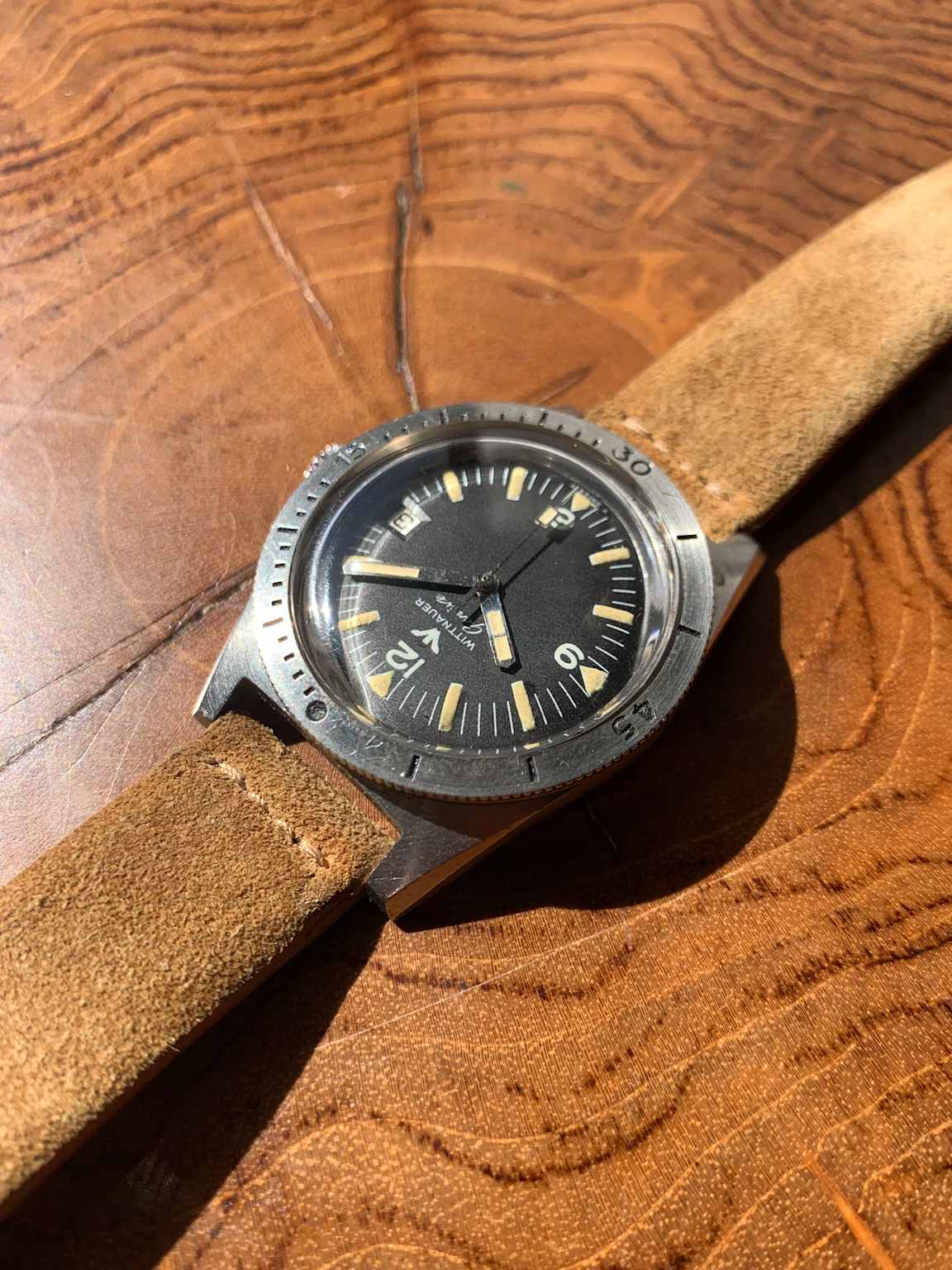
1960’s Wittnauer 4000 Skin Diver Watch — Shiny Happy Objects
Technical Specifications
The Wittnauer Skin Diver 4000 presents classic mid-century dive watch proportions that wear exceptionally well on modern wrists:
Case Dimensions:
- Diameter: 38mm (measured across the bezel)
- Thickness: 11-12mm including domed crystal
- Lug-to-lug: 46mm
- Lug width: 19-20mm (varies by example; 20mm appears most common)
Water Resistance:
The caseback is marked “20 ATU,” indicating a water resistance rating of 20 atmospheres, equivalent to approximately 200 meters or 660 feet. This represents substantial capability for a skin diver of the era, though vintage seals should never be trusted without professional testing and replacement.
Crystal:
Acrylic (plexiglass) with a high dome profile, typical of 1960s dive watches. The pronounced dome adds visual depth and was more resistant to shattering under pressure than flat crystals, though it scratches more easily than modern sapphire.
Case Materials:
All examples feature stainless steel cases with a screw-back construction. The case exhibits beveled edges along the lugs and a polished mid-case that transitions to brushed lug tops on well-preserved examples. The case design bears similarities to other skin divers of the period, particularly those utilizing cases from shared suppliers.
Caseback:
The screw-back features a notched edge for removal with a specialized tool. Markings typically include “STAINLESS STEEL” and sometimes production codes. Some examples feature engraved presentation inscriptions, as these watches were popular corporate gifts during the 1960s.
Crown:
The crown is a push-down design (not screw-down), positioned at 3 o’clock. Original crowns were signed with the Wittnauer logo, though unsigned replacement crowns are extremely common as originals were frequently lost or damaged during servicing. The crown’s non-screw-down design was typical for skin divers of the era; water resistance was achieved through gasket compression rather than threaded locking mechanisms.
!

Three Affordable Vintage Dive Watches From Historic American
Movements/Calibers
The Wittnauer Skin Diver 4000 was fitted with several movement variants during its production run, all manually-wound calibers:
Caliber C11KS (First Execution)
The earliest examples of the Reference 4000 housed the Wittnauer caliber C11KS, a 17-jewel manual-wind movement with sweep seconds. Technical specifications include:
- Jewel Count: 17 jewels
- Frequency: 19,800 vph (2.75 Hz)
- Diameter: 26mm (11.5 lignes)
- Type: Manual wind with sweep seconds
- Features: Quickset date complication, KIF shock protection
- Markings: Movement signed “Wittnauer Watch Co. Inc., Swiss, Unadjusted”
First execution examples with the C11KS movement typically feature “T Swiss T” or “T<25” dial markings, indicating tritium luminous material emitting less than 25 millicuries.
Caliber C11 KS-1 (Later Execution)
Later production shifted to the C11 KS-1 variant, which appears to be an evolution of the original C11KS. While specifications remain largely similar, later examples feature different dial markings:
- Dial Marking: “25 T” or “Swiss-T<25” rather than “T Swiss T”
- Production Period: Mid-to-late 1960s
- Features: Retained the quickset date and sweep seconds functionality
The transition from “T Swiss T” to “25 T” dial markings represents a shift in tritium radiation labeling standards. Both indicate the presence of tritium, but “25 T” explicitly states emission levels below 25 millicuries.
Caliber 11ES (Variant)
A smaller number of examples have surfaced with the Wittnauer caliber 11ES, a simpler movement without date complication. These appear to be either special variants or possibly replacements during servicing. The 11ES is described as an ETA 1080 ebauche, a basic but reliable time-only movement.
Collector Note: The movement variation significantly affects desirability and value. First execution pieces with the original C11KS movement and “T Swiss T” dial markings are considered more collectible than later C11 KS-1 examples. The presence of the correct movement for the dial markings is critical for authentication.
!
Dial Variations
The Wittnauer 4000 appeared in at least two distinct dial configurations, with variations in color, text, and luminous material markings:
Black Matte Dial (Most Common)
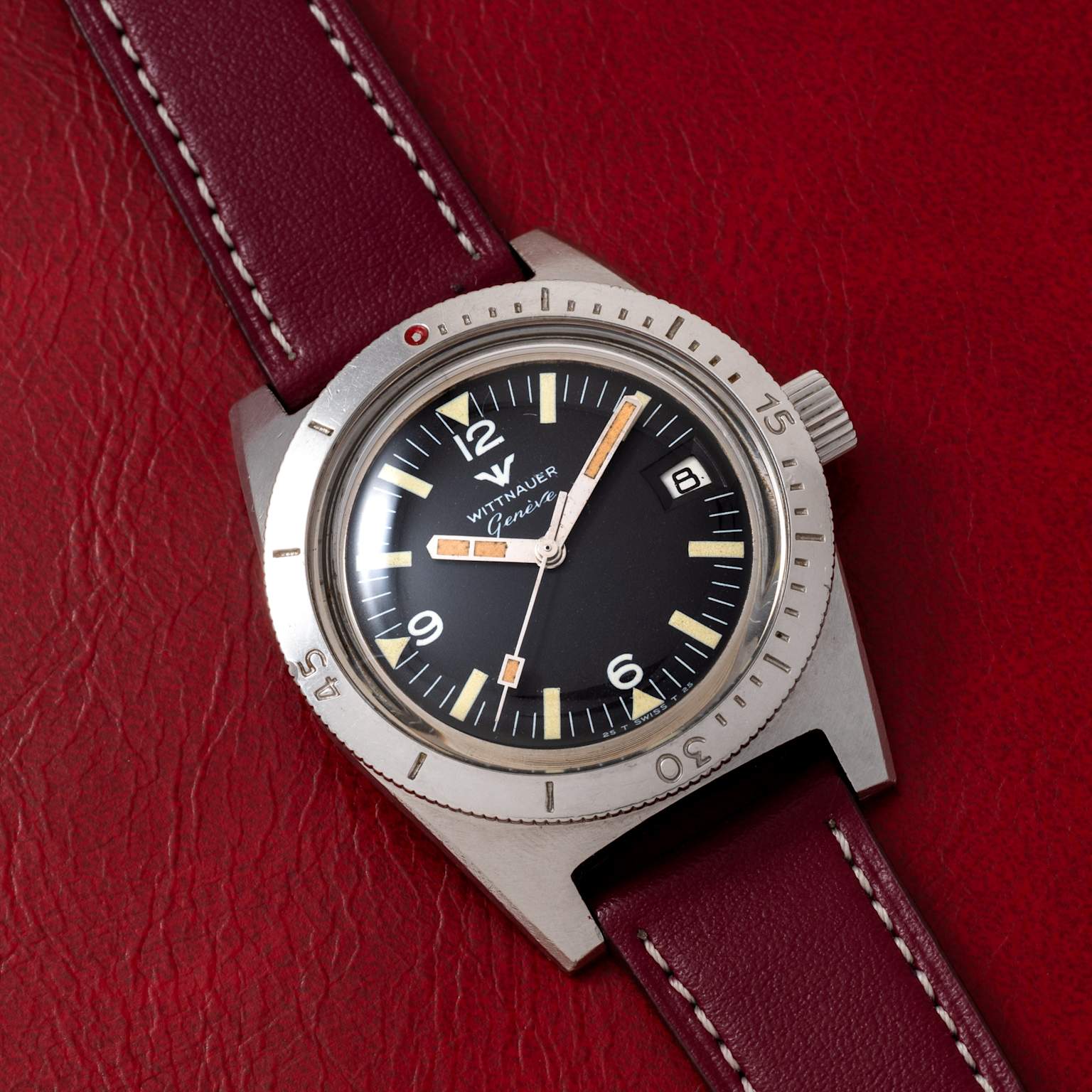
The overwhelming majority of examples feature a matte black dial with the following characteristics:
- Base Color: Matte black finish with no sunburst or texture
- Indices: Applied luminous markers at 3, 6, and 9 o’clock (Arabic numerals), with triangular and baton indices at other positions
- 12 o’clock Marker: Large luminous triangle or inverted triangle
- Handset: Dauphine or pencil-style hands with luminous fill, including a sweep seconds hand
- Text:
- Date Window: Present at 3 or 6 o’clock position on dated examples
Luminous Material Evolution
The dial markings evolved to reflect changing tritium regulations:
Early Production (circa 1960-mid 1960s):
- Marking: “T Swiss T” or “T<25” at 6 o’clock
- Indicates tritium content emitting less than 25 millicuries (earlier standard)
Later Production (mid-to-late 1960s):
Silver/Aged Silver Dial (Rare Variant)
A much rarer configuration features a silver or cream-colored dial, sometimes described as “warm aged silver”. These examples maintain the same index layout and text placement but present a dramatically different aesthetic. The silver dial variant appears less frequently in the market and commands attention when it surfaces, though condition becomes even more critical with light-colored dials where any deterioration or staining is immediately visible.
Patina Development
Original tritium luminous material on both dial and hands develops a characteristic warm patina over decades, often described as “sandy,” “creamy,” or “pumpkin” colored. This patina is highly desirable among collectors as evidence of originality. The lume on hands and dial indices should age consistently; mismatched patina colors often indicate replacement parts.
Important: Service replacement dials are encountered with some frequency. These may feature modern Super-LumiNova (which does not age) while retaining “T Swiss T” markings, creating incongruent combinations that indicate non-original components. Original dials should show consistent, natural aging across all luminous elements.
Case & Bezel Variations
Case Construction
The Wittnauer 4000 features a two-piece case design with a screw-back caseback. The case exhibits distinctive mid-century characteristics:
Case Profile:
- Rounded mid-case with polished finish
- Beveled, curved lugs that sweep downward, creating excellent wrist-hugging ergonomics
- Sharp transition edges between case surfaces (when unpolished)
- Minimal case thickness despite housing a manual-wind movement with date complication
Case Finishing:
Original case finishing featured contrasting surfaces: polished case flanks with brushed lug tops. Over decades of wear and servicing, many examples have been polished, sometimes repeatedly, which softens or eliminates the crisp edges between surfaces. Collectors prize unpolished or lightly polished examples that retain sharp case lines and original proportions.
Bezel Variations
All examples feature a bi-directional rotating bezel with engraved numerals:
Bezel Construction:
- Material: Stainless steel
- Type: Friction-fit bi-directional rotating bezel
- Insert: Engraved aluminum or painted metal insert with minute markings
- Numerals: Deep engraved markers at 5-minute intervals, with individual minute marks for the first 15 minutes
- 12 o’clock marker: Luminous “pearl” or triangle marker
Bezel Condition Issues:
The painted or printed numerals on the bezel insert are prone to wear, with many examples showing partial or complete loss of the white or silver paint fill. The luminous pearl at 12 o’clock is frequently missing or damaged. Finding examples with fully intact bezel numerals and pearl significantly increases value.
Bezel Alignment:
Proper bezel alignment with the dial’s 12 o’clock marker is a sign of an unmolested watch. Misalignment may indicate bezel replacement or improper reassembly during servicing.
Crown Types
Original Crown:
Signed with the Wittnauer logo, typically measuring approximately 6-7mm in diameter. Original signed crowns are increasingly difficult to find.
Replacement Crowns:
Unsigned replacement crowns are extremely common. Many watches were serviced during the 1970s-1990s when original parts were discarded as a matter of course. The presence of an unsigned crown does not necessarily indicate a refinished or heavily altered watch, but signed original crowns do command a premium.
Bracelet & Strap Options
Period-Correct Bracelet
Some examples of the Wittnauer 4000 were sold with original stainless steel bracelets:
Original Wittnauer Bracelet:
- Material: Stainless steel
- Construction: Flexible link design, possibly beads-of-rice style based on period Wittnauer catalogs
- End Links: Straight end links with 19-20mm width
- Condition Issues: Original bracelets, when found, often exhibit significant stretch due to age and hollow link construction
Original bracelets are rare survivors and add substantial value when present and in good condition.
Leather Straps
Most examples in today’s market are fitted with period-appropriate leather straps:
Common Configurations:
- Width: 19-20mm to fit the case lugs
- Style: Plain leather, NATO-style, or vintage-inspired rally straps
- Colors: Black, brown, or tan leather most commonly seen
The watch’s slim profile and curved lugs make it compatible with a wide range of strap styles. The moderate 38mm diameter pairs well with 19-20mm straps without appearing visually unbalanced.
Identifying Original vs. Replaced Parts
Authenticating a Wittnauer Skin Diver 4000 requires careful examination across multiple components. Service replacement parts are common given the watch’s age and the servicing practices of the 1970s-1990s.
Dial Authentication
Original Dial Characteristics:
- Consistent tritium patina across all luminous elements (dial indices and hands should age similarly)
- Crisp, sharp printing of text with no smudging or irregularities
- “T Swiss T” or “25 T” markings corresponding to movement variation (C11KS vs. C11 KS-1)
- Period-appropriate font and spacing for “WITTNAUER” and “GENEVE”
- Natural aging consistent with 60+ years (slight fading, uniform patina)
Service Dial Red Flags:
- Modern Super-LumiNova that glows bright green-blue (rather than aged tritium that glows dim or not at all)
- “T Swiss T” markings on dials with bright, modern lume (incongruent combination)
- Printing quality inconsistent with 1960s standards
- Colors that appear “too fresh” or lack appropriate patina
- Mismatched patina between dial and hands
Hands Authentication
Original Hands:
- Should exhibit similar patina development to dial indices
- Period-appropriate style (dauphine or pencil hands)
- Luminous fill that has aged consistently
- Proper length for the dial (minute hand should reach or nearly reach minute track)
Replacement Hand Indicators:
- Modern luminous material (bright white or green lume)
- Patina color that doesn’t match dial indices
- Incorrect hand style for the period
- Hands that are too short or too long for the dial
Movement Verification
Correct Movement Characteristics:
- C11KS or C11 KS-1 caliber appropriate for the dial markings
- Movement signed “Wittnauer Watch Co. Inc., Swiss, Unadjusted”
- 17 jewels
- Import code “AXA” sometimes present
- KIF shock protection visible on balance
Movement Concerns:
- Replacement movements from other Wittnauer models
- Caliber 11ES in a dial marked for C11KS-1 (possible service replacement)
- Movement serial numbers that don’t align with case era
Case Authentication
Original Case Features:
- Sharp, crisp edges between polished and brushed surfaces (if unpolished)
- Proper case proportions: 38mm diameter, beveled lugs, appropriate thickness
- Screw-back caseback with notches and “STAINLESS STEEL” marking
- No excessive thinning of lugs from over-polishing
Polishing Concerns:
- Rounded, soft edges where sharp transitions should exist
- Thinned lugs or case flanks
- Loss of original brushed finishing on lug tops
- Case that appears smaller than 38mm due to excessive material removal
Bezel & Insert
Original Bezel Characteristics:
- Deep, crisp engraving on numerals
- Paint fill in numerals (often worn but present in recesses)
- Luminous pearl at 12 o’clock (frequently damaged or missing)
- Proper alignment with dial
Replacement/Aftermarket Concerns:
- Shallow or poorly executed engraving
- Completely missing paint in numerals (though this can occur on original inserts due to age)
- Incorrect font or numeral style
- Modern adhesive-backed inserts replacing period-correct versions
Crown
Original Crown:
Replacement Crown:
Note: An unsigned crown is not necessarily a disqualifying factor, as original Wittnauer crowns are difficult to source and most serviced examples received generic replacements decades ago.
!

Wittnauer Ref. 4000 – Huntington Company
Collector Notes & Market Context
Current Market Positioning
The Wittnauer Skin Diver 4000 occupies an interesting position in the vintage dive watch market. As collector interest in 1960s skin divers has intensified over the past decade, the 4000 has transitioned from an overlooked oddity to a genuinely desirable piece.
Approximate Value Ranges (as of 2024-2025):
- Good condition with replacement parts: $1,200-1,600 USD
- Excellent condition, mostly original: $1,600-2,200 USD
- Exceptional/NOS condition, all original: $2,000-2,500+ USD
These figures represent asking prices in the dealer/enthusiast market. Auction results tend to run 10-20% lower, while truly exceptional examples with documentation can exceed these ranges.
Desirable Configurations
Collectors prioritize the following characteristics:
- First Execution Examples: Watches with the C11KS movement and “T Swiss T” dial markings represent the earliest production and command premiums
- Unpolished Cases: Examples retaining sharp, original case lines and finishing are increasingly rare and valuable
- Original Dial & Hands: Matching tritium patina and period-correct luminous material significantly impact desirability
- Complete Bezel Numerals: Intact paint fill and luminous pearl add value
- Signed Crown: Original Wittnauer-signed crowns are rare and prized
- Original Bracelet: When present and in good condition, adds 20-30% to value
Common Pitfalls to Avoid
Service Replacements:
The biggest challenge when purchasing a Wittnauer 4000 is determining what components are original versus service replacements. Watches serviced in the 1980s-1990s often received:
- Replacement dials with modern lume but period-style text
- Generic unsigned crowns
- Hands with modern luminous material
- Replacement bezel inserts
Over-Polishing:
Repeated polishing over decades can fundamentally alter case proportions, eliminating the crisp edges and bevels that give the watch its distinctive character. Examine lug thickness, case edge sharpness, and finishing transitions carefully.
Water Damage:
Many vintage dive watches spent time in the water, sometimes beyond their rated capabilities. Look for:
- Dial deterioration or spotting
- Oxidation on hands or indices
- Case corrosion around crown or caseback
- Movement damage from moisture intrusion
Franken Watches:
Components from multiple Wittnauer models or entirely different brands sometimes find their way into 4000 cases. Verify movement, dial, and hands are period-appropriate and compatible.
Value Drivers
Premium Factors:
- Unpolished or very lightly polished case with crisp edges
- Matching tritium patina across all luminous elements
- Original signed crown
- Fully intact bezel insert with numerals and pearl
- Original bracelet in wearable condition
- First execution (C11KS with “T Swiss T” dial)
- Box and papers (exceptionally rare)
Value Detractions:
- Heavy polishing or case alteration
- Service replacement dial with modern lume
- Missing or damaged bezel insert
- Water damage or dial deterioration
- Mismatched hands or incorrect components
- Non-functioning movement or expensive service needs
Market Trends
The vintage skin diver category has experienced substantial growth in collector interest since approximately 2015. As prices for iconic models like the Rolex Submariner and Omega Seamaster have climbed beyond reach for many collectors, attention has shifted to well-executed but more affordable alternatives from brands like Wittnauer, Zodiac, Squale, and others.
The Wittnauer 4000 benefits from:
- Excellent proportions that suit modern tastes (38mm, slim profile)
- Strong brand heritage and Longines connection
- Genuine 1960s skin diver provenance
- Relative affordability compared to Swiss luxury brands
However, the watch faces headwinds from:
- Limited brand recognition compared to Rolex, Omega, or even Zodiac
- Common service replacement parts complicating authentication
- Relatively high production numbers limiting scarcity premium
- No military or professional diving provenance
Comparable Models
Contemporary Competition (1960s):
- Zodiac Sea Wolf: Higher profile, stronger brand recognition today
- Squale skin divers: Similar case construction, Italian heritage
- Bulova Snorkel/Devil Diver: American competition with similar pricing
- Elgin/Waltham skin divers: Direct American market competitors
Modern Market Alternatives:
Collectors cross-shopping the Wittnauer 4000 often consider:
- Vintage Zodiac Sea Wolf ($2,000-4,000)
- Vintage Squale skin divers ($1,500-3,000)
- Modern reissues (Zodiac Super Sea Wolf Skin, $1,000-1,500 new)
- Vintage Certina DS or Longines dive watches ($1,500-3,000)
The Wittnauer represents excellent value for collectors seeking authentic 1960s skin diver character without the premium pricing of more famous brands.
!
Conclusion
The Wittnauer Skin Diver Reference 4000 stands as a testament to the golden age of tool watch design, when manufacturers prioritized proportion, functionality, and understated elegance over marketing hype and status signaling. This mid-1960s skin diver offers collectors a genuine piece of horological history backed by the technical expertise of Longines-era Wittnauer manufacturing.
With its perfectly sized 38mm case, beautifully curved lugs, and classic matte black dial, the 4000 wears as well today as it did six decades ago. The watch’s modest 200-meter water resistance and bi-directional bezel provide legitimate dive watch functionality, while the slim profile and versatile aesthetic make it equally at home on a NATO strap with casual wear or a leather band for dressier occasions.
Collectors should approach the model with eyes wide open regarding the prevalence of service replacement parts, particularly dials, hands, and crowns. Authenticating original components requires careful examination and ideally some experience with the model. However, for those willing to invest the time to find a well-preserved example, the Wittnauer 4000 represents one of the best values in vintage 1960s skin divers, offering genuine period charm, excellent wearability, and a fascinating connection to Wittnauer’s Longines partnership era.
As interest in vintage dive watches continues to grow and prices for top-tier examples climb, the Wittnauer 4000 deserves recognition as a thoughtfully designed, historically significant timepiece that captures everything compelling about mid-century skin diver watches without the six-figure price tag.