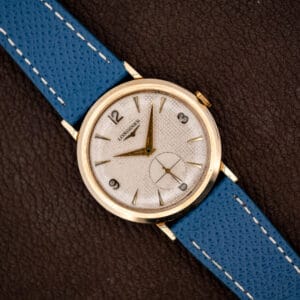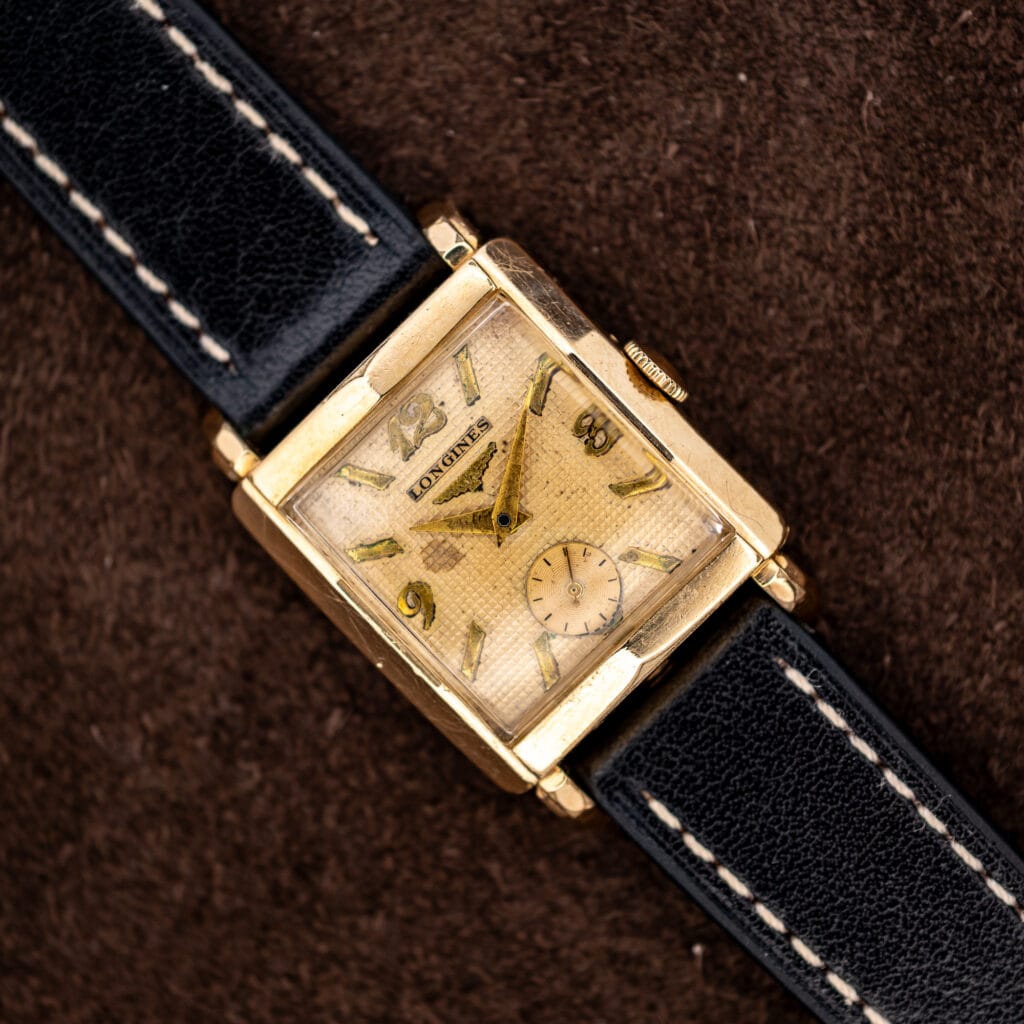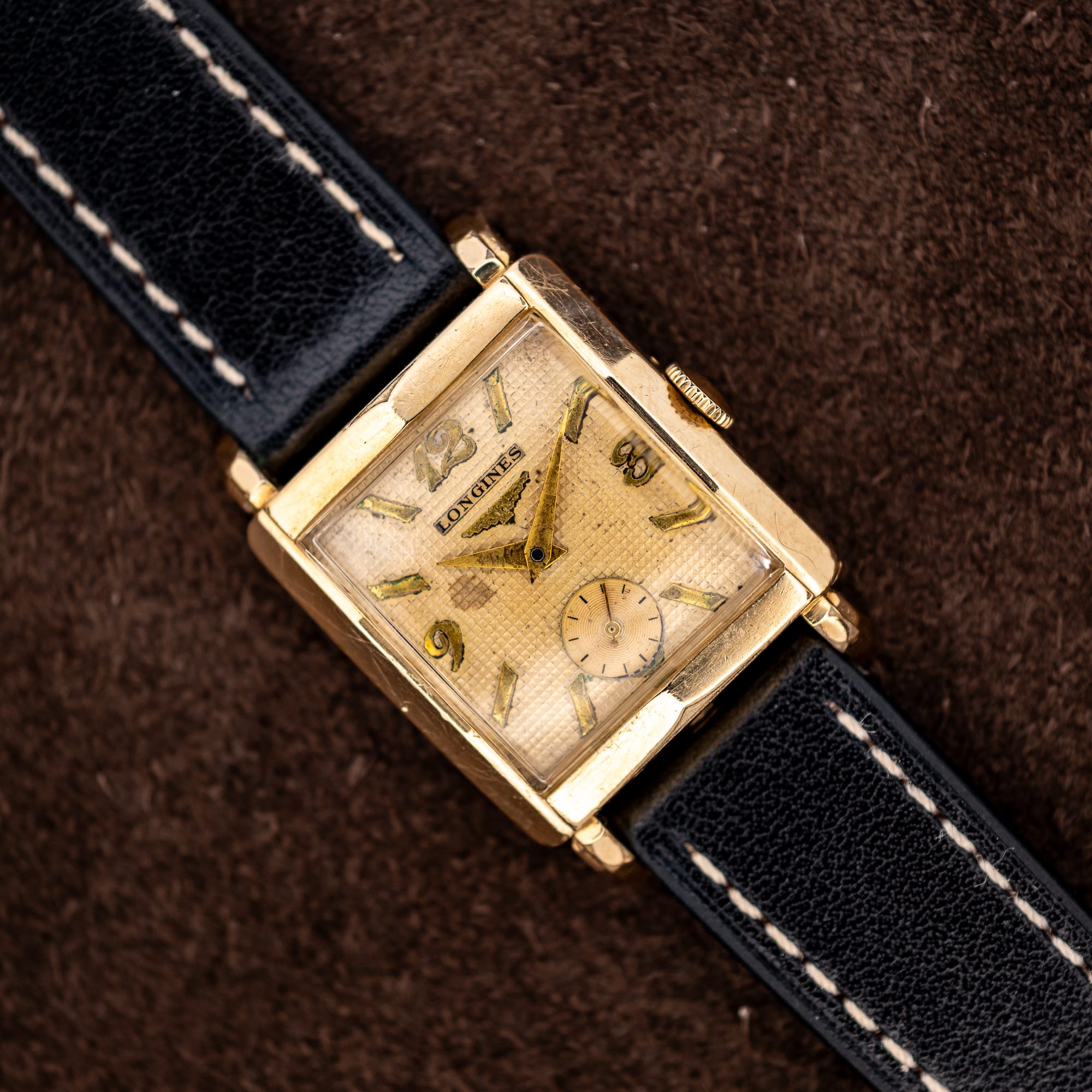
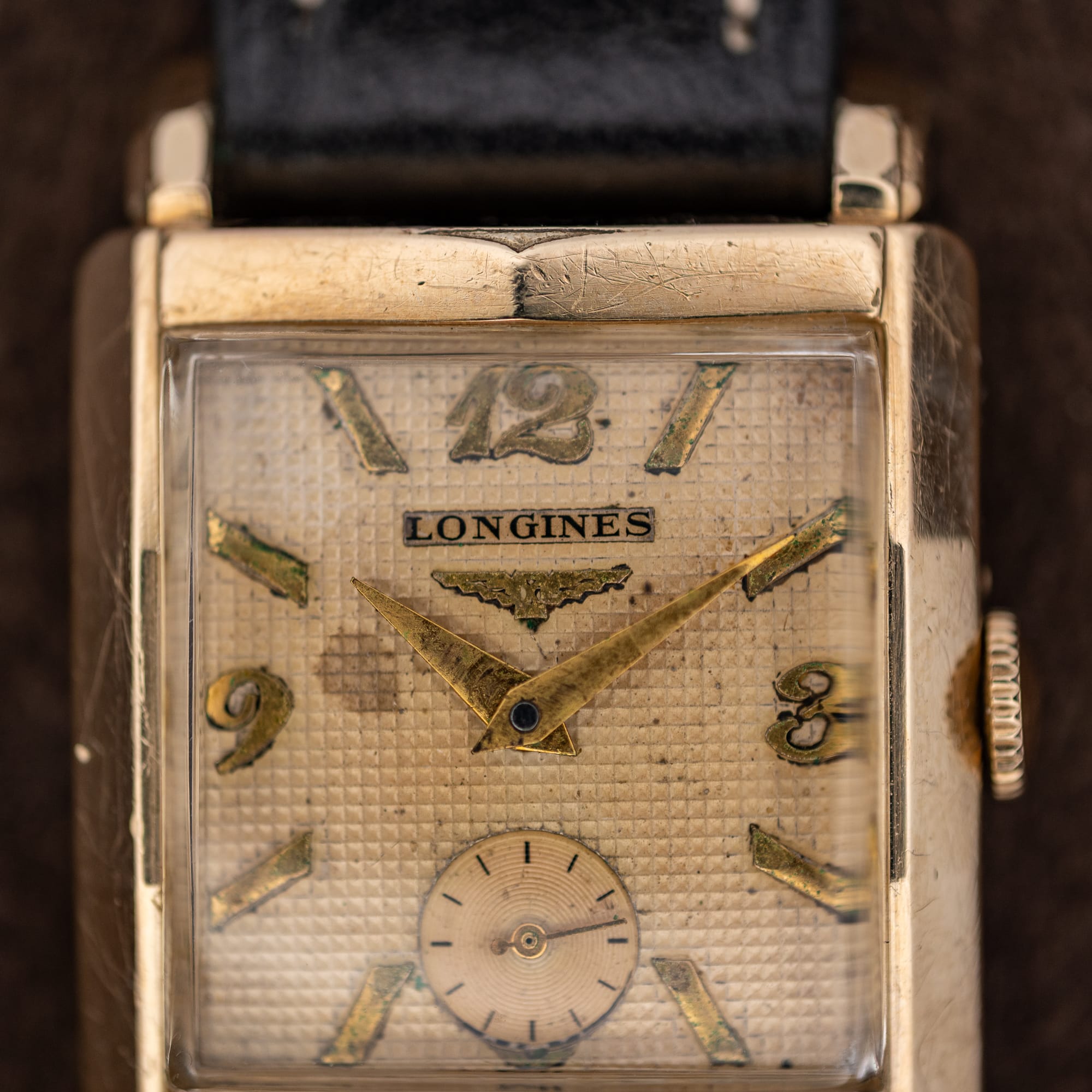
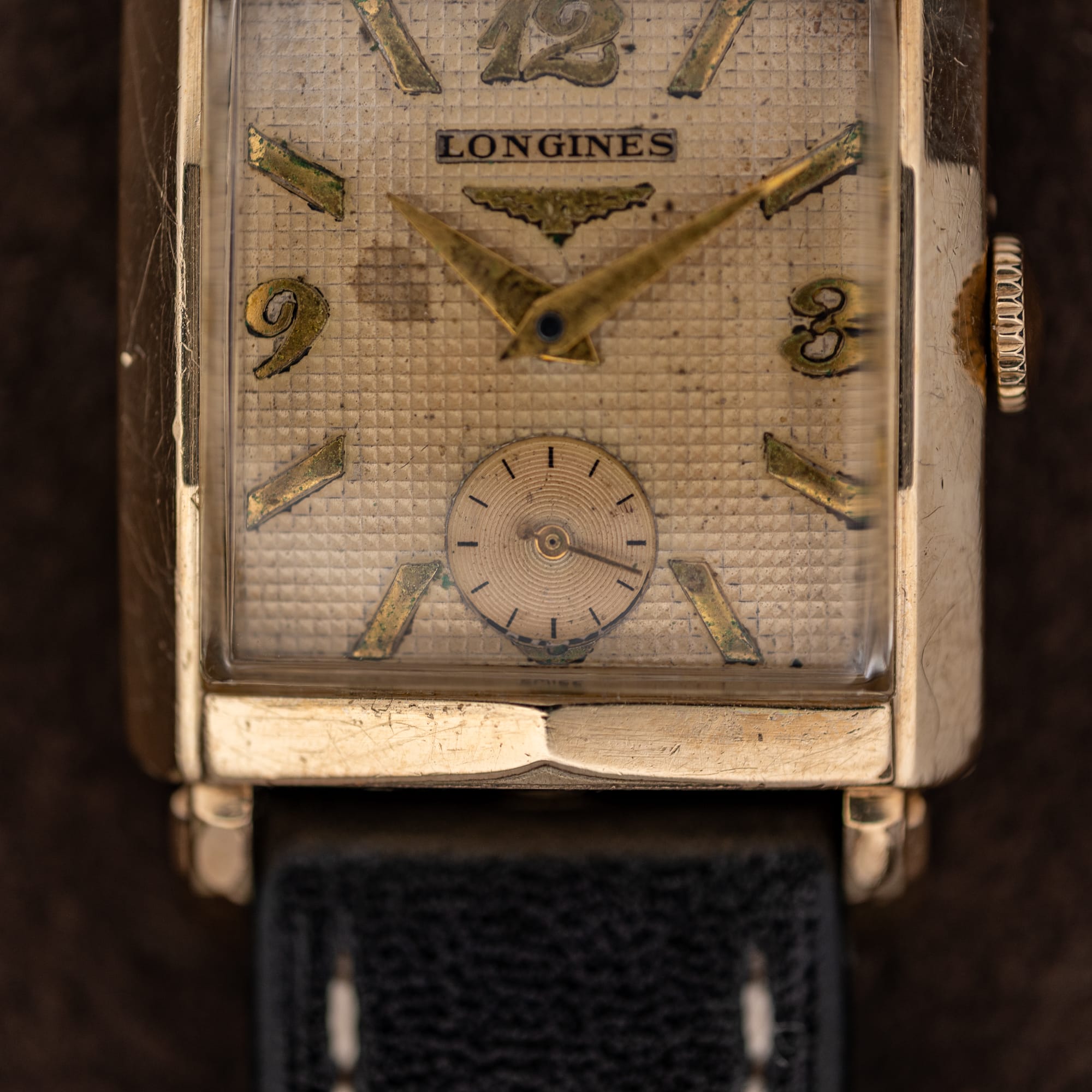
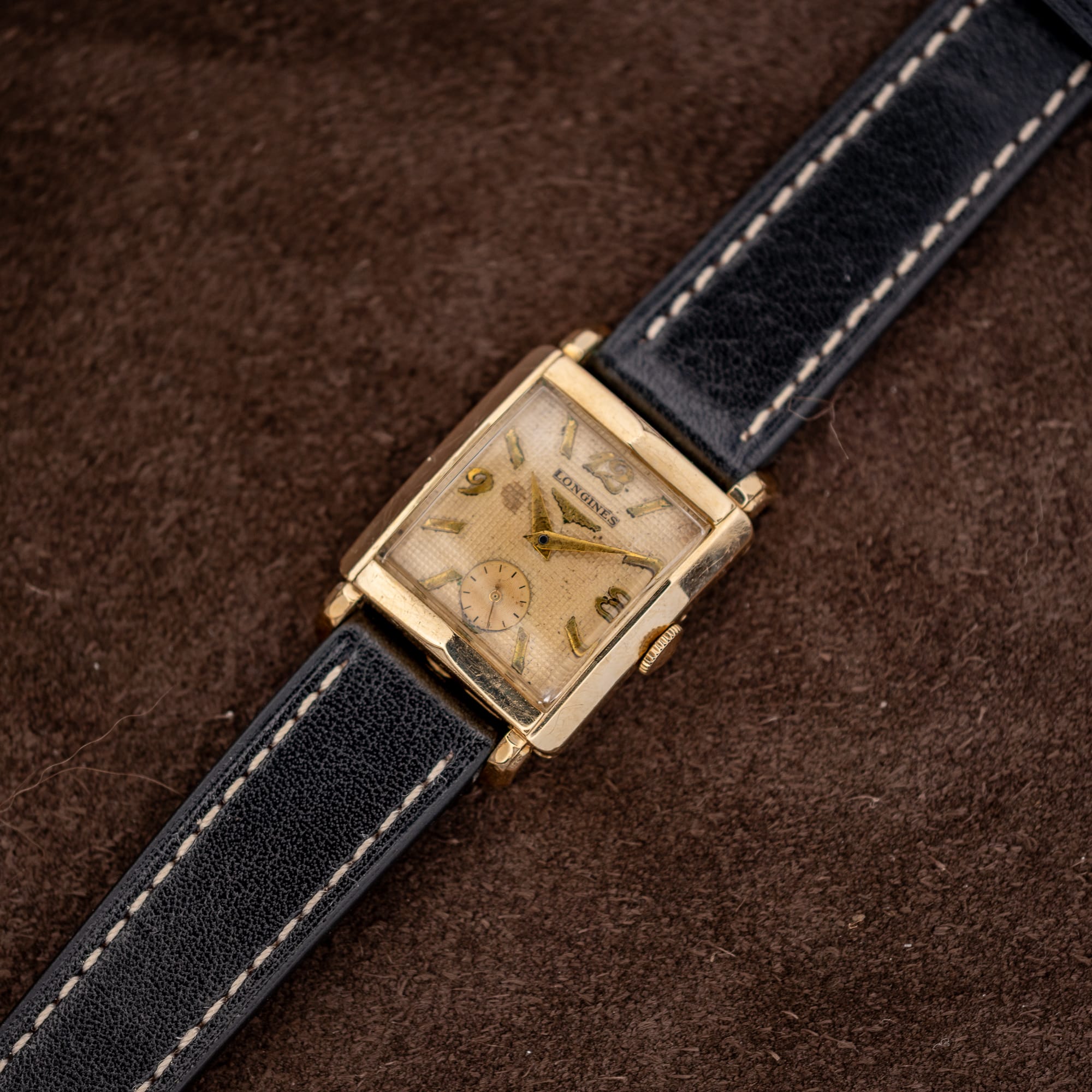
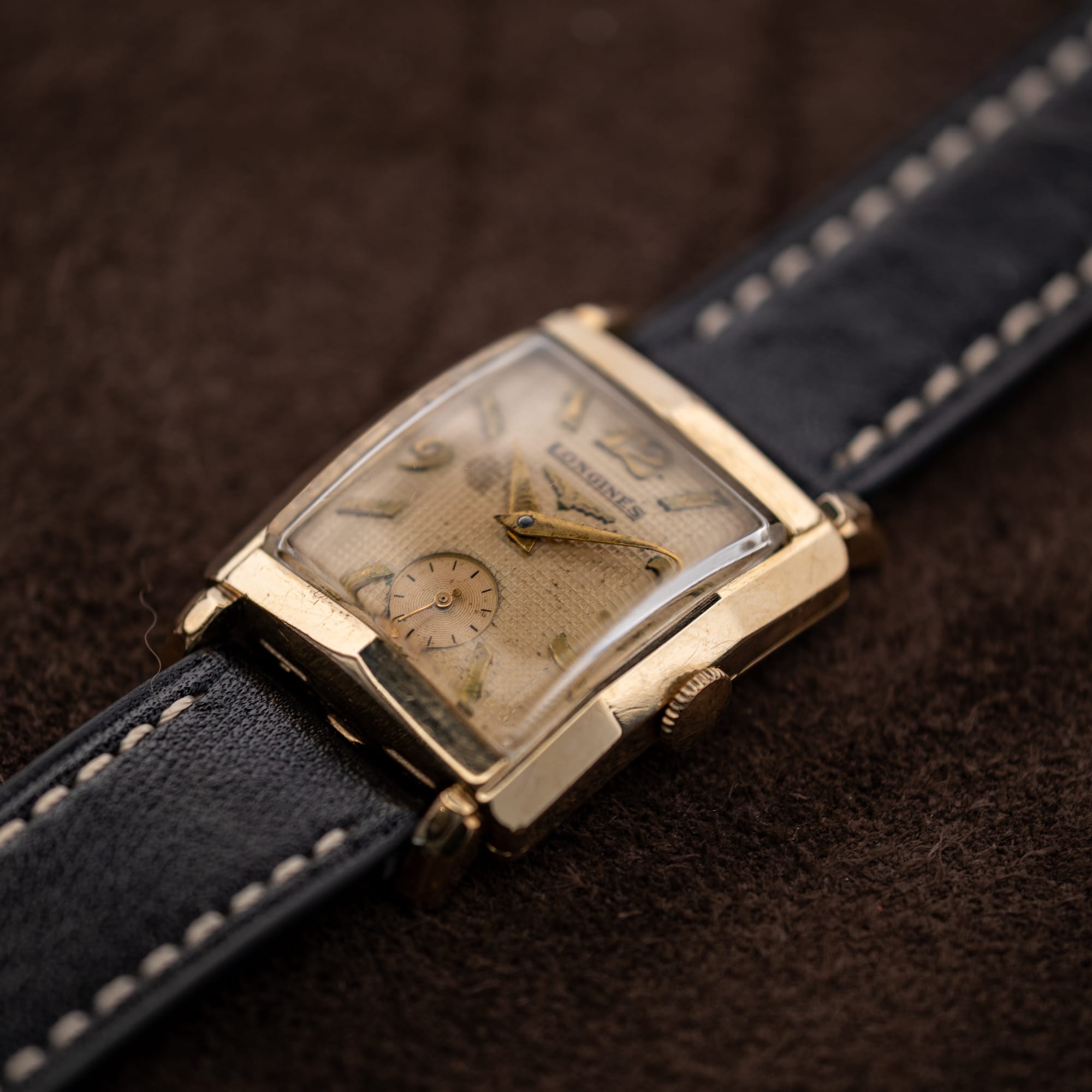
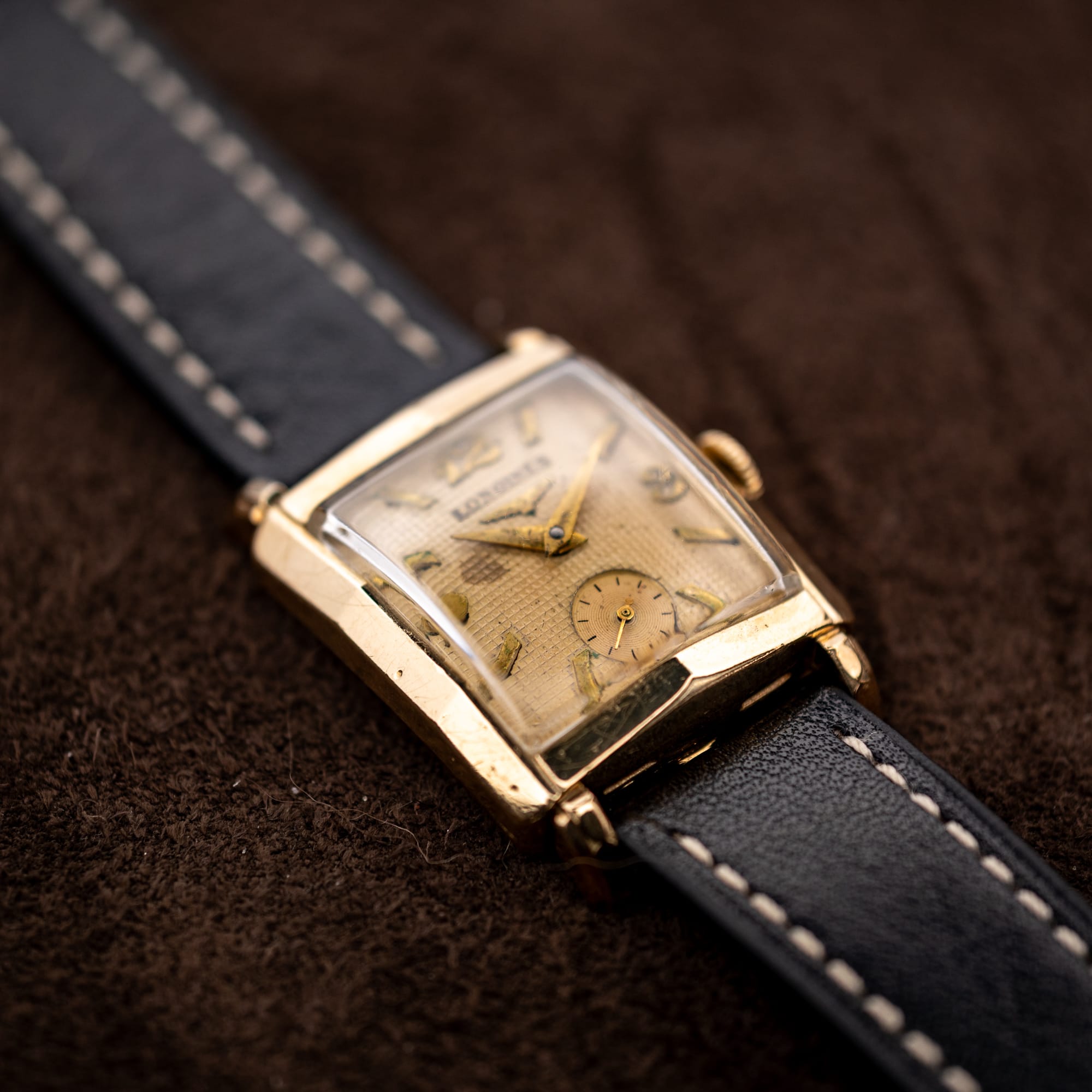
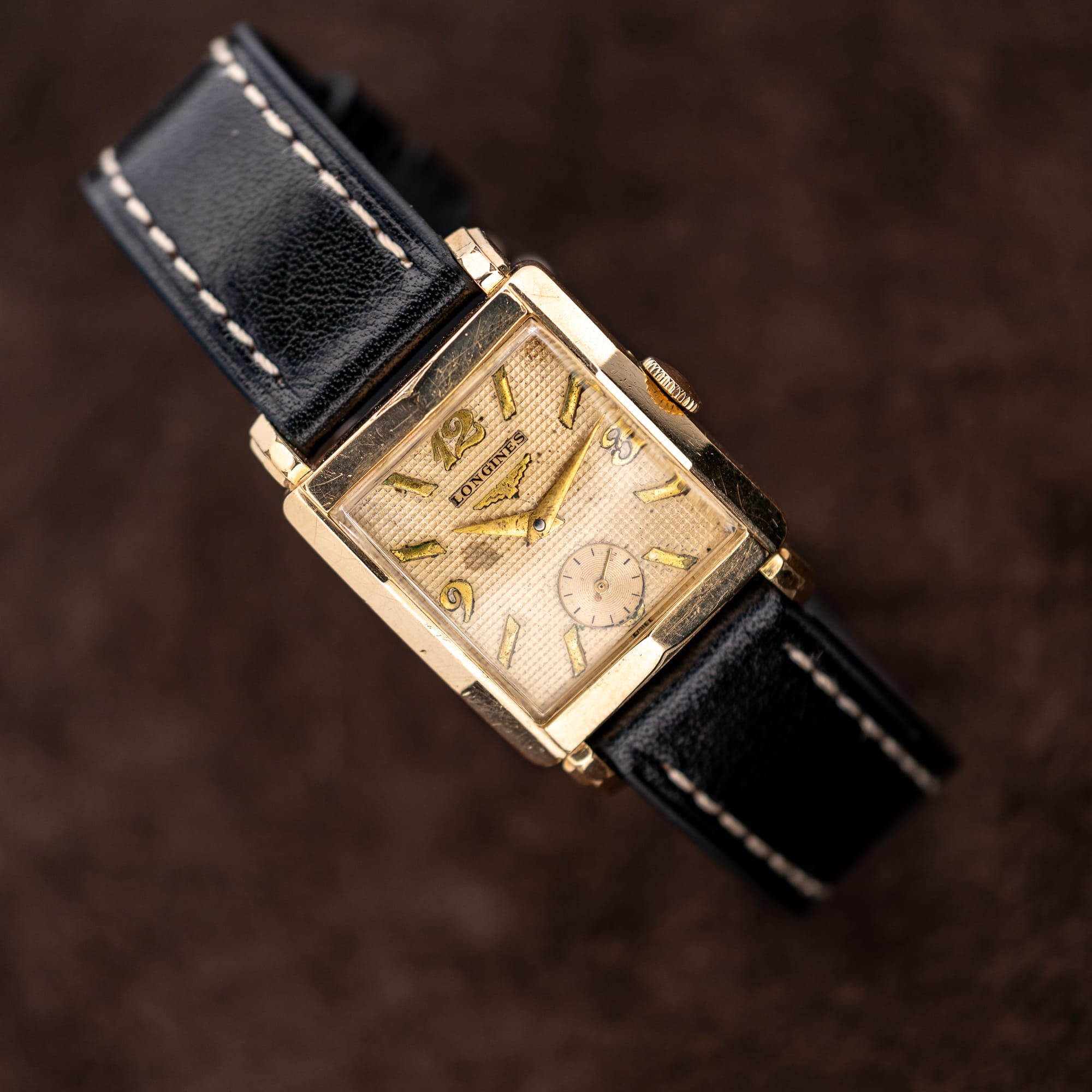
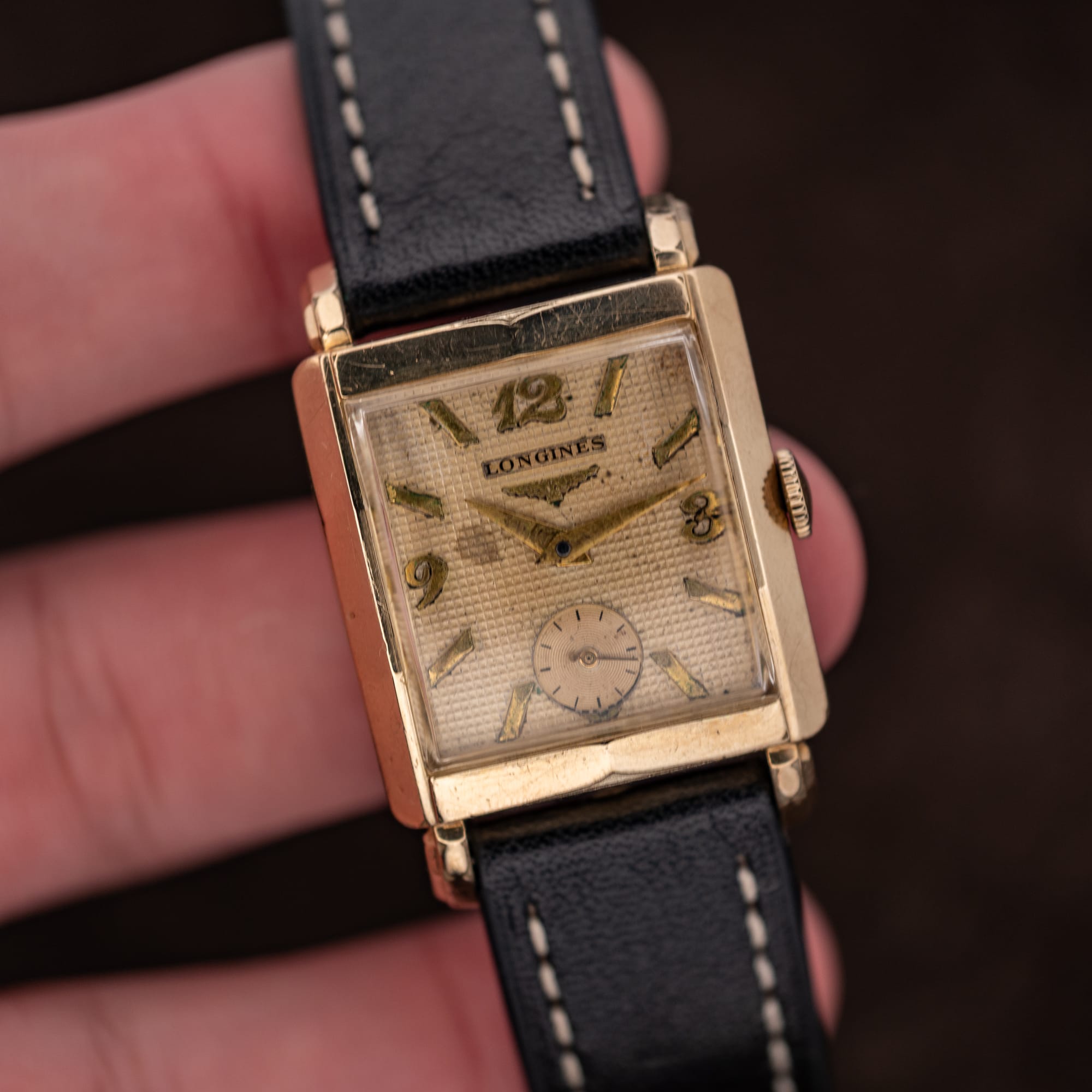

Three shapes share this Longines waffle dial, each at a different scale. The smallest is the texture: rows of tiny raised squares, packed so tightly that the off-white surface looks nearly flat until the light shifts and every square picks up its own highlight and shadow. The largest is the case, a broad faceted square that surrounds the dial like a mat around a print. Between the two sits the one circle on the face, a recessed small-seconds register at six, cut with fine concentric rings that look smooth beside all that grid.
Against so much geometry, the numerals loosen up. Only the 12, 3 and 9 are written out, as applied Arabic figures with some swagger in their curves, and the markers between them flare as they run toward the corners, which keeps the square from feeling boxed in. Two broad, pointed gold-tone hands ride above the relief. Near the top, the name sits in a small rectangular cartouche with an applied winged hourglass just below it.
That hourglass has a long paper trail. Longines registered the name and the winged hourglass in Switzerland in 1889, then in 1893 filed the mark under the Madrid Agreement, an international register that counted six member countries at the time. Its application was the fourteenth ever filed there, and the thirteen ahead of it have all since lapsed. The hourglass is still in service, here in miniature above a textured dial.
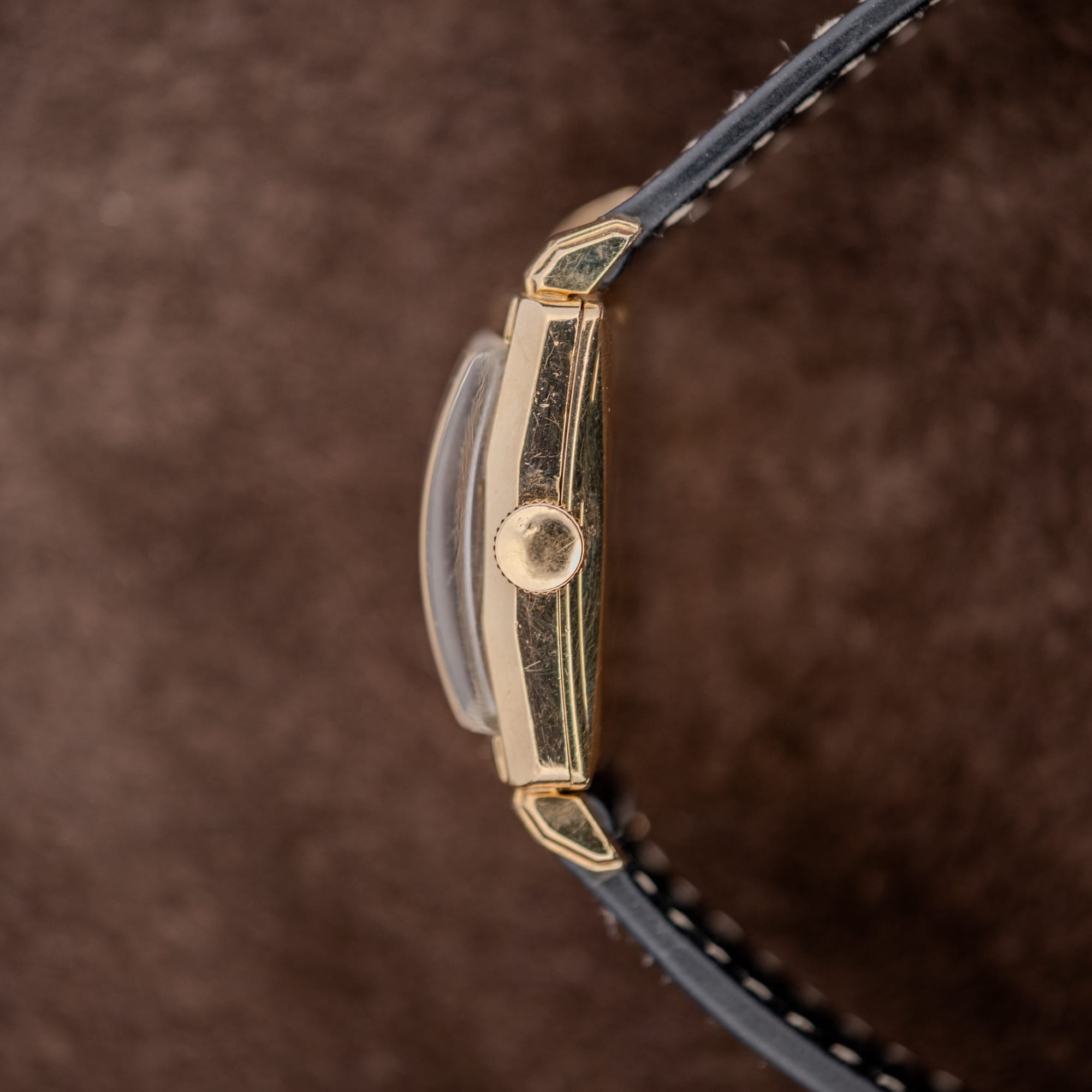
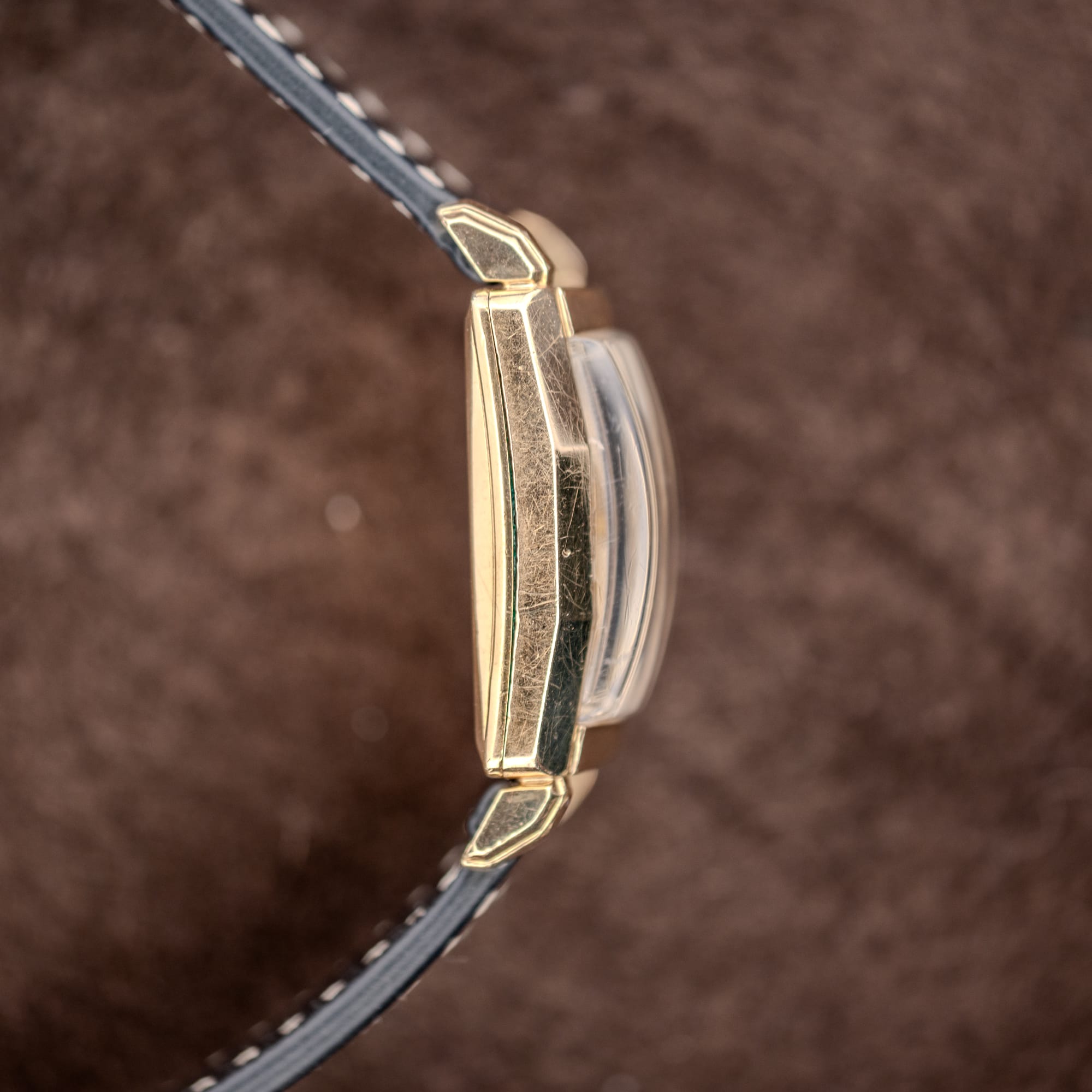
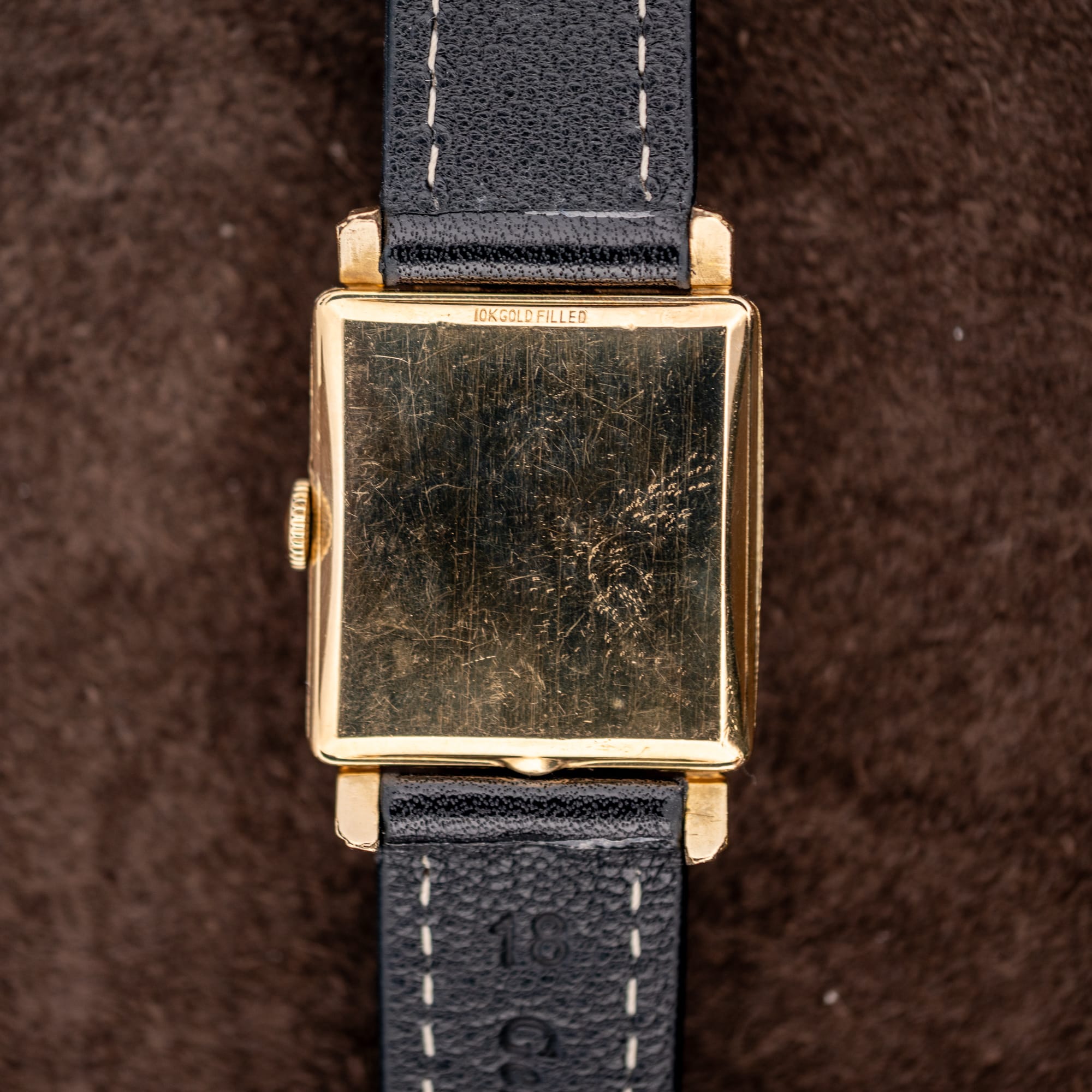
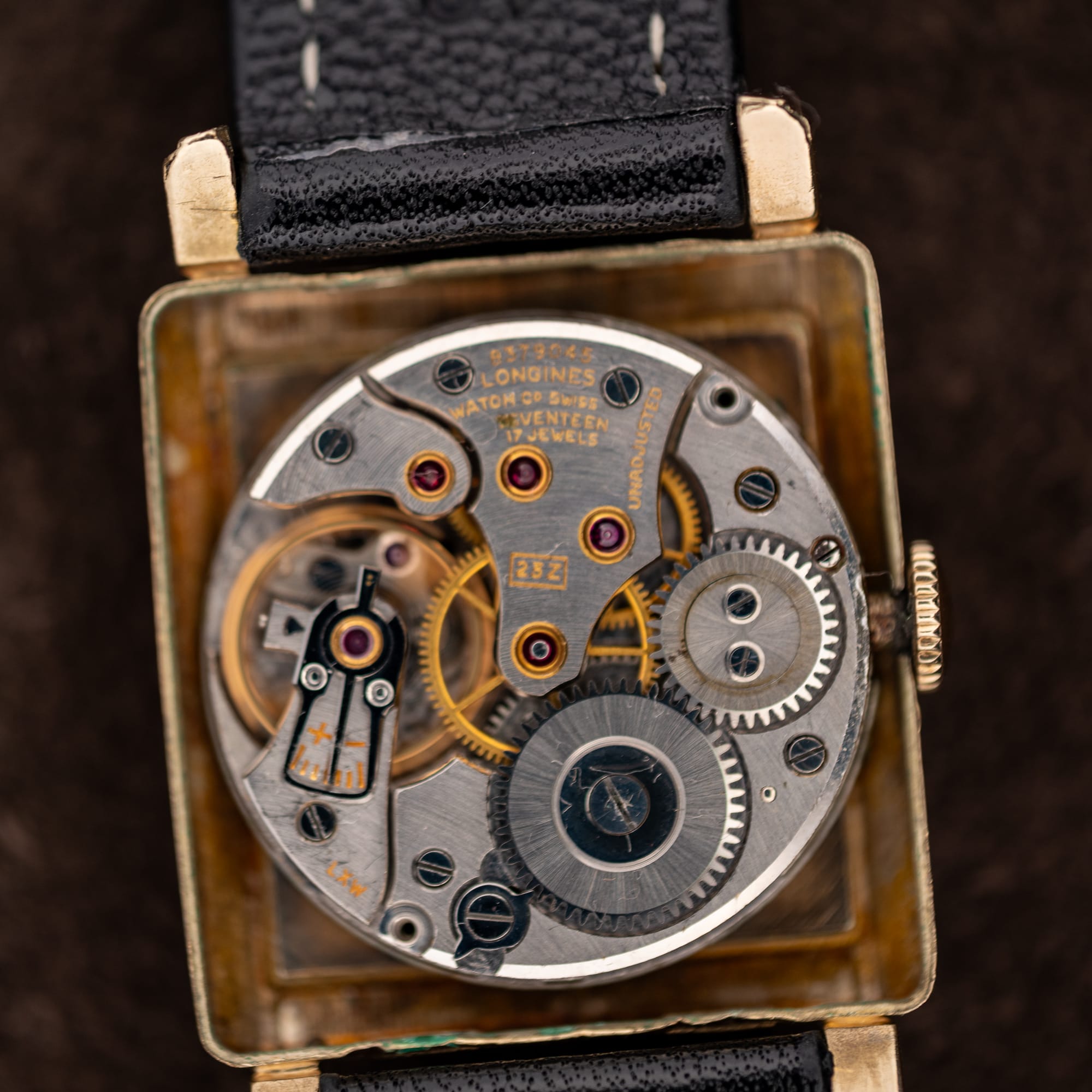
The case gives that dial plenty of gold to sit in. It is 10k gold-filled, 27mm across and 38mm from lug to lug, so it wears taller than it is wide, and the faceted surround gives the front an angular, Art Deco edge. From the side, a strongly domed crystal rises well above the case while short, geometric lugs keep the profile compact. The plain knurled crown winds the 17-jewel Longines movement directly, with no automatic rotor and no date to set.
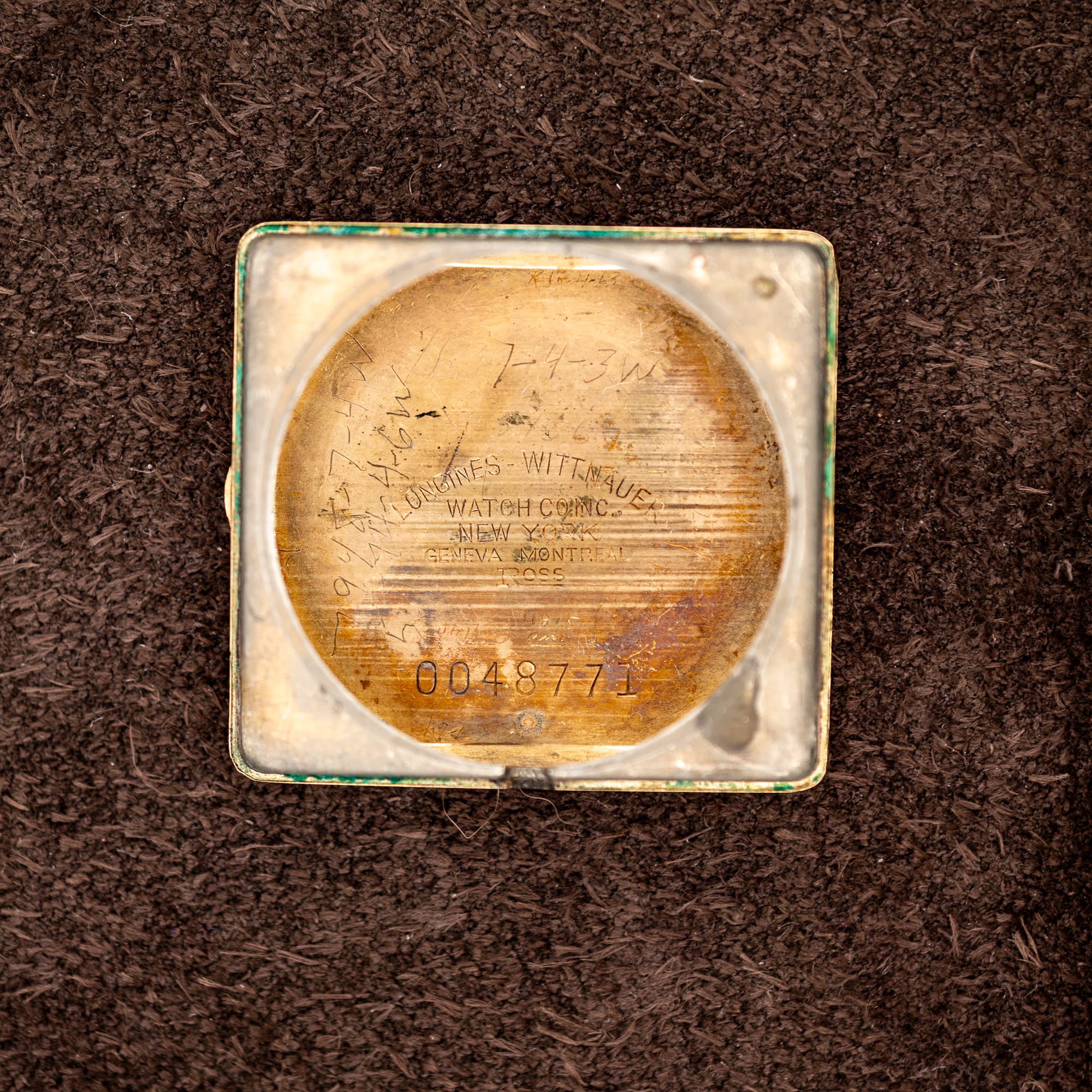
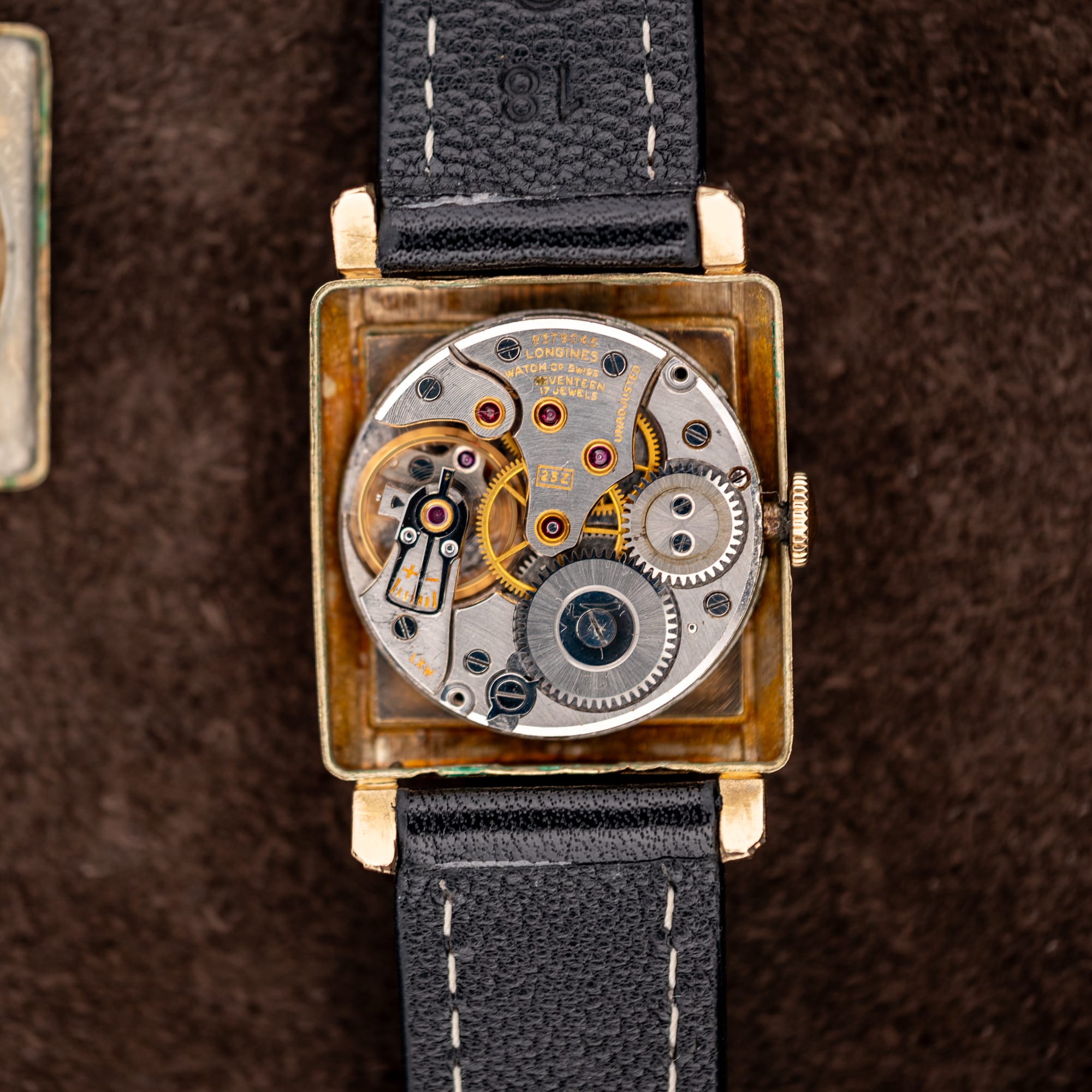
Inside the case back, the stamp reads LONGINES-WITTNAUER, with New York, Geneva and Montreal below it. Albert Wittnauer landed in New York from Switzerland in 1872, sixteen years old, and learned the Swiss watch import trade from the inside. The house he built became Longines’ distributor in the United States, and for decades that joined name was what American buyers met inside cases like this and at the foot of the ads.
Longines-Wittnauer also put its name on the air. From 1951 to 1955 it sponsored Chronoscope, a fifteen-minute CBS interview program broadcast live at eleven at night from a book-lined New York studio, with the Longines emblem displayed behind the guests. John F. Kennedy sat for it as a congressman in 1952. Most live news of that era was never recorded. Chronoscope was filmed, and the company later gave those films to the National Archives.
This dial has aged to a warm, uneven tone, with a darker patch left of center toward nine o’clock, and the back and flanks carry fine surface marks from wear. In window light the grid still lifts out of the off-white square by square, while the small-seconds hand keeps circling inside its ringed register at six.