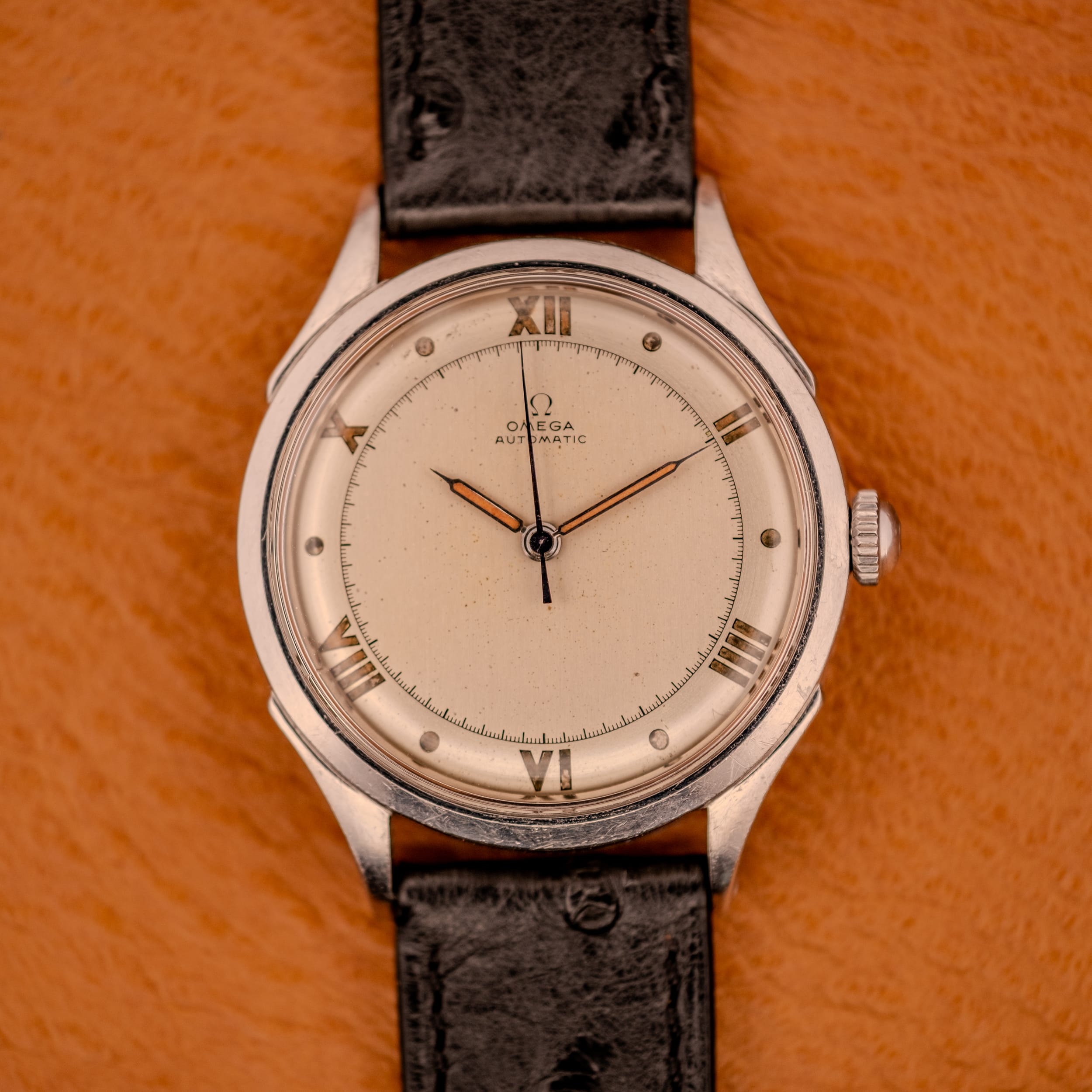

1944 was the year Omega committed to commercial automatic production. 1948 was the year the Seamaster officially launched, timed to the brand’s centenary. The Omega Pre-Seamaster 2584-1 sits inside that narrow window, an Omega-signed automatic that does not yet carry the Seamaster name on the dial but already runs the bumper architecture that would carry the brand for the next decade. To us, this is the moment the Omega automatic stopped being an experiment and started becoming the watch the brand would build a century on, and in our opinion the pre-Seamaster references are among the quietly important ones in the long-form Omega catalogue.
Omega’s automatic story properly begins in 1943 and 1944 with the 28.10 bumper family, the brand’s first production rotor calibers, and accelerates through the 30mm 330-series and 350-series bumpers that fill out the catalog across the second half of the 1940s. The reference 2584-1 lives squarely in that transitional pre-Seamaster window, sharing case architecture, dial vocabulary, and movement family with the references that would carry the Seamaster signature only months later. Omega’s own centenary in 1948 is the moment the Seamaster line was formally announced, and references like the 2584-1 are the watches that were already on the bench when the announcement happened. A genuinely interesting place to be in Omega catalog history.
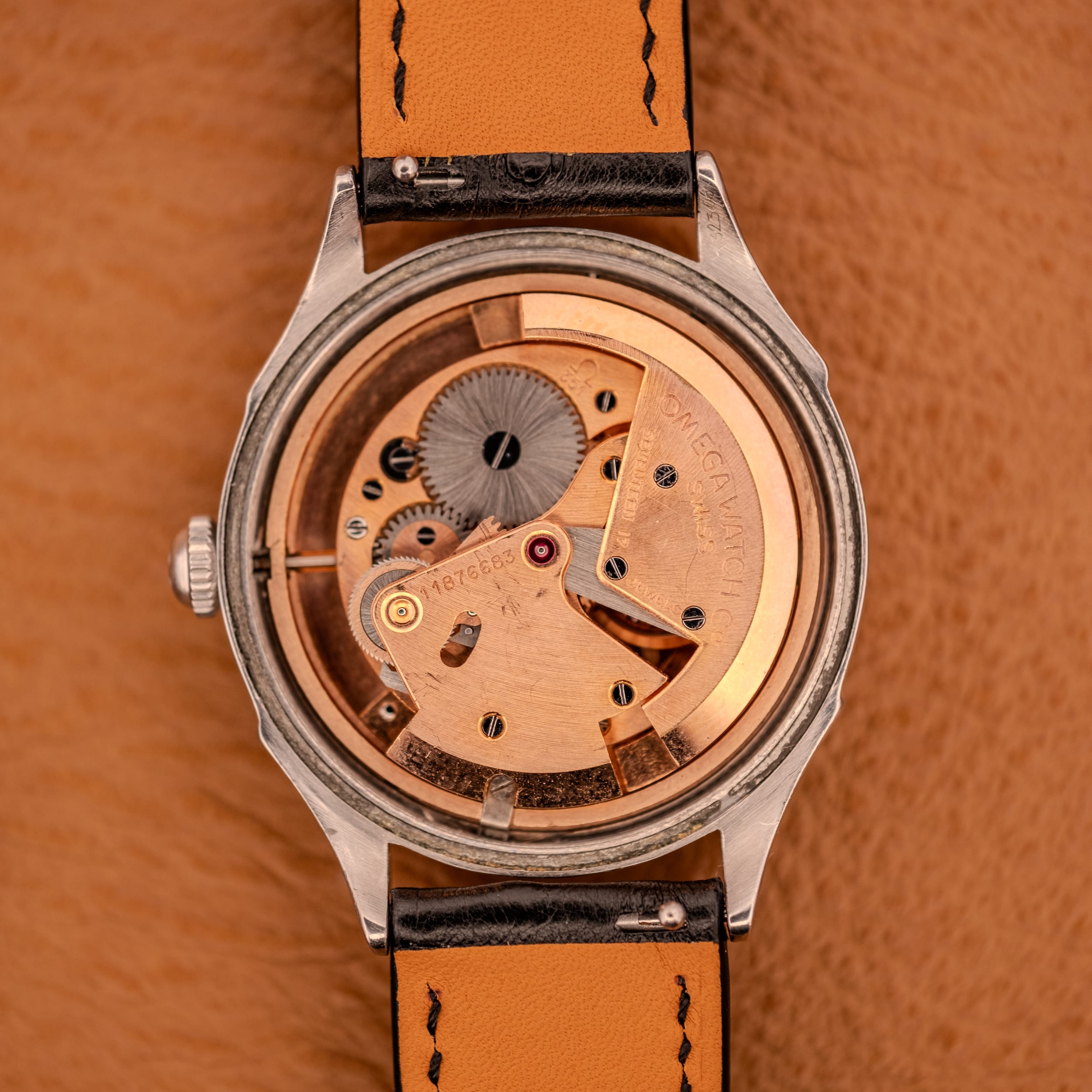
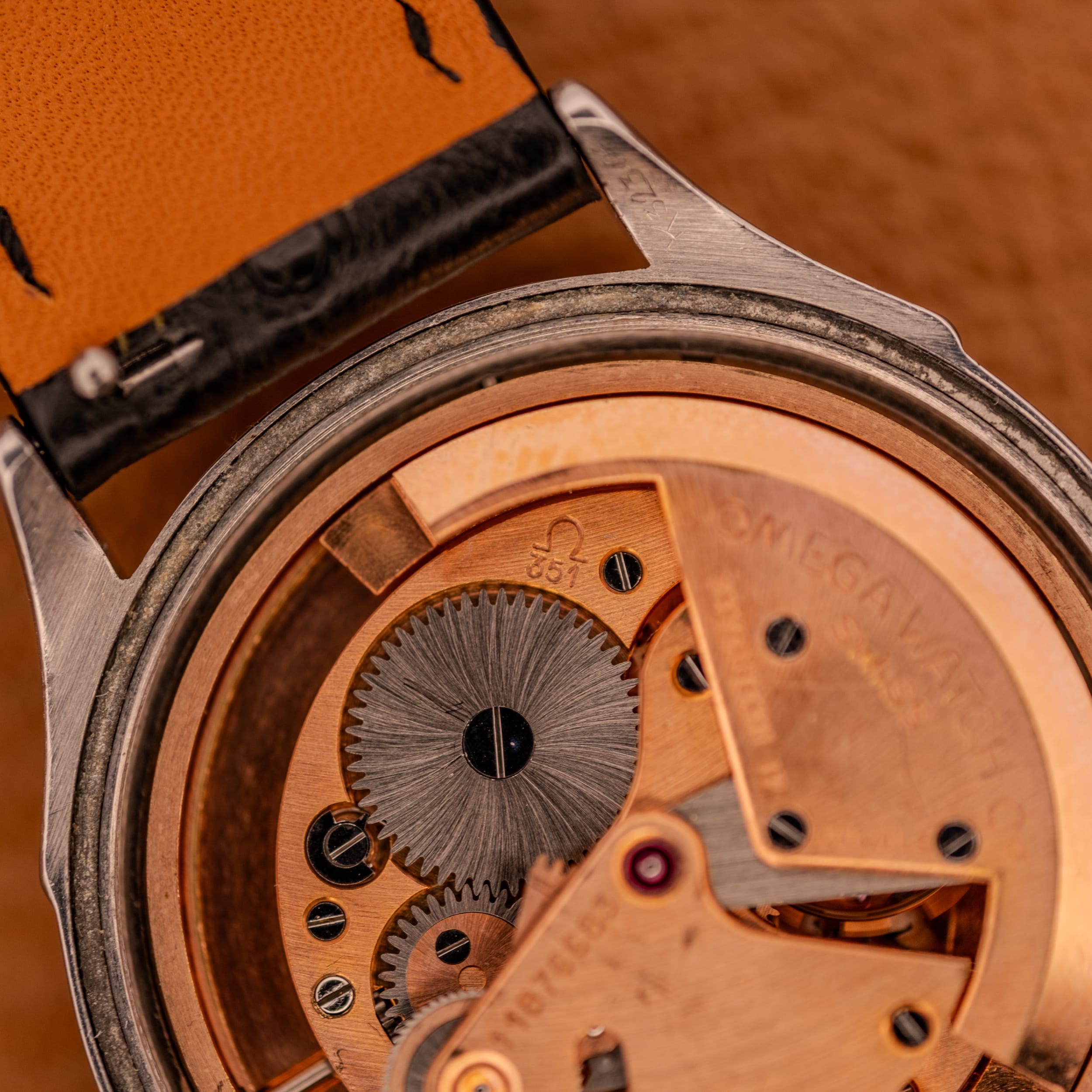
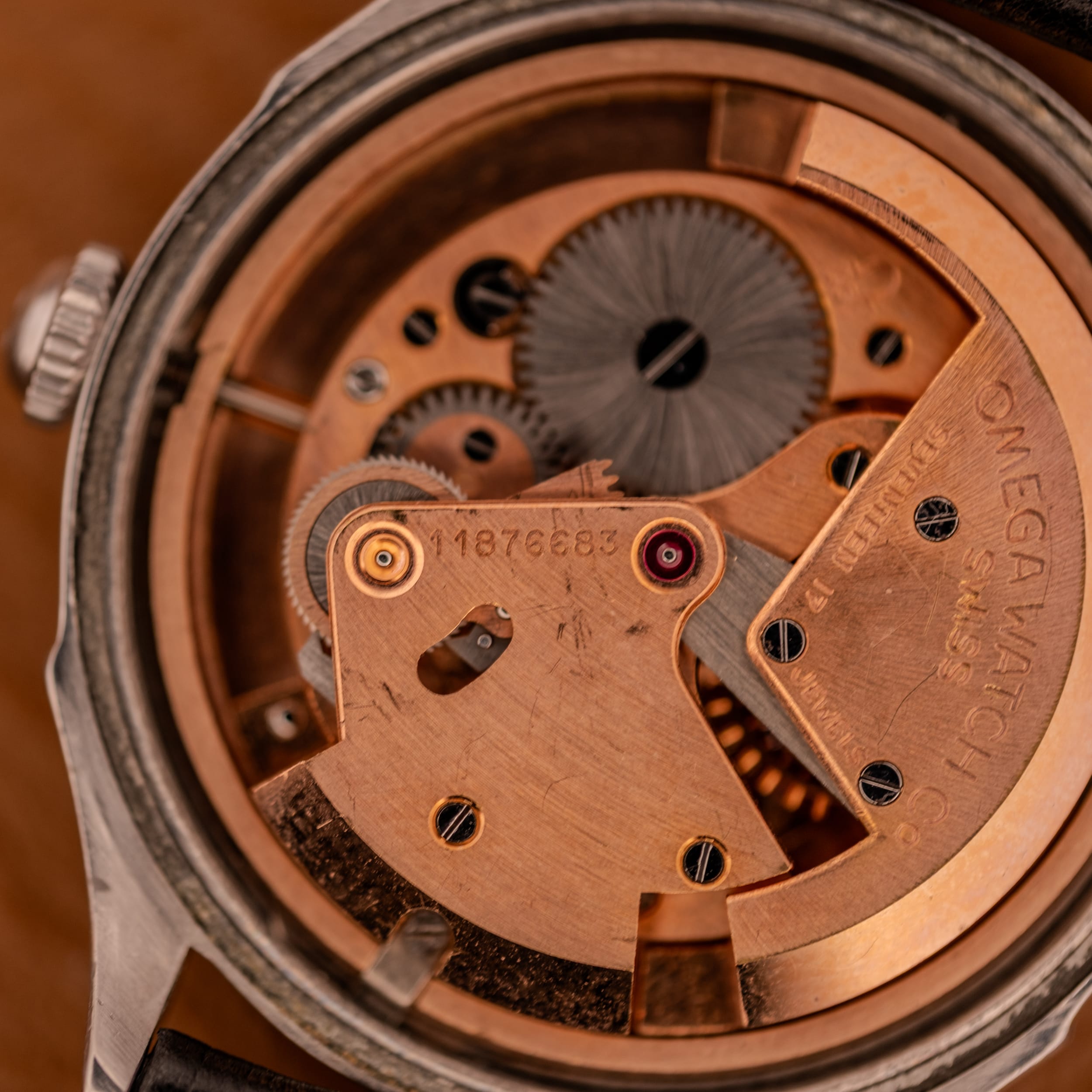
The caliber is the Omega 351, a bumper automatic from the 30mm family that powered the brand’s earliest commercial automatics. Seventeen jewels, beating at 19,800 vibrations per hour, with Incabloc shock protection and a roughly forty-two-hour power reserve. A bumper automatic uses a half-rotor mass that swings through an arc of about 270 degrees before striking sprung buffers and bouncing back the other way, the design that preceded the now-standard full-rotor that pivots a complete 360 degrees on a central axle. The mainspring is protected by a slipping bridle inside the barrel rather than the click stop of a manually wound caliber. On the wrist a bumper has a distinct feel, a soft rocking knock you can sense when the half-rotor strikes the buffers, and that mechanical signature is one of the reasons collectors chase bumper-era Omegas specifically. Our service photographs show the copper-toned bridges with the Omega Watch Co. signature, the caliber designation 351 stamped near the balance, and a movement serial reading 11876683 that places production firmly in the 1947 to 1948 window. To us, the 351 is the bumper that sits right at the door of the Seamaster era, the caliber that finished what the 28.10 started and handed the baton to the full-rotor 500 a decade later.
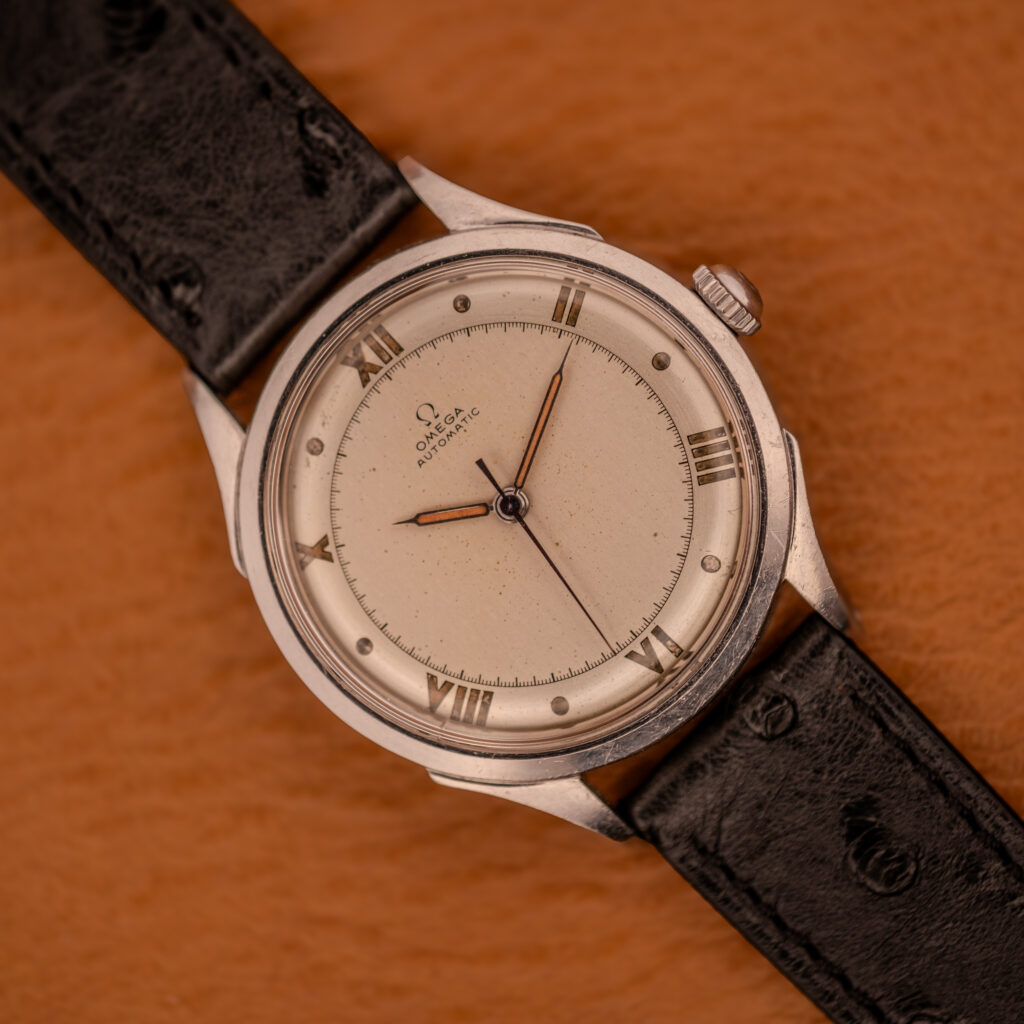
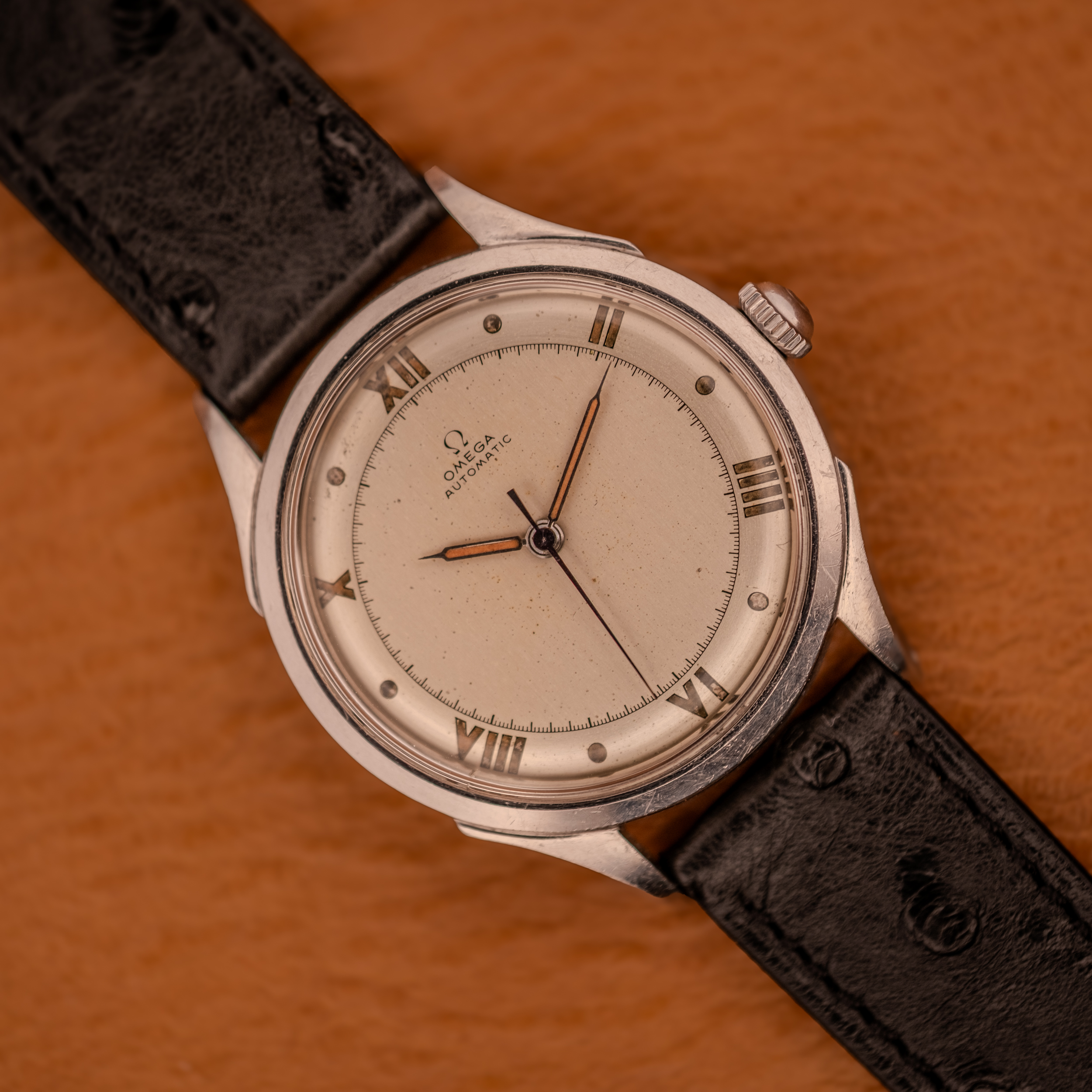
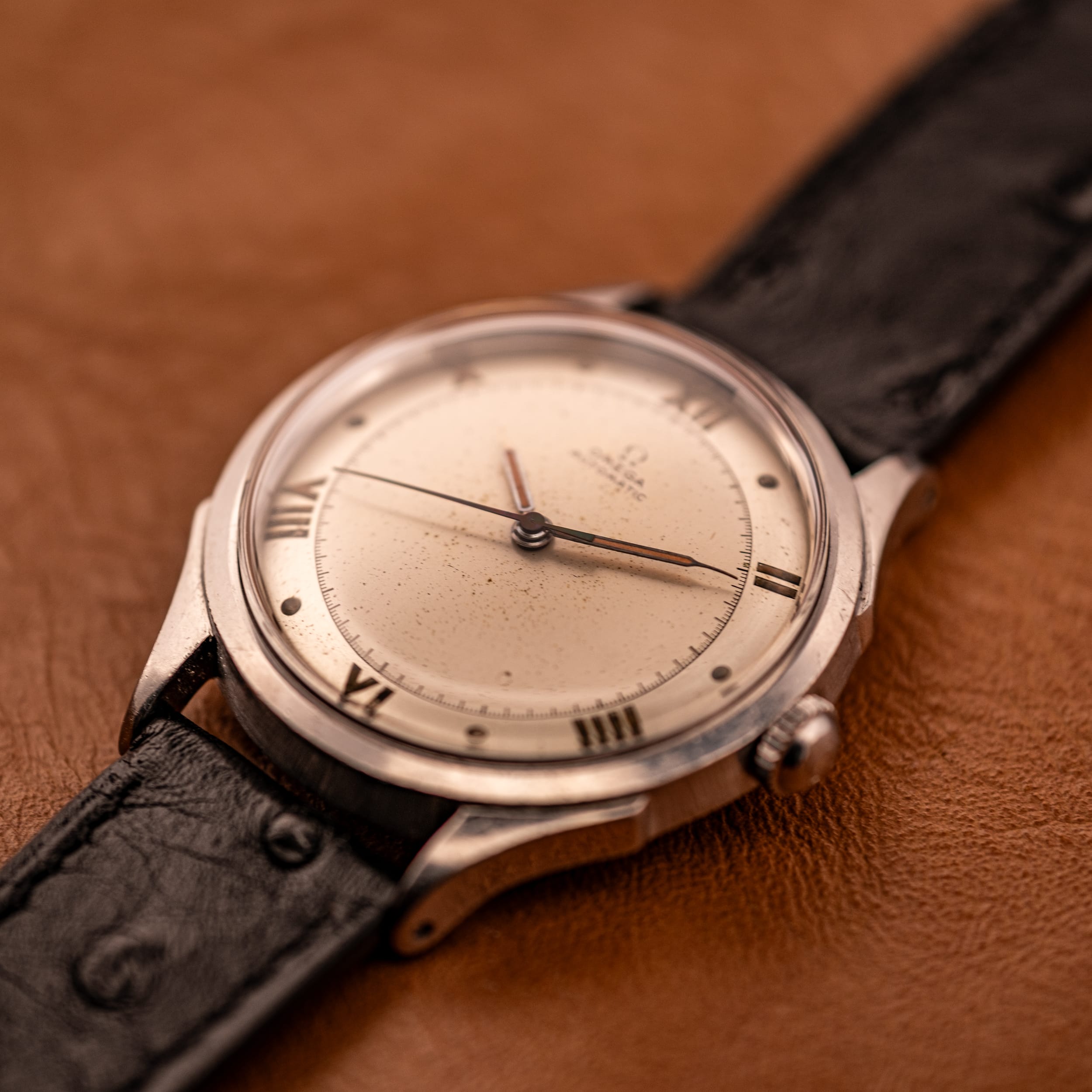
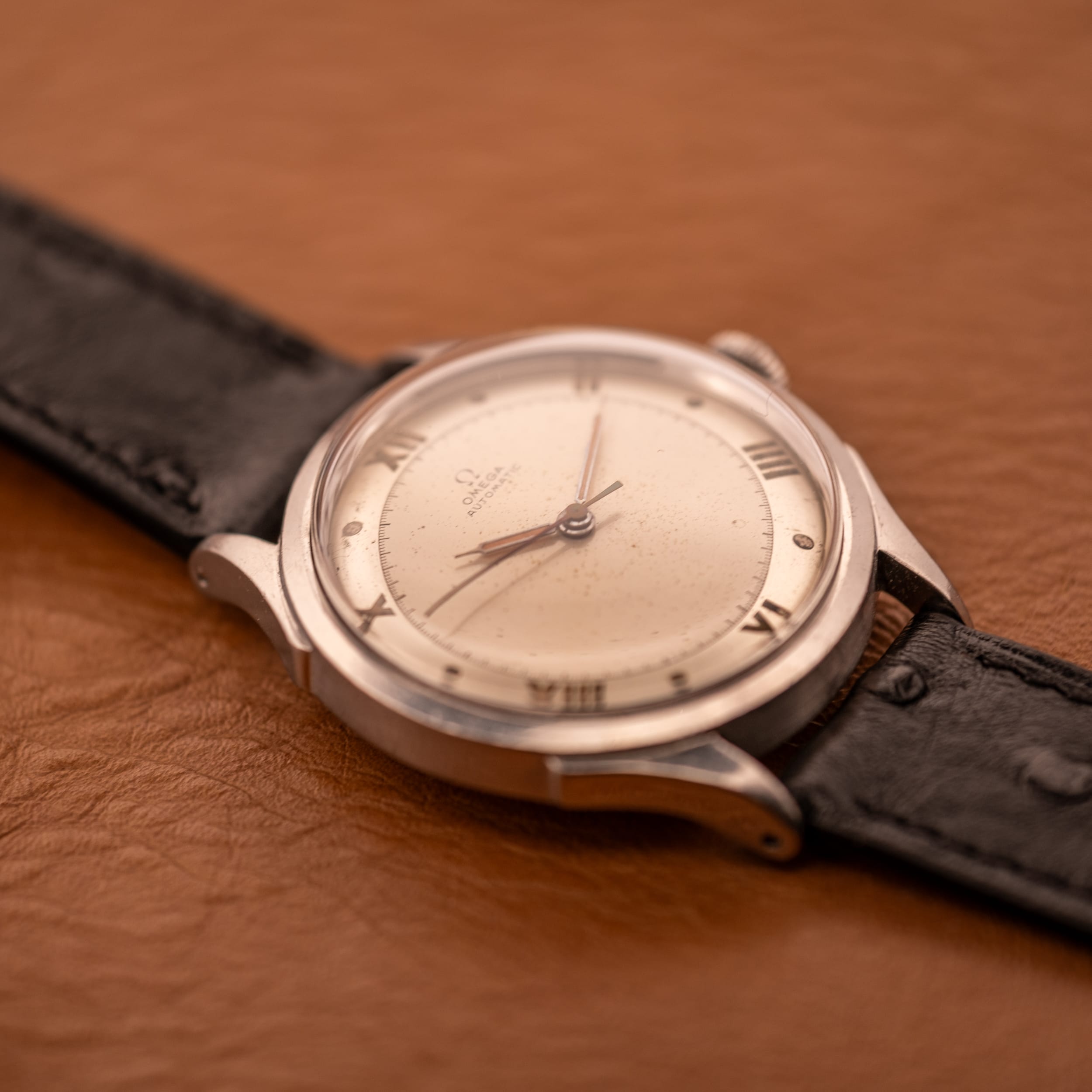
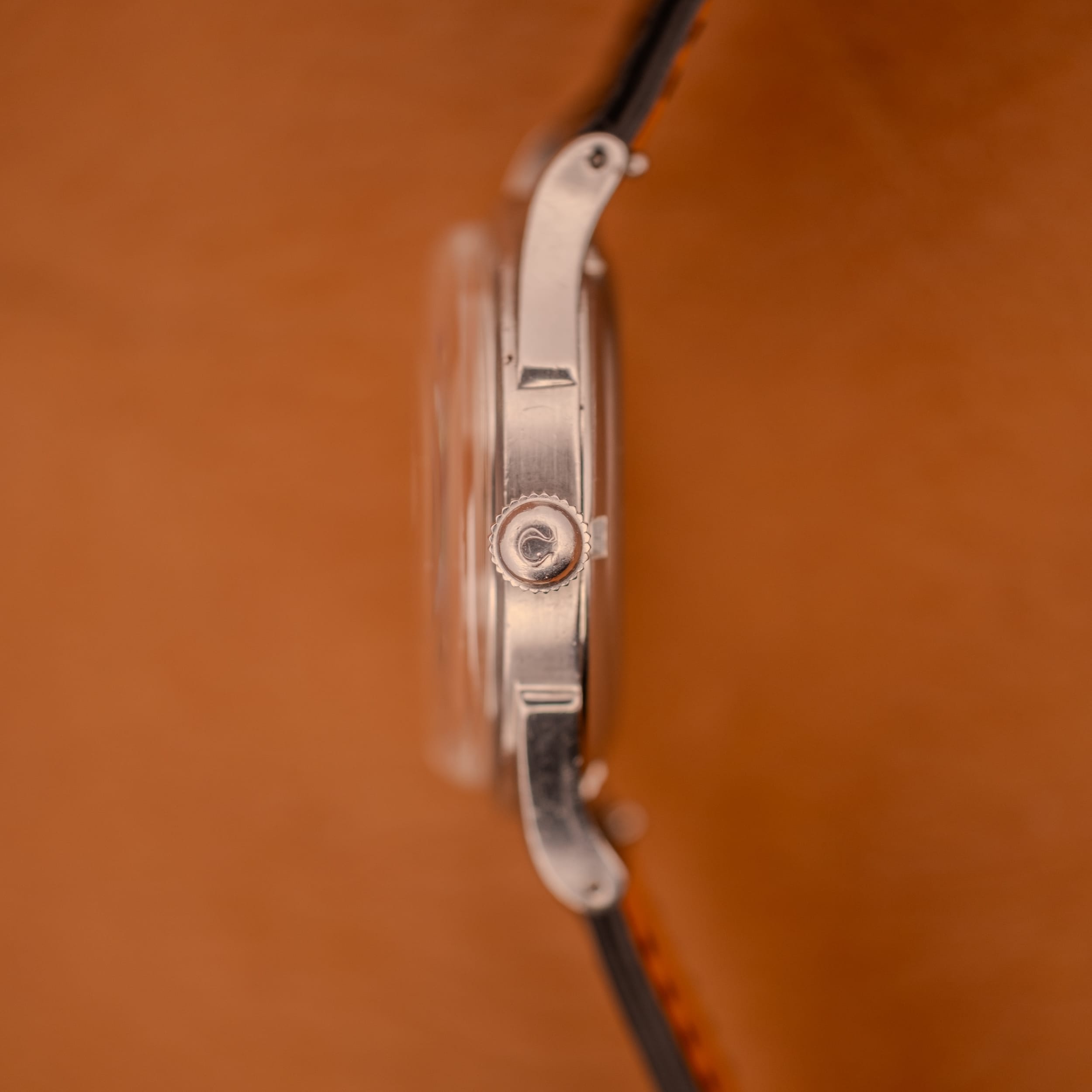
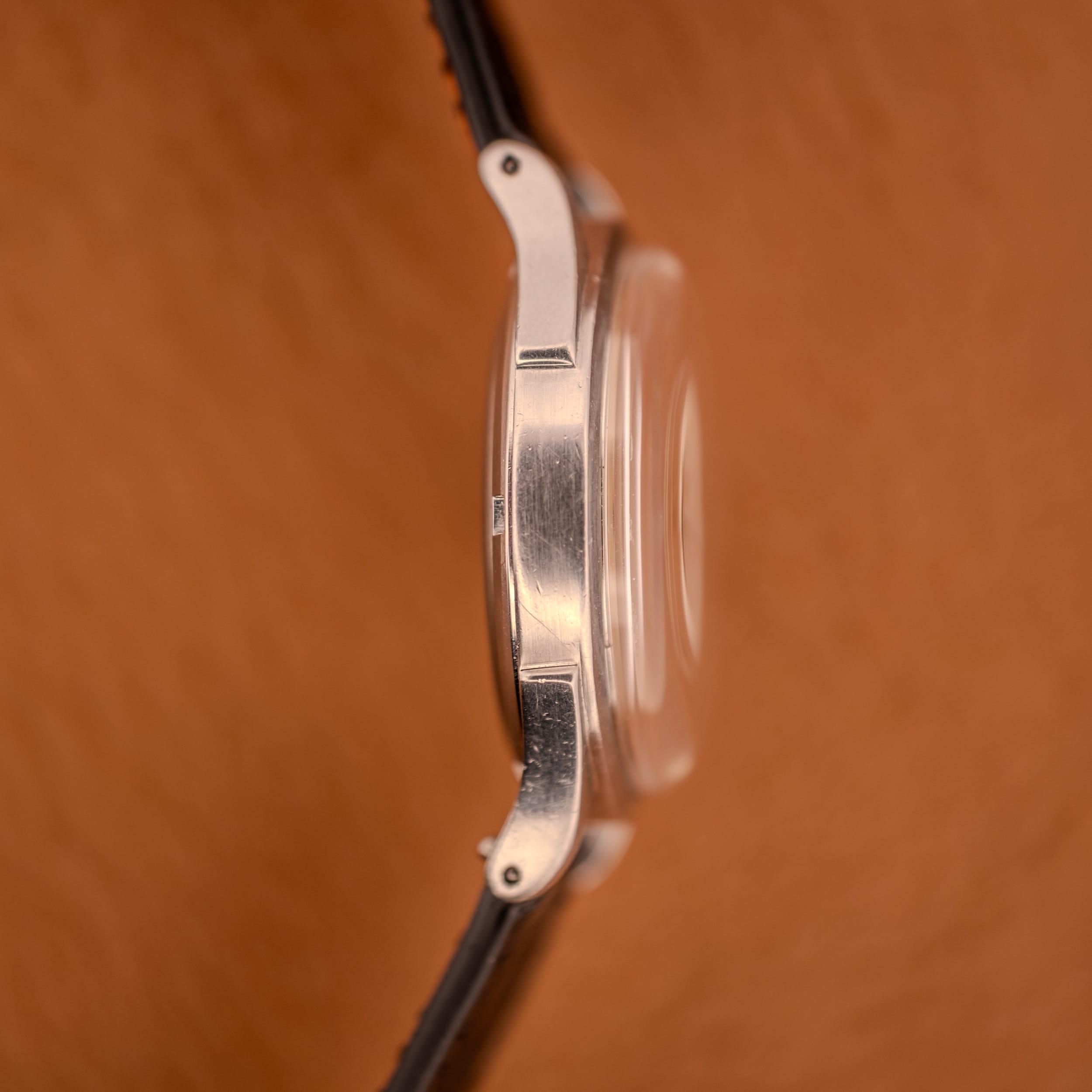
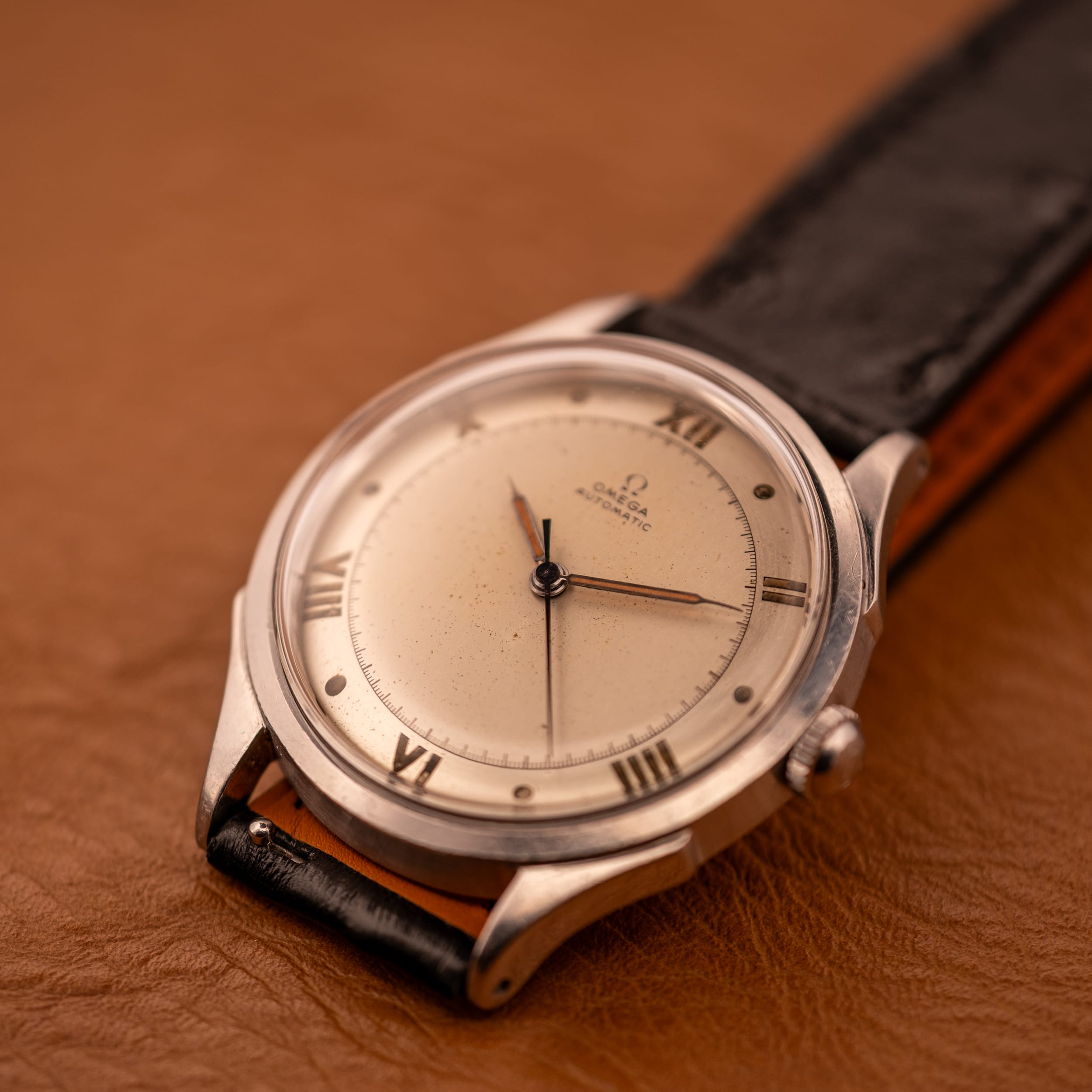
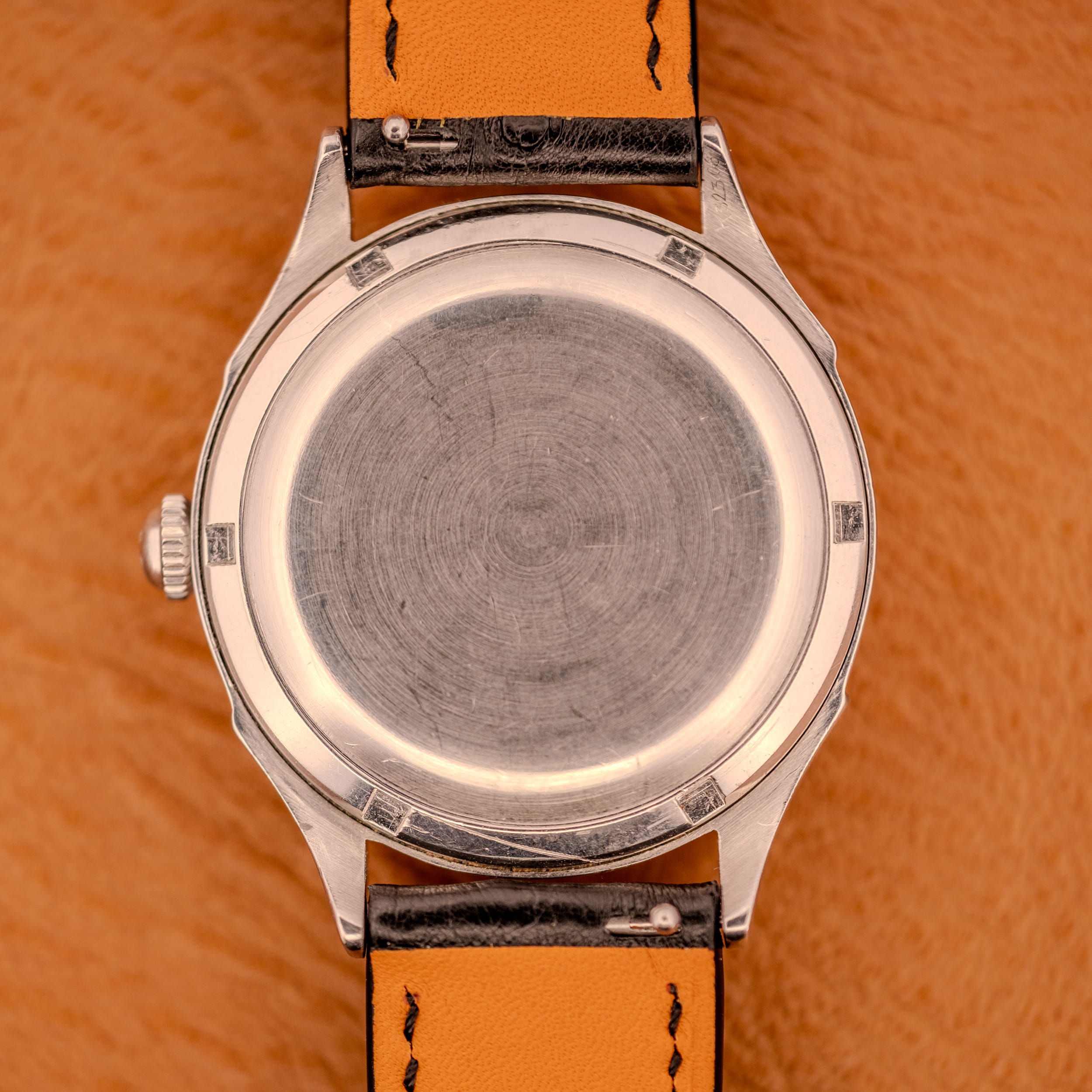
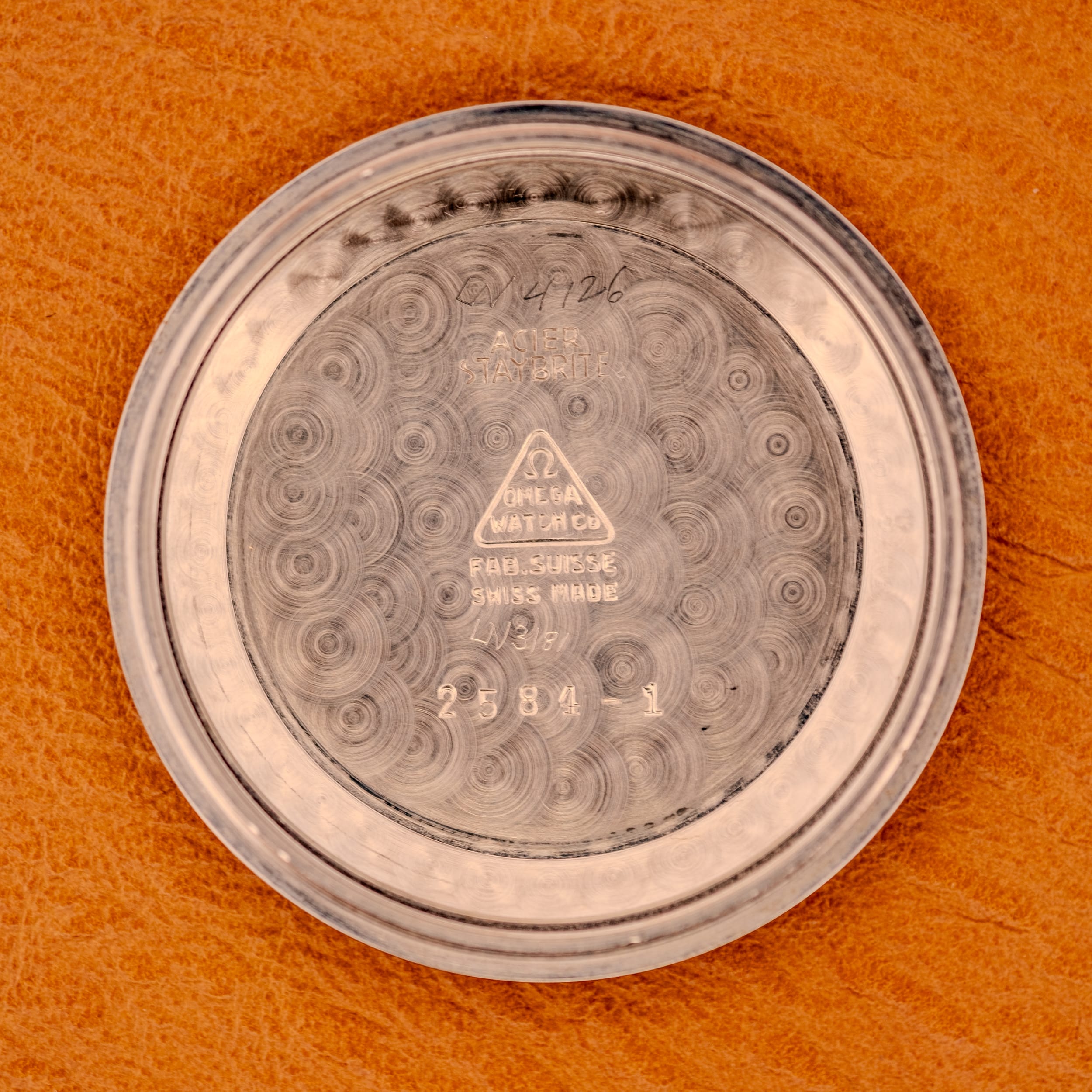
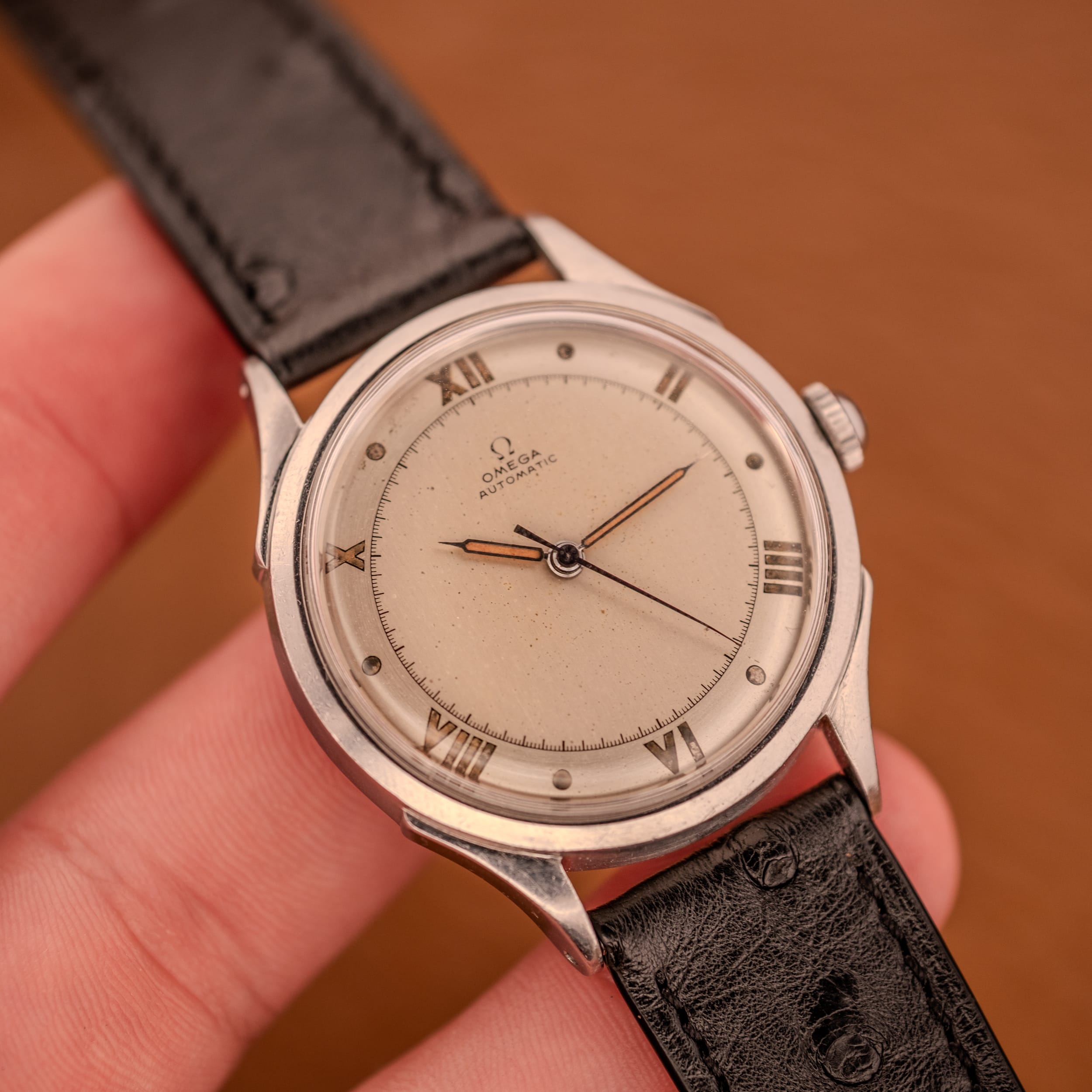
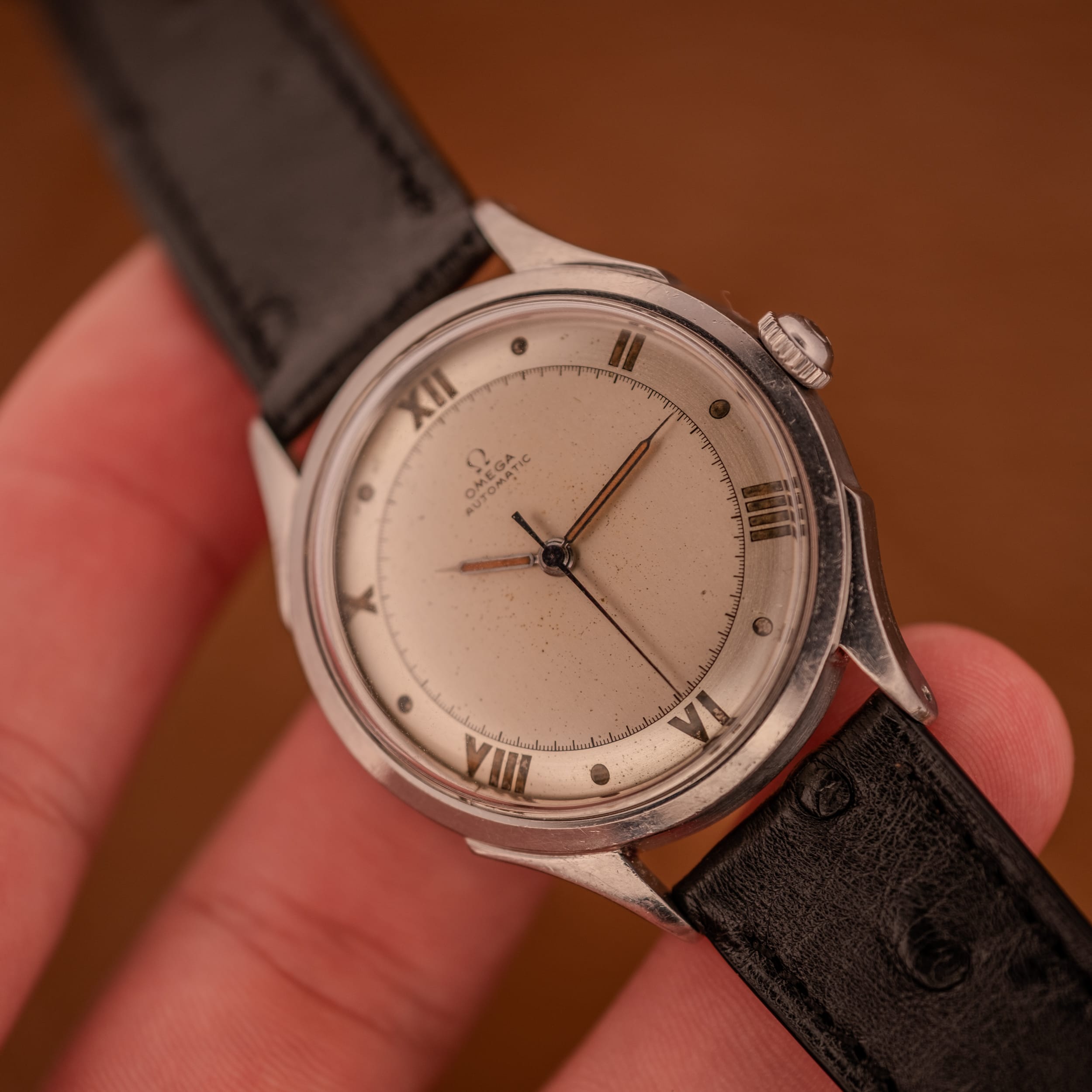
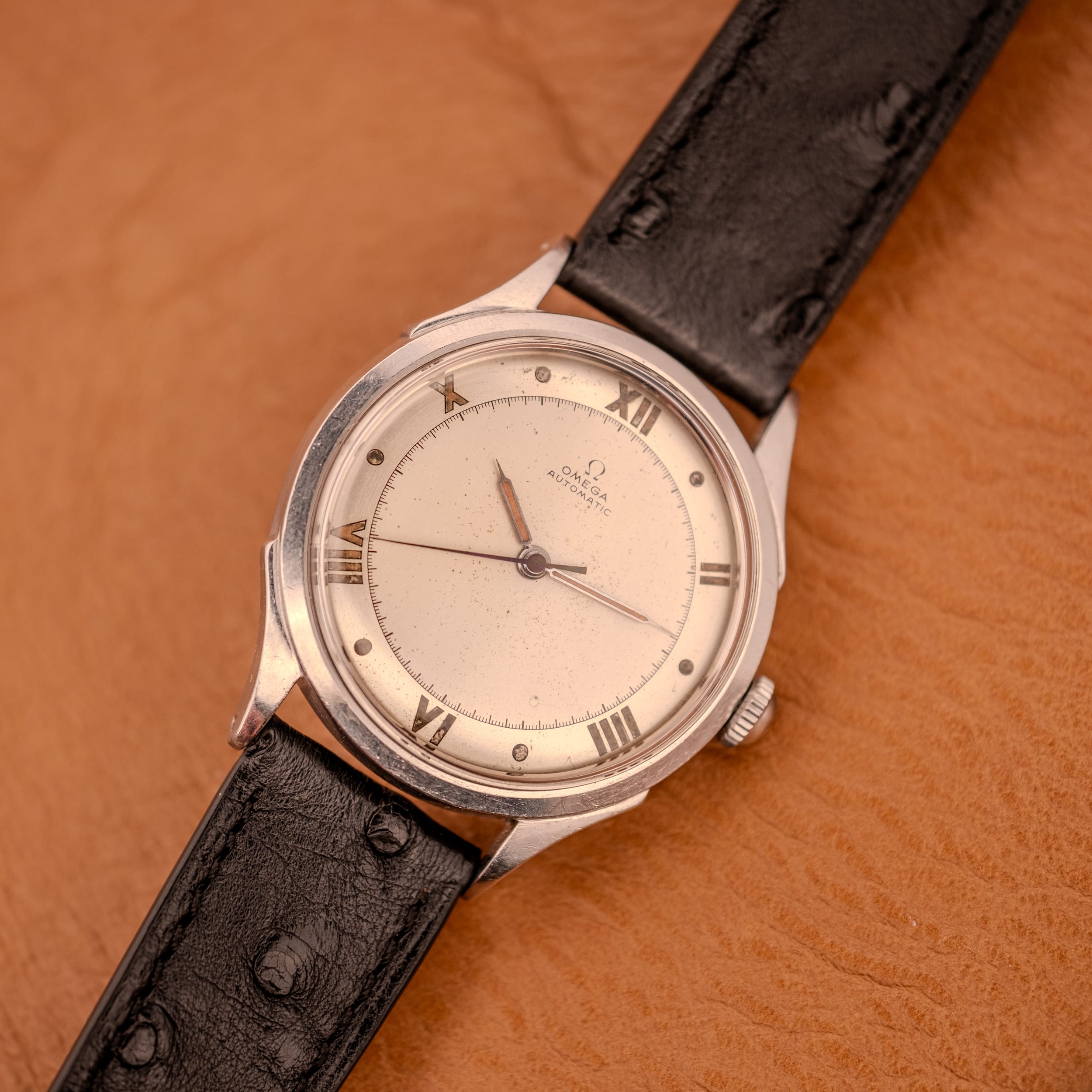
The case is a stainless steel cushion measuring 35.4mm across with a 42.6mm lug-to-lug span and an 18mm lug width, the kind of dimensions that read perfectly proportioned on a modern wrist. The lugs are the design feature that earns the case its character, downturned and faceted with sharp upper edges that cut into the upper case band before flaring out to wrap the wrist, a shape that is distinctly 1940s Omega and unmistakable once you have handled one. Honest hairlines and gentle scratching scatter across the case sides and the snap-on caseback, the kind of wear that reads as a watch worn and loved for eight decades rather than locked away. The outer caseback is plain polished steel with the period-correct notched edge for opening. Open the back and the inner caseback is stamped clearly, reading “ACIER INOXYDABLE” across the upper half, the Omega Watch Co. triangle logo at center, “FAB. SUISSE” and “SWISS MADE” beneath the logo, a watchmaker service mark “LV3/9,” and “2584-1” along the lower edge, exactly the layout a vintage collector wants to see on a reference from this generation.
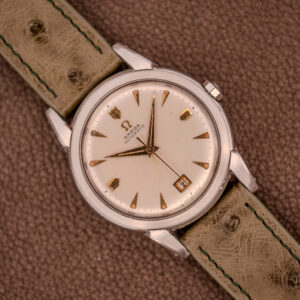
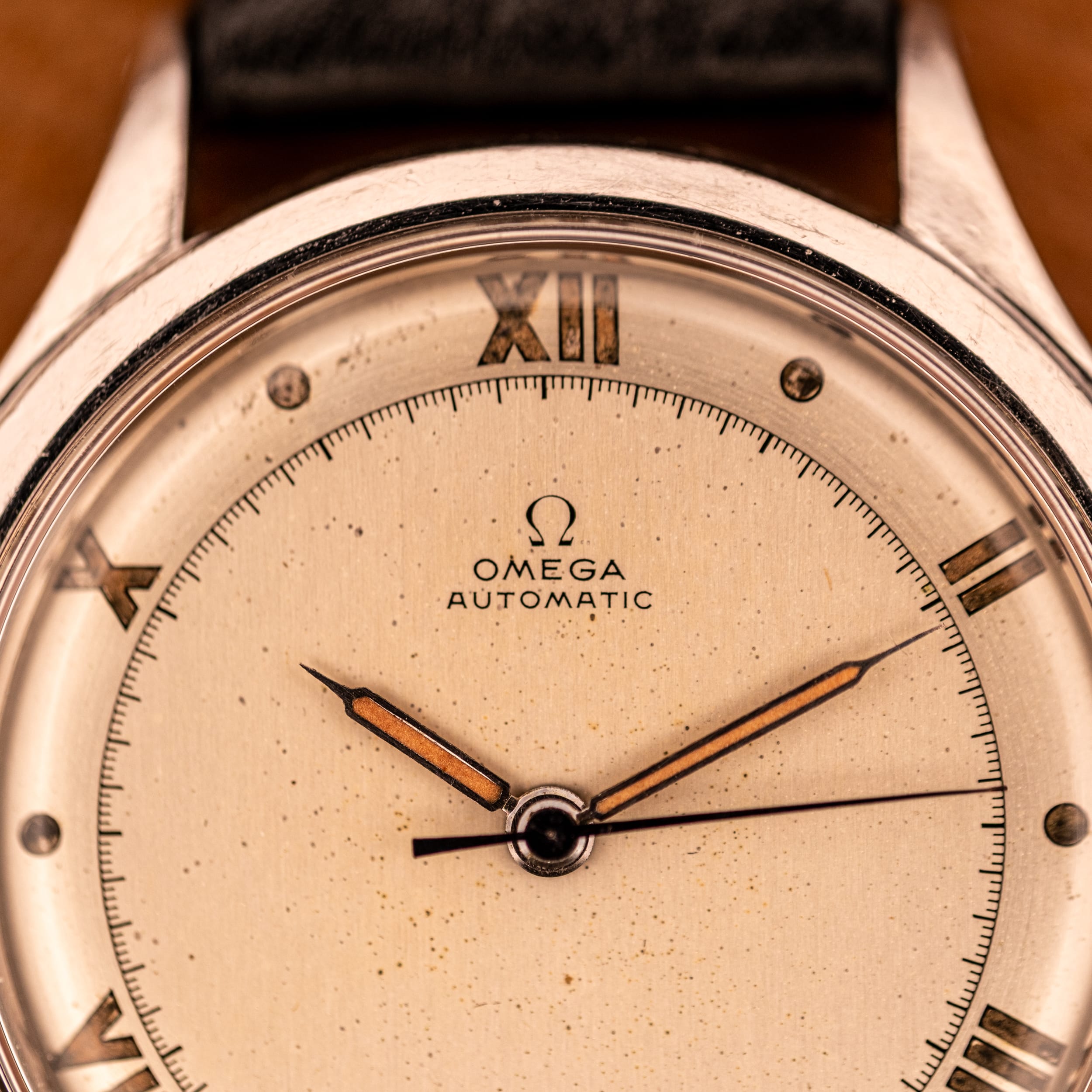
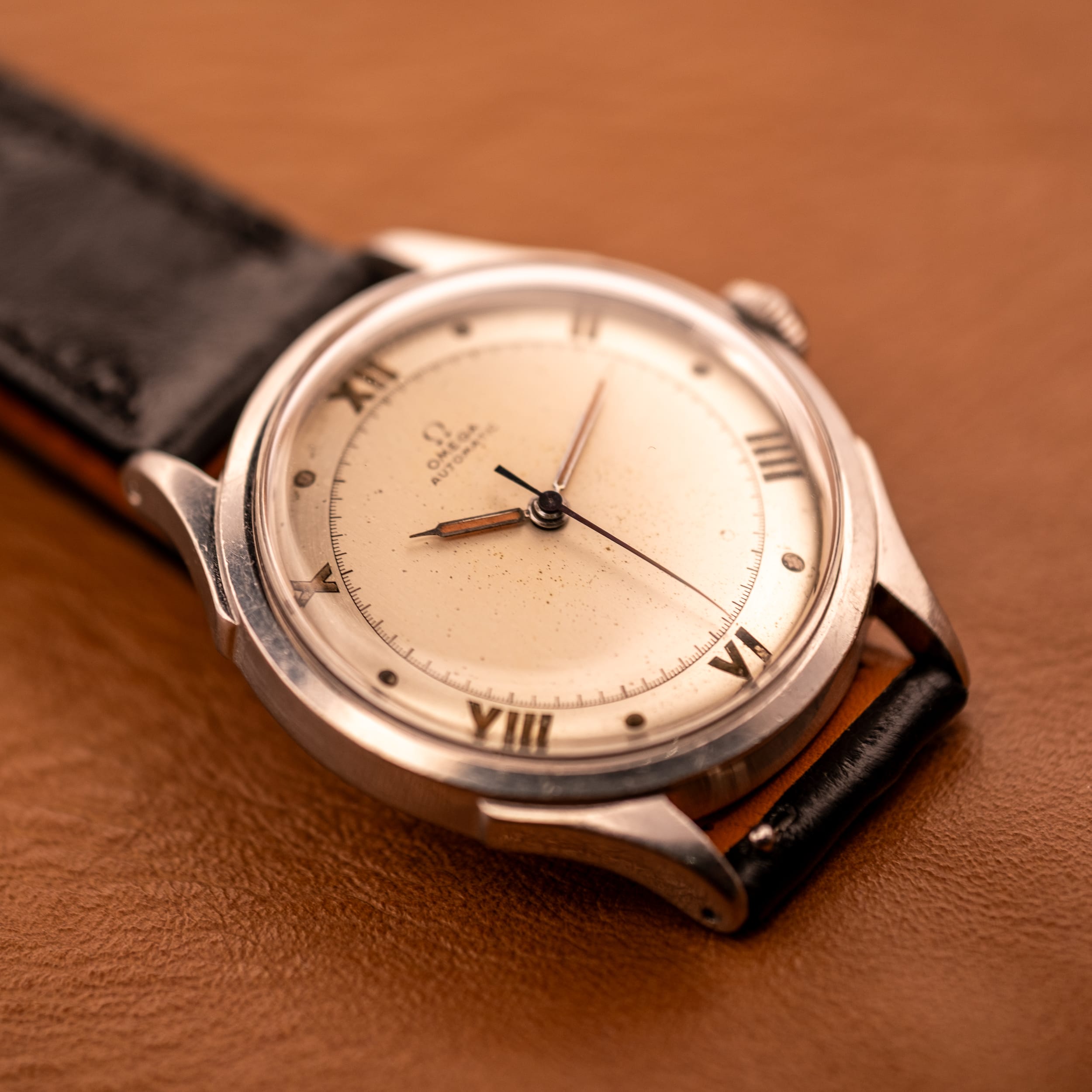
The dial is the headline. The factory original cream silver field has aged across nearly eighty years into a warm, even, lightly speckled patina that reads honest rather than damaged. Applied steel Roman numerals stand at the cardinal hours of XII, III, VI, and IX with applied steel dots marking every hour position in between, and the outer minute track runs as a fine chemin-de-fer railroad pattern around the perimeter. The Omega symbol sits applied above the printed OMEGA wordmark and the AUTOMATIC text at the upper half of the dial. The hands are the original slim dauphine pair, both matched, with a faint warm tone that suggests they were originally fitted with a luminous compound that has now darkened and aged into the steel. The dial has no luminous markers and no “SWISS MADE” printing at the lower edge, both period-correct for a 1940s Omega automatic of this style. This is the original factory dial in unrestored condition, a survivor at the eighty-year mark, and the originality story stays clean.
The crown is the original Omega-signed component with the period-correct Omega symbol intact at the center and operates with the positive engagement a properly serviced 351 should give. The acrylic crystal sits clear and gently domed above the dial.
We have paired the watch with one of our black ostrich leather straps and an OTTUHR signed buckle. The deep black reads as a clean counterweight to the warm cream of the dial and the silver of the steel case, and the ostrich grain gives the package a slight formal weight that suits the late-1940s dress automatic character perfectly.
Serviced in-house at OTTUHR and backed by our 2-year mechanical warranty, this is the kind of pre-Seamaster Omega we get genuinely excited about. Factory original dial, factory hands, original signed crown, intact inner-caseback stampings, and the bumper caliber 351 running cleanly through the brand’s most interesting transitional moment. For the collector who values originality over polish, who reads aged factory dials as character rather than damage, and who wants a piece of late-1940s Omega watchmaking from the exact moment the Seamaster line was about to be born, this is exactly the kind of watch we love bringing in.