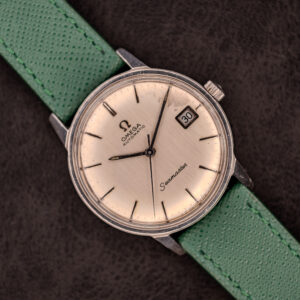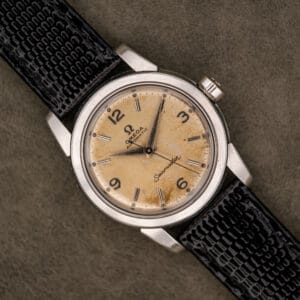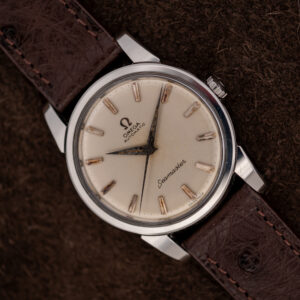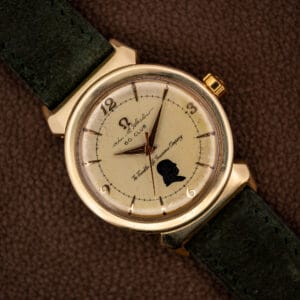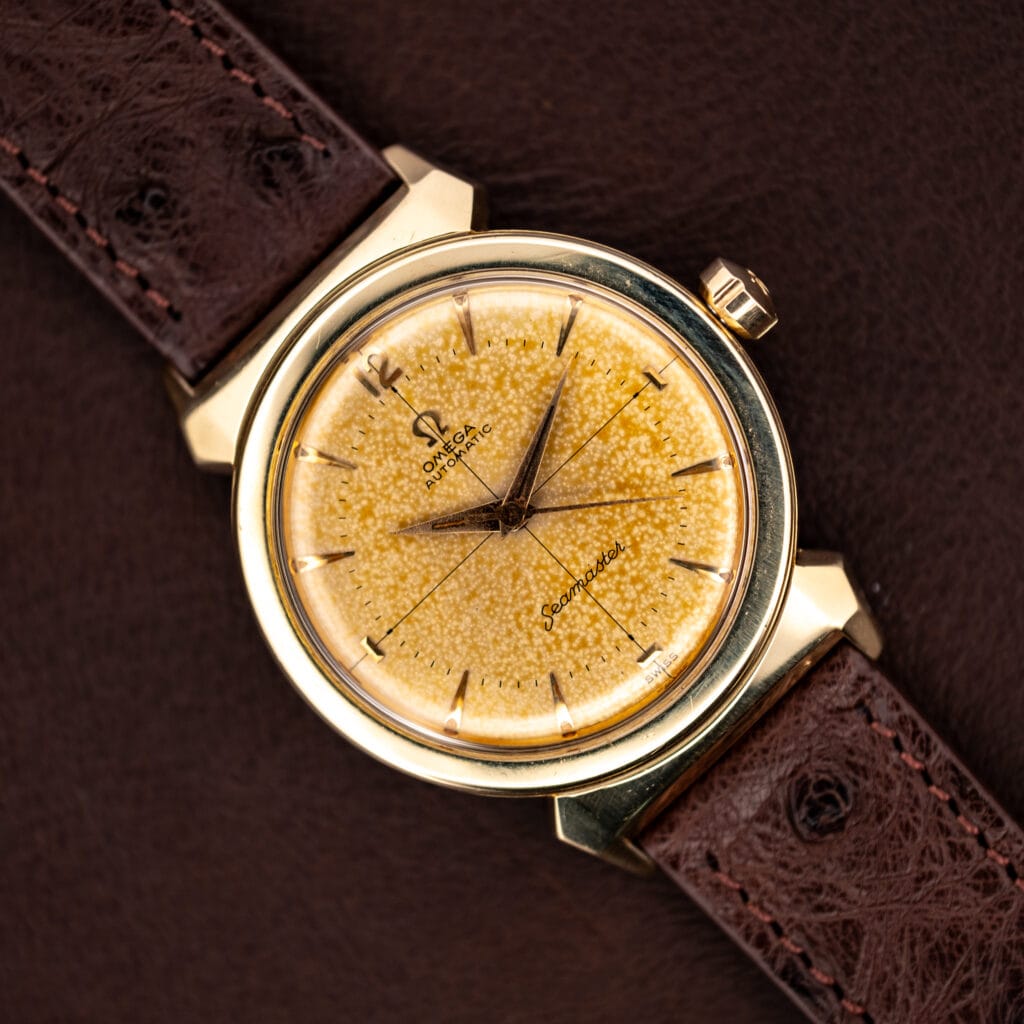
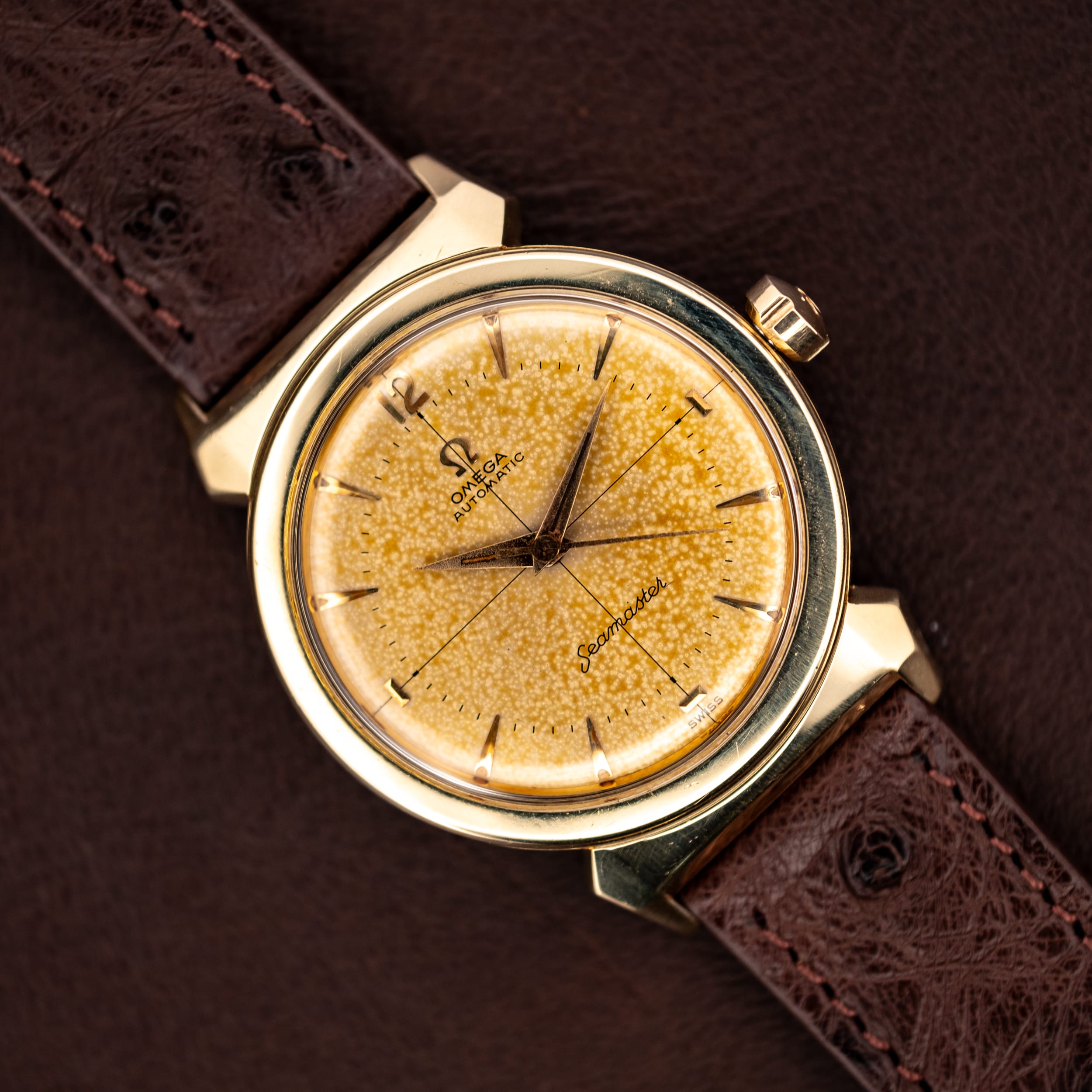
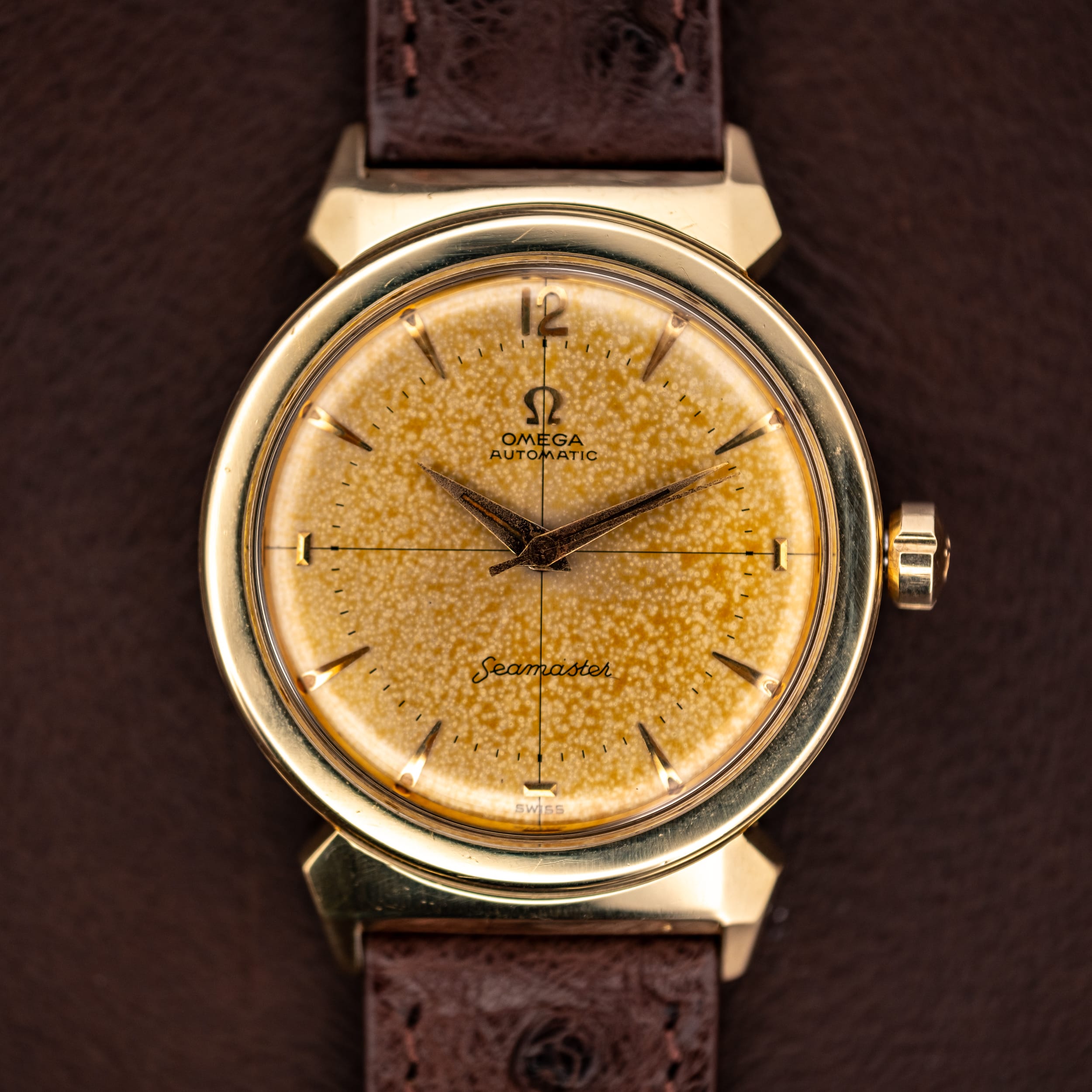
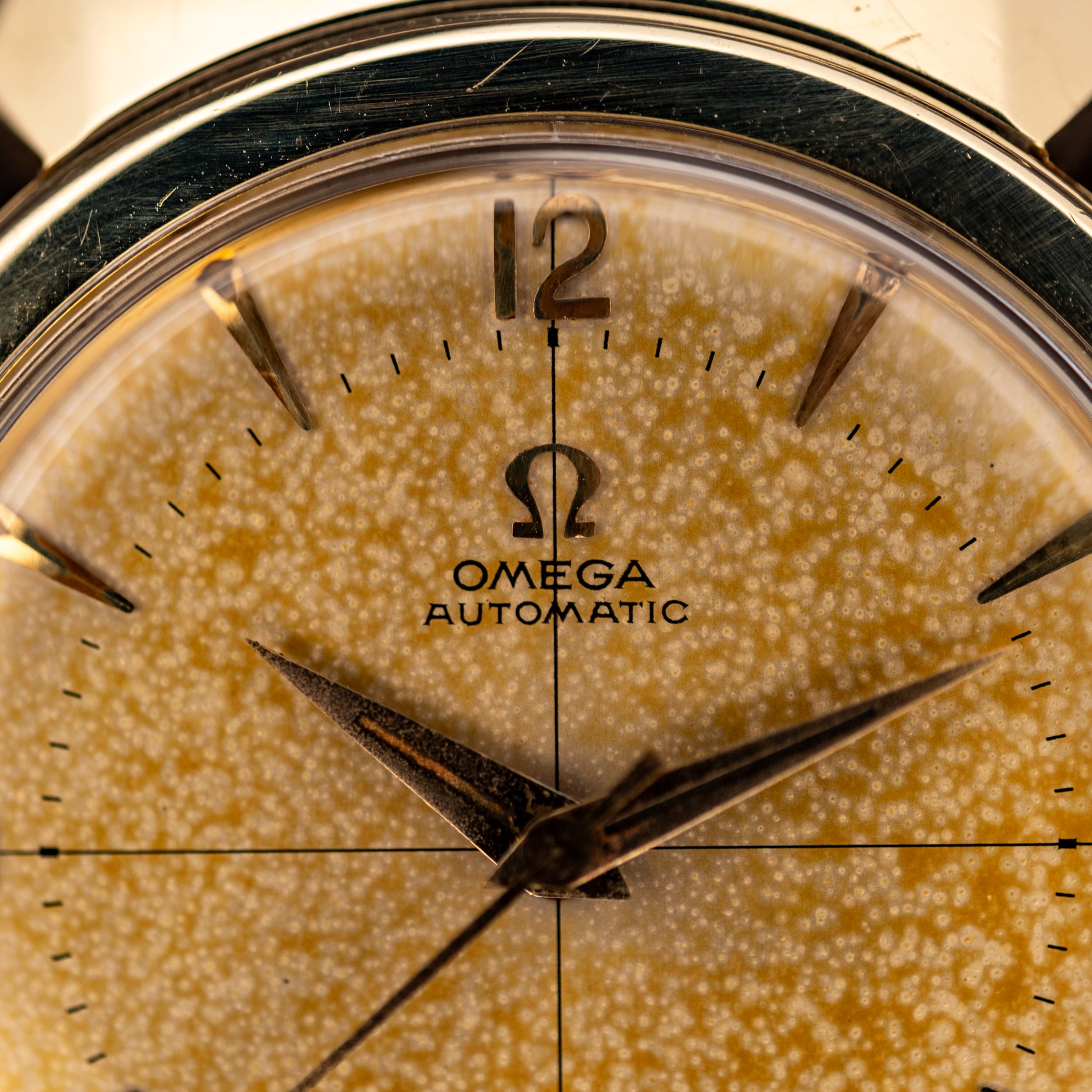
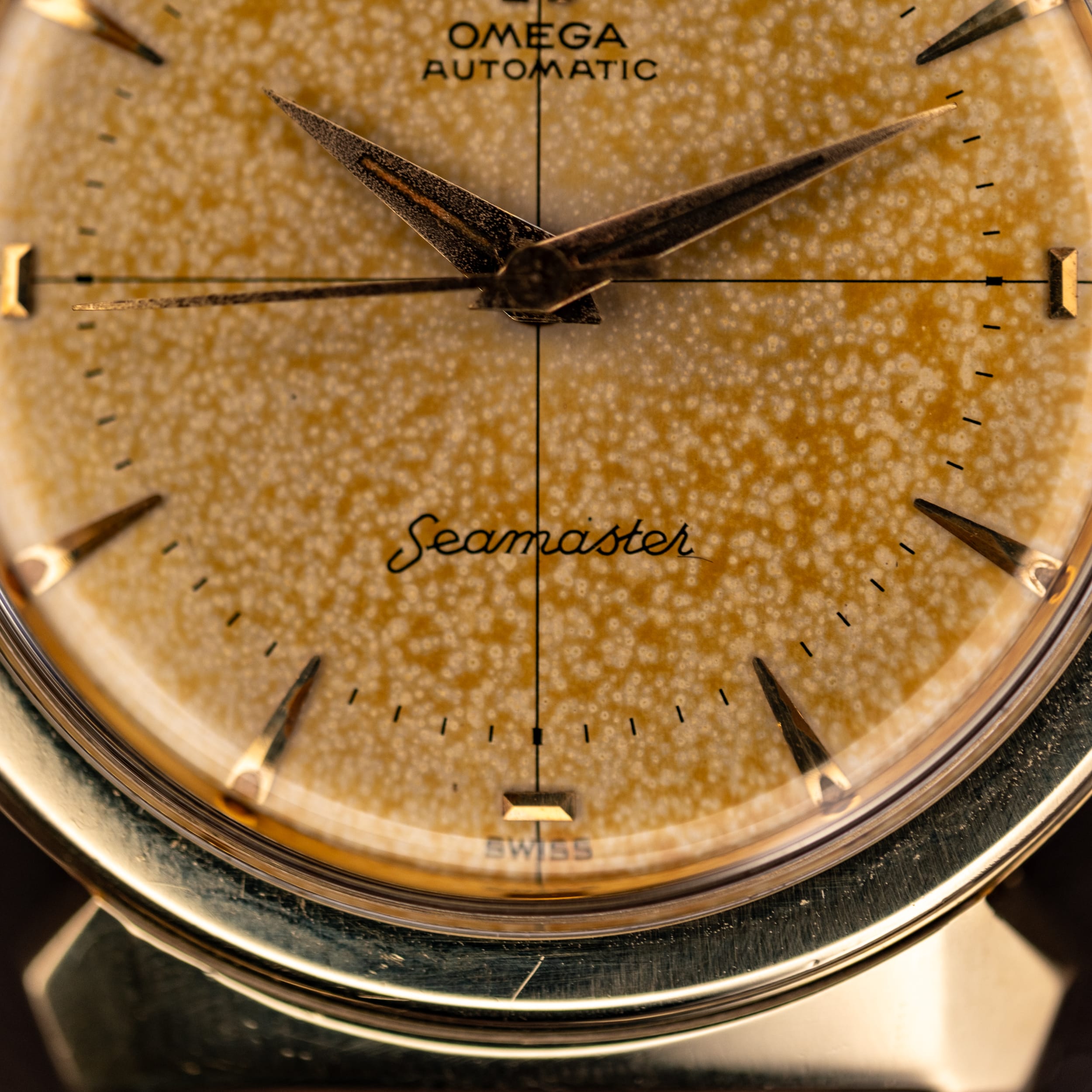
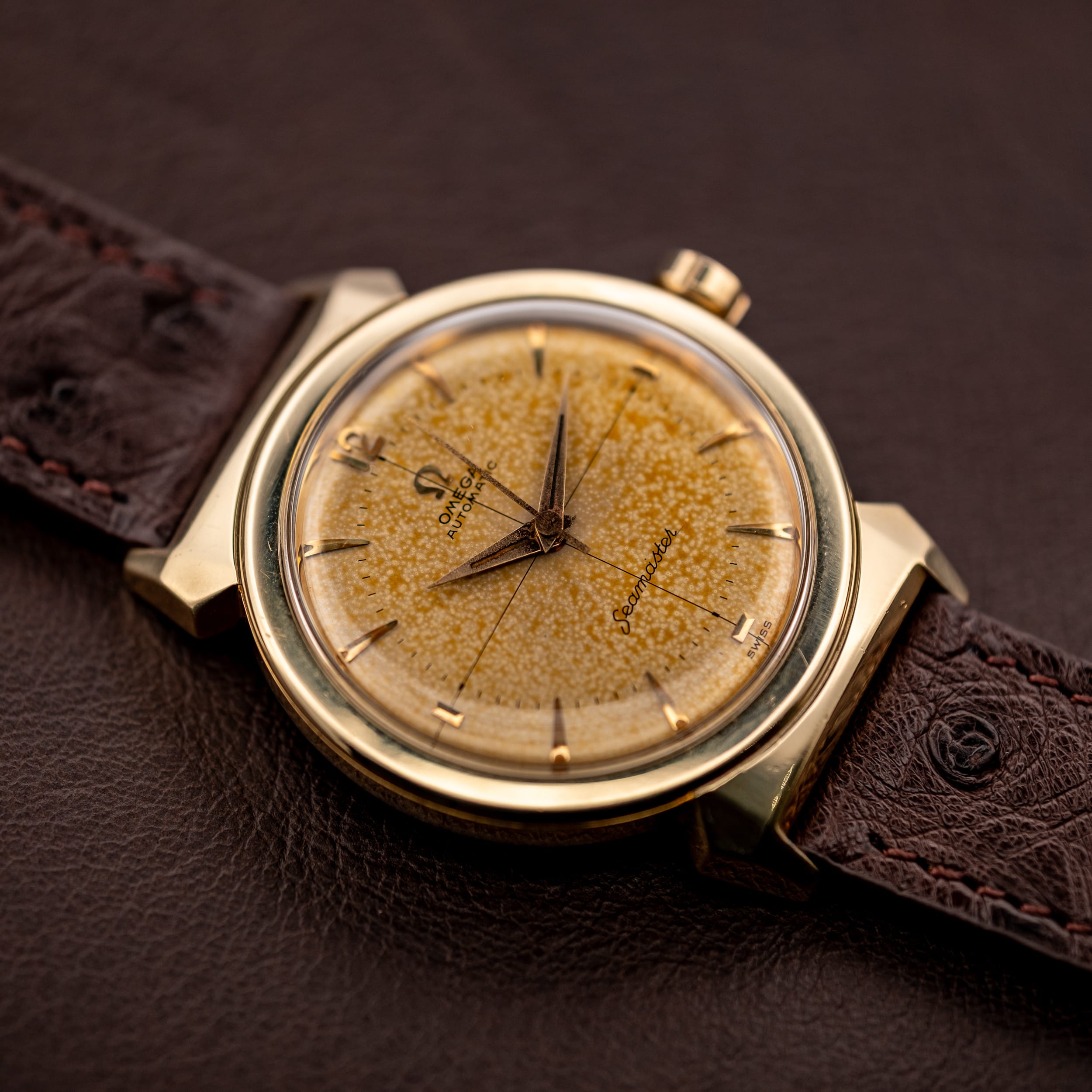
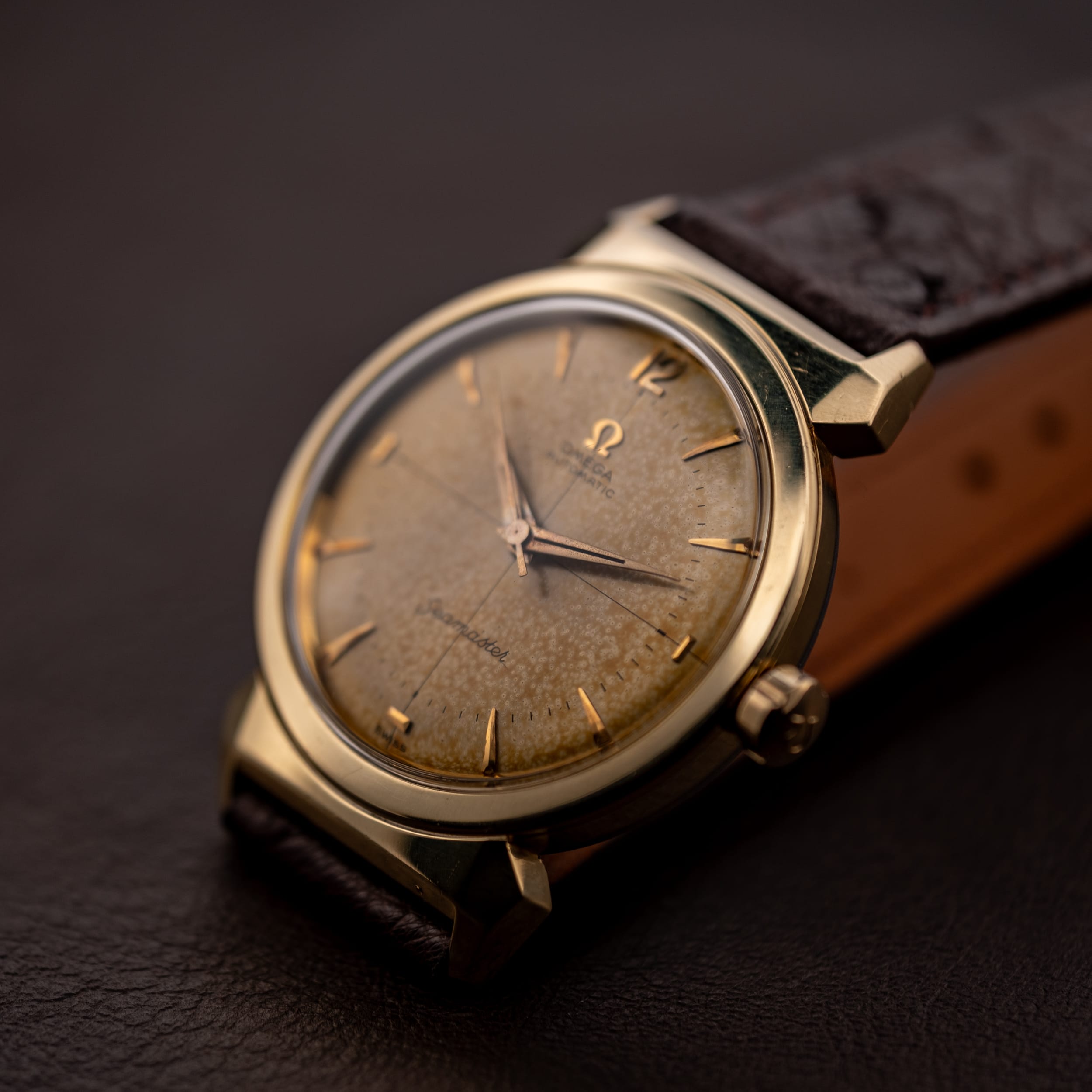
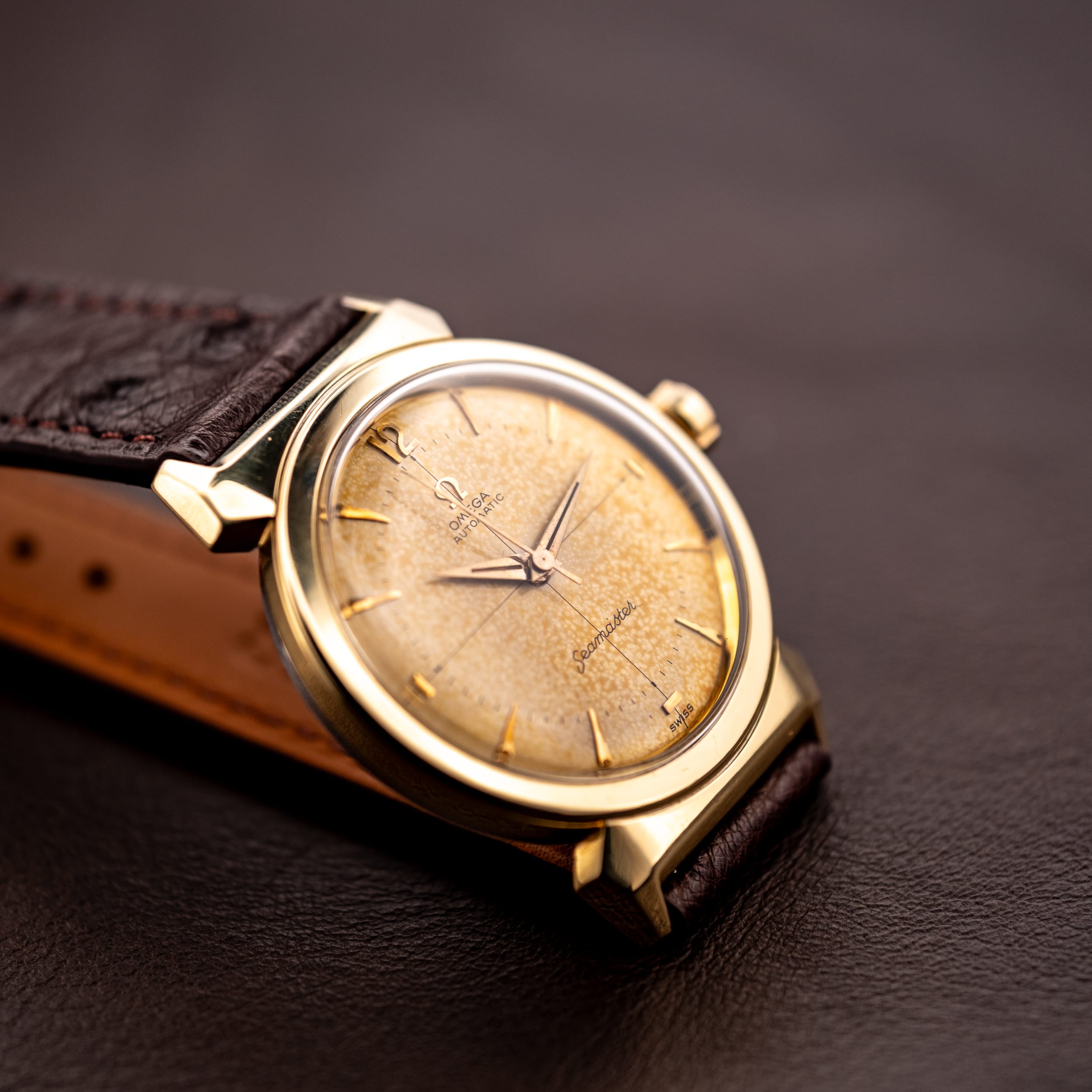
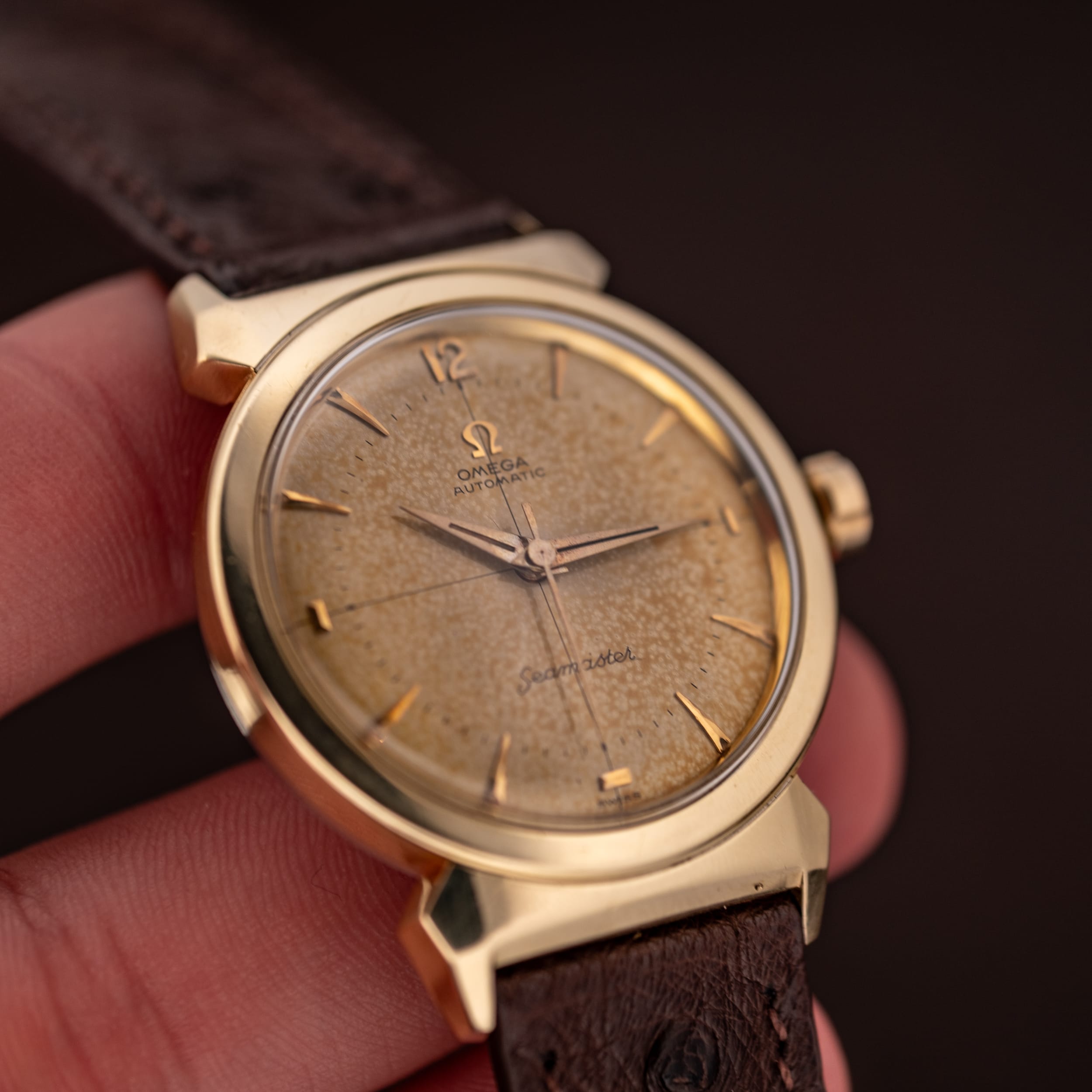
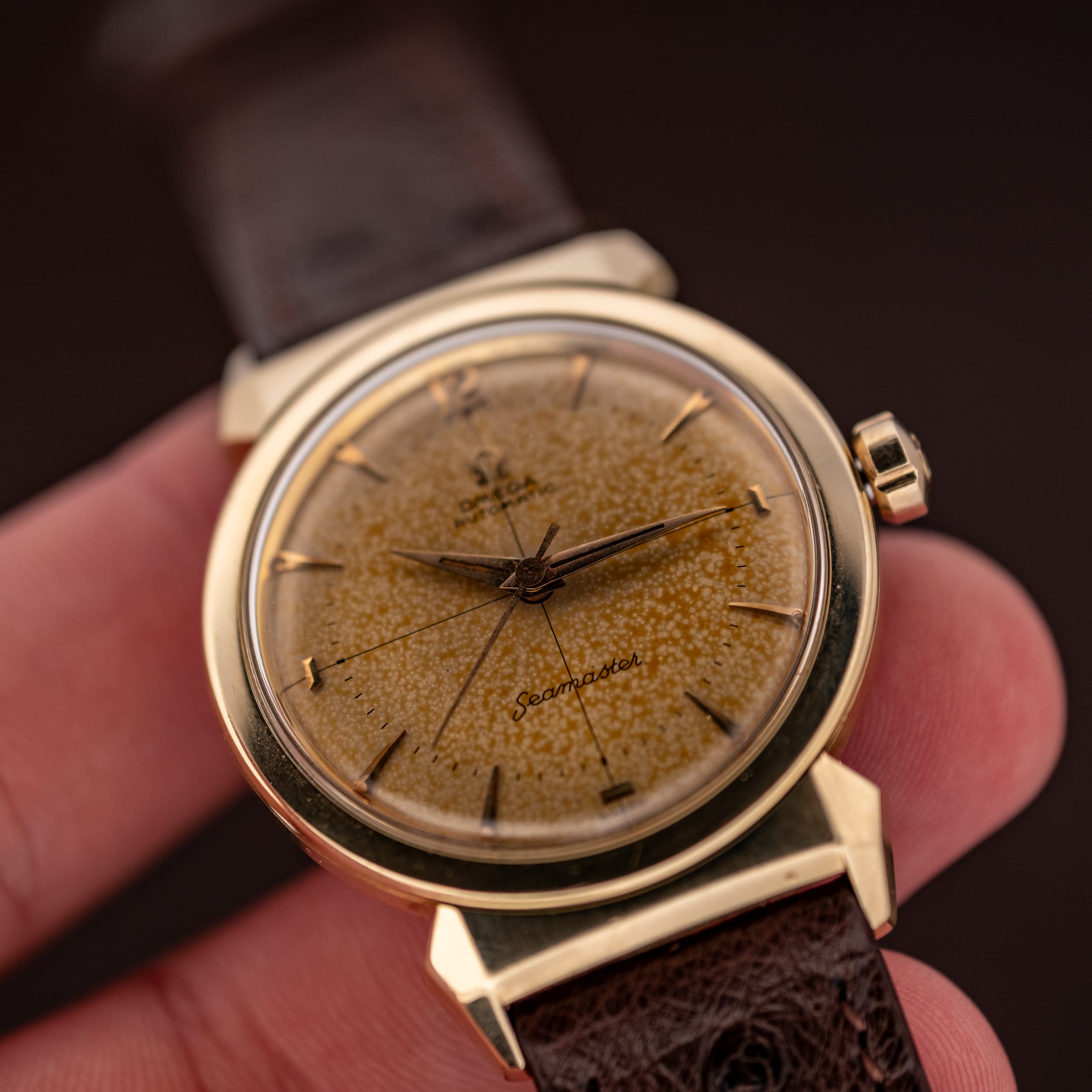
The tropical dial is what people see first on this Omega Seamaster 14363-3, and on this example it has aged into a deep chocolate field shot through with cream and honey speckles drifting across the surface like a slow exposure of a star field. The crosshair pattern is fully intact across the center, the applied gold dauphine markers ring every hour position, and the cursive Seamaster script sits exactly where Omega printed it in the late 1950s. To us, this is what a late-1950s gold-capped Seamaster looks like when sixty-plus years of chemistry are allowed to do their own work, and in our opinion the dial is the entire reason you buy this reference.
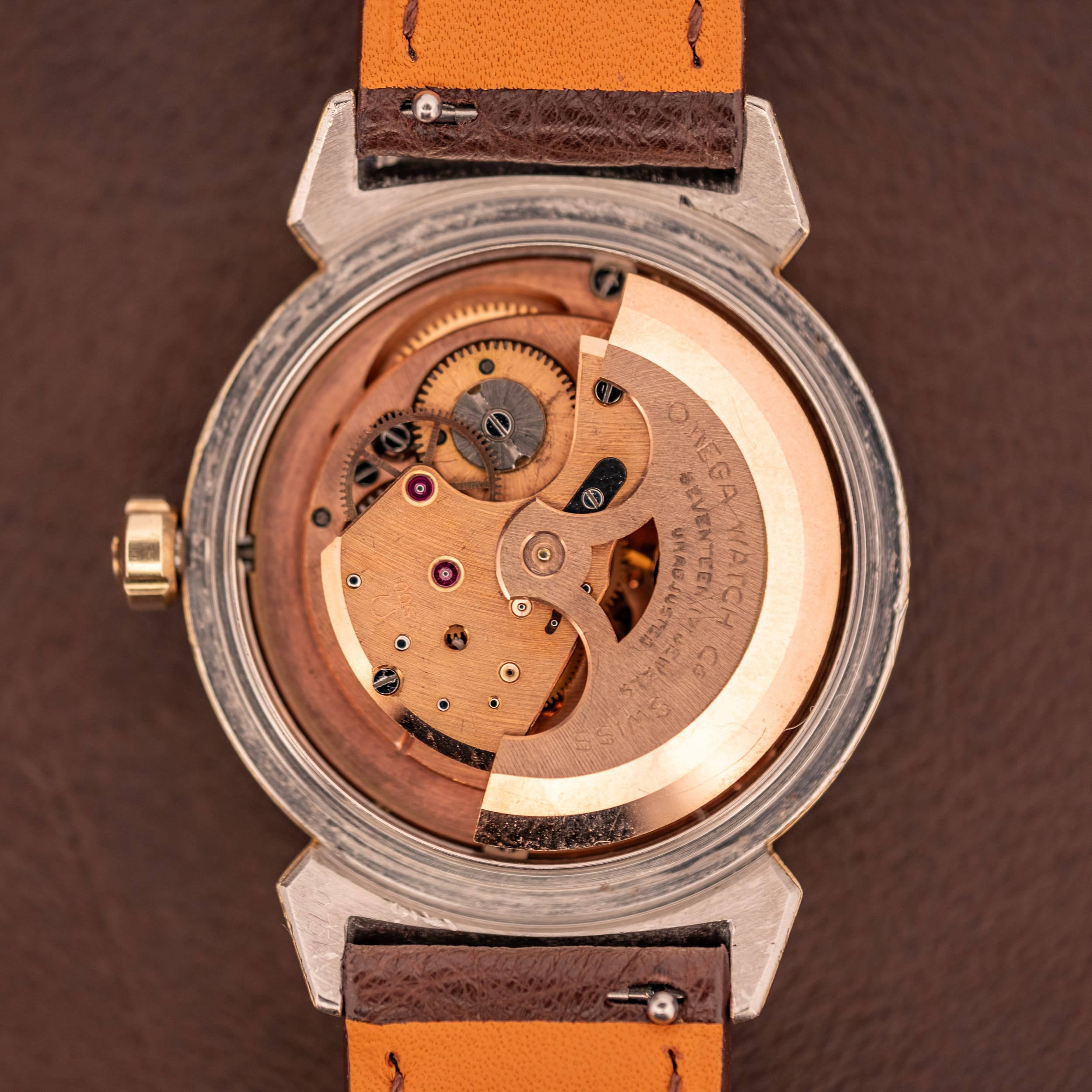
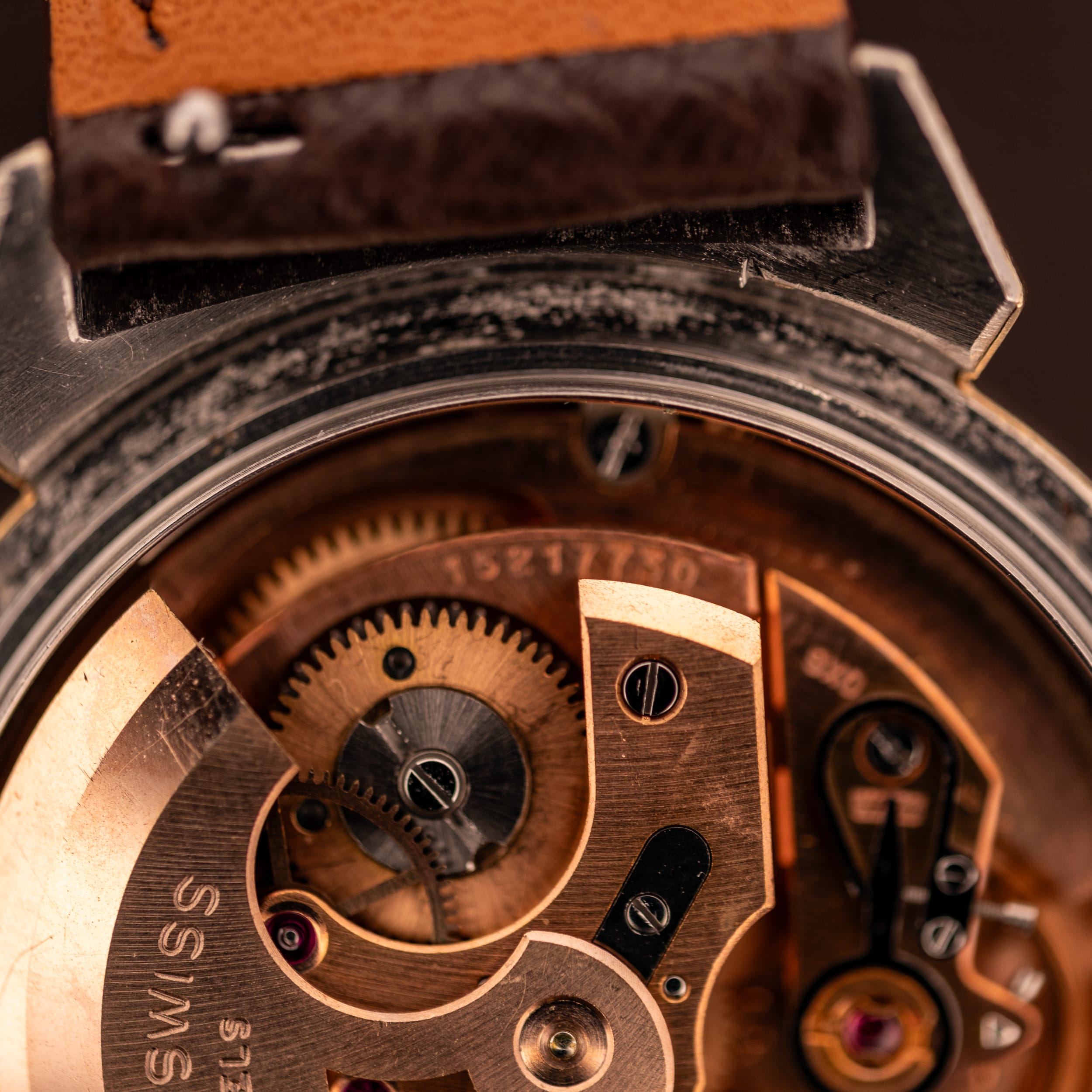
The caliber 500, introduced in 1957, was Omega’s first true full-rotor automatic with central seconds, replacing the long line of bumper-driven automatics that had dominated the brand’s catalog since the early 1940s. Where the bumpers used a swinging mass to wind the mainspring with a characteristic side-to-side knock against spring buffers, the 500 used the now-standard rotor that pivots a full 360 degrees on a central axle, beating at 19,800 vibrations per hour across seventeen jewels. Copper-toned bridges, an Omega-signed rotor, and the architectural template that every Omega automatic of the 1960s would inherit, including the chronometer-rated 5XX family that powered the Constellations. The movement visible in our service photographs shows the copper finishing across the bridges and the original Omega-signed rotor, with the visible serial dating production firmly to 1958. To us, the caliber 500 is the movement that quietly bridged Omega’s prewar identity and its postwar chronometer ambition.
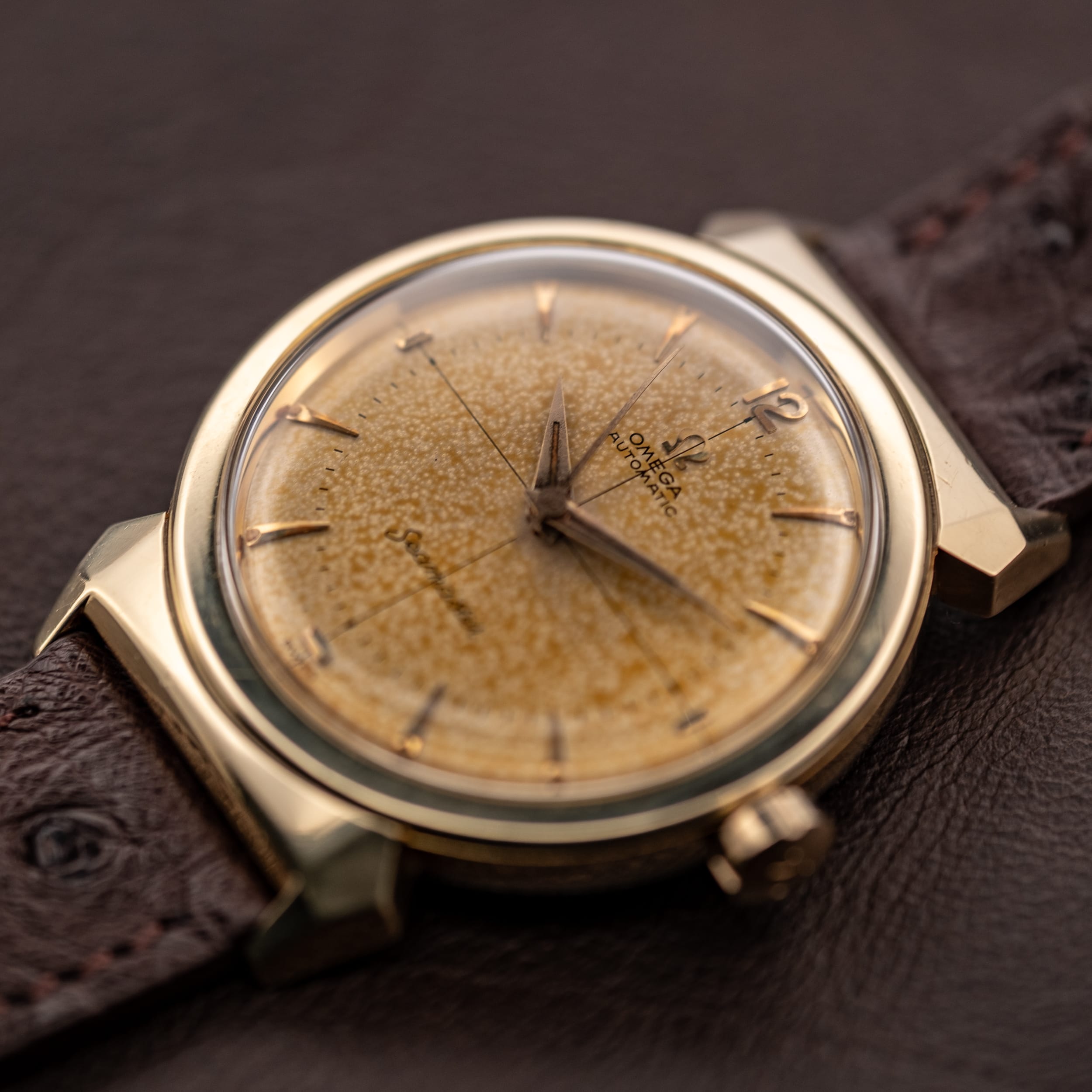
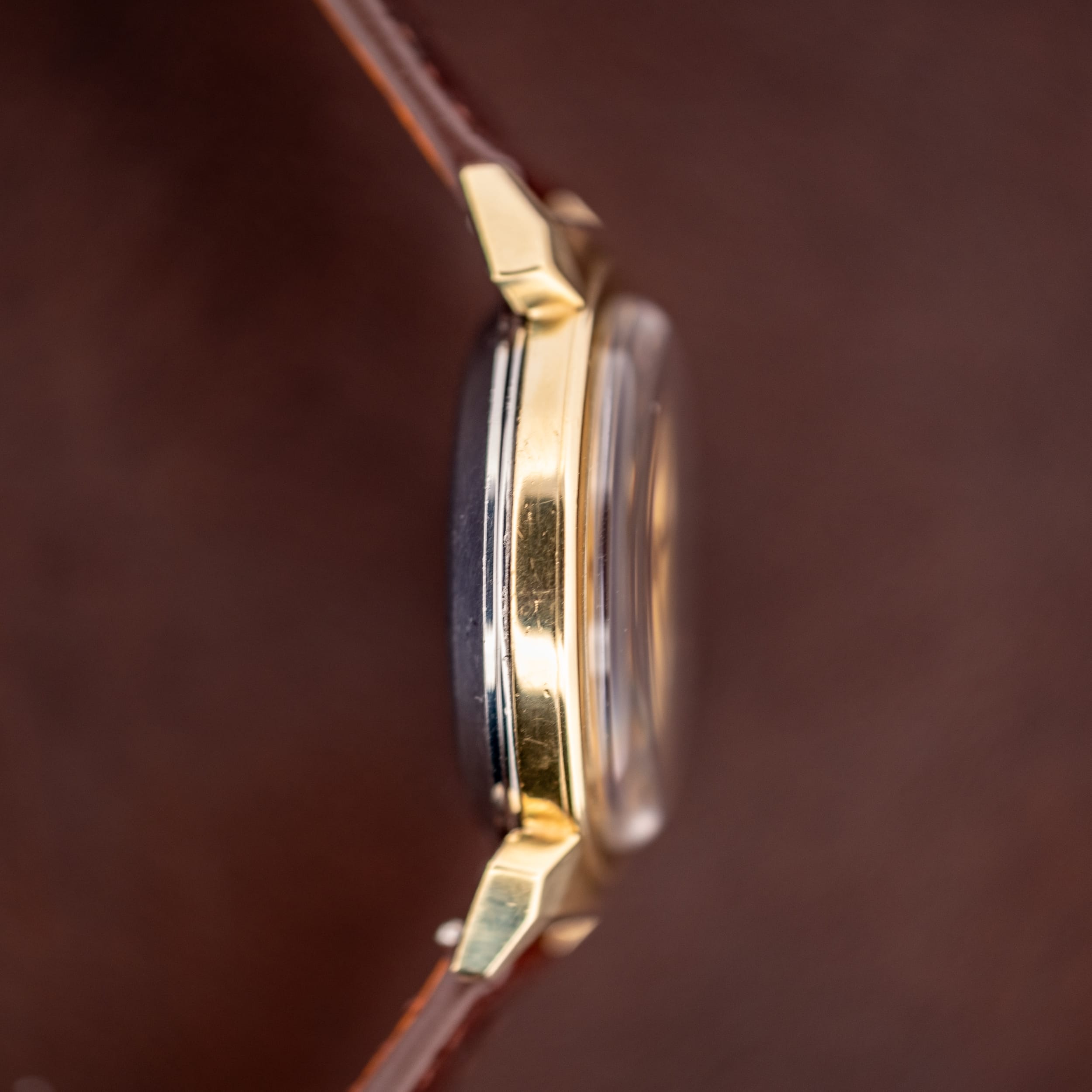
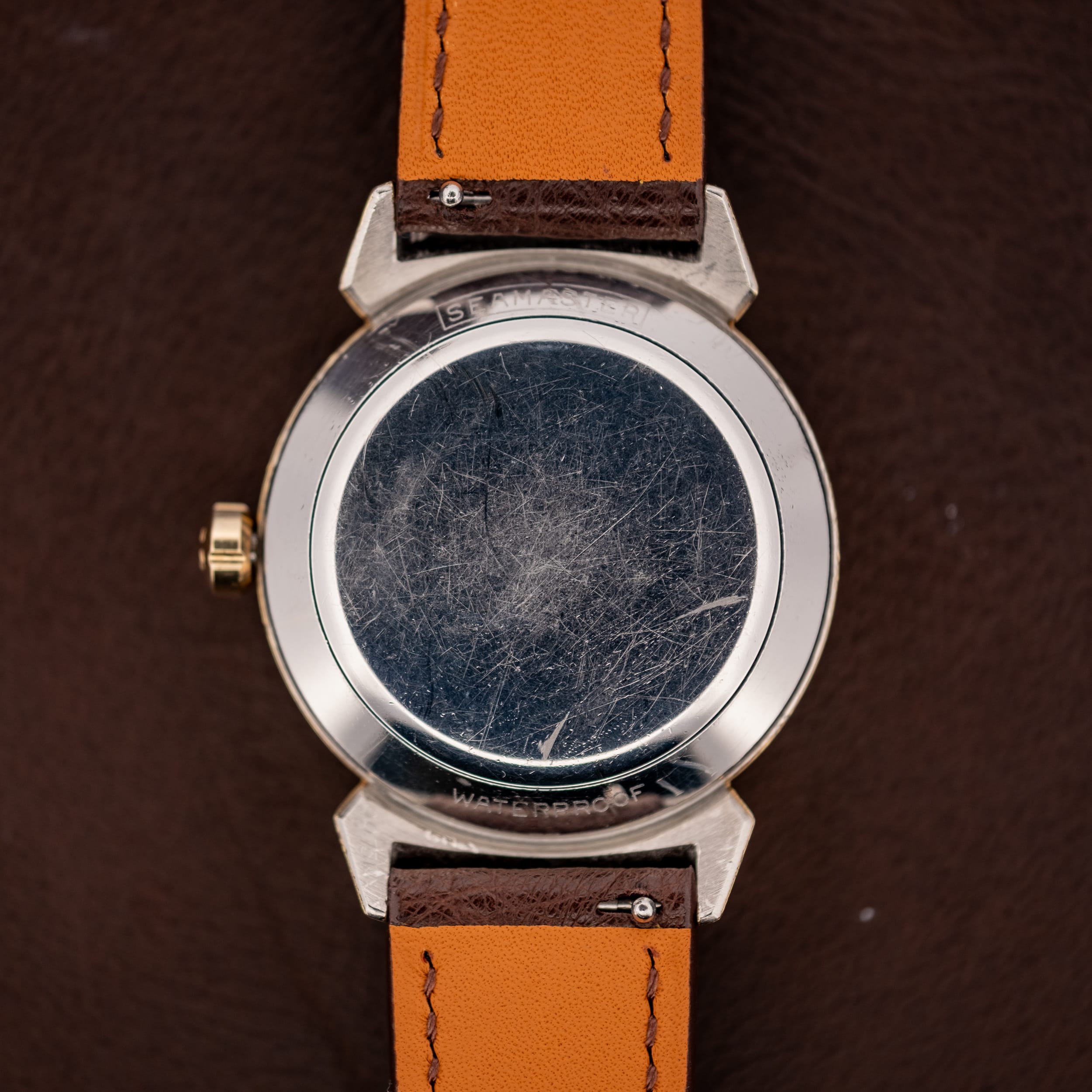
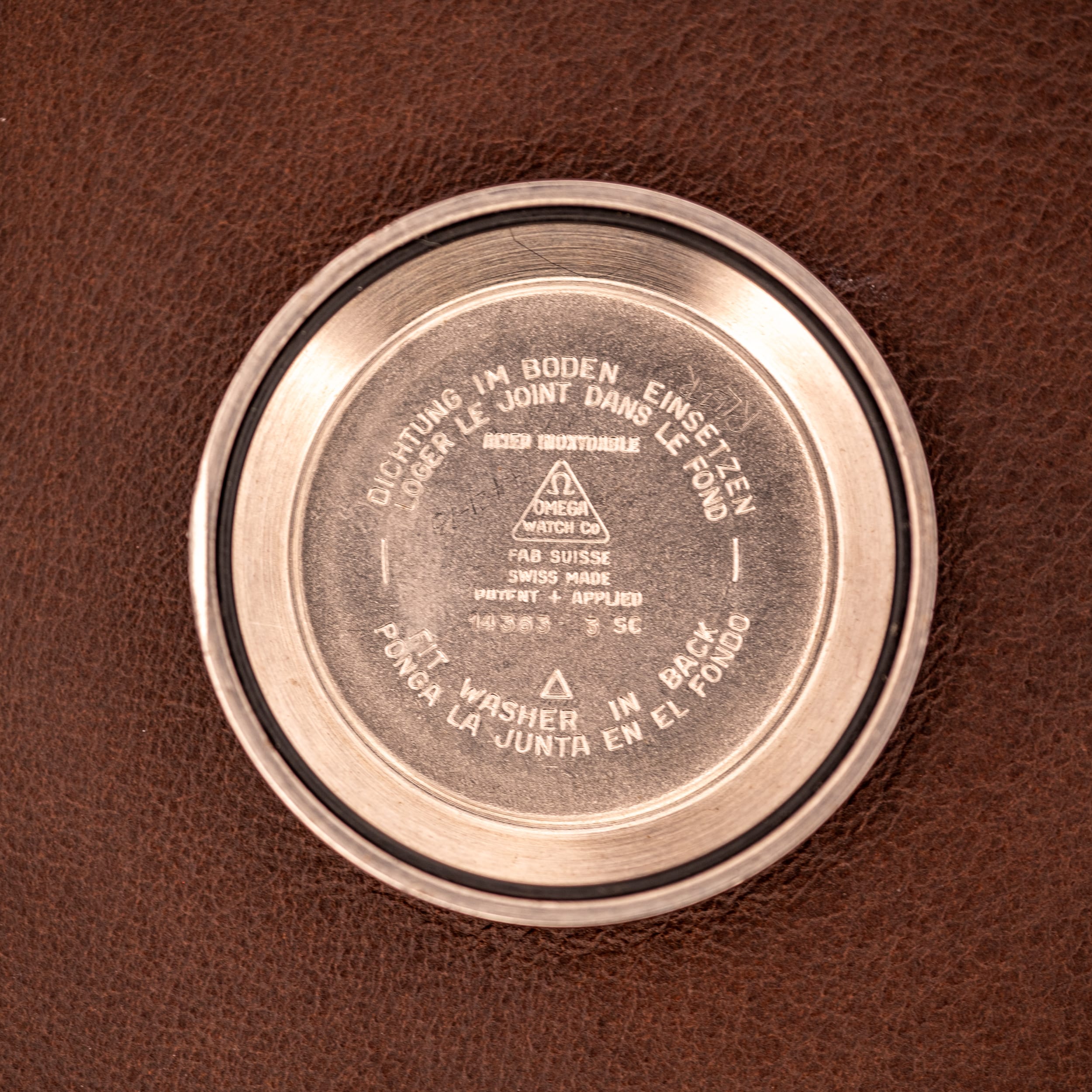
The case is the configuration vintage collectors spend the most time learning to read. The top half, bezel and lugs and upper case band, is solid 14k yellow gold applied as a substantial cap over the stainless steel core. The lower case band and screw-down back are stainless steel, exactly what you see when the watch is on the wrist viewed from below. This is a true gold-capped construction, not gold-filled and not gold-plated, and it wears with a depth and warmth that thinner gold platings simply cannot match. The faceted scarab lug shape, with its sharply cut upper surfaces transitioning into a wide polished bezel, is one of the most distinct case designs of the late-1950s Omega catalog. The case measures 34.5mm across with a 43.5mm lug-to-lug span and an 18mm lug width, the exact dimensions a vintage collector wants on the wrist today. Honest hairlines across the gold cap and gentle scratching on the steel caseback record a watch that has been worn rather than locked away. The screw-down back carries OMEGA WATCH CO around the perimeter and the WATERPROOF specification along the lower edge. Open the back and the inner caseback is stamped 14363 / 3 SC alongside the Omega Watch Co. triangle logo and the multilingual gasket instructions in German, French, English, and Spanish, with PATENT APPLIED FOR confirming the case construction generation exactly as it should.
The Omega Seamaster tropical dial is where this watch turns into a piece of accidental art. The factory original silver canvas has aged across six decades into one of the most dramatic tropical patinas we have ever handled, a deep chocolate field that has developed a spider-pattern texture of cream and honey speckles scattered evenly across the entire surface. The factory finish has gone its own way over six decades and the dial has settled into a chocolate-and-cream field the factory could not have engineered itself, even if it had wanted to. This is the original factory dial, untouched and unrestored, with every period feature reading clearly through the surface. Applied gold dauphine markers ring the dial at every hour position, with a single applied gold “12” numeral standing at the top. The applied Omega logo sits above the printed OMEGA AUTOMATIC text and the cursive Seamaster script along the lower half. The crosshair pattern, the fine horizontal and vertical lines that cross through the dial center and divide the surface into four quadrants, is fully intact and remains one of the most desirable design features of late-1950s Omega dials. The dauphine hands have darkened to a warm brown that matches the dial perfectly, an exact original-handset match that you simply cannot fake. Refinished dials kill the value of any vintage Omega, and the factory dial is the single most important originality factor on any reference this old. This dial is exactly the kind of survivor that makes the 14363 reference worth chasing.
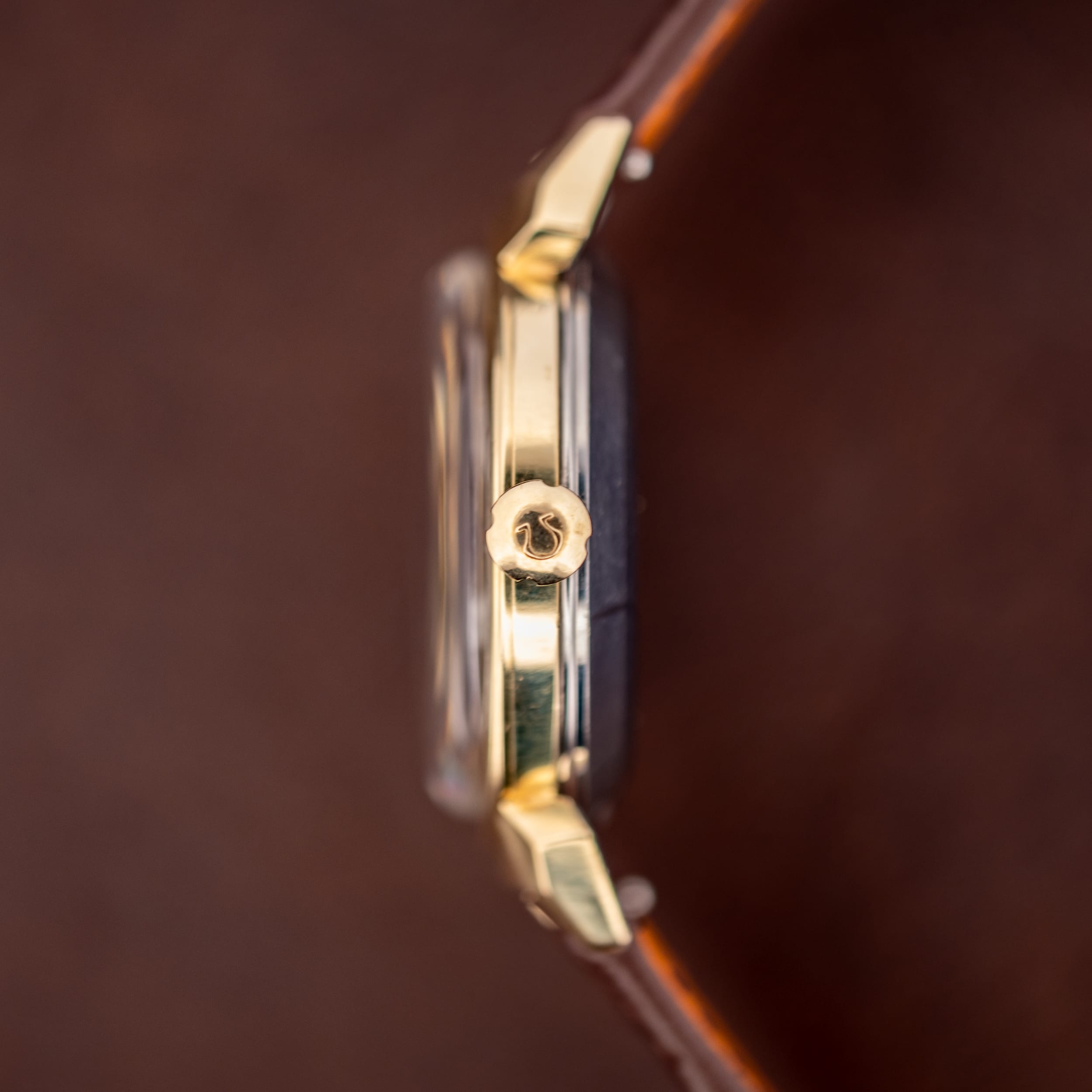
The crown is the original Omega-signed component with the period-correct logo intact and operates with the positive engagement a properly maintained caliber 500 should give. The acrylic crystal sits clear and proud above the dial with the gentle doming that helps the tropical color play across its surface in light.
We have paired the watch with one of our chocolate brown ostrich leather straps and an OTTUHR signed buckle. The strap material picks up the chocolate field of the dial without competing with the gold case, and the ostrich grain gives the package a slightly formal weight that suits the late-1950s dress Seamaster character perfectly.
Serviced in-house at OTTUHR and backed by our 2-year mechanical warranty, this is the kind of late-1950s Omega Seamaster we get genuinely excited about. Factory original dial, original crown, intact crosshair, gold-capped case in honest unrestored condition, and the caliber 500 that started the modern Omega automatic story. For the collector who values originality over polish, who reads patinated dials as character rather than damage, and who wants a piece of late-1950s Swiss watchmaking with a real story attached, this is exactly the kind of watch we love bringing in.