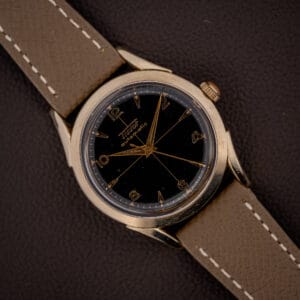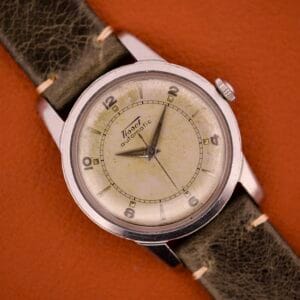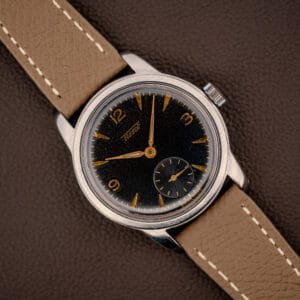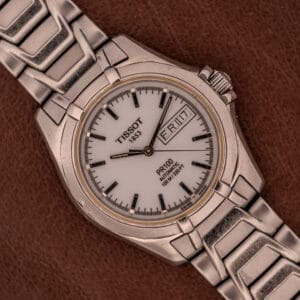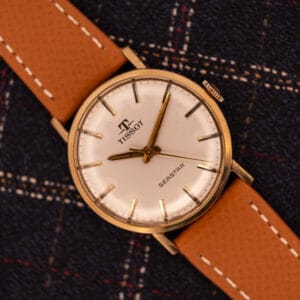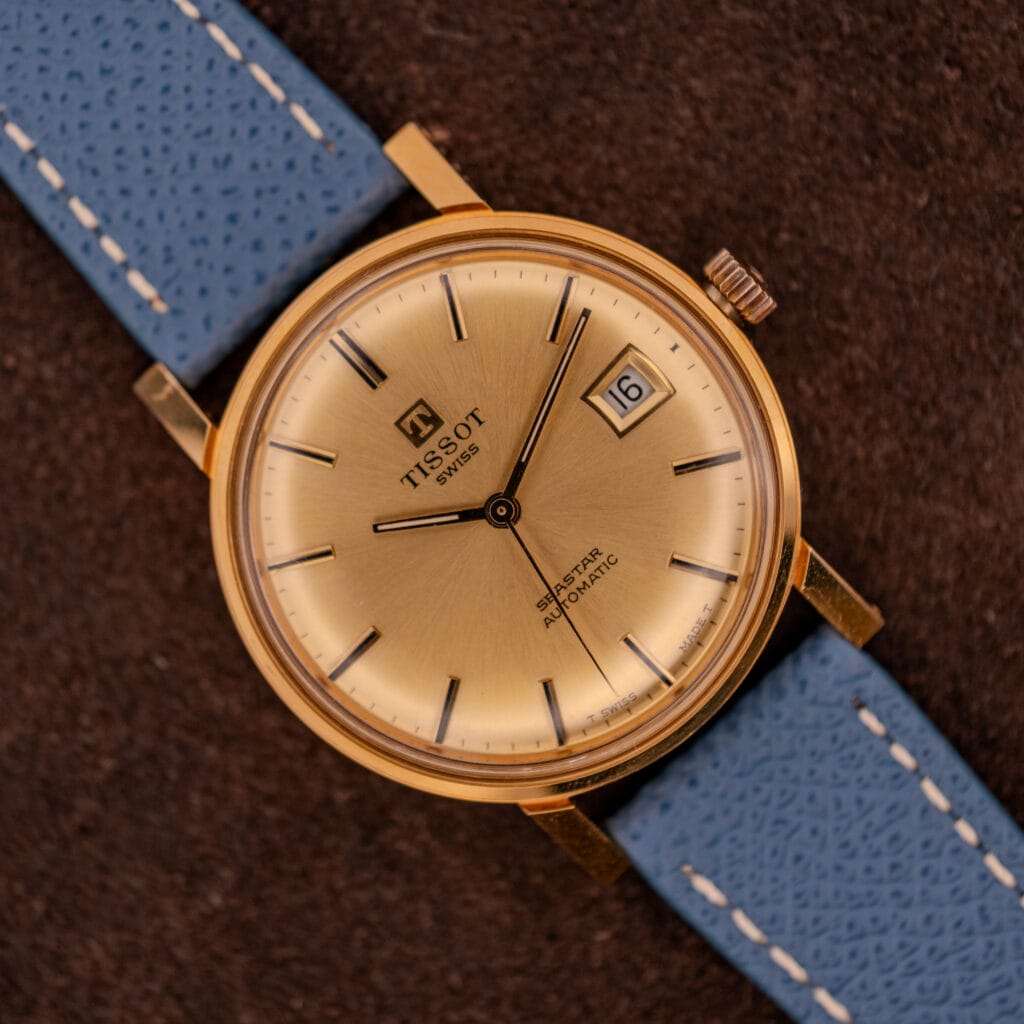
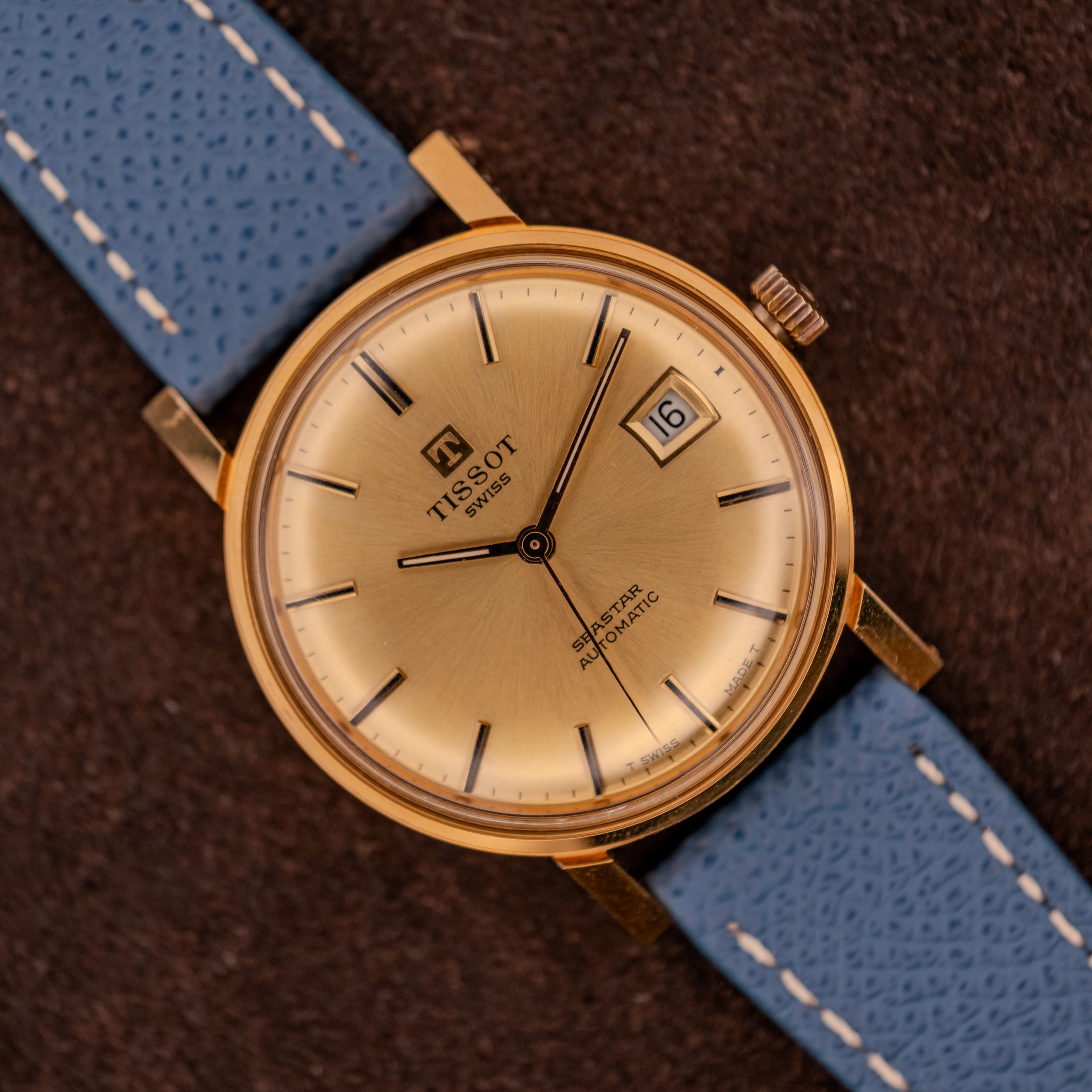
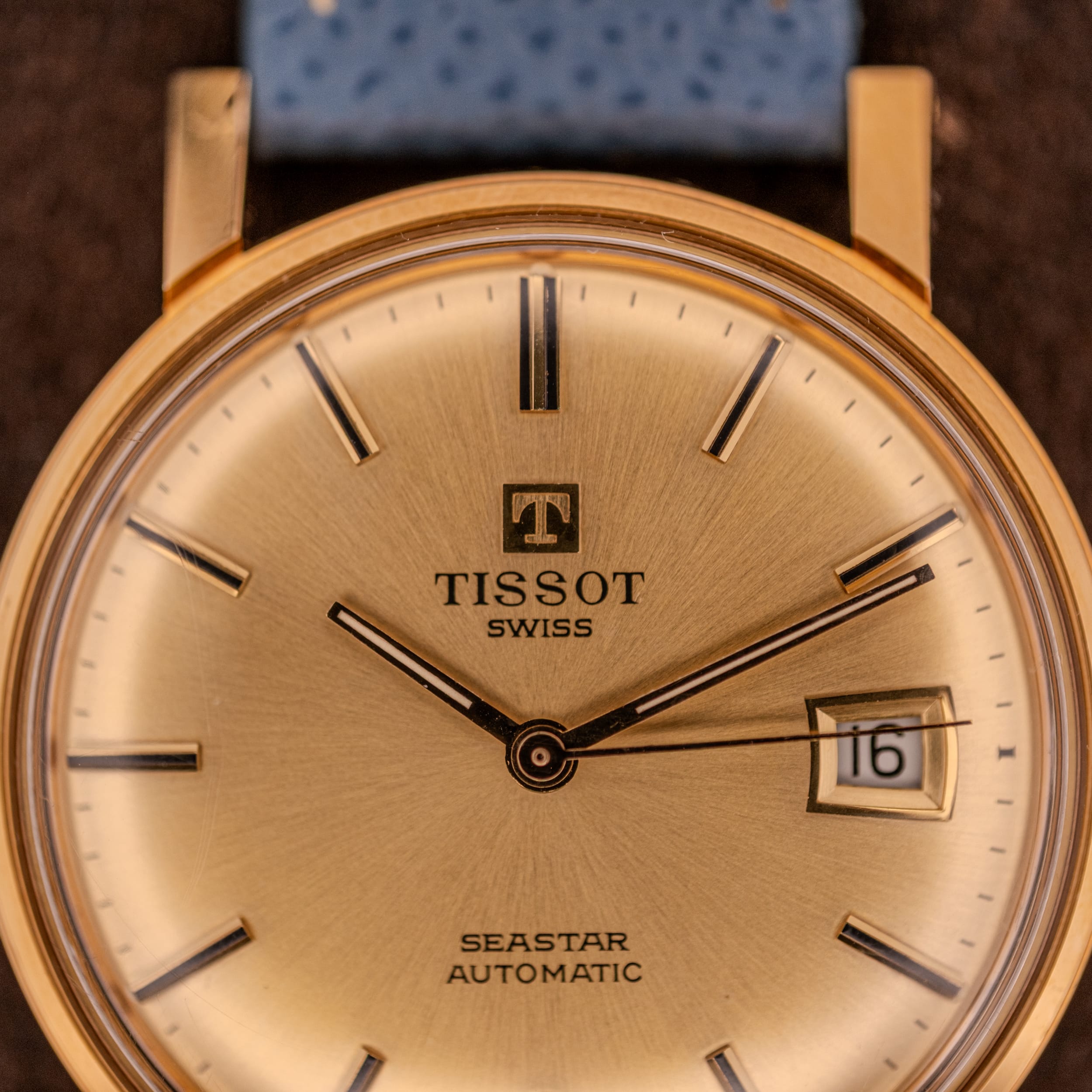
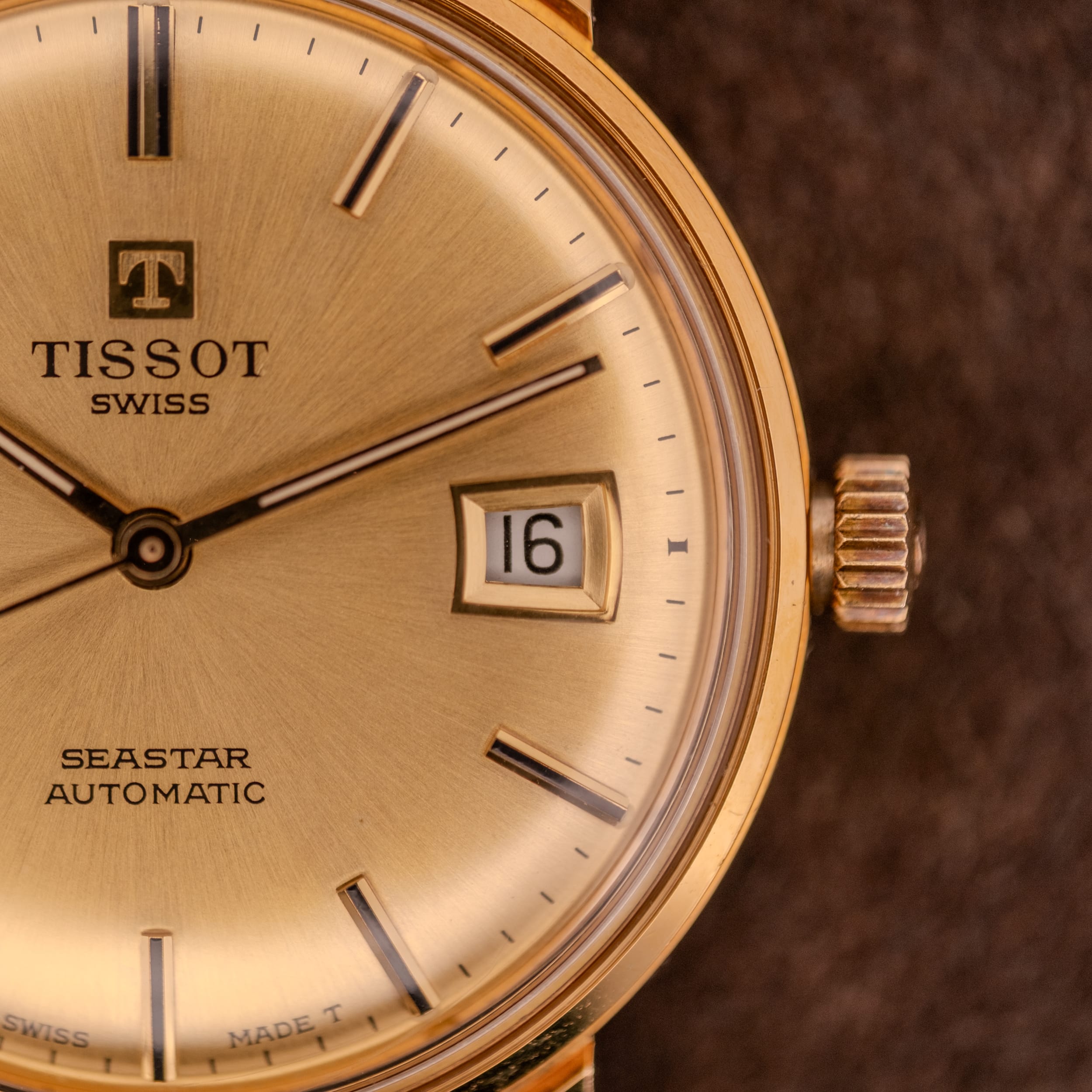
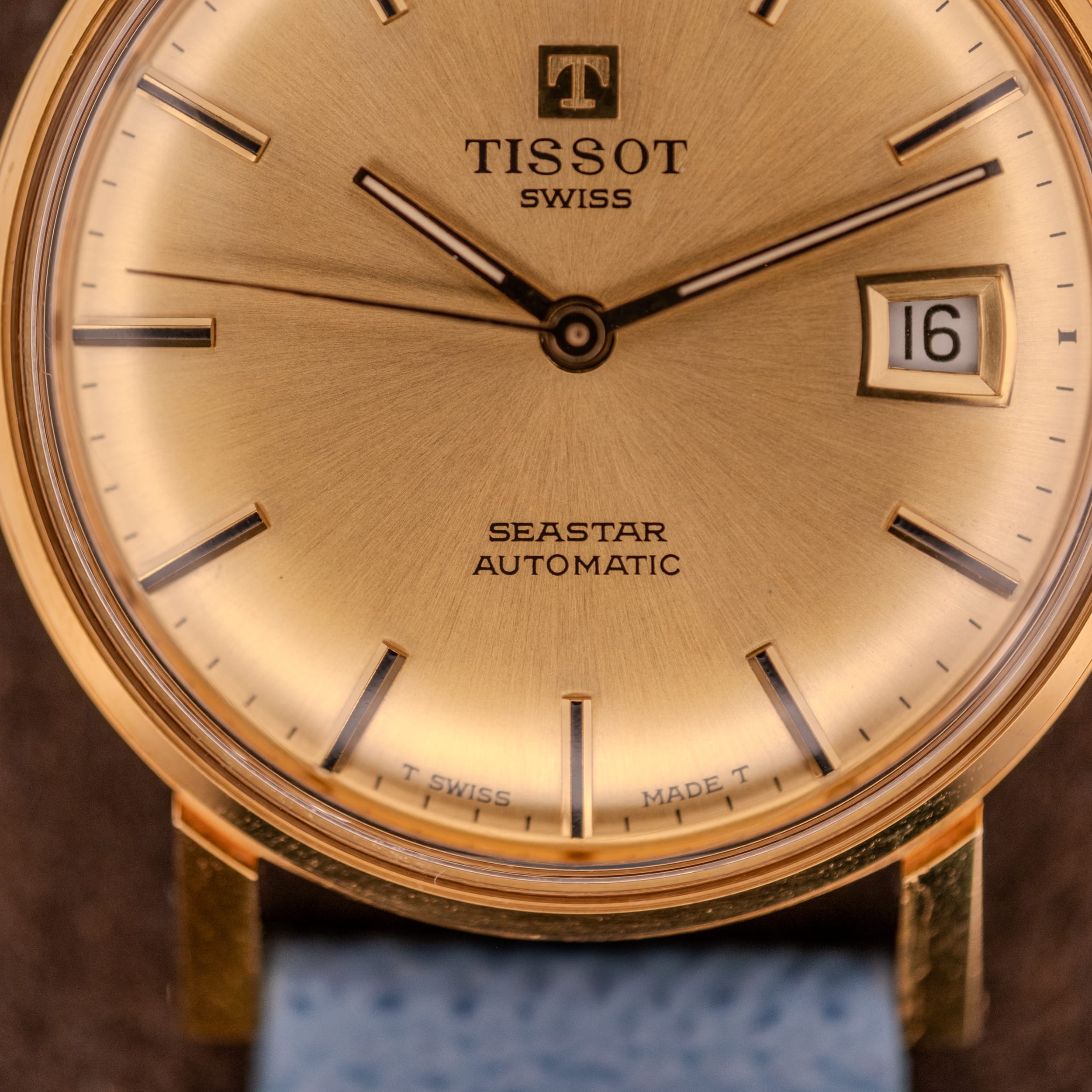
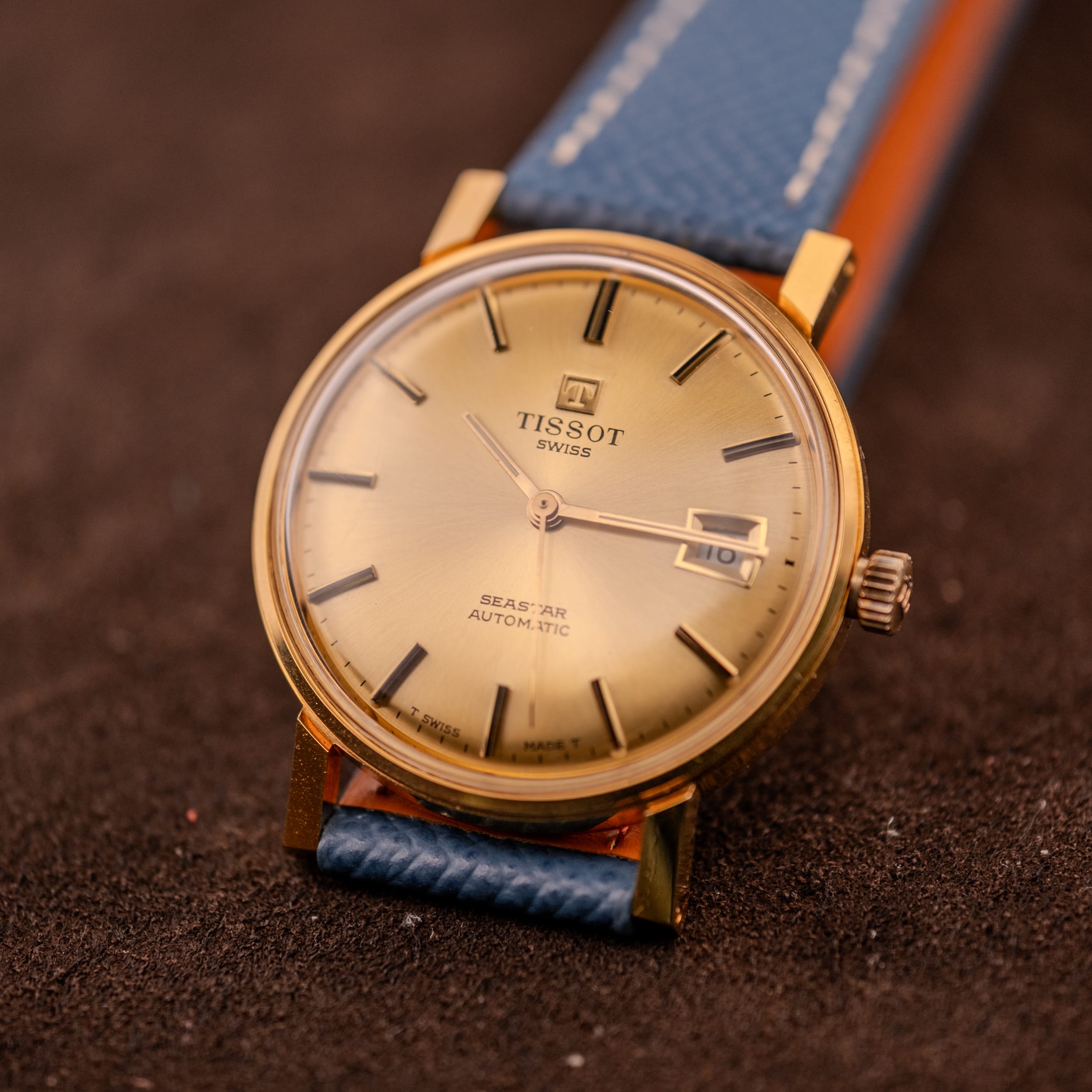
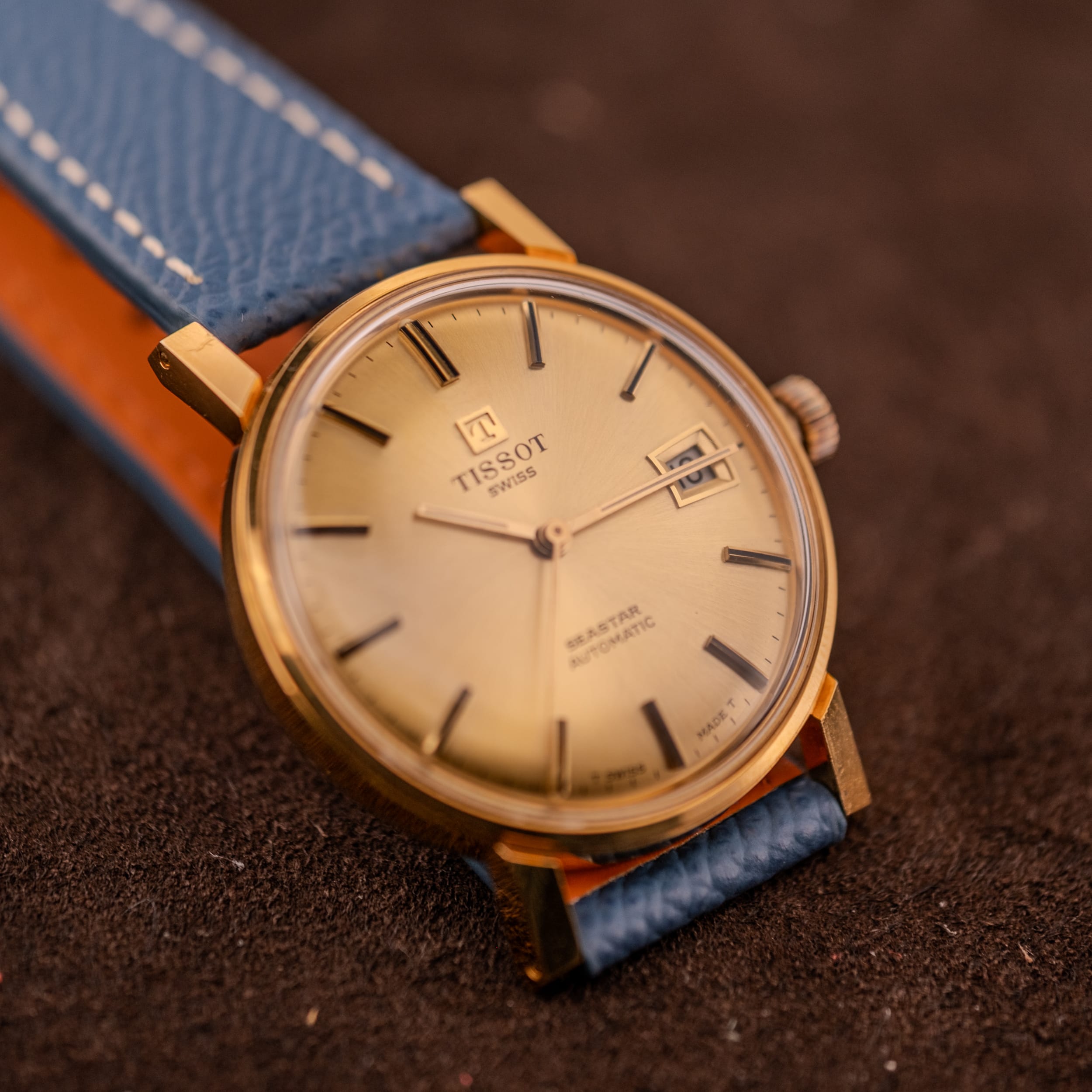
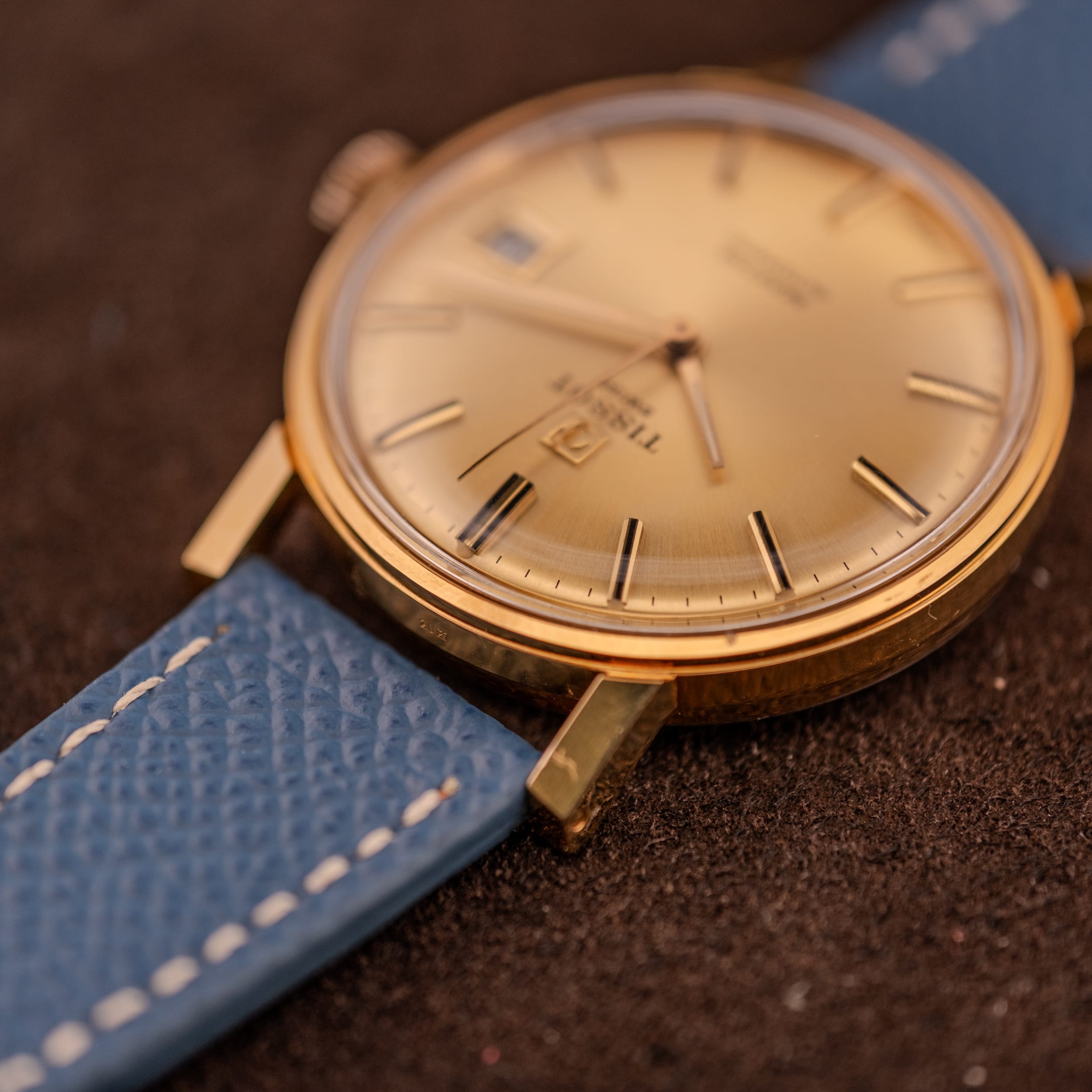
Watch a champagne dial like this one for thirty seconds in good window light, and you see what the sunburst pattern is actually engineered to do, which is to turn the dial into a slow color wheel that walks between honey, butter, neutral straw, and back again as your wrist rolls through the room. In our opinion, this is the kind of dial that gets undersold in photographs and oversold in person, and that asymmetry is exactly why we like leading our Tissot Seastar Automatic listings with the dial itself rather than with the badge above it.
Tissot was founded in 1853 in Le Locle by Charles-Félicien Tissot and his son Charles-Émile, which makes the brand one of the oldest continuously operating Swiss watchmakers, with a back catalog that quietly outpaces most of its more famous neighbors. The piece that matters most to context here is the 1930 SSIH merger, when Tissot tied itself to Omega under a single industrial umbrella, Société Suisse pour l’Industrie Horlogère, and for the next fifty-odd years the two houses shared movement architecture, engineering staff, and factory floor space. The Seastar line itself arrived in the late 1950s as Tissot’s everyday water-resistant model, and by the early 1970s, when this reference was built, it had matured into a series of clean, dressy automatics with date complications, finished to a standard that consistently punched above Tissot’s market position.
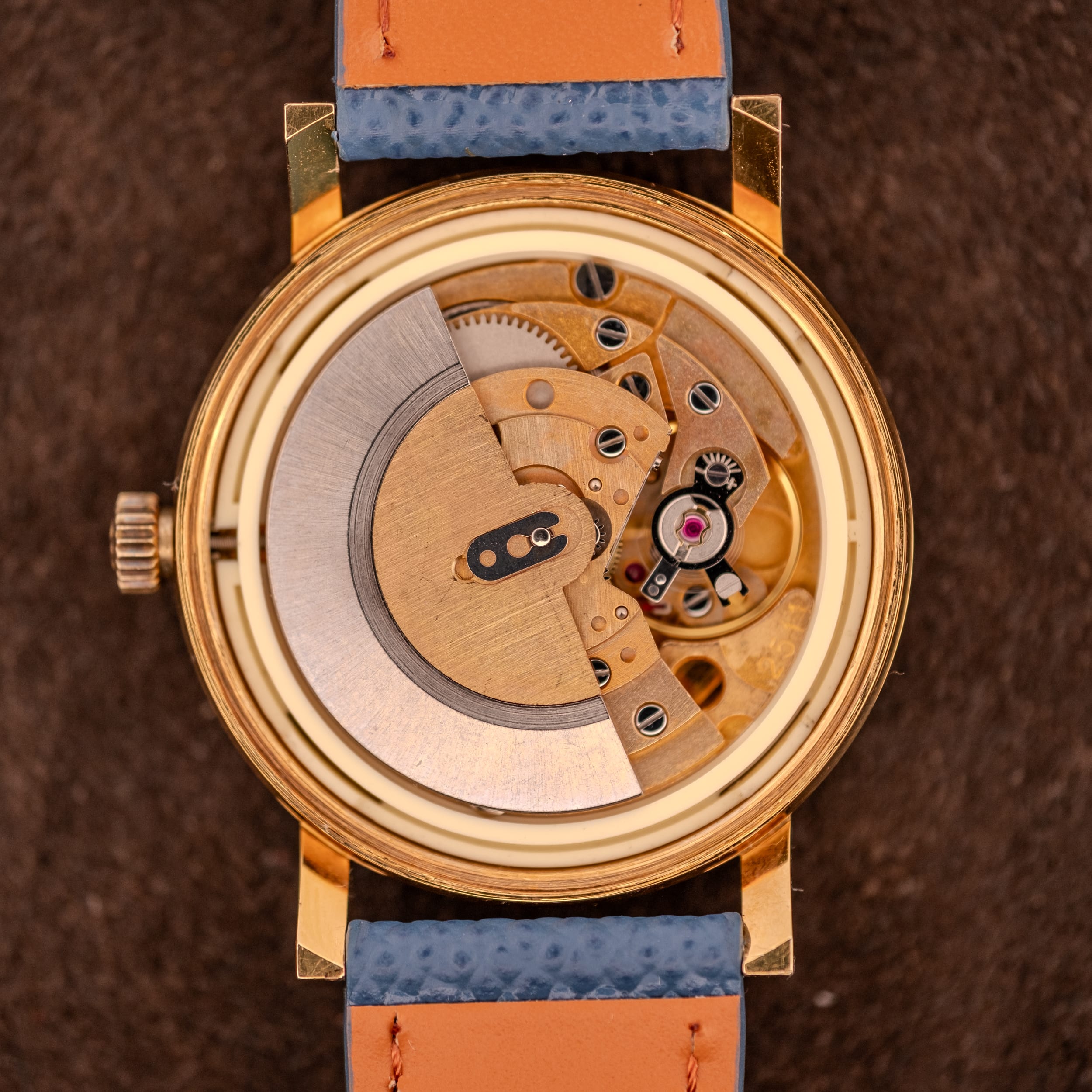
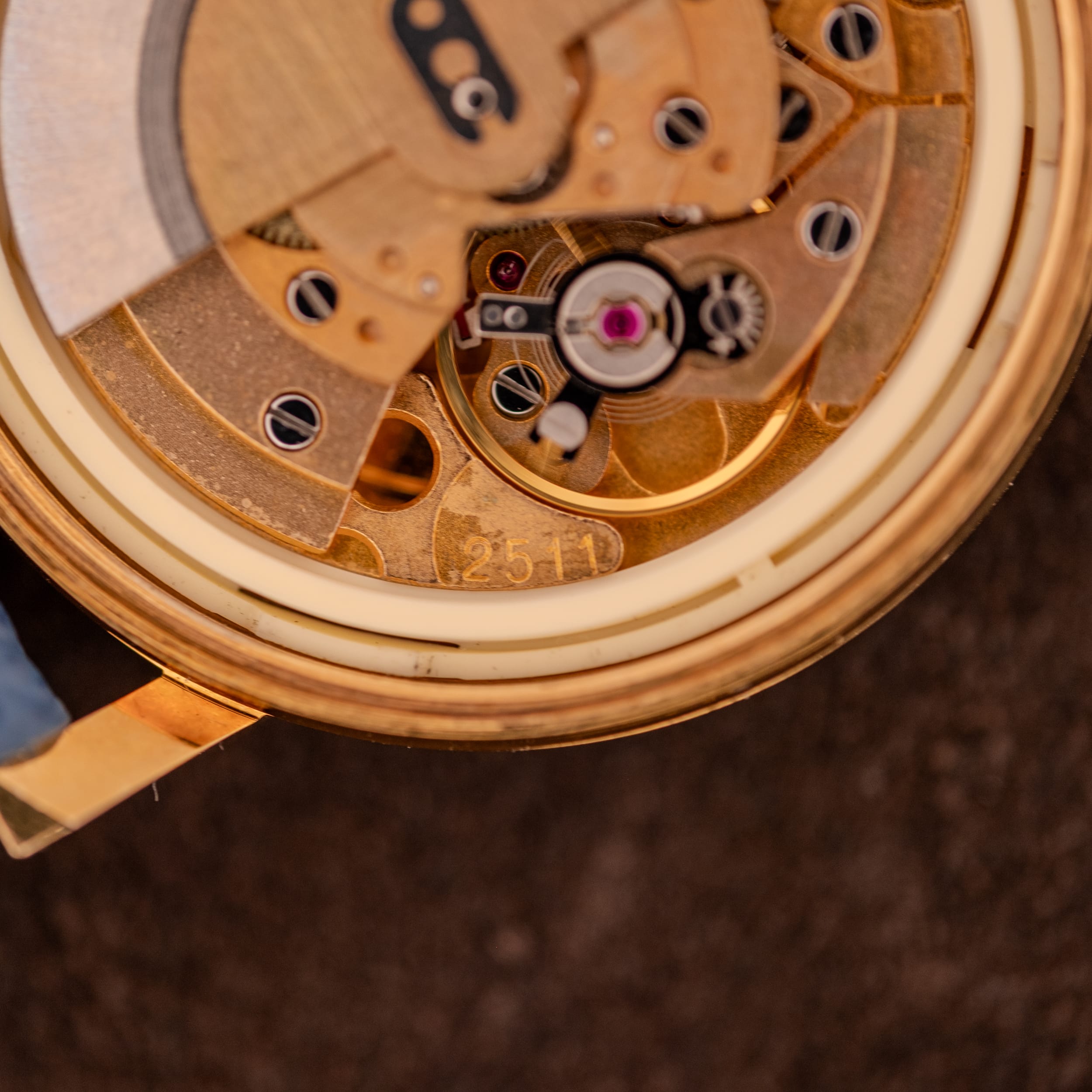
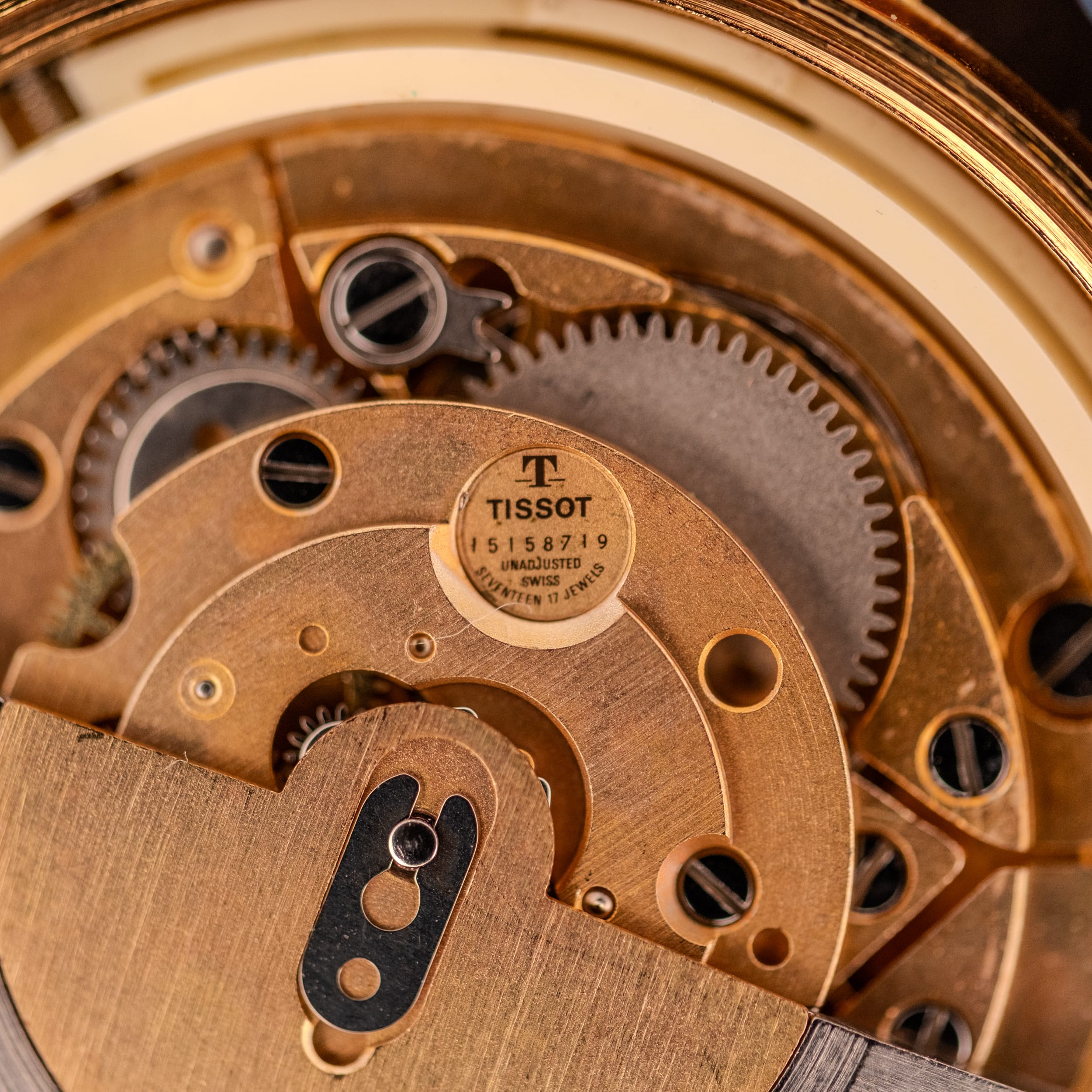
Inside this case sits the Tissot caliber 2511, a 17-jewel automatic with date, running at 21,600 vibrations per hour, with the well-recognized SSIH-era architecture that Tissot shared with its Omega siblings under the partnership. The movement carries serial 15158719, with the bridge stamped TISSOT inside the small Tissot “T” cartouche, then UNADJUSTED, SWISS, SEVENTEEN 17 JEWELS in clean factory text, and the caliber number 2511 engraved cleanly on the plate near the dial side. The bridges and rotor have aged to a warm copper-brass tone that is exactly what you want to see on a properly preserved early-1970s vintage Swiss automatic, with no signs of moisture, oxidation, or amateur intervention. The balance carries its red jewel cleanly, the rotor sits cleanly on its post, and the watch ran true on the wrist during our intake testing.
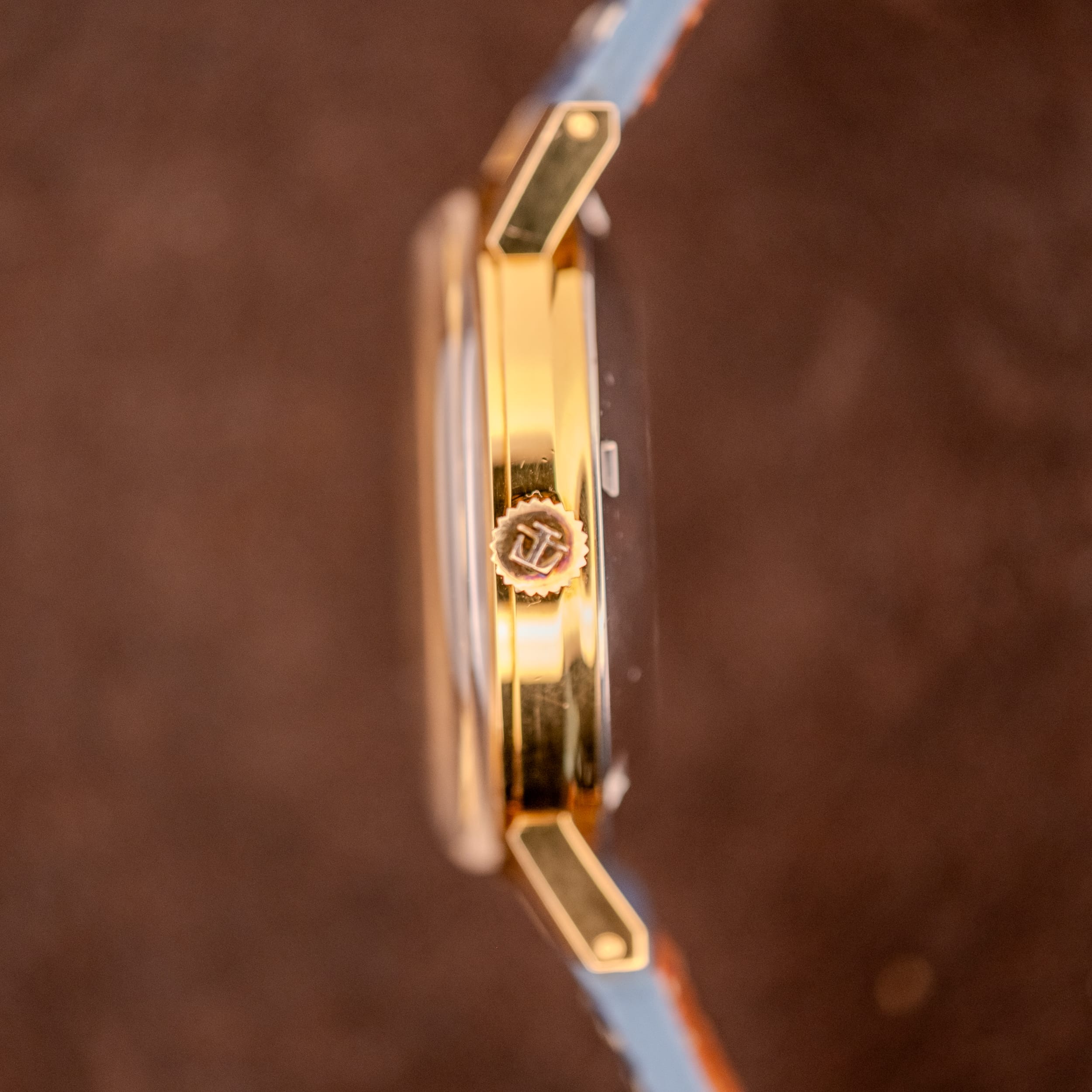
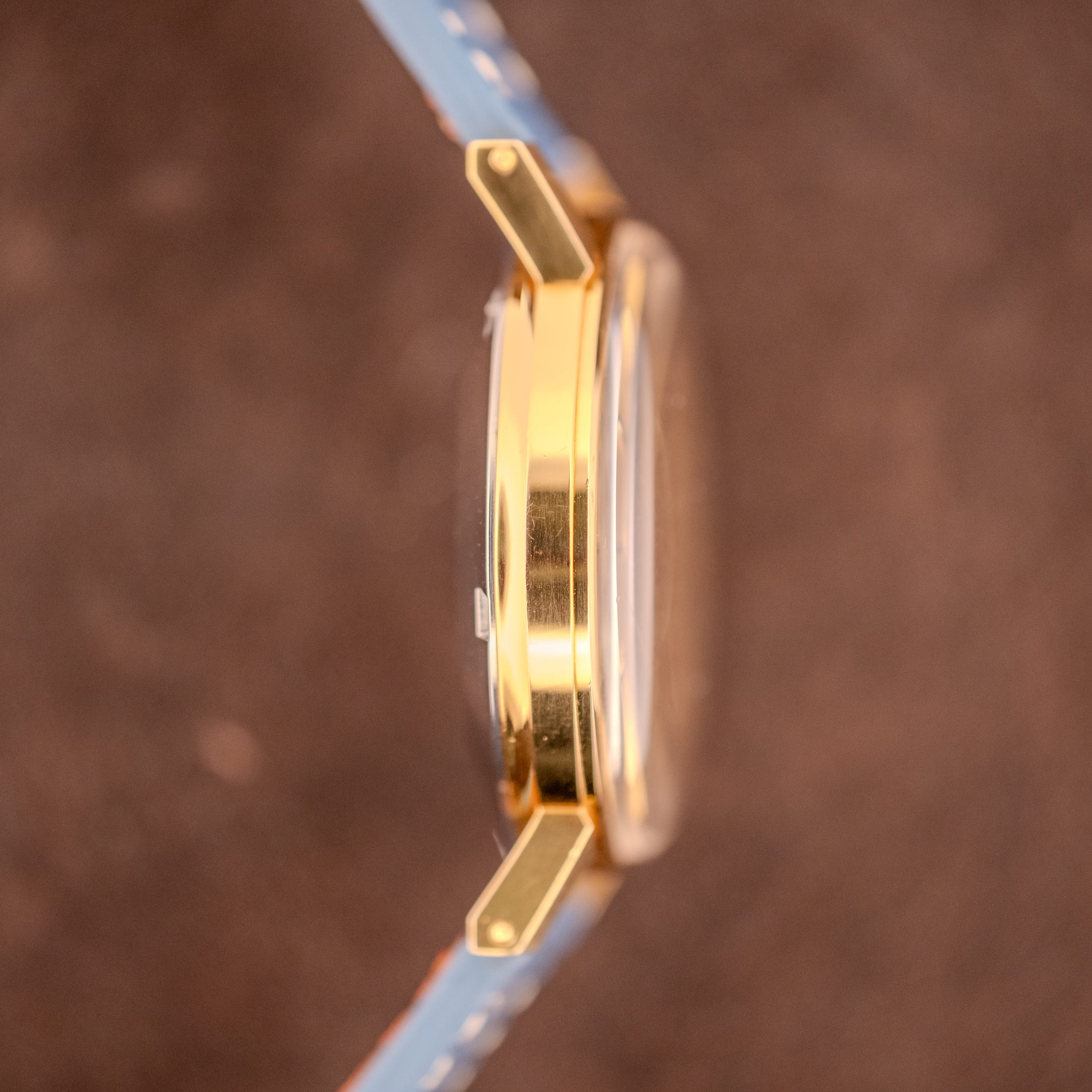
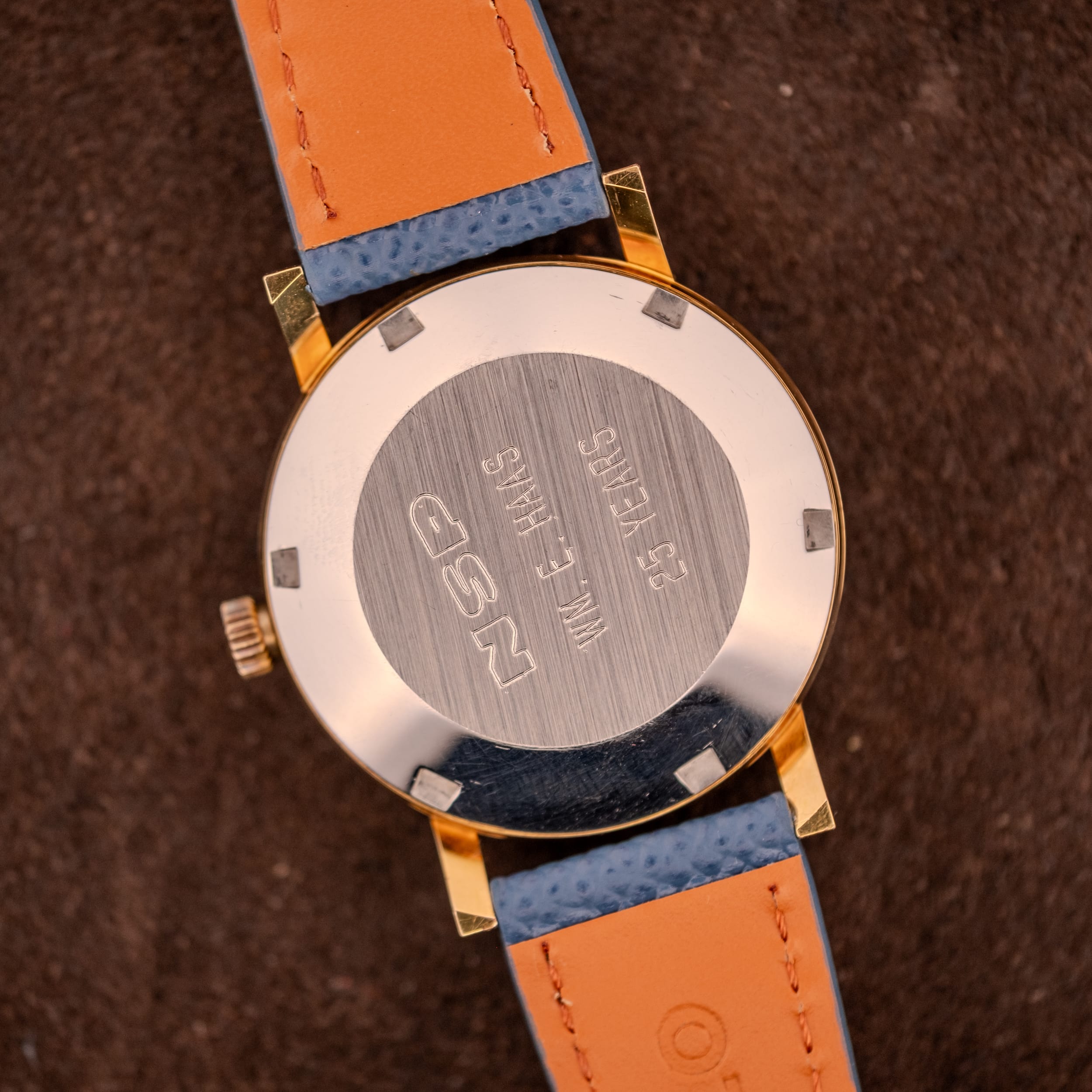
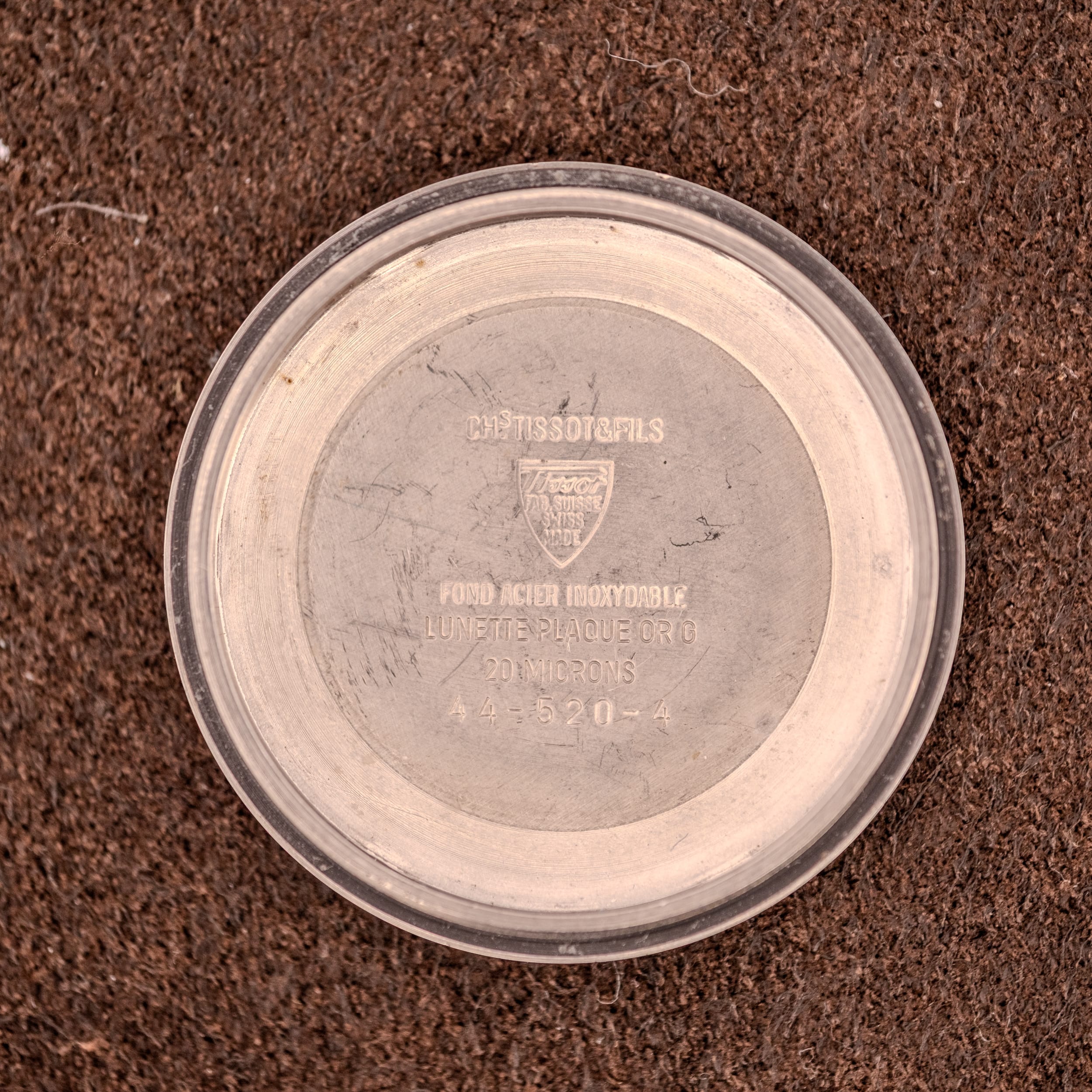
The case is a 34mm round housing, 41mm lug to lug, with 18mm lug width and a 20-micron gold-plated bezel and body riding over a stainless steel caseback. The interior caseback stampings read in order CHS TISSOT & FILS, the Tissot shield with FAB SUISSE SWISS MADE inside it, FOND ACIER INOXYDABLE, LUNETTE PLAQUE OR G, 20 MICRONS, and the reference 44-520-4. The exterior caseback carries a three-line presentation engraving stamped NSP, WM E HAAS, 25 YEARS, identifying this piece as a quarter-century service award given to one William E. Haas. Service award watches are, to us, some of the most quietly compelling provenance you can find in vintage, because they tend to have lived a particular kind of life, presented with ceremony, worn sparingly if at all, and then preserved as a memento. The condition of this gold plating, sharp edges, clean side flanks, fluted crown still seated where it should be, reads exactly like a watch that spent the majority of its life resting on a shelf rather than fighting cuffs.
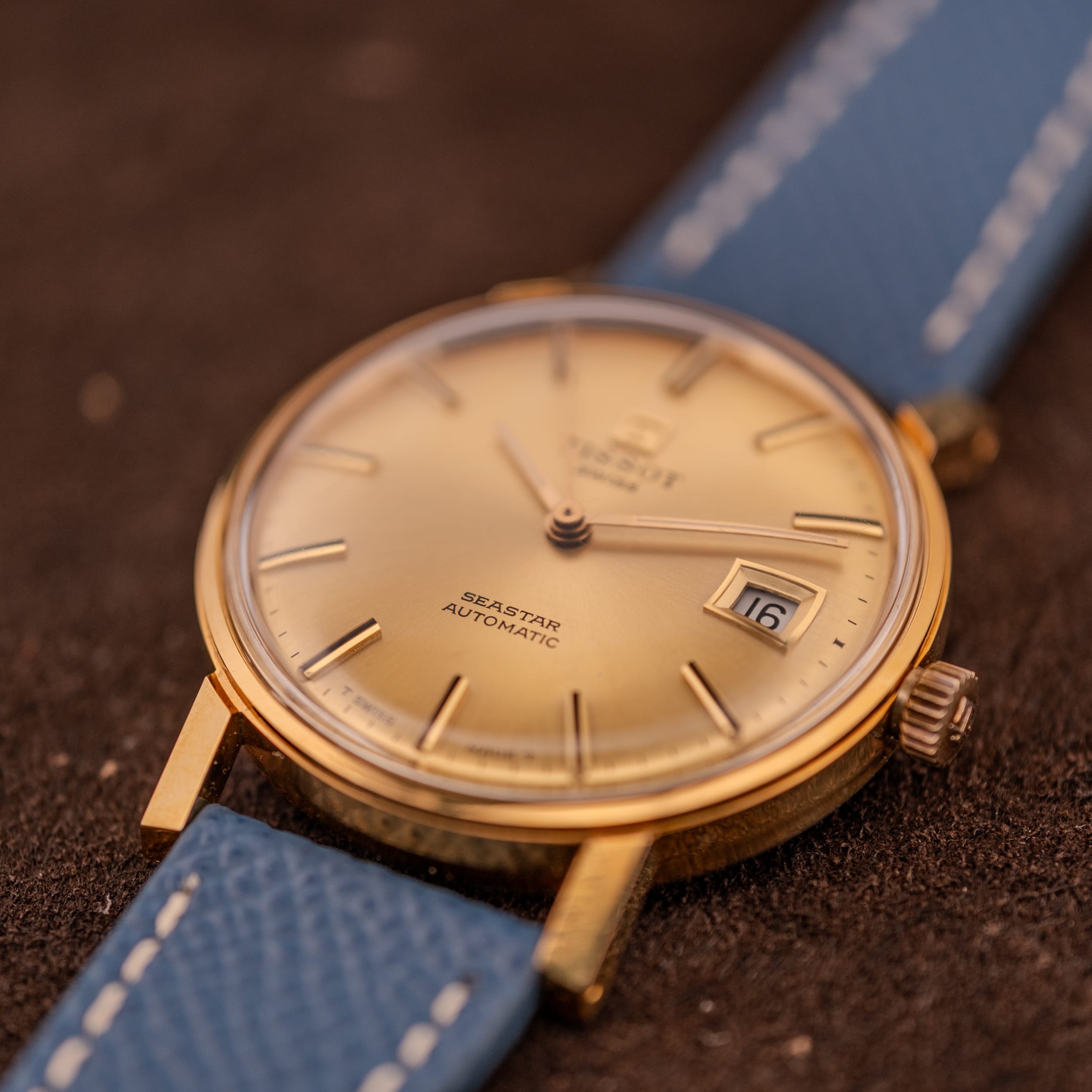
The dial itself is a warm champagne gold sunburst, anchored by applied baton hour indices that carry a black inset stripe down the center, which gives them a three-dimensional read against the radiating sunray. A double baton marks twelve, the Tissot “T” logo sits in its small square cartouche directly below it, with TISSOT and SWISS printed in fine black serif beneath. At six, SEASTAR and AUTOMATIC float in matching serif type, and at the very bottom of the dial the T SWISS MADE T tritium designation flanks the lowest minute marker. The date window at three is framed by an applied gold bevel that catches light as a small four-pointed kite, with the gold-tone date wheel carrying clean black numerals. The hands are gold dauphine for hour and minute, with the central ridge polished to a sharp edge, and a slim gold center seconds completes the set. There is nothing on this dial that fights itself, which is part of what makes the watch read as quietly as it does on the wrist.
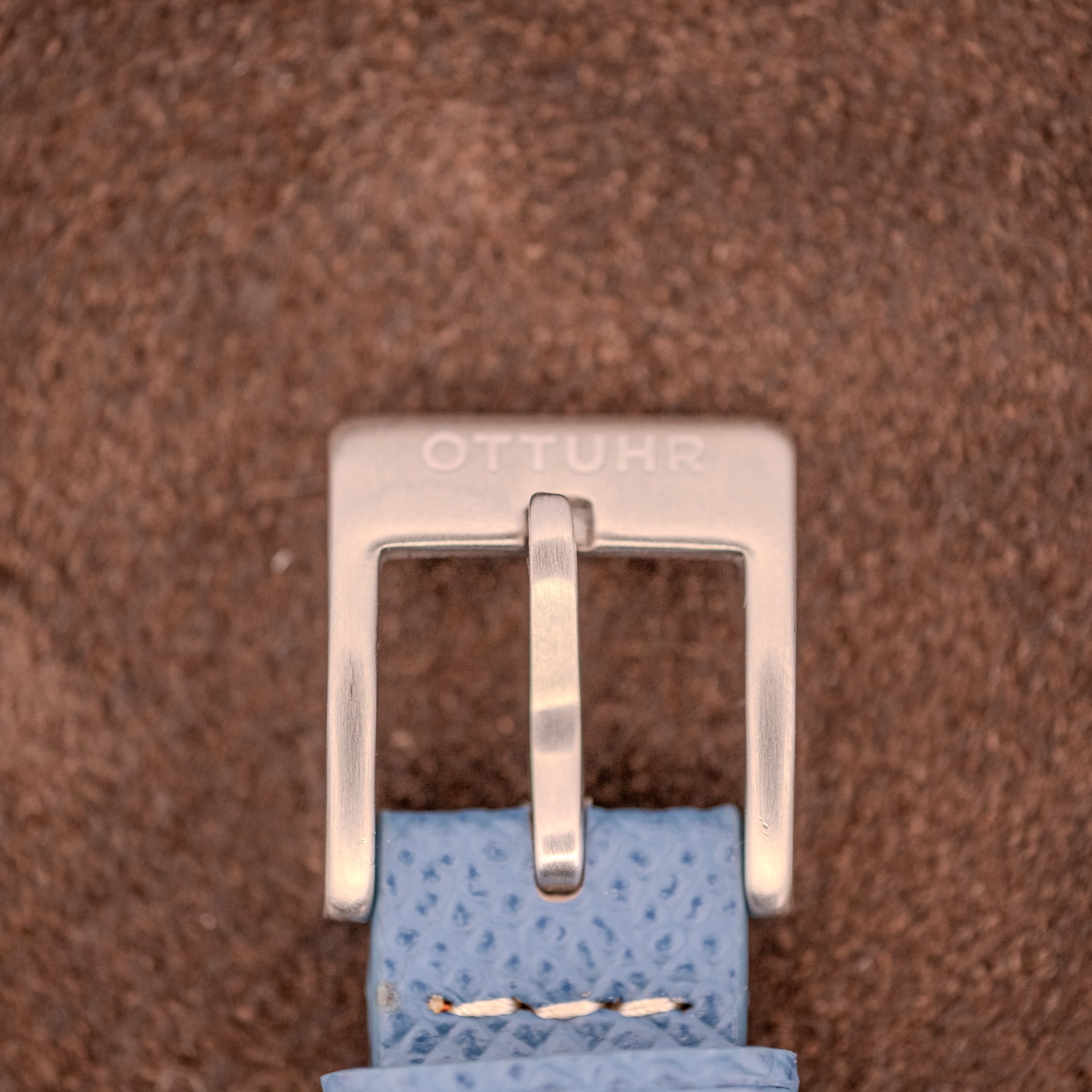
We have paired the watch on a blue full-grain calf strap with cream contrast stitching, an OTTUHR-signed brushed steel buckle, and sizing that fits comfortably up to an 8.5 inch wrist. The blue picks up the cool reflectance hiding inside the champagne sunburst and pulls the watch into a slightly more sportive register than a brown strap would.
Serviced in-house at OTTUHR and backed by our 2-year mechanical warranty. For the collector who values provenance, preservation, and the quiet handsomeness of a properly built SSIH-era automatic over splash and noise, this Tissot Seastar Automatic is, to us, exactly the kind of golden time capsule we love sending out the door.