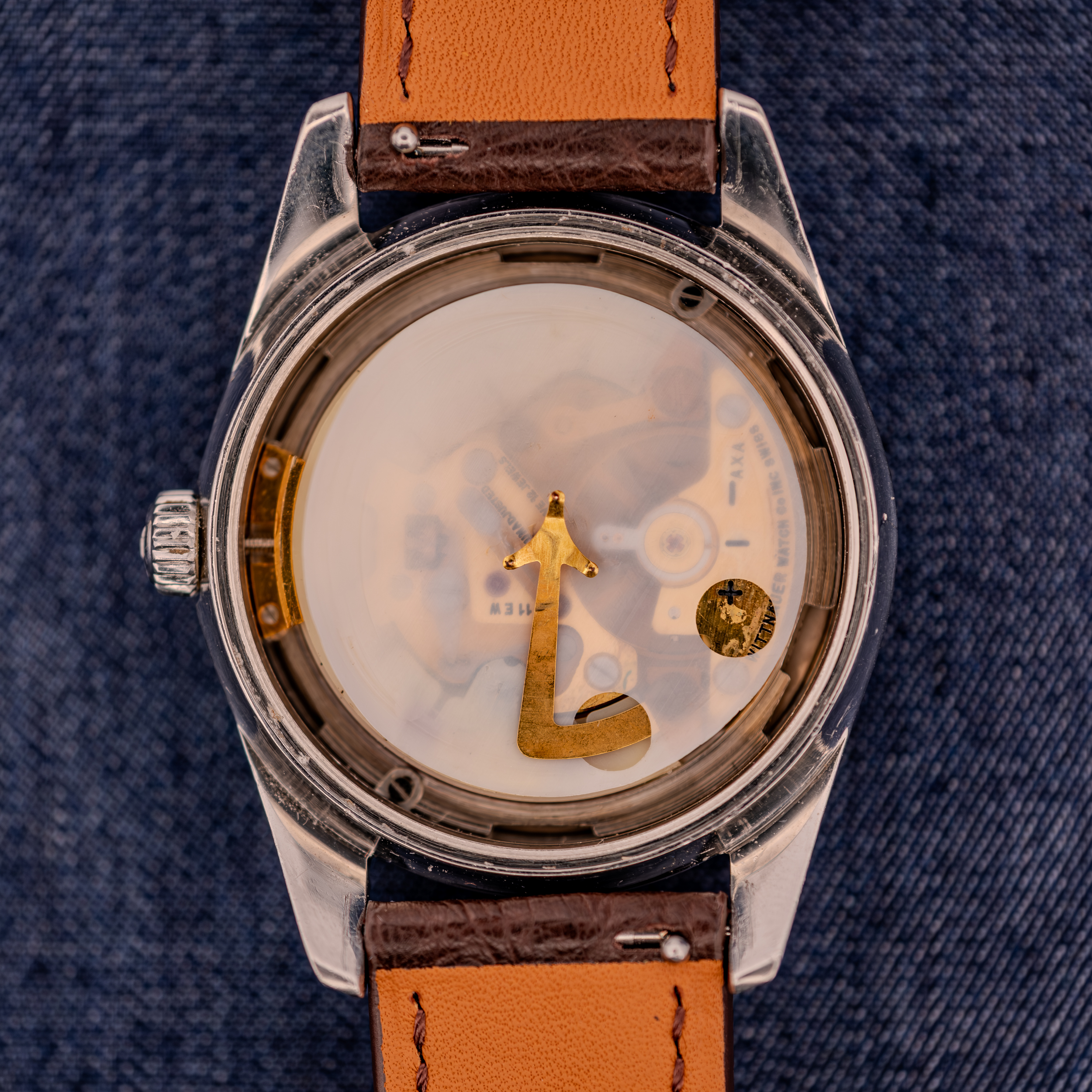
To us, the Wittnauer Electro-Chron is one of the most quietly important Swiss watches of the early 1960s, and the reason has nothing to do with how it tells time and everything to do with what it represents. By the close of 1960 the Swiss industry had spent the better part of two decades watching Hamilton and Bulova reinvent the wristwatch in America, first with the Hamilton Electric in 1957 and then with the Bulova Accutron tuning fork in 1960, and Switzerland needed an answer. The Wittnauer Electro-Chron was that answer, and the Ref. 6150/2 you see here is the production-run dress execution of it.
Wittnauer was founded in New York in 1885 by Albert Wittnauer, a Swiss immigrant who had been working in his brother-in-law’s import house bringing Longines pocket watches into the American market. By the late 1880s the company was importing under its own name and supplying the United States Navy with marine chronometers, and through the early twentieth century Wittnauer built one of the strongest American distribution networks of any Swiss-owned brand, eventually merging formally with Longines in 1936 to become the Longines-Wittnauer Watch Co. The Electro-Chron sits inside that combined era, designed in Switzerland and marketed aggressively in the United States as Wittnauer’s public proof that Swiss watchmaking had caught up to the electric revolution coming out of Lancaster and Long Island.
The caliber is where the historical weight lives. The Wittnauer 11EW is the brand-signed version of the Landeron 4750, the first electric movement Switzerland ever produced. Research and development on the L4750 began inside Ébauches SA in the 1940s under designers André Breyer and René Besson, ESA secured the patent in 1959, and the first production movements rolled off the Landeron line at Le Locle at the close of 1960 with the formal debut at the Basel Fair in April 1961. What makes the L4750 architecturally distinct from the American electrics is that it contains no permanent magnet. Where Hamilton built a coil-on-balance system and Bulova built a tuning fork, the Landeron team used contact wires that fire electric impulses directly against the steel balance plate to keep the balance oscillating, retaining the entire mechanical balance-and-escapement geometry collectors already understood and simply replacing the mainspring with a battery cell. Thirteen jewels, unadjusted, signed Wittnauer Watch Co. Inc. with the ESA AXA designation on the bridge.
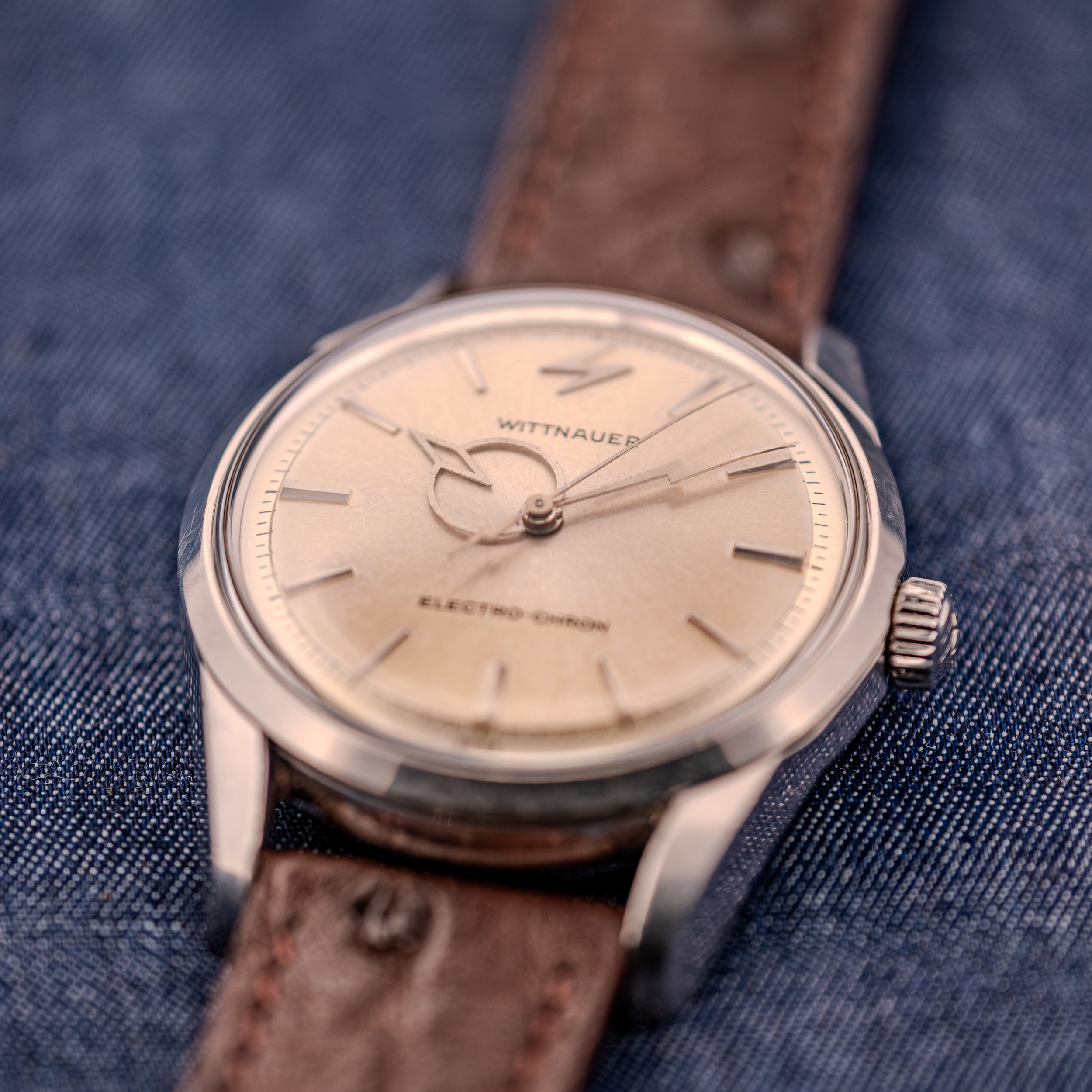
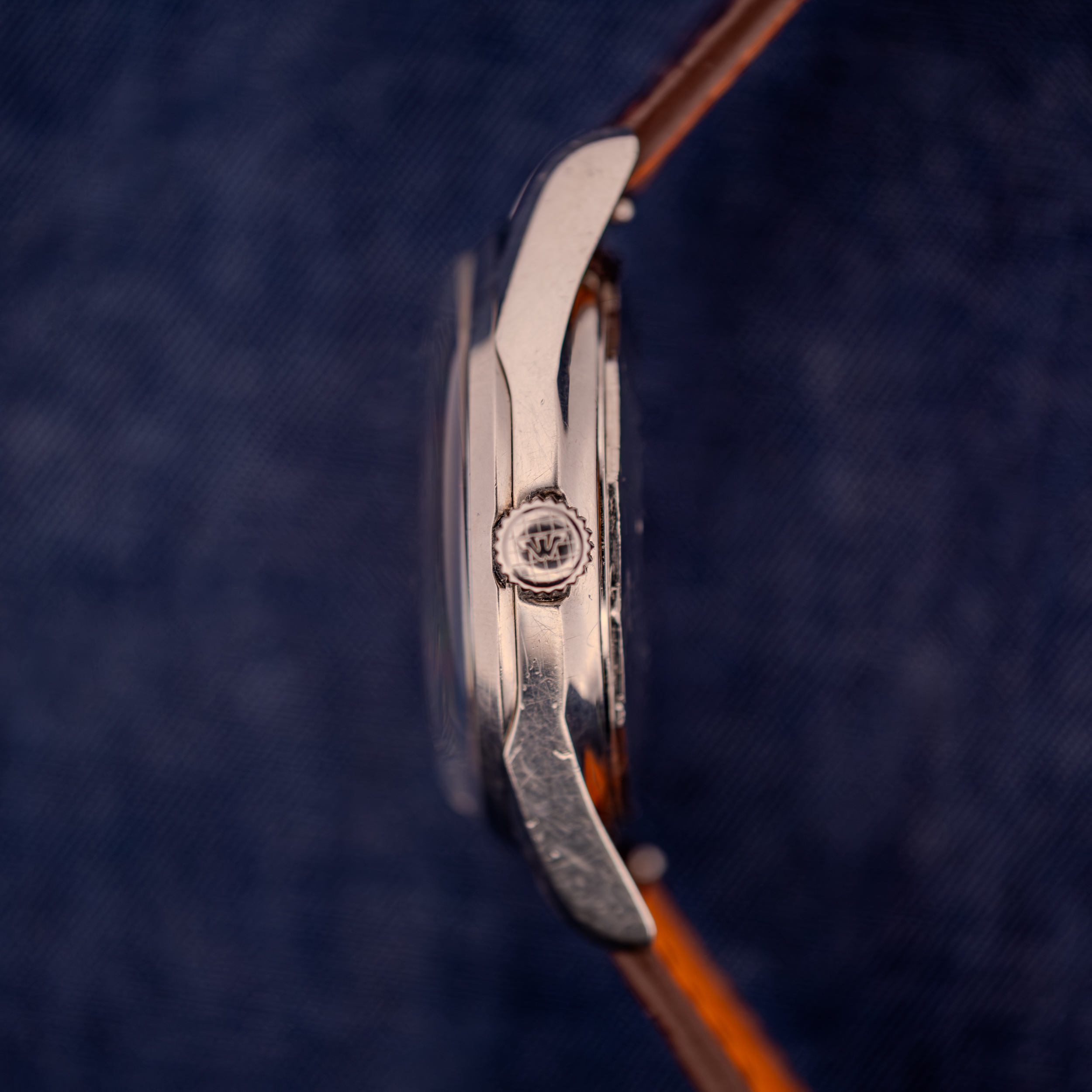
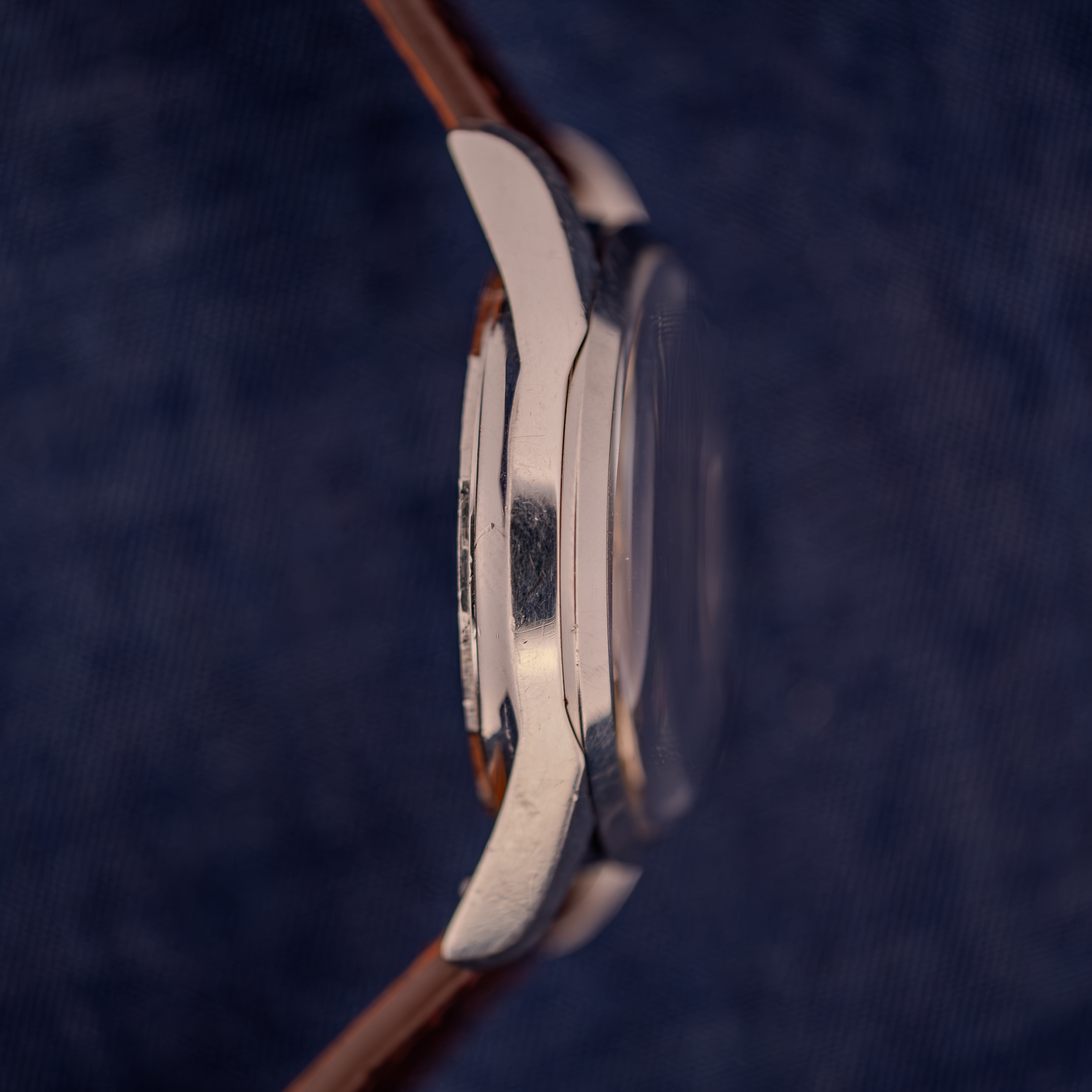
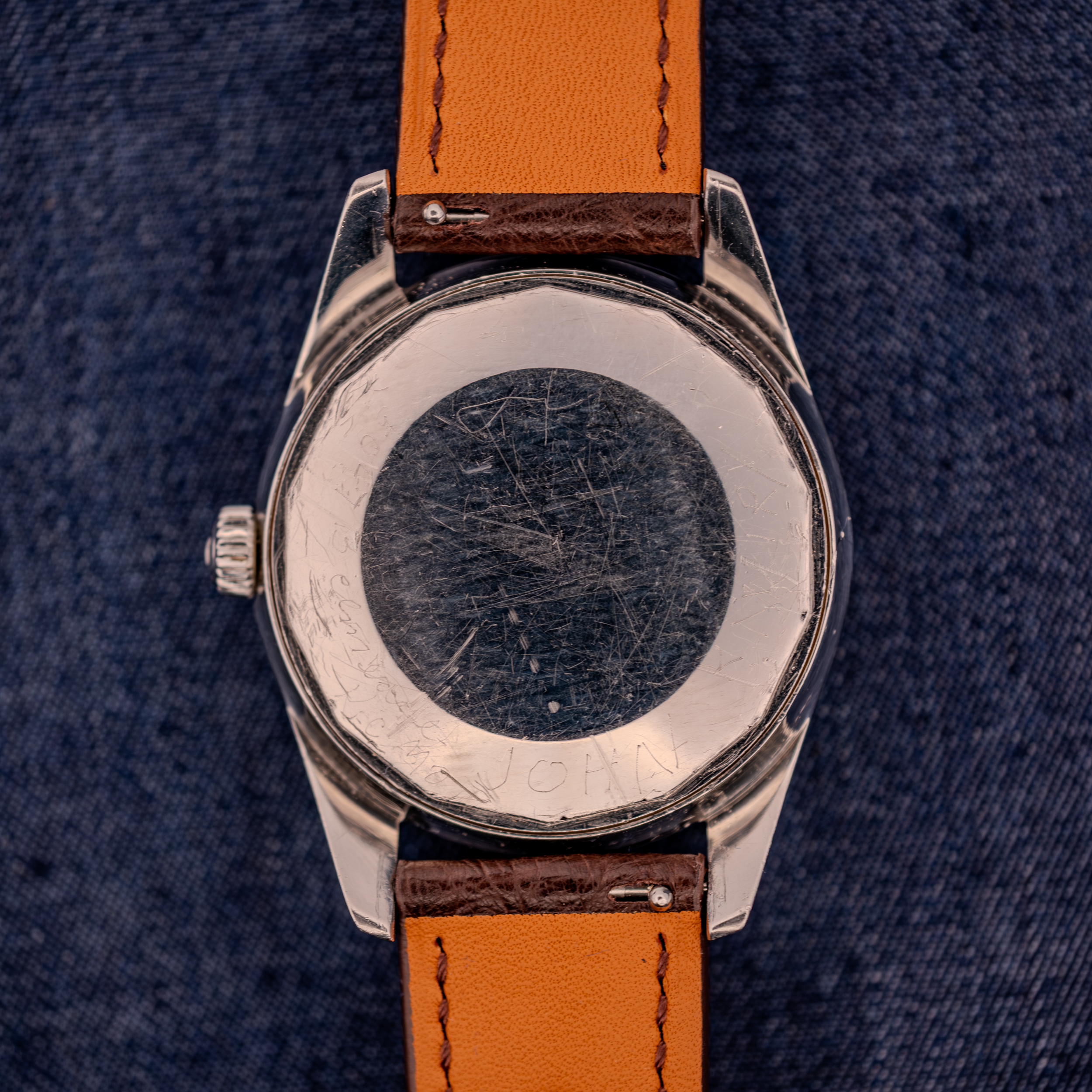
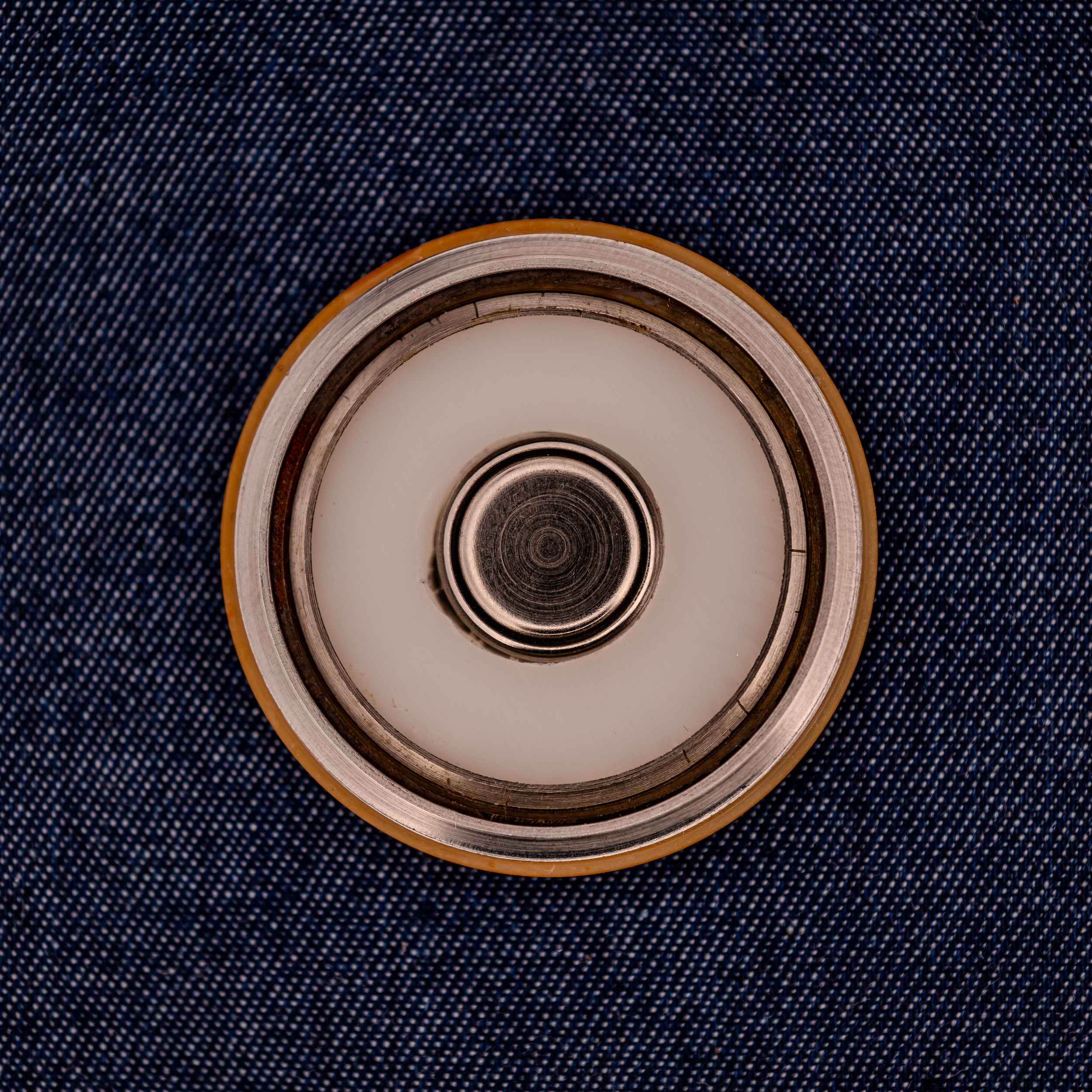
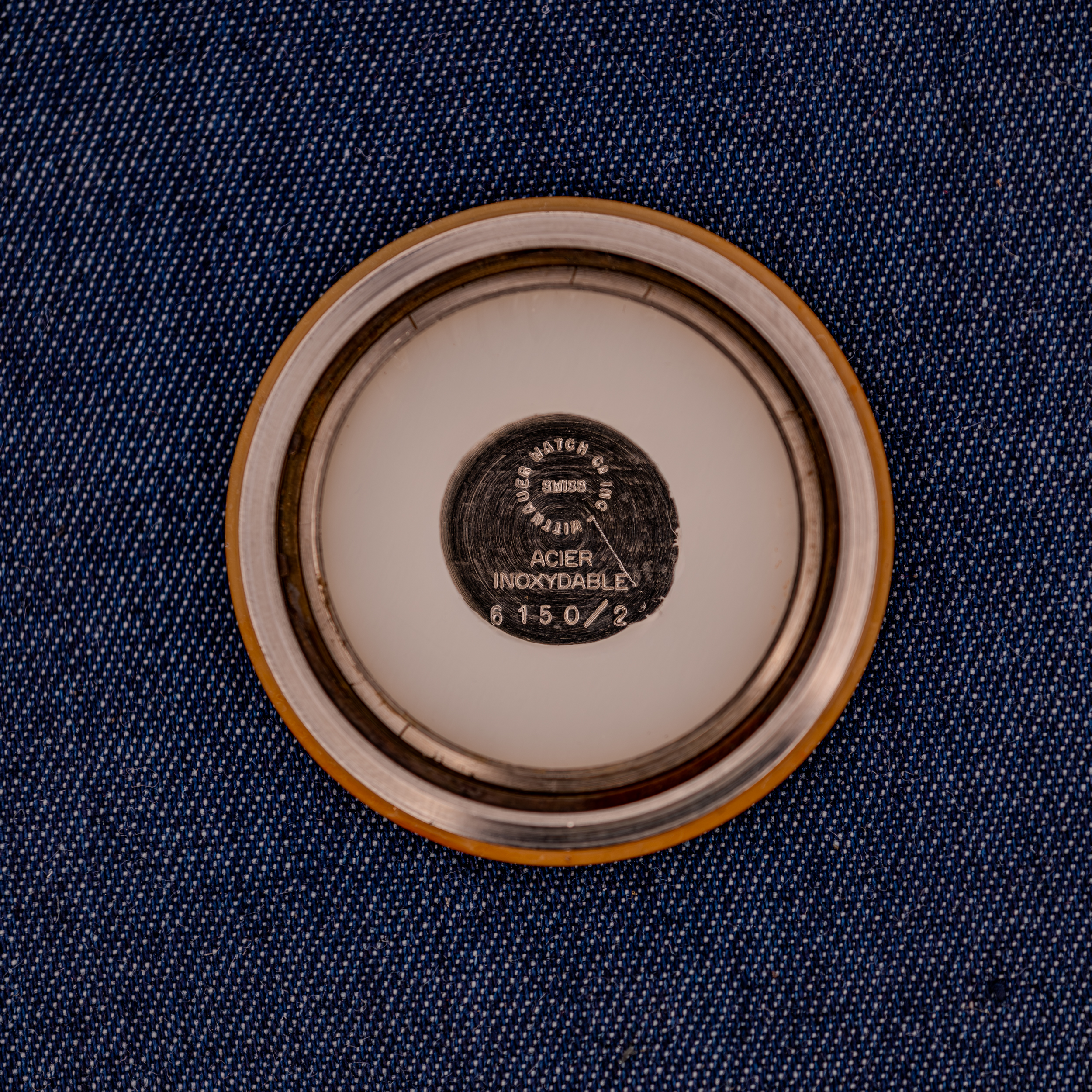
The case is a 36mm round in stainless steel with a 45mm lug-to-lug span and 18mm lug width, finished with mirror-polished case sides and lugs and a smooth polished bezel framing the dial. The inner case stamping reads “WITTNAUER WATCH CO. INC” arcing across the top with “SWISS” below, “ACIER INOXYDABLE” beneath that, and the reference number “6150/2” stamped at the lower edge, with the round brass-toned movement-protection cover sitting centered. The outer caseback carries a piece of provenance we found genuinely charming, a hand-engraved “JOHN” along the lower edge in what reads as a personal owner’s mark from the period when watches were given as retirement gifts and named accordingly. The polished case sides show light handling wear exactly proportional to a sixty-year-old daily-worn watch, and the crown is signed with the stylized Wittnauer “W” logo correctly for this reference.
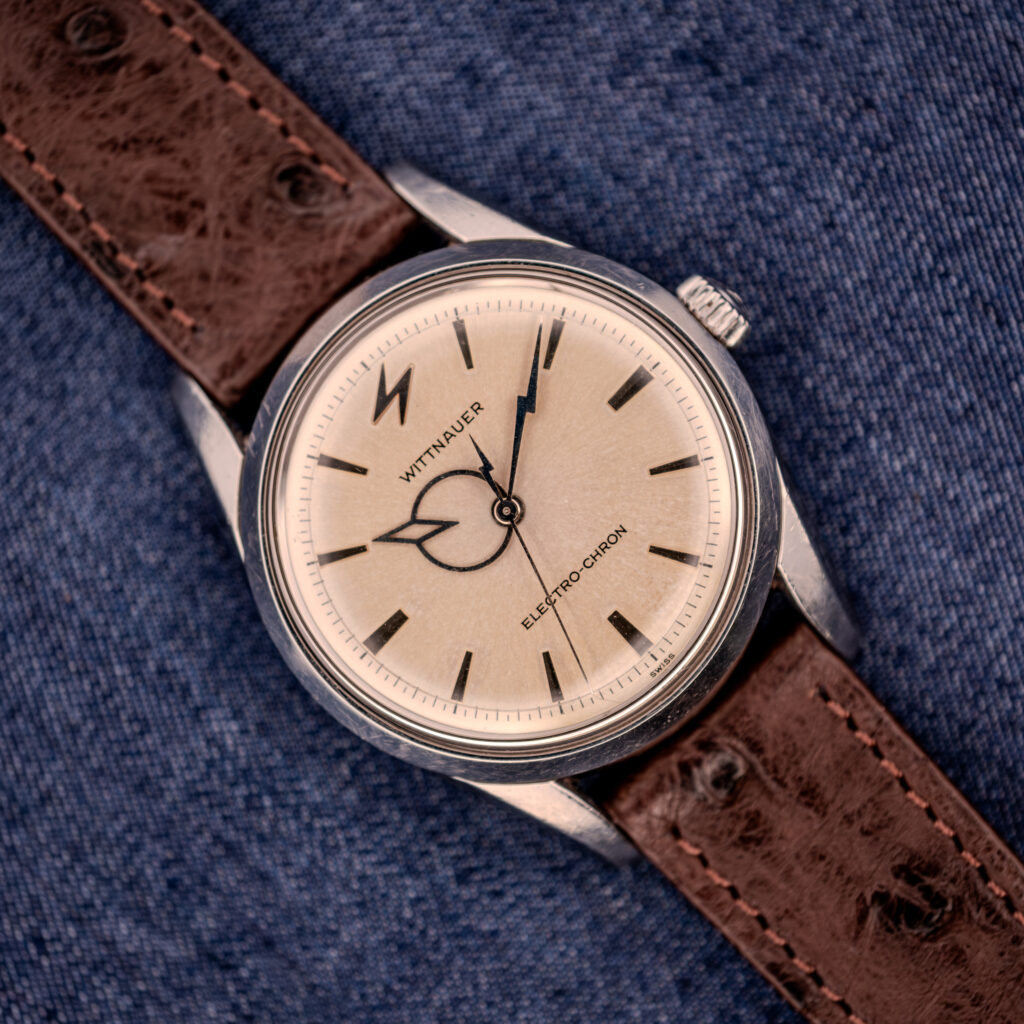
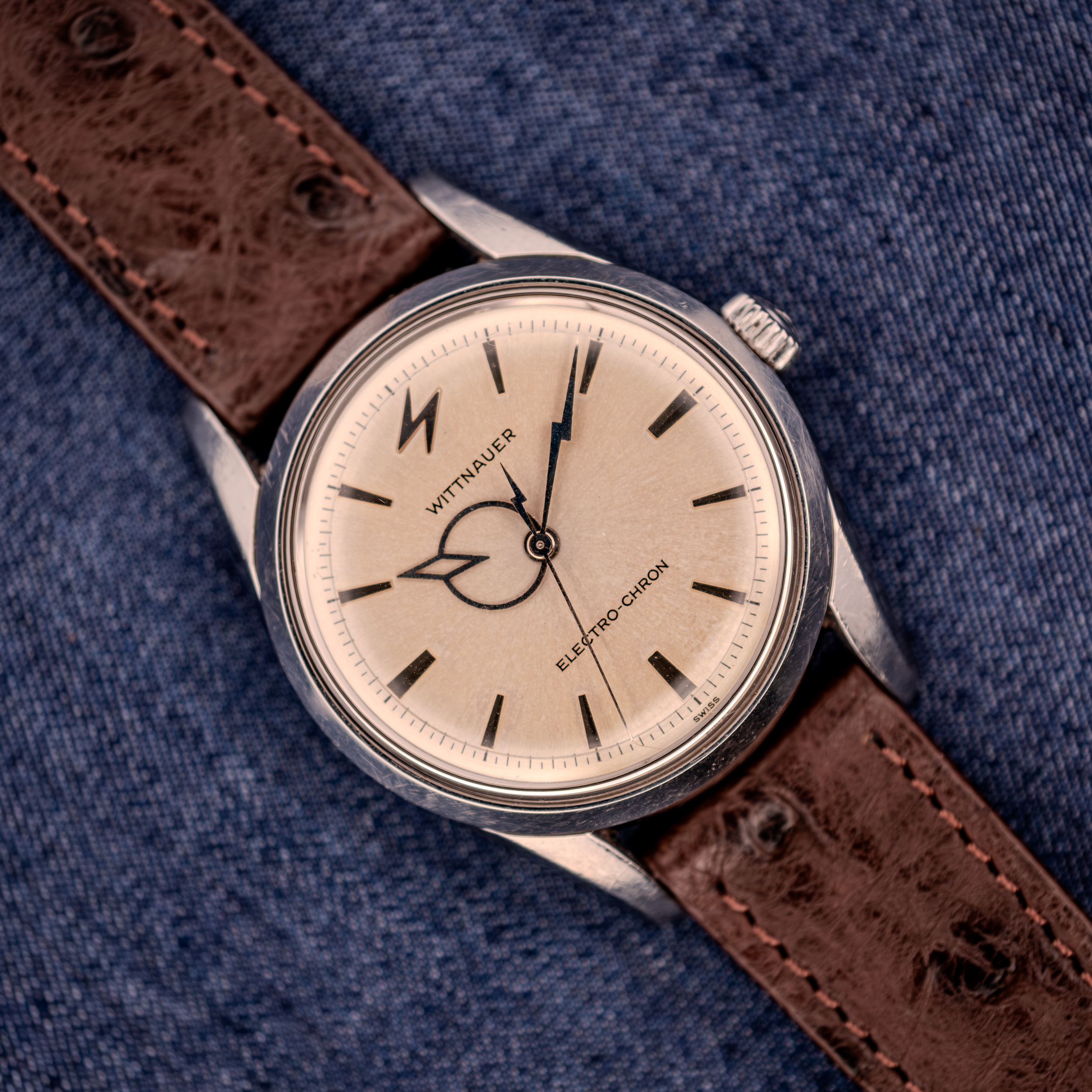
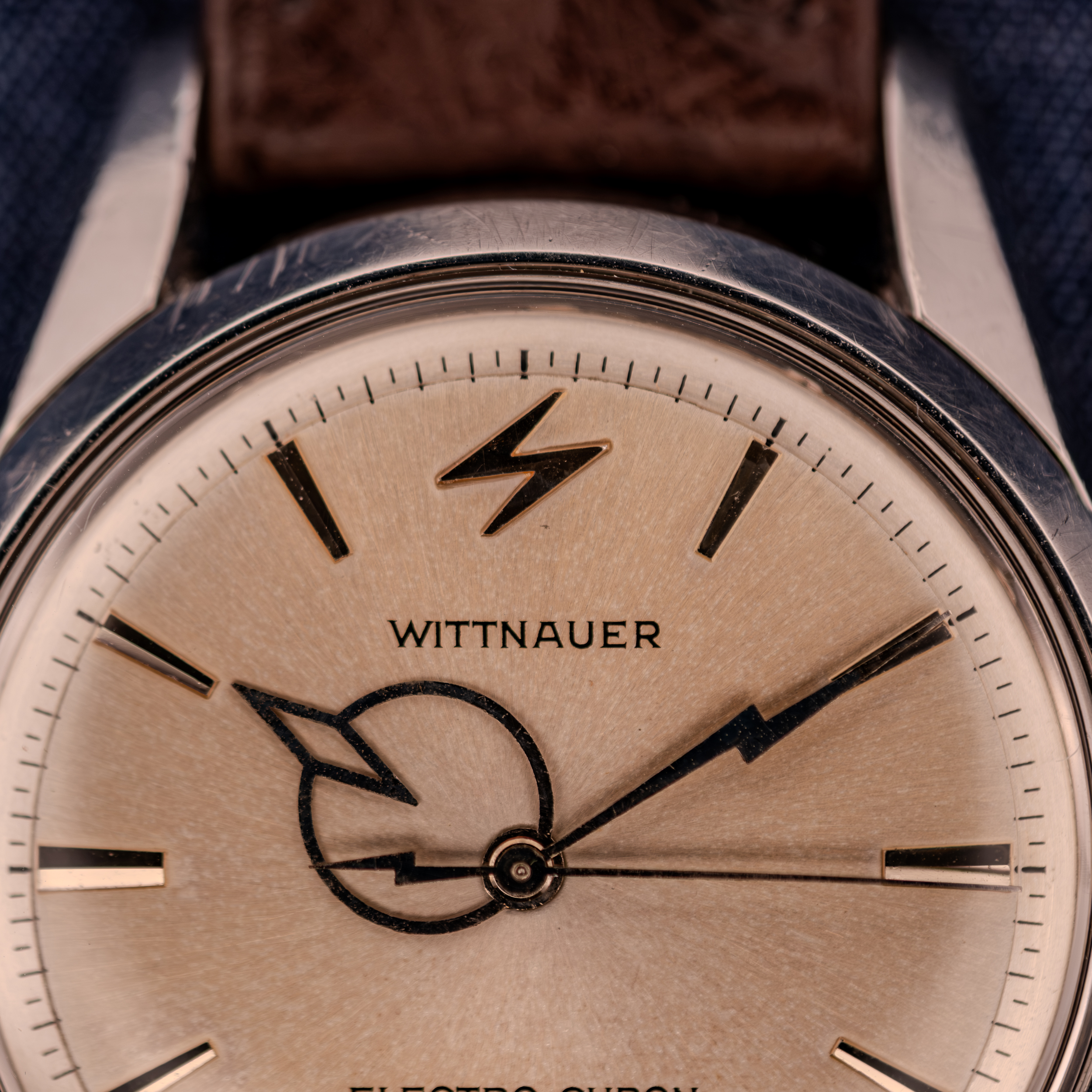
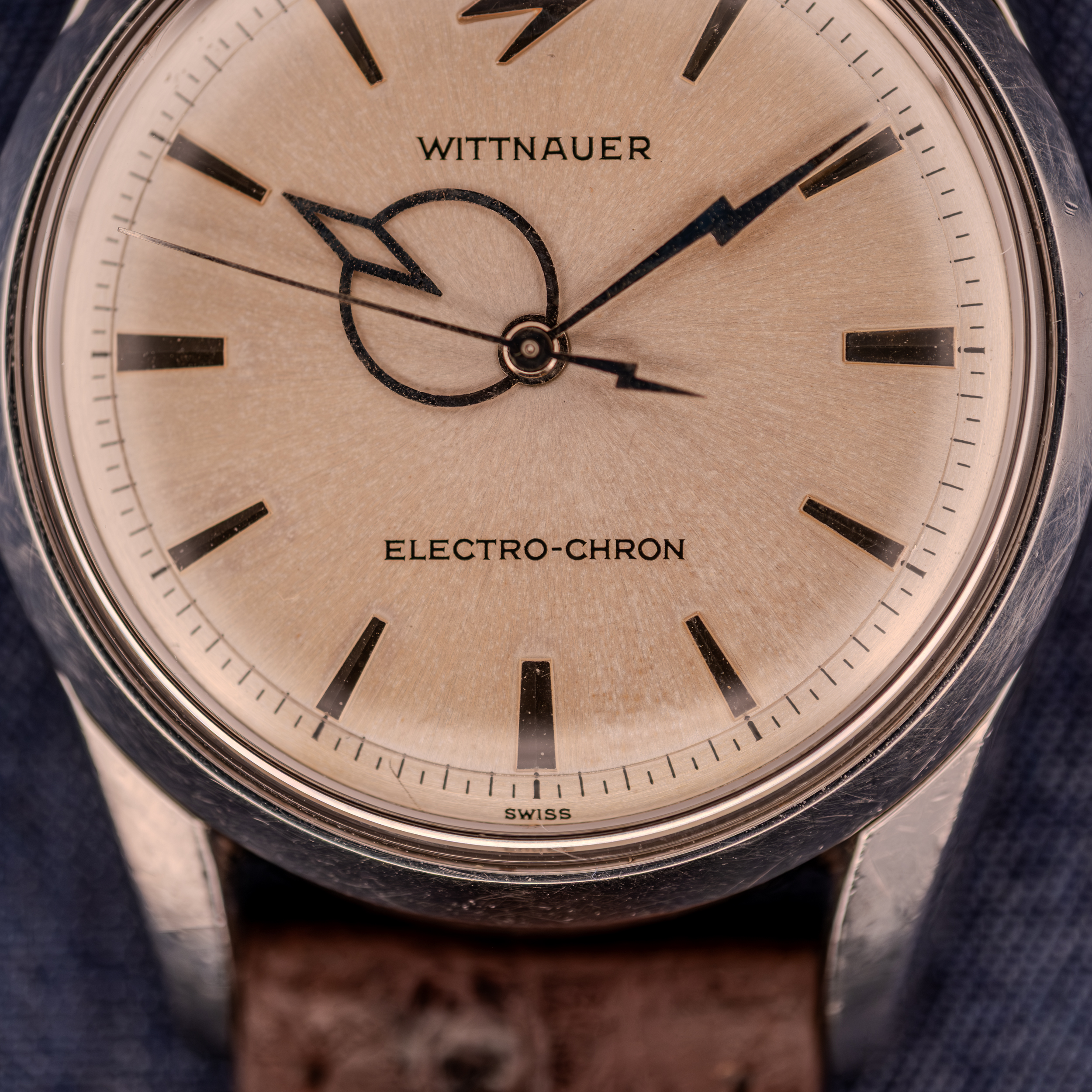
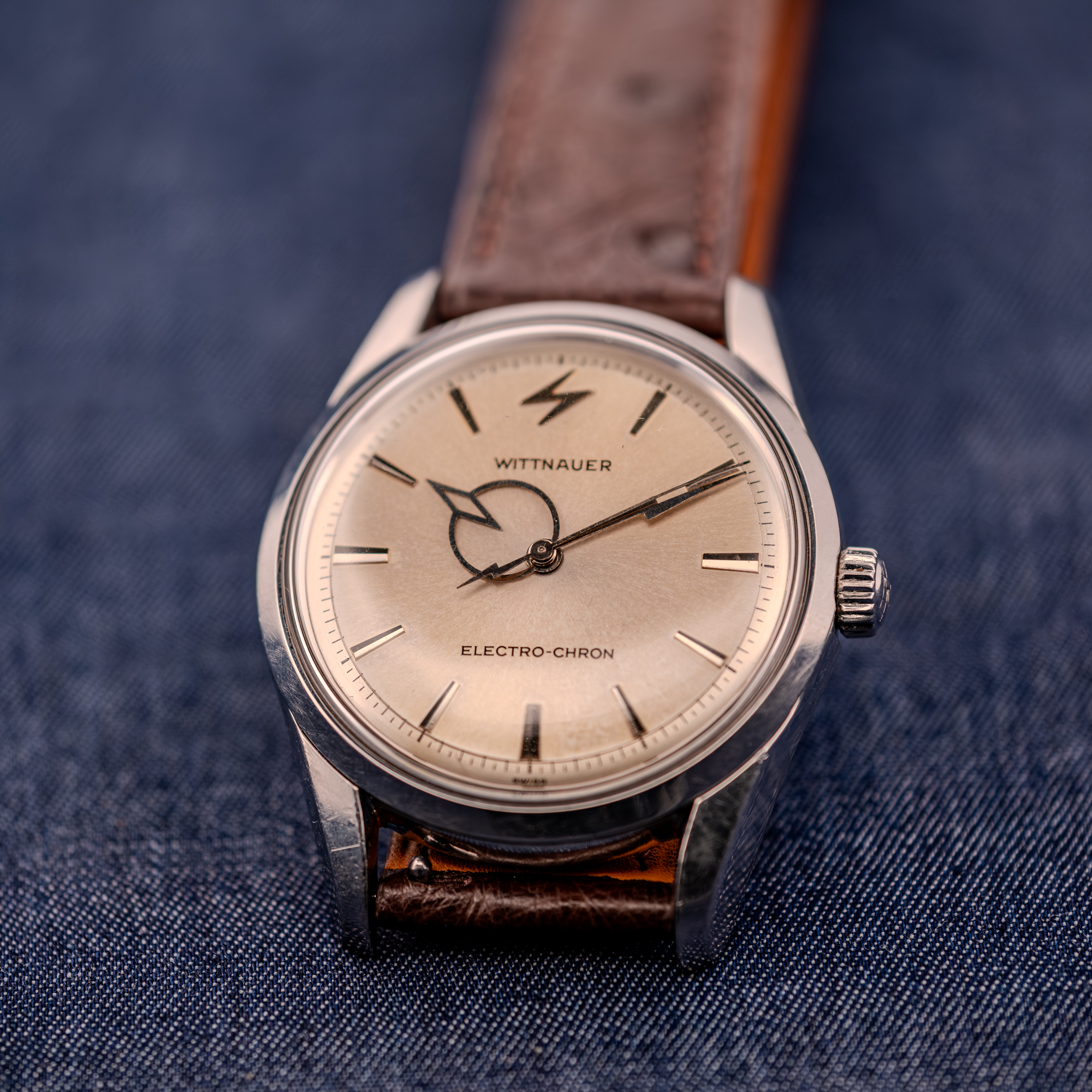
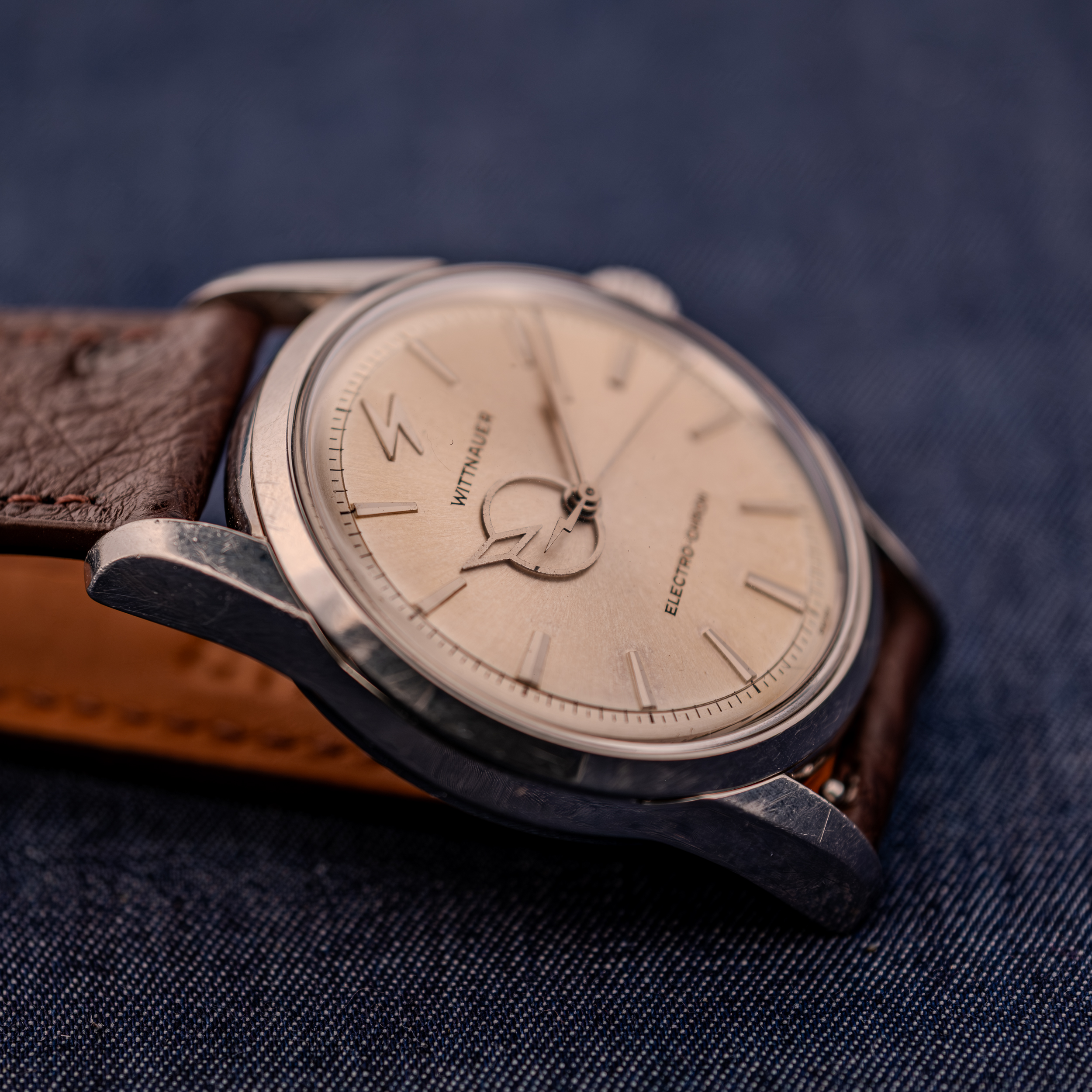
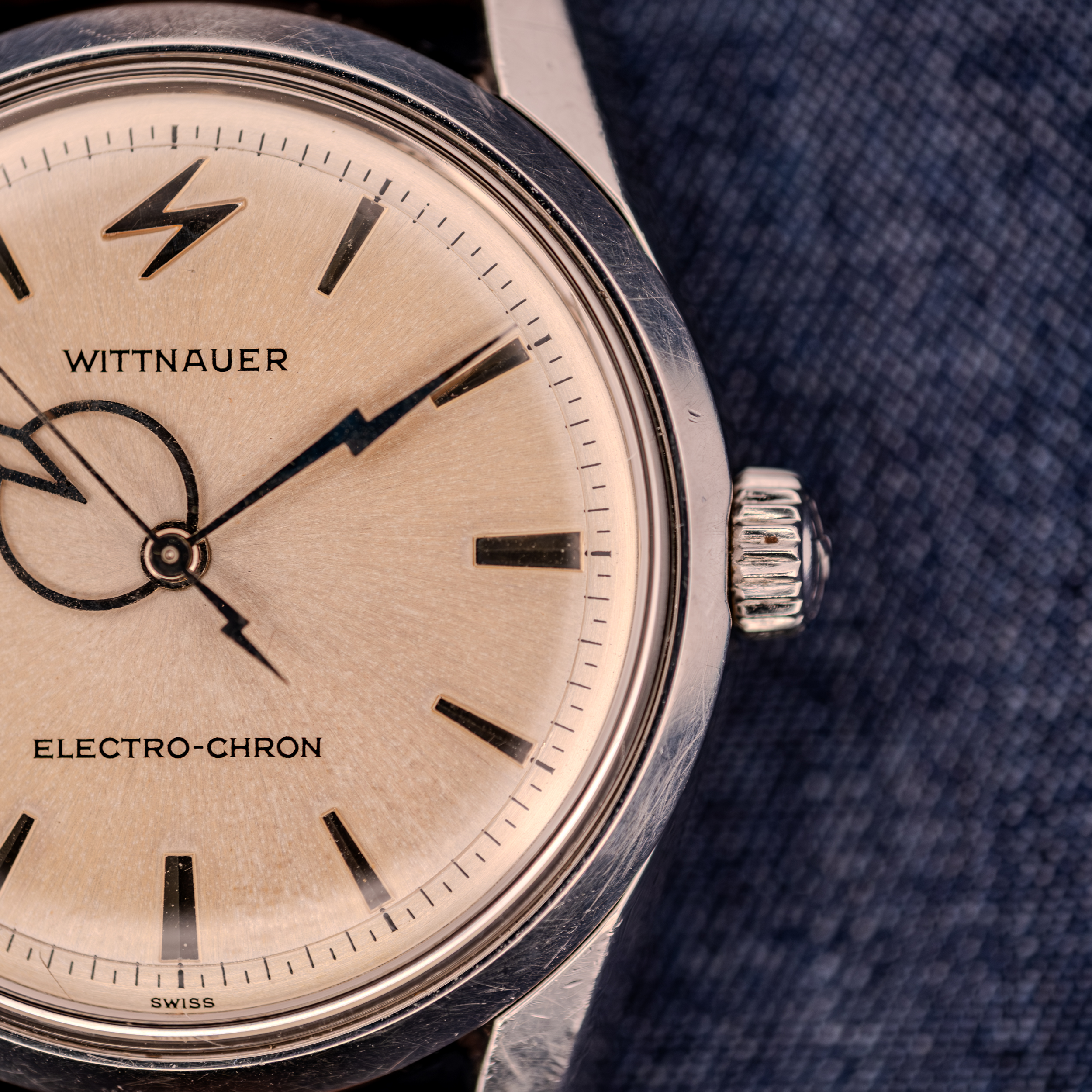
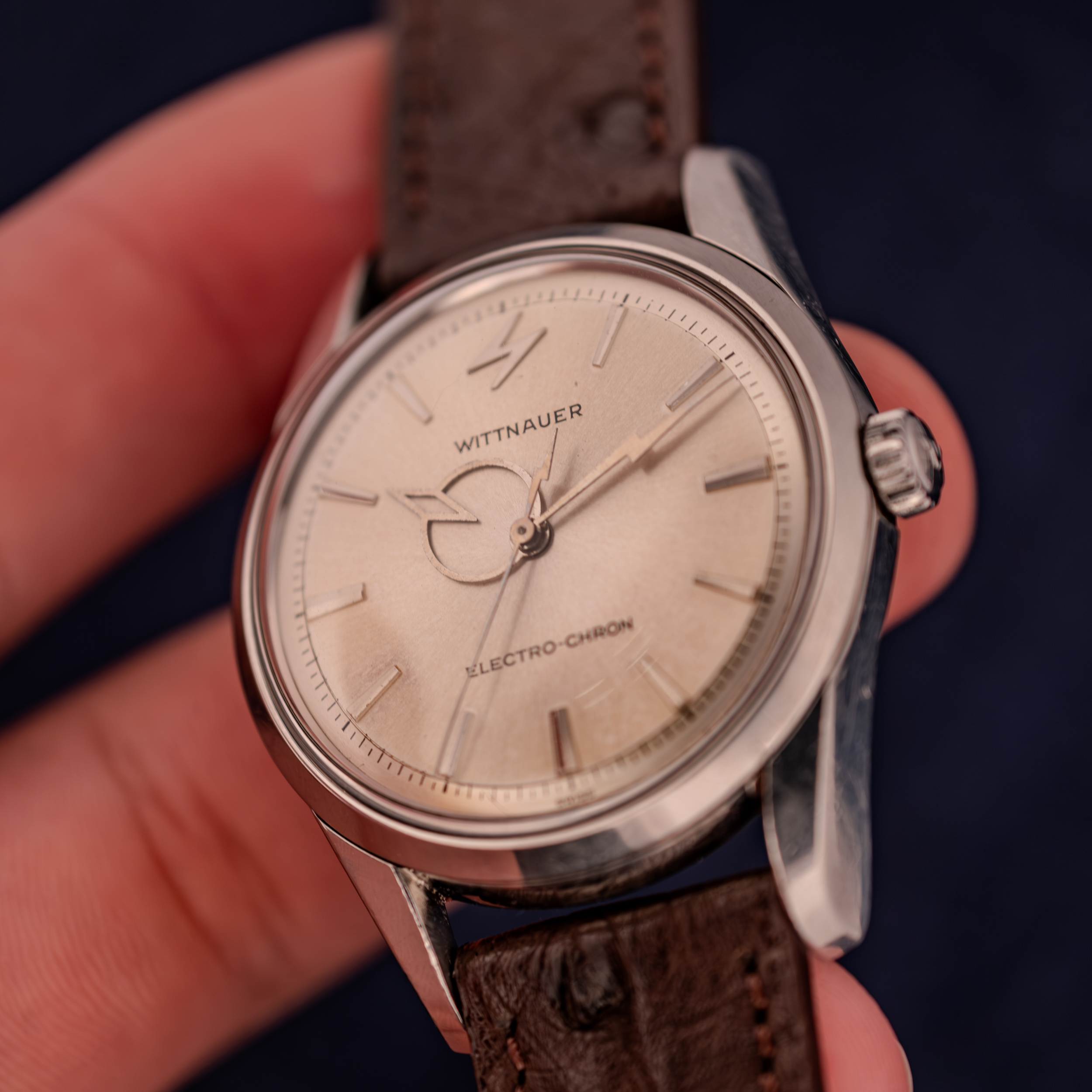
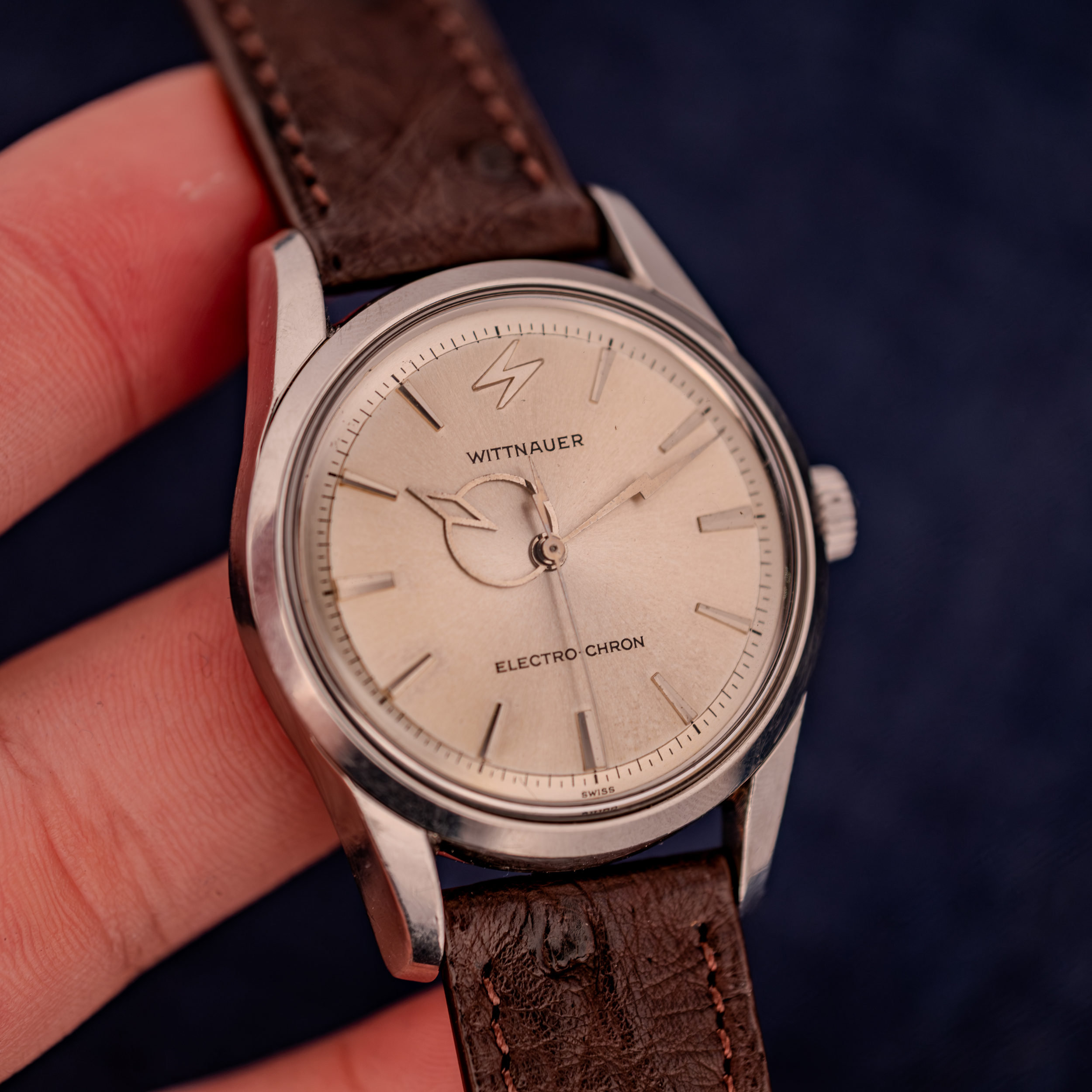
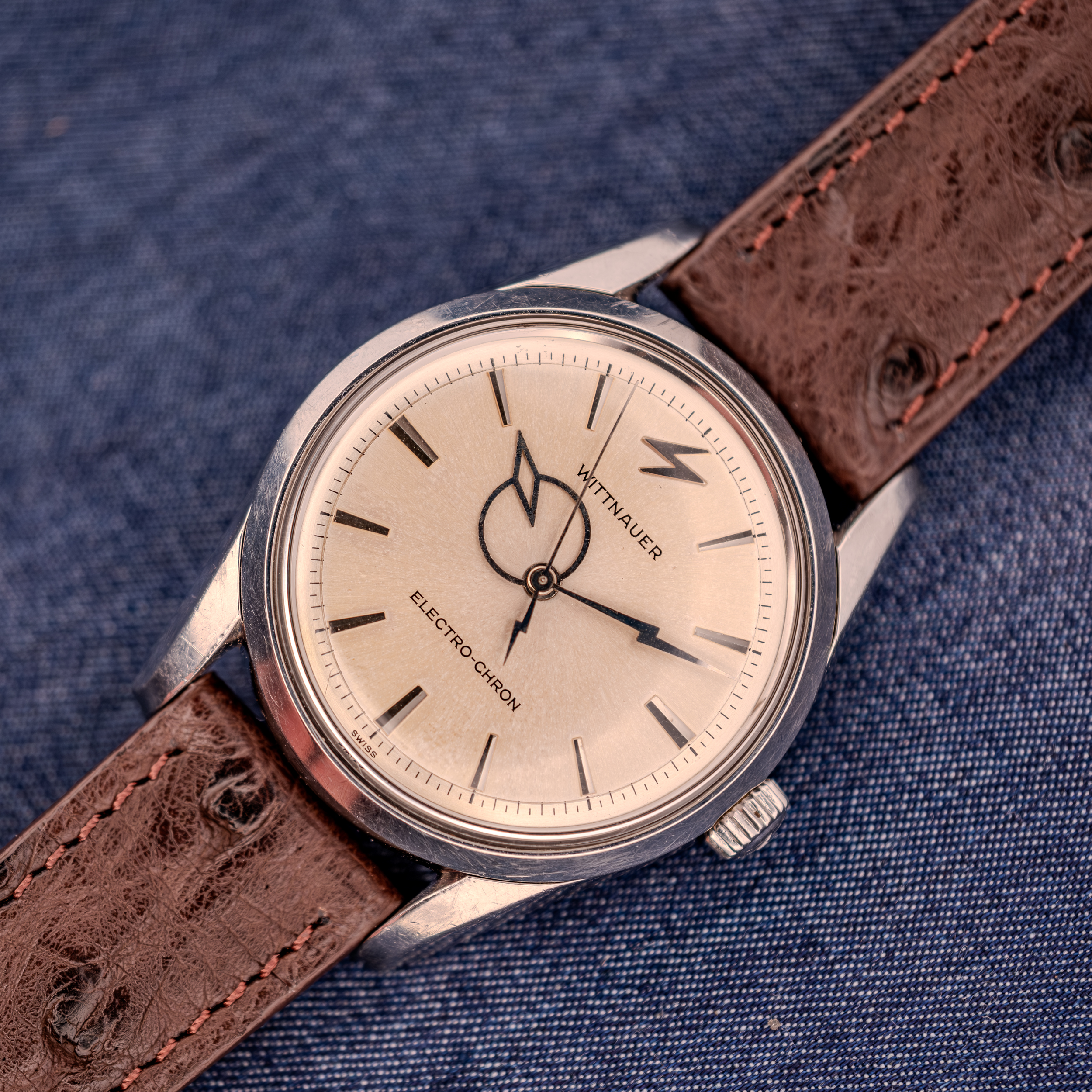
The dial is the part of this Wittnauer Electro-Chron that makes the model line worth chasing. A silver sunburst base with very light warm cream toning developed evenly across the surface, signed “WITTNAUER” in printed block letters in the upper center and “ELECTRO-CHRON” in the lower center, with “SWISS” along the bottom edge below six o’clock. The lightning bolt motif appears three separate times in the layout, which to us is the design coup of the reference. An applied steel lightning bolt sits in place of the twelve marker at the top of the dial. The minute hand is a slim steel stick extending from the center pinion to a beautifully formed lightning bolt at the tip. And the hour hand is the visual signature of the entire model, an eccentric open circle outlined in black with a small lightning bolt graphic running through its center, an unusually graphic approach to telling time that reads as completely modern even six decades on. Applied steel baton markers anchor the remaining eleven hour positions, an inner minute-and-seconds rail track runs around the dial perimeter, and the printed dial signatures and “SWISS” line have remained crisp and unmolested. To us this is an honest factory-original dial showing the kind of gentle warming a silvered surface develops over decades, character we read as the watch earning its age rather than anything resembling refinishing.
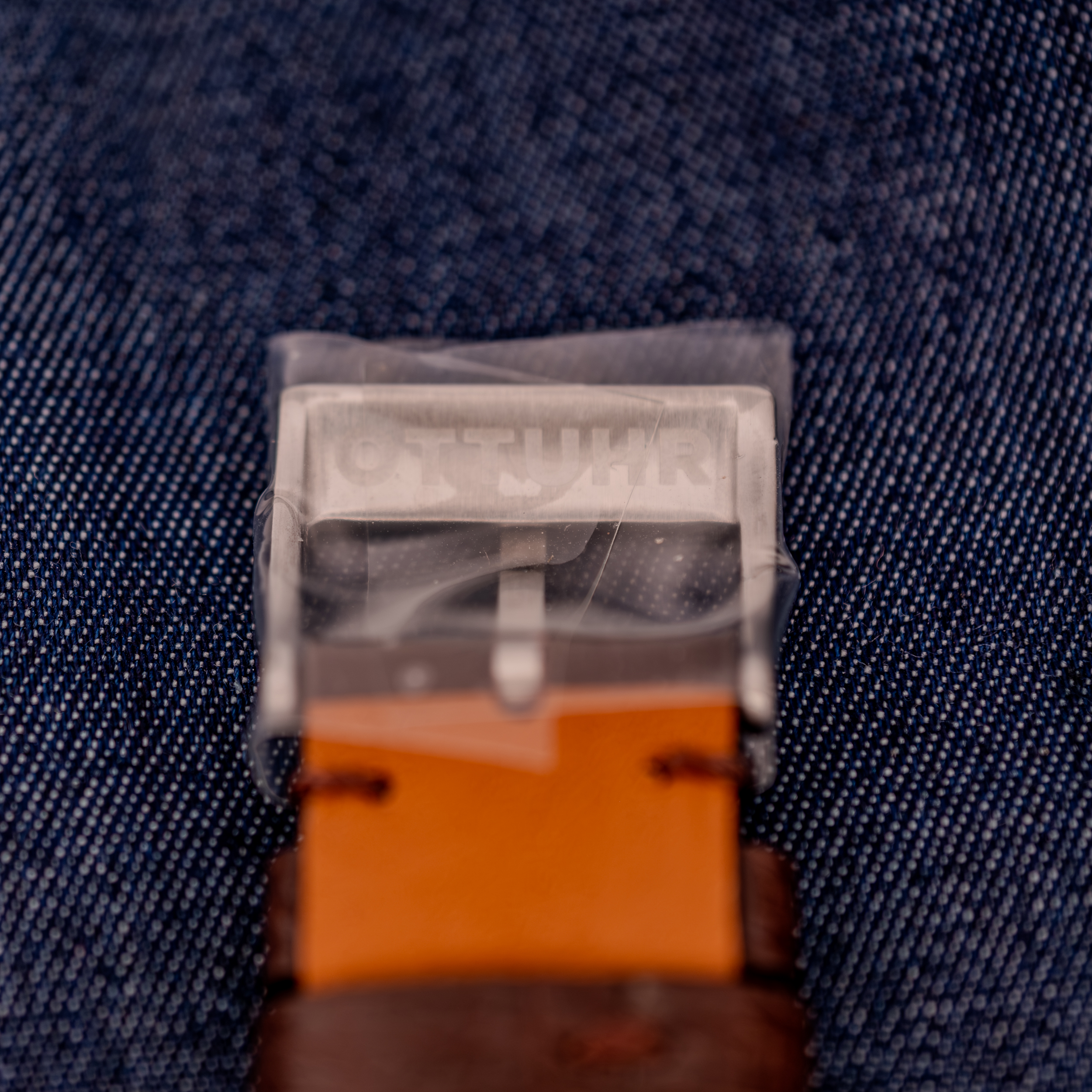
We have paired this Wittnauer Electro-Chron with one of our brown ostrich leather straps, the genuine ostrich grain pattern visible across the surface and finished with matching brown stitching, which gives the watch a warm tonal frame that picks up the cream warmth in the dial and softens the polished steel case beautifully. The closure is our OTTUHR signed buckle in clear, sized correctly for the 18mm lug width.
Serviced in-house at OTTUHR and backed by our 2-year warranty, this Wittnauer Electro-Chron Ref. 6150/2 is exactly the kind of historically dense Swiss watch we love finding. For the collector who values the inflection point watches over the icon watches, who wants the first Swiss electric movement in its production-run dress execution, and who reads a hand-engraved “JOHN” on the outer caseback as the kind of provenance no auction house can manufacture, this is the piece. In our opinion, this is the dress watch every serious vintage collection needs the moment it stops being only about icons and starts being about history.