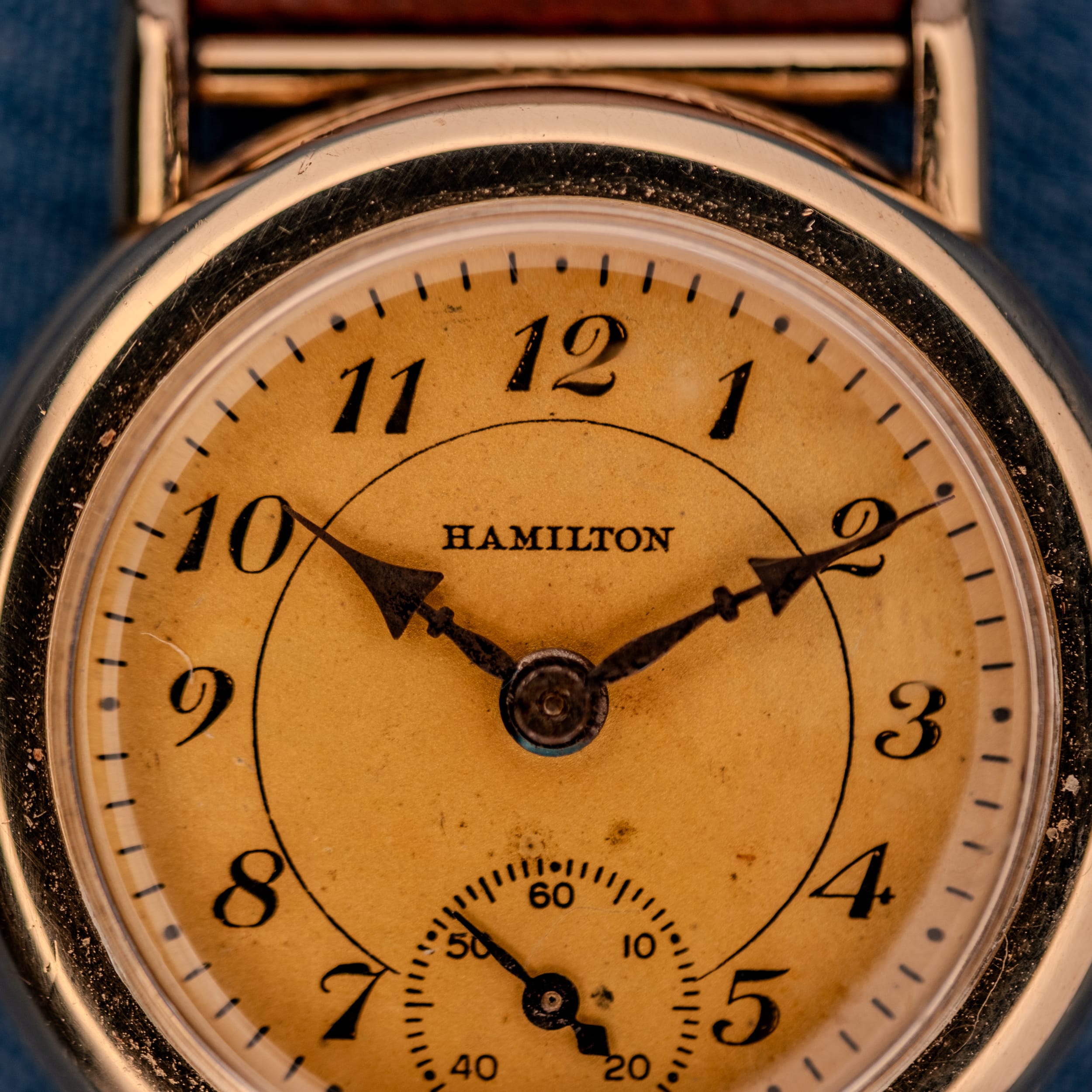
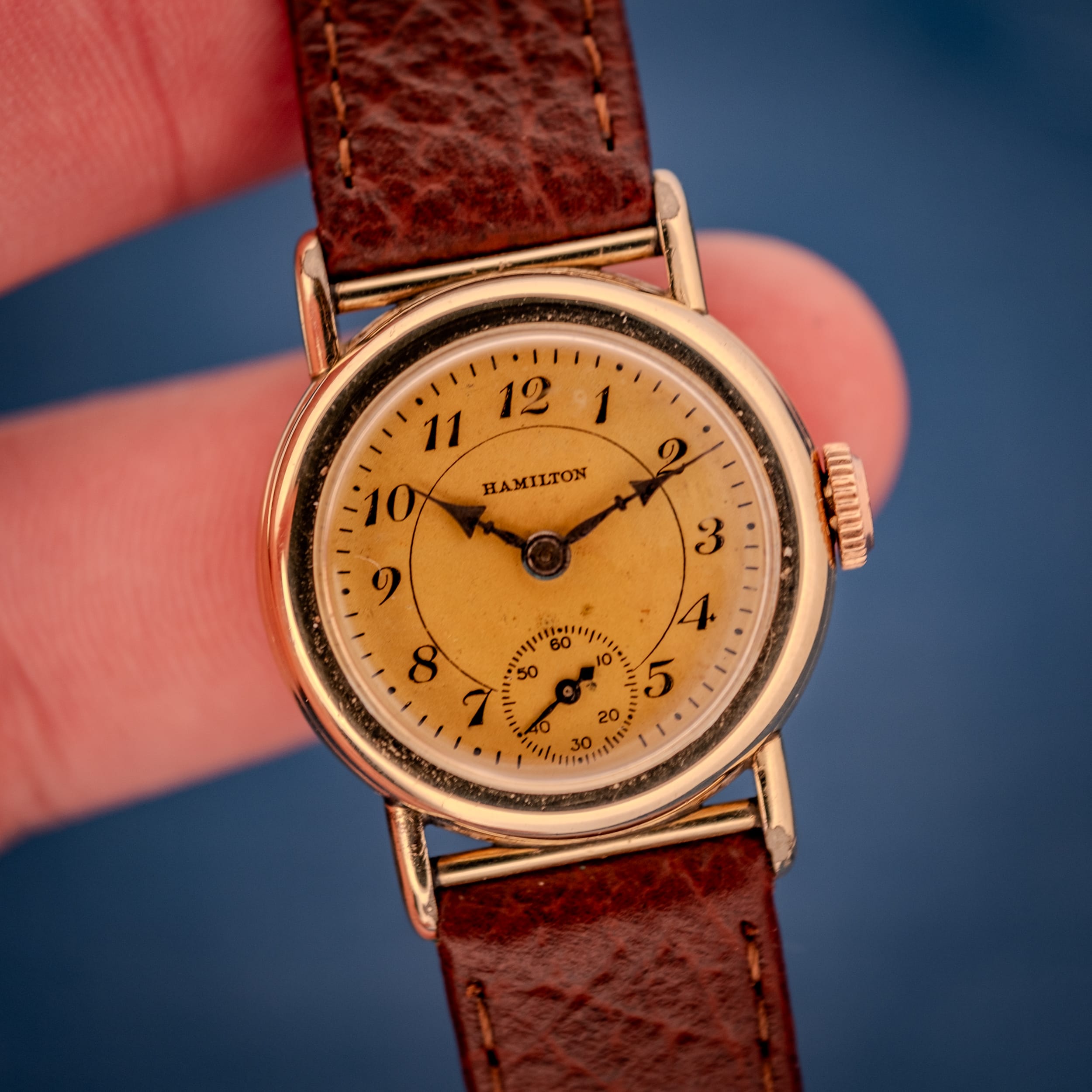
Inside the back of this 1936 Hamilton Randolph, in the small period stamping that almost nobody ever sees on a closed wrist, sits the Wadsworth Watch Case Co. signature next to the Hamilton serial. That stamping anchors the watch to a 1936 Lancaster delivery in a 10k yellow gold filled case Wadsworth built to Hamilton’s spec, wrapping a cream Art Deco dial drawn in the full design language of the period. To us, this is the moment American watchmaking stopped imitating Swiss dress design and started speaking with its own voice on the wrist, and in our opinion the small round 987-E references are among the more underread chapters of the pre-war Hamilton catalogue.
Hamilton was Lancaster, Pennsylvania, end of statement. From its founding in 1892 through the second World War, every movement the brand sold was designed, finished, and assembled at its Lancaster works, supplied to the U.S. Army across both world wars and chosen by Charles Lindbergh for his transatlantic flight. The Randolph sits in the catalogue of named dress models Hamilton built across the 1930s, the period when the brand transitioned production from pocket watches into wristwatches and gave nearly every reference a proper name rather than a number. Randolph, Prescott, Sutton, Morley, the names read like a roll call of American place and family. To us, this is the era when U.S. watchmaking produced wristwatches that did not need to apologize next to anything coming out of Geneva.
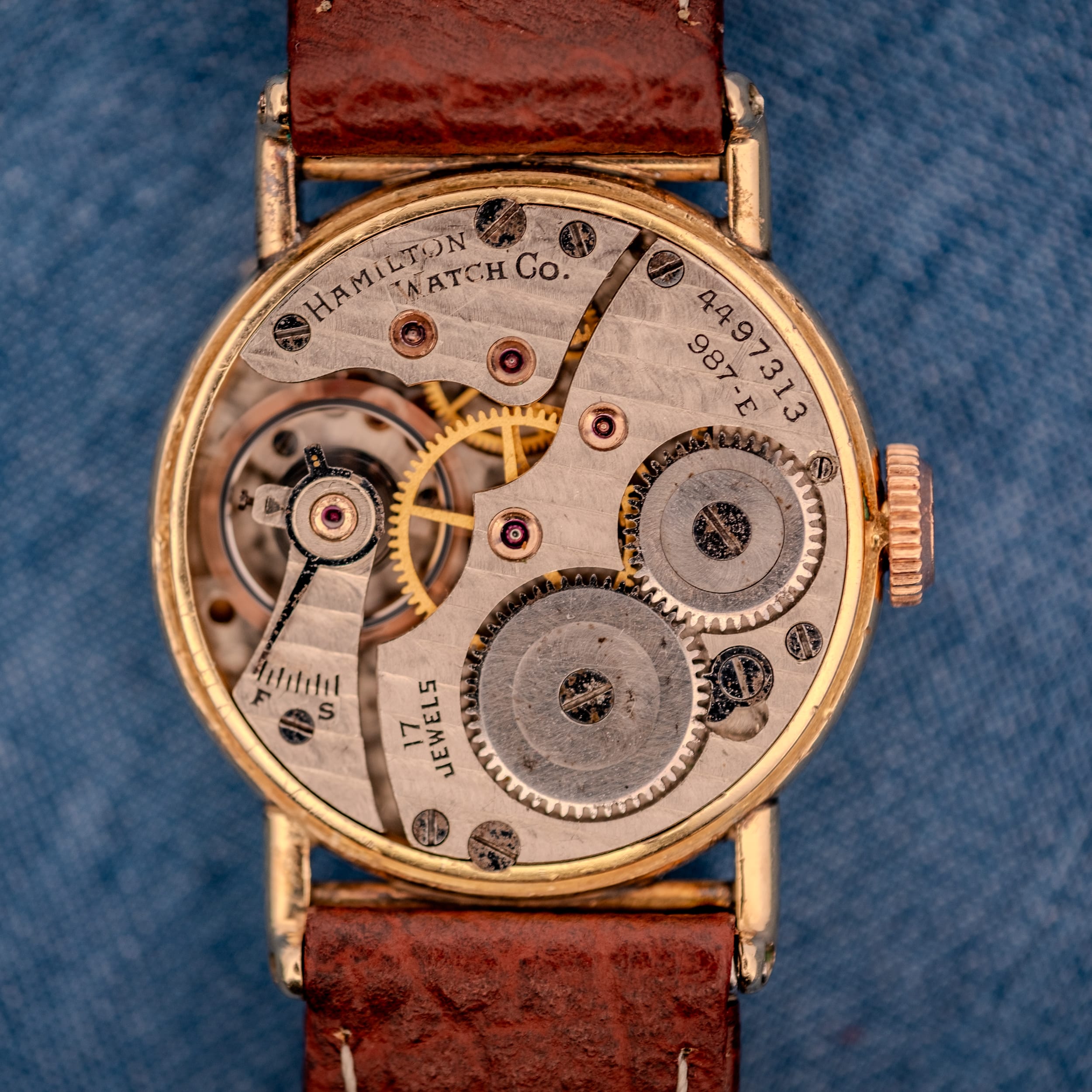
The caliber is the Hamilton 987-E, the Elinvar-hairspring variant of the brand’s foundational 6/0-size wristwatch movement family. The base 987 had carried Hamilton through the late 1920s with screw-set jewels. The 987-F brought friction-fit jewels, the F standing for friction. The 987-E added the Elinvar hairspring, the iron-nickel-chromium alloy developed by Charles-Edouard Guillaume that holds its elasticity across temperature and corrects the timekeeping drift that had plagued earlier hairsprings for two centuries. Seventeen jewels, manual wind, 18,000 vibrations per hour, sub-seconds at six, monometallic balance, double-roller escapement, the period-correct architecture of an American dress wristwatch built when Hamilton was still answering to nobody but itself. Our service photograph reads HAMILTON WATCH Co. across the top of the plate, with the serial 4497313 and the caliber designation 987-E stamped to the right, 17 JEWELS along the bottom edge, and the F S regulator scale at lower left. The serial dates production firmly to 1936 against the Hamilton tables. To us, the 987-E is one of those quietly important movements that does not get talked about next to its Swiss contemporaries but that runs for nine decades on a clean and oil and keeps time within a margin its original owner would recognize.
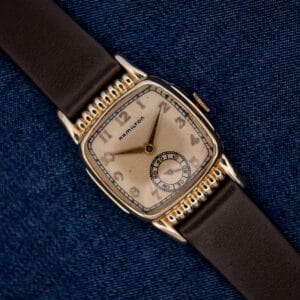
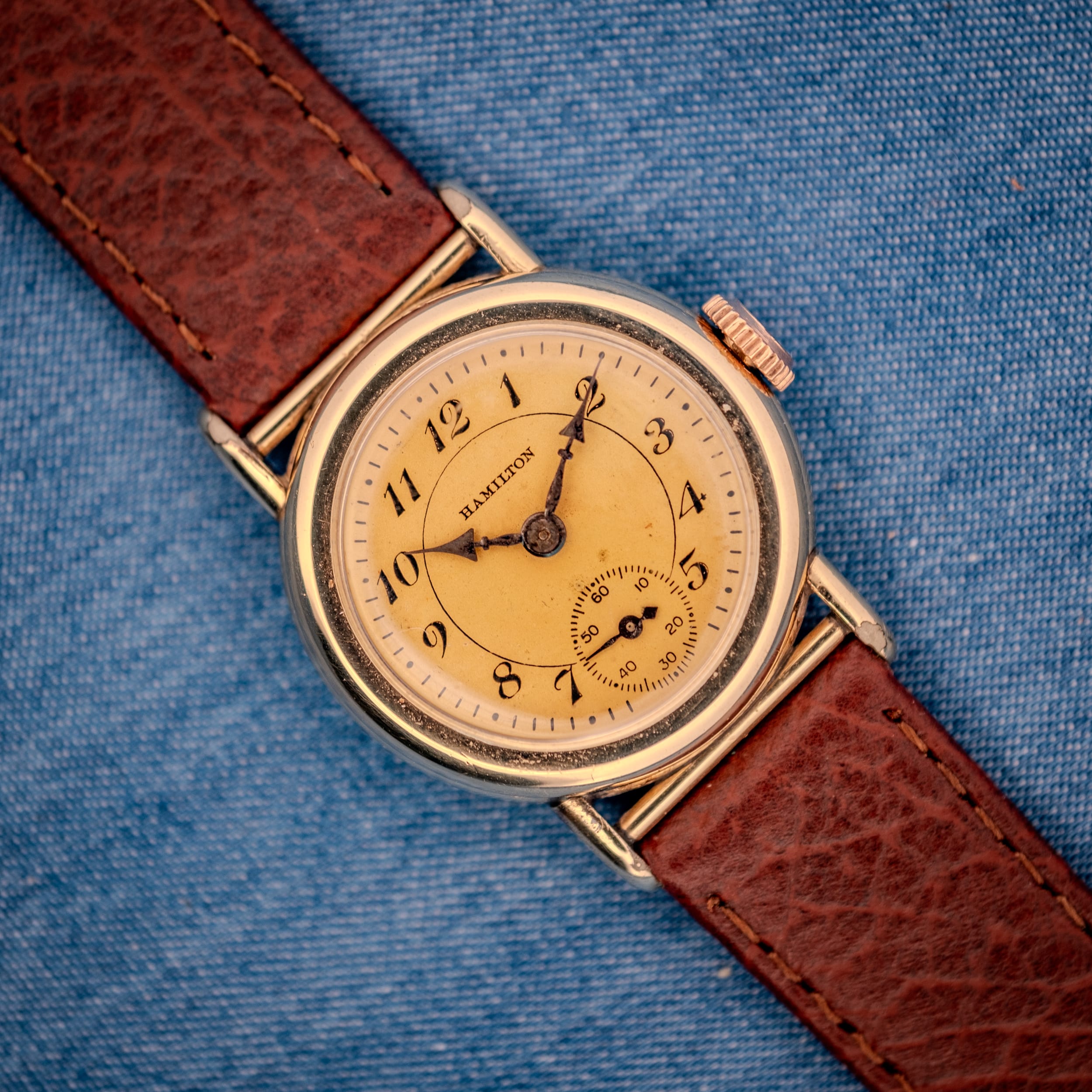
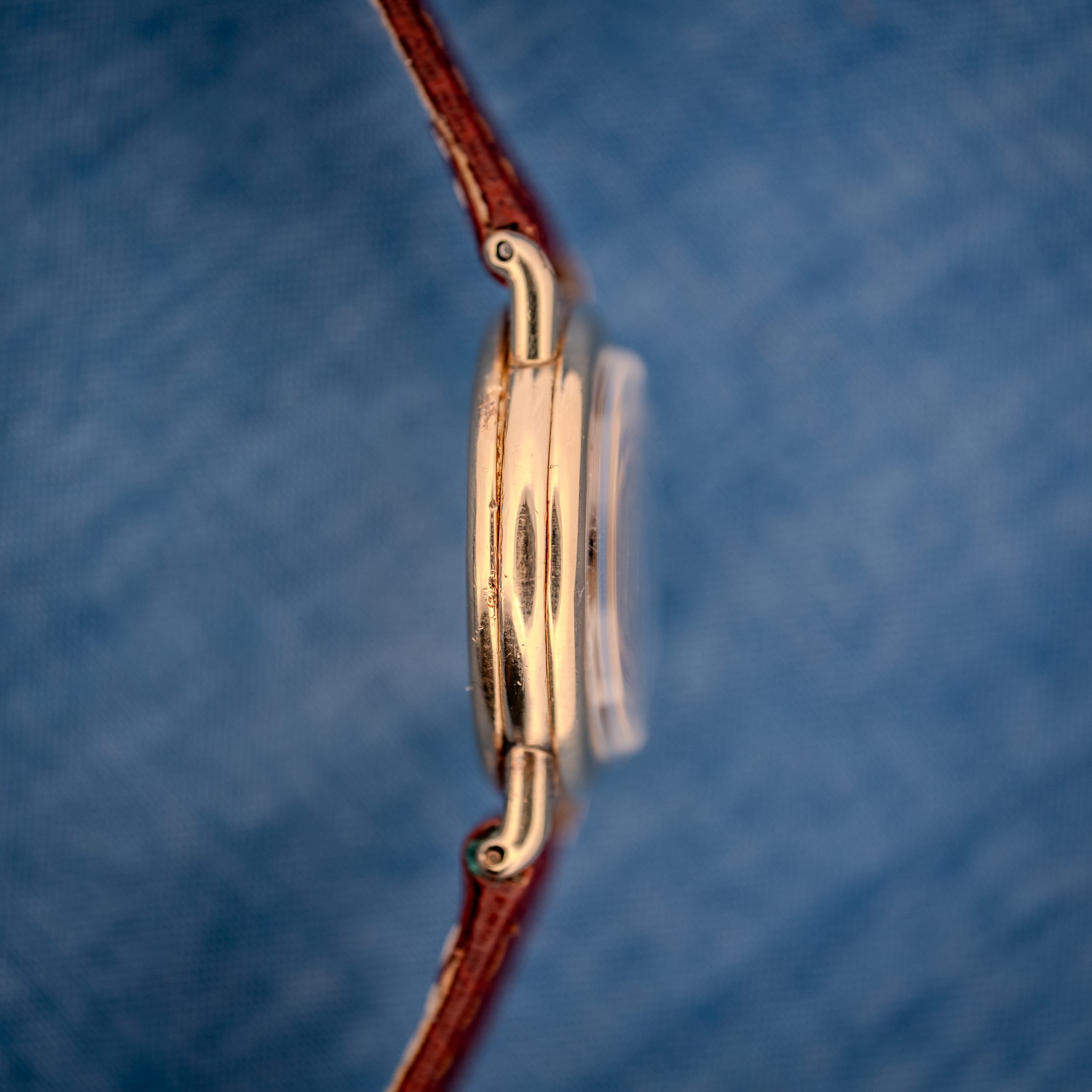
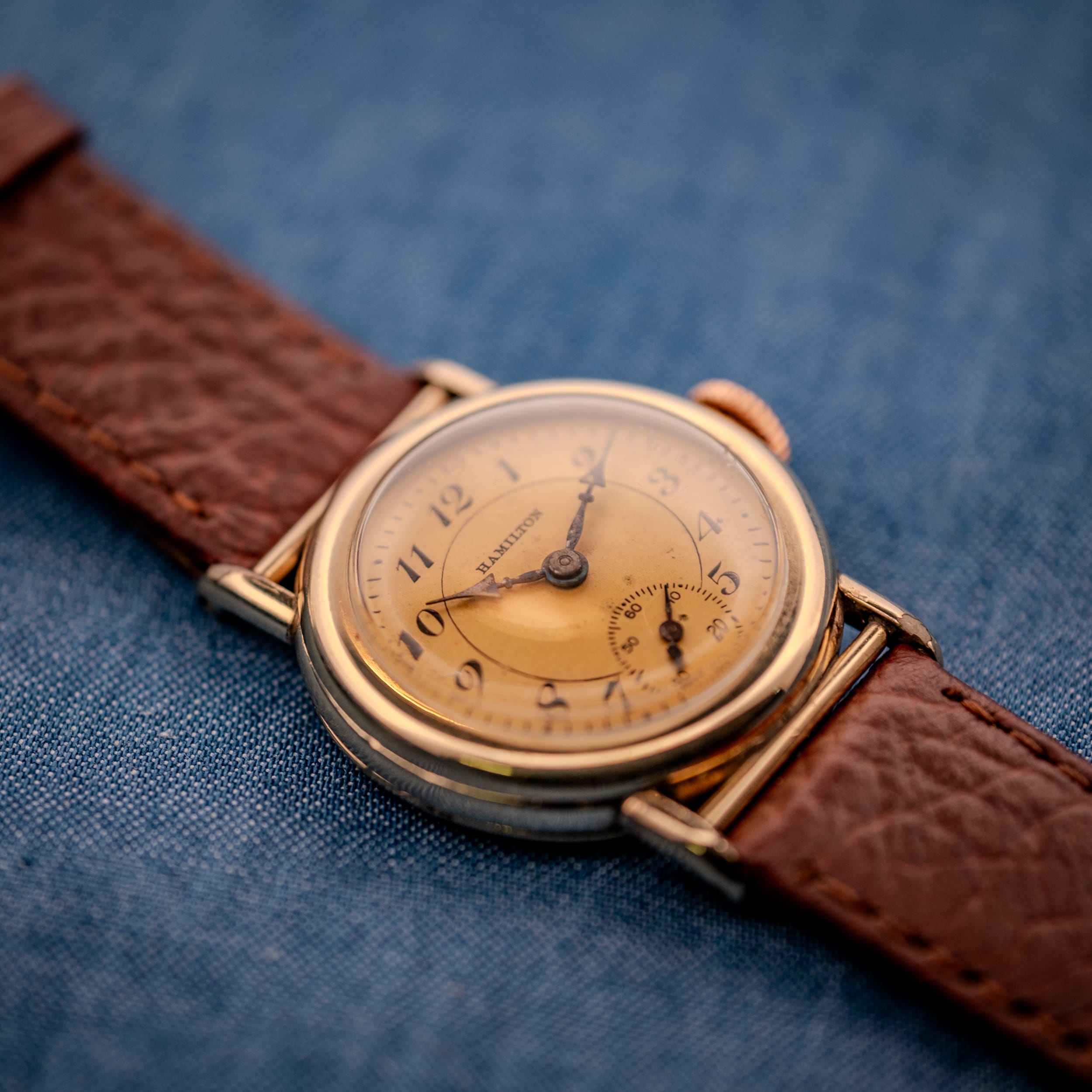
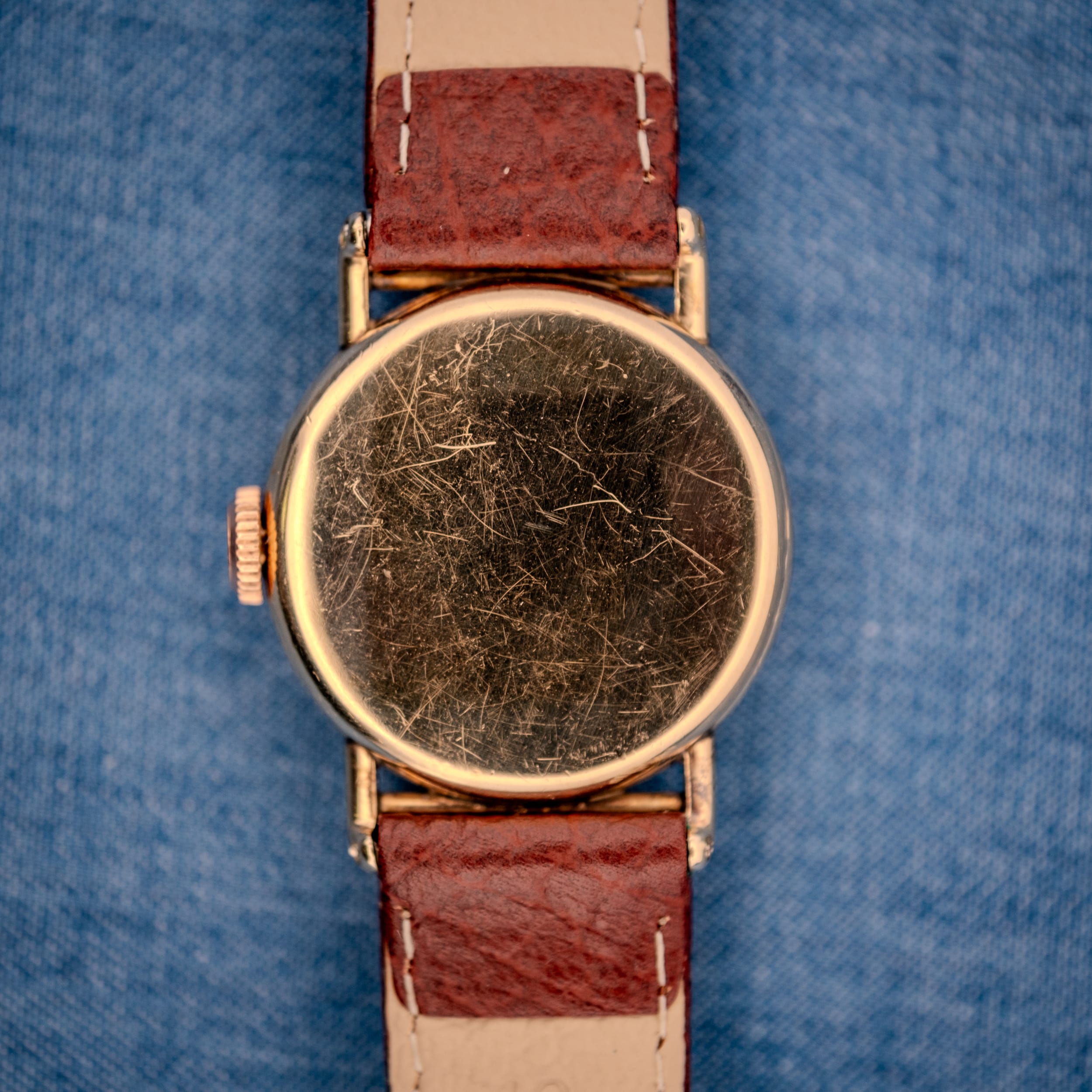
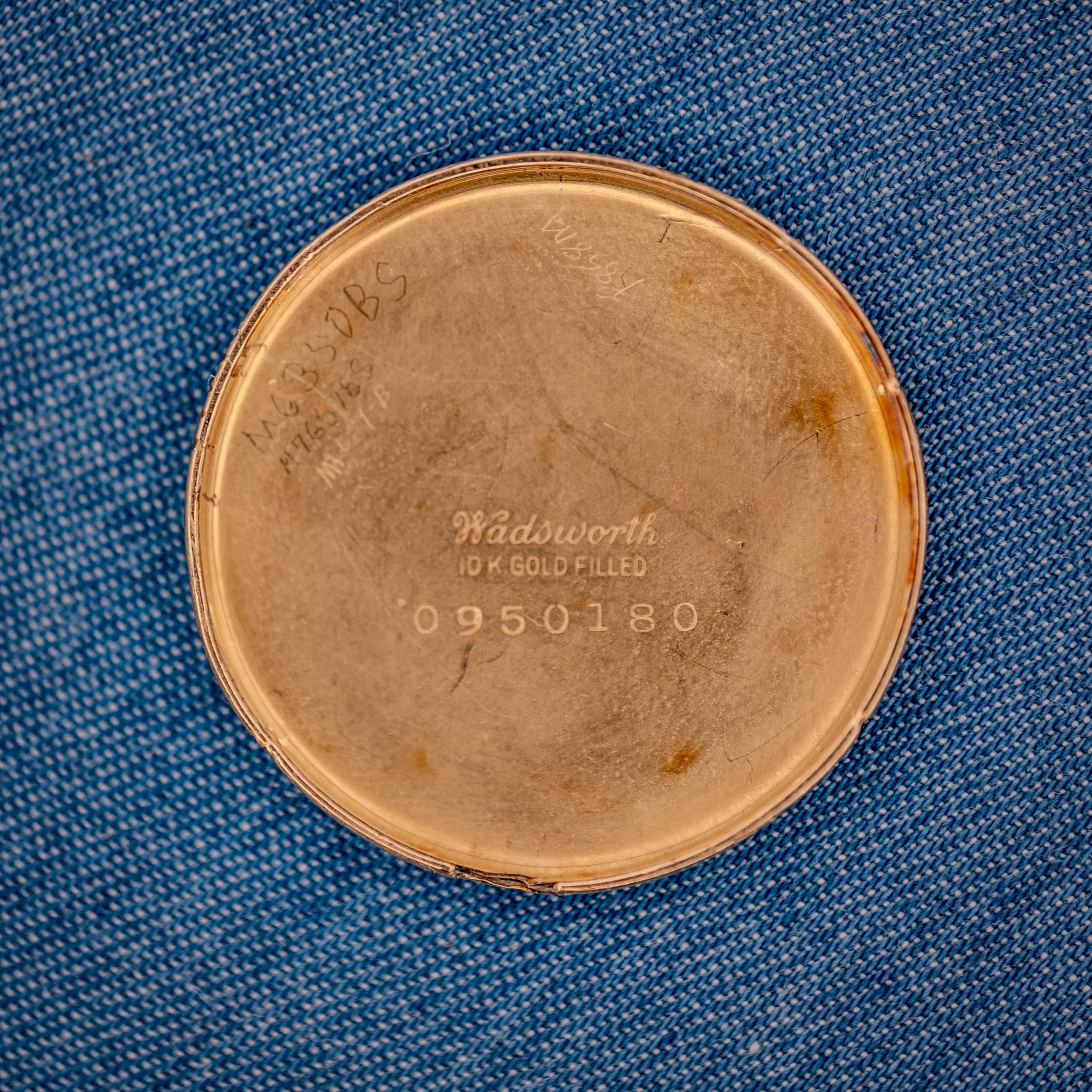
The case is a round 10k yellow gold filled construction supplied to Hamilton by Wadsworth, one of the American casemakers Hamilton contracted with through the 1930s alongside Star and Keystone. The outer caseback wears a smooth field with honest hairline scratching scattered across it, the kind of wear pattern that records eighty-nine years on a wrist rather than in a drawer. Open the back and the inner caseback is stamped Wadsworth across the top, 10K GOLD FILLED beneath, and the case serial 0950180 reading clearly below, with watchmaker service scratches around the perimeter telling you this watch has been cared for properly across its life. Gold-filled construction means a substantial layer of solid 10k gold metallurgically bonded to a base metal core, the kind of build that wears across decades rather than rubs off across years. The case measures 27.6mm across the bezel with a 34.3mm lug-to-lug span and a 16mm lug width, with thin wire-formed lugs soldered to the round case in the architectural style that defined American dress watches of the mid-1930s.
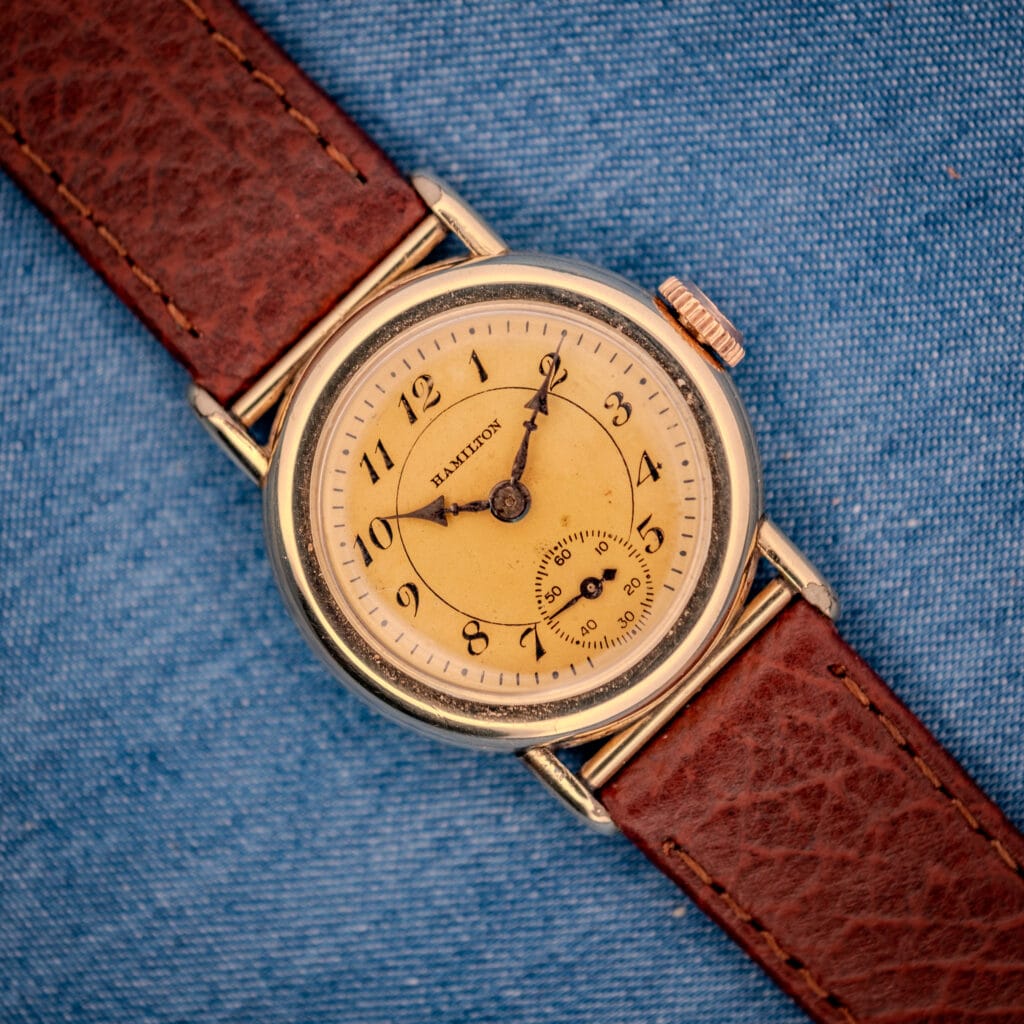
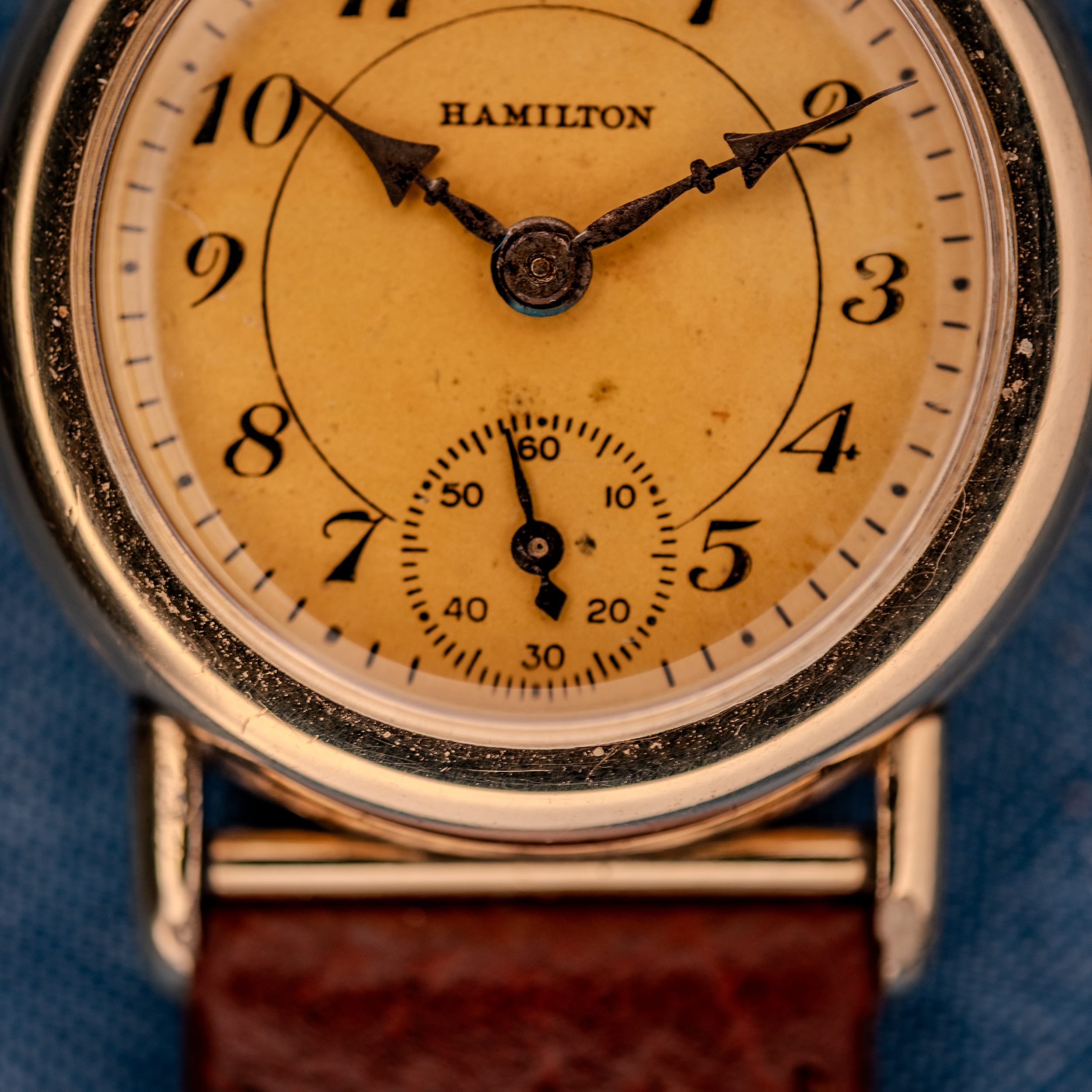
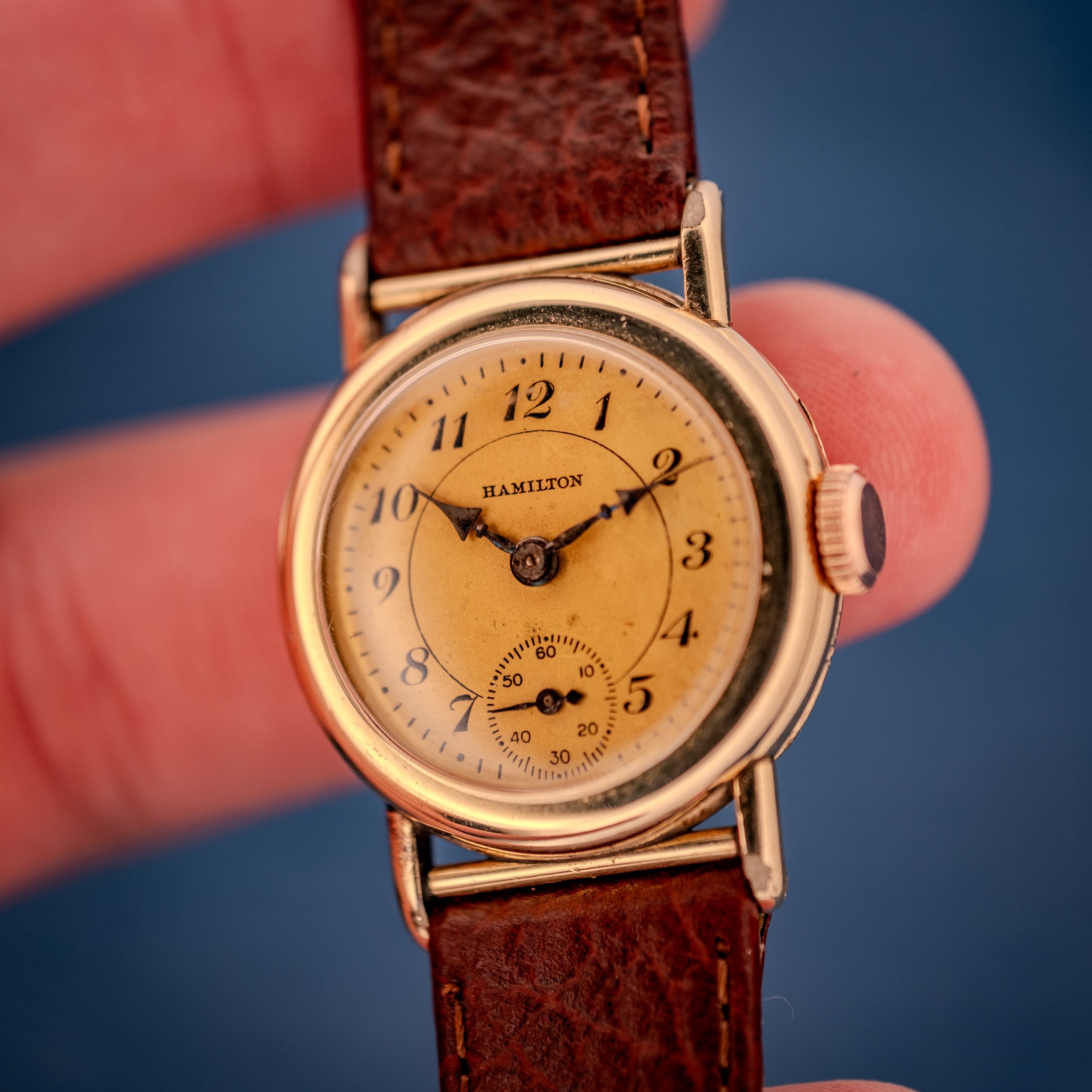
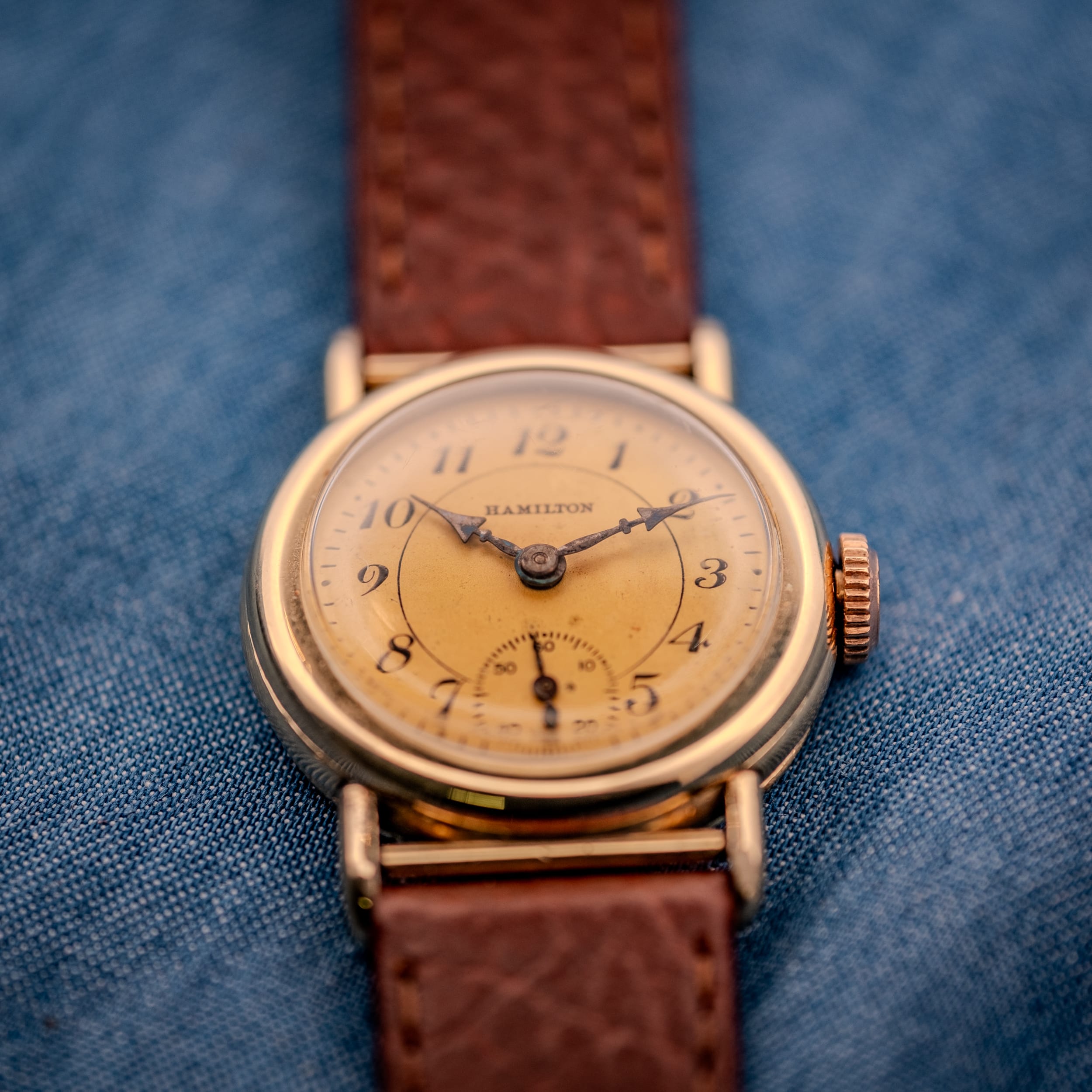
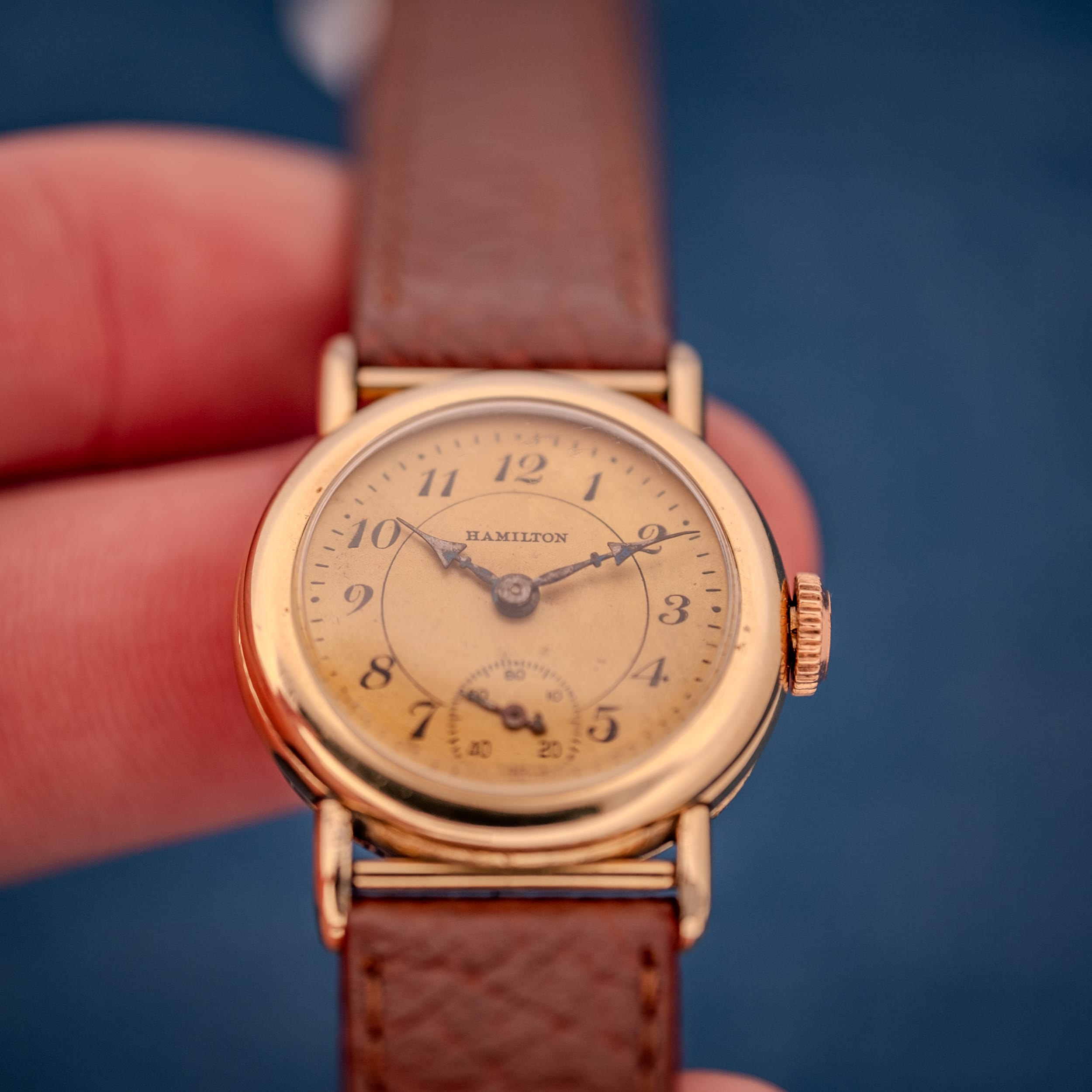
The dial is where the watch turns into Art Deco proper. The original factory surface has aged across nine decades into a warm cream field with gentle honey patina pooling toward the center and around the sub-seconds, the kind of even mellow tonal shift that you simply cannot fake on a refinished dial. The Arabic numerals are drawn in the elongated Breguet-influenced typography that ran through the late-1920s and 1930s Hamilton catalogue, every numeral rendered with the slight calligraphic flourish that reads instantly as period rather than reproduction. The printed HAMILTON wordmark sits just under twelve in the upper half of the dial. A sub-seconds register cuts in at six with its own ring of Arabic numerals at every ten-second mark, drawn in proportion against the main dial. The cathedral arrow-tipped hour and minute hands are the original Hamilton-fitted set in blued steel with their facet finishing intact, paired against a small blued-steel seconds hand in the sub-register. This is a pre-tritium-era American dress dial, built without luminous compound, and the originality story stays clean across every visible feature. To us, an unrestored Art Deco Hamilton dial that has aged into honey rather than been scrubbed back to white is exactly the kind of survivor that the named-model 987-family Hamiltons get genuinely chased for.
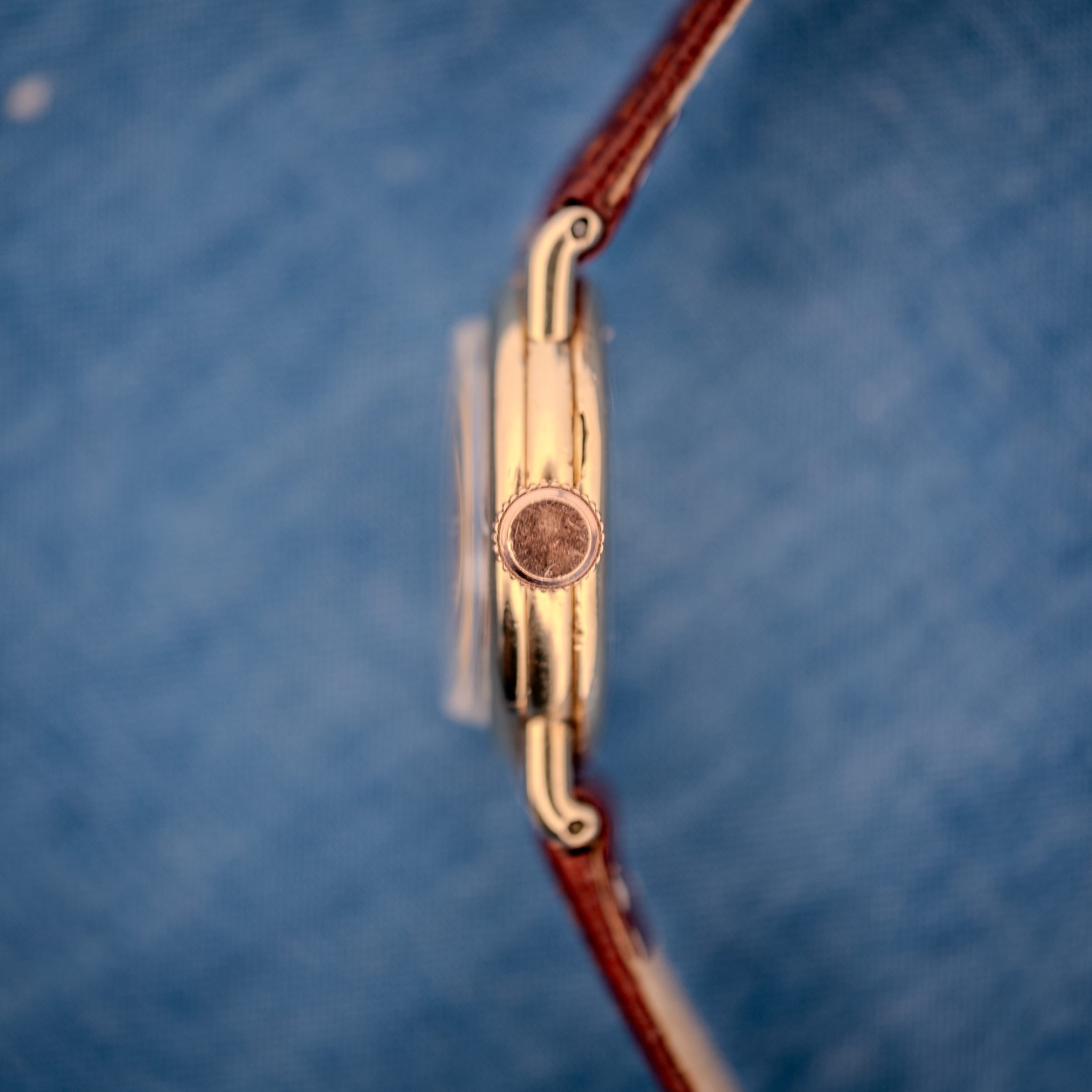
The crown is a rose-toned signed component with the toothed edge intact and operates with the positive engagement a properly maintained 987-E should give. The crystal sits clear above the dial with the gentle doming that helps the cream surface play in light.
We have paired the watch with one of our textured brown leather straps and an OTTUHR signed buckle. The warm chocolate grain reads as a deliberate match to the honey-aged dial and the yellow gold filled case, the brown-on-gold-on-cream palette letting the Art Deco dial language sit as the loudest element on the wrist exactly where it belongs.
Serviced in-house at OTTUHR and backed by our 2-year mechanical warranty, this is the kind of pre-war Lancaster Hamilton we get genuinely excited about. Factory original dial, factory cathedral hands, original signed crown, intact Wadsworth case stampings, and the 987-E manual caliber with its Elinvar hairspring running cleanly. For the collector who values originality over polish, who reads Art Deco dial language as character rather than antique, and who wants a piece of American watchmaking from the era before Hamilton’s corporate sale, this is exactly the kind of watch we love bringing in.