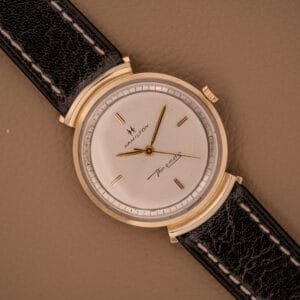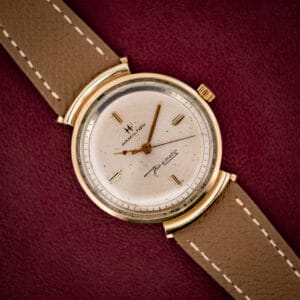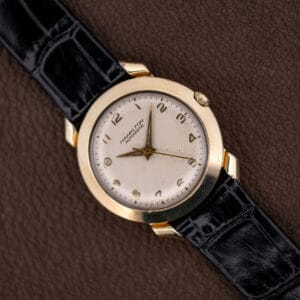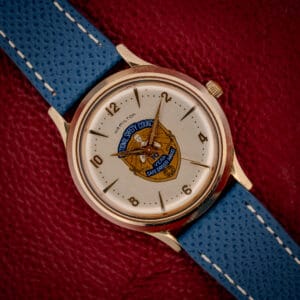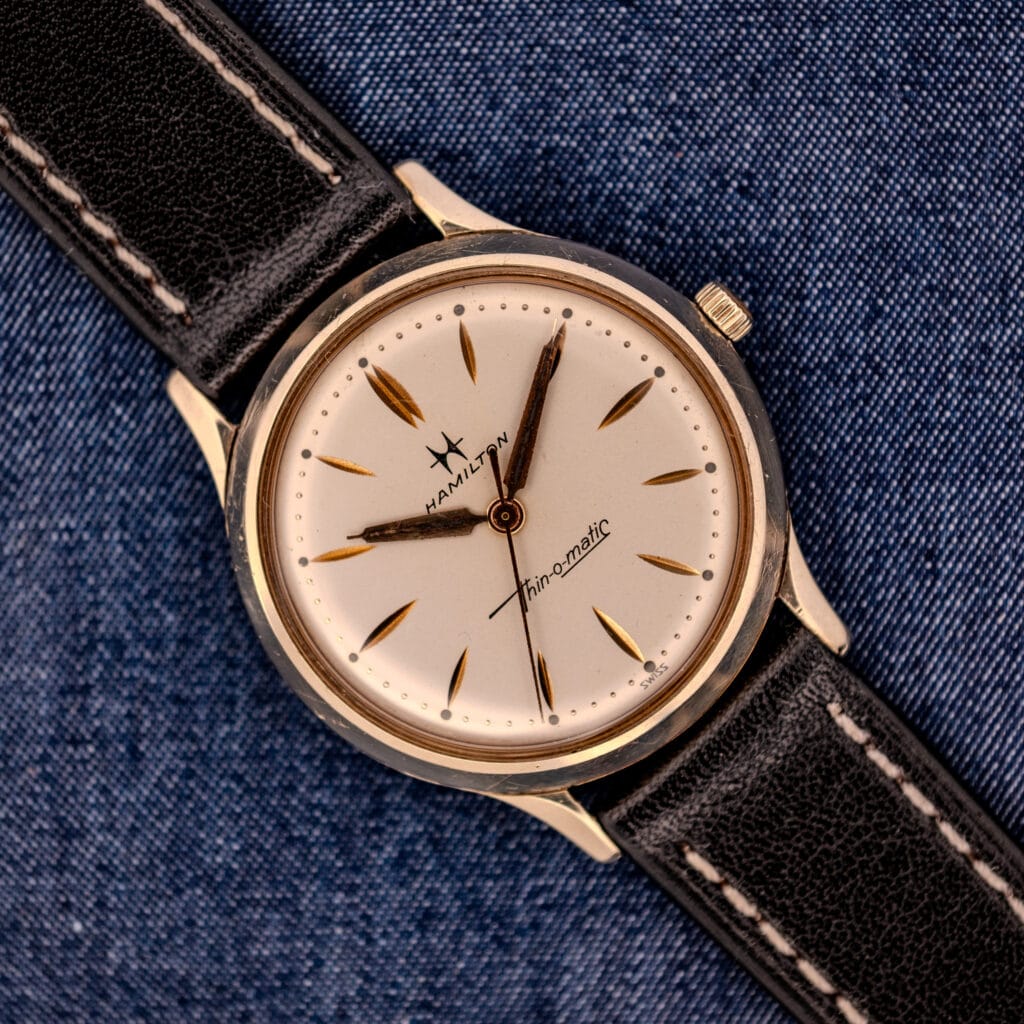
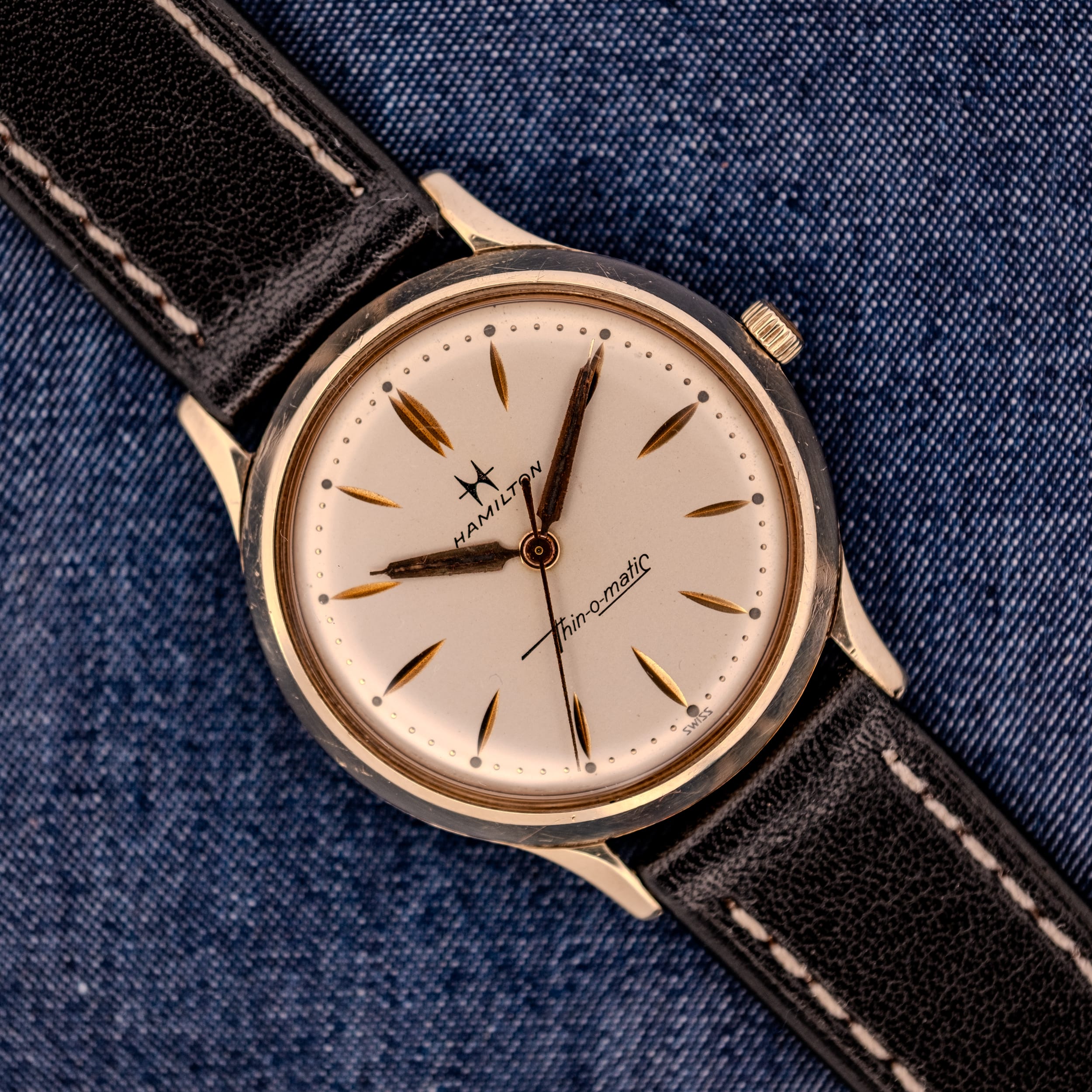
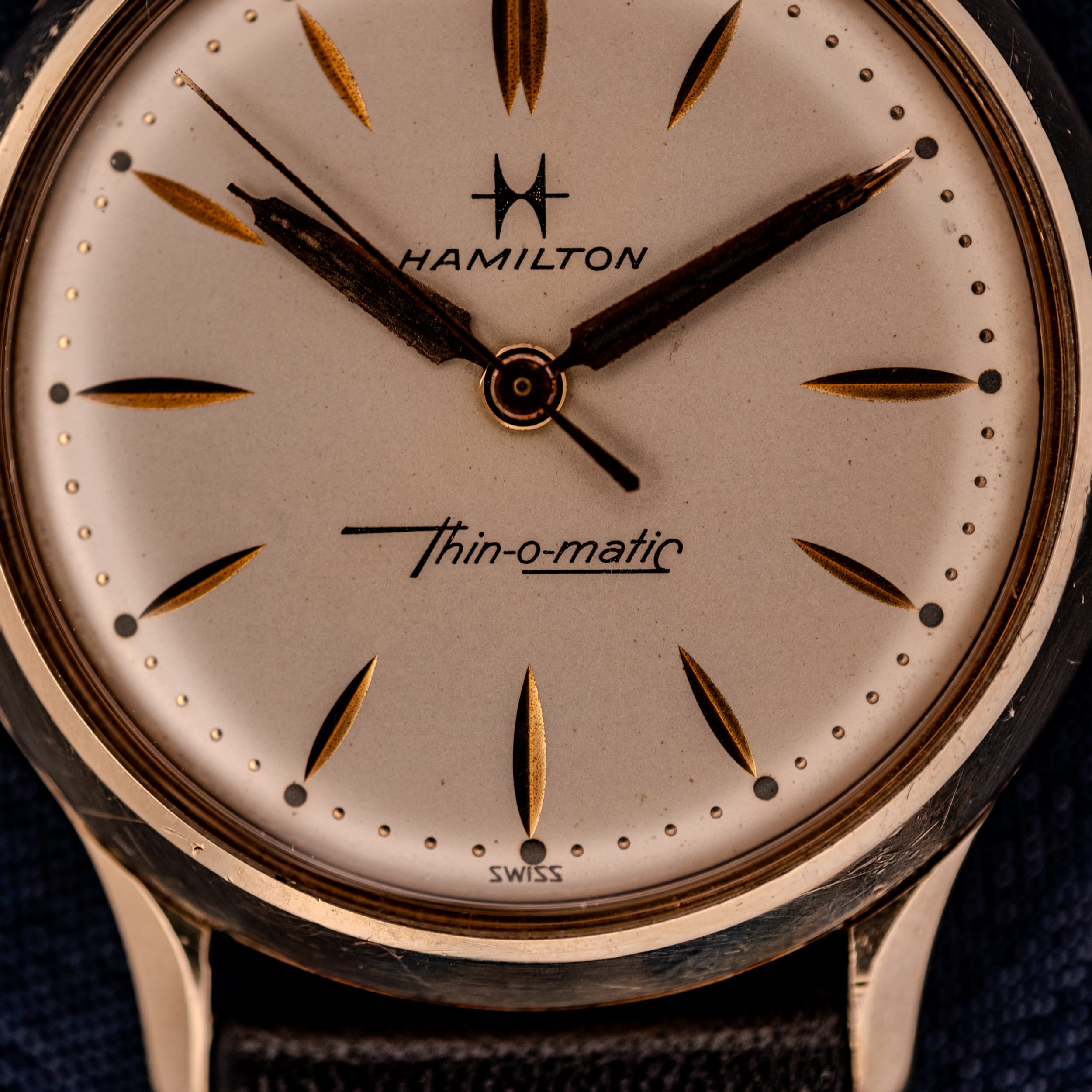
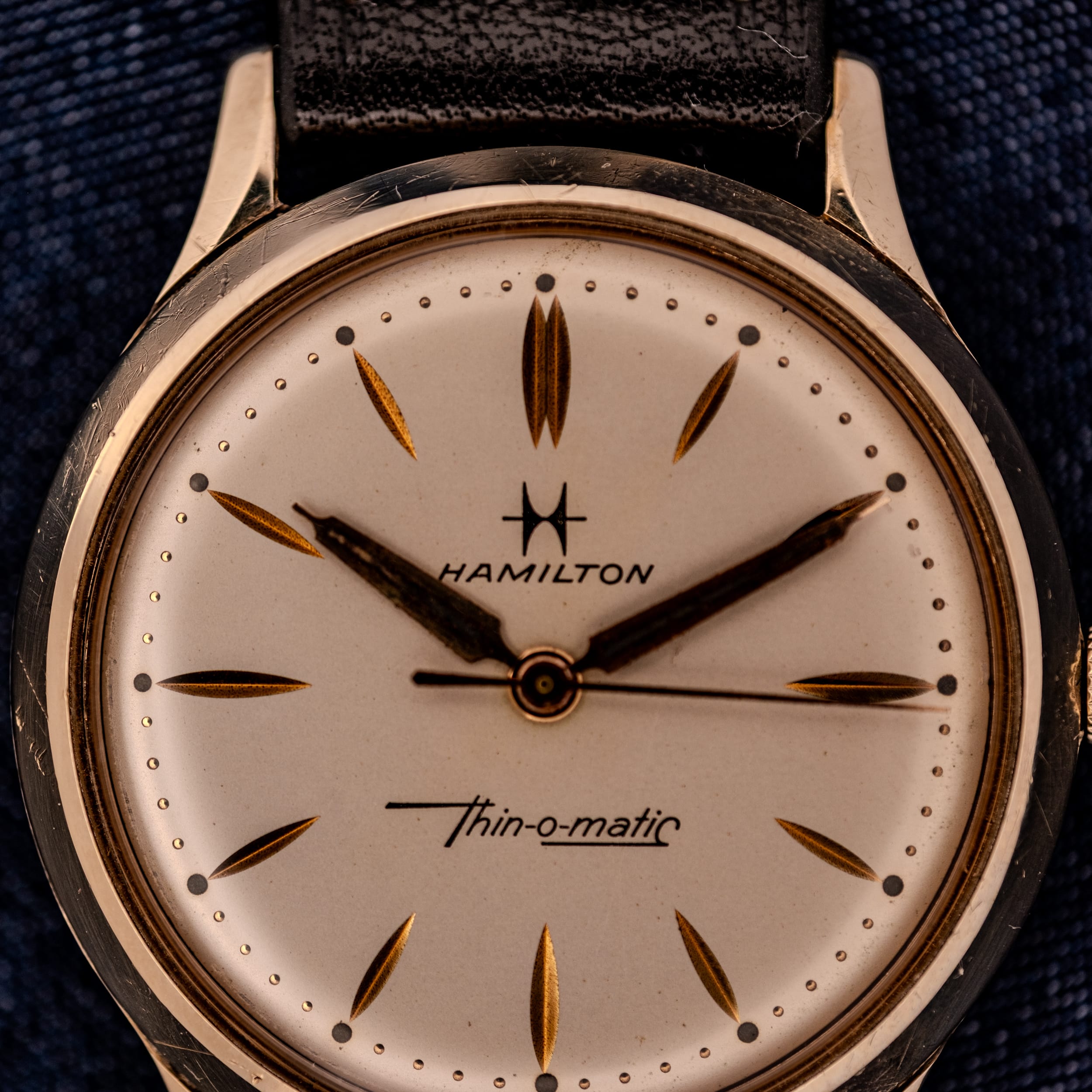
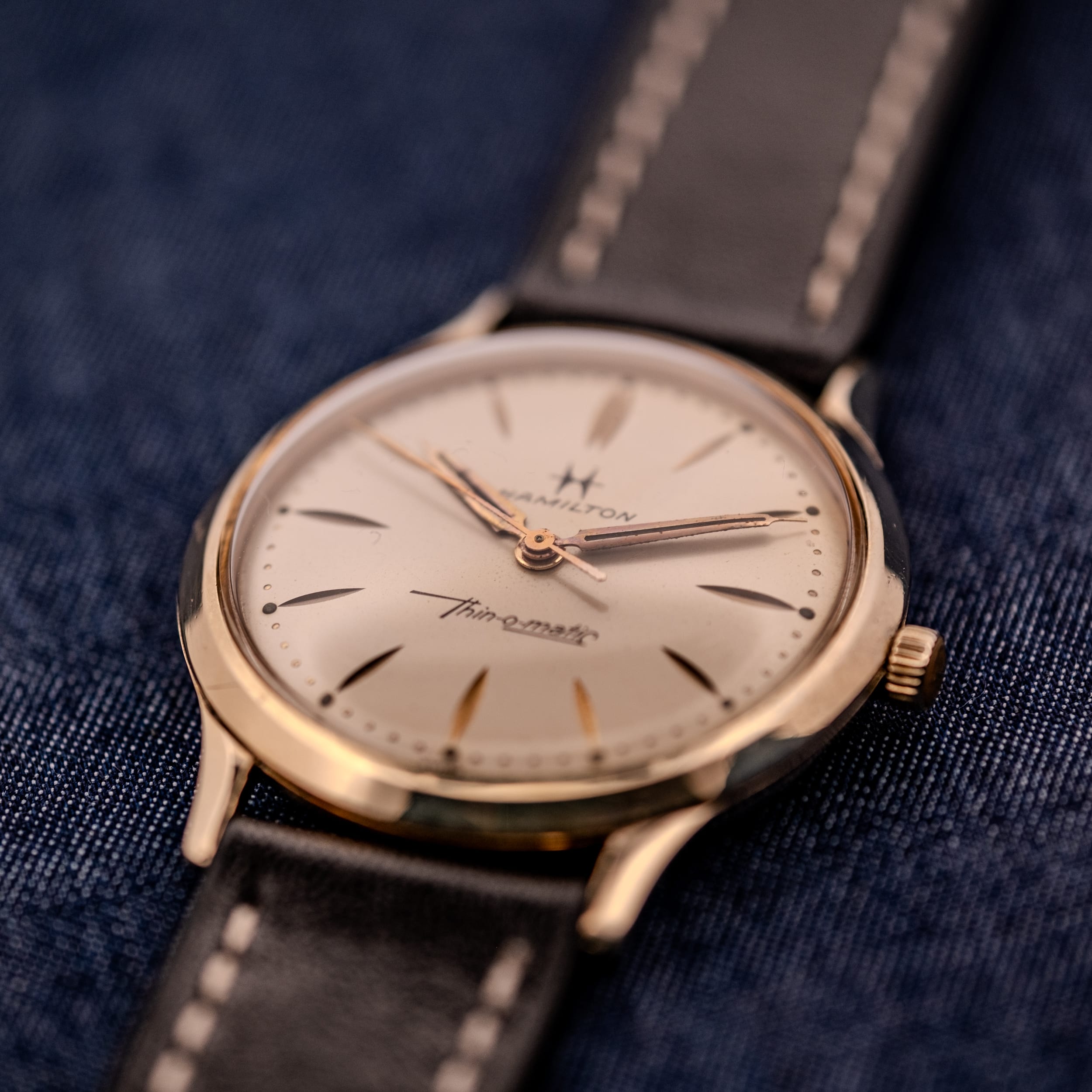
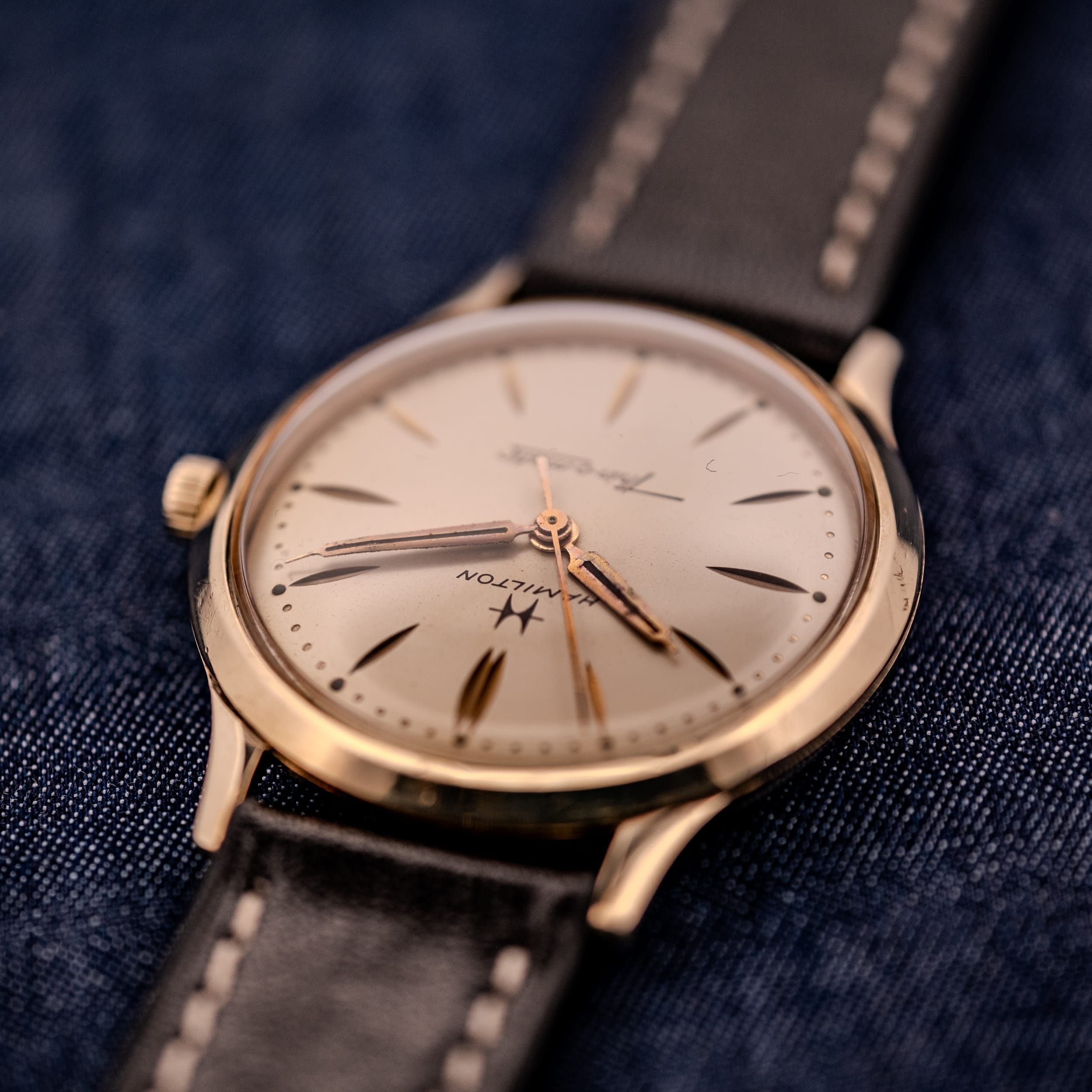
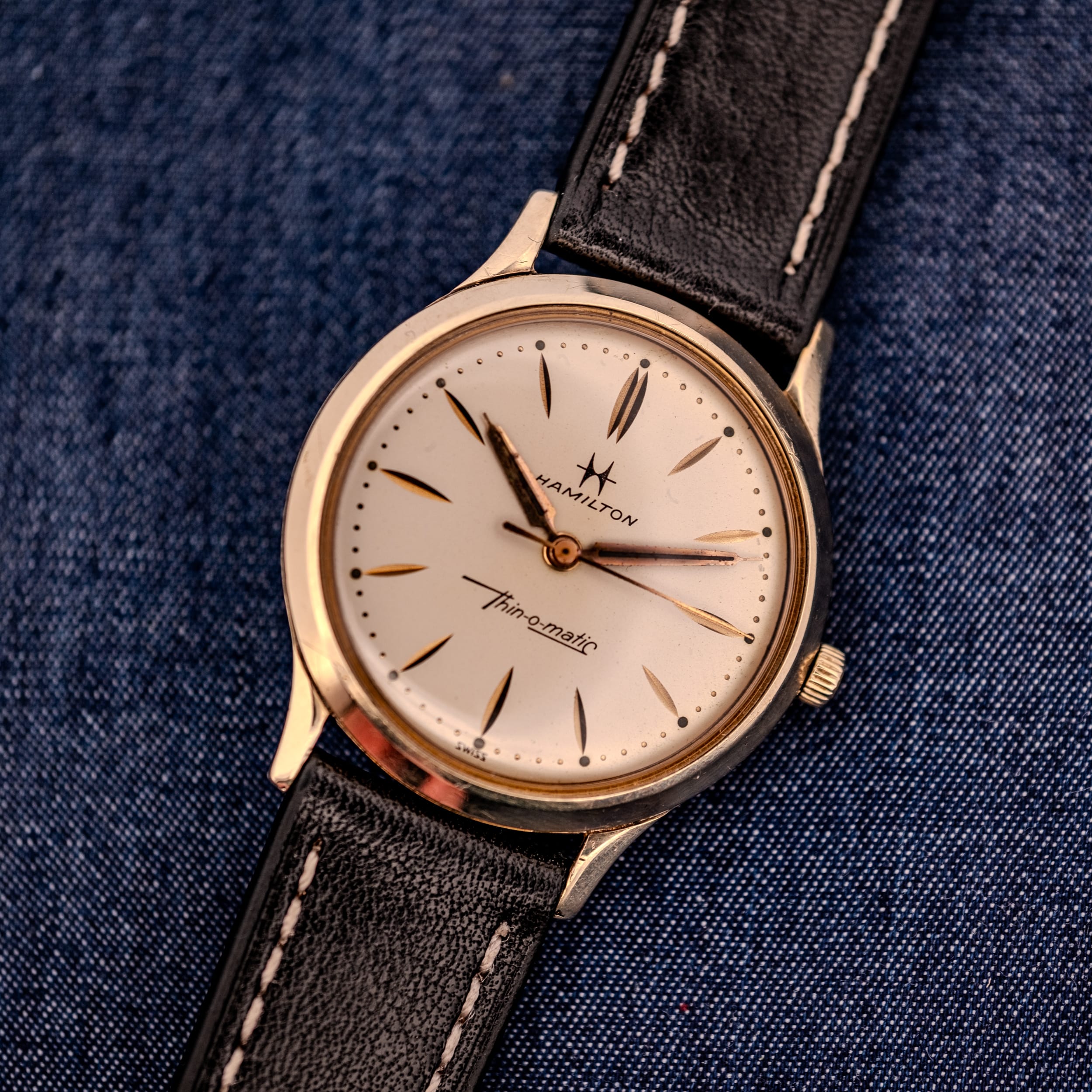
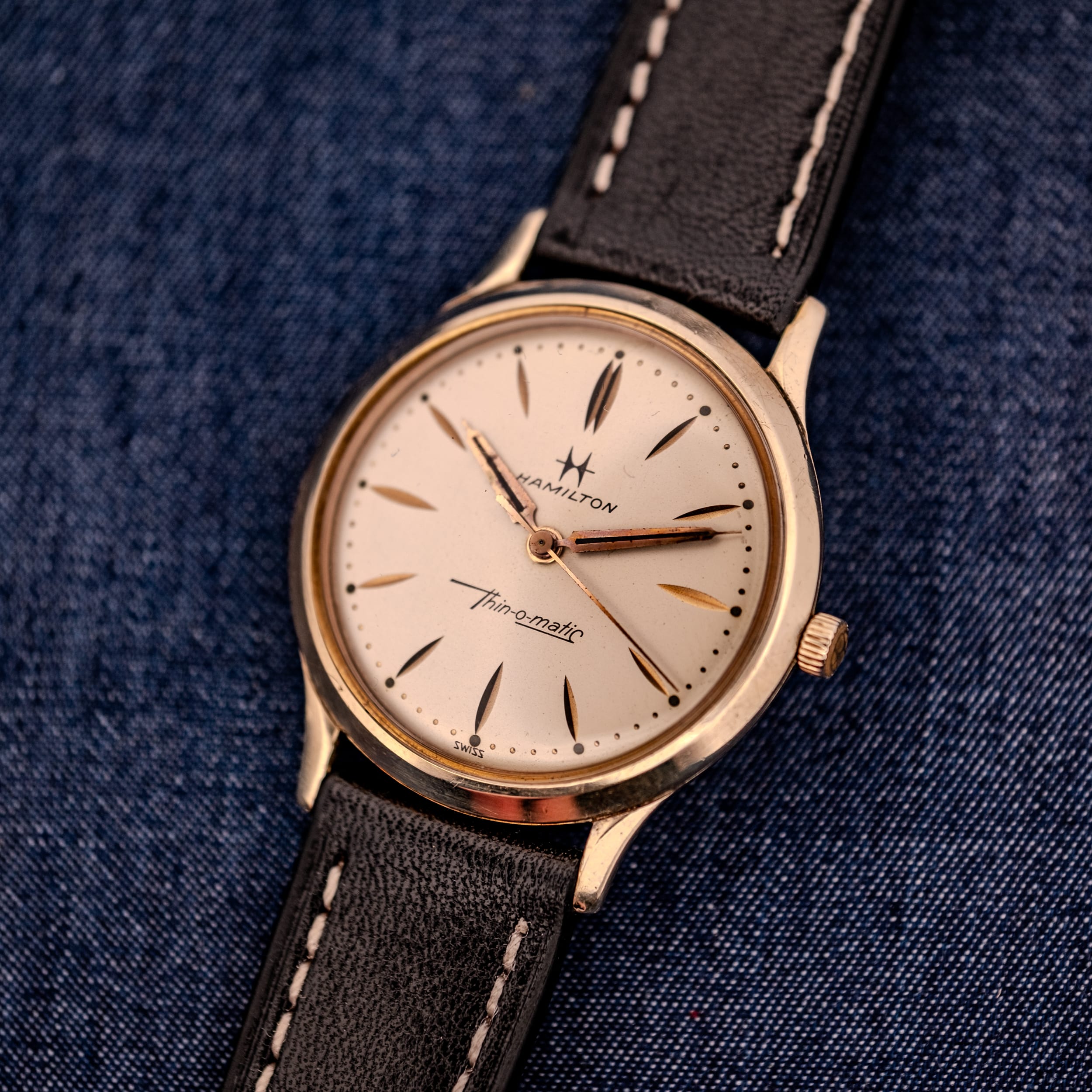
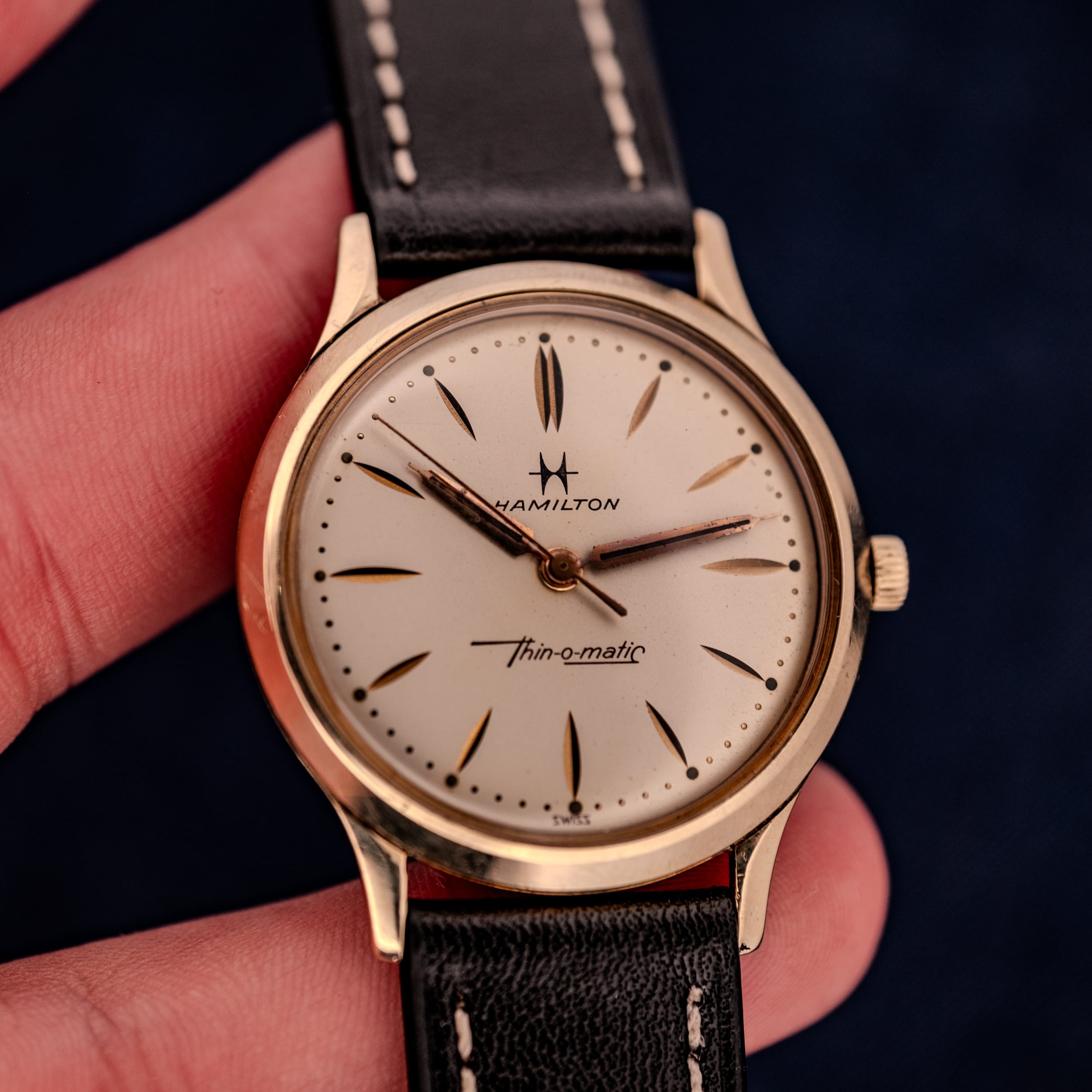
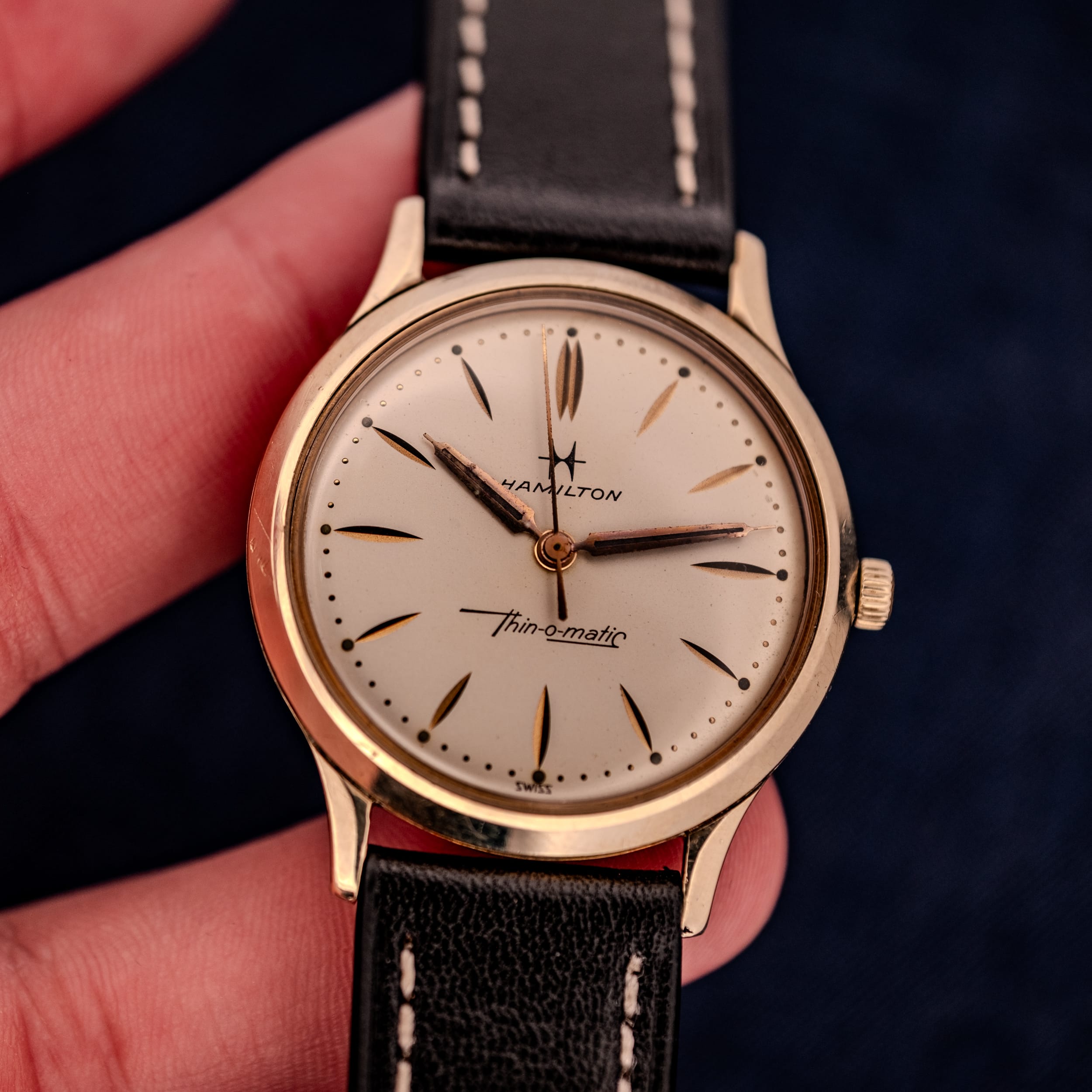
The cream dial on this Thin-o-Matic has aged the way a cream dial should, warm and even and gently softened, the gold marquise indices still catching light and the cursive Thin-o-matic script at six still as confident as the day Lancaster printed it. To us, this is the dial that holds the whole watch together, and the dial that anyone shopping a 1962 Hamilton Thin-o-Matic should be looking at first.
Hamilton’s Thin-o-Matic line emerged from a specific moment in mid-century watchmaking when thinness genuinely was the headline. Buren in Switzerland patented the micro-rotor architecture in 1954, and Hamilton was among the first non-Buren names to license it, pairing the Swiss ebauche with their own dial work, casing, and American distribution out of Lancaster, Pennsylvania. The Thin-o-Matic line gave Hamilton a flagship automatic platform that could compete with the Swiss thin-automatic specialists of the period, and the partnership eventually became outright ownership when Hamilton acquired Buren in 1966.
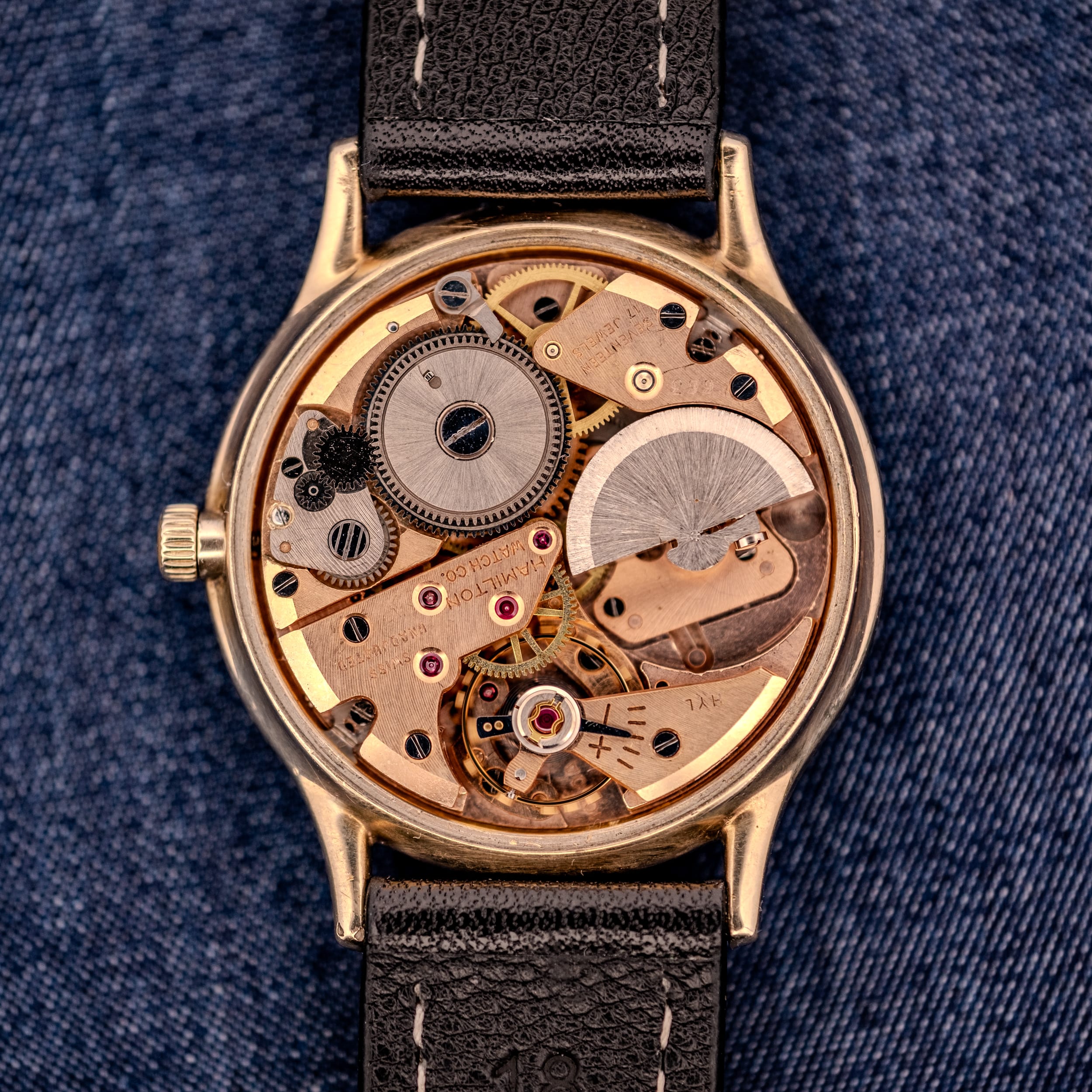
The movement here is the Hamilton 663, the brand’s name for the Buren-supplied 17-jewel micro-rotor automatic that powers this generation of the Thin-o-Matic. The micro-rotor is the small offset winding mass visible at the right side of the movement when you flip the watch over, swinging in a tight arc within the plane of the main plate rather than stacking a full rotor on top, the architecture that lets the entire automatic mechanism sit at roughly 3.25mm thick. Our service photograph shows the bridge signed HAMILTON / WATCH CO. with the 663 caliber number stamped at the lower right, the whole movement finished in the warm pink-gilt plating that distinguishes the first-generation Hamilton-Buren collaboration from the later nickel-plated production. The reversing pinion that sits at the heart of the winding train allows that small rotor to wind in both directions of swing, a piece of design that made the micro-rotor a serious automatic architecture rather than a clever curiosity.
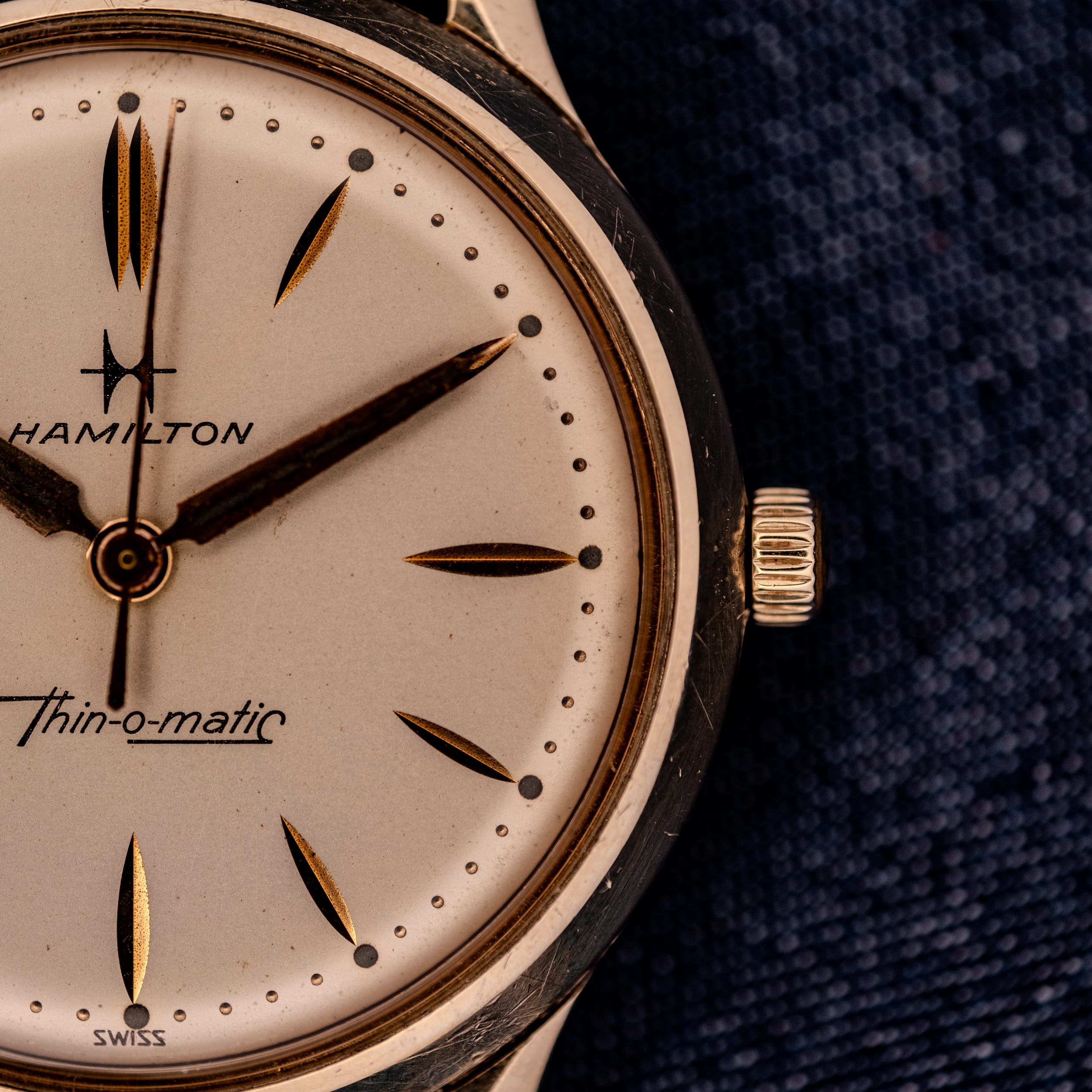
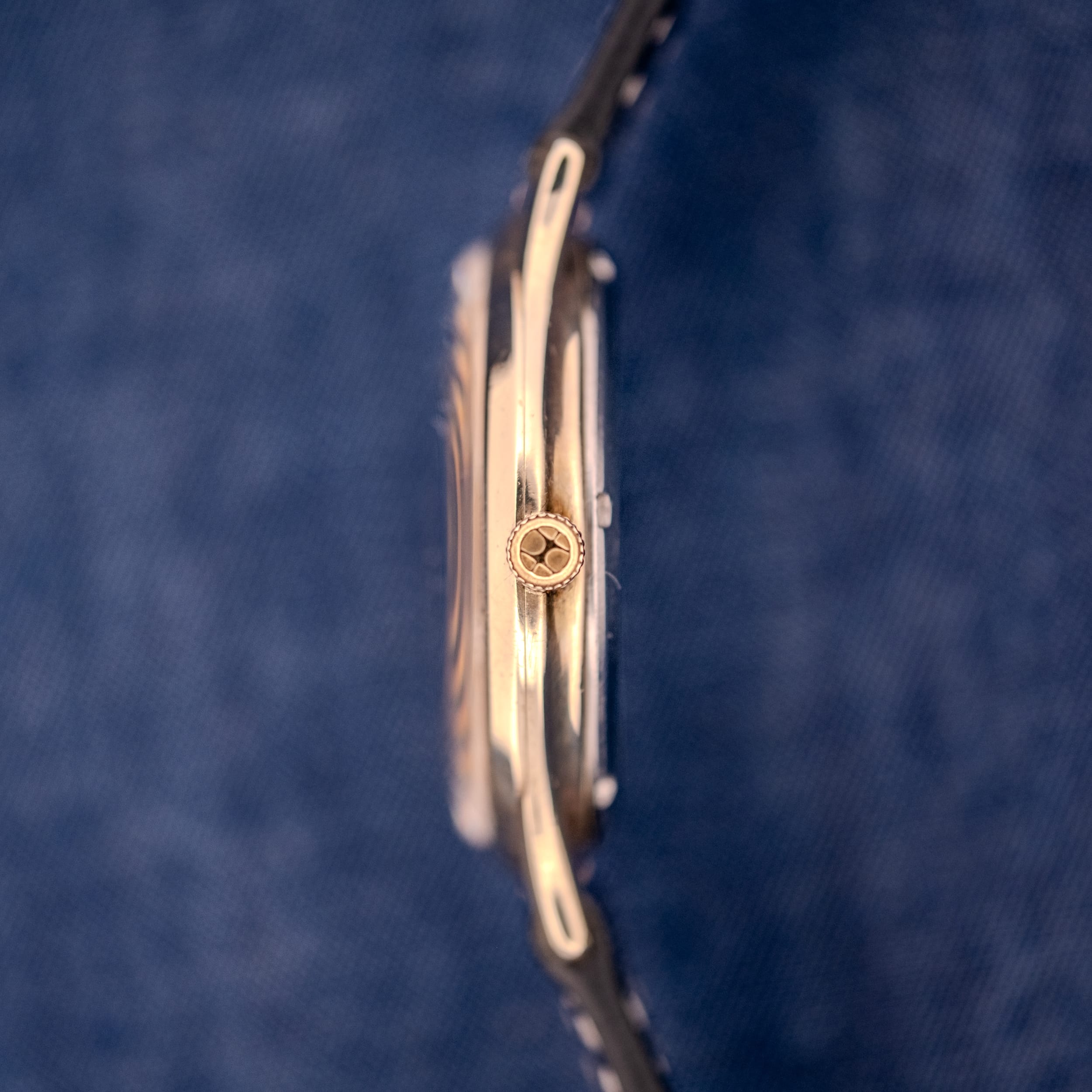
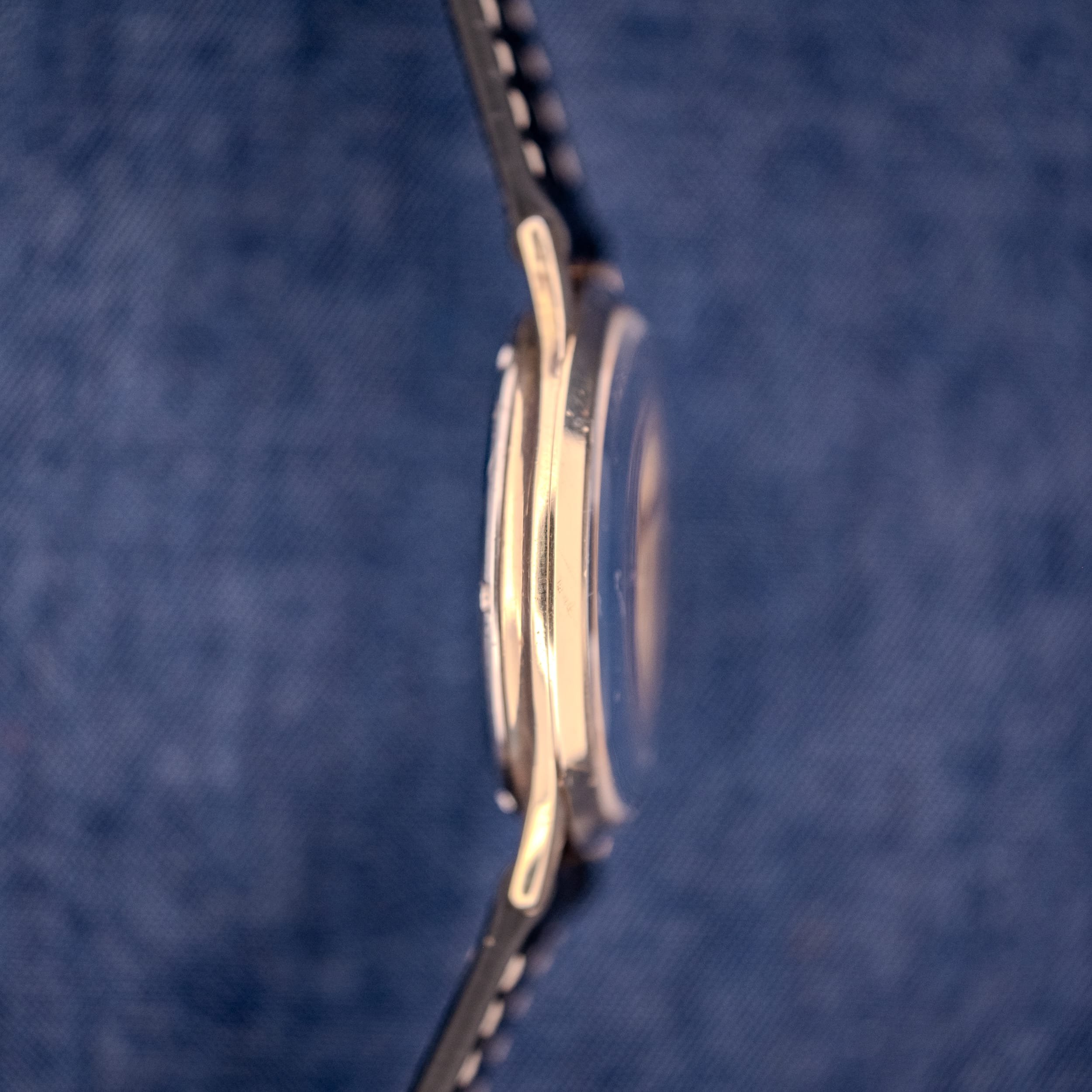
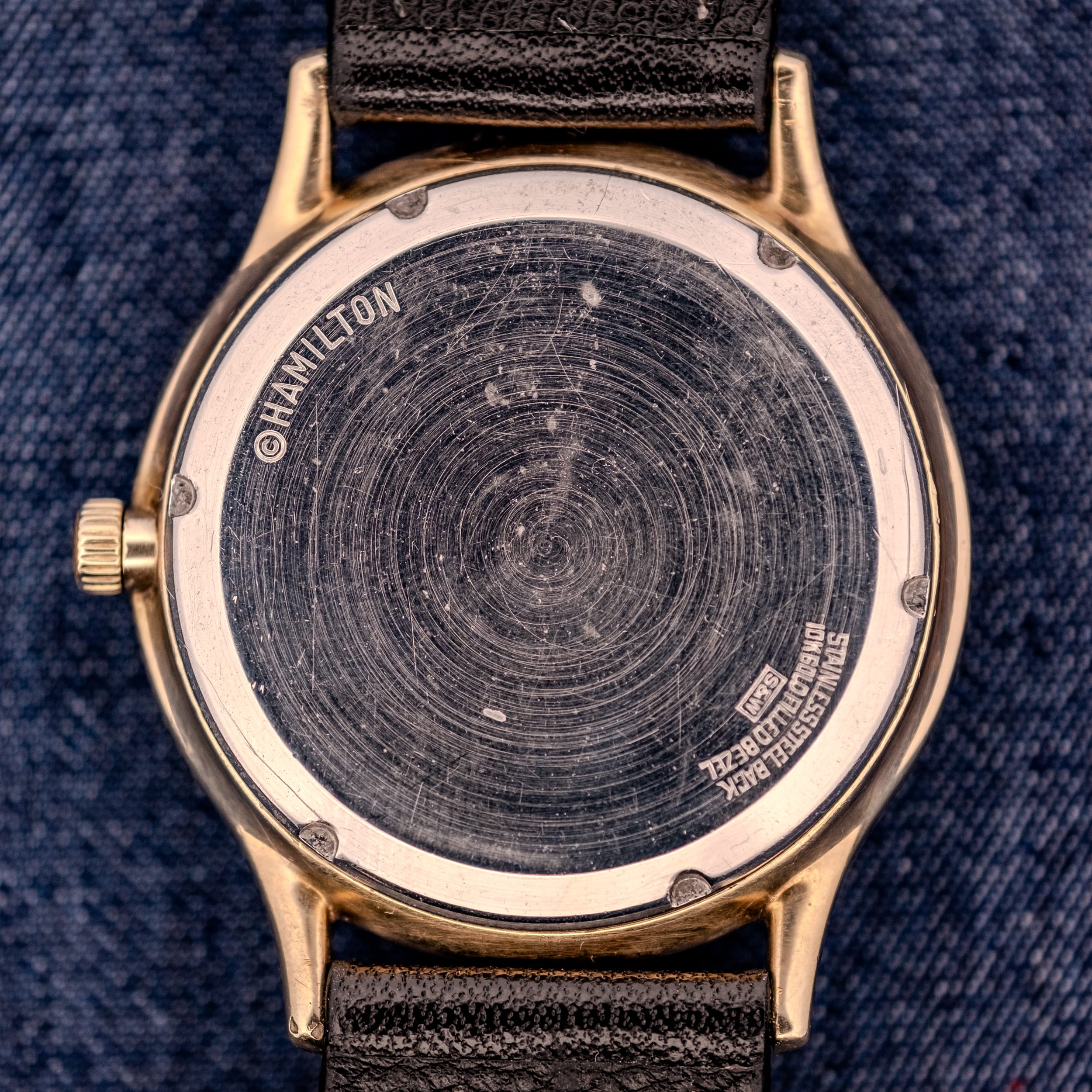
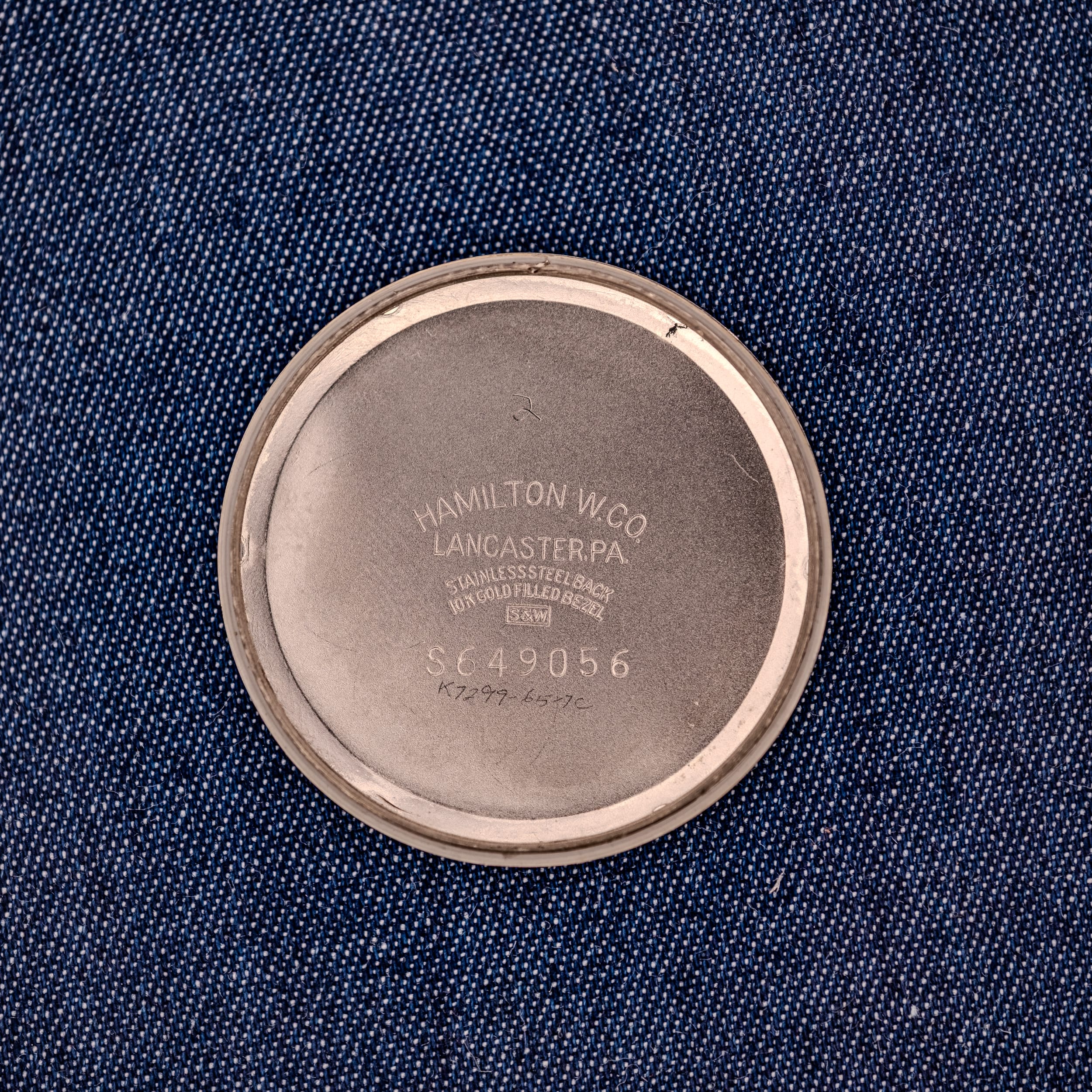
The case is a slim round 34mm with a 41mm lug-to-lug, an 18mm lug width, and a side profile that genuinely earns the Thin-o-Matic name. The construction is the classic mid-century Hamilton split: a 10k yellow gold filled bezel mated to a stainless steel back, stamped on the inside in clean period serif HAMILTON W.CO / LANCASTER, P.A. / STAINLESS STEEL BACK / 10K GOLD FILLED BEZEL / S&W, with the serial S649056 below. The S&W mark is the Star Watch Case Company, the long-running American case supplier that shaped a generation of Hamilton bezels through the postwar decades. Honest wear lives on the bezel and across the steel back, hairline scratches that show in side raking light, and we read all of it as the kind of even wear that comes from a watch that was worn rather than stored.
The dial is single-tone, matte, and beautifully even across its surface. Gold-toned applied marquise indices sit at each hour, pinched at the centers like leaves, with a fine printed black dot minute track tracing the perimeter. The Hamilton crossed-star logo and HAMILTON wordmark sit just above center, the cursive Thin-o-matic script sits just below, and SWISS prints small and confident at the bottom edge. The original feuille hour and minute hands have oxidized to a deep, near-black tone that contrasts handsomely against the cream, while the slim center seconds hand still catches the original gilt tone in the right light. There is no lume on the dial or hands, which is correct for a 1962 Hamilton dress watch of this line. The original Hamilton signed crown, bearing the brand’s crossed-star emblem, remains in place at three.
This example wears on a black leather strap with light contrast stitching and a simple buckle clasp, a quiet and dressy pairing that lets the slim gold filled case carry the visual weight without competing with it.
Serviced in-house at OTTUHR and backed by our 2-year mechanical warranty, this 1962 Hamilton Thin-o-Matic is the kind of vintage automatic that earns its keep by disappearing into the cuff and surprising the wearer every time it is pulled out for a closer look. For the collector who values genuine mid-century engineering and a dial that has earned its character over six decades on the wrist, this is, to us, one of the cleanest examples of the Hamilton Thin-o-Matic Cal. 663 we have handled.