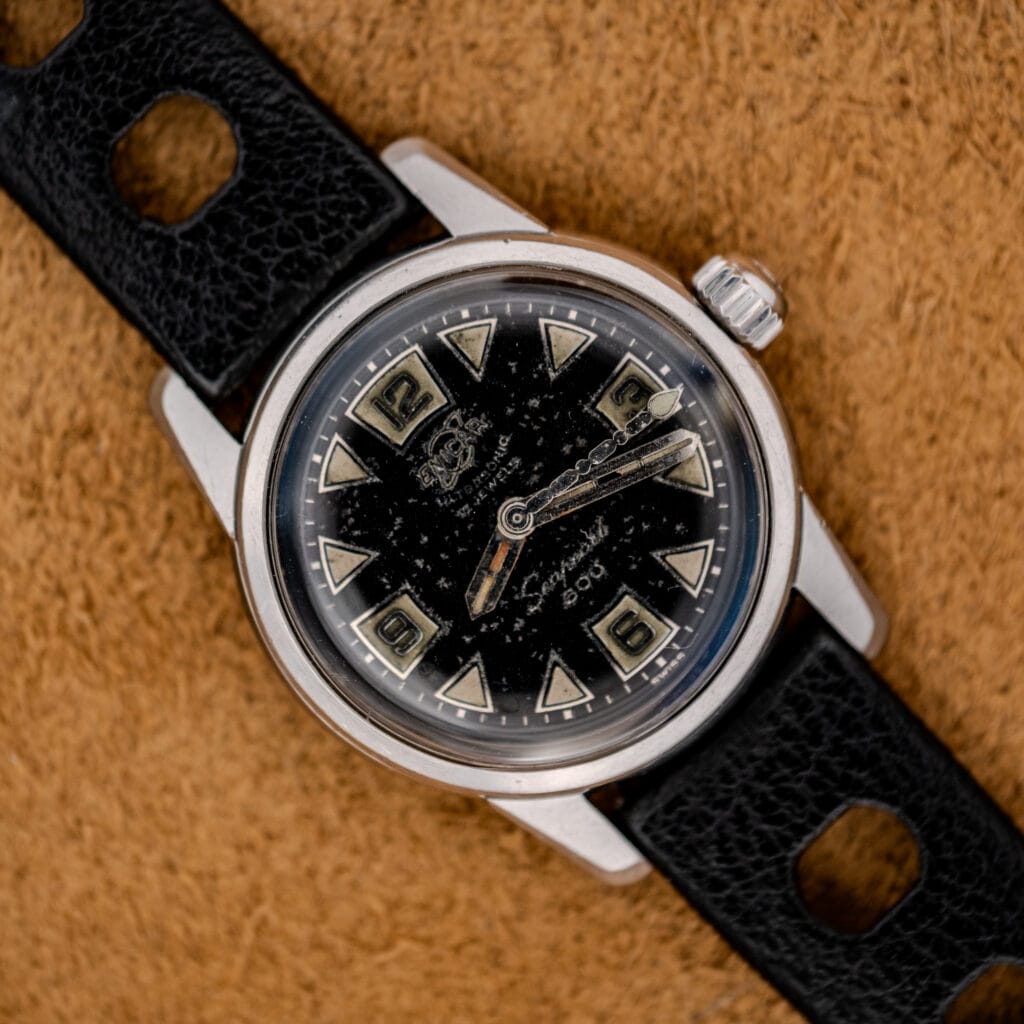
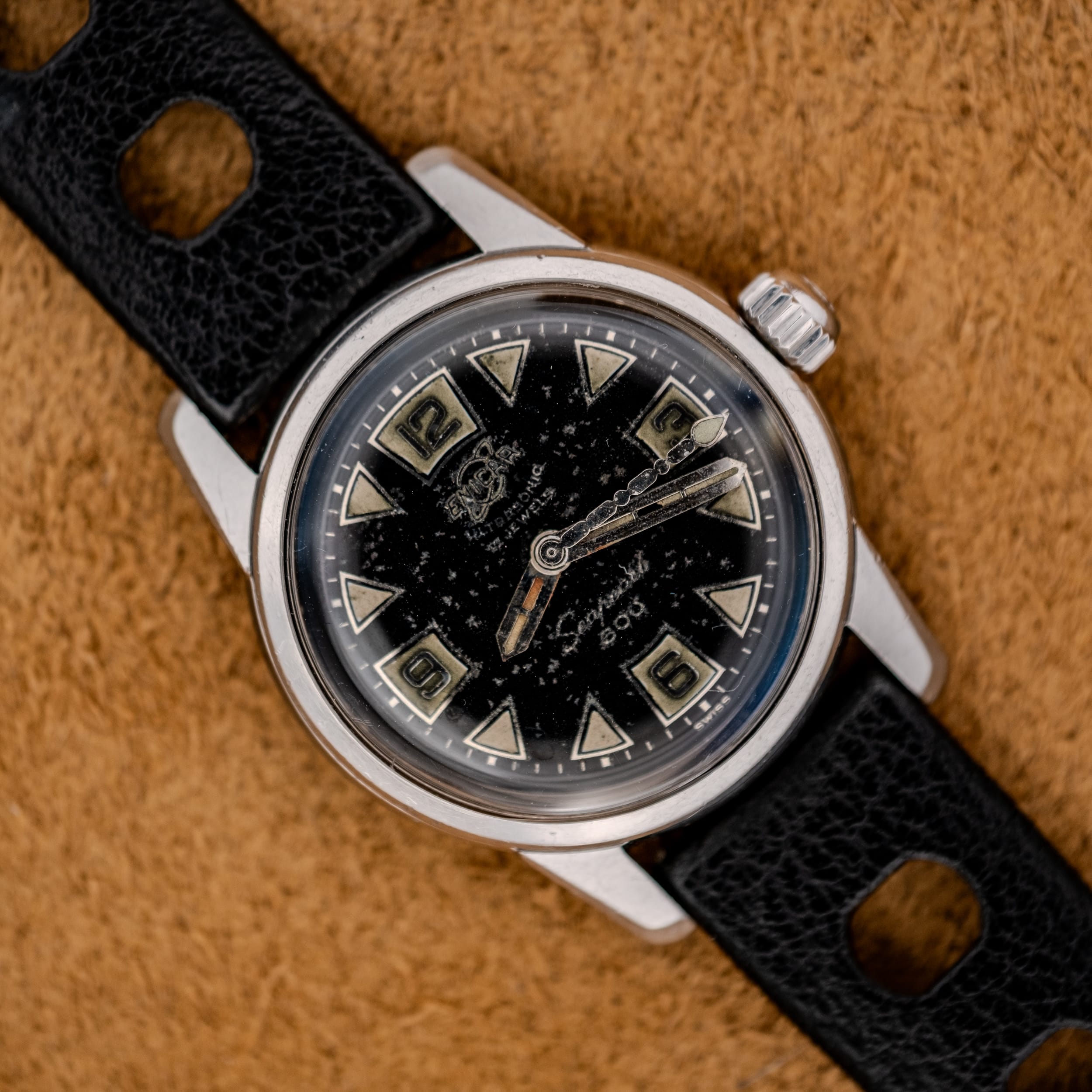
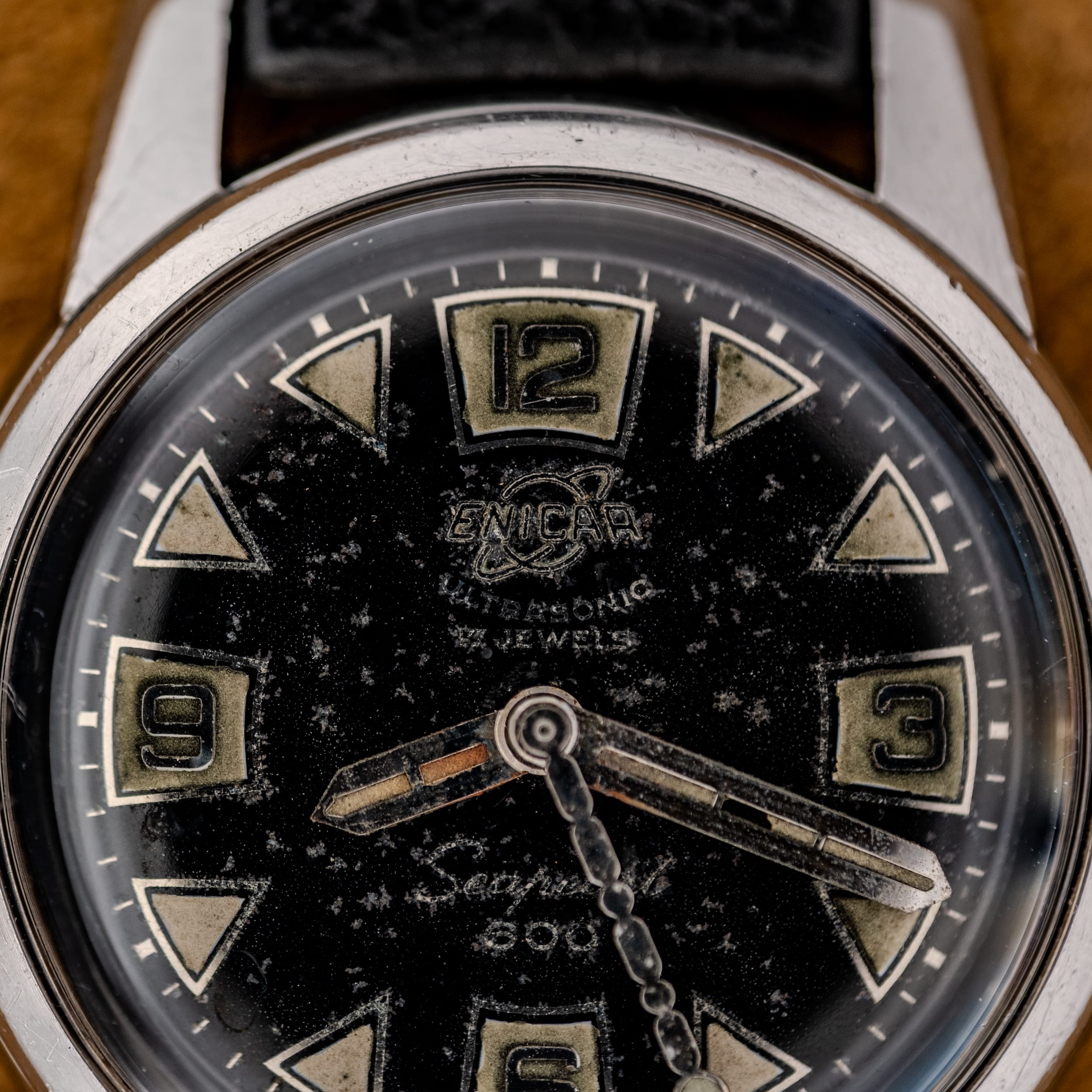
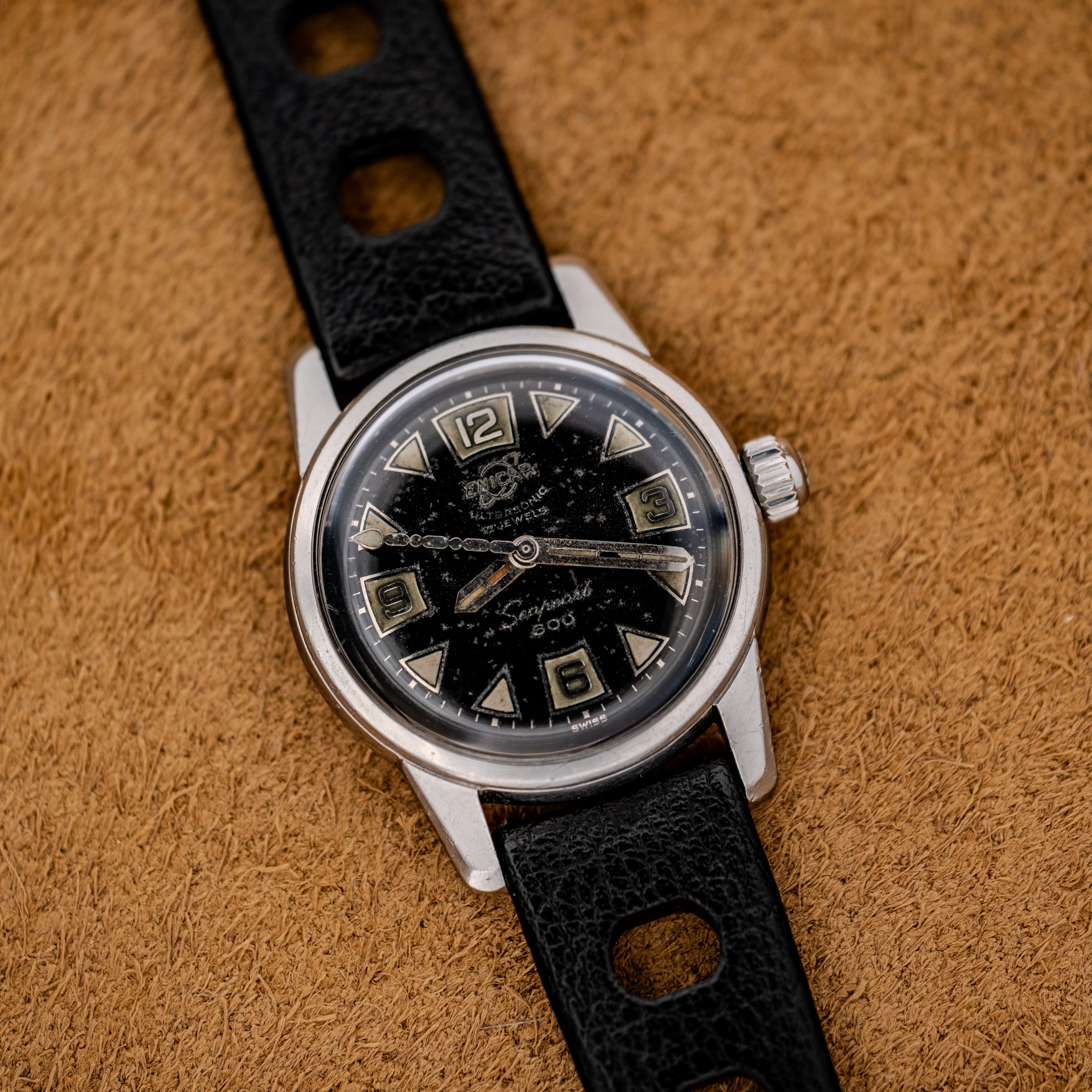
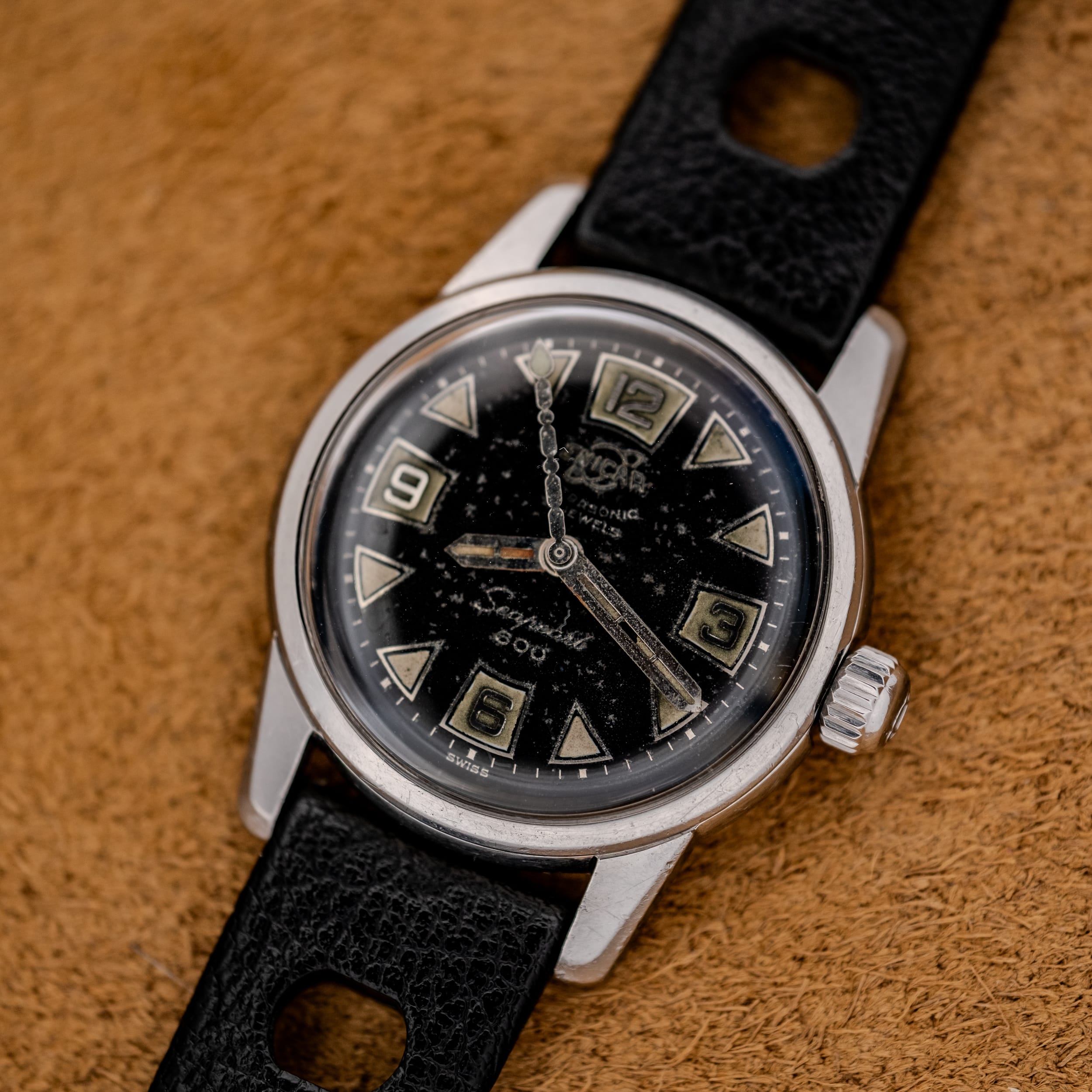
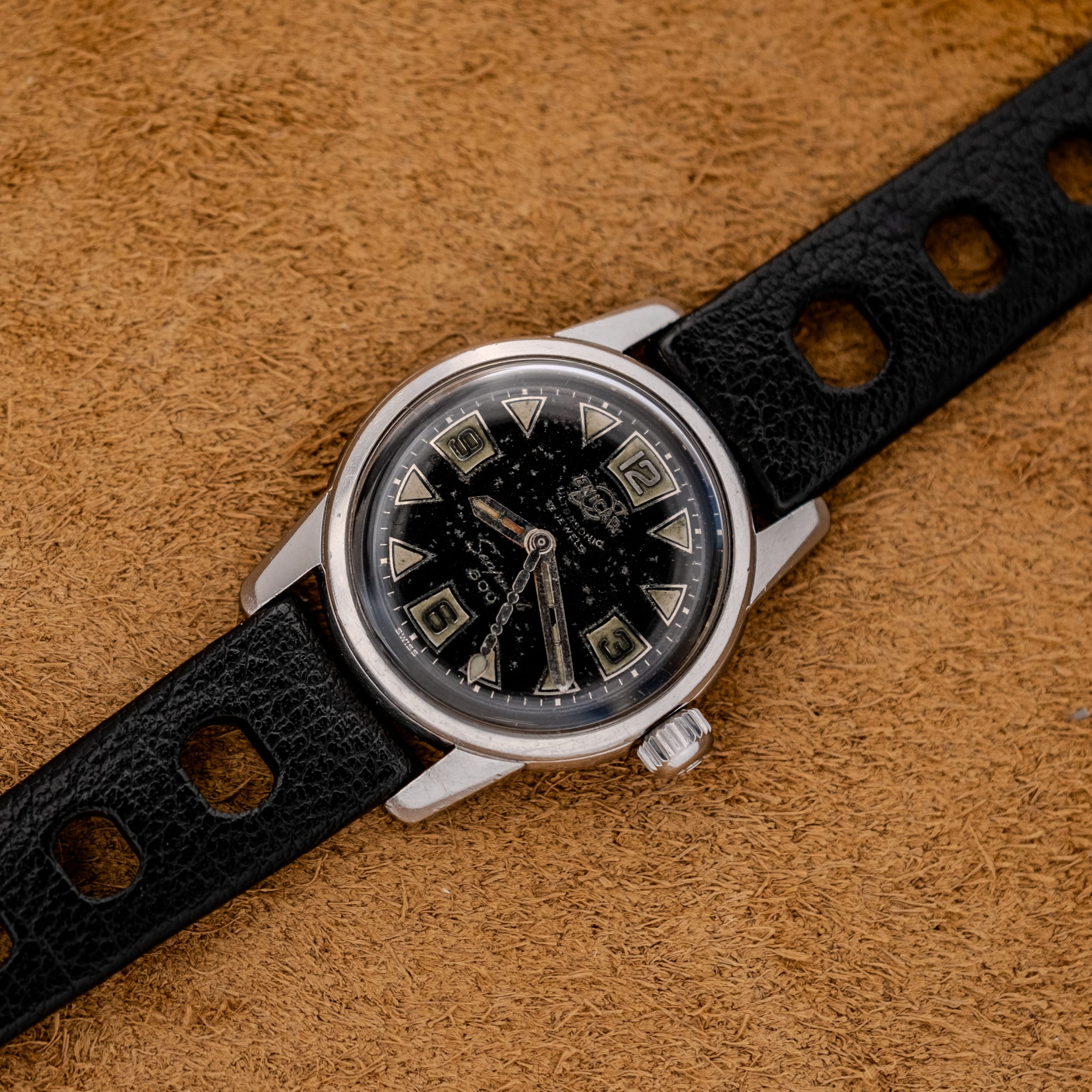
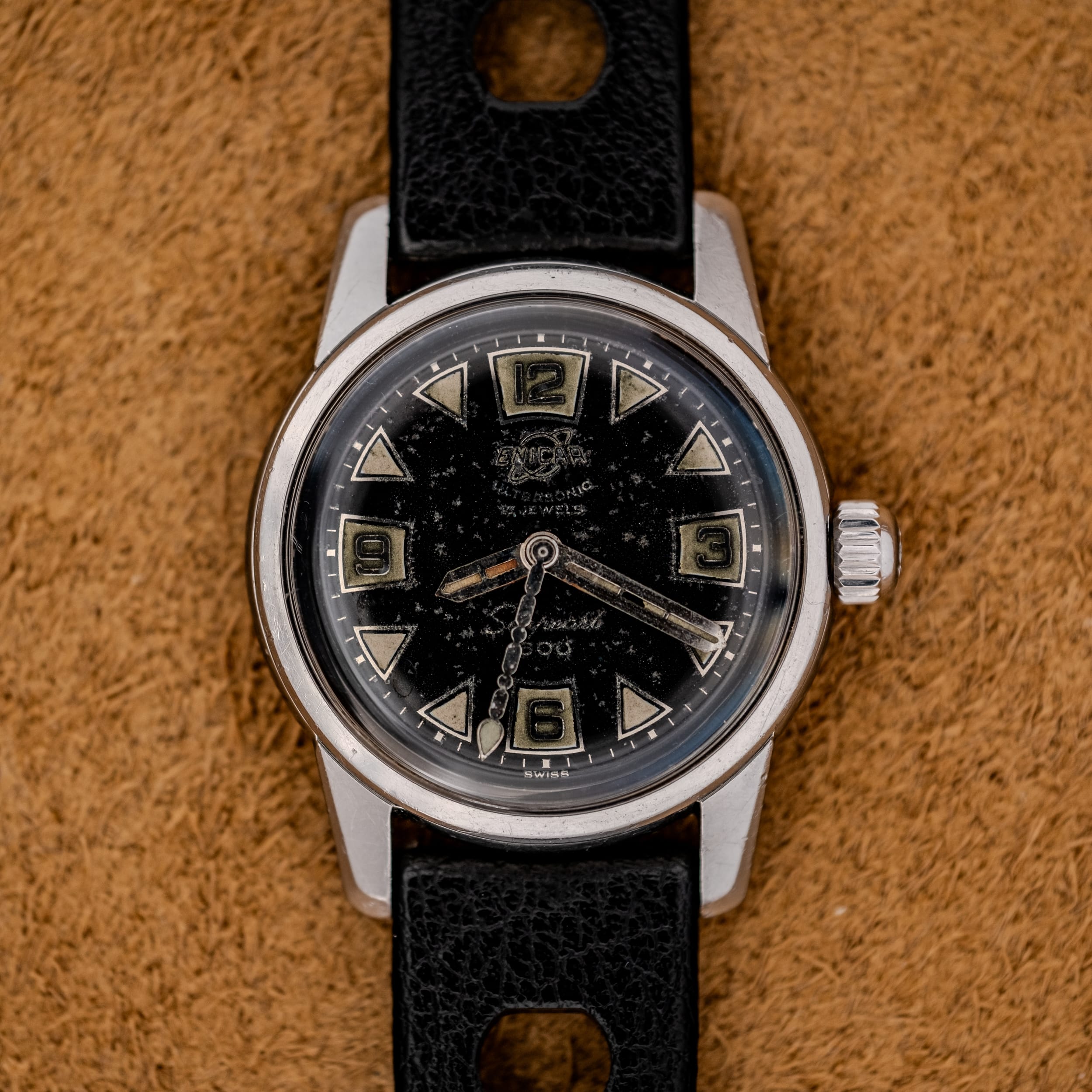
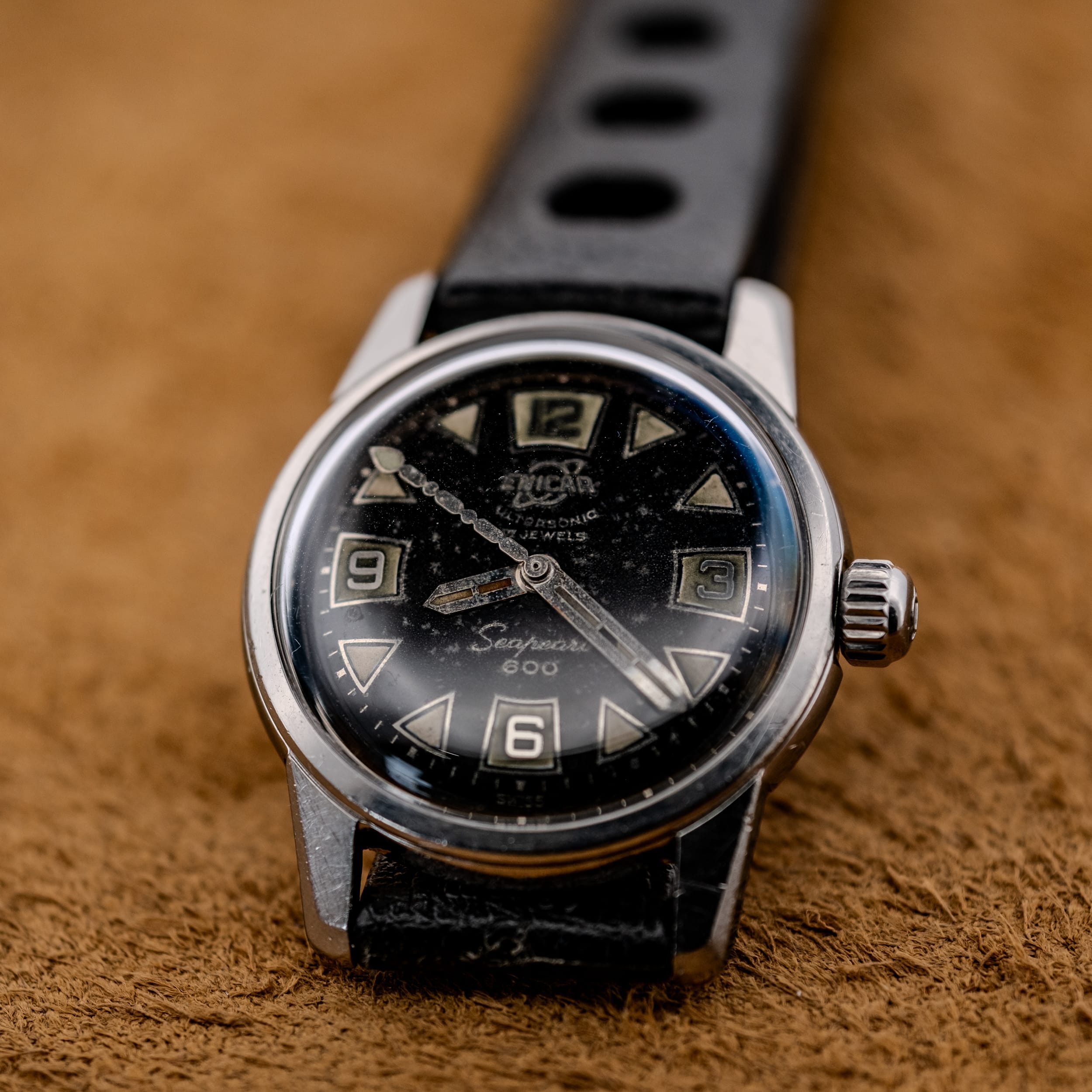
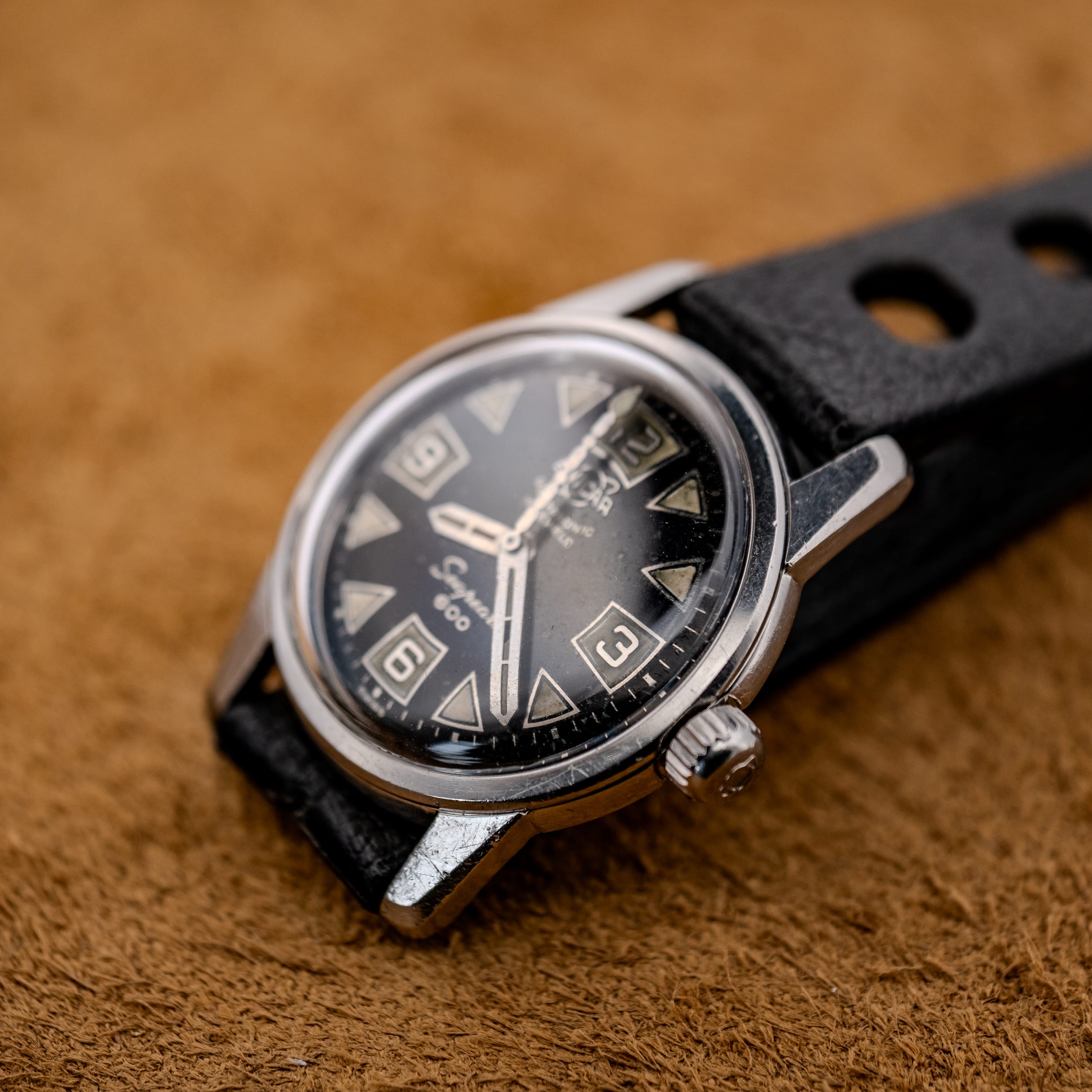
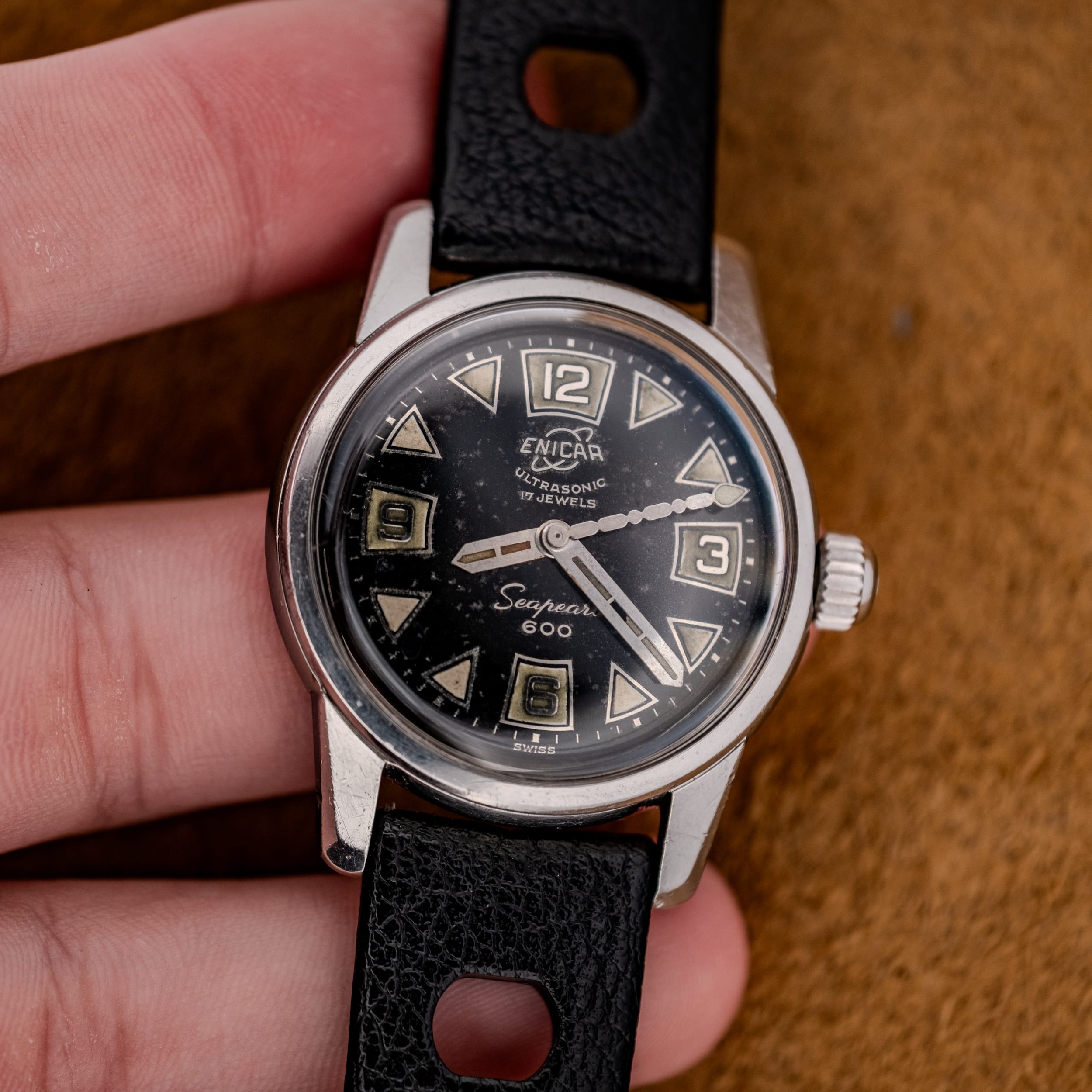

Hold an Enicar Seapearl 600 up to a strong angled light and the dial does something that almost no other vintage diver does, which is read like a slow-motion night sky. The base is glossy black, but six decades of patina have laid a fine pinpoint constellation of white speckling across the entire surface, and the effect is what collectors have come to call the “starry night” dial. In our opinion, this is one of the rare cases where age has improved a watch instead of merely preserving it, and it is the single reason we will always stop what we are doing when an honest Enicar Seapearl 600 crosses our bench.
Enicar traces its roots to Ariste Racine, who set up shop in Lengnau, Switzerland in the mid-nineteenth century and named the brand by spelling his surname backwards, which is the kind of quiet Swiss confidence we love. By the 1950s and 1960s the firm had carved out a serious reputation in tool watches, in part through its partnership with EPSA, the case-making house behind some of the era’s most pressure-resistant designs. The defining moment for the sport line came in 1956, when Enicar watches accompanied the Swiss Himalayan expedition to the summits of Lhotse and Everest, and from that point forward the word Sherpas appeared on the casebacks of Enicar’s professional series as a permanent reminder of where these watches had actually been.
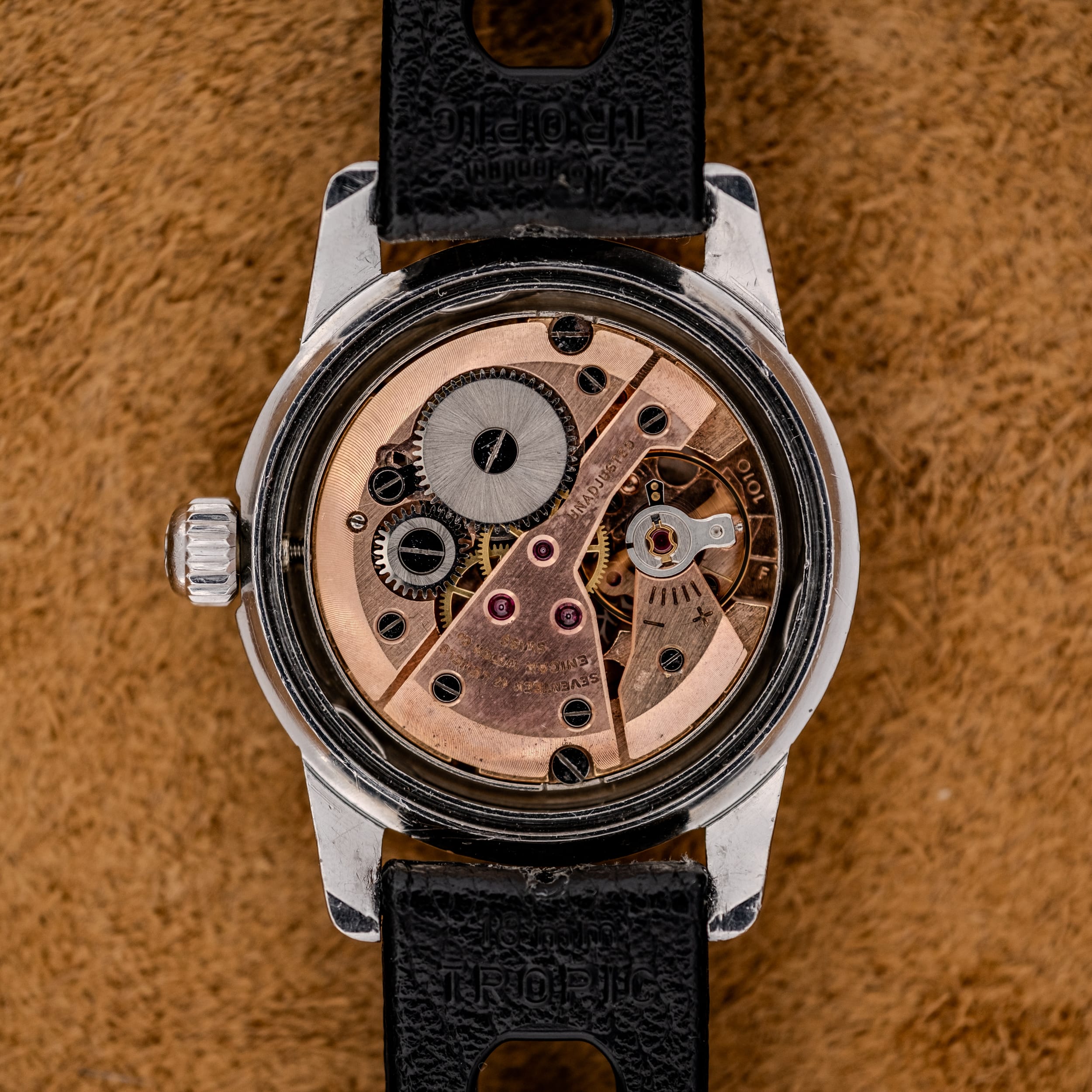
Inside this case sits the manually wound Enicar AR 1010, which is, for the historically minded buyer, the headline of the watch as much as the dial is. The AR designation honors Ariste Racine himself, and the 1010 was Enicar’s earliest in-house generation, predating the later 1120 family that powered the Sherpa Super-Dive and Sherpa Graph. To find the 1010 still living inside a Seapearl 600 is, to us, exactly the kind of correct-period match that separates a casually preserved example from a properly preserved one. The plates and bridges here have aged to a warm copper-rose tone, the seventeen jewels are seated cleanly, and the movement carries the engraved 1010 caliber stamp alongside the Enicar signature on the upper bridge.
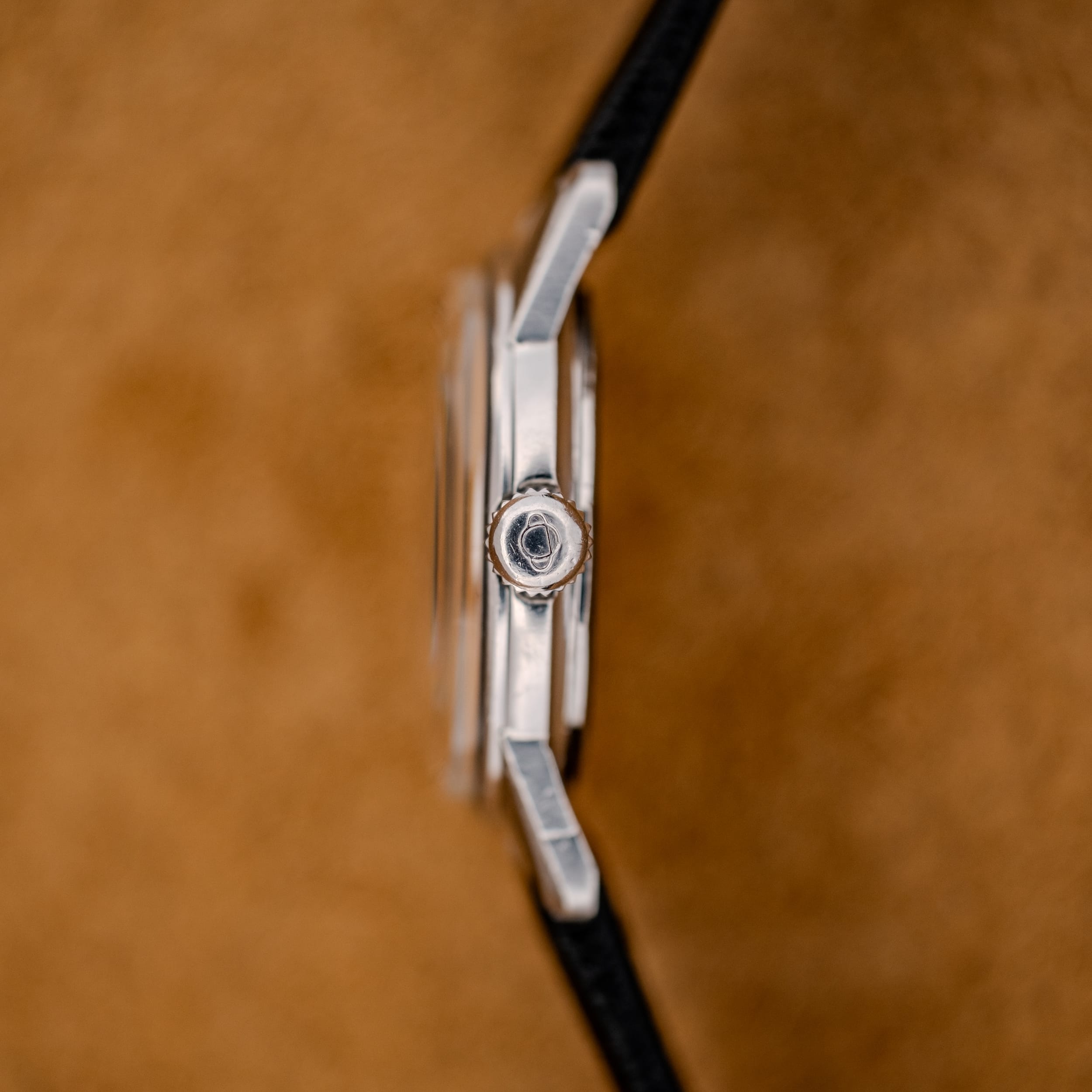
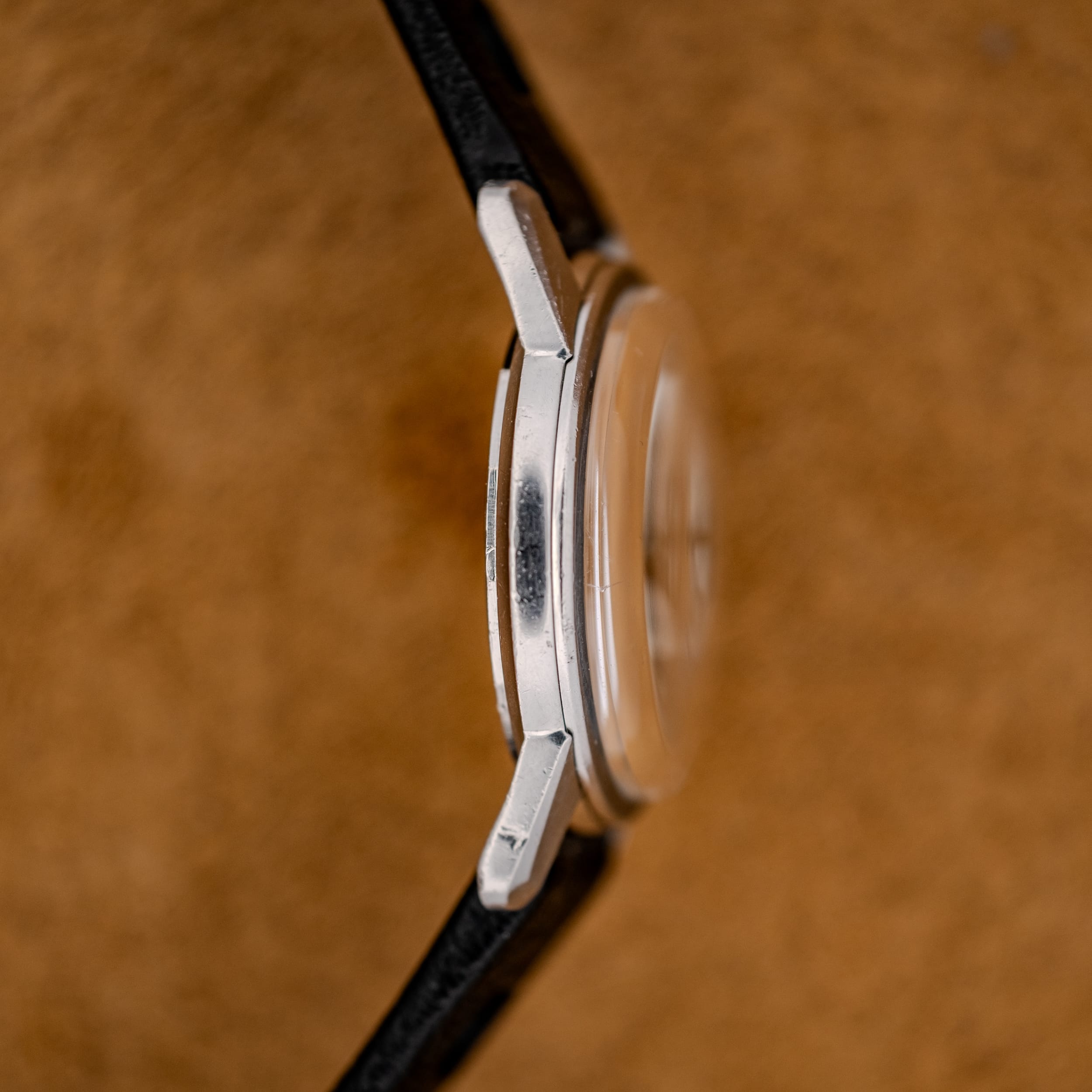
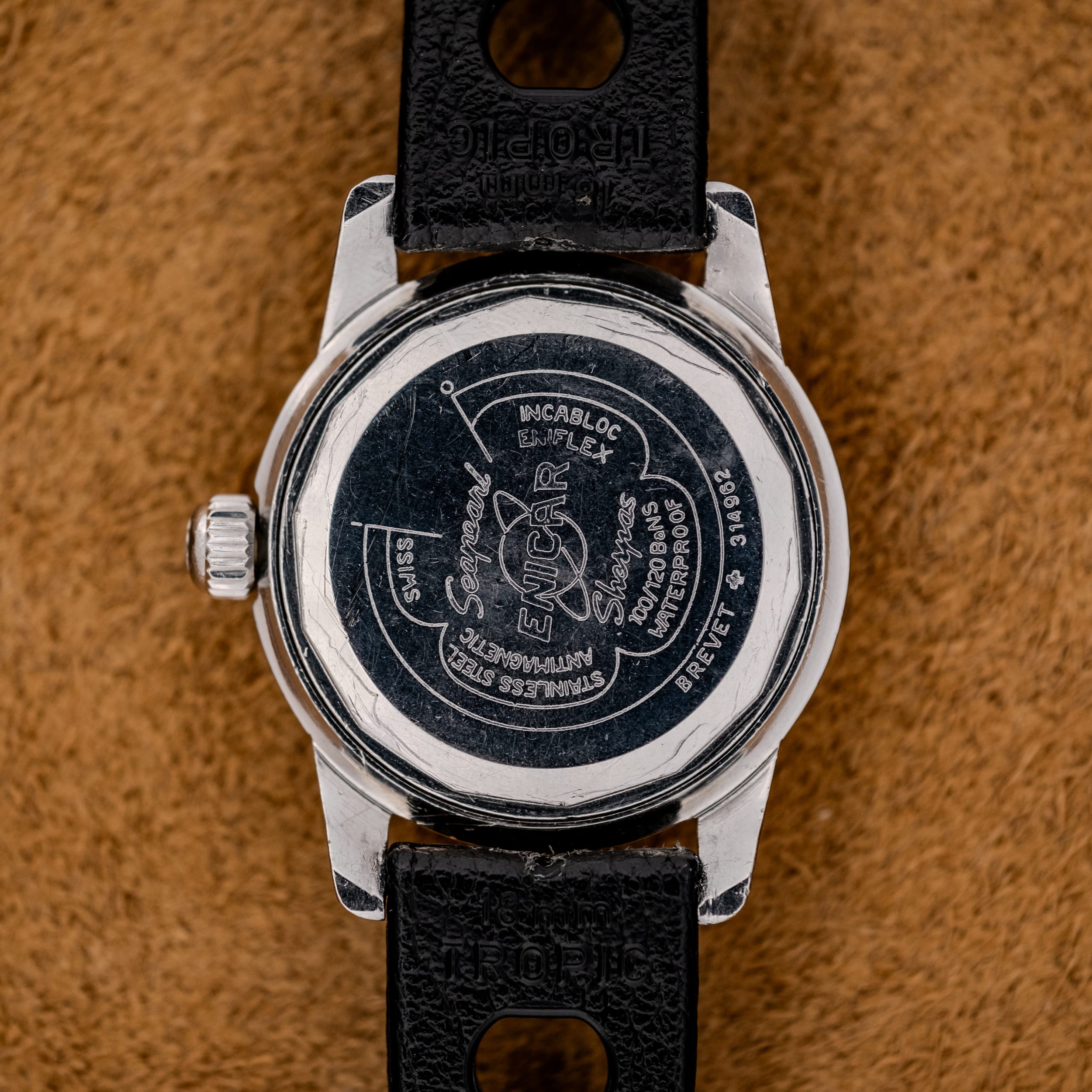
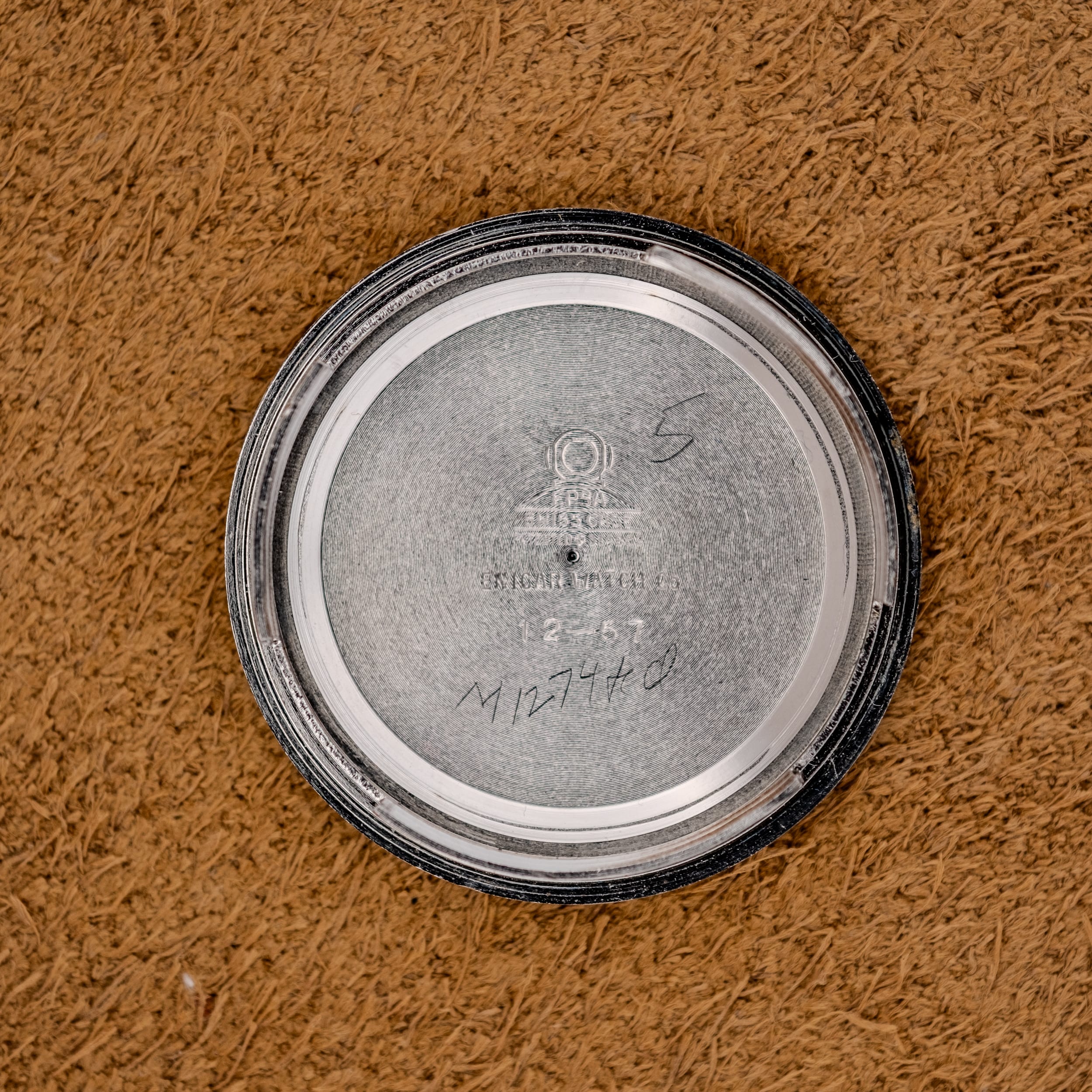
The case is a stainless steel 35.4mm round housing with 42.3mm lug-to-lug, 18mm lug spacing, and the angular faceted lugs that read instantly as mid-century Swiss tool. The crown is signed with the Enicar Saturn logo, the small atom-and-orbit emblem with its planet at center, and it sits cleanly seated against the right flank with its crosshatched grip still sharp. The exterior caseback is the showpiece, with the Saturn logo at center surrounded by the concentric Seapearl Sherpas medallion engraving and the full ring of designations, INCABLOC ENIFLEX at the top, 100/120 BARS WATERPROOF along one arc, BREVET 314962 at the bottom, SWISS along the lower left, and STAINLESS STEEL ANTIMAGNETIC running along the opposite arc. The interior caseback carries the EPSA helmet logo and the case stamp, and the side flanks show the kind of honest polished wear you would expect on a sixty-year-old tool watch that was actually worn instead of cosseted.
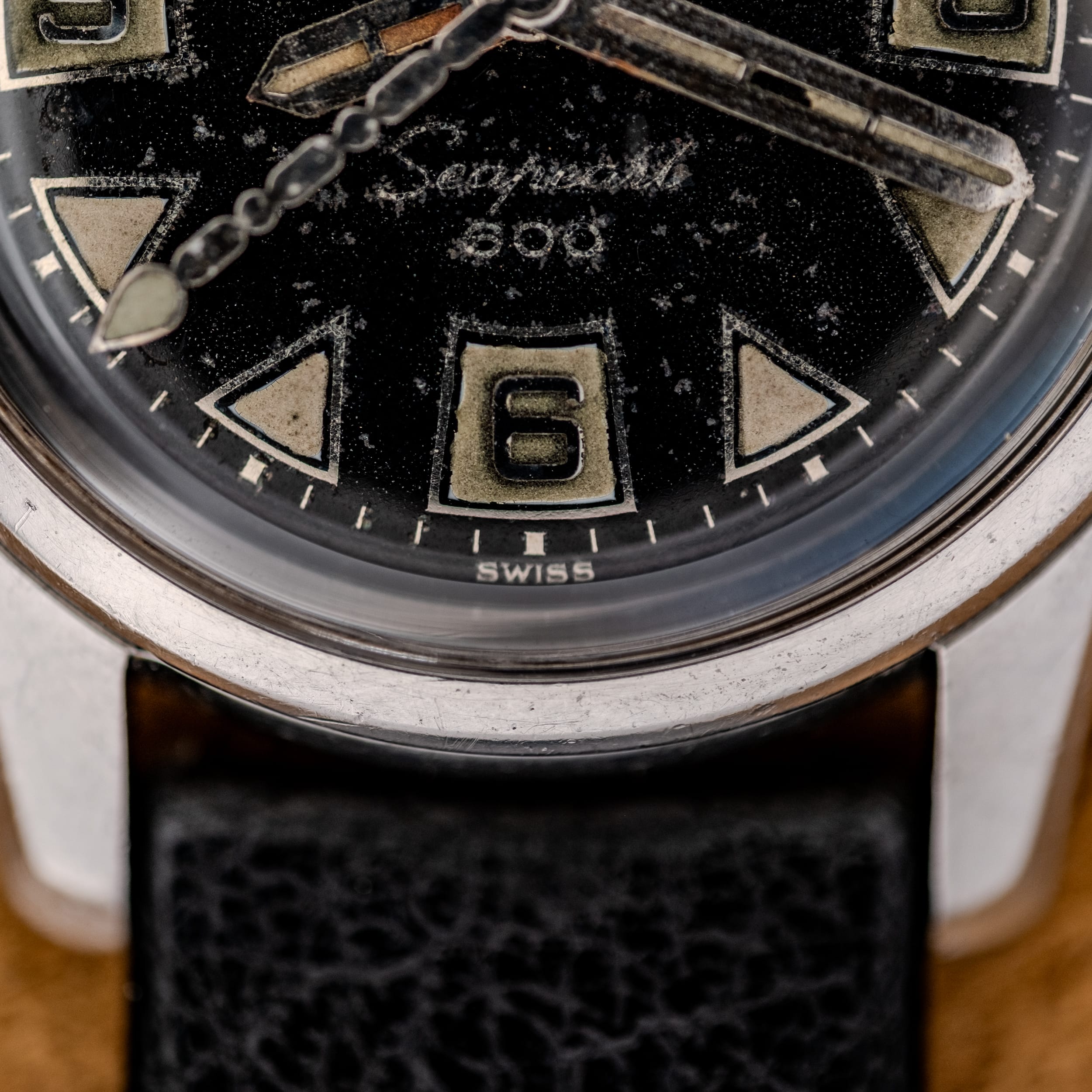
The dial, though, is where this watch genuinely earns its place in a serious collection. The glossy black field has developed that constellation-like speckling across its entire surface, evenly distributed and never blotchy, which is exactly what you want to see when the speckling reads as natural aging rather than damage. Applied steel trapezoid frames mark the cardinals at twelve, three, six, and nine, each one carrying its painted Arabic numeral inside the frame, with sandy cream lume aged into the surrounding zones. The remaining eight hour positions wear applied steel triangular markers pointing inward, each with the same warm lume residue. The Enicar Saturn logo sits in the upper half of the dial alongside ULTRASONIC 17 JEWELS in fine factory print, with the cursive Seapearl 600 script floating in the lower half, and SWISS printed cleanly between the six marker and the chapter ring at the bottom. The hour and minute hands are broad sword shapes with their luminous fills aged to match the markers, and the seconds hand is the famous chain-link lollipop, a sequence of small linked discs running from center to tip that remains one of the most quietly inventive design decisions in all of mid-century horology.
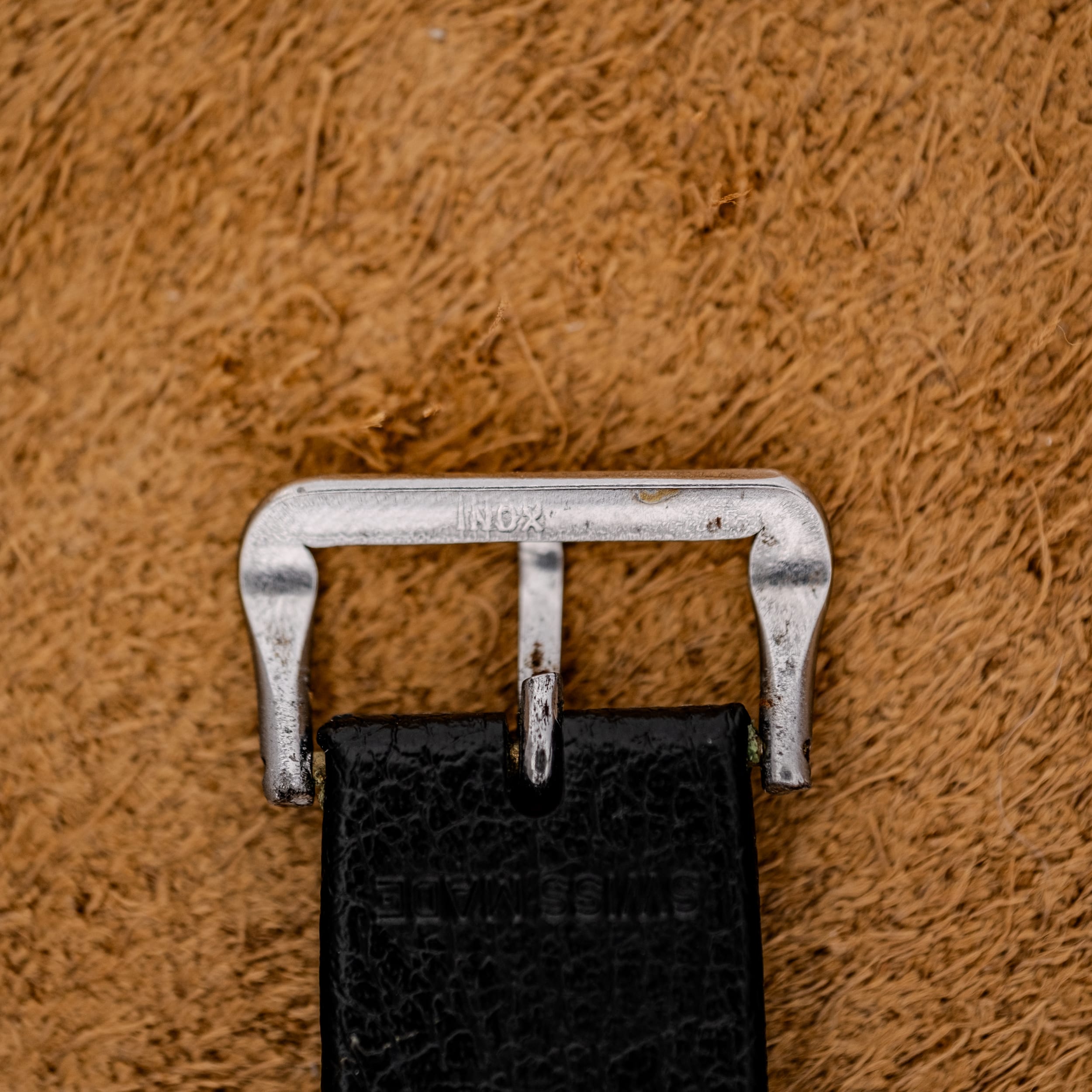
We have left the watch on its black perforated Tropic-style rubber strap, which is, to us, exactly the strap a 1960s skin diver was always meant to wear. The Tropic signature is visible on the underside, and the strap is fitted to a stainless steel signed buckle stamped INOX. The combination reads as period-correct without being precious about it, and it sizes comfortably up to an 8.5 inch wrist.
Serviced in-house at OTTUHR and backed by our 2-year mechanical warranty. For the collector who values a dial that has aged into something genuinely unrepeatable, a movement that is the original and correct match for the model, and a chain-link seconds hand that you simply cannot find anywhere else in vintage, this Enicar Seapearl 600 is, to us, one of the most quietly compelling skin divers we have had the pleasure of preparing.