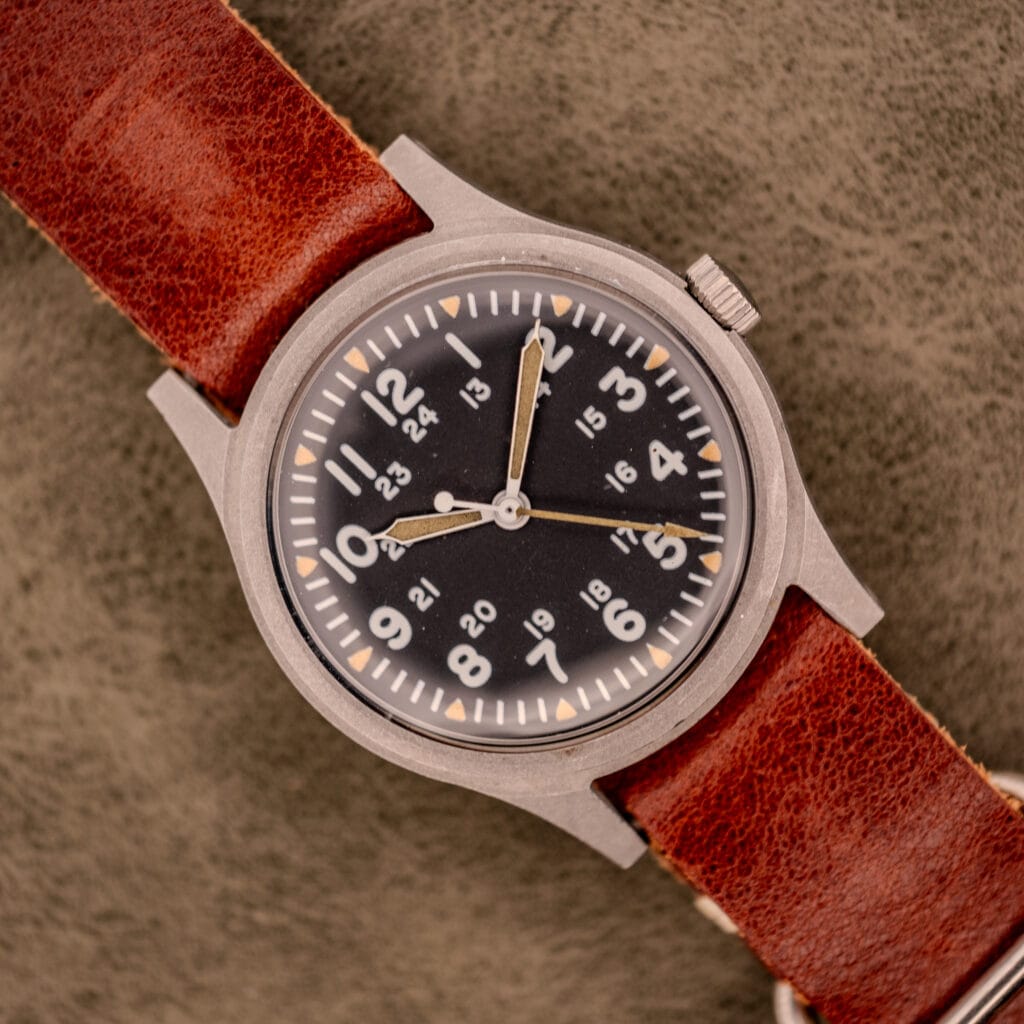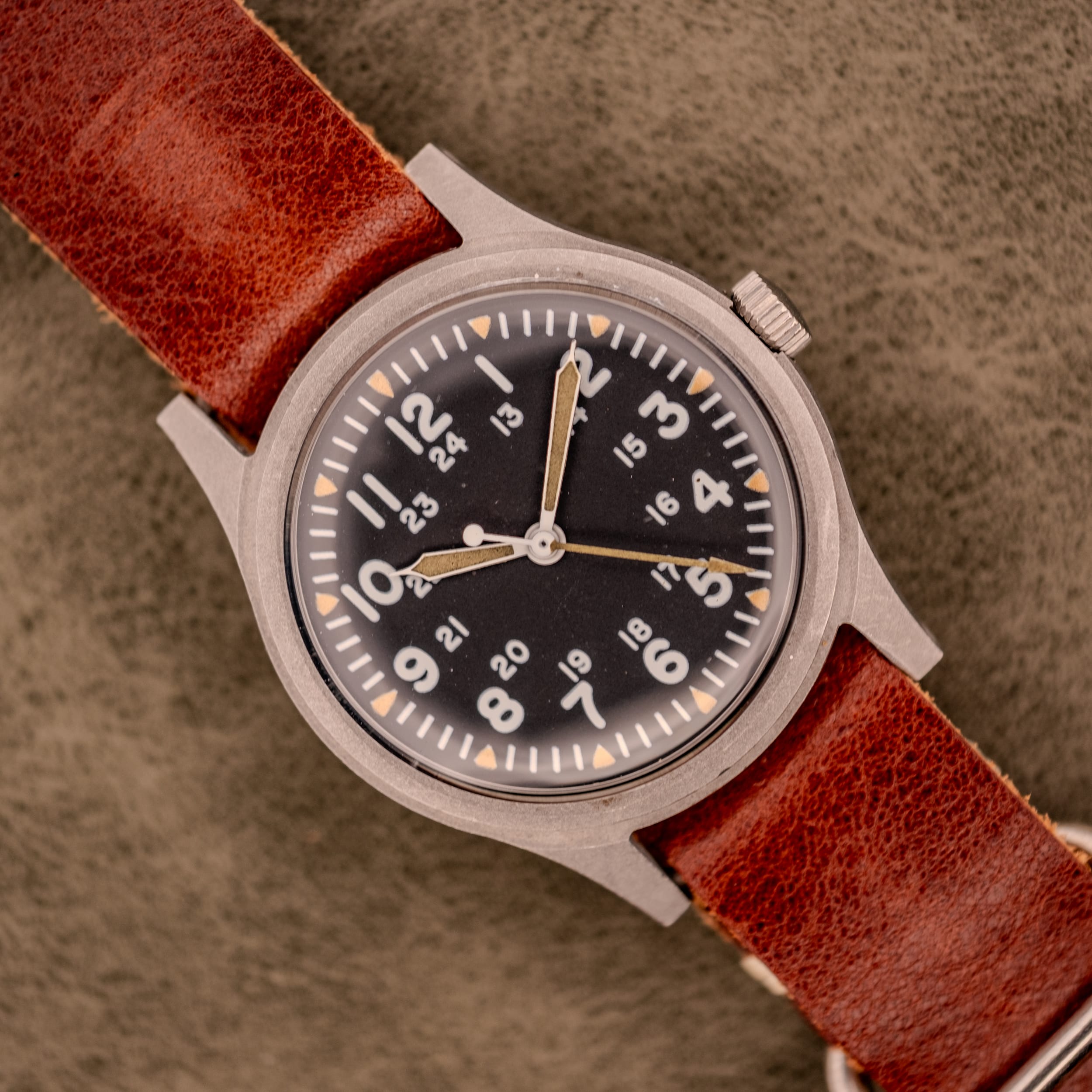
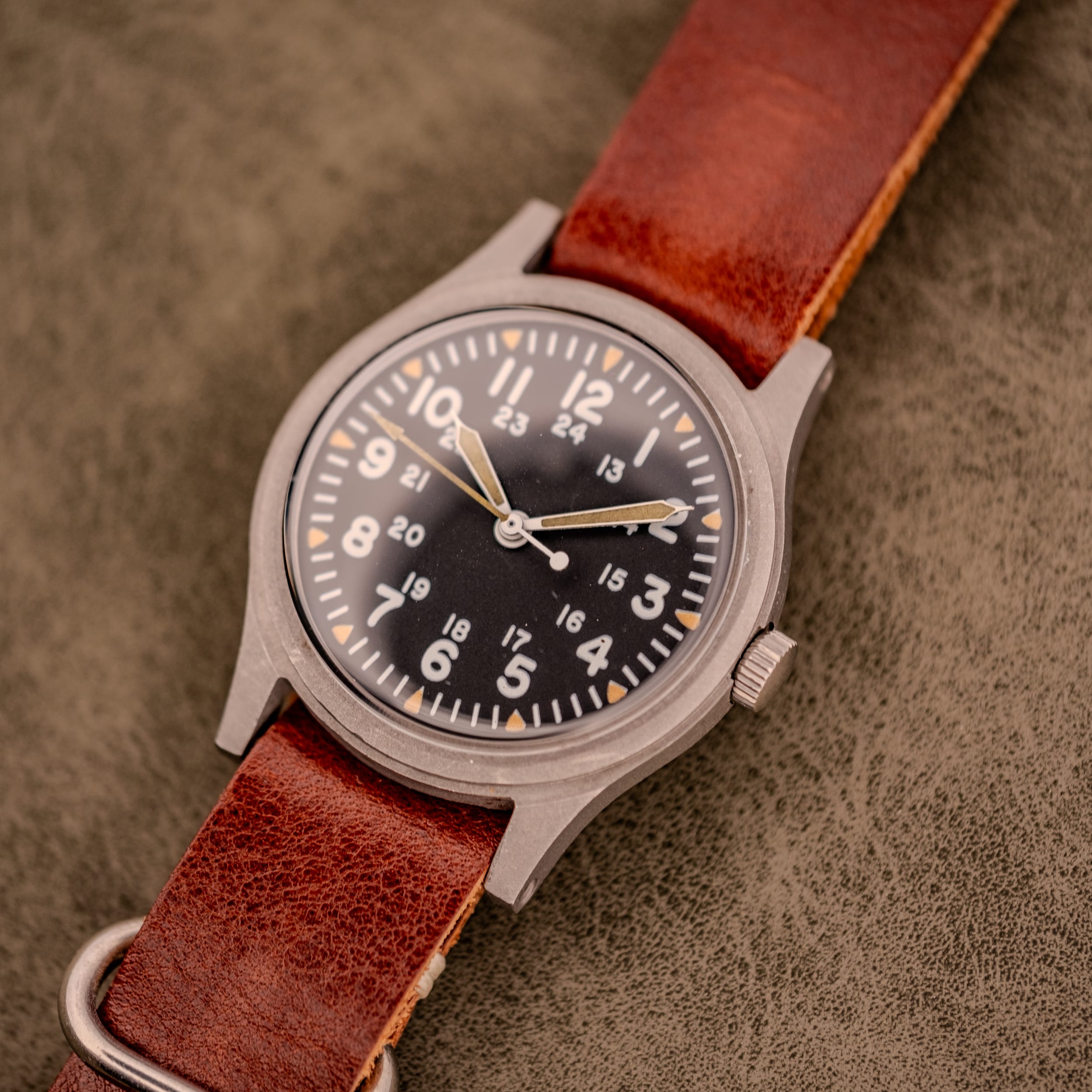
In our opinion, the Hamilton GG-W-113 is the single most undervalued American military field watch a vintage collector can still buy in honestly issued condition. The reference is small, mechanical, sterile, and stamped on the caseback with the kind of full provenance that simply does not exist on most 40-year-old watches. To us, a 1979 GG-W-113 in its original parkerized case with the tritium aged just so is a one-piece education in what a tool watch was actually supposed to be: legible, robust, repairable, and built to a federal specification that left no room for marketing.
The GG-W-113 spec was released by the U.S. General Services Administration in 1967 and ran for two full decades before quartz finally retired it in the late 1980s. Where the parallel MIL-W-46374 was the disposable, non-hacking grunt watch that ground forces carried, the GG-W-113 was the higher-specification piece for aviators, requiring a hacking, 17-jewel manual wind movement and a sterile dial built for cockpit legibility. It was issued to United States Air Force pilots, aircrew, and other airborne personnel, and it served on American wrists from the closing years of the Vietnam conflict straight through the Cold War. American watchmakers Benrus, Hamilton, and Marathon all held the contract at various points, and Hamilton’s late-1970s production runs are widely considered the most consistent examples the program produced.
Inside ticks the Hamilton caliber 649, an ETA 2750 base, 17-jewel manual wind with hacking seconds, an Incabloc shock setting, a 21,600 vibration-per-hour beat rate, and roughly 50 hours of power reserve from a fully wound mainspring. By 1979, Hamilton’s American operations had long since closed and movement production had moved to Switzerland under the broader Swiss watchmaking consolidation of the period, but the brand continued to fulfill U.S. military contracts under the Hamilton name, and the watches remained loyal to the original GG-W-113 specification down to the smallest detail. The 649 is the workhorse caliber that powered Hamilton’s GG-W-113 production from the early 1970s onward, and it is a thoroughly proven, easily serviced piece of mid-century Swiss engineering.
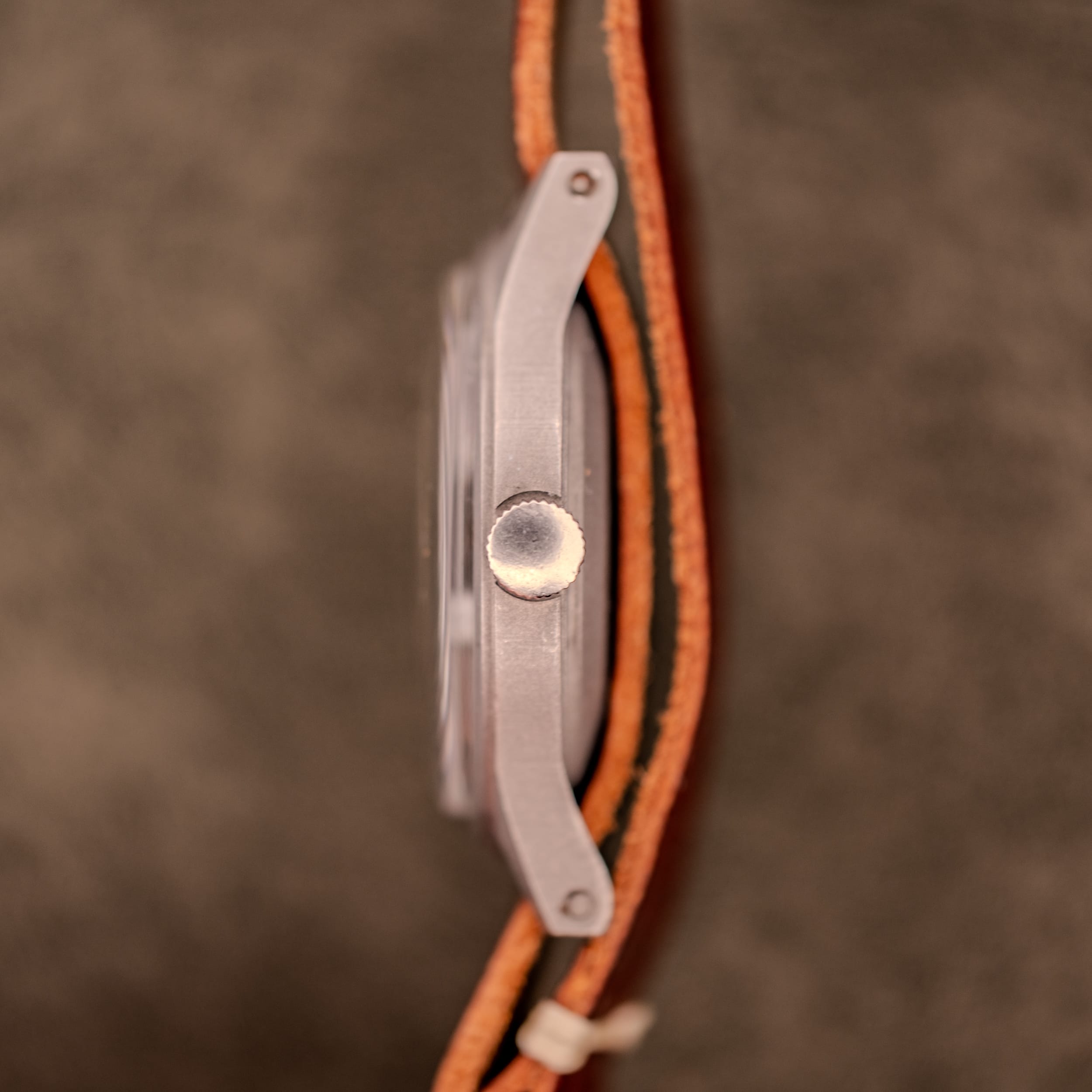
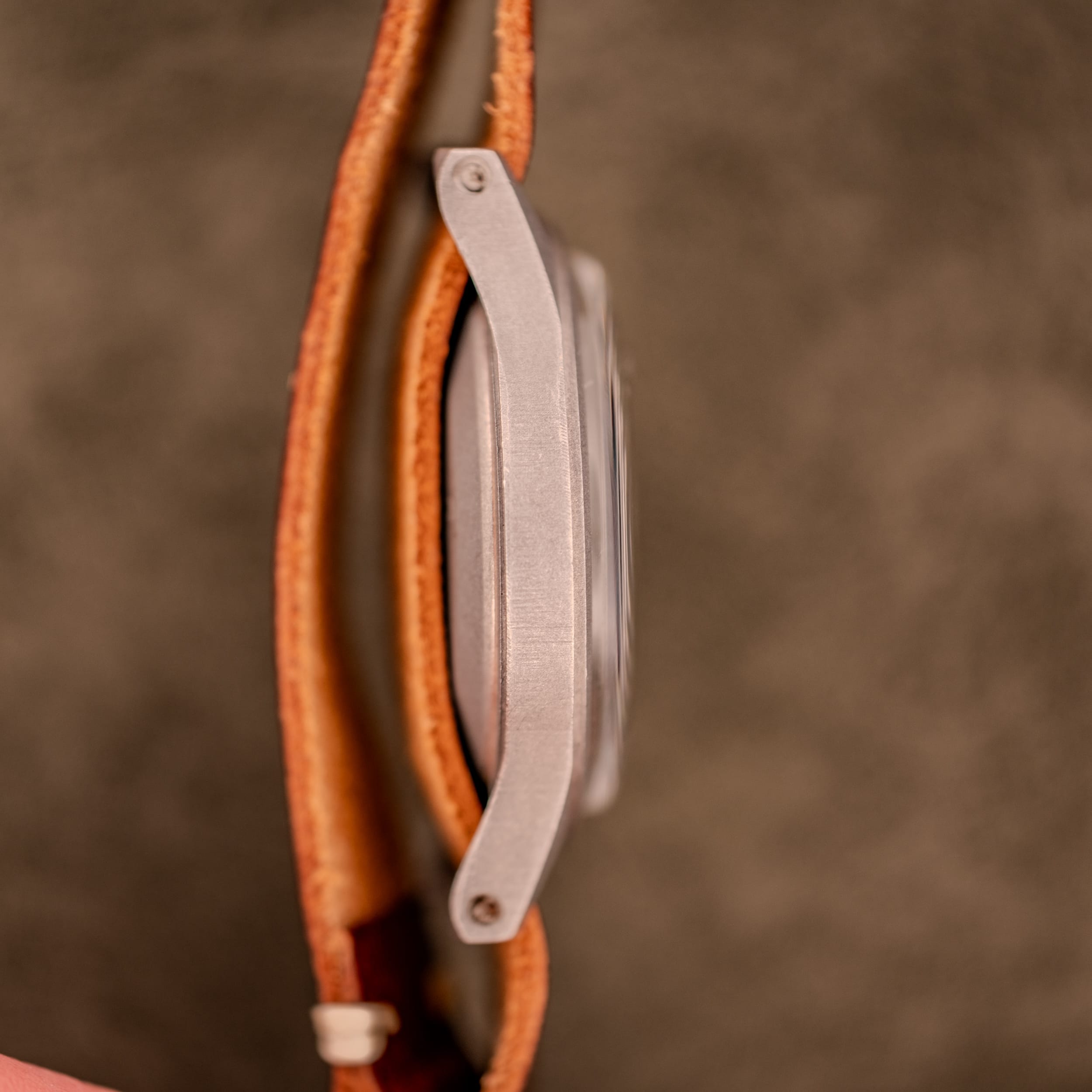
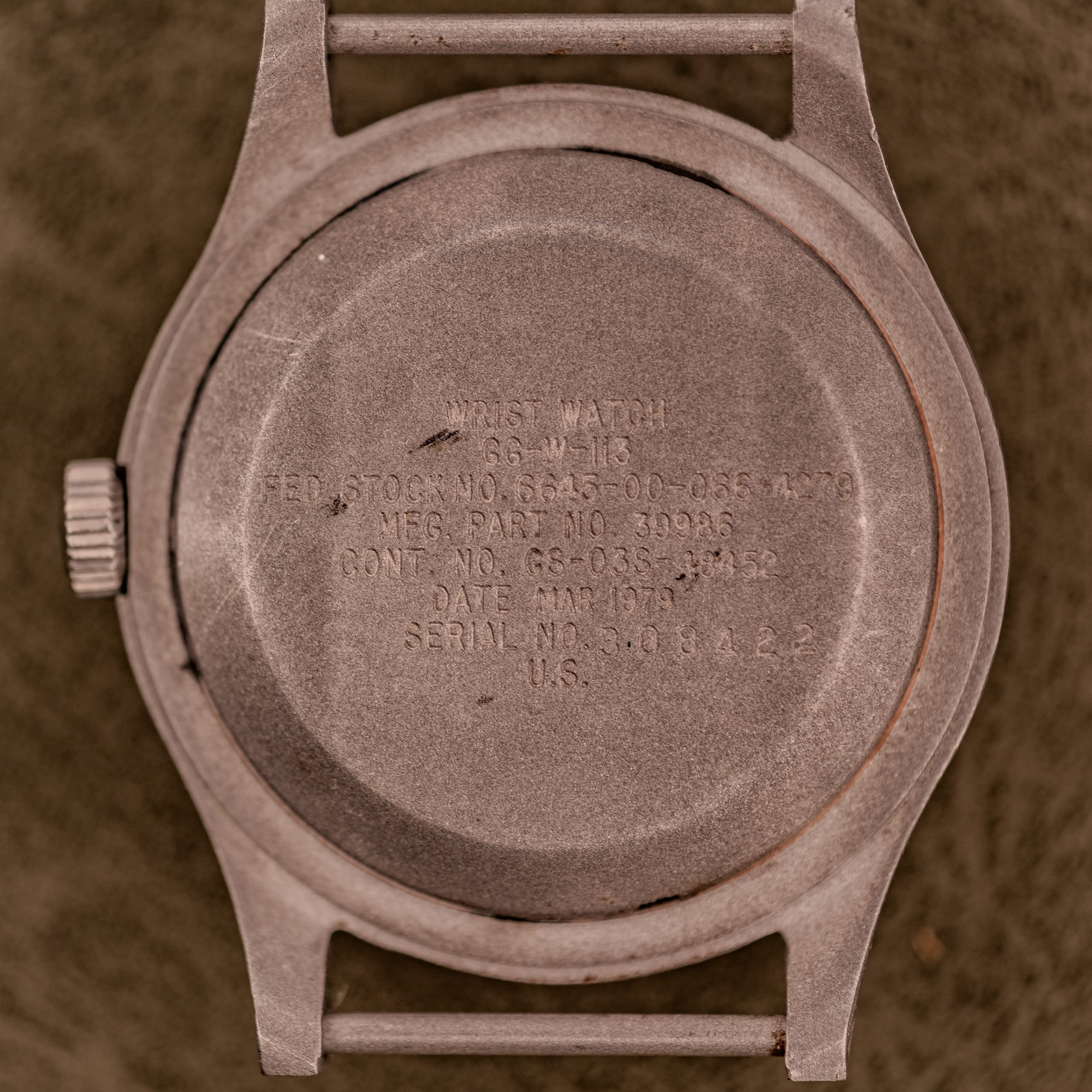
The case is the classic one-piece parkerized stainless steel construction the spec called for, measuring 35.5mm in diameter with a 41mm lug-to-lug span and an 18mm lug width, with the fixed strap bars per the late-1970s configuration. The matte bead-blasted finish has held up beautifully across four and a half decades, with the kind of even, soft grey patina that simply cannot be faked or reproduced. The full caseback stampings are visible and clear: WRIST WATCH, GG-W-113, FED. STOCK NO. 6645-00-066-4279, MFG. PART NO. 39986, CONT. NO. GS-03S, DATE MAR 1979, SERIAL NO. 308422, and the proud U.S. designation at the bottom. The federal stock number itself is a piece of provenance, as the NIIN 066-4279 designates watches required to hack and run on a 15-jewel or higher movement.
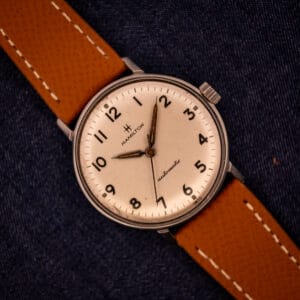
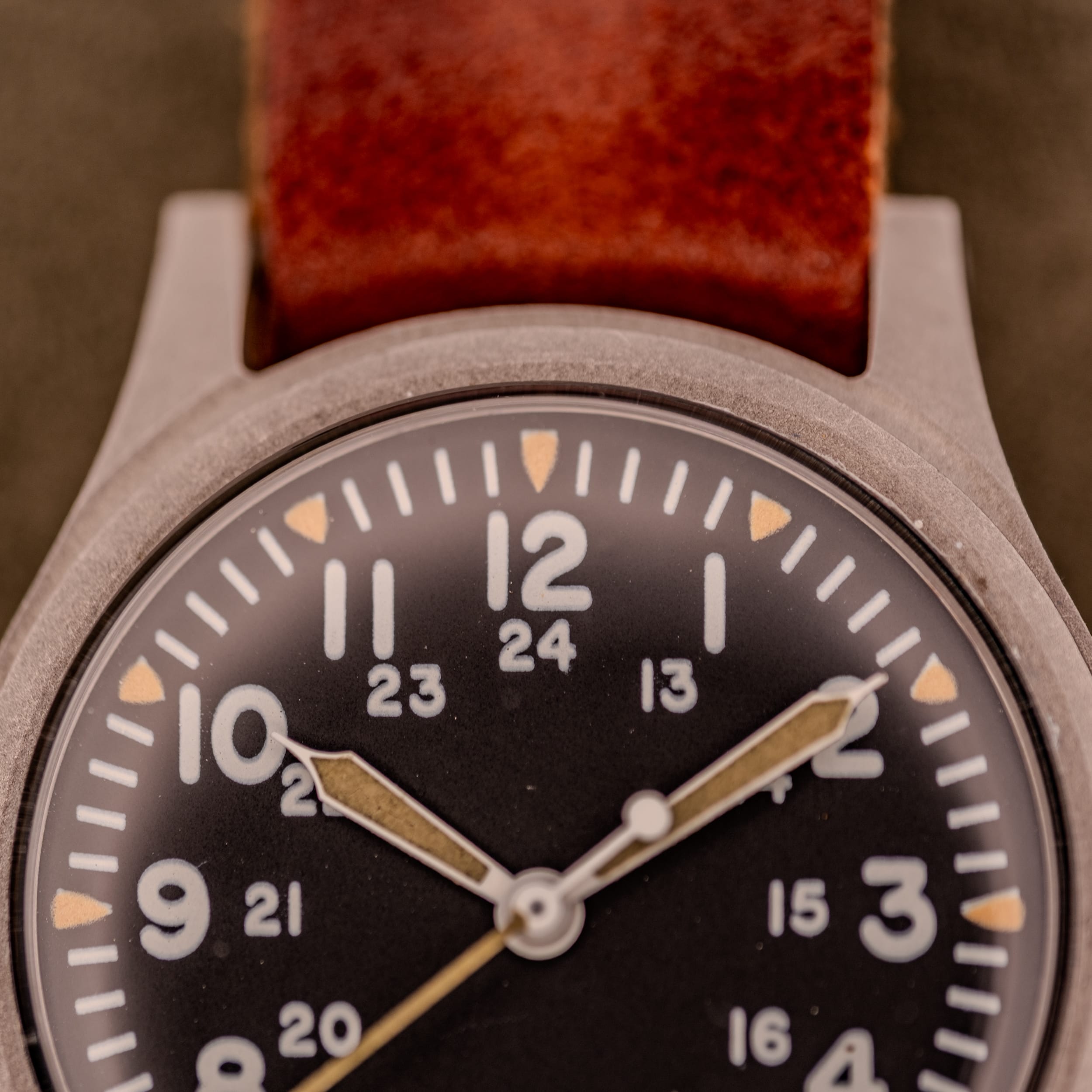
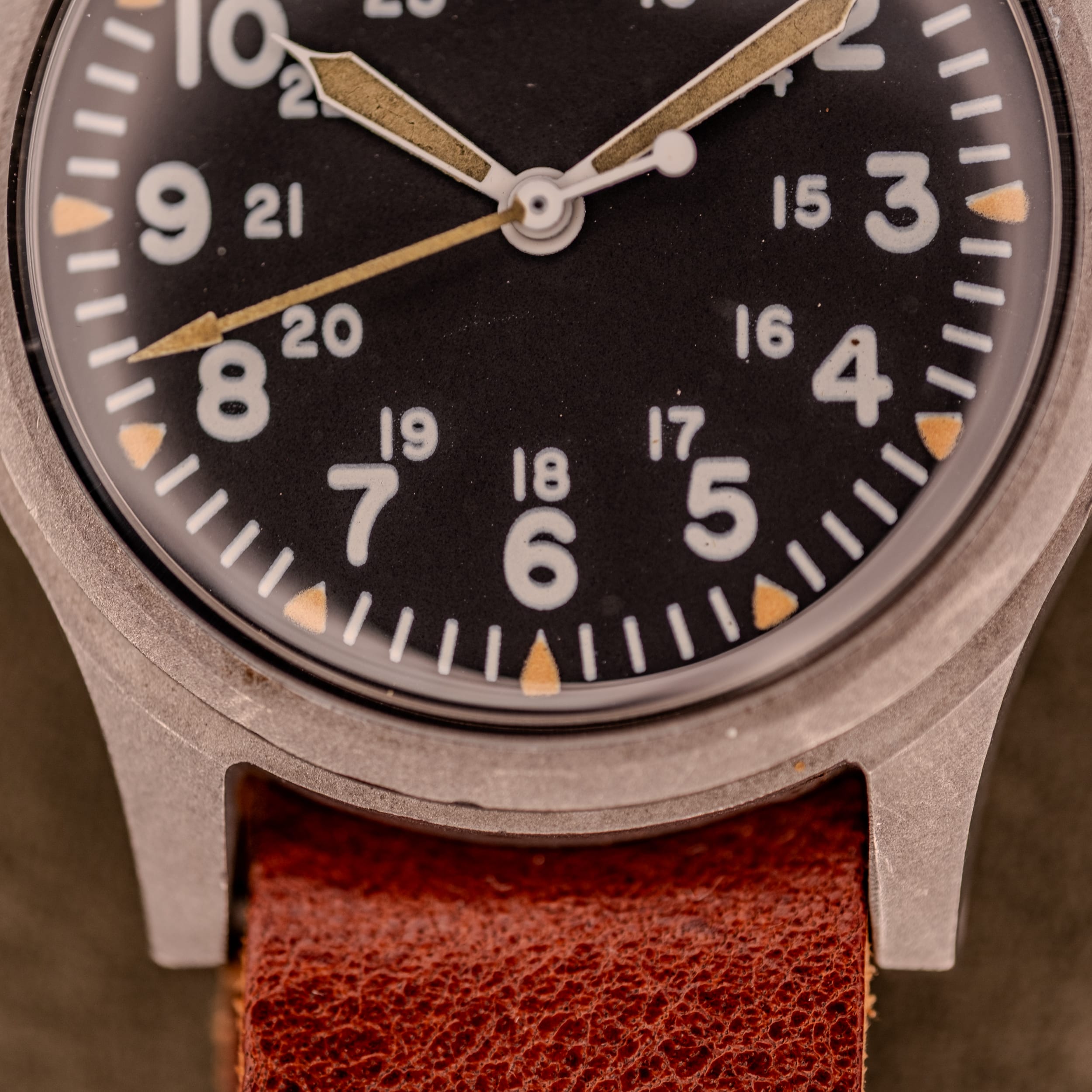
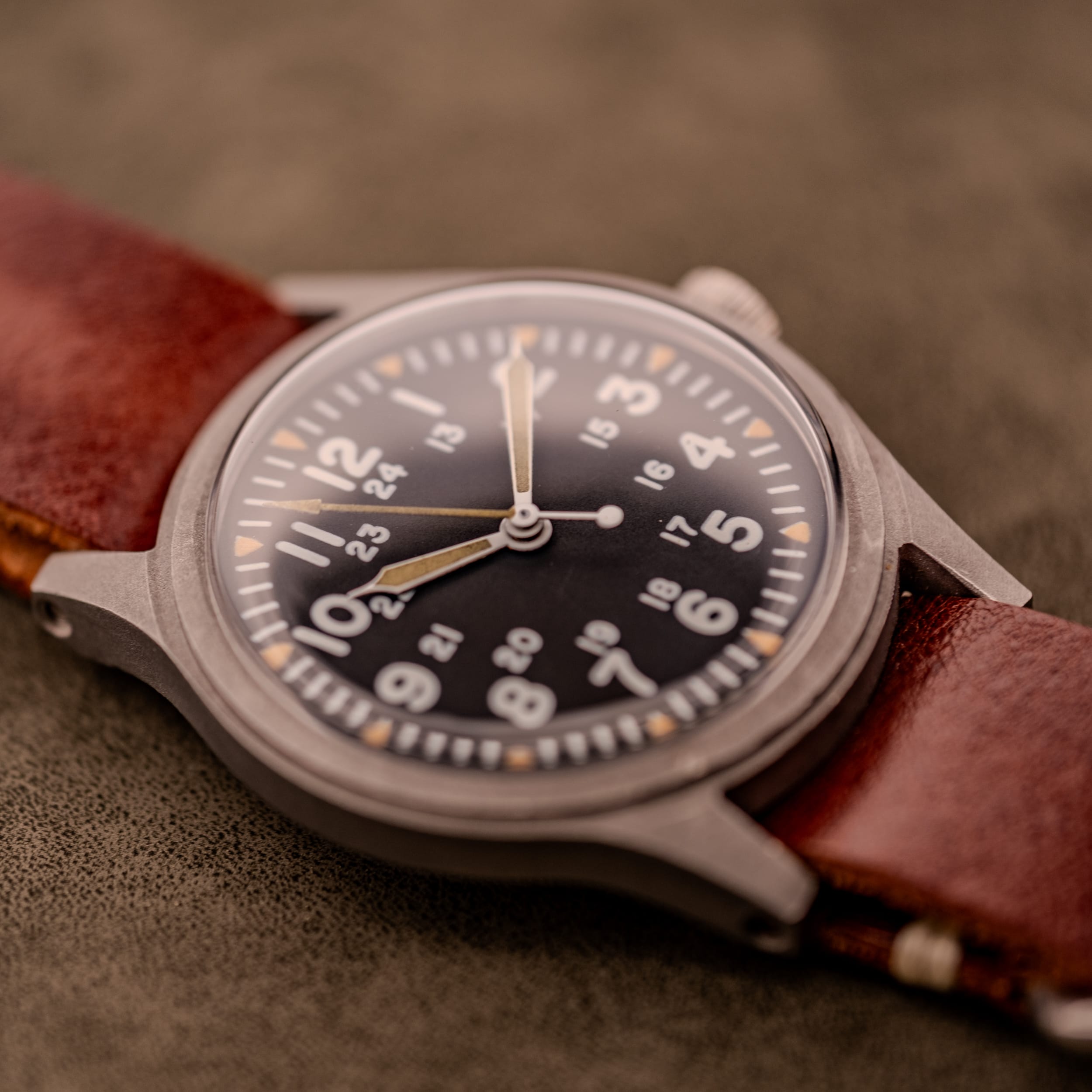
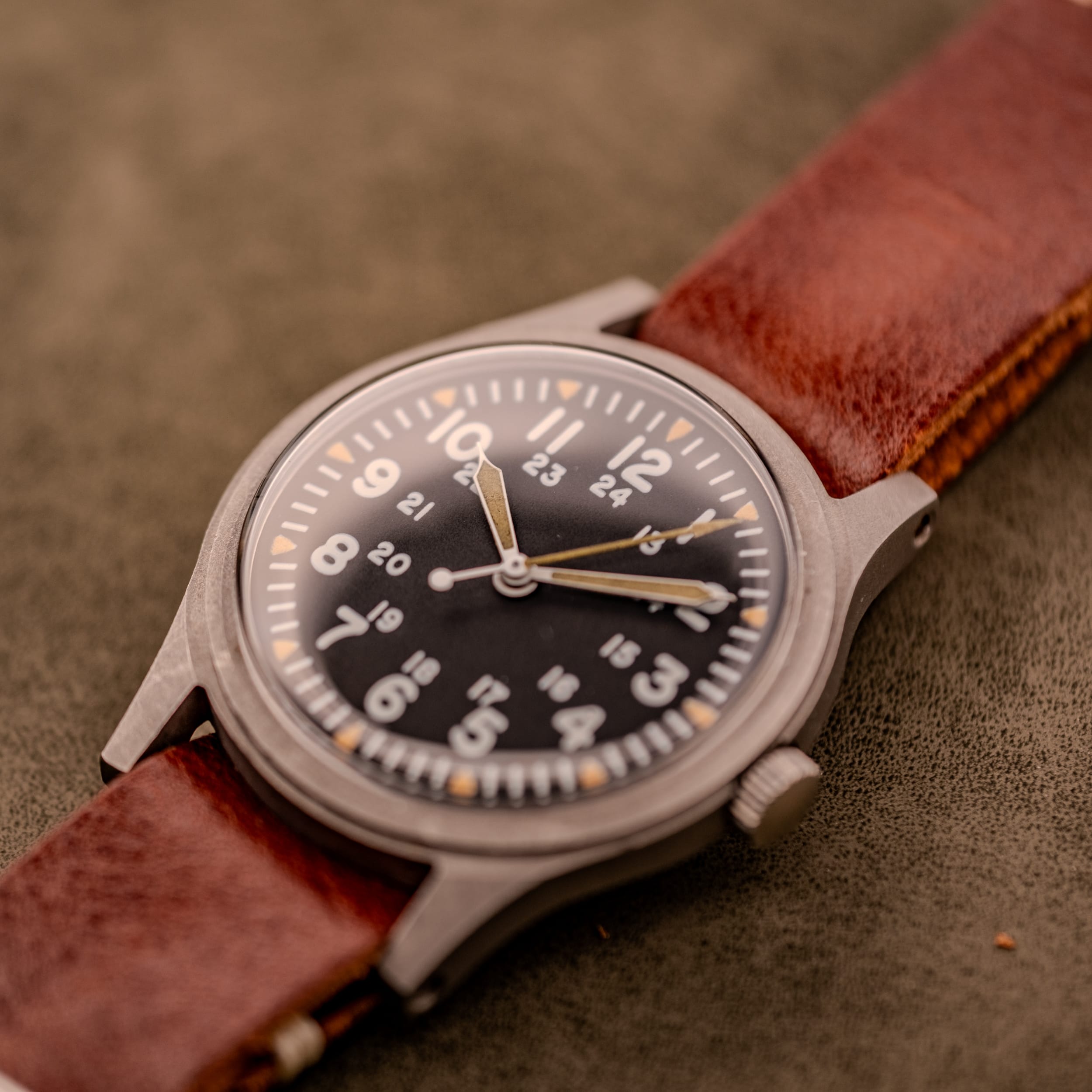
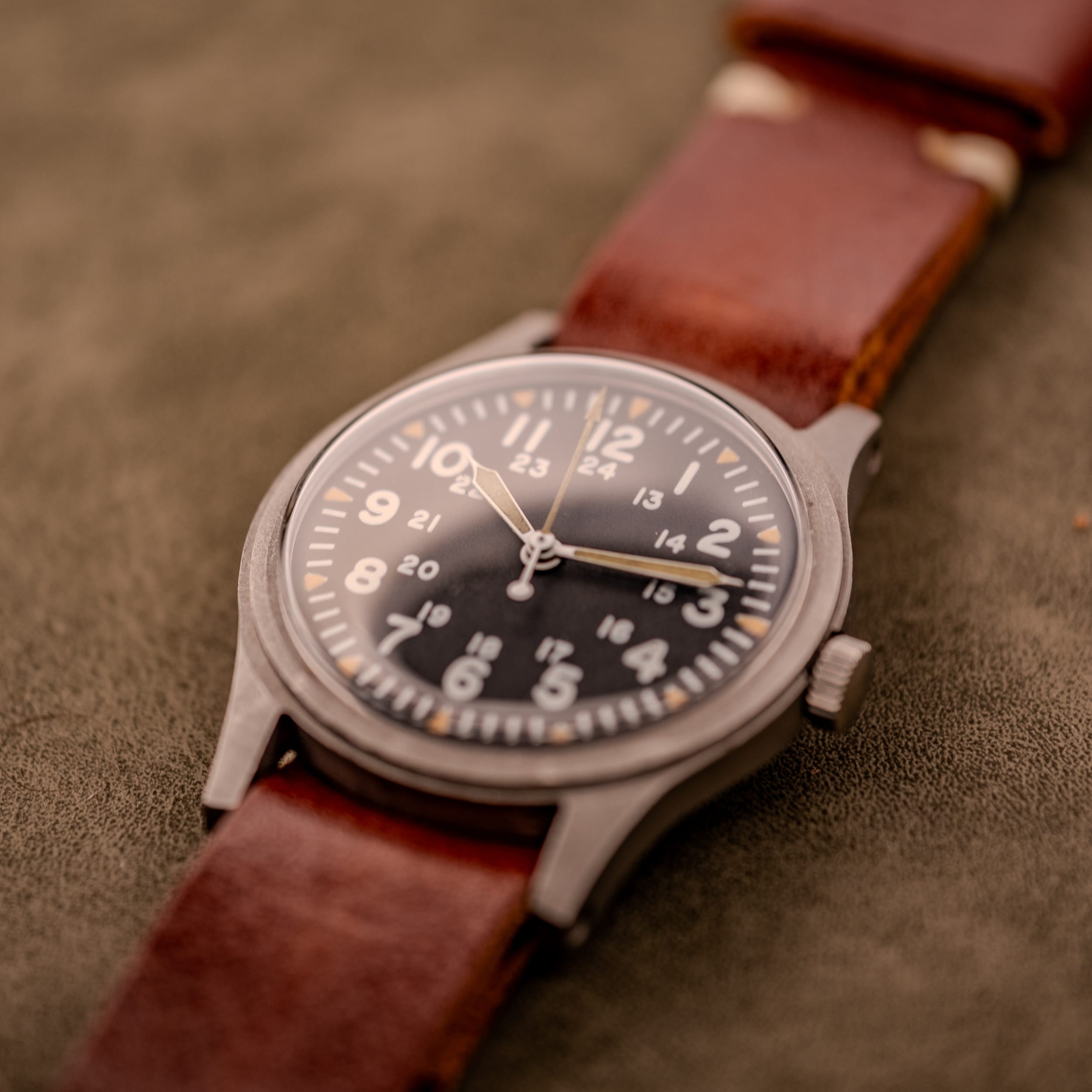
The dial is original, unsigned, and exactly as the GG-W-113 sterile dial requirement specified. Bold white painted Arabic numerals 1 through 12 march around the outer track, with the smaller military 24-hour numerals 13 through 24 printed inside in matching crisp white. Triangular tritium lume plots sit at each hour position around the perimeter, and they have aged into the most beautiful warm cream khaki tone, with subtle variation across the dial that gives this Hamilton GG-W-113 real personality. The pencil-shaped hour and minute hands carry matching aged tritium fill, and the lollipop-tipped sweep seconds hand picks up its own warm patina at the tip. A domed acrylic crystal sits proud above the dial. There is no H3 propeller marking, which is correct for the GG-W-113 specification, as the radioactive material warning came in only with the later MIL-W-46374B watches.
We have paired this Hamilton with a brown leather strap on our OTTUHR signed buckle, which gives the watch the kind of warm, lived-in look it deserves and lets the parkerized case sit cleanly without competing finishes pulling attention away from the dial.
Serviced in-house at OTTUHR and backed by our 2-year mechanical warranty, this is a wonderfully honest issued example of the reference. Factory original sterile dial, factory hands, fully legible caseback stampings, the correct hacking caliber 649 ticking underneath, and the kind of aged tritium plots that you cannot reproduce on a refinished dial. For the collector who values issued provenance over polish, who reads patina as character rather than damage, and who wants a genuine piece of American military aviation history without crossing into five-figure mil-spec territory, this is exactly the kind of GG-W-113 we love bringing in. To us, this is exactly how a 1979 Hamilton GG-W-113 should come in.