


The Omega Seamaster CK 2767 represents a pivotal chapter in horological history, a bridge between Omega’s wartime innovations and the birth of a legendary collection that continues today. Introduced in the early 1950s as part of the second generation of “beefy lug” Seamasters, this reference captures the optimism of the post-war era while retaining the robust engineering DNA developed for military service.
What makes the CK 2767 particularly compelling to collectors is its position as the center-seconds sibling to the CK 2766 small-seconds model, both sharing the distinctive oversized lugs that give these watches remarkable wrist presence despite their modest 34mm dimensions. This was Omega’s final Seamaster series powered by the charming “bumper” automatic movements before the brand transitioned to full-rotor calibers. For collectors seeking an entry point into vintage Omega, the 2767 offers authenticity, historical significance, and a remarkable variety of dial configurations—from the coveted honeycomb textures to pristine two-tone executions, all at a fraction of the cost of the brand’s more celebrated references.
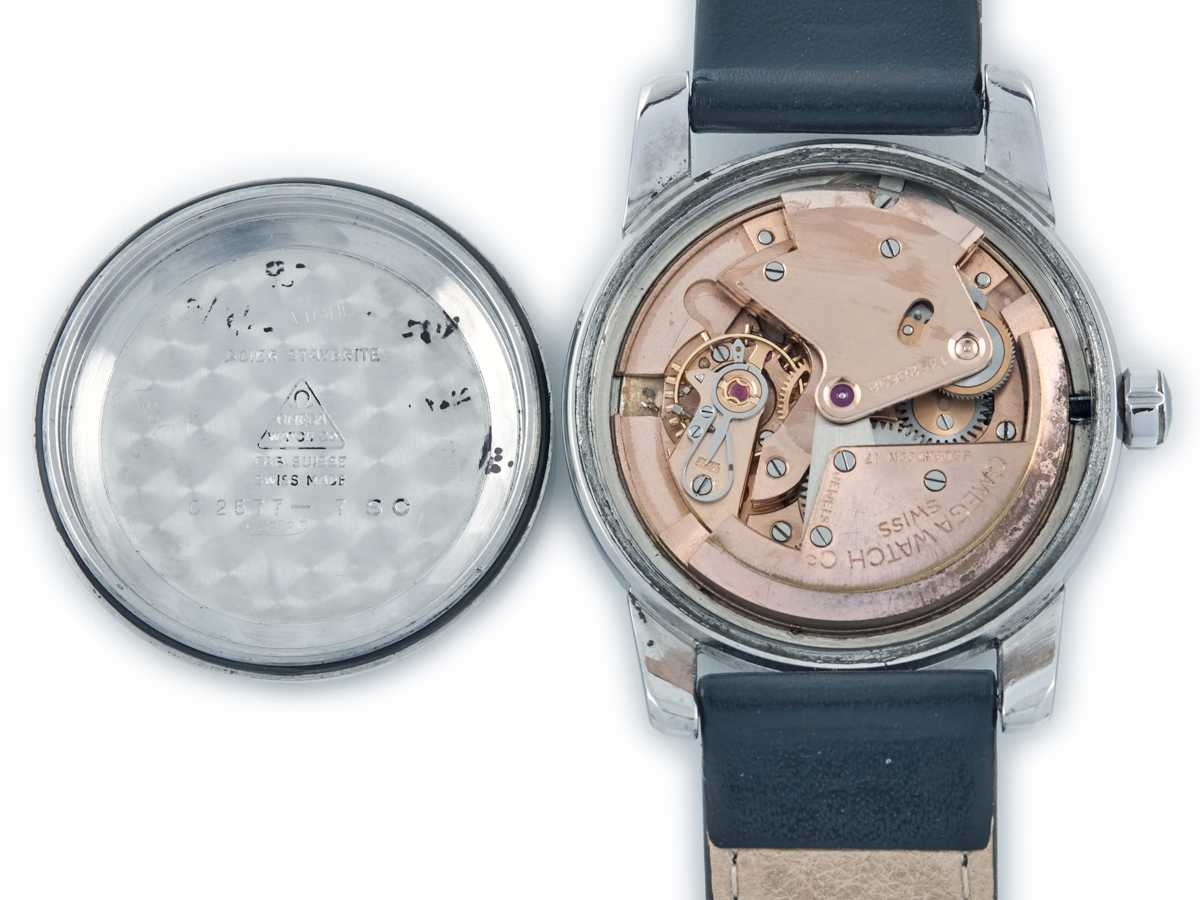
Bumper Movement Omega Seamaster Bumper Automatic Cal 354
HISTORY & PRODUCTION PERIOD
Production Years: Approximately 1950-1955, with the bulk of production occurring between 1952-1954.
The CK 2767’s genesis lies in the crucible of World War II. Between 1940 and 1945, Omega delivered over 110,000 timepieces to the British Ministry of Defence for the Royal Air Force and Royal Navy. These military watches demanded unprecedented water resistance, antimagnetic properties, and reliability under extreme conditions. When peace arrived in 1945, demand surged for civilian watches incorporating this battle-tested technology.
In 1948, on Omega’s 100th anniversary, the brand launched the Seamaster collection—the company’s first true product family. The initial series featured what collectors now call “first generation” cases with more traditional proportions. By 1950, Omega introduced the CK 2766 and CK 2767 as part of the “second generation” of Seamasters, characterized by their distinctive “beefy” or “fat” lugs that swept dramatically downward. The CK 2766 featured a small seconds subdial at 6 o’clock, while the CK 2767 proudly displayed a sweeping central seconds hand—hence the “SC” designation (Seconde Centrale in French).
The 2767 succeeded the earlier CK 2576 center-seconds model and represented the last center-seconds Seamaster to house Omega’s bumper automatic movements. By late 1954 and into 1955, Omega began transitioning to the more efficient 500-series full-rotor automatic calibers, gradually phasing out the 2767. Production estimates are unavailable, but movement serial numbers suggest several thousand examples were manufactured across the various sub-references.
Position in the Lineup: The CK 2767 occupied the mid-tier position in Omega’s 1950s dress watch hierarchy—more accessible than the jumbo 36.5mm references like the CK 2494, yet more substantial and modern than the smaller dress watches. It bridged the gap between pure dress elegance and the emerging sports watch category that would explode later in the decade with the Seamaster 300 of 1957.
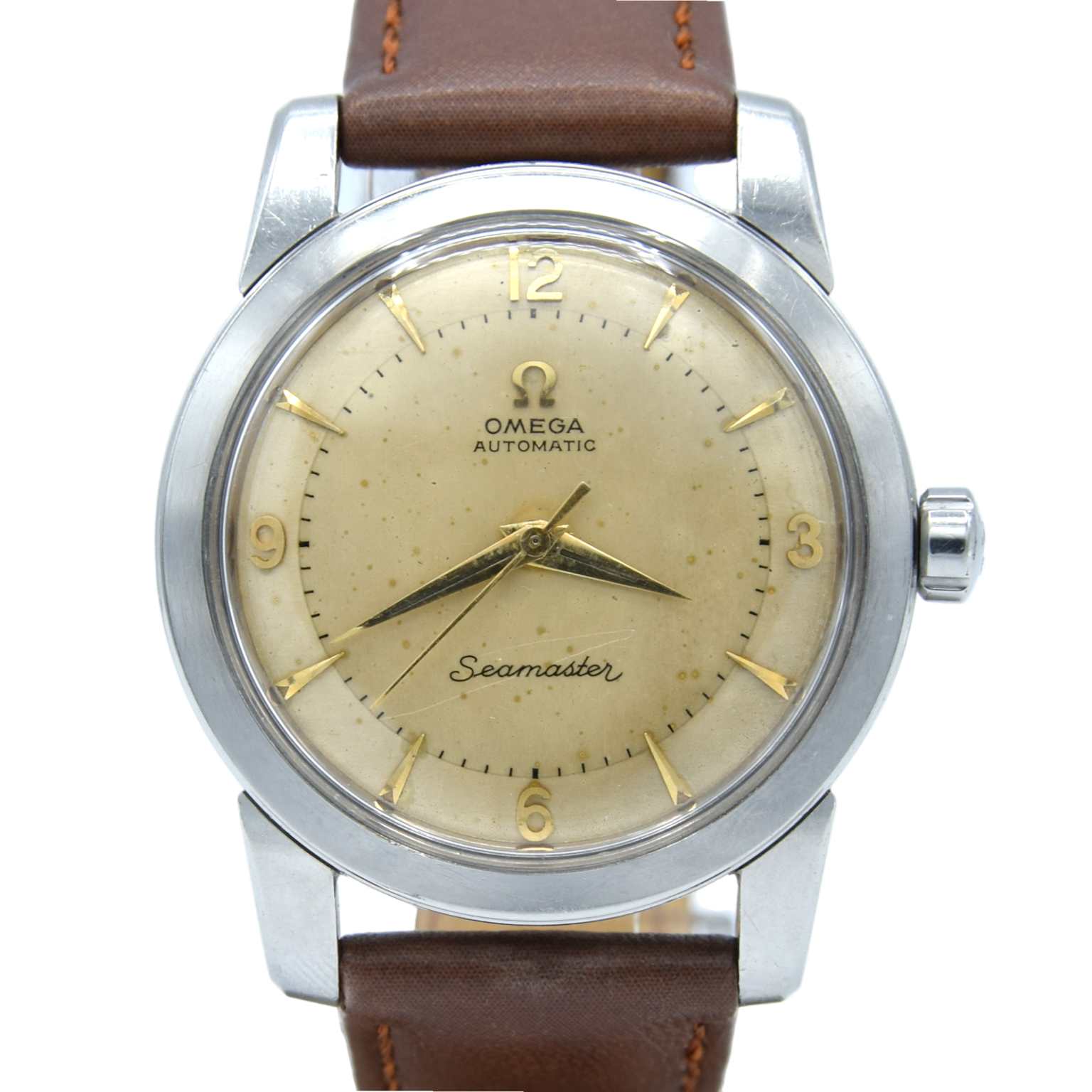
1954 Omega Seamaster Original Condition Automatic Bumper
TECHNICAL SPECIFICATIONS
Case Design Features:
- Sharp bevels on lugs and bezel (when unpolished)
- Omega-signed crown (period-correct “clover-leaf” or “flat foot” styles)
- Case back engraved “SEAMASTER” at 12 o’clock position and “WATERPROOF” at 6 o’clock on outer surface
The 2767’s proportions create a fascinating optical illusion: despite the modest 34mm diameter, the extended beefy lugs and substantial presence make it wear closer to a modern 38mm watch. This was intentional design by Omega’s engineers, who understood that wrist presence mattered as much as technical specifications.
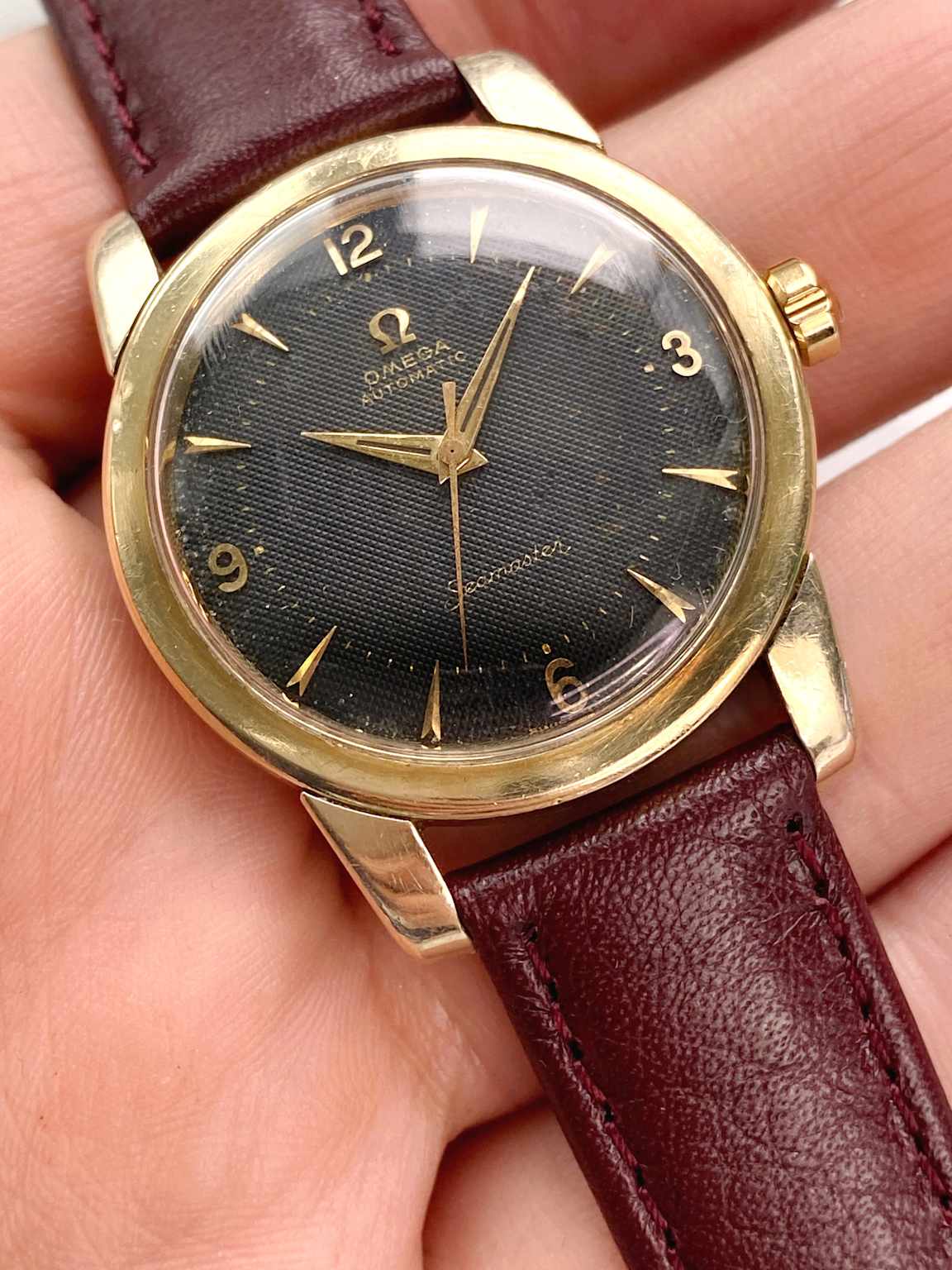
Omega Seamaster Automatic Automatik Black Honeycomb Dial
MOVEMENTS/CALIBERS
The CK 2767 was produced with multiple caliber variations, all from Omega’s 35x series of bumper automatic movements. Understanding which caliber is correct for your example is crucial for authentication.
Omega Caliber 351
Usage in 2767: The caliber 351 appears in early production 2767 models, typically those with non-chronometer dials.
Omega Caliber 352
Usage in 2767: The caliber 352 powered chronometer-certified examples of the 2767. These watches feature “CHRONOMETRE” and often “OFFICIALLY CERTIFIED” on the dial.
Omega Caliber 354
Usage in 2767: The caliber 354 is the most commonly encountered movement in CK 2767 examples, appearing in mid-to-late production pieces from approximately 1954 onward.
Movement Construction & Characteristics:
All three calibers share the distinctive bumper (or hammer) automatic mechanism invented by John Harwood in 1923. Unlike modern full-rotor automatics that swing 360 degrees, the bumper’s semi-circular weight oscillates through approximately 200-270 degrees of arc before striking spring bumpers at each end. This creates the characteristic “thunk” sensation when you shake the watch—a tactile reminder of mid-century ingenuity.
The bumper design emerged because Rolex’s patent on the 360-degree rotor (filed in 1931) locked other manufacturers out of full-rotor designs until 1948. By the time that patent expired, Omega had refined its bumper movements to remarkable levels of reliability and accuracy. The caliber 352, in particular, earned widespread respect for its chronometer-grade performance when properly serviced.
Movement Finishing:
- Copper-colored rhodium plating on bridges (characteristic of period Omega movements)
- Circular Côtes de Genève (Geneva stripes) decoration on rotor and bridges
- Blued screws on higher-grade examples
- Movement signed “OMEGA WATCH CO SWISS” and “SEVENTEEN 17 JEWELS”
Common Movement Issues:
Bumper movements require experienced watchmakers familiar with their unique construction. Common problems include:
- Worn bumper springs (reduces winding efficiency)
- Worn ratchet wheels (causes slipping)
- Missing or loose case clamp pin (movement moves inside case)
- Dried lubricants affecting amplitude and timekeeping
When properly serviced, these movements deliver excellent timekeeping within COSC chronometer specifications. However, finding watchmakers experienced with bumper automatics is increasingly challenging, and service costs typically range from $300-$600 for a complete overhaul.
Bumper Movement Omega Seamaster Bumper Automatic Cal 354
DIAL VARIATIONS
The CK 2767’s dial diversity represents one of its greatest appeals to collectors. Omega produced this reference with numerous dial configurations, textures, and color combinations, offering something for every aesthetic preference.
Dial Colors
Silver/Silvered Dials
The most common configuration, featuring a silvered or white dial with applied hour markers. These dials age gracefully, developing subtle patina ranging from cream to light champagne tones. Original examples show even aging across the dial surface.
Gold/Champagne Dials
Warm-toned dials in various shades from pale champagne to deeper gold. These were often paired with gold-capped or solid gold cases, though steel examples exist.
Two-Tone “Tuxedo” Dials
Highly desirable configuration featuring contrasting center and outer dial sections, typically with a darker outer ring and lighter center. The contrast creates visual depth and makes the watch instantly recognizable.
Black Dials
Rare configuration that commands premium pricing when authentic. Many black-dial examples on the market are service replacements or repaints—exercise extreme caution.
Dial Textures
Honeycomb/Waffle Texture
The most coveted dial variant features a subtle honeycomb or “waffle” texture that catches light beautifully. These textured dials were produced in limited quantities and typically appear on examples from the early production period. Collectors prize these configurations, with honeycomb examples commanding 30-50% premiums over smooth dials in equivalent condition.
Smooth/Matte Finish
Standard production featured smooth or very subtly grained dial surfaces. These age well and are most common in the marketplace.
Crosshair Dials
Some examples feature delicate crosshair patterns radiating from the center post, adding visual interest. The crosshair should pass through specific parts of dial text—through the first part of the “M,” center of the “E,” and middle of the Omega symbol.
Hour Markers & Numerals
Omega employed several index configurations across the 2767 production run:
- Applied dart/arrowhead indices: Most common style, featuring pointed markers at hour positions
- Applied “epi” (wheat grain) indices: Elegant elongated markers
- Arabic numerals: Typically at 12, 3, 6, and 9 o’clock positions
- Mixed configurations: Some dials combine Arabic numerals with applied indices
All applied elements should show period-appropriate construction with visible solder points or mounting pins when examined under magnification.
Dial Text & Markings
Standard Configuration:
- “OMEGA” applied metal logo at 12 o’clock (sharply defined)
- “AUTOMATIC” printed text (period-appropriate font)
- “SEAMASTER” printed text (flowing script with distinctive “S”)
- “SWISS MADE” at 6 o’clock position
Chronometer Configuration:
- All standard text plus:
- “CHRONOMETRE” (French spelling)
- “OFFICIALLY CERTIFIED” (on some examples)
The dial printing quality on original examples is crisp and even, with consistent line weights. Repainted dials often show telltale signs: uneven printing, incorrect fonts, misaligned minute tracks, or missing “Swiss Made” text.
Hands
Dauphine Hands
The most common hand style, featuring tapered diamond-shaped hands with radium luminous material. These hands should match the dial’s metal finish—gold hands with gold indices, silver/steel hands with silver indices.
Alpha/Tapered Alpha Hands
Some examples feature alpha-style hands with broader tips.
Luminous Material:
Original hands contain radium luminous compound, which develops a cream-to-tan patina over decades. By the 1960s, Omega transitioned to tritium (marked with “T SWISS T” on dials), but the 2767’s production ended before this change. If you see tritium markings, the dial is a service replacement.
CASE & BEZEL VARIATIONS
Understanding case material prefixes is essential for authenticating CK 2767 examples.
Reference Number Prefixes
CK (Acier): Stainless steel case
- Gold plating (typically 14K or 80-micron) over stainless steel base
- Often shows wear at edges of lugs and bezel after 70 years
- More affordable entry point than solid gold
- 18K yellow gold most common
- Hallmarks stamped inside case back
- Rare and valuable—commands significant premiums
Two-Tone: Steel case with gold bezel
- Uncommon configuration
Sub-Reference Numbers
The numerical suffix following the hyphen indicates specific variations within the 2767 family:
![Omega] 1951 Seamaster 2767-3 SC, gilt dial : r/VintageWatches](https://ottuhr.com/wp-content/uploads/2025/12/761865e7dd6f55274d02878dde7fde5a0e2020f9.jpg)
Omega] 1951 Seamaster 2767-3 SC, gilt dial : r/VintageWatches
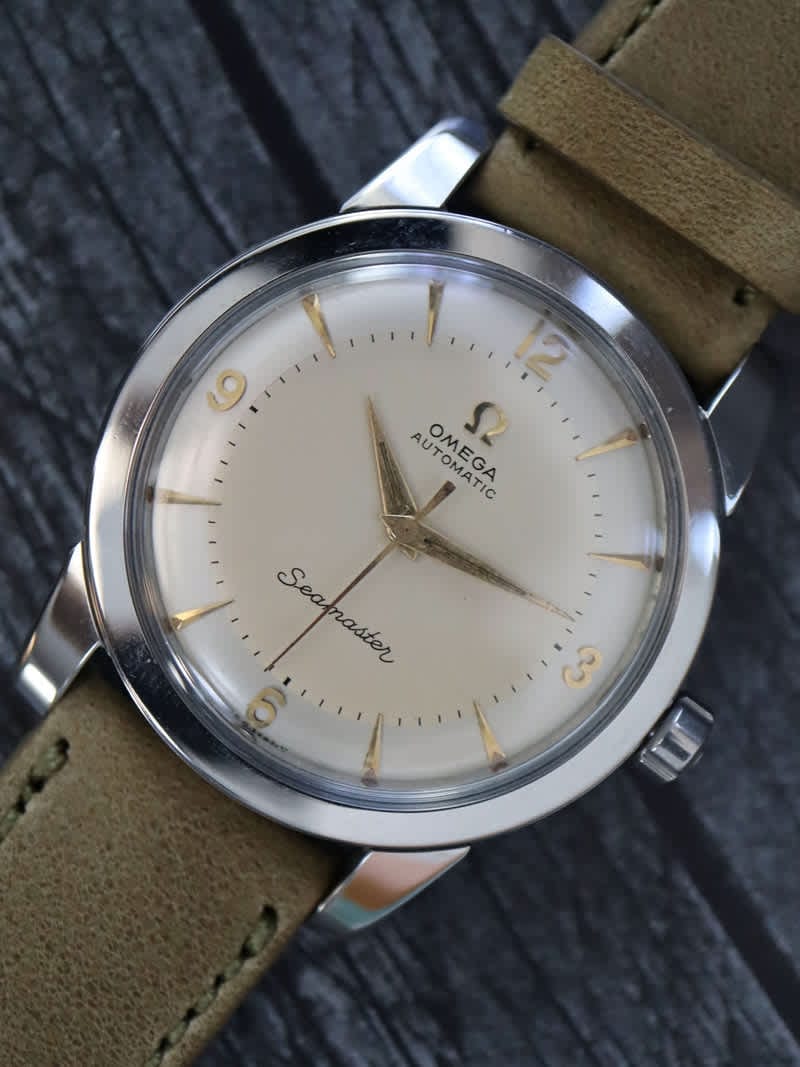
39250: Omega Vintage Seamaster, Size 34mm, Ref. 2767-2
- 2767-4 SC: Features beefy lug design with press-fit back
- 2767-5 SC: Another documented variant
- 2767-10 SC: Later production example
The specific differences between these sub-references remain somewhat mysterious, as Omega’s internal documentation from this era is incomplete. Variations likely relate to case manufacturer, bezel style, or minor dimensional differences rather than significant design changes.
Case Construction Details
Lugs:
The defining characteristic of the 2767 is its “beefy” lugs—oversized, downward-sweeping extensions that create dramatic wrist presence. These lugs feature sharp bevels and facets that catch light beautifully when unpolished. Polishing warning: Over-polishing destroys these bevels, permanently reducing both aesthetics and value.
Bezel:
Smooth polished bezel with subtle bevel at edge. The bezel should maintain sharp definition where it meets the case top.
Crown:
Original Omega-signed crowns feature period-appropriate designs including “clover-leaf” and “flat foot” styles. The crown should screw smoothly without excessive play. Replacement crowns are common—verify correct style for the period.
Case Back:
Exterior markings:
- “SEAMASTER” engraved at 12 o’clock position
- “WATERPROOF” engraved at 6 o’clock position
- Some examples show wear or polishing of these engravings
Interior markings should include:
- “OMEGA WATCH CO”
- “FAB SUISSE SWISS MADE”
- “ACIER INOXYDABLE” (stainless steel) or gold hallmarks
- Full reference number (e.g., “2767-3 SC”)
- Case maker marks (CB, HF, or others)
- “PATENT + APPLIED” or similar markings
- Multi-language instructions regarding gasket installation
The presence of three different languages (French, German, Italian, and/or English) stamped inside the case back is authentic to period Omega production and not a red flag as some believe.
BRACELET & STRAP OPTIONS
Period-correct bracelet options for the CK 2767 are increasingly rare and valuable.
Original Omega Bracelets
Beads of Rice Bracelet
The quintessential vintage Omega bracelet style, featuring cylindrical “rice bead” links that create a flexible, elegant appearance.
Authentic characteristics:
- Stamped “OMEGA” on clasp
- Various reference numbers: 1383/32, 1444, and others
- 18mm width at endlinks
- Either folded links (earlier) or semi-solid construction
- U.S. market examples often stamped “MADE IN USA”
- Curved endlinks (reference-specific)
Original beads of rice bracelets in good condition command $400-$1,200 depending on material and condition. Aftermarket reproductions exist but lack the build quality and correct end-link fitting of originals.
Rice Grain/Mesh Bracelets
Alternative period bracelet featuring tighter mesh construction. These show distinctive stretch patterns after decades of wear.
Leather Straps
Original leather straps rarely survive, but period-appropriate replacements enhance authenticity.
Original buckle characteristics:
- Omega-signed buckle with vintage logo
- Appropriate width (18mm)
- Steel or gold-plated to match case
Contemporary collectors often fit vintage-style leather straps in oxblood, honey, brown, or black to complement the watch’s warm patina.
IDENTIFYING ORIGINAL vs. REPLACED PARTS
Authentication is crucial when purchasing vintage Omega watches, as the market contains numerous examples with replaced, refinished, or incorrect components.
Dial Authentication
Original dial characteristics:
- Crisp, even printing with consistent line weights
- Applied metal Omega logo with sharp definition
- Minute track properly aligned with dial periphery
- Crosshairs (if present) pass through correct points in text
- “SWISS MADE” present at 6 o’clock (except on service dials)
- Period-appropriate patina showing even aging
- Font styles matching documented examples
Red flags for refinished/replaced dials:
- Overly pristine appearance inconsistent with age
- Uneven or bubbled surface
- Incorrect font styles or letter spacing
- Missing or poorly executed applied logos
- Minute track misalignment
- Crosshairs in wrong positions
- Evidence of repainting under magnification
Refinished dials significantly reduce value—often by 50-70% compared to original examples.
Hands Authentication
Original hands should:
- Match case and dial metal finish (gold with gold, steel with steel)
- Show appropriate lume aging if lumed
- Fit proportionally to dial size
- Match period-appropriate styles (Dauphine for most 2767s)
Warning signs:
- Metal finish mismatched to dial (e.g., gold hands on silver dial)
- Modern Super-LumiNova instead of aged radium/tritium
- Incorrect hand styles for the period
- Disproportionate sizing
Movement Authentication
Verify correct caliber for the dial:
- Chronometer dials must have Cal. 352 or 354
- Standard dials typically use Cal. 351 or 354
- Movement serial number should align with case production date
Original movement characteristics:
- Copper-colored rhodium plating
- Proper signatures and jewel count markings
- Chronometer movements have appropriate regulation systems
- Serial numbers consistent with production period
Dating by movement serial number:
- 12,000,000-13,000,000: 1950-1952
- 13,000,000-14,000,000: 1952-1954
- 14,000,000-15,000,000: 1954-1956
Incorrect movements sometimes result from watchmaker substitutions during service. A chronometer dial with a non-chronometer movement is a red flag.
Crown Authentication
Original Omega-signed crowns are increasingly rare. Replacement crowns are acceptable if period-appropriate style, but incorrect crowns (modern styles, wrong size) indicate neglected service history.
Case Condition
Unpolished cases show:
- Sharp, defined bevels on lugs
- Crisp edges where bezel meets case
- Visible machining marks in recessed areas
- Consistent brushed or polished finishes in original configurations
Over-polished cases exhibit:
- Rounded lug edges and lost bevels
- Thinned case walls
- Reduced definition between surfaces
- “Blobby” appearance replacing sharp lines
Over-polishing is irreversible and significantly reduces collector value. Seek examples with minimal polishing and sharp original case features.
Crystal
Correct acrylic crystals feature:
Modern replacement crystals are acceptable for wearability but should maintain period-appropriate profile.
COLLECTOR NOTES & MARKET CONTEXT
Current Market Positioning
The CK 2767 occupies a sweet spot in the vintage Omega market: historically significant, aesthetically appealing, and refreshingly affordable compared to the brand’s more celebrated references.
Approximate value ranges (2024-2025 market):
| Configuration | Condition | Price Range (USD) |
|---|---|---|
| Steel, standard dial, Cal. 351/354 | Good, original | $600-$1,200 |
| Steel, standard dial, Cal. 354 | Excellent, unpolished | $1,000-$1,800 |
| Steel, honeycomb dial, Cal. 354 | Excellent | $1,500-$2,500 |
| Steel, chronometer dial, Cal. 352/354 | Excellent | $1,200-$2,000 |
| Gold-capped, standard dial | Good to excellent | $800-$1,500 |
| Gold-capped, honeycomb dial | Excellent | $1,800-$2,800 |
| Solid 18K gold | Excellent | $2,500-$5,000+ |
| Black dial (authentic) | Excellent | $2,000-$3,500 |
Value modifiers:
- Refinished dial: -50% to -70%
- Over-polished case: -20% to -40%
- Incorrect parts: -30% to -60%
- Original box and papers: +30% to +50%
- Honeycomb/waffle dial: +30% to +50%
Investment Perspective
While vintage Omega watches have shown strong appreciation over the past decade, the CK 2767 remains relatively undervalued compared to comparable references. The Speedmaster Professional and Seamaster 300 receive most collector attention, leaving excellent opportunities in dress Seamasters.
Bullish factors:
- Growing appreciation for 1950s dress watch aesthetics
- Limited supply of unpolished examples with original dials
- Increasing difficulty finding experienced bumper movement watchmakers drives preference for preserved examples
- Honeycomb dial variants approaching Constellation pie-pan territory in desirability
Risk factors:
- Bumper movements require specialized service
- Market flooded with refinished/frankenwatches
- Limited name recognition compared to sports models
- Service costs ($300-$600) represent significant percentage of watch value
Collecting Strategy
Prioritize:
- Original, unrefined dials – Worth 2-3x refinished equivalents
- Sharp, unpolished cases – Irreplaceable once over-polished
- Correct caliber for dial markings – Authentication critical
- Honeycomb/waffle dial variants – Commanding premiums already
- Chronometer versions – Historical significance and performance
- Two-tone “tuxedo” dials – Distinctive and increasingly sought
Common pitfalls:
- Assuming all patina is desirable – Water damage differs from even aging
- Buying refinished dials unknowingly – Study authentic examples extensively
- Overlooking incorrect hands – Should match dial metal finish
- Accepting any bumper movement – Verify correct caliber
- Missing polishing damage – Examine lug bevels carefully
What Drives Premiums
Box and papers: Complete sets with Extract from Archives command 30-50% premiums. Omega’s Extract service (120 CHF) provides factory verification of production details.
Provenance: Corporate presentation watches (e.g., TWA employee awards) add historical interest.
Unpolished cases: Sharp bevels and original finishes increasingly rare.
Rare dial configurations: Honeycomb texture, authentic black dials, and early chronometer versions.
Complete originality: All-original examples in excellent condition becoming unicorns.
Comparison to Related References
vs. CK 2766 (small seconds):
The 2766 and 2767 are siblings differing only in seconds hand configuration. Small seconds (2766) appeal to purists and dress watch enthusiasts, while center seconds (2767) offer more modern practicality. Market values are roughly equivalent, with dial configuration driving premiums rather than seconds hand placement.
vs. CK 2577 (earlier center-seconds):
The 2577 (late 1940s) lacks the dramatic beefy lugs of the 2767, wearing smaller and more conservatively. Market values favor the 2767’s more distinctive design.
vs. CK 2576 (earlier small-seconds):
Similar story to 2577—more traditional case design, typically trading 20-30% below equivalent 2767 examples.
vs. Jumbo beefy lug references (2493, 2494, 2765, etc.):
The larger 36.5mm “jumbo” beefy lug Seamasters command premiums for their exceptional wrist presence. However, the 34mm 2767 offers better proportions for smaller wrists while maintaining the signature lug design.
CONCLUSION
The Omega Seamaster CK 2767 represents an ideal entry point into serious vintage Omega collecting. It captures a pivotal moment when Omega transitioned military innovations into civilian horological excellence, resulting in a watch that balances historical significance with daily wearability. The variety of dial configurations—from pristine silver to coveted honeycomb textures—ensures that collectors can find examples matching their aesthetic preferences without the stratospheric prices commanded by Speedmaster or Seamaster 300 references.
For collectors, the 2767 rewards patience and education. Study authentic examples, learn to identify correct components, and prioritize originality above cosmetic perfection. An unpolished case with honest wear trumps a heavily polished “perfect” example every time. Similarly, an original dial showing gentle patina vastly exceeds a refinished dial in collector value, even if the refinish appears pristine.
As the vintage watch market matures, discerning collectors increasingly recognize the CK 2767’s compelling combination of attributes: distinctive design, robust engineering, historical provenance, and relative affordability. The bumper movement’s charming mechanical personality adds tactile appeal that modern watches cannot replicate. For those seeking a vintage Omega that rewards both the heart and the mind, the CK 2767 delivers magnificently.