


Last updated ~ February 2, 2026
Brand
Production Period
1955–1959
Model Line
Case Shape
Round
Diameter
33mm
Lug to Lug
41mm
Lug Width
19mm
Case Thickness
12mm
Case Back
Screw-Down
Caliber
Crystal
Bezel
Fluted
The Rolex Oyster Perpetual 6593 stands as one of the most visually distinctive references from the 1950s Rolex catalog, defined entirely by its sculptural Bombay lugs. These dramatically curved, convex lugs transform what would otherwise be a standard 33mm dress watch into something that wears substantially larger and commands attention on the wrist. The term Bombay derives from the French word bombé (rounded or convex), later Americanized by collectors who recognized these watches as a distinct subset within the Oyster Perpetual family.
The 6593 represents the mid-1950s expression of Rolex’s decorative lug experiment, positioned in the chronology between the earlier 6090 (fitted with caliber A.260) and the later 1010/1011 references (fitted with caliber 1560). Produced exclusively in 14k yellow gold with fluted bezels, the 6593 houses Rolex’s workhorse caliber 1030, a 25-jewel chronometer-certified automatic movement known for reliability and accuracy.
Production of the 6593 aligns with serial numbers ranging approximately from 150,000 to 550,000, corresponding to the years 1955 through 1959. Total production numbers remain undocumented by Rolex, but the reference is decidedly scarce in today’s market. The combination of gold-only construction, distinctive case design, and relatively short production window places the 6593 in the rare to extremely rare category. Examples surface occasionally at auction and through specialized vintage dealers, but pristine unpolished specimens with original dials command significant premiums.
Collector interest in the 6593 centers on case condition and originality. The Bombay lugs, being the defining characteristic, must retain their sculptural shape and sharp definition. Over-polished cases with rounded, softened lugs lose much of their appeal and value. The fluted bezel likewise must show crisp, well-defined grooves. Dial condition matters immensely, as service replacement dials from later eras compromise authenticity. Original champagne or silver dials with matching patina on luminous plots and hands carry the highest desirability.
The 6593 carries no official nickname beyond the Bombay designation shared with other Bombé-lugged references. Within the broader vintage Rolex market, demand for the 6593 remains steady among collectors who appreciate mid-century design flourishes and less common references. Values have appreciated alongside the general vintage Rolex market, though the 6593 has not experienced the explosive growth seen in sport models. Current market positioning places well-preserved examples in the $4,000 to $8,000 range, with exceptional unpolished pieces commanding premiums.
Historical Context, Provenance, and Manufacturing Details
Rolex’s experimentation with Bombé lugs began in the late 1940s as the brand sought to differentiate its Oyster Perpetual line through decorative case variations. The earliest Bombay references, 5016 and 5018, featured the 9 3/4″ caliber and appeared around 1948-1950. These watches introduced the spiral-like, rounded lug profile that would become the Bombay signature.
By the early 1950s, Rolex transitioned to the A.260 caliber with reference 6090, consolidating the small seconds and center seconds variants. The 6593 emerged around 1955 as Rolex introduced caliber 1030, their refined automatic movement with improved chronometer performance. The 6593 did not replace a specific predecessor but rather represented the natural evolution of the Bombay line as movements were updated.
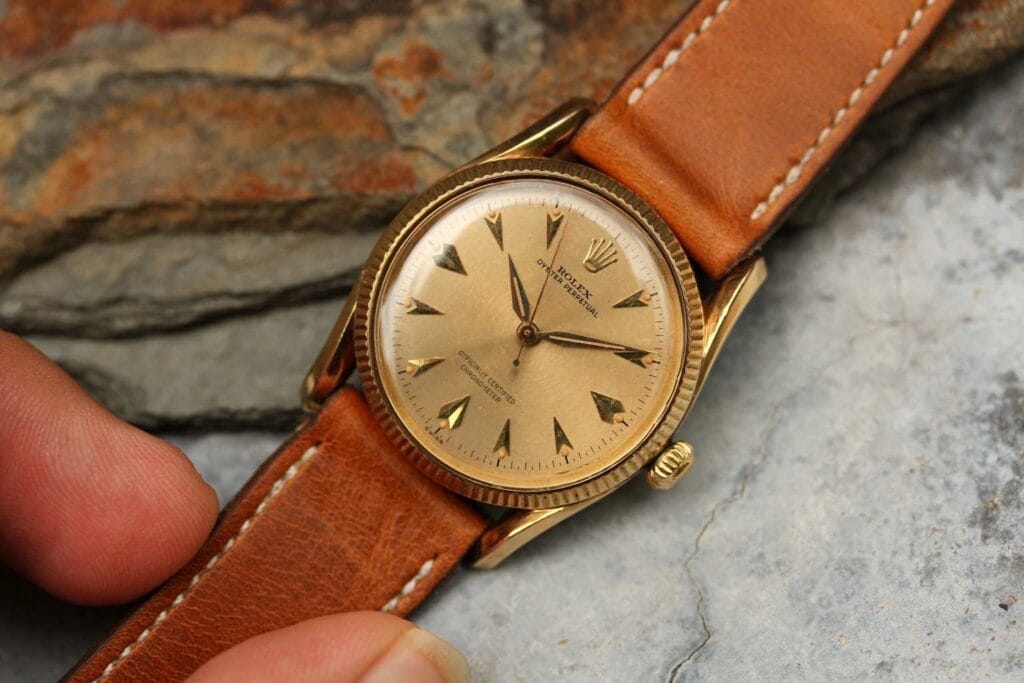
The market positioning of the 6593 in the mid-1950s placed it as a premium dress watch offering. At approximately 34mm in diameter (measuring across the widest point of the curved lugs), the watch targeted buyers seeking elegance with presence. The gold-only construction and fluted bezel signaled luxury, while the chronometer certification emphasized precision. This was not groundbreaking technology but rather Rolex’s established formula applied to a distinctive case design.
The 6593 was eventually succeeded by references 1010 and 1011 in 1959 when Rolex introduced caliber 1560. Reference 1010 featured a smooth bezel while 1011 retained the fluted bezel, continuing the Bombay aesthetic into the 1960s and early 1970s. These later references represent the final chapter of the Bombay design, as Rolex gradually moved toward more standardized case shapes.
Cases for the 6593 were likely manufactured by C.R. Spillmann SA, the La Chaux-de-Fonds case maker that produced the majority of Rolex Oyster cases from the 1920s through the 1980s. Spillmann, operating under poinçon de maître number 136, was Rolex’s exclusive case supplier for the first decade of Oyster production and continued as a primary supplier through the vintage era. Rolex eventually acquired Spillmann in 1998, bringing case production fully in-house.
The 6593’s place in horological history is modest but notable. It represents a transitional period when Rolex was willing to offer more decorative case variations alongside their increasingly tool-focused professional models. While the Submariner, GMT-Master, and Explorer were establishing Rolex’s reputation for purpose-built instruments in the 1950s, references like the 6593 served buyers seeking classic dress watches with distinctive character. The Bombay design never achieved the commercial success or cultural penetration of Rolex’s sport models, making these watches comparatively rare today.
Construction and Architecture
The visual identity of the 6593 begins and ends with its case. The 14k yellow gold Oyster case measures 33mm at the case body but wears substantially larger due to the extended, curved Bombay lugs. Total lug-to-lug measurement reaches approximately 40-42mm, with the lugs sweeping dramatically outward and downward to follow the wrist’s contour. This curvature allows the relatively compact case to hug the wrist while maintaining substantial visual presence.
The lugs themselves feature a sculptural, almost spiral quality, with pronounced rounded profiles that catch light from multiple angles. Factory-fresh examples show sharp, well-defined lug shapes with visible depth to the curves. The case flanks between the lugs are polished, contrasting with the horizontal brushing typically found on Oyster case sides. The crown guards had not yet been introduced in the 1950s, leaving the crown fully exposed at 3 o’clock.
The fluted bezel stands as the 6593’s most recognizable detail after the Bombay lugs. Crafted in 14k yellow gold to match the case, the bezel features the characteristic Rolex fluting pattern with fine, evenly spaced grooves running radially from the crystal edge. This fluted design originated as a functional element, allowing the bezel to be gripped and screwed down onto the case to ensure water resistance. By the 1950s, the fluting had evolved into a purely decorative signature associated with Rolex’s dress watch offerings.
The crystal is domed acrylic (often referred to as Plexiglas or Hesalite), standard for all Rolex watches of this era. Acrylic crystals offer shatter resistance and develop a warm, vintage character over time. They scratch more easily than modern sapphire but can be polished to restore clarity. The domed profile sits slightly proud of the bezel, creating the distinctive vintage Rolex silhouette. Rolex did not transition to sapphire crystals until the late 1970s and early 1980s, making acrylic correct for the 6593.
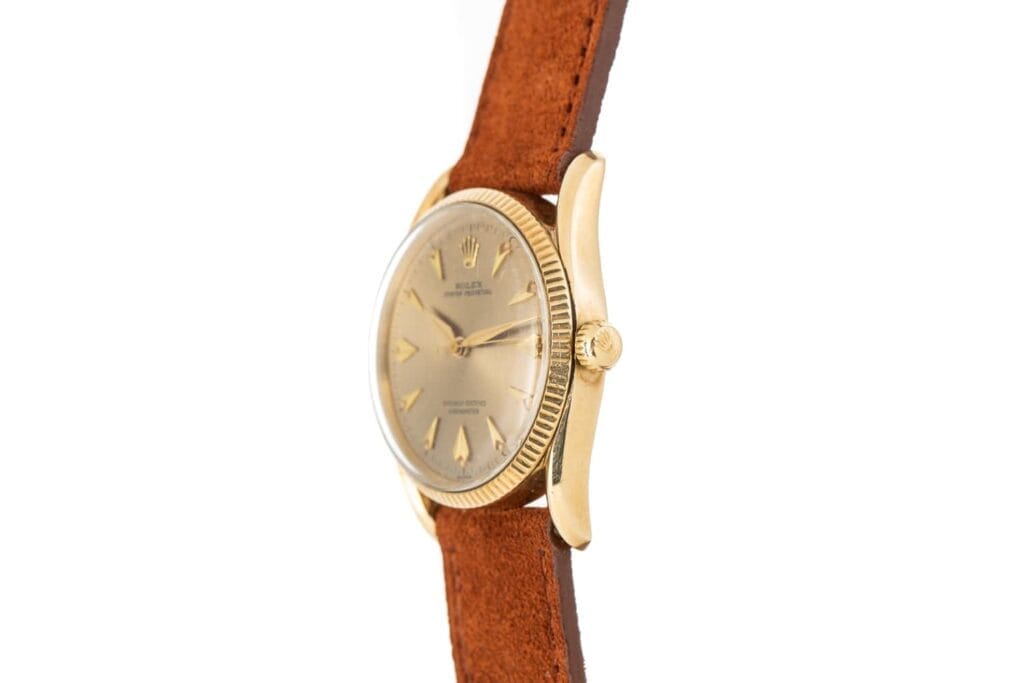
Dial configurations on the 6593 center primarily on champagne gilt variants, though silver and ivory examples exist. The champagne dial features a sunburst finish that radiates from the center, creating subtle depth and dimension. Applied gold hour markers in either dagger or arrowhead shapes provide strong visual contrast. The dial text reads “Rolex Oyster Perpetual” across the upper half, with “Officially Certified Chronometer” below in smaller text. At 6 o’clock, the single word “Swiss” indicates the use of radium-based luminous material, standard for Rolex production until 1963.
Hands vary between dauphine and alpha styles, both period-correct for the 6593. Dauphine hands feature a faceted, diamond-shaped profile tapering from a wide base to a sharp point, offering elegance and clarity. Alpha hands present a more deltoid shape with a thin neck expanding to a broader tip, resembling the Greek letter alpha. Both styles were commonly used on 1950s Rolex dress watches and appear with similar frequency on surviving 6593 examples. The seconds hand is typically a simple straight design in blued steel, though gold examples exist. Luminous plots on the hour markers and hands would have been radium-based, aging to a cream or tan patina over decades.
The crown is a Rolex-signed screw-down design, correct for Oyster cases of this era. The crown features fine knurling for grip and typically measures 5.5-6.0mm in diameter. Period-correct crowns will show appropriate wear and patina consistent with the case. The Twinlock system, featuring two sealed zones via O-rings, was introduced by Rolex in the 1950s and would have been implemented on the 6593 to ensure water resistance. However, vintage water resistance can no longer be guaranteed, and these watches should not be exposed to moisture.
The screw-down case back is smooth and slightly domed, engraved with “Montres Rolex SA Geneva Switzerland” in a circular pattern. The case material is marked (14K, 585, or 0.585 depending on market), along with Swiss hallmarks and potentially the case maker’s poinçon de maître. Between the lugs at 12 o’clock, the reference number 6593 is stamped, while the serial number appears between the lugs at 6 o’clock. These engravings may appear in either wide (Typeface A) or narrow (Typeface B) fonts, both correct depending on production batch.
The 6593 was never offered with an integrated bracelet. Period-correct options include leather straps in brown or black, typically 19mm at the lugs. Some examples may have been sold with mesh or leather bracelets, though documentation of original bracelet offerings remains sparse. Modern collectors typically fit the 6593 with high-quality leather straps in shell cordovan or calfskin, emphasizing the watch’s dress watch character.
| Dial Variation | Markers | Hands | Text |
|---|---|---|---|
| Champagne Gilt | Applied gold dagger or arrowhead | Dauphine or alpha, gold with lume | Rolex Oyster Perpetual / Officially Certified Chronometer / Swiss |
| Silver/Ivory | Applied gold baton or arrowhead | Dauphine or alpha, gold with lume | Rolex Oyster Perpetual / Officially Certified Chronometer / Swiss |
Cross-Reference Data
The 6593 shares its core architecture with other Oyster Perpetual references from the same era, differing primarily in case material and bezel configuration.
| Reference | Material | Bezel | Case Size | Caliber | Notes |
|---|---|---|---|---|---|
| 6564 | 14k gold, 9k gold, stainless steel | Smooth or fluted | 34mm | 1030 | Standard round lugs, most common OP variant of the era |
| 6565 | Stainless steel | Smooth | 34mm | 1030 | Steel version with standard lugs |
| 6567 | 14k gold, rose gold | Fluted | 34mm | 1030 | Gold version with fluted bezel, standard lugs |
| 6090 | 14k gold, rose gold | Smooth or fluted | 34mm | A.260 | Earlier Bombay reference with A.260 caliber |
| 1010 | 14k gold | Smooth | 34mm | 1560 | Successor Bombay reference with smooth bezel |
| 1011 | 14k gold | Fluted | 34mm | 1560 | Successor Bombay reference with fluted bezel |
The key distinction placing the 6593 in its own category is the combination of Bombé lugs, fluted bezel, and caliber 1030. The 6090 predates it with earlier movement technology, while the 1010/1011 succeed it with updated caliber 1560. The 6564 and 6567, while contemporaneous and sharing the same movement, feature standard straight lugs and thus lack the Bombay designation.
Movements & Calibers
The Rolex caliber 1030 powers every 6593, representing the brand’s first-generation modern automatic movement with improved chronometric performance. Introduced in 1950, the 1030 replaced earlier calibers and established the technical foundation that would carry Rolex through the 1950s.
Technical Specifications:
- Jewels: 25
- Frequency: 18,000 vibrations per hour (2.5 Hz)
- Power Reserve: 42-48 hours
- Diameter: 28.5mm
- Height: Not specified in documentation
- Functions: Hours, minutes, center seconds
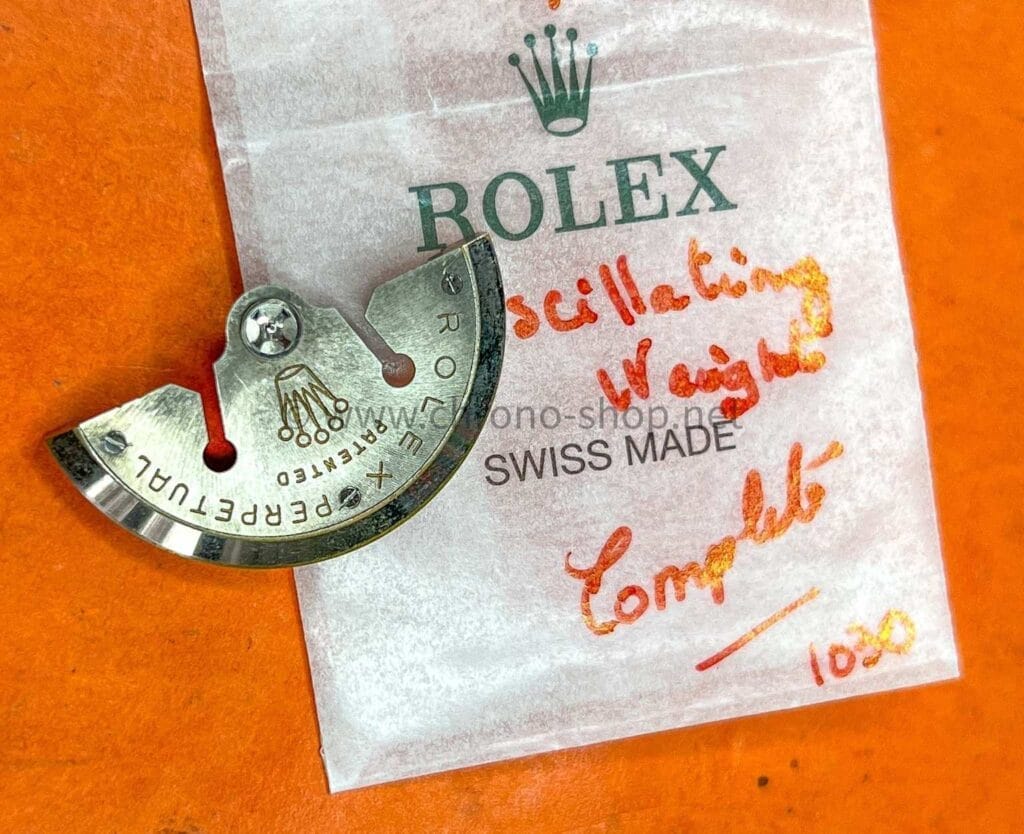
The 1030 is an automatic movement with bidirectional winding via Rolex’s Perpetual rotor. The rotor itself is nicknamed the “butterfly rotor” due to its lightened, wing-like design visible through the case back. This rotor design reduces weight while maintaining winding efficiency, allowing the movement to achieve full wind with moderate wrist motion. The movement architecture follows traditional Swiss construction with a full bridge supporting the balance assembly.
Chronometer certification is standard for the 1030 in the 6593. Rolex submitted these movements to the Contrôle Officiel Suisse des Chronomètres (COSC) for testing, with passing movements earning “Officially Certified Chronometer” designation on the dial. This certification confirms the movement’s accuracy within -4/+6 seconds per day across five positions and two temperatures. The 1030 consistently met these standards, establishing Rolex’s reputation for precision in everyday timepieces.
The movement features no hacking seconds (the seconds hand continues to run when the crown is pulled for time setting) and no quickset date, as the 6593 has no date complication. The crown operates in two positions: pushed in for normal operation, and pulled out for time setting. Winding occurs automatically via the rotor, though manual winding is possible by rotating the crown clockwise in the pushed-in position.
Rolex marked caliber 1030 movements with specific engravings on the movement plates. The balance bridge is signed “Rolex Perpetual” or “Rolex Perpetual SA Geneva,” along with “Twenty Five Jewels” and “Adjusted to Five Positions.” The caliber number 1030 appears stamped into the plate, along with a unique movement serial number. These markings serve as authenticity indicators and help establish production date through cross-referencing movement serial ranges.
Service and maintenance of caliber 1030 movements remains straightforward for qualified watchmakers. Parts availability through Rolex service centers and aftermarket suppliers allows for proper restoration. Common service items include mainspring replacement, lubricant renewal, balance staff replacement if damaged, and jewel servicing. A full service by a competent vintage Rolex specialist should restore a 1030 to chronometer-grade performance, typically achieving accuracy within +/- 10-15 seconds per day or better. Service intervals of 5-7 years are recommended for watches in regular use.
The caliber 1030 was eventually succeeded by caliber 1530 (1957), then caliber 1560 (1959), and finally caliber 1570 (1960s), each offering incremental improvements in frequency (moving from 18,000 to 19,800 vph) and incorporating hacking seconds functionality. The 1030 remains highly regarded among collectors for its reliability and serviceability, with many examples still running strong seven decades after production.
Identifying Original vs. Replaced Parts
Authenticating a 6593 requires systematic evaluation of every component, as service interventions and replacement parts compromise originality and value.
Dial Authenticity:
Original 6593 dials display specific characteristics that service replacements cannot replicate perfectly. The dial text “Rolex Oyster Perpetual” and “Officially Certified Chronometer” should be printed in the correct font for the era, with specific spacing and alignment. The coronet (Rolex crown logo) at 12 o’clock must show period-correct proportions and printing quality. Applied hour markers should be precisely positioned and show consistent solder points on the dial reverse (visible only when the dial is removed).
Radium-era dials marked only with “Swiss” at 6 o’clock are correct for the 6593’s production period (1955-1959). Later service dials may show “T Swiss T” or “Swiss-T<25” markings, indicating tritium replacement after 1963. These service dials are immediately identifiable as non-original and reduce the watch’s collector value significantly. A Geiger counter test can confirm radium presence, with original radium dials showing measurable radiation levels even 70 years later. Tritium dials show negligible radiation due to tritium’s 12-year half-life.
Original gilt dials (gold-colored text and markers on champagne or silver backgrounds) should show even aging and patina. The luminous material on hour markers and in the hands should display consistent color and aging characteristics. If the dial plots appear fresher or different in color from the hands, service reluming has likely occurred. Original radium ages to cream, tan, or brown tones depending on exposure and storage conditions.
Refinished dials present the most challenging authentication issue. Professional refinishing can restore a deteriorated dial’s appearance but always compromises originality. Signs of refinishing include: overly perfect printing with no age-appropriate cracking or patina, luminous plots that appear too white or fresh, uneven text printing under magnification, and incorrect font or spacing. Collectors heavily discount refinished dials, with values dropping 30-50% compared to original examples in similar condition.
Hands Verification:
Period-correct hands for the 6593 are either dauphine or alpha style in yellow gold, with luminous fill matching the dial plots in color and patina. The seconds hand may be blued steel or gold. Replacement hands from later eras often show incorrect styles, proportions, or lume colors. Under UV light, original radium lume should show no glow (radium’s luminescence fades quickly but radiation persists), while service replacement tritium hands from the 1960s-1990s may show slight residual glow. Modern Super-LumiNova replacements glow brightly under UV and immediately signal service intervention.
The hands should show aging consistent with the dial. If the hands appear significantly fresher or older than the dial, replacement has occurred. Hand luminous plots should match the dial plots in color precisely; any variance indicates mixed-generation parts.
Crown Originality:
Original Rolex-signed crowns for the 6593 feature period-correct design with appropriate wear. The crown should be 5.5-6.0mm in diameter with fine knurling and the Rolex coronet logo. Later replacement crowns may show different logo styles, incorrect dimensions, or anachronistic features like Twin-lock dots (two dots below the coronet, indicating gasket technology not present on 1950s crowns).
Crown wear should appear natural and consistent with case condition. A pristine crown on a well-worn case suggests replacement. The threads should engage smoothly without cross-threading or looseness, though some play is normal in vintage examples.
Case Condition and Polishing:
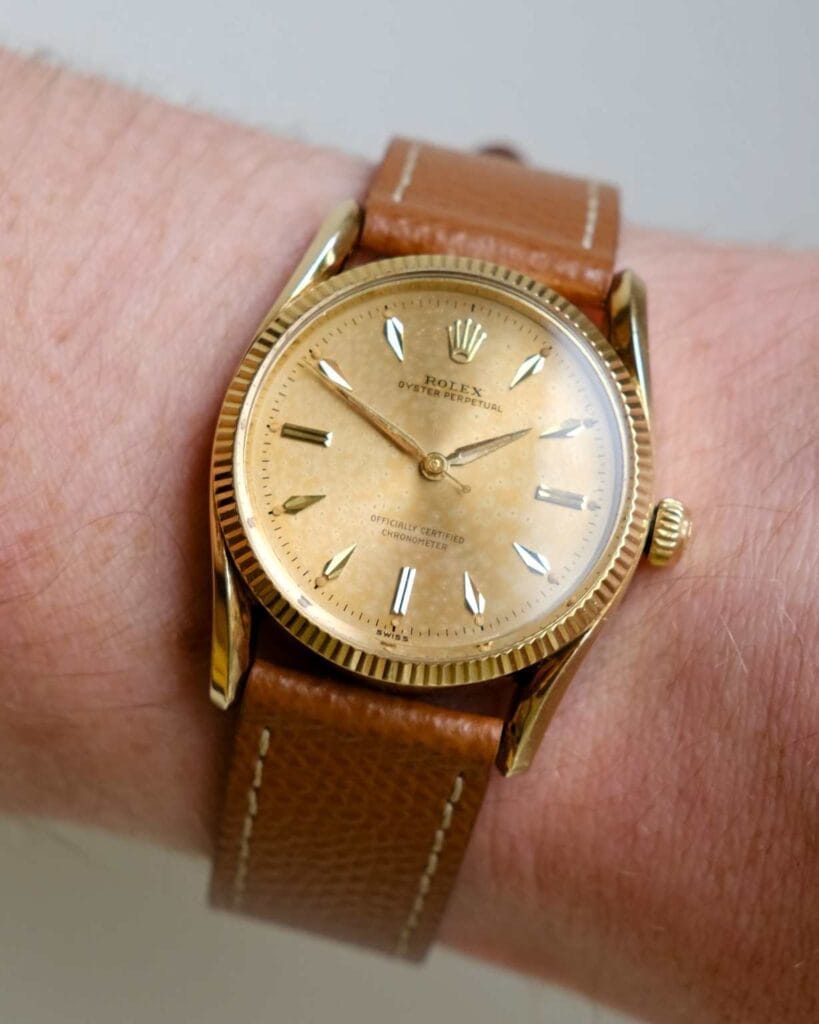
The Bombay lugs are the 6593’s defining feature and the most critical element to evaluate. Original, unpolished cases show sharp, well-defined lug curves with pronounced three-dimensional form. The edges where the lug curves meet the case body should be crisp and angular. Hallmarks, reference numbers, and serial numbers between the lugs should be deep and clearly legible.
Over-polishing destroys these characteristics progressively. Signs of excessive polishing include: rounded, softened lug curves with reduced definition, thinned lugs with less mass, shallow or partially removed hallmarks and engravings, loss of crisp edges where surfaces meet, and overall reduction in case dimensions. A properly polished case may show slight rounding but retains fundamental shape and proportions. Heavy polishing creates a formless, melted appearance that collectors call “over-polished” or “polished to death”.
The fluted bezel likewise suffers from polishing. Original bezels show sharp, evenly spaced grooves with distinct peaks and valleys. Polished bezels show rounded grooves with less depth and definition. Some polishing is acceptable if the bezel retains its basic character, but heavily polished bezels lose the crisp visual impact that defines the feature.
The case back should show appropriate thickness with no signs of over-thinning. The engravings should be deep and clear. The screw-down case back threads should engage properly without excessive play or resistance. Some collectors use micrometers to measure case back thickness, comparing against known original specifications to detect over-polishing.
Bracelet Verification:
The 6593 was sold on leather straps, not bracelets. Any metal bracelet is a later addition. Period-correct leather options would be simple two-piece straps with gold-plated or solid gold tang buckles. Original Rolex buckles from the 1950s show specific design details and markings, though documentation of exactly which buckles were supplied with which references remains incomplete.
Collector Notes & Market Context
The 6593 occupies a specialized niche in the vintage Rolex market, appealing to collectors who value design distinctiveness and relative rarity over the mainstream recognition of sport models. Current market positioning places the reference as a mid-tier vintage Rolex buy, accessible compared to Submariners or GMTs but commanding premiums over standard Oyster Perpetual references from the same era.
Approximate value ranges as of 2025:
- Fair condition, polished case, service dial: $3,500-4,500
- Good condition, properly polished case, original dial with issues: $4,500-6,000
- Excellent condition, minimal polishing, strong original dial: $6,000-8,000
- Exceptional condition, unpolished case, pristine original dial: $8,000-10,000+
These ranges assume correct caliber 1030, original case, and functioning chronometer-certified movement. Examples with particularly desirable dial variations, full sets with box and papers, or documented provenance can command premiums of 20-30% above base values.
Configuration Desirability:
Champagne gilt dials with applied gold markers represent the most commonly encountered and desired configuration. The warm tones complement the yellow gold case and align with period aesthetics. Silver or ivory dials offer slightly less common alternatives and appeal to collectors seeking variety, though they do not command premiums in the current market.
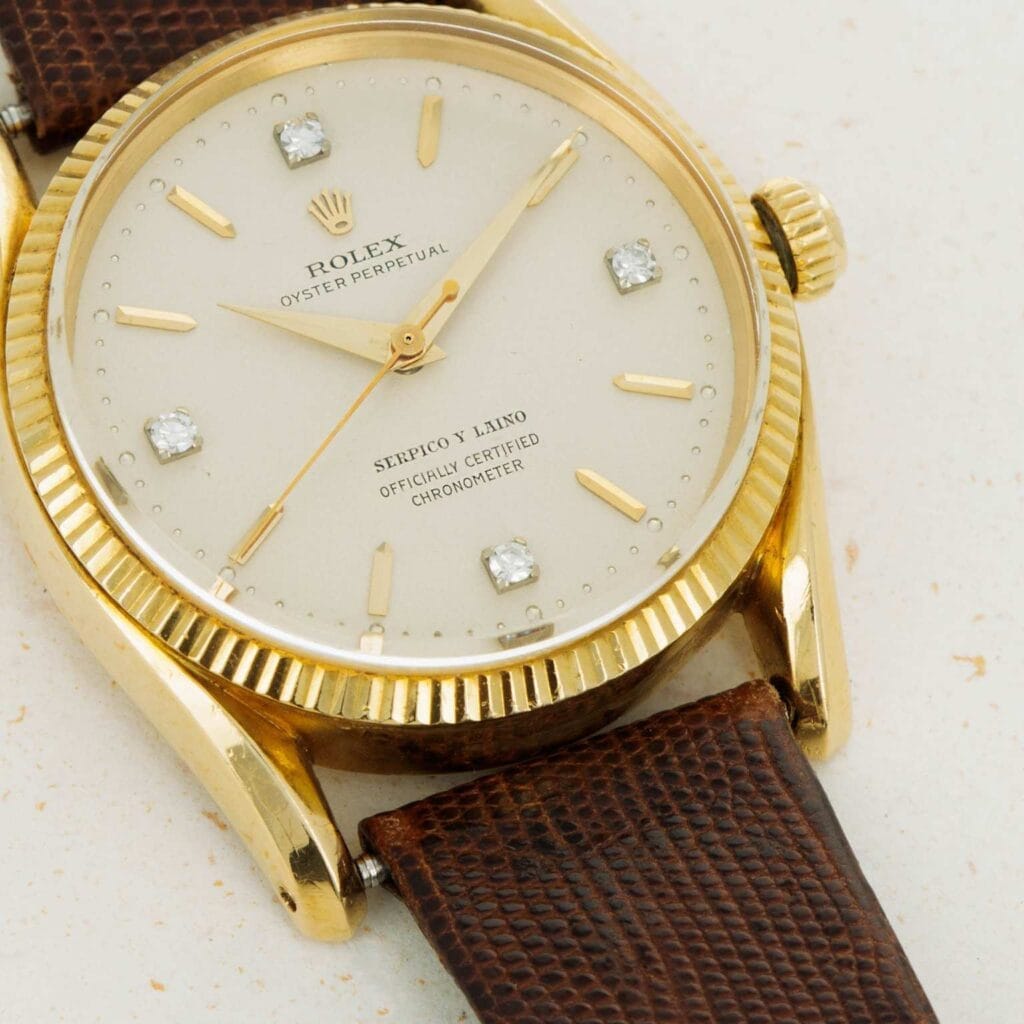
Unpolished cases with sharp, well-defined Bombay lugs command the highest premiums. The collector market strongly favors originality, with unpolished examples worth 30-50% more than comparable polished pieces. The visibility and prominence of the Bombay lugs make case condition impossible to overlook, elevating its importance beyond typical dress watch purchases.
Common Pitfalls:
The 6593’s relative obscurity creates authentication challenges. Many dealers and even some collectors lack familiarity with the reference, leading to misidentification or incorrect descriptions. The watch is sometimes incorrectly listed as a Datejust despite having no date function. Verify the reference number between the lugs at 12 o’clock to confirm correct identification.
Service replacement dials from later eras destroy much of the 6593’s value. These dials typically show tritium markings (“T Swiss T” or “Swiss-T<25”) that are anachronistic for the reference’s 1955-1959 production period. Collectors should demand radium-era “Swiss” only marking at 6 o’clock, with matching radium lume patina on plots and hands.
Movement replacements occasionally occur, with sellers substituting later calibers to remedy failed original movements. Caliber 1030 is correct and exclusive for the 6593. Any other caliber indicates incorrect service work and reduces value substantially. Movement serial numbers can be cross-referenced against known ranges to verify period correctness.
Gold purity variations exist depending on market. U.S. examples typically feature 14k gold (marked 14K or 0.585), while European examples may show 18k gold (marked 18K or 0.750). The case back hallmarks should confirm gold content and match the case. Mismatched case backs or cases with incorrect gold markings may indicate assembled or incorrect examples.
Box and papers are exceptionally rare for vintage Rolex of this era. Most 6593 examples were sold as watches only, with boxes and papers discarded long ago. A complete set with original box, papers, and chronometer certificate can double the value of the watch itself. However, buyers must verify paper authenticity, as fraudulent papers exist. The serial number on papers must match the case serial number exactly.
Value Drivers:
Beyond the universal vintage Rolex value drivers (originality, condition, completeness), several factors specific to the 6593 influence pricing:
- Lug definition: Sharp, well-preserved Bombay lugs with pronounced curves command premiums
- Dial condition: Original radium-era dials with strong printing and matching lume patina
- Case finishing: Unpolished or lightly polished cases with visible hallmarks and engravings
- Fluted bezel sharpness: Crisp, well-defined grooves with no rounding from polishing
- Movement condition: Functioning chronometer-certified caliber 1030 with correct markings
- Completeness: Rare examples with box, papers, and period-correct accessories
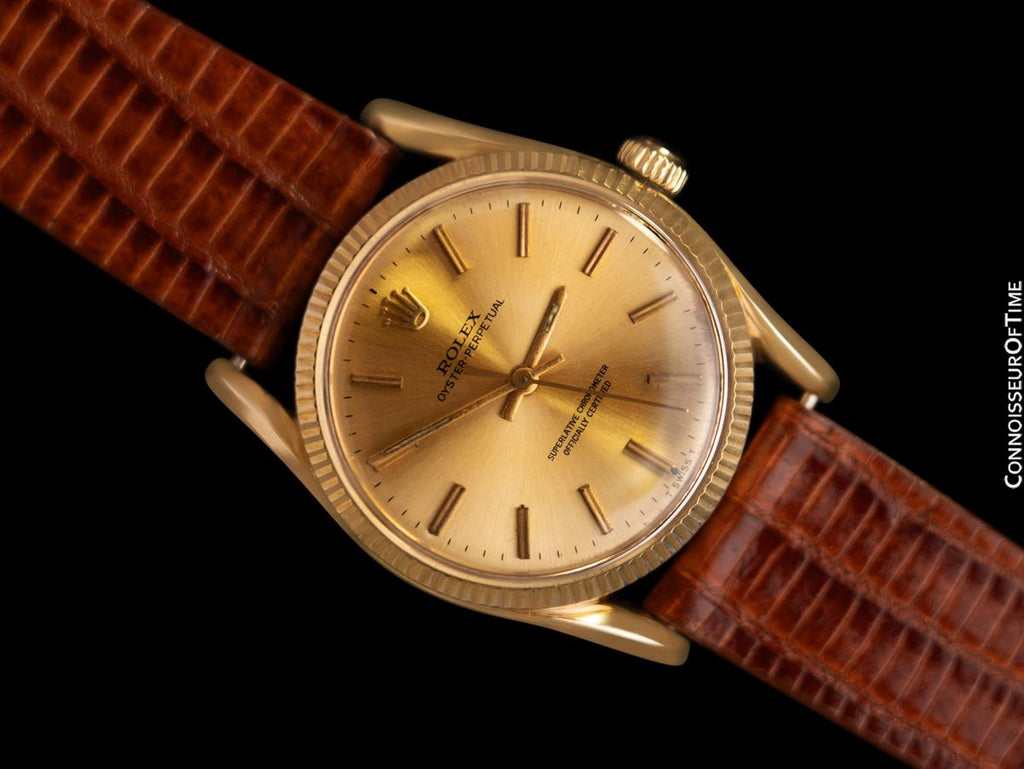
Wearability & Lifestyle Fit
The 6593 functions primarily as a dress watch, though its gold construction and modest water resistance allow for careful daily wear in appropriate contexts. The 33mm case body dimensions align with vintage standards but appear small by modern preferences. However, the extended Bombay lugs increase wrist presence substantially, making the watch wear more like a modern 36-38mm piece.
Daily Wearer Viability:
The 6593 can serve as a daily wearer for collectors who appreciate vintage proportions and accept certain limitations. The caliber 1030 movement provides reliable automatic operation with 42-48 hours of power reserve, sufficient for regular wear with occasional rest days. Chronometer certification ensures accuracy within acceptable daily tolerances (+/- 10-15 seconds per day after proper service).
However, several factors limit pure daily wear utility. The acrylic crystal scratches easily in modern environments, requiring periodic polishing or replacement. The 14k gold case shows wear from daily contact with surfaces, developing scratches and dings that are difficult to remove without polishing (which reduces case mass and definition). The period water resistance, while functional when new, cannot be guaranteed after 70 years and should not be relied upon.
The manual crown operation (no quickset complications to worry about) simplifies daily use. Time setting requires only pulling the crown and rotating. Automatic winding maintains the mainspring through normal wrist motion, eliminating daily winding routines. The watch can be left unworn for several days without issue, requiring only a few minutes of wrist motion to restart after the movement runs down.
Dress Watch Appropriateness:
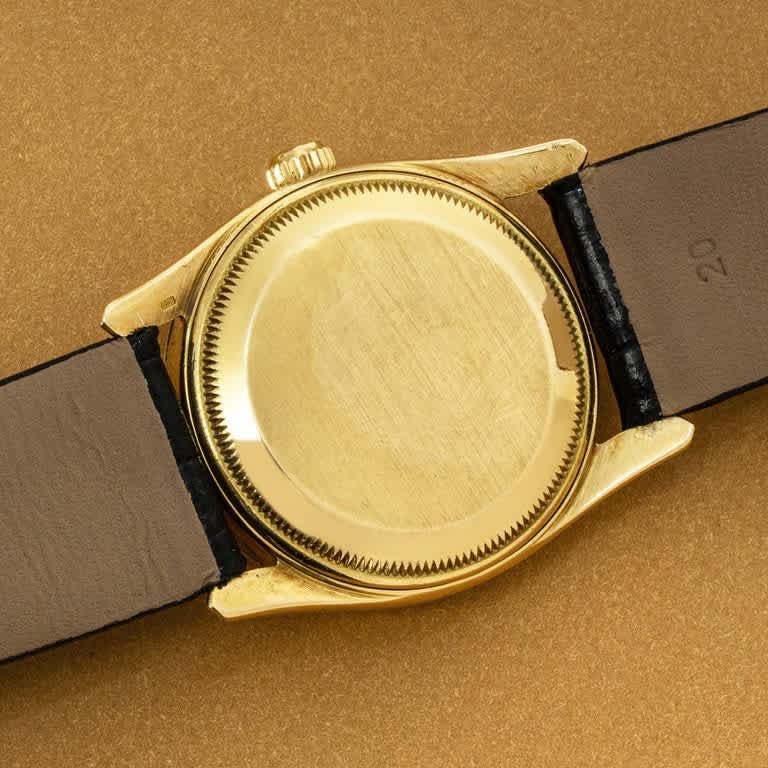
The 6593 excels as a dress watch, fulfilling this role better than any other application. The yellow gold case and fluted bezel create classic formal elegance. The thin profile (12mm height) slides easily under shirt cuffs. The champagne or silver dial provides excellent legibility without visual clutter. The watch pairs naturally with suits, dress shirts, and formal attire, complementing traditional menswear without drawing excessive attention.
The Bombay lugs introduce an interesting tension in dress watch orthodoxy. Traditional dress watch design favors restraint and understatement, while the 6593’s sculptural lugs make a deliberate statement. This positions the watch as appropriate for buyers who appreciate elegance with personality, rather than pure minimalism. The watch succeeds at formal occasions while maintaining distinctiveness beyond standard dress watch offerings.
Sport/Tool Watch Suitability:
The 6593 has no sport or tool watch credentials whatsoever. The gold case construction, dress-oriented design, and modest water resistance make this watch inappropriate for athletic activities, outdoor adventures, or demanding environments. The case shows damage easily from impacts. The acrylic crystal scratches from abrasion. The leather strap (period-correct fitting) lacks durability for active use.
Water resistance when new would have been modest, likely 30-50 meters by modern testing standards. After 70 years, seals have degraded and water resistance cannot be assumed. The watch should not be exposed to water beyond hand washing, and even that requires care to avoid crown exposure while the crown is unscrewed.
Comfort Factors:
Weight sits in the moderate range for a vintage gold watch, with the 14k gold case and leather strap creating a balanced, comfortable wearing experience. The watch lacks the top-heavy feeling of solid gold modern pieces thanks to its compact case dimensions. Extended wearing sessions reveal no significant discomfort, though individual wrist anatomy varies.
The curved Bombay lugs are the 6593’s secret comfort weapon. While the case body measures only 33mm, the downward-curving lugs follow the wrist’s contour naturally. This prevents the “floating” appearance common with small vintage watches on modern wrists and improves stability. The watch sits securely without excessive strap tension.
Lug-to-lug measurement of approximately 40-42mm suits wrists from 6.5 inches to 7.5 inches comfortably. Smaller wrists find the watch well-proportioned, while larger wrists benefit from the extended lug design that prevents the watch from appearing undersized. Wrists above 7.5 inches may find the watch too small for modern preferences.
Thickness of 12mm remains slim by any standard, allowing the watch to slip under tight shirt cuffs without difficulty. The domed acrylic crystal adds minimal height and creates no clearance issues. The watch wears thinner on the wrist than the measurement suggests, thanks to the curved case back and lack of case overhang.
Strap Versatility:
The 19mm lug width presents some challenges for modern strap selection, as most suppliers focus on 18mm and 20mm options. However, quality 19mm straps are available from specialist vintage watch strap makers. The gold case pairs naturally with brown leather in various tones from honey to dark chocolate. Black leather offers a more formal alternative. Shell cordovan, calfskin, and crocodile are all appropriate material choices depending on desired formality and character.
The watch does not suit NATO straps, rubber straps, or casual strap options. The gold case and dress watch design demand traditional leather or potentially a period-appropriate mesh bracelet. Modern strap experimentation should be avoided, as it clashes with the watch’s 1950s design language.