

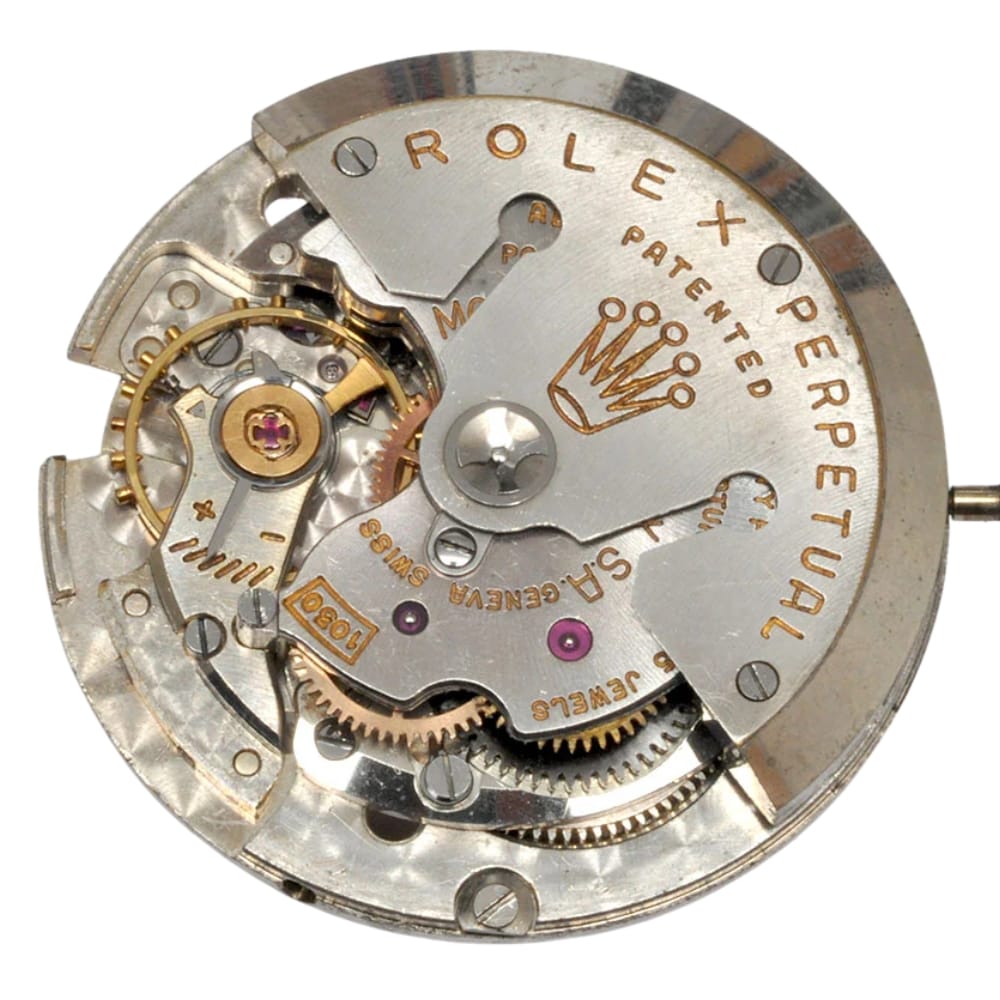
The Rolex 1030 represents a watershed moment in horological history: Rolex’s first complete in-house automatic movement. Before 1950, Rolex relied on ebauches from suppliers like Aegler or modified existing calibers. The 1030 changed that equation entirely, establishing the technical foundation that would power the brand’s professional sports watch lineup through the 1950s, including early Explorers, Submariners, and Oyster Perpetual models. Its signature feature, the distinctive “butterfly” rotor named for its cutaway, wing-like shape, became an instantly recognizable hallmark of mid-century Rolex engineering.
The 1030 set the standard for what a Rolex automatic movement should deliver: chronometer-grade accuracy, bidirectional winding efficiency, and mechanical robustness suitable for tool watch applications. While overshadowed today by higher-frequency successors, the 1030 proved Rolex could design and manufacture complete movements to exacting standards. Watches powered by this caliber carried “Officially Certified Chronometer” designations on their dials when COSC-rated, a mark of precision that separated them from non-chronometer “Precision” models using earlier calibers.
Estimating total production of the 1030 is challenging. Rolex produced the caliber from 1950 through approximately 1957, when it was succeeded by the 1530 and the second-generation 1560 series. Based on serial number ranges and production data, an estimated 150,000 to 200,000 units were manufactured during this seven-year window. This figure accounts for the caliber’s use across multiple model lines, including non-date Oyster Perpetuals (references 6532, 6564), Explorers (6150, 6350, 6610), early Submariners (6536, 6538, 6200, 6204, 6205), and GMT-Master prototypes. The 1030 is uncommon but not rare. Well-preserved examples surface regularly at auction and through specialist dealers, though finding one in unrestored, chronometer-certified configuration with original dial and hands requires patience.
The collector market for 1030-powered watches trends upward. Early Submariners with 1030 movements, particularly Big Crown 6538 references associated with James Bond, command $150,000 to $500,000 depending on condition and provenance. Explorer 6610 models fetch $15,000 to $40,000 for clean examples, while non-sport Oyster Perpetuals with 1030 calibers remain relatively accessible at $5,000 to $12,000. Demand is stable to rising, driven by collectors seeking the earliest in-house Rolex automatics before the brand transitioned to higher-beat movements in the 1960s.
Historical Context, Provenance, and Manufacturing Details
Rolex developed the 1030 in the late 1940s to address two strategic imperatives: reduce dependence on external ebauche suppliers and create a thinner automatic movement suitable for non-Bubbleback cases. Prior Rolex automatics used the larger A296 caliber, necessitating bulbous case backs to accommodate the movement’s height. The 1030’s 5.85 mm profile allowed Rolex to slim its Oyster cases dramatically, creating the sleeker silhouette that would define the brand’s sports watches.

The 1030 replaced or coexisted with various earlier calibers. It directly succeeded the A296 in many model lines and represented Rolex’s first complete departure from reliance on movements like the Hunter or Aegler-supplied calibers. The 1030 itself was succeeded by the 1530 (introduced around 1957) and the second-generation 1560 series (1959), both of which refined the 1030’s architecture while maintaining its core design philosophy. The 1530 added a free-sprung balance with Microstella regulating screws, while the 1560/1570 increased the beat rate to 19,800 vph and eventually introduced hacking seconds in 1972.
The 1030 is an in-house manufacture movement, designed, produced, and assembled entirely at Rolex facilities in Geneva. Unlike later Rolex reliance on Valjoux chronograph ebauches or ETA partnerships in Tudor, the 1030 represents vertical integration at its peak. Every component, from the mainspring to the escapement, was Rolex-made. Production took place at Rolex’s Acacias facility in Geneva, the same location where the brand manufactured cases and assembled complete watches during this period.
Horologically, the 1030 sits in the transitional era between post-war watchmaking and the high-frequency precision movements of the 1960s. Its 18,000 vph beat rate was standard for the time, matching contemporaneous calibers from Omega, Jaeger-LeCoultre, and other Swiss manufacturers. The bidirectional winding system, using red anodized aluminum reversing wheels patented in 1952, represented cutting-edge efficiency. The butterfly rotor’s distinctive cutaway design reduced weight while maintaining winding effectiveness, a solution Rolex would refine in later calibers but never fully abandon.
Construction and Architecture
Plate and Bridge Layout
The 1030 uses a three-quarter plate construction with separate bridges for the automatic winding mechanism and balance assembly. The mainplate is brass, rhodium-plated for corrosion resistance and aesthetic uniformity. The automatic winding module sits beneath a large bridge (part 7000) that spans much of the movement’s upper surface. This architecture allows for relatively straightforward servicing, as the automatic mechanism can be removed as a complete module without disturbing the going train.
Balance Wheel
The 1030 employs a monometallic Glucydur balance wheel, a beryllium-copper alloy resistant to magnetic fields and temperature-induced dimensional changes. The balance diameter measures approximately 10 mm. Unlike later free-sprung balances with Microstella screws, the 1030 uses a regulator index with pins that bracket the hairspring’s outer coil. This index regulator system, while less refined than free-sprung designs, allows for easier rate adjustment but introduces friction where the pins contact the hairspring. The balance runs on KIF Flector shock absorbers, discussed below.
Balance Spring (Hairspring)
The 1030 features a Breguet overcoil hairspring, a significant technical advancement that improves isochronism compared to flat hairsprings. The overcoil’s terminal curve elevates the outermost coil above the plane of the spring, allowing it to breathe more concentrically during expansion and contraction. This reduces positional rate variations, particularly between horizontal and vertical orientations. The hairspring material is Nivarox or a similar paramagnetic alloy, providing resistance to magnetism and reasonable temperature compensation. The spring attaches to the balance staff via a collet and terminates at a stud holder mounted on the balance cock.
Escapement Type
The 1030 uses a traditional Swiss lever escapement with jeweled pallet stones set in a pallet fork (part 6918/6917 refers to escape wheel components). The escape wheel has 15 teeth, standard for Swiss lever escapements. The pallet fork features two synthetic ruby pallet stones that engage alternately with the escape wheel teeth, transmitting impulses to the balance wheel. The escapement is fully jeweled, with cap jewels protecting the escape wheel pivots. Rolex used Duofix springs on the escape wheel cap jewels in some examples.
Shock Protection System
The 1030 employs KIF Flector shock absorbers on the balance wheel pivots. KIF, a competitor to Incabloc, was Rolex’s preferred shock protection system during this era, reportedly chosen to avoid displaying “Incabloc” text on dials. The KIF system uses a spring-loaded conical jewel setting that absorbs impacts by allowing the jewel assembly to shift slightly, then return to position. The shock protection covers both upper and lower balance jewels. Parts references include 7040 for the upper balance shock device and 7042 for jewel-in-setting components.
Regulator Type
The 1030 uses a pinned regulator (index regulator) system. The regulator features two pins that bracket the hairspring, with a lever arm allowing the watchmaker to lengthen or shorten the effective hairspring length by moving the pins along the spring’s coils. This changes the timekeeping rate. The regulator is marked with plus and minus indicators for gaining and losing time. Unlike free-sprung balances that require adjusting balance screws, the index regulator allows for quicker, less precise timing adjustments, but introduces the risk of hairspring distortion if pins are set too tightly.
Mainspring Material and Type
The 1030 uses a white alloy mainspring designed for automatic winding applications. The mainspring is a slipping-bridle type, meaning the outer end can slide against the barrel wall rather than being rigidly attached. This prevents over-winding damage when the rotor continues to turn after the mainspring reaches full tension. Recommended mainspring part number is 7825, the same specification used in later 1530/1570 calibers. Mainspring thickness ranges from 0.122 to 0.125 mm depending on strength grade (standard vs. weak strength versions exist for addressing amplitude issues).
Gear Train Details
The 1030 gear train follows standard Swiss automatic architecture. The center wheel drives the third wheel, which drives the fourth wheel (seconds), which drives the escape wheel. The fourth wheel (part 6910) carries the seconds pinion that extends through the dial to drive the seconds hand. The cannon pinion drives the motion works for the hour and minute hands. The going train is fully jeweled, with cap jewels on critical pivots to reduce friction. Specific gear ratios are not widely documented, but the 18,000 vph frequency and standard four-wheel going train suggest conventional Swiss ratios.
Finishing Quality and Techniques
The 1030’s finishing quality reflects its position as a chronometer-grade movement but falls short of haute horlogerie standards. Rolex applied perlage (circular graining) to the mainplate and visible surfaces, creating overlapping circular patterns that trap dust and provide visual texture. Bridges feature brushed finishing rather than elaborate Côtes de Genève striping. Edges are chamfered but not to the polished bevels (anglage) seen in higher-grade movements. Screw heads are polished, and jewel settings are generally pressed rather than gold chatons. Chronometer-certified examples received more careful regulation and testing but not significantly different finishing compared to non-chronometer versions. Overall, the 1030 emphasizes functional reliability over decorative finishing, consistent with its tool watch applications.
Cross-Reference Data
The Rolex 1030 was not rebadged or sold under alternative names to other manufacturers. It remained exclusive to Rolex-branded watches.
Base Caliber vs. Elaborated Versions
| Variant | Differences | Jewel Count | Functions |
|---|---|---|---|
| 1030 | Base time-only caliber, chronometer or non-chronometer grades | 25 | Time, center seconds |
| 1035 | Adds date complication via date wheel and quickset mechanism | 25 | Time, center seconds, date |
| 1036 | Adds date complication, used in GMT-Master references with GMT module | 25 | Time, center seconds, date (base for GMT complication) |
| 1040 | Deadbeat seconds variant (Tru-Beat), modified escapement for jumping seconds | 25 | Time, deadbeat seconds |
| 1055 | Adds day and date complications (Day-Date “President” models) | 25 | Time, center seconds, day, date |
| 1065 | Date complication variant similar to 1035 | 25 | Time, center seconds, date |
| 1080 | Antimagnetic version for Milgauss, includes soft iron Faraday cage | 25 | Time, center seconds, antimagnetic |
All variants share the same base architecture, with complications added via additional modules.
Compatible Case References by Brand
| Brand | Reference Numbers | Production Years | Notes |
|---|---|---|---|
| Rolex | 6532, 6564 | 1955-1959 | Oyster Perpetual, 34mm, time-only |
| Rolex | 6150, 6350, 6610 | 1952-1959 | Explorer, 36mm, chronometer certified (6350, 6610) |
| Rolex | 6200, 6204, 6205, 6536, 6538 | 1954-1959 | Submariner, various crown sizes, chronometer certified (6536/6538) |
| Rolex | 6534 | 1957-1959 | Oyster Perpetual Date, 34mm, date function (uses 1035 variant) |
| Rolex | 6542 | 1954-1959 | GMT-Master, 38mm, Bakelite bezel (uses 1036 GMT variant) |
| Rolex | 1020, 6556, 6558 | 1954-1963 | Tru-Beat, deadbeat seconds (uses 1040 variant) |
| Rolex | 6541, 6543 | 1955-1963 | Milgauss, antimagnetic (uses 1080 variant) |
Dial Compatibility
The 1030 dial feet positions are standardized for 28.5 mm movements. Date variants (1035, 1065) require dials with date windows at 3 o’clock. Day-Date variants (1055) require dual windows at 12 o’clock (day) and 3 o’clock (date). When restoring, confirm dial foot spacing matches the specific caliber variant, as date complications may require different foot configurations.
Crown and Stem Specifications
| Component | Specification | Part Number |
|---|---|---|
| Winding Stem | Thread diameter: 0.90 mm (TAP 10) | 6946 (standard length, cut to fit) |
| Setting Mechanism | Yoke-style clutch | Standard Rolex Oyster system |
| Crown Thread | 0.90 mm (TAP 10) | Varies by case reference |
| Stem Attachment | Threaded, 0.90 mm or 1.10 mm variants exist | 6946 (0.90 mm), 6946-1 (1.10 mm) |
Generic aftermarket stems are available but require cutting to proper length for specific case references.
Identification Marks
Caliber Number Location
The caliber number “1030” is engraved on the mainplate, visible when the rotor is removed. The engraving appears on the movement’s dial side near the center, typically below the balance cock or near the winding mechanism bridge. Font style is thin, serif engraving consistent with 1950s Rolex practices.
Logo and Brand Marks
The movement bears “Rolex Perpetual SA Geneva” engraving on the rotor or movement plate. Chronometer-certified examples include “Officially Certified Chronometer” or similar text. The rotor (part 7010) features the Rolex crown logo. Twenty-five jewels are marked on the movement.
Date Codes
The 1030 predates Rolex’s systematic movement date coding. Serial numbers on the case (not movement) provide production year estimates. Serial ranges for 1030 production approximately span 200,000 to 1,100,000 (1955-1959), though Rolex reset serial numbers at 200,000 in 1955 after reaching 999,999 in 1954.
Finishing Marks
Expect perlage on the mainplate, visible through movement openings. Bridges show brushed or rhodium-plated surfaces without elaborate striping. Jewel settings are pressed, not gold chatons. Screw heads are polished. The distinctive butterfly rotor is the most obvious visual identifier, with its cutaway wings and red anodized winding wheels visible beneath.
Adjustment Markings
Chronometer-certified movements may have regulation marks or COSC certification indicators, though these appear on the case or dial rather than engraved on the movement itself. “Adjusted to Five Positions” or similar text appears on the dial of chronometer examples.
Correct Serial Number Formats and Locations
Case serial numbers appear between the lugs at 6 o’clock, requiring bracelet removal to view. Format for 1030-era watches is numeric, ranging from six to seven digits. Serial 200,000 to approximately 1,100,000 corresponds to 1955-1959 production years. Movement serial numbers are less commonly referenced but may appear on the movement itself.
Expected Engravings and Stampings
Authentic 1030 movements show: caliber number “1030,” jewel count “25 Jewels,” “Rolex Perpetual SA Geneva” or similar manufacturer marking, and rotor engravings. Case engravings include serial number, reference number (at 12 o’clock between lugs), and case maker marks. Inside case backs may show stamped reference numbers and date codes.
Font and Marking Style by Production Era
Early 1950s engravings use thinner, more delicate serif fonts. Later production (1957-1959) shows slightly bolder engraving. Rotor logos evolved subtly over the production run. Compare examples from known authentic sources when evaluating a specific watch.
Part Information

Movement Components and Part Numbers
| Part Name | Part Number | Interchangeability Notes |
|---|---|---|
| Mainspring | 7825 | Interchangeable with 1530, 1570, 1575 calibers; available in standard and weak strength |
| Balance Complete | 6932 | Complete balance with Breguet hairspring, timed; specific to 1030 |
| Hairspring | N/A | Breguet overcoil type, Nivarox alloy |
| Escape Wheel | 6917, 6918 | Two part numbers exist for different specifications; fits 1030, 1035, 1036, 1040, 1055, 1065 |
| Pallet Fork | N/A | Swiss lever type with jeweled pallet stones |
| Crown Wheel | N/A | Standard automatic winding crown wheel |
| Ratchet Wheel | N/A | Located under automatic winding bridge |
| Click Spring | N/A | Tension spring for ratchet wheel |
| Setting Lever Spring | 6964 | Yoke spring, fits multiple 1000-series calibers |
| Rotor (Oscillating Weight) | 7010 | Butterfly design, specific to 1030/1035/1036 variants |
| Rotor Bearing | 7005 | Sole for winding mechanism, supports rotor pivot |
| Fourth Wheel | 6910 | Drives seconds hand, fits 1030, 1035, 1036, 1040, 1055 variants |
| Winding Stem | 6946 | TAP 10 thread (0.90 mm), cut to fit specific case |
| Clutch Wheel | 6949 | Part of keyless works |
| Setting Wheel | 6965 | Keyless works component, fits 1000-series calibers |
Sourcing Notes
Genuine Rolex 1030 parts remain available through specialized suppliers like Perrin Watch Parts, Ofrei, Cas-Ker, and Watch Material, though stock is sporadic. Mainsprings (part 7825) are commonly stocked as they interchange with later calibers. Balance assemblies and escapement components are harder to source and expensive when available. Generic aftermarket parts exist for items like stems, mainsprings, and some wheels, but quality varies.
Common failure points include worn rotor bearings (part 7005), which cause rotor wobble and plate wear. Mainsprings weaken over time, reducing power reserve. Pallet fork and escape wheel jewels can chip if the watch suffers impact. The butterfly rotor’s thin profile makes it susceptible to bending if mishandled during service. Winding stems frequently break or wear at the threading.
Acceptable generic replacements exist for mainsprings and winding stems, provided they meet dimensional specifications. Escapement components should be Rolex genuine or high-quality Swiss equivalents; using inferior pallet forks or escape wheels compromises timekeeping. Balance assemblies should remain original or be replaced with genuine Rolex parts, as generic balances rarely match the original’s poise and hairspring characteristics.

Performance Data
Manufacturer Specifications
| Specification | Value |
|---|---|
| Accuracy (new, chronometer certified) | -4 to +6 seconds per day (COSC standard) |
| Positions Tested | 5 positions (horizontal, crown up, crown down, crown left, crown right) |
| Temperature Compensation | Yes, via Glucydur balance and Nivarox hairspring; tested at 8°C, 23°C, 38°C |
| Isochronism | Improved via Breguet overcoil hairspring; rate more stable across amplitude variations than flat hairspring designs |
Chronometer certification for the 1030 followed COSC (Contrôle Officiel Suisse des Chronomètres) standards of the 1950s. Movements underwent 15-day testing at five positions and three temperatures. To achieve chronometer certification, the movement had to maintain -4 to +6 seconds per day deviation, with strict limits on mean variation and positional variance. Non-chronometer examples (marked “Precision” on the dial rather than “Officially Certified Chronometer”) did not undergo this testing and typically exhibited wider rate variations.
Observed Performance (Field Data)
Well-maintained, chronometer-certified 1030 calibers typically deliver accuracy between -2 to +8 seconds per day when fully serviced. Non-chronometer examples range from -5 to +15 seconds per day. Performance degrades if the movement is unserviced, with dried lubricants, worn pivots, or weakened mainsprings.
Common performance issues include:
- Low amplitude: Expected amplitude when fully wound and properly serviced is approximately 240-260 degrees in horizontal positions. Amplitude below 200 degrees indicates problems such as dried lubricants, worn pivots, or weak mainspring.
- Positional rate variation: The index regulator design introduces friction at the regulator pins, causing rate changes between positions. Horizontal vs. vertical position differences of 10-20 seconds per day are not uncommon in vintage examples.
- Rebanking/knocking: If amplitude exceeds approximately 310-320 degrees when fully wound (typically due to an overly strong mainspring), the balance can exhibit “rebanking,” where the roller jewel strikes the wrong side of the pallet fork, causing wildly fast rates in certain positions. Solution: install a weaker mainspring (part 7825-1).
- Rate drift over power reserve: As the mainspring unwinds from full tension to near-empty, torque decreases, affecting amplitude and rate. Isochronism of the Breguet overcoil mitigates this somewhat, but rate can still vary by 5-10 seconds per day across the full 42-hour power reserve.
Expected amplitude when fully wound: 260-280 degrees (horizontal positions), 220-240 degrees (vertical positions). After 24 hours: 240-260 degrees (horizontal), 200-220 degrees (vertical). Amplitude below 200 degrees after less than 24 hours from full wind indicates service needs.
Servicing recommendations: full overhaul every 5-7 years to maintain optimal performance. This includes disassembly, ultrasonic cleaning, replacement of worn pivots or jewels if necessary, fresh lubrication with appropriate oils (Moebius 9010 for jewels, D5 or similar for escapement, Lubeta or grease for automatic mechanism), and regulation to COSC standards if chronometer-certified. Rolex-authorized service centers can provide period-correct parts, though independent watchmakers with vintage expertise often deliver equal or superior results at lower cost.