


Last updated ~ February 2, 2026
Brand
Production Period
1988–2006
Model Line
Case Shape
Round
Diameter
36mm
Lug to Lug
44mm
Lug Width
20mm
Case Thickness
12mm
Case Back
Screw-Down
Caliber
Crystal
Bezel
Coin Edge
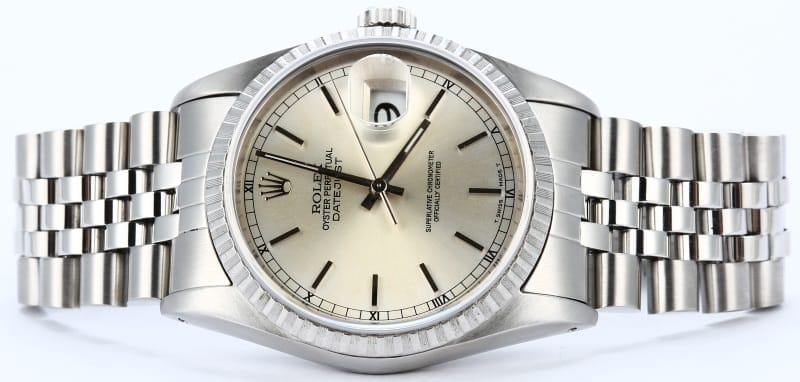
The Rolex Datejust 16220 holds a singular distinction in the Datejust lineage: it was the final reference to feature the engine-turned bezel before Rolex permanently discontinued this decorative option. Produced from 1989 until the mid-2000s, the 16220 bridged an important transitional period in Rolex manufacturing, introducing scratch-resistant sapphire crystal and the legendary Caliber 3135 movement while retaining the classic 36mm case proportions that defined generations of Datejust watches. For collectors seeking vintage character paired with modern reliability, the 16220 represents an increasingly compelling proposition.
The reference occupies a specific niche within the stainless steel Datejust family. Its engine-turned bezel, featuring decorative grooves machined into stainless steel, provides visual interest that distinguishes it from the smooth bezel reference 16200 while remaining more understated than precious metal fluted bezels. The bezel style was never produced in gold, making it exclusively an all-steel option that appealed to buyers seeking an elevated aesthetic without the cost of two-tone or solid gold construction. As a result, the 16220 represented the top of the line among all-steel Datejust models of its era.
Production volume for the 16220 is unknown, as Rolex maintains strict confidentiality regarding manufacturing figures. However, the reference appears with sufficient regularity on the secondary market to suggest substantial production over its approximately 15-year lifespan. Examples range from early tritium-dial specimens with drilled lug holes to late-production SuperLumiNova versions without lug holes, creating meaningful variation within the reference that attracts different collector preferences. Overall availability can be characterized as uncommon but not rare, with clean examples increasingly difficult to source as more enter long-term collections.
Collector sentiment toward the 16220 has strengthened considerably in recent years. The reference benefits from “neo-vintage” appeal, offering the slim proportions and classic aesthetics associated with vintage Rolex while providing the daily-wear practicality of sapphire crystal and a robust modern movement. Market prices typically range from $4,500 to $7,500 depending on condition, completeness, and specific variant, positioning the 16220 as accessible entry-level Rolex collecting while the discontinued engine-turned bezel adds genuine collectibility. Demand appears stable with gradual appreciation, and certain variants such as tapestry dials and early drilled-lug examples command meaningful premiums.
Historical Context and Manufacturing Details
The Rolex Datejust 16220 emerged during a period of significant technological refinement at Rolex. The 162XX series debuted in 1988 as successors to the 160XX generation, with the reference number change signifying important upgrades that would define Rolex watches for decades to come. The 16220 specifically entered production in 1989 as a direct replacement for reference 16030, which had served since the late 1970s with its acrylic crystal and Caliber 3035 movement. This generational transition, while visually subtle, represented meaningful advances in durability and movement architecture.
Development History
Rolex developed the 162XX series to incorporate two primary innovations. First, scratch-resistant sapphire crystal replaced the acrylic crystals that had characterized Datejust watches for decades. This change dramatically improved daily-wear durability, as sapphire rates 9 on the Mohs hardness scale compared to acrylic’s relatively soft surface. Second, the new Caliber 3135 movement replaced the Caliber 3035, bringing refined architecture that would prove so successful it remained in production for over 30 years.
The 16220 specifically addressed the market segment seeking an all-steel Datejust with decorative appeal beyond a simple smooth bezel. The engine-turned pattern, featuring fine grooves machined around the bezel circumference, provided visual interest similar to the classic fluted bezel style while avoiding the cost of precious metals. This positioning made the 16220 attractive to buyers who appreciated design flourishes but preferred the practicality and relative affordability of stainless steel construction.
Production continued until approximately 2004 to 2006, though sources conflict on the precise end date. Examples with Y-serial (2002-2003) and F-serial (2003-2004) numbers are documented, and at least one 2006-dated example has been recorded. Rolex introduced the successor reference 116200 at Baselworld 2004, but the 116200 offered only a smooth bezel option, permanently discontinuing the engine-turned style. The smaller Rolex Date model continued with the engine-turned bezel for several additional years, but for the Datejust collection, the 16220 marked the end of this aesthetic.
Manufacturing Context
The 16220 was not marketed as a revolutionary release but rather as a steady evolution within Rolex’s most successful product line. The Datejust had represented the cornerstone of Rolex’s catalog since its 1945 introduction, and the 162XX series continued this tradition without dramatic aesthetic changes. Visual differences between the outgoing 16030 and new 16220 were minimal, maintaining the design continuity that Rolex customers expected. The reference number change served primarily to document the crystal and movement upgrades for internal tracking and service purposes.
Within the broader Rolex catalog of its production era, the 16220 occupied a mid-range position. It sat below precious metal references like the two-tone 16233 and white gold bezel 16234, but above the entry-level smooth bezel 16200. Retail pricing started around $1,800 to $2,200 in 1989 and climbed to approximately $3,200 to $3,800 by the early 2000s, positioning it as accessible luxury for professionals and watch enthusiasts who valued Rolex quality without requiring precious metals.
The 16220 introduced 904L stainless steel to the Datejust line, marking an important material advancement. This austenitic stainless steel, harder and more corrosion-resistant than the 316L steel used in predecessor models, takes a superior polish and maintains its appearance better over time. Rolex now markets this material as “Oystersteel.” During 16220 production, the 904L steel was used for cases while bracelets remained 316L, a distinction that changed with later references.
Factory and Production Location
Rolex manufactures virtually all components of its watches in-house across multiple Swiss facilities. The Caliber 3135 movement was produced at Rolex’s movement facility in Bienne, which the company formally acquired in 2004 after decades of partnership. Cases were manufactured at the Plan-les-Ouates facility near Geneva, following Rolex’s 1988 acquisition of the C.R. Spillmann workshop that had produced Oyster cases since 1926. Dials came from the Chêne-Bourg facility, and final assembly occurred at Rolex’s Acacias headquarters in Geneva.
The vertical integration of Rolex manufacturing means that nearly every component of the 16220, from hairspring to bracelet clasp, originated from Rolex-owned facilities. This control extends to material production, as Rolex operates its own foundry for precious metals and has invested extensively in metallurgical capabilities for steel alloy production. Such integration ensures consistency across production but also means that component variations within a reference typically reflect deliberate engineering changes rather than supplier inconsistencies.
Horological Significance
The 16220 qualifies as a workhorse reference: reliable, well-regarded, and representing evolutionary refinement rather than revolutionary innovation. It did not introduce industry firsts or technical breakthroughs, but rather applied proven Rolex technology in a practical, attractive package. The reference’s significance lies more in what it concluded than what it began; as the final engine-turned bezel Datejust, it represents the end of an aesthetic option that had characterized Rolex dress watches for decades.
The Caliber 3135 movement inside the 16220, while not new to this specific reference, did represent an important architectural advancement over its predecessor. The full balance bridge design, replacing the single-point balance cock of the Caliber 3035, became the template for Rolex movement architecture for the following three decades. In this sense, 16220 examples contain the movement that defined modern Rolex watchmaking, even if the reference itself was not the first to house it.
Construction and Architecture
The Rolex Datejust 16220 embodies the Oyster design philosophy that has defined Rolex since the 1920s. The case construction prioritizes water resistance and durability while maintaining the balanced proportions that make the Datejust suitable for both dress and casual wear. Visual identity derives from the distinctive engine-turned bezel, the clean lines of the 36mm Oyster case, and the date aperture with Cyclops magnification at 3 o’clock that gives the Datejust its name.
Case Design
The 16220 case follows the classic Oyster construction: a three-piece design comprising case middle, screw-down caseback, and screw-down crown. The round case measures 36mm in diameter, a size that was considered standard for men’s dress watches during its production period and now appeals to those seeking alternatives to contemporary larger sizing trends. Lug-to-lug distance measures 43 to 43.5mm, providing good wrist presence without overhang on smaller wrists. Total case thickness is 11.5 to 12mm, thin enough to slide under dress shirt cuffs comfortably.
The case material is 904L stainless steel, distinguished from common 316L steel by its higher nickel and chromium content. This composition provides superior corrosion resistance and polishes to a brighter, more lustrous finish. The 16220 was the first Datejust to use this material for its case, though bracelets remained 316L steel during this reference’s production.
Case finishing combines polished and brushed surfaces in the traditional Rolex manner. The case sides and bezel are polished, while the case top and lug tops receive a brushed, or satin, finish. This combination provides visual depth and helps disguise minor scratches during daily wear. The transition between finishes is executed with crisp lines that indicate manufacturing precision.
An important case variation affects collector desirability. Early 16220 examples, produced from 1989 until approximately late 1994, feature drilled lug holes: small holes piercing through each lug that facilitate spring bar removal. Rolex phased out lug holes on Oyster models beginning in late 1994, so examples produced after this transition lack this feature. Drilled lug holes are prized by vintage enthusiasts as they recall earlier Rolex construction and facilitate easier bracelet changes, commanding premiums of approximately $200 to $400 over equivalent no-hole examples.
Dial Variations
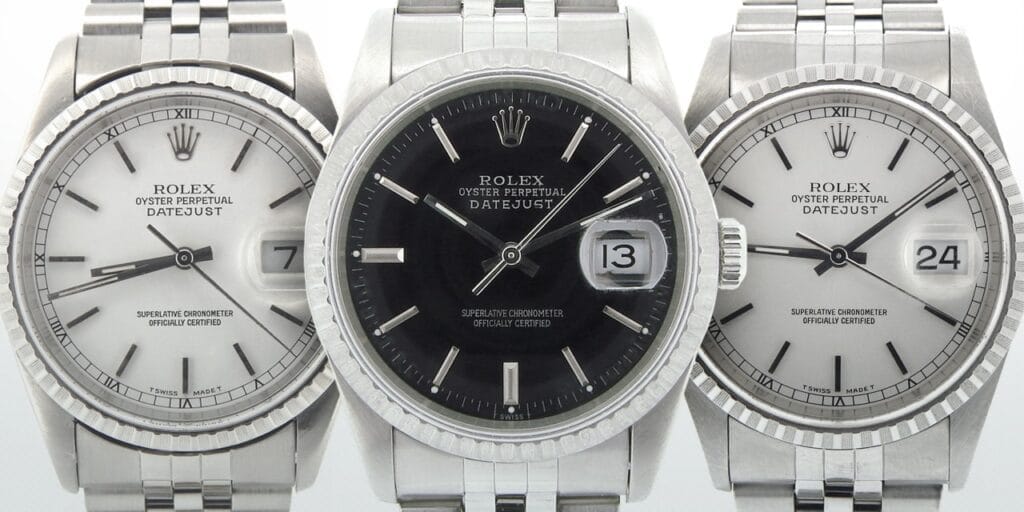
The 16220 was offered with numerous dial configurations across its production span, though the selection was less extensive than for precious metal Datejust variants. Standard dial colors included silver, white, black, and grey, colors that complemented the stainless steel case and bezel without adding premium. More distinctive options included sunburst blue, a vivid color that shifts from near-black to bright blue depending on lighting angle, and rose or salmon tones that softened the steel aesthetic.
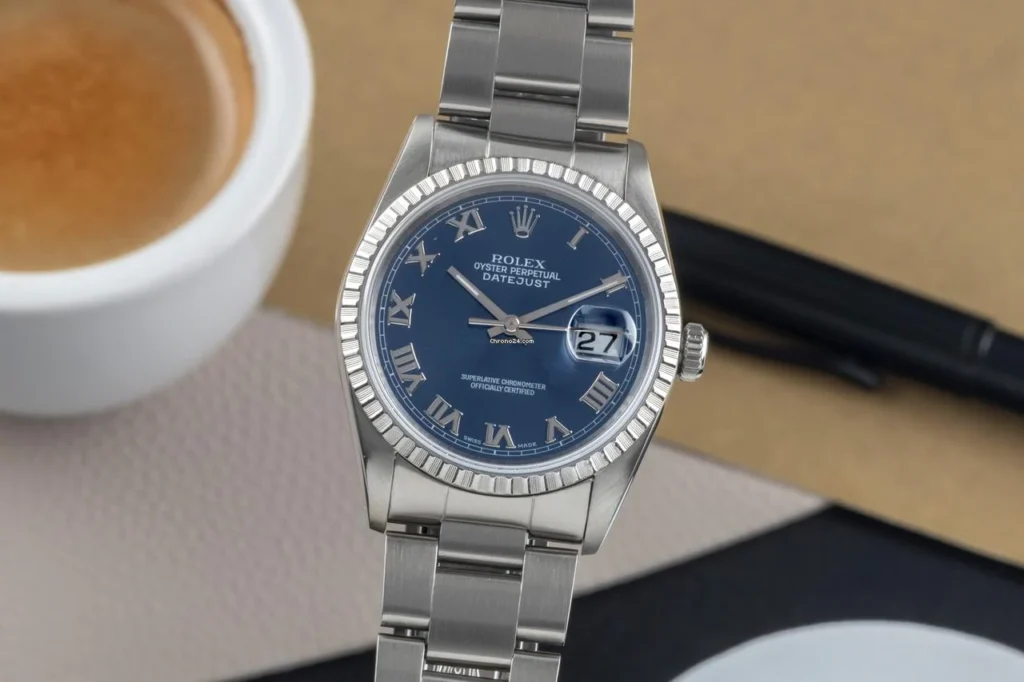
Beyond solid colors, the 16220 offered textured dial options that command collector premiums today. Tapestry dials feature a vertically oriented pattern of ridges creating a three-dimensional crosshatch effect that interacts dramatically with light. Linen dials present a woven fabric-like texture that adds subtle depth and visual interest. Both textured options were produced in limited quantities relative to standard sunburst or matte dials, making them increasingly sought after. White “porcelain” dials feature a thick lacquer finish that creates unusual depth, with printed text appearing to float on the surface.
Index styles varied between elegant stick or baton markers, most common on the reference, and applied Roman numerals for a more classical appearance. Mixed configurations combining Roman numerals at certain positions with stick indices elsewhere were also available. All applied indices were executed in 18-karat white gold to prevent tarnishing, maintaining their appearance over decades of wear.
The dial text at 6 o’clock reveals production period through luminescent material designation. Early examples display “T SWISS T” or “SWISS T<25” indicating tritium luminous material. Around 1998, Rolex transitioned to non-radioactive LumiNova, marked simply “SWISS” on dials. From approximately 2000 onward, SuperLumiNova replaced LumiNova, and dials display “SWISS MADE” in the standard two-line format. These variations, while seemingly minor, allow precise dating and significantly affect collector considerations.
Hands
All 16220 models employ baton or stick hands crafted from 18-karat gold with luminous inserts. The hour hand features a rectangular profile with a luminous insert, while the longer minute hand maintains similar styling with proportionate dimensions. A thin center seconds hand with a small luminous plot provides visual confirmation of the movement’s operation. Hand finishing is polished to match the dial’s applied indices.
Luminous material on hands evolved in parallel with dial lume. Early production used tritium, which develops a cream or orange patina with age and provides minimal glow after 25-plus years as the radioactive material decays. LumiNova and SuperLumiNova hands maintain their white color indefinitely and provide significantly brighter, longer-lasting glow. For authentication purposes, hand lume must match dial lume in both material type and aging characteristics; mismatched lume indicates service replacement parts.
Crown
The 16220 employs Rolex’s Twinlock crown system, featuring two gasket sealing zones that provide water resistance to 100 meters. The crown measures approximately 6mm in diameter and is finished to match the case, with the Rolex coronet logo on the outer face. A single horizontal dash beneath the coronet identifies stainless steel material. The screw-down crown threads into a crown tube integrated into the case middle, requiring multiple turns to fully secure the seal.
Crown operation follows standard Rolex convention for quickset date movements. When screwed down, the watch is sealed and operational. Unscrewing and pulling to the first position allows date adjustment by turning counterclockwise (note: some sources indicate clockwise; owners should consult their specific documentation). Pulling to the second position hacks the seconds hand and allows time setting by turning in either direction.
Crystal
A scratch-resistant sapphire crystal protects the dial, representing one of the primary upgrades over the predecessor reference 16030. The crystal features the characteristic Cyclops lens at 3 o’clock, magnifying the date display by 2.5 times for improved legibility. Unlike current production, anti-reflective coating was not applied to the 16220’s crystal interior; Rolex did not introduce AR coating until 2005, after most 16220 production had concluded.
Post-2002 examples may feature Rolex’s laser-etched crown logo on the crystal at the 6 o’clock position. This micro-etching, nearly invisible to the naked eye but detectable under magnification, serves as an anti-counterfeiting measure. Its presence or absence can help date specific examples, as watches produced before 2002 will not feature this marking.
Bracelet and Strap Options
The 16220 was offered with two bracelet options, each providing distinct character. The Jubilee bracelet, reference 62510H, features the five-link construction introduced alongside the original 1945 Datejust. Its design alternates polished center links with brushed outer links, creating an intricate pattern suited to dress wear. The Jubilee bracelet pairs with 555 or 555B stamped end links that curve to meet the case lugs.
The Oyster bracelet, reference 78360, offers a sportier three-link design with flat, uniform links. This bracelet provides a more substantial, tool-watch aesthetic while maintaining the brushed and polished finishing pattern. The Oyster pairs with 558B end links. Both bracelet styles during 16220 production featured solid outer links and hollow center links, a construction approach that changed to solid throughout with later 6-digit references.
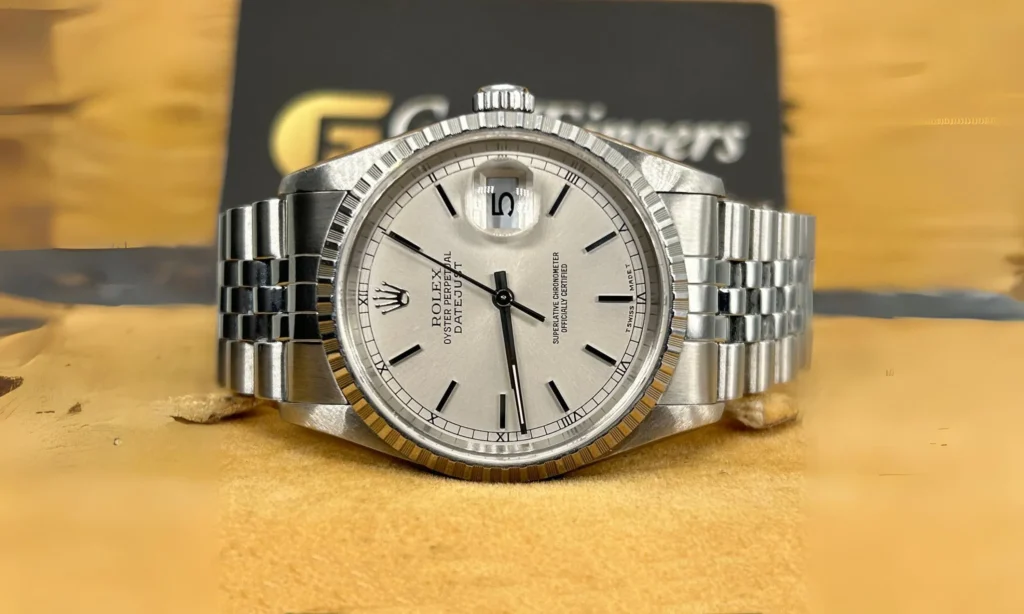
Bracelet clasp codes enable dating and authenticity verification. The code, stamped inside the clasp hinge, combines letters indicating year with numbers 1 through 12 indicating month. For example, “P8” indicates August 1991 (P = 1991, 8 = August). An “S” suffix following the date code, such as “MA5S,” indicates a Rolex Service Center replacement clasp rather than original equipment.
Sub-Reference Summary Table
| Configuration | Bezel | Dial Options | Bracelet | Notes |
|---|---|---|---|---|
| 16220 | Engine-turned steel | Silver, white, black, blue, grey, champagne, rose | Jubilee 62510H or Oyster 78360 | Standard configuration |
| 16220 Tapestry | Engine-turned steel | Silver tapestry, slate tapestry | Jubilee or Oyster | Premium textured dial |
| 16220 Linen | Engine-turned steel | Silver linen | Jubilee or Oyster | Premium textured dial |
Reference Key, Variations, and Sub-References
Understanding Rolex reference taxonomy enables collectors to quickly identify watch specifications and authenticate period-correct configurations. The 16220 follows Rolex’s five-digit reference system used from 1988 until the introduction of six-digit references in the mid-2000s. Decoding this system reveals case size, model family, bezel type, and case material at a glance.
Taxonomy and Nomenclature Decoding
The reference number 16220 breaks down as follows. The first three digits, “162,” identify the model family and generation: a 36mm Datejust with Caliber 3135 movement and sapphire crystal. This distinguishes the 162XX generation from the preceding 160XX generation (Caliber 3035, acrylic crystal) and the succeeding 116XXX generation (six-digit references with updated case proportions).
The fourth digit, “2,” designates bezel type. Within the 162XX Datejust family, this position indicates: “0” for smooth steel bezel (reference 16200), “2” for engine-turned steel bezel (reference 16220), “3” for fluted 18-karat gold bezel on steel case (references 16233 for yellow gold, 16234 for white gold). This systematic approach allows immediate identification of bezel style from the reference number alone.
The fifth digit, “0,” indicates case material. Zero specifies all-stainless steel construction, distinguishing the 16220 from two-tone references that would feature different final digits. This position also distinguishes solid gold models in the broader Datejust catalog.
| Reference | Bezel | Material | Approx. Market Value (2025) |
|---|---|---|---|
| 16200 | Smooth steel | All steel | $4,800 – $6,500 |
| 16220 | Engine-turned steel | All steel | $5,000 – $7,500 |
| 16233 | Fluted 18k yellow gold | Two-tone | $7,000 – $10,000 |
| 16234 | Fluted 18k white gold | Steel case | $6,500 – $9,000 |
Production Variations and Chronology
While the 16220 does not have formally designated Mark generations like certain sports references such as the Daytona 16520, production variations create meaningful differentiation for collectors. These variations correlate with serial number prefixes that allow approximate dating.
The earliest 16220 examples, bearing L-prefix serial numbers from 1988-1989, feature tritium dials marked “T SWISS T,” drilled lug holes, and the “open” 6 and 9 date wheel where these numerals display hollow centers rather than filled shapes. These earliest specimens offer the most vintage character within the reference.
Production through the early 1990s (E, X, N, C, S serial prefixes spanning 1990-1994) maintained tritium dials and drilled lug holes. Rolex phased out drilled lug holes at approximately the end of 1994, making S-serial and W-serial examples from this transitional period potentially available with or without lug holes depending on specific production timing.
Around 1997-1998 (U-serial), Rolex transitioned luminous materials from tritium to LumiNova. Dials from this brief transitional period are marked simply “SWISS” without the “T” designations. These “Swiss-only” dials are estimated to represent approximately 5% of total production and are increasingly recognized as collectible transitional variants.
From approximately 1999-2000 onward (A, P, K, Y, F serial prefixes), SuperLumiNova replaced LumiNova and dials display “SWISS MADE” in the standard two-line format. These later examples lack vintage patina potential but offer brighter, more durable lume performance.
| Serial Prefix | Year | Lume Material | Lug Holes | Date Wheel |
|---|---|---|---|---|
| L | 1988-1989 | Tritium | Yes | Open 6/9 |
| E | 1990 | Tritium | Yes | Open 6/9 |
| X, N | 1991 | Tritium | Yes | Varies |
| C | 1992 | Tritium | Yes | Varies |
| S | 1993-1994 | Tritium | Transitional | Varies |
| W, T | 1995-1996 | Tritium | No | Standard |
| U | 1997-1998 | LumiNova | No | Standard |
| A | 1998-1999 | LumiNova/SuperLumiNova | No | Standard |
| P, K | 2000-2001 | SuperLumiNova | No | Standard |
| Y | 2002-2003 | SuperLumiNova | No | Standard |
| F | 2003-2004 | SuperLumiNova | No | Standard |
Transitional Models and Factory Anomalies
The 16220’s lengthy production span means examples exist across multiple generational transitions. Watches from the mid-1990s may combine features from different production periods, such as a tritium dial in a no-hole case, or vice versa, depending on component availability during assembly. These transitional combinations are factory original, not modifications, and their desirability depends on collector preference.
Service replacement components introduce additional variation. Rolex Service Centers install current-production parts during service, meaning a 1992 watch serviced in 2010 might receive SuperLumiNova hands and a SuperLumiNova dial even though the case serial indicates early production. These service dials and hands are genuine Rolex parts, but mismatched lume generations reduce collector value compared to fully original examples. The presence of service parts can often be detected by examining lume color and aging: tritium-era hands should display aged, creamy lume while SuperLumiNova hands maintain bright white appearance indefinitely.
Case and Component Codes
The reference number 16220 is stamped between the 12 o’clock lugs, visible only with the bracelet removed. The serial number, providing production date information, is stamped between the 6 o’clock lugs. Both engravings should display sharp, deeply cut characters consistent with Rolex’s machine engraving standards.
The caseback exterior is smooth and unmarked on all genuine 16220 examples. Interior caseback markings include “MONTRES ROLEX S.A. GENEVA SWITZERLAND” and may include reference and serial information. Any exterior caseback engravings, exhibition windows, or decorative patterns indicate non-original or counterfeit construction.
Bracelet and end-link pairings should correspond to documented Rolex specifications. The Jubilee bracelet reference 62510H pairs with 555 or 555B end links; the Oyster bracelet reference 78360 pairs with 558B end links. Mixing these pairings, while sometimes occurring through service or parts interchange, suggests investigation into the watch’s history.
Movements and Calibers
The Rolex Caliber 3135 powers every 16220 example and represents one of the most successful automatic movement designs in horological history. Introduced in 1988, the 3135 powered Rolex’s flagship models for over 30 years before gradual replacement by the Caliber 3235 beginning in 2015. Its reputation for accuracy, reliability, and serviceability makes it a favorite among both collectors and professional watchmakers.
Caliber Overview and Production Periods
The Caliber 3135 served as Rolex’s primary time-and-date movement across their entire catalog during the 16220’s production span. Unlike some references that transitioned between calibers, every 16220 contains the same fundamental movement, though incremental improvements occurred throughout production. The movement is entirely designed and manufactured in-house by Rolex at their Bienne facility.
| Specification | Caliber 3135 |
|---|---|
| Movement Type | Automatic, self-winding |
| Diameter | 28.5mm (12½ lignes) |
| Height | 6.0mm |
| Frequency | 28,800 vph (4 Hz) |
| Power Reserve | Approximately 48 hours |
| Jewels | 31 |
| Components | Approximately 195-200 total parts |
| Winding | Bidirectional via Perpetual rotor |
Technical Specifications
The 3135 operates at 28,800 vibrations per hour, or 4 Hz, producing the smooth sweeping seconds hand motion characteristic of modern Rolex watches. This high-beat frequency, an increase from the 19,800 vph of earlier calibers, contributes to improved timekeeping accuracy and helps the movement resist positional variations and external shocks.
Power reserve is approximately 48 hours from a fully wound mainspring, though some specifications round this to 50 hours. The bidirectional Perpetual rotor winds the mainspring efficiently regardless of wrist movement direction. The movement can also be manually wound via the crown, allowing the watch to be fully charged before wearing after storage.
The movement measures 28.5mm in diameter and 6.0mm in height, making it 0.3mm thinner than the predecessor Caliber 3035. This dimensional efficiency contributed to the 16220’s comfortable case thickness while accommodating the robust architecture necessary for Rolex’s reliability standards.
Key Features and Complications
The Caliber 3135 provides hours, minutes, center seconds, and instantaneous date display. The date changes instantaneously at midnight rather than gradually, snapping to the next numeral in a fraction of a second. This mechanism requires substantial spring energy and careful calibration but provides a more satisfying user experience than slow-creep alternatives.
The quickset date function allows the date to be adjusted independently from the time-setting mechanism. By pulling the crown to the first position and rotating, the date advances without affecting the hour and minute hands. This practical feature, while common today, represented a significant convenience when introduced, eliminating the need to cycle the hands through 24 hours to correct the date.
Hacking seconds, or stop-seconds function, halts the seconds hand when the crown is pulled to the time-setting position. This allows precise synchronization with a time signal, a feature required for chronometer certification and appreciated by those who value exact timekeeping.
All Caliber 3135 movements carry COSC chronometer certification, having passed the Swiss Official Chronometer Testing Institute’s 15-day testing regimen in five positions and three temperatures. Certified chronometers must achieve accuracy between negative 4 and positive 6 seconds per day. Rolex’s internal standards are reported to be stricter, with finished watches typically performing within negative 2 and positive 2 seconds per day.
Caliber Architecture and Components
The defining architectural innovation of the Caliber 3135 is its full balance bridge, replacing the single-point balance cock of the preceding Caliber 3035. This dual-support design holds the balance wheel from both sides, providing superior stability and shock resistance. The balance bridge became a hallmark of Rolex movement architecture, continuing through all subsequent date calibers.
The balance wheel itself is a Glucydur free-sprung design, constructed from a beryllium-copper alloy selected for its stability and resistance to temperature variations. Rather than using a traditional regulator with a movable index, Rolex employs the Microstella system: four gold timing screws positioned on the balance wheel rim. These screws allow fine adjustment of rate by changing the wheel’s moment of inertia, a more stable and precise regulation method than traditional approaches.
The 16220’s hairspring composition depends on production period. Early and mid-production examples use Nivarox hairsprings, a nickel-iron alloy with good temperature stability. The Parachrom hairspring, constructed from a niobium-zirconium alloy providing superior anti-magnetic properties and shock resistance, began appearing in Caliber 3135 movements around 2007-2008, after most 16220 production had concluded. Consequently, the vast majority of 16220 examples contain Nivarox hairsprings.
The automatic winding system employs PTFE-coated reversing wheels, identifiable by their distinctive red or maroon color visible through the movement. These reversing wheels provide bidirectional winding efficiency with reduced friction and quieter operation than earlier designs. Shock protection comes from the KIF Elastor system; the Paraflex shock absorber introduced in 2005 was not deployed in the 3135 during 16220 production.
Movement Markings and Identification
Authentic Caliber 3135 movements display specific markings that aid identification and authentication. The oscillating weight, or rotor, is engraved “ROLEX” with the coronet logo, along with “GENEVA SWITZERLAND.” The rotor is constructed from a tungsten alloy segment for efficient winding, attached to a gold-colored bridge.
The movement serial number is engraved on the movement itself, separate from the case serial number between the 6 o’clock lugs. This movement serial can be cross-referenced with Rolex service records if available. The caliber designation “3135” appears on the movement’s main plate.
Visual inspection of an authentic 3135 reveals côtes de Genève (Geneva stripes) decoration on bridges, rhodium plating on visible surfaces, and the characteristic red or maroon reversing wheels. Polished and chamfered screw heads, precisely finished edges, and overall consistency of execution distinguish genuine movements from counterfeits.
Service markings may appear on movements that have been serviced by Rolex or authorized service centers. These markings typically indicate service date and location, providing history documentation that can be valuable for establishing provenance.
Authentication Guide
Authenticating a Rolex Datejust 16220 requires careful examination of multiple components to verify period-correct configuration and genuine Rolex manufacture. The vintage market includes refinished dials, incorrect replacement parts, and outright counterfeits, making detailed knowledge essential for collectors. A systematic approach examining each component against known standards provides confidence in purchase decisions.
Dial Authentication
Authentic 16220 dials display specific characteristics that evolved across production periods. All dials should show “ROLEX” in applied coronet form at 12 o’clock and “OYSTER PERPETUAL” printed below. “DATEJUST” appears printed in a separate line, and “SUPERLATIVE CHRONOMETER OFFICIALLY CERTIFIED” indicates COSC certification.
Dial printing should be sharp and evenly applied, with consistent ink density across all text. Magnification reveals clean edges without bleeding or feathering. The font weight and spacing remain consistent with documented examples from the same production period. Any variations in printing quality suggest refinishing or non-original manufacture.
Applied indices should sit perfectly upright and evenly spaced around the dial. The indices themselves should show sharp faceting if baton-style, with polished surfaces displaying even reflection. Index feet, where the markers attach to the dial, should be invisible from the front; visible adhesive or uneven seating indicates problems.
Luminous material on indices should match the dial’s age designation. Tritium dials (“T SWISS T” or similar) should show aged lume ranging from cream to orange-brown depending on original application and exposure history. The lume should appear evenly aged across all indices; dramatically different coloring between indices suggests replacement. LumiNova and SuperLumiNova indices maintain white or slightly off-white coloring regardless of age.
Font and Logo Authentication
The Rolex coronet logo at 12 o’clock evolved subtly over decades. For the 16220 production period, the coronet should display precise proportions with five points of consistent size and even spacing. The center ball should be centered and proportional. Poor-quality counterfeits often show irregular point spacing, uneven ball placement, or incorrect overall proportions.
The “ROLEX” text appearing below the coronet should display consistent letter spacing and the specific font weight used during 16220 production. Comparison with documented authentic examples reveals subtle font characteristics that counterfeits rarely replicate precisely.
Text at the 6 o’clock position provides production dating. Tritium-era dials display “T SWISS T” with the T appearing on either side of “SWISS,” or “SWISS T<25” on some examples. Transitional LumiNova dials show only “SWISS.” SuperLumiNova dials display “SWISS MADE” in two words. Any combination not matching these documented patterns indicates a refinished or non-original dial.
Hands Authentication
Authentic 16220 hands are manufactured from 18-karat gold with luminous material inlays. Hand proportions should match the dial indices in style; baton hands pair with baton indices. The hands should be perfectly straight with no bends or warping, and the luminous material should be evenly applied in consistent width strips.
Hand lume must match dial lume in type and aging. Tritium hands on a tritium dial should display similar patina coloring; dramatically whiter hands suggest service replacement. The same principle applies in reverse: aged-appearing hands on a SuperLumiNova dial indicate incorrect parts pairing.
Hand finishing should show polished surfaces with even reflection. The hands pivot from precisely centered posts; any wobble or off-center mounting indicates poor assembly. The seconds hand should sweep smoothly at 8 beats per second with no hesitation, stuttering, or irregular movement.
Crown Authentication
The 16220 crown should display the Rolex coronet on its outer face, correctly proportioned and sharply defined. Beneath the coronet, a single horizontal dash indicates stainless steel material. Two dots arranged vertically would indicate the Triplock crown used on professional diving models, not appropriate for the Datejust.
Crown dimensions should measure approximately 6mm in diameter with proportions matching the case aesthetic. The crown should screw down smoothly without excessive resistance or grinding, threading fully into the crown tube. When unscrewed, the crown should pull to two distinct positions for date setting and time setting with clear detents.
Common replacement crowns, including some aftermarket and service parts, may display subtle proportion differences from period-original crowns. Comparison with documented examples helps identify such variations.
Case Authentication
The 16220 case should display correct proportions: 36mm diameter, 43 to 43.5mm lug-to-lug, approximately 12mm thickness, and 20mm lug width. Lug shape should be gently curved with even taper from case to tip. Over-polished cases display rounded edges where sharp transitions should exist, and reduced lug thickness compared to specification.
Between the 12 o’clock lugs, the reference number “16220” should be cleanly engraved in even, precisely spaced characters. Between the 6 o’clock lugs, the serial number provides production date information. Both engravings should display consistent depth and character formation. Shallow, uneven, or poorly spaced characters suggest counterfeit manufacture.
The caseback exterior must be completely smooth with no engravings, medallions, or decorations. Any exterior caseback markings indicate non-Rolex manufacture. The caseback threads should engage smoothly with the case middle, creating a waterproof seal when tightened.
Lug holes, if present, should pierce cleanly through each lug with even diameter and smooth interior walls. Their presence indicates pre-1995 production; absence indicates later production. Lug holes on a watch with SuperLumiNova dial, or absent lug holes on a tritium dial, require explanation.
Bezel Authentication
The engine-turned bezel should display sharp, precisely machined grooves around its entire circumference. The pattern should be perfectly consistent with no variations in spacing, depth, or angle. The bezel should fit securely to the case with no play or movement, and its diameter should match the case precisely.
Over-polishing softens the engine-turned pattern, reducing the crispness of individual grooves. Severely polished bezels display a worn appearance that diminishes the decorative effect and indicates heavy wear or aggressive refinishing. Original bezels maintain sharp definition between grooves even after decades of use.
Authentication Red Flags Summary
The following indicators warrant concern or rejection when evaluating a 16220 for purchase:
Mismatched serial number and reference number locations or formats suggest case manipulation or counterfeit construction. Lume color mismatch between hands and dial indicates service replacement parts or incorrect assembly. Caseback engravings, exhibition windows, or any exterior markings indicate non-Rolex manufacture. Quartz movement ticking at one beat per second instead of smooth sweeping motion indicates counterfeit or incorrect movement. Rehaut engravings (serial numbers or “ROLEX” text on the inner bezel ring) indicate post-2005 production, after the 16220 was discontinued. Font irregularities, uneven printing, or incorrect text sequences on dials suggest refinished or counterfeit dials. Loose or incorrectly fitting end links, bracelet gaps, or mismatched bracelet references indicate parts replacement or incorrect assembly. Excessively worn bezel pattern with rounded grooves suggests heavy polishing that has altered original specifications.
Wearability and Collector Standing
The Rolex Datejust 16220 occupies a practical sweet spot for collectors who desire both investment-worthy collecting and genuine daily wear capability. Its 36mm case size, robust movement, and versatile aesthetics make it suitable for nearly any occasion, while its discontinued status and unique bezel style provide collecting appeal beyond mere utility.
Case Size and Modern Wearability
The 36mm diameter represents the traditional men’s dress watch size that dominated the market during the 16220’s production. While contemporary trends have pushed average case sizes toward 40mm and beyond, the 36mm Datejust has experienced renewed appreciation among collectors who value proportion and comfort over wrist presence.
The 43 to 43.5mm lug-to-lug measurement determines how the watch sits across the wrist. This dimension suits wrists from approximately 6.0 inches to 7.5 inches in circumference, with the case sitting flat without lug overhang. Those with larger wrists may find the watch appears undersized by current standards, while those with smaller wrists will appreciate the balanced proportions.
Multiple sources note that the 16220 “wears larger than its measurements suggest” due to case and lug design. The integrated lug structure and modest thickness create visual presence beyond what the 36mm specification might indicate. First-time viewers are often surprised at how substantial the watch appears on wrist.
Durability and Practical Considerations
The 16220 was engineered for daily wear, not occasional use. The 904L steel case resists corrosion and scratches better than common stainless steels. The sapphire crystal provides practical immunity from the scratches that quickly marred earlier acrylic crystals. Water resistance to 100 meters accommodates swimming, rain exposure, and normal daily activities, though Rolex recommends against hot water exposure that can affect gasket integrity.
The Caliber 3135 movement’s reputation for reliability is well-documented across decades of service. When properly maintained with service intervals of approximately 5 to 7 years, the movement provides accurate, dependable timekeeping indefinitely. Service costs at Rolex Service Centers typically range from $500 to $800 for a complete overhaul including gasket replacement, movement cleaning, and timing adjustment.
Bracelet durability represents the primary wear consideration. The hollow center links used during 16220 production are more susceptible to stretch over extended wear than the solid links found in later references. Stretched bracelets display loose, rattling links and increased sag when worn. While Rolex can service and tighten bracelets, severely stretched examples may require link replacement or complete bracelet replacement to restore proper fit and appearance.
Comfort and Ergonomics
The 36mm Oyster case with curved lugs conforms well to most wrist shapes. The modest thickness of approximately 12mm allows the watch to slide under shirt cuffs without catching. Weight distribution across the bracelet prevents the case from pulling to one side or creating pressure points.
Both bracelet options provide comfortable wear for extended periods. The Jubilee bracelet’s articulated five-link design offers flexibility and drape around the wrist. The Oyster bracelet’s three-link design provides a firmer feel preferred by some wearers. Neither bracelet is objectively superior; selection is a matter of aesthetic preference and wearing style.
Collector Sentiment and Reputation
The collector community regards the 16220 favorably as an underappreciated value proposition within the Rolex catalog. Forum discussions on Watchuseek, RolexForums, and TimeZone consistently describe the reference as combining vintage appeal with modern reliability. The discontinued engine-turned bezel attracts collectors seeking distinctive variants that stand apart from the common smooth and fluted options.
Common praise centers on the balance between vintage aesthetics and practical wearability. The slim case proportions, textured bezel option, and potential for tritium patina development satisfy vintage enthusiasts, while sapphire crystal and the Caliber 3135 provide modern durability. The reference represents an entry point to Rolex ownership at prices below comparable fluted-bezel variants.
Criticisms are few but include the hollow bracelet links susceptible to stretch, the limited dial variety compared to precious metal references, and the bezel style’s polarizing nature; some collectors prefer the classic fluted look and find the engine-turned pattern too casual or similar to the fluted style it emulates.
Rarity and Availability
Overall production numbers for the 16220 are unknown, but the reference appears with sufficient regularity on the secondary market to suggest substantial volume over its 15-plus year production span. Current availability can be characterized as uncommon but not rare; patient searching typically yields multiple examples for consideration at any given time.
Certain variants are considerably scarcer. Tapestry and linen dials were produced in limited quantities and command premiums of $500 to $1,000 over standard dials. Blue sunburst dials are sought after and add approximately $300 to comparable silver or black dial examples. Early drilled-lug examples with tritium dials represent the reference’s most vintage-oriented configuration and attract traditional collectors.
Geographic distribution appears relatively even across major markets. The 16220 was sold globally through authorized dealers, and secondary market availability does not strongly favor particular regions. European and Asian markets may see slightly different dial distribution due to regional preferences during original sales.
Popularity and Collector Following
The 16220 occupies an accessible position in Rolex collecting, appealing to both first-time Rolex buyers seeking quality entry points and experienced collectors assembling comprehensive Datejust collections. It functions well as a “gateway watch” introducing new collectors to vintage Rolex ownership, while also serving as a specific acquisition target for those seeking the discontinued engine-turned bezel.
Market data from WatchCharts indicates the reference appreciated approximately 9.6% over the past five years with relatively low volatility of 14.3%. This performance trails some sports references but exceeds overall Datejust collection averages for certain periods. The steady appreciation with limited volatility suggests stable collector demand rather than speculative trading.
No celebrity associations or notable historical appearances specifically feature the 16220, though the broader Datejust family has extensive cultural presence. The reference’s appeal lies more in its technical characteristics and collector positioning than in famous provenance.
Current Market Values
Secondary market pricing for the 16220 varies with condition, completeness, and specific variant. The following ranges reflect 2024-2025 market observations.
| Condition | Completeness | Price Range (USD) |
|---|---|---|
| Excellent | Full set with box, papers, tags | $6,500 – $7,500 |
| Very Good | Box included | $5,500 – $6,500 |
| Good | Watch only, no papers | $4,500 – $5,500 |
| Fair | Visible wear, needs service | $3,800 – $4,500 |
Premium configurations add to these base ranges. Tapestry or linen dials add $500 to $1,000. Blue sunburst dials add approximately $300. Early examples with drilled lug holes and tritium dials in excellent condition can reach $7,500 or beyond with complete documentation. Full sets with original box, warranty papers, booklets, and hang tags command $800 to $1,500 premiums over watch-only equivalents.
The 16220 positions favorably against related references. It typically trades above the smooth-bezel 16200 due to the distinctive engine-turned bezel, but below the precious-metal-bezel 16234, which incorporates 18-karat white gold. This middle positioning offers collectors distinctive design at steel-only pricing.
Major auction houses rarely feature the 16220, as their focus tends toward exceptional vintage pieces or current-production precious metal models. However, private sales and smaller auction platforms record transactions consistent with the ranges above. The reference maintains strong liquidity with median time-to-sale faster than 82% of tracked watches, indicating healthy market depth.
Conclusion
The Rolex Datejust reference 16220 represents a compelling convergence of historical significance, practical utility, and collector value. As the final Datejust to feature the engine-turned bezel, its discontinuation ensures permanent scarcity of this specific aesthetic within the Rolex catalog. The reference spans an important transitional period, introducing 904L steel and the enduring Caliber 3135 while preserving the classic 36mm proportions that defined generations of Datejust watches.
For collectors, the 16220 offers genuine vintage appeal without vintage fragility. Early examples with tritium dials and drilled lug holes provide patina development and traditional Rolex construction details, while sapphire crystal and a robust modern movement eliminate the daily-wear concerns associated with true vintage pieces. Later production examples offer the same movement reliability and bezel distinctiveness with brighter luminous material and contemporary durability.
Market positioning favors the reference. Prices between $4,500 and $7,500 represent substantial value within the Rolex ecosystem, below comparable fluted-bezel variants while offering the distinctive visual interest that smooth-bezel references lack. Appreciation has been steady without the volatility affecting certain sports references, suggesting genuine collector demand rather than speculation.
Authentication requires attention to period-correct details, as the reference’s long production span created meaningful variation in luminous materials, case construction, and component specifications. Understanding the transition from tritium to LumiNova to SuperLumiNova, the discontinuation of drilled lug holes around 1994, and the serial number dating system enables confident evaluation of any example.
The 16220 serves equally well as an introduction to Rolex collecting or as a specific target for established collectors. Its combination of discontinued uniqueness, proven reliability, versatile aesthetics, and accessible pricing creates a reference that rewards ownership with both wearing pleasure and investment soundness. The engine-turned bezel that distinguishes the 16220 from its siblings will never return to Rolex production, ensuring that examples will only grow scarcer as years pass and more enter permanent collections.