


Last updated ~ April 10, 2026
Brand
Production Period
1967–1979
Model Line
Case Shape
Round
Diameter
40mm
Lug to Lug
47.5mm
Lug Width
20mm
Case Thickness
14mm
Case Back
Screw-Down
Caliber
Crystal
Bezel
Dive
The Rolex Submariner 1680’s relationship to the 5512 is often mischaracterized. The 5512 was the chronometer-certified no-date Submariner to which the 1680 most closely corresponds in terms of movement quality and dial text. Both wore the four-liner COSC text; both used cal. 1570-series movements. The 1680 effectively added the date to this premium Submariner tier. The 5513, non-chronometer rated and two-lined, continued independently as the pure, symmetrical no-date option at a slightly lower retail position.
The Sea-Dweller 1665 is the logical professional counterpart. Both use the cal. 1575 architecture, both were in production simultaneously, and both received COMEX-issued variants. The 1665 omits the Cyclops lens and adds the helium escape valve on the case flank, reflecting its saturation diving specification. Collectors of this period often note the tonal interplay between a Double Red Sea-Dweller 1665 and a Red Sub 1680 as the apex collector pairing within the vintage professional Rolex universe.
Manufacturing and production location
Movements were manufactured at Rolex’s movement facility in Bienne (Manufacture des Montres Rolex SA, before its full integration into Rolex SA in 2004). Case and bracelet components were processed at Rolex’s Geneva and Chene-Bourg facilities. Final watch assembly took place in Geneva.
Period advertising and marketing
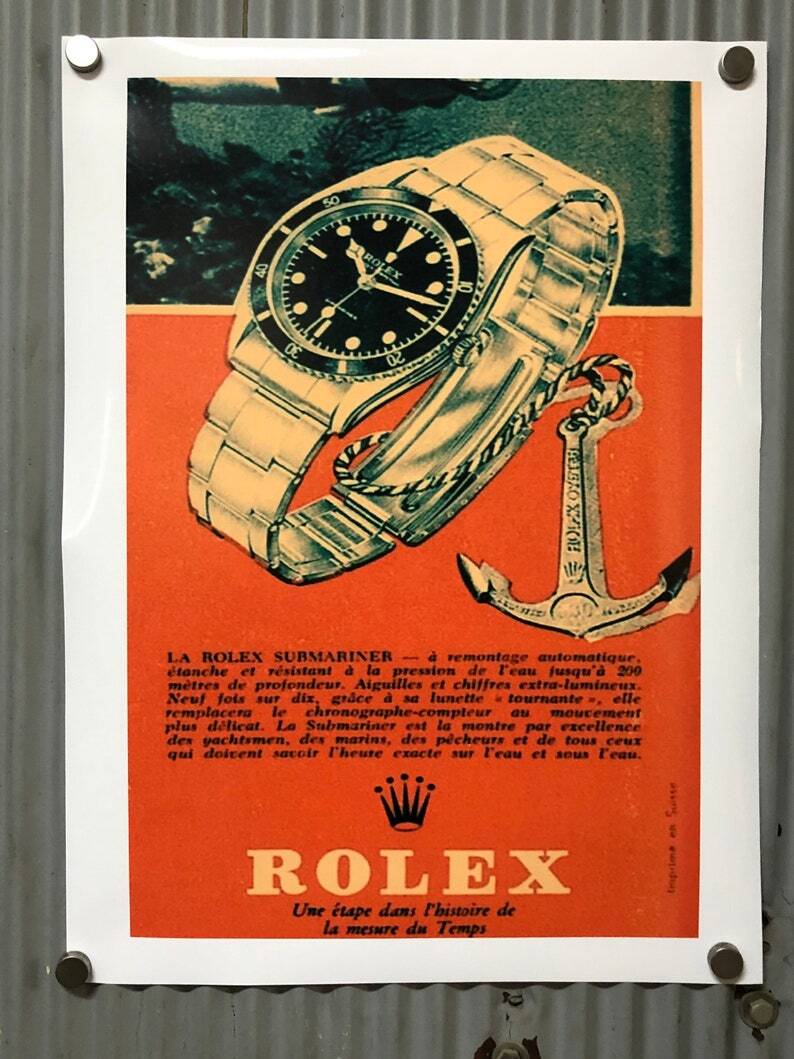
Rolex’s marketing of the 1680 era emphasized versatility and the passage from functional tool to everyday luxury. Early Submariner advertising from the 1960s had leaned on underwater and nautical imagery, but by the late 1960s and through the 1970s, Rolex began positioning the Submariner in contexts that included formal occasions, yachting, and professional settings.
The introduction of the date-equipped 1680 reinforced this pivot. Rolex’s underlying promotional message was that the owner need never remove the watch: it was capable of accompanying a diver underwater and a professional to the boardroom. Advertising copy from the period used constructions like “if you were working / racing / shipping out tomorrow” and “work pretty well at any level.” The America’s Cup 12-meter yacht racing context, used in several 1970s Rolex campaigns, was particularly aligned with the Submariner Date.
The no-date 5513 received less marketing investment as Rolex shifted its promotional attention toward the date-equipped model and the Sea-Dweller. The 5513’s continued production through the 1980s was largely driven by its established user base and lower manufacturing complexity rather than active promotional push.
Rolex’s decision in 1969 to introduce a solid gold Submariner in the 1680/8 was itself a marketing statement of considerable ambition, explicitly signaling that the Submariner had graduated from pure tool watch to a platform for precious metal luxury. This move foreshadowed the two-tone and gold Submariner variants that followed in subsequent generations.
Military and professional dive issue
The term “MilSub” in Rolex parlance refers specifically to the reference 5517, a purpose-built variant of the 5513 ordered by the British Ministry of Defence for Royal Navy clearance divers and SBS operators, featuring fixed bar-end lugs, sword hands, tritium symbol “T” above 6 o’clock, and a fully graduated 60-minute bezel. The reference 1680 was not produced as an official military-specification MilSub. British military procurement of dive watches in the 1970s centered on the 5513 and the purpose-built 5517, not the date-equipped 1680.
Examples supplied to the Peruvian Air Force (Fuerza Aerea del Peru, or FAP) carry an additional engraving on the outside of the caseback reading “Fuerza Aerea del Peru” in Roman sans-serif font, often filled with black enamel (most of which has worn away by now), plus the serial number and a military code. Rolex supplied approximately 700-800 watches across all models to the FAP, making these among the rarest 1680 variants.
The COMEX connection
The reference 1680 carries a legitimate and significant professional issue history through Rolex’s partnership with COMEX (Compagnie Maritime d’Expertises), the French deep-sea engineering company that worked with Rolex to develop and validate the helium escape valve for the Sea-Dweller. As part of an ongoing arrangement beginning in the early 1970s, Rolex supplied COMEX with watches free of charge in exchange for operational feedback.
COMEX 1680 examples carry the word “COMEX” printed on the dial below the standard text hierarchy. Because the 1680 was not fitted with a helium escape valve, COMEX 1680s were issued primarily to office staff and for non-saturation diving duties rather than to the saturation divers themselves, who were equipped with Sea-Dweller 1665s and specially modified 5513/5514 references bearing HEVs. Because many COMEX 1680 examples never entered the water, surviving examples often display exceptional dial preservation relative to their age. Production quantities were extremely limited. All known examples originate from COMEX staff or their families.
Production timeline
Introduction and early production (c. 1967-1969)
The reference 1680 is most commonly dated to a 1969 debut, corresponding to serial numbers in the 2.1 million range and caseback stamps from early 1969. Some sources cite a 1967 introduction, and there are accounts of examples with serial numbers placing them in 1967, though these may represent pre-production or initial limited-run examples rather than broad market availability. The most defensible position supported by serial number analysis is that consistent commercial production began in 1969, with earlier examples being extremely rare.
The very first production watches are identifiable by MK1 dials, serial numbers in the 2.07 million range, and the rivet-link bracelet reference 7206 with 80 end pieces. The MK1 “Long F” dials are the rarest across the entire 1680 run.
Serial number ranges by production year
| Year | Approximate Serial Range |
|---|---|
| 1966 | 1,275,000 – 1,485,000 |
| 1967 | 1,485,000 – 1,710,000 |
| 1968 | 1,710,000 – 1,945,000 |
| 1969 | 1,945,000 – 2,240,000 |
| 1970 | 2,240,000 – 2,590,000 |
| 1971 | 2,590,000 – 2,890,000 |
| 1972 | 2,890,000 – 3,200,000 |
| 1973 | 3,200,000 – 3,570,000 |
| 1974 | 3,570,000 – 3,865,000 |
| 1975 | ~3,865,000 – 4,267,100 |
| 1976 | 4,267,100 – 4,539,000 |
| 1977 | 4,539,000 – 5,006,000 |
| 1978 | 5,006,000 – 5,482,000 |
| 1979 | 5,482,000 – 5,958,000 |
These are collector-documented ranges derived from decades of cross-referencing known examples. The transition from Red to White dial text occurred at approximately the 4.0 million serial, with some overlap extending to roughly 4.2 million. Red dials at serials above 4.0M are transitional anomalies, not guaranteed frauds, but require careful verification of all other components.
The Red Sub era (1969 – c. 1975)
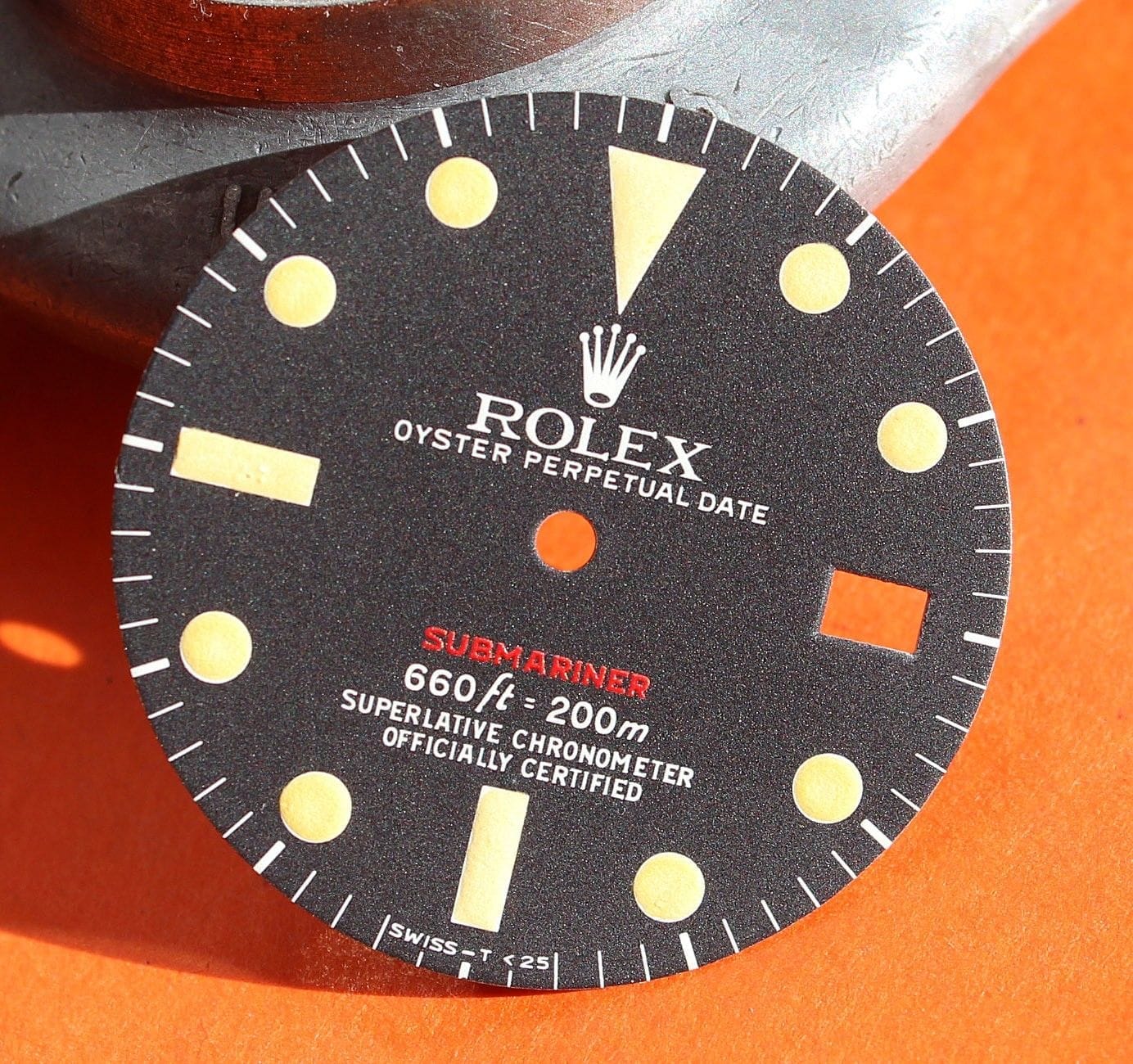
The period from 1969 to approximately 1975 (serial numbers roughly 2.1 million to 4.0 million) encompasses the “Red Sub” era, distinguished by the word “SUBMARINER” printed in red above 6 o’clock. Rolex applied this red text from approximately serial 2.1 million through approximately 4.0 million. The red text was never applied to any other stainless steel Submariner reference before or since. Six distinct “Marks” are documented for the Red Sub period, plus a seventh LumiNova service dial of exceptional rarity.
The transition from “meters first” (200m=660ft) to “feet first” (660ft=200m) depth notation occurred around 1970 to 1971, believed by many historians to reflect commercial accommodation of the rapidly growing North American market, though Rolex has never confirmed this.
The White Sub era (c. 1975 – 1979)
Around 1975, coinciding with serial numbers approaching the 4.0 million range, Rolex transitioned the dial text to all-white. Unlike the Red Sub Marks, which correlate reasonably well to serial number ranges, the three White Sub Marks were apparently applied somewhat interchangeably during the same production windows rather than sequentially.
Production of the reference 1680 wound down in 1979, with the very last examples carrying serial numbers in the 5.9 to 6.2 million range. The reference 16800 began production concurrently around 1979, and the transition was gradual rather than a clean cutover.
Construction and architecture
Case design
The 1680 retained the same 40mm Oyster case architecture established with the 5512. The case thickness runs to approximately 13.5mm, with the domed acrylic crystal adding perceptible height at the crystal centerpoint. The lug-to-lug span of approximately 47.5mm wears compactly on the wrist despite the apparent size of the watch face. Lugs are drilled through on all production examples.
The earliest 1680 examples, produced through approximately 1969, used the same thinner case architecture shared with the 5512 and 5513 of the late 1960s. From 1970 onward, the case walls are slightly more substantial and conform to what most collectors recognize as the archetypal 1680 form.
The bidirectional bezel on the 1680 rotates in both directions and relies on friction for retention. Unlike the unidirectional, ratcheting bezel introduced with the reference 16800, the 1680 bezel can be bumped in either direction during a dive, which is a safety limitation but also a defining specification distinction for collectors. The Blancpain patent on unidirectional bezels, granted in 1952 for the Fifty Fathoms, remained in force for the entirety of the 1680’s production run.
Serial number location
The serial number is engraved between the lugs at the 6 o’clock position, on the case flank beneath the bracelet. The reference number (1680) appears between the lugs at 12 o’clock. Both positions require bracelet removal to read. The rehaut engraving system Rolex later adopted was not introduced until 2005.
Caseback engravings and stampings
The caseback screws down and has a plain, smooth exterior. The interior carries critical stamped text:
Reference stamp: “1680” is always stamped inside the caseback regardless of production year.
Date code stamp (1969-1972 only): From the earliest production through approximately 1972, Rolex stamped the caseback with a production quarter and year using Roman numerals for the quarter. The format is a Roman numeral over a two-digit year, for example “II 69” (second quarter 1969), “III 69” (third quarter 1969). Known codes run from “II 69” through approximately “II 72.”
From 1973 onward, Rolex discontinued the date code, and only the “1680” reference stamp remains. Service replacement casebacks were never given date codes even when fitted to pre-1972 watches, so the absence of a date code on an early example is not automatically a red flag, but its presence on a verified early watch is a strong authenticity indicator.
French import stamps appear on some examples imported into France and are found on the caseback exterior or movement.
Dial variants: the Red Submariner (Marks I through VI)
Rolex used multiple dial manufacturers simultaneously – primarily Singer, Beyeler, and Lemrich – which is the root cause of the numerous dial variants. Each manufacturer’s tooling, ink application methods, and layout specifications produced subtle but identifiable differences. All Red Sub dials carry the “Swiss-T<25” tritium marking at 6 o’clock and a matte black lacquered surface.
| Mark | Depth Order | Approx. Serials | Maker | “6” Shape | Red Print Method | Key Identifier |
|---|---|---|---|---|---|---|
| I (Long F) | Meters first | 2.07M – 2.2M | Singer | Closed | Red over white base | “f” curls above “t”; SUBMARINER width = depth width |
| II | Meters first | 2.2M – 2.45M | Singer | Open | Red over white base | “f” stops level with first “R”; coronet slightly broader |
| III | Meters first | 2.2M – 2.45M | Singer | Open | Red direct on dial | “f” ends behind second “R”; narrower “t” curve |
| IV | Feet first | 2.45M – 3.1M | Singer | Open (wide) | Red over white base | “f” and “t” horizontals offset |
| V | Feet first | 2.45M – 3.3M | Beyeler | Open (narrow) | Red direct on dial | “f” and “t” co-linear; Beyeler-made |
| VI | Feet first | 3.3M – 4.0M | Lemrich | Closed | Red direct on dial | Only feet-first with closed 6s; rounder “S” in Superlative |
Marks II and III were produced simultaneously and share the same serial range. The same is true of Marks IV and V. Neither pair represents a strict temporal sequence but rather concurrent production from different dial suppliers.
Mark VIII (Service Red Dial): An exceptionally rare service dial, produced after Rolex ceased manufacturing the red-text dial for new watches. These replacement dials were made with LumiNova rather than tritium, so the 6 o’clock signature reads “SWISS” (no T) rather than “Swiss-T<25.” The lume appearance is brighter and white rather than aged cream. Only a handful are known.
Mark 0 / Prototype dials: A very small number of dials have surfaced featuring no minute track and unique “Swiss Made” stamps instead of “Swiss-T<25.” These are believed to be proto-production examples and require expert verification.
Mark-by-Mark identification checklists
Mark I identification: – “SUBMARINER” text width exactly equals the depth rating text width – “L” in “ROLEX” is perfectly centered under the bottom of the coronet – Sixes in “660” are fully closed (the loop is sealed) – The “f” in “ft” has a descending stroke that curls above the crossbar of the “t,” the distinctive “long F” – Red text sits on a white sub-layer; under strong magnification a white outline is visible around the red letters
Mark II identification: – “SUBMARINER” text width is now slightly shorter than the depth rating text – Sixes in “660” are open (a small gap exists at the end of each loop) – The “f” in “ft” terminates at the same horizontal level as the first “R” in “SUBMARINER” – Rolex coronet is fractionally broader than the Mark I coronet – Red text still printed over white base layer
Mark III identification: – Nearly identical to Mark II in overall appearance – The “f” in “ft” terminates visibly behind (to the left of) the second “R” in “SUBMARINER,” the single most reliable differentiator from Mark II – The lower curvature of the “t” in “ft” is significantly narrower than on the Mark II – Red printed directly onto dial surface; no white base layer – Open sixes
Mark IV identification: – First feet-first dial: reads “660FT=200M” – Open sixes, widely spaced – Red printed over a white base layer (white often visible at letter edges) – The horizontal member of the “f” and the baseline of the “t” in “ft” are at visibly different heights (offset) – First “E” in “CHRONOMETER” aligns with the “D” in “CERTIFIED”
Mark V identification: – Open sixes, but the gap is minimal, practically invisible without magnification – Red printed directly on dial (no white base) – The “f” and “t” horizontals in “ft” are at the same height (co-linear), the opposite of Mark IV – Produced by Beyeler; overall character shapes differ subtly from Singer-made dials
Mark VI identification: – Closed sixes in “660,” the sole feet-first Mark with closed 6s and the single fastest identifier – Red printed directly on dial (no white base) – Co-linear “f” and “t” horizontals – The “S” in “SUPERLATIVE” has a noticeably rounder, more open curve than on previous Marks – Made by Lemrich; found in serials from approximately 3.3M to 4.0M
Dial variants: the White Submariner (Marks I, II, III)
From approximately the 4.0 million serial range onward (mid-1970s through end of production), the word “SUBMARINER” was printed in white. All white dials are feet-first (660FT=200M), all carry tritium lume, and all are matte black. Unlike the Red Sub Marks which follow a rough chronological sequence, the three White Sub Marks were produced simultaneously and fitted to watches across the entire White Sub serial range. A given serial number cannot predict which Mark is on the dial.
Dial manufacturers: Lemrich & Cie (Marks I and III), Beyeler (Mark II).
| Mark | “L” in ROLEX | Sixes | “C/H” Alignment | Maker |
|---|---|---|---|---|
| I | Perfectly centered under coronet | Closed | C in CERTIFIED below H in CHRONOMETER | Lemrich |
| II | Shifted left of centerline | Open | Variant alignment | Beyeler |
| III | Shifted left (same as II) | Closed | C NOT aligned with H | Lemrich |
White Mark I identification: – “L” in “ROLEX” sits exactly centered vertically beneath the bottom of the coronet – “SUBMARINER” text width equals the depth rating text width – Sixes closed – “C” in “CERTIFIED” is directly beneath the “H” in “CHRONOMETER”
White Mark II identification: – The single fastest identifier is the coronet shape, distinctly broader and differently proportioned from the Lemrich-made coronets (Marks I and III) – “L” shifted left of center under the coronet – “SUBMARINER” text is longer than the depth rating text – Sixes open – Produced by Beyeler in two ink-weight variants (thick and thin); the thick variant’s sixes can appear almost closed under casual inspection
White Mark III identification: – “L” shifted left (matches Mark II position) – Sixes closed (matches Mark I) – “C” in “CERTIFIED” is NOT aligned with the “H” in “CHRONOMETER,” the differentiator from Mark I – Same Lemrich-made coronet as Mark I
Service dials for the White Sub exist in both tritium and LumiNova variants, with the LumiNova examples signed “SWISS” at 6 o’clock.
Luminescence: tritium markings and authentication
All original 1680 dials use “Swiss-T<25” at 6 o’clock. The “25” represents 25 millicuries, the maximum permitted emission level. Sports models with substantial lume content use this higher threshold designation rather than the lower “T Swiss T” marking found on dress watches (limited to 7.5 millicuries).
Tritium has a half-life of approximately 12.3 years. A 1680 dial from the 1970s will exhibit very little to no functional glow in darkness, which is entirely normal. Under UV (blacklight) illumination, original tritium shows a faint, dull phosphorescence, often yellowish or cream-colored, that glows briefly when the UV source is removed and fades quickly. Lume that glows intensely and sustains its glow long after the UV source is removed is almost certainly modern LumiNova or SuperLuminova, indicating a relume.
Field test: Take the watch from sunlight into a dark room. Tritium fades within seconds to a very faint glow. LumiNova sustains a strong glow for minutes.
Hands
The correct handset for the steel 1680 is the Mercedes-style set (named for the three-leaf “Mercedes” symbol on the hour hand). The handset is shared with the Sea-Dweller ref. 1665, and NOS or used period parts from one reference are physically compatible with the other.
- Hour hand: Large Mercedes symbol with tritium lume filling the three lobes, sitting in a recessed reservoir
- Minute hand: Rectangular lume plot
- Seconds hand: Typically no lume on original factory hands; some service hands carry a small dot. The lollipop end should be properly filled with luminous compound matching the dial plots
With age, the tritium in the hand lume plots develops the same cream-to-yellow patina as the dial. Matching color temperature between dial indices and hand lume is a strong indicator of non-tampered components. The lume plots in original tritium handsets can crack and flake as the tritium capsule material ages and contracts. This is period-correct deterioration, not a defect in the authentication sense, but loose tritium particles can end up inside the case and the movement should be cleaned.
Crown evolution
| Crown | Ref. | Period | Identification | Seal Type |
|---|---|---|---|---|
| Twinlock | 24-700 | 1967 – ~1971 | No dots beneath coronet | Two O-ring sealed zones |
| Triplock (Gen 1) | 24-701/702 | ~1972 onward | Three dots beneath coronet | Three watertight zones, no O-ring at crown |
| Triplock (Gen 2) | 24-703 | 1980s service only | Three dots (same appearance) | Adds O-ring seal |
For authentication, the crown type should be cross-referenced against the serial number. A Twinlock on a serial below ~2.59M is correct and original. Finding a Triplock on an early serial is extremely common (service replacement) and does not indicate tampering. A 24-703 on any 1680 indicates post-production service.
Crystal
The ref. 1680 uses a unique acrylic (plexiglass) crystal designated by Rolex part number 25-127, known as the “Top Hat” crystal because it protrudes approximately 3mm above the top plane of the case and bezel, giving the watch a distinctively tall, box-shaped profile. No other Submariner Date reference uses this profile; the 16800 that followed used a lower-profile crystal. The Cyclops magnification lens is integral, providing approximately 2.5x magnification of the date aperture.
Crystal generations: – First generation: Sharp 90-degree edges; genuinely box-shaped in cross-section with right angles at the top corners. Period-correct for pre-1972 examples. – Second generation: Small chamfers or bevels at the top corners; still acrylic, still part 25-127, but with a softened edge profile.
Original Cyclops lenses can develop crazing, yellowing, or cracking with age, particularly along the junction where the lens meets the main crystal body. A cracked Cyclops is cosmetic and does not compromise water resistance (since the Cyclops sits on top of the flat crystal) but does affect value.
Bezel insert variants
| Insert | Font | “4” and “0” Relationship | “4” Interior | “5” Belly | Approx. Period |
|---|---|---|---|---|---|
| MK I (Kissing 40) | Fat | Touch with no gap | Triangular (pointed top) | Long, curved | 1967-1970 |
| MK II (Long 5) | Fat | Some sources merge with MK I | Perfect triangle | Elongated drop | ~1970-1972 |
| MK III | Fat | Clear gap between “4” and “0” | Triangular; slight serif | Standard | ~1972-1976 |
| MK IV (thin) | Thin | Clear gap; flat-topped “4” | Flat top (not triangular) | Standard | Service replacement |
The interior space of the “4” digit is the most reliable differentiator between fat font variants. Original Marks I-III have a pointed or triangular interior. The thin font Mark IV has a flat horizontal top. The “Kissing 40” where the “4” and “0” touch can also occur on later fat font inserts where print registration has drifted slightly with age, so a kissing 40 alone is not definitive.
For the Meters First era (serials below ~2.45M), the correct insert is the Long 5 type. For the Feet First / White Sub era, the correct insert is the MK III fat font. The bezel pip (tritium dot at 12 o’clock) will fade or disappear with age. Missing pip is common and period-correct.
Bracelet and endlink references
Ref. 7206 rivet-link (~1967-1969): Riveted three-link construction, endlink code 80, no diver extension or safety latch. Found on the earliest 1680 production, carried over from the 5512/5513 transition.
Ref. 9315 folded-link (~1970 to mid-1970s): The canonical correct bracelet for the Red Submariner and the most desirable for period-correct presentation. Folded three-link construction (hollow side links), diver extension clasp with safety latch. “9315” stamped on the link adjacent to the endpiece. Endlinks stamped “280” or “380.”
Clasp variants in chronological order: – “Pat Pend” clasp: Pre-patent grant; “Patent Pending” stamped on the inner face of the unfolded diver extension. The earliest and most sought-after variant. – “Pateted” clasp (1970-1972): Rolex misspelled “Patented” as “Pateted,” omitting the letter “N,” and no one caught the error for roughly two years. These misspelled clasps are now premium collector items and also appear on some contemporary 5512, 5513, 1665, and 1016 examples. – “Patented” clasp (~1973 onward): Correct spelling; less desirable than the error variants.
Clasps on 9315 bracelets were date-stamped (quarter + year) through 1972. Clasps from 1973 onward bear no date stamp.
Ref. 93150 solid-link (~1976-1980): Solid three-link construction (substantial side links vs. folded links on 9315). Endlinks stamped “580.” Correct bracelet for all White Submariner examples. Alphabetical date code on clasp: VA=1976, VB=1977, VC=1978, VD=1979.
Note on 93250: The ref. 93250 with Solid End Links (SEL) is associated with the ref. 16610, not the 1680. It is not a correct or documented factory option for any 1680.
| Serial Range | Correct Bracelet | Endlinks | Clasp Notes |
|---|---|---|---|
| ~1.27M – ~2.2M | 7206 or 9315 | 80 or 280/380 | 7206 on earliest; 9315 from ~1970 |
| ~2.2M – ~4.0M | 9315 | 280 or 380 | Date-stamped through 1972; Pateted error 1970-1972 |
| ~4.0M – ~6.0M | 93150 | 580 | Alpha-coded from VA (1976) onward |
Collector note: A “Pateted” clasp on a 93150 bracelet is an impossible factory combination. The Pateted error predates the 93150, so this pairing immediately indicates assembled parts.
Date wheel
The factory-original date wheel has a brushed silver metallic finish. All numeral sixes and nines are open with one deliberate exception: the numeral 26 features a closed six. This asymmetry is factory-standard and not an error.
Two service replacement date wheel variants are known: a similar but non-metallic silver finish (matte, without the metallic sheen, believed by some to have originated as GMT-Master 1675 parts used in service), and a white date wheel (modern style) with all 6s and 9s open, including the 26. Presence of a white date wheel is a strong indicator of post-production service. Tudor date wheels use a distinctly different, rounder numeral font and should never appear in a 1680.
Material and reference variants
Steel reference 1680
The stainless steel reference 1680 in its standard configuration is the canonical Red Sub or White Sub described above. Material is 316L stainless steel. There is no 904L distinction in this era.
Gold reference 1680/8
Rolex introduced the first solid 18k yellow gold Submariner simultaneously with the 1680 steel model in 1969, designating it reference 1680/8. The “/8” suffix was Rolex’s internal code for 18k gold across multiple references. The caseback is stamped “1680” inside, not “1680/8.”
The 1680/8 initially appeared with a black dial and black bezel insert. A blue dial and blue aluminum bezel insert variant followed in 1971, with gold applied “nipple” hour markers (named for their conical applied index form) that differ from the flat lume plots on the steel version. Text is printed in gold (not red, not white), and there is no “Red Sub” version of the gold model.
The blue dials on the 1680/8 have become legendary for their propensity to undergo color transformation due to UV exposure and chemical interaction with the original dial lacquer, producing states ranging from navy, to purple, to brown, to a dramatic orange-brown “tropical” condition. Blue-dialed 1680/8 examples with deep tropical patina command substantial premiums. The 2.8 million serial range is particularly associated with strong purple transformation (“aubergine”).
The 1680/8 is fitted with an 18k yellow gold Oyster bracelet with a gold folding clasp and gold diver’s extension. The movement is the same Cal. 1575 used in the steel version.
The tropical phenomenon
The 1680, particularly in its black steel configuration with meters-first dials in the 2.1 to 2.5 million serial range, is associated with one of the most prized dial conditions in all of vintage Rolex collecting. The black lacquer used on early production dials was susceptible to UV degradation under certain conditions of wear and storage, causing a gradual shift from black to various shades of warm brown, sometimes described as “rootbeer” or “tobacco.” Watches worn daily in warm, sun-exposed climates are disproportionately represented among known tropical examples.
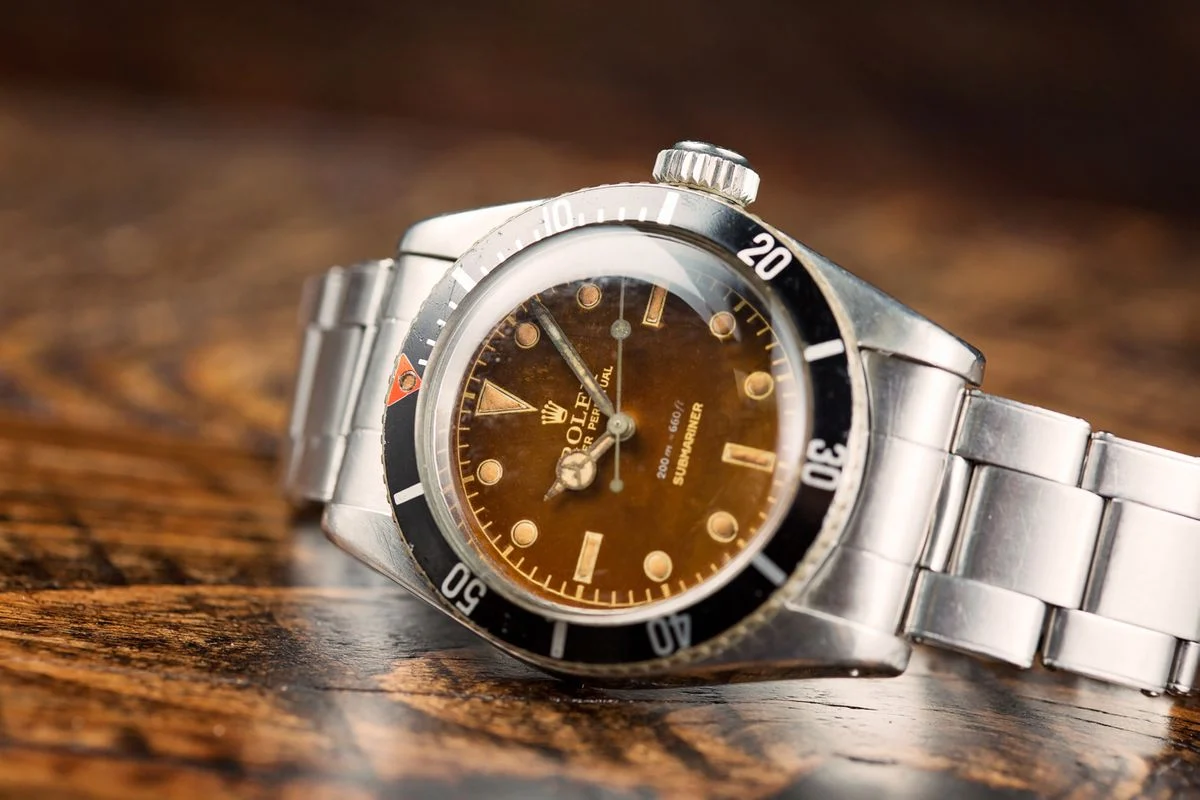
The phenomenon was common enough that Rolex service centers in the early 1970s often replaced these dials for free during routine service, which has significantly reduced the surviving population of original tropical 1680 dials. An unserviced, all-original tropical 1680 with a matching tropical dial is among the rarest and most valuable configurations of the reference.
Authentic tropical dials show the color change uniformly across the dial surface with intact lacquer (no flaking, blistering, or cracking), clean original lume, and hour marker applications that are fully seated. The lacquer surface of a true tropical should be glossy and continuous. Brown coloration concentrated around seams, springbars, or the crown is a sign of moisture damage, not UV-induced tropical fading.
Full variant matrix
| Component | Meters First (~1967-1971) | Feet First Red (~1971-1975) | White Sub (~1975-1980) |
|---|---|---|---|
| Serial range | ~1.27M – 2.45M | ~2.45M – 4.0M | ~4.0M – 6.0M |
| Dial marks | I, II, III | IV, V, VI | I, II, III (white) |
| Depth order | 200M=660FT | 660FT=200M | 660FT=200M |
| Lume marking | Swiss-T<25 | Swiss-T<25 | Swiss-T<25 |
| Movement hacking | No (pre-~1971 serials) | Yes (~2.59M+) | Yes |
| Crown | Twinlock (pre-~1972) | Triplock 701/702 | Triplock 701/702 |
| Bracelet | 7206 or 9315/280 | 9315/280 or 380 | 93150/580 |
| Bezel insert | MK I-II (fat font) | MK II-III (fat font) | MK III (fat font) |
| Caseback code | Roman numeral + year | None (post-1972) | None |
| Crystal | 25-127 (square edge) | 25-127 | 25-127 (beveled edge) |
Movements and calibers
Caliber 1575: the date-equipped 1570
The movement powering the reference 1680 is the cal. 1575, the date-equipped variant of the cal. 1570. The 1680 was fitted exclusively with the Cal. 1575 for its entire production run. There is no Cal. 1556 in any reference 1680; the 1556 is a movement used in certain Datejusts and is unrelated to the Submariner line. Any claim of a 1556 in a 1680 represents either a misidentification or movement tampering.
Rolex does not stamp these movements “1575”; the rotor bridge carries the “1570” designation regardless of configuration. Rolex produced the same bridge component for both the 1570 (time-only) and 1575 (date) movements and labeled it with the base caliber number. This is factory-standard and has been documented across the entire production run. Any movement in a 1680 that shows a bridge stamp reading “1575” is not a factory-original fitment.
| Specification | Detail |
|---|---|
| Designation stamped | 1570 (functional cal. 1575) |
| Architecture | In-house automatic, bidirectional rotor |
| Diameter | 28.5mm (12.5 lignes) |
| Height | 5.75mm |
| Jewels | 26 |
| Frequency | 19,800 vph (2.75 Hz) |
| Power reserve | 48 hours |
| Escapement | Swiss lever |
| Hairspring | Free-sprung Breguet overcoil |
| Regulation | Microstella adjustment screws |
| Shock system | KIF Ultraflex (early) / KIF Parechoc (later) |
| Date mechanism | Instantaneous jump, slow-set (not quickset) |
| Hacking | Added approximately 1971-1972 |
| COSC certification | Yes, Superlative Chronometer |
The 1575 architecture derives from the cal. 1560, itself a refinement of the 1530 series. The jump from 18,000 vph in the 1560 to 19,800 vph in the 1570/1575 series improved chronometric stability and produced smoother seconds hand motion. The power reserve increased from 44 hours to 48 hours.
The date mechanism provides an instantaneous jump rather than the gradual creep of earlier date systems, snapping precisely at midnight. The date can be set in slow-set mode by cycling the crown through time but lacks the quickset function that the successor cal. 3035 would introduce with the reference 16800 in 1979.
Hacking vs. non-hacking
The hacking seconds feature (crown at position 3 stops the seconds hand for precise time synchronization) was added at approximately serial 2,590,000, corresponding to roughly 1971-1972:
- Non-hacking (pre-~1971): Pulling the crown to setting position does not stop the seconds hand. Found in Meters First era watches. Pulling the crown simply engages the hand-set mechanism without interrupting the balance.
- Hacking (from ~1971-1972): Crown at setting position stops the balance wheel via a brake lever, halting the seconds hand. Standard on all Feet First and White Sub examples.
The transition is not an absolute cutoff. Rolex drew from parts stocks that were not always consumed in strict serial order. Generally, any watch with a serial below approximately 2.4M can be expected to be non-hacking, and any above 2.9M should be hacking.
Caliber comparison
| Spec | Cal. 1575 (1680) | Cal. 3035 (16800 successor) |
|---|---|---|
| Frequency | 19,800 vph | 28,800 vph |
| Power reserve | 48 hours | 48 hours |
| Jewels | 26 | 27 |
| Date function | Slow-set only | Quick-set |
| Hacking | From ~1971 | Yes |
| COSC | Yes | Yes |
Authentication guide
Authentication priorities in order of fraud frequency
- Dial: The single most value-determining and most frequently swapped component.
- Bezel insert: Fat font vs. thin font is the critical first pass.
- Serial/caseback date code cross-reference: Presence of a date code matching the serial range is strong provenance.
- Crown type vs. serial: Twinlock on pre-2.59M serial is correct.
- Bracelet reference and endlinks: Confirmed 9315 with “Pateted” clasp on a correct-era serial is compelling.
- Movement: Verify bridge stamped “1570,” check hacking relative to serial.
- Date wheel: Metallic brushed silver with closed 26 = original.
Dial authentication
The single most consequential authenticity question on any 1680 is whether the dial is original. A refinished or “redial” can cut value by 50% or more, and some redialled examples are sophisticated enough to fool casual buyers. The fastest tell is a mismatch in aging across the watch: if the case shows wear, the hands show mild oxidation, and the bracelet has honest stretch, yet the dial looks freshly printed with crisp, bright text and uniform matte black lacquer, something is wrong.
Under magnification, examine the transitions between printed text and the dial surface. On an original dial the paint sits with slightly softened edges that have aged in place; on a repainted dial the printed borders are unnaturally sharp, bleed at the edges, or sit on top of any prior surface texture rather than being integrated into the original lacquer layer. The printing of the coronet (crown logo) uses pantograph-guided engraving of remarkable precision; any fuzziness, thickening, or smearing under 10x magnification is immediately suspect.
A high-gloss or newly matte surface that does not match expected aging is another red flag. Original matte dials have a subtle grain to their lacquer that develops micro-oxidation at the surface over decades; a newly refinished matte surface shows a uniformly flat, dead finish.
Tritium plot aging authentication
On an unserviced, unaltered 1680, correct tritium aging presents as follows: plots should show a warm cream to deep tan color, sometimes described as custard or caramel. The 12 o’clock triangle tends to age faster and darker than the circular hour markers because its larger surface area accumulates more oxidation. The Mercedes hands should show a broadly similar but not perfectly identical tone, as lume was applied to hands and dial at different times with slightly different thicknesses.
Minor color differences between hands and dial plots are therefore not automatically a sign of parts swapping; the dial typically receives a thicker application and ages to a deeper tone than the hands. However, dramatic differences (bright white LumiNova hands against deep ochre dial plots, or vice versa) are a clear sign of mismatched parts. Full matching in both color tone and UV behavior under blacklight is the ideal, though modest natural variation is acceptable.
Signs of relume
Visual signs include: lume that overfills the applied rings and spreads onto the dial surface around the hour markers; an unnaturally uniform cream or white color when original tritium should show warm yellowed or brownish patina; lume that is inconsistent in height between the triangular 12 o’clock index and the circular markers (fresh application sits higher); and overspill of lume material onto the dial printing. Under UV, a relumed dial shows dramatically different intensities between the original text (dull under UV) and freshly applied plots (glowing intensely).
Case authentication
On an unpolished or lightly worn 1680, the following geometry should be present and crisp:
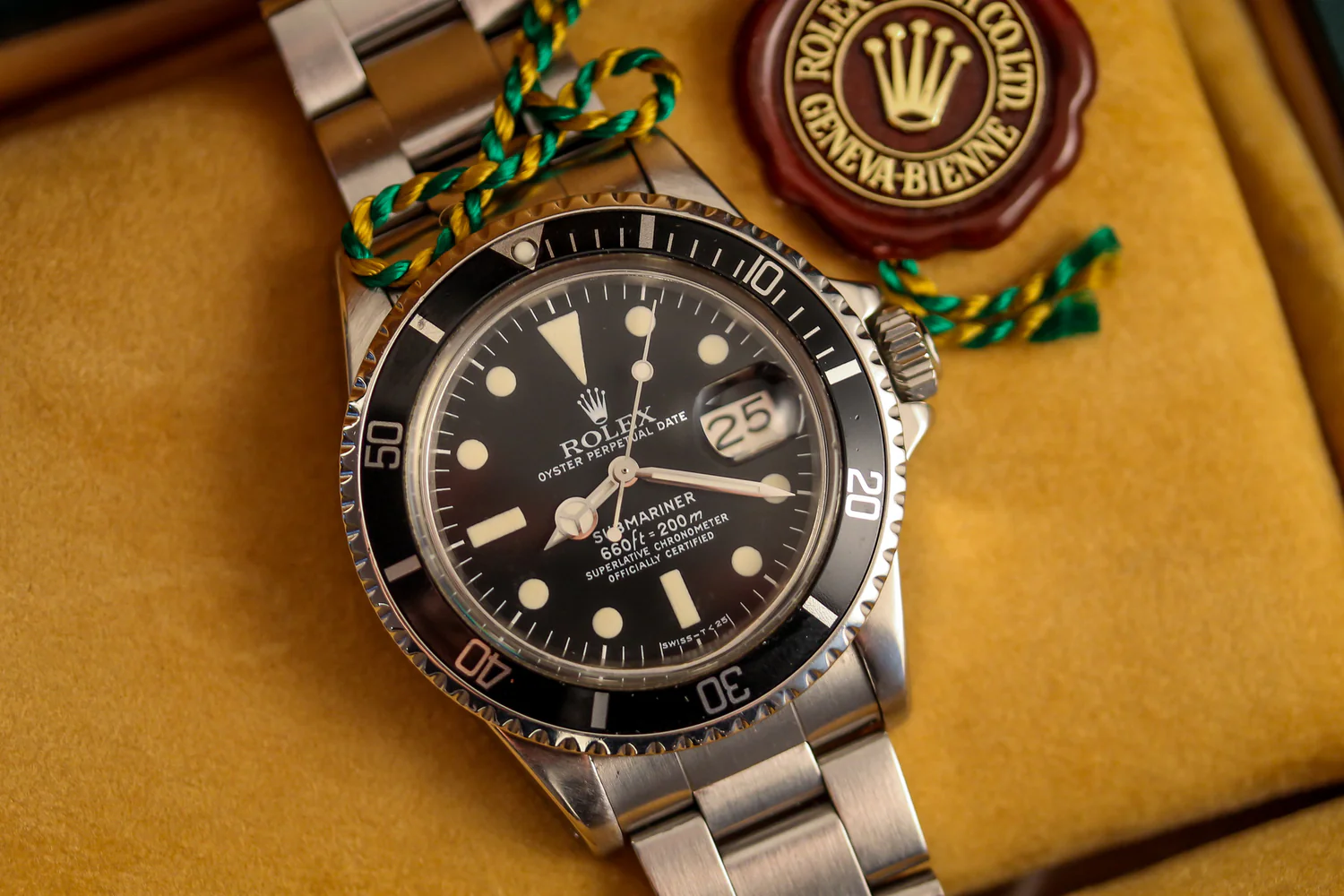
- The transition between the brushed top surface of the lugs and the polished sides of the case is a sharp, defined chamfer (bevel). On an over-polished case this chamfer becomes rounded or disappears into a continuous curved surface.
- Brushed surfaces should show perfectly parallel, fine grain lines from the factory satin finishing. Swirl marks, wavy reflection patterns, or inconsistent grain direction indicate amateur or excessive polishing.
- Serial and reference engravings between the lugs should be deep and sharp; light or partially obliterated numbers indicate lug faces have been buffed.
- Springbar holes in the lugs should be perfectly round with sharp, defined edges. An over-polished case shows these holes becoming oval and losing their sharp rim, sometimes to the point where springbars visibly protrude. This is considered by many experienced collectors to be the definitive “pass” criterion for an over-polished case.
- Crown guards should be symmetrical in height and thickness. Asymmetric guards indicate uneven polishing.
- Viewing the long flat side of the case (between the lugs, parallel to the bracelet) is the most reliable overall assessment: a factory-correct surface is geometrically flat; a polished case shows a subtle convex curvature.
Bezel authentication
The “Ghost” bezel refers to an aluminum insert that has faded from black to soft grey, blue-grey, or pale violet-grey through natural UV exposure over decades. Ghost bezels are highly desirable precisely because they cannot be manufactured: the authentic fade is the product of decades of real-world UV exposure. An authentic ghost bezel shows an even fade that is more advanced at the most UV-exposed portions and retains the characteristic “orange-peel” micro-texture on its surface. The reverse side of the aluminum insert ring should remain black.
The primary concern is artificial bleaching, where a standard black insert is chemically treated to simulate ghost fade. Tells include: unnaturally uniform fade without subtle gradients; absent or damaged orange-peel texture; and bleaching damage on the back of the insert ring where it should remain black.
Bracelet authentication
A clasp code that significantly predates or postdates the case serial is not automatically a problem; codes that are later (but still period-correct) can be explained by service replacement, which is common and acceptable. An “S” prefix on a clasp code indicates a Rolex service-replacement bracelet, genuine but not original to the watch.
Stretch assessment: The folded-link Ref. 9315 is particularly prone to stretch because the folded side links and small pivot pins wear down over decades. To assess, hold the bracelet horizontally and observe whether it droops or holds a straight profile. Also flex sideways: minimal lateral play indicates low stretch, while significant wobble indicates heavy wear. A heavily stretched bracelet can sometimes be refreshed by replacing pivot pins, but it will never return to original tightness.
Common frankenwatch configurations
Dial swaps for value inflation: The most financially significant configuration involves placing a genuine Red Sub dial into a White Sub case. Since Red Sub dials command premiums of $10,000-$30,000 or more over White Sub dials, the incentive is significant. The tell is that certain dial Marks were only produced during specific serial ranges, so a Mark I Meters First dial should correlate with a 2.0x-2.2x serial.
Service dials represented as original: White Sub service dials marked “SWISS” at 6 o’clock are genuine Rolex parts but not original to the watch and significantly impact value.
Tudor date wheels: Tudor date wheels use a distinctly different, rounder numeral font. The correct 1680 date wheel has a silver background with open 6s and 9s.
Aftermarket bezel inserts: High secondary-market value of period-correct inserts means aftermarket substitutes circulate widely, often with subtly incorrect font weights.
Movement swaps: A 1675 GMT-Master or 5513 movement (both Cal. 1575/1570 variants) can function in a 1680 case since the movement family is shared. Cross-referencing movement serial to case serial through published databases mitigates this risk.
Over-polished cases with original dials: A watch with a genuine original dial but heavily polished case presents a collector dilemma. The value of the dial is real; the case has been degraded. Case geometry inspection is the crucial due diligence step.
Market positioning and pricing
The Red Submariner premium structure
The Mark I Meters First (“Long F”) is the rarest dial, having been produced for only a few months in 1969 in a narrow serial range (approximately 2.07M to 2.2M). The combination of its very brief production window, the frequency with which early dials were replaced by Rolex during service, and the inherent fragility of 50-year-old matte lacquer means survival rates for truly original examples are low.
The Mark II and Mark III Meters First dials occupy the next tier and are the sole variants known to produce tropical brown coloration. A Mark II with a tropical brown dial in full-set condition sold for over $105,000 at auction in 2020.
The concept of “coherence,” where all components feel as if they have lived one life together rather than being assembled from multiple sources, commands the strongest premiums. Unpolished cases are perhaps the single largest differentiator at the premium end, adding 30-50% or more compared to an equally dialed example in a polished case.
Current market pricing
| Dial Variant | Condition Range | Approximate Market Price |
|---|---|---|
| White Sub (any Mark) | Good-Excellent | $10,000 – $18,000 |
| White Sub, Full Set w/ Box/Papers | Excellent | $22,000 – $25,000 |
| Red Sub Mark IV-VI (Feet First) | Good-Excellent | $17,000 – $45,000 |
| Red Sub Mark II/III Non-Tropical | Good-Excellent | $25,000 – $60,000 |
| Red Sub Mark II/III Tropical | Excellent, Full Original | $70,000 – $105,000+ |
| Red Sub Mark I (Long F, Meters First) | Good-Excellent, Original | $50,000 – $100,000+ |
| Any Mark, Full Set w/ Box/Papers | +20-40% above watch-only price |
Five-year price trend (2020-2025)
The 1680 market followed the broader vintage Rolex trajectory: steady pre-pandemic appreciation, sharp acceleration in 2020-2022, a correction in 2023, and stabilization with modest recovery through 2024-2025. At the peak in 2021-2022, a solid Mark IV that might have traded for $18,000 in 2019 briefly reached $35,000-$40,000. The 2023 correction brought those mid-tier examples back to the $22,000-$28,000 range. The top-tier Marks proved more resilient, with serious collector demand providing a floor that the broader market bubble had inflated only modestly by comparison. The fundamental scarcity of clean, unpolished, original-dial 1680s is structurally supportive of long-term value.
Rarity and survival rates
Within the total production universe, the survival rate for unpolished, original-dial, non-relumed examples is sharply lower than total production suggests. Rolex itself replaced faded or damaged dials for free during the 1970s and early 1980s, meaning many watches received new dials before they ever left the service network. The Meters First production window was very short, and Mark I production lasted only months, reducing its potential survival universe to a few hundred truly original examples in any condition.
For the Red Sub family overall, original dials are present on perhaps 30-50% of currently circulating examples by conservative collector estimates; the balance have service dials, replaced lume, or subtle dial work. For the White Sub, original dials are more common but service dials are still prevalent given that Rolex continued the 1680 service program deep into the 1990s.
Wearability and collector standing
Case size and modern wearability
The 40mm case, 47.5mm lug-to-lug, and approximately 13.5mm thickness (plus acrylic dome) are fully in line with modern sports watch norms. The case sits compactly on the wrist, and the curved case and drilled lugs help the watch wear smaller than the diameter would suggest, keeping it practical on wrists from around 6.5 inches upward. The 1680 will appeal both to vintage purists and to modern watch wearers stepping back into historical references. It has more wrist presence than a 5513 but remains more svelte than many current 44mm chronographs.
Durability and practical considerations
- Case: Solid steel with robust screw-in back. Crown guards help shield the crown from direct knocks.
- Water resistance: Originally 200 meters on paper, but any unserviced vintage example should be treated as not water-resistant. Gaskets age, pusher tubes loosen, and corrosion around the crown tube is not uncommon in neglected pieces.
- Crystal: Hesalite scratches easily but fine scratches polish out with PolyWatch. Less likely to shatter than sapphire in an impact.
- Bezel: Aluminum can chip and fade. Heavy desk wear will gradually add marks.
- Bracelet: Vintage folded-link bracelets stretch. Many collectors fit modern bracelets or high-quality straps for daily wear and keep originals aside.
In practice, a freshly serviced 1680 is perfectly usable as an “often worn” watch if treated with reasonable care and kept away from water.
Collector sentiment
Within the collector community, the 1680 sits alongside the Double Red Sea-Dweller 1665, the 6239 Paul Newman Daytona, and the bakelite bezel GMT-Master 6542 as references where the collector conversation is dense, the variants are numerous, the condition premiums are dramatic, and access to truly original examples is increasingly constrained.
Entry-level Submariner collectors often aspire to own “a Red Sub” and the 1680 is one of the main targets once they move beyond the 5513. Seasoned enthusiasts treat the 1680 as a destination reference that tends to anchor their Rolex collection for the long term. Sentiment has shifted from “good-value vintage Rolex” to “blue-chip tool watch” over the past decade, and that change is unlikely to reverse so long as interest in vintage sport Rolex remains strong.
The succession: reference 16800
The reference 16800, introduced in approximately 1979, replaced the 1680 and introduced several material and technical upgrades that define the line between vintage and modern Submariner aesthetics:
- Crystal: Synthetic sapphire replaced acrylic, eliminating the warm dome and period-correct scratch patina that collectors prize on the 1680
- Bezel: Unidirectional, ratcheting click mechanism replaced the bidirectional friction bezel, improving dive safety
- Movement: Cal. 3035 replaced the 1575, operating at 28,800 vph and introducing the quickset date function
- Water resistance: Upgraded from 200m to 300m
Early 16800 examples retained matte black dials with painted tritium hour markers, giving them a visual continuity with the 1680 that many collectors value as the “transitional” aesthetic. Later 16800 production shifted to glossy dials with applied white gold surrounds, establishing the modern Submariner look. The reference 168000, produced in an extremely limited window from approximately 1987 to 1988, carried the additional distinction of being the first Submariner in 904L stainless steel.