

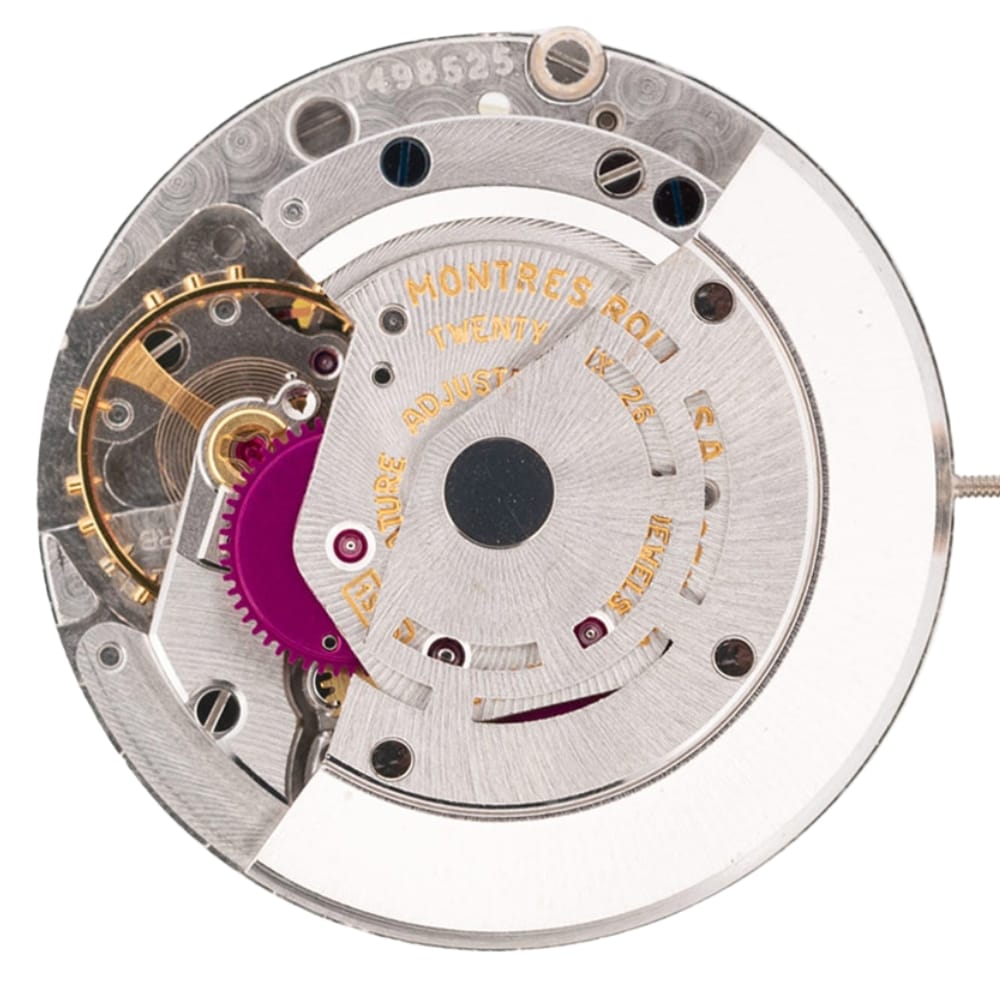
The Rolex 1575 stands as one of the most significant automatic movements in horological history, not for revolutionary innovations but for bulletproof reliability in an era when Rolex cemented its reputation as the maker of indestructible tool watches. Introduced in 1965, the 1575 powered some of the most iconic Rolex references ever produced, including the GMT-Master 1675, the first Submariner Date 1680, the Explorer II 1655, and the original Sea-Dweller 1665. When watchmakers today describe a movement as “built like a tank,” they are thinking of calibers like the 1575.
The 1575 represents the maturation of Rolex’s first generation of fully in-house automatic movements, the 1500 series. Based on the caliber 1570 architecture, the 1575 added a date complication through a modular calendar mechanism that snapped over at exactly midnight using a cam, spring, and jewel system. This instantaneous date change was a significant improvement over slow-transitioning calendar mechanisms common in the 1960s. The movement beat at 19,800 vph, a meaningful increase over its predecessor’s 18,000 vph, delivering smoother seconds hand motion and improved chronometric performance. Starting around 1971-1972, Rolex added a hacking feature that stopped the seconds hand when the crown was pulled, allowing precise time synchronization.

Scarcity and Production
The caliber 1575 was produced in extremely high numbers during its 16-year production run from 1965 to 1981. Total production likely exceeded several hundred thousand units, though Rolex has never confirmed exact figures. The movement powered multiple reference families across stainless steel, two-tone, and solid gold variants. The GMT-Master 1675 alone remained in production for 21 years (1959-1980), with the 1575 serving as its primary movement from 1965 onward. When accounting for Datejust, Submariner Date, Explorer II, and Sea-Dweller production, the 1575 becomes one of Rolex’s most prolific calibers of the 1960s and 1970s.
Serial number ranges provide approximate production dating: watches from 1965 start around serial 1,100,000, while production ended around 1981 between serials 6,520,870 and 7,100,000. The caliber is common, not scarce. Well-maintained examples remain widely available through the vintage market, though condition varies dramatically based on service history. Rarity stems not from the movement itself but from specific dial variants, case configurations, or provenance of the host watch.
Collector Standing
The caliber 1575 occupies a paradoxical position in the collector market. As a movement, it commands no premium whatsoever; collectors buy vintage Rolex tool watches for their cases, dials, bezels, and hands, not their movements. A properly serviced 1575 is expected, not celebrated. However, the movement’s reputation for durability and serviceability makes it a significant factor in purchase decisions. Collectors prefer watches with original, unmodified 1575 movements that show evidence of proper maintenance rather than Franken-watches with mismatched parts or movements that have been butchered by incompetent watchmakers.
Demand for watches powered by the 1575 continues to rise, particularly for GMT-Master 1675 “Pepsi” bezels, Submariner 1680 “Red Subs,” and Explorer II 1655 “Freccione” references. These watches command strong prices not because of their movements but despite them, the 1575 serving as the reliable mechanical foundation collectors take for granted. One notable exception: the Marlon Brando GMT-Master 1675, engraved with his name and worn in Apocalypse Now, sold for $5.37 million in 2019, making it the most expensive GMT-Master ever sold. The movement inside was a standard 1575, illustrating that provenance, not mechanical complexity, drives stratospheric auction results.
Historical Context, Provenance, and Manufacturing Details
Development History
The caliber 1575 emerged from Rolex’s push to modernize its automatic movement family in the mid-1960s. By 1965, the company had identified several areas where its first-generation 1560 series movements needed improvement: beat rate, power reserve, and instantaneous date functionality. The 1575 addressed all three. Rolex increased the frequency from 18,000 vph to 19,800 vph, delivering smoother seconds hand motion and improved chronometric stability. Power reserve grew from 44 hours to 48 hours, providing an additional half-day of runtime when off the wrist. The date mechanism transitioned to an instantaneous jump system that changed precisely at midnight rather than gradually over several hours.
The technical challenge Rolex solved was not revolutionary engineering but execution at scale. Swiss watchmakers understood the principles of higher-beat movements and instantaneous date mechanisms, but producing these features reliably across tens of thousands of units annually required exceptional manufacturing precision and quality control. Rolex succeeded where others struggled, establishing a reputation for movements that simply worked, year after year, with minimal intervention.
Predecessor and Successor
The caliber 1575 evolved directly from the caliber 1560, which Rolex introduced in 1959. The 1560 established the architectural DNA for the entire 1500 series: free-sprung balance with Microstella regulation, Breguet overcoil hairspring, KIF shock protection, and a center-mounted rotor. The 1575 retained this architecture while adding the date module and increasing the beat rate. Interestingly, Rolex often stamped the automatic winding bridge with “1570” even on 1575 movements because both calibers shared the same bridge. The 1570 designation technically refers to the non-date variant, while 1575 indicates the date version, but Rolex’s modular manufacturing approach meant components were interchangeable across the family.
The caliber 1575 was eventually replaced by the caliber 3035, introduced in 1977. The 3035 represented a significant leap: beat rate increased to 28,800 vph, the movement gained a quickset date function, and jewel count rose to 27. The quickset date proved particularly valuable, allowing users to adjust the date independently without cycling the hands through 24 hours. The 3035 powered the transitional generation of Rolex tool watches from the late 1970s through the late 1980s before giving way to the 3135 in 1988.
Manufacturing Context
The caliber 1575 is a fully in-house Rolex manufacture movement, designed, produced, and assembled at Rolex facilities in Switzerland. This marked a significant shift from Rolex’s earlier history, when the company sourced movements from Aegler, a specialist manufacturer. By the mid-1950s, Rolex had brought movement production in-house, giving the company complete control over quality, tolerances, and production scheduling.
The 1575 was manufactured at Rolex’s Bienne facility, the company’s primary movement production center. Production involved hundreds of individual operations: cutting gear teeth, jeweling pivot holes, assembling the balance and hairspring, testing chronometric performance, and regulating finished movements to COSC chronometer standards. Every movement received a serial number stamped on the movement plate, allowing Rolex to track production batches and service history. When serviced by Rolex service centers decades later, watchmakers regularly achieve timing results of +2 seconds per day or better, a testament to the movement’s fundamental design quality.
Horological Context
The caliber 1575 arrived during a transformative period in watchmaking. The 1960s saw the rise of higher-beat movements (28,800 vph and above), improved shock protection systems, and increasingly sophisticated calendar mechanisms. Rolex’s approach with the 1575 was characteristically conservative: adopt proven technologies, execute them flawlessly, and prioritize reliability over novelty. While competitors pursued exotic complications and ultra-thin dress movements, Rolex focused on making movements that could survive decades of daily wear in challenging environments.
The 1575 was not groundbreaking. It was a workhorse, a transitional design that carried Rolex through a critical period of brand building. Watches powered by the 1575 accompanied pilots, divers, explorers, and military personnel throughout the 1960s and 1970s, establishing Rolex’s reputation not through advertising claims but through actual field performance. When collectors today discuss the “golden age” of Rolex tool watches, they are describing an era when the 1575 was the mechanical heart of the lineup.
Construction and Architecture

Plate and Bridge Layout
The caliber 1575 employs a traditional three-quarter plate construction common to mid-century Swiss automatic movements. The main plate, manufactured from nickel-plated brass, provides structural rigidity and mounting points for all movement components. The barrel bridge covers the mainspring barrel independently, allowing watchmakers to service the power source without complete disassembly. A unified train wheel bridge secures all gear train wheels (center, third, fourth, and escape wheels) under one component, simplifying assembly and improving positional stability during timing adjustments.
The automatic winding mechanism sits beneath a separate automatic bridge, often stamped “1570” even on 1575 movements due to Rolex’s modular manufacturing approach. This bridge houses the oscillating weight bearings and reversing wheel system. The balance cock, an independent component, secures the balance assembly and provides mounting for the stud holder that anchors the outer terminal of the hairspring. Finishing quality follows Rolex’s functional philosophy: perlage (circular graining) on the main plate, moderate Geneva stripes on bridges, and chamfered edges on higher-grade examples. The movement was never intended to win aesthetic awards but to function reliably under stress.
Balance Wheel
The caliber 1575 employs a free-sprung balance with Microstella regulating screws, one of Rolex’s signature technical features. The balance wheel itself is a two-arm design manufactured from Glucydur, a beryllium-copper alloy chosen for its thermal stability and antimagnetic properties. Four gold-colored Microstella screws thread into the balance rim at cardinal points, each screw featuring a distinctive star-shaped head that gives the system its name.
Timing adjustment occurs by rotating these screws inward (to speed up the watch) or outward (to slow it down). Each screw’s position changes the balance wheel’s moment of inertia, altering oscillation frequency without touching the hairspring. This approach eliminates the traditional index regulator, a component notorious for shifting position after shocks and causing timing drift. Rolex developed a specialized Microstella wrench with a graduated scale indicating timing change per screw turn, one second per day for low-head screws and two seconds per day for high-head screws.
The balance wheel diameter and mass are calibrated to deliver a 52-degree lift angle at the escapement. The assembly is laser-poised during manufacturing to ensure perfect equilibrium, though earlier 1575 movements used screw-based poising where watchmakers adjusted tiny timing screws to balance the wheel. The absence of a traditional regulator means the 1575 requires more skill to regulate than pin-lever systems, but once properly adjusted, it maintains stable performance across positions and over time.
Balance Spring (Hairspring)
The 1575 uses a Nivarox alloy hairspring with a Breguet overcoil terminal curve. Nivarox, a proprietary alloy of iron, nickel, chromium, titanium, and beryllium, became the Swiss industry standard for balance springs due to its excellent elasticity, temperature compensation, and resistance to magnetic fields. The Breguet overcoil, where the outer coil rises above the plane of the spring and curves inward toward the center, ensures concentric breathing of the hairspring during oscillation. This concentricity prevents the spring from shifting its center of gravity laterally, improving isochronism (consistent rate regardless of amplitude).
The hairspring attaches at its inner terminal to a collet pressed onto the balance staff, while the outer terminal connects to a stud screwed into the balance cock. On properly serviced examples, the hairspring should beat concentrically without touching adjacent coils or the anti-shock cap jewel. The spring’s length and characteristics are carefully matched to the balance wheel’s inertia to achieve the design frequency of 19,800 vph. Balance assemblies for the 1575, including the hairspring, are available as complete units (part 8106) for replacement during service.
Escapement Type
The caliber 1575 employs a classic Swiss lever escapement, the most common escapement architecture in mechanical watchmaking. This design uses a lever (pallet fork) with two synthetic ruby pallet stones that alternately engage and release the escape wheel’s teeth, converting the escape wheel’s rotational energy into discrete impulses that maintain the balance wheel’s oscillation.
What distinguishes the 1575’s escapement is Rolex’s decision to add shock protection to both sides of the escape wheel pivots, a feature rarely seen in production movements. The escape wheel’s pivots are fine and vulnerable to damage from impacts, and while most manufacturers protected only the balance wheel, Rolex extended protection to the escape wheel as well. This design choice reflects the company’s tool watch philosophy: every vulnerable component receives protection because field reliability matters more than manufacturing cost. Both upper and lower escape wheel jewels sit in KIF shock-protected settings, allowing the pivots to deflect under impact and return to center without damage.
The escapement jeweling includes the two pallet stones, the escape wheel itself, and the balance impulse jewel. These jewels are manufactured from synthetic corundum (ruby) and precision-ground to exact angles. During service, watchmakers verify that the pallet stones engage the escape wheel teeth at proper depth and that the impulse jewel enters and exits the pallet fork notch cleanly without excessive friction.
Shock Protection System
The caliber 1575 uses KIF Parechoc shock protection for the balance wheel pivots and escape wheel pivots. KIF (Kif Parechoc SA, founded 1944) manufactured shock absorbers that became Rolex’s preferred system, reportedly because using “Incabloc” (a competitor’s brand) would have required printing the Incabloc name on the dial, diluting Rolex’s branding.
The KIF system works identically to Incabloc in principle: a spring-loaded jewel assembly allows the balance staff’s pivot to deflect upward under shock, then return to center as the spring resets. The balance staff’s pivot runs in a cap jewel (above) and a hole jewel (below), with a tiny oil reservoir between them maintained by surface tension. When the watch experiences a sharp impact, the pivot tip moves vertically against the cap jewel and springs back, preventing the pivot from snapping or bending.
The 1575 features KIF shock protection on both the upper and lower balance jewels (dial side and movement side) as well as on both sides of the escape wheel. This comprehensive protection scheme ensures that the two most vulnerable components in the movement can survive the shocks and impacts typical of daily wear. The shock protection units are replaceable, with specific part numbers for KIF blocks and springs available from specialized suppliers.
Regulator Type
The caliber 1575 uses a free-sprung balance with no traditional regulator. This design philosophy eliminates the index regulator (regulating pins that adjust the effective length of the hairspring) in favor of adjusting the balance wheel’s inertia directly through the Microstella screws. Free-sprung balances offer significant advantages: they are less susceptible to timing shifts from shocks, they maintain rate stability across positions more effectively, and they eliminate one potential point of failure (the regulator moving accidentally).
The trade-off is complexity during regulation. Adjusting a traditional regulator requires moving a lever; adjusting Microstella screws requires calculating which screws to turn, in which direction, and by how many degrees to achieve a target timing change. Rolex developed specialized tools and training procedures to ensure watchmakers could reliably regulate free-sprung movements to chronometer standards. The caliber 1575’s balance cock has no regulator arm or index pins, only a stud holder that anchors the hairspring’s outer terminal.
Fine adjustment is possible through subtle repositioning of the Microstella screws, while gross adjustment (for example, after replacing a hairspring) may require adding or removing mass from the balance wheel’s rim or adjusting the timing screws. The free-sprung system means properly regulated 1575 movements hold their rate exceptionally well over years of service, explaining why well-maintained examples still achieve chronometer-grade timekeeping 50+ years after manufacture.
Mainspring Material and Type
The caliber 1575 uses a white alloy mainspring measuring 1.30mm height × 0.120mm thickness × 460mm length, housed in an 11.0mm diameter barrel. The mainspring is an auto-wind type with a slipping bridle that allows the spring to slip when fully wound, preventing overwinding damage during continuous automatic winding. The spring material is a specialized steel alloy engineered for consistent torque delivery across the winding range, from fully wound to nearly unwound.
Mainsprings are consumable components that lose elasticity over time, typically requiring replacement during full service (recommended every 10 years for vintage movements). Generic Swiss-made mainsprings for the 1575 are widely available from suppliers like Generale Ressorts, one of the world’s largest mainspring manufacturers. The mainspring fits the same barrel used across the 1530 family (calibers 1530, 1560, 1570, 1575, 1580), allowing for interchangeability.
When installing a new mainspring, watchmakers use a specialized mainspring winder (part specific to Rolex 1530 family) to compress the spring into the barrel without kinking or damaging the metal. Proper lubrication of the mainspring is critical: the spring’s outer surface must be lubricated where it contacts the barrel wall, and the arbor (barrel shaft) must be lubricated to reduce friction during unwinding. A properly serviced mainspring should deliver smooth, consistent power across the full 48-hour power reserve.
Gear Train Details
The caliber 1575 uses a traditional four-wheel gear train (center wheel, third wheel, fourth wheel, escape wheel) arranged in a conventional Swiss layout. The center wheel drives the minute hand and rotates once per hour. It meshes with the third wheel, which rotates significantly faster and transmits power to the fourth wheel. The fourth wheel drives the seconds hand (mounted on the fourth wheel pinion) and rotates once per minute. Finally, the fourth wheel drives the escape wheel, which oscillates at 19,800 vph under control of the escapement and balance assembly.
All wheels are manufactured from brass with polished steel pinions. Jeweling is comprehensive: the center wheel arbor runs in a jeweled bearing in the main plate (no upper jewel, as the wheel is supported by the calendar mechanism on the dial side), the third wheel has jewels top and bottom, the fourth wheel has jewels top and bottom, and the escape wheel has shock-protected jewels on both sides. This 26-jewel count represents functional jeweling where jewels reduce friction at high-speed pivots, not decorative jeweling added to inflate the jewel count.
The seconds hand mounts directly to the fourth wheel pinion, making it a direct-drive center seconds configuration. This arrangement is simpler and more reliable than small seconds or indirect seconds designs but requires the center of the dial to accommodate the seconds arbor. The gear ratios are calculated to deliver exactly 19,800 beats per hour from the escape wheel’s rotation rate, with each beat representing one tick of the balance wheel.
Finishing Quality and Techniques
The caliber 1575 receives utilitarian finishing appropriate to a tool watch movement. Functionality and serviceability took priority over aesthetics. The main plate features perlage (circular graining), a decorative pattern applied with a rotating abrasive tool that creates overlapping circles across the plate surface. This finish serves both aesthetic and practical purposes: the matte surface hides minor scratches that accumulate during service, and it helps reveal dust or debris during inspection.
The bridges show light Geneva striping (Côtes de Genève), parallel lines applied with a reciprocating abrasive pad. The stripes are not particularly fine or deeply executed compared to haute horlogerie standards but provide a pleasant visual texture. Edges on some components show beveling (anglage), where sharp corners are broken with a 45-degree chamfer, though this is limited to visible areas like the balance cock and automatic bridge.
Screw heads receive polishing on higher-grade examples, though many 1575 movements show unpolished or lightly brushed screws. The level of finishing varied somewhat depending on the destination watch: movements intended for precious metal cases sometimes received slightly better finishing than those destined for stainless steel tool watches, though the mechanical specification remained identical.
There were no multiple “grade” levels for the 1575 in the traditional Swiss sense (base grade, adjusted, chronometer, observatory chronometer). All 1575 movements received COSC chronometer certification, meaning they were tested in multiple positions and temperatures to meet chronometer standards of -4/+6 seconds per day. The movement finishing reflects Rolex’s philosophy that a watch’s beauty lies in what it does, not how it looks when you open the case back.
Cross-Reference Data
Alternative Caliber Names and Rebranded Versions
The caliber 1575 was produced exclusively by Rolex for Rolex watches. Unlike many Swiss calibers of the era, which were sold as ébauches (base movements) to multiple watch brands, the 1575 never appeared under alternative designations or in non-Rolex watches. Rolex’s vertical integration meant the company retained complete control over movement production and distribution.
One important marking anomaly collectors should understand: the automatic winding bridge on 1575 movements is frequently stamped “1570,” causing confusion. This is not incorrect or evidence of a mismatched movement. Rolex used the same bridge component across multiple calibers in the 1530 family. The “1570” designation technically refers to the non-date variant, while “1575” indicates the date version, but because both movements share identical automatic winding mechanisms, Rolex manufactured one bridge design stamped “1570” and used it across both calibers. The presence of a date wheel and calendar mechanism confirms the movement is a 1575, regardless of the bridge stamping.
Base Caliber vs. Elaborated Versions
| Variant | Differences | Jewels | Key Functions |
|---|---|---|---|
| Cal. 1570 | Non-date base caliber | 26 | Hours, minutes, center seconds |
| Cal. 1575 | Date version with calendar module | 26 | Hours, minutes, center seconds, instantaneous date |
| Cal. 1575 GMT | GMT complication added | 26 | Hours, minutes, center seconds, date, 24-hour GMT hand |
The caliber 1570 served as the architectural foundation for the 1575. The movements share identical dimensions (28.2mm diameter, though the 1575 is slightly taller at 6.3mm due to the calendar mechanism), the same free-sprung balance system, identical gear trains, and the same automatic winding mechanism. The critical difference is the addition of a date display at 3 o’clock, driven by a modular calendar mechanism that sits between the main movement and the dial.
The caliber 1575 GMT represents a further elaboration, adding a 24-hour hand complication. This variant includes an additional wheel (the 24-hour wheel) that rotates once every 24 hours rather than 12 hours, driving a fourth hand that makes one complete rotation per day. The GMT complication allowed pilots and international travelers to track a second time zone, making it essential equipment for Pan Am pilots who commissioned the original GMT-Master. The 1575 GMT powers the GMT-Master 1675 and Explorer II 1655, though interestingly, the Explorer II 1655 used the GMT hand as a 24-hour indicator for day/night orientation rather than a true second time zone.
All variants underwent COSC chronometer certification, meaning timing performance met identical standards across the family. Hacking seconds (the ability to stop the seconds hand by pulling the crown to position 3) was added to all three variants around 1971-1972.
Compatible Case References by Brand
| Brand | Reference | Production Years | Notes |
|---|---|---|---|
| Rolex GMT-Master | 1675 | 1965-1980 | Most common reference, stainless steel, “Pepsi” or all-black bezel |
| Rolex GMT-Master | 1675/3 | 1965-1980 | Two-tone (Rolesor) steel and yellow gold |
| Rolex GMT-Master | 1675/8 | 1965-1980 | Solid 18k yellow gold, “Nipple dial” markers |
| Rolex Datejust | 1601 | 1965-1981 | Stainless steel with fluted gold bezel, various dial colors |
| Rolex Datejust | 1600 | 1960-1977 | Stainless steel with smooth bezel |
| Rolex Datejust | 1603 | 1960-1978 | Stainless steel with engine-turned bezel |
| Rolex Explorer II | 1655 | 1971-1984 | 39mm steel case, fixed 24-hour bezel, orange GMT hand (“Freccione”) |
| Rolex Submariner Date | 1680 | 1967-1980 | 40mm steel case, black dial and bezel, first Submariner with date |
| Rolex Submariner Date | 1680/8 | 1969-1980 | 18k yellow gold with blue dial and bezel |
| Rolex Sea-Dweller | 1665 | 1967-1977 | Double Red dial text, 2000ft rating, no cyclops |
| Rolex Sea-Dweller | 1665 (Great White) | 1977-1983 | White dial text only, 2000ft rating, transitional model |
The caliber 1575 achieved remarkable versatility, powering professional dive watches rated to 2,000 feet, pilot’s watches designed for dual time zones, and elegant Datejust dress watches. Case sizes ranged from 36mm (Datejust) to 40mm (GMT-Master, Submariner, Sea-Dweller), with the Explorer II measuring 39mm. All references used Rolex Oyster cases with screw-down crowns and case backs, ensuring water resistance appropriate to each model’s intended use.
Dial Compatibility Note
Dial foot positions remained consistent across the 1575 family, but date window location varied by reference. Datejust and GMT-Master references place the date window at 3 o’clock, requiring dials cut to accommodate the cyclops magnification lens. The Submariner 1680 and Sea-Dweller 1665 also position the date at 3 o’clock, but only the Submariner 1680 uses a cyclops lens; the Sea-Dweller omits it for dial legibility under pressure.
The Explorer II 1655 uses a 1575 GMT movement but with a unique dial configuration. The 24-hour hand (orange on early examples, red on later versions) serves as a day/night indicator rather than a second time zone, and the fixed bezel (not rotatable) is marked with 24-hour graduations. Dials are not interchangeable between the Explorer II and GMT-Master despite both using 1575 GMT movements due to different dial foot positions and hand stack configurations.
Collectors restoring vintage Rolex watches must verify that dial, hands, and movement are correctly matched. Franken-watches with incorrect date wheel positions, mismatched hand stacks, or wrong dial feet damage both value and authenticity. Original dials command significant premiums, particularly gilt dials from early production (1965-1967) and rare color variants.
Crown and Stem Specifications
| Component | Specification | Part Number | Notes |
|---|---|---|---|
| Winding Stem | Thread: 0.90mm (TAP 8), Height: 1.8mm | 7869 | Standard stem for all 1530 family calibers |
| Winding Stem (Variant) | Thread: 1.10mm | 7869-1 | Alternate thread diameter variant |
| Crown Thread | Tap 10 (0.90mm) | N/A | Matches stem thread diameter |
| Setting Mechanism | Yoke clutch | N/A | Keyless works use yoke for positive engagement |
The winding stem (part 7869) is a critical component that couples the crown to the movement’s keyless works. The stem diameter is 0.90mm with a TAP 8 thread, and the stem height (distance from movement top plate to stem centerline) measures 1.8mm. This stem height is critical when considering movement swaps or case compatibility; movements with significantly different stem heights will misalign with the crown tube, preventing proper seating.
Generic aftermarket stems are widely available and generally reliable for the 1575. However, watchmakers servicing high-value vintage Rolex watches often prefer genuine Rolex stems when available, as thread tolerances and material hardness can vary on generic parts. The stem must thread smoothly into the crown without play or binding, and the keyless works must engage positively at all three positions: position 0 (crown pushed in and screwed down for water resistance), position 1 (pulled one click for date adjustment, though the 1575 lacks quickset date, so this position has no function), position 2 (pulled to outermost position for time setting, which also activates hacking to stop the seconds hand).
Identification Marks
Caliber Number Location
The caliber designation appears stamped on the automatic winding bridge, though as noted previously, this marking frequently reads “1570” rather than “1575” due to Rolex’s use of shared bridge components. The presence of a date wheel and calendar mechanism visible from the dial side confirms the movement is a 1575 regardless of bridge engraving. The main movement plate may also show production codes or batch numbers, though these are less useful for caliber identification than observing the date complication’s presence.
Logo and Brand Marks
Rolex movements from this era feature minimal branding compared to modern calibers. The rotor (oscillating weight) typically shows the Rolex coronet logo with “ROLEX” text, along with “SWISS” or “SWISS MADE” to indicate country of origin. The balance cock may show chronometer certification marks, though this varied by production era. Some movements show “MONTRES ROLEX S.A.” engraved on the main plate or bridges, confirming manufacture by Rolex SA.
Quality stamps and Swiss hallmarks appear on precious metal components in gold or two-tone references, but stainless steel movements show minimal additional marking. The movement serial number appears stamped between the lugs on the case (not on the movement itself in this era), allowing dating via Rolex serial number charts.
Date Codes
The caliber 1575 era predates Rolex’s modern alphanumeric date code system. Serial numbers stamped between the case lugs at 6 o’clock provide approximate production year dating. Serial ranges progressed roughly sequentially:
- 1965-1967: 1,100,000-5,999,999
- 1968-1970: 2,000,000-6,999,999
- 1971-1973: 2,500,000-7,999,999
- 1974-1976: 3,500,000-8,999,999
- 1977-1980: 5,000,000-9,000,000+
- 1981: 6,500,000-7,100,000
Overlap exists in these ranges because Rolex did not assign serials in strict numerical order; different production batches and references received serial numbers from different ranges simultaneously. Case backs on earlier examples (pre-1972) sometimes show production quarter codes stamped inside, providing more precise dating.
Finishing Marks
Authentic caliber 1575 movements show perlage (circular graining) on the main plate, light Geneva striping on bridges, and moderate edge beveling on visible components. The finishing quality is consistent but not exceptional, appropriate for a tool watch movement prioritizing function over form. Comparison with known authentic examples is the best method for verification, as counterfeiters often apply heavy, crude finishing that looks impressive to untrained eyes but differs from Rolex’s restrained approach.
The rotor shows a distinctive pattern: radial brushing from center to rim, creating a sunburst effect. This finishing is consistent across genuine Rolex rotors from this era. The rotor should also show proper weight distribution with smooth, friction-free rotation when the movement is removed from the case.
Jewel Markings
Jewels in the caliber 1575 are press-fit into the main plate and bridges rather than mounted in gold chatons (decorative jewel settings). This is typical of mid-grade Swiss movements where functionality takes priority over aesthetic presentation. The jewels themselves are synthetic corundum (ruby), ground to precise diameters and oil-retention characteristics. Under magnification, authentic jewels show consistent color (deep red for rubies) and clean, sharp edges without chips or cracks.
The shock protection jewels (balance and escape wheel) sit in KIF shock absorber settings, identifiable by the spring-loaded mounting that allows vertical deflection. These settings are gold-colored (brass or bronze alloy) and show the characteristic KIF shape, distinct from the Incabloc system’s design. Generic replacement jewels are available for service, though watchmakers working on high-value collectibles prefer using genuine Rolex jewels when possible.
Adjustment Markings
All caliber 1575 movements received COSC chronometer certification during original production. However, adjustment markings indicating positions tested or timing results are minimal or absent on many examples. Unlike older pocket watch movements that proudly displayed “Adjusted to 5 Positions” or “Adjusted to Temperature,” Rolex’s approach was to certify performance without elaborate dial or movement engravings advertising the fact.
The dial text “SUPERLATIVE CHRONOMETER OFFICIALLY CERTIFIED” or “OFFICIALLY CERTIFIED CHRONOMETER” indicates the movement met COSC standards. Movements serviced by Rolex service centers after original production may show service timing results on paperwork but rarely receive additional engravings on the movement itself.
Correct Serial Number Formats and Locations
Serial numbers appear stamped on the watch case, not the movement. Prior to the late 1980s, Rolex stamped the serial number between the lugs at 6 o’clock (requiring bracelet removal to view), while the reference number appears between the lugs at 12 o’clock. Serial numbers from the 1575 era are 6-7 digit numerals without letters, progressing sequentially from approximately 1,100,000 (1965) to 7,100,000 (1981).
Authentic serial numbers show consistent depth, sharp edges, and proper font characteristics for the era. Forged or re-stamped serial numbers often show irregular depth, incorrect fonts, or misalignment. The serial should match the approximate production year based on documented ranges, though some variation is normal due to Rolex’s non-sequential numbering practices.
Expected Engravings and Stampings
Legitimate caliber 1575 movements show the following engravings:
- Automatic bridge: “1570” or occasionally “1575” (due to shared bridge components)
- Main plate: “SWISS” or “SWISS MADE” and potentially batch codes
- Rotor: Rolex coronet logo with “ROLEX” text, “SWISS” designation
- Balance cock: Sometimes shows “ROLEX” or chronometer certification marks
- Case: Serial number at 6 o’clock, reference number at 12 o’clock (between lugs)
Engravings should show consistent depth and style appropriate to industrial stamping methods used in the 1960s-1970s. Modern laser engraving (introduced much later) would be inappropriate and indicate replacement parts or fraudulent modification. The metal surrounding engravings should not show polishing or rework, which often indicates an attempt to remove or alter original markings.
Font and Marking Style by Production Era
Rolex maintained relatively consistent engraving styles throughout the 1575 production run (1965-1981), though subtle variations occurred. Early production movements (mid-1960s) sometimes show slightly different font weights or serifs compared to later examples (late 1970s), but these differences are minor. What matters more for authentication is that the font style is correct for Rolex’s industrial stamping equipment of that era.
Dial printing evolved more noticeably than movement engravings. Early GMT-Master 1675 watches featured gilt (gold-colored) dial printing until approximately 1966-1967, when Rolex transitioned to matte dials with white printing. Submariner 1680 “Red Sub” dials (1967-1975) featured red “SUBMARINER” text before transitioning to all-white text around 1975. These dial variations provide more precise dating than movement engravings and are heavily scrutinized by collectors.
Part Information

Movement Parts with Part Numbers
Sourcing Notes
Still Available:
- Mainsprings: Widely available from Swiss manufacturers like Generale Ressorts; generic parts perform well
- Balance complete: Available from specialized suppliers, both genuine Rolex NOS (new old stock) and quality generic versions
- Common wear items (gaskets, stems, crown wheels): Generic aftermarket parts readily available
Commonly Fail:
- Mainspring: Loses elasticity over time; should be replaced at every full service (10-year intervals)
- Calendar mechanism springs: The date jumper spring and yoke spring weaken over decades, causing slow date changes or date mechanism failure
- Reversing wheels: The automatic winding system’s reversing wheels (Teflon-coated in many examples) show wear on their teeth and require periodic replacement
Acceptable Generic Replacements:
- Winding stems: Generic Swiss stems with correct threading work reliably
- Mainsprings: Swiss-made generic mainsprings deliver equivalent performance to original Rolex springs
- Jewels: Generic synthetic corundum jewels with correct dimensions function identically to original jewels
- Gaskets and seals: Modern silicone gaskets often outperform original cork or rubber gaskets
Parts Requiring Genuine Rolex Components:
- Rotor (oscillating weight): Weight, dimensions, and bearing fit are critical; generic rotors often cause winding efficiency issues
- Balance wheel (if replacing entire assembly): Timing and poising require genuine Rolex specifications
- Dial and hands: Aftermarket dials and hands destroy collectibility and authenticity; only genuine Rolex parts acceptable for restoration
Sourcing Challenges:
Genuine Rolex parts for the caliber 1575 become increasingly scarce as NOS inventory depletes. Rolex prioritizes current-production calibers for parts manufacturing, leaving older movements dependent on remaining factory stock. Watchmakers often source components from donor movements (parts calibers) when genuine Rolex parts are unavailable or prohibitively expensive. For high-value watches where originality matters, collectors may wait months or years for correct parts rather than compromise with generic replacements.
Performance Data
Manufacturer Specifications
The caliber 1575 received COSC (Contrôle Officiel Suisse des Chronomètres) chronometer certification as standard. COSC testing in the 1960s-1970s required movements to maintain accuracy within -4 to +6 seconds per day across five positions (dial up, dial down, crown up, crown down, crown left) and at three temperatures (8°C, 23°C, 38°C). Testing occurred over 15 days with daily measurements, and only movements meeting strict isochronism, rate consistency, and accuracy criteria received certification.
Rolex’s internal standards exceeded COSC minimums. The company aimed for movements to achieve +2 seconds per day or better when serviced by Rolex service centers. This tighter tolerance reflects Rolex’s brand positioning: chronometer certification was baseline performance, not an aspirational goal. Watchmakers performing warranty service or post-sales regulation targeted near-zero deviation in the dial-up position (the wearing position for most users) and minimal positional variation.
The lift angle of 52 degrees, critical for accurate timing machine measurements, remained consistent across all 1575 production. Watchmakers measuring rate variation on timing machines must set equipment to 52° lift angle and 19,800 bph (2.75 Hz) frequency, or calculated amplitude and beat error will display incorrectly.
Observed Performance (Field Data)
Well-maintained caliber 1575 movements with recent service routinely achieve +0 to +5 seconds per day in normal wearing conditions. This performance represents remarkable consistency for a 50+ year-old movement design, testament to the fundamental soundness of Rolex’s engineering. Watchmakers report that properly serviced 1575 movements often outperform COSC chronometer standards, particularly when measured in the dial-up position.
Typical Accuracy Range:
- Excellent condition (recent service, no wear): +0 to +3 seconds per day
- Good condition (5-10 years since service): +3 to +8 seconds per day
- Fair condition (10+ years since service): +10 to +20 seconds per day
- Poor condition (decades without service, worn pivots): +30 seconds to several minutes per day or stopping entirely
Common Performance Issues:
- Magnetization: Vintage movements using Nivarox hairsprings (not the later Parachrom) remain vulnerable to magnetic fields. Exposure to speakers, magnetic phone cases, or MRI machines causes the hairspring coils to stick together, resulting in fast running (often +60 seconds per day or more). Demagnetization using a demagnetizer tool typically resolves this immediately.
- Dried Lubricants: Movements that have not been serviced in 15-20+ years suffer from evaporated or oxidized lubricants. Pivots run dry, increasing friction and reducing amplitude. Symptoms include irregular running, stopping after 12-24 hours despite full winding, or position-dependent stopping. Full disassembly, ultrasonic cleaning, and relubrication restore normal function.
- Calendar Mechanism Failure: The date jumper spring and calendar yoke spring lose tension over decades. Symptoms include slow date changes (transitioning over several hours rather than snapping at midnight), date wheel stopping between numbers, or complete failure to advance the date. Replacement of worn calendar springs resolves this.
- Mainspring Failure: Mainsprings lose elasticity and develop set (permanent deformation) after decades of use. A worn mainspring delivers reduced power reserve (24-30 hours instead of 48 hours) and lower amplitude, causing the watch to stop prematurely or run irregularly. Mainspring replacement during service is routine maintenance, not a sign of defective design.
- Worn Pivots: The balance staff pivots (especially) and other wheel pivots show wear after decades of use without service. Excessive pivot wear creates endshake (vertical play) or sideplay (lateral movement), degrading timing consistency. In severe cases, the balance staff requires replacement, though most wear can be addressed through rebushing jewel holes during service.
Expected Amplitude:
Amplitude measurements from timing machines provide insight into movement health:
- Fully Wound (dial up): 270-310° typical, 250° minimum acceptable
- 24 Hours Elapsed: 250-280° typical
- 42-48 Hours Elapsed: 200-230° typical, near end of power reserve
- Crown Up Position: Typically 20-40° lower than dial up due to increased friction
- Dial Down Position: Similar to dial up, sometimes slightly higher
Amplitude below 200° in dial-up position when fully wound indicates problems: dried lubricants, worn pivots, weak mainspring, or magnetization. Watchmakers use amplitude readings across multiple positions to diagnose specific issues before disassembly.
Performance Degradation Over Time:
The caliber 1575 ages predictably. Movements with no service history for 20-30+ years typically show:
- Reduced amplitude (often 150-180° when fully wound)
- Increased positional variation (30-60 seconds per day difference between dial up and crown up)
- Shortened power reserve (24-36 hours instead of 48 hours)
- Erratic date changes or date mechanism failure
With proper service (disassembly, cleaning, relubrication, and replacement of worn components), these movements return to near-original performance. The caliber 1575’s reputation for serviceability explains its continued popularity among collectors: any competent watchmaker can restore a neglected example to excellent functionality, unlike more complex or fragile designs that require specialist expertise.