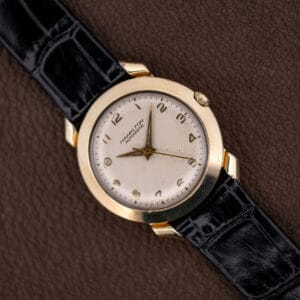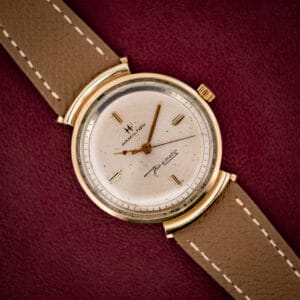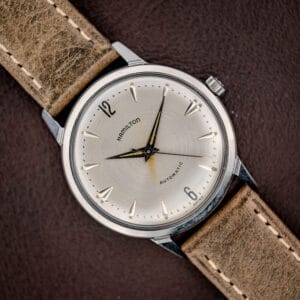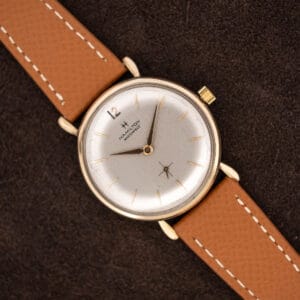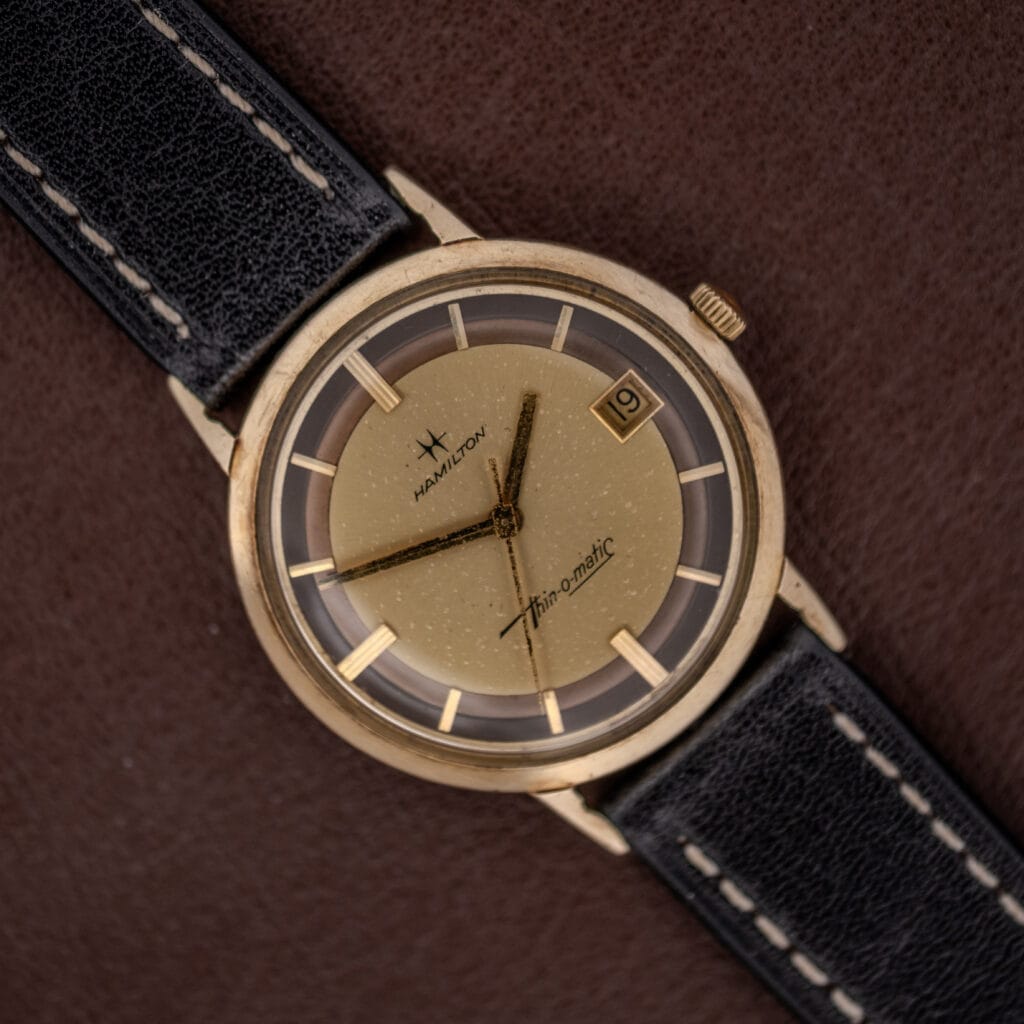
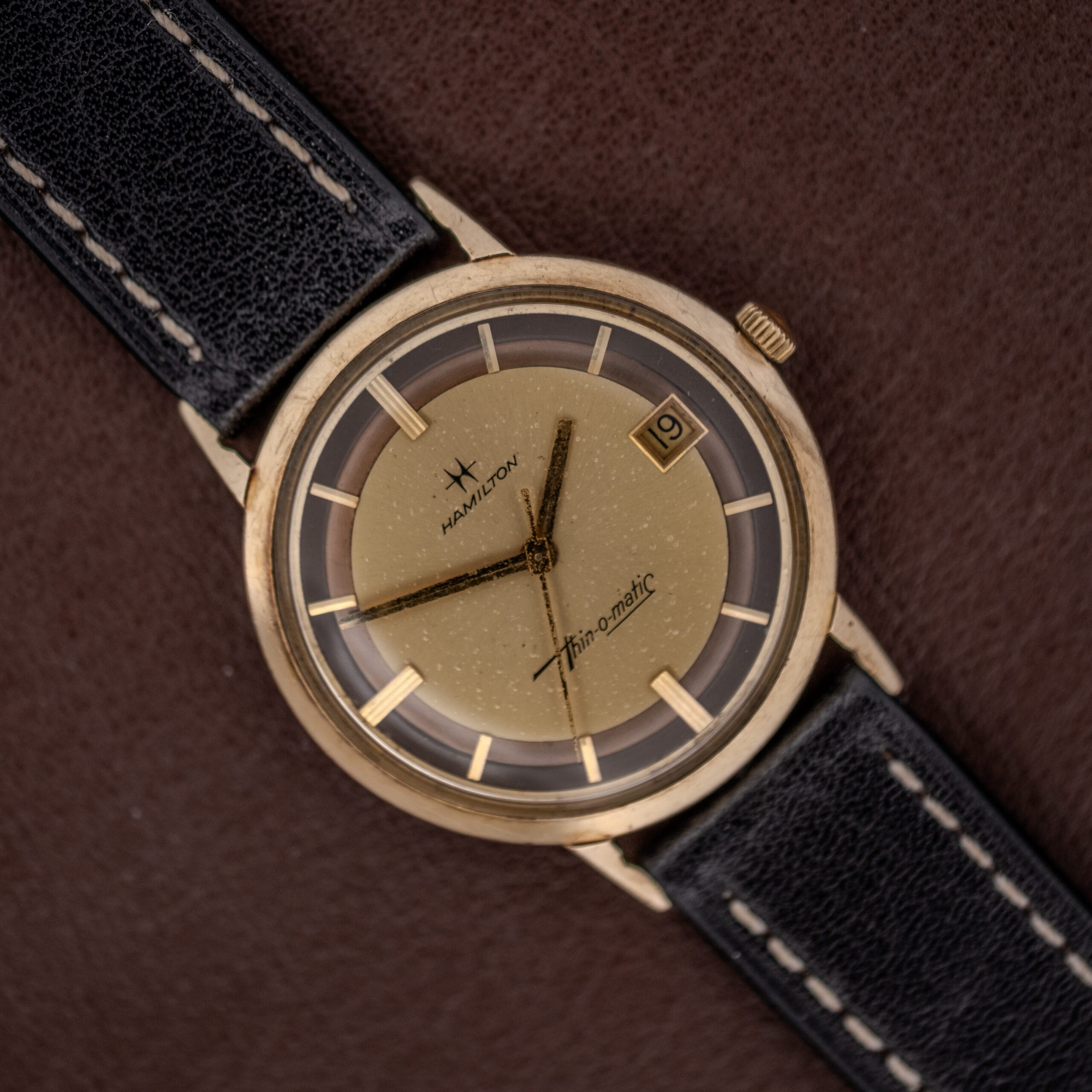
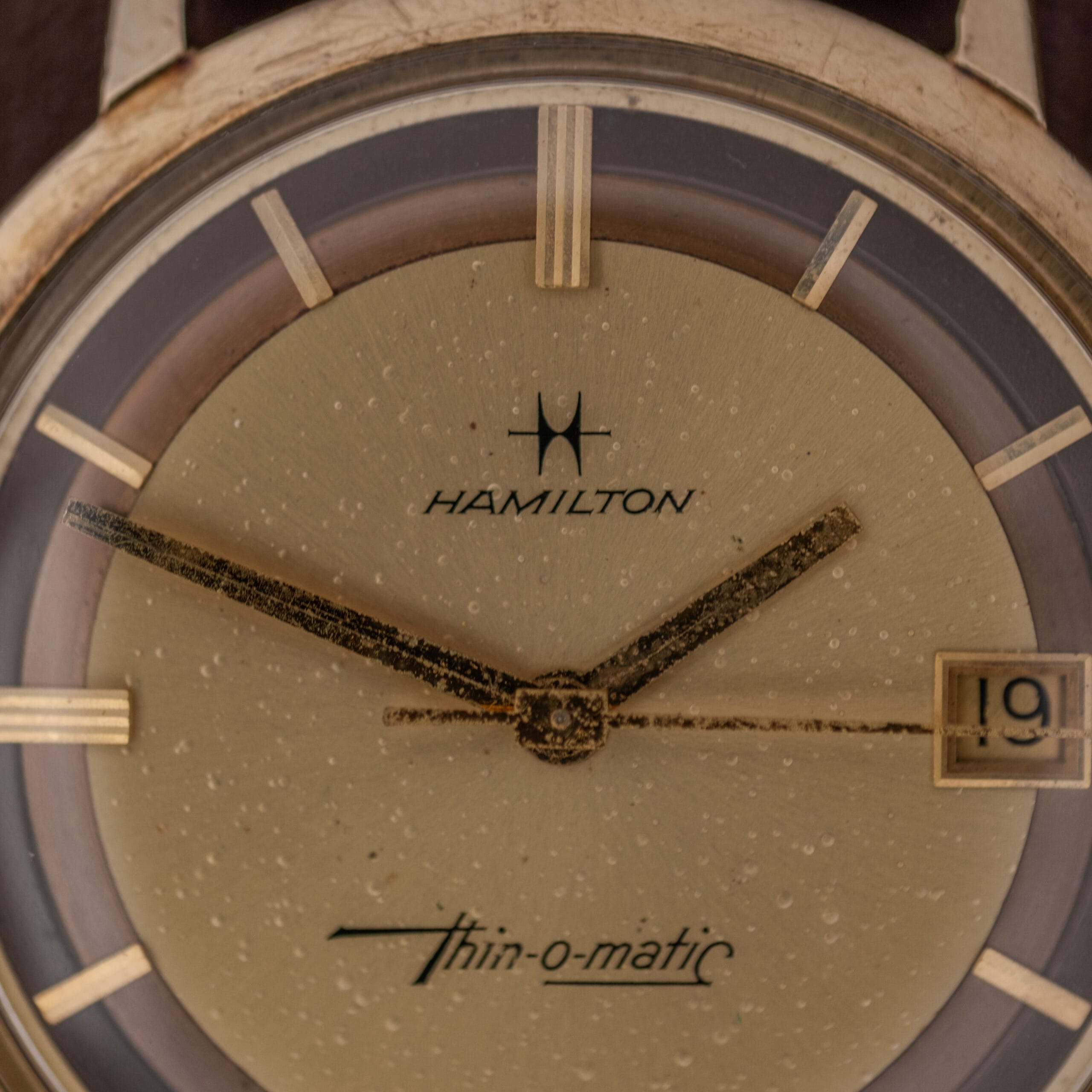
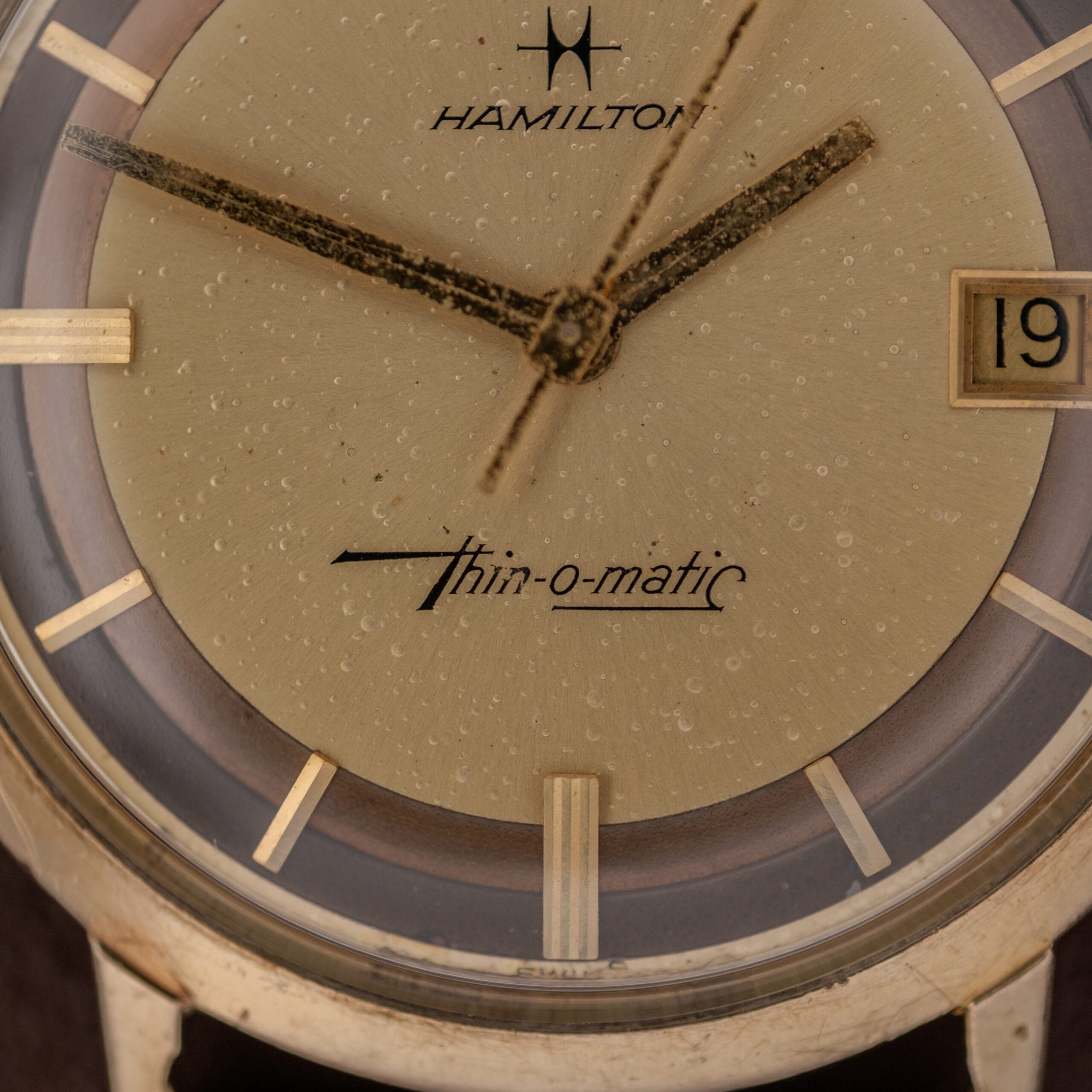
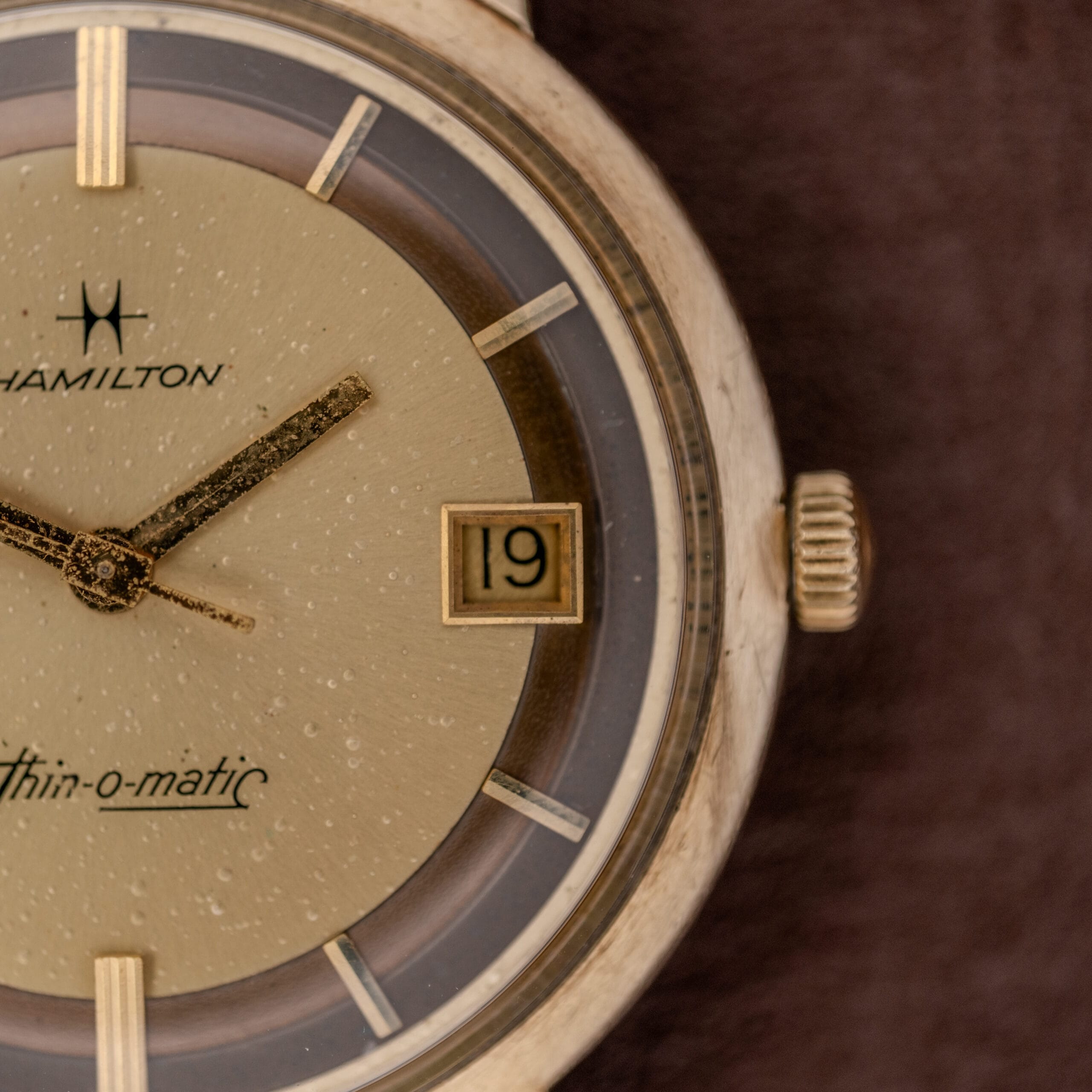
There is a particular kind of late-1960s American-Swiss watch that quietly refuses to age, and to us, the Hamilton Thin-O-Matic is one of the cleaner examples of how that hybrid era should look on a wrist. This Ref. 991165 in 10k yellow gold filled is a Thin-O-Matic from the back half of the line’s run, with a two-zone dial that does more visual work in 34mm than most modern watches manage twice the size.
Hamilton introduced the Thin-O-Matic name in 1960 as the brand’s thin-profile automatic line, sitting alongside the manually wound Thin-O-Matic Masterpiece and the dressier Hamilton dress range out of Lancaster, Pennsylvania. By the time this particular Hamilton Thin-O-Matic was cased up, Hamilton had already acquired Buren Watch Company in Switzerland and was actively transitioning Swiss-made calibers into its American-cased product line. The Thin-O-Matic family itself splits into two distinct movement architectures: the Buren-derived micro-rotor calibers like the 663 and 666, and the ETA-derived full-rotor automatics like the one inside this watch. Both wear the same family name on the dial. Both deserve their own conversation.
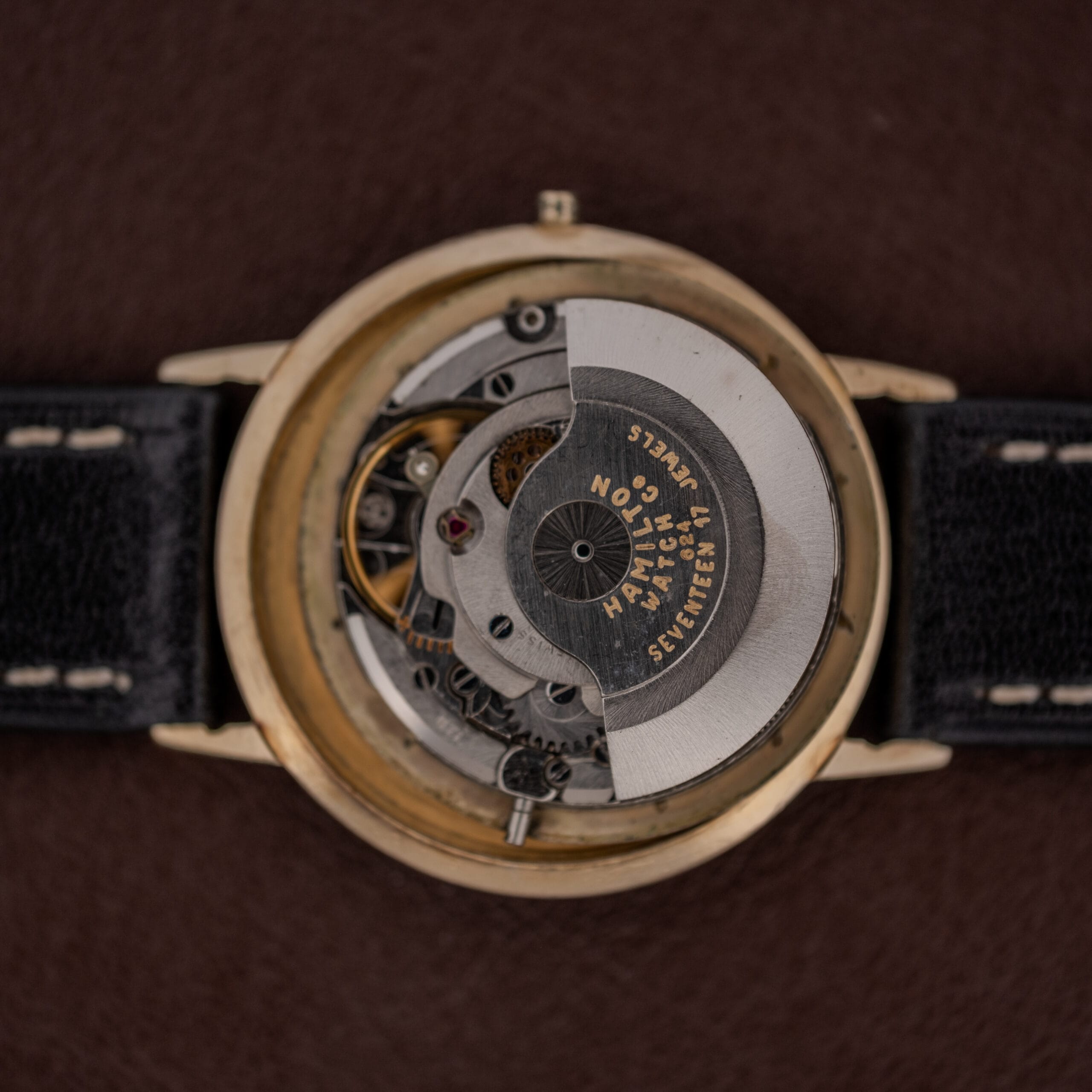
The caliber here is the Hamilton 624, which is Hamilton’s signed version of the ETA 2522. Through the movement side you can see a full-size half-circle rotor signed “HAMILTON WATCH CO” with “SEVENTEEN 17 JEWELS” running around its perimeter and the caliber number “624” stamped clearly on the rotor face. The finish is honest workmanlike nickel with circular damascening on the rotor and red jewel settings visible at the balance, with shock protection in place. It is the kind of caliber Hamilton was using to keep American buyers in genuinely Swiss-made automatics during the consolidation years, and it runs the way these movements always run once properly serviced, which is to say accurately and without fuss.
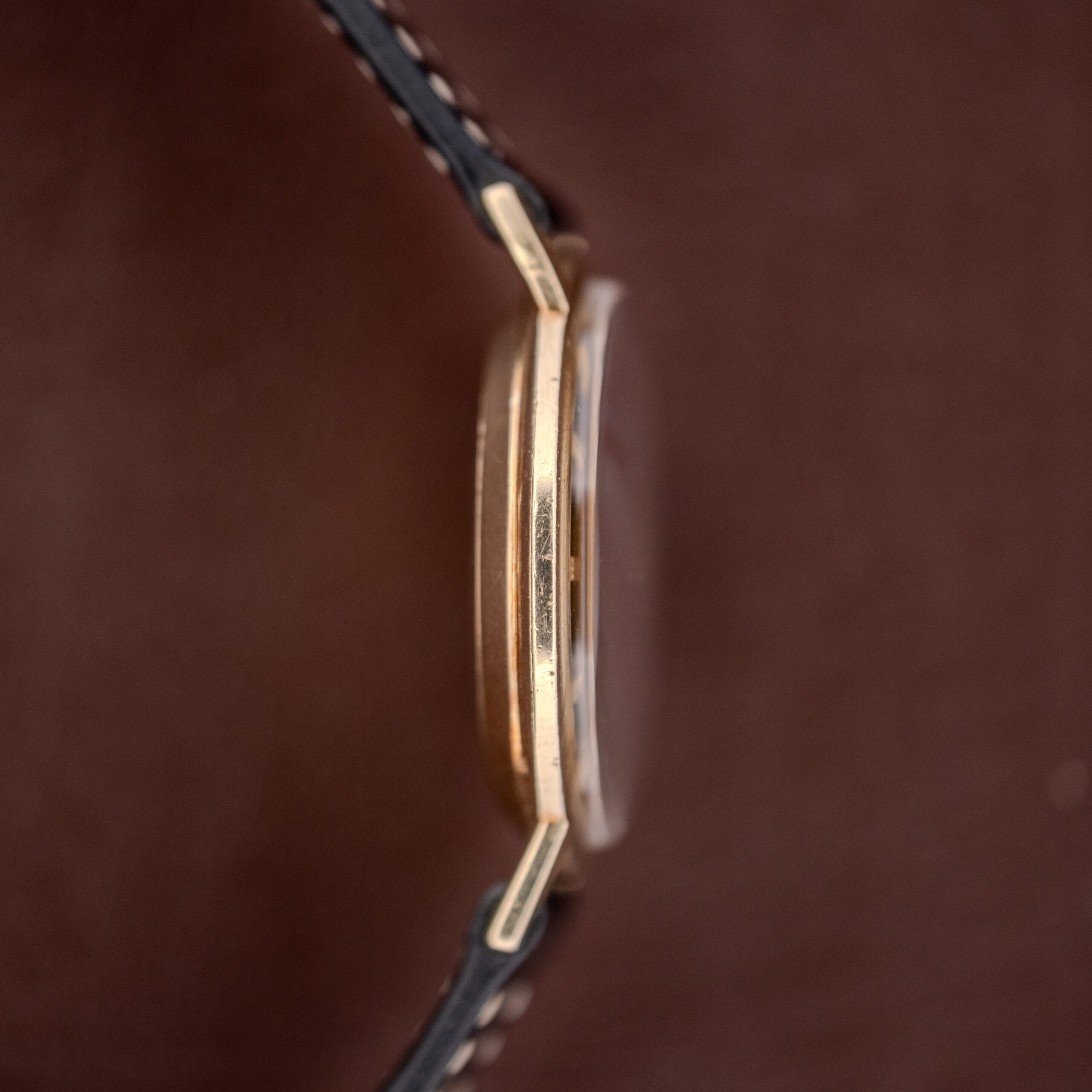
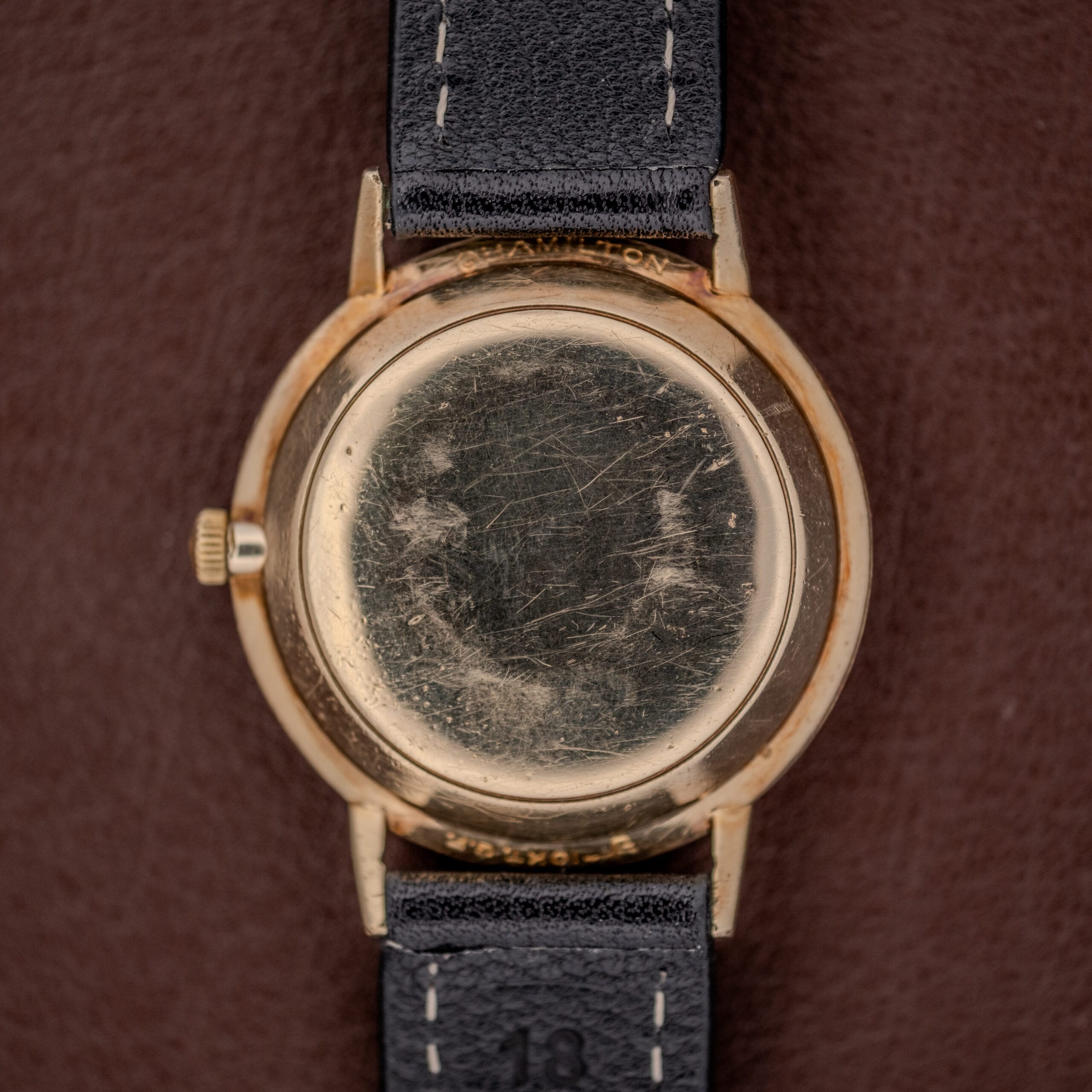
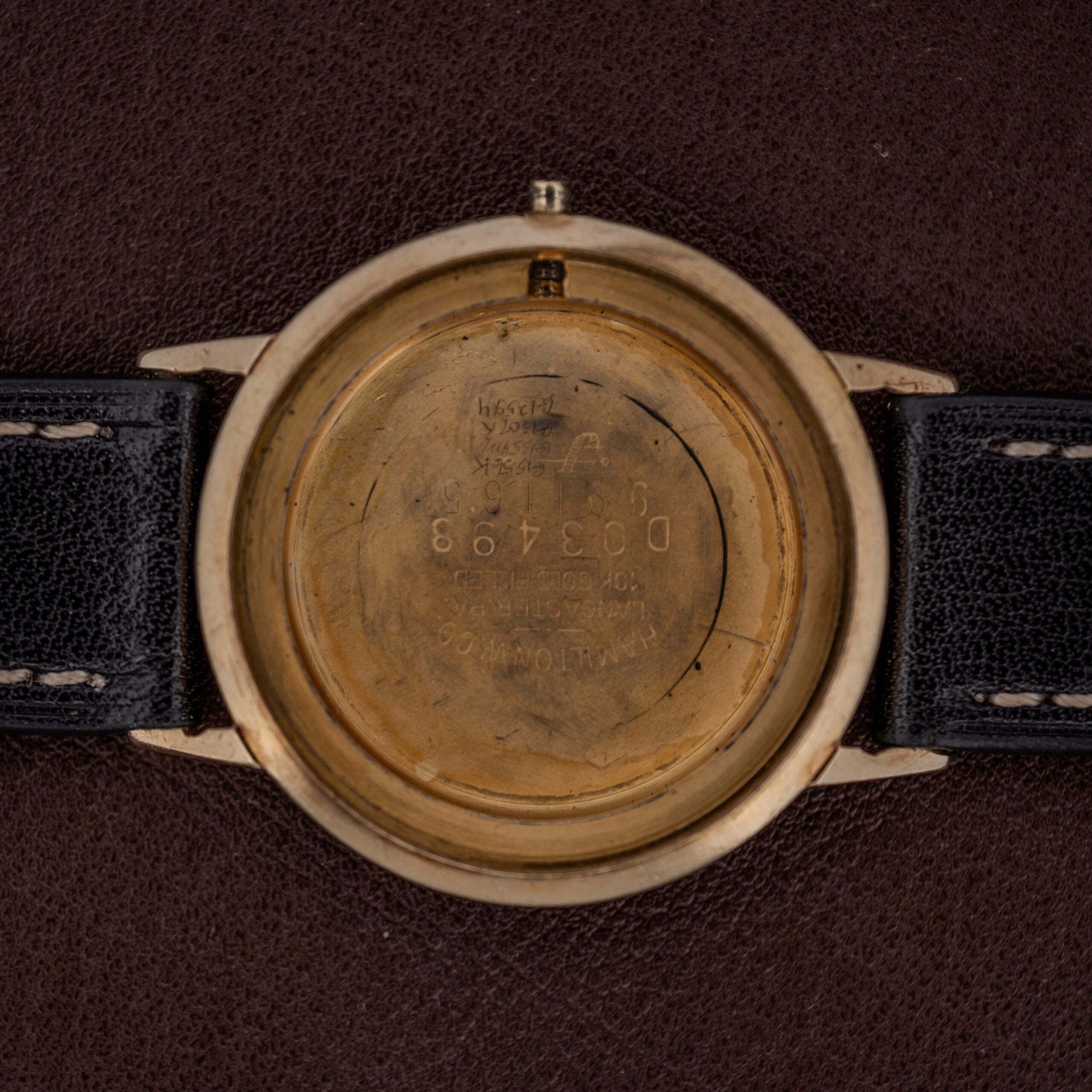
The case is a 34.2mm round profile with a 41mm lug-to-lug and the slim midcase profile that earns the Thin-O-Matic name. The construction is 10k yellow gold filled, which is not the same as gold plating. Gold-filled means a thick, mechanically bonded layer of solid 10k gold over a brass core, a far more durable application than electrodeposited plate. The case was built by the Star Watch Case Company of Ludington, Michigan, the same Michigan-based casemaker that supplied Hamilton’s American product line for decades and which also produced cases for Time Computer’s Pulsar LED watches in the 1970s. The inner caseback is stamped “HAMILTON W. CO” / “LANCASTER, PA” / “10K GOLD FILLED” with the Star Watch Case arrow logo and quality assurance mark, plus the case reference “991165” and a serial number. The outer caseback is plain and carries a “HAMILTON” engraving along its upper rim, and shows honest light hairlining across its surface from decades of normal wear, with no signs of polishing-through to the brass core.
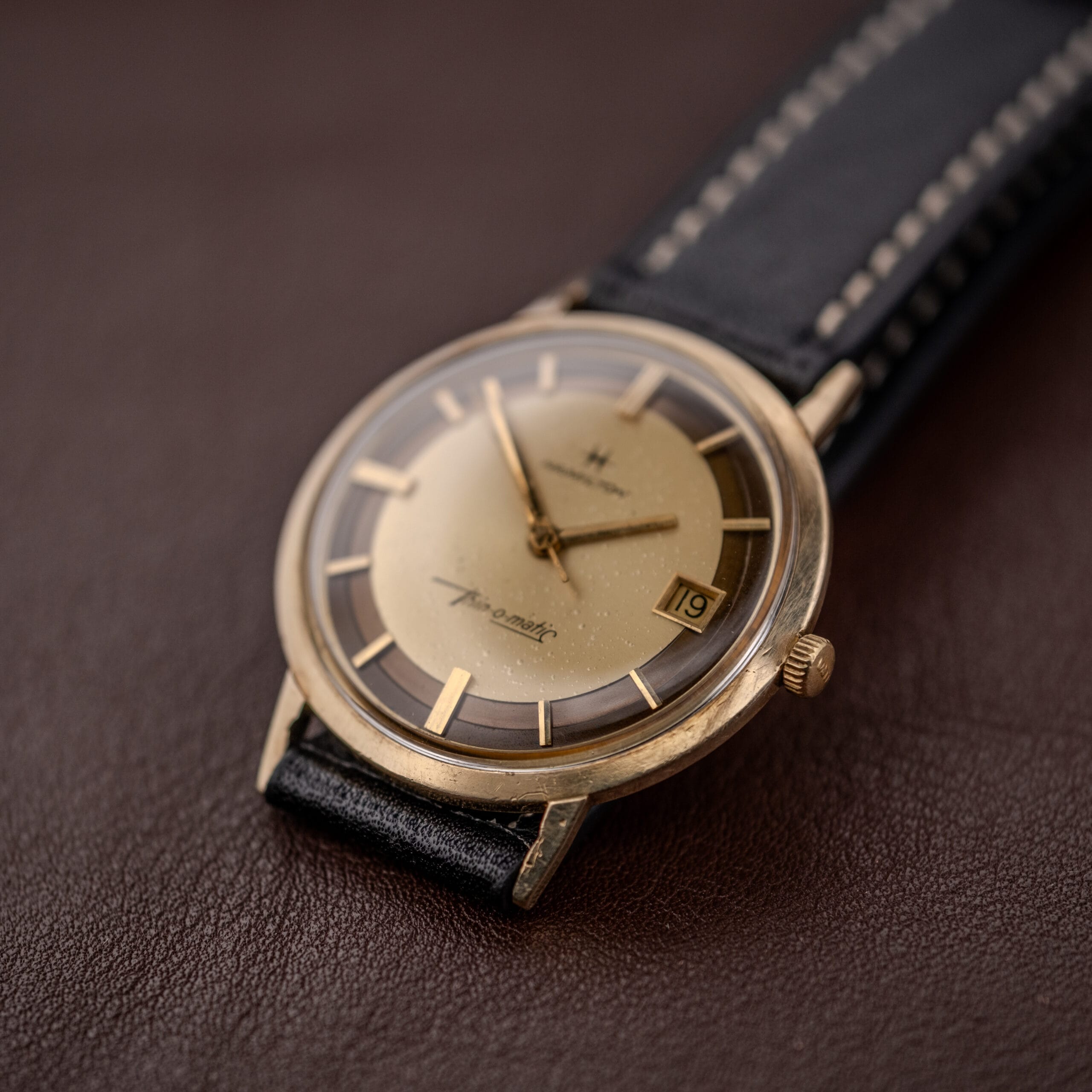
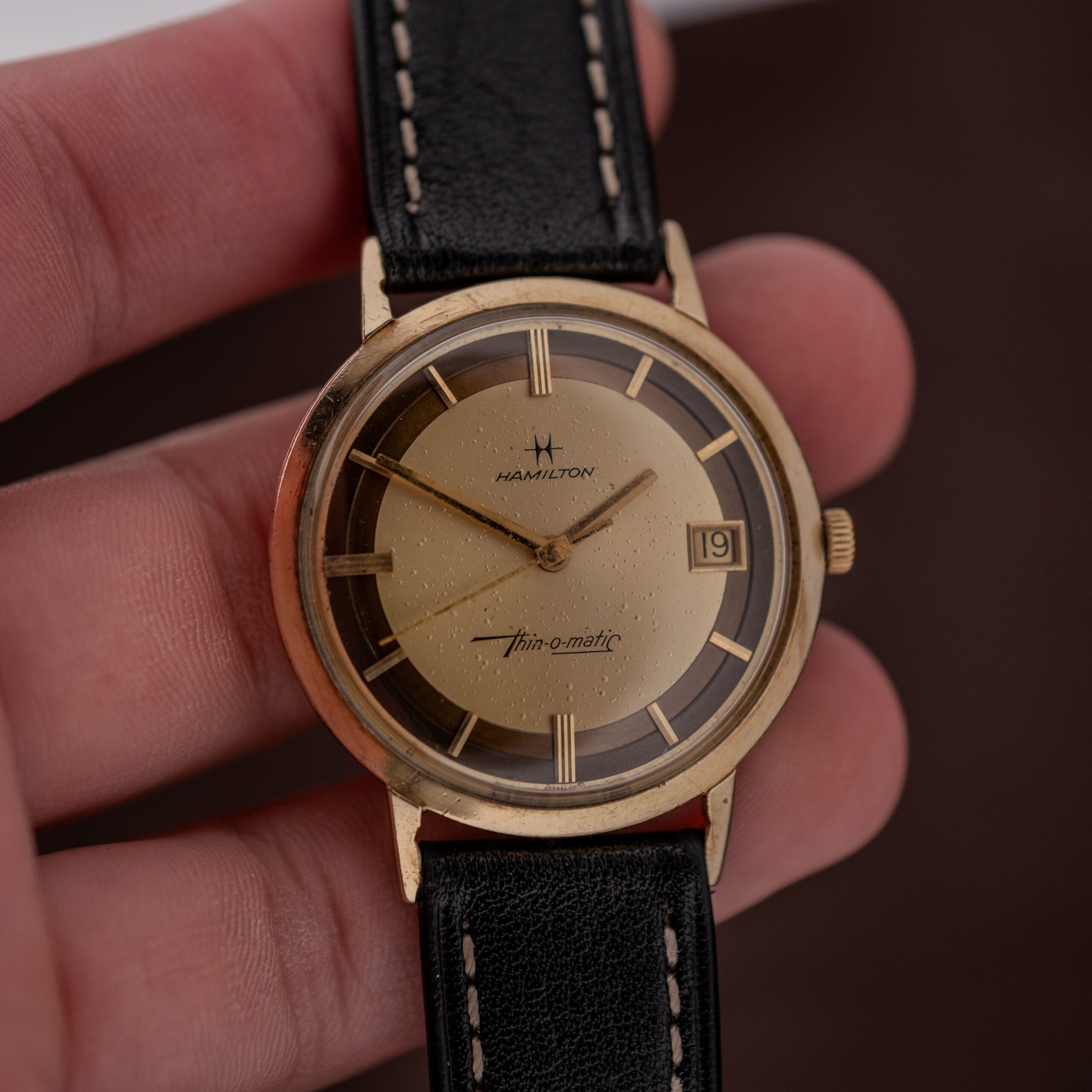
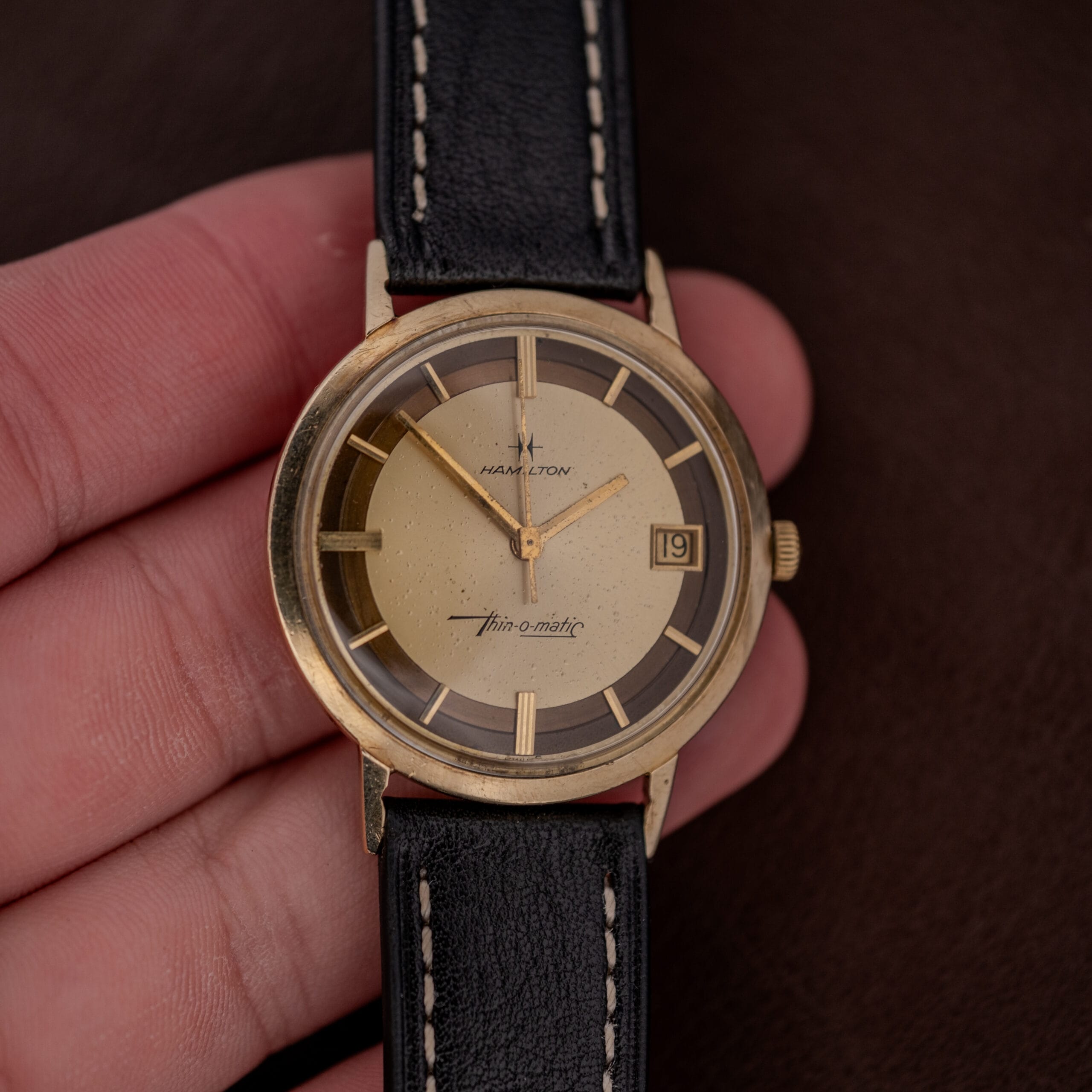
The dial is genuinely two-zone in a way photos can underplay. A smoky brown reflector ring runs the perimeter, with applied gold-tone baton indices planted directly on that brown chapter at the hour positions. The center steps inward to a textured champagne-gold field with a fine stippled finish that catches light differently from the lacquered outer ring. The applied Hamilton H crosshair logo and printed “HAMILTON” sit at twelve, the cursive “thin-o-matic” signature anchors the lower half above six, and a gold-framed date window at three reads cleanly through a beveled aperture. Gold dauphine hands sweep across the center with the central pinion showing some honest oxidation and a uniform patination that we would describe as the dial having aged into character rather than away from it. There is no lume on the dial or hands, which is correct for a Hamilton Thin-O-Matic of this dress configuration.
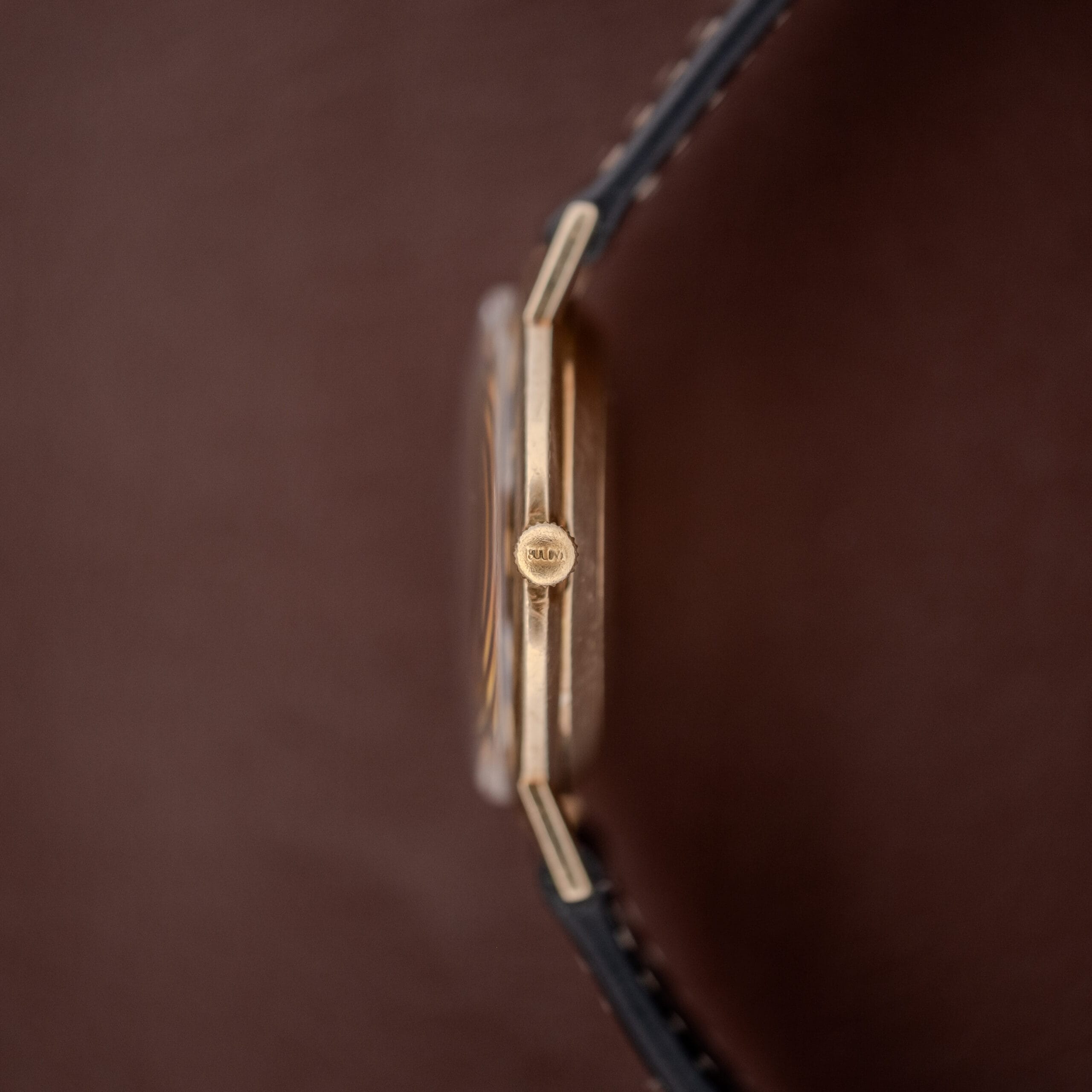
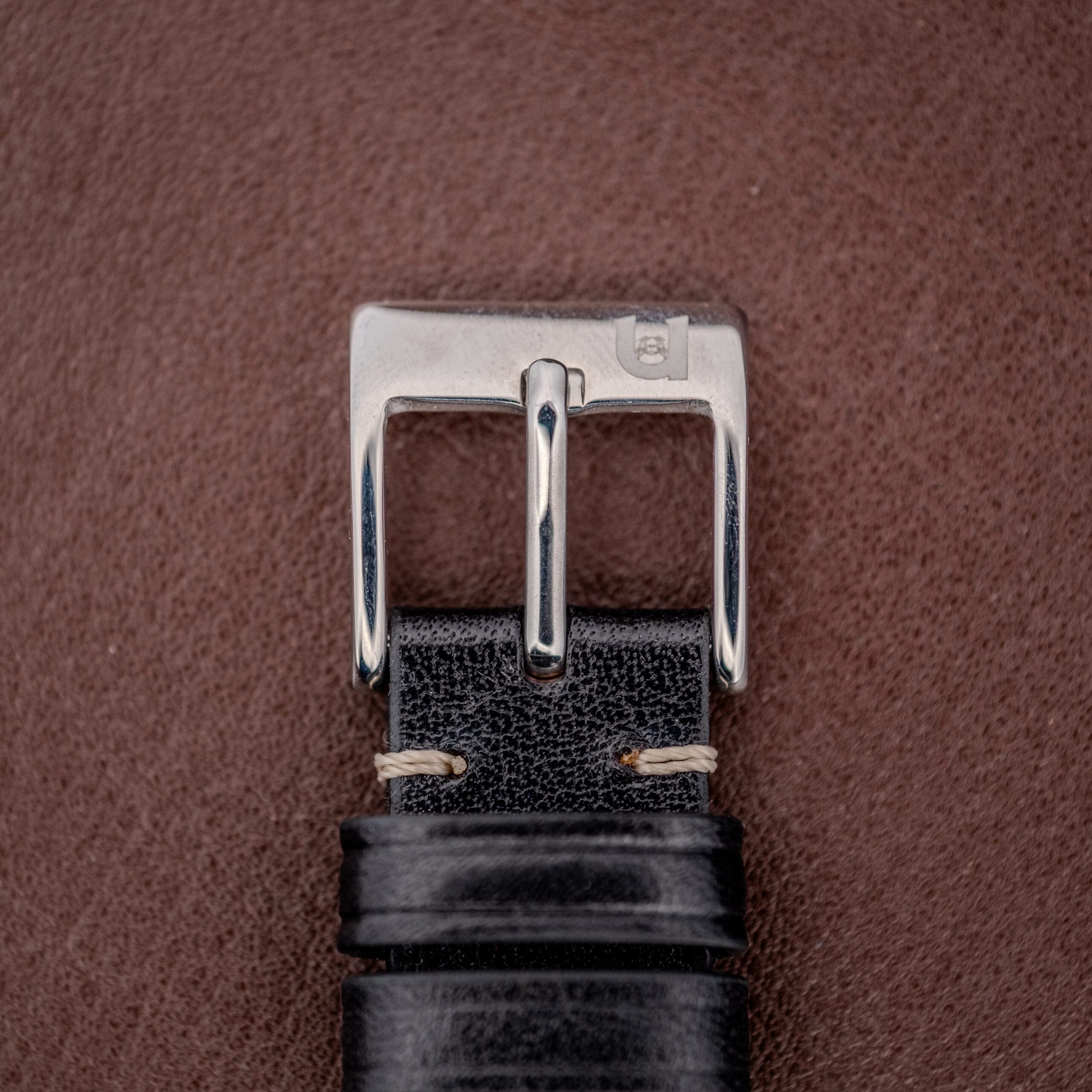
Two notes on originality the experienced collector will want up front. The crown is signed “BULOVA” rather than Hamilton, a service-replacement made at some point in the watch’s life and a common period substitution given Hamilton and Bulova both used compatible crown threading. The buckle on the strap is a steel aftermarket buckle rather than a signed Hamilton piece. Both are easy upgrades for the next owner who wants full originality, and neither affects the watch’s mechanical integrity. Beyond those two callouts, the dial is original and untouched, the case is unpolished, and the movement is correct to the reference.
It comes presented on a black leather strap with cream contrast stitching in 18mm, which carries the gold case nicely and keeps the watch reading dressy. A cognac or saddle brown leather would also work well here if you want to lean further into the dial’s warmer center, and a black alligator-grain would push the watch fully into evening territory.
Serviced in-house at OTTUHR and backed by our 2-year mechanical warranty, this Hamilton Thin-O-Matic is for the collector who values dial composition over case size, and who would rather wear a two-zone American-Swiss automatic that nobody else at the table will recognize than chase another over-broadcast sports watch. To us, the late-1960s Hamilton Thin-O-Matic in 10k gold filled is one of the quietly most rewarding ways into the brand’s transition era, and this Ref. 991165 is a wonderfully honest example of the genre.