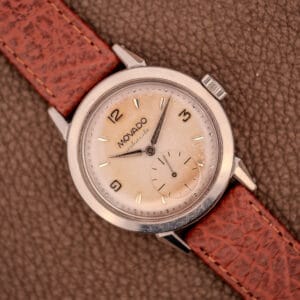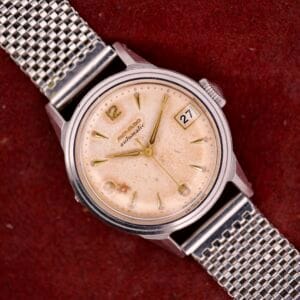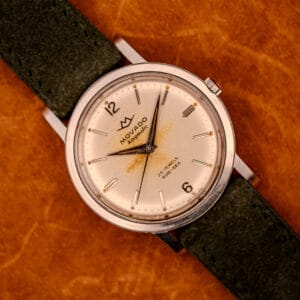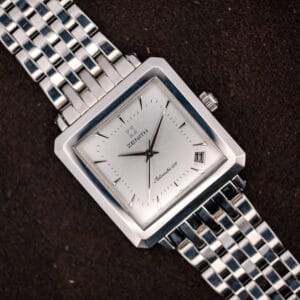
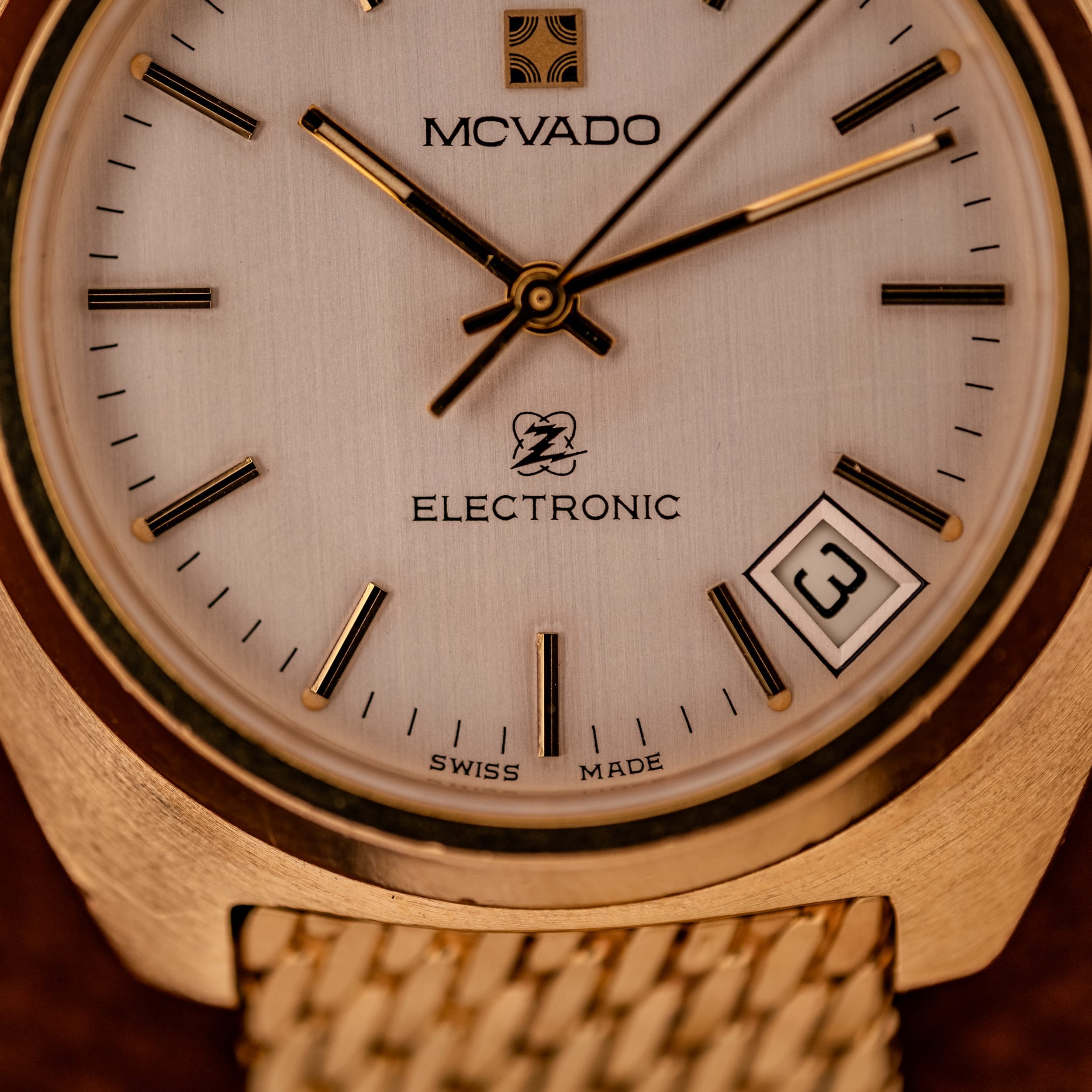
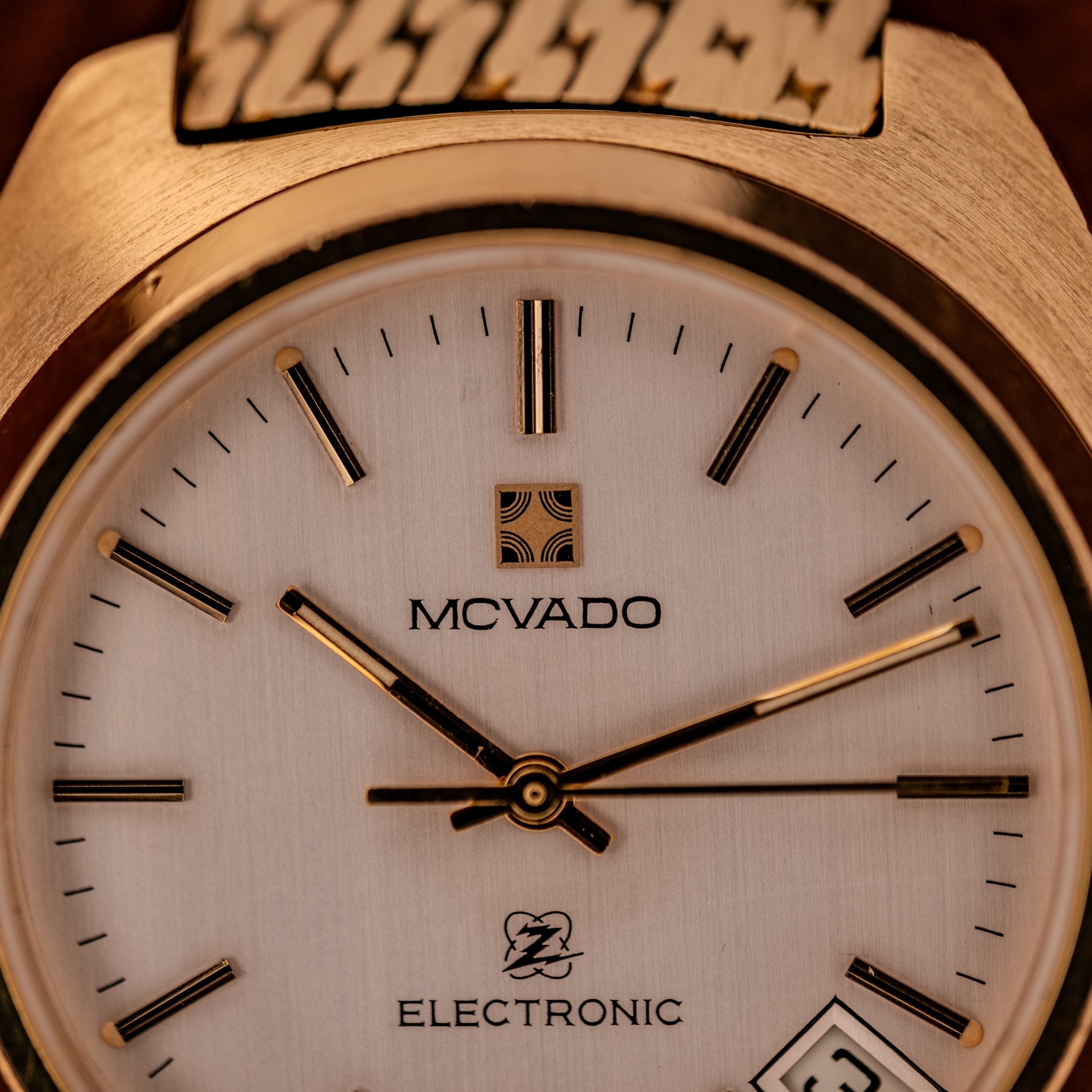
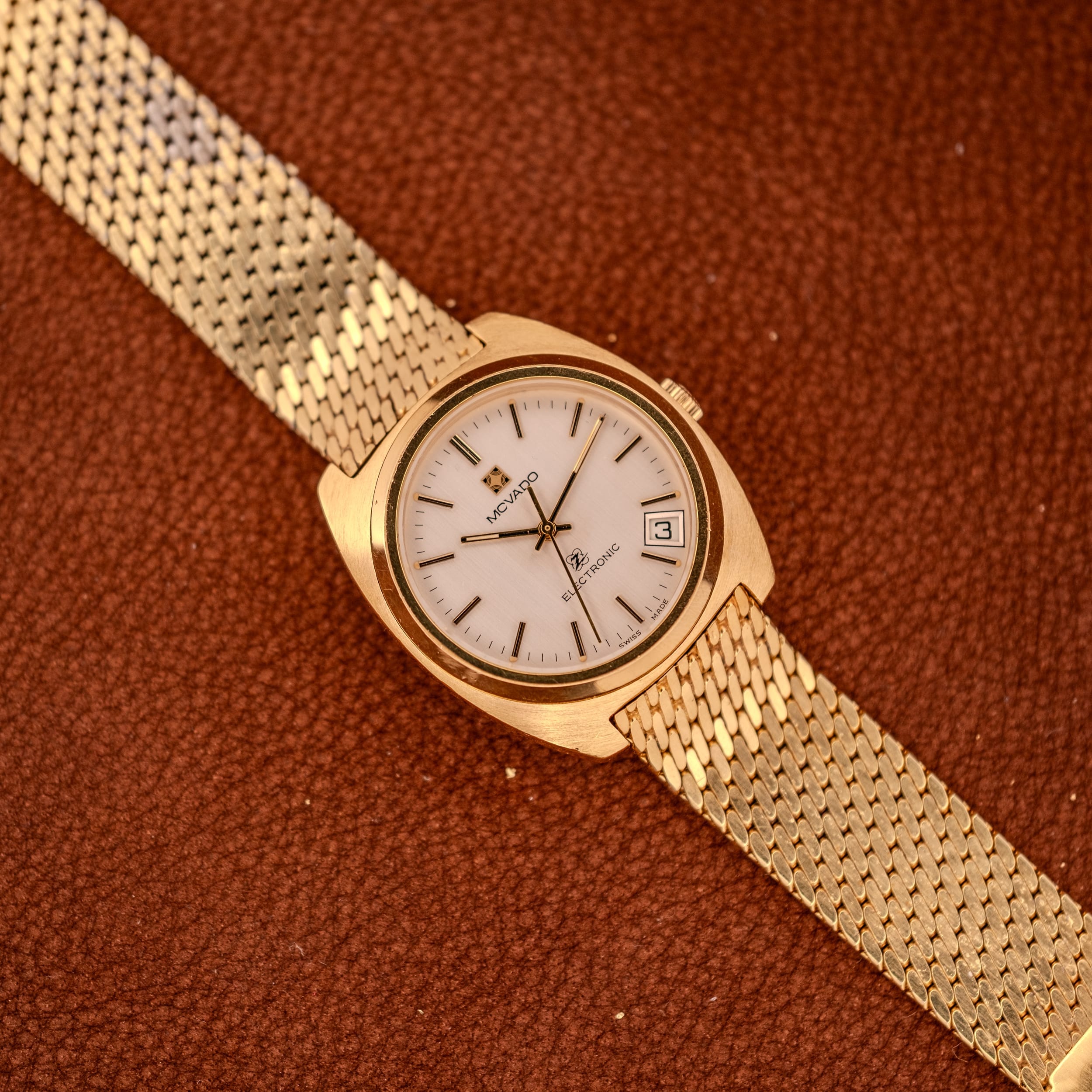
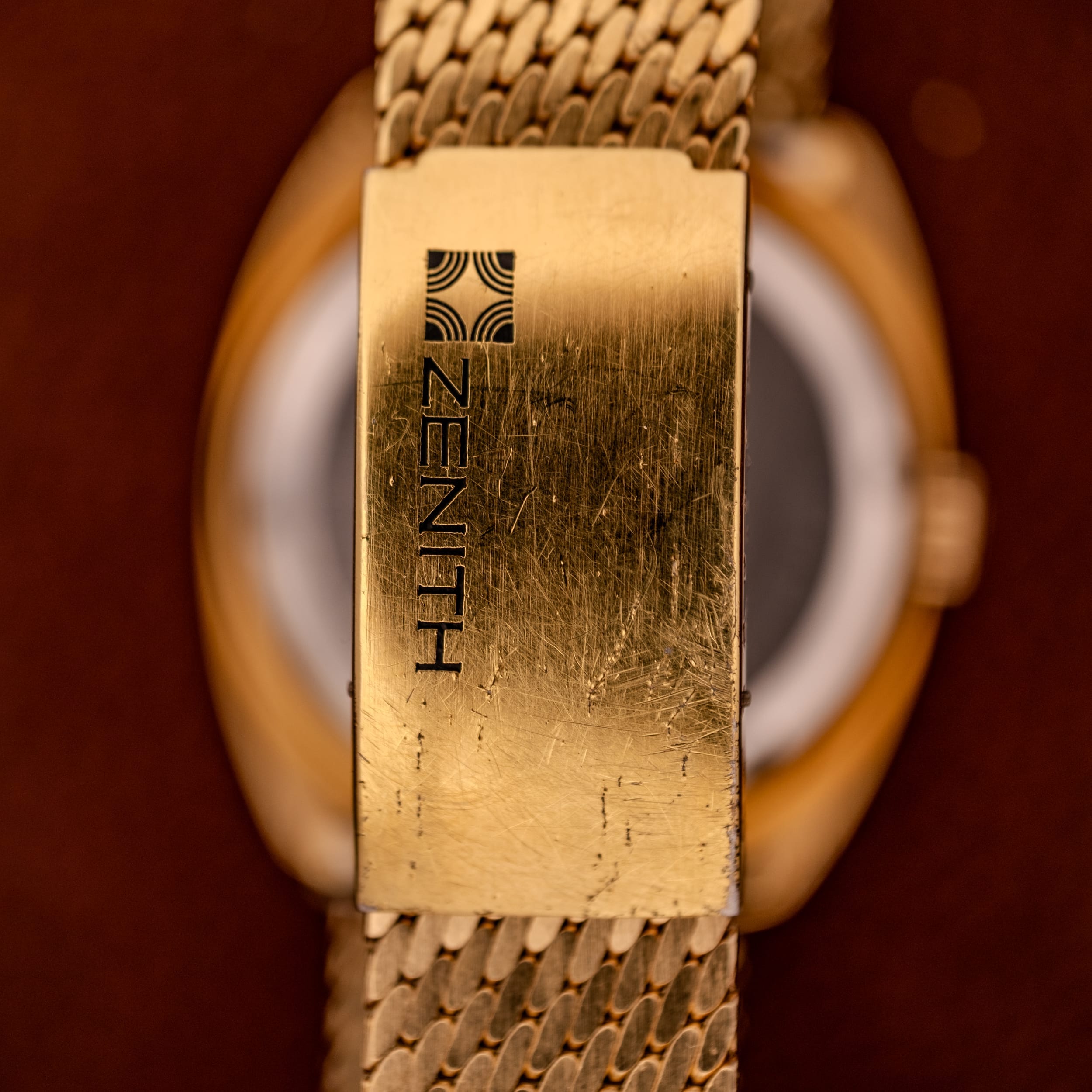
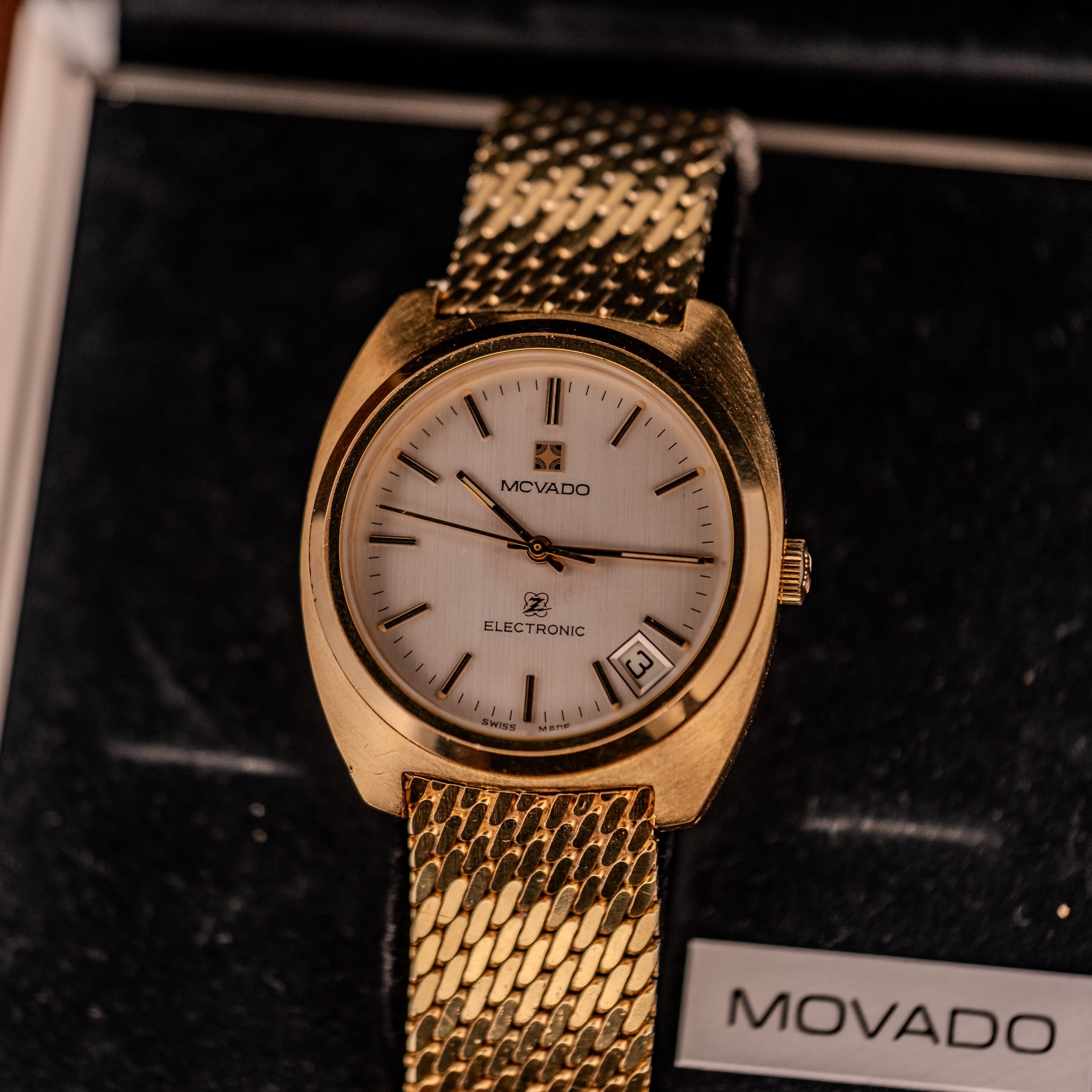

The ESA 9162 tuning fork caliber is, in our opinion, the high-water mark of an entire branch of horological engineering that the quartz revolution closed off almost as soon as it opened. This Movado Electronic Ref. 20-0090-500 is one of the more characterful ways to put that caliber on a wrist, dressed in a cushion gold-electroplated case with an integrated mesh bracelet that locks the watch into its early 1970s moment. The dial reads MOVADO and the crown plus the deployant clasp are both signed Zenith, with a stylized Zenith Electronic mark printed below center on the dial. That is the entire story of this watch told in three engravings.
The MZM group (Movado, Zenith, Mondia) formed in 1969 as a defensive consolidation against the rising tide of cheaper electronic competition out of Japan and the United States. Inside the group, parts and components moved across brand lines as a matter of routine, which is how Movado-dialed watches ended up wearing Zenith-signed crowns and clasps as standard kit rather than oddity. This Movado Electronic, produced inside the documented 1969 to 1976 production window of Ref. 20-0090-500, sits right in the middle of that brief cross-pollination period before SSIH absorbed Movado and the partnership unwound. Pieces from this era carry a kind of fingerprint that later Movado output never repeats.
Inside is the ESA 9162, the Mosaba-family caliber that ESA built under license from Bulova’s tuning fork patents and that most of the Swiss industry adopted under proprietary names. Omega called it the Speedsonic. Longines used Ultronic. IWC stamped it as a hack-equipped electronic dress watch. Zenith, branding the caliber for itself and for Movado within the MZM group, renamed it Cal. 50.0. The 9162 ran the same 360 Hz tuning fork concept Max Hetzel pioneered at Bulova in the late 1950s, but with a redesigned counterbalanced fork for positional accuracy, a hack function the original Accutron 214 never offered, and a modular construction that made it serviceable in a way the early Bulova generation simply wasn’t. Some 9162-equipped watches achieved chronometer certification. The on-wrist signature is the perfectly fluid sweep seconds, free of the ticking discontinuity that gives every mechanical and quartz movement away. Zenith Electronic is what the clasp signing nods at; the 9162 is what makes it true.
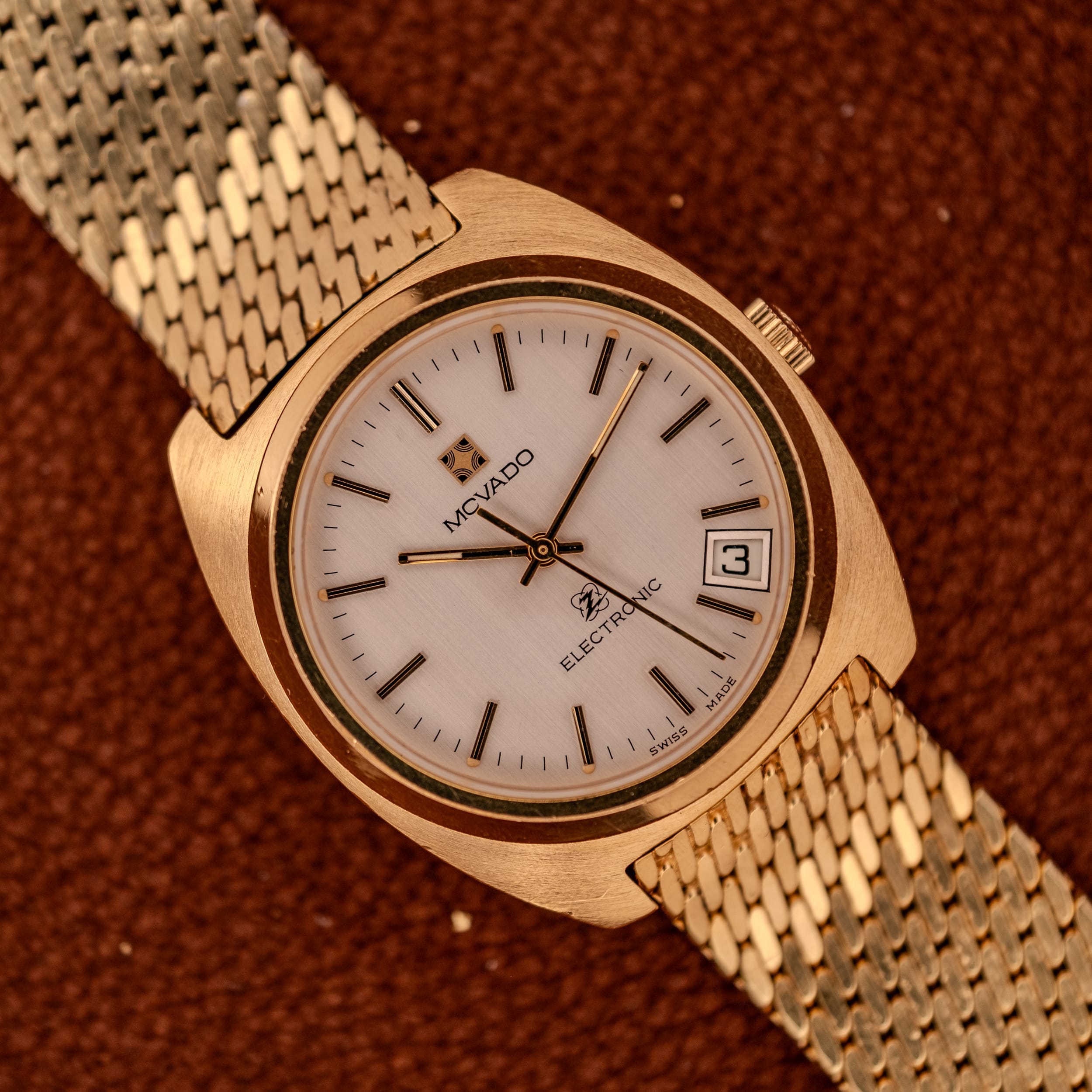
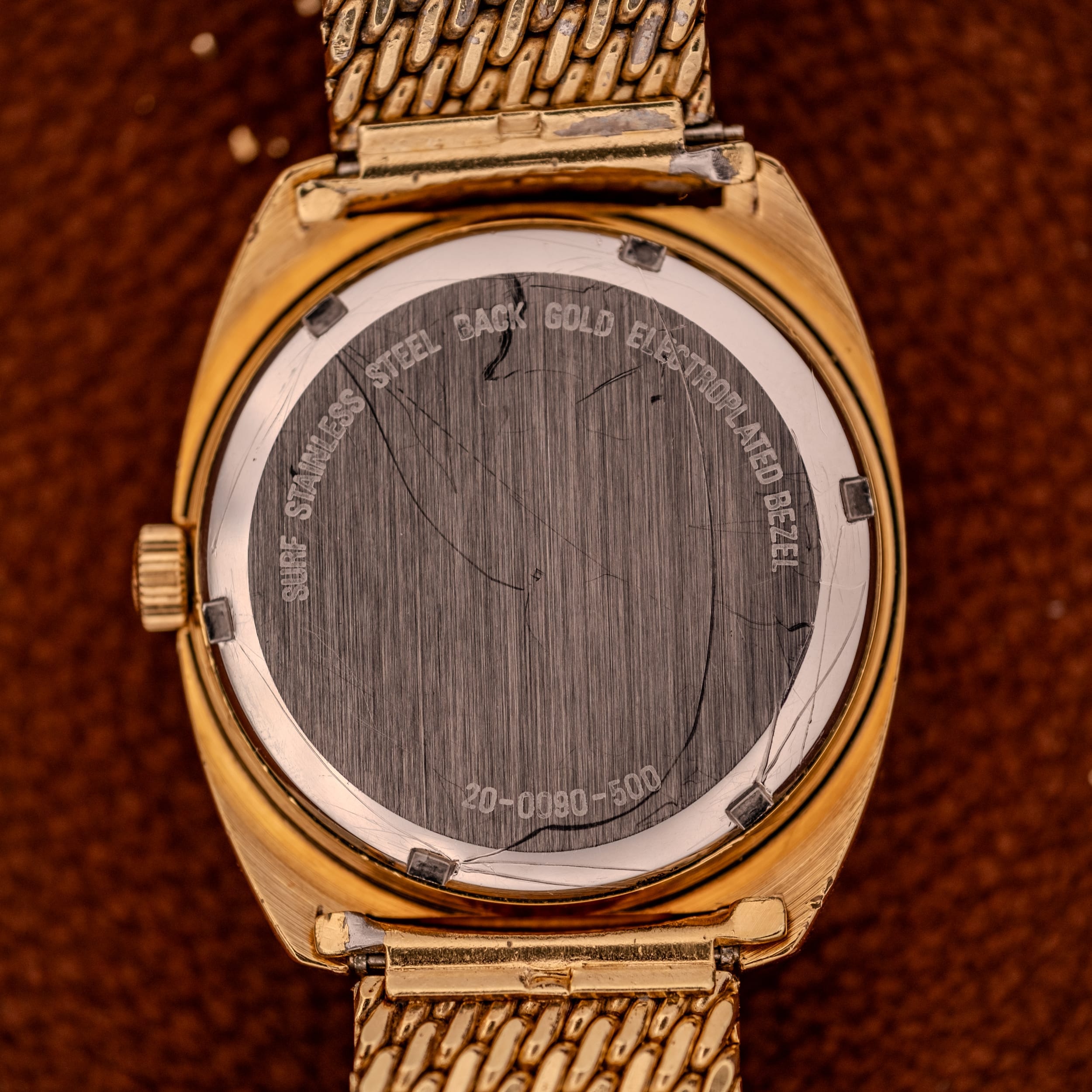
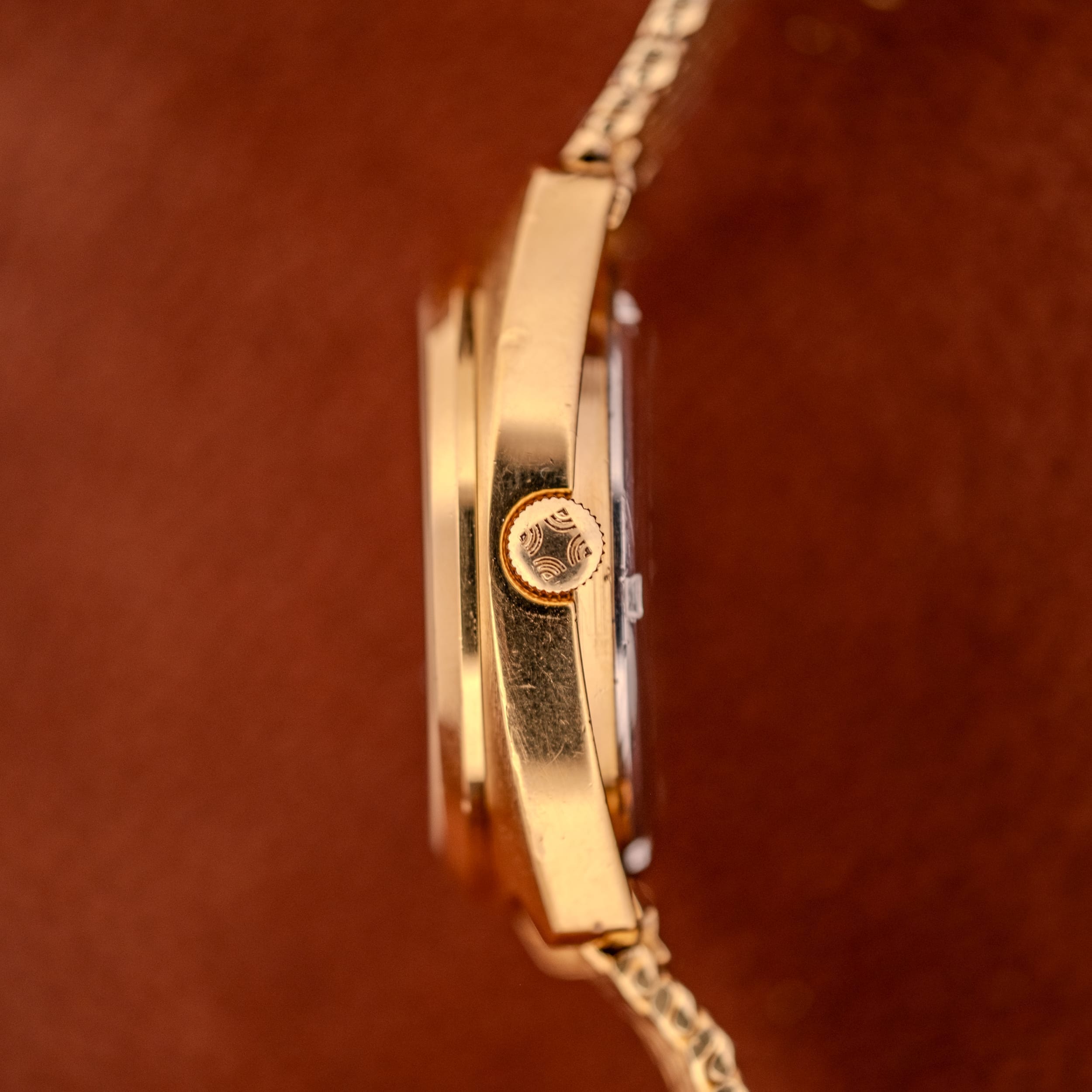
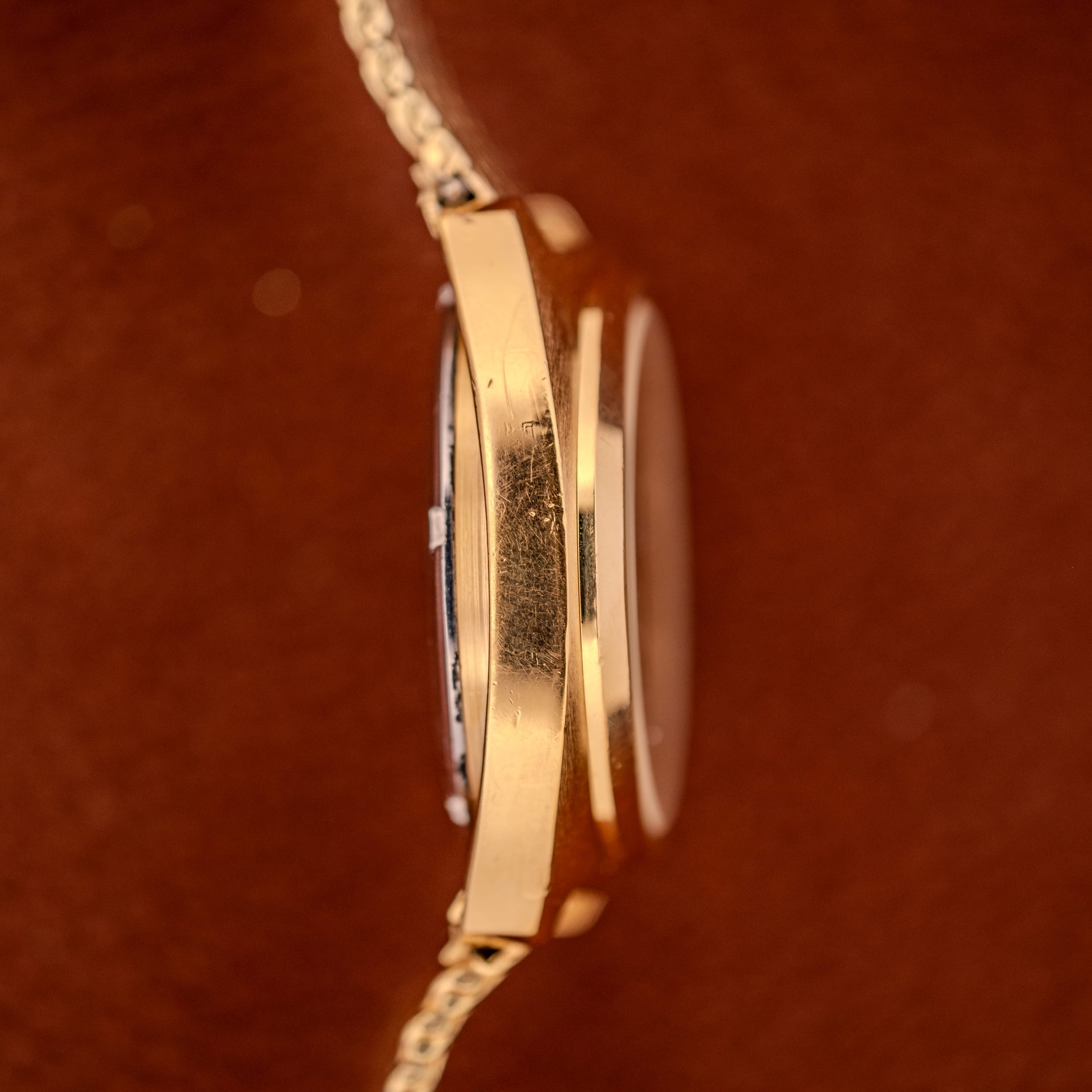
The case is a 36.4mm cushion in gold-electroplated steel with a stainless steel snap-on caseback, 40.2mm lug to lug, with subtly curved flanks that flow into integrated end-link shoulders. The outer caseback wraps around its brushed steel insert with the legend “SURF STAINLESS STEEL BACK GOLD ELECTROPLATED BEZEL”, and the model reference “20-0090-500” is stamped below center. The brushed steel back carries deep scribed marks and tool scratches from past battery changes, which is the entirely expected condition for a tuning fork watch that has been kept running across five decades; battery replacement on these calibers requires opening the back, so each service leaves its signature. The gold electroplate on the bezel and flanks shows light surface wear consistent with careful occasional use, and the crown sits unobtrusively at three with the geometric stacked-Z Zenith mark engraved on its face.
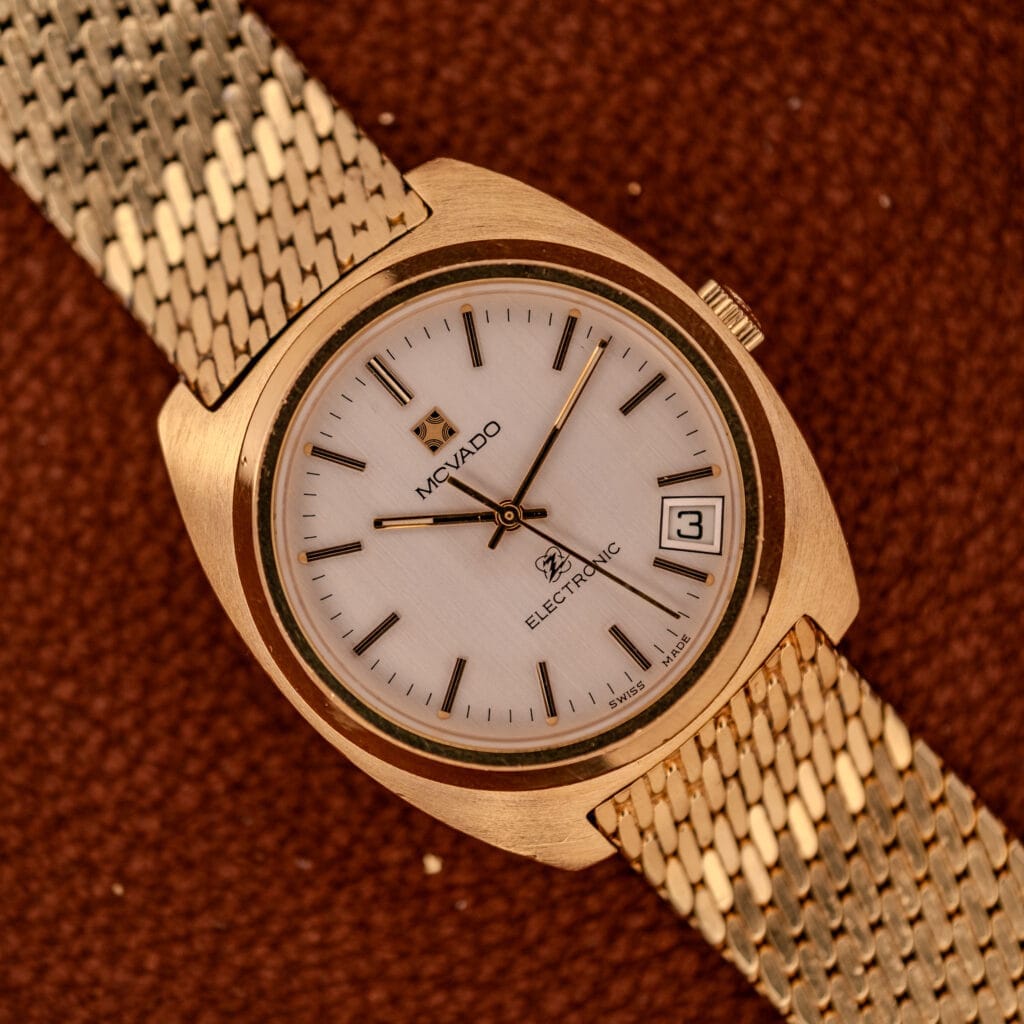
The dial is a subtly brushed white with vertical lining that catches light differently at every angle, and the layout is pure 1970s Movado Electronic. Applied polished gold baton indices with black inset channels sit at every hour, paired with matching dauphine hour and minute hands carrying the same channel detail, plus a slender black sweep seconds hand. The Movado four-quadrant arched logo and MOVADO wordmark anchor the top of the dial at twelve. Below center sits the stylized Zenith Electronic mark, a stacked-Z with a sonic-wave streamer beneath it, with the ELECTRONIC wordmark printed underneath. SWISS MADE prints small at six. A white-on-white date aperture sits at the 4:30 position with a black numeral, the only printed complication on an otherwise clean dial. The whole composition is original, with no refinish indicators visible in any of the macro photos, and the gold tone of the dial markers ties cleanly to the case finish.
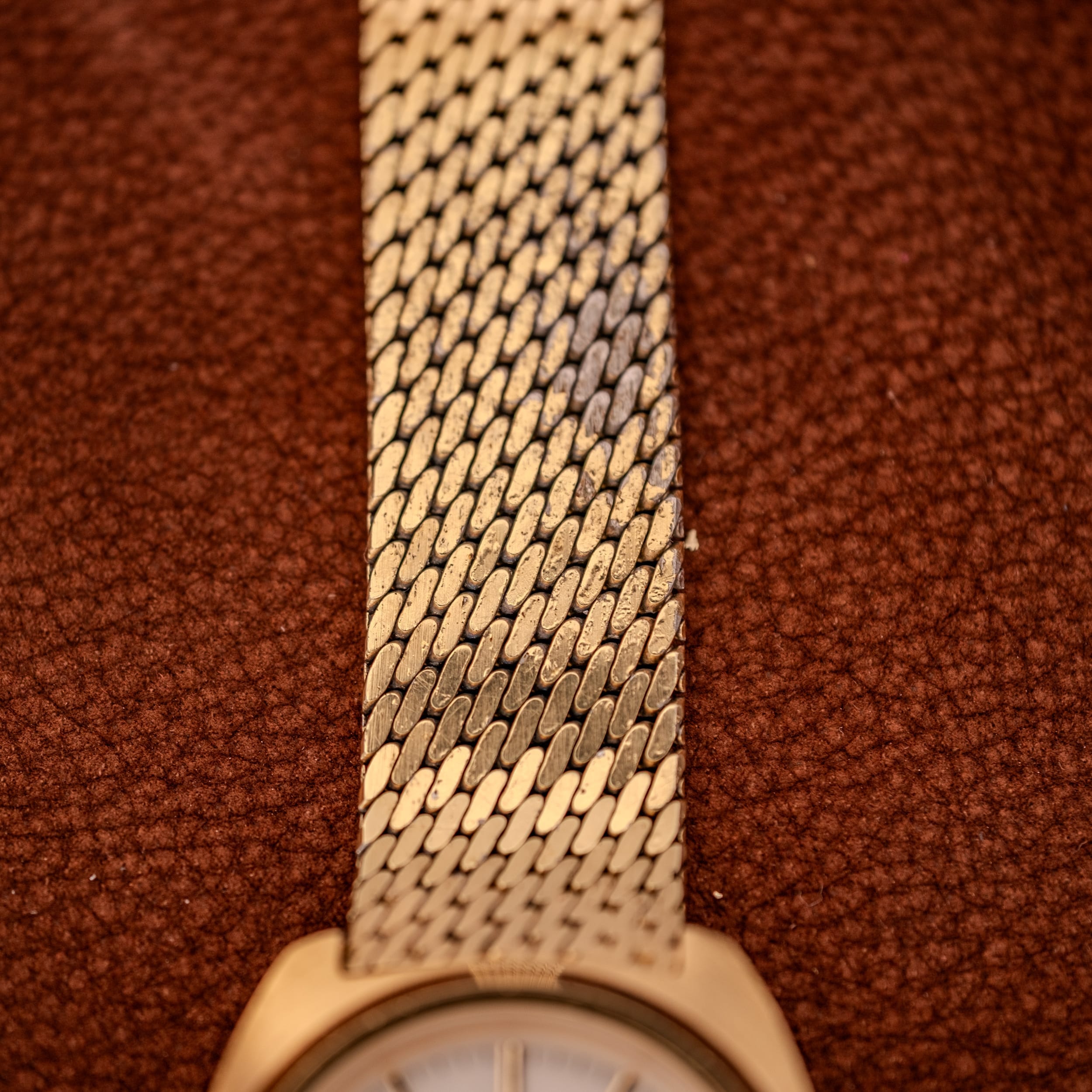
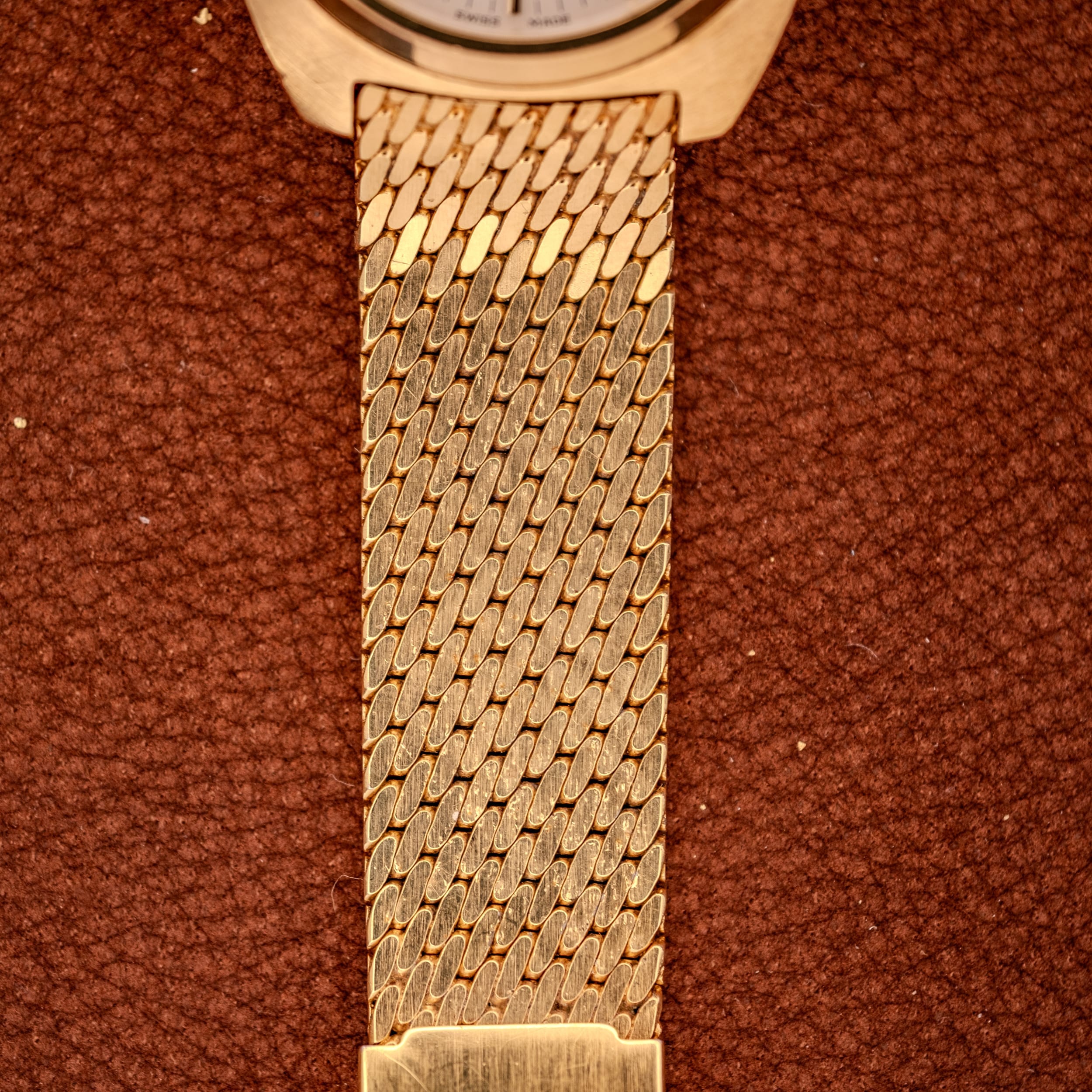
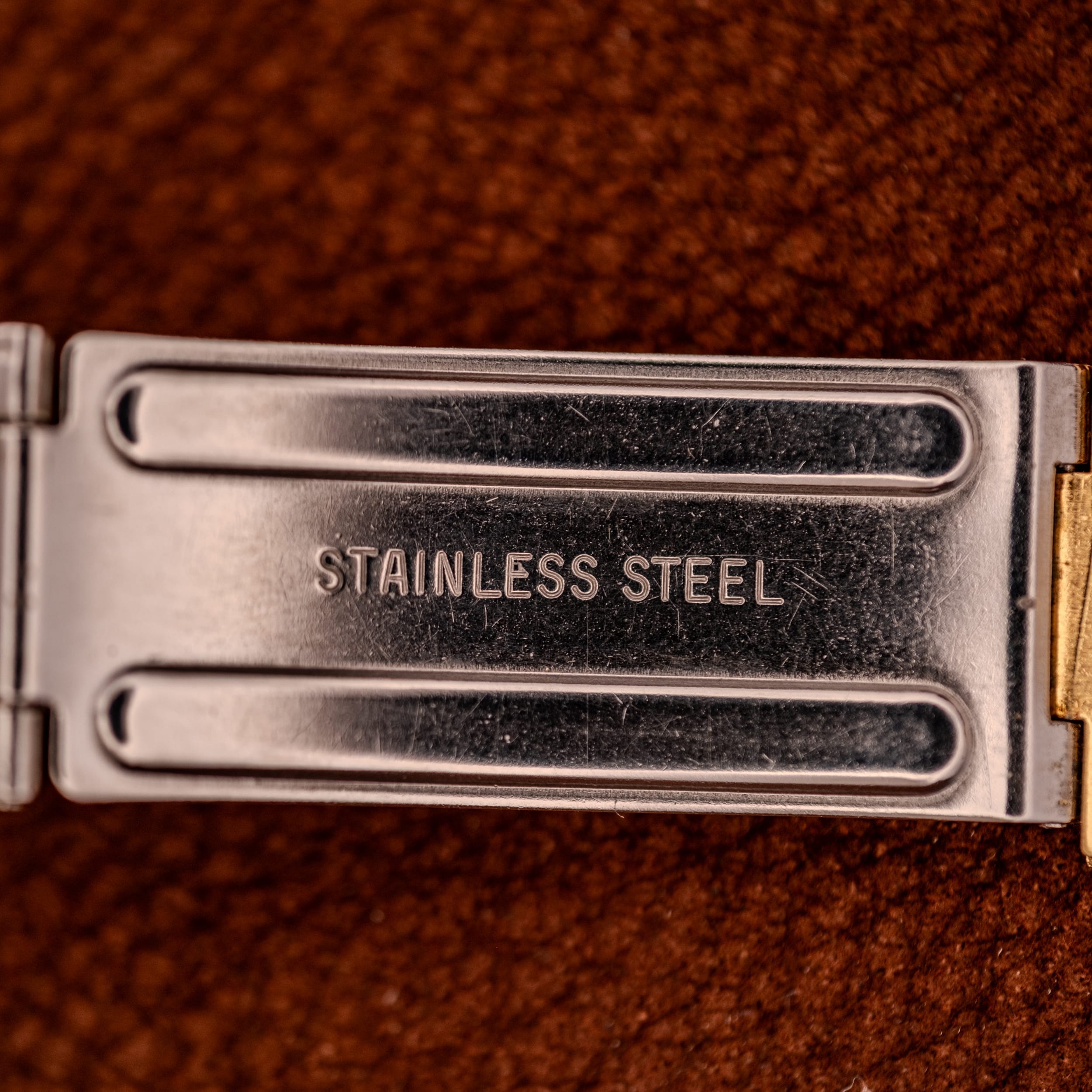
The watch comes on its original Zenith-signed gold-electroplated mesh bracelet, woven in a tight chain pattern with a faint herringbone texture that becomes more visible in raking light. The bracelet integrates directly into the cushion case shape rather than attaching via removable spring bars, a design decision that locks the watch into its period silhouette and gives it the integrated jewelry-on-the-wrist presence the MZM dress codes were designed for. The deployant clasp top is engraved with the stacked-Z Zenith geometric logo and the ZENITH wordmark, while the inside of the clasp blade is stamped “STAINLESS STEEL”, confirming the gold-electroplate-over-steel construction. Wear is honest, with light surface marks along the high points of the bracelet and on the clasp’s outer face, none of which interfere with the closure mechanism. Fits up to roughly an 8.5 inch wrist.
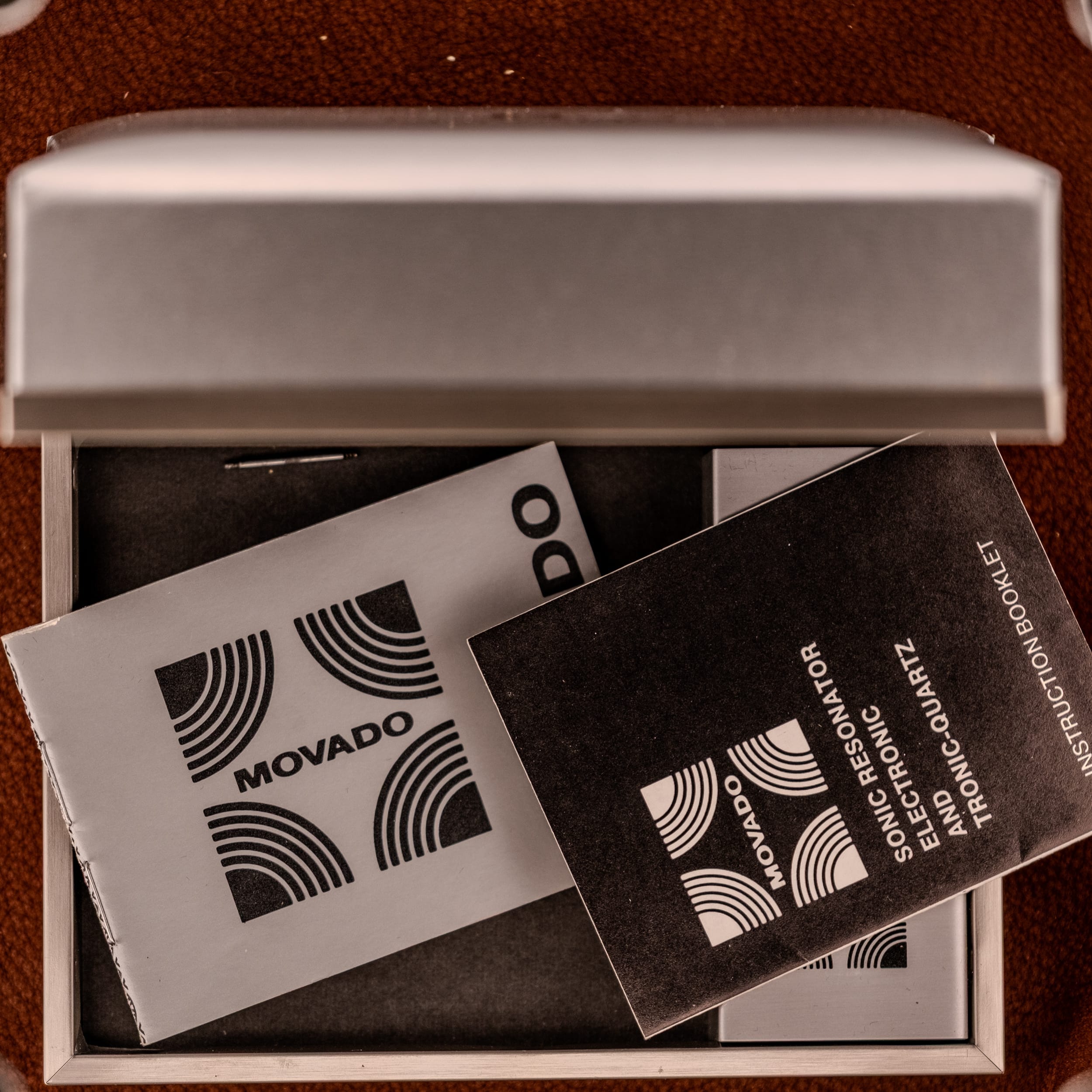
The watch comes with its original Movado presentation box and both period booklets: the silver Movado general booklet and the genuinely scarce black “MOVADO SONIC RESONATOR ELECTRONIC AND ELECTRONIC-QUARTZ TRONIC INSTRUCTION BOOKLET” that shipped with these calibers from new. Full-set tuning fork watches surface infrequently; full-set Movado Electronics with the original Sonic Resonator instruction booklet surface less frequently than that. Serviced in-house at OTTUHR and backed by our 2-year warranty, this is, in our opinion, the right way to put a Zenith Electronic on the wrist: a Movado-dialed example of the model that proves the MZM partnership actually built something rather than just sharing a P&L. For the collector who values the on-wrist behavior of a true tuning fork caliber and the period-honest detail of cross-signed crown and clasp engravings, this one rewards close inspection.