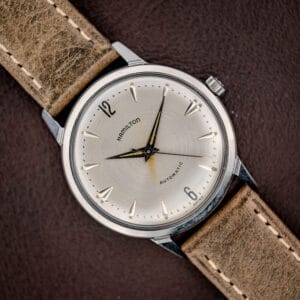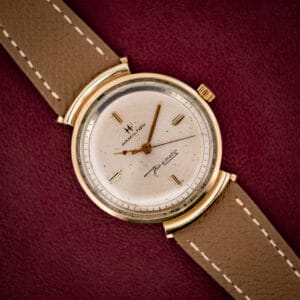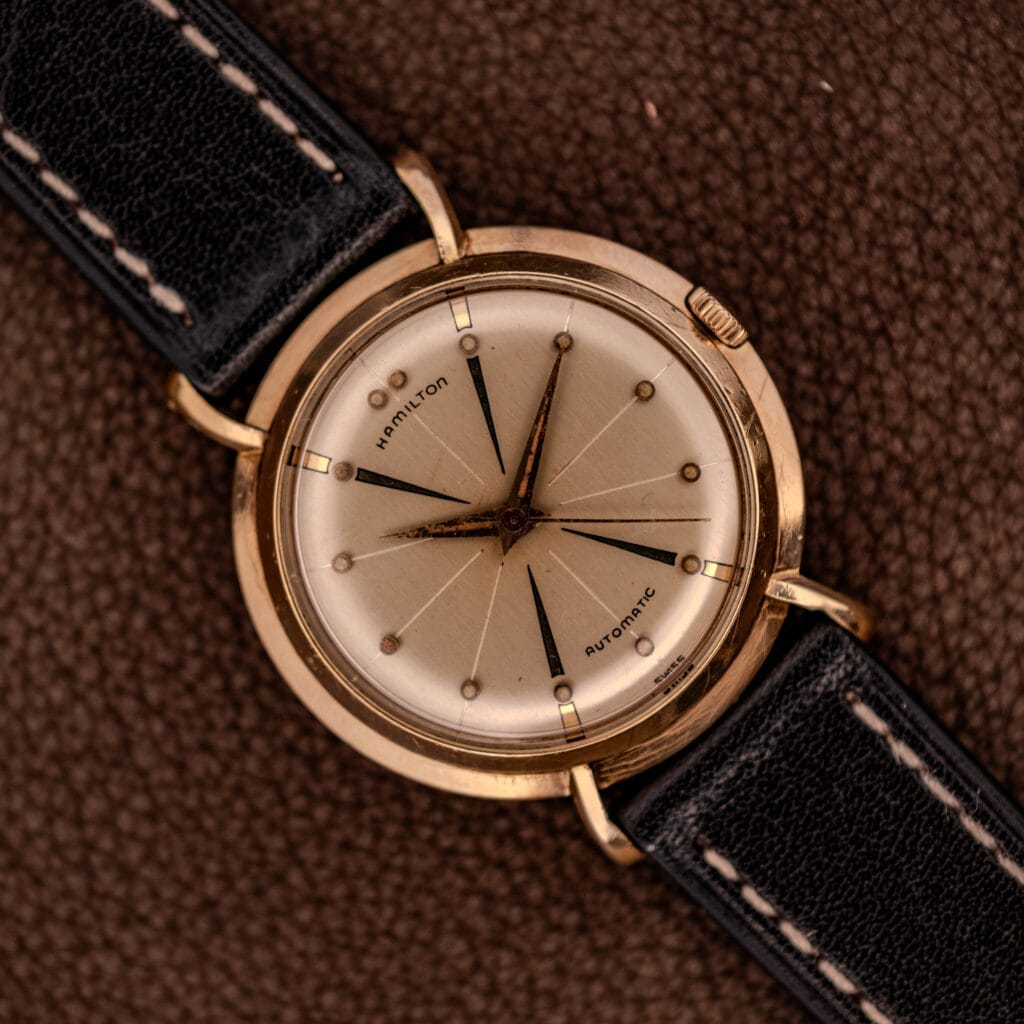
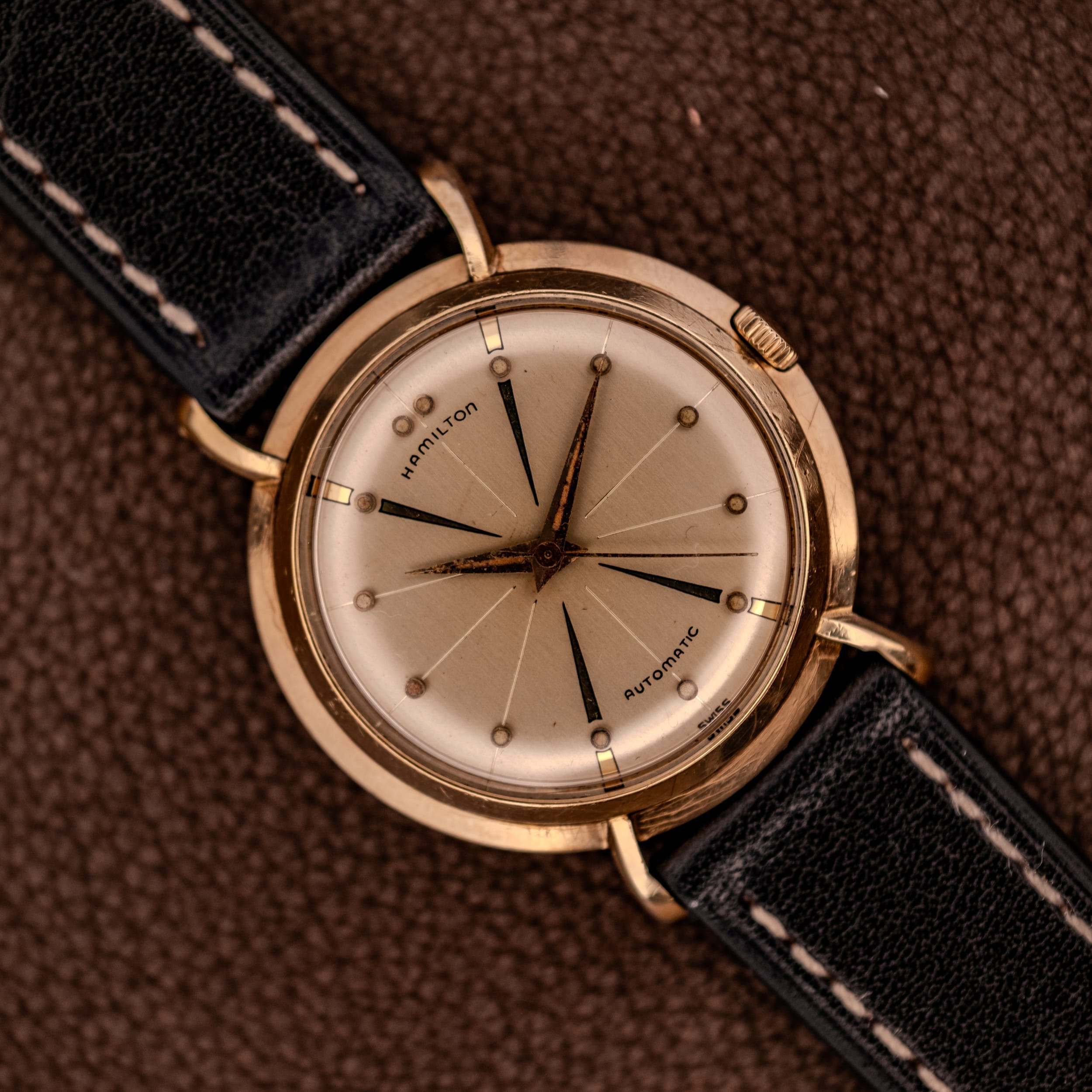
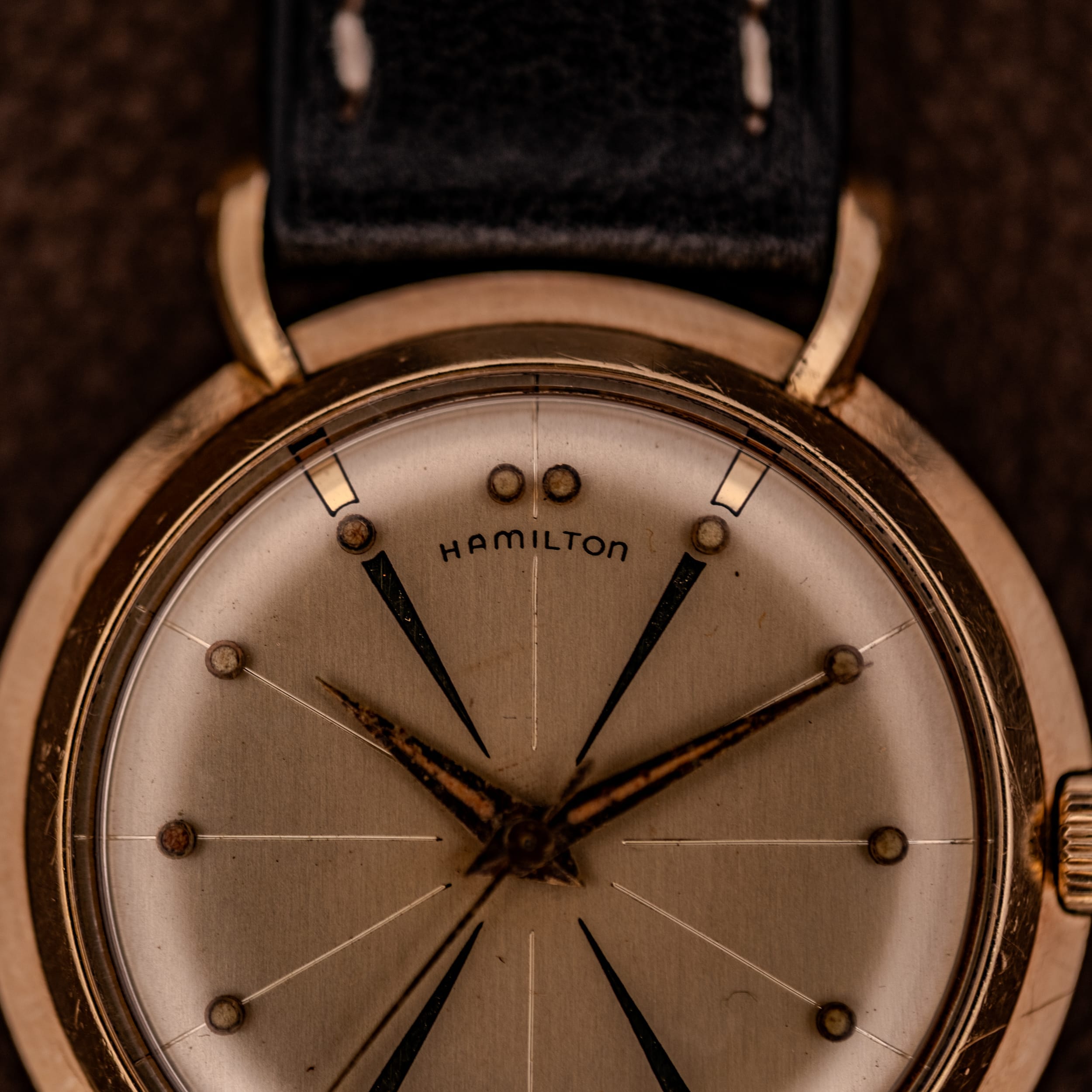
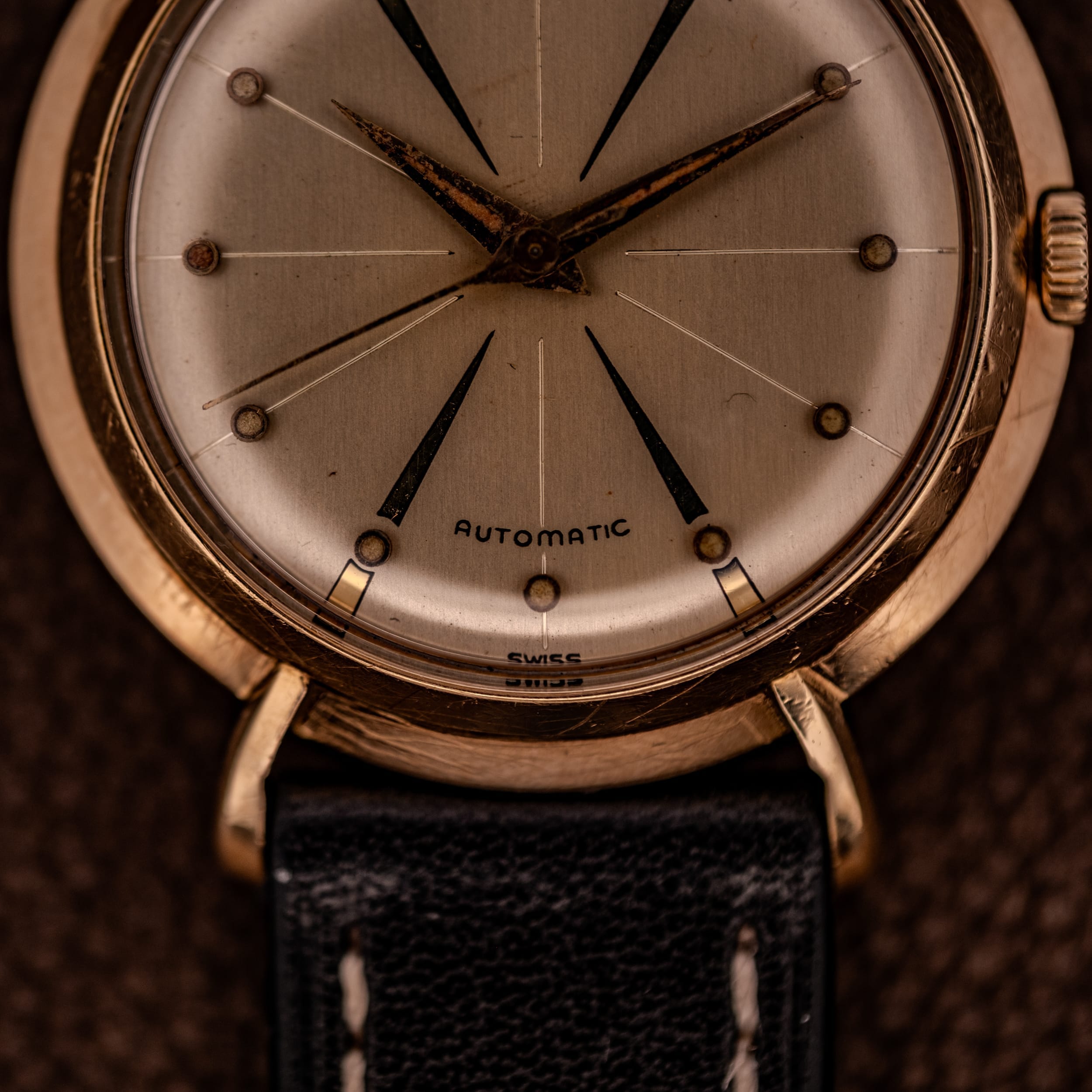
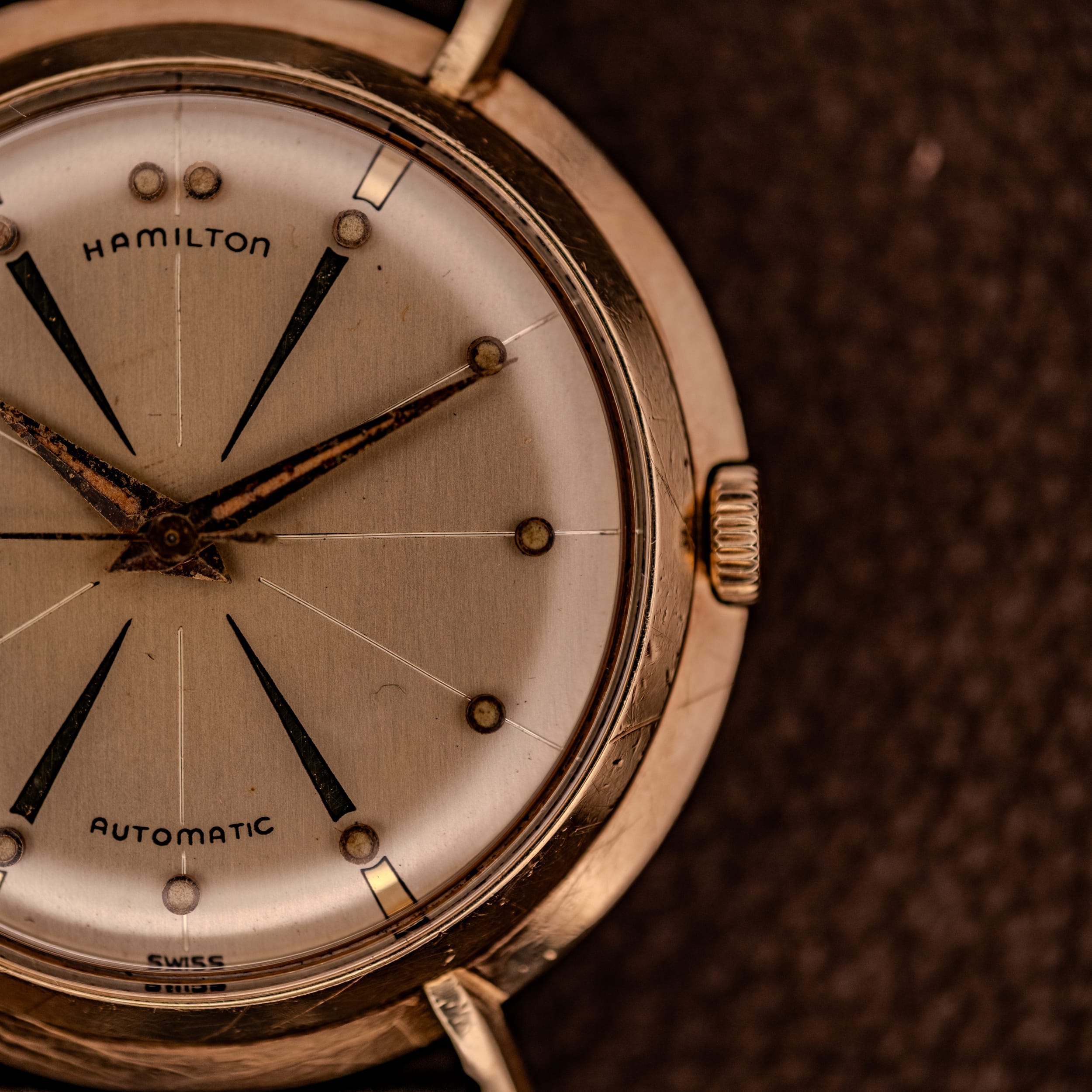
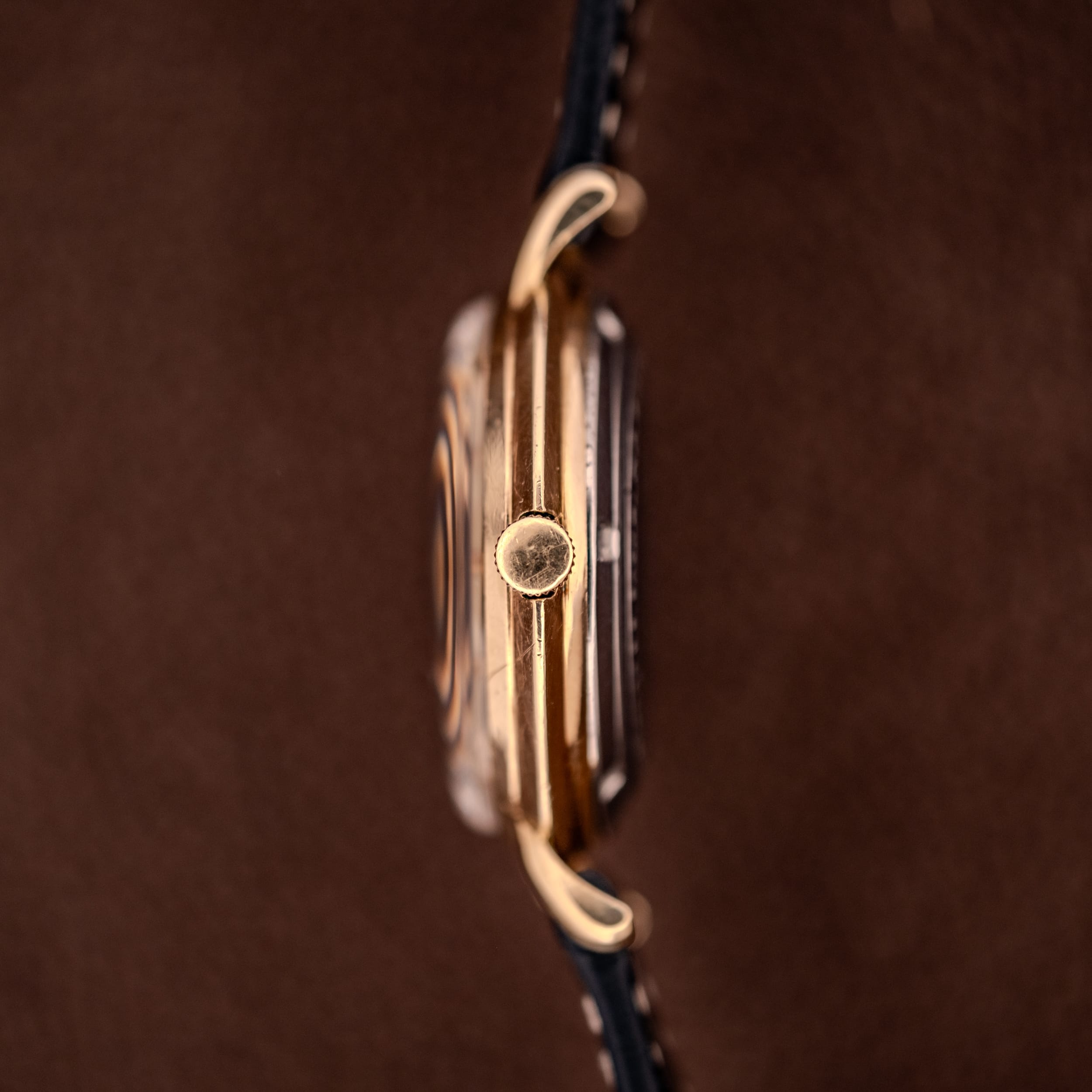
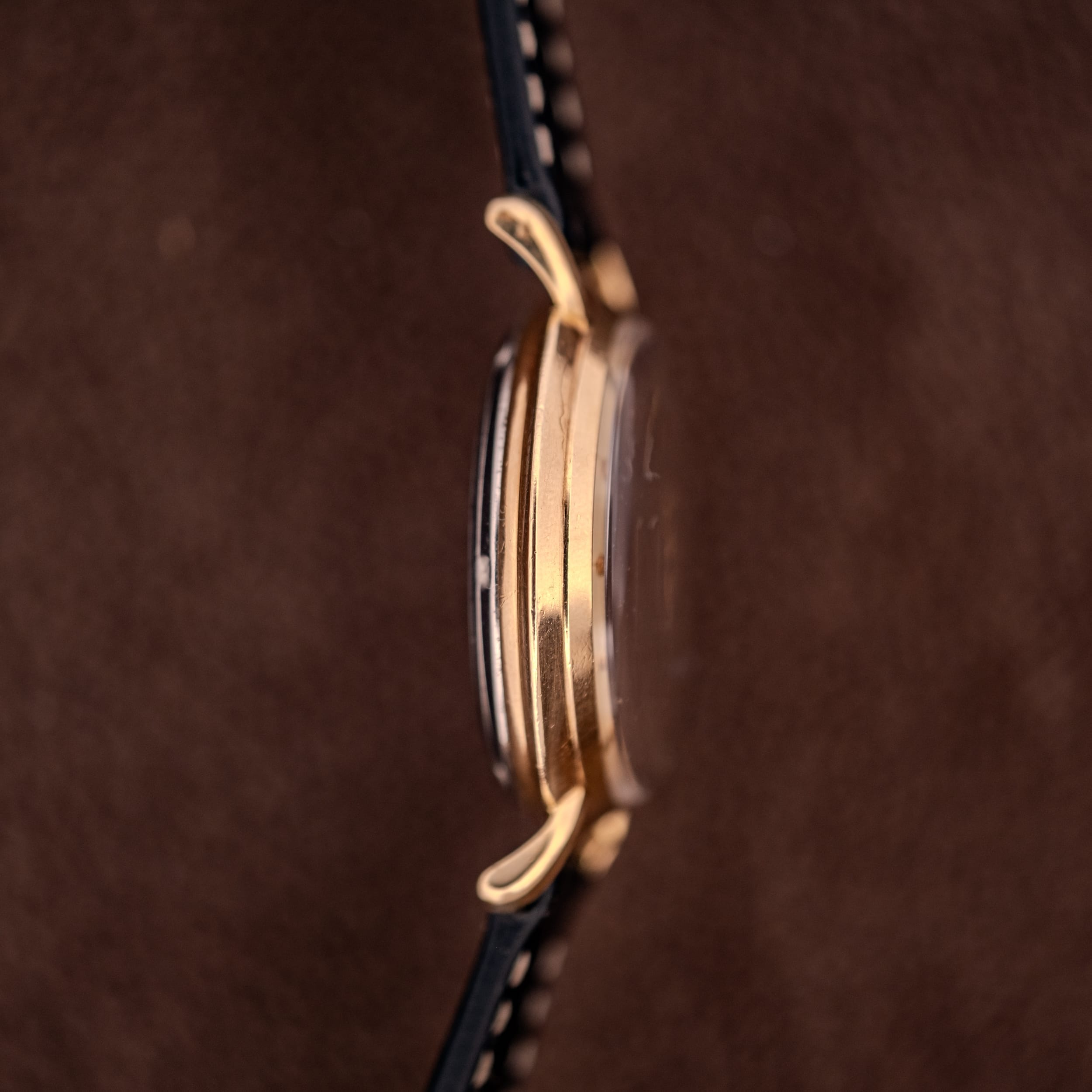
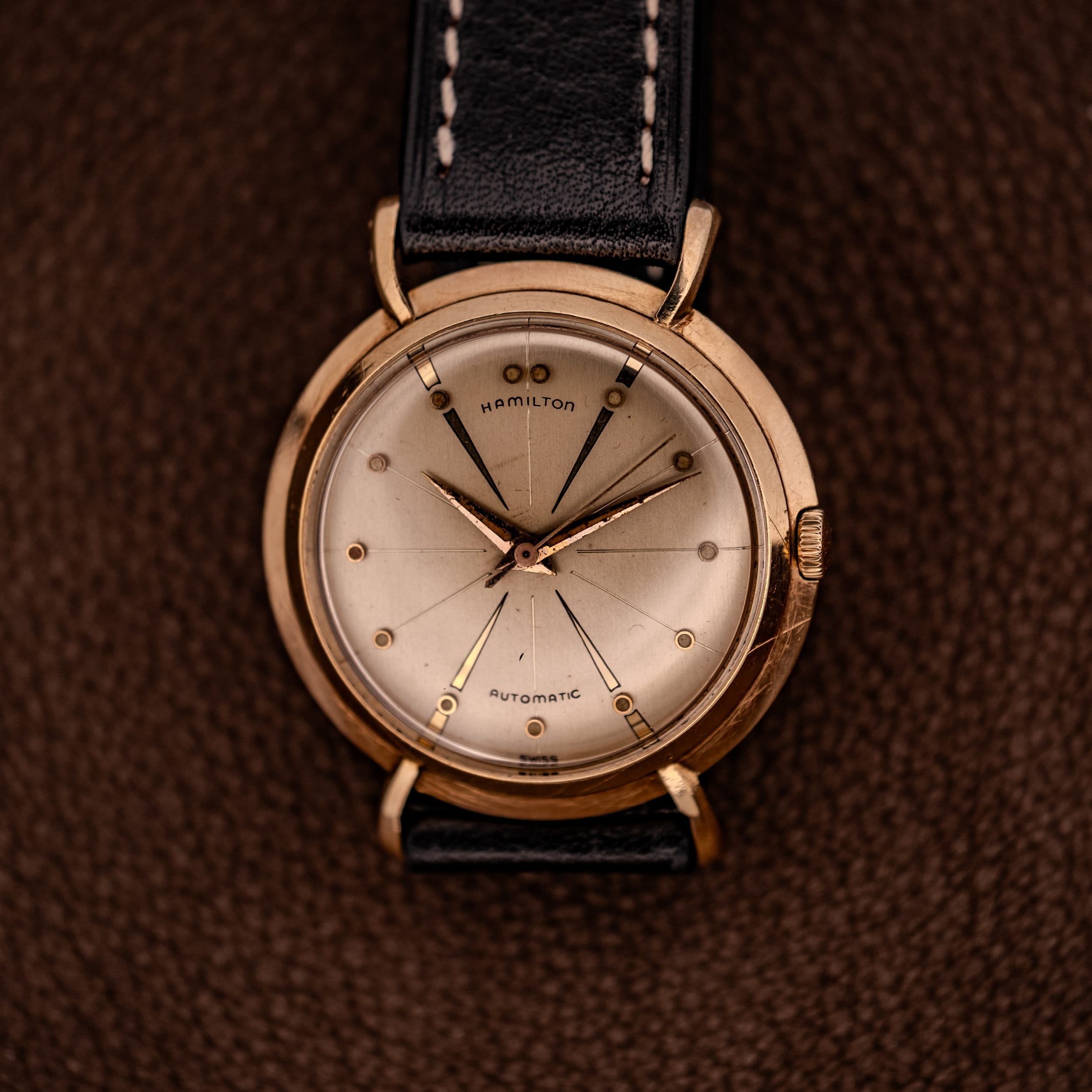
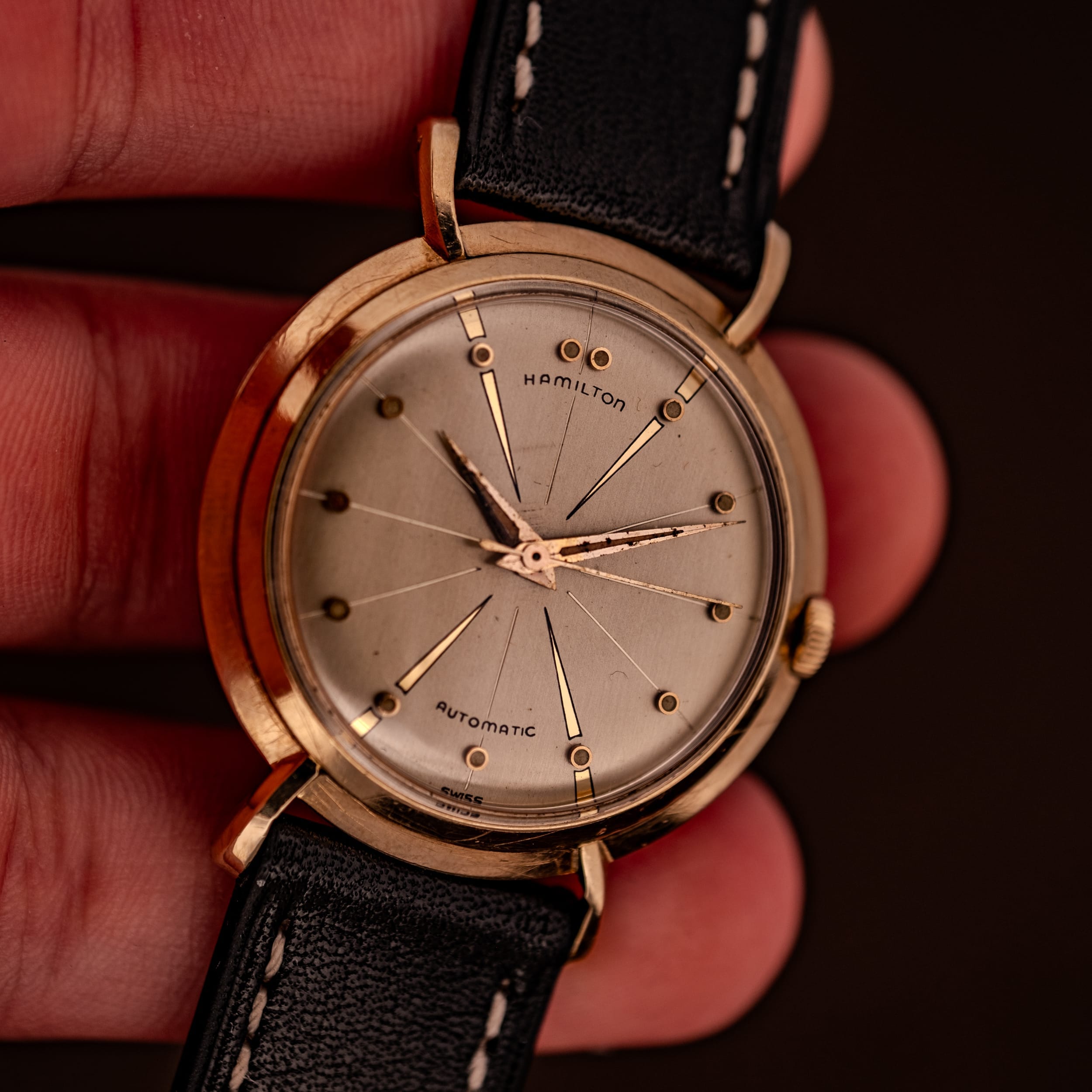
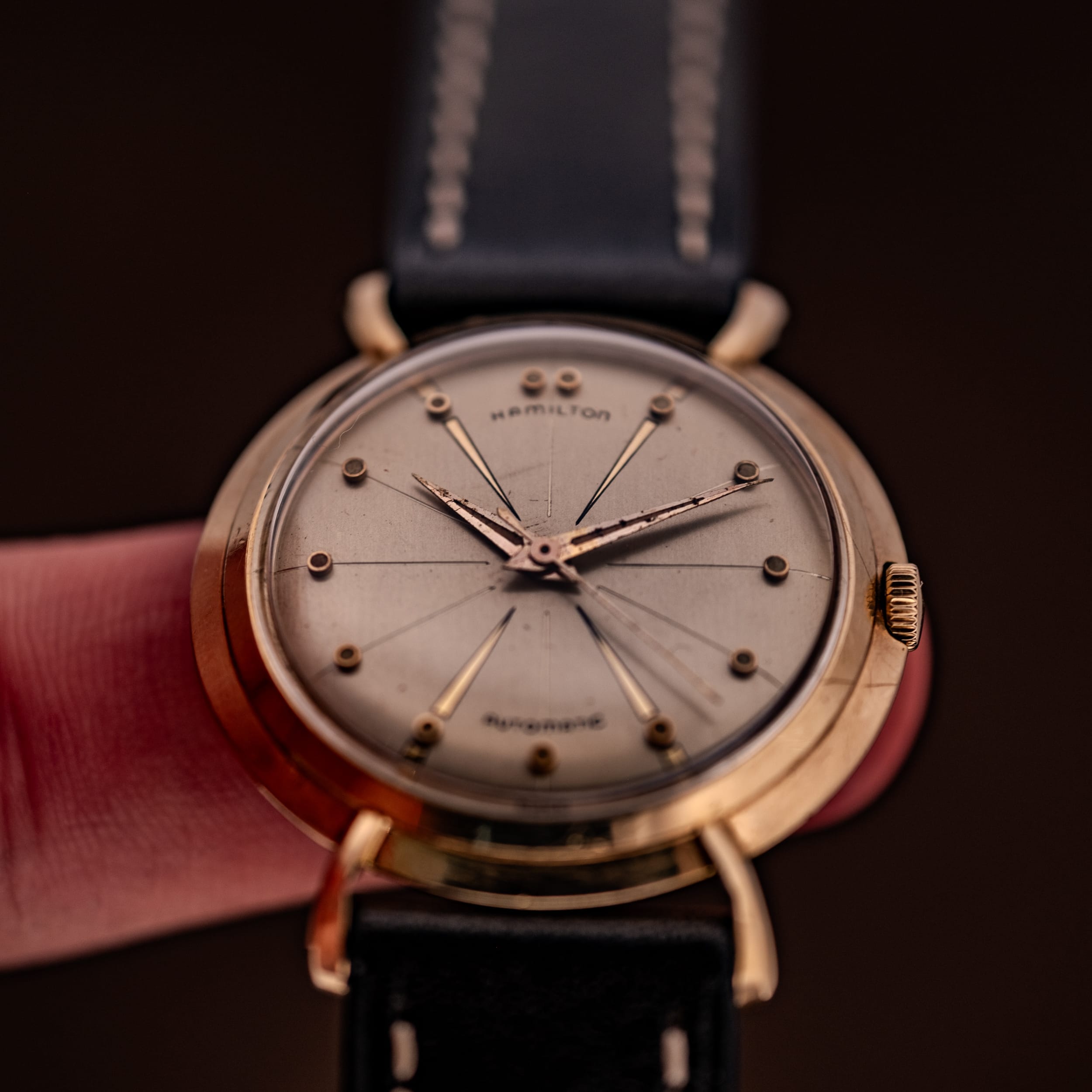
Most mid-century industrial design ideas stop at the dial. The Hamilton Sputnik, in our opinion, is one of the few wristwatches where the design idea continues past the dial, through the case, and out into the lugs as a single continuous gesture. Richard Arbib drew the K-454 in 1955 as part of his ongoing assignment with Hamilton, and what he produced was a watch whose dial daggers do not simply sit on the dial as decoration. They radiate outward from a center point and align, with engineered precision, with the swept-down angled lugs of the case itself. Look at the watch from above and the four daggers and four lugs read as eight arms of one starburst. That is the Arbib trick, and that is the genuine source of the “Sputnik” nickname collectors hung on this reference once Sputnik 1 went into orbit two years after the K-454 came to market.
Hamilton was a Lancaster, Pennsylvania firm with a deep American watchmaking pedigree by the time it released the K-454, but the K-prefix series sits at one of the most interesting inflection points in the company history. By 1954 Hamilton had launched its first automatic line, twelve models built around Swiss-supplied movements rather than the in-house American calibers the company had built its reputation on. The K-prefix denoted the 10K gold-filled cases in that automatic family. The reference numbering matters here because the K-454 is part of the same generation that produced the Asymmetric and, two years later, the Ventura, and Arbib hand is unmistakable across all of them. He was working out an industrial-design language for Hamilton that abandoned traditional round-and-square watch conventions in favor of cases that looked like satellite components, automobile fins, and 1950s American futurism made wearable.
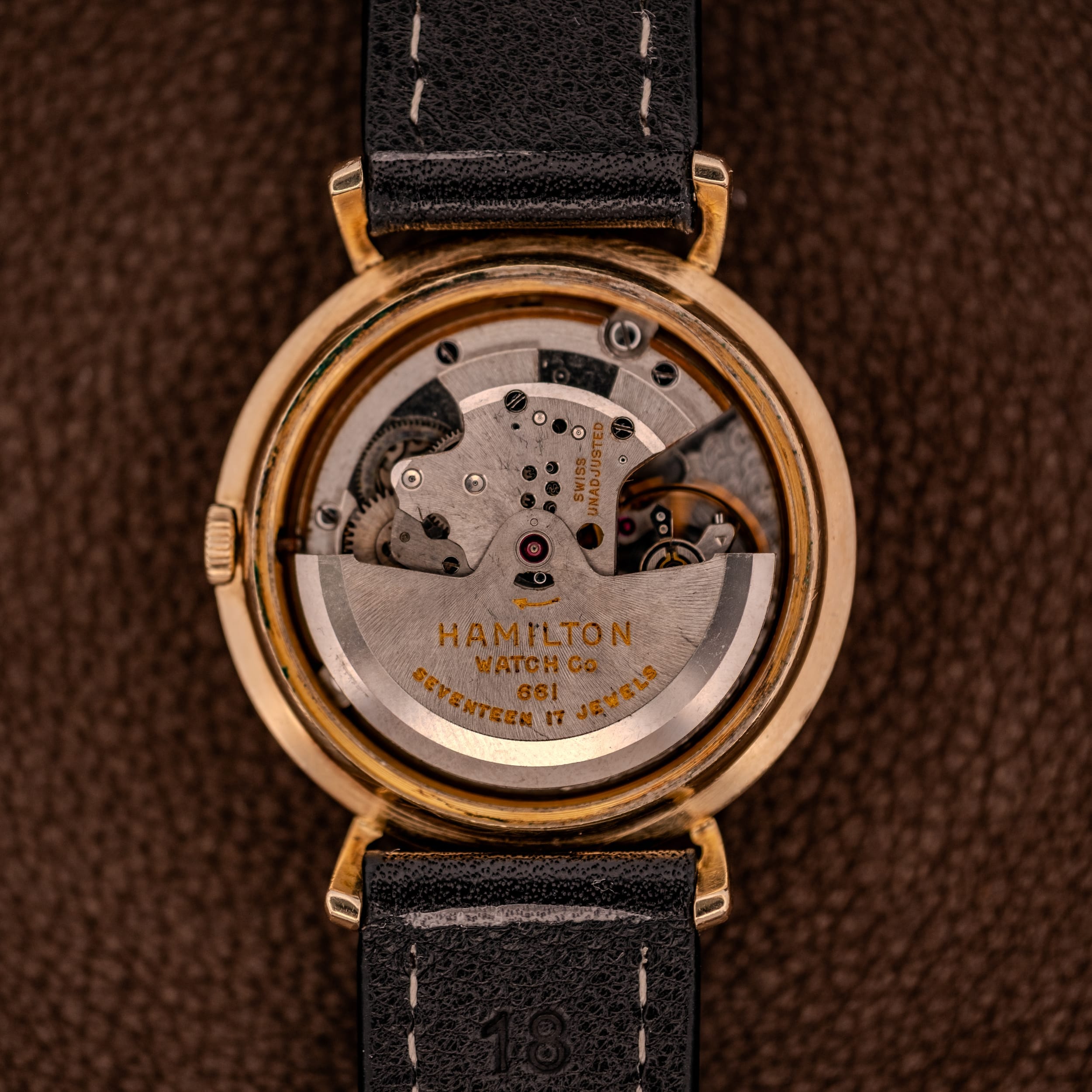
Powering this watch is Hamilton Caliber 661, which despite the American-sounding designation is a Certina Kurth Freres ebauche base, specifically the Certina 25-45, finished and signed by Hamilton. The 661 is a 17-jewel full-rotor automatic running at 18,000 vibrations per hour with a monometallic balance and shock protection. The base Certina 25-45 had been introduced in 1951, and Hamilton adopted it as part of the 1954 push into automatic winding. There are mechanical sisters to the 661 (the 664 and 665) that share the bridge architecture and rotor system but use proper ruby jewels in the auto-winding train; the 661 used non-ruby bearings there to hit a price point. Open the caseback on this example and the Hamilton-signed rotor is engraved “HAMILTON WATCH Co 661 SEVENTEEN 17 JEWELS” in gold lettering, with “SWISS UNADJUSTED” stamped on the bridge above the balance. The bridge plate carries a rose-gilt finish typical of mid-1950s Swiss movement work, and the visible red balance jewel reads cleanly under the rotor.
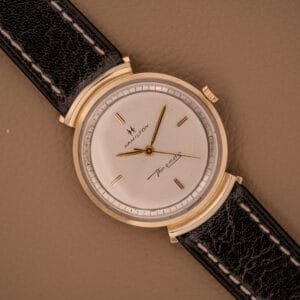
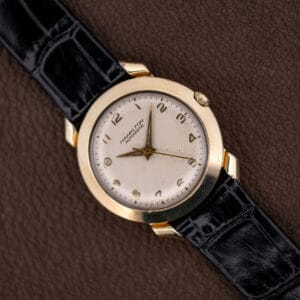
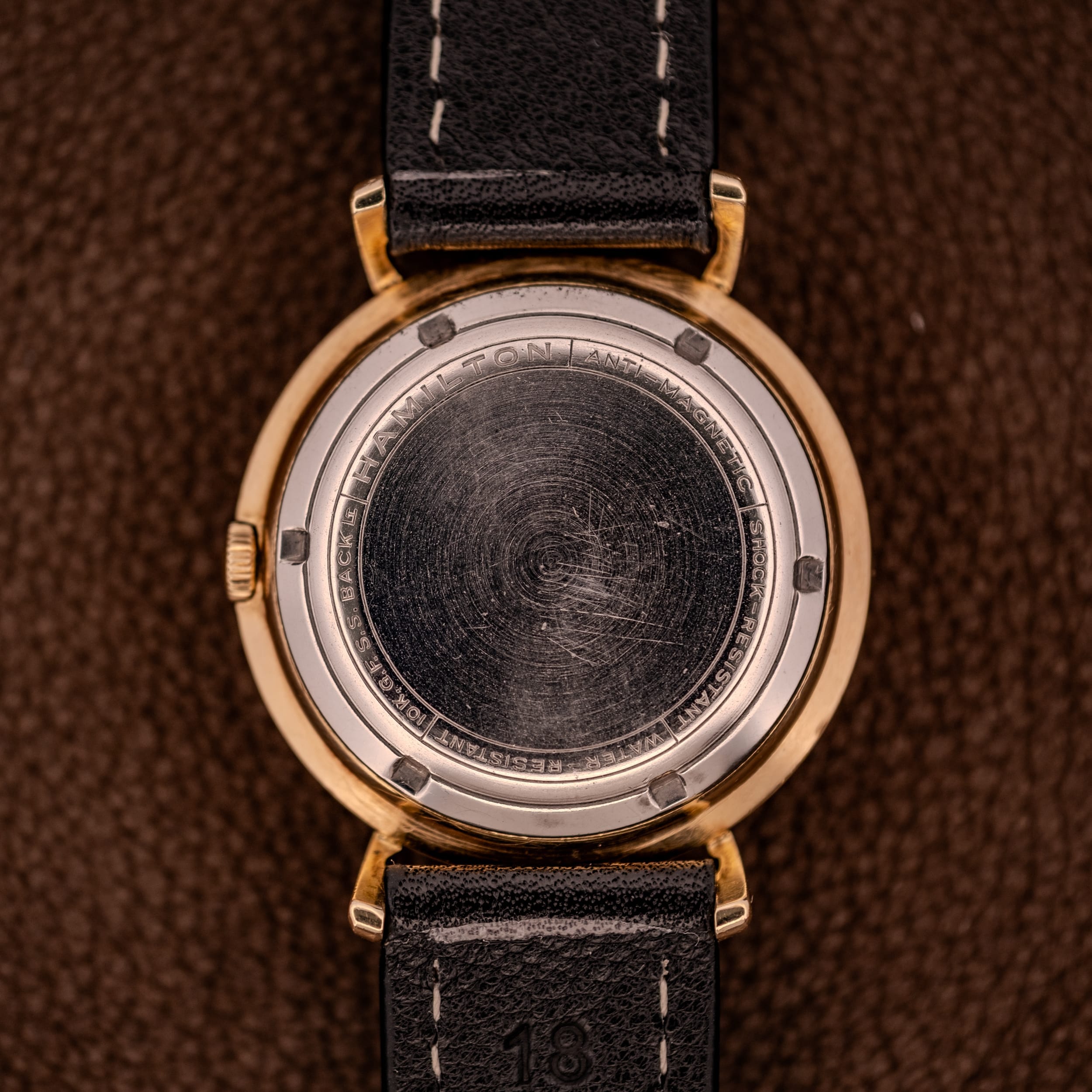
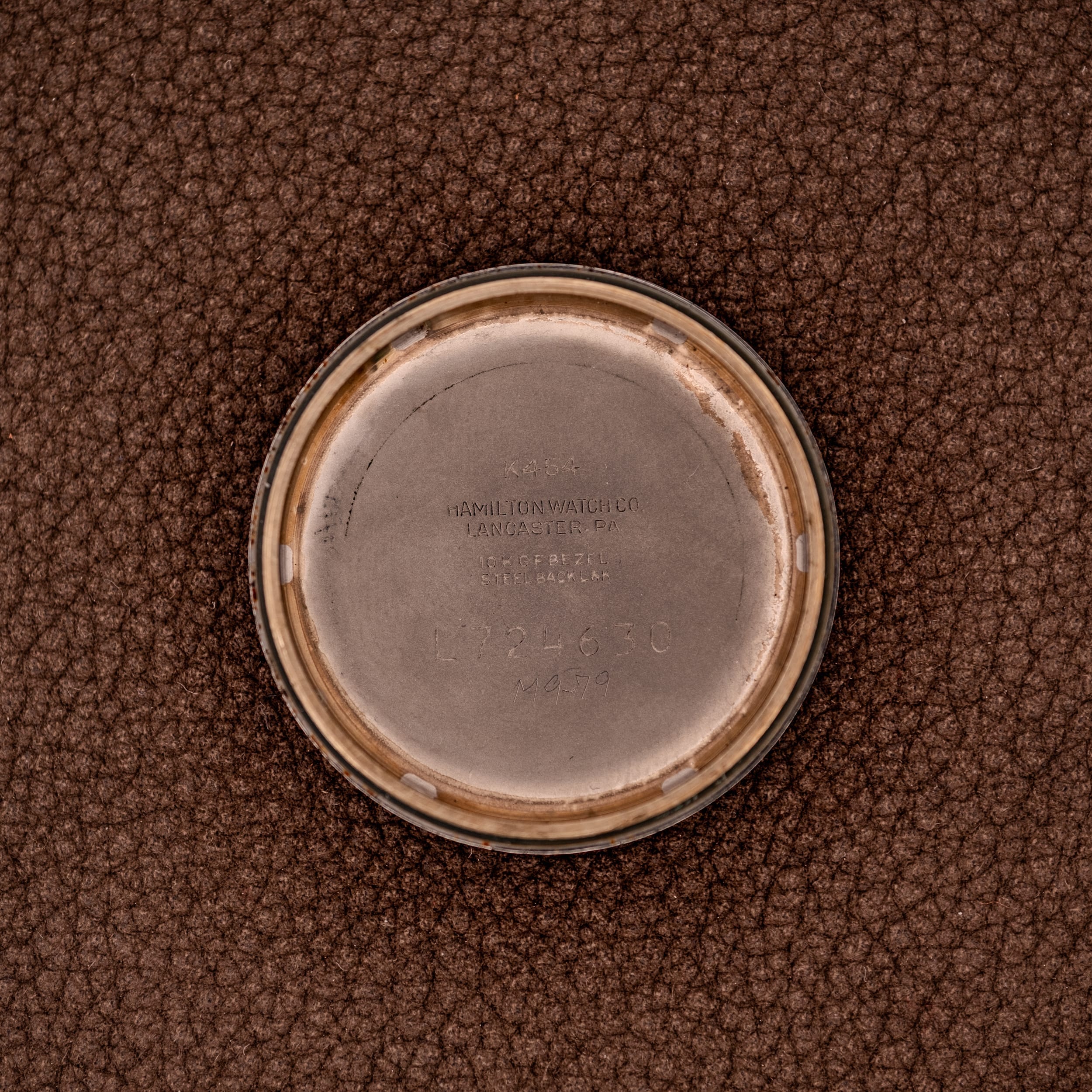
The case is 10K yellow gold filled, measuring 34mm across and approximately 41mm lug to lug, with a stainless steel central caseback disk inset into a gold-filled outer caseback ring. The outer caseback ring is engraved verbatim with “HAMILTON”, “ANTI-MAGNETIC”, “SHOCK RESISTANT”, and “WATER RESISTANT” around its perimeter, with the central stainless steel disk showing decades of honest concentric scratching from repeated service openings. The inner caseback carries the Hamilton Watch Co Lancaster PA stamping along with the K-454 reference number and the case serial number, all consistent with American assembly of the Swiss movement that Hamilton finished and signed in Lancaster. The case sides show light surface wear from sixty-plus years of being worn, with no aggressive polishing and no thinning of the gold-fill at the high points. The signed onion crown sits at 3 and seats cleanly against the case; this is not a sport watch, and Hamilton “Water Resistant” engraving on a 1955 dress automatic should be read as splash protection rather than as a contemporary water-resistance rating.
The silver dial wears its decades quietly. The base surface is satin-brushed silver with fine engraved starburst lines radiating from center to the outer edge of the dial, a secondary visual element that reinforces the dagger architecture above it. The four applied dagger markers at the 1, 5, 7, and 11 positions are gold-edged with dark enamel-filled centers, sitting flush to the dial and faceted to catch light from any angle. Between the daggers, small round applied gold dot markers with aged warm-cream luminous fills punctuate the remaining hour positions, with paired dots flanking the HAMILTON signature at 12 and the AUTOMATIC signature at 6. The dauphine hour and minute hands have aged from their original gold tone to a warmer copper-brown patina that reads honestly as decades of light exposure rather than as damage. The center sweep seconds hand has aged similarly. There is no retouching anywhere on this dial.
We are presenting this watch on a black smooth leather strap with cream contrast stitching, sized to the K-454 17mm lug width. The black-on-gold pairing reads cleanly mid-century, and the contrast stitching keeps the strap from disappearing visually against the dark leather. The buyer can swap to brown for a softer feel or to a NATO for a more casual rotation; the 17mm lug width is uncommon enough that a curated change is worth doing rather than grabbing any 18mm strap from a drawer.
Serviced in-house at OTTUHR and backed by our 2-year mechanical warranty, this Hamilton Sputnik is, to us, one of the more conceptually complete vintage American watches a collector can put on the wrist. The Arbib industrial-design idea actually works on the wrist in a way it never quite does in photographs, and the K-454 specifically is the cleanest expression of his radiating-dagger-into-lug concept that Hamilton ever produced. For the collector who values a watch where the design intent is fully resolved across dial and case rather than treated as two separate problems, this Hamilton is, in our opinion, the right place to start with mid-century American watchmaking.