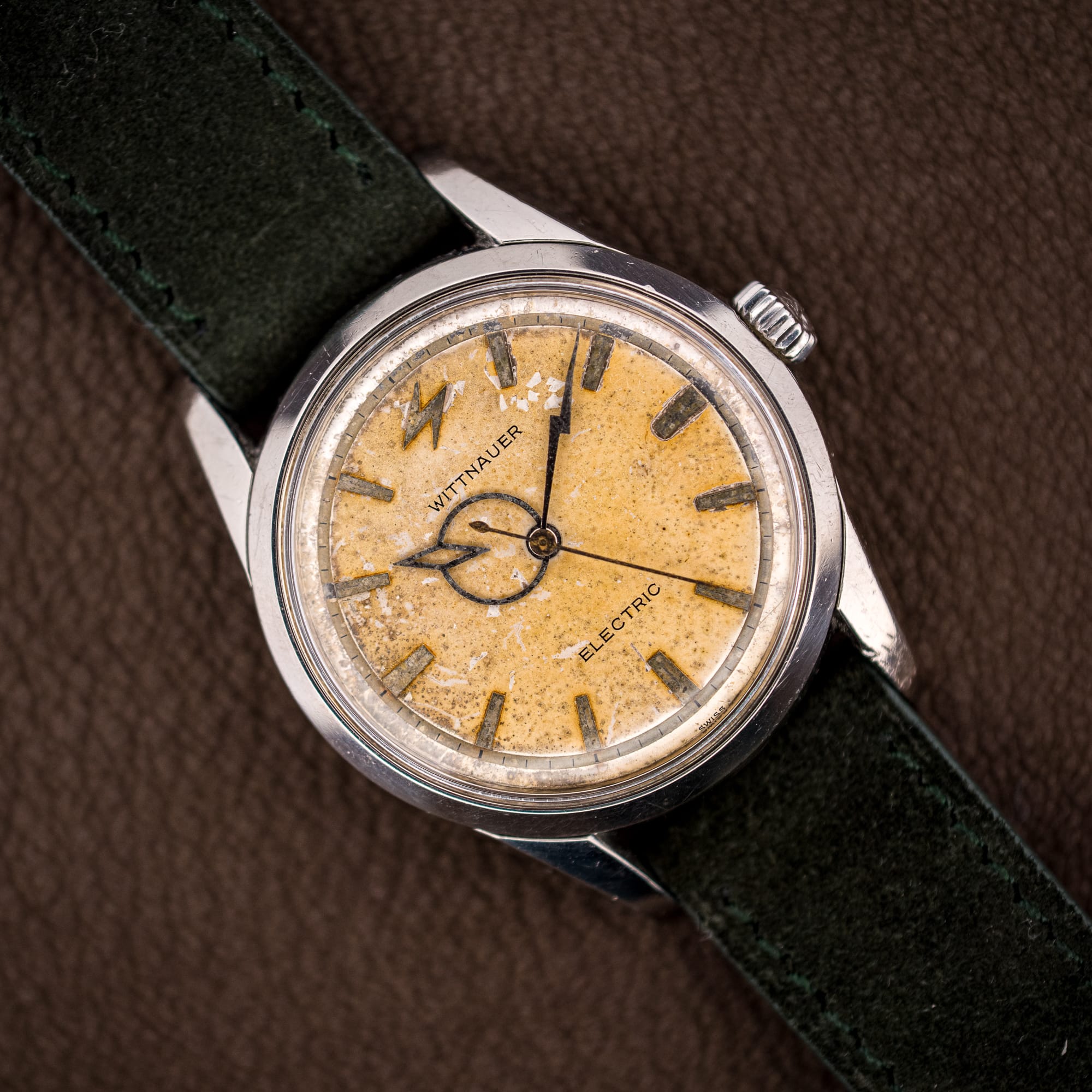
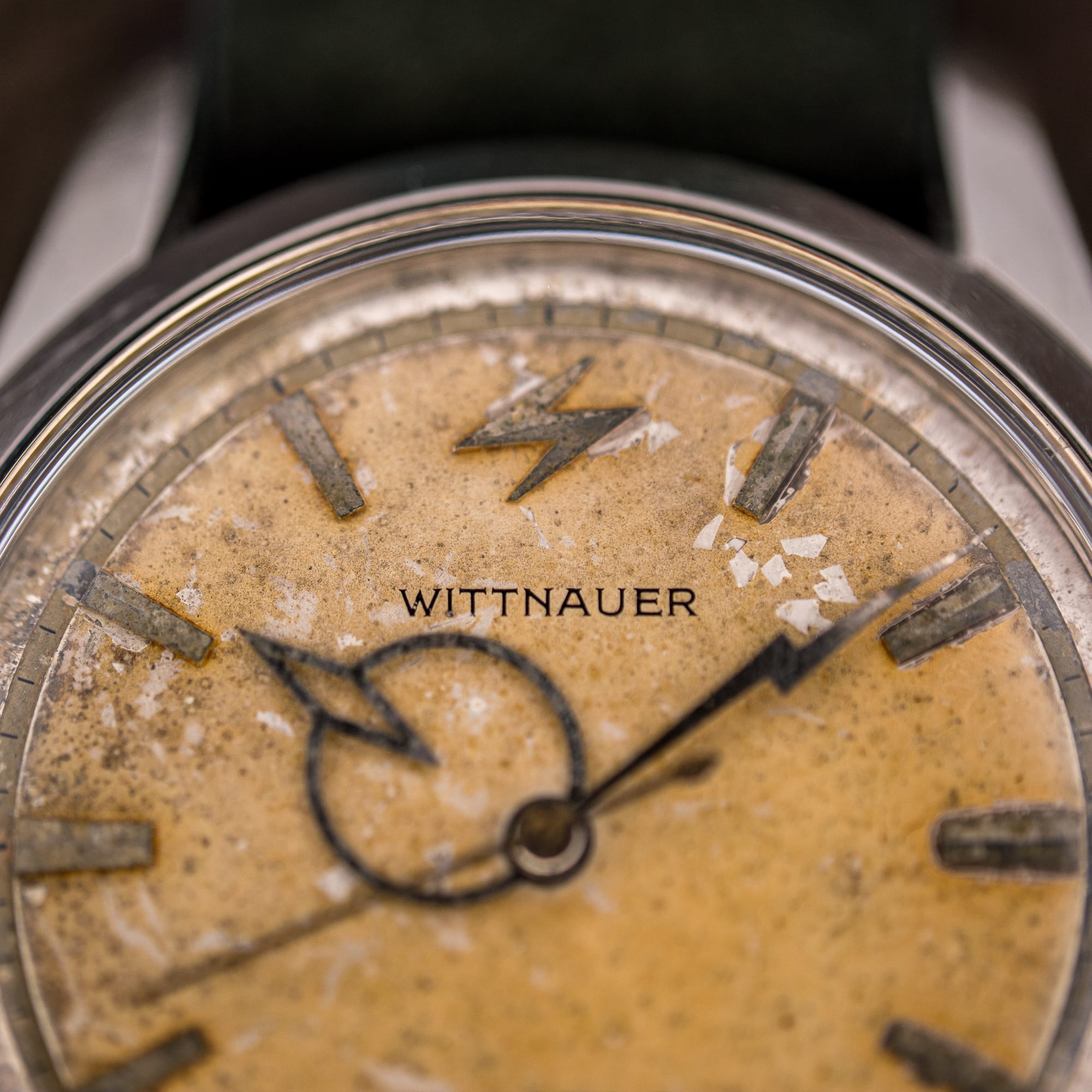
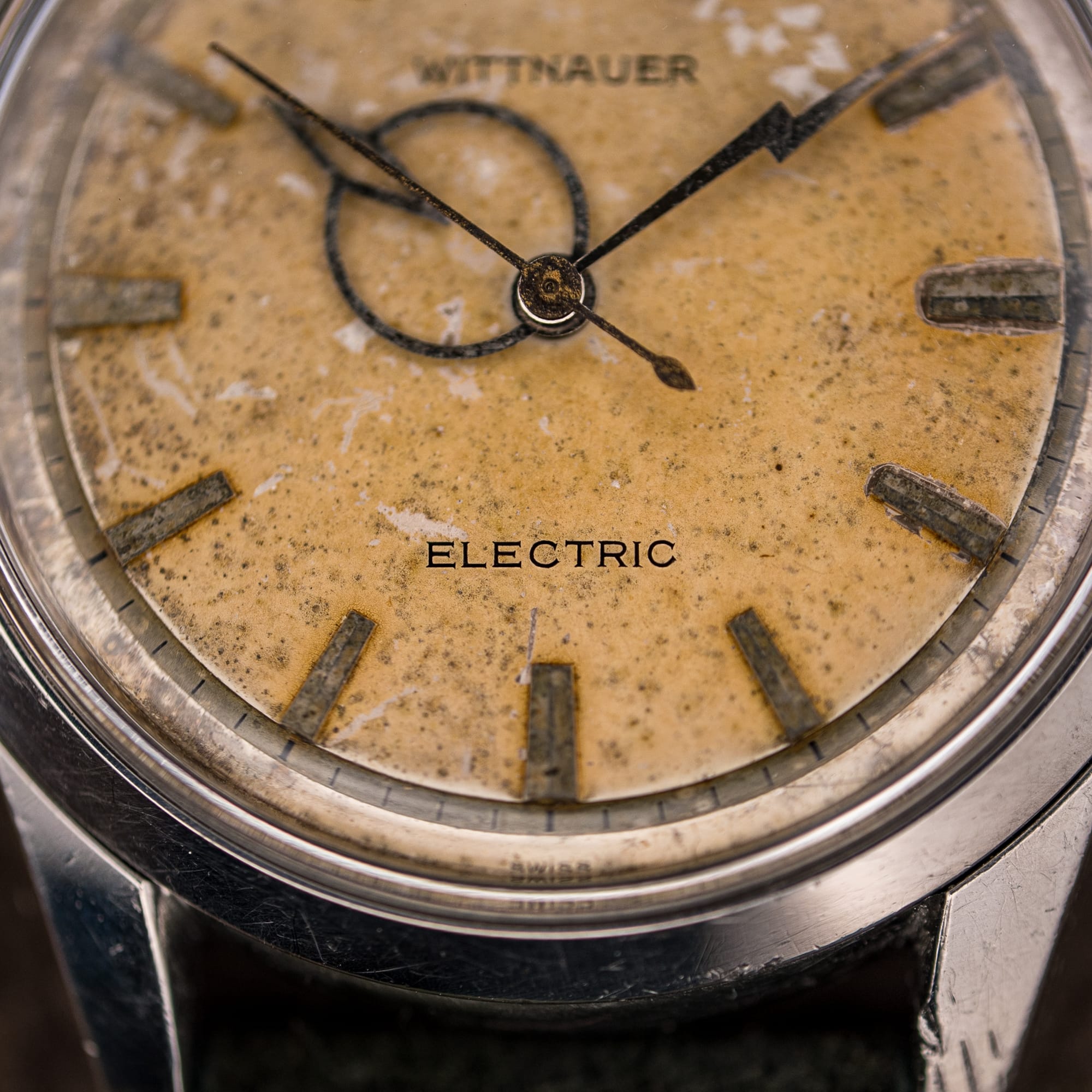
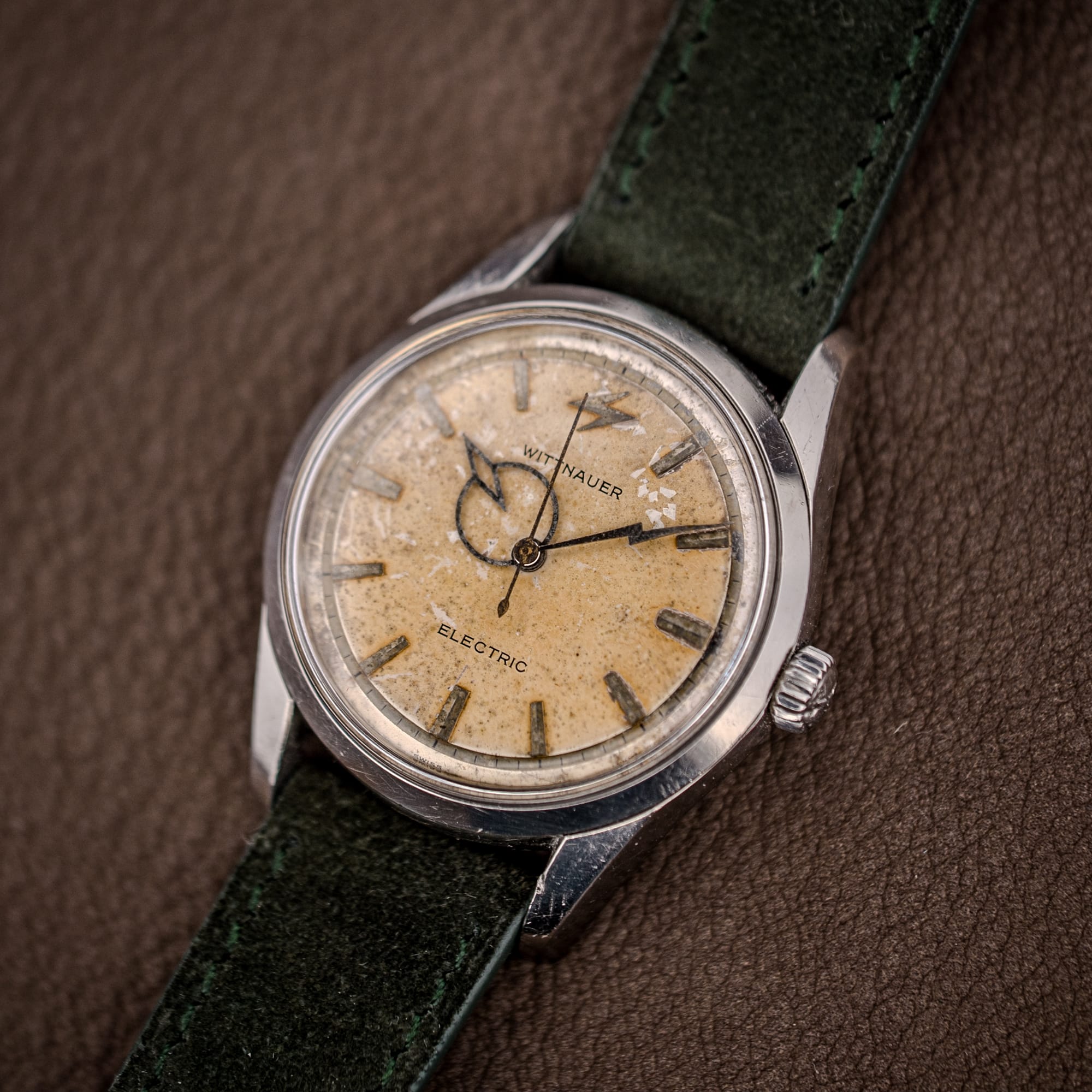
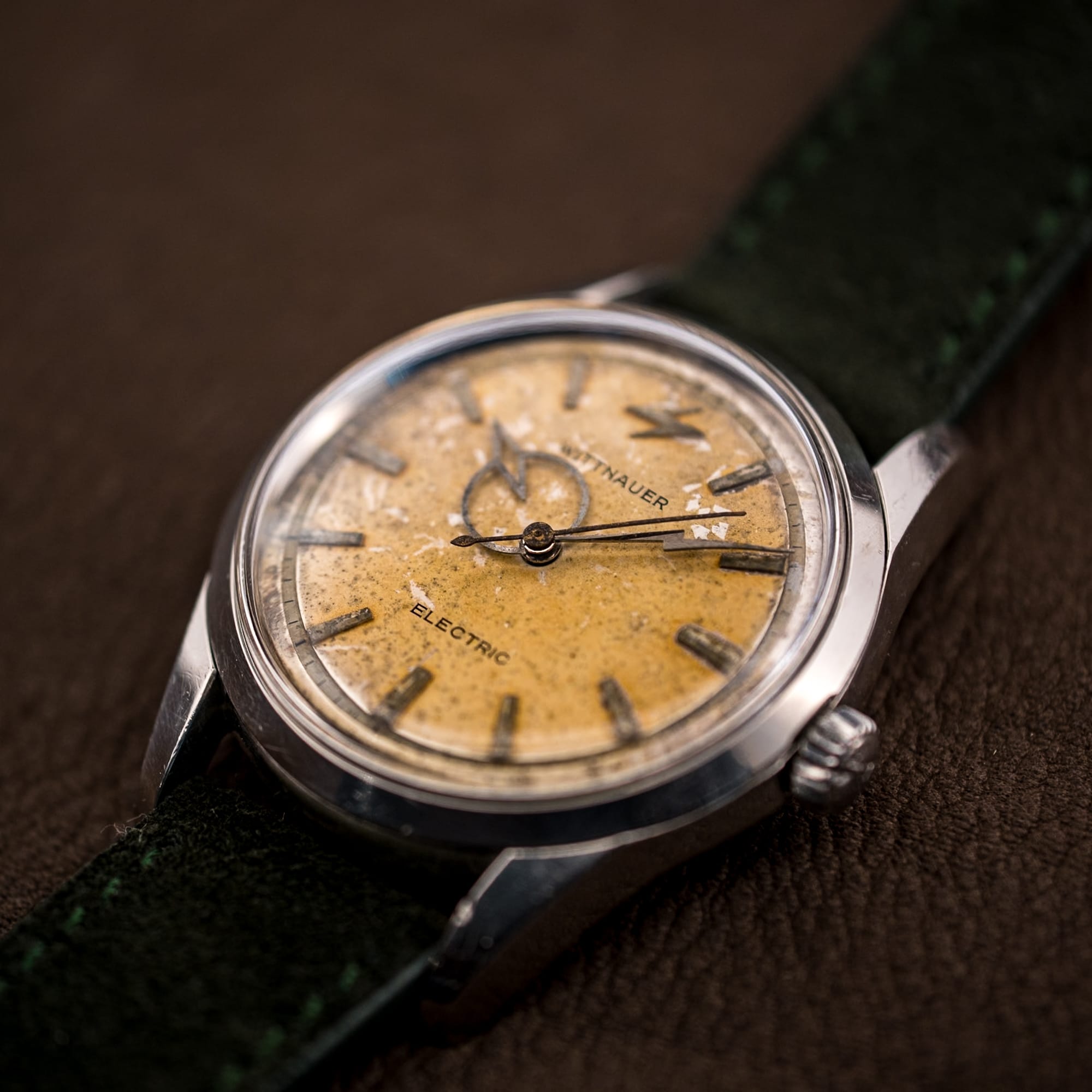
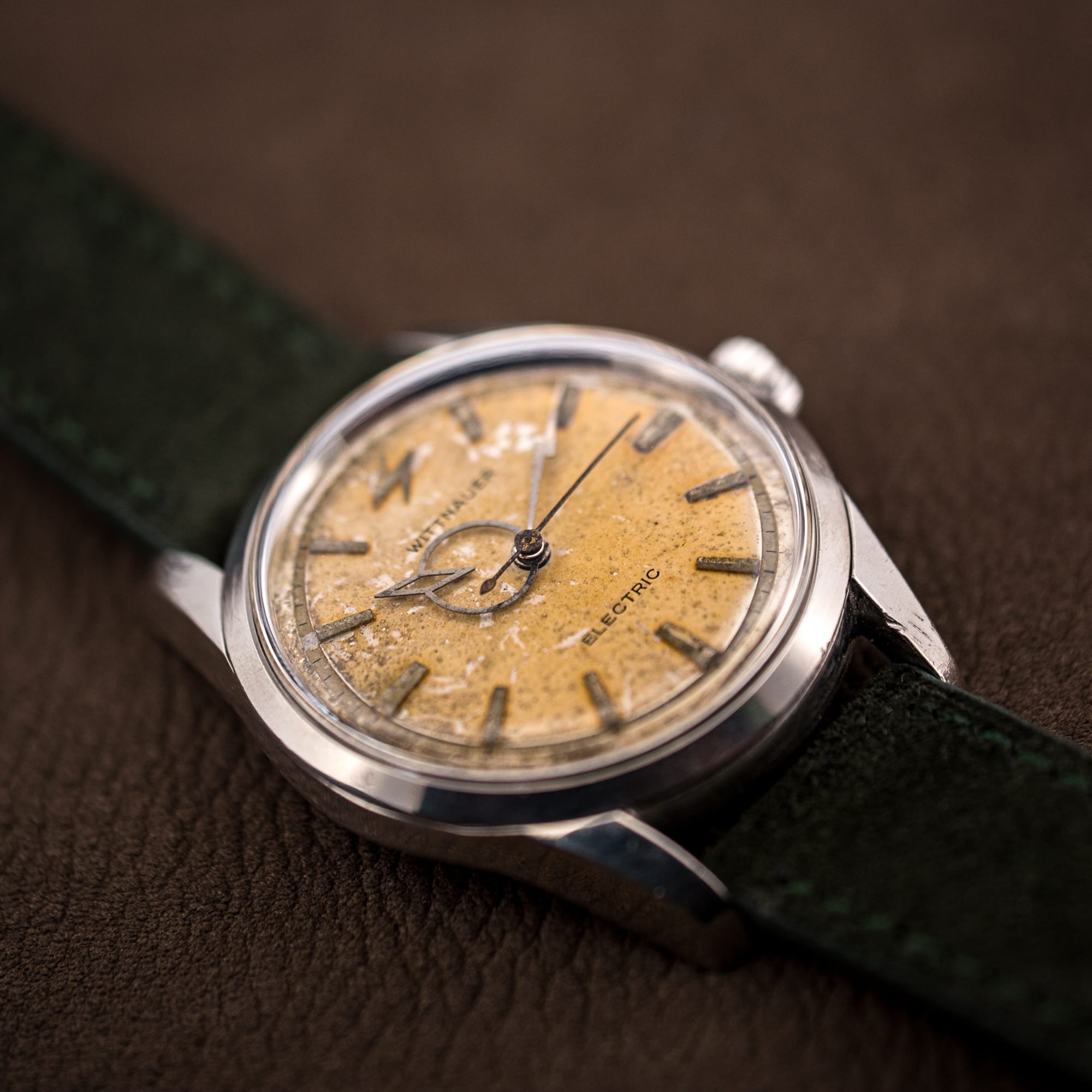
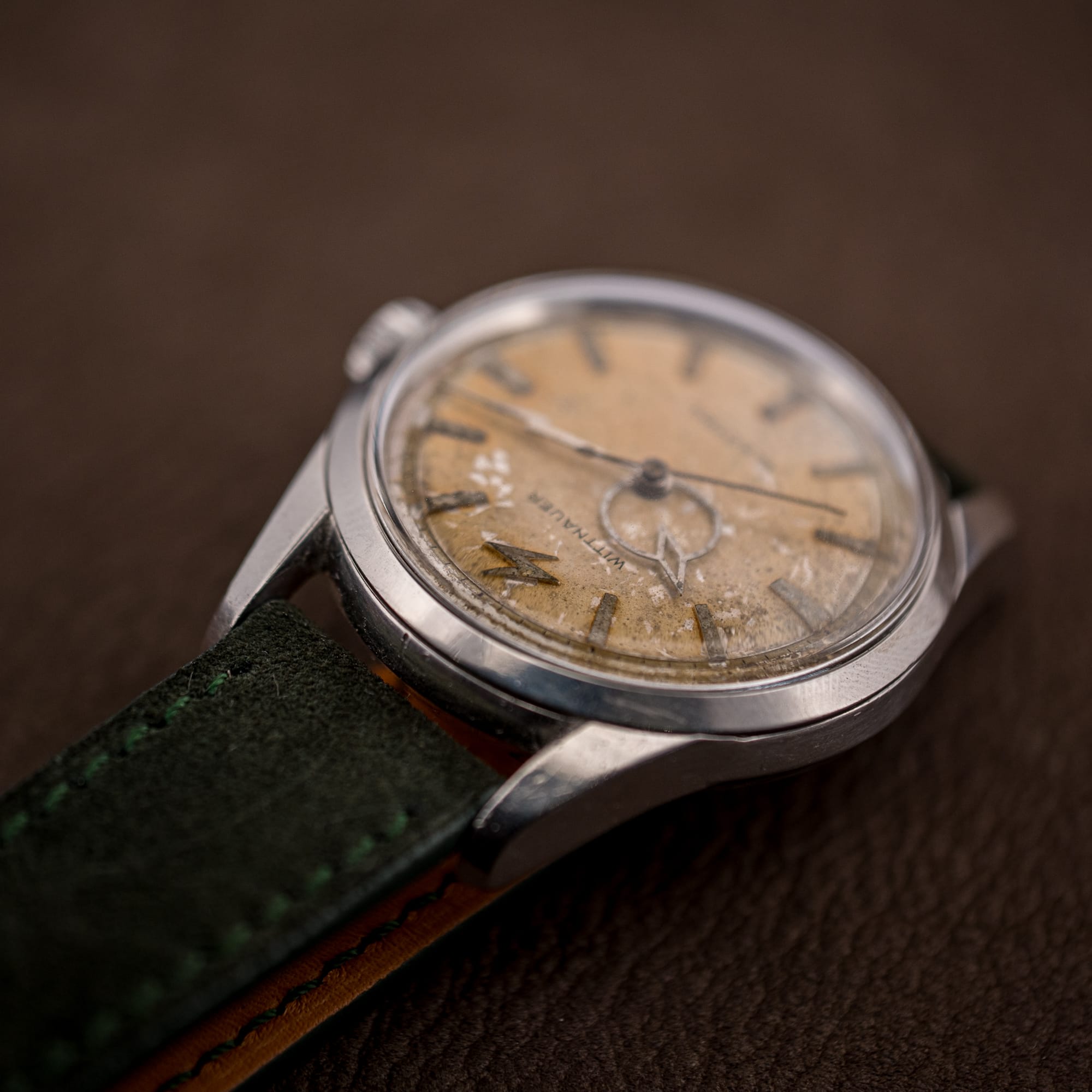
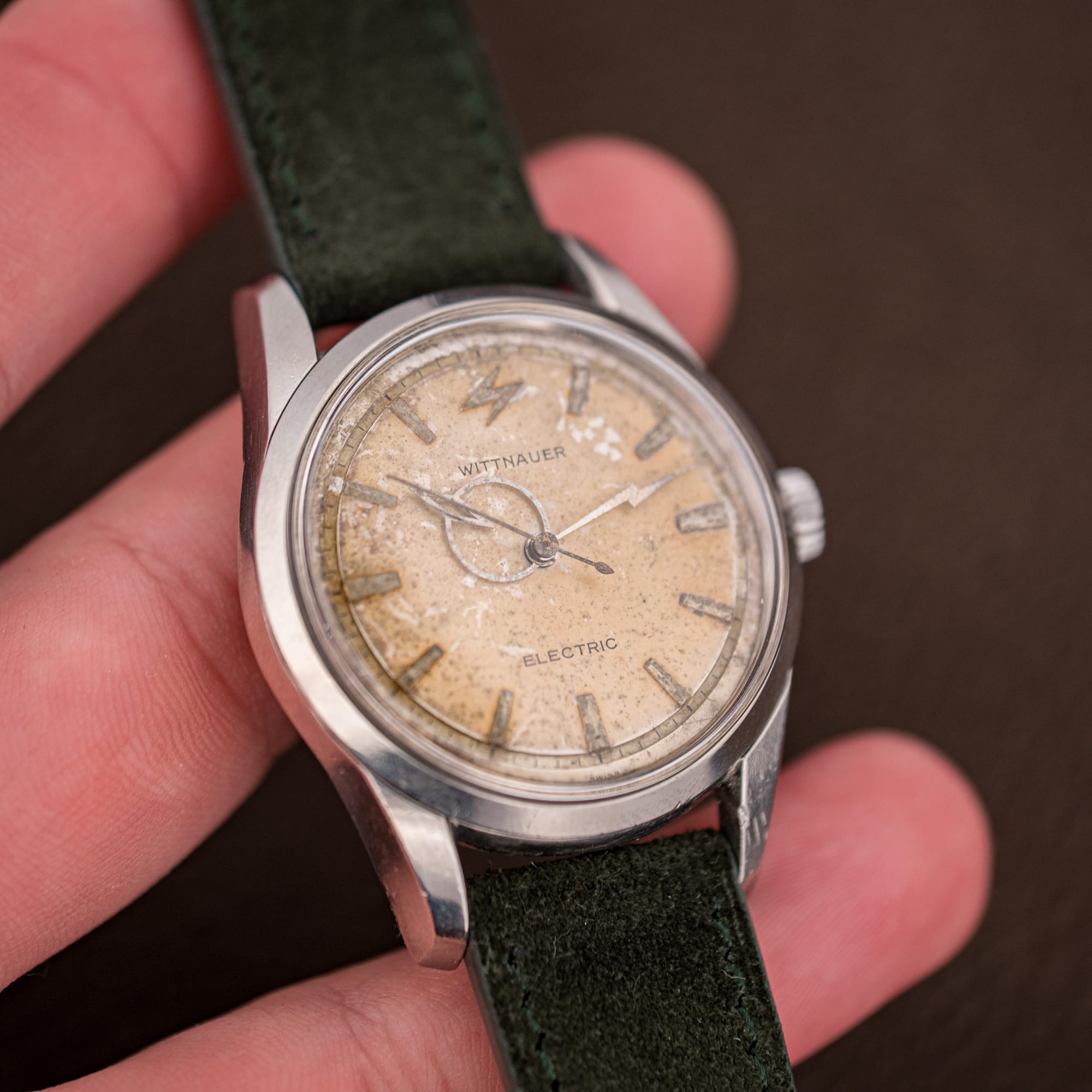
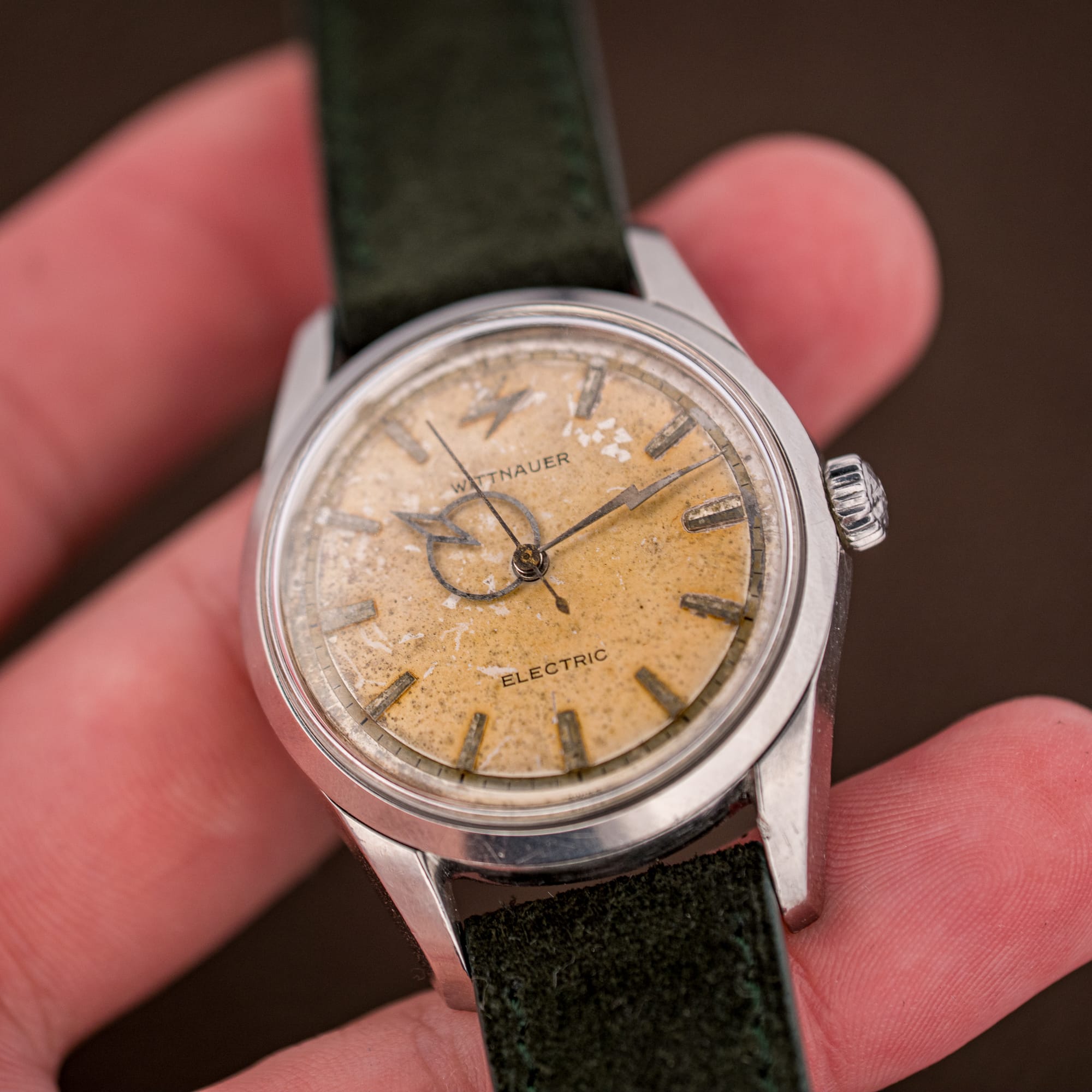
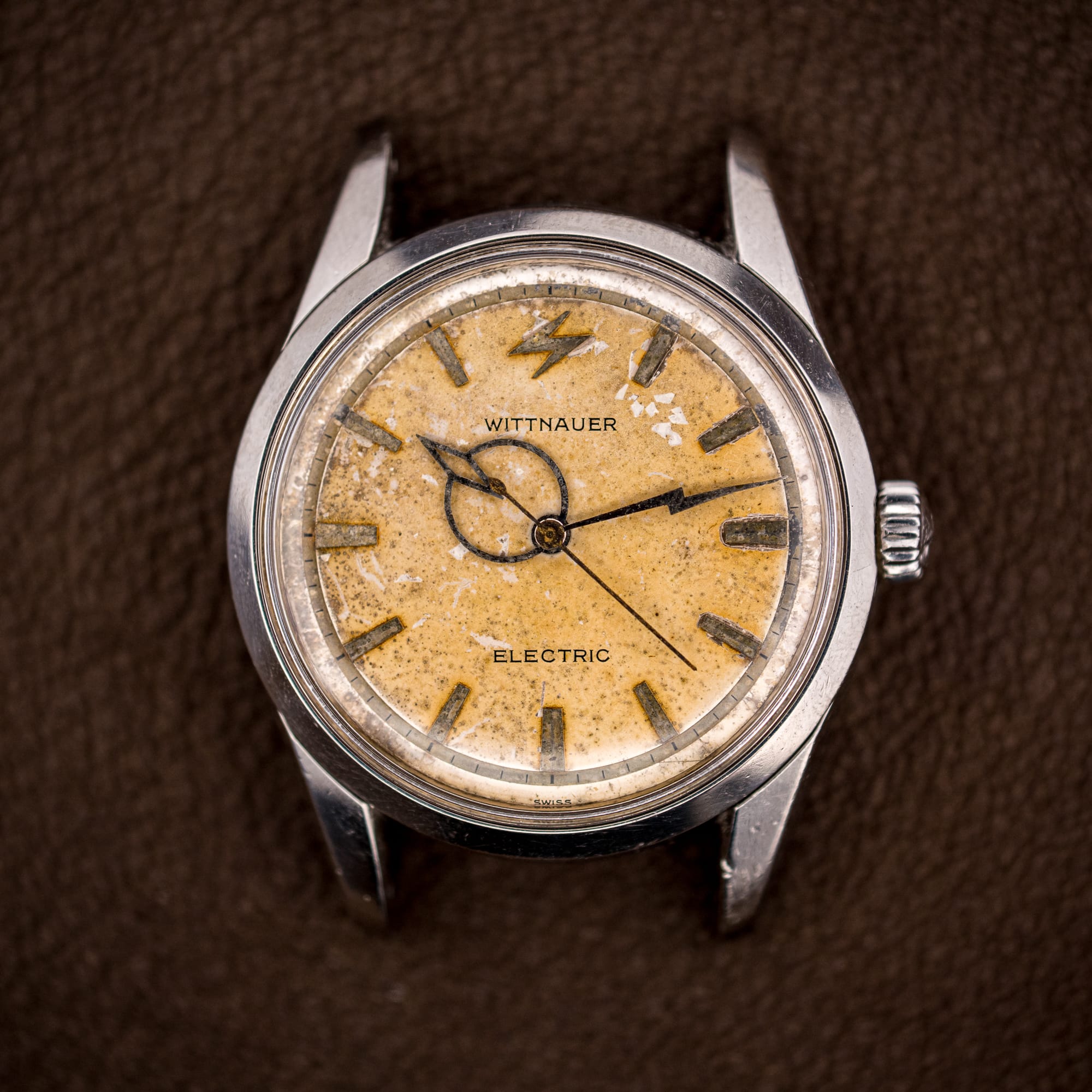
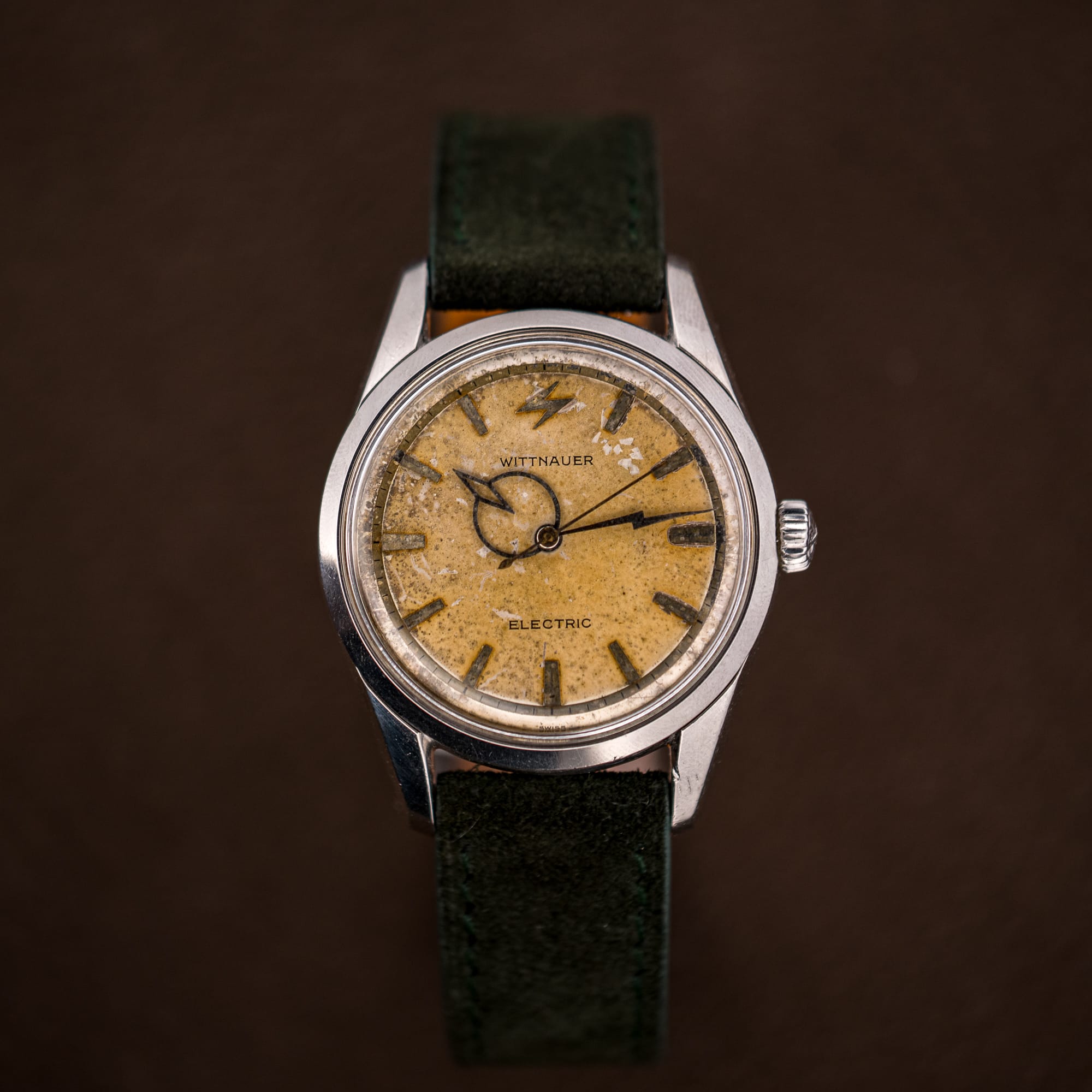
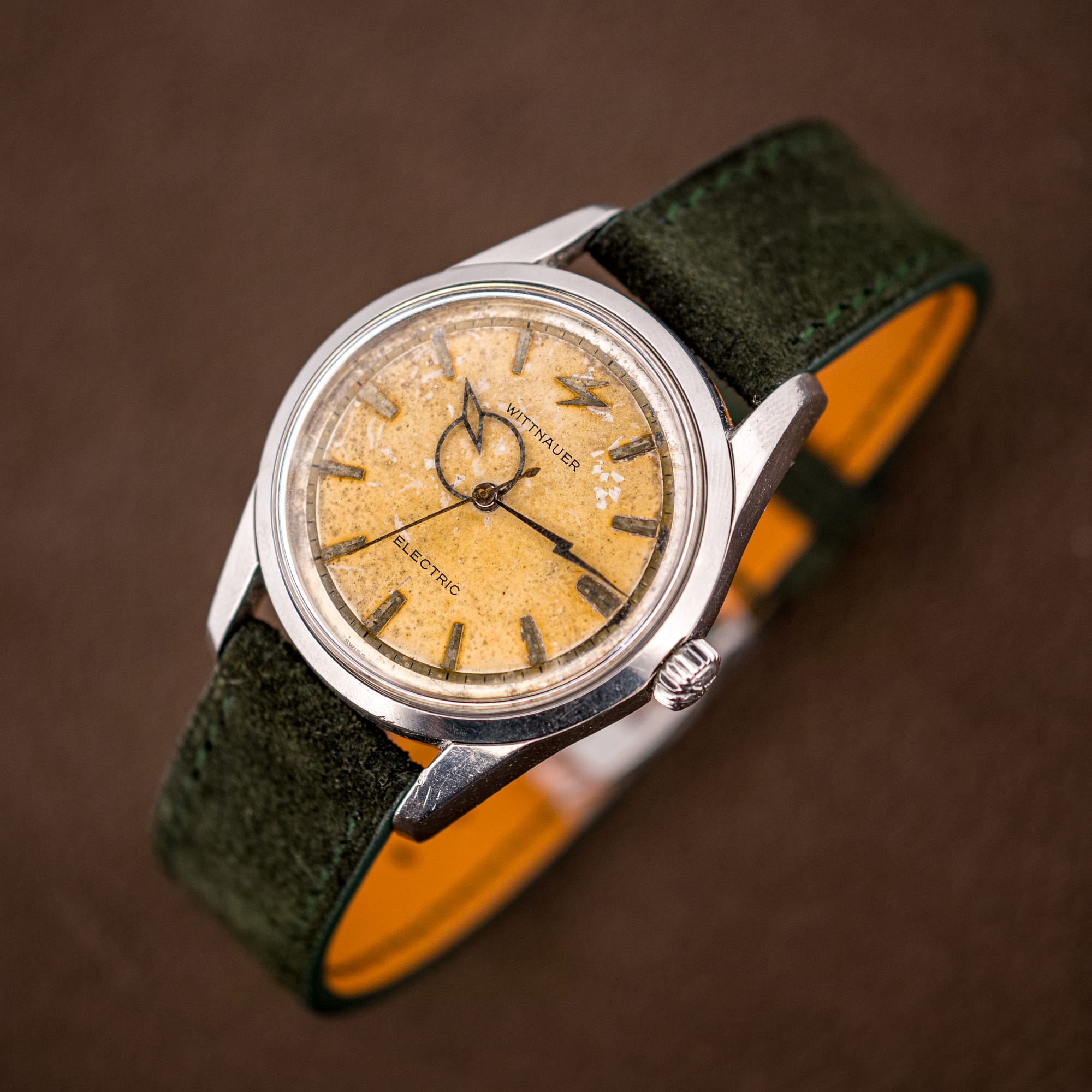

In our opinion, the first-generation Wittnauer Electric, the Ref. 6150/1 with “ELECTRIC” printed on the dial rather than the later “Electro-Chron” wordmark, is one of the most genuinely characterful entries into electric watchmaking, and this Wittnauer Electro-Chron lives that idea about as completely as we have ever seen it lived. The 6150/1 case, the twin lightning-bolt handset, the eccentric circular hour hand, and the Landeron 4750 caliber inside are the unmistakable signatures of the very first commercial Swiss electric wristwatch line, and this particular example has aged into something we honestly cannot stop staring at.
Wittnauer occupies a quietly important corner of mid-century horology that the broader collecting world is still catching up to. Founded in New York in 1872 by Albert Wittnauer as an American distributor for fine Swiss watches, the firm became one of the most respected names in American retail through the first half of the twentieth century, and by the time the Swiss watch industry decided to chase electric movements at the close of the 1950s, Wittnauer was perfectly positioned to bring that technology to the American market. The Electro-Chron line, launched at Basel in April 1961 and reaching American jewelers shortly after, was Wittnauer’s bid to put a Swiss electric on American wrists, and the watches were prestigious enough that the Cleveland Indians and the New York Yankees used them as presentation pieces to retired players in the early 1960s, baseball provenance that quietly drives collector interest to this day.
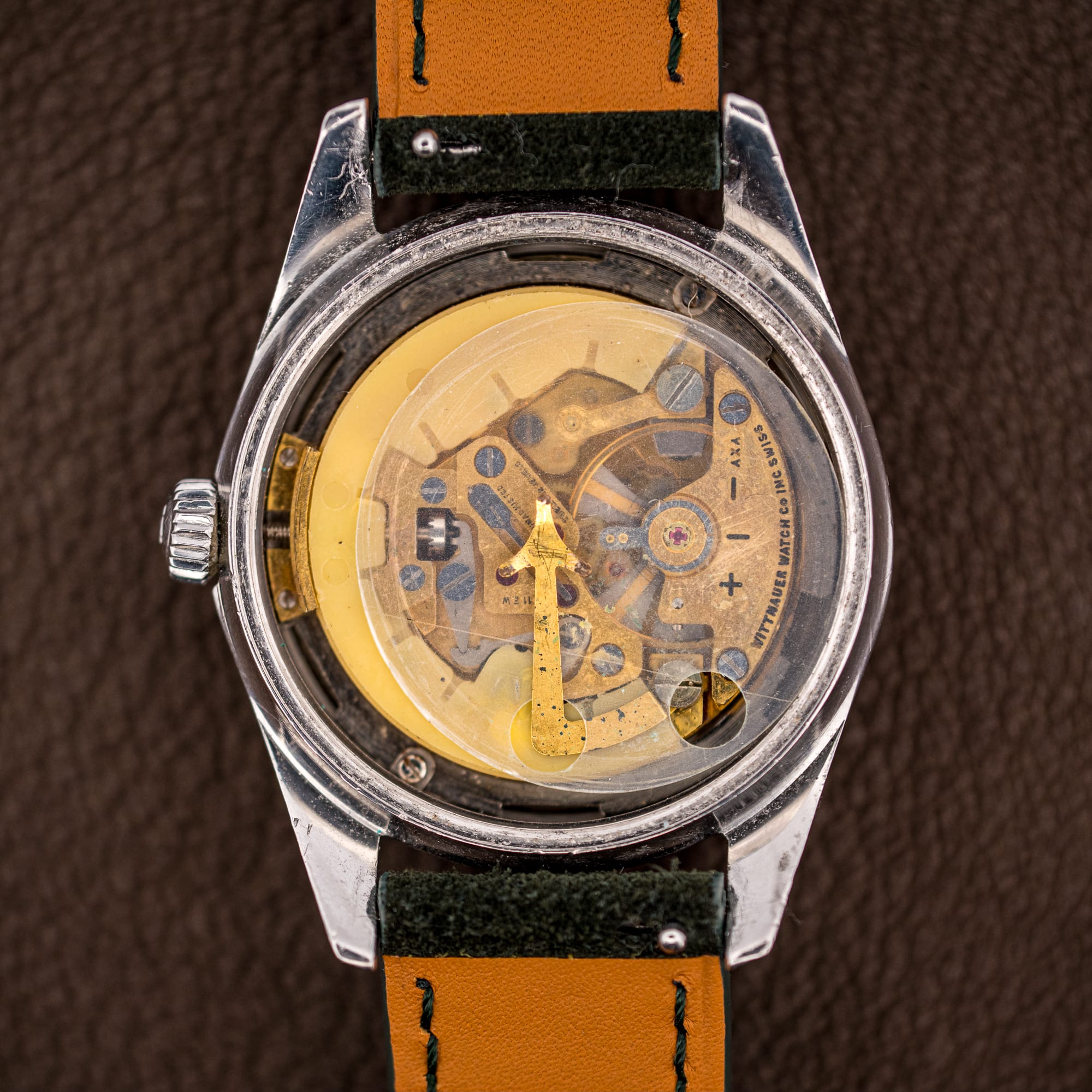
The caliber inside is the Landeron 4750, the very first Swiss-made electric watch movement, developed at Ebauches SA’s Landeron facility and signed inside this case as the Wittnauer caliber 11EW. The Landeron architecture is a beautiful piece of horological thinking. Where the American Hamilton 500 used a magnetic balance, Landeron’s engineers eschewed magnets entirely and built a contact-controlled system where electric impulses passing through fine contact wires interact with a steel balance plate, achieving near-quartz accuracy at a time when quartz wristwatches were still nearly a decade away. The technology was technically brilliant and commercially short-lived, displaced first by Bulova’s Accutron tuning-fork and then completely buried by quartz, and that short production window is exactly why every clean surviving example matters. The movement in this watch is signed WITTNAUER WATCH CO INC SWISS on the bridge, with clearly visible plus and minus polarity marks at the battery clip, the yellow plastic battery isolator still in place, and the thirteen jewels of the Landeron 4750 architecture set into the gilt plate. The transparent factory dust cover sits over the works and protects the contact wires from interference, exactly as Landeron specified.
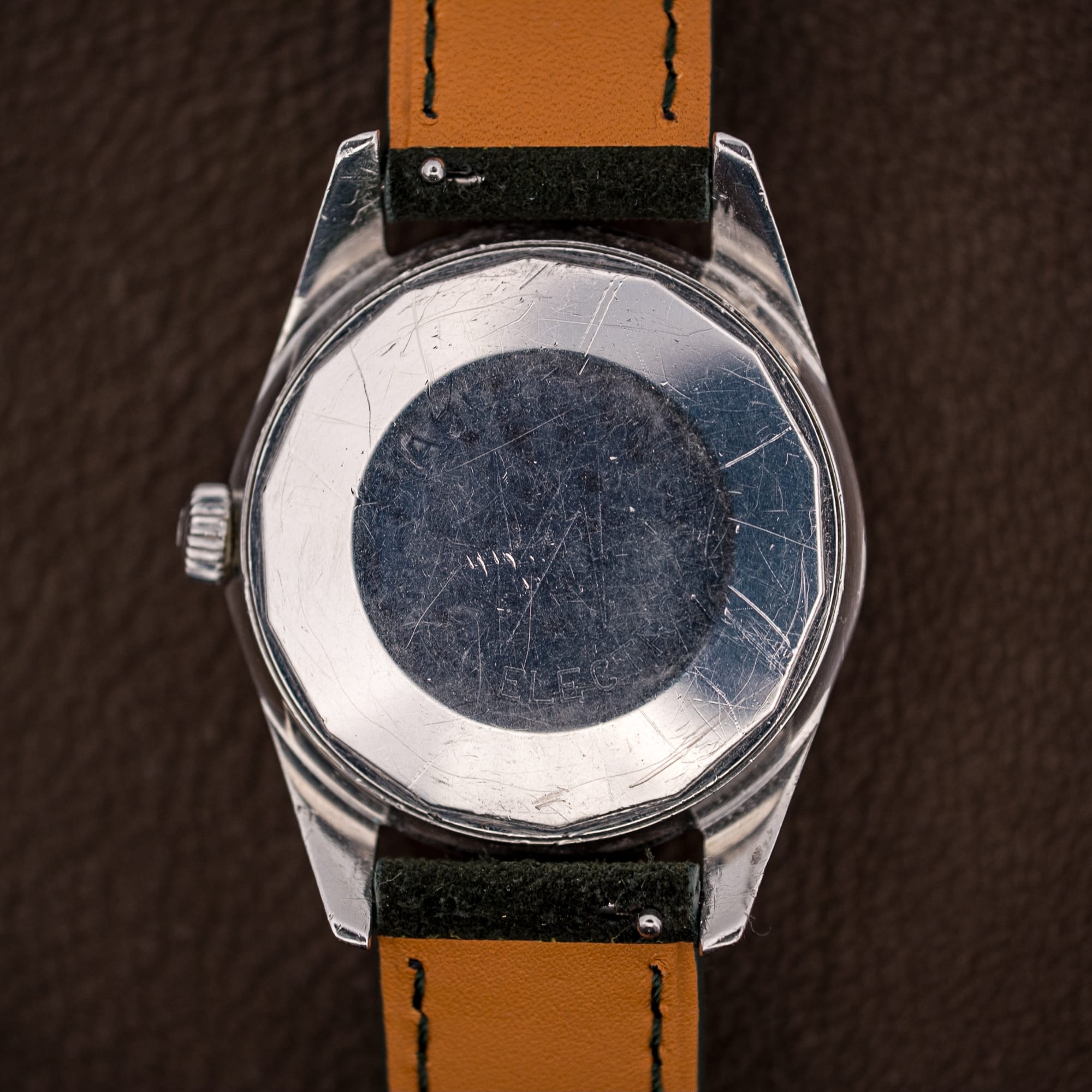
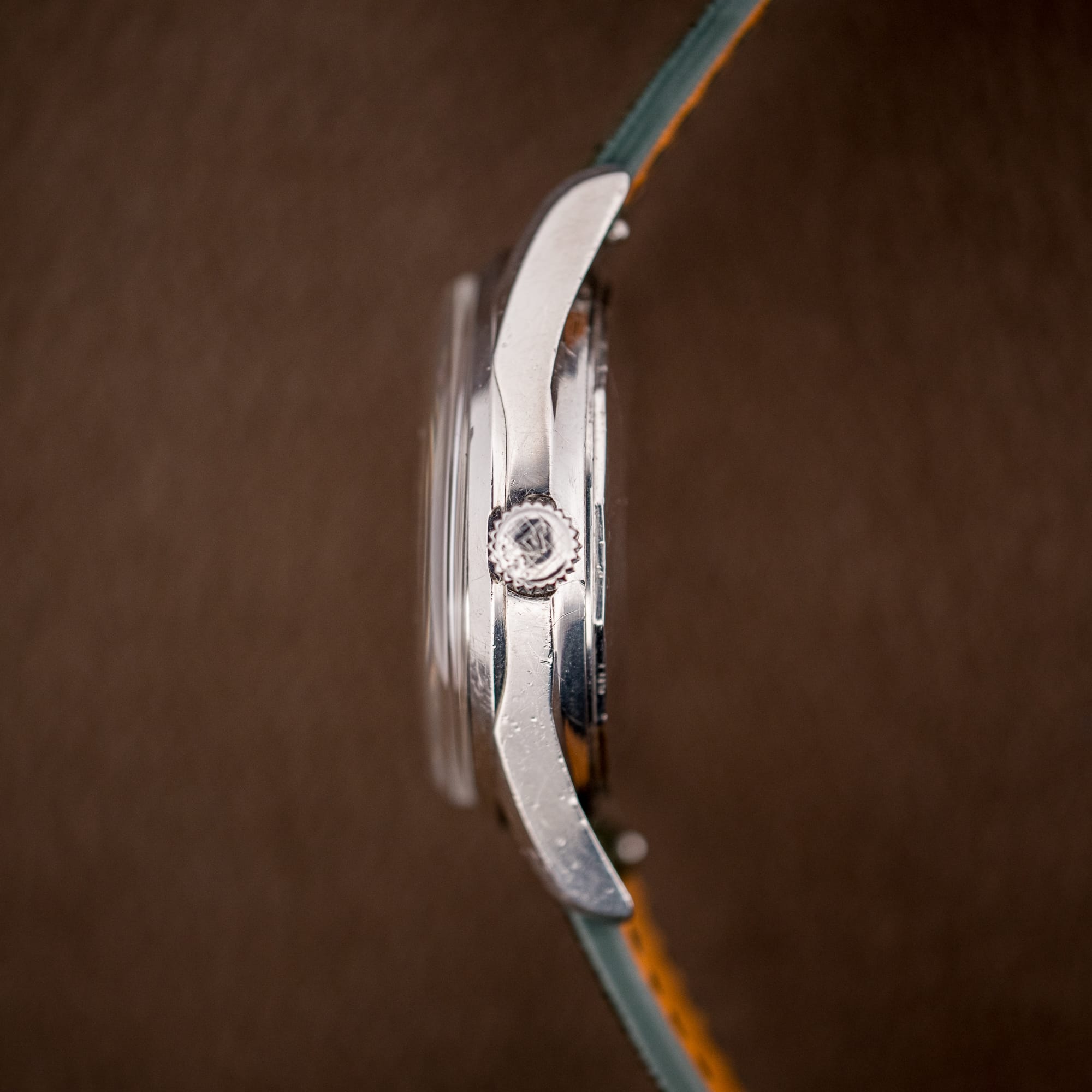
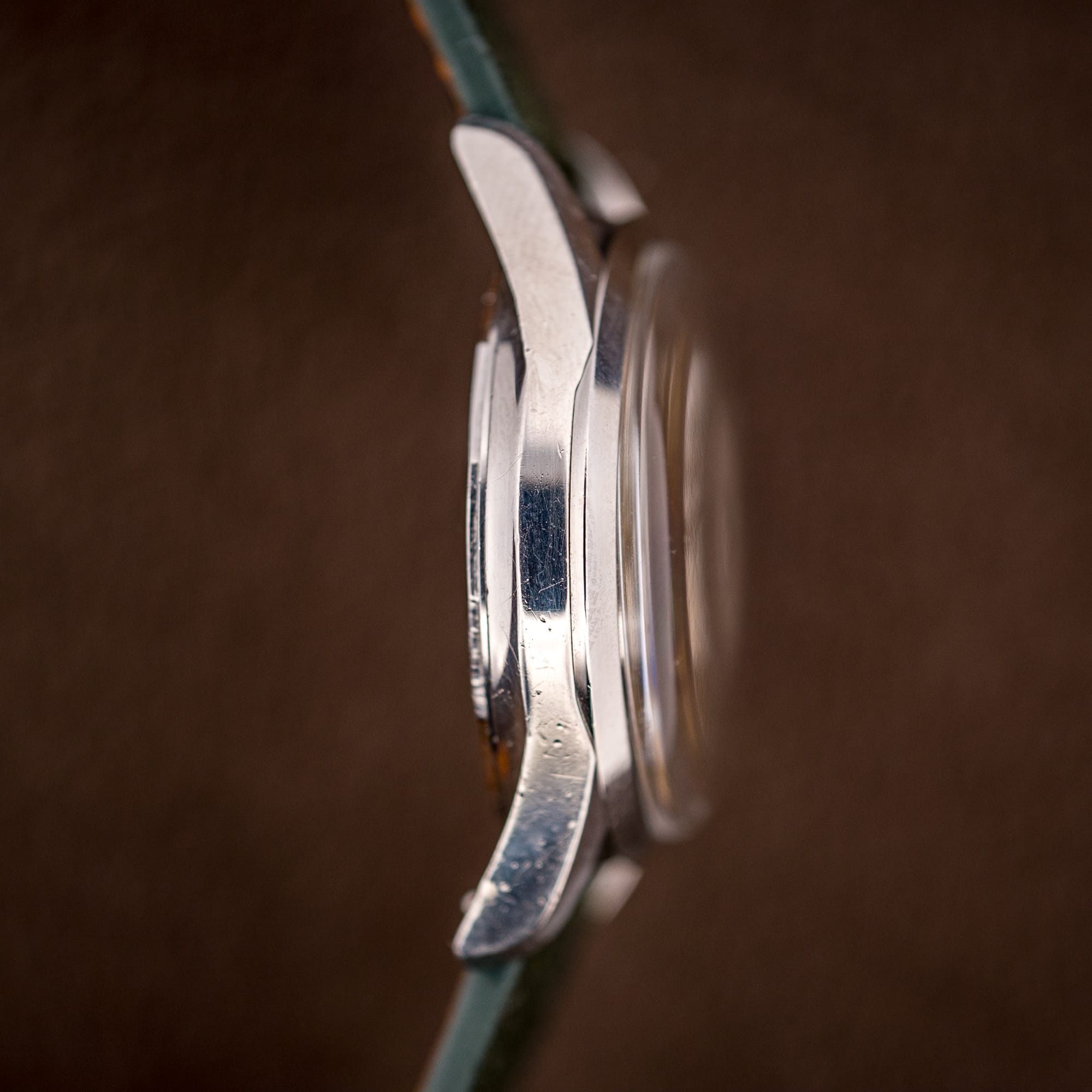
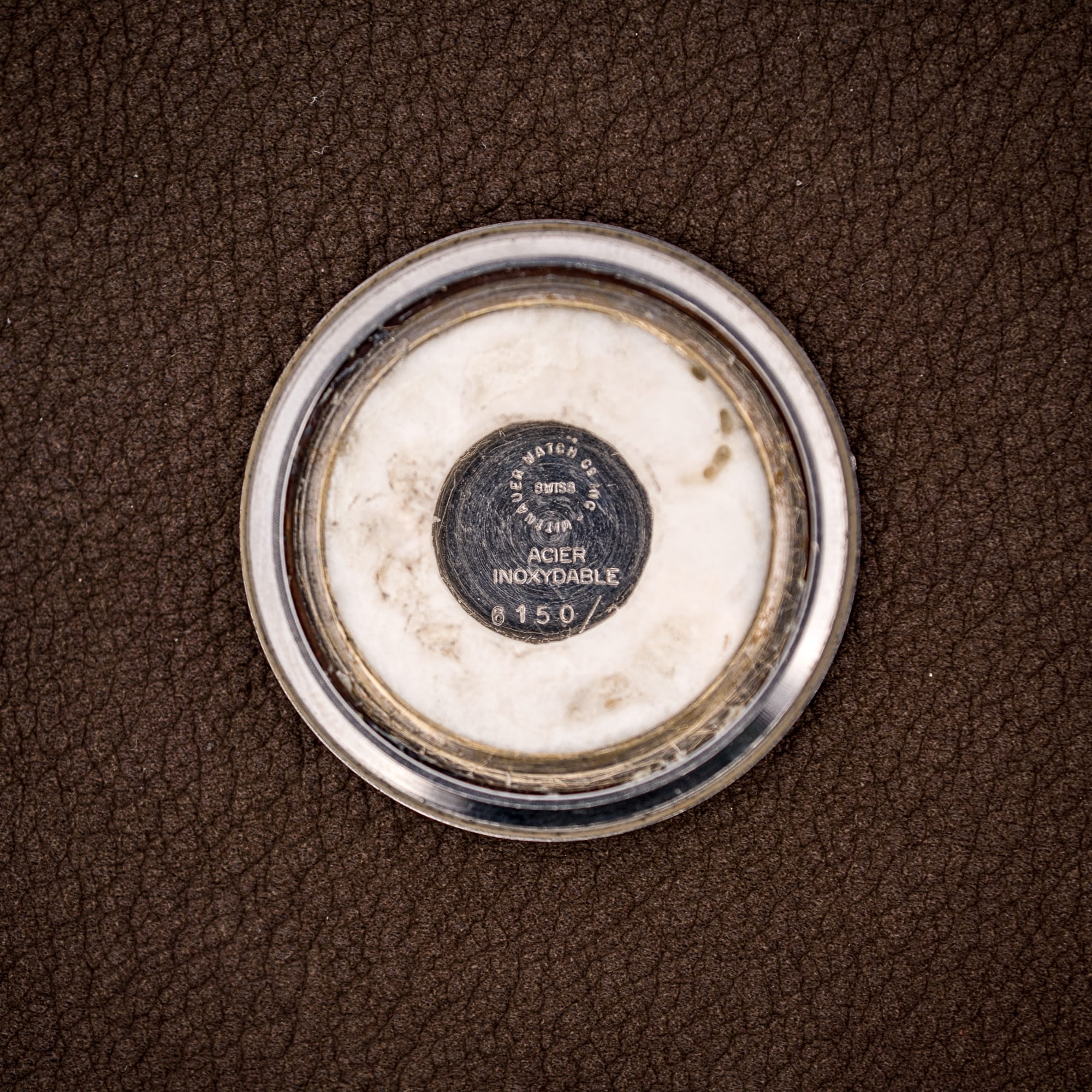
The case is the early 6150/1 in stainless steel, 36mm across, 45mm lug to lug, with 18mm lug spacing, a round profile with smoothly downward-curving lugs and a low polished bezel. The construction is the first-generation two-piece arrangement with a separate round battery-access cover set into a snap-back, a far more serviceable design than the later one-piece cases that forced battery changes through the front of the watch. The inner caseback stampings read WITTNAUER WATCH CO INC, SWISS, 6150/1 around the outer ring, with the battery cover further stamped WITTNAUER WATCH CO INC, SWISS, ACIER INOXYDABLE at center. The outer caseback carries faint service marks consistent with sixty-plus years of life. The signed Wittnauer crown sits at three.
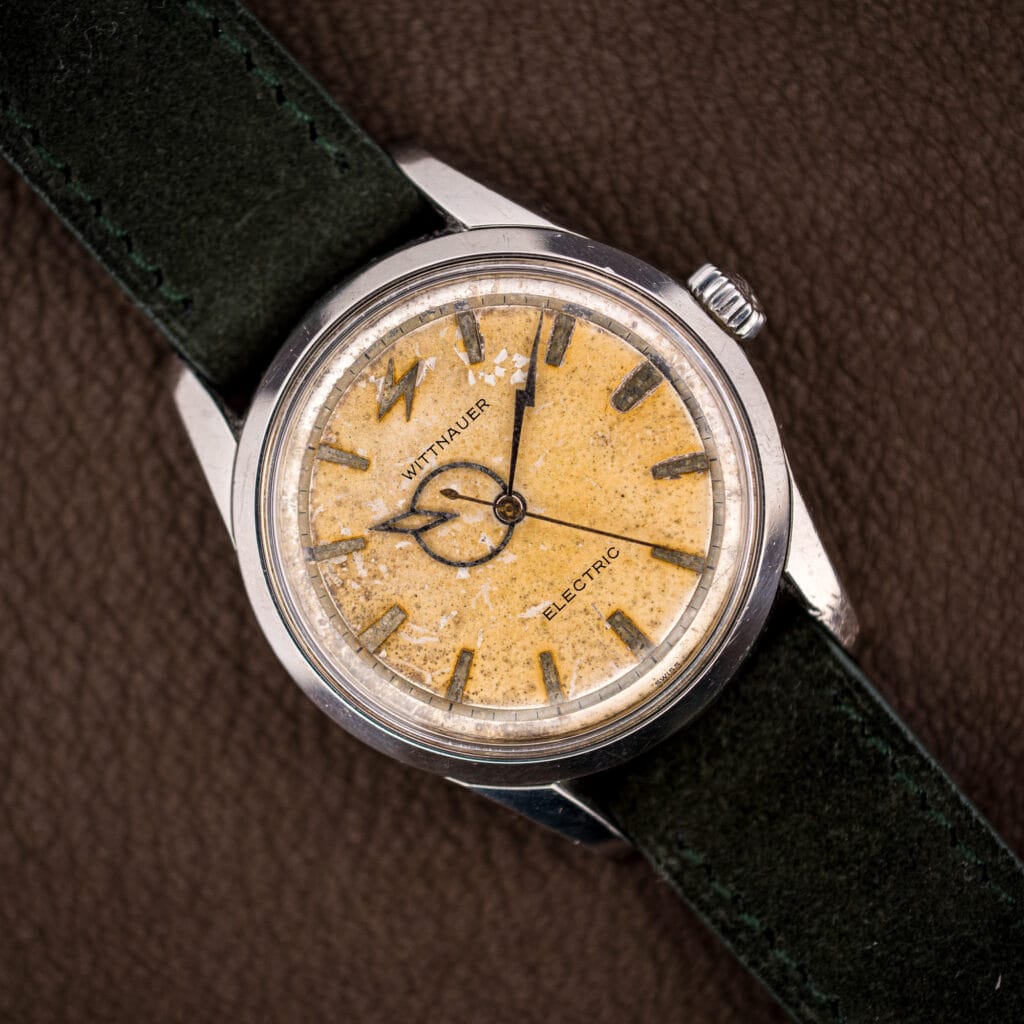
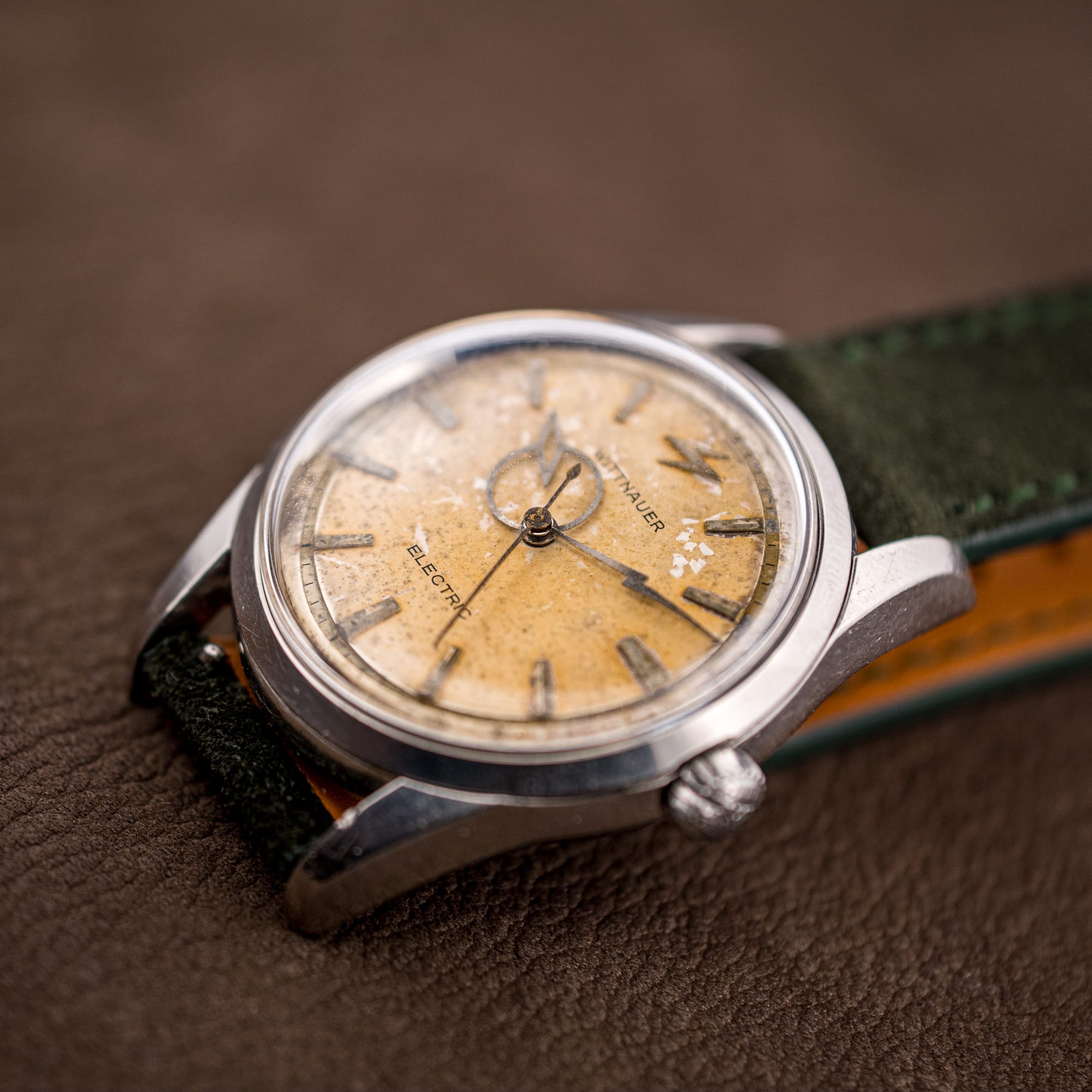
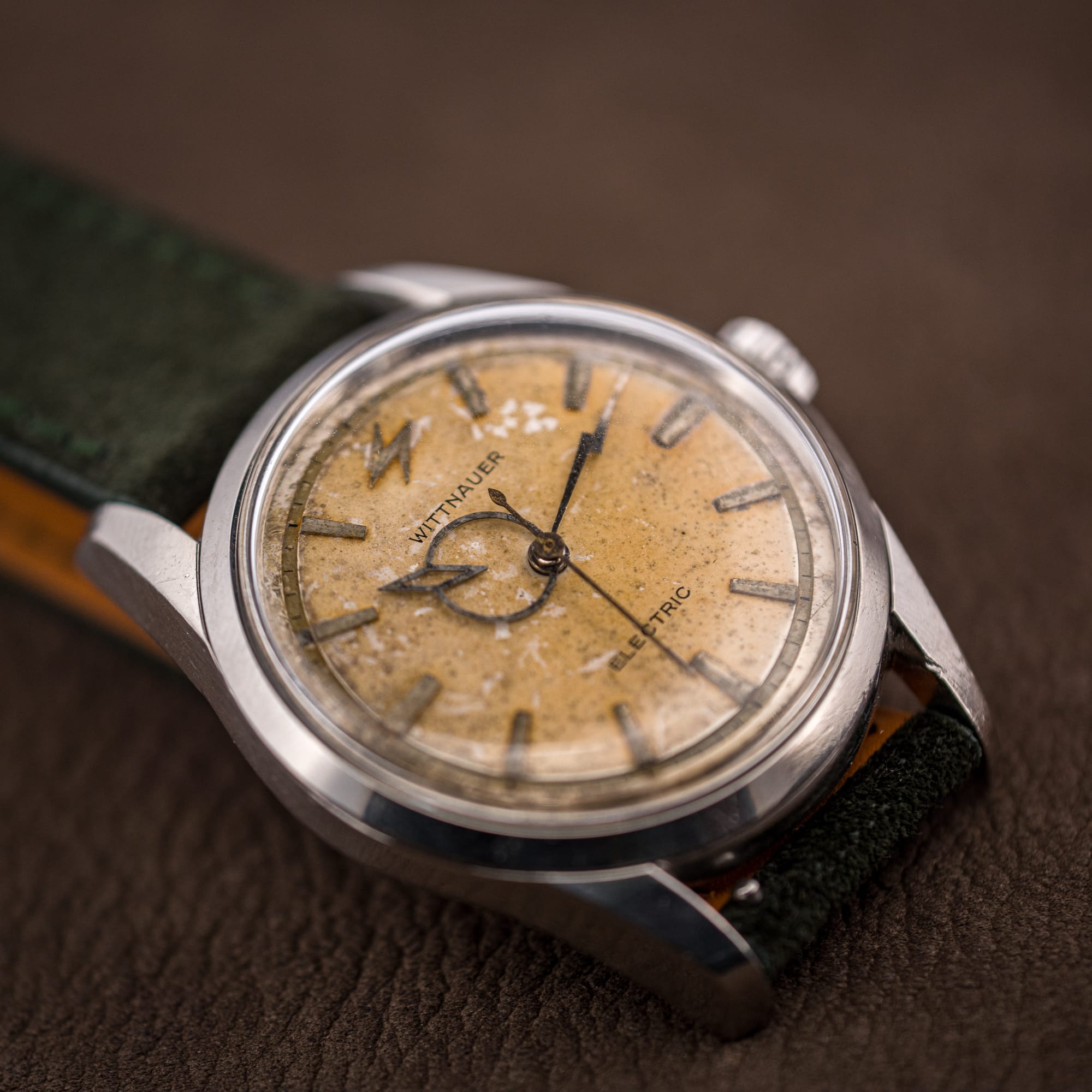
The dial is what makes this Wittnauer Electro-Chron the one we kept coming back to. Originally a silver sunburst surface, the dial has tropicalized over six decades into a warm honey and amber field, heavily speckled and mottled, with patches of cream and pale yellow and zones of surface degradation that read in person as geological rather than damaged. There is no faking this kind of aging and no reason to try. The WITTNAUER wordmark sits in clean black print under the twelve, with ELECTRIC printed above the six in matching type, and SWISS marked tiny at the very bottom edge. In the twelve position, where most dials would carry a marker, there is a small printed lightning-bolt symbol, the design cue the Electro-Chron line borrowed for itself. The applied stick markers at the remaining hour positions have oxidized in concert with the dial, taking on a weathered tone that blends rather than fights with the field. And the handset is the whole reason these watches are still being hunted by collectors: a jagged lightning-bolt minute hand, a jagged lightning-bolt seconds hand, and an eccentric circular hour hand that reads like a small open loop with a fine triangular tip. All three hands are present, original, and aged in lockstep with the dial.
We are presenting this watch on an OTTUHR green Italian suede strap with green contrast stitching and an OTTUHR-signed buckle, a pairing we like specifically because the cool olive green plays against the warm honey of the tropical dial in a way a black or brown strap simply cannot. The strap was made for this configuration, and the watch wears beautifully on it.
Serviced in-house at OTTUHR and backed by our 2-year warranty. For the collector who values the earliest version of the earliest Swiss electric, who cares more about a dial with sixty years of honest tropical character than about a clean-and-replaced redial, and who wants the rarer first-generation “ELECTRIC” dial signature rather than the later Electro-Chron print, to us this Wittnauer Electro-Chron Ref. 6150/1 is exactly the one to chase.