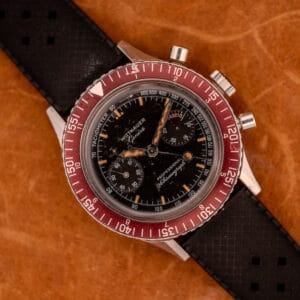
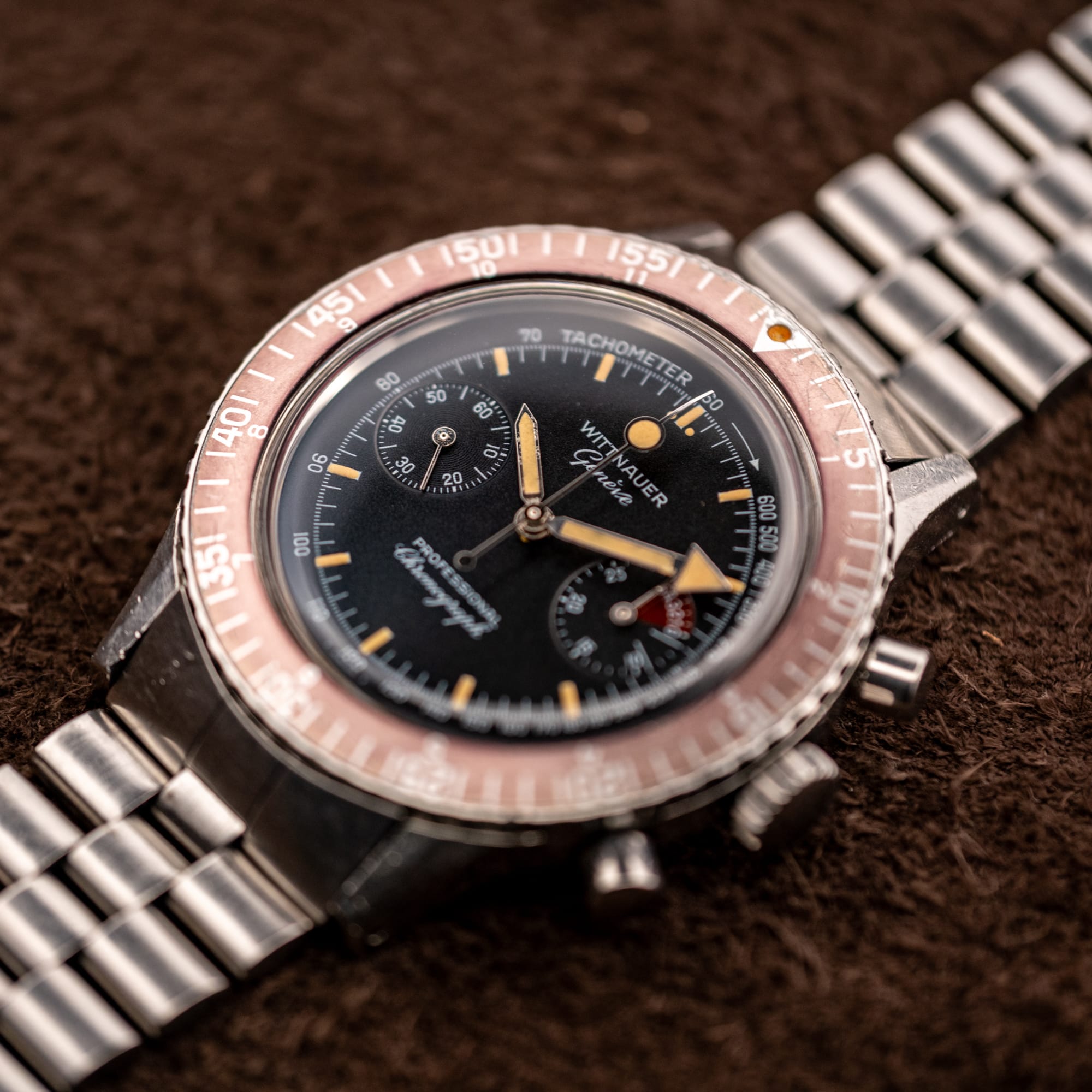
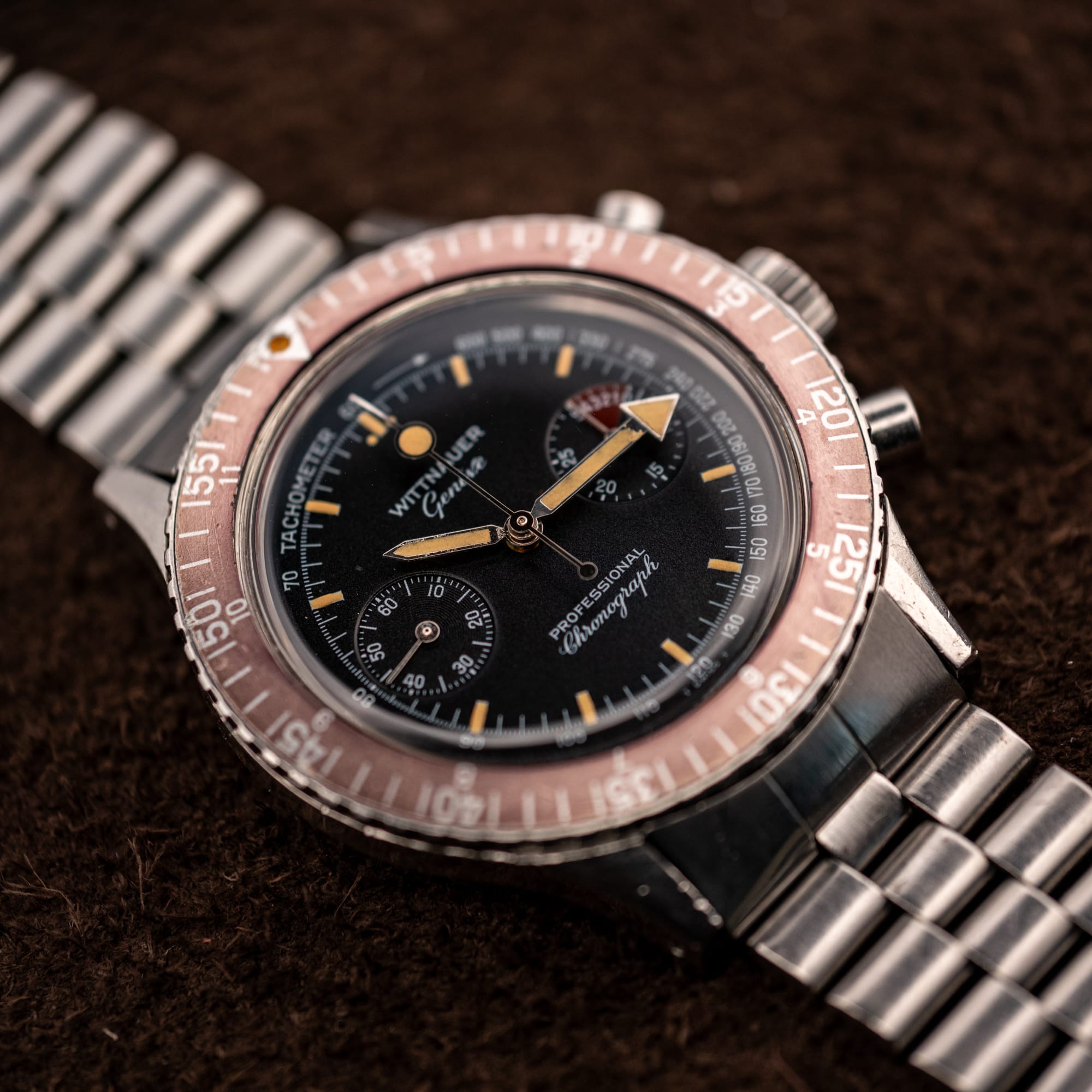
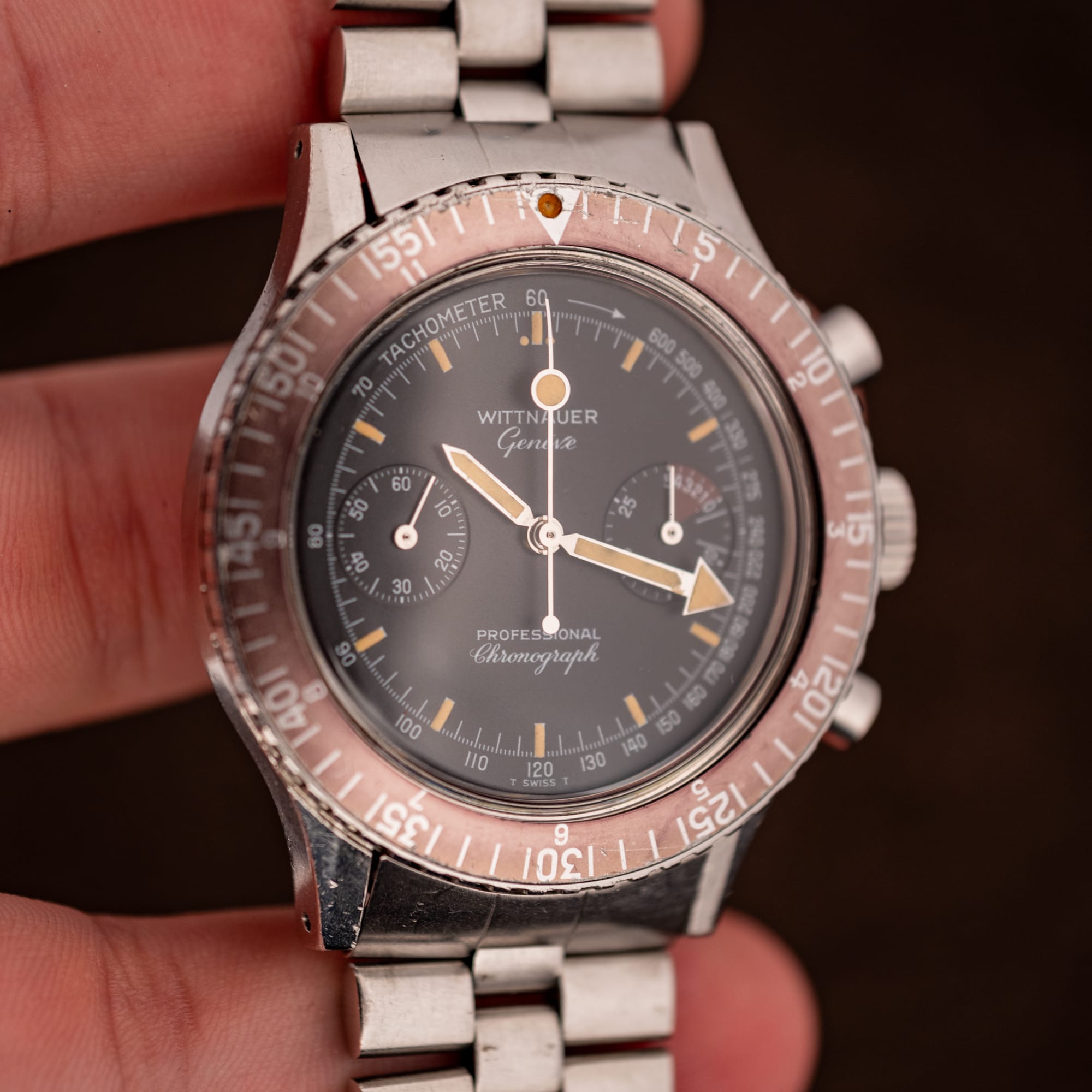
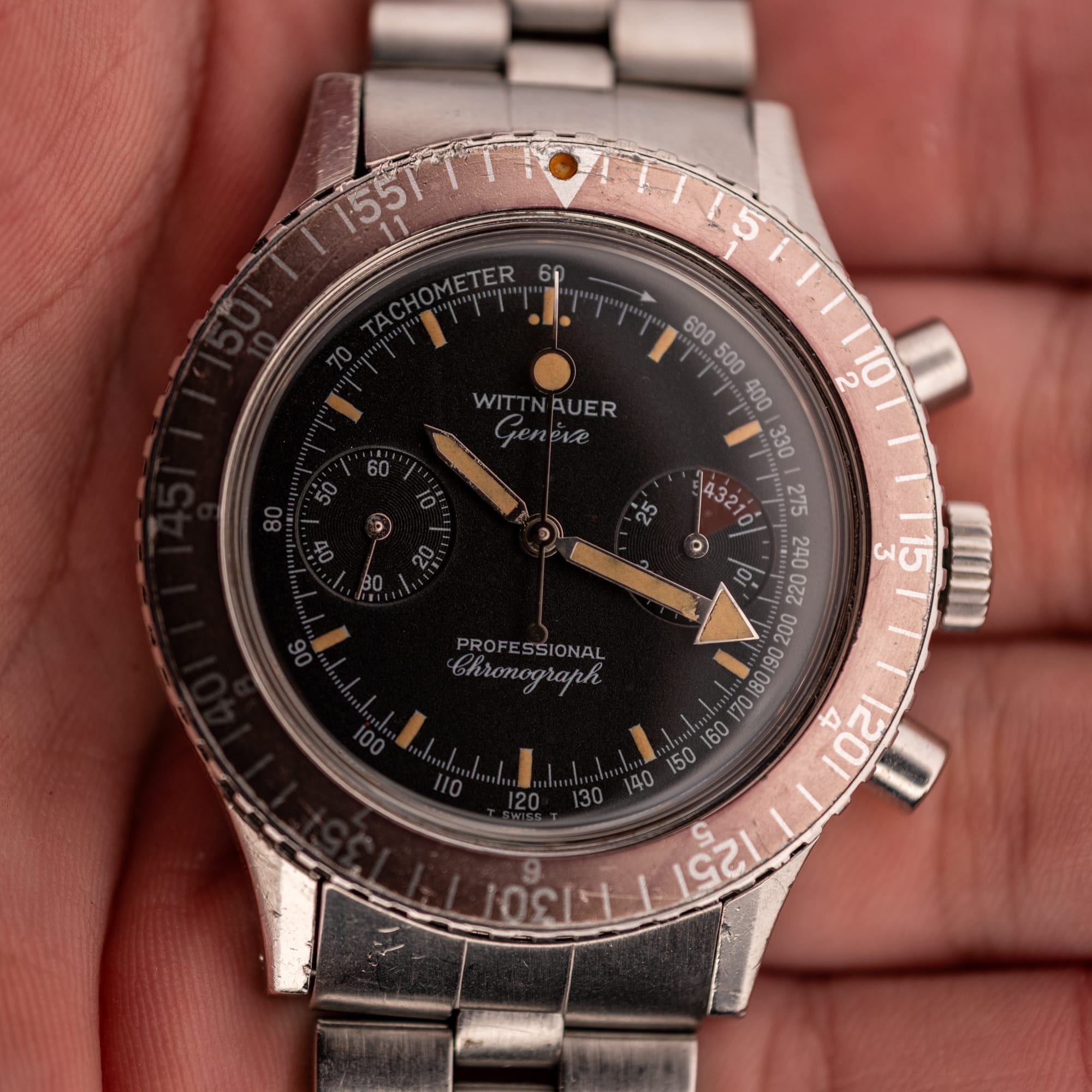
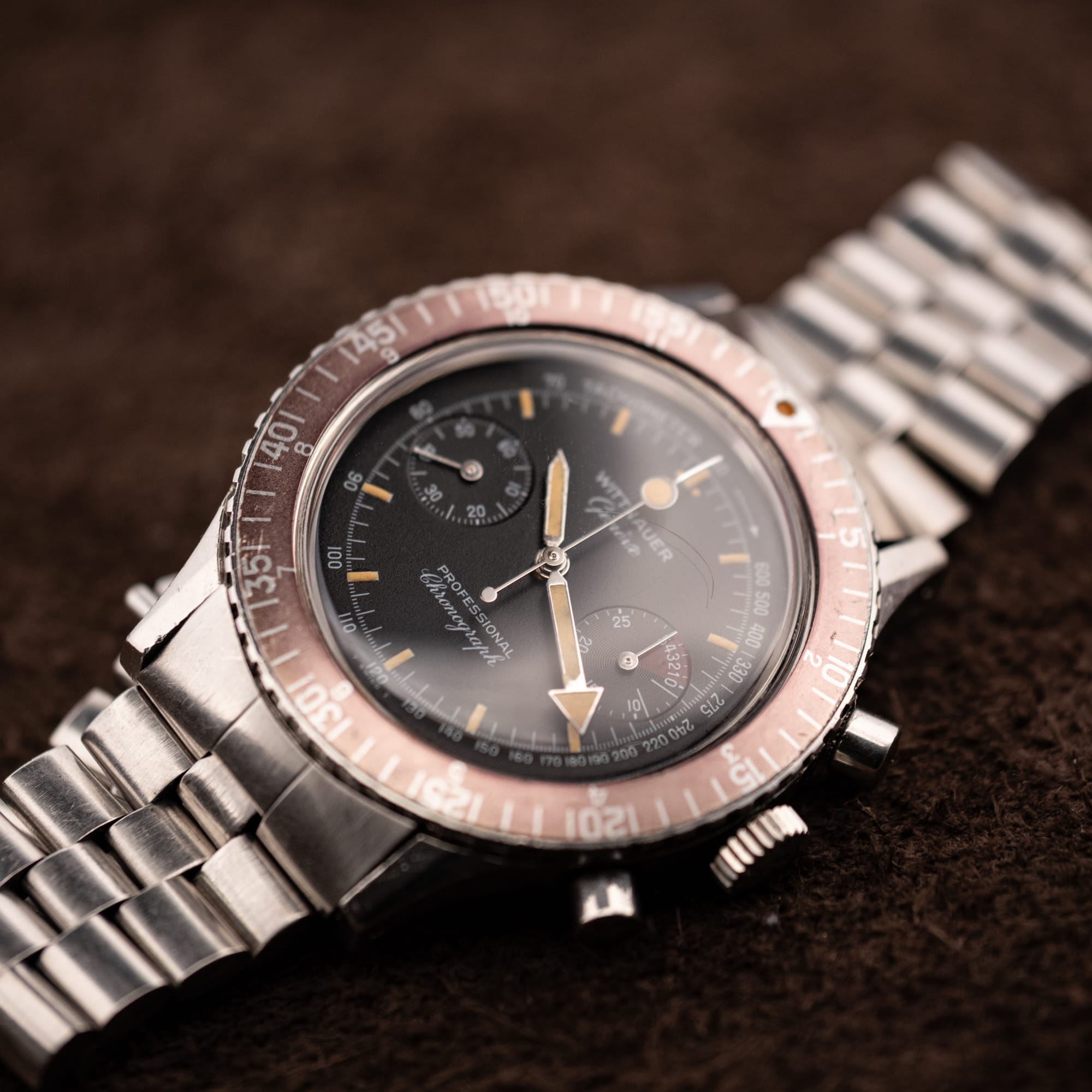
Mention Wittnauer to most American collectors and the mind goes to navigation: the Weems second-setting watches, the cockpit and deck instruments, the name that flew with the Navy and rode along on Lindbergh’s later expeditions. The Wittnauer Professional Chronograph is the other side of that bench, and in our opinion it is the more wearable one. This is the reference 7004A, the 239T variant, a 1960s steel chronograph built around a regatta countdown and a cherry-red elapsed-time bezel, and it remains one of the few chronographs of its decade that still reads as a genuine instrument rather than a dress watch wearing pushers.
Wittnauer had imported fine Swiss watches into America since the 1880s, and by the time this piece was made the firm sat under Longines, which had absorbed Wittnauer across the 1950s. That Longines-Wittnauer stretch, running right up to the Quartz Crisis, was when the brand’s chronograph output ran hottest, and the Professional was its sport flagship: a 40mm case at a moment when most chronographs were still content at 36 or 37.
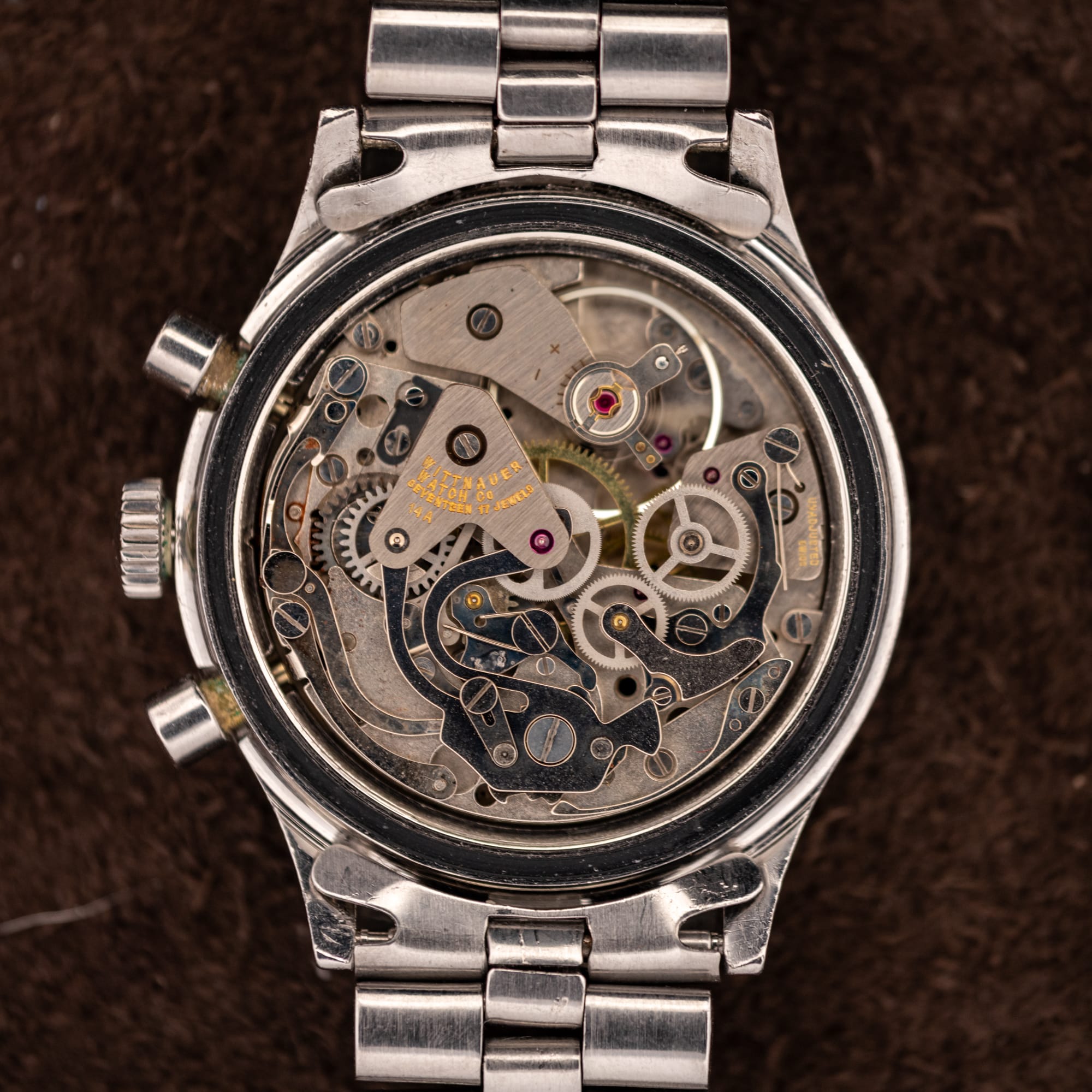
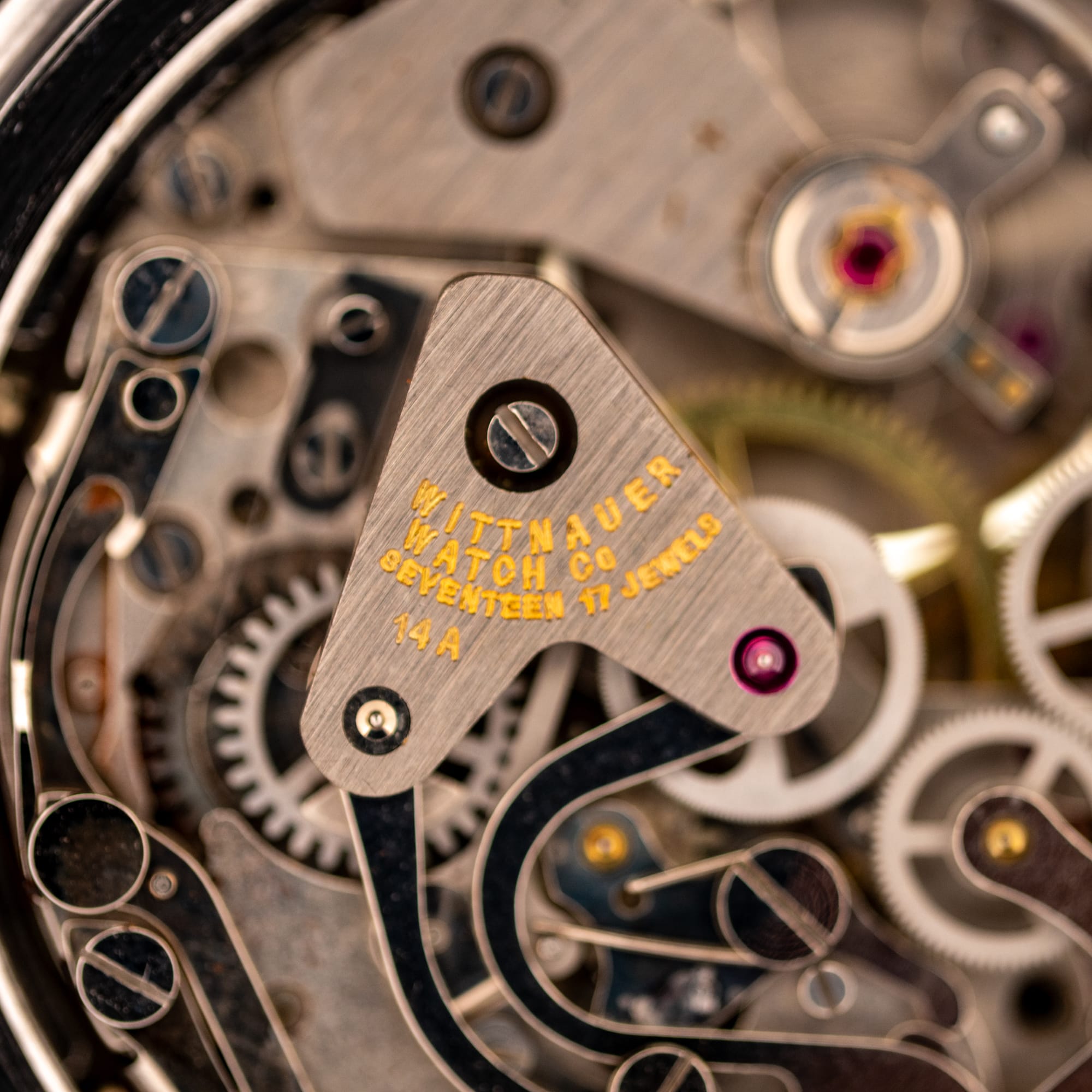
Behind the dial sits the Landeron 248, and its family tree is the real story. In 1937 the Fabrique d’Ebauches Landeron, the Hahn family house in Le Landeron, worked with Depraz to release the caliber 47, the first chronograph ever switched by cams rather than a column wheel. The notion bordered on heretical at the time, that a chronograph could be started, stopped, and reset with stamped cams instead of the jeweler’s puzzle of a column wheel, and the point of it was to make the complication affordable. It worked well enough that the 48 family it spawned ran until 1970 and crossed three and a half million movements, and the cam-switching principle Landeron proved is the one nearly every modern chronograph, the Valjoux 7750 included, still leans on today. The 248 is a 17-jewel, two-register member of that family, and as our movement photograph shows, the bridge here is gold-engraved WITTNAUER WATCH Co, PATENTED, SEVENTEEN 17 JEWELS rather than left in plain Landeron livery. One period quirk worth knowing: on the 248 the upper pusher only starts the chronograph. Our example wears the Landeron, which marks it as the earlier and, to most of us, the more interesting build, before Wittnauer moved the reference onto the Valjoux 7733 at the close of the decade.
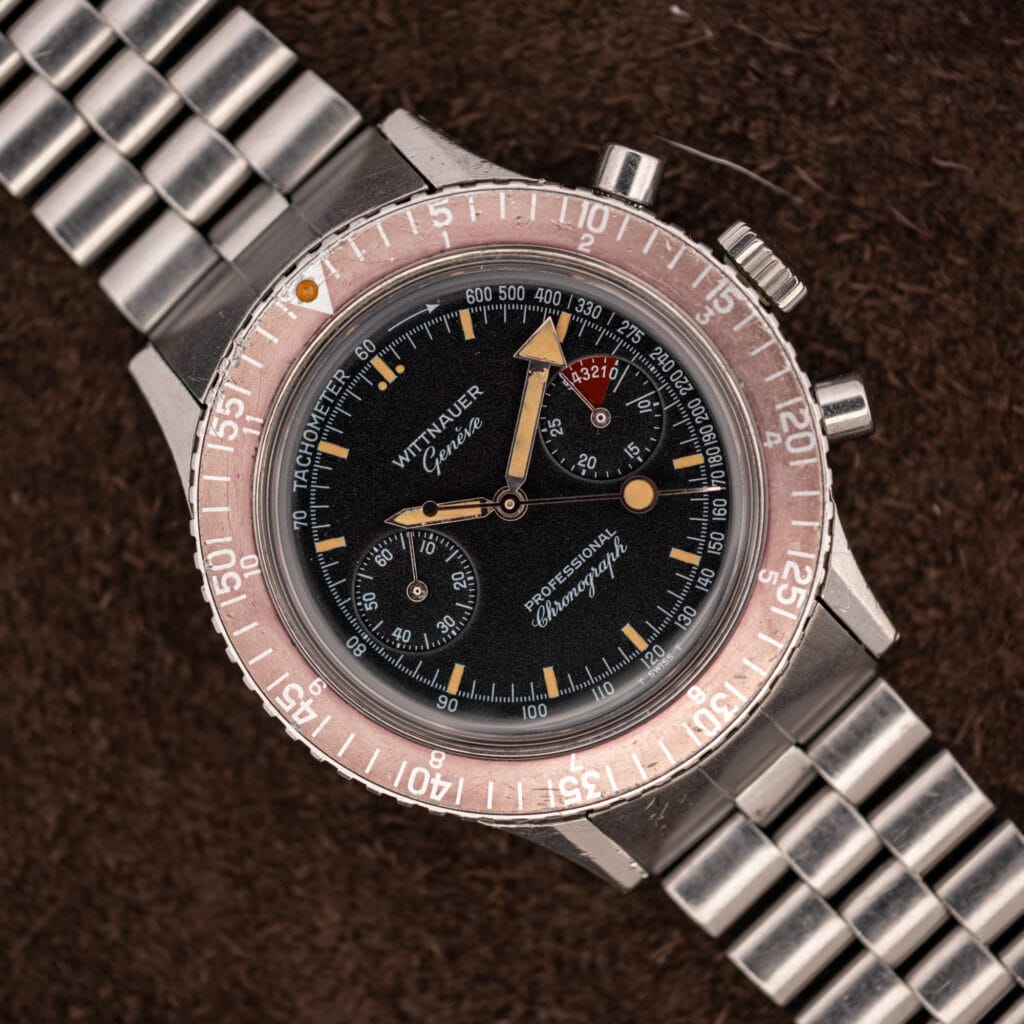
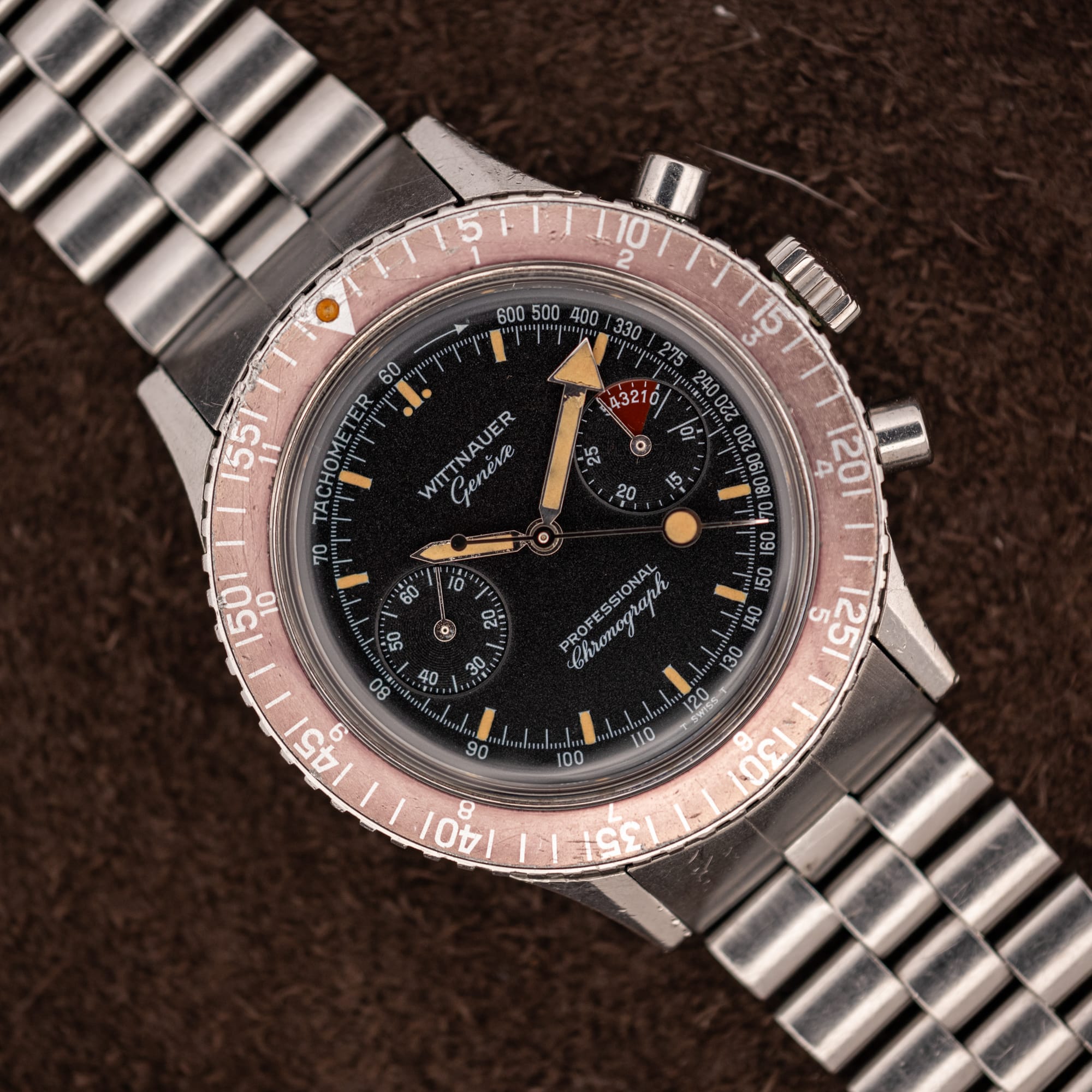
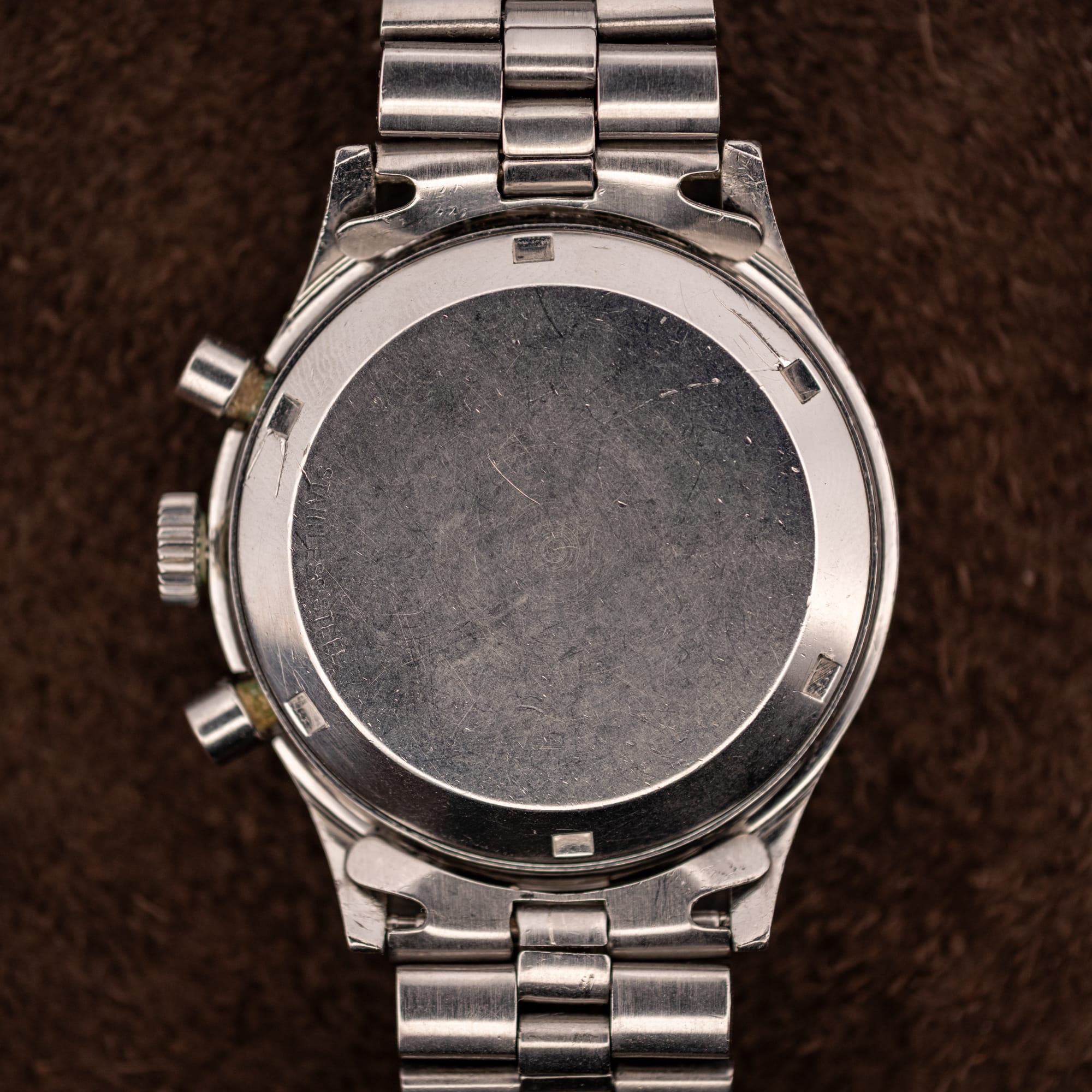
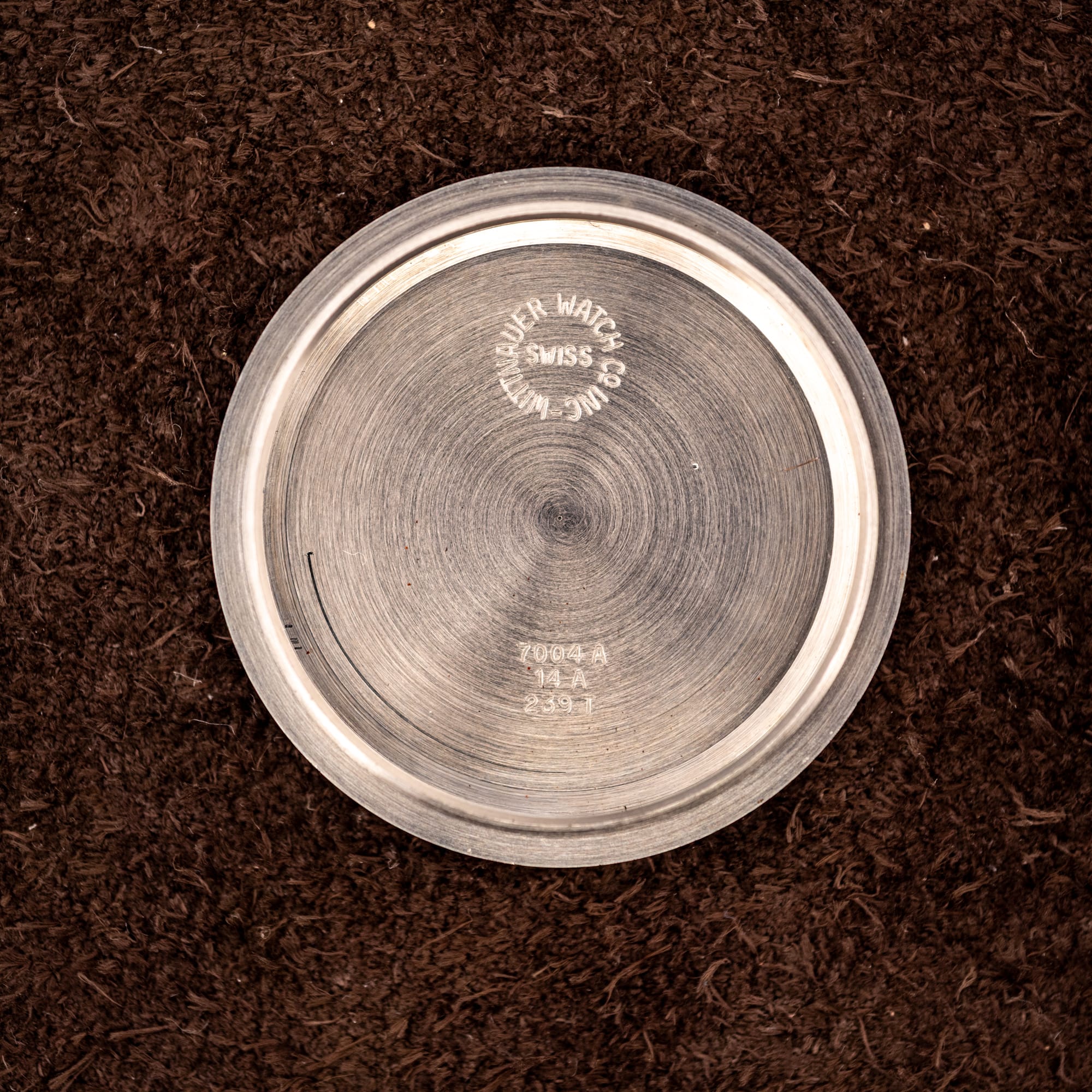
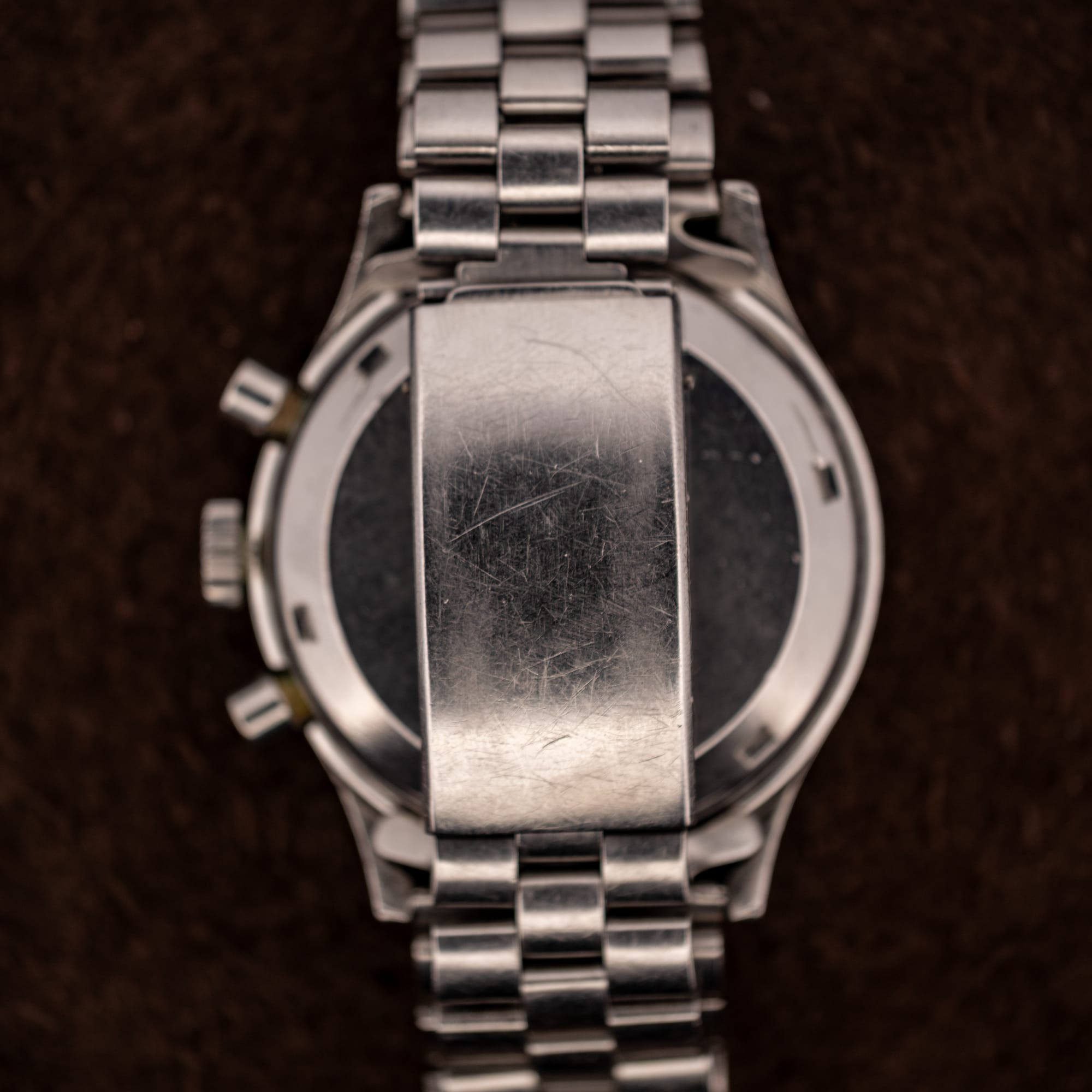
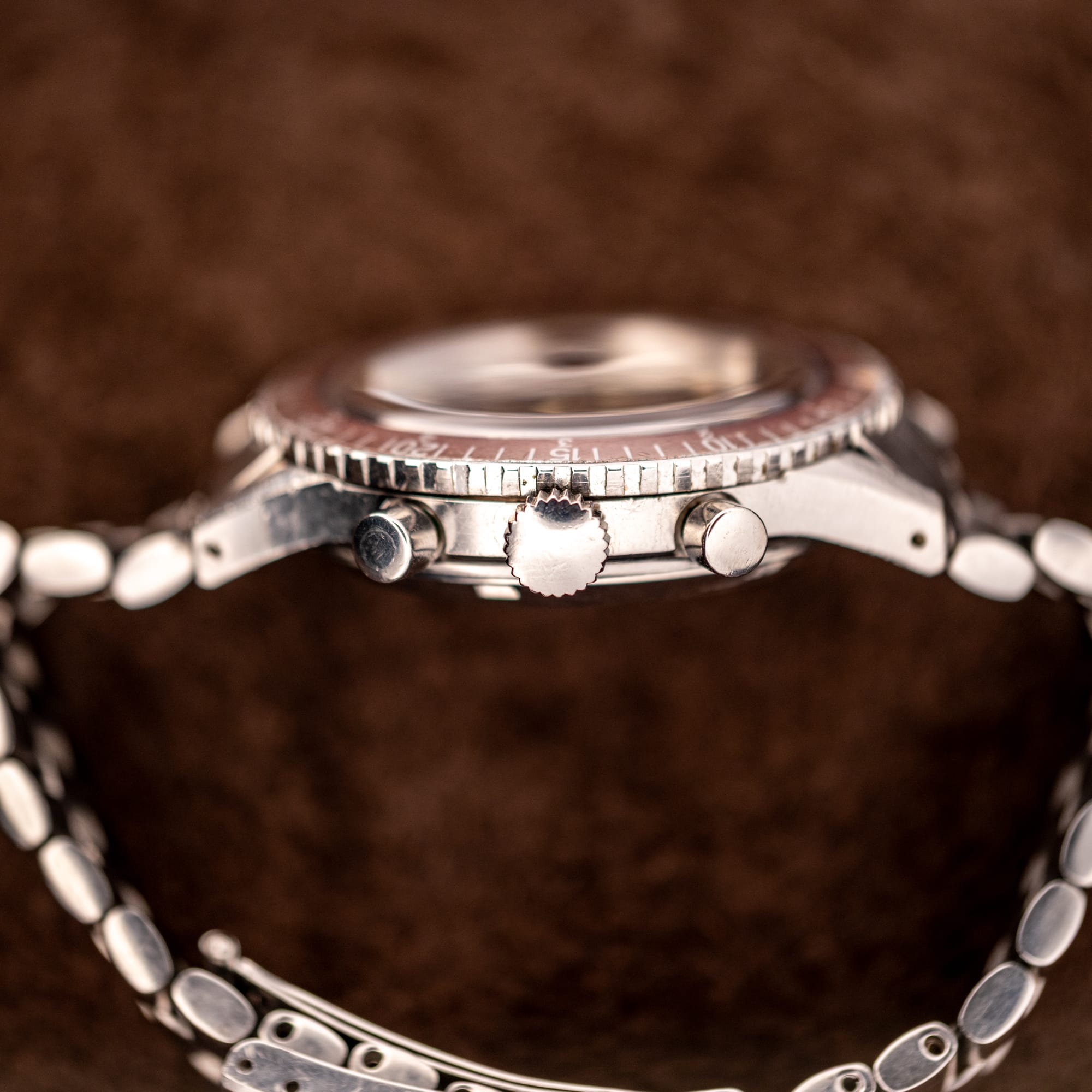
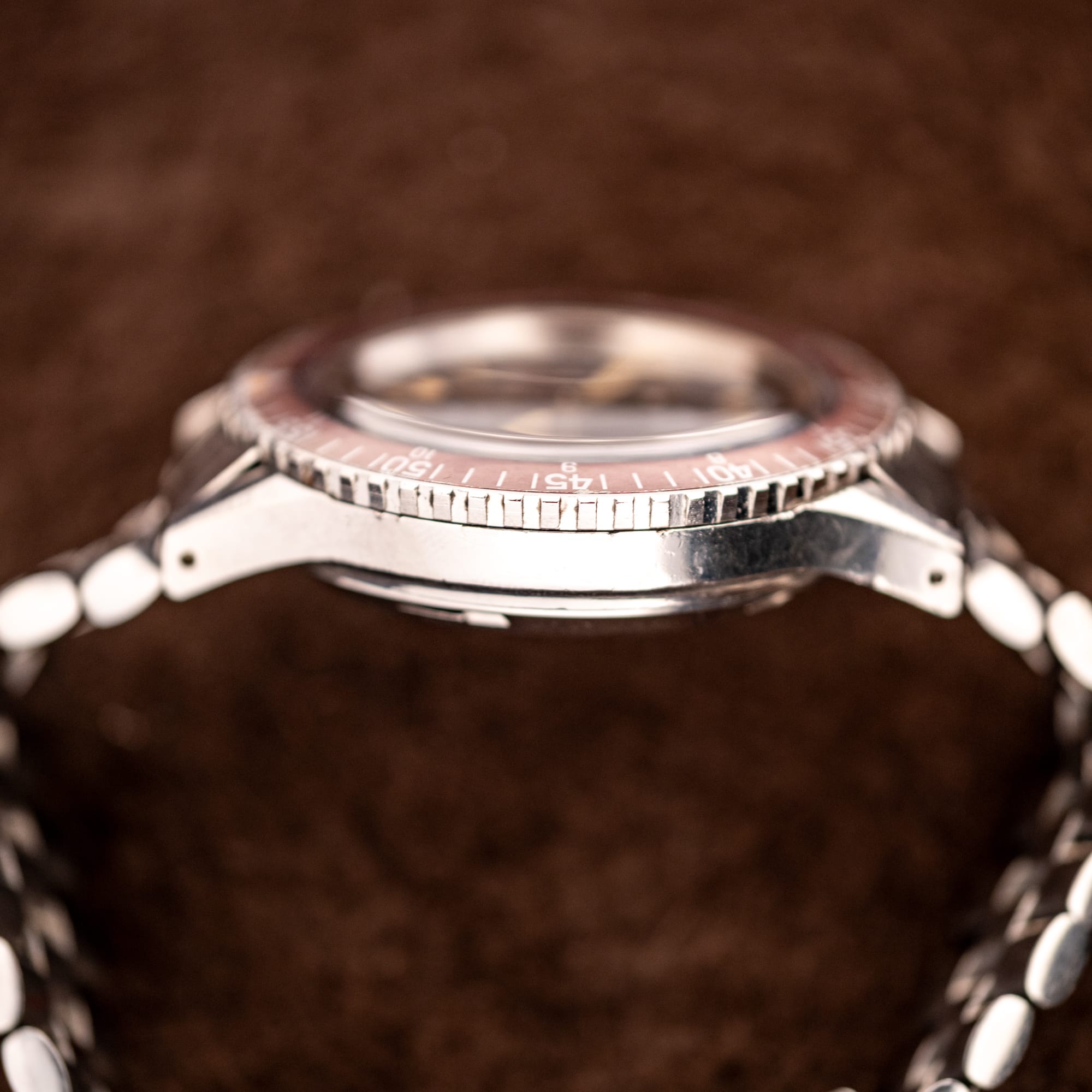
The case measures 40mm across, 46.7mm lug to lug, with a 20mm lug width, the faceted lugs and twin pump pushers the Professional is known for, a signed crown, and a tall domed acrylic crystal over a coin-edged bidirectional bezel. It carries its years honestly, with hairlines and soft brushing across the smooth outer caseback that we have left exactly as found. Open it and the inner caseback reads WITTNAUER WATCH CO INC around the rim, SWISS at the center, with 7004-A, 14 A, and 239-T stamped below, the period-correct markers that tie this case to the reference on the dial.
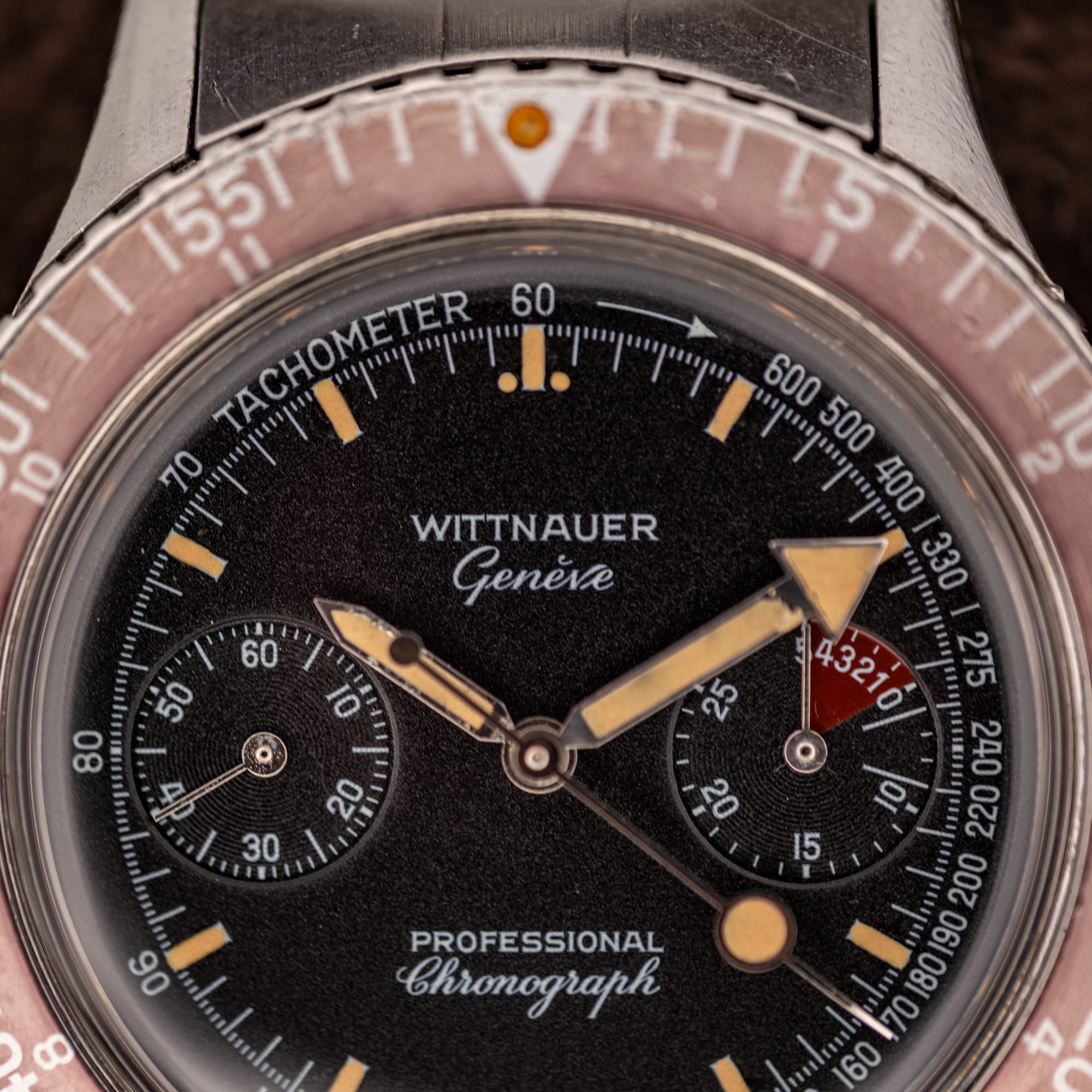
The dial is matte black under a printed tachymeter scale, with the two concentric guilloche registers the reference is loved for: running seconds at nine and the regatta countdown at three, the latter still holding its red paint across the five-minute countdown numerals. WITTNAUER over Geneve sits below twelve, PROFESSIONAL over Chronograph above six, and T SWISS T at the foot confirms the tritium it left the factory with. That tritium has settled into a warm cream across the broad luminous arrow hands and the hour plots, with a matching glow carried down the long arrow-tipped central chronograph hand. The bezel insert, cherry red when it was new, has weathered to a soft dusty rose, and the lumed triangle at its top still sits exactly where it should. We read all of that as character, not as wear.
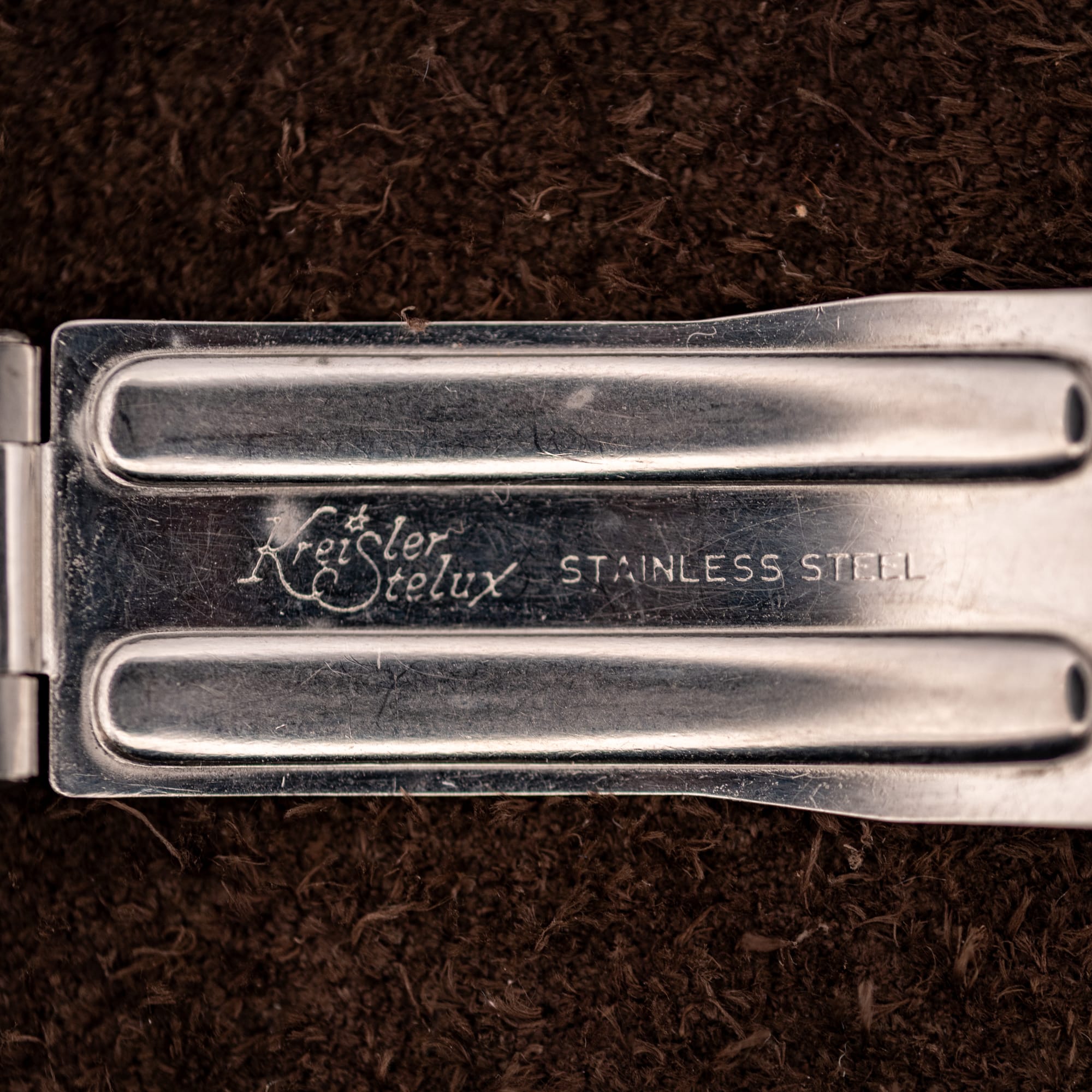
It comes on a period beads-of-rice stainless steel bracelet, silver and supple, closing on a folding clasp signed Kreisler Stelux, the American maker that dressed a great many imported chronographs of this era. The bracelet is honest to the watch’s American retail life, and it wears the part: substantial across the wrist without tipping into heavy.
Serviced in-house at OTTUHR and backed by our 2-year mechanical warranty, this Wittnauer Professional Chronograph is the kind of tool watch we hold onto longer than we should. Compact, characterful, and genuinely useful, it offers a regatta timer, a tachymeter, and a cam-switched chronograph in one steel case. For the collector who would rather own the design that proved a point than the one that merely sold well, this is the 7004A to have. To us, the faded bezel is not the flaw in the watch. It is the proof it lived.