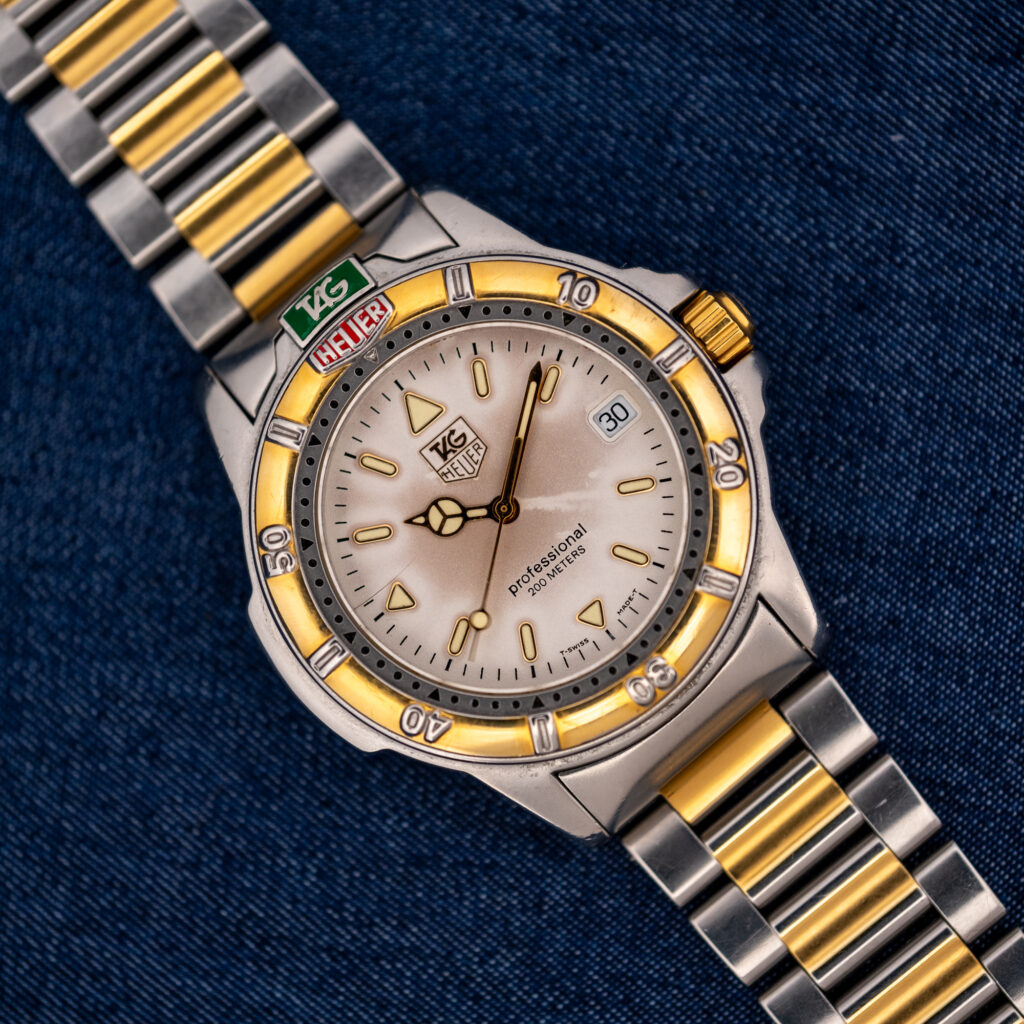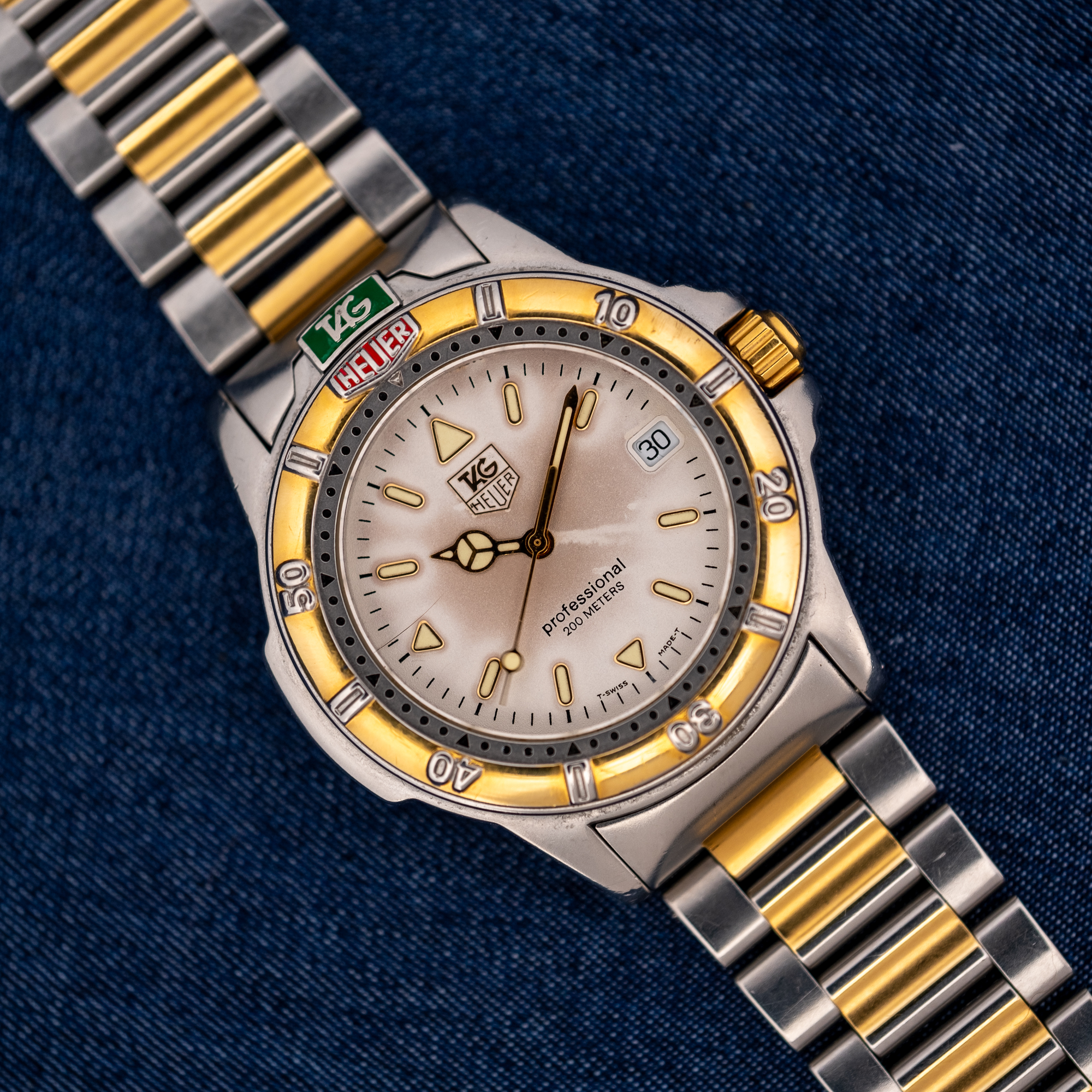
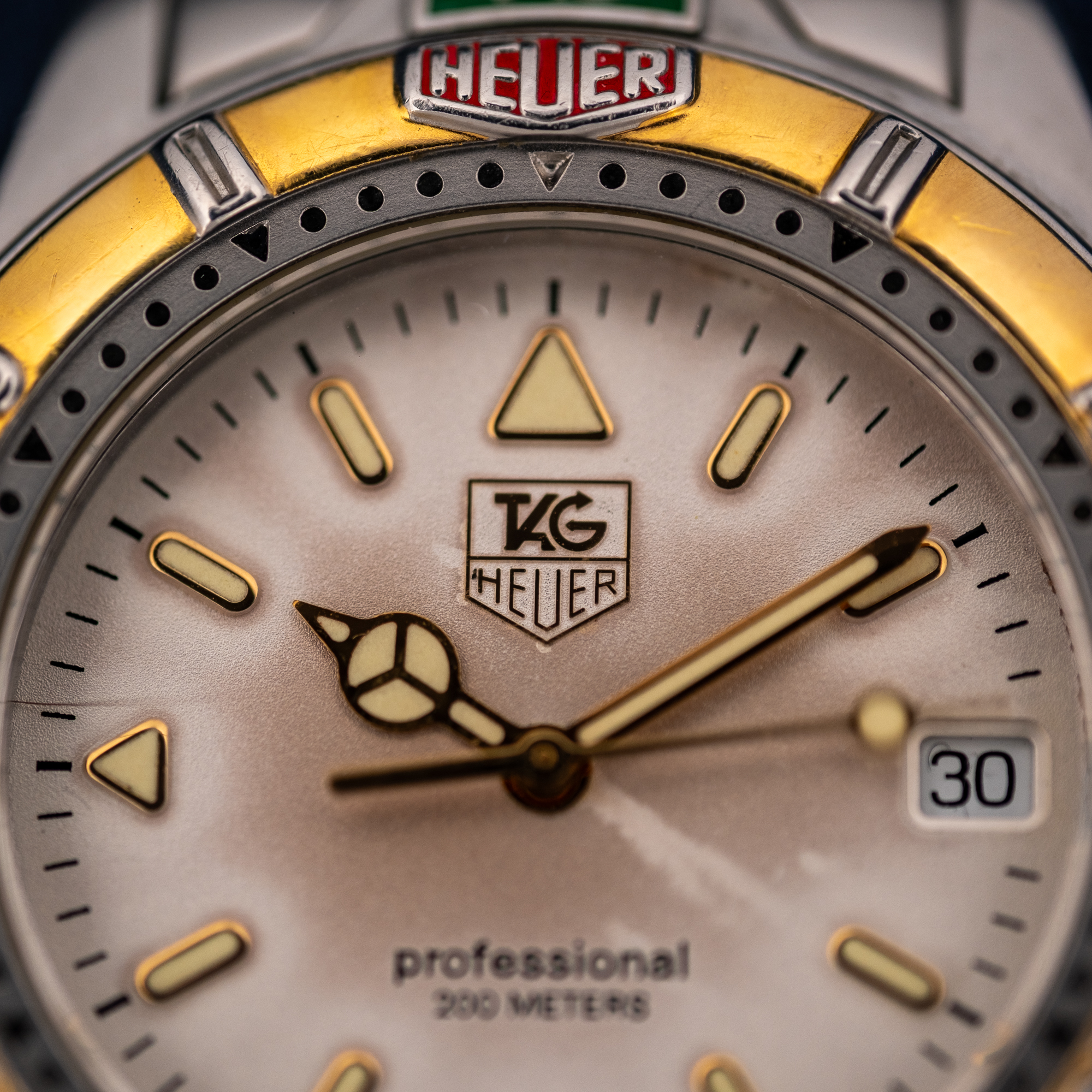
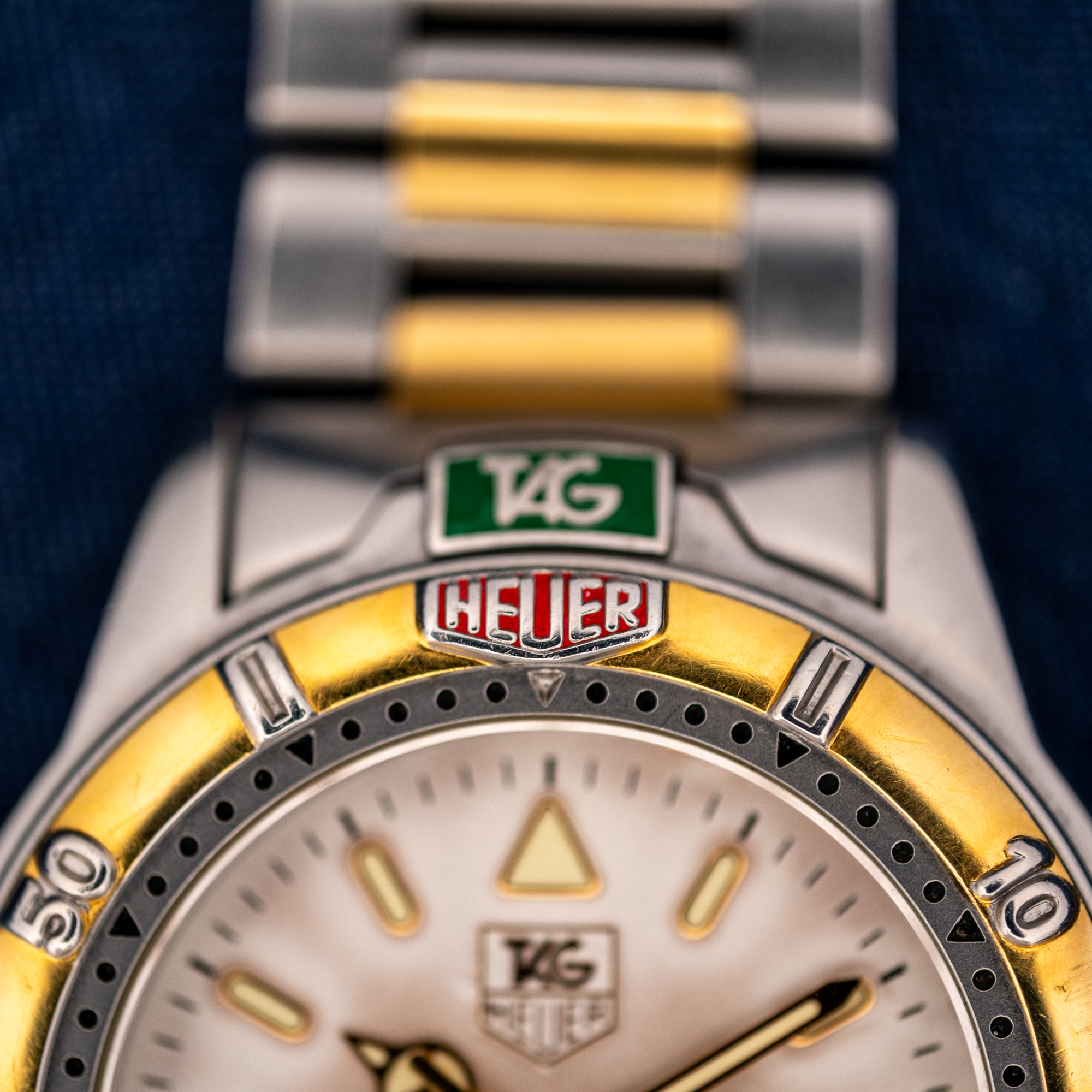
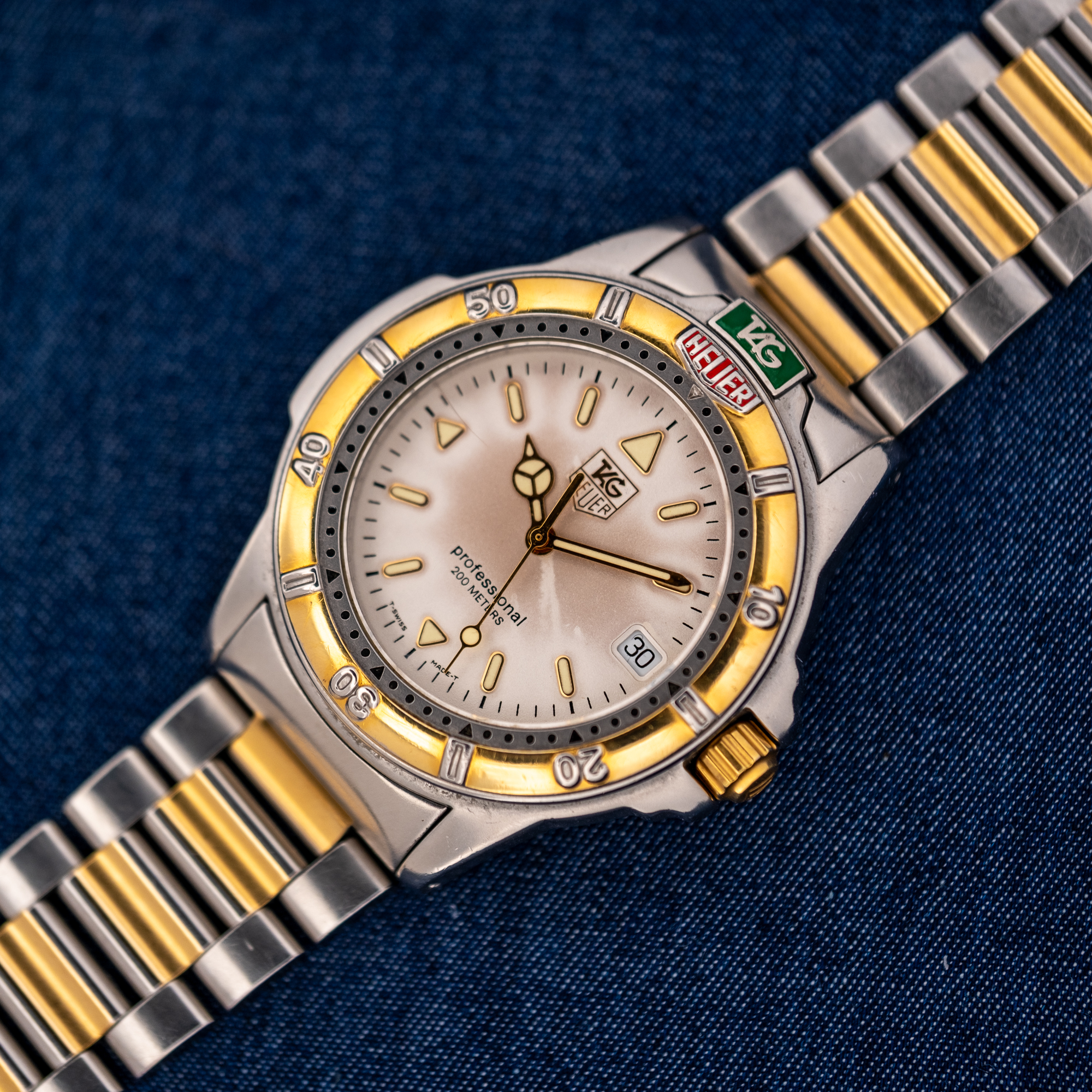
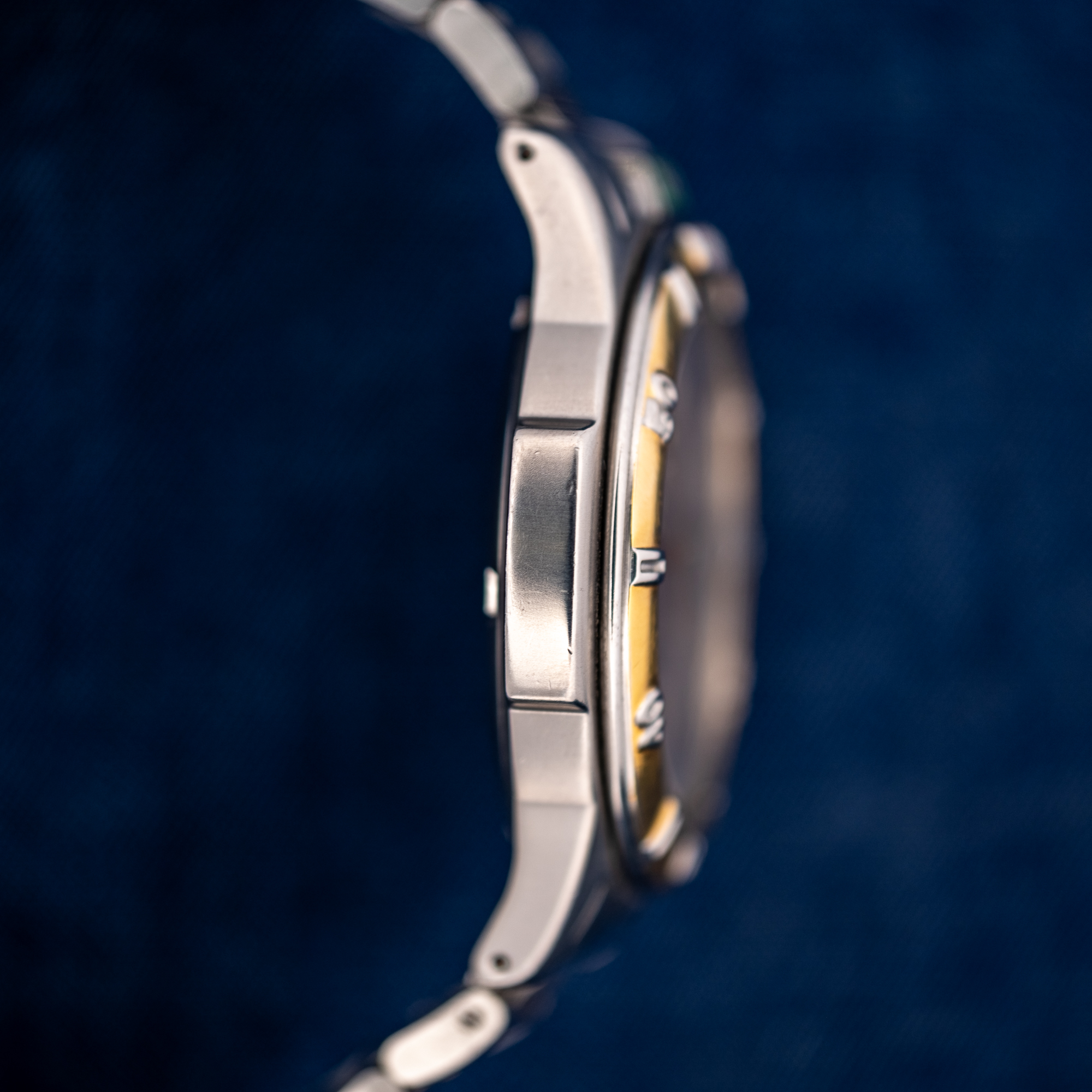
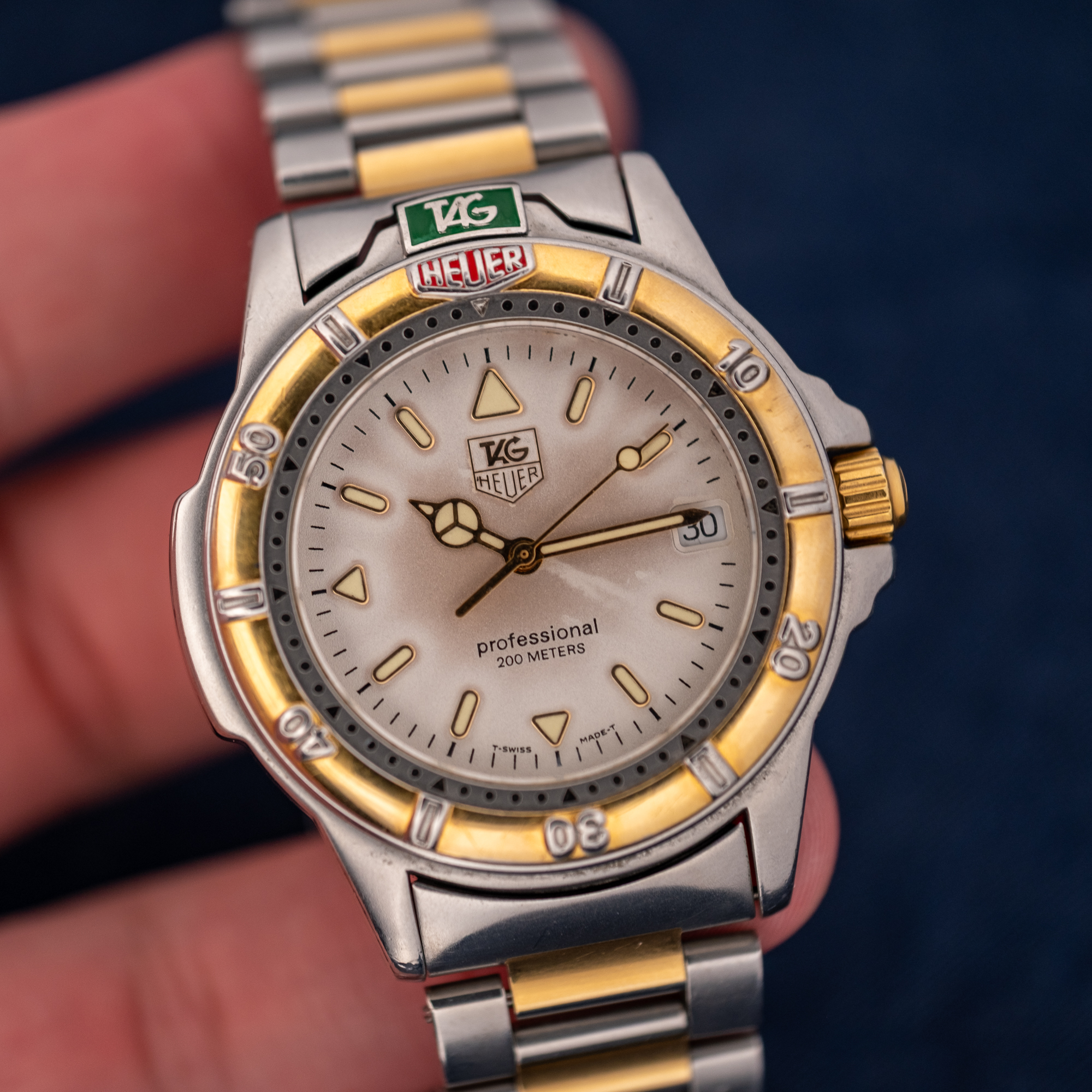
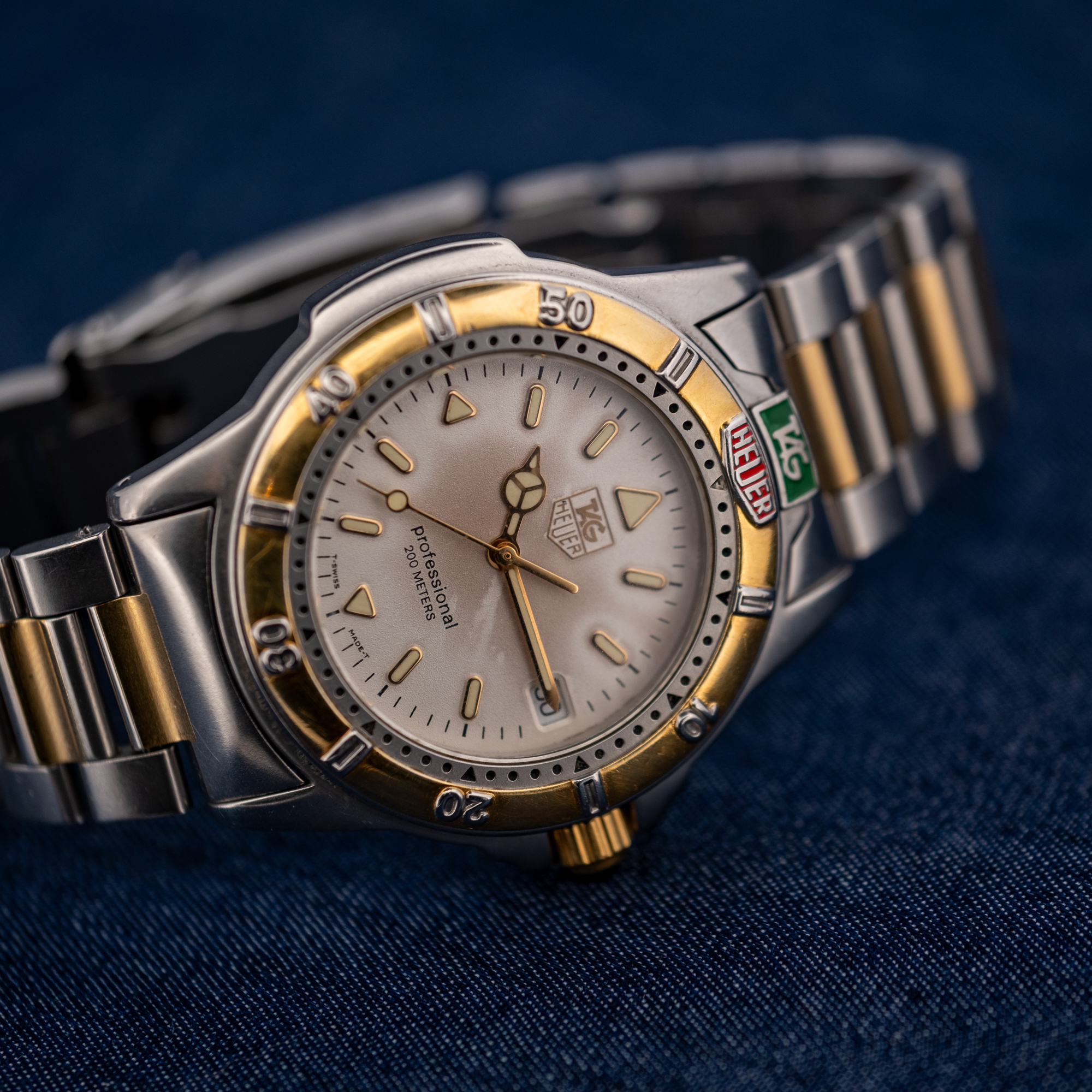

The shield on this watch comes in two pieces. TAG, in green, is molded into the case at twelve and never moves. HEUER, in red, belongs to the bezel, so the moment the bezel turns to time a dive, a parking meter or a pot of pasta, the second half of the name drifts away from the first. No other TAG Heuer collection ever wore its logo that way.
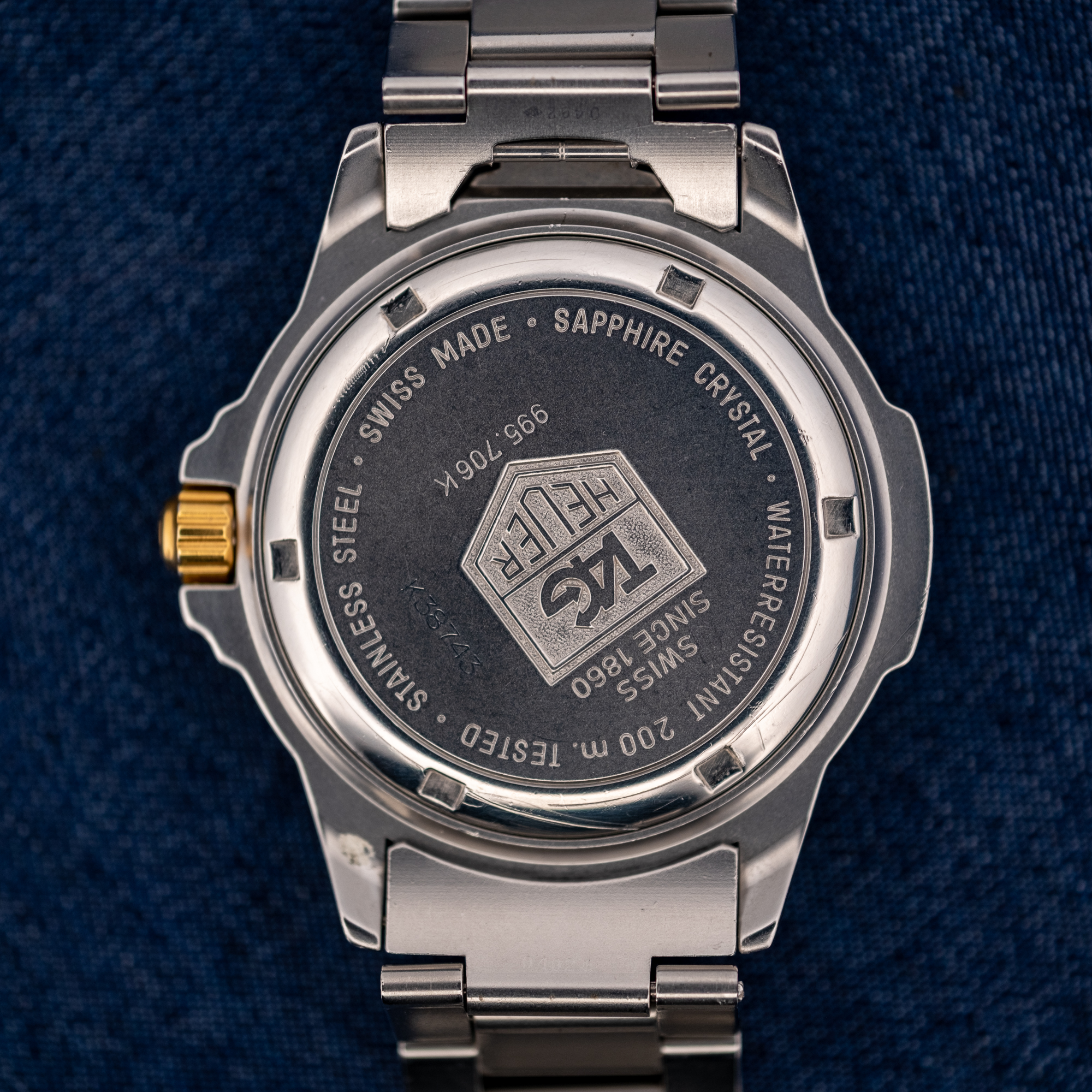
The split runs along a real seam. Heuer was the family name, on watches since Edouard Heuer founded the company in St-Imier in 1860, and the back of this case still reads SINCE 1860. TAG was the newcomer: the initials of Techniques d’Avant Garde, the group that bought a majority stake in 1985 and set its letters in front of the old name. On the TAG Heuer 4000 Series, the newcomer is fixed to the case and the founder’s name is the part that turns.
Both halves were painted, and paint on a raised logo at the top of a case does not have an easy life, so worn shields are common on the 4000. On this one, the green and the red are both still in the shield.
The 4000 arrived in the early 1990s to fill a gap in TAG Heuer’s own lineup. On one side stood the 2000 Series, the company’s utilitarian diver. On the other stood the S/el, launched in 1987 as a watch to wear “with the dinner suit or the wet suit.” The 4000 took the working equipment of the first and some of the polish of the second, in a softer, rounder case than the 2000 and without the S/el’s elaborate lugs and bracelet. The sales literature called it “a well-tempered character,” and it held its place until the Kirium replaced it in the late 1990s.
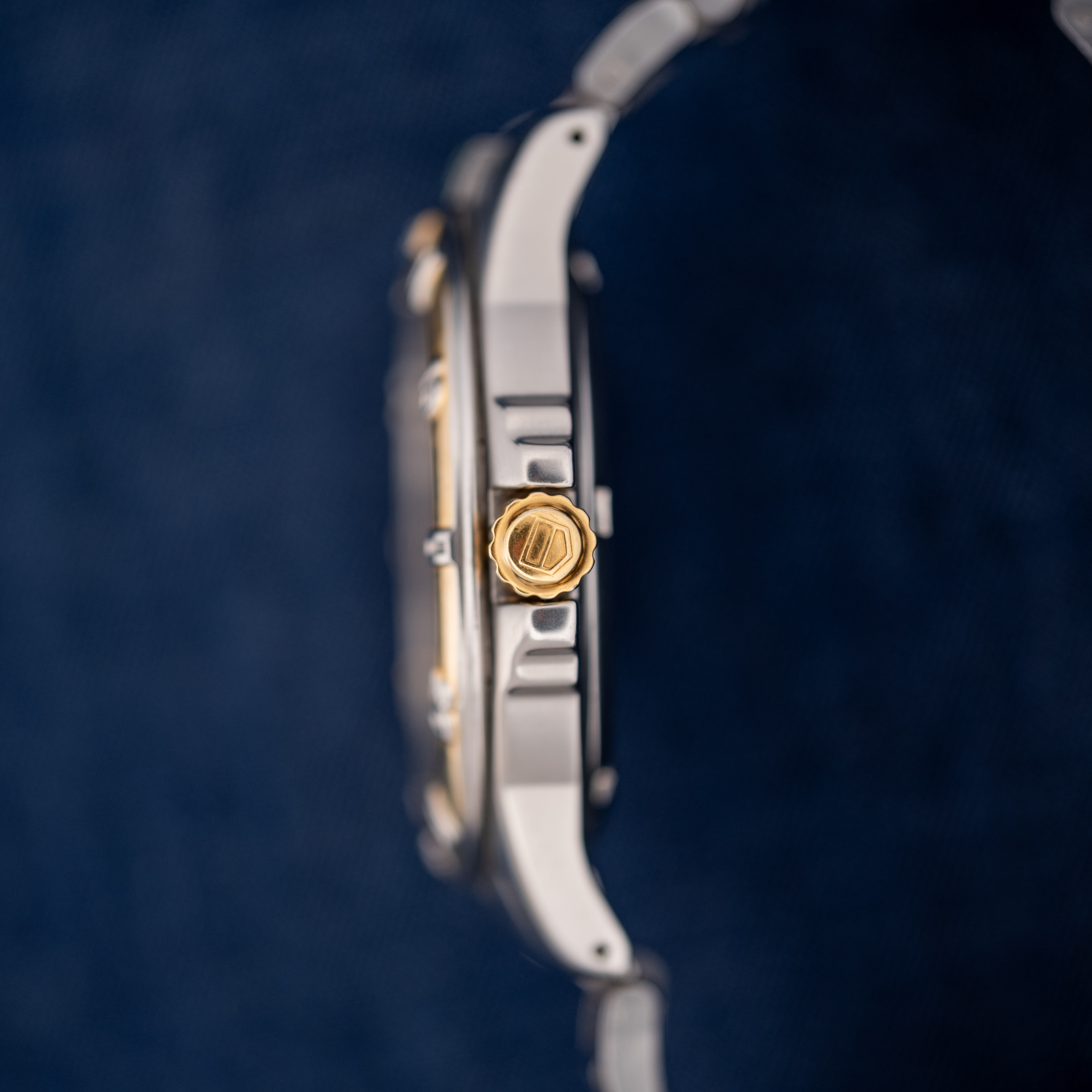
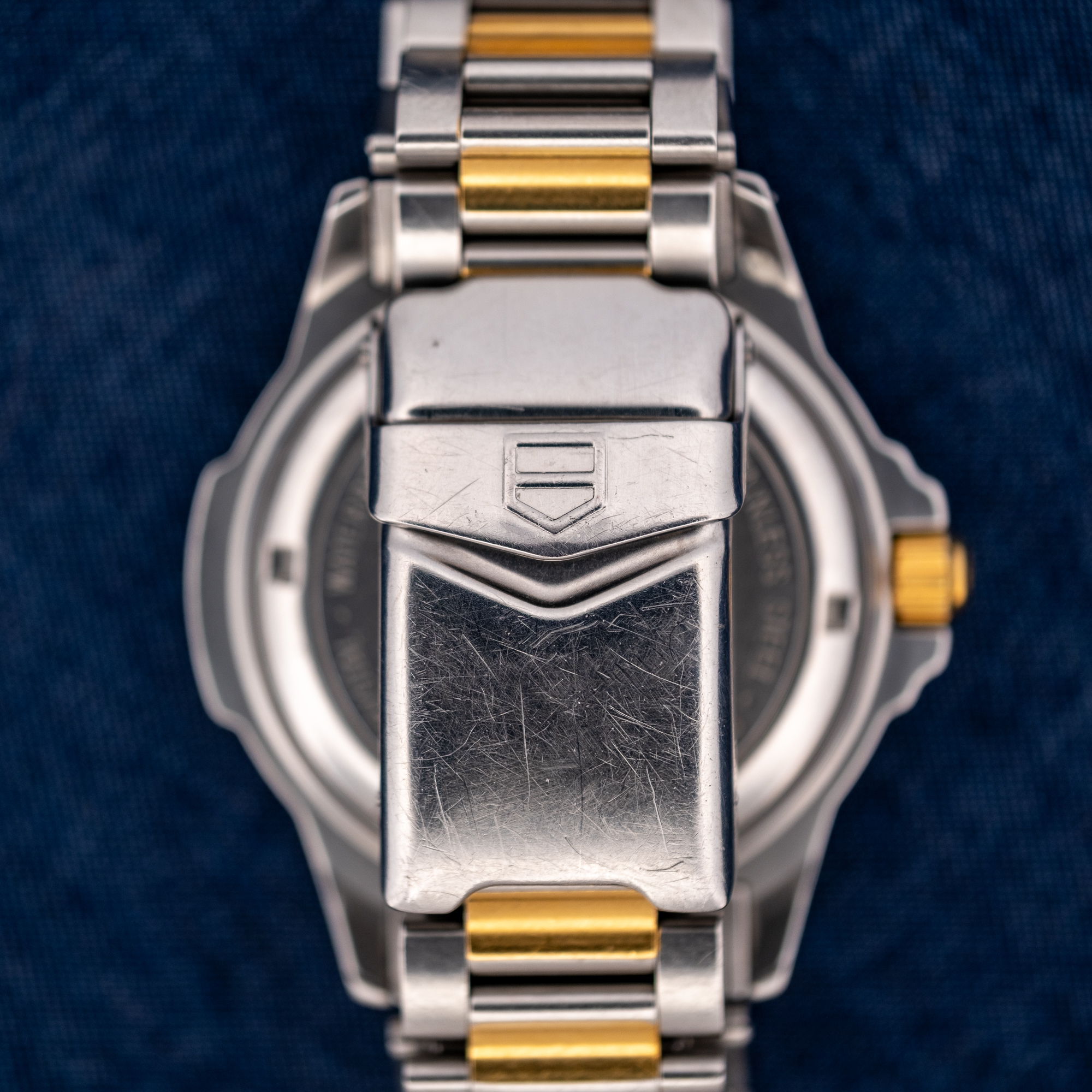
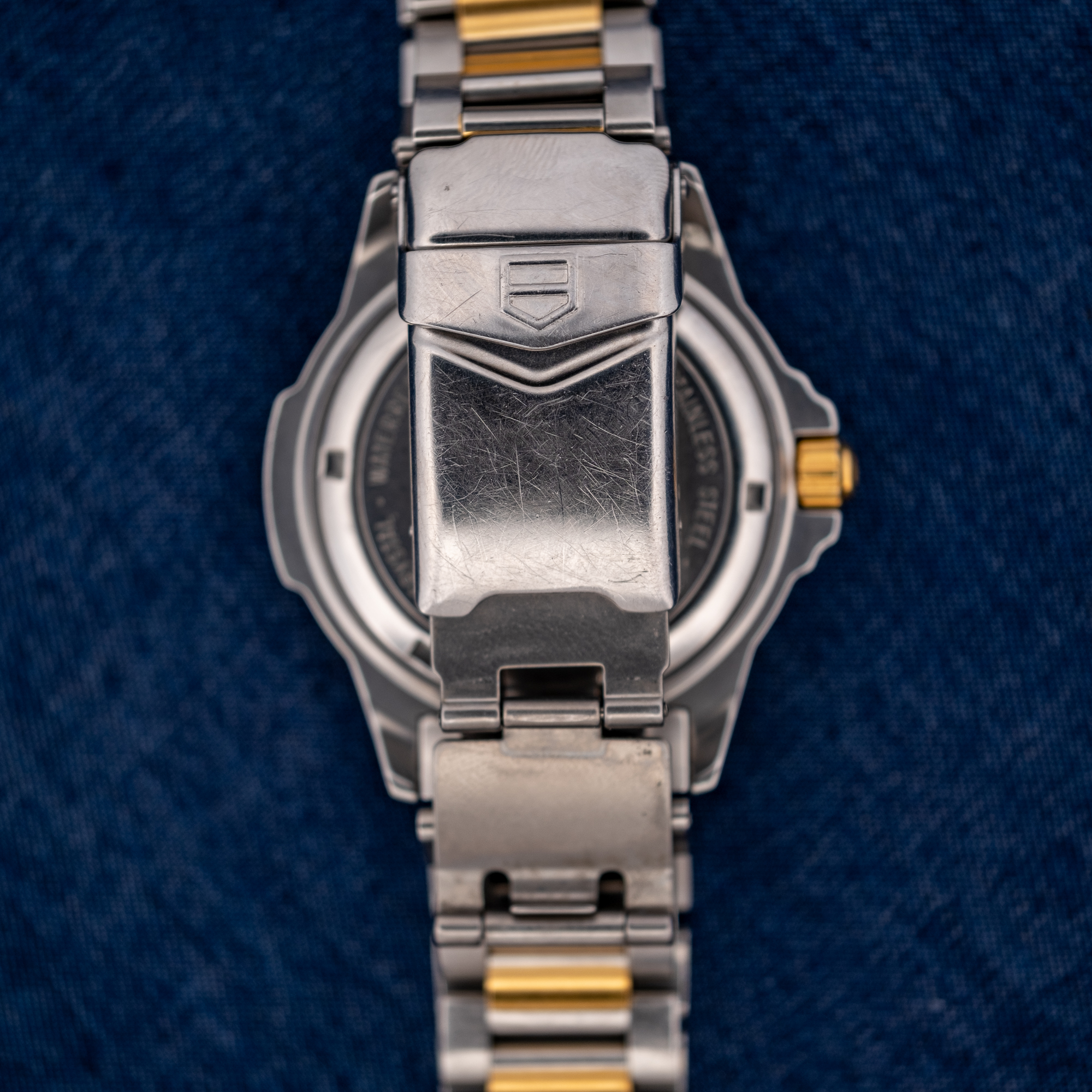
It also carried the checklist TAG Heuer built its 1990s divers around, the “six features”: 200 meters of water resistance, a screw-down crown, a double safety clasp, a unidirectional bezel, a sapphire crystal and luminous markers. The stamped ring on this case back names two of them, SAPPHIRE CRYSTAL and WATERRESISTANT 200 m. TESTED. That is the watch’s original rating, and we make no promise about water today.
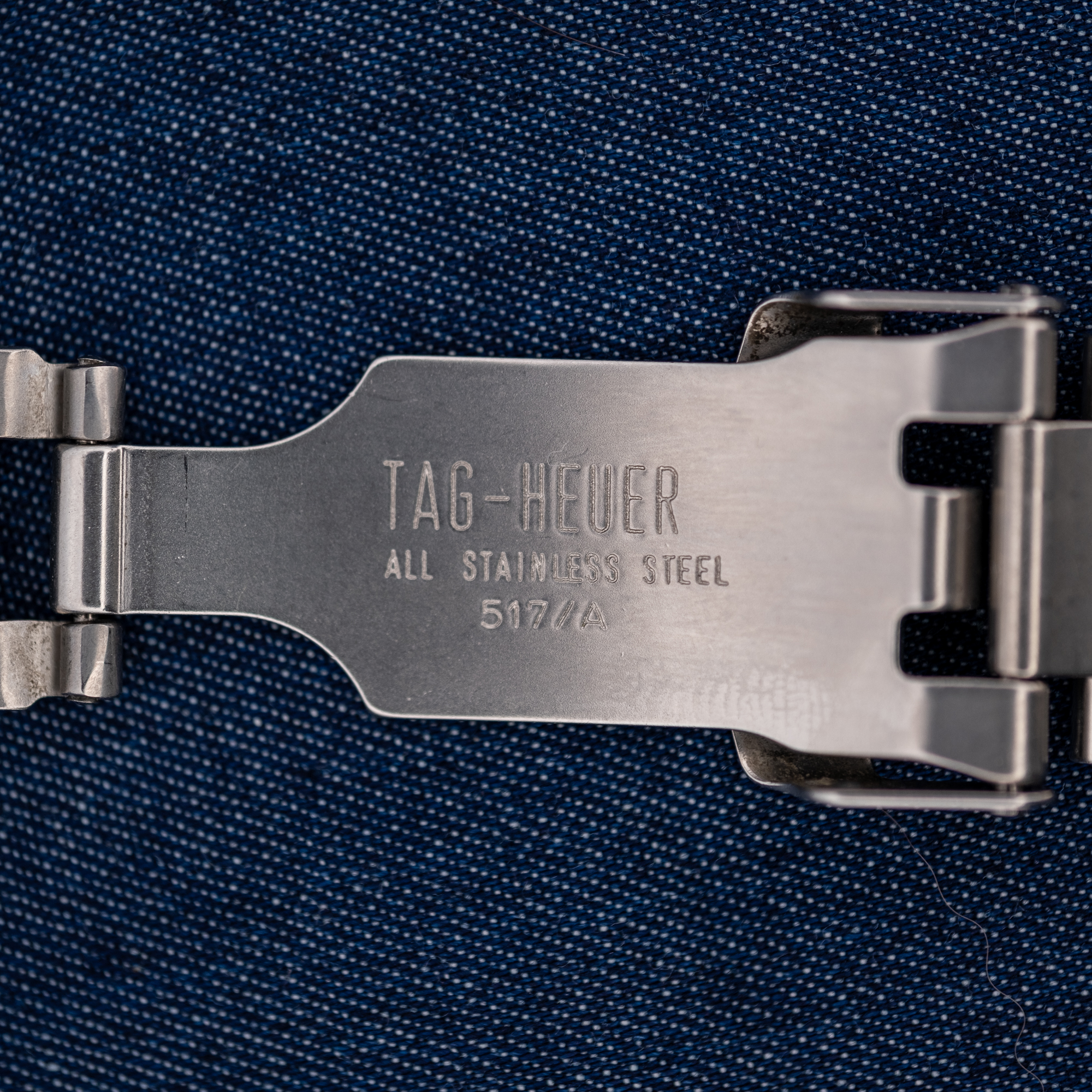
The dial and the back carry no series name. TAG Heuer seldom printed one, so the number on the back does the identifying. In the 1991 catalog, 995.706 is the men’s quartz model with a two-tone bezel, case and bracelet; the same design in the midsize and ladies’ sizes carried 995.713 and 995.708. Those six-figure numbers did not record the bracelet, which had a number of its own, 517, and the inside of this clasp is stamped 517/1A. When the range moved to letter codes in the early 1990s, the watch became WF1120.BB0517, with the bracelet finally written into the reference.
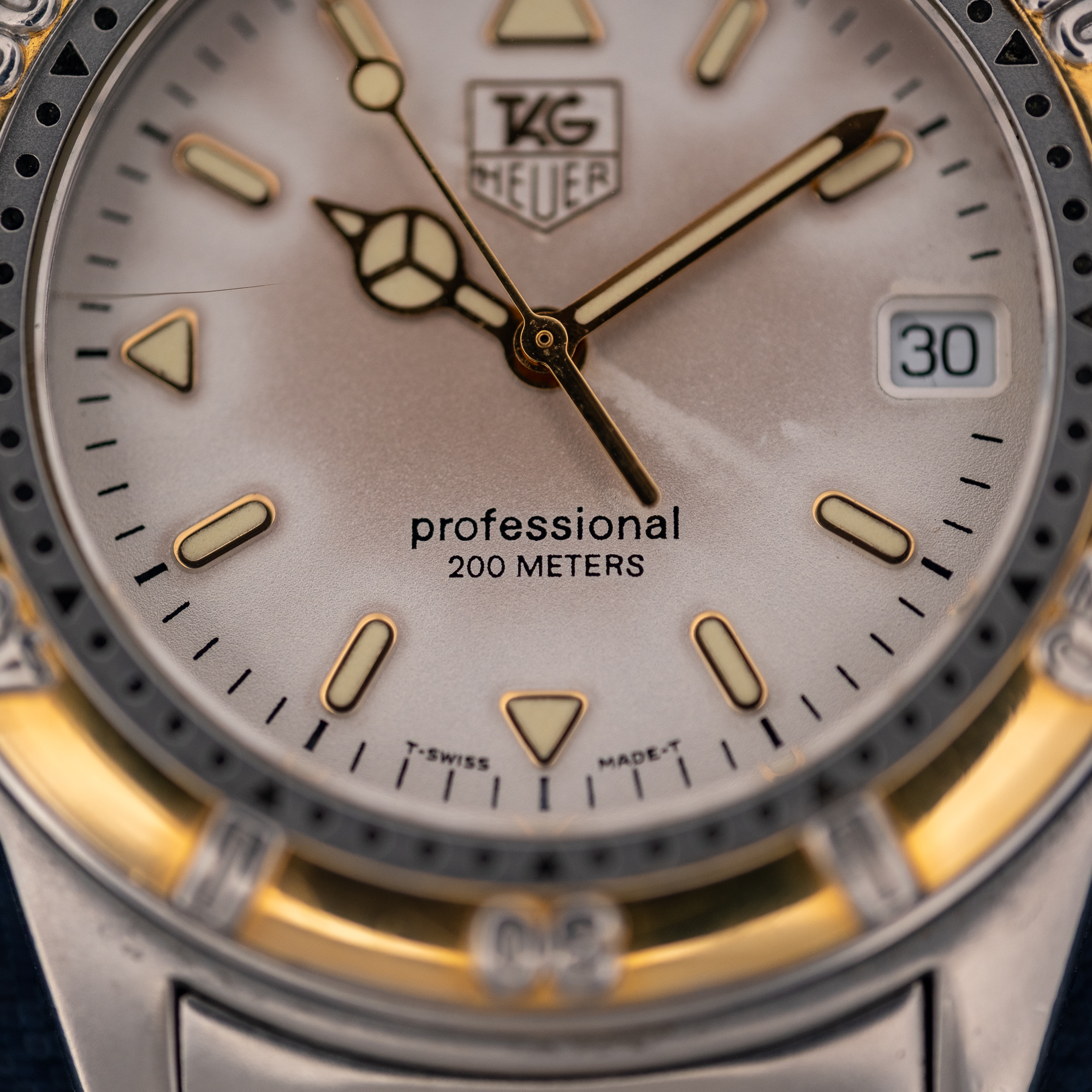
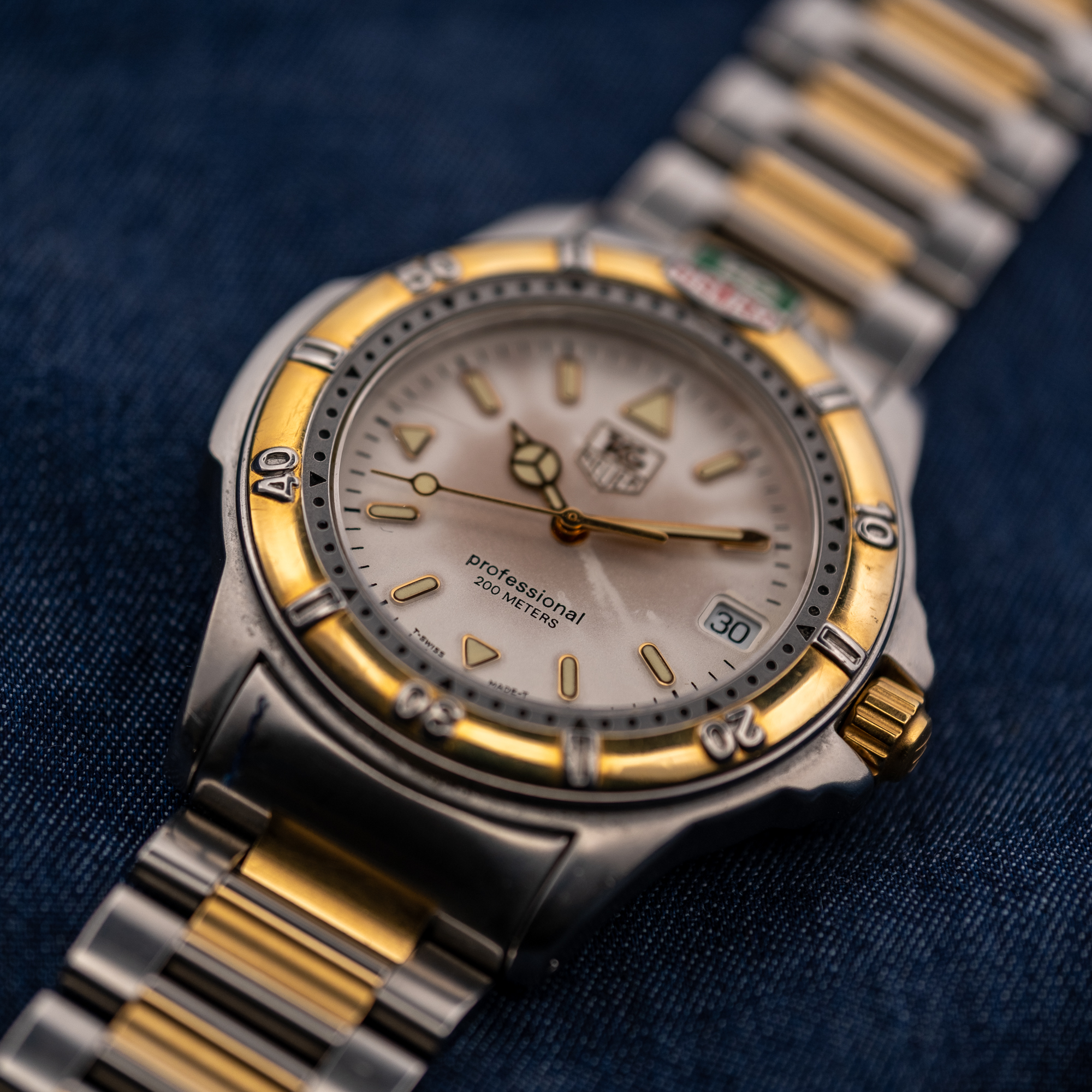
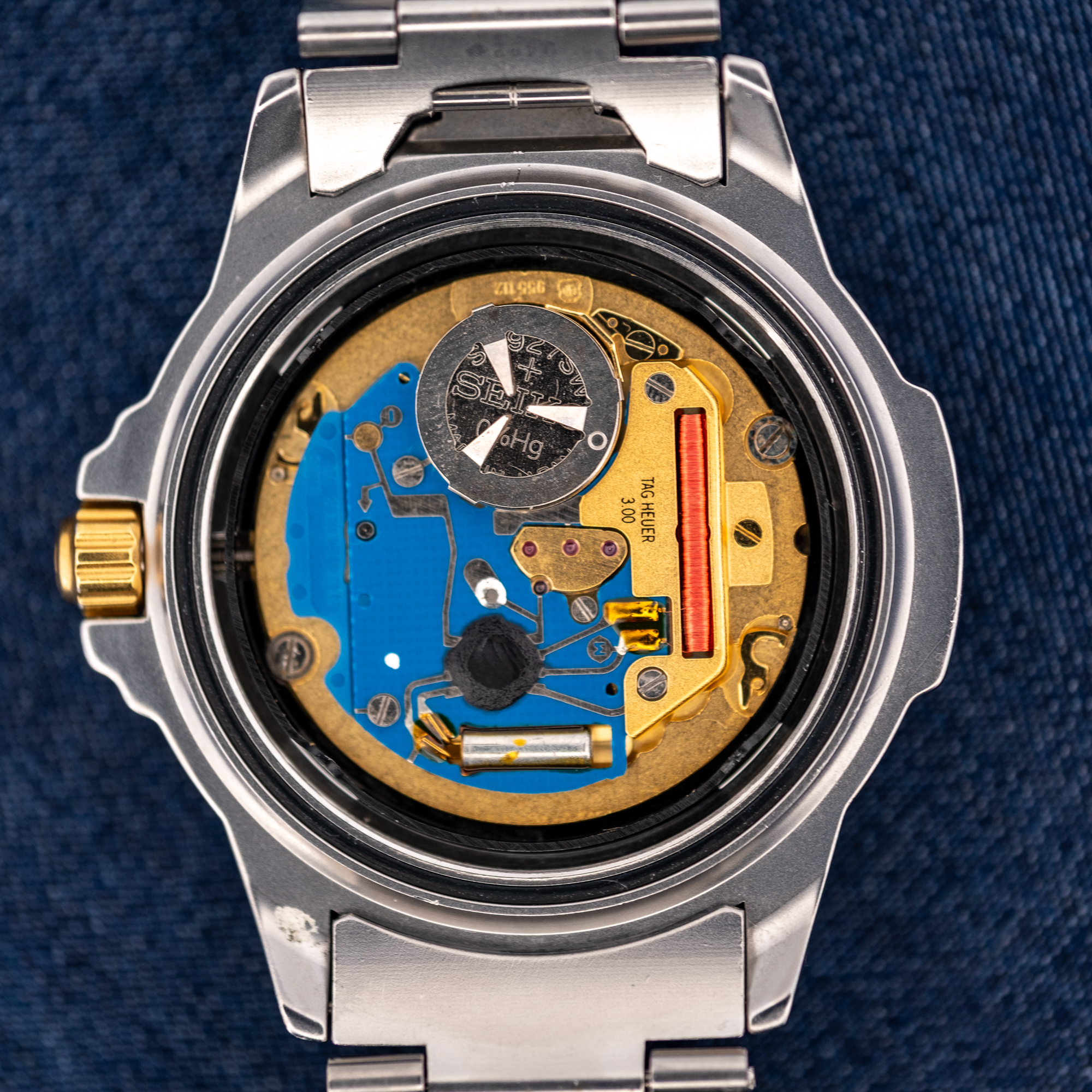
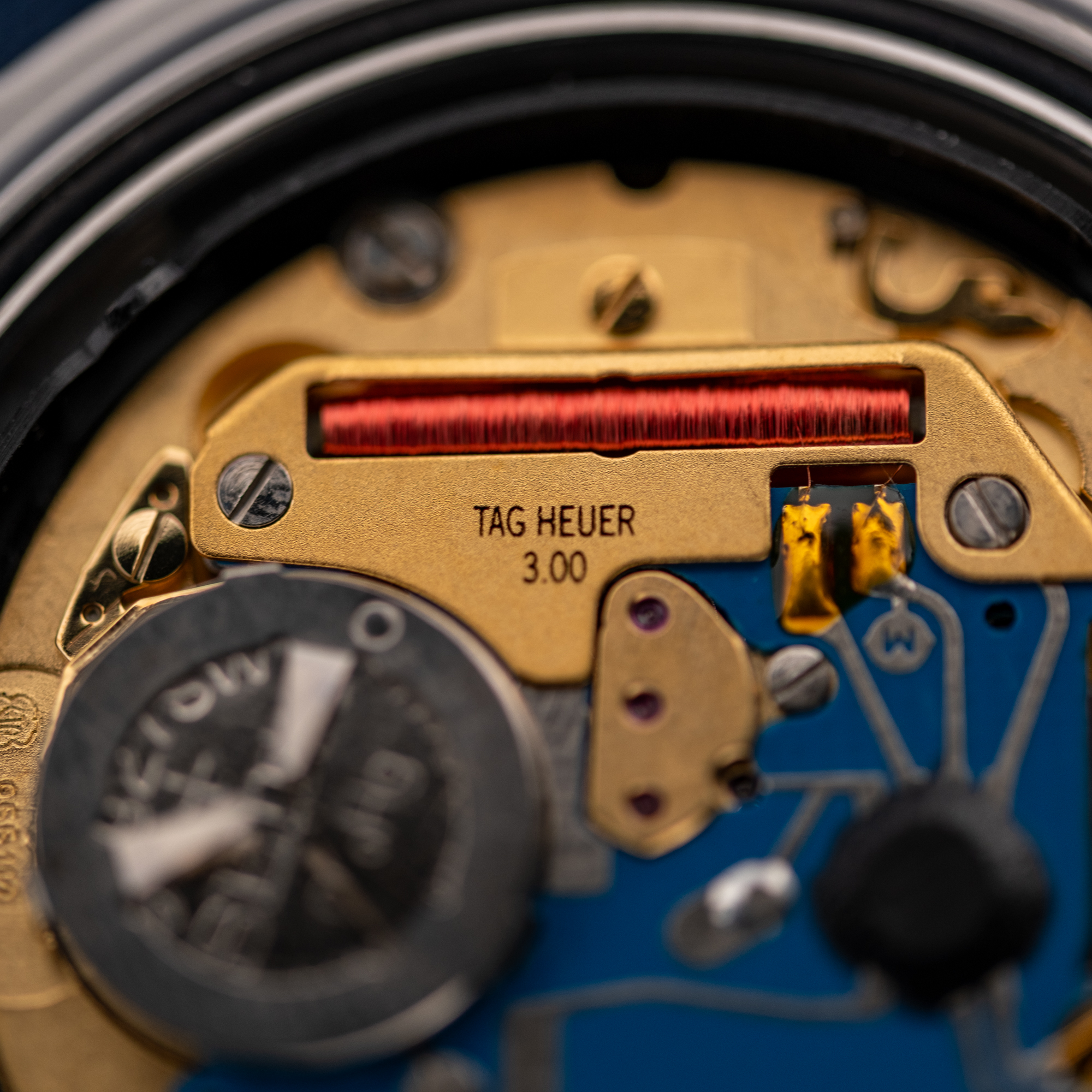
The quartz 4000 carried the word Professional on its dial; the automatic version printed automatic and added an inner minute track. Split around the six marker, T-SWISS MADE-T signals tritium lume on the hands and markers, and inside, the quartz movement’s bridge is signed TAG HEUER 3.00. The case is 38mm of stainless steel with a gold-plated bezel, on a matching two-tone bracelet, around a cream dial with a date window. The gold-tone bezel and bracelet centers show fine scratches, and the clasp face is well marked from wear. Left alone, the two halves of the logo sit together at twelve as one green-and-red shield.