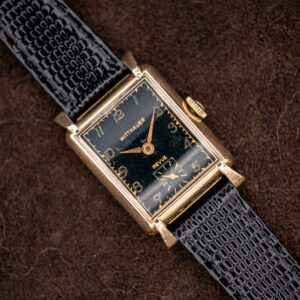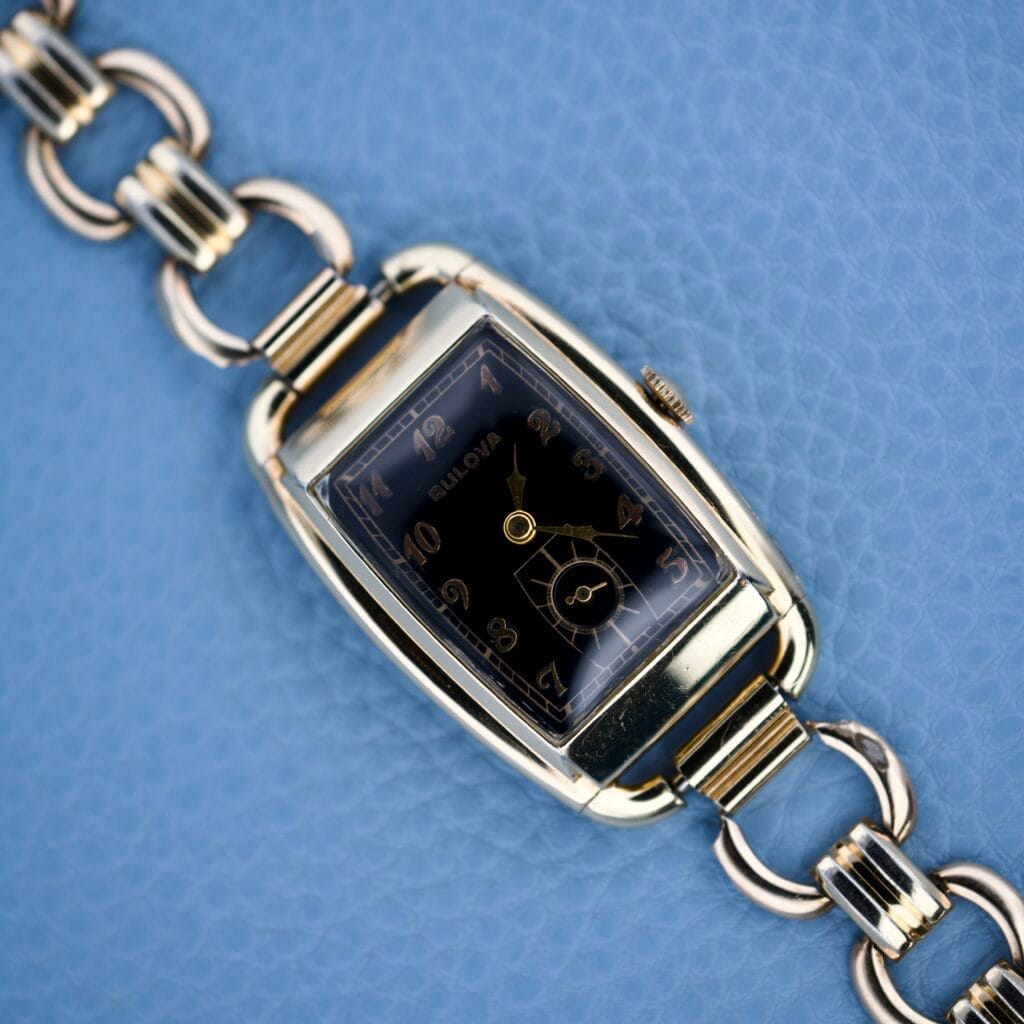
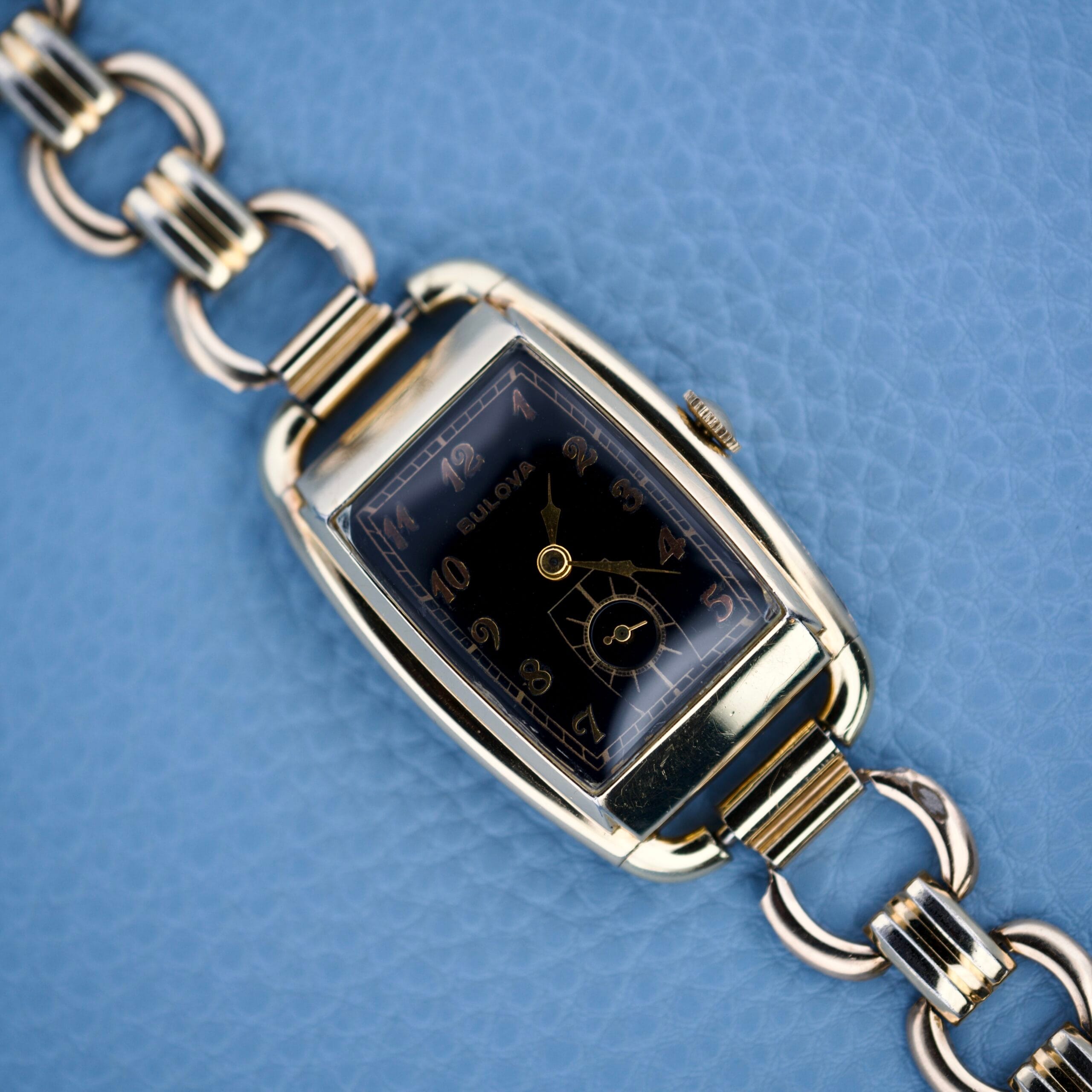
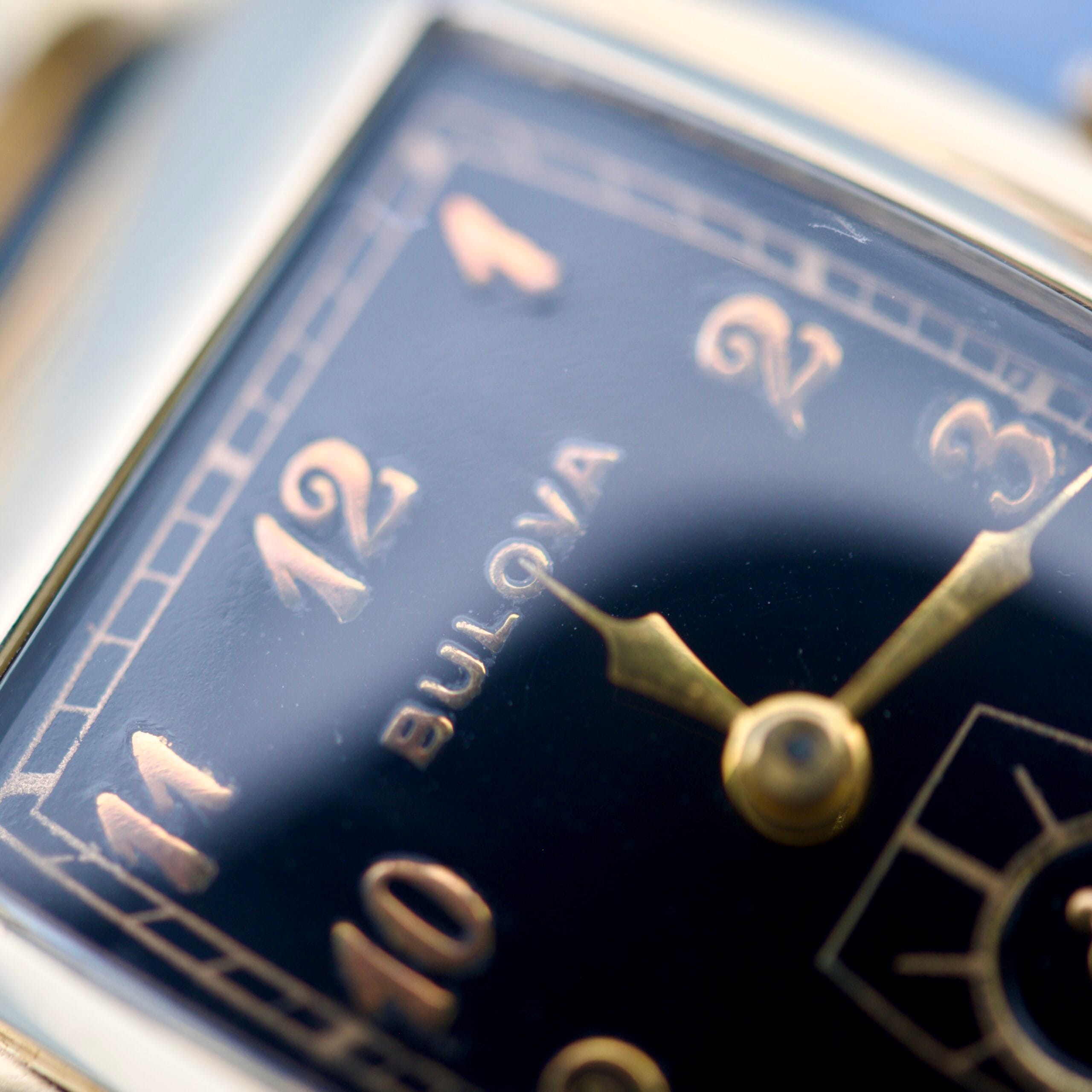
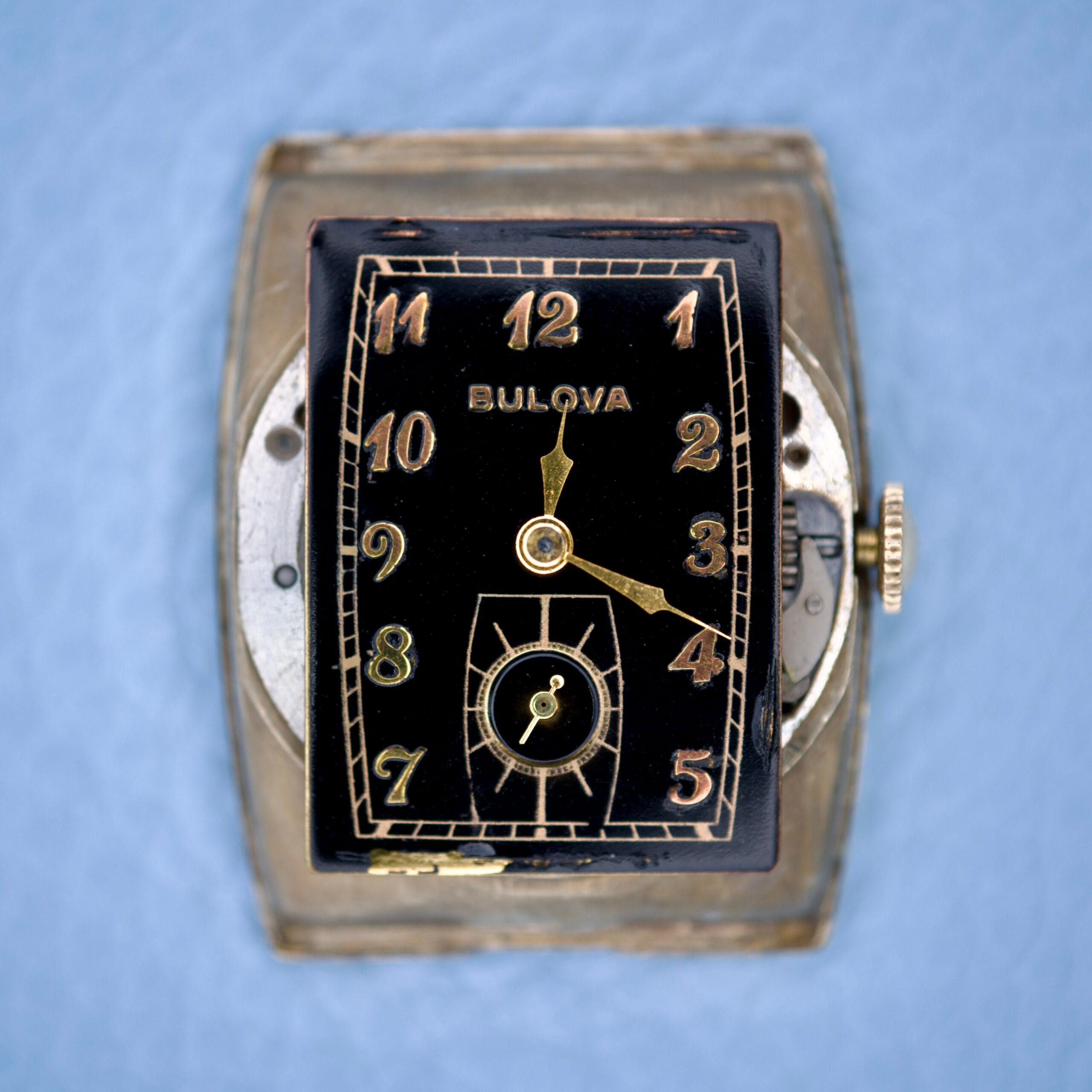
The dial here is what carries this Bulova Art Deco, and in our opinion it is one of the cleanest American small-format survivors we have handled at this case size. What left Bulova’s New York plant as a high-gloss black lacquer surface has held its mirror finish through the better part of eighty years, with the gilt printing across the Arabic numerals and the chapter-ring frame still reading sharp and bright against that black field. The sub-seconds register at 6 sits inside its own arched gilt cartouche with radial sector lines fanning out behind a small gilt baton seconds hand, and the BULOVA signature directly below 12 holds its print exactly where Bulova was setting it across the late-Deco and early postwar catalog. To us this is the kind of survivor dial you cannot redo, even if you wanted to.
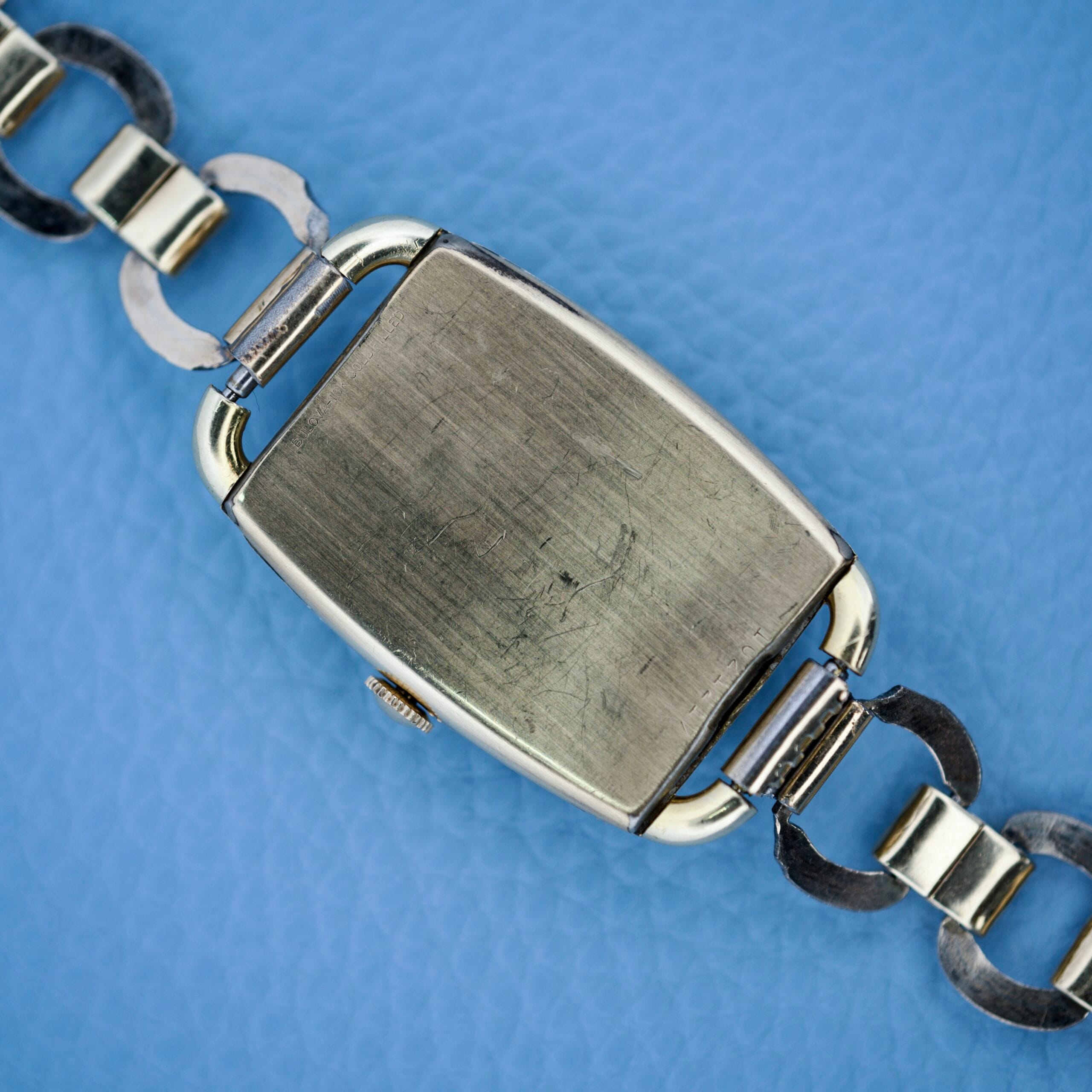
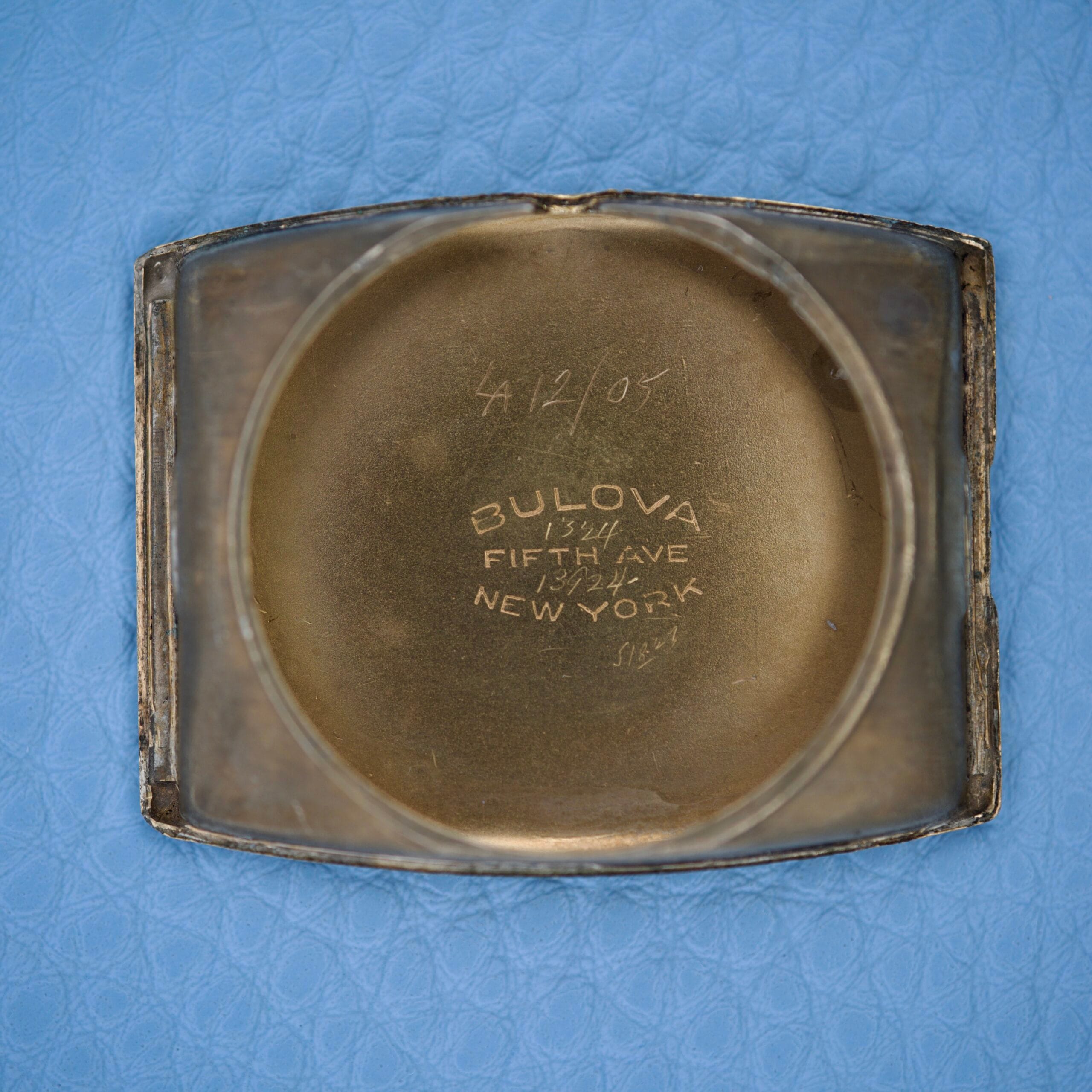
Bulova in this period was building from its Fifth Avenue New York address into a serious mid-century American watchmaking presence, and its smaller-format curved cases sat at the intersection of two design moments: the late wave of American Art Deco that had defined the 1930s, and the more restrained postwar styling that would dominate by 1950. The lacquer-black dial with stylized gilt Arabic numerals was Bulova’s most confidently Deco design language, and the brand kept producing variations of this exact dial-and-case formula well past the period that gave Art Deco its name. The inside caseback on this example reads verbatim “BULOVA / 1324 / FIFTH AVE / 13724 / NEW YORK”, a retailer-marked variant rather than the Bulova HQ stamping, which points to a Fifth Avenue jeweler casing run. A handwritten “4 12 05” tucked into the same caseback documents an April 2005 service stop along the way.
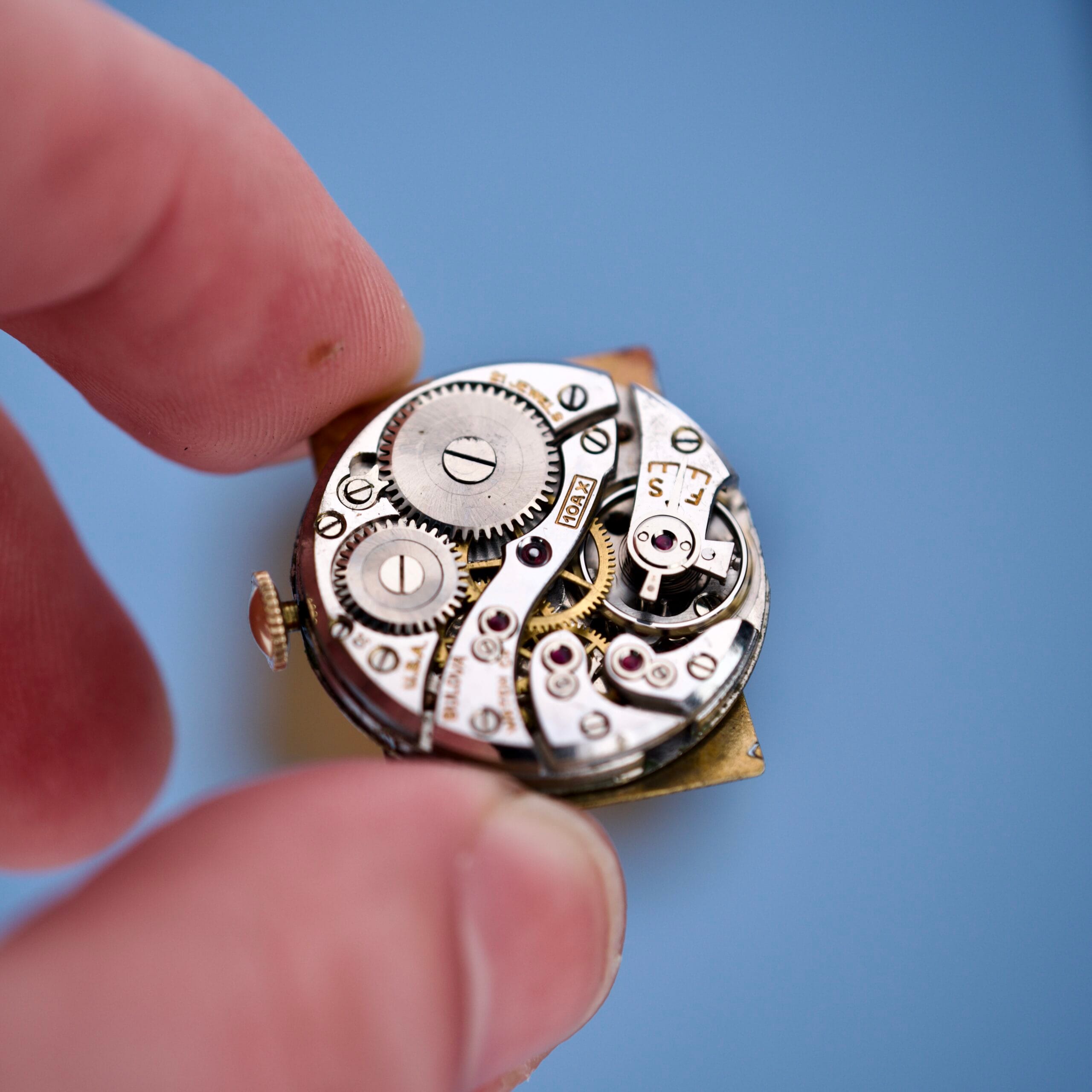
Ticking inside is the Bulova Caliber 10AK, a fifteen-jewel American-made manual-wind movement that Bulova produced from the early 1940s into the early 1950s. The 10AK is one of the more historically significant Bulova calibers because it carried the brand through the wartime ordnance contracts: the same fifteen-jewel sub-seconds 10AK that powered civilian dress watches was the movement Bulova built into its U.S. military-issue watches during and after World War II. Bulova specified a Breguet overcoil hairspring on the 10AK and the later 10AKC variant ran with Incabloc shock protection, which by the standards of mid-century American watchmaking made this a genuinely well-engineered small-format caliber rather than a budget alternative. The movement on this example shows the brushed bridges, gilt-screwed jewel chatons, and clean Bulova bridge signature that you want to see on a survivor opened by competent hands across the decades.
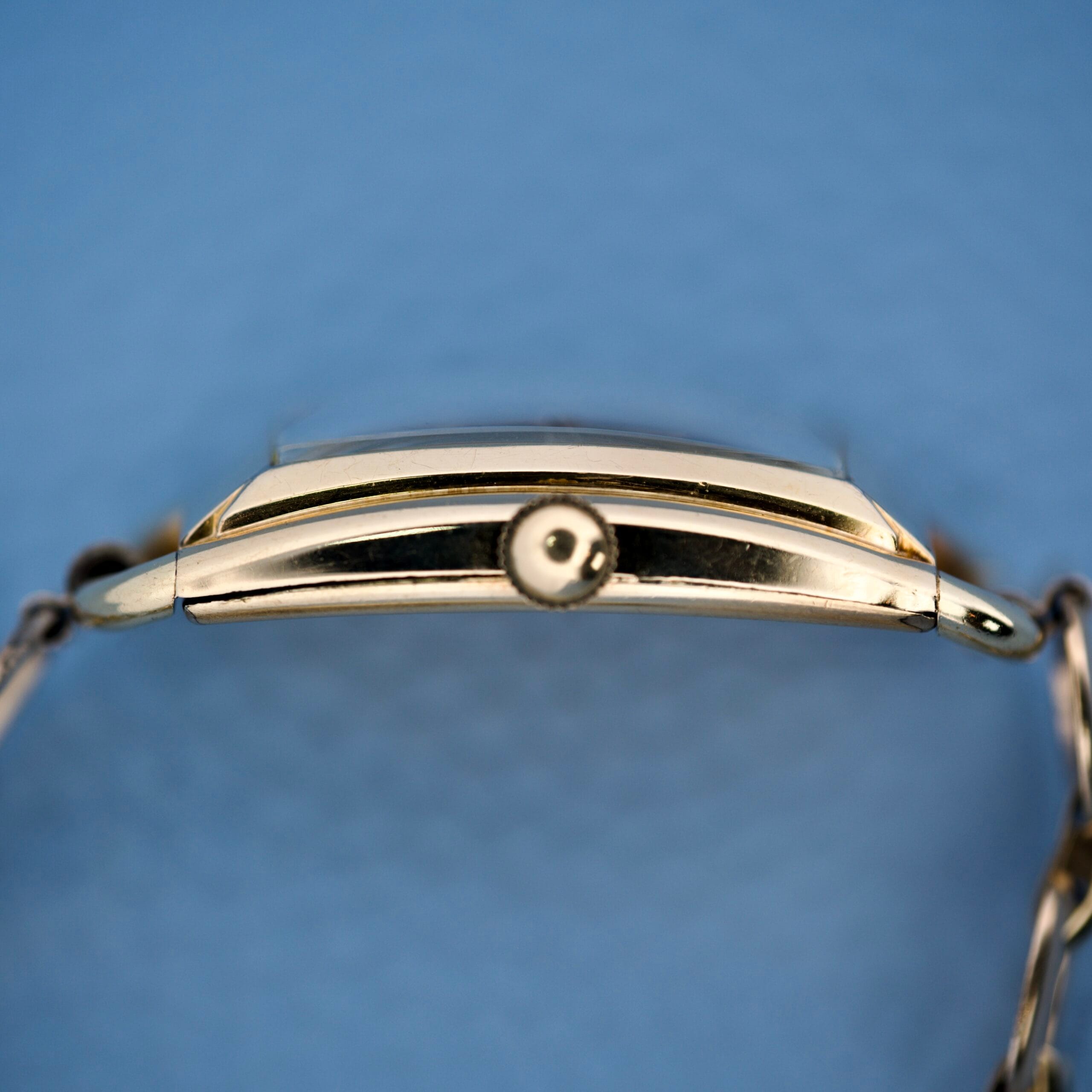
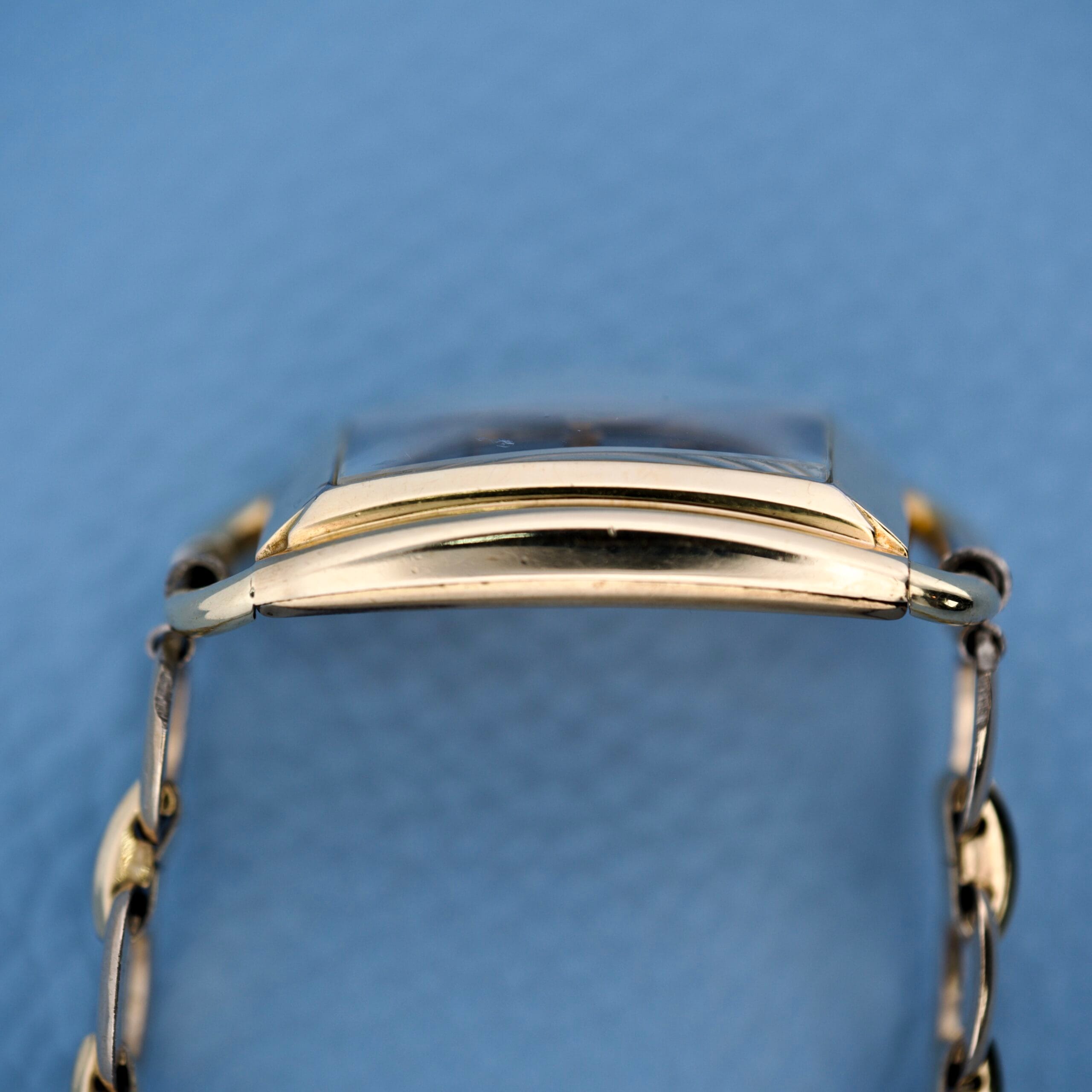
The case is a curved tonneau gold-filled construction with stepped polished sides and integrated lug arches that flow directly into the bracelet, the kind of full-jewelry approach that the late-Deco period in America did better than almost anyone. The side profile shows the layered case architecture clearly, with a polished outer step over a wider inner step, all rendered in gold-filled construction. Gold-filled means a thick bonded gold layer over a base-metal core rather than the thin electrodeposit you get on gold-plated cases, a meaningfully more durable build for a piece always meant to be worn. The crystal is a domed acrylic that follows the curve of the case, and a small fluted gilt crown at 3 sits flush against the case flank. Honest surface wear shows across the outer caseback where decades of service-tool contact have left a satin patina.
Back to the dial. The base is a deep glossy black lacquer that still throws a mirror reflection under direct light, with no fading, no spotting, no restoration evidence. The hour markers are gilt printed Arabic numerals at every position except 6, where the sub-seconds register takes over, and the numerals are rendered in a stylized late-Deco face with curled tails, swelled bowls, and the kind of confident type-design that almost nothing else in the period American catalog can match. A gilt chapter-ring frame traces the inside perimeter of the dial in a double-line border that follows the tonneau shape, with small minute ticks set between the inner and outer lines. The sub-seconds register at 6 sits inside its own arched gilt cartouche with radial sector lines fanning out behind a printed inner track, and a tiny gilt baton seconds hand sweeps over it. The hour and minute hands are gilt leaf shapes with subtle cutouts that catch light cleanly against the black field. No lume on this dial, no date window, no extra complication.
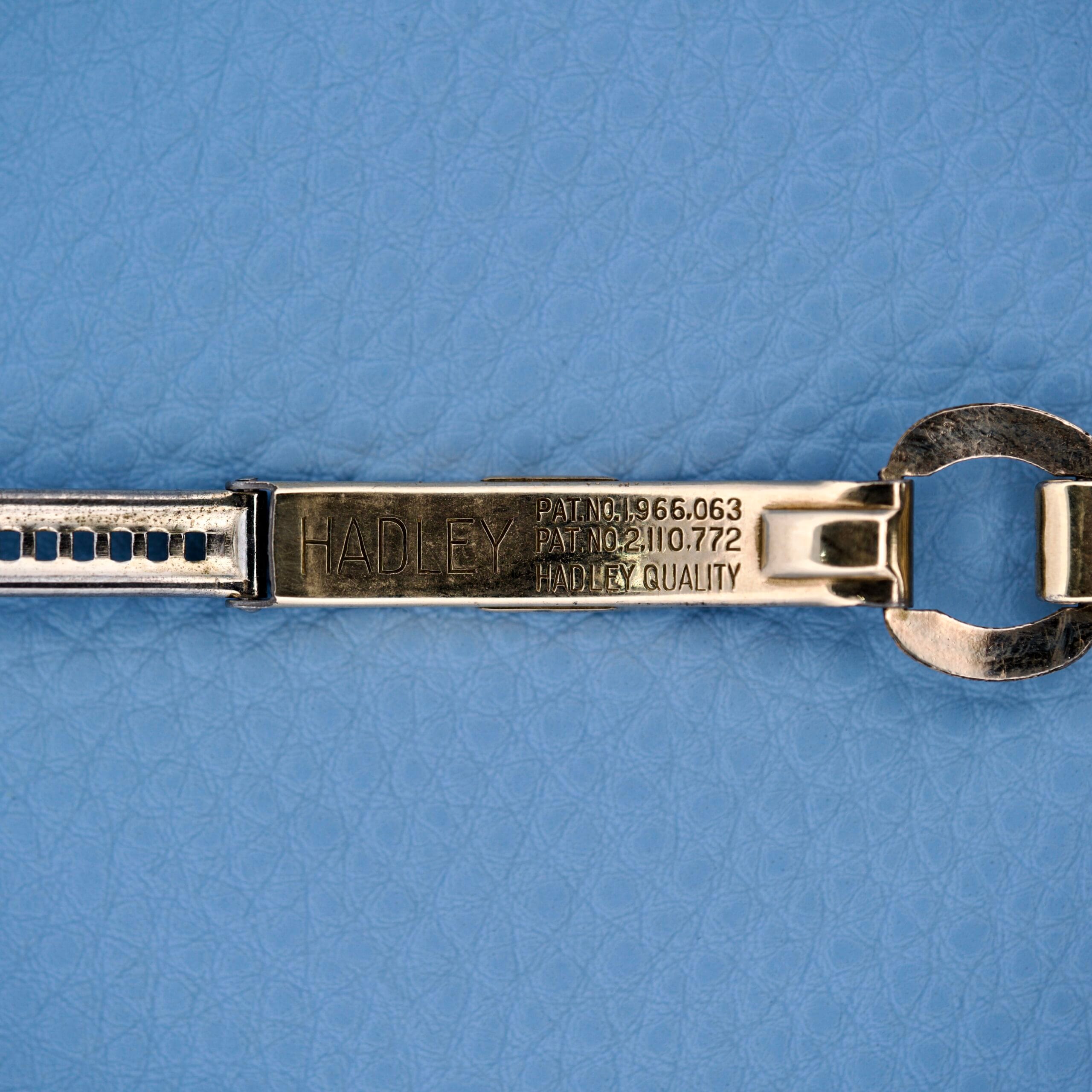
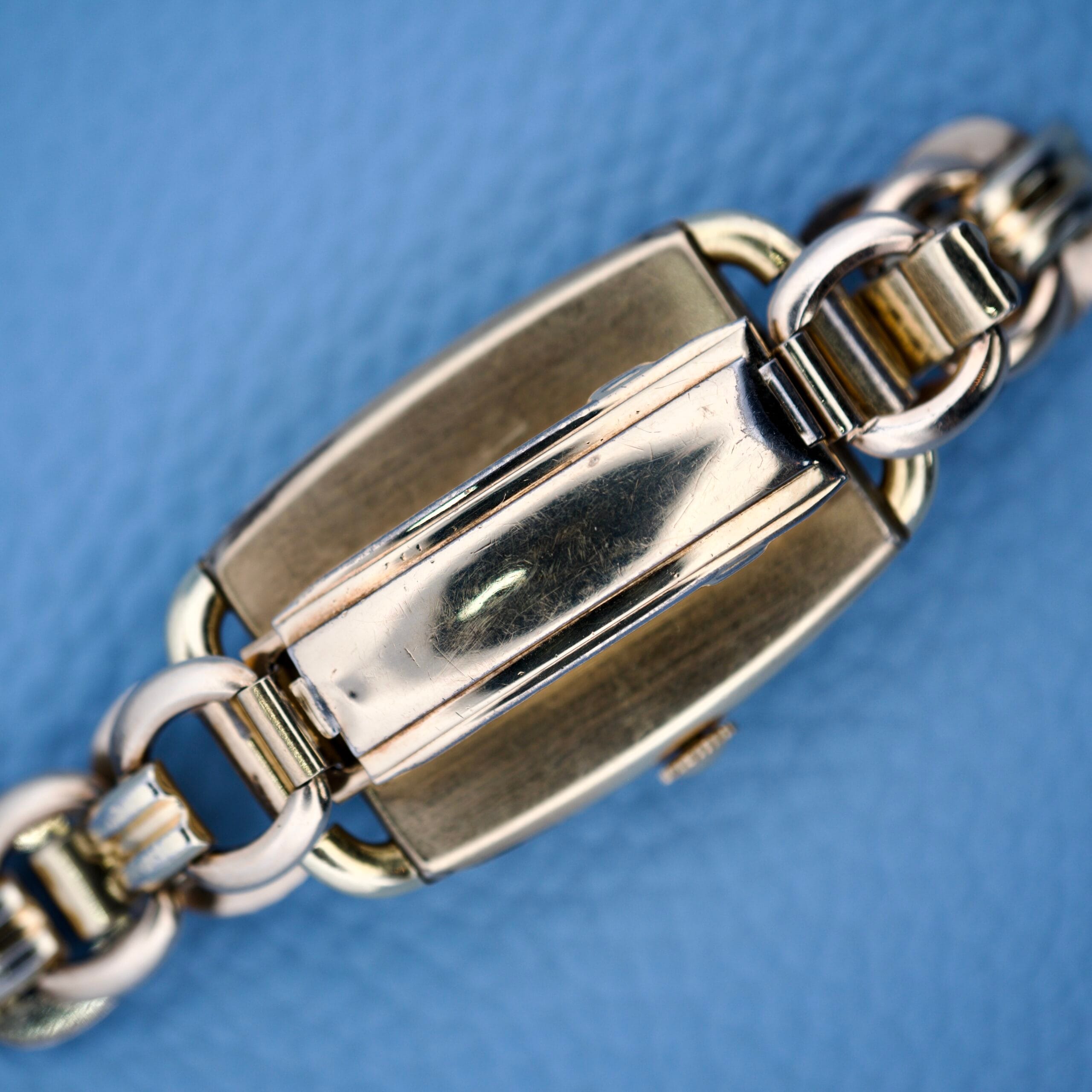
The watch arrives on its period-appropriate gold-filled integrated link bracelet by Hadley, signed verbatim “HADLEY / PAT NO 1,966,063 / PAT NO 2,110,772 / HADLEY QUALITY” on the clasp. Hadley’s patent 1,966,063 was issued in 1934 as a bracelet connecter design, which dates this style of bracelet to the mid-1930s and onward, with the second patent number sitting in the 1938 range. The bracelet itself is a two-tier ring-and-bar geometric link pattern, with circular outer links framing horizontal bar centers, a design that ties the case and bracelet together as a single flowing piece of wrist jewelry exactly the way the Deco period intended. No separate strap is fitted because the bracelet is the strap, and the bracelet is half the visual story.
Serviced in-house at OTTUHR and backed by our 2-year mechanical warranty, this Bulova Art Deco is for the collector who values a genuinely earned American-dial survivor and a defensible mid-century Bulova caliber over a polished modern reissue. The combination of the lacquer-black dial, the stylized gilt Arabic numerals, the arched sub-seconds register at 6, the integrated Hadley bracelet, and the Caliber 10AK movement all line up into a piece that, to us, reads as one of the most quietly confident late-Deco Bulova small-format survivors we have had in hand.