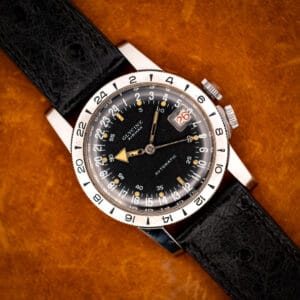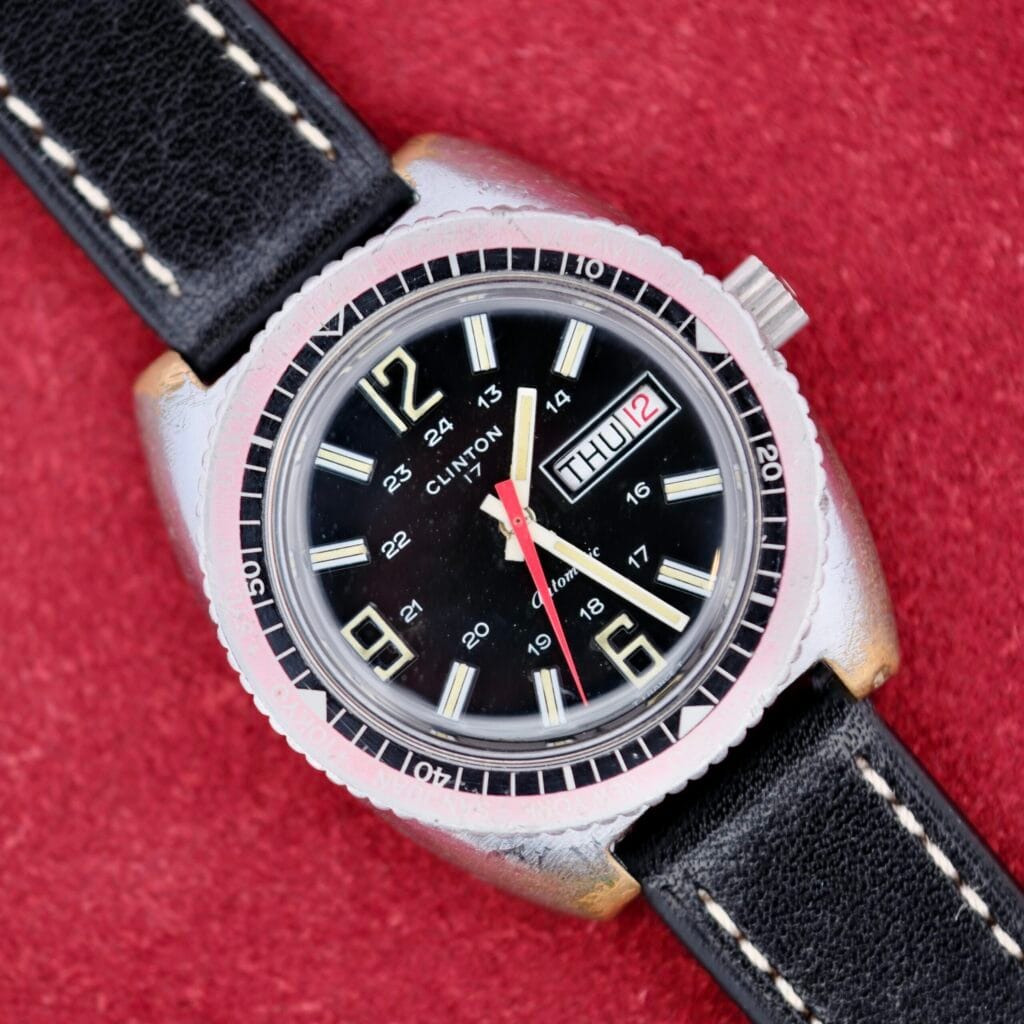
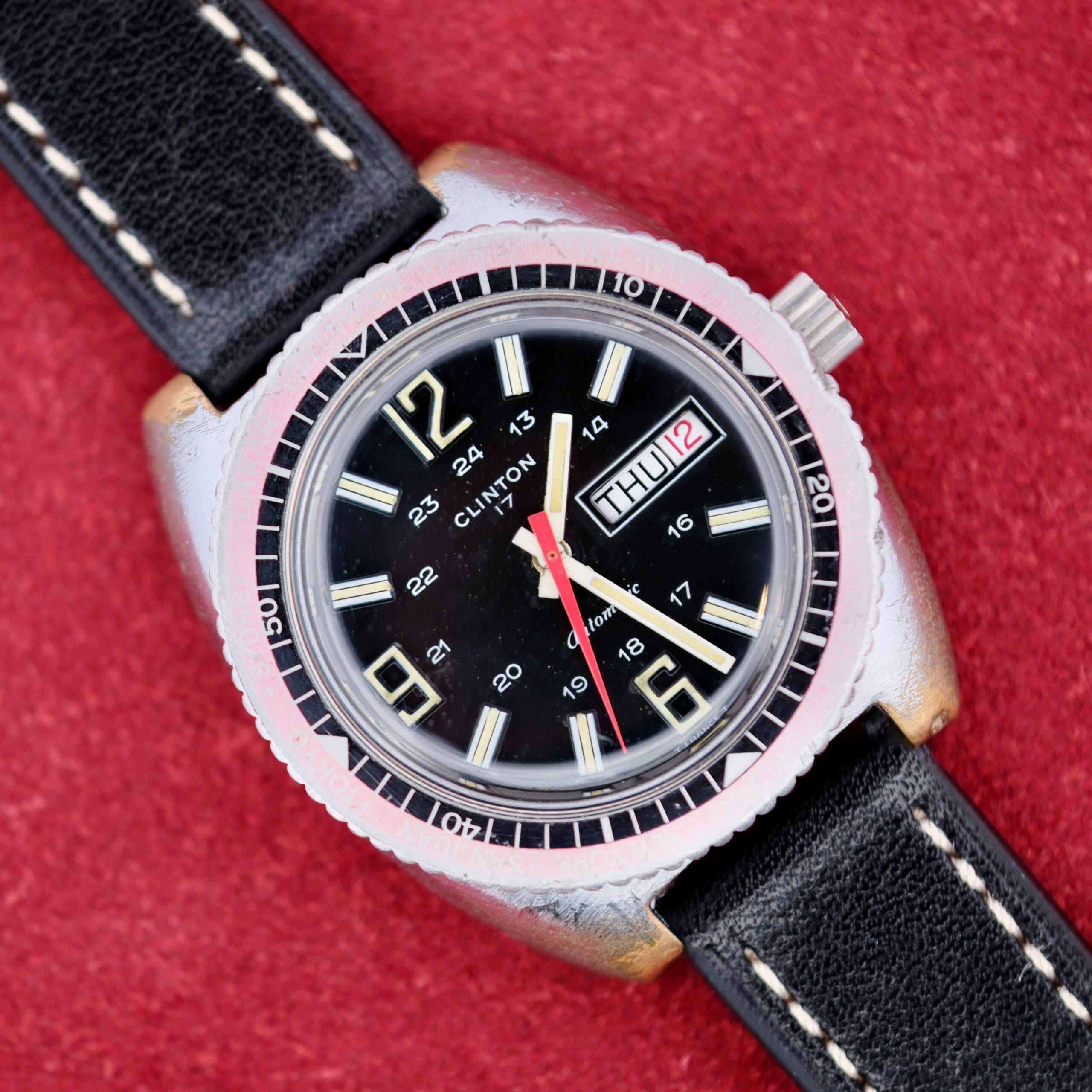
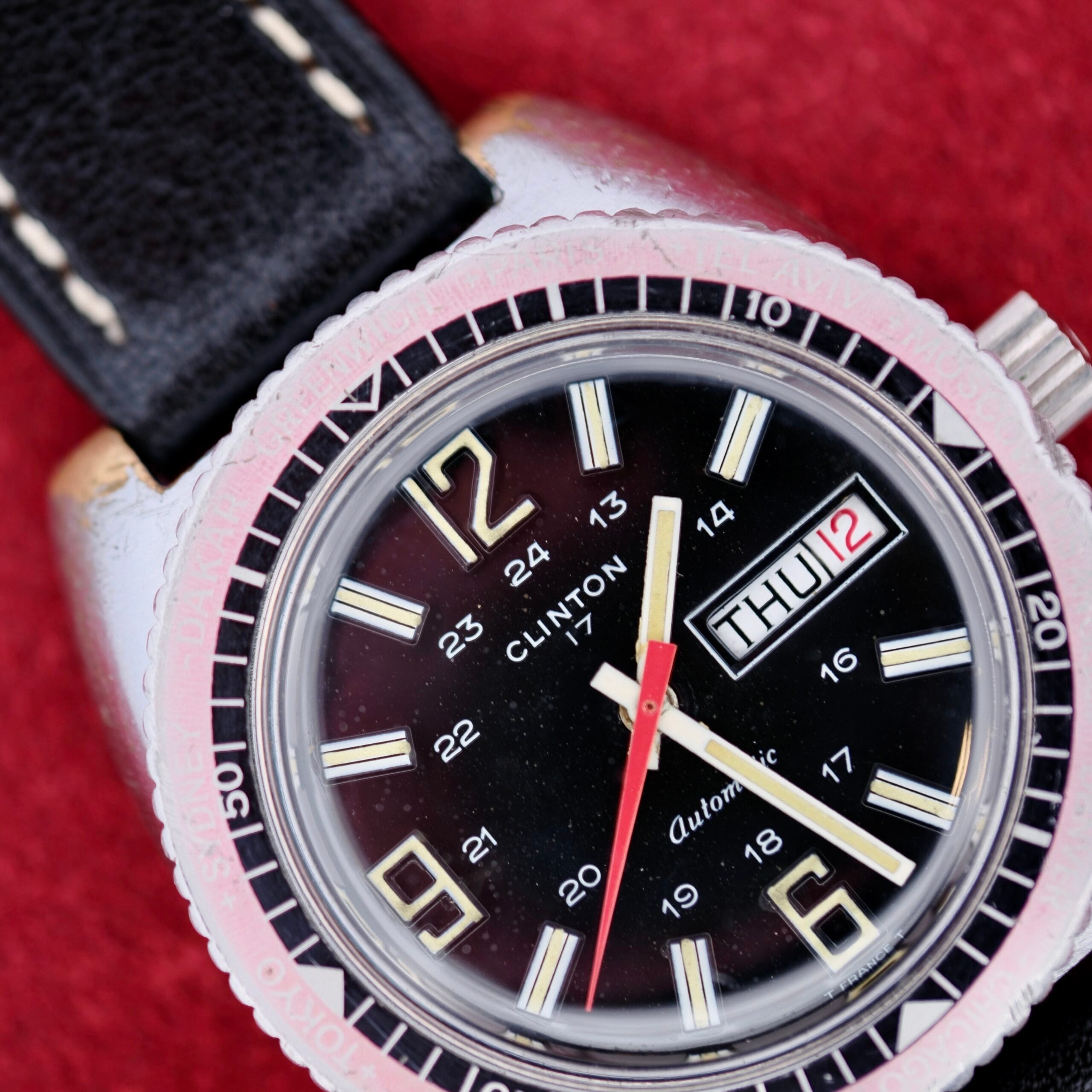
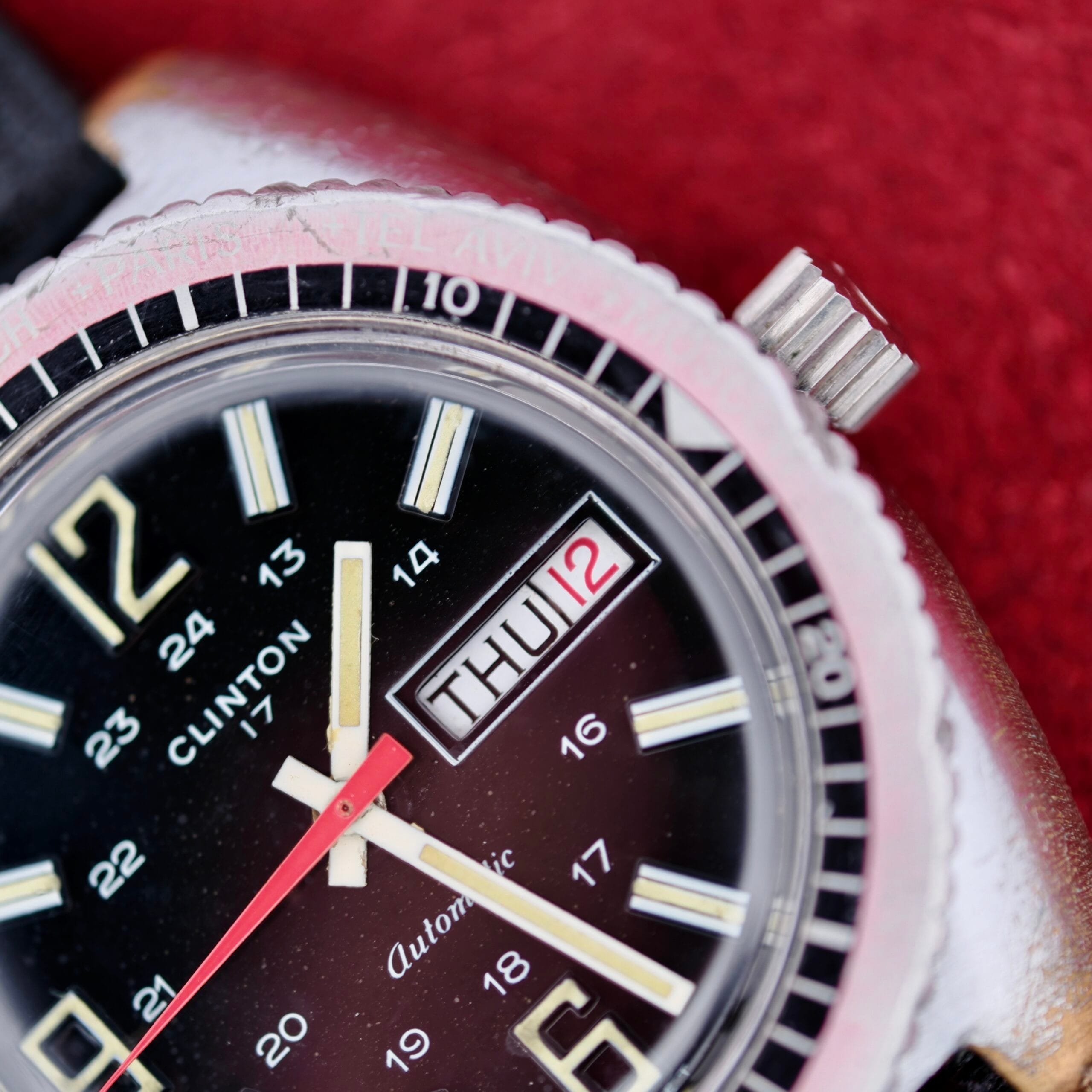
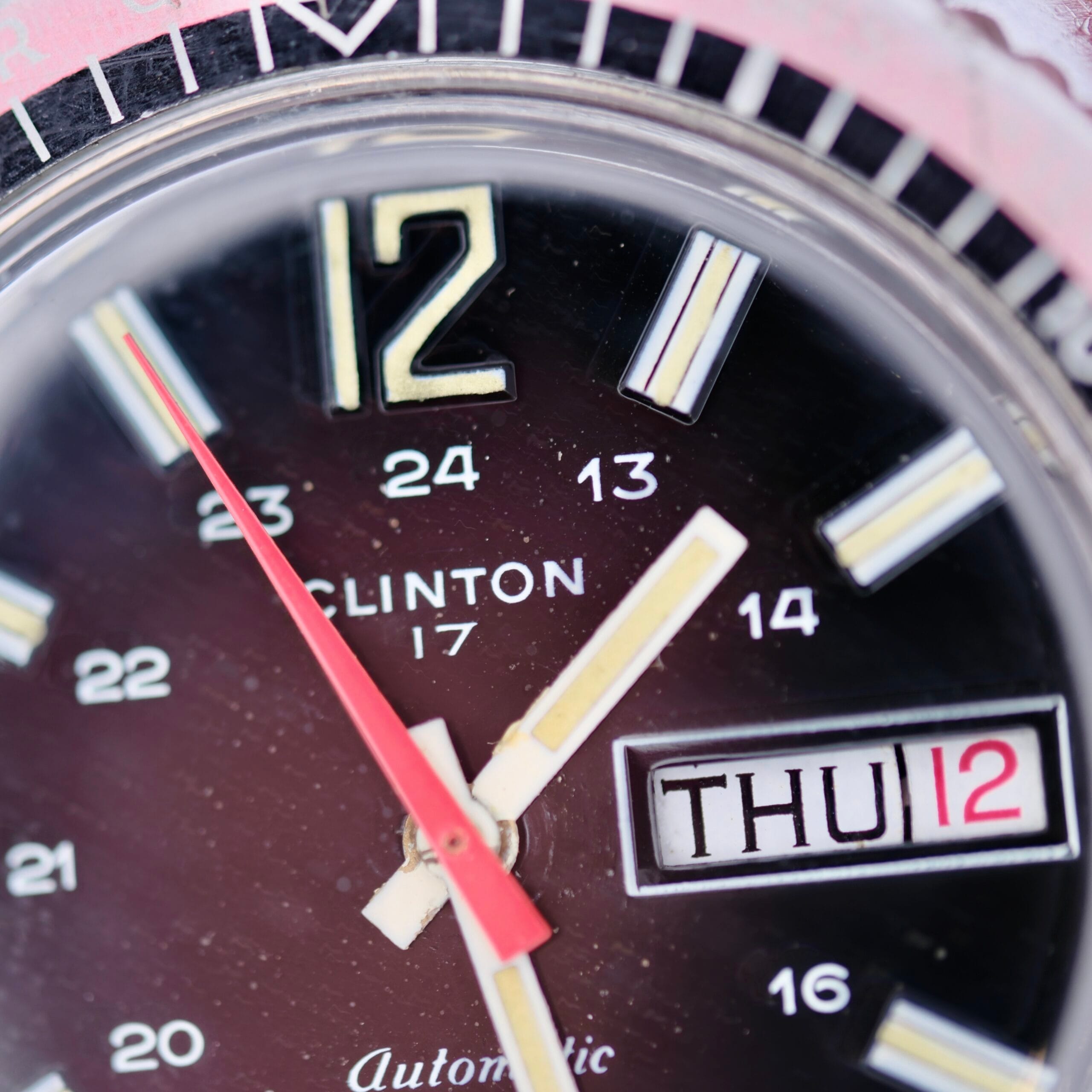

The dial is the whole watch here, and in our opinion it earns the spotlight. A printed inner ring carries the second twelve hours of the day in white, the date window at three flips between black for the day-of-week and red for the calendar number, and the applied steel batons wear their original tritium in a beautifully even cream. The Clinton World Timer is one of those mid-1970s pieces that looks more expensive than it ever was, and we genuinely think that gap is what makes it interesting.
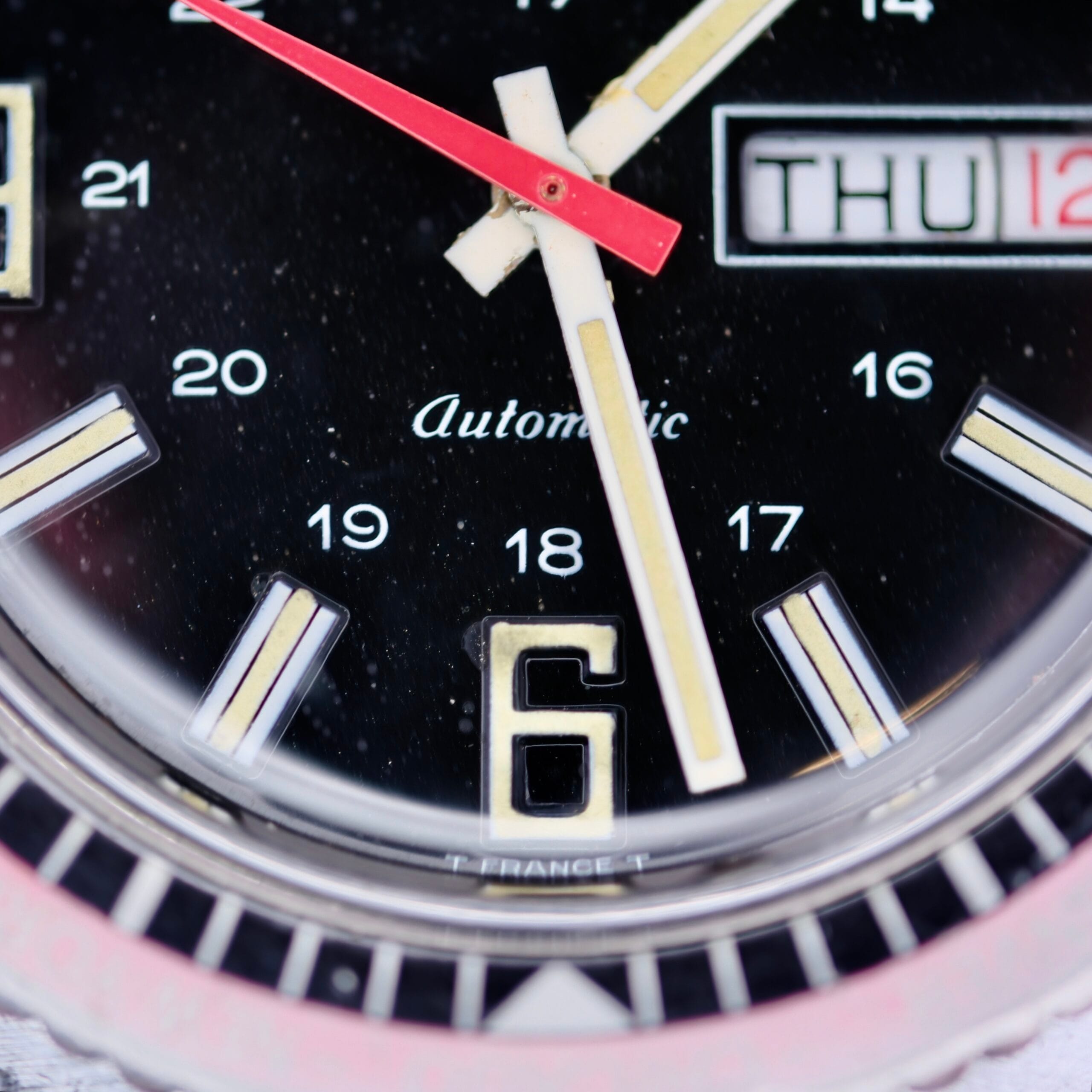
Clinton was an American-market brand of the kind that flourished after the long collapse of American watchmaking, sourcing dials, hands, and ebauches from European suppliers, casing the results in France or Switzerland, and selling them through Montgomery Ward catalogs and Main Street jewelers at prices that made automatics broadly accessible. The “CLINTON 17” you see at the center of this dial nods to the seventeen-jewel automatic caliber inside, a piece of marketing convention that quietly tells the buyer the watch is properly engineered without leaning on a Swiss-name pedigree it never claimed. This particular example shows “T FRANCE T” beneath the six, marking it as a French-assembled, tritium-lume piece of the era.
The seventeen-jewel automatic at the heart of the Clinton World Timer would have come out of the French ebauche industry of the period, when France Ebauches and a handful of smaller French suppliers were producing serviceable self-winding calibers for the budget end of the market. We are not going to overclaim what specific caliber is fitted without pulling the back to read the bridge, but the era and the country tell most of the story: this is the kind of robust, repairable, anti-shock-protected mid-decade automatic that watchmakers still happily service today. A date and day complication driven off the calendar plate, and decades of running before parts wear became a question. Nothing exotic; everything honest.
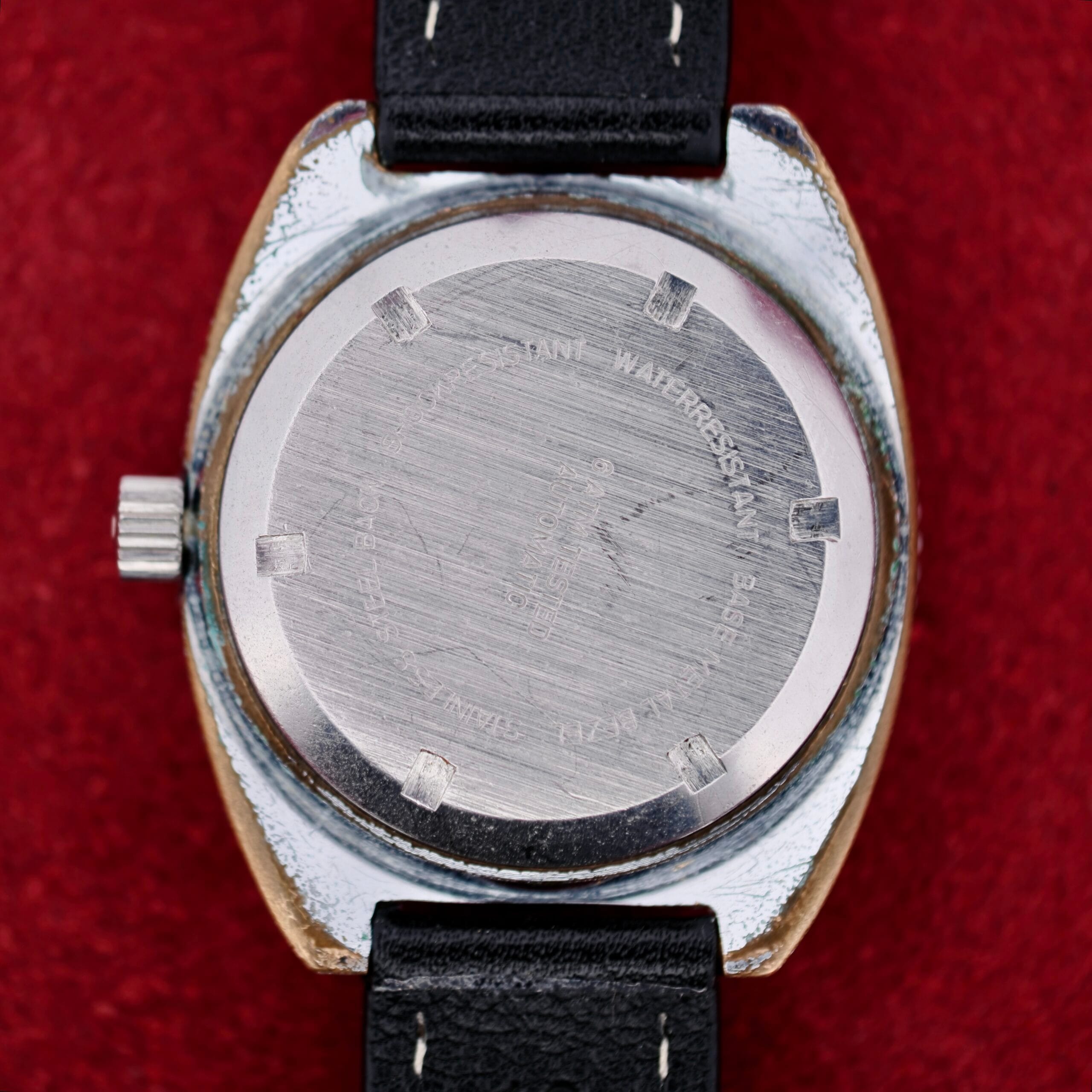
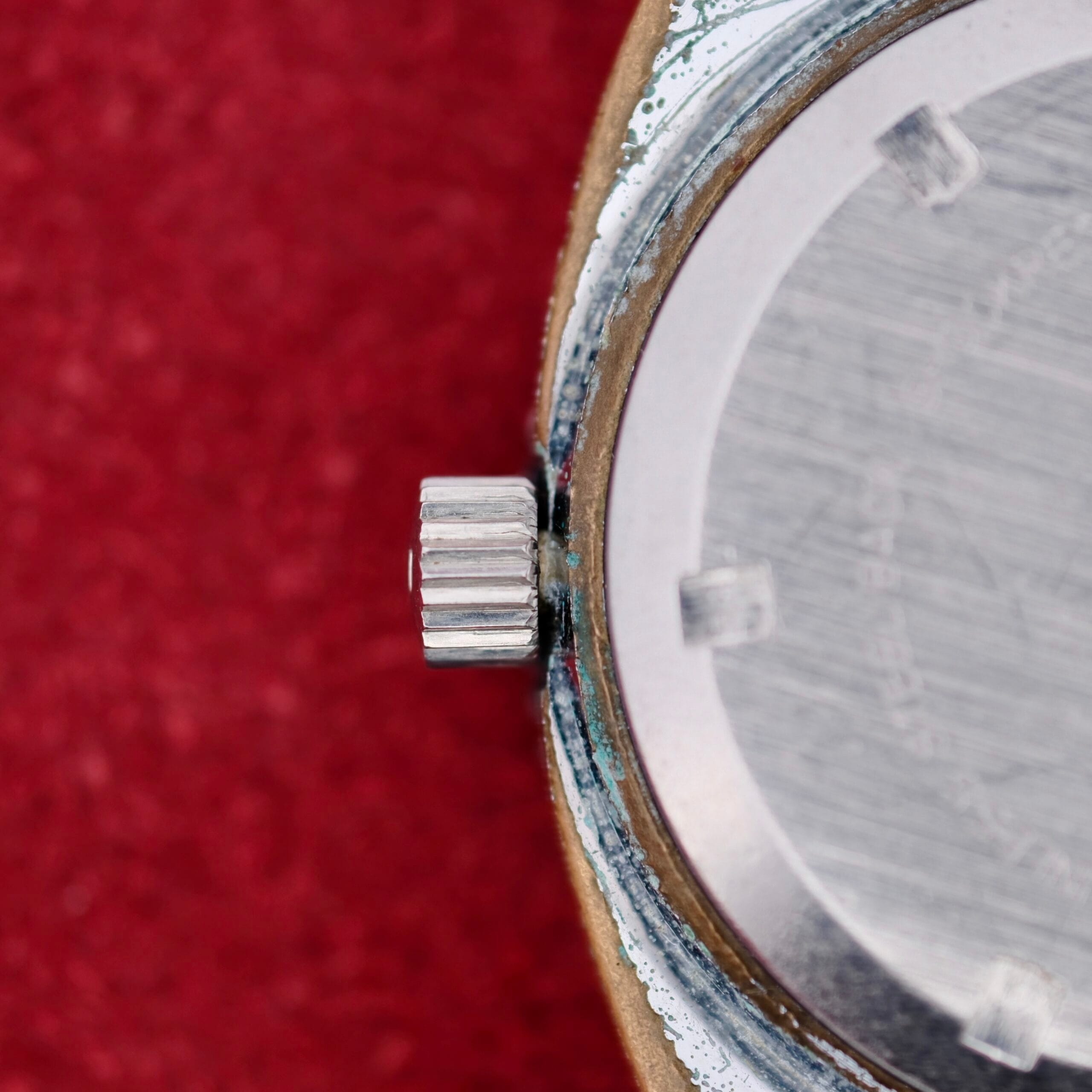
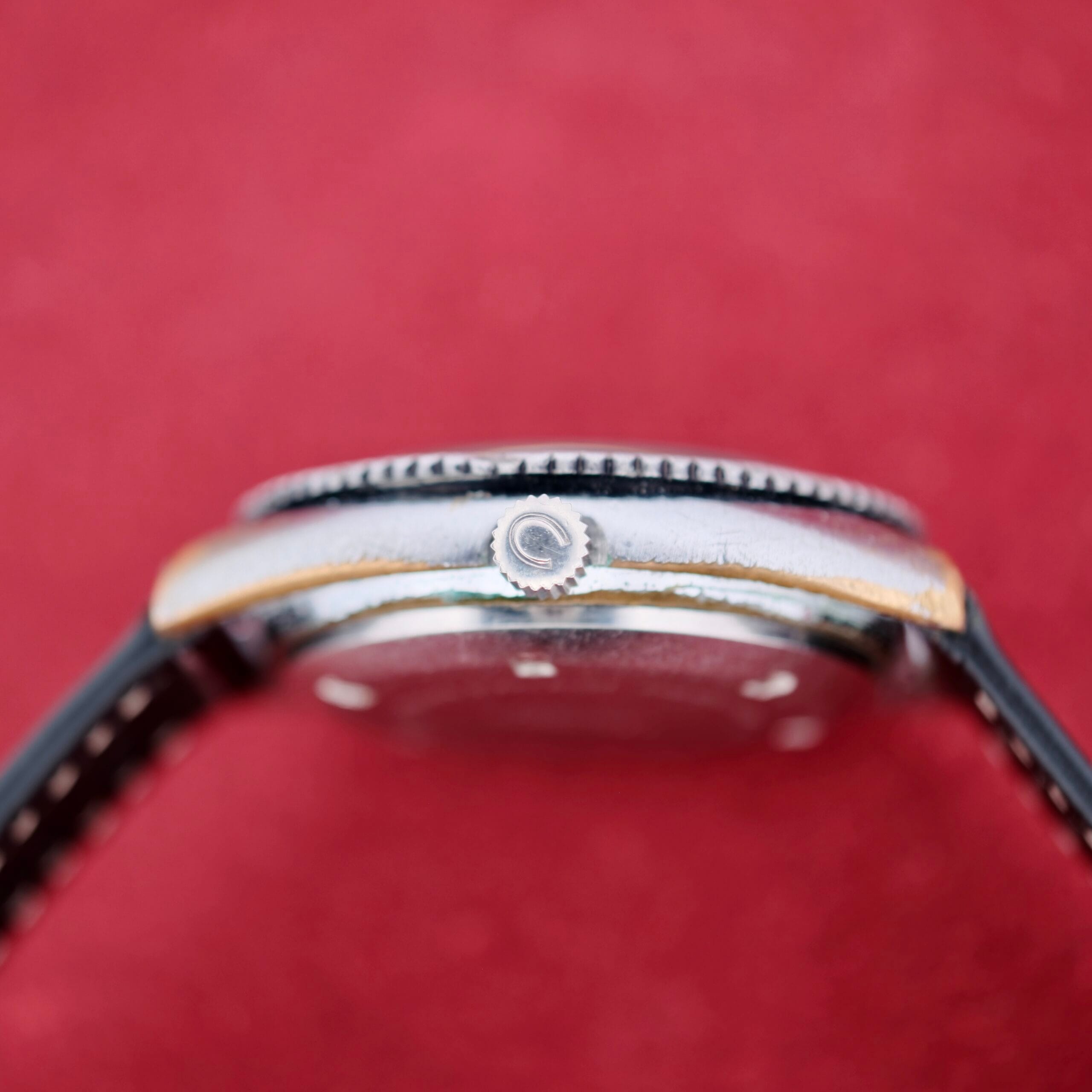
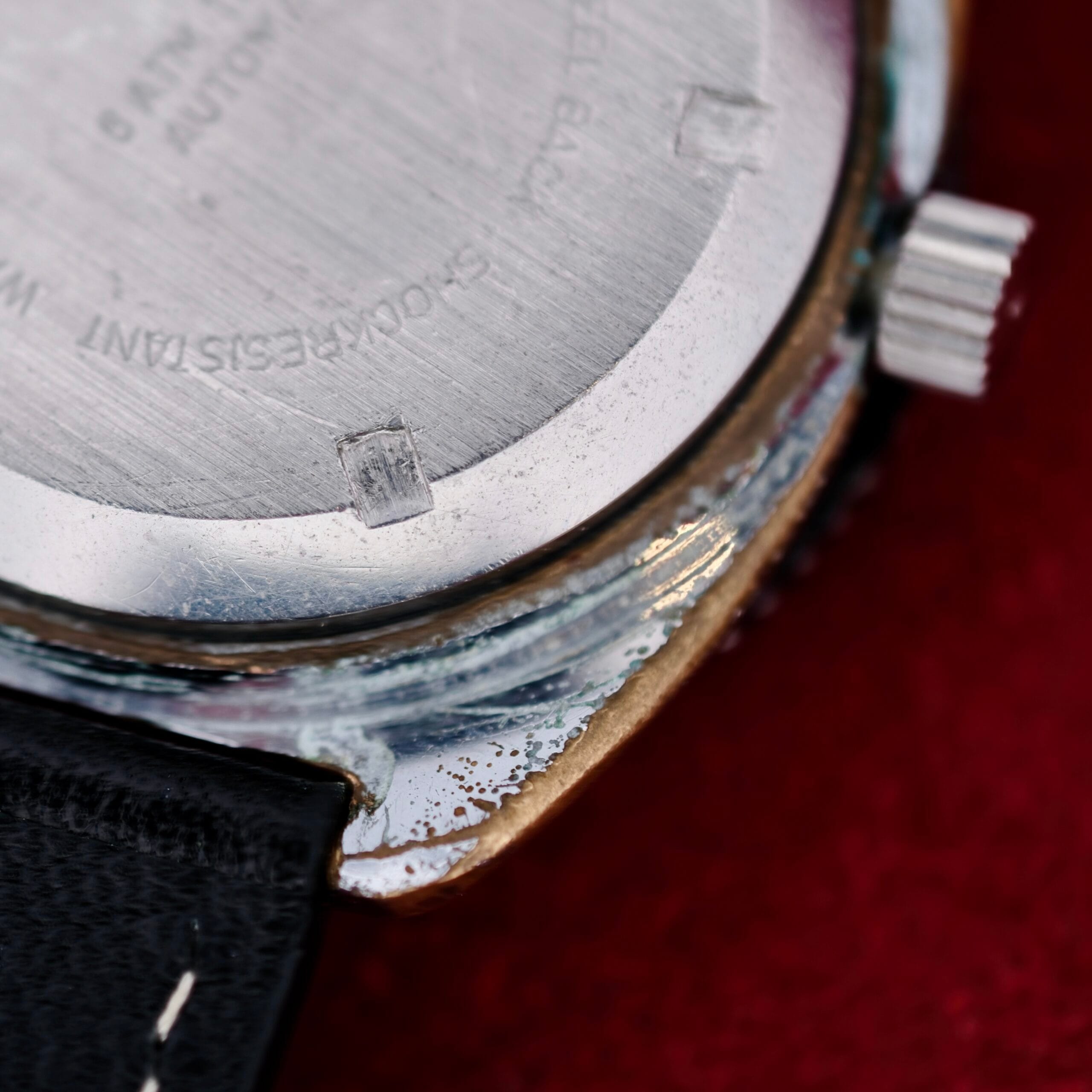
The case measures 39mm across without the crown, with a round profile that softens toward a faintly cushion-set silhouette through the case sides. Lugs are short and integrated, taking an 18mm strap. The crystal is domed acrylic and shows the warm distortion that only acrylic gives. The chrome-plated case body has worn through to its base-metal warmth at the chamfers and at a few high points along the bezel ring, the way every 1970s chrome case eventually does. We genuinely think this kind of honest wear reads as character on a watch this old, not as a defect. The caseback is a separate piece, stainless steel, and its rim is stamped verbatim with “WATER RESISTANT,” “STAINLESS STEEL BACK,” “SHOCK RESISTANT,” and “AUTOMATIC.” The construction tell, in fact, is that the back was steel while the case body was the era-standard plated base metal.
Now the dial. The base is matte black with a near-imperceptible darker gradient toward the rim. The hour track is a set of large applied steel batons with creamy tritium fill that has aged to a uniform yellow-cream across all twelve positions and the hour hand, which is the signature you want to see on an original dial. The twelve and the six are oversized applied Arabic numerals, also lume-filled, and the three-position is given over to the day-date aperture. Inside the hour batons runs a printed white inner ring of 13 through 24, the actual world-timing tool of this design, since rotating the bezel and reading the inner numerals gives you a second time zone at a glance. The day window prints “THU” in white on black; the date window prints “12” in red on white, the kind of roulette-style touch that brands picked up to make day-date watches feel less utilitarian. The hour and minute hands are dauphine batons full of luminous fill; the sweep seconds hand is a bright red baton with a white tip, and it sets the whole composition on a clear directional axis. Below the six o’clock applied numeral, “T FRANCE T” is printed plainly, the period-correct tritium and origin mark.
The watch ships on a black leather strap with cream contrast stitching. To us this pairing reads well: the cream stitch picks up the aged-tritium tone of the lume, the black leather frames the black dial without competing with it, and the strap looks fresher than the watch in a way we genuinely like on a vintage piece. The contrast makes the watch feel worn and the strap feel maintained, which is closer to how these were owned and treated in their decade of origin than a perfectly matched setup would be. An 18mm width opens the door for a tropic, a heavily textured oiled leather, or a flat-stitched Bund if you want to push it in a more period direction.
Serviced in-house at OTTUHR and backed by our 2-year mechanical warranty. For the collector who values an honest, characterful, mid-1970s automatic with real period-correct French assembly and a dial that earns the look every time, this Clinton World Timer makes a quietly compelling case. It is, in our opinion, one of the more rewarding sub-$300 vintage automatics you can put on a wrist today.